Search Results: "mt"

21 October 2008

Biella Coleman: Nerd Girls.

I am all for models and examples, and well, Nerd Girls, is such a web portal meant to celebrate “smart-girl individuality that s revolutionizing our future.” And they “want to encourage other girls to change their world through Science, Technology, Engineering and Math, while embracing their feminine power.” That message is all good and fine but the profile page is just a little too homogeneous and “made up” and actually just looks fake as fake can be (and what is UP with those dumb glasses they are all wearing?!). Sorry to say this, but all those “chics” look like they are fake nerds and are really models for Seventeen magazine or soft-porn movies. Is Nerd Girls a joke? Or is it real and just not for Ugly (or regularly looking) Nerd Girls? update
[h0mee] lol
[h0mee] actually what it really reminds me of
[h0mee] are those inspirational posters you see in high school meant to inspire students to study harder
[biella] like this one update again (sorry, the comments on my irc channel are just too good to ignore: [Atala] lol one of my friends just said the site seems like a thought experiment on what would happen if MTV bought Bitch magazine.
[rex] EXACTLY

17 October 2008

Raphael Geissert: adjusting the clock "iznogoud", technet says


From blogs.t e chnet.com/latam/archive/2008/10/16/argentinadst-2008-2009.aspx:

Please note that if you adjust the machine s clock manually, you may have adverse effects on your environment. This procedure is not supported by Microsoft.


lmao, give me a break.

Their proposed "fix" for end users, vista, and server 2008 users is to "Move machine time zone to (GMT -2:00) Mid Atlantic". IOW what they mean is "we suck at this, you are on your own".

Oh, and yes: I just reminded the iznogoud character; nothing further :).

16 October 2008

Steve Kemp: Dirty. Dangerous. Your kind of people.

Screen Fork?
There are times when I think of forking. Mostly sanity returns very quickly, though Still GNU Screen is one program that I use almost constantly, and it seems to work at a glacial pace. The Debian package has a lot of open bugs against it. Some trivial, some annoying, and some with patches. Making the program GNU/Linux only would simplify a lot of things. But then again would that be a legitimate reason to fork it? Me? I'd just like to see some additional primitives.
More QPSMTPD
I've come up with a nice simple qpsmtpd plugin to do spamgourmet-like setup. This means I can have email addresses:
  • steve.3.count@steve.org.uk
    • Allows only three mails to this address.
  • steve.date.20-10-2008@steve.org.uk
    • Allows only mail to be sent here prior to Oct 20th.
Plugin code will be in the usual place in the next day or two..
ObFilm: xXx

15 October 2008

Matthew Palmer: E-mail Address Validation for Ruby

Making sure you get valid data from users is a constant headache. E-mail addresses just happen to be a particular piece of data that causes me pain and suffering at the day job, because when people put bad e-mail addresses into web apps we host, my mail queues clog up, and that makes me a sad and slightly (more) irritated sysadmin. Since I work for a Rails hosting shop, and I like programming in Ruby, I got all industrious this weekend and put together EmailAddressValidator, a ruby class to validate an e-mail address via a regex or (optionally) DNS lookups (to make sure something might accept mail for the domain) and making (most of) a delivery attempt to an MX for the domain. It's not foolproof, but it'll stop my mailqueues from getting clogged with a fair percentage of the stuff that gives me ulcers. The fun part now is getting the customer base to (a) use the class at all, and (b) run it over their existing user address lists. As an aside, if someone wanted to setup an SMTP server configured for a catchall on gmial.com, I think he or she would have a lot of juicy stuff in very short order.

9 October 2008

Eddy Petrișor: Nokia has your data

As a beta tester for the new email application from Nokia, you will have to give your mail account password:


and agree that they will get your data, too [1].


Really unimpressive, Nokia.


[1] I haven't checked the "Nokia privacy policy", but is enough for me to say no, thanks, and start to wonder if they do anything behind my back with the phones they sell.

8 October 2008

Ian Wienand: Why symbol visibility is good

ELF has two related concepts for managing symbols in your programs. The first concept is the symbol binding. Global binding means the symbol is visible outside the file being built; local binding is the opposite and keeps the symbol local only (static) and weak is like global, but suggests that the symbol can be overridden.
$ cat syms.c
static int local(void)    
int global(void)    
int  __attribute__((weak)) weak(void)    
$ gcc -o syms -c syms.c
$ readelf --syms ./syms
Symbol table '.symtab' contains 10 entries:
   Num:    Value  Size Type    Bind   Vis      Ndx Name
...
     5: 00000000     8 FUNC    LOCAL  DEFAULT    1 local
     8: 00000008     8 FUNC    GLOBAL DEFAULT    1 global
     9: 00000010     8 FUNC    WEAK   DEFAULT    1 weak
...
This is all well and good, but starts breaking down when you want to load many different modules and keep strict API's (such as, say, dynamic libraries!). Consider that for two files to share a common function, the function must end up with a global visibility.
$ cat file1.c
void common_but_not_part_of_api(void)    
$ cat file2.c
extern void common_but_not_part_of_api(void);
void api_function(void)  
     common_but_not_part_of_api();
 
$ gcc -shared -fPIC  -o library file1.c file2.c
$ readelf --syms ./library
Symbol table '.symtab' contains 60 entries:
   Num:    Value  Size Type    Bind   Vis      Ndx Name
...
    53: 00000424    29 FUNC    GLOBAL DEFAULT   11 api_function
    55: 0000041c     5 FUNC    GLOBAL DEFAULT   11 common_but_not_part_of_api
...
In the example above, both the function we want exported (api_function) and the function we don't wish exported (common_but_not_part_of_api) end up with exactly the same attributes. Binding attributes are useful for the linker putting together object files; but aren't a complete solution. To combat this, ELF provides for visibility attributes. Symbols can be default, protected, hidden or internal. Using these attributes, we can flag extra information for the dynamic loader so it can know which symbols are for public consumption, and which are for internal use only. The most logical way to use this is to make all symbols by default hidden with -fvisibility=hidden and then "punch holes in the wall" for those symbols you want visible.
$ cat file1.c
void common_but_not_part_of_api(void)    
$ cat file2.c
extern void common_but_not_part_of_api(void);
void  __attribute__((visibility("default"))) api_function(void)  
      common_but_not_part_of_api();
 
$ gcc -fvisibility=hidden -shared -fPIC  -o library file1.c file2.c
$ readelf --syms ./library
Symbol table '.symtab' contains 60 entries:
   Num:    Value  Size Type    Bind   Vis      Ndx Name
    48: 000003cc     5 FUNC    LOCAL  HIDDEN   11 common_but_not_part_of_api
    54: 000003d4    29 FUNC    GLOBAL DEFAULT  11 api_function
Now the dynamic loader has enough information to distinguish between the two, and can stop any external access to common_but_not_part_of_api easily. This extra information also has potential for performance improvements. Any time a symbol may be overridden, the compiler must generate a program lookup table (PLT) entry for the function so that the dynamic loader can re-direct the function call. The PLT is a trampoline which gets the correct address of the function being called (from the global offset table, GOT) and bounces the function call to the right place. An example should illustrate: Bouncing via the PLT In the first example, there was not enough information to tell if the function would ever be able to be overridden, hence a PLT entry had to be created and the function called through it (disassemble it to see the details!). With correct symbol visibility attributes, there is enough information to know that common_but_not_part_of_api is never to be overridden, hence the PLT (and the associated costs of trampolining) can be avoided. The internal attribute is even stricter; it says that this function will never be called from outside this module (for example, we might pass the address of common_but_not_part_of_api to anyone). This can lead to even better code, because on many architectures transitioning to another module might involve flipping global pointer registers or other similarly expensive operations. So that's how symbol binding and visibility attributes can work together to get you the best performance possible from your program!

4 October 2008

Junichi Uekawa: Maintaining binfmtc.

Maintaining binfmtc. I've revisited the binfmtc package. g77 is gone, gfortran is now the way to go, kernel module building has somewhat changed a little. The rest seems to be working fine. How to build and run source-code hasn't changed that much in the last year which is not a bad thing.

3 October 2008

Adrian von Bidder: Microsoft contacting me

I recently received an email from Amy Wilcox from Murphy & Associates, representing Microsoft (the mail was sent from a Microsoft address, via smtp.microsoft.com, so it appears to be genuine.) They asked me to remove the ban for Microsoft search from my robots.txt because customers complained they couldn't find my site
First, cowards, they (the people complaining to MS) should have contacted me directly. I don't exactly hide my email address. Second: apparently they still did know about my site, else they wouldn't have complained to MS. In any case, I responded that the removal of this robots.txt entry would be a commercial opportunity for me if they cared to take me up on this offer. I will, of course, amend the omission of not putting a robots.txt on my new blog.fortytwo.ch domain...

Julien Danjou: The eggtray problem

I still don't know why but many GTK+ applications use something called eggtrayicon. As far as I know, eggtrayicon.c is a file written in 2002 by Anders Carlsson which implements the Freedesktop.org system tray procotol for GTK+ applications. Problem is that this C file is used in dozens of programs and maybe more, and is a bit bugged. I've already send patches for mail-notification and Audacious. pidgin is the first fixed implementation I found and works quite well. Many other applications are probably affected. That seems to me like a real problem. Multiple copy of bad code instead of using native GTK+ system tray implementation. So please stop using this bad implementation

29 September 2008

Ian Wienand: Kernel Development Course

Here are some slides and examples I used for a kernel course I developed (some time ago now). The course was aimed at C developers who wanted an introduction to both general UNIX-style user-space and Linux kernel development with a focus on embedded systems issues. The course is aimed at two 8-hour days, and is pretty packed in even then. The first day is user-space development and kernel building, focusing on things like make, autotools, advanced gcc, getting cross-compilers working, configuring the kernel and building. The second day we get into kernel internals; building up a kernel module to produce some simple proc nodes, take data, crash and debug, etc, look at internals like concurrency and the driver model, and focus on USB quite a bit. Here is a tarball of the entire thing, including the examples. Hopefully these can help out anyone tackling the design of such a course.

28 September 2008

Jonathan McDowell: Which data contract?

I bought an EEE 901. More on that later.
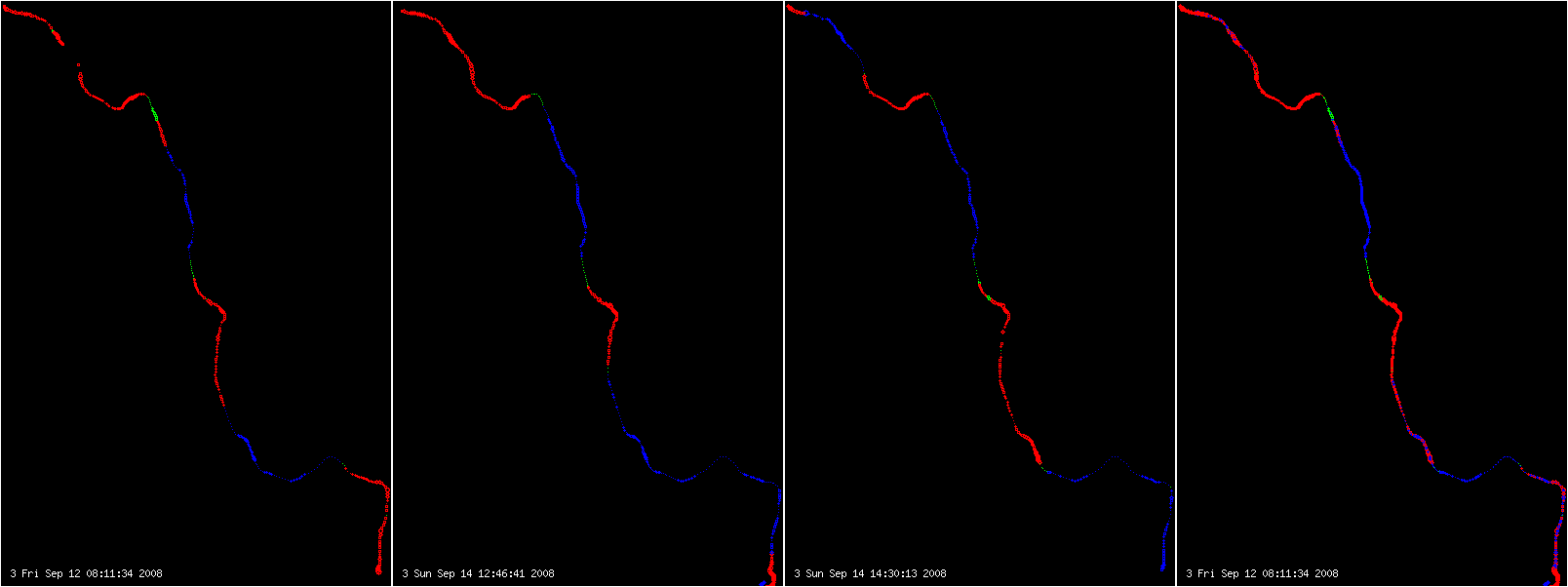
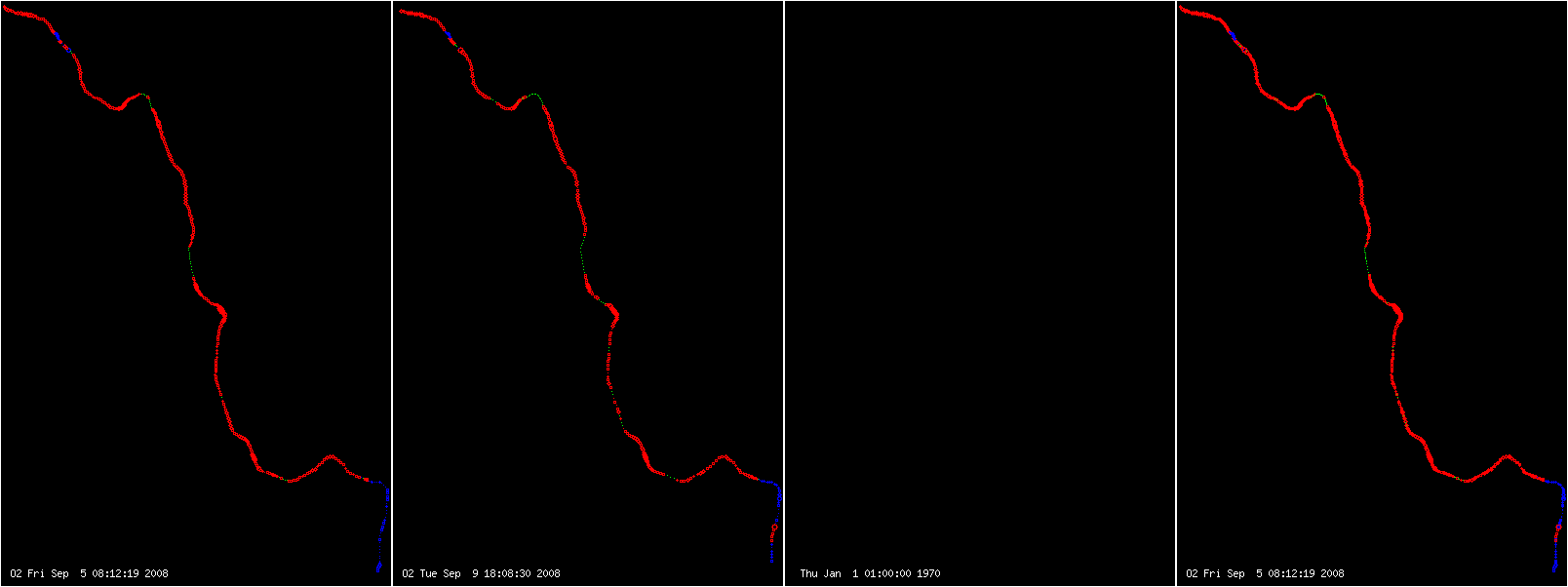
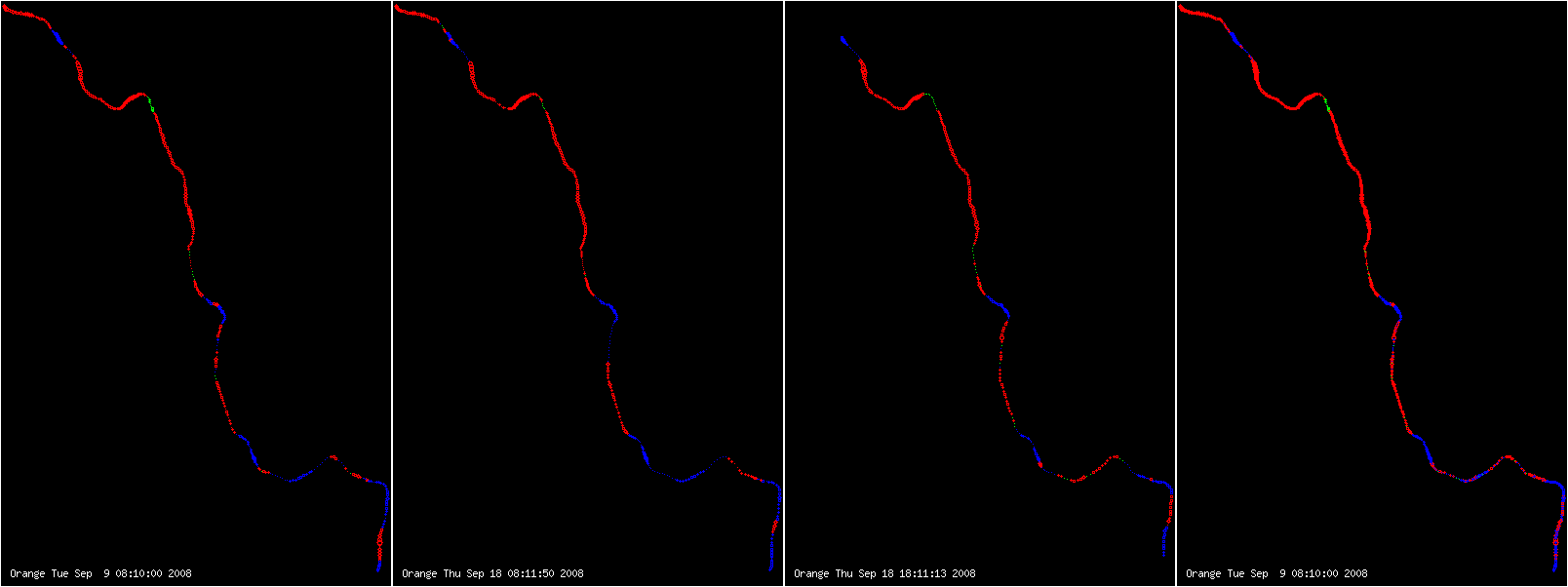
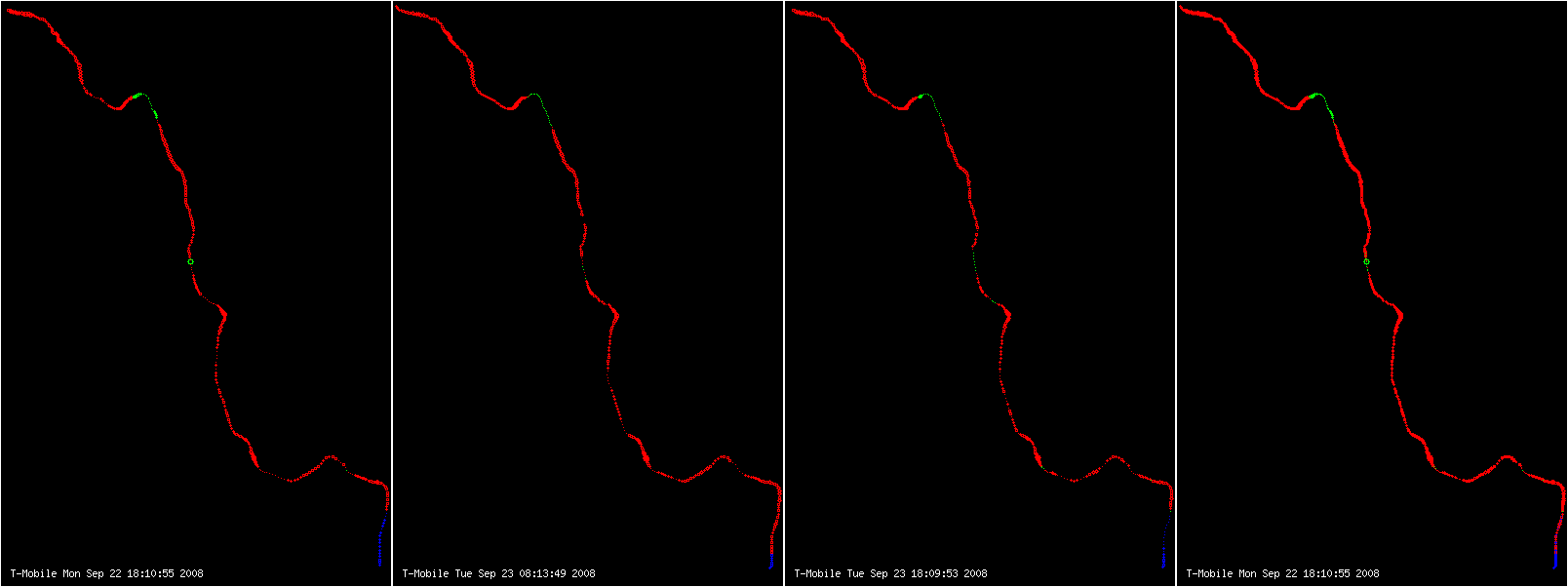
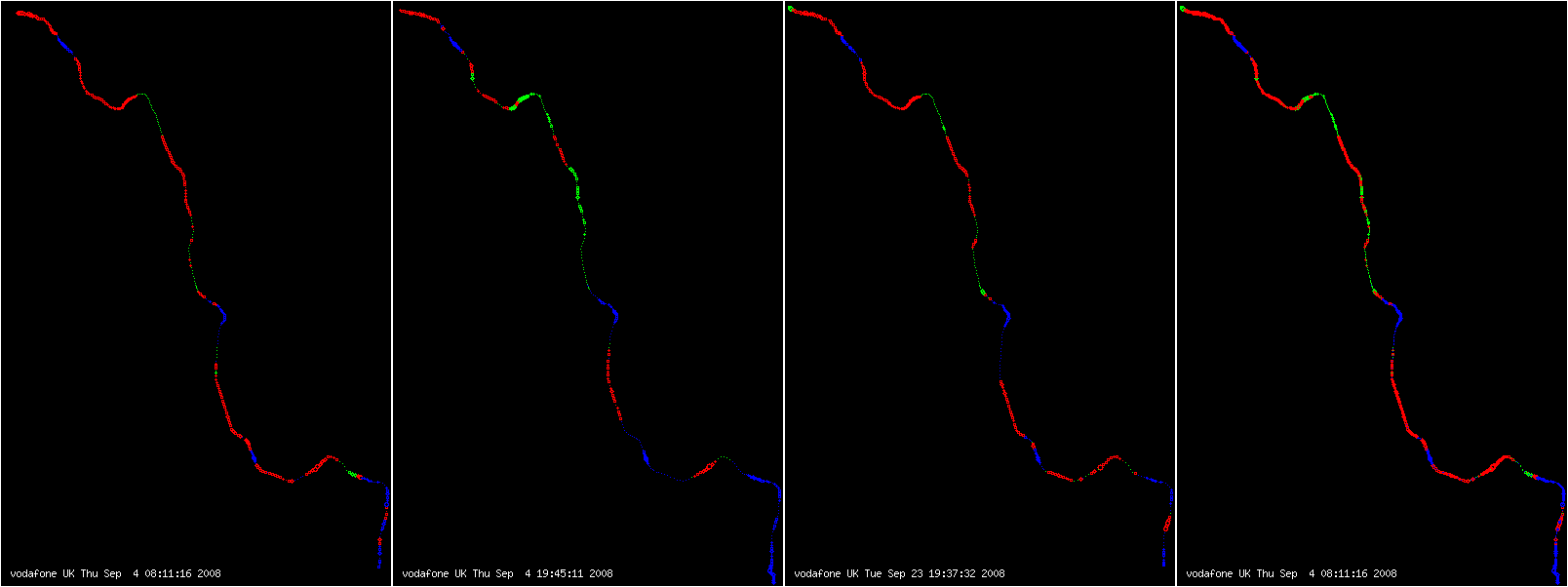
For the past few weeks I've been trying to work out which "mobile broadband" provider to go with for my daily commute. It's a train journey from the north coast of Northern Ireland to Belfast and goes through some sparsely populated areas, so I wasn't expecting to get anything that would provide 3G all the way. However I do want a provider that can do their best to keep a session up for the journey, handing over between 2G + 3G as necessary. Coverage maps/checkers aren't too bad if you just want to check a static point, but really even then it's better to actually try the provider in the location yourself. So, armed with a bluetooth GPS (Bl eNEXT BN-909GR), an Option GT 3G Quad PCMCIA card and my laptop I set about measuring signal strength along my train journey for each of the 5 providers available. I also made sure to actually try a session with them for at least one journey, because signal strength is not everything.

I wrote some Perl using Net::GPSD and Device::Gsm to query my current location, signal strength, 2G/3G status and network every 10 seconds. I did this for 3 train journeys (except for O2) and then also produced an "optimistic" file of all the data points combined for that provider.

A second piece of Perl took this data and drew the maps you see below. The graph on the right for each provider is all data points. Red means 2G, blue means 3G, green means "Limited Service" (ie it could see a signal, but not one it was allowed to connect to). White means that we had a GPS location and no signal at all. Click on the maps for bigger versions. You can see the route on OpenStreetMap - my graphs are a little squished horizontally, but the journey is from Castlerock (top left on the coast near Coleraine) to Belfast (bottom right).

3
O2
Orange
T-Mobile
Vodafone

At first glance 3 look to be the best bet. Lots of blue, a reasonably priced data plan. Except they can't hold up a session to save themselves. Not only does a 2G/3G handover almost always seem to result in a drop, but I had periods of failing to get a 2G session up at all and had some random drops while in 3G coverage as well. So strike them off.

O2 and T-Mobile don't manage any 3G outside Belfast (that's the bottom right corner btw). I found that a few periods of 3G along the journey helped a lot; it meant I could do a quick mail sync rather than the long drawn out affair it was on a 2G connection. They can both handle handover between 2G/3G and keep a session up for most of the journey, but the lack of speed counts them out.

Vodafone managed the worst reception, which is disappointing. I found them quite good when I lived in England (my datacard is from a Vodafone Pay as You Use data contract). I did find sessions being dropped during the no signal regions, so they just don't seem to be a good bet.

Which leaves Orange. I've had issues with Orange and data in the past (pre 2004 IIRC) but in testing they were able to keep a session up between Belfast and Castlerock, handling 2G/3G handover fine. Coverage was reasonably good and they manage 3G at several points along the journey (the blue points roughly correspond to Coleraine, Ballymena, Antrim and Belfast). I understand Orange have some EDGE capability, but my card doesn't do EDGE so I've no idea if that'll be an extra gain or not. I had a few issues with getting dud DNS servers but this happened with the other providers too so I was beginning to suspect the datacard of playing up. Manually setting known good servers in resolv.conf worked fine.

So, before I go and sign up to an 18 month Orange contract, what have I forgotten?

27 September 2008

Christine Spang: finally found a decent DAP

I recently bought a 4GB Sansa Clip to solve the problem where once-a-week or so I want portable music or podcasts and don’t have any: namely, at the gym, occasionally when walking somewhere, and on trains and buses. I’ve been looking for something exactly like this for ages—small, attachable for use during exercise, enough space for a few hours of music/audio, OGG support, and not necessarily much more than that. Basically, an iPod Shuffle that plays OGG and doesn’t involve dealing with Apple. For the longest of time, this was pie-in-the-sky nonexistant. After a few weeks of using the Clip, I’m extremely pleased so far. The battery life is much longer than I’d ever want to listen to music for continuously (they claim 15 hours, and I haven’t gotten it down to less than half charge yet). It’s light in the hand but not too flimsy in feel, the clip makes it easy to attach to e.g. shorts, the interface is easy to use, and the sound quality is good. After upgrading to the latest firmware, it plays OGG as well as MP3. Both Rhymthbox and Banshee work for transferring files to it. I think my biggest complaint so far would be that the audio jack doesn’t fit in as securely as it could, which sometimes manifests as sound skipping and can be fixed by making sure the headphones are completely plugged in. Seriously, it was funny when my Walkman skipped during runs in 2003, but I hope I’m past that phase of life at this point. At any rate, it doesn’t happen all that often, so it’s more of a minor annoyance than anything. And well, the firmware isn’t free—but hey, can’t have everything.

25 September 2008

MJ Ray: Another Wednesday, Another Joe-Job

Yesterday, another of our mailboxes got joe-jobbed, just like last week. Again, it was one of our Exim servers (yes, one got done along with a qmail last week). Again, it was an address that should never appear as the SMTP sender. Again, I put something like

        deny
          message = 553 That address is not used for outgoing email so should never get errors - please telephone us if in error
          senders = :
          recipients = !/etc/exim4/permitted-envelopes
into /etc/exim4/local-rcpt.acl, added CHECK_RCPT_LOCAL_ACL_FILE = /etc/exim4/local-rcpt.acl to /etc/exim4/conf.d/main/02_local_options, put all permitted envelope addresses into /etc/exim4/permitted-envelopes, then ran update-exim4.conf and /etc/init.d/exim4 reload and the flood stopped. So far, it seems to be working like it should. Is there a drawback I haven’t spotted yet, apart from the obvious problem of needing to list all outgoing envelope addresses?

22 September 2008

Axel Beckert: Can't resist this meme

Just stumbled over this meme at Adrian (the meme seems to be started by madduck involuntarily), and since I’m fascinated by how people choose hostnames since my early years at university, I can’t resist to add my two cents to this meme. To be exact, I have two schemes, one for servers out there somewhere (Hetzner, xencon, etc.) and they’re all wordplays on their domain name noone.org, e.g. symlink.to.noone.org (short name “sym” :-), gateway.to.noone.org (usually an alias for one of the machines below), virtually.noone.org (always a virtual machine, initially UML, soon a Xen DomU), etc. So nothing for a quiz here. My other scheme is for all my machines at home and my mobile machines. I’ll start this list with the not so obvious hostnames, so the earlier you guess the scheme, the better you are (or the better you know me ;-). One more hint in advance: “(*)” means this attribute or fact made me choose the name for the machine and therefore can be used as hint for the scheme. :-)
azam
My first PC at all, a 386 with 25 MHz and MS-DOS. (Got named retroactively(*). Hadn’t hostnames at that time.)
ak (pronounced as letters)
Got it from my brother after he didn’t need it anymore. It initially was identical to azam, but once was upgraded to a 486. Still have the 386 board, though.
azka
My first self-bought computer, a pure SCSI system with a AMD K5-PR133 and 32 MB RAM. Initially had SuSE 4.4 and Windows 95 on. Still my last machine which had a Windows installed! :-)
m35
Same case and same speed as azka. Used it for experimenting(*) with Sid years ago.
azu
Initially also an AMD K5-PR133, later replaced by a Pentium 90 and used as DSL router.
azl
An HP Vectra 386/25N book size mini desktop I saved from the scrapyard at Y_Plentyn before his (first) move to Munich. The cutest(*) 386 I ever saw.
ayce
A 386 with 387 co-processor(*) and solded 8 MB of RAM.
ayca
A 1992 Toshiba T6400C 486 laptop bought at VCFe 5.0.
bijou
My 1996 ThinkPad 760ED, which is still working and running Debian GNU/Linux 5.0 Lenny (I started with Debian 3.0 Woody on it and always dist-upgraded it! :-)
gsa (pronounced as letters)
My long-time desktop after azka. A Pentium II with 400 MHz and 578 MB of RAM at the end. Bought used at LinuxTag 2003, it worked until end of last year when it started to suddenly switch off more and more often and now refuses to boot at all. Hasn’t been replaced yet though. I mostly use my laptops at home since then.
gsx (pronounced as letters)
An AMD K6 with 500 MHz I got from maol and which was used as Symlink test server more than once. (It was the machine initially named symlink.to.noone.org because of that.)
hy
My 32 bit Sparc, a Hamilton Hamstation.
hz (pronounced as letters)
My 64 bit Sparc, an UltraSparc 5.
tub
An HP Apollo 9000 Series 400, model 400t from 1990.
tpv (pronounced as letters, too ;-)
My Zaurus SL-5500G.
tryane
A Unisys Acquanta CP mini desktop with a passively cooled(*) 200 MHz Pemtium MMX. Used as DSL router for while, but the power supply fan was too noisy.
lna (pronounced as letters)
A 233 MHz Alpha
loadrunner
An IBM ThinkPad A31 running Sid. I use it as beside terminal.
pony
A Compaq LTE5100 laptop with a Pentium 90 running Sid.
dagonet
A Sony Vaio laptop which ran Debian GNU/kFreeBSD until it broke.
Those who know me quite good should already have guessed the scheme, even if they can’t assign all the names. For all others, here’s one name which doesn’t exactly fit into the scheme, but still is related in someway, but you need to knowledge of the theme’s subject to know the relation:
colani
A big tower from the early 90s designed by Colani.
Ok, and now the more obvious hostnames:
rosalie
A very compact Toshiba T1000LE 8086 laptop running ELKS and FreeDOS.
amisuper
Also an old Symlink test server from maol. He named it “dual”. 2x(*) Pentium I with 166 MHz. Unfortunately doesn’t boot anymore.
visa
An IBM NetVista workstation running Debian GNU/kFreeBSD. My current IRC host.
nemo
My ASUS EeePC running Debian 5.0 Lenny.
pluriel
My current WLAN router running FreeWRT.
c1
My MicroClient JrSX, an embedded 486SX compatible machine with 300 Mhz for VESA mountings.
c2
My MicroClient Jr, an embedded Pentium MMX compatible machine with 200 Mhz for VESA mountings.
c-crosser
My Lenovo ThinkPad T61 running Debian 5.0 Lenny.
c-cactus and c-metisse
The KVM based virtual(*) machines on c-crosser running Sid and Debian GNU/kFreeBSD.
jumper
My NAS(*) at home, currently a TheCus N4100. Soon to be replaced by some Mini-ITX box.
Any one who hasn’t guessed the scheme yet? For those understanding German it’s explained at the end of my old hardware page. For all others I suggest either to look at the domain name in my e-mail address (no, it’s usually not noone.org). Still not clear? Well, feel free to ask me for all the gory details or mark the following white box to see the scheme as well as the explanations for nearly all hostnames hidden in there:
All the machines are named after Citroëns. Old machines after old Citroëns, current hardware after current Citroën models or prototypes. Those names starting with “A” are 2CV derivatives since the 2CV was Citroëns “A” model. “AZ” was the 2CV, AZU and AK were 2CV vans and everything starting with AY (e.g. AYA, AYA2, AYB – but those don’t sound that nice ;-) is Dyane based, but I currently only use Méhara names (AYCA is the normal Méhari, AYCE the 4x4 version). Interestingly not everything starting with AYC is a Méhari: AYCD was the Acadiane, the Dyane van. HY and HZ are variants of Citroëns “H van” (HX, HW and H1600 as well, but they don’t sound that nice), TUB was the pre-WWII “H van” prototype and later the nickname of the “H van” in France. TPV was the name of the pre-WWII 2CV prototype and an abbreviation for Toute Petite Voiture (French for “Very Small Car”), hence the Zaurus, my smallest Linux box, got that name. Rosalie was the nickname of a rear-wheel drive pre-WWII Citroën. M35 was a Wankel engine prototype of the Ami 8 and the Ami Super was the 4 cylinder version of the Ami 8. Bijou was a 2CV based coupé build by Citroën UK in the late 50s and early 60s. Visa and LNA were 2CV predecessors which were available with 2CV engines, but were stopped before the 2CV. GSA and GSX are GS late derivatives. C1, C2, (C3) Pluriel, C-Crosser, Jumper and Nemo are current Citroën models and C-Cactus and C-Métisse are recent Citroën prototypes and show cars. The 2CV Dagonet was an aerodynamically optimised 2CVs by Jean Dagonet in the 50s. The Tryane is an aerodynamic and fuel efficient, three wheeled car by Friend Wood based on the 2CV and with a body of wood. And Colani once dressed a 2CV so that it broke several efficiency world records. The Namco Pony was a 2CV based light utility truck (similar to the Méhari, but with steel body) built in Greece under license in many variants. And Loadrunner is the name of some CX six-wheeler conversions.
Some links about the naming items: Hope you had fun. I had. ;-)

Now playing: Willi Astor — Gwand Anham Ära

21 September 2008

Clint Adams: VCS info in prompts

For a while, lots of people have been using their zsh prompts to display information about their current VCS (git in particular) working directories. I am no exception, though I was just doing a simple git rev-parse and git symbolic-ref in my precmd(). Starting with zsh-beta 4.3.6-dev-0+20080921-1, I am now using the vcs_info subsystem developed by Frank Terbeck. It has backends for bzr, cdv, cvs, darcs, git, hg, mtn, p4, svk, svn, and tla. These backends can be enabled or disabled via configuration. To get it working quickly, do something like
autoload -Uz vcs_info
precmd()  
  psvar=()
  vcs_info
  [[ -n $vcs_info_msg_0_ ]] && psvar[1]="$vcs_info_msg_0_"
 
PS1="%m%(1v.%F red %1v%f.)%# "

Wouter Verhelst: SSL "telnet"

A common way to debug a network server is to use 'telnet' or 'nc' to connect to the server and issue some commands in the protocol to verify whether everything is working correctly. That obviously only works for ASCII protocols (as opposed to binary protocols), and it obviously also only works if you're not using any encryption. But that doesn't mean you can't test an encrypted protocol in a similar way, thanks to openssl's s_client:

wouter@country:~$ openssl s_client -host samba.grep.be -port 443
CONNECTED(00000003)
depth=0 /C=BE/ST=Antwerp/L=Mechelen/O=NixSys BVBA/CN=svn.grep.be/emailAddress=wouter@grep.be
verify error:num=18:self signed certificate
verify return:1
depth=0 /C=BE/ST=Antwerp/L=Mechelen/O=NixSys BVBA/CN=svn.grep.be/emailAddress=wouter@grep.be
verify return:1
---
Certificate chain
 0 s:/C=BE/ST=Antwerp/L=Mechelen/O=NixSys BVBA/CN=svn.grep.be/emailAddress=wouter@grep.be
   i:/C=BE/ST=Antwerp/L=Mechelen/O=NixSys BVBA/CN=svn.grep.be/emailAddress=wouter@grep.be
---
Server certificate
-----BEGIN CERTIFICATE-----
MIIDXDCCAsWgAwIBAgIJAITRhiXp+37JMA0GCSqGSIb3DQEBBQUAMH0xCzAJBgNV
BAYTAkJFMRAwDgYDVQQIEwdBbnR3ZXJwMREwDwYDVQQHEwhNZWNoZWxlbjEUMBIG
A1UEChMLTml4U3lzIEJWQkExFDASBgNVBAMTC3N2bi5ncmVwLmJlMR0wGwYJKoZI
hvcNAQkBFg53b3V0ZXJAZ3JlcC5iZTAeFw0wNTA1MjEwOTMwMDFaFw0xNTA1MTkw
OTMwMDFaMH0xCzAJBgNVBAYTAkJFMRAwDgYDVQQIEwdBbnR3ZXJwMREwDwYDVQQH
EwhNZWNoZWxlbjEUMBIGA1UEChMLTml4U3lzIEJWQkExFDASBgNVBAMTC3N2bi5n
cmVwLmJlMR0wGwYJKoZIhvcNAQkBFg53b3V0ZXJAZ3JlcC5iZTCBnzANBgkqhkiG
9w0BAQEFAAOBjQAwgYkCgYEAsGTECq0VXyw09Zcg/OBijP1LALMh9InyU0Ebe2HH
NEQ605mfyjAENG8rKxrjOQyZzD25K5Oh56/F+clMNtKAfs6OuA2NygD1/y4w7Gcq
1kXhsM1MOIOBdtXAFi9s9i5ZATAgmDRIzuKZ6c2YJxJfyVbU+Pthr6L1SFftEdfb
L7MCAwEAAaOB4zCB4DAdBgNVHQ4EFgQUtUK7aapBDaCoSFRWTf1wRauCmdowgbAG
A1UdIwSBqDCBpYAUtUK7aapBDaCoSFRWTf1wRauCmdqhgYGkfzB9MQswCQYDVQQG
EwJCRTEQMA4GA1UECBMHQW50d2VycDERMA8GA1UEBxMITWVjaGVsZW4xFDASBgNV
BAoTC05peFN5cyBCVkJBMRQwEgYDVQQDEwtzdm4uZ3JlcC5iZTEdMBsGCSqGSIb3
DQEJARYOd291dGVyQGdyZXAuYmWCCQCE0YYl6ft+yTAMBgNVHRMEBTADAQH/MA0G
CSqGSIb3DQEBBQUAA4GBADGkLc+CWWbfpBpY2+Pmknsz01CK8P5qCX3XBt4OtZLZ
NYKdrqleYq7r7H8PHJbTTiGOv9L56B84QPGwAzGxw/GzblrqR67iIo8e5reGbvXl
s1TFqKyvoXy9LJoGecMwjznAEulw9cYcFz+VuV5xnYPyJMLWk4Bo9WCVKGuAqVdw
-----END CERTIFICATE-----
subject=/C=BE/ST=Antwerp/L=Mechelen/O=NixSys BVBA/CN=svn.grep.be/emailAddress=wouter@grep.be
issuer=/C=BE/ST=Antwerp/L=Mechelen/O=NixSys BVBA/CN=svn.grep.be/emailAddress=wouter@grep.be
---
No client certificate CA names sent
---
SSL handshake has read 1428 bytes and written 316 bytes
---
New, TLSv1/SSLv3, Cipher is DHE-RSA-AES256-SHA
Server public key is 1024 bit
Compression: NONE
Expansion: NONE
SSL-Session:
    Protocol  : TLSv1
    Cipher    : DHE-RSA-AES256-SHA
    Session-ID: 65E69139622D06B9D284AEDFBFC1969FE14E826FAD01FB45E51F1020B4CEA42C
    Session-ID-ctx: 
    Master-Key: 606553D558AF15491FEF6FD1A523E16D2E40A8A005A358DF9A756A21FC05DFAF2C9985ABE109DCD29DD5D77BE6BC5C4F
    Key-Arg   : None
    Start Time: 1222001082
    Timeout   : 300 (sec)
    Verify return code: 18 (self signed certificate)
---
HEAD / HTTP/1.1
Host: svn.grep.be
User-Agent: openssl s_client
Connection: close
HTTP/1.1 404 Not Found
Date: Sun, 21 Sep 2008 12:44:55 GMT
Server: Apache/2.2.3 (Debian) mod_auth_kerb/5.3 DAV/2 SVN/1.4.2 PHP/5.2.0-8+etch11 mod_ssl/2.2.3 OpenSSL/0.9.8c
Connection: close
Content-Type: text/html; charset=iso-8859-1
closed
wouter@country:~$ 
As you can see, we connect to an HTTPS server, get to see what the server's certificate looks like, issue some commands, and the server responds properly. It also works for (some) protocols who work in a STARTTLS kind of way:
wouter@country:~$ openssl s_client -host samba.grep.be -port 587 -starttls smtp
CONNECTED(00000003)
depth=0 /C=BE/ST=Antwerp/L=Mechelen/O=NixSys BVBA/CN=samba.grep.be
verify error:num=18:self signed certificate
verify return:1
depth=0 /C=BE/ST=Antwerp/L=Mechelen/O=NixSys BVBA/CN=samba.grep.be
verify return:1
---
Certificate chain
 0 s:/C=BE/ST=Antwerp/L=Mechelen/O=NixSys BVBA/CN=samba.grep.be
   i:/C=BE/ST=Antwerp/L=Mechelen/O=NixSys BVBA/CN=samba.grep.be
---
Server certificate
-----BEGIN CERTIFICATE-----
MIIDBDCCAm2gAwIBAgIJAK53w+1YhWocMA0GCSqGSIb3DQEBBQUAMGAxCzAJBgNV
BAYTAkJFMRAwDgYDVQQIEwdBbnR3ZXJwMREwDwYDVQQHEwhNZWNoZWxlbjEUMBIG
A1UEChMLTml4U3lzIEJWQkExFjAUBgNVBAMTDXNhbWJhLmdyZXAuYmUwHhcNMDgw
OTIwMTYyMjI3WhcNMDkwOTIwMTYyMjI3WjBgMQswCQYDVQQGEwJCRTEQMA4GA1UE
CBMHQW50d2VycDERMA8GA1UEBxMITWVjaGVsZW4xFDASBgNVBAoTC05peFN5cyBC
VkJBMRYwFAYDVQQDEw1zYW1iYS5ncmVwLmJlMIGfMA0GCSqGSIb3DQEBAQUAA4GN
ADCBiQKBgQCee+Ibci3atTgoJqUU7cK13oD/E1IV2lKcvdviJBtr4rd1aRWfxcvD
PS00jRXGJ9AAM+EO2iuZv0Z5NFQkcF3Yia0yj6hvjQvlev1OWxaWuvWhRRLV/013
JL8cIrKYrlHqgHow60cgUt7kfSxq9kjkMTWLsGdqlE+Q7eelMN94tQIDAQABo4HF
MIHCMB0GA1UdDgQWBBT9N54b/zoiUNl2GnWYbDf6YeixgTCBkgYDVR0jBIGKMIGH
gBT9N54b/zoiUNl2GnWYbDf6YeixgaFkpGIwYDELMAkGA1UEBhMCQkUxEDAOBgNV
BAgTB0FudHdlcnAxETAPBgNVBAcTCE1lY2hlbGVuMRQwEgYDVQQKEwtOaXhTeXMg
QlZCQTEWMBQGA1UEAxMNc2FtYmEuZ3JlcC5iZYIJAK53w+1YhWocMAwGA1UdEwQF
MAMBAf8wDQYJKoZIhvcNAQEFBQADgYEAAnMdbAgLRJ3xWOBlqNjLDzGWAEzOJUHo
5R9ljMFPwt1WdjRy7L96ETdc0AquQsW31AJsDJDf+Ls4zka+++DrVWk4kCOC0FOO
40ar0WUfdOtuusdIFLDfHJgbzp0mBu125VBZ651Db99IX+0BuJLdtb8fz2LOOe8b
eN7obSZTguM=
-----END CERTIFICATE-----
subject=/C=BE/ST=Antwerp/L=Mechelen/O=NixSys BVBA/CN=samba.grep.be
issuer=/C=BE/ST=Antwerp/L=Mechelen/O=NixSys BVBA/CN=samba.grep.be
---
No client certificate CA names sent
---
SSL handshake has read 1707 bytes and written 351 bytes
---
New, TLSv1/SSLv3, Cipher is DHE-RSA-AES256-SHA
Server public key is 1024 bit
Compression: NONE
Expansion: NONE
SSL-Session:
    Protocol  : TLSv1
    Cipher    : DHE-RSA-AES256-SHA
    Session-ID: 6D28368494A3879054143C7C6B926C9BDCDBA20F1E099BF4BA7E76FCF357FD55
    Session-ID-ctx: 
    Master-Key: B246EA50357EAA6C335B50B67AE8CE41635EBCA6EFF7EFCE082225C4EFF5CFBB2E50C07D8320E0EFCBFABDCDF8A9A851
    Key-Arg   : None
    Start Time: 1222000892
    Timeout   : 300 (sec)
    Verify return code: 18 (self signed certificate)
---
250 HELP
quit
221 samba.grep.be closing connection
closed
wouter@country:~$ 
OpenSSL here connects to the server, issues a proper EHLO command, does STARTTLS, and then gives me the same data as it did for the HTTPS connection. Isn't that nice.

Russell Coker: An Update on DKIM Signing and SE Linux Policy

In my previous post about DKIM [1] I forgot to mention one critical item, how to get Postfix to actually talk to the DKIM milter. This wasn’t a bad thing because it turned out that I hadn’t got it right. I had configured the DKIM milter on the same line as the milters for ClamAV and SpamAssassin - in the smtpd_milters section. This was fine for relaying outbound mail via my server but didn’t work for locally generated mail. For locally generated mail Postfix has a directive named non_smtpd_milters which you need to use. So it seems that a fully functional Postfix DKIM milter configuration requires adding the following two lines to /etc/postfix/main.cf: smtpd_milters = unix:/var/run/dkim-filter/dkim-filter.sock
non_smtpd_milters = unix:/var/run/dkim-filter/dkim-filter.sock This also required an update to the SE Linux policy. When I was working on setting up DKIM I also wrote SE Linux policy to allow it and also wrote policy for the ClamAV milter. That policy is now in Debian/Unstable and has been approved for Lenny. So I now need to build a new policy package that allows the non_smtpd_milter access to the DKIM milter and apply for it to be included in Lenny. SE Linux in Lenny is going to be really good. I think that I’ve already made the SE Linux support in the pre-release (*) of Lenny significantly better than Etch plus all my extra updates is. More testers would be appreciated, and more people joining the coding would be appreciated even more. (*) I use the term pre-release to refer to the fact that the Lenny repository is available for anyone to download packages.

19 September 2008

Clint Adams: When the dogs divide her, stoop to strategies, when it all comes down to dust

Trick looked up at the bay window. He raised the phone and dialed. No answer. He looked at the window again. He dialed again. Brystol answered. She asked him what he wanted. She sounded irritated. He asked if he could come up. She told him no. In his romcom fantasy, she had welcomed him with warmth and gusto. He sighed and trudged off. In her romcom fantasy, he had ignored her no, burst through the door, and generally behaved in such ways that, if her friend Chessil had expressed the same scenario, she would have described as most resembling a creepy stalker. When she peered out the window, he was no longer there. This happened several more times, and always ended in disappointment. Brystol's boyfriend Trock knew that she wasn't into him enough. That much was obvious. In his romcom fantsay, though, his persistence and unwavering devotion finally melted her cold, black heart, and she changed into the woman of his dreams. In her romcom fantasy, he effortlessly changed into an entirely different man. Trock lavished her with attentions and affections, directly in furtherance of his aims. For this reason, she disrespected him greatly. Brystol did not want someone to put her on a pedestal, nor did she want someone who wanted to spend all his time with her. What she wanted was something entirely different. One day, when particularly irritated by Trock, she called Trick and invited him to dinner. She made clear that it was strictly platonic. He dropped everything, cancelled all his plans, made several sacrifices that could not be justified if he were to try to explain this to someone logically, and met her for dinner. In his romcom fantasy, things would not be strictly platonic. In her romcom fantasy, he would ignore the platonic bit and put the moves on her. Both were disappointed that night. Life began to wear on Brystol. Trock continued to grate on her nerves. She was losing hope for all aspects of her life, and panic caused her to travel on false pretenses to go visit her ex-boyfriend Treck. Treck was probably not what you would call a ladies' man, but he had lots of women, and he treated them all like dirt. In her previous dealings with him, Brystol had been subjected to all manner of abuse, and though she complained about it and reciprocated, this was treatment with which she was very comfortable. In her romcom fantasy, their mutual mistreatment was indicative for their great love for one another, and Treck would someday forego all his other affairs and declare her to be his one and only. In his romcom fantasy, he bested the Sultan of Brunei in personal combat, somehow won his title, and satisfied himself with no fewer than ten concubines per day. Still, Brystol's soul was not completely filled, and when she returned home, she positioned herself in three ways to provoke Trick. In her romcom fantasy, he would recognize her vulnerability, accommodate her whims, and fight her boyfriend for her. He did not recognize her vulnerability, nor did he understand that her callous airs of indifference masked the significance of her seemingly innocuous statements to him of late. In his romcom fantasy she would stop being such a bitch. Shortly thereafter they both died of broken hearts, one after the other. Trock was devastated. He couldn't figure out what had happened. Then again, who can?

Jan Wagner: Migrating Mails from Dovecot to Cyrus what a pain!

Today I had to move an Inbox of some Gig mail to transfer from a dovecot to a cyrus imap server. I thought using imapsync would just do the trick, but no it doesn’t. Many of the messages wasn’t transferable cause “Message contains invalid header”.
I tried to upgrade imapsync, dovecot and cyrus to the latest version, but nothing fixed the problem. Digging around in the ned did lead me after hours to Renes
How to fix emails for Cyrus LMTP and IMAP
. I did throw his script on the Inbox of the dovecot server, but this did lead me into getting “FETCH for mailbox got too little data” in the dovecot server log and breaking down the connection of the imap client to the server. This could be fixed while removing corresponding dovecot.index.cache and restarting the server.

18 September 2008

MJ Ray: Spam Revenge: Stopping Joe-job Floods in qmail

Myself and a colleague were both getting Joe-jobbed yesterday. I had an easy time telling Exim to reject mine at SMTP time, but the colleague receives mail on our only Plesk server, so it’s using qmail. I’ve noticed before that qmail admin tools are primitive and incomplete, so I looked for the appropriate rocks to bang together to put this fire out. (I think I just sprained a metaphor.) My best attempt so far is to edit the user’s .qmail file to start with a pipe to a command that exit 100s if it detects an error for an email which the user obviously didn’t send (wrong email client or whatever). qmail understands code 100 as a hard error, so I think that should generate an SMTP error, but I didn’t figure out from the logs whether it was SMTP-time or later and my testing was inconclusive. I suspect Plesk will remove my pipe when the user next edits their email account, too. How do qmail/Plesk users not drown in spam? In related news, I’ve started getting “Challenge Response” emails from users of Merak Mail Server Software for emails I never sent. I’m answering the challenges so that challenge-response users get spam if their server spams me. Challenge-response is evil - I don’t want spam from your mailserver just because you accepted spam that said it was from me. If you are using Merak Mail Server Software, change away now! One of my current anti-spam tactics is to read my email in batches (which Suw suggests is a good idea) and group messages which look “similar”. Very similar messages appear for very few reasons: people resending messages, mailing list threads, stuff from spam-nets and a few others. Apart from spam-nets, most of the others match one of a few keywords. My current method of doing this is part-automatic and part-human. Are there automated anti-spam tools which exploit this local similarity? I think DCC used to include this idea, but then there were software patents and hoo-ha and I stopped paying so much attention. Finally, a small discussion has broken out in the comments of Is Yahoo Now Even Worse On Spam? about whitelisting and business-critical uses of free webmails.

Next.

Previous.