Search Results: "eric"

1 January 2009

Dirk Eddelbuettel: R/Finance conference in Chicago in April: Call for Papers

The following went out to the R-announce and R-SIG-Finance mailing lists a few days ago. The conference already has a very strong lineup of invited speakers, and we are now asking R / Finance users from both academia and industry to submit suitable one-page abstracts:
Call for Papers The Finance Department of the University of Illinois at Chicago (UIC),
the International Center for Futures and Derivatives at UIC, and
members of the R finance community are pleased to announce R/Finance 2009: Applied Finance with R on April 24 and 25, 2009, in Chicago, IL, USA Confirmed keynote speakers include:
Patrick Burns (Burns Statistics)
David Kane (Kane Capital)
Roger Koenker (U of Illinois at Urbana/Champaign)
David Ruppert (Cornell)
Diethelm Wuertz (ETH Zuerich)
Eric Zivot (U of Washington)
We invite all users of R in Finance to submit one-page abstracts or
complete papers (in txt/pdf/doc format). We encourage papers both on
academic research topics and related to use of R by Finance practitioners.
Presenters are strongly encouraged to provide working R code to accompany
the presentation/paper. Datasets need not be made public. Please send submissions to committee@RinFinance.com.
The submission deadline is January 31st, 2009.
Submissions will be evaluated and submitters notified via email on a rolling basis. Additional details about the conference will be announced as available. For the program committee:
Gib Bassett, Peter Carl, Dirk Eddelbuettel, John Miller,
Brian Peterson, Dale Rosenthal, Jeffrey Ryan
See you in Chicago in April!

31 December 2008

Russell Coker: Tidal River

Tim (a member of my local LUG) writes about some observations he has made of a nearby river and speculates on a tidal bore-like phenomenon [1]. One thing that surprised me was how short the list was on the Tidal Bore Wikipedia page [2], and the fact that is it missing an entry for Tidal River at Wilson s Promontory [3] (where my family often spent the Christmas holidays when I was young). Some of the tidal bores are described as having a wave as high as two meters, Tidal River is not so impressive, my observation was that during the 80 s it was about 40cm near the mouth of the river. The area near the river mouth had many bends when I last saw it which absorbed some of the energy of the wave (but I expect that the river changes course constantly so it might be straight from time to time). On one occasion I River Surfed [4] about 500 meters upstream at Tidal River on a surf-mat (an inflatable surf-board). I have searched for research into this issue, the Tidal Bore Research Society [5] seems to just maintain a list of tidal bores and not do any real research. Pierre Lubin, Stephane Glockner, and Hubert Chanson published a paper titled Numerical simulation of turbulence generated by a tidal bore [6]. Hubert Chanson at the University of Queensland has written an interesting paper titled Physical Modelling of the Flow Field in an Undular Tidal Bore [7]. Hubert seems to have published more papers related to tidal bores than anyone else (or at least more papers that are publicly accessible).

Joachim Breitner: Handling explicit and implicit recusion in Haskell data

For a while I have been pondering over a problem that arises when your functionally written program has some state with cross references for example a list of users, each of which uses a number of computers, and a list of computers, each having an owner. Implicit referencing For doing queries on such data, it would be convenient if every reference is just the referenced object itself. Although we would visualize this as a graph, semantically, it is more like an infinite tree. This is possible in Haskell, due to laziness, and if you create the data structure cleverly, it even uses constant memory, no matter how deep you enter this infinite tree (a recent post of mine talks about this). A possible data definition would be:
data User = User  
userName :: String,
uses :: [Computer]

data Computer = Computer
computerName :: String,
owner :: User -- references the Users

data State = State [User] [Computer]

testState = let user = User "Conrad" [computer]
computer = Computer "Z3" user
in State [user] [computer]
Explicit referencing But such a representation is very unsuitable for updates (at least I can t think if a nice way of updating such a graph without breaking the internal cross-references) and serialization, which is a must for a HAppS based application. So what one would probably start with is this data structure:
data User = User  
userId :: Int,
userName :: String,
uses :: [Int] -- references the Computers

data Computer = Computer
computerId :: Int,
computerName :: String,
owner :: Int -- references the Users

data State = State [User] [Computer]

testState = State
[User 0 "Conrad" [1]]
[Computer 1 "Z3" 0]
I think the semantics of this are clear. Note that the referencing is currently not type-safe, but this can be provided by phantom types. Maybe I ll write more about that later. Now imaging you want to display the information about the first computer with your web application. You extract the information with let State _ cs = testState in head cs and pass that to your templating engine. But what if your template wants to display the name of the owner? It only has access to his userId. You would either need to know what information the template will ever need, extract that from the state beforehand and pass it along, or give the template access to the whole state. In that case, though, there has to be lookup-logic in your output code, which is also not nice. Woudln t it be nice if you could, in your application logic, work with the explicit references, which are easy to modify and store, but somehow turn that into the implicit referencing? Duplicated representation One way would be to have two unrelated sets of data structures, ExplicitState, ExplicitUser, ExplicitComputer, which use explicit identifiers to reference each other, and ImplicitState,... which are defined as the first representation of our state. It is then mostly trivial to write a function that converts ExplicitState to ImplicitState. The big disadvantage of this is that you have to maintain these two different hierarchies. It also means that every function on the state has to be defined twice, which often almost identical code. Clearly, this is not desirable. Annotated representation It would be more elegant if the state is stored in one data type that, controlled by a type parameter, comes in the one or the other representation. To do that, we need two types: One that contains a value, and one that contains just a reference:
newtype Id v = Id v deriving (Show, Typeable, Data)
newtype Ref v = Ref Int deriving (Show, Typeable, Data)
Then we need to adjust our data definitions, to make use of these. (I ll leave out the names, to keep the code smaller)
data User ref = User  
userId :: Int,
uses :: [ref (Computer ref)]

data Computer ref = Computer
computerId :: Int,
owner :: ref (User ref)

data State ref = State [User ref] [Computer ref]
Here we introduce a type parameter ref , which will later be either Id or Ref. Note that now a reference also states the object it is a reference for, which greatly increases type safety. Functions on these data types that don t work with the references will be polymorphic in the ref type parameter, so only need to be written once. A User Id is a complete user with all related data, while User Ref is a user with only references. And a Ref (User Ref) is reference to a user, which contains references... Not so kind kinds Did you notice the lack of a deriving clause? Our data structures have the relatively peculiar kind ((* -> *) -> *), which makes it hard for the compiler to derive instances for things like Show. But we already know that we will only use Id or Ref for the type variable, so we can use ghc s StandaloneDeriving language extension and have these instances created:
deriving instance Show (User Id)
deriving instance Show (User Ref)
deriving instance Show (Computer Id)
deriving instance Show (Computer Ref)
deriving instance Show (State Id)
deriving instance Show (State Ref)
Toggling a type parameter The next step is to write the conversion function. It will have type
unrefState :: State Ref -> State Id
For that, and for later, we need lookup functions:
unrefUserRef :: State Id -> Ref (User Ref) -> Id (User Id)
unrefUserRef (State l _) (Ref i) = Id $ fromJust $
find (\u@(User i' _) -> i == i') l
unrefComputerRef :: State Id -> Ref (Computer Ref) -> Id (Computer Id)
unrefComputerRef (State _ l) (Ref i) = Id $ fromJust $
find (\u@(Computer i' _) -> i == i') l
These expect a State (with implicit referencing) and a reference, and look up this reference. The function unrefState then looks like this:
unrefState :: State Ref -> State Id
unrefState (State us cs) =
let unrefState = State (map (unrefUser unrefState) us)
(map (unrefComp unrefState) cs)
in unrefState
where unrefUser :: State Id -> User Ref -> User Id
unrefUser s (User i refs) = User i (map (unrefComputerRef s) refs)

unrefComp :: State Id -> Computer Ref -> Computer Id
unrefComp s (Computer i ref) = Computer i (unrefUserRef s ref)
Note how we tie the knot in the let expression. This is the trick that ensures constant memory consumption, because every reference points back to the same place in memory. Satisfied already? So what do we have? We have no duplication of data types, we can write general functions, and we can resolve the explicit referencing. We can also easily write functions like unrefUser :: State Ref -> User Ref -> User Id, which transform just a part of the state. But writing unrefState is very tedious when the State becomes more complex. Each of the other unrefSomething functions are very similar, but need to be written anyways. This is unsatisfactory. What we want, is a generic function, something like
gunref :: State Ref -> a Ref -> a Id
which, given a state with explicit references, replaces all explicit references in the first argument (which could be State Ref or User Ref or anything like that) with implicit ones. This function can not exist, because we would not know anything about a and b. But maybe we can do this:
gunref :: (Data (a Id), Data (a Ref)) =>  State Ref -> a Ref -> a Id
Typeable and Data Before being able to do so, we need to derive Data for our types. We can start with
deriving instance Data (User Id)
deriving instance Data (User Ref)
deriving instance Data (Computer Id)
deriving instance Data (Computer Ref)
deriving instance Data (State Id)
deriving instance Data (State Ref
but that will complain about missing Typeable instances. Unfortunately, ghc s deriver for Typeable (even the stand-alone-one), does not handle our peculiar kind, so we need to do it by hand. With some help from quicksilver on #haskell, I got it to work:
instance Typeable1 ref => Typeable (User ref) where
typeOf _ = mkTyConApp (mkTyCon "User") [typeOf1 (undefined :: ref ())]
instance Typeable1 ref => Typeable (Computer ref) where
typeOf _ = mkTyConApp (mkTyCon "Computer") [typeOf1 (undefined :: ref ())]
instance Typeable1 ref => Typeable (State ref) where
typeOf _ = mkTyConApp (mkTyCon "State") [typeOf1 (undefined :: ref ())]
everywhere is not enough Turning to the documentation of Data.Generics, I notice with some disappointment that there is no function that is able to change a type they all seem to replace a value by another value of the same type. But the functions gfoldl and gunfold sounded like they could be used for this. Warning: What comes now is a very non-haskellish hack that subverts the type system, just to get the job done. Please read it with a healthy portion of distrust. If you know of a cleaner way of doing that, please tell me! Wrapped Data I want to do some heavy type hackery, so I need to disable haskell s type system. There is Data.Dynamic, but not even that is enough, as we need to carry a type s Data instance around as well. So let s wrap that up:
data AData where AData :: Data a => a -> AData
instance Show AData where show (AData a) = "<" ++ show (typeOf a) ++ ">"

fromADataE :: forall b. Data b => AData -> b
fromADataE (AData d) = case cast d of
Just v -> v
Nothing -> error $ "Type error, trying to convert " ++
show (typeOf d) ++ " to " ++
show (typeOf (undefined :: b)) ++ "."
There is also a function that converts an AData back to a normal type, if possible. If it s not possible, then there is a bug in our code, so we give an informative error message. AData transformers Similar to everywhere, we want to have transformers that combinable. They need to have the change to convert an arbitrary value, but also signal that they could not convert something (and this something has to be recursed into). I came up with this:
type ADataT = AData -> Maybe AData

extADT :: forall a b. (Data a, Data b) => ADataT -> (a -> b) -> ADataT
extADT at t a@(AData v) = case cast v of
Just x -> Just (AData (t x))
Nothing -> at a

doNothing :: ADataT
doNothing = const Nothing
ADataT is the type for such a transformer. doNothing will not transform anything, and extADT can be used to add any function to the list of tried transformers, in the spirit of extT. The ugly part To apply such a transformer, I want to use this function, which I ll describe in the code comments:
everywhereADT :: forall a b. (Data a, Data b) => ADataT -> a -> b

-- first check if we can transform this value already
everywhereADT f v = case f (AData v) of
-- if so, coerce it to the users requested type, which hopefully goes well
Just r -> fromADataE r
-- if not, we need to recurse into the data structure
Nothing -> recursed

-- for that, we first need to figure out the arguments to the
-- constructor. We store them in the untyped list
where args :: [AData]
(Const args) = gfoldl k z v
-- gfoldl lets us have a look at each argument. We wrap it in AData
-- and append it to the list
k (Const args) arg = Const (AData arg : args)
z start = Const []

-- We need the data constructor of the input data type. If the user did not want
-- it to be transformed, it will be the same
c = toConstr v

-- To give better error messages, we make sure that the outmost type constructor
-- of the requested type actually has the data constructor we were given. Otherwise
-- gunfold will complain in a non-helpful way
input_type = dataTypeRep (constrType c)
output_type = dataTypeRep (dataTypeOf (undefined :: b))

recursed = if input_type /= output_type
then error $ "Can not convert <" ++ show input_type ++ ">"++
" to <" ++ show output_type ++ ">."
-- the types match, so we assemble the output type, using gunfold
else snd (gunfold k' z' c)
k' :: forall b r . Data b => ([AData], b -> r) -> ([AData],r)

-- we start by reversing the input list
z' start = (reverse args,start)

-- then we call us recursively on the argument and feed the result
-- to the output constructor
k' ((AData a) : args, append) = (args, append (everywhereADT f a))

-- Used for folding (we don t need to retain the original constructor)
data Const a b = Const a
What a beast! But surprisingly, it works. Here are some examples. Note that I always have to specify the requested output type:
bool2Int :: Bool -> Int
bool2Int False = 0
bool2Int True = 1

*Main> everywhereADT (doNothing extADT bool2Int) True :: Int
1
*Main> everywhereADT (doNothing extADT bool2Int) True :: ()
*** Exception: Type error, trying to convert Int to ().
*Main> everywhereADT (doNothing extADT bool2Int) (True,False) :: (Int,Int)
(1,0)
*Main> everywhereADT (doNothing extADT bool2Int) ([True,False],True,()) :: ([Int],Int,())
([1,0],1,())
*Main> everywhereADT (doNothing extADT bool2Int) ([True,False],True,()) :: [()]
*** Exception: Can not convert to .
*Main> everywhereADT (doNothing extADT bool2Int) [True] :: [Bool]
[*** Exception: Type error, trying to convert Int to Bool.
I hope this code does not inflict too much pain on any Haskell-loving reader. I know I violated the language, but I didn t know how to do it better (at least not without using Template Haskell). I also know that this is not very good performance wide: Every single value in the input will be deconstructed, type-compared several times and re-assembled. If that is an issue, then this function should only be used for prototyping. Almost done To apply this to our state, we only need to glue it to our lookup functions from above:
gunref :: (Data (a Id), Data (a Ref)) =>  State Ref -> a Ref -> a Id
gunref s w = let unrefState = gunref' unrefState s
in gunref' unrefState w

gunref' :: (Data (a Id), Data (a Ref)) => State Id -> a Ref -> a Id
gunref' unrefState = everywhereADT unref'
where unref' = doNothing extADT
unrefUserRef unrefState extADT
unrefComputerRef unrefState
Now we have a generic unreferencer. I set the type a bit more specific than necessary, to make it safe to use (under the assumption that the list of lookup functions is complete and will not leave any Ref in the output).
*Main> testState 
State [User userId = 0, uses = [Ref 1] ] [Computer computerId = 1, owner = Ref 0 ]
*Main> gunref testState testState
State [User userId = 0, uses = [Id (Computer computerId = 1, owner = Id (User userId = 0,
uses = [Id (Computer computerId = 1, owner = Id (User userId = 0, uses = ..
Oh, and by the way, if you want to test this code, you ll need at least:
 -# LANGUAGE DeriveDataTypeable, FlexibleInstances, GADTs,
FlexibleContexts, StandaloneDeriving, ScopedTypeVariables #-

28 December 2008

Andrew Pollock: [life/americania] The Civic Musical Road and Other Adventures

It's not a holiday without a road trip, especially with petrol prices being lower now than they were three years ago when we arrived here. So we headed off on Christmas Day for San Simeon, with the general plan to tour Hearst Castle on Boxing Day (which isn't a public holiday in the US, but is a company holiday), and then head to Thousand Oaks, to visit a friend of Sarah's who also had heart surgery this year, and then head home. We'd hatched this plan a few months ago, and afterwards, saw a news piece on the "Civic Musical Road", and when we discovered it wasn't too far from Thousand Oaks in the grand scheme of things, we decided to throw that on the itinerary as well. I found a five-part "making of" documentary on YouTube, along with what I presume is the original commercial, and of course, we had to record the experience. Making of, part 1 Making of, part 2 Making of, part 3 Making of, part 4 Making of, part 5 Presumably the final commercial Our experience (on the relocated version)

Erich Schubert: Enumerating audio devices in GStreamer

Since it took me more than one hour to figure out (and the documentation wasn't too helpful), here's how to enumerate audio devices in GStreamer:
import gst
sink=gst.element_factory_make("pulsesink","mysink")sink.probe_property_name("device")
devs = sink.probe_get_values_name("device")
Note that for some drivers (such as pulse) you explicitely need to call probe first, before you can get values. Also note that the ALSA module apparently only enumerates hardware devices, which probably is a bug in the module (according to Lennart's blog, you should use snd_device_name_hint which seems to be the only function to get all the ALSA devices, including software devices such as dmix or the pulse linking module).

26 December 2008

Erich Schubert: PyGTK on OS X?

Can anybody point me to a beginners tutorial for running PyGTK on OS X?I've written this little BPM tap program in PyGTK, that gives you a speed plot and confidence interval, works well for me.A friend of mine would like to use it, but is running OS X, and doesn't know much about computers. I know next to nothing about OS X. I know it already has Python2.5 installed, and that's about it.So anyone got a tutorial that doesn't require previous knowlege about using fink, ports or whatever? Something that I can point a real novice user to?Via email please, my blog intentionally doesn't have comments. Erich AT Debian DOT org.[Update: so far, I've only had requests about my bpm toy and about the same kind of instructions, but no links to refer people to...]

24 December 2008

Daniel Burrows: aptitude-gtk updates: dpkg progress bar, choosing columns, more

It's been a long time since I wrote about aptitude-gtk. Mostly that's because I haven't been doing any work on it, due to a combination of several holidays, sickness and (last but certainly not least) an unfortunate relapse of WoW-addiction. But we have moved the ball forward since the 0.5.0 release. Some of the changes since then are just polishing, with no major changes in functionality, but there are a few things that are very visible: Status pipe support aptitude now supports the dpkg status pipe. This means that it can display a progress bar showing how far through the install process it is. In fact, if you are using the Gnome frontend for Debconf, you don't even need to display the terminal at all, unless a package is so uncouth as to prompt directly on standard input. I'd like to thank the Synaptic developers -- although this is all my own code, their implementation of this functionality was very valuable documentation of how apt frontends use the status pipe in practice. Incidentally, the aptitude implementation is modularized and available in src/generic/apt/parse_dpkg_status.cc and src/generic/apt/parse_dpkg_status.h. If you want to parse dpkg messages in your own GPL project, you might want to take a look at that code. And if I don't forget, I'll ask about including this in apt once the lenny freeze is lifted. [0] Here's the dpkg progress bar in action, showing that dpkg is configuring libmad0: aptitude dpkg progress bar Clicking the "View Details" button on the dpkg progress bar will pop up a terminal in a new tab; you can close the tab and dpkg will go back to running in the background. And yes, I know that the progress bar for the download shouldn't hang around after the download completes. :-) Searching for partial strings As noted in the release notes for 0.5.0, incremental searching from the curses frontend was broken by the 0.5.0 release. I've created a new match term named ?term-prefix which matches against any extension of the term; for instance, searching form ?term-prefix(comp) will find any package that matches the term compiler, the term computer, the term compromise, or any other extension of comp. The upshot is that incremental searching should work again. Editing the list of visible columns The current package list doesn't show very much information. That's deliberate: I don't want to clutter the default view with a lot of stuff that's only necessary from time to time. But until now, there was no way to change which columns were visible. Now there is: aptitude 'Edit Columns' dialog This is a very rough proof-of-concept dialog that I've just checked into the source tree. The checkboxes are fully functional (clicking them shows and hides columns), but the buttons to save the current setup or to apply it to all the active tabs are not working. With this in place, we can think about creating columns for most of the interesting information about a package (archive, maintainer, etc). [0] By which I mean, I'll say does anyone object if I add this utility code to apt?, and when no-one says no I'll commit it. :-)

23 December 2008

Biella Coleman: The Prosaics of Micro-writing

Recently much ink has been spilled on the forms of micro-writing (Twitter, Facebook status updates, micro-blogging) that have captivated the hearts, minds, and especially keyboards of those, like me, who spend a lot of time in front of the blue screen (whether a computer or a phone). Lately, perhaps in part because I was home bound for days, I went on a status-update frenzy, updating my Facebook feed like there was no tomorrow and checking in as often to read the short nuggets left by friends. Despite this recent bonanza, I don t admit to all my friends of this addiction as some of them seem to really dislike no the more accurate term is detest this linguistic genre. Generally, it seems to me, there are those that love these messages, and then there are those who disparage them for being inane, short blasts of egotistical information that reflect and worse, reinforce the rampant, raw, unfiltered American love with self, performing the individual, and all that related jazz. I am sympathetic with the haters and at times, I admit I feel nothing but the hate (and perhaps this is why I have yet to Twit) but after thinking about it I have decided I am not really in their camp. Why? Well, something I do when I am thinking through phenomenon is ask: What Would Bakhtin Think (WWBT) as he is a theorist that I adore for he avoids so many of the traps, mostly of binary thinking, that befall most academic theorists. The answer to WWBT, at least from the way I read him, would be that he would dig and find something quite significant about these linguistic ephemera. Bakhtin, who was a Russian literary critic and thinker , thought highly of the novel as a genre for, unlike poetry, it provides a window into everyday life, into the depths and heights of the prosaic, which, however prosaic, is actually where all the extraordinary stuff of life resides. For in the humdrum of life is where he locates wonder, magic, suffering, laughter, mystery, love, oppression, and joy even if its significance often slips right on by our awareness, our perceptual world, until it is unearthed by such genres as the novel (and I would add film). You really can t get more mundane than these micro-statements, though albeit they can be fantastically funny, frustratingly opaque, devilishly satiric, and in rare occasions, poetic; and it is for all these reasons that I find them personally enjoyable and analytically valuable. So much of our life is seeped and steeped in the mundane and yet it is whizzes by us without much reflection. We certainly don t have much of a window into the mundane lives of others, especially in any real time sense. These updates are short pauses, like a temporal parenthesis (which any reader of this blog can I tell I am fond of) or a pleasant hiccup. While many say that they are egotistical blasts, I experience them otherwise, especially when I find myself smiling, laughing, wondering not at what I say but what others throw out there. For with the short update, I am transported, however ephemerally and momentarily, to your mundane world and share in the pleasures of life as is. And for those that remain unconvinced, at least take my word that Bakhtin is worth paying attention to (that is, if you pay attention to academic theory), here is a review essay that might convince you (subscription required but I will try to post a full copy later)

22 December 2008

Wouter Verhelst: Shopping for a new laptop

So my current Apple PowerBook is now 4 years old, and starting to show its age. Some parts of it have been replaced (keyboard, hard disk, bottom cover, and battery), and now it's starting to have issues again. It's not breaking down completely just yet, but seen its age, I might as well start looking for something new rather than having it fixed. I bought this PowerBook because I wanted a laptop that did not have an Intel or AMD processor at its core, which at the time meant either apple or tadpole; since, however, tadpole is only for the rich and famous (seriously well, perhaps being famous is not a requirement), and apple now also only has intel-based laptops, I guess I'm stuck with intel stuff. Besides, a 1.2Ghz SPARC is slower than my current 1.3Ghz PowerPC. So, dear lazyweb, I'd appreciate any suggestions about good laptops. What 'good' means, in my eyes, is the following: I guess the above list is quite long, and realize that my ideal laptop might just not exist; but hey, it never hurts to try, right? If it does not come preloaded with Windows, that's a plus; but OTOH, wiping a hard disk is not hard. I should also note that I'm not really interested in the low-price laptops that are available everywhere these days. Those usually have much lower performance, too small a screen, and other cutbacks that make the laptop be less than interesting for me. This is for work, not play.

21 December 2008

Ren&#233; Mayorga: Hello planet Debian!

just saying hi, if you read this post my name is Ren Mayorga, I live in San Salvador the capitol city from El Salvador, that was my raw introduction. So, hello, this is my first post on planet Debian, there is nothing more to tell about me, I m just following the tradition to say hello here :) I m currently at the NM process, and I here at this planet just to try to get to you guys the point of view from a random guy at central america :)..
16 December 2008

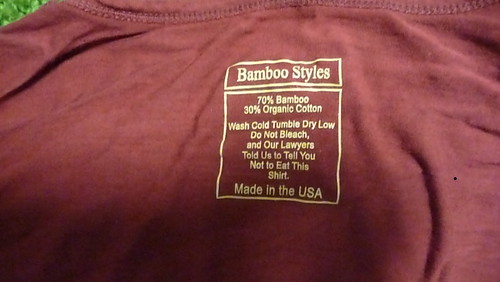
Biella Coleman: Do Not Eat the Laundry


do-not-eat, originally uploaded by the biella.
America is a land brimming with paradoxes, one of them being our simultaneous obsession with freedom and rules. We purport to be the land of the free (and while this is and may not be true, we do hold steadfast to this idea). But we also love rules rules and rules, and wait there are more and more and more rules, too many rules, which often come in the form of the form of a sign, this one being one of my favorites. (shall not produce grease laden fumes?! yes, I think it was written by an academic). So I appreciate small reminders that poke fun of and holes in our love of rules and warnings, such as the one I found on my new bamboo-based shirt, pictured above. I have taken a huge liking for bamboo shirts as of late (I am obsessed with the tactile and can only stand soft cloth, which is why I love bamboo-based cloth) and I ordered a few shirts of the Internet. I only noticed the warning when I pulled the shirt out of the dryer late the other night and it was by far one of the only times I smiled from left to right at 1 am when doing laundry. More people should take the time to plant these easter-egg type jokes as they are, I am sure, much appreciated.

15 December 2008

Miriam Ruiz: How to win online debates

From How to win online debates, by Adam Graham: You won t really influence the direction of what people think on a given issue. The prize is the satisfaction that you won the debate. You beat that guy. You showed him who was right! Congratz! As the author of the article says, quoting the film War Games: A strange game. The only winning move is not to play.

14 December 2008

Joey Hess: road trip

Blessing, VA
Rt 666 Hogback Rd
I'm in Charlottesville for a few days. Got to visit the always atmospheric Crozet Pizza, and am enjoying a cabin at Misty Mtn. Had a good long think on the drive up, but it doesn't want to come out as a blog right now.

Biella Coleman: Thinking Responsibily about the Drugs among Us

Next semester I am teaching a new undergraduate course tentatively titled Technology, Society, and Media: The Body under Transition, in Movement, and under (Massive) Transformation(s). As designed, the course should address technology and media in fairly broad stokes (which I do) but I narrow and control what is a truly unwieldy subject by framing the issues/readings in relation to the human body. Generally speaking, we will interrogate the ways in which technology engenders or erases bodily/human possibilities/capacities and especially the ethical and political ramifications that precipitate from the use/abuse of technology. We traverse a wide range of topics from the telegraph (and how it was used to speak with the dead) to the role of human enhancement technologies of today, to questions of surveillance and privacy, among many other topics. I am pretty far along with the syllabus and pretty happy with it. So far I think I have struck a nice balance between fun/light/accessible readings and some which are bit more theoretically dense. I am still looking for one or two pieces, perhaps one on tattoos and body modification and another about karaoke. If anyone knows any great articles on these topics, do pass along the information. I am probably most excited about the cluster of issues that address eugenics (and most students know next to nothing about America s central role in unleashing the Eugenics movement), disability rights activism, human enhancement technologies, and transhumanism. Considering human enhancement in light of previous efforts to enhance our population brings into relief the similar and distinct ethical issues that haunt this field. One of the most hot button issues of today concern the use of human enhancing drugs. The prestigious journal Nature has just published an editorial on the topic of cognitive enhancement drugs,Towards responsible use of cognitive-enhancing drugs by the healthy, which is a fairly interesting read and covers some of the main controversies. For me, however, the interesting issue is not only whether human enhancement is right or wrong though this is certainly important but what our embrace of these drugs tell us about the conditions under which our bodies live and labor. That is, I think we are actually missing out on posing some other important questions simply by framing this int terms of human enhancement. I suspect, and this is where ethnography would really help out, that many people turning to enhancement drugs may not be medically sick, in the technical sense but I don t think they are healthy either. Many who turn to these drugs feel pretty worn, pretty exhausted, pretty frazzled (the perfect word, I think, is agotado, Spanish for exhausted) and use these drugs as crutches, as band-aids, as an elixir to help out one preserver in tough work circumstances. I am sure there are folks who take these drugs feel fine and are just trying to push their limits and capacities but I troll many many many patient support sites and it also seems to me that many people live under a state of low-grade chronic state of unwellness. Given the pace of society, given what and how we eat, given the extraordinary rates of depression in our society ,given the fact that babies are born with 200 + chemicals in their bodies (what a way to start out life) I am skeptical that enhancement really captures what is going on with these drugs. I have not yet come up with the right term, but I am trying to come up with a phrase that would reflect the ways in which these drugs are not used as therapies for a discrete condition (Type 1 diabetes) but how they are a collective response to a state of low grade chronic unwellness that seems to mark the lives of a whole lot of people. This, I think, would be one responsible approach to human enhancement technologies that would contextualize their use within a much broader frame, one that is attuned to how bodies have been made, remade, and limited under actual material conditions of labor and life in the 21st century.

13 December 2008

Gunnar Wolf: Startups here and there

David Welgon has a nice post regarding his opinions on pros and cons on running a startup in Europe (Italy) and the USA (SF/Bay area). The first of the Italy cons got my attention:
Less of a startup culture and mentality. It's more typical to get a "job for life" and hang on to it for all you're worth. Many Italians are tremendously creative, industrious, inventive people, but are going to find it more difficult to express that in some form of business.
I know I am unlike many people, specially in this field... But anyway. I live in Mexico. Many factors in The Way Things Work are pushing people towards having an enterpeneur mentality - And what you see as a point against, I see as a very big advantage.
Some people have what it takes to run a business, and that's great. However, I think it is wrong to assume most people will benefit from running their own business - And specially in a country as mine. I cannot speak much about Europe, but from what you say, it confirms it is a good model of what I'd like Mexico to morph into.
Too many people start their companies with dreams of glory, thinking they have something to differentiate from the rest of the marketplace - and they lack it. So instead of enriching an existing company with more, and better focused, technical talent, they will end up making it poorer with yet another generic company with nothing new to offer, paying famelic wages to their employees, finding a way to skip the social security payments. And there are lots of legal ways to do so in Mexico - and a growing segment of the population has neither health care nor retirement savings, as this makes their day-to-day incomes substantially more juicy... But the future will bite them hard. Well, not only them - It will bite all of us. I still think we will inevitably, sooner or later, evolve into a more caring society, a society where the strong protects the weak, where it (via the State, the government) ensures nobody has under the minimum needed to have a decent life.
And, although I am essentialy a Socialist at heart, I do recognize there is place for people getting more money than others - After all, courage and creativity should be encouraged, and true enterpeneurs should get compensed for what they give to the society - But the ridiculous, stupid differences we get to see, specially in third world countries (remember that the world's richest man, Carlos Slim, lives on the same city I do, and around ~15 years ago even lived less than five blocks away from me... But I do have close family where having food daily on the table is far from a fact) are something that should disappear for good.
Loyalty to your employer and long-term job commitment are two values I hold very dear, and hope to be able to practice. So far, I have worked for eight years for UNAM (1999-2003 and 2005-present), and I hope to continue here for many years to come. I was just talking about this with a friend - The payment itself is far less than what I could get somewhere else, but the work conditions and long-term viability are more than enough to repay for the difference. And I am sure many of my friends and acquintances would be much better off if they stopped prioritizing getting more money now in respect to leading a better, richer life - And, of course, if we all valued more giving back to the society, as we will probably all need to ask from it sooner or later.

12 December 2008

Chris Lawrence: Corollary of the day

King Politics thinks the GOP anti-bailout faction has the politics of the day wrong:
The time for pragmatism is now, but Senate Republicans don t recognize that. Senate Republicans have yet to realize that the GOP lost so many seats in 2006 and 2008 because the American public has a greater desire for pragmatism than ideology.
I think that s true to a point but I suspect it has more to do with post-Katrina George W. Bush than any coherent definition of ideology. As much as the Democrats would like to pretend otherwise, ideological is not a term I d readily apply to the bumbling nature of Bush s second term. Nor am I really convinced that the average voter is doing much more than engaging in post-hoc rationalized-as-something-else economic voting, which doubtless makes me no fun at parties when I play a public opinion scholar. ( Yes, all this crap matters at the margins, and occasionally elections are won at the margins, but most of the time it doesn t matter. ) But I digress. There is a broader lesson, though, in that to the extent the Democrats believe that their recent success is due to their ideology it is at their long-term peril, particularly if they bypass pragmatism in favor of catering to the cobbled-together collection of rent-seekers that passes for the Democratic coalition. To the extent bailing out Detroit is seen as a Democatic handout to its paymasters particularly with the emerging frame of the greedy unions are standing in the way trumping any sort of concept that any deal that tells the UAW to can their contract is essentially an impairment of the obligation of contract (which, believe it or not, is unconstitutional) the auto bailout won t go over well in the 48 or so states that don t host significant Big Three production. On a related note, Steven Taylor notes the defining-down of the filibuster by the media to mean failure to win a cloture vote. While I accept the point graciously, I think this may be more a failure of us as a profession than the media per se; modern congressional procedures (not just filibusters and holds, but also esoterica such as the Rules Committee and UCAs), even superficially treated, aren t a strong point of most American government textbooks, and more often than not that s the only real government orientation budding journalists will get. I make a point of assigning Barbara Sinclair s Unorthodox Lawmaking in my Congress classes, but I doubt the average journalist gets that in-depth in their undergrad days. So here at least I think the blame falls somewhat closer to home than we might want to admit.

Adrian von Bidder: SSH VPN

Yes, this is just to bookmark what Romain contributed. VPNs can be created by ssh plus tun devices; debian-administration.org has a very nice write-up including proper set up of the authorized_keys file to not allow generic ssh root access. Please, can everybody add big disclaimers on all ssh + ppp based HOWTO's that this is obsolete? Or is there a reason I'm still doing it that way other than the omnipresence of said documentation?

11 December 2008

Julien Blache: pommed v1.23: full late 2008 laptops support

pommed v1.23 is out, with full support for the late 2008 laptops. The LCD backlight inner workings got figured out finally, but there s a catch: the backlight won t react to the settings when running X11 with the proprietary nVidia drivers on the MacBook5,1 and the MacBookAir2,1. It works fine on the MacBookPro5,1 and it works fine on all three machines with the opensource nouveau driver. Switching to the console before setting the backlight and then back to X does work as a workaround. So there s something up with the proprietary nVidia driver, and my uneducated guess is that the MacBook Pro may somehow be exempt from the issue due to its dual GPU config. I ve also switched the nVidia machines to using the generic sysfs backlight driver in pommed. This driver has been there for some time for the PowerPC machines, so now it s part of the generic pommed code. You need the mbp_nvidia_bl driver in your kernel for this to work. Don t panic! If you don t have it, pommed will fall back to the native driver (nv8600mgt) and everything will work just as before. Pommed will tell you if it has to fall back to the native driver, so check your logs if you want to know. This release of pommed needs testing on all nVidia machines: MacBookPro3,1, MacBookPro4,1, MacBookPro5,1, MacBook5,1 and MacBookAir2,1. If anything doesn t work, tell me about it and I ll fix it.

Next.

Previous.
