Search Results: "beh"

23 January 2013

Russ Allbery: Log parsing and infinite streams

I have a problem I have to solve for work that involves correlating Apache access and error logs. Part of WebAuth logs successful authentications to the Apache error log, and I want to correlate User-Agent strings with users so that we can figure out what devices our users are using by percentage of users rather than percentage of hits. The problem, as those who have tried to do this prior to Apache 2.4 know, is that Apache doesn't provide any easy way to correlate access and error log entries (made even more complex because two separate components are involved). I could have just hacked something together, but I've written way too many ad hoc log parsers, and, see, I was reading this book.... The book in question is Mark Jason Dominus's Higher Order Perl. I'm not quite done with it, and will post a full review when I am. I have some problems with it, mostly around the author's choice of example problems. But there is one chapter on infinite streams, and the moment I read that chapter on the train, it struck me as the perfect solution to log parsing problems. I'm not much of a functional programming person (which is where Dominus is drawing most of the material for this book), so I don't know if this terminology is standard or somewhat unique to the book. An infinite stream in this context is basically a variation on an interator that lets you look at the next item without consuming it. The power comes from putting this modified iterator in front of a generator and use it to consume one element at a time, and then compose this with transformation and filtering functions. That gives you all the power of the iterator to store state and lets you process one logical element from the stream at a time, without inverting your flow of control. Dominus provides code in the book for a very nice functional implementation of this that's about as close as you're probably going to get to writing Haskell in Perl. Unfortunately, his publisher decided to write their own free software license, so the license is kind of weird and doesn't explicitly permit redistribution of modified code. It's probably fine, but I didn't feel like dealing with it, and I'm more comfortable with writing object-oriented code at the moment (at least in Perl), so I decided to write an object-oriented version of the same code specific for log parsing. That's what I've been doing since shortly after lunch, and I can't remember the last time I've had this much fun writing code. I have a reasonable first cut at a (fully tested and fully test-driven) log parsing framework built on top of a reasonably generic implementation of the core ideas behind infinite streams. I also used this as an opportunity to experiment with Module::Build, and have discovered that the things I most disliked about it have apparently all been fixed. And I'm also using Perl 5.10 features. (I was tempted to start using some things from 5.12, but I do actually need to run this on Debian stable.) It's rather satisfying to write a thoroughly modern Perl module. There are some definite drawbacks to writing this in an object-oriented fashion. There's rather more machinery and glue that has to be set up, it's probably a bit slower, and it tends to accumulate layers of calls. One of the advantages of the method with standalone functions and a very simple, transparent data structure is that it's easier to eliminate unnecessary call nesting. But I suspect the object-oriented version will do what I want without any difficulties, and if I feel very inspired, I can always fiddle with it later. Maybe I'll eventually use this as a project to experiment with Moose as well. I'm surprised that no one else has done this, but I poked around on CPAN a fair bit and couldn't find anything. This will all show up on CPAN (as Log::Stream) as soon as I've finished enough of it to implement my sample application. And then I'll hopefully find some time to rewrite our metrics system using it, which should simplify it considerably....

22 January 2013

John Goerzen: Today is Pretend St. Patrick s Day!

Today in the USA is Martin Luther King, Jr., day. But sometimes these holidays get confusing for a 6-year-old. I asked Jacob the other day if he knew what holiday was coming up. He thought about it for a second, then declared it would be St. Patrick s Day. He was excited because St. Patrick s Day is green. When he realized that it was really MLK Day, he was disappointed. That day isn t green. So I said, Jacob, how about we celebrate pretend St. Patrick s Day on Monday? His face lit up, he got a huge smile, and said, Oh yes! Great idea, dad! Oliver got all excited about it too. I was already planning on us doing some cooking, and thankfully had green food coloring already. So I sort of discarded my plans so each meal could have something green in it. When the boys woke up this morning, I wished each of them Happy Pretend St. Patrick s Day! We all wore green. Jacob put his shirt on backwards so the side with more green would be facing front. For breakfast, our green dish was green crepes with a succotash (based on baby lima beans and corn) filling. The boys were excited to discover that the crepes could be green on one side, and green and a little brown on the other. Jacob was unsure of the succotash idea, but after having a few bites, declared it excellent . After breakfast, we made bread. They loved watching the green food coloring disperse in the water. We checked on how green the dough looked periodically. We watched how it was rising and whether it was staying green. And we checked in on it backing, as the crust turned from green to brown. We discussed green bread over and over. Important questions were asked and answers were attempted. And then, of course, the moment of truth removing the loaf from the pan. The boys jabbered excitedly that there was some green peeking out. While we waited for it to cool, we went out to the creek. The creek is dry this year, so we got to walk in it. Jacob used his stick to make a line behind him. I asked him, Is that a line so we can find our way back? Oh! Uhm. Yes! And then he added arrows so we d know which way to go. Jacob stopped every 20 or so feet to collect pretend train tickets from Oliver and me. Oliver eventually grew tired of this, so Jacob started collecting Oliver s ticket from me. They climbed on some trees, managed to find some mud, drew outlines of train cars in the dirt, and then followed Jacob s line back down the creek bed. They pointed out any green things they saw. Then we went back to the house, took off our warm coats, and cut into the bread. Can you imagine the excitement? I hadn t realized green is a flavor, but it must have been somehow, because those boys absolutely loved this green bread. When we got out the jam, Jacob realized that it was red on the green bread, and that now his bread was Christmas-colored. All sorts of green bread discoveries were made, but the best among them was that if you hold a slice of green bread up to the bright sun, the sun makes it glow green and it looks like a stained-glass window. Sometimes a few drops of food coloring can add a ton of excitement to a day.

Matthew Palmer: When is a guess not a guess?

when it s a prediction . In the 4th January edition of the Guardian Weekly , the front page story, entitled Meet the world s new boomers 1 contained this little gem:
Back in 2006, [PricewaterhouseCoopers] made some forecasts about what the global economy might look like in 2050, and it has now updated the predictions in the light of the financial crisis and its aftermath.
Delightful. They made some forecasts about what the global economy might look like. Given that they clearly didn t include any impact of the GFC in their forecasts, it clearly wasn t a particularly accurate forecast. Y know what an inaccurate prediction is called? Guesswork. Let s call a spade a spade here. I see this all the time, and it s starting to shit me. People making predictions and forecasts and projections hither and yon, and they re almost always complete bollocks, and they never get called on it. I read the Greater Fool blog now and then, and that blog is chock full of examples of people making predictions which have very little chance of being in any way accurate. While Dr Ben Goldacre and others are making inroads into requiring full disclosure in clinical trials, I m not aware of anyone taking a similar stand against charlatans making dodgy-as-hell predictions over and over again, with the sole purpose of getting attention, without any responsibility for the accuracy of those predictions. Is anyone aware of anyone doing work in this area, or do I need to register badpredictions.net and start calling out dodginess?

Russ Allbery: Review: Fantasy & Science Fiction, March/April 2011

Review: Fantasy & Science Fiction, March/April 2011
Editor: Gordon van Gelder
Issue: Volume 120, No. 3 & 4
ISSN: 1095-8258
Pages: 258
Charles de Lint's book review column sticks with the sorts of things he normally reviews: urban and contemporary fantasy and young adult. Predictably, I didn't find that much of interest. But I was happy to see that not all the reviews were positive, and he talked some about how a few books didn't work. I do prefer seeing a mix of positive and negative (or at least critical) reviews. James Sallis's review column focuses entirely on Henry Kuttner and C.L. Moore (by way of reviewing a collection). I'm always happy to see this sort of review. But between that and de Lint's normal subject matter, this issue of F&SF was left without any current science fiction reviews, which was disappointing. Lucius Shepard's movie review column features stunning amounts of whining, even by Shepard's standards. The topic du jour is how indie films aren't indie enough, mixed with large amounts of cane-shaking and decrying of all popular art. I find it entertaining that the F&SF film review column regularly contains exactly the sort of analysis that one expects from literary gatekeepers who are reviewing science fiction and fantasy. Perhaps David Langford should consider adding an "As We See Others" feature to Ansible cataloging the things genre fiction fans say about popular movies. "Scatter My Ashes" by Albert E. Cowdrey: The protagonist of this story is an itinerant author who has been contracted to write a family history (for $100K, which I suspect is a bit of tongue-in-cheek wish fulfillment) and has promptly tumbled into bed with his employer. But he is somewhat serious about the writing as well, and is poking around in family archives and asking relatives about past details. There is a murder (maybe) in the family history, not to mention some supernatural connections. Those familiar with Cowdrey's writing will recognize the mix of historical drama, investigation, and the supernatural. Puzzles are, of course, untangled, not without a bit of physical danger. Experienced fantasy readers will probably guess at some of the explanation long before the protagonist does. Like most Cowdrey, it's reliably entertaining, but I found it a bit thin. (6) "A Pocketful of Faces" by Paul Di Filippo: Here's a bit of science fiction, and another mystery, this time following the basic model of a police procedural. The police in this case are enforcing laws around acceptable use of "faces" in a future world where one can clone someone's appearance from their DNA and then mount it on a programmable android. As you might expect from that setup, the possibilities are lurid, occasionally disgusting, and inclined to give the police nightmares. After some scene-setting, the story kicks in with the discovery of the face of a dead woman who, at least on the surface, no one should have any motive to clone. There were a few elements of the story that were a bit too disgusting for me, but the basic mystery plot was satisfying. I thought the ending was a let-down, however. Di Filippo tries to complicate the story and, I thought, went just a little too far, leaving motives and intent more confusing than illuminating. (6) "The Paper Menagerie" by Ken Liu: Back to fantasy, this time using a small bit of magic to illustrate the emotional conflicts and difficulties of allegiance for second-generation immigrants. Jack is the son of an American farther and a Chinese mother who was a mail-order bride. He's young at the start of the story and struggling with the embarassment and humiliation that he feels at his mother's history and the difficulties he has blending in with other kids, leading to the sort of breathtaking cruelty that comes so easily from teenagers who are too self-focused and haven't yet developed adult empathy. I found this very hard to read. The magic is beautiful, personal, and very badly damaged by the cruelty in ways that can never really be fixed. It's a sharp reminder of the importance of being open-hearted, but it's also a devastating reminder that the lesson is normally learned too late. Not the story to read if you're prone to worrying about how you might have hurt other people. (6) "The Evening and the Morning" by Sheila Finch: This long novella is about a third of the issue and is, for once, straight science fiction, a somewhat rare beast in F&SF these days. It's set in the far future, among humans who are members of the Guild of Xenolinguists and among aliens called the Venatixi, and it's about an expedition back to the long-abandoned planet of Earth. I had a lot of suspension of disbelief problems with the setup here. While Earth has mostly dropped out of memory, there's a startling lack of curiosity about its current condition among the humans. Finch plays some with transportation systems and leaves humanity largely dependent on other races to explain the failure to return to Earth, but I never quite bought it. It was necessary to set up the plot, which is an exploration story with touches of first contact set on an Earth that's become alien to the characters, but it seemed remarkably artificial to me. But, putting that aside, I did get pulled into the story. Its emotional focus is one of decline and senescence, a growing sense of futility, that's halted by exploration, mystery, and analysis. The question of what's happened on Earth is inherently interesting and engaging, and the slow movement of the story provides opportunities to build up to some eerie moments. The problem, continuing a theme for this issue, is the ending. Some of the reader's questions are answered, but most of the answers are old, well-worn paths in science fiction. The emotional arc of the story is decidedly unsatisfying, at least to me. I think I see what Finch was trying to do: there's an attempted undermining of the normal conclusion of this sort of investigation to make a broader point about how to stay engaged in the world. But it lacked triumph and catharsis for me, partly because the revelations that we get are too pedestrian for the build-up they received. It's still an interesting story, but I don't think it entirely worked. (6) "Night Gauntlet" by Walter C. DeBill, Jr., et al.: The full list of authors for this story (Walter C. DeBill, Jr., Richard Gavin, Robert M. Price, W.H. Pugmire, Jeffrey Thomas, and Don Webb) provides one with the first clue that it's gone off the rails. Collaborative storytelling, where each author tries to riff off the work of the previous author while spinning the story in a different direction, is something that I think works much better orally, particularly if you can watch facial expressions while the authors try to stump each other. In written form, it's a recipe for a poorly-told story. That's indeed what we get here. The setup is typical Cthulhu mythos stuff: a strange scientist obsessed with conspiracy theories goes insane, leaving behind an office with a map of linkages between apparently unrelated places. The characters in the story also start going insane for similar reasons, leading up to a typical confrontation with things man was not meant to know, or at least pay attention to. If you like that sort of thing, you may like this story better than I did, but I thought it was shallow and predictable. (3) "Happy Ending 2.0" by James Patrick Kelly: More fantasy, this time of the time travel variety. (I call it fantasy since there's no scientific explanation for the time travel and it plays a pure fantasy role in the story.) That's about as much as I can say without giving away the plot entirely (it's rather short). I can see what Kelly was going for, and I think he was largely successful, but I'm not sure how to react to it. The story felt like it reinforced some rather uncomfortable stereotypes about romantic relationships, and the so-called happy ending struck me as the sort of situation that was going to turn very nasty and very uncomfortable about five or ten pages past where Kelly ended the story. (5) "The Second Kalandar's Tale" by Francis Marion Soty: The main question I have about this story is one that I can't answer without doing more research than I feel like doing right now: how much of this is original to Soty and how much if it is straight from Burton's translation of One Thousand and One Nights. Burton is credited for the story, so I suspect quite a lot of this is from the original. Whether one would be better off just reading the original, or if Soty's retelling adds anything substantial, are good questions that I don't have the background to answer. Taken as a stand-alone story, it's not a bad one. It's a twisting magical adventure involving a djinn, a captive woman, some rather predictable fighting over the woman, and then a subsequent adventure involving physical transformation and a magical battle reminiscent of T.H. White. (Although I have quite likely reversed the order of inspiration if as much of this is straight from Burton as I suspect.) Gender roles, however, are kind of appalling, despite the presence of a stunningly powerful princess, due to the amount of self-sacrifice expected from every woman in the story. Personally, I don't think any of the men in the story are worth anywhere near the amount of loyalty and bravery that the women show. Still, it was reasonably entertaining throughout, in exactly the way that I would expect a One Thousand and One Nights tale to be. Whether there's any point in reading it instead of the original is a question I'll leave to others. (7) "Bodyguard" by Karl Bunker: This is probably the best science fiction of the issue. The first person protagonist is an explorer living with an alien race, partly in order to flee the post-singularity world of uploaded minds and apparent stagnation that Earth has become. It's a personal story that uses his analysis of alien mindsets (and his interaction with his assigned alien bodyguard) to flesh out his own desires, emotional background, and reactions to the world. There are some neat linguistic bits here that I quite enjoyed, although I wish they'd been developed at even more length. (The alien language is more realistic than it might sound; there are some human languages that construct sentences in a vaguely similar way.) It's a sad, elegiac story, but it grew on me. (7) "Botanical Exercises for Curious Girls" by Kali Wallace: One has to count this story as science fiction as well, although for me it had a fantasy tone because the scientific world seems to play by fantasy rules from the perspective of the protagonist. Unpacking that perspective is part of the enjoyment of the story. At the start, she seems to be a disabled girl who is being cared for by a strange succession of nurses who vary by the time of day, but as the story progresses, it becomes clear that something much stranger is going on. There are moments that capture a sense of wonder, reinforced by the persistantly curious and happy narrative voice, but both are undercut by a pervasive sense of danger and dread. This is a light story written about rather dark actions. My biggest complaint with the story is that it doesn't so much end as wander off into the sunset. It set up conflict within a claustrophobic frame, so I can understand the thematic intent of breaking free of that frame, but in the process I felt like the story walked away from all of the questions and structure that it created and ended in a place that felt less alive with potential than formless and oddly pointless. I think I wanted it to stay involved and engaged with the environment it had created. (6) "Ping" by Dixon Wragg: I probably should just skip this, since despite the table of contents billing and the full title introduction, it's not a story. It's a two-line joke. But it's such a bad two-line joke that I had to complain about it. I have no idea why F&SF bothered to reprint it. (1) "The Ifs of Time" by James Stoddard: This certainly fits with the Arabian Nights story in this issue. The timekeeper of a vast and rambling castle (think Gormenghast taken to the extreme) wanders into a story-telling session in a distant part of the castle. The reader gets to listen to four (fairly good) short stories about time, knowledge, and memory, told in four very different genres. All of this does relate to why the timekeeper is there, and the frame story is resolved by the end, but the embedded stories are the best part; each of them is interesting in a different way, and none of them outlast their welcome. This was probably the strongest story of this issue. (7) Rating: 6 out of 10

19 January 2013

Charles Plessy: Debian-Installer in a Cloud, part 2.

I finally manage to create an image of the Debian Installer automatically, with no key or password transiting on the Cloud or the network, and without using the ec2-api-tools, which are non-Free. Thanks to Eucalyptus for implementing the attribute InstanceInitiatedShutdownBehavior in euca2ools 2.1.2. In brief, I start a micro-instance with an additional volume, and I pass it a script for cloud-init, which will download the Installer on the volume and shut down the instance. Then, I register the volume as a machine image. Those machine images of the Installer are to be preseeded via instance metadata to install Debian on another volume. I am still struggling with the pre-configuration. More details will follow in the next article. In the meantime, here are the commands I a using. On the local computer, start an instance on the Cloud. Until #696595 is fixed and cloud-init is installed by default, I use a Ubuntu image.
HELPER_AMI=ami-7609bb77 # Ubuntu 12.04 LTS Precise amd64 EBS (Asia North-East)
Start the instance with an extra volume of 1 GiB, which will persist after termination (/dev/sdb=:1:false). Pass the script debigen-install-installer-cloud (see below).
HELPER_INSTANCE=$( euca-run-instances \
        --instance-initiated-shutdown-behavior terminate \
        --instance-type t1.micro \
        --block-device-mapping /dev/sdb=:1:false \
        --user-data-file debigen-install-installer-cloud \
        $HELPER_AMI  
        tee /dev/stderr   grep INSTANCE   awk ' print $2 ')
Wait that the boot finished.
while [ ! $(euca-describe-instances $HELPER_INSTANCE   grep INSTANCE   cut -f 6   tee /dev/stderr) = "running" ]
    do sleep 30
done
Get the volume's identifier
TARGET_VOLUME=$( euca-describe-volumes  
        grep $HELPER_INSTANCE   grep '/dev/sdb'  
        tee /dev/stderr   awk ' print $2 ')
Wait that the scripts shuts down the instance.
while [ ! $(euca-describe-instances $HELPER_INSTANCE   grep INSTANCE   cut -f 6   tee /dev/stderr) = "terminated" ]
    do sleep 30
done
Snapshot the volume and register it as a machine image.
PV_KERNEL=aki-44992845 # Boot PV-Grub on hd0 (Asia North-East)
TARGET_SNAPSHOT=$( euca-create-snapshot $TARGET_VOLUME  
        tee /dev/stderr   awk ' print $2 ')
while euca-describe-snapshots $TARGET_SNAPSHOT   grep -q pending ; do sleep 30 ; done
euca-register \
    --name test_di \
    --description test_of_debian_installer \
    --snapshot $TARGET_SNAPSHOT \
    --kernel $PV_KERNEL \
    --architecture x86_64
Here is the script called debigen-install-installer-cloud, used above.
#!/bin/sh -ex    
mke2fs -L debian-installer /dev/xvdb -F
mount LABEL=debian-installer /mnt/
cd /mnt    
ARCH=amd64
DIST=squeeze
DI_VERSION=20110106+squeeze4+b2
MIRROR=jp
BASEURL=http://ftp.$MIRROR.debian.org/debian/dists/$DIST/main/installer-$ARCH/$DI_VERSION/images/netboot/xen
wget $BASEURL/initrd.gz $BASEURL/vmlinuz    
mkdir -p boot/grub    
cat > boot/grub/menu.lst <<__END__
default 0
timeout 3
title  Debian Installer ($DI_VERSION $ARCH)
root   (hd0)
kernel /vmlinuz root=LABEL=debian-installer ro console=hvc0 auto=true priority=critical url=http://169.254.169.254/latest/user-data DEBIAN_FRONTEND=text
initrd /initrd.gz
__END__
sleep 30     
halt

18 January 2013

Ian Campbell: Using Valgrind to Debug Xen Toolstacks

What is Valgrind? Valgrind is a framework for building dynamic analysis tools. Several useful tools are included in the Valgrind distribution including tools to check dynamic memory usage (memcheck), a cache profiler (cachegrind), heap profiler (massif) and thread debugger (helgrind) among others. Valgrind also provides a framework which can be used to build other tools. The Valgrind tool which I find most useful and the one which I have most experience with is memcheck. This tool can detect all manner of memory management problems, including use after free, using uninitialized data, memory leaks, double free. Between them these can result in savings of many hours of staring a core dumps and gdb backtraces. How Does memcheck Work? At its core Valgrind is a dynamic binary translation engine, which is used to instrument the code at runtime. In the case of memcheck this is used to track properties of the memory in a process, including aspects such as whether each bit (yes, bit) of memory has been initialized since it was allocated. It also tracks this information as data is loaded into registers, so it can know if a given register is currently tainted with uninitialized data or not. As well as instrumentation through binary translation Valgrind also includes instrumented versions of the C dynamic memory allocation functions which are used to track whether a each bit of memory is currently considered free or allocated, as well as tainting registers when they contain a pointer to memory which has been freed. A large part of memcheck's functionality is built upon Valgrind's ability to determine when memory has been initialized. However although binary translation can be used to instrument when the application itself has initialized some memory it is not currently possible to instrument the behaviour of system calls, in other words Valgrind cannot automatically determine when memory has been initialised e.g. after a read(2) system call. For this reason Valgrind has baked in knowledge about the behaviour of system calls on various platforms. For example lets consider the read(2) system call. The prototype of read(2) is:
    ssize_t read(int fd, void *buf, size_t count);
This system call reads up to count bytes from the file descriptor fd into the memory pointed to by buf and returns the number of bytes read. Here is the code within Valgrind which handles this system call (found in coregrind/m_syswrap/syswrap-generic.c):
PRE(sys_read)
 
   *flags  = SfMayBlock;
   PRINT("sys_read ( %ld, %#lx, %llu )", ARG1, ARG2, (ULong)ARG3);
   PRE_REG_READ3(ssize_t, "read",
                 unsigned int, fd, char *, buf, vki_size_t, count);
   if (!ML_(fd_allowed)(ARG1, "read", tid, False))
      SET_STATUS_Failure( VKI_EBADF );
   else
      PRE_MEM_WRITE( "read(buf)", ARG2, ARG3 );
 
POST(sys_read)
 
   vg_assert(SUCCESS);
   POST_MEM_WRITE( ARG2, RES );
 
These two functions are called before and after the system call respectively. The main piece of functionality is the calls to PRE_MEM_WRITE and POST_MEM_WRITE. In this case PRE_MEM_WRITE is used to check that the memory starting at ARG2 (recall that this is the supplied buffer) and extending for ARG3 bytes (the system calls count argument) consists of allocated memory. After the system call in complete the post function calls POST_MEM_WRITE to indicate to Valgrind that RES bytes of the buffer have know been initialized. The above is a relatively simple case, but the above two hooks must be supplied for each system call on each platform which Valgrind wishes to support. One of the most problematic system calls is the ioctl(2) system call. The ioctl call takes a file descriptor, a request number and a pointer to a per-ioctl argument structure and implements per-device control requests. There are literally dozens of devices many with their own specific ioctls. For this reason a sizable portion of Valgrind code is dedicate to decoding the behaviour of the myriad of potential ioctls and providing pre- and post-call instrumentation for them. Interacting with the Hypervisor from Userspace Under Xen the toolstack is a normal userspace process running in the control domain (typically domain 0). As part of its operation the toolstack needs to communicate with the hypervisor and to do this it uses hypercalls. However a userspace process cannot simply make hypercalls on its own, instead it must request that the OS kernel make the hypercall for it. This prevents just any userspace process making a hypercall, since the kernel will first check the privilege of the process making the request. Under Linux a userspace process makes hypercalls by using the ioctl(2) system call on a special "Privileged Command" (privcmd) device. In this case the toolstack uses the IOCTL_PRIVCMD_HYPERCALL ioctl request which takes a hypercall number and the hypercall arguments as its argument. Other OSes which can be used as a control domain posses similar interfaces. Making memcheck Work With Xen Toolstacks? As might be expected the majority of the work to allow Valgrind to work on Xen toolstack processes was teaching it about the IOCTL_PRIVCMD_HYPERCALL ioctl. Fortunately it was not necessary to teach Valgrind about every hypercall but only about those which are used by toolstacks. This is a smallish subset of all hypercalls including the domctl interfaces and a handful of others. The initial batch of patches cover all of the system calls needed to start new domains, shut them down and migrate them using the XL toolstack. New hypercalls will be added as they are discovered to be missing. Getting and Using This Functionality The initial set of patches were accepted into Valgrind's Subversion repository trunk revision 13081 in October 2012 and are expected to be part of the 3.9.0 release. Until 3.9.0 is released it will be necessary to get this functionality from SVN. Fortunately this is relatively simple and follows the usual autofoo dance. Although the usual caveats regarding running unreleased software apply.
  $ svn co svn://svn.valgrind.org/valgrind/trunk valgrind
  $ cd valgrind
  $ ./autogen.sh
  $ ./configure
  $ make
  $ sudo make install
Once Valgrind is built and installed simply call it passing the command to be debugged as an option:
  # valgrind xl list
  ==16186== Memcheck, a memory error detector
  ==16186== Copyright (C) 2002-2012, and GNU GPL'd, by Julian Seward et al.
  ==16186== Using Valgrind-3.9.0.SVN and LibVEX; rerun with -h for copyright info
  ==16186== Command: xl list
  ==16186== 
  Name                                        ID   Mem VCPUs    State   Time(s)
  Domain-0                                     0   512     4     r-----     332.5
  ==16186== 
  ==16186== HEAP SUMMARY:
  ==16186==     in use at exit: 0 bytes in 0 blocks
  ==16186==   total heap usage: 16 allocs, 16 frees, 93,529 bytes allocated
  ==16186== 
  ==16186== All heap blocks were freed -- no leaks are possible
  ==16186== 
  ==16186== For counts of detected and suppressed errors, rerun with: -v
  ==16186== ERROR SUMMARY: 0 errors from 0 contexts (suppressed: 39 from 6)
Here we see that xl list has no leaks! However if I comment out the call to libxl_dominfo_list_free in tools/libxl/xl_cmdimpl.c:main_list() then instead Valgrind reports:
[...]
  ==16203== HEAP SUMMARY:
  ==16203==     in use at exit: 90,112 bytes in 1 blocks
  ==16203==   total heap usage: 16 allocs, 15 frees, 93,529 bytes allocated
  ==16203== 
  ==16203== LEAK SUMMARY:
  ==16203==    definitely lost: 0 bytes in 0 blocks
  ==16203==    indirectly lost: 0 bytes in 0 blocks
  ==16203==      possibly lost: 90,112 bytes in 1 blocks
  ==16203==    still reachable: 0 bytes in 0 blocks
  ==16203==         suppressed: 0 bytes in 0 blocks
  ==16203== Rerun with --leak-check=full to see details of leaked memory
  ==16203== 
  ==16203== For counts of detected and suppressed errors, rerun with: -v
  ==16203== ERROR SUMMARY: 0 errors from 0 contexts (suppressed: 39 from 6)
[...]
So it has caught the memory leak! Rerunning with the suggests --leak-check=full goes even further and tells me where the leaked memory was allocated:
[...]
  ==16204== 90,112 bytes in 1 blocks are possibly lost in loss record 1 of 1
  ==16204==    at 0x4024480: calloc (vg_replace_malloc.c:593)
  ==16204==    by 0x4050CE4: libxl_list_domain (libxl.c:548)
  ==16204==    by 0x805EEC7: main_list (xl_cmdimpl.c:3931)
  ==16204==    by 0x804D6DD: main (xl.c:285)
[...]
To ease debugging of domain creation I find it useful to use the -F option to xl create to stop xl from forking and daemonising. Most xl subcommands do not daemonize and so need no special treatment. For more information on running Valgrind see the Valgrind Documentation. Conclusion Valgrind is a powerful tool in the arsenal of the C programmer, and can be used to catch a large number of hard to debug and common issues before they happen can save many hours of tedious debugging. The ability to use tools such as this on Xen toolstack processes is of enormous benefit and has already found several bugs in the XL toolstack.

17 January 2013

Craig Small: Pre-selecting ToscaWidgets jqgrid values in TurboGears

My Turbogears project has recently reached an important milestone; one of the back-end processes now runs pretty much continuously and the plugins it use (or at least the ones I can see) are also working. That means I can turn to the front-end which displays the data the back-end collected. For some of the data I am using a ToscaWidgets (or TW2) widget called a jqGridWidget which is a very nice jquery device that separates the presentation and data using a json query. I ve mentioned previously about how to get a jqGridWidget working but left the pre-filtering out until now. This meant that my grid showed all the items in the database, not just the ones I wanted to see, but it was a start. Now this widget displays things called Attributes which are basically children of another model called Hosts. Basically, Attributes are things you want to check or track about a Host. My widget used to show all Attributes but often on a Host screen, I want to see its hosts only. So, this is how I got my widget to behave; I m not sure this is THE CORRECT way of doing it, but it does work. First, in the Hosts controller you need to create the widget and pass along the host_id that the controller has obtained. I was not able to use the sub-classing trick you see in some TW2 documentation but actually make a widget instance.
class HostsController(BaseController):
    # other stuff here
    class por2(portlets.Portlet):
        title = 'Host Attributes'
        widget = AttributeGrid()
        widget.host_id = host_id
Next, the prepare() method in the Widget needs to get hold of the host_id and put it into the postData list. I needed to do it before calling super() because the options become one long string in the sub-class.
class AttributeGrid(jqgrid.jqGridWidget):
    def prepare(self, **kw):
        if self.host_id is not None:
            self.options['postData'] =  'hostid': self.host_id 
        super(AttributeGrid, self).prepare()
This means the jqgrid when it asks for its JSON data will include the hostid parameter as well. We need that method to see the host ID so we can filter the database access. Finally in the JSON method for the Attribute we pick up and filter on the hostid.
    @expose('json')
    @validate(validators= 'hostid':validators.Int() )
    def jqsumdata(self, hostid=0, page=1, rows=1, *args, **kw):
        conditions = []
        if hostid &gt; 0:
            conditions.append(model.Attribute.host_id == hostid)
        attributes =model.DBSession.query(model.Attribute).filter(and_(*conditions))
From there you run through the attributes variable and build your JSON reply.

16 January 2013

Michal &#268;iha&#345;: Weblate has per project ACL

I've got yet another question whether Weblate has any sort for ACL to limit access to project. As usual, my answer was no, but I started to think how I would implement such feature. After a little bit of thinking and playing with code, I've realized, that this is not that hard as I thought and implemented it in few minutes. So there is another ofter requested feature which will come in Weblate 1.4 - ACL. It provides simple way to limit access to some projects to some users. The default behavior is still that anybody logged in can do anything, but this can be changed per project by enabling ACL for it. More details are available in our documentation.

Filed under: English Weblate 0 comments Flattr this!

Raphael Geissert: A bashism a week: ulimit

Setting resource limits from a shell script is commonly done with the ulimit command.
Shells provide it as a built-in, if they provide it at all. As far as I know, there is no non-built-in ulimit command. One could be implemented with the Linux-specific prlimit system call, but even that requires a fairly "recent" kernel version (circa 2010).

Depending on the kind of resource you want to limit, you may get away with what some shells such as dash provide: CPU, FSIZE, DATA, STACK, CORE, RSS, MEMLOCK, NPROC, NOFILE, AS, LOCKS. I.e. options tfdscmlpnvw, plus H for the hard limit, S for the soft limit, and a for all. Bash allows other resources to be limited.

Remember, if you rely on any non-standard behaviour or feature make sure you document it and, if feasible, check for it at run-time. ulimit is not required by POSIX:2001 to be implemented for the shell.

Russ Allbery: afs-admin-tools 2.0

For years, I've distributed the individual AFS administrative tools that we use at Stanford as separate software releases on my web site, but this has clearly been less and less efficient. We've needed to package them for use at Stanford and didn't want to create separate packages for each individual script, we've wanted to get them out of their current CVS repository, and they didn't support any unified configuration system or simple method for local site customization. I started trying to solve those problems over a year ago by converting all the scattered CVS files into a coherent Git repository and turning the collection of scripts into an actual distribution that I can version and release more like regular software packages. But other things kept coming up, and it's one of the yearly goals I had for last year that I didn't finish. Today, I finally took the time to finish this off. The scripts frak, fsr, lsmounts, mvto, partinfo, volcreate, volcreate-logs, and volnuke, which were previously distributed separately, are now collectively distributed as afs-admin-tools and all support a standard configuration file and location. I also rolled up some previously unreleased fixes and removed some remaining Stanford-specific behavior. I have not, with this release, incorporated any of the various changes that people have sent me to the individual scripts. That's next. They're also all still standalone scripts without any common code moved into a Perl module, but I may change that in the future. Note that some of these scripts refer to scripts that will be part of the afs-mountpoints package. Putting that together is my next task, but it's a bit trickier since we moved the mount point database into an actual database, so I need to put some work into the Perl modules that wrap that database. Hopefully I can get that released before too long as well. You can get the latest release from the (new! shiny!) afs-admin-tools distribution page.

14 January 2013

Russell Coker: Promoting Enthusiasm

Rusty wrote an insightful post titled What Can I Do To Help? about reactions to new ideas [1]. He suggests that people make an effort to have a positive approach when someone talks about a new idea, it s quite common for people to point out reasons why the new idea might not work out which is discouraging for the person who had the idea. I think that is a really good point. I probably haven t done too well in that regard in the past and will try to do better in future. Code Written by Assholes Rusty previously wrote a post titled If you didn t run code written by assholes, your machine wouldn t boot which implies that we should just let assholes be assholes [2]. That doesn t go well with his What Can I Do To Help? post. Note that I m not accusing Rusty of hypocrisy here, giving advice to help people who want to get along well with others is not in contradiction with refraining from giving unsolicited advice and encouragement to difficult people who have expressed no interest in improving their behavior. A comment on the latter post by Doctor Whom says If I had seen this kind of talk when I was a teenager, I would have thought twice about picking up coding , presumably given the number of people who read Rusty s blog there are some teenagers who experienced some discouragement towards a career in computers (or a hobby in FOSS) from Rusty s post. I ve already written a response to the If you didn t run code written by assholes post, among other things I suggested that people who are minor assholes should be assisted to be less difficult and major assholes should be excluded [3]. In that post I was working on the assumption that for every significant task that needs to be completed (such as making a popular OS bootable) someone will do it, if the person working on it disappears then someone else will take over there is a community of programmers who will work on whatever needs to be done. The Importance of Individuals But in terms of new ideas it really comes down to individuals. Most projects which are significant and important now probably started out as one person or a small group who had an idea that seemed unlikely to succeed at the time. So while any big and successful project can have people replaced (which is among other things a requirement of long-term success) there are situations in which individuals with ideas matter. Another important factor is that even ideas which turn out to be impractical are still useful. Someone who has an impractical idea about a technical issue and investigates it fully will learn a lot and may end up working on the less radical ways of solving similar problems this is good for the individual and the community. Another Way of Promoting Enthusiasm In terms of promoting enthusiasm it seems that one thing that can be done by high profile people is to avoid writing posts like If you didn t run code written by assholes, your machine wouldn t boot . When people in positions of power and influence appear to have no interest in promoting good behavior it really discourages people who are vulnerable to the assholes which among other things means most members of minority groups. Obviously Rusty could t stamp out all asshole behavior, but if he announced a plan to try and make things better in that regard then it would help. It s difficult to be enthusiastic when faced with discrimination from a minority and disinterest from the majority. Of course with the way the Internet works I m sure someone will say what about the assholes who have great ideas, shouldn t we nurture their enthusiasm by letting them keep doing asshole things? . I think that for the major assholes this won t be a problem, for example anyone who s racist will be well aware that many people disagree strongly with them and thus won t be particularly discouraged when they meet more people who disagree. For the minor assholes (people who don t want to be assholes) it will be somewhat discouraging to be corrected, but that could be a learning experience for them that s worth more than support in implementing their latest technical idea. Update: Why Rusty is Important In response to a comment by private mail I ve added this section after publication. Firstly I think that the opinions of all members of the community matter as they all affect the social environment which determines what types of behavior are encouraged and discouraged. But Rusty is more important than most people. Firstly Rusty has a Wikipedia page [4], that alone is an objective criteria indicating his importance. But in terms of influencing people in the FOSS community the most important things are that he s a high profile Linux kernel programmer (which alone gives significant status and influence) and that he s the founder of the first Linux conference in Australia (which is now known as Linux.conf.au AKA LCA). When issues such as the anti-harassment policy for LCA are being discussed any opinion that Rusty offered would be taken very seriously. But so far he doesn t seem to be involved in any of the public discussions.

13 January 2013

Russ Allbery: Slacktivism that may actually help

Normally, I'm not that much of a fan of the slacktivist trend of signing pre-canned petitions, signing things that political organizations send in the mail, and so forth. It takes very little effort and therefore carries very little weight. A lot of those efforts are more exercises in helping the signers feel better about themselves. But there is the occasional exception. Most of you probably already know about the death of Aaron Swartz. For those who aren't familiar, see Larry Lessig's article. Swartz suffered from depression (and, seriously, fuck depression it's an awful, horrible disease), but there's little doubt that the ongoing federal prosecution using the full weight of the US district attorney's office to hound him for what amounts to political trespassing was part of what led to his suicide. As it happens, I personally believe that Swartz committed a crime, and probably should have paid some consequence for it (on the order of a fine or some community service). Hooking your devices up to someone else's network without their permission and messing around in their wiring closets (locked or not) is, for me, akin to traipsing into someone's barn or backyard shed without their permission and using some of their tools because you want to use them. And whether or not one likes the current copyright regime (and I don't like it at all), MIT is still in the awkward position of having to work with it. Abusing their license for your political goals is effectively recruiting them into your activism without their permission, and as I've mentioned before, I have a mild obsession with consent. It was a crime. However, it was a minor crime, and that's where this whole situation went completely off the rails. One aspect of a justice system is fairness: uniform application of the laws to everyone. However, another aspect of a justice system is proportionality: punishments that fit the crime. Without ever having been convicted, Swartz was already punished completely out of proportion to what he actually did, both financially and emotionally, by prosecution by the US attorney that went far, far beyond zealous into actively abusive. This despite the fact that the owner of the academic papers that he was downloading as an act of open access activism stated they did not want the case to proceed and asked the US government to drop the charges. I don't think what Swartz did was right, or legal. However, the correct reaction was "look, involuntarily recruiting MIT as an accomplice to your act of civil disobedience is not okay don't ever do that again." Not "you are evil and should be locked up in prison for 35 years." And I'm completely fed up with the disproportionality of our justice system and the practice of ridiculous over-charging of crimes in an attempt to terrify people into bad plea bargains. Which brings me to the slacktivism. This is exactly the sort of situation where popular opinion matters. US attorneys who have lost the faith and support of the population they serve won't keep their jobs. And no one in government particularly wants this case to be splashed across the front pages, or to have to answer questions about the appropriateness or proportionality of the prosecution while people are mourning a dead young man. If we make it clear enough to the Obama administration that people are watching, that this matters, and that we're angry about it, not only is it quite likely there will be consequences for this prosecutor, but it may serve as a deterrant for other prosecutors in the future. There is a petition on WhiteHouse.Gov to remove the district attorney for prosecutorial overreach, and for once taking five minutes to create an account and clicking on a petition may be both useful and appropriate. Taking disciplinary action here is, unlike with a lot of petitions, something that the Obama administration can actually do, directly, without involving the rest of the dysfunctional US government, and without making new law. If you are a US citizen, please consider going to this site and signing it to say that this matters to you and you believe this prosecution was excessive and inappropriate. Please note: you do not have to believe that Swartz died solely or even primarily because of this prosecution to do this. We'll never really know the complex factors behind his death. But this was a burden that he shouldn't have had to deal with. Please also note that you do not have to think he was justified in his behavior to sign this petition. This is not a question of whether what he did should be legal or was ethical. Rather, even assuming it was illegal, it's a question of appropriate punishment and proportionality of response. Whether or not you agree with his political cause, there simply was not enough damage done, to anyone, to warrant this kind of aggressive prosecution. And the direct victims agreed, which was the point at which the district attorney should have scaled way back on their actions or dropped the matter entirely. Not doing so was an abuse of office and position, and that should have consequences. ETA: Corrected "taking" to "using" in the analogy about tools. I was actually thinking "taking and then returning" when I wrote that, but only the first word made it into the post, and ended up creating a confusing parallel with theft that wasn't intended.

Bernhard R. Link: some signature basics

While almost everyone has already worked with cryptographic signatures, they are usually only used as black boxes, without taking a closer look. This article intends to shed some lights behind the scenes. Let's take a look at some signature. In ascii-armoured form or behind a clearsigned message one often does only see something like this:
-----BEGIN PGP SIGNATURE-----
Version: GnuPG v1.4.12 (GNU/Linux)
iQIcBAABAgAGBQJQ8qxQAAoJEH8RcgMj+wLc1QwP+gLQFEvNSwVonSwSCq/Dn2Zy
fHofviINC1z2d/voYea3YFENNqFE+Vw/KMEBw+l4kIdJ7rii1DqRegsWQ2ftpno4
BFhXo74vzkFkTVjo1s05Hmj+kGy+v9aofnX7CA9D/x4RRImzkYzqWKQPLrAEUxpa
xWIije/XlD/INuhmx71xdj954MHjDSCI+9yqfl64xK00+8NFUqEh5oYmOC24NjO1
qqyMXvUO1Thkt6pLKYUtDrnA2GurttK2maodWpNBUHfx9MIMGwOa66U7CbMHReY8
nkLa/1SMp0fHCjpzjvOs95LJv2nlS3xhgw+40LtxJBW6xI3JvMbrNYlVrMhC/p6U
AL+ZcJprcUlVi/LCVWuSYLvUdNQOhv/Z+ZYLDGNROmuciKnvqHb7n/Jai9D89HM7
NUXu4CLdpEEwpzclMG1qwHuywLpDLAgfAGp6+0OJS5hUYCAZiE0Gst0sEvg2OyL5
dq/ggUS6GDxI0qUJisBpR2Wct64r7fyvEoT2Asb8zQ+0gQvOvikBxPej2WhwWxqC
FBYLuz+ToVxdVBgCvIfMi/2JEE3x8MaGzqnBicxNPycTZqIXjiPAGkODkiQ6lMbK
bXnR+mPGInAAbelQKmfsNQQN5DZ5fLu+kQRd1HJ7zNyUmzutpjqJ7nynHr7OAeqa
ybdIb5QeGDP+CTyNbsPa
=kHtn
-----END PGP SIGNATURE-----
This is actually only a form of base64 encoded data stream. It can be translated to the actual byte stream using gpg's --enarmor and --dearmour commands (Can be quite useful if some tool only expects one BEGIN SIGNATURE/END SIGNATURE block but you want to include multiple signatures but cannot generate them with a single gpg invocation because the keys are stored too securely in different places). Reading byte streams manually is not much fun, so I wrote gpg2txt some years ago, which can give you some more information. Above signature looks like the following:
89 02 1C -- packet type 2 (signature) length 540
        04 00 -- version 4 sigclass 0
        01 -- pubkey 1 (RSA)
        02 -- digest 2 (SHA1)
        00 06 -- hashed data of 6 bytes
                05 02 -- subpacket type 2 (signature creation time) length 4
                        50 F2 AC 50 -- created 1358081104 (2013-01-13 12:45:04)
        00 0A -- unhashed data of 10 bytes
                09 10 -- subpacket type 16 (issuer key ID) length 8
                        7F 11 72 03 23 FB 02 DC -- issuer 7F11720323FB02DC
        D5 0C -- digeststart 213,12
        0F FA -- integer with 4090 bits
                02 D0 [....]
Now, what does this mean. First all gpg data (signatures, keyrings, ...) is stored as a series of blocks (which makes it trivial to concatenate public keys, keyrings or signatures). Each block has a type and a length. A single signature is a single block. If you create multiple signatures at once (by giving multiple -u to gpg) there are simple multiple blocks one after the other. Then there is a version and a signature class. Version 4 is the current format, some really old stuff (or things wanting to be compatible with very old stuff) sometimes still have version 3. The signature class means what kind of signature it is. There are roughly two signature classes: A verbatim signature (like this one), or a signature of a clearsigned signature. With a clearsigned signature not the file itself is hashed, but instead a normalized form that is supposed to be invariant under usual modifications by mailers. (This is done so people can still read the text of a mail but the recipient can still verify it even if there were some slight distortions on the way.) Then the type of the key used and the digest algorithm used for creating this signature. The digest algorithm (together with the signclass, see above) describes which hashing algorithm is used. (You never sign a message, you only sign a hashsum. (Otherwise your signature would be as big as your message and it would take ages to create a signature, as asymetric keys are necessarily very slow)). This example uses SHA1, which is no longer recommended: As SHA1 has shown some weaknesses, it may get broken in the not too distant future. And then it might be possible to take this signature and claim it is the signature of something else. (If your signatures are still using SHA1, you might want to edit your key preferences and/or set a digest algorithm to use in your ~/.gnupg/gpg.conf. Then there are some more information about this signature: the time it was generated on and the key it was generated with. Then, after the first 2 bytes of the message digest (I suppose it was added in cleartext to allow checking if the message is OK before starting with expensive cryptograhic stuff, but it might not checked anywhere at all), there is the actual signature. Format-wise the signature itself is the most boring stuff. It's simply one big number for RSA or two smaller numbers for DSA. Some little detail is still missing: What is this "hashed data" and "unhashed data" about? If the signed digest would only be a digest of the message text, then having a timestamp in the signature would not make much sense, as anyone could edit it without making the signature invalid. That's why the digest is not only signed message, but also parts of the information about the signature (those are the hashed parts) but not everything (not the unhashed parts).

Russell Coker: Android Multitasking

My new Samsung Galaxy S3 has support for Multi Window Mode , here is a video which shows how to use this, Multi Window Mode starts at about 2:30 [1]. A common complaint about Android is the lack of multitasking, which is partly true and only slightly alleviated by Multi Window Mode. Running Multiple Programs Traditionally Android has multitasked with a similar ability to a Unix shell session, you can have applications running in the background and switch between them but you can t see multiple applications running at the same time (apart from seeing notification messages at the top of the screen). The new Multi Window Mode allows two or more applications to share a screen. But it only applies to a small number of applications which support it, on my phone that is applications shipped by Samsung and Google Chrome. Also I can t have multiple copies of Chrome open at the same time which means I can t do the things that I do on every PC that runs Chromium (the non-Google build of Chrome). I have not yet found a situation where Multi Window Mode has been useful to me, the applications I use for most tasks don t support it. So while Android being based on Linux does multitask really well in the technical computer-science definition it doesn t do so well in the user-centric definition. In practice Android multitasking is mostly about task switching and doing things like checking email in the background. Having multiple programs running at once is particularly difficult due to the Android model of applications sometimes terminating when they aren t visible. A common task is to view a message in a MUA and switch between that and another window (EG a web browser). K9 is my preferred MUA for Android which seems to have no option to switch back and still be viewing the same message as before the task switch so at least three actions need to be taken to get back to the same message after I resume K9. One major feature to make multitasking on Android more usable would be a way of rapidly switching between two applications and being certain that each one would be in the same state when the user switches back to it. Copy and Paste Another problem with Android multitasking is the difficulty in copying and pasting text. While copy/paste is not strictly required for multitasking it is a logical requirement when you have multiple applications running on behalf of a single user. For PCs everyone knows that you select text by holding down the SHIFT key while using the cursor control keys or by holding down the mouse button and swiping the mouse cursor over the text and you then use CTRL-C or the Edit menu to copy text. On Android it s a long press to select text which then gives you markers for the start and end, you drag those markers around and then select that you want to copy the text. This is at best a lot more inconvenient than using a high resolution input device like a mouse to select text. At worst it doesn t seem particularly reliable, K9 Mail for example won t let me copy text from a message for unknown reasons on a desktop OS such problems are vanishingly rare such that I can t think of an example of it happening. IO and Multitasking Multitasking for a user (as opposed to the multitasking needed to host dozens or hundreds of concurrent users) on Unix servers was very limited in the days of VT100 terminals and similar devices. Programs such as GNU Screen [2] allowed a text display to perform windowing functions that are similar to a modern GUI. But generally it seems that the ability for a user to run multiple programs at once is largely limited by their ability to see the output and to rapidly switch between programs or sessions. As a keyboard with ~100 keys and a text display with 80*25 characters is a major limitation it s obviously going to be a comparable (and often greater) limitation to have an on-screen keyboard that takes half the screen space, a single program taking all the screen, and a drop-down status bar that might be useful for multitasking. With Android 4.0 and above you can activate a task switcher by holding down the home button for two seconds [3]. There are also a variety of third party task switching programs on the Google Play store which all seem to start by holding down the home button. One problem with these options is that they require an extended press of the home button where the ideal is something that is as quick as ALT-TAB or a single mouse movement on a desktop system. One possible input action would be to switch between the most recent tasks with a palm swipe on the screen an operation that is quick and easy. Currently a palm swipe is used for a screen capture, but as there are four possible directions for swiping the screen one of them could be used for screen capture and another two for task switching. But this wouldn t do a lot of good without the ability to switch tasks without losing the context that either requires Android application changes or having the OS not tell an application that it was occluded. The iPaQ had interesting capabilities for input, it had a main button on the front that could be pushed in four directions (usually for cursor control) as well as being pushed in, four extra buttons on the front, and a button on the side [4]. I don t recall the methods that Familiar Linux on the iPaQ [5] used for task switching, but it was less of an issue as the iPaQ had less RAM, no Internet access and no telephony functions. I think that adding a bunch of extra buttons to an Android phone would make it a lot more useful. The iPaQ method of cursor control is one that could be considered (it could alleviate the copy/paste problems among other things). As an aside in two years of using Android phones I ve done less serious writing on Android than I did in my first two years of using Familiar on the iPaQ largely due to the lack of keys and a stylus on my Android phones. The screen size on Android phones is also a limit for multitasking. The earlier/cheaper phones that have small screens with resolutions such as 320*480 have very limited ability to display two programs at once. The 720*1280 display in the Galaxy S3 has a lot more potential in this regard and the Galaxy Note 2 and the HTC J Butterfly AKA Droid DNA have even more potential. In the future it seems that screen size limitations on phone multitasking will be a solved problem for everyone who can afford one of the high end phones which incidentally are much cheaper than the iPaQ was 10 years ago. Conclusion Checking email in the background etc is very useful on Android systems. But in terms of the user running two programs at once it seems very limited, and that situation seems likely to remain until the vendors adopt multi-window support. This could be difficult given that Google applied a lot of pressure to CyanogenMod to stop them from doing it [6]. Even when a system with a large display (particularly a tablet) runs a version of Android that supports multi-window mode that still won t entirely solve the problem. No matter how big your display is there are occasions when you need to use it all for a single application while still having the ability to rapidly switch to another application. User interface tweaks to allow rapid task switching without losing application context are necessary. Finally for the past two years that I ve been using Android devices I have been disappointed in the ways that they compare poorly to the iPaQ running Familiar I used 10 years ago. I once wrote a feature article for a magazine on an iPaQ while so far I haven t even written a blog post on an Android device. I think that some of the earlier Android devices might have been better in some ways, the trackball on the HTC Nexus One might have made it more suitable for writing long articles than more recent Android devices.

12 January 2013

Russ Allbery: Review: Asimov's, April/May 2011

Review: Asimov's Science Fiction, April/May 2011
Editor: Sheila Williams
Issue: Volume 35, No. 4 & 5
ISSN: 1065-2698
Pages: 192
Williams's editorial this issue is about the tendency of SF to take a rose-colored view of the world, which on the surface seems odd given the tendency of recent SF towards dystopia. But she makes a good point that the portrayal of the past is rose-colored, linking that into the current steampunk trend. She doesn't take the argument quite as far as I'd like, but I'm glad to see editorials raising points like this. I'm inclined to think that a lot of the rose-colored frame of the past is because few of us want to read about real historic conditions at any length, even for edification, because the stench and discomfort isn't fun to read about. Silverberg's column is another discussion of programmatic plot generators, which mostly makes the point that plot ideas are the easy part of writing. James Gunn contributes an extended biography of Isaac Asimov that probably won't be new to long-time genre readers but may fill in some details (although it politely sticks to mostly flattering material). Spinrad's book review column is one of his better ones; it looks at two novels by China Mi ville and two by Ian McDonald and explores differences in world-building. Spinrad predictably makes the case in favor of science fiction with rules and against the New Weird, but the discussion along the way was worth reading. "The Day the Wires Came Down" by Alexander Jablokov: Speaking of steampunk, here's an example. There is even an airship, although the primary technological focus is suspended street cars. Jablokov postulates a city-wide transportation network of suspended carriages called telpher cars, along with a city built around the telpher cables: stores on roofs, windows displaying merchandise to passing cars, and even a history of heated competition and dirty tricks between competing telpher networks. The story is set, as the title would indicate, on the last day of the network. It's being shut down for cost, with some hints that progress is destroying something precious. There is a plot here, revolving around some mysteries of the history of the telpher network and the roles of several people in that history. But the story is primarily a celebration of old technology. It's a rail fan's story recast with a steampunk technology, featuring the same mix of fascination with mechanics and a sense that the intricate details are falling out of common knowledge (and perhaps usefulness). As a story, it's a bit slow-moving, but I enjoyed the elegiac tone. (7) "An Empty House with Many Doors" by Michael Swanwick: This is a very short story, more of an emotional profile, involving a man's reaction to the death of his wife. Oh, and parallel universes. It's sort of the inverse of Niven's classic "All the Myriad Ways." Similar to Niven's story, I found the idea vaguely interesting but the conclusion and emotional reaction unbelievable and alien. (5) "The Homecoming" by Mike Resnick: Resnick tends to yank on the heart-strings rather sharply in his stories, so I knew roughly what to expect when a father comes home to find his son is visiting. A son who, rather against his father's wishes, has been significantly altered to be able to live with aliens. Throw in a mother with serious dementia, and you can probably predict what Resnick does with this. Still, most of the story is a two-sided conversation, and I thought he succeeded in doing justice to both sides, even though one of them was destined to lose. (6) "North Shore Friday" by Nick Mamatas: Illegal Greek immigrants, a family-run system for getting them married off before the INS catch them, government psi probes and eavesdropping on thoughts, joint projects between computer and religion departments, secret government experiments, and even ghosts... this story is a complex mess, with numerous thoughts stuck into small boxes and scattered through the surface story. It's one of those stories where figuring out what's going on, and even how to read the story in a sensible way, is much of the fun. If you find that fun, that is; if not, it will probably be frustrating. I wished there was a bit more plot, but there's something delightful about how much stuff Mamatas packs into it. (6) "Clockworks" by William Preston: This is a prequel to Preston's earlier "Helping Them Take the Old Man Down". Like that story, it's primarily a pulp adventure, but layered with another level of analysis and thoughtfulness that tries to embed the pulp adventure in our understanding of human behavior and the nature of the world, although this one stays a bit more pulp than its predecessor. As with Preston's other story, we don't get directly in the head of the Old Man (here, just called the man, but identifiable from clues in both stories as Doc Savage); instead, the protagonist is a former villain named Simon Lukic who the man hopes to have fixed by operating on his brain. The undercurrent that lies beneath a more typical pulp adventure is the question of whether Lukic is actually healed. I think there was a bit too much daring-do and human perfection, but it's a perfectly servicable pulp story with some depth. (6) "The Fnoor Hen" by Rudy Rucker: If you've read any of Rucker's work before, you probably know what to expect: a mind-boggling blizzard of mathematically-inspired technobabble that turns into vaguely coherent surrealism. (You can probably tell that I'm not much of a fan, although the clear good humor in these stories makes it hard to dislike them too much.) There's a mutated chicken and some sort of alternate mathematical space and then something that seems like magic... I'd be lying if I said that I followed this story. If you like Rucker, this seems like the sort of thing that you'd like. (4) "Smoke City" by Christopher Barzak: At the start of this story, I thought it was going to be an emotional parable about immigration. The progatonist lives two lives: one in our world, and one in the Smoke City of industry, a world of hard labor, pollution, and little reward, with families in both. But nearly all of the story is set within Smoke City, and the parable turns out to be a caustic indictment of industry and its exploitation of labor. I kind of wish Barzak hadn't used rape as a metaphor, but when the captains of industry show up, I can't argue with how deeply and accurately the story shoves in the knife. There isn't much subtlety here, but it's still one of the better stories in this issue. (7) "A Response from EST17" by Tom Purdom: I'm very happy to see Purdom's writing appearing regularly. His stories are always quiet and matter-of-fact, and at first seem to miss emotional zest, but they almost always grow on me. He lets the reader fill in their own emotional reactions to events, and there's always a lot going on. This story is a first-contact story, except that the "humans" here are not human at all. They're automated probes sent by two separate human civilizations, with different programming and different governance algorithms, and they quickly start competing negotiations. The aliens they've discovered similarly have factions, who start talking to the different probes in an elaborate dance of gathering information without giving too much away. The twist is that this pattern has replayed itself many times in the past, and information itself can be a weapon. I enjoyed this one from start to finish. (7) "The One That Got Away" by Esther M. Friesner: Friesner is best known, at least to me, for humorous fantasy, and this story is advertised as such from early on. The first-person protagonist is a prostitute in a seaside town. She's bemused to finally be invited over by a sailor who's been eyeing her all evening, but that sailor has something else in mind than normal business. For much of this story, the fantasy element is unclear; when it finally comes, it was an amusing twist. (7) "The Flow and Dream" by Jack Skillingstead: This is a mildly interesting variation on the old SF story of hibernating humans (on a generation ship or elsewhere) waking up to a transformed world. Here, it's not a ship, it's a planet, and the hiberation was to wait for terraforming rather than for transit. The twist comes from an excessively literal computer and the fun of putting together the pieces. Sadly, the story trails off at the end without much new to say. (5) "Becalmed" by Kristine Kathryn Rusch: "Becalmed" takes place immediately before "Becoming One with the Ghosts" and explains the incident that created the situation explored in that story. The first-person protagonist of "Becalmed" is a linguist, an expert in learning alien languages so that the Fleet can understand the civilizations that it runs across. But something went horribly wrong at their last stop, something that she's largely suppressed, and now she's confined to quarters and possibly in deep trouble. As is the ship; they're in foldspace, and they have been for days. "Becalmed" is structed like a mystery, centered around recovering the protagonist's memories. It's also a bit of a legal procedural; the ship is trying to determine what to do with her and to what degree she's responsible. But the heart of the story is a linguistic and cultural puzzle. This is another great SF story from Rusch, whose name on a cover will make me eager to start reading a new magazine. I love both angles on the universe she's built, but I think I like the Fleet even better than the divers. The Fleet captures some of the magic of the original Star Trek, but with much more mature characters, more believable situations, and a more sensible and nuanced version of the Prime Directive. Rusch writes substantial, interesting plots that hold my interest. I'd love to see more like this. (8) Rating: 7 out of 10

9 January 2013

Raphael Geissert: A bashism a week: brace expansion

Brace expansion is well known and handy, but sadly it is not required by POSIX:2001. Shells that don't support it will simply and silently leave it as is.

If you use it to shorten commands, as in "echo Debian GNU/ Linux,kFreeBSD ", you have to spell it out or use some sort of loop.

When using brace expansion for sequences you will usually have to fall back to using the seq command or using loops. " 1..9 " can be replaced with "seq -s ' ' 1 9", " 1..9..2 " to "seq -s ' ' 1 2 9", and so on.
If you use brace expansion for sequences of characters then seq won't be of much help.

I must note that the seq command is not required by POSIX:2001, however.

Remember, if you rely on any non-standard behaviour or feature make sure you document it and, if feasible, check for it at run-time.

7 January 2013

Rapha&#235;l Hertzog: My Free Software Activities in December 2012

This is my monthly summary of my free software related activities. If you re among the people who made a donation to support my work (836.78 , thanks everybody!), then you can learn how I spent your money. Otherwise it s just an interesting status update on my various projects. Debian Packaging I uploaded Zim 0.58, WordPress 3.5 (and I had to file a ticket about the availability of sources of minified javascript files again) and another security update for python-django (696535). Speaking of python-django, I forwarded one bug report of Anders Kaseorg concerning Django s bash completion (#695811). I also sponsored the upload of ledgersmb 1.3.25-1. Other Debian work I contributed some patches to improve debian-installer support in live-build. I also added a work-around for bug #652946 in live-installer and committed a fix for this same bug in a jessie branch of partman-target. I also prepared a bugfix for a counter-productive behavior of choose-mirror (#695261, it was not possible to override the codename of the release to install via preseed if you install from a CD with a full base system). I discovered an oddity in the Packages.diff/Index file for the architectures armhf and s390x, I reported it to ftpmasters in #696792. (All those issues were discovered while working for a customer) Debian France I spent quite some time on Debian France this month again. I started by setting up an internal gitolite to manage our accounting/administrative documents. Then I updated galette, the web application that we are using to manage our database of members. In the process, I filed two bugs that we discovered. I immediately tested Galette by registering 4 members that joined during the former mini-Debconf in Paris. We have plans to automate the membership renewal process so we have opened a Paypal account. This month we also cleared the last steps so that I and Sylvestre Ledru have full control on the Debian France bank account. I also registered the new officers at the Tribunal d instance de Sarreguemines . Salt bug reports During the last mini-debconf, I discovered Salt (thanks to Julien Cristau!) and since I had to switch some servers of mine, I took this opportunity to upgrade to wheezy and try out salt at the same time. It took much more time than expected but the result is pleasant. The configuration of all my servers is now well documented/specified in a central Git repository, and moving services is much easier than before. In the process, I filed quite some bugs (#2865, #2851, #2866 and #2875), most of them have been fixed in the 0.11.1 release that just happened. Thanks I wish you a happy new year and all the best for 2013! See you next month for a new summary of my activities.

4 comments Liked this article? Click here. My blog is Flattr-enabled.

5 January 2013

Ian Wienand: Position Independent Code and x86-64 libraries

A comment pointed out that the original article from 2008 made a few simplifications that were a bit misleading, so I have taken some time to update this. Thanks for the feedback. If you've ever tried to link non-position independent code into a shared library on x86-64, you should have seen a fairly cryptic error about invalid relocations and missing symbols. Hopefully this will clear it up a little. Let's start with a small program to illustrate.
int global = 100;
int function(int i)  
    return i + global;
 
Firstly, inspect the disassembley of this function:
$gcc -c function.c
$objdump --disassemble function.o
0000000000000000 <function>:
   0:   55                      push   %rbp
   1:   48 89 e5                mov    %rsp,%rbp
   4:   89 7d fc                mov    %edi,-0x4(%rbp)
   7:   8b 05 00 00 00 00       mov    0x0(%rip),%eax        # d <function+0xd>
   d:   03 45 fc                add    -0x4(%rbp),%eax
  10:   c9                      leaveq
  11:   c3                      retq
Lets just go through that for clarity: The IP relative move is really the trick here. We know from the code that it has to move the value of the global variable here. The zero value is simply a place holder - the compiler currently does not determine the required address (i.e. how far away from the instruction pointer the memory holding the global variable is). It leaves behind a relocation -- a note that says to the linker "you should determine the correct address of foo (global in our case), and then patch this bit of the code to point to that addresss". Relocations with addend The top portion of the image above gives some idea of how it works. We can examine relocations in binaries with the readelf tool.
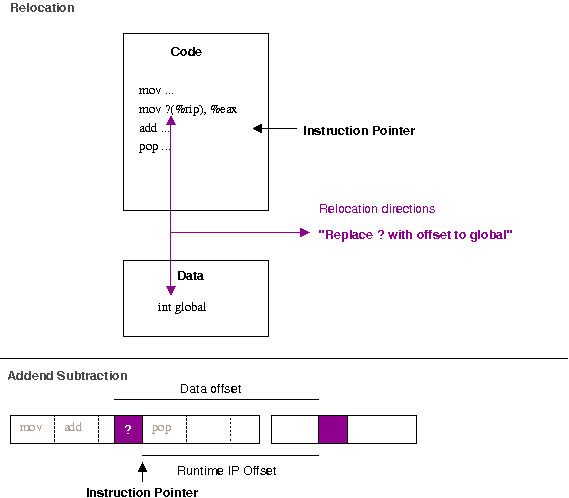
$ readelf --relocs ./function.o
Relocation section '.rela.text' at offset 0x518 contains 1 entries:
  Offset          Info           Type           Sym. Value    Sym. Name + Addend
000000000009  000800000002 R_X86_64_PC32     0000000000000000 global + fffffffffffffffc
There are many different types of relocations for different situations; the exact rules for different relocation types are described in the ABI documentation for the architecture. The R_X86_64_PC32 relocation is defined as "the base of the section the symbol is within, plus the symbol value, plus the addend". The addend makes it look more tricky than it is; remember that when an instruction is executing the instruction pointer points to the next instruction to be executed. Therefore, to correctly find the data relative to the instruction pointer, we need to subtract the extra. This can be seen more clearly when layed out in a linear fashion (as in the bottom of the above diagram). If you try and build a shared object (dynamic library) with an object file with this type of relocation, you should get something like:
$ gcc -shared function.c
/usr/bin/ld: /tmp/ccQ2ttcT.o: relocation R_X86_64_32 against  a local symbol' can not be used when making a shared object; recompile with -fPIC
/tmp/ccQ2ttcT.o: could not read symbols: Bad value
collect2: ld returned 1 exit status
If you look back at the disassembly, we notice that the R_X86_64_32 relocation has left only 4-bytes (32-bits) of space left for the relocation entry (the zeros in 7: 8b 15 00 00 00 00). So why does this matter when you're creating a shared library? The first thing to remember is that in a shared library situation, we can not depend on the local value of global actually being the one we want. Consider the following example, where we override the value of global with a LD_PRELOAD library.
$ cat function.c
int global = 100;
int function(int i)  
    return i + global;
 
$ gcc -fPIC -shared -o libfunction.so function.c
$ cat preload.c
int global = 200;
$ gcc -shared preload.c -o libpreload.so
$ cat program.c
#include <stdio.h>
int function(int i);
int main(void)  
   printf("%d\n", function(10));
 
$ gcc -L. -lfunction program.c -o program
$ LD_LIBRARY_PATH=. ./program
110
$ LD_PRELOAD=libpreload.so LD_LIBRARY_PATH=. ./program
210
If the code in libfunction.so were to have a fixed offset into its own data section, it will not be able to be overridden at run-time by the value provided by libpreload.so. Additionally, there are only 4-bytes available to patch in for the address of global -- since a shared library could conceivably be loaded anywhere in the 64-bit (8-byte) address space we therefore need 8-bytes of space to cover ourselves for all possible addresses global might turn up at. The two basic possibilities for an object file are to be either linked into an executable or linked into a shared-library. In the executable case, the value of global will be in the exectuable's data section, which should definitely be reachable with a 32-bit offset of the current instruction-pointer. The instruction-pointer relative address can simply be patched in and the executable is finalised. But what about the shared-library case, where we know the value of global could essentially be anywhere within the 64-bit address space? It is possible to leave 8-bytes of space for the address of global, by telling gcc to use the large-code model. e.g.
$ gcc -c -mcmodel=large function.c
$ objdump --disassemble ./function.o
./function.o:     file format elf64-x86-64
Disassembly of section .text:
0000000000000000 <function>:
   0:  55                      push   %rbp
   1:  48 89 e5                mov    %rsp,%rbp
   4:  89 7d fc                mov    %edi,-0x4(%rbp)
   7:  48 b8 00 00 00 00 00    movabs $0x0,%rax
   e:  00 00 00
  11:  8b 10                   mov    (%rax),%edx
  13:  8b 45 fc                mov    -0x4(%rbp),%eax
  16:  01 d0                   add    %edx,%eax
  18:  5d                      pop    %rbp
  19:  c3                      retq
However, this creates a problem if you really want to share this code. By having to patch in an address of global directly, this means the run-time code above does not remain unchanged. Two separate processes therefore can't share this code -- they each need separate copies that are identical but for their own addresses of global patched into it. By enabling Position Independent Code (PIC, with the flag -fPIC) you can ensure the code remains share-able. PIC means that the output binary does not expect to be loaded at a particular base address, but is happy being put anywhere in memory (compare the output of readelf --segments on a binary such as /bin/ls to that of any shared library). This is obviously critical for implementing lazy-loading (i.e. only loaded when required) shared-libraries, where you may have many libraries loaded in essentially any order at any location. Of course, any problem in computer science can be solved with a layer of abstraction and that is essentially what is done when compiling with -fPIC. To examine this case, let's see what happens with PIC turned on.
$ gcc -fPIC -shared -c  function.c
$ objdump --disassemble ./function.o
./function.o:     file format elf64-x86-64
Disassembly of section .text:
0000000000000000 <function>:
   0:   55                      push   %rbp
   1:   48 89 e5                mov    %rsp,%rbp
   4:   89 7d fc                mov    %edi,-0x4(%rbp)
   7:   48 8b 05 00 00 00 00    mov    0x0(%rip),%rax        # e <function+0xe>
   e:   8b 00                   mov    (%rax),%eax
  10:   03 45 fc                add    -0x4(%rbp),%eax
  13:   c9                      leaveq
  14:   c3                      retq
It's almost the same! We setup the frame pointer with the first two instructions as before. We push the first argument into memory in the pre-allocated "red-zone" as before. Then, however, we do an IP relative load of an address into rax. Next we de-reference this into eax (e.g. eax = *rax in C) before adding the incoming argument to it and returning.
$ readelf --relocs ./function.o
Relocation section '.rela.text' at offset 0x550 contains 1 entries:
  Offset          Info           Type           Sym. Value    Sym. Name + Addend
00000000000a  000800000009 R_X86_64_GOTPCREL 0000000000000000 global + fffffffffffffffc
The magic here is again in the relocations. Notice this time we have a P_X86_64_GOTPCREL relocation. This says "replace the data at offset 0xa with the global offset table (GOT) entry of global. Global Offset Table operation with data variables As shown above, the GOT ensures the abstraction required so symbols can be diverted as expected. Each entry is essentially a pointer to the real data (hence the extra dereference in the code above). Since we can assume the GOT is at a fixed offset from the program code within plus or minus 2Gib, the code can use a 32-bit IP relative address to gain access to the table entries. So, taking a look a the final shared-library binary we see a final offset hard-coded
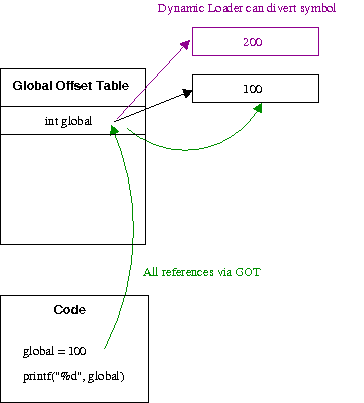
$ gcc -shared -fPIC -o libfunction.so function.c
$ objdump --disassemble ./libfunction.so
00000000000006b0 <function>:
 6b0:  55                      push   %rbp
 6b1:  48 89 e5                mov    %rsp,%rbp
 6b4:  89 7d fc                mov    %edi,-0x4(%rbp)
 6b7:  48 8b 05 8a 02 20 00    mov    0x20028a(%rip),%rax        # 200948 <_DYNAMIC+0x1d8>
 6be:  8b 10                   mov    (%rax),%edx
 6c0:  8b 45 fc                mov    -0x4(%rbp),%eax
 6c3:  01 d0                   add    %edx,%eax
 6c5:  5d                      pop    %rbp
 6c6:  c3                      retq
 6c7:  90                      nop
Every process who wants to share this code just needs to make sure they have their unique address of global at 0x20028a(%rip). Since each process has a separate address-space, this means they can all have different values for global but share the same code! Thus the default of the small-code model is sensible. It is exceedingly rare for an executable to need more than 4-byte offsets for a relative access to a variable in it's data region, so using a full 8-byte value would just be a waste of space. Although leaving 8-bytes would allow access to the variable anywhere in the 64-bit address space; when building a shared library, you really want to use -fPIC to ensure the library can actually be shared, which introduces a different relocation and access to data via the GOT. This should explain why gcc -shared function.c works on x86-32, but does not work on x86-64. Inspecting the code reveals why:
$ objdump --disassemble ./function.o
00000000 <function>:
   0:   55                      push   %ebp
   1:   89 e5                   mov    %esp,%ebp
   3:   a1 00 00 00 00          mov    0x0,%eax
   8:   03 45 08                add    0x8(%ebp),%eax
   b:   5d                      pop    %ebp
   c:   c3                      ret
$ readelf --relocs ./function.o
Relocation section '.rel.text' at offset 0x2ec contains 1 entries:
 Offset     Info    Type            Sym.Value  Sym. Name
00000004  00000701 R_386_32          00000000   global
We start out the same, with the first two instructions setting up the frame pointer. However, next we load a memory value into eax -- as we can see from the relocation information, the address of global. Next we add the incoming argument from the stack (0x8(%ebp)) to the value in this memory location; implicitly dereferencing it. But since we only have a 32-bit address-space, the 4-bytes allocated is enough to access any possible address. So while this can work, you're not creating position-independent code and hence not enabling code-sharing. The disadvantage of PIC code is that you require "bouncing" through the GOT, which requires more loads and reads to find an address than directly referencing it. However, if your program is at the point that this is becoming a performance issue you're probably not reading this blog! Hopefully, this helps clear up that possibly cryptic error message. Further searches around position-independent code, global-offset tables and code-sharing should also yield you more information if it remains unclear.

Jan Wagner: Brainfucked intellectual property rights

This issue is about a bit specific situation in Germany and it's (mainly tax-financed) public service broadcasting. If you think you are not interested, please skip this entry. :) Just beginning from scratch... In Germany we have (like most european countries) a public service broadcasting. Starting with 2013 the system collecting the funding of the public service broadcasting changed from GEZ to Beitragsservice.
To make it short (and a bit simplified) ... it changed from "most 'families' have to pay" to "every menage has to pay". This means, even if you don't have any device to use the service of the german public service broadcasting but are a menage, you have to pay for it. This sitiation is even more worse than pay-TV. Don't get me wrong ... I'm neither against public service broadcasting nor against paying for it in principle. In the rare cases I'm watching TV, this is most likely a channel of the public service broadcasting. Same counts for the rest of my small family. Mostly we are watching news and documentations ... also some movies are watched. The kids are watching KiKA, which we like cause it's Ads-free and it's not just some cartoons with hidden violence. So we most likely benefit from public service broadcasting. Anyways ... in common we are not using "TV" as most of the others may do. We still like some sort of the broadcast, but we are missing it cause various reasons. For our luck there is a service called 'Mediathek' provided by the most german public service broadcasting channels. If you missed a broadcast or are prevented for any reason, you may watch the broadcast there. Unfortunately the timeframe you can access the broadcast is very short, in most cases 7 days. This is manifested in the so called Rundfunkstaatsvertrag, more precisely in the 12. Rundfunk nderungsstaatsvertrag. The 'Tagesschau' has a good explanation about the issue. This means, in simple words, the tax payed broadcasts needs to be deleted after a (in my eyes) short time. WTF?!? Why do we wipe work we all payed for it? Guess what ... it was implemented by lobbying from commercial print media and private (e.g. ads-financed) TV-channels. A comment about a related problem, which I agree, can be found here. Another challenge ... How do you know there is a broadcasting your are interested in? How do you know when it is broadcasted? I remember, my parents was subscribed to a daily newspaper, which included an additional TV paper, my parents-in-law bought also one.
As we are neither subscribed to a daily newspaper nor buying a TV paper, we have to solve that differently (beside that a printed paper won't help us I think). When we use the opportunity to watch TV at the evening, I just use an electronical TV paper (-app). If we find something which fits, we are fine .. if not, we do other things. This sounds a bit like an old school behaviour and it is not, how I would like to use a media today. I like using a feedreader. You can subscribe differnt 'channels' of information feeds and it is a way I would love to use TV. In the past I used a tool called 'Mediathek', which is a tool for Mac OSX. With this tool it was easily possible to find broadcasts, you could subscribe to so called 'channels', which means broadcasts of a same series for example. You could also mark them as "unread" und "read" .. something like a feedreader.
On the other way, it was also possible to list recent broadcast per genres and popular broadcast of the recent and the last week. This was very comfortable as this was working for several mediathek sites for german public service broadcasting channels in one central place. For every broadcast you could just view it or download it to view it later. You could even download subscribed channels automatically. After using the Mediathek-App and being satisfied by the Mediathek sites of the german public service broadcasting channels for several years, this week the server(s) behind the App was shut down. What the f....?!? On Twitter the author stated that the shutdown was cause by problems with the copyright law. Das Erste, ZDF and WDR denied that they has anything todo with this recent issue. The question is ... what is the direct cause for shutting down such a good service. This smells a bit like the PirateBay issue, but in this case the content which is Mediathek providing access to isn't pirated, but legal hosted. So where is the real issue? In my mind, the german citizen has payed to produce this content and should have the right to access the content is an usable way. The Mediathek App did provide such a way and it is really pissing me off that this access isn't available anymore, at least for this reason. Actually I don't see any solution to access our payed content in a decent way. Footnote: I think it's obscenely, that publishing houses and commercial broadcaster trying to gain their turnover at the expense of the german citizen by forcing the german legislature to implement Depublication,.

Next.

Previous.

