Armadillo is a powerful
and expressive C++ template library for linear algebra and scientific
computing. It aims towards a good balance between speed and ease of use,
has a syntax deliberately close to Matlab, and is useful for algorithm
development directly in C++, or quick conversion of research code into
production environments. RcppArmadillo
integrates this library with the R environment and language and is
widely used by (currently) 1074 other packages on CRAN, downloaded 29.3 million
times (per the partial logs from the cloud mirrors of CRAN), and the CSDA paper (preprint
/ vignette) by Conrad and myself has been cited 535 times according
to Google Scholar.
This release brings a new upstream release 12.4.0 made by Conrad a
day or so ago. I prepared the usual release candidate, tested on the
over 1000 reverse depends (which sadly takes almost a day on old
hardware), found no issues and sent it to CRAN. Where it got tested
again and was once again auto-processed smoothly by CRAN within a few
hours on a Friday night which is just marvelous. So this time I tweeted
about it too.
The releases actually has a relatively small set of changes as a
second follow-up release in the 12.* series.
Changes
in RcppArmadillo version 0.12.4.0.0 (2023-05-26)
Upgraded to Armadillo release 12.4.0 (Cortisol Profusion
Redux)
Added norm2est() for finding fast estimates of
matrix 2-norm (spectral norm)
Added vecnorm() for obtaining the vector norm of
each row or column of a matrix
The sixth release of the still new-ish qlcal package
arrivied at CRAN today.
qlcal
delivers the calendaring parts of QuantLib. It is provided (for the R
package) as a set of included files, so the package is self-contained
and does not depend on an external QuantLib library (which can be
demanding to build). qlcal covers
over sixty country / market calendars and can compute holiday lists, its
complement (i.e. business day lists) and much more.
This release brings updates to a few calendars which happened since
the QuantLib 1.30 release, and also updates a several of the (few)
non-calendaring functions.
Changes in version 0.0.6
(2023-05-24)
Several calendars (India, Singapore, South Africa, South Korea)
updated with post-QuantLib 1.3.0 changes (Sebastian Schmidt in #6)
Three now-used scheduled files were removed (Dirk in #7))
A number of non-calendaring files used were synchronised with the
current QuantLib repo (Dirk in #8)
Last release, we also added a quick little demo using
xts to column-bind calendars produced from each of the
different US sub-calendars. This is a slightly updated version of the
sketch we
tooted a few days ago. The output now is
Courtesy of my CRANberries, there
is a diffstat report for this
release. See the project page
and package documentation for more details, and more examples.
If you like this or other open-source work I do, you can now sponsor me at
GitHub.
I upgraded the host running my blog to Debian 12 today. My website has existed in some form since 1997, it changed from pure html to a Python CGI script in the early 2000s, and when blogging became big around then, I migrated to WordPress around 2004.
This WordPress instance ran on Ubuntu up until 2010, and then on Debian ever since. Upgrades are just too easy. I did end up hitting one small bug with today s upgrade though, I run the PHP fast process manager on the Apache MPM event server, and during upgrade, php8.2-fpm wasn t enabled somehow (contrary to what I would expect), at least a simple 'a2conf enable php8.2-fpm' saved my site again after a (very rare) few minutes of downtime.
My mother died earlier this month. She d been diagnosed with cancer back in February 2022 and had been through major surgery and a couple of rounds of chemotherapy, so it wasn t a complete surprise even if it was faster at the end than expected. That doesn t make it easy, but I m glad to be able to say that her immediate family were all with her at home at the end.
I was touched by the number of people who turned up, both to the wake and the subsequent funeral ceremony. Mum had done a lot throughout her life and was settled in Newry, and it was nice to see how many folk wanted to pay their respects. It was also lovely to hear from some old school friends who had fond memories of her.
There are many things I could say about her, but I don t feel that here is the place to do so. My father and brother did excellent jobs at eulogies at the funeral. However, while I blog less about life things than I did in the past, I did not want it to go unmarked here. She was my Mum, I loved her, and I am sad she is gone.
Kweather Snap
I have completed the 23.04.1 KDE Gear applications release for snaps! With this release comes several new KDE Snaps!
Kweather
Krecorder
Kclock
Alligator
Ghostwriter
Kasts
Tokodon
Plus many long outdated / broken snaps are updated and or fixed!
Check them all out here:
https://snapcraft.io/search?q=KDE
I have been busy triaging and squashing bugs in regards to snaps on https://bugs.kde.org
Snapcraft:
Updated the kde-neon extension for the newest content pack.
Made a core22 qmake plugin with tests PR
https://github.com/canonical/craft-parts/pull/463
Future work:
Top on my TO-DO list is still PIM. There are many parts, making it more complex. I am working on it though. QT6/KF6 is making it s way to the top of the list as well. KDE Neon has made significant progress here, so I am in early stages of updating our build scripts to generate our qt6/kf6 content snap.
Thanks for stopping by!
https://gofund.me/2c7b1808 All proceeds go to improving my ability to work. Thanks for your consideration!
It wouldn t be inaccurate to say that I ve had a lot on my plate in the last few years, and that I have a *huge* backlog of little tasks to finish. Just last week, I finally got to all my keysigning from DebConf22. This week, I m at MiniDebConf Germany in Hamburg. It s the second time I m here! And it s great already. Last year I drafted a blog entry, but never got around to publishing it. So, in order to mentally tick off yet another thing, here follows a somewhat imperfect (I had to delete a lot of short-hand because I didn t know what it means anymore), but at least published post about my activities from a year ago.
This week (well, last year) I attended my first ever in-person MiniDebConf and MiniDebCamp in Hamburg, Germany. The last time I was in Germany was 7 years ago for DebConf15 (or at time of publishing, actually, last year for this same event).
My focus for the week was to work on Debian live related stuff.
In preparation for the week I tried to fix/close as many Calamares bugs as I could, so before the event I closed:
File calamares upstream issue #1944 Calamares allows me to select a username of root for Debian bug #976617.
File calamares upstream issue #1945 Calamares needs support for high DPI for Debian bug #992162.
Comment on calamares bug #1005212 Calamares installer fails at partitioning disks requesting further info.
Close calamares bug #1009876 There is no /tmp item in the list during the partitioning step in the debian calamares installer /tmp partitions can be created, not a bug, really just a small UI issue.
Close calamares bug #974998 SegFault when clicked on Create in manual partitioning , not reproducible in bullseye.
Close calamares bug #971266 Debian fails to start when /home is encrypted during installation this works fine since bullseye.
Close calamares bug #976617 Calamares allows me to select a username of root has since been fixed upstream.
Monday to Friday we worked together on various issues, and the weekend was for talks.
On Monday morning, I had a nice discussion with Roland Clobus who has been working on making Debian live images reproducible. He s also been working on testing Debian Live on openqa.debian.net. We re planning on integrating his work so that Debian 12 live images will be reproducible. For automated testing on openqa, it will be ongoing work, one blocker has been that snapshots.debian.org limits connections after a while, so builds on there start failing fast.
On Monday afternoon, I went ahead and uploaded the latest Calamares hotfix (Calamares 3.2.58.1-1) release that fixes a UI issue on the partitioning screen where it could get stuck. On 15:00 we had a stand-up meeting where we introduced ourselves and talked a bit about our plans. It was great to see how many people could benefit from each other being there. For example, someone wanting to learn packaging, another wanting to improve packaging documentation, another wanting help with packaging something written in Rust, another wanting to improve Rust packaging in general and lots of overlap when it comes to reproducible builds! I also helped a few people with some of their packaging issues.
On Monday evening, someone in videoteam managed to convince me to put together a loopy loop for this MiniDebConf. There s really wasn t enough time to put together something elaborate, but I put something together based on the previous loopy with some experiments that I ve been working on for the upcoming DC22 loopy, and we can use this loop to do a call for content for the DC22 loop.
On Tuesday morning had some chats with urbec and Ilu,Tuesday afternoon talked to MIA team about upcoming removals. Did some admin on debian.ch payments for hosting. On Tuesday evening worked on live image stuff (d-i downloader, download module for dmm).
On Wednesday morning I slept a bit late, then had to deal with some DPL admin/legal things. Wednesday afternoon, more chats with people.
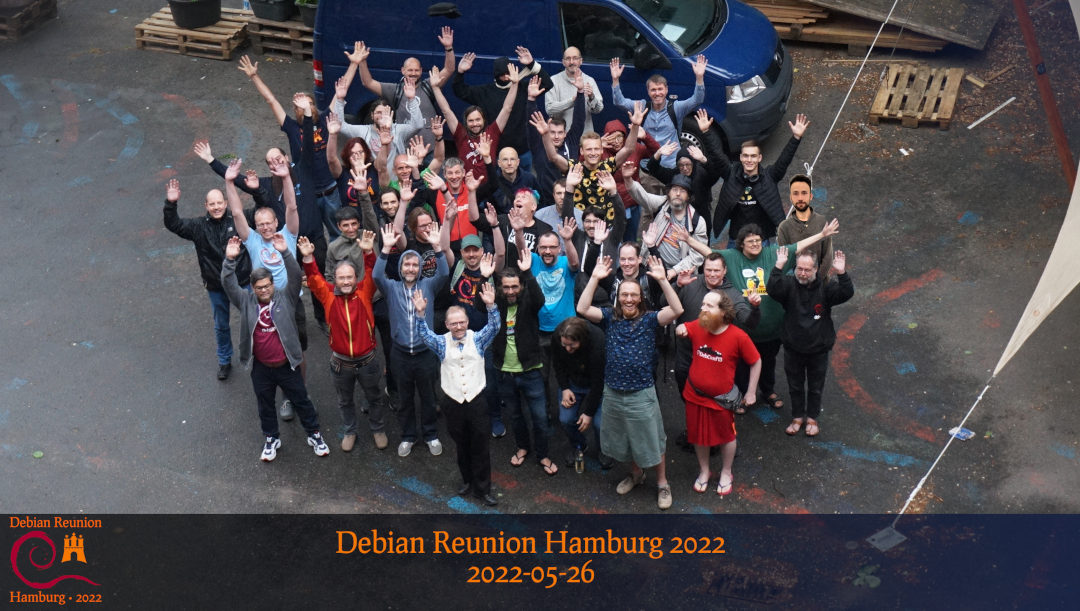
On Thursday: Talked to a bunch more people about a lot of issues, got loopy in a reasonably shape, edited and published the Group photo!
On Friday: prepared my talk slides, learned about Brave (https://github.com/bbc/brave) It initially looked like a great compositor for DebConf video stuff (and possible replacement for OBS, but it turned out it wasn t really maintained upstream). In the evening we had the Cheese and Wine party, where lots of deliciousness was experienced.
On Saturday, I learned from Felix s talk that Tensorflow is now in experimental! (and now in 2023 I checked again and that s still the case, although it hasn t made it s way in unstable yet, hopefully that improves over the trixie cycle)
I know most of the people who attended quite well, but it was really nice to also see a bunch of new Debianites that I ve only seen online before and to properly put some faces to names. We also had a bunch of enthusiastic new contributors and we did some key signing.
I've been watching the neovim community for a while and what seems like a
cambrian explosion of plugins emerging. A few weeks back I decided to spend
most of a "day of learning" on investigating some of the plugins and
technologies that I'd read about: Language Server
Protocol,
TreeSitter,
neorg (a grandiose organiser plugin),
etc.
It didn't go so well. I spent most of my time fighting version
incompatibilities or tracing through scant documentation or code to figure out
what plugin was incompatible with which other.
There's definitely a line where crossing it is spending too much time playing
with your tools instead of creating. On the other hand, there's definitely
value in honing your tools and learning about new technologies. Everyone's line
is probably in a different place. I've come to the conclusion that I don't have
the time or inclination (or both) to approach exploring the neovim universe in
this way. There exist a number of plugin "distributions" (such as LunarVim): collections of pre-
configured and integrated plugins that you can try to use out-of-the-box. Next
time I think I'll pick one up and give that a try &emdash independently
from my existing configuration &emdash and see which ideas from it I might like to
adopt.
shared vimrcs
Some folks upload their vim or neovim configurations in their entirety for
others to see. I noticed Jess Frazelle had published
hers so I took a look. I suppose one could
evaluate a bunch of plugins and configuration in isolation using a shared vimrc
like this, in the same was as a distribution.
bufferline
Amongst the plugins she uses was bufferline, a plugin to re-work neovim's
tab bar to behave like tab bars from more conventional editors1. I don't make
use of neovim's tabs at all2, so I would lose nothing having the (presently hidden)
tab bar reworked, so I thought I'd give it a go.
I had to disable an existing plugin lightline, which I've had enabled for years
but I wasn't sure I was getting much value from. Apparently it also messes with the
tab bar! Disabling it, at least for now, at least means I'll find out if I miss it.
I am already using
vim-buffergator as a means
of seeing and managing open buffers: a hotkey opens a sidebar with a list of
open buffers, to switch between or close. Bufferline gives me a more immediate,
always-present view of open buffers, which is faintly useful: but not much.
Perhaps I'd like it more if I was coming from an editor that had made it more
of an expected feature. The two things I noticed about it that aren't
especially useful for me: when browsing around vimwiki pages, I quickly
open a lot of buffers. The horizontal line fills up very quickly. Even when I
don't, I habitually have quite a lot of buffers open, and the horizontal line
is quickly overwhelmed.
I have found myself closing open buffers with the mouse, which I didn't do
before.
vert
Since I have brought up a neovim UI feature (tabs) I thought I'd briefly mention
my new favourite neovim built-in command: vert.
Quite a few plugins and commands open up a new window (e.g. git-fugitive,
Man, etc.) and they typically do so in a horizontal split. I'm increasingly
preferring vertical splits. Prefixing any3 such command with vert forces
the split to be vertical instead.
in this case the direct influence was apparently DOOM Emacs
(neo)vim's notion of tabs is completely different to what you might expect
from other UI models.
at least, I haven't found one that doesn't work yet
We are pleased to announce that Proxmox
has committed to sponsor DebConf23 as a
Platinum Sponsor.
Proxmox develops powerful, yet easy-to-use open-source server software.
The product portfolio from Proxmox, including server virtualization, backup,
and email security, helps companies of any size, sector, or industry to
simplify their IT infrastructures. The Proxmox solutions are based on the
great Debian platform, and we are happy that we can give back to the
community by sponsoring DebConf23.
With this commitment as Platinum Sponsor, Proxmox is contributing to make
possible our annual conference, and directly supporting the progress of
Debian and Free Software, helping to strengthen the community that
continues to collaborate on Debian projects throughout the rest of
the year.
Thank you very much Proxmox, for your support of DebConf23!
Become a sponsor too!
DebConf23 will take place from September 10th
to 17th, 2022 in Kochi, India, and will be preceded by DebCamp, from
September 3rd to 9th.
And DebConf23 is accepting sponsors!
Interested companies and organizations may contact the DebConf team
through sponsors@debconf.org, and
visit the DebConf23 website at
https://debconf23.debconf.org/sponsors/become-a-sponsor/.
We are pleased to announce that Infomaniak
has committed to sponsor DebConf23 as a
Platinum Sponsor.
Infomaniak is a key player in the European Cloud and the leading developer of
Web technologies in Switzerland. It aims to be an independent European
alternative to the web giants and is committed to an ethical and sustainable
Web that respects privacy and creates local jobs. Infomaniak develops cloud
solutions (IaaS, PaaS, VPS), productivity tools for online collaboration and
video and radio streaming services.
The company uses only renewable electricity, offsets 200% of its CO2 emissions
and extends the life of its servers up to 15 years. The company cools its
infrastructure with filtered air, without air conditioning, and is building
a new data centre that will fully recycle the energy it consumes to heat up
to 6,000 homes.
With this commitment as Platinum Sponsor, Infomaniak is contributing to make
possible our annual conference, and directly supporting the progress of
Debian and Free Software, helping to strengthen the community that continues
to collaborate on Debian projects throughout the rest of the year.
Thank you very much Infomaniak, for your support of DebConf23!
Become a sponsor too!
DebConf23 will take place from September 10th
to 17th, 2022 in Kochi, India, and will be preceded by DebCamp, from
September 3rd to 9th.
And DebConf23 is accepting sponsors!
Interested companies and organizations may contact the DebConf team
through sponsors@debconf.org, and
visit the DebConf23 website at
https://debconf23.debconf.org/sponsors/become-a-sponsor/.
Shared library loading. ld.so seems to load shared libraries serially, looking through the load paths, looking through DT_LOADED sections, and looking up library paths or what's in ld.so.cache.
I thought I could scan DT_LOADED with just reading approx first 2kB of shared library, and get the full list of shared libraries first, and then readahead(2) the list of shared libraries available.
The result was that I could load blender binary slightly faster. blender spends about 300ms waiting for disk loading shared libraries and I could shorten it to about 100ms.
sopreload, is a proof of concept with rough edges but I think it's a nice improvement.
Tobias Frost
did 15.0h (out of 15.0h assigned and 1.0h from previous period), thus carrying over 1.0h to the next month.
Utkarsh Gupta
did 3.5h (out of 11.0h assigned and 18.5h from previous period), thus carrying over 26.0h to the next month.
Evolution of the situation
In April, we have released 35 DLAs.
The LTS team would like to welcome our newest sponsor, Institut Camille Jordan, a French research lab. Thanks to the support of the many LTS sponsors, the entire Debian community benefits from direct security updates, as well as indirect improvements and collaboration with other members of the Debian community.
As part of improving the efficiency of our work and the quality of the security updates we produce, the LTS has continued improving our workflow. Improvements include more consistent tagging of release versions in Git and broader use of continuous integration (CI) to ensure packages are tested thoroughly and consistently. Sponsors and users can rest assured that we work continuously to maintain and improve the already high quality of the work that we do.
Thanks to our sponsors
Sponsors that joined recently are in bold.
We are happy to share that the RcppSimdJson
package has been updated to release 0.1.10.
RcppSimdJson
wraps the fantastic and genuinely impressive simdjson library by Daniel Lemire and collaborators. Via
very clever algorithmic engineering to obtain largely branch-free code,
coupled with modern C++ and newer compiler instructions, it results in
parsing gigabytes of JSON parsed per second which is quite
mindboggling. The best-case performance is faster than CPU speed as
use of parallel SIMD instructions and careful branch avoidance can lead
to less than one cpu cycle per byte parsed; see the video of the talk by Daniel Lemire
at QCon.
This release updates the underlying simdjson library to
version 3.1.8 (also made today). Otherwise we only made a minor edit to
the README and adjusted one tweek for code coverage.
The (very short) NEWS entry for this release follows.
Changes in version 0.1.10
(2023-05-14)
simdjson was upgraded to version 3.1.8
(Dirk in #85).
How-To use fwupd
As one cannot use fwupd on Qubes OS
to update firmwares this is a quick How-To for
using fwupd on Grml for future me. (Qubes 4.2 will bring qubes-fwupd.)
boot into Grml.
mkdir /efi ; mount /boot/efi to /efi or set OverrideESPMountPoint=/boot/efi/EFI if you mount to the usual path.
Hello folks!
We recently received a case letting us know that Dataproc 2.1.1 was unable to write to a BigQuery table with a column of type JSON. Although the BigQuery connector for Spark has had support for JSON columns since 0.28.0, the Dataproc images on the 2.1 line still cannot create tables with JSON columns or write to existing tables with JSON columns.
The customer has graciously granted permission to share the code we developed to allow this operation. So if you are interested in working with JSON column tables on Dataproc 2.1 please continue reading!
Use the following gcloud command to create your single-node dataproc cluster:
The following file is the Scala code used to write JSON structured data to a BigQuery table using Spark. The file following this one can be executed from your single-node Dataproc cluster.
Main.scala
import org.apache.spark.sql.functions.col
import org.apache.spark.sql.types. Metadata, StringType, StructField, StructType
import org.apache.spark.sql. Row, SaveMode, SparkSession
import org.apache.spark.sql.avro
import org.apache.avro.specific
  val env = "x"
  val my_bucket = "cjac-docker-on-yarn"
  val my_table = "dataset.testavro2"
    val spark = env match
      case "local" =>
        SparkSession
          .builder()
          .config("temporaryGcsBucket", my_bucket)
          .master("local")
          .appName("isssue_115574")
          .getOrCreate()
      case _ =>
        SparkSession
          .builder()
          .config("temporaryGcsBucket", my_bucket)
          .appName("isssue_115574")
          .getOrCreate()

  // create DF with some data
  val someData = Seq(
    Row(""" "name":"name1", "age": 10  """, "id1"),
    Row(""" "name":"name2", "age": 20  """, "id2")
  )
  val schema = StructType(
    Seq(
      StructField("user_age", StringType, true),
      StructField("id", StringType, true)
    )
  )
  val avroFileName = s"gs://$ my_bucket /issue_115574/someData.avro"

  val someDF = spark.createDataFrame(spark.sparkContext.parallelize(someData), schema)
  someDF.write.format("avro").mode("overwrite").save(avroFileName)
  val avroDF = spark.read.format("avro").load(avroFileName)
  // set metadata
  val dfJSON = avroDF
    .withColumn("user_age_no_metadata", col("user_age"))
    .withMetadata("user_age", Metadata.fromJson(""" "sqlType":"JSON" """))
  dfJSON.show()
  dfJSON.printSchema
  // write to BigQuery
  dfJSON.write.format("bigquery")
    .mode(SaveMode.Overwrite)
    .option("writeMethod", "indirect")
    .option("intermediateFormat", "avro")
    .option("useAvroLogicalTypes", "true")
    .option("table", my_table)
    .save()
#!/bin/bash
PROJECT_ID=set-yours-here
DATASET_NAME=dataset
TABLE_NAME=testavro2
# We have to remove all of the existing spark bigquery jars from the local
# filesystem, as we will be using the symbols from the
# spark-3.3-bigquery-0.30.0.jar below.  Having existing jar files on the
# local filesystem will result in those symbols having higher precedence
# than the one loaded with the spark-shell.
sudo find /usr -name 'spark*bigquery*jar' -delete
# Remove the table from the bigquery dataset if it exists
bq rm -f -t $PROJECT_ID:$DATASET_NAME.$TABLE_NAME
# Create the table with a JSON type column
bq mk --table $PROJECT_ID:$DATASET_NAME.$TABLE_NAME \
  user_age:JSON,id:STRING,user_age_no_metadata:STRING
# Load the example Main.scala
spark-shell -i Main.scala \
  --jars /usr/lib/spark/external/spark-avro.jar,gs://spark-lib/bigquery/spark-3.3-bigquery-0.30.0.jar
# Show the table schema when we use  bq mk --table  and then load the avro
bq query --use_legacy_sql=false \
  "SELECT ddl FROM $DATASET_NAME.INFORMATION_SCHEMA.TABLES where table_name='$TABLE_NAME'"
# Remove the table so that we can see that the table is created should it not exist
bq rm -f -t $PROJECT_ID:$DATASET_NAME.$TABLE_NAME
# Dynamically generate a DataFrame, store it to avro, load that avro,
# and write the avro to BigQuery, creating the table if it does not already exist
spark-shell -i Main.scala \
  --jars /usr/lib/spark/external/spark-avro.jar,gs://spark-lib/bigquery/spark-3.3-bigquery-0.30.0.jar
# Show that the table schema does not differ from one created with a bq mk --table
bq query --use_legacy_sql=false \
  "SELECT ddl FROM $DATASET_NAME.INFORMATION_SCHEMA.TABLES where table_name='$TABLE_NAME'"
Google BigQuery has supported JSON data since October of 2022, but until now, it has not been possible, on generally available Dataproc clusters, to interact with these columns using the Spark BigQuery Connector.
JSON column type support was introduced in spark-bigquery-connector release 0.28.0.
Small reminder for the Debian Reunion Hamburg 2023 from May 23 to 30
As in previous years there will be a rather small Debian Reunion Hamburg 2023 event taking place from May 23rd until the 30th (with the 29th being a public holiday in Germany and elsewhere).
We'll have days of hacking (inside and outside), a day trip and a small cheese & wine party, as well as daily standup meetings to learn what others are doing, and there shall also be talks and workshops. At the moment there are even still some beds on site available and the CfP is still open!
For more information on all of this: please check the above wiki page!
May the force be with you.
A first follow-up to the initial
announcement just days ago of the new crc32c
package. The package offers cyclical checksum with parity in
hardware-accelerated form on (recent enough) intel cpus as well as on
arm64.
This follow-up was needed because I missed, when switching to a
default static library build, that newest compilers would
complain if -fPIC was not set. gcc-12 on my
box was happy, gcc-13 on recent Fedora as used at CRAN was
not. A second error was assuming that saying
SystemRequirements: cmake would suffice. But hold on
whippersnapper: macOS always has a surprise for you! As
described at the end of the appropriate section in Writing R
Extensions, on that OS you have to go the basement, open
four cupboards, rearrange three shelves and then you get to use it. And
then in doing so (from an added configure script) I failed
to realize Windows needed a fallback. Gee.
The NEWS entry for this (as well the initial release) follows.
Changes in version 0.0.2
(2023-05-11)
Explicitly set cmake property for
position-independent code
Help macOS find its cmake binary as
detailed also in WRE
Help Windows with a non-conditional Makevars.win pointing at
cmake
Add more badges to README.md
Changes in version 0.0.1
(2023-05-07)
Initial release version and CRAN upload
If you like this or other open-source work I do, you can now sponsor me at
GitHub.
India Press Freedom
Just about a week back, India again slipped in the Freedom index, this time falling to 161 out of 180 countries. The RW again made lot of noise as they cannot fathom why it has been happening so. A recent news story gives some idea. Every year NCRB (National Crime Records Bureau) puts out its statistics of crimes happening across the country. The report is in public domain. Now according to report shared, around 40k women from Gujarat alone disappeared in the last five years. This is a state where BJP has been ruling for the last 30 odd years. When this report became viral, almost all national newspapers the news was censored/blacked out. For e.g. check out newindianexpress.com, likewise TOI and other newspapers, the news has been 404. The only place that you can get that news is in minority papers like siasat. But the story didn t remain till there. While the NCW (National Commission of Women) pointed out similar stuff happening in J&K, Gujarat Police claimed they got almost 39k women back. Now ideally, it should have been in NCRB data as an addendum as the report can be challenged. But as this news was made viral, nobody knows the truth or false in the above. What BJP has been doing is whenever they get questioned, they try to muddy the waters like that. And most of the time, such news doesn t make to court so the party gets a freebie in a sort as they are not legally challenged. Even if somebody asks why didn t Gujarat Police do it as NCRB report is jointly made with the help of all states, and especially with BJP both in Center and States, they cannot give any excuse. The only excuse you see or hear is whataboutism unfortunately
Profiteering on I.T. Hardware
I was chatting with a friend yesterday who is an enthusiast like me but has been more alert about what has been happening in the CPU, motherboard, RAM world. I was simply shocked to hear the prices of motherboards which are three years old, even a middling motherboard. For e.g. the last time I bought a mobo, I spent about 6k but that was for an ATX motherboard. Most ITX motherboards usually sold for around INR 4k/- or even lower. I remember Via especially as their mobos were even cheaper around INR 1.5-2k/-. Even before pandemic, many motherboard manufacturers had closed down shop leaving only a few in the market. As only a few remained, prices started going higher. The pandemic turned it to a seller s market overnight as most people were stuck at home and needed good rigs for either work or leisure or both. The manufacturers of CPU, motherboards, GPU s, Powersupply (SMPS) named their prices and people bought it. So in 2023, high prices remained while warranty periods started coming down. Governments also upped customs and various other duties. So all are in hand in glove in the situation. So as shared before, what I have been offered is a 4 year motherboard with a CPU of that time. I haven t bought it nor do I intend to in short-term future but extremely disappointed with the state of affairs
AMD Issues
It s just been couple of hard weeks apparently for AMD. The first has been the TPM (Trusted Platform Module) issue that was shown by couple of security researchers. From what is known, apparently with $200 worth of tools and with sometime you can hack into somebody machine if you have physical access. Ironically, MS made a huge show about TPM and also made it sort of a requirement if a person wanted to have Windows 11. I remember Matthew Garett sharing about TPM and issues with Lenovo laptops. While AMD has acknowledged the issue, its response has been somewhat wishy-washy. But this is not the only issue that has been plaguing AMD. There have been reports of AMD chips literally exploding and again AMD issuing a somewhat wishy-washy response. Asus though made some changes but is it for Zen4 or only 5 parts, not known. Most people are expecting a recession in I.T. hardware this year as well as next year due to high prices. No idea if things will change, if ever
I previously wrote that when Firefox receives a file whose
media type is text/markdown, it prompts the user to download it, whereas
other browsers display rendered results.
Now it is possible to upvote a proposal on
connect.mozilla.org
asking that Firefox renders Markdown by default.

 Armadillo is a powerful
and expressive C++ template library for linear algebra and scientific
computing. It aims towards a good balance between speed and ease of use,
has a syntax deliberately close to Matlab, and is useful for algorithm
development directly in C++, or quick conversion of research code into
production environments. RcppArmadillo
integrates this library with the R environment and language and is
widely used by (currently) 1074 other packages on CRAN, downloaded 29.3 million
times (per the partial logs from the cloud mirrors of CRAN), and the CSDA paper (preprint
/ vignette) by Conrad and myself has been cited 535 times according
to Google Scholar.
This release brings a new upstream release 12.4.0 made by Conrad a
day or so ago. I prepared the usual release candidate, tested on the
over 1000 reverse depends (which sadly takes almost a day on old
hardware), found no issues and sent it to CRAN. Where it got tested
again and was once again auto-processed smoothly by CRAN within a few
hours on a Friday night which is just marvelous. So this time I tweeted
about it too.
The releases actually has a relatively small set of changes as a
second follow-up release in the 12.* series.
 I upgraded the host running my blog to Debian 12 today. My website has existed in some form since 1997, it changed from pure html to a Python CGI script in the early 2000s, and when blogging became big around then, I migrated to WordPress around 2004.
This WordPress instance ran on Ubuntu up until 2010, and then on Debian ever since. Upgrades are just too easy. I did end up hitting one small bug with today s upgrade though, I run the
 The following contributors got their Debian Developer accounts in the last two months:
 My mother died earlier this month. She d been diagnosed with cancer back in February 2022 and had been through major surgery and a couple of rounds of chemotherapy, so it wasn t a complete surprise even if it was faster at the end than expected. That doesn t make it easy, but I m glad to be able to say that her immediate family were all with her at home at the end.
I was touched by the number of people who turned up, both to the wake and the subsequent funeral ceremony. Mum had done a lot throughout her life and was settled in Newry, and it was nice to see how many folk wanted to pay their respects. It was also lovely to hear from some old school friends who had fond memories of her.
There are many things I could say about her, but I don t feel that here is the place to do so. My father and brother did excellent jobs at eulogies at the funeral. However, while I blog less about life things than I did in the past, I did not want it to go unmarked here. She was my Mum, I loved her, and I am sad she is gone.
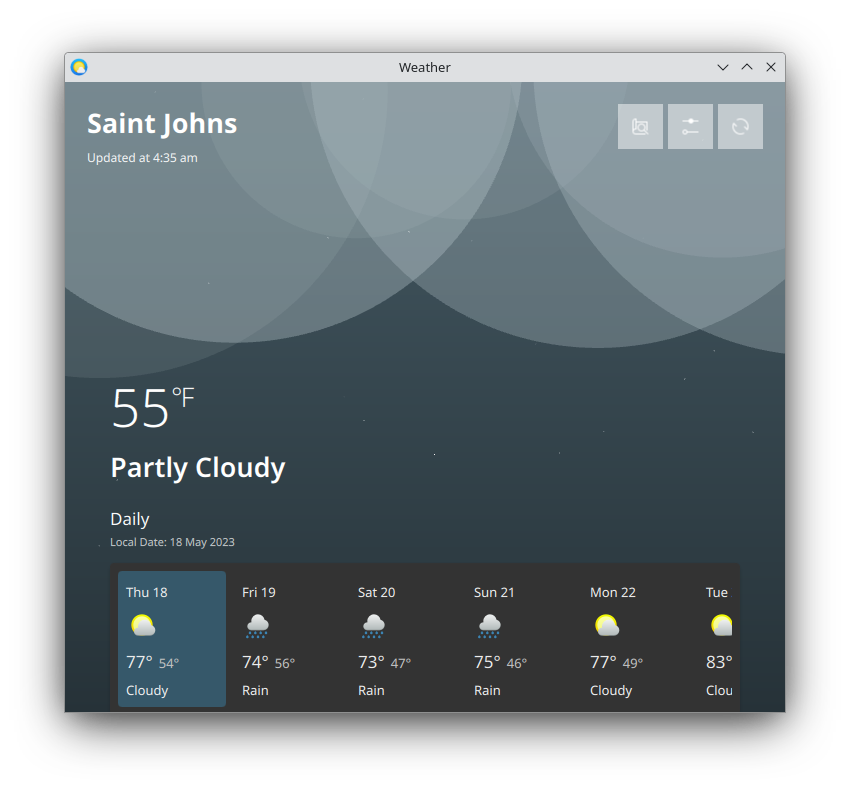 Kweather Snap

 I've been watching the neovim community for a while and what seems like a
cambrian explosion of plugins emerging. A few weeks back I decided to spend
most of a "day of learning" on investigating some of the plugins and
technologies that I'd read about:

 Considering I ve created my own private cloud in my home as part of: wp-k8s: WordPress on privately hosted Kubernetes cluster (Raspberry Pi 4 + Synology)....
The post

 Shared library loading. ld.so seems to load shared libraries serially, looking through the load paths, looking through DT_LOADED sections, and looking up library paths or what's in ld.so.cache.
I thought I could scan DT_LOADED with just reading approx first 2kB of shared library, and get the full list of shared libraries first, and then readahead(2) the list of shared libraries available.
The result was that I could load blender binary slightly faster. blender spends about 300ms waiting for disk loading shared libraries and I could shorten it to about 100ms.

 Like each month, have a look at the work funded by
 How-To use fwupd
As one cannot use
 Hello folks!
We recently received a case letting us know that Dataproc 2.1.1 was unable to write to a BigQuery table with a column of type JSON. Although the BigQuery connector for Spark has had support for JSON columns since 0.28.0, the Dataproc images on the 2.1 line still cannot create tables with JSON columns or write to existing tables with JSON columns.
The customer has graciously granted permission to share the code we developed to allow this operation. So if you are interested in working with JSON column tables on Dataproc 2.1 please continue reading!
Use the following gcloud command to create your single-node dataproc cluster:


 I