Search Results: "ed"

3 May 2011

John Goerzen: The death of one

I mourn the loss of thousands of precious lives, but I will not rejoice in the death of one, not even an enemy. Returning hate for hate multiplies hate, adding deeper darkness to a night already devoid of stars. Darkness cannot drive out darkness: only light can do that. Hate cannot drive out hate: only love can do that. anonymous (often attributed to Martin Luther King, Jr.)
Seen many times today.

Luke Faraone: Your release sucks.

I look forward to Ubuntu s semiannual release day, because it s the completion of 6ish months of work by Ubuntu (and by extension Debian) developers.I also loathe it, because every single time we get people saying This Ubuntu release is the worst release ever! .Ubuntu releases are always rocky around release time, because the first time Ubuntu gets widespread testing is on or after release day.We ship software to 12 Million Ubuntu Users with only 150 MOTUs who work directly on the platform. That s a little less than 1 developer with upload rights to the archive for every 60,000 users.1 Compared to Debian, which (at last estimate in 2010) had 1.5 million uniques on security.debian.org, yet has around 1000 Debian Developers.Debian has a strong testing culture; someone once estimated that around of Debian users are running unstable or testing. In Ubuntu, we don t have good metrics on how many people are using the development release that I m aware of (pointers welcome), but I d guess that it s a very very small percentage. A common thread in bug reports, if we get a response at all, goes on as follows:

Triager:2 Is this a problem in $devel?

User: I ll let you know when it hits final

Triager: It s too late then. Then we ll want you to test in the next release. We have to fix it BEFORE its final

User: Ok, I ll test at beta.

Triager: That s 2 weeks before release, which will be too late. Please test ASAP if you want us to have time to fix it Of course, there are really important bugs with hardware support which keep on cropping up. But if they re just getting reported on or around release day, there are limits to what can be done about them this cycle.We need to make it easier for people to run early development versions, and encourage more people to use them (as long as they re willing to deal with breakage). I m not sure whether unstable/testing is appropriate for Ubuntu, and I m fairly confident that we don t want to move to a rolling release (currently being discussed in Debian, summary). But we badly need more developers, and equally importantly, more testers to try it out earlier in the release process.To users: please, please try out the development versions. Download a LiveCD and run a smoketest, or check if bugs you reported are in fact fixed in the later versions. And do it early and often.

  1. This number, like all other usage data, is dated, and probably wasn t even accurate when it was first calculated
  2. Developer, bugcontrol member, etc. Somebody who is not experiencing the problem but wants to help.

2 May 2011

Kai Wasserb ch: Flattr option added to traffic-intensive package downloads

Due to popular demand ("I would give you something, if you'd offer Flattr."), which really just came up after WineHQ started linking to the download page, I've added a Flattr link to the wine-unstable download page. I still wanted to keep it as unobtrusive as possible and just use a text link. In other news I've uploaded 1.3.19 today, sorry that I didn't manage to do so before the weekend was over, but the upstream release happend after I went on a short trip to Bremen. And since some people didn't seem to read the notes on the download page, I'll try it through this channel: the package download page is NOT an APT repository. I want people to carefully consider the pros and cons before installing software from a third party. So please don't point your sources.list to the download page. Thanks!

Michal Čihař: PPA for Debian

There seem to be lot of momentum in discussions about making Debian testing more attractive to users on debian-devel mailing list (see Lucas's summary for summary of the lengthy discussion). One of the raised points there is that Debian misses equivalent of Ubuntu's PPA or openSUSE build service. As Debian is usually about do-ocracy, it will be there once it will be implemented, but I still don't think it is always useful to have such thing. The problem with both (but this is especially the case for openSUSE build service) is that you need to add dozens of home: projects with questionable quality of the software. This usually leads to horrible mess, especially in case of incompatible libraries with different build options (anybody using wxWidgets?). It can definitely lower barrier for people to create packages for the distro, but is it really good to lower barrier that much? I'd really prefer new things to be uploaded to Debian itself without need to use any external repositories, it would ensure at least some level of quality and compatibility with other packages.

Filed under: Debian English Suse 5 comments Flattr this!

Michal Čihař: Photo of a week 17

Finally some picture published on time. Going to slightly larger animals this week. Picture taken at parkour race in Prague. Race Taken again using PENTAX K7 + PENTAX-DA 70mm F2.4 Limited.

Filed under: English Photography 1 comments Flattr this!

Lucas Nussbaum: Debian rolling discussion on -devel@

Here is my attempt at a summary of the rolling discussion currently happening on debian-devel@. It might not be complete, it s probably a bit biased, but I hope that it s still better than nothing. It was also posted on debian-devel@. If you are involved in Debian development, please discuss it on debian-devel@, rather than in the comments of this blog. If you want to provide feedback about the Debian rolling idea, use this Doodle poll and/or the comments of this blog.
Update : Someone had the good idea to vandalize the poll, and remove all the votes from people in favor of rolling. Before the vadalism (log), the results were:
37 votes: I am a Debian user, I use testing or unstable, and I would like rolling to happen.
6 votes: I am a Debian user, I use testing or unstable, and I DON T want rolling to happen.
17 votes: I am a Debian user, I use stable, and I would like rolling to happen.
3 votes: I am a Debian user, I use stable, and I DON T want rolling to happen.
7 votes: I am NOT a Debian user, but I would probably use it if rolling happened.
1 vote: I am NOT a Debian user, and I don t care about rolling. Motivations There s some user demand for rolling releases. For evidence, one can look at the usage of Debian testing or unstable which clearly goes further than the Debian development community. Or at the quickly growing market share of ArchLinux. Or at the interest in LinuxMint and Aptosid. Or at the DPL s report of his interactions with the press. Debian s only official product is its stable releases. While it s a clearly great and useful product, many users and developers don t recognize themselves in it: it contains software that is too old for their needs. The success of Ubuntu is related to this problem: Ubuntu proposes a different compromise between stability and up-to-date-ness. While concurrencing Ubuntu with more frequent stable releases (released every 6-months, for example) doesn t look like the right thing to do, Debian is in a perfect position to provide a rolling release with marginal additional work, since Debian already has testing (and unstable) to build on. The rolling discussion investigates how we could endorse the concept of a rolling release, provided as a product in addition to stable releases. This rolling release would be based on the current testing branch. Benefits for Debian: Current proposed plan for rolling (Disclaimer: this is mostly my view. It is shared by others, but some details might not be) rolling is mostly about (external) communication. It is not expected to change our development processes fundamentally.
It would be a statement by the project (through a GR, for example). A very preliminary draft was proposed by Raphael Hertzog:
Title: Debian endorses usage of testing by end-users, and renames it to rolling The Debian project recognizes that the Debian testing distribution initially created to make it easier to prepare and test the next stable release has become a useful product of its own. It satisfies the needs of users who are looking for the latest stable versions of software and who can cope (or even appreciate) a system that s constantly evolving. The Debian project decides to endorse this usage and will strive to provide a good experience to users of testing . To better communicate this policy change to our users, testing will be renamed rolling .
Yes, it s mostly PR bullshit , and I don t expect it to significantly change Debian development processes. However, communication is necessary if we want to attract new users. What would change is more attention from developers to what happens in testing/rolling, which is a good thing since a better testing/rolling makes it easier to create stable releases from it. Open questions Most of the discussion is about the influence of the introduction of rolling on Debian development processes, and in particular, on the painful process resulting in stable releases. Many fear that, with rolling , it will be harder to get stable releases out. The root question is: if we do rolling, what do we do during freezes? Several options have been mentioned in the thread:
  1. We could decide not to do anything special: just freeze rolling for ~6 months, as we used to freeze testing. That might bore people who like the constant flux of new upstream releases, but if we decide that it s the only way to ensure high-quality stable releases, so be it.
  2. We could decide to fork a frozen branch when we freeze, and continue to manage rolling using migrations from unstable.
  3. We could mix both solutions: freeze rolling for 3 months, so that most of the stabilization work occurs with a single active branch, and then, for the final release preparation, fork frozen off rolling, and unfreeze rolling.
Two kinds of objections have been raised: Other things that were discussed: Tentative personal conclusion I have the impression that advertising testing as a rolling release usable by end-users is generally considered a good thing.
The renaming of testing to rolling is not as consensual, but most opponents have a whatever ; if you want position. How we deal with freezes is the hard point in this discussion. I m personnally in favor of the freeze rolling for 3 months, then fork frozen and unfreeze rolling plan, though it has some problems too (it is not clear whether the required manpower really decreases at the end of freezes). Where do we go from there? After another round of discussion, we might postpone the how to deal with freezes question to later, and proceed with a GR to measure the support for the testing for end-users + s/testing/rolling/ proposal.

Russell Coker: This Event Will be Photographed

sign saying This event will be photographed. Images may be used in Banyule City Council promotional material (posters, website, flyers etc).  If you do not want your image used, please go to Event Control staff and tell them. The above sign was prominently displayed at a fair that was recently run by the Banyule Council. We have had some discussions in the Linux community about what policies should be used in regard to photography at events, it seems that this is a precedent for being able to opt-out of public photography.

Christian Perrier: Weird feeling...

...when waking up, learning, live, the death of Bin Laden, and then spend one hour wondering if I should be happy or sad that we end up being happy of this. Confused, still confused.

Christian Perrier: 2011 week 17 Debian work

Will I succeed maintaining a weekly log of what I'm doing in Debian? We'll see. At least, let's try. D-I work: After spending most of the end of week 16 uploading D-I components, I completed this during this week. I hunted down the remaining arch:all, arch:i386 and arch:amd64 packages that need an upload because of l10n changes. The main point was bringing published D-I work inline with the work of translators. That was mostly meant to publicly have an image with Uyghur activated (which I blogged about separately). Finally, I ended up doing some changes to the fonts-ukij-uyghur package in order to use the right font to display the language in D-I, as well as improving the readability by increasing the font size just as we're already doing for Arabic and Persian. Samba packaging: I got release managers approval to upload a new release to stable-proposed-updates. It fixes several important bugs in samba 3.5.6, often affecting Win7 clients. I'm always happy to see that we can do that even when issues are ot security or "release critical" issues. I also integrated the newly-published samba 3.6.0-pre3 in the package maintenance SVN. However, we're still having problems with symbols disappearing from libwbclient, that prevent me to upload 3.6.0pre3 in experimental. Steve Langasek's help here will be welcome. Pytrainer and "gant" packaging: I setup a mailing list for the pkg-running maintenance team so that we can move the few packages some of us maintain (pytrainer and garmin-forerunner-tools as of now, and soon "garmin-ant-downloader", the helper tool for 405 watches). I also began looking at pytrainer bugs and forwarding some of them upstream. I also began packaging "gant" (had to rename it as we already have a gant package, totally unrelated). I just got a notice from Klaus Ethgen about improvements he did to the software. We'll try to figure out what to do as this software doesn't really have a clear upstream and published versions. l10n work: a few packages introduced debconf templates and I launched reviews of English for them (while mumbling about uncoordinated work, of course..;-)). I also reviewed about one hundred package description translations in French DDTP (something I recently began to commit to do even though it means onlinen work for me, which I'm not used to). No l10n NMUs this week but a few maintainer uploads after I (gently) kicked their ass..:-)

1 May 2011

Christian Perrier: [life] Bhutanese music

I really don't know how I ended up spending this entire evening listening to Bhutanese music. But I did well. I particularly enjoyed Rang Sem Kar Ga Mikar and Gayser Jang Lu Jonpi Gang, which I both found on YouTube. The former reminded be the pleasure and (apparent) simplicity of Bhutanese dances, which I had the privilege to share with guests in Thimphu a few years ago. The latter gives a great idea of the peacefulness of that place of the world (I recommend scenery views some of which probably taken at Dochula Pass). And that language is so beautiful even when one doesn't understand a word. Maybe some readers of this blog will become listeners of Bhutanese music for some time after reading this. I just can wish this. And, doh, I really can't wait until I go back there. I will, one day or another. "Ku Zu Zang Po La" to those who made me discover that place.

Michal Čihař: Photo of a week 16

Slightly delayed, but here comes photo for last week. I simply failed to download it from camera and process it. Continuing in animal macro, this time it is frog somewhere in Beskydy mountains. Frog Taken again using same combo PENTAX K7 + PENTAX-DA 35mm F2.8 Macro Limited.

Filed under: English Photography 0 comments Flattr this!

Ana Beatriz Guerrero Lopez: Qt 3 looking for adopters

With KDE 3 almost gone in unstable, the KDE team is not longer interested in Qt 3 and we are looking for new maintainer(s). If you want to have Qt 3 in wheezy, now is the time to step up! Please, read this email and reply in list.

Luca Falavigna: Blessed Ioannes Paulus II

I will never forget.

Christian Perrier: Preview of Debian Installer in Uyghur

Last week, I announced the activation of Uyghur language in Debian Installer. For once, I even went further: I rebuilt all D-I packages that include localization (at least for i386/amd64 architectures) and uploaded them. As a consequence, D-I daily builds now allow previewing how an install done in Uyghur can be like. For this, please go to the Debian Installer development page, download the netboot ISO image (not netinst) and launch D-I with "suite=unstable" passed as argument when booting the ISO image. You should end up with something like this, this or this. There are a few glitches, still: for instance, as the font we chose has no Bold variant, the screens "titles" do not use an Uyghur font but an Arabic or Persian one. As a consequence, glyphs ar enot properly joined together. I'm investigating this issue with Uyghur translators and we're trying to choose an appropriate font among the gazillion that have been created by UKIJ. Please notice that Uyghur looks like Arabic but, according to those who can read Arabic, is really different from Arabic (or Persian). I hope that this great work by Gheyret Tohti, Abduqadir Abliz and other people working on this will give ideas to other so-called "minorities", here or there in the world, who want to be able to install Debian in their language. There is still a lot of work to do, such as having end-user software localization for Uyghur and, then, a uyghur-desktop task, but this is at least the first language that gets added for wheezy. In case you would be wondering, the current count of activated languages in D-I is 71.

30 April 2011

Julian Andres Klode: last two weeks

The last two weeks, two new python-apt releases were made. 0.8.0~exp3 did not add much, but 0.8.0~exp4 added some new bindings for our friends at the mancoosi project. I also committed several fixes to the APT repository, but did not upload them yet. In #debian-devel, some people (including me and others on the Debian side; and sladen, sabdfl for the Ubuntu side) discussed the Ubuntu font license which is considered non-free by Debian, due to extreme naming restrictions in section 2 (unmodified versions must keep the name, slightly modified versions must keep the name and add something). Some consider those restrictions equivalent to invariant sections. After we discusses the font license, we quickly got to discuss Doctor Who and time travel, as those two are obviously connected. Some other things happened as well, like closing more bugs, but all in all, the last two weeks where a bit less intensive than the two weeks before them.
Filed under: Debian

Petter Reinholdtsen: Experimental Open311 API for the mySociety fixmystreet system

Today, the first draft implementation of an Open311 API for the Norwegian service FiksGataMi started to work. It is only available on the developer server for now, and I have not tested it using any existing Open311 client (I lack the platforms needed to run the clients I have found so far), but it is able to query the database and extract a list of open and closed requests within a given category and reported to a given municipality. I believe that is a good start to create a useful service for those that want to do data mining on the requests submitted so far. Where is it? Visit http://fiksgatami-dev.nuug.no/open311.cgi/v2/ to have a look. Please send feedback to the fiksgatami (at) nuug.no mailing list.

Russell Coker: Autism Awareness and the Free Software Community

It s Autism Awareness Month April is Autism Awareness month, there are lots of articles about Autism, most of them are at best misleading if not wrong. The most common error seems to be describing non-verbal Autistic children and then claiming that Autistic people comprise about 1% of the population. The number of non-verbal Autistic children is a lot less than 1% of the population, and at least 1/3 of the people on the Autism Spectrum have good verbal skills and often talk more than average. To be precise, they are describing the symptoms of people who would be diagnosed with Severity 3 according to the American Psychiatric Association s Diagnostic and Statistical Manual (the DSM) as applying to all people who are on the Autism Spectrum even though of the currently diagnosed people probably about 1/3 might be classified as Severity 2 and 1/3 as Severity 1. It seems that severity 1 Autism is going to be the replacement for Asperger Syndrome in the new DSM-5. The problem with misleading information in regard to what comprises Autism is that parents really don t want to have a child who s abnormal and search for evidence to make their wishes come true. At the extreme there are parents who can convince themselves that a 4yo non-verbal child isn t on the Autism Spectrum. When people are given the impression that Autism is only about non-verbal children then they will probably think that a 6yo who can give a half-hour lecture on a topic of interest (regardless of whether the audience is interested) isn t on the Autism Spectrum. There is also a similar issue with undiagnosed adults, I would have probably got assessed at least a decade earlier if I had learned more about Autism instead of believing some of the stories. In a quick Google search for Autism Awareness Month I haven t found any clear and accurate information on what Autism is or what should be done about it, so it seems to me that the awareness project has largely been a failure. The Autism page on Wikipedia [1] and the page for Asperger Syndrome [2] are good places to start reading. By merely pointing to those two Wikipedia pages I ve made this post a lot more useful than every article I ve seen in the mainstream media. To find some useful and insightful posts about Autism awareness you have to add some search terms such as neurodiversity, which turns up posts such as a post by Leah Jane about Autism Acceptance [3]. It seems that the Autism Awareness articles that are most useful at informing people will only be found by people who are already aware of some of the issues. Most People Who Read this are Geeks The majority of the readers for my blog come from aggregators that cater to fairly geeky people. Geek culture is largely Aspie culture. So I think that most people who read my blog have a good general knowledge of what people who might be diagnosed with Asperger Syndrome or High Functioning Autism are like they just think that such people are merely a bit more geeky than is typical for the Free Software community. So it s not as if all Autistic people are hidden away somewhere because they can t live independently. Many of us work in the computer industry and in academia. Probably the majority of people who have a university degree related to science or engineering have had a professor who was on the Autism Spectrum, probably most people who have any significant experience in the computer industry have had colleagues who are on the Spectrum. After having become used to the geek culture I initially found it difficult to believe that I could be on the Autism Spectrum because I knew heaps of people in the Free Software community who are at least as geeky as me but apparently weren t on the Autism Spectrum. I now think that the majority of people who are as geeky as me would get diagnosed with Asperger Syndrome (or High Functioning Autism under DSM-5) if they were assessed. Adult Diagnosis If you are wondering whether you might be on the Autism Spectrum then it s worth reading the pages linked from the DSM 5 draft process have the full diagnostic criteria (both for DSM-4 and DSM-5) [4]. Also Glenn Rowe has a web page with tests designed by Professor Simon Baron-Cohen [5] and Leif Ekblad has a project to do long-term analysis of changes to personality test scores which starts with a quick Aspie quiz [6] (and also has lots of links to other relevant sites). If you think that you might be on the Autism Spectrum (which means Asperger Syndrome in the case of most people who read my blog) then I recommend that you get assessed if possible. As assessment by a psychologist isn t cheap there is the option of self-diagnosis in which case Chaotic Idealism s post about self-diagnosis is worth reading [7].

Thomas Girard: ACE+TAO Debian packaging moved to git

We recently converted Debian ACE+TAO package repository from Subversion to git. This was a long and interesting process; I learned a lot on git in the course. I had been using git for a while for other packages: BOUML, dwarves and GNU Smalltalk. But I did not really get it. A preliminary study led by Pau[1] showed that out of the following three tools: the last one was giving results that look better.
The conversion svn-all-fast-export requires physical access to the repo, so the Alioth SVN repo was copied on my machine svn-pkg-ace/ before running the tool:
svn-all-fast-export --identity-map authors.txt --rules pkg-ace.rules svn-pkg-ace
Here's the content of the pkg-ace.rules configuration file that was used:
create repository pkg-ace
end repository
match /trunk/
  repository pkg-ace
  branch master
end match
match /(branches tags)/([^/]+)/
  repository pkg-ace
  branch \2
end match
The author mapping file authors.txt being:
markos = Konstantinos Margaritis <email-hidden>
mbrudka-guest = Marek Brudka <email-hidden>
pgquiles-guest = Pau Garcia i Quiles <email-hidden>
tgg = Thomas Girard <email-hidden>
tgg-guest = Thomas Girard <email-hidden>
The tool sample configuration file merged-branches-tags.rules recommends to post-process tags, which are just a branch in SVN. That's why the configuration file above treats branches as tags. The conversion was indeed fast: less than 1 minute.
Post-conversion observations Invoking gitk --all in the converted repo revealed different kind of issues:
  • svn tags as branches: http://thomas.g.girard.free.fr/ACE/tags-as-branches.png Branches are marked with green rectangles, and tags with yellow arrows. What we have here (expected given our configuration of the tool) are branches (e.g. 5.4.7-5) corresponding to tags, and tags matching the SVN tagging commit (e.g. backups/5.4.7-5@224). We'll review and fix this.

  • merged code that did not appear as such: http://thomas.g.girard.free.fr/ACE/missing-merge-metadata.png Branches that were not merged using svn merge look like they were not merged at all.

  • commits with wrong author: http://thomas.g.girard.free.fr/ACE/wrong-author.png Before being in SVN, the repository was stored in CVS. When it was imported into SVN, no special attention was given to the commit author. Hence I got credited for changes I did not write.
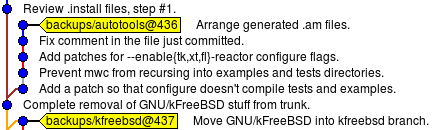
  • obsolete branches: http://thomas.g.girard.free.fr/ACE/obsolete-branches.png The tool leaves all branches, including removed ones (with tag on their end) so that you can decide what to do with them.

  • missing merges: http://thomas.g.girard.free.fr/ACE/missing-merge.png The branch 5.4.7-12 was never merged into the trunk!

Learning git Based on observations above, I realized my limited knowledge won't do to complete the conversion and clean the repository. There are tons of documentation on git out there, and you can find a lot of links from the git documentation page. Here's the one I've used:
The Git Object Model It's described with pictures here. You really need to understand this if you haven't already. Once you do, you understand that git is built bottom-up: the plumbing then the porcelain. If you can't find the tool you need, it's easy to write it.
git fast-import The Migrating to Git chapter explains how you can use the git fast-import tool to manually import anything into git. I've used it to create tags with dates in the past, slightly changing the Custom Importer example in the book:
#!/usr/bin/env ruby
#
# retag.rb
#
# Small script to create an annotated tag, specifying commiter as well as
# date, and tag comment.
#
# Based on Scott Chacon "Custom Importer" example.
#
# Arguments:
#  $1 -- tag name
#  $2 -- sha-1 revision to tag
#  $3 -- committer in the form First Last <email>
#  $4 -- date to use in the form YYYY/MM/DD_HH:MM:SS

def help
  puts "Usage: retag <tag> <sha1sum> <committer> <date> <comment>"
  puts "Creates a annotated tag with name <tag> for commit <sha1sum>, using "
  puts "given <committer>, <date> and <comment>"
  puts "The output should be piped to git fast-import"
end
def to_date(datetime)
  (date, time) = datetime.split('_')
  (year, month, day) = date.split('/')
  (hour, minute, second) = time.split(':')
  return Time.local(year, month, day, hour, minute, second).to_i
end
def generate_tag(tag, sha1hash, committer, date, message)
  puts "tag # tag "
  puts "from # sha1hash "
  puts "tagger # committer  # date  +0000"
  print "data # message.size \n# message "
end
if ARGV.length != 5
  help
  exit 1
else
  (tag, sha1sum, committer, date, message) = ARGV
  generate_tag(tag, sha1sum, committer, to_date(date), message)
end
graft points (graft means greffe in French) Because of missing svn:mergeinfo some changes appear unmerged. To fix this there are graft points: they override git idea of parents of a commit. To create a graft point, assuming 6a6d48814d0746fa4c9f6869bd8d5c3bc3af8242 is the commit you want to change, currently with a single parent 898ad49b61d4d8d5dc4072351037e2c8ade1ab68, but containing changes from commit 11cf74d4aa996ffed7c07157fe0780ec2224c73e:
me@mymachine$ echo 6a6d48814d0746fa4c9f6869bd8d5c3bc3af8242 11cf74d4aa996ffed7c07157fe0780ec2224c73e 898ad49b61d4d8d5dc4072351037e2c8ade1ab68 >> .git/info/grafts
git filter-branch git filter-branch allows you to completely rewrite history of a git branch, changing or dropping commits while traversing the branch. As an additional benefit, this tool use graft points and make them permanent. In other words: after running git filter-branch you can remove .git/info/grafts file. I've used it to rewrite author of a given set of commits, using a hack on top of Chris Johnsen script:
#!/bin/sh

br="HEAD"
TARG_NAME="Raphael Bossek"
TARG_EMAIL="hidden"
export TARG_NAME TARG_EMAIL
filt='
    if test "$GIT_COMMIT" = 546db1966133737930350a098057c4d563b1acdf -o \
            "$GIT_COMMIT" = 23419dde50662852cfbd2edde9468beb29a9ddcc; then
        if test -n "$TARG_EMAIL"; then
            GIT_AUTHOR_EMAIL="$TARG_EMAIL"
            export GIT_AUTHOR_EMAIL
        else
            unset GIT_AUTHOR_EMAIL
        fi
        if test -n "$TARG_NAME"; then
            GIT_AUTHOR_NAME="$TARG_NAME"
            export GIT_AUTHOR_NAME
        else
            unset GIT_AUTHOR_NAME
        fi
    fi
'
git filter-branch $force --tag-name-filter cat --env-filter "$filt" -- $br
(Script edited here; there were much more commits written by Raphael.)

Important

It's important to realize that the whole selected branch history is rewritten, so all objects id will change. You should not do this if you already published your repository.

The --tag-name-filter cat argument ensures our tags are copied during the traversal; otherwise they would be untouched, and hence not available in the new history.

Hint

Once git filter-branch completes you get a new history, as well as a new original ref to ease comparison. It is highly recommended to check the result of the rewrite before removing original. To shrink the repo after this, git clone the rewritten repo with file:// syntax -- git-filter-branch says it all.

Cleaning up the repo To recap, here's how the ACE+TAO git repo was changed after conversion:
  1. Add graft points where needed.

  2. Clean tags and branches. Using git tag -d, git branch -d and the Ruby script above it was possible to recreate tags. During this I was also able to add missing tags, and remove some SVN errors I did -- like committing in a branch created under tags/.

  3. Remove obsolete branches.

  4. Merge missing pieces. There were just two missing debian/changelog entries. I did this before git filter-branch because I did not find a way to use the tool correctly with multiple heads.

  5. Fix commit author where needed. Using the shell script above Raphael is now correctly credited for his work.

That's it. The ACE+TAO git repository for Debian packages is alive at http://git.debian.org/?p=pkg-ace/pkg-ace.git;a=summary.
[1]http://lists.alioth.debian.org/pipermail/pkg-ace-devel/2011-March/002421.html
[2]available in Debian as svn-all-fast-export

Julien Blache: forked-daapd: v0.16

forked-daapd v0.16 is a bugfix release, mainly addressing a bad regression introduced in v0.15. Fixes: The DAAP bug is what causes an incorrect display and sorting in iTunes, the tags issue could cause a segfault in some cases, and finally fixing the file size in the HTTP streaming code may or may not fix some issues but was a bad bug anyway. Tarballs available at http://alioth.debian.org/~jblache/forked-daapd/ ; GPG signatures made with my Debian key F5D65169.

Christian Perrier: Pytrainer: finally

This week, I finally switched to use pytrainer to track my running data. Up to now, I was still using Garmin proprietary software on Elizabeth's Windows copmuter for this. Mostly because my GPW watch is a Forerunner 405, that uses a bloody crappy stupid USB stick with proprietary communication protocol (ANT+). So, the use of proprietary crappy software was kinda mandatory. There is however some code floating around to handle this device in Linux, named "Gant". This is far from being very polished, but I finally managed to make it work more or less reliably to get the GPS traces from my watch to my Debian laptop. So, during the week , I brought all my old running data back from "Garmin Training Center" (the Windows software provided by Garmin) back to my laptop and imported it in pytrainer. And I imported new data from my daily runs with help of that "gant" software. So, this is now time to really jump into maintenance of pytrainer and help my friend No l (that will be easy as pytrainer is kinda well maintained), then package "gant" for Debian, as part of the work in the "pkg-running" maintenance team (Ralf Treinen, No le K the and /me). New challenge for me: learn how to create a git public repo and maintain a package in it (I already participate to maintenance work with git for several things, but I never initiated any). Other plans: some bug triage on pytrainer (if some is needed, I indeed don't know yet) and eventually deal with things that have to be reported upstream. Looking at Launchpad might also be a good idea as I suspect that many are using pytrainer with Ubuntu.

Next.

Previous.
