Search Results: "ed"

16 May 2011

Lars Wirzenius: TDDD, more thoughts

My previous blog entry about Test Driven Distro Development (TDDD) was rather rambling. Here is the condensed version, plus some further thoughts. I would like to automatically determine whether "testing" is minimally ready to be released, at any given point in time. To implement this, I would like to see Debian get tools that would allow us to define specific minimal functionality that should work in a Debian release, and automatically verify that it does. I would like us to use these tools to determine whether a release is ready for release, with manual override from the release team. Ideally, we would use the tools to prevent breakages from moving into "testing", so that it gets closer to always being releasable. Getting test coverage sufficiently high that we can replace the release team's judgement abour releasablity will never happen: Debian is rather too large and and complex for that. However, we can reap much benefit from even relatively small coverage. Here is my initial suggestion for the minimal criteria that should be satisfied, at all times, in "testing". They are aimed at making sure that even if something else breaks, at least the basic stuff works well enough that one can log in and fix things. These are minimal criteria. They're not meant to verify that everything in Debian works. After these work, adding more coverage is not just possible, but reasonably easy in many cases. Want to make sure DNS gets configured right? Write a test that logs in and does a lookup inside the test system. After the tools have evolved, writing a simple test like that should be only a line or two. The tests I am talking here are system tests, or acceptance tests for the whole system, not just for individual packages. Unit tests would test individual functions or methods or classes; integration tests would test groups of them, or possibly entire programs; system tests test groups of programs/packages. The point is not to verify that every package works in every possible case, but that the system as a whole works. Most package-specific functional tests should be part of the package's own test suite. We should also run those, but that's somewhat orthogonal to the vision I'm trying to articulate here. At least the following scenarios should be tested (the above tests should be run after each scenario): It may be useful to run the tests against "unstable" as well as "testing". However, rejecting an upload to "unstable" may be less wise than preventing packages from being copied from "unstable" to "testing". Exactly how this the development processes should adopt TDDD is an interesting question, but a reasonable toolset should be adaptable to anything we want to do. (Indeed, it would be possible to structure the toolset so that it isn't specific to developing a distro: a "system-test" tool that a sysadmin could use to verify that a server works would probably be useful to some people. Perhaps such a tool exists and could be adapted for TDDD?) Running these tests for security updates to "stable" would obviously also be a possibility that should perhaps be considered. Running these tests would happen something like this: I would further like to see Debian make it possible to have isolated branches for development. This would help with, for example, large transitions that take a long time. The transition could be prepared in a branch of its own, and when it's ready to be pushed into unstable, the automatic tests outlined above could be used to verify the transition doesn't break anything too critical. (If the tests fail, the push fails; if necessary, that can be overridden manually, but that should be rare.) In my view, branches would greatly benefit Debian development, but they're not necessary for starting to implement TDDD. My condensed versions are still too long.

Rudy Godoy: GSoC 2011: Compute Clusters Integration for Debian Development and Building

Hi, been offline for a while and now after my mid-term exams I m glad to tell that I ll be working on this year s GSoC project called: Compute Clusters Integration for Debian Development and Building . The main idea for this project is to give Debian developers and downstream developers a set of tools for helping them to leverage the power of a cloud-based infrastructure for their development duties. This is specially targeted to porters, multi-arch and cross-development, So I ll ask such teams for feedback on the subject over the next days. People at Eucalyptus has been very helpful and willing to cooperate with us to make this project a success. We expect to get them involved on the packaging and probably as Debian contributors, if not developers, also. Next week is the official coding phase start, but I ve been talking and working together with my mentor Steffen and the Eucalyptus people already. We ll be starting working on the qemu ARM images, reusing and resuming the job did by Dominique Belhachemi in the past GSoC. Of course I welcome as much feedback as you might find useful. I plan to post a project update every two weeks.

Stefano Zacchiroli: debconf newbies again

Bug: never been to DebConf. Fix: DebConf newbies. Last year we have funded the DebConf newbies initiative to encourage Debian contributors who have never attended DebConf, to actually do so. There are plenty of reasons for doing that; as I wrote back then: My personal belief is that attending DebConf increases the enthusiasm of attendees and ultimately will make them better Debian citizens. It surely happened to me years ago: in the beginning of my Debian membership (as DD, since DMs did not exist back then) I just cared about my pet packages. It was only after meeting the Debian crowd in person at a FOSS event (LinuxTag 2004, IIRC) that I got really enthusiastic about Debian, gradually increasing my involvement in the project. I've never regretted it. This year, we are doing DebConf newbies again (see also Ganneff's blog post on the topic, for extra goodies). Deadline for applying (via newbies@debconf.org) is June 18th, although you should better register before May 19th to the conference proper to get sponsored accomodation.
Update: fix deadline date

Vincent Bernat: Migrating from Trac to GitHub

I was hosting my projects on several Trac instances on a dedicated server. However, since several months, spam was pourring.

Trac & spam

How to fight spam with Trac There is not built-in mechanism in Trac to fight spam. However, plugins enable to setup several ways to stop spam (or at least, reduce it). One of them is Akismet, a web service who can tell you if some message is a spam or not. It is able to catch most of the spam. A bayesian filter complement this service. A learning step is mandatory and can become cumbersome when the vast majority of the tickets you receive is just spam. I used those two mechanisms on my Trac instances. Another path is to require an account to post a ticket. Creating an account each time you want to create a ticket for some software is burdensome. I did not want to do this to the poor souls that have found a bug in one of my projects. An alternative is to setup a public account and adding somewhere in the page some instructions on how to use it when you want to open a ticket but don t want to open an account.

Removing spam Despite Akismet and the bayesian filter, I still got two or three spams a day. I catched them in my RSS flow or in my email if they were not classified as spam. There are two steps to remove the spam:
  • tell the bayesian filter by using the administration panel in the web interface,
  • remove the spam from the database using some SQLite commands directly on the server hosting the Trac instance.
Indeed, Trac does not propose the possibility to remove a ticket. Of course, there are plugins, but you must find them, install them, find how to configure them, etc. Cumbersome.

GitHub GitHub is a popular source code hosting service which uses Git as a backend. This is a proprietary platform but a lot of open source projects have migrated to it, thanks to its features and the good performances. Everybody is on GitHub. This was the ideal opportunity.

Features First, GitHub allows to host Git repository. You push your Git repositories. There is a nice and fast web interface to browse them. However, I still keep an instance of cgit. Then, GitHub is very popular because they drive people to fork projects. With one single click, you can fork your favorite project. You get a copy which is synchronised with the forked project. There is also a wiki (accepting many markup syntaxes). This wiki is also available through Git. At last, GitHub offers a minimalistic ticket system. You open a ticket, you make some comments, you can add a tag or two and you can close it. That s all. Quite light. But enough for small projects like mine. However, there is more! Do not open a ticket to send a patch. There is no way to attach files to tickets. You need to fork the project, create a branch with your patch and request a pull for your branch. This will appear as a ticket but your commits will be linked to it. The author can then review and comment your branch, ask for some changes and if he wants to integrate it, a simple merge is sufficient. He can even do it using the web interface. Convenient. Socially, you can comment commits, tickets, projects and subscribe to a lot of events. You can receive and answers tickets by mail. However, an accound is mandatory to open a ticket. Since there is a lot of projects on GitHub, this account should be useful for a lot of software. To cut a long story short, even if GitHub is a proprietary platform, it offers nice and interesting features. More and more projects migrate from Google Code to GitHub even if there is less features on the latter.

Migration I have searched for tools to migrate automatically tickets from Trac to GitHub. For example, there is SD. At last, I have done it manually. GitHub API is well documented and there exists bindings in various languages including Python but it is a very limited API. You can t choose the number of the ticket nor its date. I have also rewritten README files to use the markdown markup and avoid the use of wiki pages when possible. I have also put some URL redirections with the help of nginx. In conclusion, even if maintaining Trac instances was not a lot of work, one thing that I do not have to do anymore. And no spam on GitHub, I assume.

15 May 2011

Steve Kemp: Images transitioned, and mysql solications.

Images Moved
So I've retired my old picture hosting sub-domain, and moved all the files which were hosted by the dynamic system into a large web-root. This means no more uploads are possible, but each link continues to work. For example: Happily the system generated "random" links, and it was just a matter of moving each uploaded file into that static location, then removing the CGI application. The code for the new site has now been made public, although I suspect there will need to be some email-pong if anybody wishes to use it. Comments welcome.
MySQL replacements?
Lets pretend I work for a company which has dealings with many MySQL users. Lets pretend that, even though it is true, such that I don't have to get into specifics. Let us pretend that we have many many hundreds of users who are very happy with MySQL, but that we have a few users who have "issues". That might be:
  • mysqld segfaulting every few months, with no real idea why.
    • Transactions are involved. So are stored proceedures.
    • MySQL paid support might have been perfect, or it might have lead to "yup, its a bug. good luck rebuilding with this patch. let us know how it turns out kthxbai."
    • Alternatively it might not have been re-producable.
  • Master-Master and Master-Slave setups being "unreliable" such that data inconsistencies arise despite MySQL regarding them as being in sync.
    • Good luck resolving that when you have two almost-identical "mysqldump" outputs which are 6Gb each and which cause "diff" to exit with "out of memory" even on a 64Gb host.
    • Is it possible to view differences in table-data, via the binary records? That'd be a fun project .. for a masochist.
  • Poor usage of resources.
  • Heavy concurrancy caused by poorly developed applications in a load-balanced environment, leading to stalling queries. (Wordpress + Poor wordpress plugins I'm looking at you; you're next on my killfile).
To compound this problem some of these installations may or may not be running Etch. let us pretend they are not, just to simplify things. (They mostly arent' these days, but I'm sure I could think of one or two if I tried) So, in this hypothetical situation what would you recommend? I know there are new forks aplenty of MySQL. Drizzle et al. I suspect most of the forks will be short-lived - lots of this stuff is hard and non-sexy. I suspect the long-lived forks are probably concentrating on edge-cases we've not hit (yet), or on sexy exciting things like new storage engines and going nosql like all the cool kids. Realistically going down the postgresql road is liable to lead to wholly different sets of problems, and a significant re-engineering of several sites, applications and tools with no proof of stability. Without wanting to jump ship entirely, what, if any, are our options?
PS. MySQL I still mostly love you, but my two most recent applications were written to use redis instead. Just a coincidence... I swear. No, put down that axe. Please can't we just talk about it?/p> ObQoote: "I've calculated your chance of survival, but I don't think you'll like it. " - Hitchhikers Film.

David Watson: Project 52 - Week 19

Back indoors this week, took a shot of my wife, daughter and my own hands. I wanted an image for our bedroom wall that represented our family. Week 19 - Family

Joerg Jaspert: DebConf Newbies / Non Regulars 2011

Like last years initiative from Joey we have another opening for DebConf Newbies . Turns out this year it is me doing the main work for it, so here we are: If then this is for you. To apply for this funding, email newbies@debconf.org before 18th of June. The earlier you mail, the better, as funding will be given out in a first-come/first-serve way. In your email include an estimate of your travel costs, from where you travel from and the amount you are unable to fund yourself. I also need to know the dates you plan to arrive and leave. Please indicate if you will also need sponsored food and accommodation. (At the time of this writing you can still get sponsored food and accommodation by simply registering with the conference, so if you read this before May 19th please ensure to register NOW). Please also ensure you register with the conference now (see DebConf11 registration, even if your plans are not fully secure at this time. There is no punishment if you can not attend later - simply do not follow the reconfirmation process shortly before the conference.

Clint Adams: Fast and Furious Fourier Transform

A while ago, MusicBrainz used a technique called TRM for associating audio fingerprints with tracks. This relied on a proprietary, non-free database controlled by a for-profit company. Your choices were to either use it and have music fingerprinting, or to not have the ability to fingerprint, since no one who knew how to develop a free database was doing so. After some time with TRMs, MusicBrainz underwent a transition to PUIDs, and after running in parallel for some time, TRMs were dropped. PUIDs rely on a proprietary, non-free database controlled by a for-profit company. Amazingly, things have changed. Now you can use free software to contribute to a publicly-available database. If you have a music collection cleanly and properly tagged with MusicBrainz IDs, I urge you to participate in this project.

Kai Wasserb ch: Chronicle 4.6-2 fixes another UTF-8 encoding issue

Today I was playing with some RDF information, initially triggered by my entry about Josephine. While at it I decided to add some information explicitly to the head tag, including
<meta property="cc:attributionName" content="Kai Wasserb ch" />
<meta property="dc:creator" content="Kai Wasserb ch" />
Obviously I wanted to add those two tags to my templates, so Chronicle adds that to all files. Unfortunately this resulted in an encoding error of the " ". Some digging in the source of chronicle showed, that HTML::Template-new() was called without ensuring, that the tempalte files were parsed as UTF-8 encoded. The solution was to add a filter. The just uploaded version 4.6-2 contains the required patch and if you don't use the Debian packages you won't be left out for long, as Steve already applied the fix upstream.

Lars Wirzenius: vmdebootstrap and FreedomBoxLite

I played around some with with vmdebootstrap, my little toy to generate a disk image with a pre-installed Debian system. I added some more features, and to show them off, created a simplistic, proof-of-concept image to demostrate what FreedomBox might do. The image includes Apache and an SSH server, and a pre-configured user. You can use SFTP to put files on the server, and HTTP to access them. An instant file-sharing appliance. A real FreedomBox should, of course, do all sorts of other things, and this filesharing should probably be done differently, too. This is not a demonstration of the FreedomBox. It's a demonstration of vmdebootstrap. The following command builds the image. Passwords are fixed, so you'll want to not run the image on a public network.
sudo vmdebootstrap \
--log fboxlite.log \
--log-level debug \
--image fboxlite.img \
--hostname fboxlite \
--size 1G \
--verbose \
--enable-dhcp \
--package ssh \
--package apache2 \
--mirror http://mirror.lan/debian/ \
--customize=./fboxlite-customize \
--root-password=password1
You'll need the following customization script as well:
#!/usr/bin/python
import crypt
import os
import subprocess
import sys
def runcmd(argv, stdin='', ignore_fail=False, **kwargs):
    p = subprocess.Popen(argv, stdin=subprocess.PIPE, 
                         stdout=subprocess.PIPE, stderr=subprocess.PIPE, 
                         **kwargs)
    out, err = p.communicate(stdin)
    if p.returncode != 0:
        msg = 'command failed: %s\n%s\n%s' % (argv, out, err)
        if not ignore_fail:
            raise Exception(msg)
    return out
print 'Customizing fboxlite'
rootdir = sys.argv[1]
# Create a fboxlite account.
runcmd(['chroot', rootdir, 'adduser', '--gecos', 'Freedombox Lite',
        '--disabled-password', 'fboxlite'])
encrypted = crypt.crypt('password1', '..')
runcmd(['chroot', rootdir, 'usermod', '-p', encrypted, 'fboxlite'])
# Create /srv/shared for holding shared files.
shared = os.path.join(rootdir, 'srv', 'shared')
os.mkdir(shared)
runcmd(['chroot', rootdir, 'chown', 'fboxlite:fboxlite', 'srv/shared'])
os.chmod(shared, 0775)
# Configure Apache to serve /srv/shared as /shared.
conf = os.path.join(rootdir, 'etc', 'apache2', 'sites-available', 'default')
text = open(conf, 'r').read()
lines = text.splitlines()
new_lines = [
    'Alias /shared "/srv/shared"',
    '<Directory "/srv/shared/">',
    'Options Indexes',
    '</Directory>',
]
lines = lines[:-1] + new_lines + lines[-1:]
text = ''.join('%s\n' % line for line in lines)
open(conf, 'w').write(text)
If you're using libvirt with KVM, you can then use the following command to deploy the disk image:
virt-install --connect qemu:///system -n fboxlite -r 512 \
--os-type linux --os-variant debiansqueeze \
--disk $(pwd)/fboxlite.img --vnc  --import
Log in via the emulated console, and run ip addr to see what the IP address of the virtual machine is (and if you can find a way to query libvirt what the address is, please tell me). Then you can use the following URLs (in, for example, Nautilus):
sftp://fboxlite@192.168.122.133/srv/shared/
http://192.168.122.133/shared/
Replace the correct IP address in the above URLs and off you go.

Christian Perrier: 2011 week 19 Debian work

That was a damn busy week. It was mostly centered about attending SambaXP, the annual Samba user and developers conference, in G ttingen, Germany. The only free software conference I attend with expenses paid by my employer, Onera. This year was the 10th edition and, as last year, to the "who was there for the nth edition" game, I won by staying alone as they asked who attended all editions of the conference. :-) That was a great week, with time spent with people as interesting as Andrew Tridgell, Jeremy Allison, John Terpstra, Volker Lendecke, Kai Blin, to name a few. A good opportunity, again, to get input from our packaging work for that big piece of software, as well as getting visibility about the future of Samba. I also had a great, even if short talk, with the kind Karolin Seeger, the release manager of Samba for 3 years now. We talked about....children, as she's now a mother since last year (with a non negligible impact on her professionnal life, as often in Germany). Great meeting, too, with Brad Kuhn, from the Software Freedom Conservacy, who had a keynote about GPL licence enforcment activities. It becomes more and more sure that Samba3 and Samba4 will reconverge together after the Samba Team releases Samba 3.6. It brings plans for our packaging work: I think we'll stick with having samba 3.6 in wheezy while the brand new shiny Samba4 probably stays separate in some way. Our users (and /me first) clearly need stability in the file and print services first. Of course, I did some packaging work there: samba 3.6.0pre3 was uploaded to experimental, about 10 days after its official announcement. I also worked on the samba *binary* package bugs, triaging them as usual. We now have 51 bugs opened against the samba binary package: 18 unclassified, 11 moreinfo (several likely to be closed as unreproducible or user error), 1 wontfix, 8 with a pending patch and 13 forwarded upstream. I'm also thinking about a possible way to ask about SMB2 support in samba: it won't be activated by default in 3.6 (mostly because us, distros, requested for that and, by "us", I mean Debian, RHEL, SuSe and their derivatives, so quite a large consensus). Still, it would be good to put some light on SMB2 support and a debconf question about it could be a solution (not shown by default and defaulting to no SMB2). I also worked quite extensively on packages maintained by No l K the, Ralf Treinen and me, aka "the pkg-running team". I did setup a git repo for my new "garmin-ant-downloader" package, that allows downloading track files from Garmin Forerunner 405 GPS watches (guess what is the brand and model of mine!). My first packaging git repository! Thanks to Ralf for his advice and help in this. I triaged bugs in the other two packages we maintain: pytrainer (more bugs forwarded upstream) and garmin-forerunner-tools (which was later uploaded by Ralf). I also setup a team mailign list so, now, we're a real team...:-) Few activity on the l10n front: a few Smith reviews are in progress and I completed 1 or 2 French translations, and reviewed some others. Regular activity, then. The only specific stuff is that I'm now pushing harder for the French DDTP effort, doing many reviews and translations there. We try to reach 100% in the "popcon500" packages. Later, we'll try to head at reaching the hieghts reached by the Italian and German teams, who are, on this l10n activity, way ahead from us. Finally, during the SambaXP conference, and as usual (except last year because of too heavy work duties), I visited my German friends, living "close to" G ttingen, accomppanied by Luk Claes and his friend and colleague Ivo, who were also attending SambaXP. Great barbecue at Andreas and Kathrin Tille's place, facing the Wernigerode castle at sunset. And the best sp tzle ever at Meike and Alex Reichle's place in Hildesheim, with a french touch on the salad's dressing as well as great Chilean wine brought by Meike's coworker Wolfram. Always a great time to see these good friends even if that means driving a few hours (and being flashed....twice!...by german speed cameras on the way to and back Andreas place!) To complete the week, I ran a 34km/800m+ trail today in the Rambouillet forest, completing it in 3h31. I'll probably blog separately about running updates as it is now quite some time that I didn't. Guess what? I'll be sleeping well tonight...

Kai Wasserb ch: LWP::Authen::OAuth in NEW

I've uploaded liblwp-authen-oauth-perl to Debian today, [UPDATE: currently the package is waiting in NEW (please note, that the previous link might not work, in case the package has entered the archive already or the page hasn't been generated yet). and is now in the archive. Thanks a lot to the FTP Masters for the quick processing!] LWP::Authen::OAuth allows to easily integrate OAuth authentication into Perl programs and libraries. Some of you might already guess, why I have an interest in OAuth for Perl: as a user (and maintainer) of Chronicle I'd find it neat, if there could be some Flattr integration (especially a automatic submission of new posts to Flattr). This sent me searching for an Perl implementation of the Flattr API. Unfortunately this turned up nothing, therefore I'm now planning to write some sort of Net::Flattr Perl module, which I can then use in Chronicle for one task or another. Net::Flattr (preliminary name, but probably the final one, as the implementation of the Twitter API is called Net::Twitter) is going to be a library, which should offer the same functionality as Flattr's PHP library. For now there are some scetches to this extent on my hard drive, but nothing showable. I hope I find the time soon to write this but it shouldn't be too difficult. ;-) Apart from my particular use case, you can use LWP::Authen::OAuth for any other OAuth-requiring API. I hope the package helps you to build more cool tools for and on your Debian system!

John Goerzen: Napoleon, Winter in May, and Silly String

This is just a diary of a random day sort of post. Nothing all that particularly unusual, but then perhaps if I only blog about the unusual, the typical gets lost. This week started out with temperatures as high at 99F. Today we didn t even reach 60, and tonight will be cold almost to freezing. It s Kansas, so while we remark on the strange weather, we re not particularly surprised by it. This morning, Jacob and Oliver went over to play across the street. Jacob then went with Terah to a birthday party for one of his classmates, while Oliver helped plant some trees with his grandparents. I was at home this morning, which gave me a small but welcome break from the past week: we had something going on 6 out of the last 7 evenings, and little time to do anything else. So I got out the Kindle and read from War and Peace. I started at the kitchen table while eating some granola, and then sat on the couch. The day was cold, windy, and overcast, and I like to use natural light, so there were only a few places to sit with enough light. I sat there reading the account of Napoleon s capture of Moscow in 1812, the characters lives uprooted by those events, and stories of violent mobs forming. And, of course, Tolstoy s essays on the mistake of overstating the importance of famous figures in history were common. I am now about 3/4 through War and Peace, which means I ve read 1,044 pages and have (only) 348 to go. As I got up to try to find slippers or a blanket for my cold feet at one point, I remembered a conversation I had while eating lunch this week. I was reading on the Kindle while reading, and a person I knew happened to walk past. She asked what I was reading. I said simply, War and Peace. There was this stunned silence, so I added, for fun. It s great! Which is true. She said, Oooookay, John, you just enjoy that then and went on her way. This isn t the first time I ve had a conversation like that about this book. It seems to be held up as some example of long, dry, literature that people are made to read but don t want to. I think that only long is accurate here. Anyhow, pretty soon Oliver arrived and, much to my surprise, said Doh! (meaning no ) when I asked him if he was ready for lunch. Instead he stood there looking at me sweetly. Taking a guess, I said, Oliver, would you like to watch train videos? Yeah yeah yeah yeah! So we did. He particularly enjoyed the steam engines today, and eventually was ready for lunch at 12:30. Jacob and Terah got home just as he was finishing. Oliver got his nap, and I played with Jacob for a bit. Ever since he had heard of the British wedding in preschool, he s been interested in weddings, so I showed him pictures from Terah and me at our wedding. This was a big hit. Then he went with Terah to decorate a Sunday School room at church, so I read a bit more Tolstoy. Tolstoy s characters sometimes are prone to not just changes in mood but changes in outlook and worldview changing from cold, logical, and uncaring to warm and loving, or from despair at the vanity and shallowness of humanity to elation at the simple honesty of a peasant and renewed trust in the human spirit. At first I marveled at this tendency in certain characters, but on reflection, and in consideration of the timeline of the novel, which spans several years, it didn t seem quite so strange. Things can happen to change the mood of individuals, or even a country; I can remember the national mood changing after 9/11, and again after Obama s election, for instance. I also felt a contrast with some of the characters who, due to their decisions or circumstances, lost things that mattered while chasing things that weren t as important. I felt fortunate to be at this place, with Jacob, Oliver, and Terah, and decided that we all ought to do something fun in the evening, but hadn t quite figured out what. And about that, the clouds started to break and Oliver woke up from his nap. I went up to his room, and much to his delight, played peekaboo with him for quite awhile. Eventually he was done with that game, but spotted my phone, so I helped guide his finger to launch Youtube and watch a train video over the wifi. This was certainly a Big Deal to him. After Terah and Jacob got back, I figured it was time figure out something fun to do. And what could be more fun, I decided on the spur of the moment, than a drive into town to pick up some cans of Silly String for the boys, neither of which had ever used it before. So we went to a restaurant, then bought the surprise toy (I hadn t told them what it would be beforehand), then went to an ice cream place, and finally back home. Oliver loved it. He needed my help to press the nozzle to make it come out, but still had a great time and shrieked with delight. Jacob then tried out his can, and stood in one place spraying his bright green strings all over the place. Then he took to running around the yard spraying string randomly in every direction until he finally completely emptied out the can. And after that, he gathered up some of the different colors of string and rolled them up into a ball which he was very proud of. A nice day.

Clint Adams: I hate Android

Processor       : ARMv6-compatible processor rev 6 (v6l)
BogoMIPS        : 132.71
Features        : swp half thumb fastmult edsp java 
CPU implementer : 0x41
CPU architecture: 7
CPU variant     : 0x0
CPU part        : 0xb76
CPU revision    : 6
Cache type      : write-back
Cache clean     : cp15 c7 ops
Cache lockdown  : format C
Cache format    : Harvard
I size          : 16384
I assoc         : 4
I line length   : 32
I sets          : 128
D size          : 16384
D assoc         : 4
D line length   : 32
D sets          : 128
Hardware        : SMDK6410
Revision        : 0000

14 May 2011

Joey Hess: Blogger's hiccough

So Blogger had a hiccough, and I've seen people in blogs I read being confused about why their posts and comments to posts seemed to vanish. I wish that people had more autonomy over their data and didn't just feel it could vanish like that when someone messes up. Giving nontechnical people that autonomy is hard, things have to be made quite simple, and they have to be educated to want it. Liw and I are trying to take preservation of user data beyond backups at Branchable. Coincidentially[1], while Blogger was down I was working on automating_git_pushes_from_Branchable. So every change made to a site is committed to git and pushed right offsite to GitHub or Gitorious, or a personal server. ikiwiki-hosting's new git push configurator The only hard part of this for the user is the ssh key distribution, which is currently a cut and paste affair. Monkeysphere, I've got my eye on you.. By the way, I was stunned to see that GitHub does not support automatic git pushes out of GitHub. Although it can notify a million CIA-type services, the actual data is thus very subtly encouraged to be siloed. This feature seems to have been requested since at least 2009. Can't be that hard can it? (I didn't see a way to make Gitorious do it either.)
[1] Actually, this was the last feature I needed to move Ikiwiki's own wiki over to Branchable, so I plan to do that soon and retire its current server.

Vincent Bernat: FVWM configuration

There is actually some buzz around Gnome 3 and the new release of Ubuntu switching to Unity. I thought this was a good occasion to make this small post to tell that I still uses FVWM whose latest version was released a month ago. FVWM is a very old window manager. So old that nobody really knows what the F stands for. It comes with a ugly configuration by default and can be configured to look even uglier. However, FVWM is powerful and highly configurable. Moreover, it is pretty lightweight.

My FVWM configuration My configuration of FVWM is available on GitHub. It requires the use of fvwm-crystal. If you are running Debian or Ubuntu, there is a package for this. This is a set of powerful configuration files for FVWM which add a lot of goodies and themes. Unfortunately, the project site seems to have disappared. You can still grab the sources from your nearest Debian mirror. While those configuration files were great, I did not like to have such a complex desktop with all those icons and menus. However, what is great with fvwm-crystal is you can overlay your own configuration. If a file is present in your home directory, it will take precedence over the one installed on the system. So, I just wrote a new recipe. What you may want to steal from my configuration is the ability to alter the configuration depending on the fact that you are using one or two screens. With one screen, you get:
  • an application panel (a launcher bar) on the upper left corner,
  • an icon manager (which will contained iconified windows) on the upper right corner,
  • a systray on the left of the icon manager
  • a pager (which shows various desktops) just below it,
  • two icon managers (which act as a taskbar) on the bottom, one for regular applications and the other one for terminal windows.
One screen setup of FVWM With two screens, the organization is different. The two icon managers at the bottom are on their own screens. The pager is between the two screens and the other elements are on the upper left of the right screen. Dual screen setup of FVWM If I am using a single screen and I plug another one, I do something like this to get my setup updated:
1
2
$ xrandr --output  VGA-1 --auto --output DVI-I-1 --auto --right-of VGA-1
$ killall trayer ; FvwmCommand Restart
I also uses conky, a light-weight system monitor. It is started in my .xsession, not through FVWM.

Building wallpapers for dual-screen One difficulty with a multi-head setup is how to get the background set properly? . I have made a small script for generating one. Use it like this:
1
$ ./build-wallpaper.py -d ~/.fvwm/wallpapers -c -t ~/tmp/mywallpaper.png
It will randomly select two wallpapers and put them together to look nice on your dual-screen setup. It will also correct the aspect ratio, either by cropping the image or centering the image. You need the following dependencies to make script work: python-xpyb and python-imaging. UPDATE: Thomas Adam pointed to Nitrogen, a graphical wallpaper utility supporting multi-head setups. It is a great tool if you want to set manually your wallpaper but it does not allow to select a random one. Nowadays, I grab most of my wallpapers from InterfaceLIFT.

13 May 2011

Gustavo Noronha Silva: My experience with GNOME 3 so far

You know, GNOME Shell and I are not really strangers to each other for a long time now. I have been using it almost daily as my main desktop since late 2009, when I started shipping it to Debian experimental. That means that I had ample opportunity to both get used to it and witness the huge improvements it had with every new release. My general feeling towards GNOME 3 is this: . Yes, I love it! I love the new themes, I love the window borders, I love the top panel, the overview, the dynamic workspaces, I love the Me menu, I love the clock and the calendar, the system indicators with the beautiful symbolic icons, being able to search for applications in such a nice way, the window animations, the multi-screen support, the new nautilus, the dash, looking glass. It s hard for me to even express how thankful I am and how much admiration I have for the awesome folks who helped bring this to life. Thanks so much!
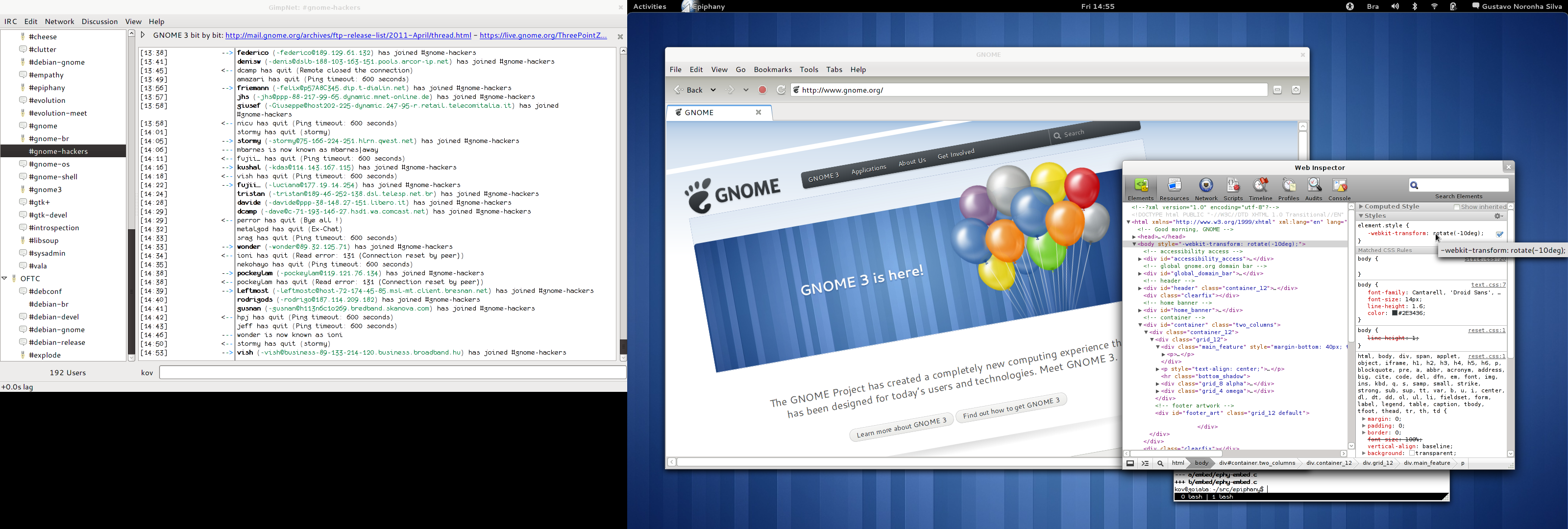
My GNOME3 desktop

My GNOME 3 desktop

After all this time, there are only two things I can say I dislike about GNOME3, apart from some minor wishlists: the alt-tab behaviour and the message tray. Let me expand on those. Message Tray Of the very few things I dislike, there is only 1 I hate and cannot see myself living with: the accordion animation in the message tray. No, really, it s such a terrible, terrible idea. Every single time I try to use that thing I overshoot while moving the mouse to the left, then overshoot again moving the mouse to the right because the frigging icon has moved. It s no good knowing that I can click in the text or in the empty area to its right, it feels wrong. It s terrible that my actual target is moving at all. Every single time I use it is a small frustration for me it s as if the message tray was playing games with me, laughing at me for not having good enough mouse pointer driving skills even more than the infamous sub-menus used to. And I had to go through that penance whenever I wanted to find the person I was chating with to resume the conversation. I wrote an extension that disables the accordion animation by simply not showing the title at all when you hover the icon, and I patched GNOME Shell s CSS to make the icons a bit bigger, so that it s easier for me to hit them with the mouse. It s clearly not ideal, and you still have to click the various people icons to figure out which of your friends who were lazy enough to not add a picture to their IM profiles is that one, but it s still much better than chasing the (smaller) ones around to figure that out. Perhaps we should have the icons be bigger and always have the title bellow them? I don t know, I trust the awesome designers who designed the awesomess that s everywhere else will come up with a great idea.
My Message Tray

My message tray with bigger icons and no accordion animation.

Alt Tab The number 1 feature of workspaces for me has always been locality being able to not see all of the other applications and windows that are open elsewhere. This lowers the amount of noise when I m trying to find something. The overview is very nice in this matter only windows in the current workspace are shown, and even when you have an extra screen, the windows in there appear in that screen. The alt-tab behaviour, on the other hand, of showing all windows and apps, even with the separator, bothers me. It s really useful to have when you want to go to a specific window no matter where it is (I usually use the dash for that, though), but it adds noise when you want to go to a specific window _in this_ workspace, which is the most common use case for my usage. So I copied the alt-tab code over to an extension and modified it so that only windows in the current workspace would be considered. In addition to that, with the windows in the extra screen always being there no matter what workspace you re in (which I think is an awesome idea), they are effectively in all workspaces, so they add constant noise even with my extension. It s also weird to have to look at the main screen to switch to a window in the extra screen. There s a huge discontinuity. What I would prefer is having alt-tab to follow the mouse regarding screens only show windows in the extra screen if you hit alt-tab in there, making sure the selector thing appears in there as well.

Kai Wasserb ch: Public Service Announcement: Wine 1.3.20 packages available

Just a short announcement for the impatient: Wine 1.3.20 packages are available. As of this writing it's only the source package, the binaries follow as soon as they're built. As a small side note: this is, as far as I can remember, my quickest upload of a Wine version (only about 15 minutes after the release was tagged upstream).

Gunnar Wolf: Call centers, call recording and customer dissatisfaction Fun anyone?

While swearing at my bank's automated phone attention system, I was thinking that taking advantage in the fact they already usually say that "the call will be recorded to improve service quality" call center operators/programmers should record all user activity and, just for laughs, play back the grumbles angry users shout at the system. Of course, at random intervals, on loudspeakers, over the crowded call centers. Oh, they do it already?

Lars Wirzenius: I'm in the movie business now

I got recruited into the movie business via Soile, and the teaser for the movie is now out: http://www.edinburghdigest.com/. I did two evenings as a "Digital Imaging Technician", as you can see from the credits. In other words, I copied files from camera memory cards to hard disks with a laptop. While everyone else were out in the cold, I sat in a pub. Soile is in the credits too. She actually did moviestuff, I just did computer geek stuff.

Next.

Previous.