Search Results: "uli"

16 November 2006

Zak B. Elep: Ubuntu-PH Release Party for 6.10 (Edgy Eft)


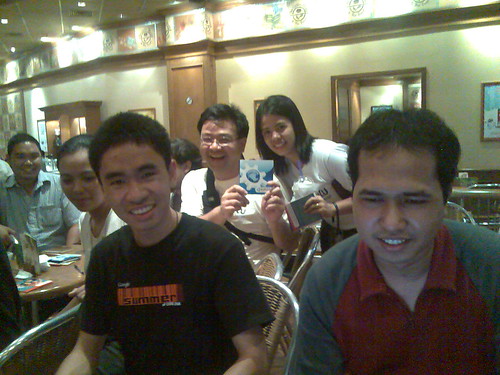
Last night I called Ubunteros nearby Manila for the Edgy Eft (belated) release party at the Coffee Bean and Tea Leaf at Greenbelt 3. Little did I know that there will be a lot of folks coming from the just-concluded FOSS@work workshop joining in the fun, thanks to Yolynne Medina and Eric Pareja. Diane Gonzales and I got to the venue first, then followed by the FOSS@Work folks. Dominique Cimafranca, Migs Paraz, Ranulf Goss, Jopes Gallardo, and Joel Bryan Juliano were there too, and all in all we were easily the noisiest group in the coffee shop, seemingly occupying the entirety of the place. I originally planned to move the group to have dinner somewhere, but along the way everybody seemed to forgot dinner and we quite engaged in talking to everyone else. It was terrific. The 2 boxes of Edgy ,K,Ed Ubuntu CDs I brought were easily given away to everyone; we even had them exchanged and autographed (naks!) reminiscent of what Ealden and I did last February when Mark came here. As a finale, we had a group photo of everyone with their CDs; Dominique remarks that in his informal’ study, more and more women prefer Ubuntu (and I sure do think he’ll be blogging more about this soon. ;) Needless to say, the above photo doesn’t do great justice to what happened last night; it came from my elric which I didn’t get use much as a camera since I too was happily chatting away. That said, I expect RJ Ian will be posting his photos from his brand-spanking-new Kodak camera to the Ubuntu-PH site once he gets back to Mindanao with Yolynne and company. I also think the FOSS@Work folks also have their own photosite or wiki to post more photos, which we’ll be seeing sooner. Jerome Gotangco and Ealden Esca an, the guys whom we all owe Ubuntu-PH to, were unfortunately unable to attend last night, as Jerome was off to Cebu to participate in the ICT congress there, while Ealden was quite busy at work. Hopefully they (as well as last night’s attendees!) can attend the next Release Party for 7.04 (aka Feisty Fawn,) and hopefully it will be just as fun, and be more meaningful if more Ubuntu-PH folks get involved in its development! Update: Yolynne and RJ just posted pics fresh from their arrival to home. Expect more pics later, nicely tagged too…

15 November 2006

MJ Ray: Business: Email, sigs and signing

Ian Rawlings wrote in an article in uk.comp.os.linux that:
"There was a legal precedent set in the UK a little less than a year ago, in which the company's name and contact details in an email signature were taken as sufficient identification of the company for the contents of the email to be acceptable as a contract [...]"
and then helpfully provided some references about it. The headline on Disclaimers could make emails into contracts [The Register] seems a bit off. Even the article ends:
"The end result of this could be that people who include a signature and disclaimer at the bottom of their emails might actually be making themselves more liable than people who just send one line emails."
Note the might there. It's quite a leap, isn't it? Mehta v J Pereira Fernandes SA [2006] EWHC 813 (Ch) (07 April 2006) appears to have ruled that headers were not a sufficient signature, rather than that a plain text signature block (sig) is sufficient. Have I missed a key point here? AFAICS, the ruling contains the following key general points:
"28. I have no doubt that if a party creates and sends an electronically created document then he will be treated as having signed it to the same extent that he would in law be treated as having signed a hard copy of the same document. [...]"
"30. [...] if a party or a party's agent sending an e mail types his or her or his or her principal's name to the extent required or permitted by existing case law in the body of an e mail, then in my view that would be a sufficient signature for the purposes of Section 4. [...]"
I doubt that a sig is quite the same as a hand signature, as it doesn't necessarily 'serve as a method of authentication' as required by the Digital Signature Directive ( 1999/93/EC, Electronic Signatures Regulations 2002), but there are times when it could bind one to things. Essentially, using a sig is like using headed paper, not like hand-signing. Parts of the ruling (para.19) seem to argue that automatic insertions make things carry less weight AFAICT - does that hint at how futile those forced stupid disclaimers would be if relied upon in court? Does the same automatic-or-decision point also mean that using a electronic signature tool (gpg or whatever) selectively helps it carry more weight than signing everything automatically? I don't agree it ... signs death warrant for Digital Signatures [Financial Cryptography] Interesting questions. Anyone know if the answers are decided yet?

12 November 2006

Julien Danjou: Hacking in hostile env

I don't know why, but debmirror (or Perl ?) fails to work with Solaris. For example this code
     while(($res = $gunzf->gzreadline($line) > 0) 
           && !($line =~ /^$/))   
       $buf = $buf . $line; 
      
read the full buffer instead of reading a block of text separated by empty spaces...
Multiline matching (m//m) fails to work too. So I rewrote almost the full Packages.gz parser in a dirty Perl way for a friend, and it works. I 0\/\/N3d you, fucking OS. And there's people wanting to port Debian to that, good luck

Adam Rosi-Kessel: Toto, I Don't Think We're in Wikipedia Anymore

The last time I made any serious contributions to Wikipedia was back in 2001 or 2002. The community was exciting, friendly, and welcoming, and I enjoyed spreading the word as most non-technical people I knew had never heard of wikis or Wikipedia. Since then, I may have corrected the occasional typo or fixed a legal error, sometimes anonymously and sometimes under my account (apparently I “clarified the 13(c) protective arrangement issue” in the Urban Mass Transportation Act of 1970 back in the Fall of 2003, although I have no recollection of having done so), but I hadn’t started any new entries since the early days. At a recent presentation I attended by Sun’s Hal Stern, I learned that his eating club (Colonial Club) at Princeton University has a Wikipedia entry (as do all the other eating clubs). On further investigation, I learned there were no entries for any of the student cooperatives or other upperclassman eating options. To the uninitiated, it may be hard to understand why this matters beyond the insular Princeton community, but — suspend your disbelief just for a moment — the eating clubs have been called Princeton’s “peculiar institution” (a side-long reference to slavery) and have a storied and controversial history going back at least to the 1870’s (see, for example, this summary of the historical record from 1888-1993). It seemed to me that omitting the student cooperatives was akin to having a Wikipedia article on political parties that includes links to both the Republican and Democratic parties but leaves out any mention of the Green Party. Of course, the Green Party doesn’t wield the influence of either of the main parties, but its existence provides insight both into the American political system and the character of the two main parties. If no mention of the Green Party were included in Wikipedia, a foreign researcher attempting to learn about the American party system would come away with an incomplete and misleading understanding. The fact that the Green Party has not been particularly successful nationwide is, itself, interesting, useful, and relevant information. Although I wouldn’t pretend Princeton is as important or interesting as the American political system, it’s still a subject of scholarly investigation, and a topic that a fairly significant number of people are interested in learning about. I thought I would start basically a stub article for the Two Dickinson Street Co-op and spend a couple of days building it out and asking knowledgeable experts to contribute and add sources. Within a few seconds after I created the article, however, it was “speedily” deleted. A bit surprised, I tried to start an explanation as to why the entry warranted at least consideration for inclusion, and the article was deleted again and I found this message on my “talk” page:
This is your last warning.
The next time you vandalize a page, you will be blocked from editing Wikipedia. Diez2 14:55, 9 November 2006 (UTC)
I had gone from citizen to felon in two minutes flat! There then ensued several attempts to at least allow a debate on the deletion, but the article was unilaterally speedily deleted several times by several different editors. Even after one admin restored the article as not appropriate for “speedy deletion,” another admin stepped in and speedily deleted it again. I received some fairly acerbic retorts to my attempts — e.g. this: “We don’t have a page for every club in the world. If you want free web-hosting check out Myspace or usenet. Also anonymous postings do not make a topic notable or important.” (I’m not sure why he accused me of posting anonymously — I didn’t. Also, does “usenet” offer “free web-hosting?”) Finally, the deletion of the article was converted from a “speedy deletion” to a nomination as an “article for deletion” (‘AfD’), which allows at least for some discussion on the topic. The debate is ongoing — see it here — and some of the comments continue to be fairly corrosive. For example, one editor wrote:
Another editor called the debate a “pointless waste of time” over a “vanity article,” although I can’t find that comment any longer. I admit that I created the article without knowing much about the process, and certainly with little understanding of the numerous acronyms, flags, and the several different ways an article can be killed. Apparently, I didn’t contest the speedy deletion properly, although it wasn’t clear to me from the deletion notice exactly what I was supposed to do, and I assumed the restoration of the article by another admin meant that it would persist for at least a few days. I thus deserve some of the blame for not doing more pre-posting diligence, but I was relying for the most part on my 2001-2002 experience where you could create an article, spend a few days improving it, invite others to contribute, etc., and articles with a colorable argument for inclusion would generally stay in. It seems the new Wikipedia is a much less kind and less gentle Wikipedia. As another participant in the process wrote to me:
This whole situation is so strange. It makes me feel like I just stumbled into somebody else’s trench warfare. The defenders of notability! I wonder how long the constant vigilance of volunteers will hold out…
Of course, a similar phenomenon has occured with many open source projects. Initially, the doors are wide open and everyone’s contributions are, if not welcome, then at least tolerated. I suppose it is a sign of Wikipedia’s success that the front gates are locked so tightly. Still, I wonder how many potential good faith contributors are now permanently alienated by an initial bad experience such as this one, and whether Wikipedia will ultimately suffer from it. Low barriers to entry have traditionally been a key element to attracting participants to peer production efforts, but they seem to break down in direct relationship to the project’s external importance. Incidentally, Stern’s edit to the Colonial Club entry, mentioning F. Scott FitzGerald’s characterization of the club, was quickly reverted by another editor as “nonsense.”

11 November 2006

Adrian von Bidder: I told you!

Antiamericanism is a more and more widespread feeling, not only in eastern countries, but also here in Europe. Despite all the admiration for the achievements of americans throughout history, I have to confess that I increasingly share that feeling. (I've blogged about the USA before, so you probably already know this.) Most recently:
Es h ufen sich Klagen von Gesch ftsreisenden ber Zollbeamte, die Daten auf Mobilcomputern einsehen wollen. [ ] Regierungsbeamte haben das Recht, nicht nur das Reisegep ck, sondern auch elektronische Datentr ger zu durchsuchen. W hrend es konkreter Verdachtsmomente und einer richterlichen Anordnung bedarf, damit Beamte private E-Mails oder vertrauliche Computerdateien lesen d rfen, [haben] Z llner das Recht, die Computer auch unverd chtiger Reisender ohne Angabe von Gr nden zu durchsuchen oder gar zu konfiszieren. [Neue Z rcher Zeitung, 10.11.2006, edited]
(Complaints of business travelers about customs officers, who want to investigate data on mobile computers are accumulating. [ ] Government officials have the right, to search not only the luggage, but also electronic Data media. While specific suspiciouns and judicial orders are required, for governement officials to read private emails or confidential computer files, customs officers have the right, to scan or even confiscate computers of any traveler without giving any reasons.) This is not complaining about travel to China, Africa, Belorussia or whatever, but is a warning issued by the Association of Corporate Travel Executives about crossing the U.S. border. The ACTE is, by the way, an international organisation based in the U.S.A., so they should know.

10 November 2006

David Nusinow

With all the talk about binary drivers, and Ubuntu's recent decision to ship them by default, I was going to try and rant or philosophize about the various issues it raises, and how I think ripping Ubuntu a new one for this move is justified, but instead I'm going to talk about kitties and happy things.

On the XSF front, the coolest news has come from people other than me. In addition to providing compiz updates and improvements, Thierry Reding has been busy cleaning up the Debian mesa packaging in the XSF repo. Mesa's Debian maintainer hasn't been very active over the past few months, so Thierry has stepped in to help out there.

Julien Cristau, who helped in the early work moving from XFree86 to Xorg, has returned to the XSF to take over maintainance of xterm, which I've almost completely neglected. Both these packages needed more dedicated maintainance than I could provide, and it's great to see them both being beaten in to shape.

Drew Parsons has been as industrious as ever, packaging updates for drivers so we can ship Etch with driver support that is very close to what will be released upstream as 7.2. In addition, he's packaged the modesetting branch of the i810 driver. This is an experimental development branch that will become the mainline in the nearish future, and it basically allows the driver to set modelines that aren't specified by the BIOS, just like other drivers.

Christian Perrier continues to rock the translations.

I've been doing unglamorous work bringing the Xorg docs in to the late 90's, thus making sure that we ship with docs so that users can tell what's on their systems.

Finally, Thierry has put a ton of work in building infrastructure to move the XSF svn repo over to git. I've been evaluating this, and hopefully we can make the move soon so that we hit etch+1 development running. Using git will provide an easier means of pulling from and pushing to upstream. Hopefully, downstream derivatives will also use git as well to facilitate this. I'm really excited about all of this because it feels like we're active across the board.

And now for the kitties. Nicole and I have adopted a cat. We get to take her home from the shelter next Wednesday, so if some random characters start to appear from me on irc, it's probably her fault. Rest assured that when I never run for DPL, she will be a far better running mate than Zeke. As a favor I would like to ask you, all my loyal readers: if I start to talk about my cat constantly, like one would one's own child, please punch me in the kidney. Thank you.

7 November 2006

Julien Danjou: The man who did not know he had an amd64

On sunday, I was looking around at the /proc/cpuinfo on one of my last server. I saw that this Pentium 4 had a lot more of cpu flags that the one on my workstation. I discovered the nx flags and its purpose some days before, but I did not know what the lm flags was for... Oh my god, that's the 64 bits support. This box is an amd64 and it was installed as an i386. That's like using a knife to kill a kitten when you have an axe! So, even if the box was 800 km away from me, I decided to reinstall it from scratch, with the help of a serial cable connected on it. That was so easy. I just love Debian for such things. In the end, I'm happy, even if everyone is wondering why I killed a server during 10 hours just because it's better.

3 November 2006

Julien Danjou: DeFuBu contest #4

Bug Welcome to this 4th issue of the DeFuBu contest, the monthly championship of the funniest bug reported to the Debian BTS. The challengers How the vote has been done Four Debian related people voted for these bugs, Philipp Kern, Florent Bayle, Cyril Brulebois and Gregory Colpart.
Mohammed Adn ne Trojette should vote quicker next time. Full ranking Bugs Challengers The winners Notes To participate, simply drop me an email with a bug number. About DeFuBu

2 November 2006

Gunnar Wolf: Oaxaca on fire

Before anything else: Please excuse some grammatical mistakes I've made in this post. You should understand the topic is really upsetting, and typing while searching for links, listening to news, and gathering the basic information for a five month old conflict is not exactly compatible with me spewing out proper English ;-)
Just to re-state the obvious: Mexico is, once again, on fire. This posting is mainly written with the Debian people in mind - An important number of them, after Debconf 6, went to visit Oaxaca - In late May, during the first weeks of this incredible, stupid and scary conflict we are now facing.
I've written in my blog every now and then about our political situation. Many of us had high hopes on our current government. We thought that the authoritarian regimes were a thing of the past, we hoped for real democracy, we hoped for a government that would honor human rights and solve long-standing topics for our society - Yes, we all knew president Fox came from a right-wing party, and didn't expect much advance in the social agenda -which many of us perceive as the real problem in Mexico- but still, hoped for openness and reconciliation with the past.
I won't repeat what I've extensively said over and over - The thing is, Fox's government continues to amaze us with its stupidity, with its near-sightedness, with its hypocresy. Fox's term is really close to an end - In one more month, the govt. will change hands to the first de-facto president since Carlos Salinas (going over another story we hoped to forget).
As some of you wittnessed, there was a popular protest taking place mainly in Oaxaca - Basically, the State's public elementary school teachers demanding better payment for their work. Such a protest is already a common occurrence in Mexico, as public school teachers are among the worstly paid workers (no wonder, then, our country is still undeveloped - Make public education worse, and you have the warranty of an unprepared, ignorant population). The teachers went on strike in early May, briefly returned to classes on late June to properly close the 2005-2006 lective year, but went back on strike afterwards.
Of course, the local government (Mexico is a federative republic, each state is autonomous and makes decisions independently) took a very long time to act - and acted the worst way possible: By sending policemen to forcefully throw the teachers from their camps in the downtown streets, with no negotiation, no answer, not a drop of common sense.
That led to the formation of the (pleonasmicaly named) APPO: Popular Assembly of Oaxaca's People - A group of people, partly formed by the unhappy teachers, mainly demanding the Oaxaca state governor to step down, after he proved he is inept for his office. And yes, I'm oversimplifying here, but I don't want to dig too much - There is fortunately plenty of available information in this regard.
That happened over four months ago. APPO kept control of the city. Nobody denies that this has caused Oaxaca, a city that attracts national and international tourism like few others in the country, a great deal of economic damage - Oaxacan people are, however, still sympathetic to APPO's demands. Governor Ulises Ruiz (from PRI, the party that ruled the country for over 70 years) has not been able to be seen in public in his state for some months already. The legislative power has also been unable to work properly, and the judicial power is half-dead, doing only its most basic tasks. Renowned jurists, such as Miguel ngel Granados Chapa, have repeatedly stated that this is enough for the Federal Senate to declare the governing powers in Oaxaca have disappeared - This would put an end to the conflict, leading to immediate elections, but the Senate has denied taking this course of action. Not only that, but the Federal government took the command of the local security forces, tacitly recognizing the local government is unable to coherently excersise their authority. After almost five months, last week they issued an unanymous -but mild- exhort, asking Ulises Ruiz to consider stepping down.
So far, 15 people have been killed in the different represive actions taken, first by the local police under local command, later by the local police under federal command, and starting last week, by the federal police. Today, it seems the army is getting in the conflict as well, despite promises of not doing so by the federal authorities - Of course, they have become masters in the art of breaking promises.
Why is the federal government upholding Ulises Ruiz? Simple: After the undeniable electoral fraud we had some months ago, there are too many indicatives pointing out that our (supposedly) elected president Felipe Calder n (FeCal, as he is better known as) will have a hard time becoming the president, and many people doubt he will be able to hold the authority for the six years. So far, he has shown no better aptitude as a statesman than Vicente Fox: Instead of boldly facing the claims of fraud, he just chickened out and has spent many months hiding from the public, appearing only for selected, friendly audiences. For many months already we have heard "Ulises ya cay , le sigue Calder n" (Ulises has fallen, Calder n is next). This country has not been so badly shaken in decades - Of course, Great Statesman Vicente Fox insists the country is in peace and there are no red spots. Fox even was stupid/blind enough to state that the problems in Oaxaca would be dealt with easily and successfully, just as the problems in Chiapas and Atenco were doing his term. During Fox's campaign, he promised to solve the centuries-old Chiapas problem (that resulted in the EZLN uprising in 1994) in just 15 minutes - He just has not had time to do so. Atenco? Yes, in 2002 an angry people made him step back from the most important project of his term (a new airport for Mexico City). In May 2006, Atenco sprang again to the news because of a massive repression - I'm not going into details on Atenco right now, as it would be off-topic, but you can look at my article in FeCal.org.mx or watch a very strong video by Canal Seis de Julio (both in Spanish only) for further details.
Last Friday, however, something was different. In a repressive action, a USA citizen, the Indymedia reporter and cameraman Brad Will was killed by a paramilitary group. Even more, he was killed while doing his work, and we can clearly see this evidence on his last tape. Of course, the US ambassador issued a warning, asking the US citizens not to go to Oaxaca. And, as Lorenzo Mayer says, hay de muertos and muertos - There are different categories of dead people. A highly visible US citizen is more important than the other 14 dead Mexicans, and now the Federal Preventive Police is clashing in Oaxaca.
What should be shocking, but is not so much to those of us who know this beaten country, is the attitude of the authority when taking the city. After five months of occupation, the Oaxacan people have got used to living with APPO - be it for good or for bad. Tourism has diminished, but the people's living sources have not been attacked. Of course, as soon as the Federal Police took the downtown areas, all sorts of reports of looting have been reported. The policemen are robbing even sodas and chips, and up to TVs and microwaves. As many people state, this is a very Kafkian country.
Of course, we don't know what will come next. Most of the city has been "freed", and the APPO is holding at the University. The University is autonomous, and the PFP commands have promised not to break its autonomy - but we don't believe that. There are fights very close to the University. The Rector himself spoke a couple of hours ago at Radio Universidad, the main broadcasting point for real news on this subject (I am following on the news thanks to KeHuelga, 102.9MHz FM in Southern Mexico City, or at their webpage, from where they link to many other underground or Internet radio stations joining in the broadcast), and the reports are dramatic. Dramatic, as well, is the way all of the commercial news sources are ignoring the facts.
I want to keep you updated, as one of the very few reasons things are not worse is the public opinion and, even more, the international pressure. I'm sorry I'm not giving more links right now, but I will soon. I don't want, of course, to flood people that read my blog through the different syndications with a technical profile, so updates via my blog will be quite sparse. If you can read Spanish, we have posted many articles at FeCal, and many other individual sites are also joining in. A couple of links, and I'm off for now.
Edd Dumbill: XTech 2007 is go!

I've just published the call for participation for XTech 2007.The theme for this year’s conference is “The Ubiquitous Web”. As the web reaches further into our lives, we will consider the increasing ubiquity of connectivity, what it means for real world objects to be connected with the web, and the increasing blurring of the lines between virtual worlds and our own.XTech will have its usual four tracks: Applications, Browser Technologies, Core Technology, Open Data. Keynotes addresses will be given by Adam Greenfield, author of “Everyware: The Dawning Age of Ubiquitous Computing”, Gavin Starks of Global Cool and designers of the future Matt Webb and Jack Schulze.Head over to the call pages and submit your proposal. The deadline is 15 December 2006. The conference itself is in Paris, France, 15-18 May 2007.
ExpectnationThe publication of the XTech call is doubly exciting for me. XTech 2007 will be the first conference to be managed completely from Expectnation, the software I've been building over the course of the last year.Expectnation is a web-based system for managing conferences and training events. Right now we're conducting tests with some customers, and are working hard on readying the system for a public trial.The particular strengths of Expectnation include the management of speakers, proposals and delegates. If you would like to stay informed of our progress, there's a place to sign up for news on the Expectnation home page.

Julien Blache: Fixing the debian-installer/Sven Luther situation

[For background information on the whole debian-installer/Sven Luther situation, please read the Debian wiki.] The whole debian-installer/Sven Luther issue has been running for months now, and has seen little to no progress. A number of DPL mediation attempts have utterly failed, and there’s just no authority whatsoever above the debian-installer people that could help settle the issue. I’m just not interested in discussing who’s at fault, as both sides are at fault for something or something else. Now, looking back, there is something that bothers me. It makes me sick, even. At the end of march this year, Sven lost his mother in very difficult circumstances, in the middle of the flamewar opposing him to the debian-installer team. He sent a private mail to Frans Pop which you can read on this wiki page explaining what was happening to him, and asking him to give him a break. Reading this mail, it’s pretty clear that Sven was in shock when he wrote it. It’s so obvious that you can’t miss it, it doesn’t take a psychologist to tell you that. Nonetheless, the bashing went on, and nobody cared about what was happening to him. Now, compare to what happened to dato. How did the DDs react to that ? They rushed to debian-private, both the mailing-list and the IRC channel, to get an update on his condition, for something like two weeks. In both cases, some people knew what was happening (in Sven’s case, others DDs knew what was going on too, Frans Pop wasn’t the only one). I just can’t explain why the reaction was different, and it really bothers me. I spoke IRL with Sven about the debian-installer situation. We rehashed most of what had been told already, and he mentionned the death of his mother just as he did mention it on the mailing-lists. He has been and still is very affected by what happened to his mother. Reading his mail to Frans Pop, it’s pretty easy to understand I think. The behaviour of some DDs in this flamewar, knowing that Sven was deeply affected by this event, is inexcusable. You really should be ashamed of what you’ve done to him. He needed the kind words from the Debian family, the same kind words the Debian family told to dato, his friends and family. It’s time to clear up the mess, folks.

31 October 2006

Julien Danjou: Open Picture

calimero

Julien Danjou: DeFuBu needs you

I did not find anyone to vote for this month DeFuBu, mail me if you want to!

30 October 2006

Ian Murdock: Work Offline : What s the point?

I’ve long wondered what the point of the “Work Offline” option in Firefox is (it’s in the “File” menu). All it really seems to do is take you to a helpful (cough) error screen when you’re working offline that tells you you can’t view the page you’re trying to view till you’re online again. If the page is in the cache, it’ll display it, but that seems to happen only rarely. I jacked my cache up to 4GB, but much to my surprise, that doesn’t appear to result in a noticeably higher cache hit rate. IE has a similar option, but it actually does something. In fact, it’s quite slick. When you add a page as a favorite, you’re given a “Make available offline” option. Once that option is selected, you can click “Customize…”, which launches a wizard that allows you to mark other pages the favorite links to as available offline as well (useful for sites like Slashdot that primarily link to other sites). You can also specify when the page(s) should be synchronized (manually or on a predefined schedule, such as every day at 5am). The Blackberry browser has a similar option too, though I haven’t used it much (most of my offline time tends to be on airplanes, and I’d much rather view the web on my laptop). The Blackberry does have a neat feature IE doesn’t have though, which is if you try to load a page that isn’t available offline, it’ll offer to queue up the request and download it once you’re online again. As with everything on the Blackberry, the page will show up in the universal inbox along with email, SMS, missed calls, etc. No more trying to remember what pages you wanted to load when you were offline or resorting to tricks only a hacker could love. Imagining a feature like this integrated with a Gmail/Google Reader combo that supports offline operation makes my mouth water. As I said in the opening paragraph, I’ve been thinking about this for a long time, but I’ve never actually gotten around to writing about it. What inspired me to do that today? Scrybe, an amazing online productivity suite that has a variety of unique and killer features, including excellent use of AJAX to preserve context as you move around within the application, a novel approach to scheduling across timezones, full integration between the calendar and to-do lists (why don’t more calendar applications do this?), and more. Watch the video for yourself. The most interesting feature from my point of view, though, is the offline support: Simply select “Work Offline”, and everything works, well, offline, no browser extension required. It even appears that changes will be synchronized when you’re online again (i.e., it’s not just a read only copy). The beta isn’t publicly available yet, but I can’t wait to see how they did this. My prediction: If this works as well as it looks, all web applications will eventually work this way. And it’s good to see that some companies are thinking about the offline problem, rather than just assuming ubiquitous Internet connectivity makes the problem go away in the very near future.

28 October 2006

Russell Coker: god on my side


Today I saw the movie God On My Side by Andrew Denton. It's an interesting movie about the televangelist industry in the US. I expected it to be about the shonky frauds who harm people, there was one scene in the start of a televangelist claiming to cure diabeties (a very dangerous claim that often results in serious injury to the victims of such frauds), but mostly it was about serious evangelists and not about the frauds.

What was scary was the level of advocacy of Armageddon. These people seemed very determined to have a great war between the US and Russia (haven't they realised that the USSR doesn't exist any more?). They advocated taking all possible measures to defend Israel (not ruling out the use of nuclear weapons) and didn't want any compromise with Palestine (no land for peace - after all peace gets in the way of Armageddon).

One insightful comment by an evangelist pointed out that many Christians have gone wrong in their advocacy in being based on what they are against rather than what they are for. It's a sad trend that most Christians are not able to express any positive things that they are for and only focus on things that they oppose. On most occasions when they say they are for something it is really a disguise for being against something else, EG supporting Family Values means oppressing homosexuals, preventing freedom of speech (bad language), and banning abortions (even for rape victims).

I am looking forward to the DVD release of this. I'm sure that the out-takes and some further footage post release will be interesting.

Above is the day 21 beard picture.

Daniel Burrows: Things that Don't Suck and Things that Do

Since I sometimes worry that my blog is turning into a gripelog, I'd like to highlight a very positive experience I recently had with a company. I wanted to buy some decent desk chairs for my apartment, and due to getting a higher-than-average computer desk, I needed chairs that were fairly tall (seats around 30" from the floor).

I finally converged on a lab-stool that I found at office-chairs-discount.com and placed an order for two instances of it. They arrived a few weeks later in boxes with fairly simple assembly instructions. Unfortunately, and here's where it gets interesting, one of the chairs was broken -- the ring of plastic that was supposed to secure the foot-rest to the chair's main support was broken. After I sent an email describing the problem to their support address, they said that all I needed to do was take a picture of the broken part and they'd mail out a replacement. A few weeks later, the replacement arrived and I was able to assemble the second chair. They even were very polite when I bugged them about why the part hadn't arrived when it already had (UPS apparently didn't leave a notice for me). All in all, I was quite impressed with this company and I'd definitely buy from them again if I needed more chairs.


So, now on to less happy things. People with a mathematical background are familiar with the principle of transitivity; basically, this says that if A is less than B and B is less than C, then A is less than C. This isn't just an arcane mathematical property, though; it has important practical consequences. For instance, if you want to quickly find a word in a list of words, having the words in sorted order is a huge benefit. You can do this because, among other things, the "less-than" relationship between words is transitive (without transitivity, even the idea of a "sorted order" is somewhat peculiar).

Why do I mention this? Well, because in C#, the following inequality holds:

"Y-" < "Y'" < "-Y-" < "Y-"

That's right: by default, Microsoft's C# implementation compares strings in a non-transitive manner, contrary to all expectations that any sane programmer would have. This bit me yesterday, when I was trying to sort a rather large array of strings and then perform searches in the array. Words that I knew perfectly well were in the array (I could even see them in the debugger!) weren't being found by the search. Why? Because the list wasn't in sorted order, even after calling Array.Sort() on it. Why? Because (see above) there is no such thing as a sorted order using the default C# comparator!

At first, I hoped this might just be a bug. But in the manual, I found a nice little explanation that the default sort doesn't perform a standard lexicographic comparison, in an attempt to provide a more "human-friendly" sorting. (they give the example of sorting "coop" next to "co-op", which confuses me since those two sort next to each other in any even. But whatever.) Instead, you have to use a method which is confusingly called "CompareOrdinal" instead of "DontSuckCompare".

Of course, after reading this, I guess nothing Microsoft does can really surprise me any more. Interestingly, Mono doesn't seem to have copied this particular "bug" (although I only tested one case with it). I don't know if this is good or bad: after all, it's probably only a matter of time before a piece of software that unintentionally depends on .NET's weird string comparisons comes into being.

27 October 2006

Josselin Mouette: Why the etch release will be late

It is currently rumored that, despite great efforts from the release managers and the dunc-tank board, the etch release will not make it on time. Some say this is because of Developers being upset by some random and obscure experiment. Some others think this is because there are too many RC bugs and that we won't be able to fix them on time. Some might say this is because of a surrealist conflict with the Mozilla corporation. Guys. You're all wrong. The main reason for the delay will be the same as that of the woody release. Developers will be too busy testing the brand new Frozen-bubble 2.0.0 release extensively. Instead of hacking, they will spend their nights fighting with each other in up to five players LAN and internet games, enjoying the shining new graphics. Debian unstable packages are available in incoming and tonight on your favorite mirror.

Jacobo Tarr&#237;o Barreiro: Dunt thank

Julien: ask and ye shall receive . Anthony Towns on a dunk-tank I took the liberty of preempting Jaldhar’s GIMPing of a piece of headwear on the photo (no, contrary to popular belief, it’s not a wasps’ nest) ;-) Original found in this LWN article.

Scott James Remnant: Having Left Debian

It’s been over a year now since my last proper upload to Debian, and nine months since I announced my intent to put aside working on Debian for a while. With Matthew Garrett’s resignation from Debian, several people have compared it to my own “resignation” from Debian. It has got my thinking about whether I currently intend to ever end my “Sabbatical” and return as an active Debian Developer. I think that the end of my love-affair with Debian started at Debconf last year where several developers treated those of us who also worked on Ubuntu quite rudely. Someone was attacked for wearing an Ubuntu t-shirt at the conference, while someone else was applauded for wearing a “Fuck Ubuntu” t-shirt. That’s where I realised that maybe I didn’t have as much in common with these people as I thought I did. I still don’t understand why Debian singles Ubuntu out for this kind of treatment, we’re still the only derviative distribution that makes all of our patches to Debian available, yet Ubuntu is claimed to not do anything at all. Another example is that Ubuntu is being asked to change the Maintainer field of every package, something no other derivative is being asked to do or has ever been asked to do. Martin Krafft has had some interesting things to say about this strange relationship in the past. If that was the start of my falling out with Debian, I think that Debian considering removing documentation and firmware from the distribution, especially the documentation, was another point I started wondering whether I shared anything in common with the project anymore. Call me strange, but I think that one of the fundamental purposes of a Linux distribution is to be useful to its users. If nobody can use the distribution because it doesn’t support their hardware, and even if it did, all the documentation has been stripped out; I started to wonder what it’s aims are. It became increasingly apparent that the only users Debian was considering a priority were its own developer. And the third thing is simply a matter of Fun. Fun for me, at the moment at least, has been to build a system that fits together extremely nicely with each component doing the right thing. For Ubuntu this has meant being a driving force for it being Linux 2.6 only, with reliance on udev for hardware, etc. Upstart is just a continuation of these goals, getting a system which all “just works”, even if it means throwing out a few things people were previously fond of. All of these things would have been impossible to do in Debian itself. Getting upstart installable required changes to twelve different packages, including sysvinit itself; at a worst case, this would have required the agreement of twelve different maintainers in Debian. It’s often exhausting just persuading one of the reason for the change, persuading a dozen would have been a herculian effort. Perhaps Matthew is right, what Debian lacks is a single leadership. There’s nobody in Debian I could have gone to for approval over the changes I wanted to make, whose decision developers cannot overrule. Ubuntu has such people (the Technical Board and sabdfl), which gives the project an obvious direction instead of a couple of hundred people all pulling in different directions. In a way, I don’t feel that I’ve left Debian. I feel like I was happily going along, only to realise the mob had gone in a different direction and with no easy way of rejoining the group.

Scott James Remnant: Upstart in Universe

upstart is a replacement for the init daemon, the process spawned by the kernel that is responsible for starting, supervising and stopping all other processes on the system. The existing daemon is based on the one found in UNIX System V, and is thus known as sysvinit. It separates jobs into different “run levels” and can either run a job when particular run levels are entered (e.g. /etc/init.d/rc 2) or continually during a particular run level (e.g. /sbin/getty). The /etc/init.d/rc script is also based on the System V one (and is in the sysv-rc package), it simply executes the stop then start scripts found in /etc/rcN.d (where N is the run level) in numerical order. Why change it? Running a fixed set of scripts, one after the other, in a particular order has served us reasonably well until now. However as Linux has got better and better at dealing with modern computing (arguably Linux’s removable device support is better than Windows’ now) this approach has begun to have problems. The old approach works as long as you can guarantee when in the boot sequence things are available, so you can place your init script after that point and know that it will work. Typical ordering requirements are: This worked ten years ago, why doesn’t it work now? The simple answer is that our computer has become far more flexible: We’ve been able to hack the existing system to make much of this possible, however the result is chock-full of race conditions and bugs. It was time to design a new system that can cope with all of these things without any problems. What we needed was an init system that could dynamically order the start up sequence based on the configuration and hardware found as it went along. Design of upstart upstart is an event-based init daemon; events generated by the system cause jobs to be started and running jobs to be stopped. Events can include things such as: In fact, any process on the system may send events to the init daemon over its control socket (subject to security restrictions, of course) so there is no limit. Each job has a life-cycle which is shown in the graph below: The two states shown in red (“waiting” and “running”) are rest states, normally we expect the job to remain in these states until an event comes in, at which point we need to take actual to get the job into the next state. The other states are temporary states; these allow a job to run shell script to prepare for the job itself to be run (“starting”) and clean up afterwards (“stopping”). For services that should be respawned if they terminate before an event that stops them is received, they may run shell script before the process is started again (“respawning”). Jobs leave a state because the process associated with them terminates (or gets killed) and move to the next appropriate state, following the green arrow if the job is to be started or the red arrow if it is to be stopped. When a script returns a non-zero exit status, or is killed, the job will always be stoped. When the main process terminates and the job should not be respawned, the job will also always be stopped. As already covered, events generated by the init daemon or received from other processes cause jobs to be started or stopped; also manual requests to start or stop a job may be received. The communication between the init daemon and other processes is bi-directional, so the status of jobs may be queries and even changes of state to all jobs be received. How does it differ from launchd? launchd is the replacement init system used in MacOS X developed as an “Open Source” project by Apple. For much of its life so far, the licence has actually been entirely non-free and thus it has only become recently interesting with the licence change. Much of the goal of both systems appears initially to be the same; they both start jobs based on system events, however the launchd system severly limits the events to only the following: Therefore it does not actually allow us to directly solve the problems we currently have; we couldn’t mount filesystems once the “filesystem checked” event has been recived, we couldn’t check filesystems when the block device is added and we certainly couldn’t start daemons once the complete filesystem (as described by /etc/fstab) is available and writable. The launchd model expects the job to “sit and wait” if it is unable to start, rather than provide a mechanism for the job to only be started when it doesn’t need to wait. Jobs that need /usr to be mounted would need to spin in a loop waiting for /usr to be available before continuing (or use a file in a tmpfs to indicate it’s available, and use that modification as the event). This is not especially surprising given that Apple have a high degree of control over both their hardware and the actual underlying operating system; they don’t need to deal with the wide array of different configurations that we have in the Linux world. Had the licence been sufficiently free at the point we began development of our own system, we would probably have extended launchd rather than implement our own. At the point Apple changed the licence, our own system was already more suitable for our purposes. How does it differ from initng? Initng by Jimmy Wennlund is another replacement init daemon intended to replace the sysvinit system used by Linux. It is a dependency-based system, where upstart is an event-based system. The notion of a dependency-based system is interesting to talk about at this point. Jobs declare dependencies on other jobs that need to happen before the job itself can be started. Starting the job causes its dependencies to be started first, and their dependencies, and so on. When jobs are stopped, if running jobs have no dependencies, they themselves can be stopped. It’s a neat solution to the problem of ordering a fixed boot sequence and the problem of keeping the number of running processes to a minimum needed. However this means that you need to have goals in mind when you boot the system, you need to have decided that you want gdm to be started in order for it, and its dependencies, to be started. Initng uses run levels to ensure this happens, where a run level is a list of goal jobs that should be running in that run level. It’s also not clear how the dependencies interact with the different types of job, a dependency on Apache would need the daemon to be running where a dependency on “checkroot” would need the script to have finished running. Upstart handles this by using different events (“apache running” vs. “checkroot stopping”). Again while interesting, Initng does not solve the problems that we wanted to solve. It can reorder a fixed set of jobs, but cannot dynamically determine the set of jobs needed for that particular boot. A typical example would be that if the only dependency on the job that configures networking is the mount network filesystems job, then should that job fail or notbe a goal (e.g. because there are no network filesystems to be mounted) the result is that network devices themselves will not be configured. You could make everything a goal, and just use the dependencies to determine the order, however this is less efficient than just ordering the existing sysv-rc scripts (which can be done at install time). Another example is that often you simply don’t know whether something is a dependency or not without reading other configuration, for example the mount network filesystems may be a dependency of everything under /usr or may just be a dependency of anything allowing the user to login if it just mounts /home. The difference in model can be summed up as “initng starts with a list of goals and works out how to get there, upstart starts with nothing and finds out where it gets to.” How does it differ from Solaris SMF? SMF is another approach to replacing init developed by Sun for the Solaris operating system. Like initng it’s a dependency-based system, so see above for the differences between those systems and upstart. SMF’s main focus is serive management; making sure that once services are running, they stay running, and allowing the system administrator to query and modify the states of jobs on the system. Upstart provides the same set of functionality in this regard, services are respawned when they fail and system administrators can at any time query the state of running services and adjust the state to their liking. Will it replace cron, inetd, etc? The goal of upstart is to replace those daemons, so that there is only one place (/etc/event.d) where system administrators need to configure when and how jobs should be run. In fact, the goal is that upstart should also replace the “run event scripts” functionality of any daemon on the system. Daemons such as acpid, apmd and Network Manager would send events to init instead of running scripts themselves with their own perculiar configuration and semantics. A system administrator who only wanted a particular daemon to be run while the computer was on AC power would simply need to edit /etc/event.d/daemon and change “on startup” to “on ac power”. What about compatibility? There’s a lot of systems administrators out there who have learned how Linux works already and will not want to learn again immediately, there’s also a large number of books that cover the existing software and won’t cover upstart for at least a couple of years. For this reason, compatibility is very important. upstart will continue to run the existing scripts for the forseeable future so that packages will not need to be updated until the author wants. Compatibility command-line tools that behave like their existing equivalents will also be implemented, a system administrator would never need to know that crontab -e is actually changing upstart jobs. Does it use D-BUS?
“To D-BUS people, every problem seems like a D-BUS problem.” —Erik Troan
The UNIX philosophy is that something should do just one job, and do it very well. upstart’s one job is starting, supervising and stopping other jobs; D-BUS’s one job is passing messages between other jobs. D-BUS does provide a mechanism for services to be activated when the first message is sent to them, thereby starting other jobs. Some people have taken this idea and extended it to suggest that all a replacement init system need do is register jobs with D-BUS and turn booting into a simple matter of message parsing. This seems wrong to me, D-BUS would need to be extended to supervise these services, provide means for them to be restarted and stopped; as well as deal with being process #1 which means cleaning up after children whose parent’s have died, etc. It seems far simpler to arrange for D-BUS to send an event to init when it needs a service to be started, and focus on being a very good message passing system. The IPC mechanism used by upstart is not currently D-BUS because of various problems, however it’s always been expected that even if init itself doesn’t communicate with D-BUS directly, there would be a D-BUS proxy that would ensure messages about all init jobs and events would be given to D-BUS and D-BUS clients could send messages to init to query and change the state of jobs. What is the implementation plan? Because this is process #1 we are changing, we want to make sure that we get it right. Therefore instead of releasing a fully-featured daemon and configuration to the world, we’re developing it in the following stages:
  1. Principal development; at the end of this stage the daemon has been implemented and can manage jobs as described.
  2. Replacement of /sbin/init while running the existing sysv-rc scripts. This is the shake-down test of the daemon, can it perform the same job as the existing sysvinit daemon without any regressions?
  3. /etc/rcS.d scripts replaced by upstart jobs. These consitute the majority of tasks for booting the system into at least single-user mode, and contain many of the current ordering problems and race conditions. If the daemon solves the problems here, it will be a success.
  4. Other daemon’s scripts replaced by upstart jobs on a package-by-package basis; this will be an ongoing effort during which upstart will continue running the existing sysv-rc scripts as well as its own jobs. During this time the event system may be tweaked to ensure it truly solves the problems we need.
  5. Replcement of cron, atd, anacron and inetd. This will happen alongside the above and result in a single place to configure system jobs.
  6. Modification of other daemons and processes to send events to init instead of trying to run things themselves.
The current plan is that we will be at least part of the way into stage #3 by the time edgy is released, with that release shipping with upstart as the init daemon and the most critical rcS scripts being run by it to correct the major problems For edgy+1 we hope to have completed stage #5 and be at least part of the way into the implementation of stage #6. From the start of development of edgy+2, no new packages will be accepted unless they provide upstart jobs instead of init scripts and init scripts will be considered deprecated. What state is it in now? The init daemon has been written and is able to manage jobs as described above, receiving events on the control socket to start and stop them. This has now been uploaded to the Ubuntu universe component in the upstart package for testing before it becomes the init daemon. We welcome any experienced users who want to help test this; install the package and follow the instructions in /usr/share/doc/upstart/README.Debian to add a boot option that will use upstart instead of init. If your system boots and shut downs normally (other than a slightly more verbose boot without usplash running) then it is working correctly. Other types of events will be added as required during development and testing. Currently only a basic client tool (initctl) has been written, compatibility tools such as shutdown will be written over the next week or two before it replaces our sysvinit package.

Next.

Previous.