Search Results: "sf"

5 November 2015

Lars Wirzenius: Obnam 1.18 released (backup software)

I have just released version 1.18 of Obnam, my backup program. See the website at http://obnam.org for details on what the program does. The new version is available from git (see http://git.liw.fi) and as Debian packages from http://code.liw.fi/debian, and uploaded to Debian, and soon in unstable. The NEWS file extract below gives the highlights of what's new in this version. Version 1.18, released 2015-11-04 Bug fixes: Minor changes:

3 November 2015

Daniel Pocock: How much of Linux will be illegal in the UK?

This week I've been in the UK again, giving a talk about Lumicall and JSCommunicator in Manchester last night and a talk about Free Real-Time Communications at the mini-DebConf in Cambridge on the weekend of 7-8 November. An interesting backdrop to these activities has been a national debate about Internet privacy. The UK Government and police are demanding laws to mandate back doors in all communications products and services. It leaves me wondering about a range of issues:
  • Will overzealous UK police, reknowned for singling out and bullying people who don't conform with their idea of normality, start taking a more sinister attitude to people using software like Linux? For example, if airport security asks to inspect a laptop and doesn't see the familiar Windows or Mac OS desktop, will the owner of the laptop be delayed or told to leave it behind? Some people may feel this is extreme, but workers in these roles are known for taking initiative in their own special way, such as the infamous baby pat-down. If the owner of a Linux laptop is a Muslim, like the Texas schoolboy recently arrested because his clock looks suspicious to the untrained eye of a policeman, the chances of a rough encounter with authority probably rise even further.
  • Will developers still be able to use technologies like PGP and ZRTP in the UK? Will PGP key-signing parties become illegal or have to be held 20 miles offshore on a boat like the legendary pirate radio stations of the sixties?
  • Will Linux distributions such as Debian and Fedora have to avoid distributing packages such as Enigmail?
  • Will updates to Android and iOS on smartphones seek to automatically disable or remove apps like Lumicall?
  • Even if a user chooses a secure app like Lumicall for communication, will the vendor of the operating system be required to provide alternative ways to monitor the user, for example, by intercepting audio before it is encrypted by the app?
  • Without strong encryption algorithms, digital signatures will no longer be possible either and it will be impossible for software vendors to securely distribute new versions of their software.
  • Why should the police be the only workers to have their job done for them by Internet snooping? Why shouldn't spouses have a right to all their partner's communications to periodically verify they are not cheating and putting themselves at risk of diseases? Why shouldn't employers be able to check on employee's private communications and home computers to help prevent leaks of customer data? Why shouldn't the NHS be able to go through people's garbage to monitor what they eat given the WHO warning that bacon is more likely to kill you than a terrorist?
  • While the authorities moan about the internet being a "safe" place for terrorists and paedophiles, what is their real motivation for trying to bring in these new laws, even when their best technical advisors must surely be telling them about the risks and negative consequences for compatibility of UK systems in a global Internet? If the terrorist scare story is not so credible, is it more likely they are seeking to snoop on people who may not be paying taxes or to maintain the upper hand over rival political parties like the Greens and the UKIP in a time of prolonged and increasingly punitive austerity?
  • Australia already introduced similar laws a few weeks ago, despite widespread criticism from around the world. With cricket and rugby now over, is the UK just looking to go one up on Australia in the game of snooping?
Island mentality in the Internet age Politics aside, what would this mean from a technical perspective? The overwhelming consensus among experts is that secure technology that people use and expect in many other parts of the world, including the US, simply won't be compatible with the products and services that UK residents will be permitted to use. Bigger companies like Google and Apple may be able to offer differentiated versions of their services for the UK but smaller companies or companies who have built their reputation on technical excellence simply won't be able or willing to offer crippled versions of their products with backdoors for the UK. The UK's island geography will become a metaphor for its relationship with the global marketplace. The first thing to take note of is that encryption and authentication are closely related. Public-key cryptography, for example, simply swaps the public key and private key when being used to authenticate instead of encrypt. An effective and wide-reaching legal ban on encryption would also potentially prohibit the algorithms used for authentication. Many methods of distributing software, including packages distributed through Linux distributions or apps distributed through the Google Play store are authenticated with such algorithms. This is often referred to as a digital signature. Digital signatures help ensure that software is not corrupted, tampered with by hackers or infected by viruses when it is transmitted and stored in the public Internet. To correctly implement these mechanisms for installing software safely, every device running an operating system such as Debian, Ubuntu, Fedora or Android needs to include some software modules implementing the algorithms. In Linux, for example, I'm referring to packages like GnuPG, OpenSSL and GnuTLS. Without these components, it would be hard or even impossible for developers in the UK to contribute or publish new versions of their software. Users of the software would not be able to securely receive vital updates to their systems. An opportunity for free software? Some people say that any publicity can be good publicity. Now the Government has put the ball into play, people promoting secure solutions based on free software have an opportunity to participate in the debate too. While laws may or may not change, principles don't. It is a perfect time to remind users that many of the principles of software freedom were written down many years ago, before the opportunity for mass surveillance came into existence. These principles remain relevant to this day. The experts who developed these principles back then are also far more likely to offer insights and trustworthy solutions for the road ahead. If you'd like to discuss these issues or ask questions, please join the Free-RTC mailing list.

2 November 2015

Daniel Pocock: FOSDEM 2016 Real-Time Communications dev-room and lounge

FOSDEM is one of the world's premier meetings of free software developers, with over five thousand people attending each year. FOSDEM 2016 takes place 30-31 January 2016 in Brussels, Belgium. This call-for-participation contains information about:
  • Real-Time communications dev-room and lounge,
  • speaking opportunities,
  • volunteering in the dev-room and lounge,
  • related events around FOSDEM, including the XMPP summit,
  • social events (including the Saturday night dinner),
  • the Planet aggregation sites for RTC blogs
Call for participation - Real Time Communications (RTC) The Real-Time dev-room and Real-Time lounge is about all things involving real-time communication, including: XMPP, SIP, WebRTC, telephony, mobile VoIP, codecs, privacy and encryption. The dev-room is a successor to the previous XMPP and telephony dev-rooms. We are looking for speakers for the dev-room and volunteers and participants for the tables in the Real-Time lounge. The dev-room is only on Saturday, 30 January 2016 in room K.3.401. The lounge will be present for both days in building K. To discuss the dev-room and lounge, please join the FSFE-sponsored Free RTC mailing list. Speaking opportunities Note: if you used Pentabarf before, please use the same account/username Main track: the deadline for main track presentations was midnight on 30 October. Leading developers in the Real-Time Communications field are encouraged to consider submitting a presentation to the main track. Real-Time Communications dev-room: deadline 27 November. Please also use the Pentabarf system to submit a talk proposal for the dev-room. On the "General" tab, please look for the "Track" option and choose "Real-Time devroom". Other dev-rooms: some speakers may find their topic is in the scope of more than one dev-room. It is permitted to apply to more than one dev-room but please be kind enough to tell us if you do this. See the full list of dev-rooms. Lightning talks: deadline 27 November. The lightning talks are an excellent opportunity to introduce a wider audience to your project. Given that dev-rooms are becoming increasingly busy, all speakers are encouraged to consider applying for a lightning talk as well as a slot in the dev-room. Pentabarf system to submit a lightning talk proposal. On the "General" tab, please look for the "Track" option and choose "Lightning Talks". First-time speaking? FOSDEM dev-rooms are a welcoming environment for people who have never given a talk before. Please feel free to contact the dev-room administrators personally if you would like to ask any questions about it. Submission guidelines The Pentabarf system will ask for many of the essential details. Please remember to re-use your account from previous years if you have one. In the "Submission notes", please tell us about:
  • the purpose of your talk
  • any other talk applications (dev-rooms, lightning talks, main track)
  • availability constraints and special needs
You can use HTML in your bio, abstract and description. If you maintain a blog, please consider providing us with the URL of a feed with posts tagged for your RTC-related work. We will be looking for relevance to the conference and dev-room themes, presentations aimed at developers of free and open source software about RTC-related topics. Please feel free to suggest a duration between 20 minutes and 55 minutes but note that the final decision on talk durations will be made by the dev-room administrators. As the two previous dev-rooms have been combined into one, we may decide to give shorter slots than in previous years so that more speakers can participate. Please note FOSDEM aims to record and live-stream all talks. The CC-BY license is used. For any questions, please join the FSFE-sponsored Free RTC mailing list. Volunteers needed To make the dev-room and lounge run successfully, we are looking for volunteers:
  • FOSDEM provides video recording equipment and live streaming, volunteers are needed to assist in this
  • organizing one or more restaurant bookings (dependending upon number of participants) for the evening of Saturday, 30 January
  • participation in the Real-Time lounge
  • helping attract sponsorship funds for the dev-room to pay for the Saturday night dinner and any other expenses
  • circulating this Call for Participation to other mailing lists
FOSDEM is made possible by volunteers and if you have time to contribute, please feel free to get involved. Related events - XMPP and RTC summits The XMPP Standards Foundation (XSF) has traditionally held a summit in the days before FOSDEM. There is discussion about a similar summit taking place on 28 and 29 January 2016. Please see the XSF Summit 19 wiki and join the mailing list to discuss. We are also considering a more general RTC or telephony summit, potentially on 29 January. Please join the Free-RTC mailing list and send an email if you would be interested in participating, sponsoring or hosting such an event. Social events and dinners The traditional FOSDEM beer night occurs on Friday, 29 January On Saturday night, there are usually dinners associated with each of the dev-rooms. Most restaurants in Brussels are not so large so these dinners have space constraints. Please subscribe to the Free-RTC mailing list for further details about the Saturday night dinner options and how you can register for a seat. Spread the word and discuss If you know of any mailing lists where this CfP would be relevant, please forward this email. If this dev-room excites you, please blog or microblog about it, especially if you are submitting a talk. If you regularly blog about RTC topics, please send details about your blog to the planet site administrators:
http://planet.jabber.org ralphm@ik.nu
http://planet.sip5060.net daniel@pocock.pro
http://planet.opentelecoms.org daniel@pocock.pro
Please also link to the Planet sites from your own blog or web site. Contact For discussion and queries, please subscribe to the Free-RTC mailing list. The dev-room administration team:

31 October 2015

Russ Allbery: Vacation book haul

Reading on vacation always puts me in the mood to buy more books, including a couple that I picked up while on vacation. (I only read one, but that one, Ancillary Mercy, was certainly worth it.) Ta-Nehisi Coates Between the World and Me (non-fiction)
Kameron Hurley Empire Ascendant (sff)
Kameron Hurley Rapture (sff)
Jenny Lawson Furiously Happy (non-fiction)
Ann Leckie Ancillary Mercy (sff)
Kaori Mori Bride's Story: Volume 2 (graphic novel)
Kaori Mori Bride's Story: Volume 3 (graphic novel)
Randall Munroe xkcd: Volume 0 (strip collection)
Jo Walton The Philosopher Kings (sff)
Fumi Yoshinaga oku: Volume 3 (graphic novel) Infidel, the middle book of the Bel Dame Apocrypha trilogy by Kameron Hurley, was out of stock, so I'll have to re-order. I might put in another book order shortly to get that plus a few other things, although really I could just take that time to go read more books. Back from vacation now, so fell out of the reading habit a bit. I've been doing other stuff on the train, but shortly I'll get back into it.

29 October 2015

Mart n Ferrari: Tales from the SRE trenches: SREs are not firefighters

This is the third part in a series of articles about SRE, based on the talk I gave in the Romanian Association for Better Software. If you haven't already, you might want to read part 1 and part 2 first. In this post, I talk about some strategies to avoid drowning SRE people in operational work.

SREs are not firefighters As I said before, it is very important that there is trust and respect between Dev and Ops. If Ops is seen as just an army of firefighters that will gladly put away fires at any time of the night, there are less incentives to make good software. Conversely, if Dev is shielded from the realities of the production environment, Ops will tend to think of them as delusional and untrustworthy.

Common staffing pool for SRE and SWE The first tool to combat this at Google -and possibly a difficult one to implement in small organisations- is to have single headcount budgets for Dev and Ops. That means that the more SREs you need to support your service, the less developers you have to write it. Combined with this, Google offers the possibility to SREs to move freely between teams, or even to transfer out to SWE. Because of this, a service that is painful to support will see the most senior SREs leaving and will only be able to afford less experienced hires. All this is a strong incentive to write good quality software, to work closely and to listen to the Ops people.

Share 5% of operational work with the SWE team On the other hand, it is necessary that developers see first hand how the service works in production, understand the problems, and share the pain of things failing. To this end, SWEs are expected to take on a small fraction of the operational work from SRE: handling tickets, being on-call, performing deployments, or managing capacity. This results in better communication among the teams and a common understanding of priorities.

Cap operational load at 50% One very uncommon rule from SRE at Google, is that SREs are not supposed to spend more than half of their time on "operational work". SREs are supposed to be spending their time on automation, monitoring, forecasting growth... Not on repeatedly fixing manually issues that stem from bad systems.

Excess operational work overflows to SWE If an SRE team is found to be spending too much time on operational work, that extra load is automatically reassigned to the development team, so SRE can keep doing their non-operational duties. On extreme cases, a service might be deemed too unstable to maintain, and SRE support is completely removed: it means the development team now has to carry pagers and do all the operational work themselves. It is a nuclear option, but the threat of it happening is a strong incentive to keep things sane.
The next post will be less about how to avoid unwanted work and more about the things that SRE actually do, and how these make things better. Comment

Daniel Pocock: Lumicall rapid provisioning, Opus support and other enhancements

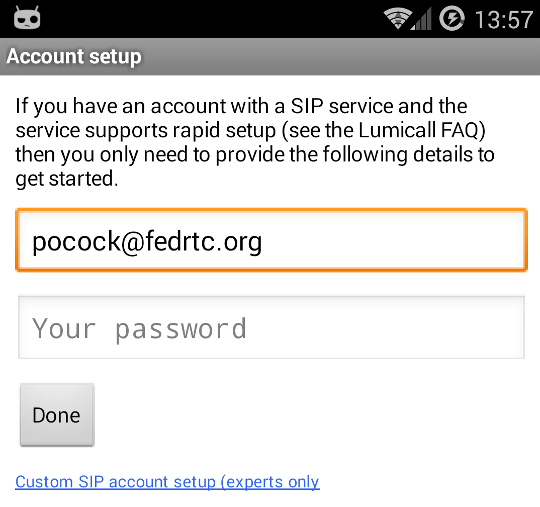
Thanks to feedback from many people at DebConf15, Lumicall has had a range of improvements over the last couple of months and it is now easier to use and more reliable than ever. Rapid provisioning for Debian.org, FedRTC.org and other SIP accounts 1. Setup your SIP password in the Debian LDAP or the FedRTC account setup (using Fedora OpenID) or any other SIP service that supports rapid provisioning (see the FAQ). 2. Install the Lumicall app from F-Droid, Google Play or by direct download. 3. When the app starts the first time, you can verify your phone number (so other users can call you using the number they know) or just click the "Manual account setup" link underneath the verification button. If you do verify your number, the "Add account" link is also available in the menu from the main screen. Test calls If a friend installs Lumicall too and you dial their number, the Lumicall popup should appear and give you the option to make the call over SIP. You can also make test calls using this link for a recorded announcement. Many other improvements
  • Support for the OPUS codec, which brings us one step closer to direct WebRTC interoperability
  • Fixing a bug in ice4j that caused NAT traversal to fail intermittently
  • Tweaks to make it more tolerant of IPv6 networks
  • The rapid account setup form (described above) for existing SIP accounts
  • Conversion to the Gradle build system (for Android Studio)
  • Breaking out embedded library code from the Lumicall repository into standalone projects so they can be maintained independently
  • Use of the compatibility library to display the ActionBar, consistent with the current design guidelines, while still maintaining compatibility with older devices
  • Use of Spongy Castle instead of Bouncy Castle crypto library for more consistent behavior across different Android devices
Share your experiences with Lumicall All feedback is welcome. If you can come in person to the workshop in Manchester (2 November) or the mini-DebConf in Cambridge (I'll be there Saturday, 7 November) then we can look at any problems in person and access logs with the Android tools if necessary. Discussion is also welcome on the Lumicall users mailing list or the Free RTC mailing list.

28 October 2015

Daniel Pocock: Free Real-Time Communications workshop in Manchester, 2 November

Manchester Free Software and MadLab are hosting a workshop on Free and Federated Real-Time Communications with Free Software next Monday night, 2 November from 7pm. Add this to your calendar (iCalendar link) Users and developers are invited to come and discover the opportunities for truly free and secure chat, voice and video with WebRTC, mobile VoIP and the free desktop. This is an interactive workshop with practical, hands-on opportunities to explore this topic, see what works and what doesn't and learn about troubleshooting techniques to help developers like myself improve the software. This is also a great opportunity for any Java developers who would like to get some exposure to the Android platform. People wishing to fully participate in all the activities are encouraged to bring a laptop with the Wireshark software and Android tools (especially adb, the command line utility) or if you prefer to focus on WebRTC, have the latest version of Firefox and Chrome installed. If you are keen to run the DruCall module for WebRTC or your own SIP or XMPP server, you can try setting it up as described in the RTC Quick Start Guide and come along to the workshop with any questions you have. A workshop near you? Manchester has a history of great technological innovation, including the first stored program computer and it is a real thrill for me to offer this workshop there. FSFE Manchester ran a workshop evaluating the performance of free software softphones back in 2012. Over the coming months, I would like to be able to hold further workshops in other locations to get feedback from people who are trying this technology, including the Lumicall app, JSCommunicator and DruCall. If you are interested in helping organize such an event or you have any other feedback about this topic, please come and discuss it on the Free RTC mailing list.

27 October 2015

Mart n Ferrari: Tales from the SRE trenches: Dev vs Ops

This is the second part in a series of articles about SRE, based on the talk I gave in the Romanian Association for Better Software. On the first part, I introduced briefly what is SRE. Today, I present some concrete ways in which SRE tried to make things better, by stopping the war between developers and SysAdmins.

Dev vs Ops: the eternal battle So, it starts at looking at the problem: how to increase the reliability of the service? It turns out that some of the biggest sources of outages are new launches: a new feature that seemed innocuous somehow managed to bring the whole site down. Devs want to launch, and Ops want to have a quiet weekend, and this is were the struggle begins. When launches are problematic, bureaucracy is put in place to minimise the risks: launch reviews, checklists, long-lived canaries. This is followed by development teams finding ways of side-stepping those hurdles. Nobody is happy. One of the key aspects of SRE is to avoid this conflict completely, by changing the incentives, so these pressures between development and operations disappear. At Google, they achieve this with a few different strategies:

Have an SLA for your service Before any service can be supported by SRE, it has to be determined what is the level of availability that it must achieve to make the users and the company happy: this is called the Service Level Agreement (SLA). The SLA will define how availability is measured (for example, percentage of queries handled successfully in less than 50ms during the last quarter), and what is the minimum acceptable value for it (the Service Level Objective, or SLO). Note that this is a product decision, not a technical one. This number is very important for an SRE team and its relationship with the developers. It is not taken lightly, and it should be measured and enforced rigorously (more on that later). Only a few things on earth really require 100% availability (pacemakers, for example), and achieving really high availability is very costly. Most of us are dealing with more mundane affairs, and in the case of websites, there are many other things that fail pretty often: network glitches, OS freezes, browsers being slow, etc. So an SLO of 100% is almost never a good idea, and in most cases it is impossible to reach. In places like Google an SLO of "five nines" (99.999%) is not uncommon, and this means that the service can't fail completely for more than 5 minutes across a whole year!

Measure and report performance against SLA/SLO Once you have a defined SLA and SLO, it is very important that these are monitored accurately and reported constantly. If you wait for the end of the quarter to produce a hand-made report, the SLA is useless, as you only know you broke it when it is too late. You need automated and accurate monitoring of your service level, and this means that the SLA has to be concrete and actionable. Fuzzy requirements that can't be measured are just a waste of time. This is a very important tool for SRE, as it allows to see the progression of the service over time, detect capacity issues before they become outages, and at the same time show how much downtime can be taken without breaking the SLA. Which brings us to one core aspect of SRE:

Use error budgets and gate launches on them If SLO is the minimum rate of availability, then the result of calculating 1 - SLO is what fraction of the time a service can fail without failing out of the SLA. This is called an error budget, and you get to use it the way you want it. If the service is flaky (e.g. it fails consistently 1 of every 10000 requests), most of that budget is just wasted and you won't have any margin for launching riskier changes. On the other hand, a stable service that does not eat the budget away gives you the chance to bet part of it on releasing more often, and getting your new features quicker to the user. The moment the error budget is spent, no more launches are allowed until the average goes back out of the red. Once everyone can see how the service is performing against this agreed contract, many of the traditional sources of conflict between development and operations just disappear. If the service is working as intended, then SRE does not need to interfere on new feature launches: SRE trusts the developers' judgement. Instead of stopping a launch because it seems risky or under-tested, there are hard numbers that take the decisions for you. Traditionally, Devs get frustrated when they want to release, but Ops won't accept it. Ops thinks there will be problems, but it is difficult to back this feeling with hard data. This fuels resentment and distrust, and management is never pleased. Using error budgets based on already established SLAs means there is nobody to get upset at: SRE does not need to play bad cop, and SWE is free to innovate as much as they want, as long as things don't break. At the same time, this provides a strong incentive for developers to avoid risking their budget in poorly-prepared launches, to perform staged deployments, and to make sure the error budget is not wasted by recurrent issues.
That's all for today. The next article will continue delving into how traditional tensions between Devs and Ops are played in the SRE world. Comment

25 October 2015

Russ Allbery: Review: The Thrilling Adventures of Lovelace and Babbage

Review: The Thrilling Adventures of Lovelace and Babbage, by Sydney Padua
Publisher: Pantheon
Copyright: 2015
ISBN: 0-307-90827-5
Format: Hardcover
Pages: 317
I seem to be writing a lot of reviews lately where any reader can easily do their own research and see if this is something they'd like. This is another of those, but perhaps a bit more obscure. As Padua explains in the preface, the first Lovelace and Babbage strip was intended to be a one-off joke. A friend suggested that she draw a comic telling the (short and rather tragic) life of Ada Lovelace, widely considered the first computer programmer even though the computer for which she wrote programs was never built: Charles Babbage's Analytic Engine. Padua found the story of Babbage and Lovelace's collaboration fascinating but too grim, and so wrote an alternate ending involving a pocket universe in which Babbage and Lovelace lived on to fight crime! Or at least fought against street organs and poetry. Padua meant this as a joke. The Internet took it as a teaser. Quite to her surprise, she found herself writing occasional additional episodes and getting lost in fascinating research about Lovelace and Babbage. The result is all at 2dgoggles.com. This book is a curated collection of those comics, including much of their (extensive) footnotes and research notes, in a very attractive and well-constructed book form. The best review, therefore, would be to go read some of the comics yourself, easily accessible via the Comics tab on the web site, and see if this is the sort of thing you'd enjoy. There is some material in the book that isn't on the web site, but most of it is there (including one full story that didn't make it into the book). There are a few reasons to buy a collection like this of material that previously appeared on the Internet. One, of course, is out of gratitude to support the author, which is the main reason I bought it. If you want to do that, though, you probably already know you do. Another reason is for additional unpublished material, but that's not really the case here. But a third is that, despite all the technology of the web, books can sometimes provide a more elegant and beautiful presentation. And that's very much the case for The Thrilling Adventures of Lovelace and Babbage. The hardcover is a beautiful work of art. It has what you would expect from a hardcover graphic novel, of course: sturdy paper, lovely story headings in the form of Victorian-style posters, and very nice artwork beneath the dust jacket. (I've been so happy to see that in the last few hardcovers I've reviewed.) But, best of all, it presents the primary research notes on each page underneath comic panels. Those who have been reading Lovelace and Babbage as it appears on the web know Padua's copious research notes. But they're normally presented at the end of each complete part, and I found myself often not reading them in detail. This might not be the case for everyone, but at least for me this presentation works so much better. Historical notes are at the bottom of (nearly) every page, in context. This might sound like it would distract from and break up the flow of the story, but at least for me it does the opposite. The comics feel so much richer when intermixed with the actual history (which in some cases is surprisingly similar to what seemed to be wild, invented scenarios). The historical notes also have end notes, and quite substantial ones. I found that organization less successful (readers of my reviews will know I have a long-standing antipathy towards end notes for anything other than cross-references), but I have to admit I have no idea how Padua would have fit those on the same page as footnotes. They're also written well enough, and with sufficient detail, that I could usually read a chapter and then read all the end notes and mostly remember what they referred to. Padua also takes advantage of the format to play a few neat games with frame breaks: characters commenting on the notes, stabbing things into them, or otherwise affecting them. I have to admit to some mild frustration where this makes the notes unreadable, since they're nearly as fascinating as the comics, but the overall effect is still worth it. (And, of course, the full notes are available on the web if one wishes to look them up.) Rounding out the book version are a few of the best original source documents that Padua found, thankfully excerpted and well-edited to not outlive their welcome for those of us who don't like poring over Victorian letters. And, finally, some beautiful illustrations of the mechanisms of the Analytic Engine with supporting descriptions of how they were supposed to work. I'm not particularly mechanically inclined, nor that fascinated by steampunk, and I still found these diagrams impressive and fun to look at. Someone more interested in such things will be in for a treat. I've been thoroughly enjoying the (sadly infrequent) installments of Lovelace and Babbage for years now, and am utterly delighted by their hardcover appearance. If you already knew about Padua's work and have any interest in nice hardcovers of such things, I don't think you'll regret the purchase. If you haven't heard of her, or this series, before, some quick reading at the web site should quickly reveal whether this is something you'd enjoy. Rating: 9 out of 10

24 October 2015

Russ Allbery: Review: Oathbreakers

Review: Oathbreakers, by Mercedes Lackey
Series: Vows and Honor #2
Publisher: DAW
Copyright: January 1989
ISBN: 0-88677-454-3
Format: Mass market
Pages: 318
The Tarma and Kethry stories tend to be stand-alone and are readable out of order, and this isn't an exception. But if you want their background, consider reading Oathblood or (less recommended) The Oathbound before reading this book. (Reading Oathblood first may require a bit of finesse, since some of the stories in that book come after this novel. Unfortunately, there is no good ordering or collection of these stories that maintains internal chronological order.) This is more like it. This is the Tarma and Kethry story that I remembered when calling them my favorite characters in the Valdemar universe. Following the short stories merged into The Oathbound fixup novel, Tarma and Kethry are still trying to gather the resources required to start a school and to rebuild Tarma's clan. That's led to them signing with a highly-respected mercenary company: Idra's Sunhawks. Idra renounced her claims to the Rethwellen line of royal succession to lead the Sunhawks, creating a mercenary band that's legendary for their quality and battlefield capabilities. The story opens with a campaign in Jkatha, on one side of a civil war, which is mostly an opportunity to get to know the Sunhawks and to see Tarma and Kethry show their competence. The real story starts later, when Idra is called back to Rethwellen for family business and something goes very wrong. I think Lackey is best at two types of stories: misunderstood young people who grow into themselves and their place in the world, and competent people displaying their competence. The Tarma and Kethry stories, and particularly Oathbreakers, are of the latter type. This is clearly wish fulfillment: Lackey's stories often lack nuance, there's rarely any doubt as to who the good and bad guys are, and, although very bad things can happen, you're probably going to get some sort of happy ending. But if you're in the mood for that sort of story, it's so satisfying. The Tarma and Kethry we see here are a mature, experienced fighter and mage team (plus Warrl, who provides vitally important magical and combat assistance, as well as some pointed advice). They know what they're doing, they care deeply for each other, and both their relationship patterns and their capabilities are well-understood. Both do a bit of growing over the course of this novel, but that's not really the point. The point is seeing them take on unfamiliar challenges and tricky investigations while being very good at what they do. In other words, this isn't bildungsroman or high fantasy; it's sword and sorcery, and an excellent example of the genre. Reading these books as part of the overall Valdemar series provides some enjoyable moments with the first explicit contact between Valdemar and its Heralds and Tarma and Kethry's world. The maps here firmly establish their home regions as well to the south of Valdemar and multiple kingdoms away, but Rethwellen (as previously established in earlier Herald-focused trilogies) is on Valdemar's southern border. Seeing Lackey's very separate magic and divinity systems cross and meet, with a bit of initial mutual suspicion, is a rather fun moment (if, at least, you're in the mood for a story in which the world has a vested interest in making sure all the good people like each other). Although I'm wondering why Kethry didn't get extremely uncomfortable when she crossed the border into Valdemar due to the trick that Vanyel pulled in his trilogy. (I seem to recall this is explained away at some point.) Be warned that this novel does contain other elements typical of early Lackey. There is, for example, the inevitable rape, although thankfully off-camera and not quite as central to the plot. (Although in a way that makes it worse since it felt gratuitous. I'm unconvinced that the rape was at all necessary to the story that Lackey was telling.) Revenge and eye-for-an-eye justice are hotly defended by the protagonists. This isn't a series to look to for subtle and complex solutions to political problems; instead, everything gets better if you just kill all the evil people. There isn't anything quite as egregious as the actions of the supposed good guys in The Oathbound, but you still have to read past a certain bloodthirstiness in the stated good side of a very black-and-white morality. That means this isn't a novel for all people or all moods. But within those genre conventions, which aren't that unusual for sword and sorcery, Oathbreakers is a lot of fun. It's one of the few Valdemar novels I've read during this re-read that lived up to my memory of it. Recommended if you like this sort of thing. Rating: 8 out of 10

23 October 2015

Russ Allbery: Review: Watchtower

Review: Watchtower, by Elizabeth A. Lynn
Series: Chronicles of Tornor #1
Publisher: Berkley
Copyright: February 1979
Printing: November 1982
ISBN: 0-425-06195-7
Format: Mass market
Pages: 226
Ryke is a soldier in service to Athor, lord of Tornor Keep. Or, at least, he was. Shortly before the opening lines of this book, Tornor Keep was taken by a southerner named Col Istor, and Athor was killed. Ryke is about to change sides under duress: his service to Col as a watch commander is the price of keeping Errel, Athor's son, alive. Alive does not mean treated with dignity, however; Errel's new place is to become court jester for Col's small domain. At the start of this book, I had no idea who Col Istor was or why he'd want to take over one of the border keeps that guard the country of Arun against its northern neighbor Anhard. At the end of this book, I still had little idea. Watchtower's relationship with world-building is not what you'd normally expect from a fantasy novel. There are only a few locations in this novel, and they're described in close detail but without much historical or strategic context. The narrative, despite being third person, follows Ryke very closely, and Ryke is not interested in thinking much about the history of his world that he knows and the reader doesn't. Or he may not care. Ryke does not come across as a curious or thoughtful person. He's a soldier, he lives to serve his lord, and that service transfers from Athor to Errel and simply stays there, with little discussion or argument. The opening section of this novel shows Ryke trying to take care of Errel while serving Col and listening to his plans to take over the rest of the northern keeps. I found it slow, claustrophobic, and not very interesting. It reads a bit like a day in the life in some grim medieval military, with little world-building or context. Watchtower is technically fantasy, but mostly because the geography and politics are imaginary. Magic is limited to a very tiny bit of (essentially) Tarot card reading and has little impact on the plot. The story does get somewhat more interesting when two green clan messengers enter the story, and Ryke and Errel escape. Lynn introduces another community and another way of life into the story than the one Ryke is used to, one that seemed modeled after monastic orders (but with the religion toned down to nearly nonexistent). I think the intended conflict of the story is between those ways of life, their draws and implications, but even that conflict is never clearly stated. Ryke seems to move from one inevitability to another, and while he does question some of his previous views and seems to open his mind a bit, actual growth is limited in this story. I reached the end of the book feeling the world was largely unchanged from its start. This story won the World Fantasy award for best novel in 1980. I have to admit I'm baffled, although partly that's because this is not really my thing. I prefer my fantasy to have more epic sweep and a lot more world-building. But perhaps the award was for the writing, which is evocative and fills the moments of the story with closely-observed detail. It has a distinctive, choppy feel, full of short declarative sentences:
The wind blew. Like some night creature caught in a trap, Col Istor's banner flapped on its pole. Ryke wondered where his wolfhound was. Sheltering, he hoped, in some warm and windless corner. He thrust his hands beneath his armpits to warm them. He entered the kitchen, nodding at the guard who stood there, and went toward the scullery. The kitchenboys huddled together in sleep like dogs in front of the oven. He stepped over their legs. The iron pots on the walls vibrated softly.
That's a paragraph chosen at random from the start of the book and should give you a good feel for the style. I think I would have liked this novel better if it had followed anyone other than Ryke. Not only did I not care for him and his simplistic loyalties, he's the least interesting character in this story. Everyone else Col, Errel, Sorren, Van, and others is more complex and more thoughtful than he is, and I think many of them would have made a better protagonist. He spends much of the center part of the book being suspicious and closed and incurious, which means the reader can only guess at what's going on between the other characters. I can't really recommend this book, but the writing is solid and it has some interesting properties for late 1970s fantasy, including both a frank look at the role of women in this society and same-sex relationships. If your taste in fantasy leans towards the gritty and realistic, you might like it more than I did. I may try the later books of the series in the hope that they have more interesting protagonists. Followed by Dancers of Arun. Rating: 6 out of 10

22 October 2015

Russ Allbery: Review: What If?

Review: What If?, by Randall Munroe
Publisher: Houghton Mifflin Harcourt
Copyright: 2014
ISBN: 0-544-27299-4
Format: Hardcover
Pages: 295
This is another one of those reviews that's somewhat pointless to write, at least beyond telling people who for some strange reason aren't xkcd readers that this is a thing that exists in the world. What If? is a collection of essays from that feature on the xkcd web site and new essays in the same vein. (Over half are new to this collection.) If you've read them, you know what to expect; if you haven't, and have any liking at all for odd scientific facts or stick figures, you're in for a treat. So, short review: The subtitle is Serious Scientific Answers to Absurd Hypothetical Questions, and it's exactly what it says on the tin, except that "serious" includes a healthy dose of trademark xkcd humor. Go read what-if.xkcd.com for numerous samples of Munroe's essay style. If you like what you see, this is a whole book of that: a nice, high-quality hardcover (at least the edition I bought), featuring the same mix of text and cartoon commentary, and with new (and in some cases somewhat longer) material. You probably now have all the information necessary to make a purchasing decision. If you need more motivation, particularly to buy a physical copy, the inside of the dust jacket of the hardcover is a detailed, labeled map of the world after a drain in the Marianas Trench has emptied most of the oceans onto Mars. And the book inside the dust jacket is embossed with what happens after the dinosaur on the cover is lowered into, or at least towards, the Great Pit of Carkoon. This made me particularly happy, since too often hardcovers inside the dust jacket look just like every other hardcover except for the spine lettering. Very few of them have embossed Star Wars references. Personally, I think that's a great reason to buy the hardcover even if, like me, you've been following What If? on the web religiously since it started. But of course the real draw is the new material. There's enough of it that I won't try any sort of comprehensive list, but rest assured that it's of equal or better quality than the web-published essays we know and love. My favorite of the new pieces is the answer to the question "what would happen if you made a periodic table out of cube-shaped bricks, where each brick was made of the corresponding element?" As with so many What If? questions, it starts with killing everyone in the vicinity, and then things get weird. Another nice touch in this collection is what I'd call "rejected questions": questions that people submitted but that didn't inspire an essay. Most of these (I wish all) get a single cartoon of reaction to the question itself, which include some of the funniest (and most touching) panels in the book. Ebook formatting has gotten much better, so there's some hope that at least some platforms could do justice to this book with its embedded cartoons. Putting the footnotes properly at the bottom of each page (thank you!) might be a challenge, though. Writing mixed with art is one of the things I think benefits greatly from a physical copy, and the hardcover is a satisfying and beautiful artifact. (I see there's also an audio book, but I'm sure how well that could work; so much of the joy of What If? is the illustrations, and I'm dubious that one could adequately describe them.) Prior web readers will be relieved to know that the mouse-over text is preserved as italic captions under the cartoons, although sadly most cartoons are missing captions. (As I recall, that's also the case for the early web What If? essays, but later essays have mouse-over text for nearly every cartoon.) Anyway, this is a thing that exists. If you follow xkcd, you probably knew that already, given that the book was published last year and I only now got around to reading it. (My current backlog is... impressive.) If you were not previously aware of What If? or of xkcd itself, now you are, and I envy you the joy of discovery. A short bit of reading will tell you for certain whether this is something you want to purchase. If your relationship to physics is at all similar to mine, I suspect the answer will be yes. A small personal note: I just now realized how much the style of What If? resembles the mixed text and illustrations of One Two Three... Infinity. Given how foundational that book was to my love of obscure physics facts, my love of What If? is even less surprising. Rating: 10 out of 10

21 October 2015

Daniel Pocock: A mission statement for free real-time communications

At FOSDEM 2013, the RTC panel in the main track used the tag line "Can we finally replace Skype, Viber, Twitter and Facebook?" Does replacing something else have the right ring to it though? Or does such a goal create a negative impression? Even worse, does the term Skype replacement fall short of being a mission statement that gives people direction and sets expectations of what we would actually like to replace it with? Towards a clearer definition Lets consider what a positive statement might look like:
Making it as easy as possible to make calls to other people and to receive calls from other people for somebody who chooses only to use genuinely Free Software, open standards, a free choice of service providers and a credible standard of privacy.
If you agree with this or if you feel you can propose a more precise statement, please come and share your thoughts on the Free RTC email list. The value of a mission statement should not be underestimated. With the right mission statement, it should be possible to envision what the future will look like if we succeed and also if we don't. With the vision of success in mind, it should be easier for developers and the wider free software community to identify the steps that must be taken to make progress.

18 October 2015

Lunar: Reproducible builds: week 25 in Stretch cycle

What happened in the reproducible builds effort this week: Toolchain fixes Niko Tyni wrote a new patch adding support for SOURCE_DATE_EPOCH in Pod::Man. This would complement or replace the previously implemented POD_MAN_DATE environment variable in a more generic way. Niko Tyni proposed a fix to prevent mtime variation in directories due to debhelper usage of cp --parents -p. Packages fixed The following 119 packages became reproducible due to changes in their build dependencies: aac-tactics, aafigure, apgdiff, bin-prot, boxbackup, calendar, camlmix, cconv, cdist, cl-asdf, cli-common, cluster-glue, cppo, cvs, esdl, ess, faucc, fauhdlc, fbcat, flex-old, freetennis, ftgl, gap, ghc, git-cola, globus-authz-callout-error, globus-authz, globus-callout, globus-common, globus-ftp-client, globus-ftp-control, globus-gass-cache, globus-gass-copy, globus-gass-transfer, globus-gram-client, globus-gram-job-manager-callout-error, globus-gram-protocol, globus-gridmap-callout-error, globus-gsi-callback, globus-gsi-cert-utils, globus-gsi-credential, globus-gsi-openssl-error, globus-gsi-proxy-core, globus-gsi-proxy-ssl, globus-gsi-sysconfig, globus-gss-assist, globus-gssapi-error, globus-gssapi-gsi, globus-net-manager, globus-openssl-module, globus-rsl, globus-scheduler-event-generator, globus-xio-gridftp-driver, globus-xio-gsi-driver, globus-xio, gnome-control-center, grml2usb, grub, guilt, hgview, htmlcxx, hwloc, imms, kde-l10n, keystone, kimwitu++, kimwitu-doc, kmod, krb5, laby, ledger, libcrypto++, libopendbx, libsyncml, libwps, lprng-doc, madwimax, maria, mediawiki-math, menhir, misery, monotone-viz, morse, mpfr4, obus, ocaml-csv, ocaml-reins, ocamldsort, ocp-indent, openscenegraph, opensp, optcomp, opus, otags, pa-bench, pa-ounit, pa-test, parmap, pcaputils, perl-cross-debian, prooftree, pyfits, pywavelets, pywbem, rpy, signify, siscone, swtchart, tipa, typerep, tyxml, unison2.32.52, unison2.40.102, unison, uuidm, variantslib, zipios++, zlibc, zope-maildrophost. The following packages became reproducible after getting fixed: Packages which could not be tested: Some uploads fixed some reproducibility issues but not all of them: Patches submitted which have not made their way to the archive yet: Lunar reported that test strings depend on default character encoding of the build system in ongl. reproducible.debian.net The 189 packages composing the Arch Linux core repository are now being tested. No packages are currently reproducible, but most of the time the difference is limited to metadata. This has already gained some interest in the Arch Linux community. An explicit log message is now visible when a build has been killed due to the 12 hours timeout. (h01ger) Remote build setup has been made more robust and self maintenance has been further improved. (h01ger) The minimum age for rescheduling of already tested amd64 packages has been lowered from 14 to 7 days, thanks to the increase of hardware resources sponsored by ProfitBricks last week. (h01ger) diffoscope development diffoscope version 37 has been released on October 15th. It adds support for two new file formats (CBFS images and Debian .dsc files). After proposing the required changes to TLSH, fuzzy hashes are now computed incrementally. This will avoid reading entire files in memory which caused problems for large packages. New tests have been added for the command-line interface. More character encoding issues have been fixed. Malformed md5sums will now be compared as binary files instead of making diffoscope crash amongst several other minor fixes. Version 38 was released two days later to fix the versioned dependency on python3-tlsh. strip-nondeterminism development strip-nondeterminism version 0.013-1 has been uploaded to the archive. It fixes an issue with nonconformant PNG files with trailing garbage reported by Roland Rosenfeld. disorderfs development disorderfs version 0.4.1-1 is a stop-gap release that will disable lock propagation, unless --share-locks=yes is specified, as it still is affected by unidentified issues. Documentation update Lunar has been busy creating a proper website for reproducible-builds.org that would be a common location for news, documentation, and tools for all free software projects working on reproducible builds. It's not yet ready to be published, but it's surely getting there. Homepage of the future reproducible-builds.org website  Who's involved?  page of the future reproducible-builds.org website Package reviews 103 reviews have been removed, 394 added and 29 updated this week. 72 FTBFS issues were reported by Chris West and Niko Tyni. New issues: random_order_in_static_libraries, random_order_in_md5sums.

17 October 2015

Simon Richter: Key Transition

So, since several years I've had a second gpg key, 4096R/6AABE354. Several of you have already signed it, and I've been using it in Debian for some time already, but I've not announced it more widely yet, and I occasionally still get mail encrypted to the old key (which remains valid and usable, but it's 1024R). Of course, I've also made a formal transition statement:
-----BEGIN PGP SIGNED MESSAGE-----
Hash: SHA1
OpenPGP Key Transition Statement for Simon Richter
I have created a new OpenPGP key and will be transitioning away from
my old key.  The old key has not been compromised and will continue to
be valid for some time, but I prefer all future correspondence to be
encrypted to the new key, and will be making signatures with the new
key going forward.
I would like this new key to be re-integrated into the web of trust.
This message is signed by both keys to certify the transition.  My new
and old keys are signed by each other.  If you have signed my old key,
I would appreciate signatures on my new key as well, provided that
your signing policy permits that without re-authenticating me.
The old key, which I am transitioning away from, is:
pub   1024D/5706A4B4 2002-02-26
      Key fingerprint = 040E B5F7 84F1 4FBC CEAD  ADC6 18A0 CC8D 5706 A4B4
The new key, to which I am transitioning, is:
pub   4096R/6AABE354 2009-11-19
      Key fingerprint = 9C43 2534 95E4 DCA8 3794  5F5B EBF6 7A84 6AAB E354
The entire key may be downloaded from: http://www.simonrichter.eu/simon.asc
To fetch the full new key from a public key server using GnuPG, run:
  gpg --keyserver keys.gnupg.net --recv-key 6AABE354
If you already know my old key, you can now verify that the new key is
signed by the old one:
  gpg --check-sigs 6AABE354
If you are satisfied that you've got the right key, and the User IDs
match what you expect, I would appreciate it if you would sign my key:
  gpg --sign-key 6AABE354
You can upload your signatures to a public keyserver directly:
  gpg --keyserver keys.gnupg.net --send-key 6AABE354
Or email sr@simonrichter.eu (possibly encrypted) the output from:
  gpg --armor --export 6AABE354
If you'd like any further verification or have any questions about the
transition please contact me directly.
To verify the integrity of this statement:
  wget -q -O- http://www.simonrichter.eu/key-transition-2015-03-09.txt   gpg --verify
   Simon
-----BEGIN PGP SIGNATURE-----
Version: GnuPG v1
iQEcBAEBAgAGBQJU/bbEAAoJEH69OHuwmQgRWOIH/AogHxhhVO5Tp5FFGpBFwljf
NzKTPBExMhZ/8trAzYybOWFv3Bx4AGdWkYfDnxP6oxQJOXVq4KL6ZcPPuIZuZ6fZ
bu0XHdPMU89u0TymR/WJENRCOcydRBe/lZs+zdJbKQtEZ+on4uNXxHpUiZPi1xxM
ggSdVBKn2PlCBcYih40S9Oo/rM9uBmYcFavX7JMouBSzgX78cVoIcY6zPRmHoq4k
TkGKfvHeSu+wbzWRmDwu/PFHRA4TKNvR6oeO+Et1yk454zjrHMXineBILRvvMCIA
t54pV6n+XzOUmtXcKnkIGltK+ZaJSV6am0swtx84RaevVXrknIQE8NvlA4MNgguI
nAQBAQIABgUCVP23tAAKCRDSx966V9+/u3j4BACVHifAcO86jAc5dn+4OkFZFhV1
l3MKIolL+E7Q7Ox+vJunGJJuGnOnazUK+64yDGZ2JxNJ4QNWD1FOs/Ng2gm82Vin
ArBtyp1ZGWUa+349X+1qarUQF9qAaUXDZjFp5Hzh/o6KC4t3eECxcb41og3LUTQD
VuG2KWNXYBe5P5ak9Q==
=o61r
-----END PGP SIGNATURE-----

Russell Coker: Mail Server Training

Today I ran a hands-on training session on configuring a MTA with Postfix and Dovecot for LUV. I gave each student a virtual machine running Debian/Jessie with full Internet access and instructions on how to configure it as a basic mail server. Here is a slightly modified set of instructions that anyone can do on their own system. Today I learned that documentation that includes passwords on a command-line should have quotes around the password, one student used a semi-colon character in his password which caused some confusion (it s the command separator character in BASH). I also discovered that trying to just tell users which virtual server to login to is prone to errors, in future I ll print out a list of user-names and passwords for virtual servers and tear off one for each student so there s no possibility of 2 users logging in to the same system. I gave each student a sub-domain of unixapropos.com (a zone that I use for various random sysadmin type things). I have changed the instructions to use example.com which is the official address for testing things (or you could use any zone that you use). The test VMs that I setup had a user named auser , the documentation assumes this account name. You could change auser to something else if you wish. Below are all the instructions for anyone who wants to try it at home or setup virtual machines and run their own training session. Basic MTA Configuration
  1. Run apt-get install postfix to install Postfix, select Internet Site for the type of mail configuration and enter the domain name you selected for the mail name.
  2. The main Postfix configuration file is /etc/postfix/main.cf. Change the myhostname setting to the fully qualified name of the system, something like mta.example.com.
    You can edit /etc/postfix/main.cf with vi (or any other editor) or use the postconf command to change it, eg postconf -e myhostname=mta.example.com .
  3. Add home_mailbox=Maildir/ to the Postfix configuration to make it deliver to a Maildir spool in the user s home directory.
  4. Restart Postfix to apply the changes.
  5. Run apt-get install swaks libnet-ssleay-perl to install swaks (a SMTP test tool).
  6. Test delivery by running the command swaks -f auser@example.com -t auser@example.com -s localhost . Note that swaks displays the SMTP data so you can see exactly what happens and if something goes wrong you will see everything about the error.
  7. Inspect /var/log/mail.log to see the messages about the delivery. View the message which is in ~auser/Maildir/new.
  8. When other students get to this stage run the same swaks command but with the -t changed to the address in their domain, check the mail.log to see that the messages were transferred and view the mail with less to see the received lines. If you do this on your own specify a recipient address that s a regular email address of yours (EG a Gmail account).
Basic Pop/IMAP Configuration
  1. Run apt-get install dovecot-pop3d dovecot-imapd to install Dovecot POP and IMAP servers.
    Run netstat -tln to see the ports that have daemons listening on them, observe that ports 110 and 143 are in use.
  2. Edit /etc/dovecot/conf.d/10-mail.conf and change mail_location to maildir:~/Maildir . Then restart Dovecot.
  3. Run the command nc localhost 110 to connect to POP, then run the following commands to get capabilities, login, and retrieve mail:
    user auser
    pass WHATEVERYOUMADEIT
    capa
    list
    retr 1
    quit
  4. Run the command nc localhost 143 to connect to IMAP, then run the following commands to list capabilities, login, and logout:
    a capability
    b login auser WHATEVERYOUMADEIT
    c logout
  5. For the above commands make note of the capabilities, we will refer to that later.
Now you have a basically functional mail server on the Internet! POP/IMAP Over SSL To avoid password sniffing we need to use SSL. To do it properly requires obtaining a signed key for a DNS address but we can do the technical work with the snakeoil certificate that is generated by Debian.
  1. Edit /etc/dovecot/conf.d/10-ssl.conf and change ssl = no to ssl = required . Then add the following 2 lines:
    ssl_cert = </etc/ssl/certs/ssl-cert-snakeoil.pem
    ssl_key = </etc/ssl/private/ssl-cert-snakeoil.key
    1. Run netstat -tln and note that ports 993 and 995 are not in use.
    2. Edit /etc/dovecot/conf.d/10-master.conf and uncomment the following lines:
      port = 993
      ssl = yes
      port = 995
      ssl = yes
    3. Restart Dovecot, run netstat -tln and note that ports 993 and 995 are in use.
  2. Run nc localhost 110 and nc localhost 143 as before, note that the capabilities have changed to include STLS/STARTTLS respectively.
  3. Run gnutls-cli --tofu 127.0.0.1 -p 993 to connect to the server via IMAPS and gnutls-cli --tofu 127.0.0.1 -p 995 to connect via POP3S. The --tofu option means to Trust On First Use , it stores the public key in ~/.gnutls and checks it the next time you connect. This allows you to safely use a snakeoil certificate if all apps can securely get a copy of the key.
Postfix SSL
  1. Edit /etc/postfix/main.cf and add the following 4 lines:
    smtpd_tls_received_header = yes
    smtpd_tls_loglevel = 1
    smtp_tls_loglevel = 1
    smtp_tls_security_level = may
    Then restart Postfix. This makes Postfix log TLS summary messages to syslog and in the Received header. It also permits Postfix to send with TLS.
  2. Run nc localhost 25 to connect to your SMTP port and then enter the following commands:
    ehlo test
    quit
    Note that the response to the EHLO command includes 250-STARTTLS, this is because Postfix was configured with the Snakeoil certificate by default.
  3. Run gnutls-cli --tofu 127.0.0.1 -p 25 -s and enter the following commands:
    ehlo test
    starttls
    ^D
    After the CTRL-D gnutls-cli will establish a SSL connection.
  4. Run swaks -tls -f auser@example.com -t auser@example.com -s localhost to send a message with SSL encryption. Note that swaks doesn t verify the key.
  5. Try using swaks to send messages to other servers with SSL encryption. Gmail is one example of a mail server that supports SSL which can be used, run swaks -tls -f auser@example.com -t YOURADDRESS@gmail.com to send TLS (encapsulated SSL) mail to Gmail via swaks. Also run swaks -tls -f auser@example.com -t YOURADDRESS@gmail.com -s localhost to send via your new mail server (which should log that it was a TLS connection from swaks and a TLS connection to Gmail).
SASL SASL is the system of SMTP authentication for mail relaying. It is needed to permit devices without fixed IP addresses to send mail through a server. The easiest way of configuring Postfix SASL is to have Dovecot provide it s authentication data to Postfix. Among other things if you change Dovecot to authenticate in another way you won t need to make any matching changes to Postfix.
  1. Run mkdir -p /var/spool/postfix/var/spool and ln -s ../.. /var/spool/postfix/var/spool/postfix , this allows parts of Postfix to work with the same configuration regardless of whether they are running in a chroot.
  2. Add the following to /etc/postfix/main.cf and restart Postfix:
    smtpd_sasl_auth_enable = yes
    smtpd_sasl_type = dovecot
    smtpd_sasl_path = /var/spool/postfix/private/auth
    broken_sasl_auth_clients = yes
    smtpd_sasl_authenticated_header = yes
  3. Edit /etc/dovecot/conf.d/10-master.conf, uncomment the following lines, and then restart Dovecot:
    unix_listener /var/spool/postfix/private/auth
    mode = 0666
  4. Edit /etc/postfix/master.cf, uncomment the line for the submission service, and restart Postfix. This makes Postfix listen on port 587 which is allowed through most firewalls.
  5. From another system (IE not the virtual machine you are working on) run swaks -tls -f auser@example.com -t YOURADDRESS@gmail.com -s YOURSERVER and note that the message is rejected with Relay access denied .
  6. Now run swaks -tls --auth-user auser --auth-password WHATEVER -f auser@example.com -t YOURREALADDRESS -s YOURSERVER and observe that the mail is delivered (subject to anti-spam measures at the recipient).
  7. Configuring a MUA If every part of the previous 3 sections is complete then you should be able to setup your favourite MUA. Use auser as the user-name for SMTP and IMAP, mail.example.com for the SMTP/IMAP server and it should just work! Of course you need to use the same DNS server for your MUA to have this just work. But another possibility for testing is to have the MUA talk to the server by IP address not by name.

16 October 2015

Vincent Sanders: Raspberries are not the only fruit

I have worked with ARM based systems for longer than I care to admit to myself. From the Acorn Archimedes 305 in 1987 through to modern 64bit systems I have seen many many changes in the ARM community. One big change has been the rise of the inexpensive single board computer (SBC).

Arguably the Raspberry Pi (RPi) was responsible for starting this trend. Before RPi there were small development boards available, I was even involved in producing some of them, none of these really became a big thing and were principally vehicles for silicon vendors to showcase their SoC in an accessible way. When I say accessible I mean for silicon vendors who were previously used to charging many thousands of pounds for their development boards now only charging hundreds.

Raspberry Pi 2 B+ in my case
In my opinion the RPi was a complete disruption to the SBC market. In early 2012 a complete ARM computer system could now be purchased for $35 ( 25) which was substantially cheaper than the best contemporary competitor the Beaglebone $89 ( 60)

To be clear, the reason the RPi succeeded (millions sold, household name) was not on price alone but also the large amount of good supporting software and how easy it was made for teachers and makers to use.

There were several areas that the RPi managed to change perceived issues into opportunities for using what was already available or third parties to provide. There were also several issues raised about the original RPi:
Some of these have been addressed since release as the foundation now sells cases, hardware revisions with much more powerful processors, pre-configured storage, cameras and displays. The important thing to note here though is the RPi has made the bare SBC a much more widely accepted product where all the non critical parts are considered "extras" and a lot is forgiven because of the price.

With that acceptance there have been many, many new SBC coming to market with better peripherals and increasingly competitive pricing. These are technically not clones as none of them use the Broadcom processor of the RPi but they often share many features and possibly even a compatible expansion header.

Banana pi in my case with a 2.5inch drive bay
The Banana Pi was one of these copycats which I acquired for a similar price as an RPi in 2014. The main processor of this system was a 1Ghz dual core Allwinner A20 processor (a considerable advance on the 700MHz single core of the original RPi) coupled to a gigabyte of memory. Additionally the board benefited from having SATA and gigabit Ethernet MAC which made for a much more versatile system. Various third parties filled in the missing peripherals including my own attempt at a case.

I acquired a cubietruck for the NetSurf project to use as a build node in their CI system this is again based on the A20 but with more memory and somewhat better peripheral support but at a substantial cost over the Banana Pi.

The most recent addition to this form factor is the introduction by Xunlong Software of the Orange Pi PC. This little board is the same footprint as the RPi2 B+ design but with differing connector placement. The processor is a quad core 1.6GHz Allwinner H3 with a gigabyte of memory and has has Ethernet and USB but no SATA.

Pile of Orange Pi PC in my cases
The big news about this board though is the price, at $15 ( 10) it resets the price expectations just as the RPi did before it. I was initially sceptical of the quality of the product (or if it would arrive at all) but I have acquired five of these boards and every one of them came well packaged, boxed and in a static bag, just like the RPi does, and they all worked.

I created a case design based on my RPi slimline case so they would be protected when piled up with all the other boards. The use of a DC barrel jack instead of micro USB for power is better in that the connector is more robust and intended for higher current draws but does mean additional leads are needed. There are, however, two flies in the ointment, neither are showstoppers but make the board a little more difficult to use.

Orange Pi in my case with heatsinkOne is a simple necessity of a substantial heatsink on the H3 processor. Initially I used a small 20 x 20mm copper heatsink (around 800mm square surface area) but this was insufficient under full load. I did not want to have to use a fan so I milled some slots into copper round bar, then cut off sections and faced them on a lathe. The completed design had more than 2200 square mm surface area and cost around $2.5 ( 1.5) in material (and a couple of hours in the workshop but that was fun and I made something)

The second issue and arguably much more serious is that of software. Let me be honest, it is dreadful, I mean very bad indeed. The images provided from the Orange Pi website are some of the worst examples of "do something quick" I have experienced.

Fortunately a user on the forums named loboris decided to create scripts that generate a Debian (and Ubuntu and Fedora) distribution images that can be installed from SD card. He relies on a somewhat patched 3.4 kernel full of Allwinner vendor changes and the inevitable binary blobs for the Marli GPU but the result does work.

I have had a few units acting as distcc compiler slaves for two weeks now at 100% CPU loading and they are still running. The processor does not get overly warm with the heatsink installed and Debian behaves just fine. The main caveat being that it is definitely not going to work if you try and update the kernel through packaging.

My ARM build farm as a pile of SBC
The state of software support and Xunlong Software relying on a forum user to complete their product does tarnish an otherwise impressive and possibly market changing SBC.

Perhaps I expect too much for fifteen bucks? I guess when the cost of the case, heatsink, cables and memory storage card is similar to the rest of the computer there is simply no margin left for anything else.

In conclusion hopefully this brief overview has provided some insight into what is available in this market and that the Raspberry Pi is indeed not the only option.

I finish with an image is of my ARM build farm consisting of every SBC I mention here (including a couple of RPi)

Norbert Preining: Debian/TeX Live multiarch update

A big update of all related packages (tex-common 6.04, texlive-bin 2015.20150524.37493-7, texlive-base/lang/extra package 2015.20151016-1) due to the move to support multi-arch. Of course, the regular updates of the TeX Live are included, too. With this change it should be possible to run a multi-arch system with only one TeX Live installed. Debian - TeX Live 2015 Thanks to the excellent support and testing of the Multi-arch guys, in particular Thorsten Glaser, Helmut Grohne, Johannes Schauer, and Wookey, I learned a lot about multi-arch, and I hope that the current setup is safe. All the packages but the various lib* packages are tagged as Multi-Arch: foreign, while the lib packages are tagged Multi-Arch: same. Anyway, if you find a bug concerning multi-arch, that is that some of the programs exhibit architecture information, please let us know via a bug report. Updated packages acro, alegreya, amiri, assoccnt, attachfile, babel-french, babel-hungarian, barr, beebe, biblatex-philosophy, bidi, bnumexpr, caption, chemfig, chemformula, chemmacros, cjk-gs-integrate, csplain, dantelogo, dataref, dtxgen, dvipdfmx-def, dvips, eledmac, elements, fcolumn, fithesis, fontspec, genealogytree, gradstudentresume, gtl, jfontmaps, knuth-local, koma-script, kotex-oblivoir, kotex-plain, kotex-utf, kpathsea, l3build, l3experimental, l3kernel, l3packages, latex, latexconfig, ledmac, ltxfileinfo, lualatex-math, luamplib, luatex, luatexbase, luatexja, luatexko, make4ht, mcf2graph, mflogo, modiagram, multiexpand, newtx, odsfile, old-arrows, paracol, pdfpages, pdftex, plain, pst-stru, pxchfon, randomwalk, reledmac, resumecls, rubik, selnolig, showhyphens, siunitx, suftesi, tetex, teubner, tex4ebook, tex4ht, texlive-scripts, tikzsymbols, tipfr, tools, tudscr, uassign, unicode-math, unravel, visualfaq, xepersian, xetex-def, xint. New packages archaeologie, ctablestack, dynamicnumber, exercises, fibeamer, h2020proposal, imfellenglish, lstbayes, tempora, xellipsis. Enjoy.


Russ Allbery: Review: Ancillary Mercy

Review: Ancillary Mercy, by Ann Leckie
Series: Imperial Radch #3
Publisher: Orbit
Copyright: October 2015
ISBN: 0-316-24668-9
Format: Trade paperback
Pages: 330
This is the third book of the series that starts with Ancillary Justice. Please don't read it out of order. The three books form a rare thing in SF: a trilogy with a clear start and a clear ending. They're ideally read fairly close together so that you can remember the people involved. By the end of Ancillary Sword, Leckie had apparently resolved most of the plot in the Athoek system, although the Ghost Gate and broader imperial turmoil still lurked. I was expecting this novel to be another change of scene, and probably a broadening of the scope into the more sweeping events set off by earlier books. That's not what Ancillary Mercy is at all. Leckie caught me by surprise early, and the book kept not going in the direction I was expecting. And the result is brilliant. It's obviously difficult to talk about this in detail, since there's no way I'm going to spoil this or any of the previous books. This is some of the best SF I've ever read, and I want anyone who's not read the series yet to have the full experience. What I will say is that there was a lot of character growth left, including in some places that I thought would remain setting-mandated blind spots. Leckie tackles some very tricky themes, ones that are hard to do well because of how thoroughly the ground has already been explored, and still manages to find an original take and an even more original tone. And remains true to Breq's characterization throughout, including one critical scene that's masterful in its heart-breaking understatedness. Breq's flat affect is both very difficult and incredibly rewarding as a first-person protagonist. If I had to call out one thing that makes this series so special to me, it's the way that Leckie puts the reader in the middle of a restrained and very careful culture, centers the book on a character with a very unusual relationship to emotion, nearly completely avoids outward displays of feeling, treats emotions primarily as data to be weighed with other information, and yet provides just the right amount of subtle clues and external reflection to show just how central emotion is to everything that happens. This is an incredibly difficult balancing act, much harder than an openly emotional book (let alone the tough-guy cliches that military SF is normally full of), and it makes the occasional pay-offs so rewarding. I think some people might find Ancillary Mercy too understated, but I thought it was note-perfect throughout. And the ending was spectacular. For those who are less enamored of Breq and more interested in the plot, don't worry: we do get some resolution to most of the loose threads. There's clearly potential in this universe for more stories (and apparently more books coming!), but this trilogy comes to a definite end. If I had to quibble, I'd say that a few bits of the plot are too convenient: the resolution would have been impossible without one very critical mistake at the start of the second book, and there's at least one perfectly-timed accident. But Leckie's most critical plot resolution tool was properly hung on the wall in the last book and used perfectly. It's hard to manage a satisfying resolution to a twisty political conflict between very sharp antagonists; for me, at least, Leckie pulls it off. Looking back on the whole series, I find it striking how much more satisfying and believable Leckie's military culture is for her setting than those I normally read. I think we're too often given far-future military stories that are full of impulsive drama, high emotion, and physical feats. But in a world of starships and space stations, advanced computers, careful and systematized roles, and precise engineering, that's not realistic. While there is some physical violence required, problems in that world are more likely to look like operational computer problems than gladiatorial problems. That means the required tools are careful and fast analytical skills, quick iterative decision-making, and precise execution, not physical toughness and grit. In that world, adrenaline is at best useless and often your enemy. Leckie's world of tea sets and emotional control is partly driven by other world-building factors, but, particularly in this book, I was struck by how well-adapted it is to a military where calm decisions and efficient follow-through are far more important than adrenaline-driven courage. The emotion is absolutely there, but the catharsis doesn't come through bloody battles or feats of physicality. Again, so tricky to pull off, since it plays against the expectations we bring as readers to a war story, but I found it so much more satisfying when written well. I also love that this series is not about saving the world, at least in any direct sense. It is about justice, and ethics, and about standing up for what's right, but it's just as much about identity, about how to choose and define one's ethics, and how to make the most of the small number of decisions one gets to make. Everyone in this world is operating under sharp constraints: culture, ability, available alliances, physical limitations, and particularly the role into which they were cast. Huge things happen in this series, but not from the dramatic, order-overturning action of Chosen Ones. Rather, change is created by individuals who find small points of leverage and definition, and who make quiet, critical decisions to become better people than they were. I adore this series, and particularly this conclusion, beyond all rational measure. I'm sure that won't be universal, just as other readers weren't as enamored as I was of the direction Leckie went in Ancillary Sword. But this was a series conclusion that I was not expecting at all, that kept surprising me right up to the climax, and was exactly the conclusion that I wanted. If you liked the previous books, and particularly if you liked Ancillary Sword but thought Breq was a bit too much in control of the plot and a bit too able to make things go her way, I think you'll love Ancillary Mercy. This is simply the best SF series I've read in a long time. Rating: 10 out of 10

Dirk Eddelbuettel: R / Finance 2016 Call for Papers

Earlier today, Josh sent the text below in this message to the R-SIG-Finance list as the very first heads-up concerning the 2016 edition of our successful R/Finance series. We are once again very excited about our conference, thrilled about upcoming keynotes (some of which are confirmed and some of which are in the works), and hope that many R / Finance users will not only join us in Chicago in May 2016 -- but also submit an exciting proposal. So read on below, and see you in Chicago in May!
Call for Papers R/Finance 2016: Applied Finance with R
May 20 and 21, 2016
University of Illinois at Chicago, IL, USA The eight annual R/Finance conference for applied finance using R will be held on May 20 and 21, 2016, in Chicago, IL, USA at the University of Illinois at Chicago. The conference will cover topics including portfolio management, time series analysis, advanced risk tools, high-performance computing, market microstructure, and econometrics. All will be discussed within the context of using R as a primary tool for financial risk management, portfolio construction, and trading. Over the past seven years, R/Finance has included attendees from around the world. It has featured presentations from prominent academics and practitioners, and we anticipate another exciting line-up for 2016. We invite you to submit complete papers in pdf format for consideration. We will also consider one-page abstracts (in txt or pdf format) although more complete papers are preferred. We welcome submissions for both full talks and abbreviated "lightning talks." Both academic and practitioner proposals related to R are encouraged. All slides will be made publicly available at conference time. Presenters are strongly encouraged to provide working R code to accompany the slides. Data sets should also be made public for the purposes of reproducibility (though we realize this may be limited due to contracts with data vendors). Preference may be given to presenters who have released R packages. The conference will award two (or more) $1000 prizes for best papers. A submission must be a full paper to be eligible for a best paper award. Extended abstracts, even if a full paper is provided by conference time, are not eligible for a best paper award. Financial assistance for travel and accommodation may be available to presenters, however requests must be made at the time of submission. Assistance will be granted at the discretion of the conference committee. Please make your submission online at this link. The submission deadline is January 29, 2016. Submitters will be notified via email by February 29, 2016 of acceptance, presentation length, and financial assistance (if requested). Additional details will be announced via the R/Finance conference website as they become available. Information on previous years' presenters and their presentations are also at the conference website. For the program committee:
Gib Bassett, Peter Carl, Dirk Eddelbuettel, Brian Peterson,
Dale Rosenthal, Jeffrey Ryan, Joshua Ulrich

Next.

Previous.