Search Results: "rra"

17 November 2010

Russell Coker: A Mobile Phone for Sysadmin Use

My telco Three have just offered me a deal on getting a new phone a couple of months earlier than my contract was supposed to expire, presumably they have some competition and want to get me locked into another 2 year contract a couple of months before anyone else has the chance.My current phone is a LG U990 Viewty [1] which I am reasonably happy with for the regular phone and camera functionality (apart from it being too slow to take a photo), it s on a $29 per month plan. I also have a 3G modem which is on a $15 per month plan for 1G of data per month for a total cost of $44 per month. As new phones have advanced client functionality (ssh, IMAP, etc) and have Wifi support for providing net access to a laptop there seems to be less need to have a separate phone and modem. So I am considering getting a high-end phone to replace the phone and modem, so while I don t want to pay a lot more than I currently pay, a $49 contract would be quite affordable and a $59 contract is something I can consider.What I need is a system with a good ssh client implementation, a high resolution screen (800*480 or better), preferably a slide out keyboard and an option to use a Bluetooth keyboard.The best option for the OS seems to be Android as it s based on Linux, it s moderately open, and it has a good range of applications. The Nokia N900 has been recommended based on features but a friend had a bad experience with a N900 that broke and didn t get good warranty support. Also the N900 doesn t have a digital compass (so can t do augmented reality). While I m primarily buying a phone for making phone calls, using the net, and being a ssh client I want to be able to do cool things like do Google searches on things that I photograph and have an annotated star map when I point my phone at the sky. Also as I m not using Windows or Apple phones for obvious reasons that leaves Android phones as the only suitable phones that are on offer from my Telco.I have checked some options for buying a grey-market phone, given that I need to get a more expensive phone contract to have the voice and data access I need the cost of buying a grey-market phone and having a no-phone contract would be unreasonable. So selecting a phone that s on offer by Three/Vodaphone seems to be the best option. Moving to another telco would be inconvenient as I would have to convince the relatives that I call often to switch as well (I get free calls to other Three/Vodaphone customers).I previously listed some phones that seemed good without regard as to where I could buy them [2] and some people wrote some really interesting and informative comments (thanks a lot!). But after considering all the options it seems that the costs of the various options force me to choose something that Three offers.Currently the best option from Three for an Android phone seems to be the HTC Desire HD [3]. It has a 800*480 screen, an 8MP camera with face-detection and geo-tagging, wifi, an accelerometer, GPS, and a digital compass. It also runs Android 2.2 (the latest release). Generally it has everything I want apart from a slide-out keyboard. It seems that Bluetooth keyboards are about $100 each, so I could buy such a keyboard and have options of taking just the phone, the phone and keyboard, or phone and laptop depending on how much I can carry and what I expect to be doing.Three PricesThe Desire HD is free on a $59 plan, or costs $15 per month on the $29 plan. So for $44 per month (the same as what I spend now) I can get a Desire HD! The down-side is that the $29 plan only allows 200MB of data per month and has an excess data fee of $0.50 per meg. My average usage has been about 300MB per month, I could reduce this a bit but I do occasionally have a month where I need a lot of data transfer. For an extra $8 per month I can get an additional 500MB of data transfer. That would give me a total cost of $52 per month for my phone, and I could get the same phone for my wife for $44 per month (I doubt that she would use the 200MB of data included). That would take a typical Three bill from $73 to $96.I might just wait a few months. The Viewty and 3G modem combination is working reasonably well, presumably there will be some better deals if I wait a while. At least now after considering all the options I could find and determining that a Desire HD from Three is the best option for me I can now evaluate any new options by comparing them to that.

15 November 2010

Jaldhar Vyas: Oxford English Dictionary Word of the Year For 2010

Refudiate. [note: OUP blog may be unreachable due to heavy traffic and/or terminal embarrassment.] I'll just go ahead and delete that draft post I've been writing about the American educational system. Update: Oxford American Dictionary actually. Your precious literacy is safe...for now.

Matthew Garrett: More hurrah

Somewhat anti-climatically (given that I originally submitted at the end of 2007), my corrected thesis has resulted in my being approved for my PhD. I'll probably get around to actually graduating around easter.

9 November 2010

John Goerzen: A Scary Day, and A Walking Miracle

I had been planning to write today about my great uncle Milt Goerzen. Milt passed away last Thursday after a long struggle with dementia, and his funeral was this morning. I was there, and was inspired by a few things I heard. But that will have to wait, because today brought one of those few moments in life that s a sense of an impending possible great loss. I can remember two others: one was when Terah passed out, and the other was when we heard that our place was on fire and our house had burned down (it turned out the house hadn t, but much of the rest had). I got a call during Milt s funeral. I didn t answer because I was, well, at a funeral, and the phone was on vibrate. When I had the chance to check the voicemail, it went something like this: I think we have an emergency with Jacob. He got run over by a tractor. He says he s OK, but I m taking him to the doctor right now. I tried to return the call, but cell phone reception wasn t cooperating. The most I got was he s OK . It s hard to describe how a moment like that feels. My mind jumped to telling Jacob I love you , and how lately when he hears that, he will snuggle in for a big hug, and say, Dad, I love you toooooooooo! On the one hand, I heard the he s OK part, and on the other hand I couldn t forget the tractor running over him part, and my mind leapt at the worst. It turns out that, while I was at the funeral, Jacob had been standing on his usual spot on the tractor, sort of to the side of the driver. He was enjoying himself like usual. The tractor hit a large hole that wasn t really visible. The combination of the jolt and the dip the tractor took towards Jacob s side knocked him off and he went directly under the big rear wheel before the tractor could be brought to a stop. I caught up with him and his grandpa after he had seen the doctor and just as he was being admitted to the hospital. He saw me and crawled over, making his sort of sad and scared sound he sometimes doesn t want to verbalize things when he s in that mood. I held him close and he seemed to appreciate it. He had to have blood drawn, and he was scared of that. I remembered his inquisitive mind, and reminded him how much he liked watching the tube fill up with blood last time he had a blood test (which he calls a blood shot ). That wasn t helping, until the actual blood test started. He cried when the needle went in, but then calmed down as the nurse, getting into the act, pointed out that there was blood filling up the tube. Hmmm! said Jacob. Then she gave him a band-aid. It has an airplane, said the nurse. Um-hmm! said Jacob. I pointed out that it looked like the airplane we were on when we flew home from New York. Jacob got a big smile and said, Yes, it IS that one! He got a sticker there too. Then it was off for an x-ray to check for broken bones and a CT scan to check for internal injuries the tractor had gone right over his abdomen. He had to get an IV at the CT scan, which he certainly didn t like. After it happened, however, he found it very interesting especially when the nurses explained that they would give him a drink through the hose attached to his hand. After that, we went to his room, with orders for him not to eat or drink anything until it was clear he didn t have digestive problems. While we waited at various steps along the way, Jacob wanted to sit on my lap and watch train videos on YouTube on my phone. He loves train videos, and brought my phone s battery nearly to depletion through the course of the afternoon. Jacob eventually seemed to get back to a bit of his usual self. At one point, while Terah had made a run home to pack an overnight bag and grandpa ran some errands of his own, Jacob wanted to leave the room. He had gone exploring in the hospital with me before: when Oliver was born, and when Terah had her thyroid surgery. So this was something he just associated with the hospital. That and lemonade, which is free any time of the day or night in the cafeteria. So we went exploring, even ventured outside into a courtyard for a bit. He was walking fast and seemed good. We had several visitors: grandparents and his aunt and uncle. Jacob got a stuffed rabbit and a colorful bug box with windows (for putting bugs inside for observation). Eventually the doctor came by and gave us the results: the x-rays showed no problems. The labs showed some elevated liver enzymes, which he expected, but no serious trouble. The CT showed contusions on his lung and bruising on his heart which would heal completely in time. He allowed Jacob to have a liquid supper (so I quickly got him the lemonade he had been wanting while the nurses got him some Jello). The doctor examined Jacob, pushing at various places, asking Does it hurt here? No. Does it hurt here? No. Here? No. Are you hungry? Yes. Does it hurt here? No. He gave me a look that said: really? It doesn t hurt ANYWHERE? What could I do but shrug my shoulders? Jacob has some abrasions on his face, arms, and back, which will probably eventually hurt (and sure enough, about 10 minutes later he started getting a little pain when he tried to move, which the doctor checked out) Then the doctor said, I hope you know you have a walking miracle today. This is just amazing. You have some thanking to whatever guardian angels you like tonight all I can say about this is that the Lord must have had some other plan for him. There s no way he could have survived that. Jacob s doctor is one that we really respect: he s scientific in his analysis, cites studies as a matter of routine, doesn t prescribe antibiotics for things that he knows they have a small chance of helping, is common-sense about not over-treating things and yet always engaged in an emergency. That little speech from him was something I d never expected to hear from him. He went on to add that I always visit my sickest patients first. You were my last visit this evening, so that should tell you something. Any other kid as healthy as he is, I might discharge already but I m just not justified doing that with a boy that s, well, been driven over by a tractor this morning. He also wanted to monitor Jacob s progress throughout the coming day, especially his digestive system. They wanted to measure his urine output, which he, predictably, found to be very interesting. Terah said I think it is about 150 ml. Jacob said, No mom, it is closer to the two hundred line. Me: Since when does Jacob know about the number 200? Terah: I don t know . he s 4, where would he have gotten it? Between that, and using every opportunity to tell people that there were not one but TWO red light switches in the x-ray room, Jacob s definitely himself in some ways already. So, that feeling of some impeding great loss is gone, replaced by being more than a bit overwhelmed by how fortunate we were today. We also appreciate all the help we ve had with Jacob and Oliver today.

8 November 2010

Matthew Garrett: Less hurrah

I would tell you about the phone call I had with a company where the CEO acknowledged that they were behaving in criminal activity in multiple jurisdictions but promised that they'd probably stop in a few weeks and so I shouldn't worry, but it seems that in the modern Internet I'm not allowed to because there were no independent witnesses and I haven't called the police, and also if I wanted people to respect my copyright I shouldn't have put my software on the internet where I'm just begging for it to be taken advantage of. Also, in future I won't be fixing any bugs unless they happen to me because you might just be making them up make my code look bad, and also you shouldn't accept any patches from me because I might by lying about things just to inflate my patch count and make myself look better at the expense of competing companies.

(for anyone missing the point: THIS IS A SERIES OF ANALOGIES INTENDED TO INDICATE THAT THIS ARGUMENT IS FACILE)

Matthew Garrett: Hurrah

I got married to a wonderful woman this weekend and in an hour or so I'm going away for a week. The last couple of weeks have been pretty busy so sorry if I've dropped any patches on the floor, but I'll catch up once I'm back.

Ritesh Raj Sarraf: apt-offline - 1.0

Hello World. I am very pleased to announce apt-offline, version 1.0. This release adds a Graphical User Interace to apt-offline.
Big thanks to Abhishek Mishra and Manish Sinha who did all the development work to make this GUI happen. Help: I was wondering if there is a logo for APT that I could use in the big blank space on the main window. Apart from the GUI, there are a bunch of bug fixes in this release (which have already been made available for the Squeeze release also).
Generate Signature Window
Download Window
Install Window
I look forward to your feedback and comments on the GUI front. Note: The GUI in its current form is basic and does not provide all the features that are available in apt-offline.

7 November 2010

Ritesh Raj Sarraf: Icedove

My recent experience with Mozilla ThuderBird, IceDove. With KDE 4.x, the KDE team took a radical step of ripping apart most of the stuff and rethinking many of the designs. Quite a bold move. Many people appreciated KDE's efforts to start afresh while others moved away from KDE. For some reasons, I decided to stick to KDE. Maybe it was because of the awesome flexibility KDE provided provides to customize the DE to one's personal taste. Or maybe because I was too used to the KDE way of doing things. I stayed with KDE while 4.0 was released and stayed with it up till very recently. I started to lose my patience with the PIM Suite. I know the PIM team is also going to some very radical changes which will bring very innovative stuff later. But, at the moment, the KDE PIM suite is very broken. Broken not in the first impress, but broken when you regularly use it. It leaks memory like anything and keeps doing lots and lots of I/O. I hope some day the KDE team decides that they do need a core team, a core team that could take care of important tasks, making sure that the imporatant tasks are Continuously Usable. It takes time to earn the reputation but it takes a lot lesser time to lose it. Anyways, having been a KDE (PIM) user for long, I had been bearing the PIM torments up until, I recently saw a colleague using IceDove. There was a time when the Mozilla suite was in itself terribly slow. But things seem to have changed a lot. Both, the browser and the PIM suite, have improved a lot lot in terms of functionality and performance. Performance is very important. What good is a feature if its performance is terrible and it hinders the usability. Some of the things that really impressed me were: Indexing: Nepomuk might be good one day but that day is yet to be seen. I patiently wait for that day to come. Well, don't have much choice. Have been patiently waiting for it since KDE 4.0 was released. KDE has great ideas with Nepomuk which is good. But realisticly, what all do you want to see indexed ? There has to be a realistic line drawn. The browsers already have indexing for the history. Amarok, the player, also does indexing. It can tell you when your last favorite song was played. For pictures, I have the awesome KPhotoAlbum that cannot be beaten by anything. But above all, the most important thing to index is your conversation. Those emails that you send daily. And indexing is no good if you can't find the information you need, later. IceDove has filled that place. It does an excellent indexing (in terms of performance) and presents a very user intuitive way to narrowing it down to, when looking for a particular information. Organization: The other great thing about KDE PIM is its ability to break down its applications into small parts and glue them together into a new, well integrated application. Yes, Kontact. It is used to be the best PIM application. Used common libraries to make the suite more efficient than the rest. But all this was used to be. Today, kpart itself might be Kontact's problem. We have different applications glued together that if built with a common design, could have benefited a lot more. Take for example: kmail, knode and akregator. They are all very important parts of the PIM suite. Yet all three are different. The only thing common amonst them is is that they are available from the same Kontact shell. kmail has a different navigation. akregator has very nice aggregated folders but the same cannot be available in knode and kmail. knode, while still okay, has been rotting for some time. So it was time to see how IceDove performed when testing it up against this Use Case. The good thing about IceDove is is that it has one single uniform interface to most of the PIM needs. I can use the same window and the same interface for all my rss feeds, my emails and my leafnode newsgroups. That has a big benefit in itself. I have only 1 integrated interface to look at and only 1 interactive method to learn. There aren't different keystrokes for different applications. All is one in IceDove. And I think one of the main reasons for Mozilla's success is its plugin architecture. It is very difficult to satisfy everyone's needs. In the same way, it is very difficult for one group of developer's to be able to innovate differently. This is where Mozilla rocked. They provided a solid foundation with basic standard interface and let new fresh minds to do the rest of the innovation. Turns out it has worked well. So, with my PIM needs satisfied, I thought KDE was serving as nothing but just a mere shell. So, now was the right time to do the thing I always thought of doing. Switch to GNOME. GNOME looks elegant at first look but that is it. I wanted to take a screenshot of an application to report a bug. I fired up PrntSc key to let the screen capture utility pop-up. It did not have the opiton to select just the application window. Hmmm! Time to return back to KDE and use the Mozilla PIM suite and hope the KDE PIM team learns and does the right thing.

2 November 2010

Francois Marier: RAID1 alternative for SSD drives

I recently added a solid-state drive to my desktop computer to take advantage of the performance boost rumored to come with these drives. For reliability reasons, I've always tried to use software RAID1 to avoid having to reinstall my machine from backups should a hard drive fail. While this strategy is fairly cheap with regular hard drives, it's not really workable with SSD drives which are still an order of magnitude more expensive.

The strategy I settled on is this one:This setup has the benefit of using a very small SSD to speed up the main partition while keeping all important data on the larger mirrored drives.

Resetting the SSDThe first thing I did, given that I purchased a second-hand drive, was to completely erase the drive and mark all sectors as empty using an ATA secure erase. Because SSDs have a tendency to get slower as data is added to them, it is necessary to clear the drive in a way that will let the controller know that every byte is now free to be used again.

There is a lot of advice on the web on how to do this and many tutorials refer to an old piece of software called Secure Erase. There is a much better solution on Linux: issuing the commands directly using hdparm.

Partitioning the SSDOnce the drive is empty, it's time to create partitions on it. I'm not sure how important it is to align the partitions to the SSD erase block size on newer drives, but I decided to follow Ted Ts'o's instructions anyways.

Another thing I did is leave 20% of the drive unpartitioned. I've often read that SSDs are faster the more free space they have so I figured that limiting myself to 80% of the drive should help the drive maintain its peak performance over time. In fact, I've heard that extra unused unpartitionable space is one of the main differences between the value and extreme series of Intel SSDs. I'd love to see an official confirmation of this from Intel of course!

Keeping the RAID1 array in sync with the SSDOnce I added the solid-state drive to my computer and copied my root partition on it, I adjusted my fstab and grub settings to boot from that drive. I also setup the following cron job (running twice daily) to keep a copy of my root partition on the old RAID1 drives (mounted on /mnt):
nice ionice -c3 rsync -aHx --delete --exclude=/proc/* --exclude=/sys/* --exclude=/tmp/* --exclude=/home/* --exclude=/mnt/* --exclude=/lost+found/* --exclude=/data/* /* /mnt/

Tuning the SSDFinally, after reading this excellent LWN article, I decided to tune the SSD drive (/dev/sda) by adjusting three things:


Is there anything else I should be doing to make sure I get the most out of my SSD?

Theodore Ts'o: I have the money shot for my LCA presentation


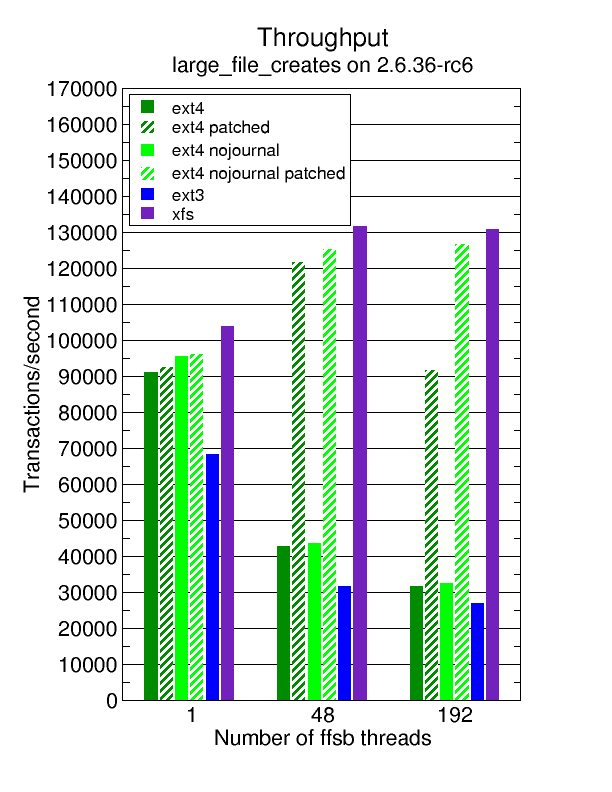
Thanks to Eric Whitney s benchmarking results, I have my money shot for my upcoming 2011 LCA talk in Brisbane, which will be about how to improve scalability in the Linux kernel, using the case study of the work that I did to improve scalability via a series of scalability patches that were developed during 2.6.34, 2.6.35, and 2.6.36 (and went into the the kernel during subsequent merge window). These benchmarks were done on a 48-core AMD system (8 sockets, 6 cores/socket) using a 24 SAS-disk hardware RAID array. Which is the sort of system which XFS has traditionally shined on, and for which ext3 has traditionally not scaled very well at. We re now within striking distance of XFS, and there s more improvements to ext4 which I have planned that should help its performance even further. This is the kind of performance improvement that I m totally psyched to see! No related posts.

Theodore Ts'o: I have the money shot for my LCA presentation


Thanks to Eric Whitney s benchmarking results, I have my money shot for my upcoming 2011 LCA talk in Brisbane, which will be about how to improve scalability in the Linux kernel, using the case study of the work that I did to improve scalability via a series of scalability patches that were developed during 2.6.34, 2.6.35, and 2.6.36 (and went into the kernel during subsequent merge window). These benchmarks were done on a 48-core AMD system (8 sockets, 6 cores/socket) using a 24 SAS-disk hardware RAID array. Which is the sort of system which XFS has traditionally shined on, and for which ext3 has traditionally not scaled very well at. We re now within striking distance of XFS, and there s more improvements to ext4 which I have planned that should help its performance even further. This is the kind of performance improvement that I m totally psyched to see! No related posts.

1 November 2010

Adnan Hodzic: I want Xperia X10 Android 2.1 update now!

Story I bought Xperia X10i this summer during DebConf10 in NYC, I loved this phone from very beginning however what bothered me was that it was still stuck on outdated Android 1.6. To get your own custom Android on it, wasn t quite possible because no one managed to hack bootloader even though some of the guys at XDA where getting pretty close. Long story made short, Sony Ericsson has finally release their Android 2.1 update, but made it available only for Nordic region, they explained it all on their blog where they also sent a message for paranoid users as they called them. I thought, if I gave it all this time I can wait a little bit longer, but then one of my friends (@sahinovic) gave me a good pointer to go in right direction with using custom ROM, Nordic for example? So this is where I got my idea. I want 2.1 update now! Please note steps below will get you Android 2.1 update, but AFAIK you ll also lose your warranty 1. Root your phone If you don t have your phone rooted, this can now be done in single click. Get X10 Root and follow instructions on screen. 2. Edit system/default.prop Get Root Explorer, mount r/w (upper right corner), edit system/default.prop Lines you re concentrating on are 1 and 3 Let s say they are:
ro.semc.version.cust=1237-0333
ro.product.name=X10_1237-0333
Edit them to look like:
ro.semc.version.cust=1234-8465
ro.product.name=X10_1234-8465
Save the file and it s gonna create automatic backup of original file. 3. Get the updates using SEUS Turn off your phone, launch SEUS, plugin in the USB cable while holding back button, SEUS is going to tell you have updates for your phone Smile Follow on screen instructions. Enjoy the update Smile Conclusion X10 is a pretty sweet phone, but with it being so closed, it also closes a lot of doors to hacking it and playing with it, great example would be this update itself, since right now Android 2.1 update is an outdated one. However 2.1 update brings new life into it, just as it s a brand new phone, it s more responsive and much much faster. And do take a backup before this update, because I lost everything from my contacts to internet settings, but all files on my sd card remained intact. If you want to discuss anything regarding this topic please do so in comment area below or find me on Twitter.

28 October 2010

Jaldhar Vyas: 4DRL Challenge Aftermath

So the four days are up. What do I have to show for it? Well I am declaring victory because S.Y.T.Y.C.D...OMG? is playable. There is a long way to go before one would actually want to play it though. I had to take out doors, AI, the level boss and levels for that matter. FOV is kind of erratic. But you can fight, take, and quaff things and the dungeon is nicely laid out (except for doors.) So that's good for something right? I will add all the other good stuff as time passes.

Dirk Eddelbuettel: Google Tech Talk on Integrating R and C++: video and slides

Last Friday, Romain and I were guests of the R intergrouplet (what an adorable name!) at Google's headquarter in Mountain View. This arose out of discussions following useR! 2010 where we met Google's Murray Stokely. There appears to be ever increasing use of R at Google, and so it was a great opportunity to give a Google Tech Talk about R and C++ integration --- centered around our Rcpp, RInside and RProtoBuf packages which facilitate interoperability between R and C++. A video recording of our ninety-minute talk is already available via the YouTube channel for Google Tech Talks. The (large) pdf with slides (which Romain had already posted on slideshare) is also available from my presentations page. The remainder of the weekend was nice too (with the notably exception of the extremly sucky weather). We got to to spend some time at the Google Summer of Code Mentor Summit which is always a fun event and a great way to meet other open source folks in person. And we also took one afternoon off to spend some with John Chambers discussing further work involving Rcpp and the new ReferenceClasses that appeared in the just-released R version 2.12.0. This should be a nice avenue to further integrate R and C++ in the near future.

25 October 2010

Jonathan Wiltshire: Facebook groups: a gift to framers

I didn t quite believe what I was seeing until I searched and found several other people noticing the same behaviour. For background, Facebook recently introduced the concept of groups not in the sense we ve been used to, but more like lists. Groups are supposed to be to lists what databases are to bits of paper. You can add friends to groups to organise them, send them group emails, run a collective mailing list, and so on. Except that in practice, this is another really good way of exploiting lazy users. See, there are some things to know about groups: The second point may be wrong it s very unclear exactly what permission is afforded to a group member and when or where information about the group membership is published. Since my day job is in private education, this immediately makes me think of two terrifying scenarios:
  1. A student inadvertently gets added to a large group and nobody notices because there is so much other traffic. Whatever my other privacy settings, anything I or anyone else posted to the group is now visible to him this is the same as the previous group arrangement. The difference is that he can now go on and add anyone else Mark Zuckerberg himself even without any kind of checks by the group administrator. A membership system like this quickly spirals out of control.
  2. Somebody with a grudge maybe I took too long fixing their PC adds me to a group with, shall we say, inappropriate or unsavoury content while I m away on holiday and tips off the child protection officer. Better yet, he first sends an email to all staff expressing horror and asking them to verify this in case it s his computer lying. Now there are multiple witnesses to the fact that I was a member of this group, and I return from the sea side to find a P45 on the door mat.
Unlike free software, I can t fix this. Fortunately, I have: enabled every email notification under the sun; few and trustworthy friends; according to my profile, no interests or contact details whatsoever; and no care for groups. I m happy with my lists, thanks all the same.
Comments flattr this!

20 October 2010

Sandro Tosi: Feeling welcome: Python, you're doing it right!

It was for a very long time (I think back from PyconIT 2) that I wanted to contribute to python. About a month and a half ago I started reading all the documentation I could about development processes & workflows, mercurial stuff (I don't have commit right, so I prefer working on a DVCS than on SVN), bugs management and so.

After all of this, less than month ago I started contributing very small patches; then when looking for "something to do" I found bugs that could be closed, in particular because they were already been fixed, and then last night R. David Murray proposed to give me "tracker privs", that moments after were granted \o/

What can I say? Thank you! that's something making me feel like I'm doing something useful to the language I love, and even if the privs are "not that much", it's a sign of trust, which really makes me happy!

As of now, I feel like I'm between "better be safe than sorry" and "it's easier to ask forgiveness than permission" mood, but we'll see how it goes.

Python, you're making me feel welcome, and so, once again, thank you!

18 October 2010

Benjamin Mako Hill: Redefining "Realistic"

When talking about free culture or free software, many people suggest that they would love to support free models, but that they don't see how to make it all work. Until they have an alternate model in front of them, they cannot bring themselves to argue for a more ethical alternative. I disagree with this approach. Instead, I say, "this is the world I want to live in and, even though I don't know exactly how to get to there from here, I'm going to refuse to settle for anything short of this ideal." Most people dismiss such thinking as "impractical" and "unrealistic." I think most people are being unimaginative. Robot jockeys are one recent illustrative reason, among many, that I feel comfortable taking this position. Some background is necessary for those that are unfamiliar with the example. A decade ago, several Gulf emirates used thousands of young boys from Sudan and South Asia as jockeys for camel racing. Human rights groups campaigned against the practice and suggested that these boys were at sometimes held as slaves and intentionally underfed to keep their weight low. Despite criticism, camel racers resisted moving away from young boys as jockeys. If they moved to heavier adults instead of young boys, they reasoned, the camels would be much slower. Of course, they were right. But they were being unimaginative in the alternatives they were considering. As the young jockeys became a increasingly unjustifiable public relations disaster for the states that supported it, law-makers in several Gulf states gave in to calls from UNICEF and others and created laws to outlaw the practice. Within three years of UAE passing strict laws against child jockeys, Swiss engineers, funded by racers desperate for an alternative, had created the first robotic camel jockey. Within several years these jockeys were lighter, cheaper, more responsive to the owner, and well on their way to being more effective than any young boy. When forced, by law and by an ethical prerogative, to come up with an alternative to young boys, racers created a solution that was superior, along nearly every axis, to the system they had fought to keep. Although the costs to society of proprietary software cannot be compared to slavery and abuse, the basic same pattern of solution-seeking can be seen in the example of free software. Early free software advocates suggested that most programmers would likely need to take a paycut. As it turned out, vibrant and successful economic models to support free software have supported a large and growing free software industry. But we have free software business models only because a small group of principled individuals refused to settle for what they knew, came up with creative ethical business models that "just might work," and put their own paychecks on the line to try them out. As open source has shown, some of these creative solutions offered models superior to what we had before. In the world of software development, free software redefined "practical" and "realistic." One can think of solving human problems as like searching for the highest point in hilly terrain in thick fog. It's easy to get stuck on the top of the first little hill you walk up (i.e., a local maximum) and then conclude you can never do better. If we refuse to compromise and force ourselves to leave that first little hill, chances are pretty good we'll find a "higher" peak. Of course, it is also possible that we will find the global maximum or the best possible solution to a given problem. In those cases, any change will mean a sacrifice. But when dealing with most most social and legal dilemmas, there are enough variables involved that this seems very unlikely. Indeed, most big problems can be thought of as having many interacting dimensions -- and only some of these will be ethical concerns. In other words, most social problems are more like the problem of child camel jockeys than they are like trying to transcend the laws of physics. Business models and laws for the regulation of technology and knowledge are extremely complicated human creations. Do we really think we cannot create ethical systems to compensate cultural creators that are at least as good as what we have now? If we never force ourselves to be "impractical" and "unrealistic", we will never find out.

16 October 2010

David Paleino: How to: database-less local map rendering with Mapnik and OSM

Here's a quick howto for local map rendering, using python, mapnik and data from OpenStreetMap. This tutorial shows how to create a stylesheet for mapnik from scratch, if you're looking for how to tweak OpenStreetMap's mapnik rendering, I plan to write a tutorial on PostGIS-driven rendering at a later time. This post is not for those who want to make a local slippy map, nor those who want to render different areas of big dumps (think of big national dumps). We'll render some features of a residential area of a city with buildings mapped. We'll get a small dump of the area for this, using the XAPI. First, you need to install mapnik. On Debian-like systems, it should be as easy as:
# apt-get install python-mapnik
Then, you need some python code to use the mapnik library. Let's call it render.py:
#!/usr/bin/python
import mapnik
###
# Configuration
###
style = 'style.xml'
output = 'output.svg'
width = 1280
height = 800
bbox = '12.58664,37.65759,12.5945,37.66325'
###
# Don't touch below!
###
bbox = bbox.split(',')
ll = mapnik.Coord(float(bbox[0]), float(bbox[1]))
tr = mapnik.Coord(float(bbox[2]), float(bbox[3]))
mymap = mapnik.Map(width, height)
mapnik.load_map(mymap, style)
map_bbox = mapnik.Envelope(ll, tr)
mymap.zoom_to_box(map_bbox)
mapnik.render_to_file(mymap, output)
For the purposes of this post, we're going to create a 1280x800 map -- adjust that to suit your needs -- and we specified a bounding box corresponding to that area. That's composed as west,south,east,north coordinates. Be sure to get them right :-). Now we need to write a Mapnik stylesheet, we'll call it style.xml. That's a XML document, you can find the documentation at the official website. The skeleton of a stylesheet is as follows:
<?xml version="1.0" encoding="utf-8"?>
<!DOCTYPE Map>
<Map bgcolor="lightblue" srs="+proj=latlong +datum=WGS84">
<Style name="...">
...
</Style>
<Layer name="...">
 <Datasource>
  ...
 </Datasource>
</Layer>
</Map>
The stylesheet has an arbitrary number of Style elements and an arbitrary number of Layer elements. The former class of elements define the appearance of the features, while the latter defines where to get data from. Each layer has a Datasource child: here's where you say where to get your data from. We're going to use the osm input plugin, which lets you parse the dump directly. This has some drawbacks: But works great for small dumps. In this tutorial, we want to pretty render a residential area, so we first need to render the road network. This will mainly be made of highway=residential roads. Each style can have one or more Rule element. These define what elements that particular style should apply to. Each rule can have different rendering settings. The given dump has different roads: residential, unclassified, tertiary and secondary. Let's add a rule for each. Here's the first of them:
<Rule>
 <Filter>[highway] = 'residential'</Filter>
 <LineSymbolizer>
  <CssParameter name="stroke">#ffffff</CssParameter>
  <CssParameter name="stroke-width">5</CssParameter>
  <CssParameter name="stroke-linejoin">round</CssParameter>
  <CssParameter name="stroke-linecap">round</CssParameter>
 </LineSymbolizer>
 <TextSymbolizer name="name" face_name="DejaVu Sans Book" size="8" fill="#000" halo_radius="1" spacing="300" placement="line" />
</Rule>
It is quite straightforward: you define what elements the rule should apply to, and then add some symbolizer. For a detailed description of each symbolizer, please read the documentation. The example dump also has a railway and some steps. To render them, we use the stroke-dasharray property:
<Rule>
 <Filter>[highway] = 'steps'</Filter>
 <LineSymbolizer>
  <CssParameter name="stroke">#ff0000</CssParameter>
  <CssParameter name="stroke-width">5.0</CssParameter>
  <CssParameter name="stroke-dasharray">2,1</CssParameter>
 </LineSymbolizer>
</Rule>
<Rule>
 <Filter>[railway] = 'rail'</Filter>
 <LineSymbolizer>
  <CssParameter name="stroke">#222222</CssParameter>
  <CssParameter name="stroke-width">3</CssParameter>
  <CssParameter name="stroke-linejoin">round</CssParameter>
 </LineSymbolizer>
 <LineSymbolizer>
  <CssParameter name="stroke">white</CssParameter>
 <CssParameter name="stroke-width">1</CssParameter>
  <CssParameter name="stroke-linejoin">round</CssParameter>
  <CssParameter name="stroke-dasharray">10,20</CssParameter>
 </LineSymbolizer>
</Rule>
Also here, it is quite simple. The values given to stroke-dasharray determine the size of the dashes, and they can be alternated. So, for the steps we have 2px of #ff0000 and 1px of trasparency, while for the rail we have 10px of white and 20px of #222222. What if we want to add some markers to the map? Easy, just use another symbolizer, called PointSymbolizer:
<Rule>
 <Filter>[highway] = 'stop'</Filter>
 <PointSymbolizer width='10' height='22' file='stop.png' type='png' allow_overlap='true' opacity='1.0' />
</Rule>
Here we mark stop signals with a pre-rendered stop.png (only png and tiff are currently supported, and svg support is only in the development version). What to do next? Well, we can make this map really nice. We'll render buildings with a pseudo-3D effect, which, however, does not reflect real heights -- but it's rather nice to see. How to achieve this? BuildingSymbolizer is the answer.
<Rule>
 <Filter>[building] &lt;&gt; ''</Filter>
 <BuildingSymbolizer>
  <CssParameter name="fill">#00ff00</CssParameter>
  <CssParameter name="fill-opacity">0.4</CssParameter>
  <CssParameter name="height">0.00007</CssParameter>
 </BuildingSymbolizer>
</Rule>
Here we just draw building=*. Regarding the height, you need to play a bit -- it took a while before I found a good value of it. One thing missing in this stylesheet, is the rendering of coastlines. Since we don't have a coastline here, I'm skipping it, but the easy way is: use another rule. This is really just a trick; OpenStreetMap renders the coastline in a different way respect to other features, that's why I'm using this trick. I'm not posting the whole stylesheet, but you can download it. You can also get the script, the OSM dump and the stop.png image. Now, you should be able to just do:
$ ./render.py
and you will have your map in output.svg :-) Here's what you would get if you use the files provided above (click to see the original SVG version):

15 October 2010

Enrico Zini: Award winning code

Award winning code Me and Yuwei had a fun day at hhhmcr (#hhhmcr) and even managed to put together a prototype that won the first prize \o/ We played with the gmp24 dataset kindly extracted from Twitter by Michael Brunton-Spall of the Guardian into a convenient JSON dataset. The idea was to find ways of making it easier to look at the data and making sense of it. This is the story of what we did, including the code we wrote. The original dataset has several JSON files, so the first task was to put them all together:
#!/usr/bin/python
# Merge the JSON data
# (C) 2010 Enrico Zini <enrico@enricozini.org>
# License: WTFPL version 2 (http://sam.zoy.org/wtfpl/)
import simplejson
import os
res = []
for f in os.listdir("."):
    if not f.startswith("gmp24"): continue
    data = open(f).read().strip()
    if data == "[]": continue
    parsed = simplejson.loads(data)
    res.extend(parsed)
print simplejson.dumps(res)
The results however were not ordered by date, as GMP had to use several accounts to twit because Twitter was putting Greather Manchester Police into jail for generating too much traffic. There would be quite a bit to write about that, but let's stick to our work. Here is code to sort the JSON data by time:
#!/usr/bin/python
# Sort the JSON data
# (C) 2010 Enrico Zini <enrico@enricozini.org>
# License: WTFPL version 2 (http://sam.zoy.org/wtfpl/)
import simplejson
import sys
import datetime as dt
all_recs = simplejson.load(sys.stdin)
all_recs.sort(key=lambda x: dt.datetime.strptime(x["created_at"], "%a %b %d %H:%M:%S +0000 %Y"))
simplejson.dump(all_recs, sys.stdout)
I then wanted to play with Tf-idf for extracting the most important words of every tweet:
#!/usr/bin/python
# tfifd - Annotate JSON elements with Tf-idf extracted keywords
#
# Copyright (C) 2010  Enrico Zini <enrico@enricozini.org>
#
# This program is free software: you can redistribute it and/or modify
# it under the terms of the GNU General Public License as published by
# the Free Software Foundation, either version 3 of the License, or
# (at your option) any later version.
#
# This program is distributed in the hope that it will be useful,
# but WITHOUT ANY WARRANTY; without even the implied warranty of
# MERCHANTABILITY or FITNESS FOR A PARTICULAR PURPOSE.  See the
# GNU General Public License for more details.
#
# You should have received a copy of the GNU General Public License
# along with this program.  If not, see <http://www.gnu.org/licenses/>.
import sys, math
import simplejson
import re
# Read all the twits
records = simplejson.load(sys.stdin)
# All the twits by ID
byid = dict(((x["id"], x) for x in records))
# Stopwords we ignore
stopwords = set(["by", "it", "and", "of", "in", "a", "to"])
# Tokenising engine
re_num = re.compile(r"^\d+$")
re_word = re.compile(r"(\w+)")
def tokenise(tweet):
    "Extract tokens from a tweet"
    for tok in tweet["text"].split():
        tok = tok.strip().lower()
        if re_num.match(tok): continue
        mo = re_word.match(tok)
        if not mo: continue
        if mo.group(1) in stopwords: continue
        yield mo.group(1)
# Extract tokens from tweets
tokenised = dict(((x["id"], list(tokenise(x))) for x in records))
# Aggregate token counts
aggregated =  
for d in byid.iterkeys():
    for t in tokenised[d]:
        if t in aggregated:
            aggregated[t] += 1
        else:
            aggregated[t] = 1
def tfidf(doc, tok):
    "Compute TFIDF score of a token in a document"
    return doc.count(tok) * math.log(float(len(byid)) / aggregated[tok])
# Annotate tweets with keywords
res = []
for name, tweet in byid.iteritems():
    doc = tokenised[name]
    keywords = sorted(set(doc), key=lambda tok: tfidf(doc, tok), reverse=True)[:5]
    tweet["keywords"] = keywords
    res.append(tweet)
simplejson.dump(res, sys.stdout)
I thought this was producing a nice summary of every tweet but nobody was particularly interested, so we moved on to adding categories to tweet. Thanks to Yuwei who put together some useful keyword sets, we managed to annotate each tweet with a place name (i.e. "Stockport"), a social place name (i.e. "pub", "bank") and a social category (i.e. "man", "woman", "landlord"...) The code is simple; the biggest work in it was the dictionary of keywords:
#!/usr/bin/python
# categorise - Annotate JSON elements with categories
#
# Copyright (C) 2010  Enrico Zini <enrico@enricozini.org>
# Copyright (C) 2010  Yuwei Lin <yuwei@ylin.org>
#
# This program is free software: you can redistribute it and/or modify
# it under the terms of the GNU General Public License as published by
# the Free Software Foundation, either version 3 of the License, or
# (at your option) any later version.
#
# This program is distributed in the hope that it will be useful,
# but WITHOUT ANY WARRANTY; without even the implied warranty of
# MERCHANTABILITY or FITNESS FOR A PARTICULAR PURPOSE.  See the
# GNU General Public License for more details.
#
# You should have received a copy of the GNU General Public License
# along with this program.  If not, see <http://www.gnu.org/licenses/>.
import sys, math
import simplejson
import re
# Electoral wards from http://en.wikipedia.org/wiki/List_of_electoral_wards_in_Greater_Manchester
placenames = ["Altrincham", "Sale West",
"Altrincham", "Ashton upon Mersey", "Bowdon", "Broadheath", "Hale Barns", "Hale Central", "St Mary", "Timperley", "Village",
"Ashton-under-Lyne",
"Ashton Hurst", "Ashton St Michael", "Ashton Waterloo", "Droylsden East", "Droylsden West", "Failsworth East", "Failsworth West", "St Peter",
"Blackley", "Broughton",
"Broughton", "Charlestown", "Cheetham", "Crumpsall", "Harpurhey", "Higher Blackley", "Kersal",
"Bolton North East",
"Astley Bridge", "Bradshaw", "Breightmet", "Bromley Cross", "Crompton", "Halliwell", "Tonge with the Haulgh",
"Bolton South East",
"Farnworth", "Great Lever", "Harper Green", "Hulton", "Kearsley", "Little Lever", "Darcy Lever", "Rumworth",
"Bolton West",
"Atherton", "Heaton", "Lostock", "Horwich", "Blackrod", "Horwich North East", "Smithills", "Westhoughton North", "Chew Moor", "Westhoughton South",
"Bury North",
"Church", "East", "Elton", "Moorside", "North Manor", "Ramsbottom", "Redvales", "Tottington",
"Bury South",
"Besses", "Holyrood", "Pilkington Park", "Radcliffe East", "Radcliffe North", "Radcliffe West", "St Mary", "Sedgley", "Unsworth",
"Cheadle",
"Bramhall North", "Bramhall South", "Cheadle", "Gatley", "Cheadle Hulme North", "Cheadle Hulme South", "Heald Green", "Stepping Hill",
"Denton", "Reddish",
"Audenshaw", "Denton North East", "Denton South", "Denton West", "Dukinfield", "Reddish North", "Reddish South",
"Hazel Grove",
"Bredbury", "Woodley", "Bredbury Green", "Romiley", "Hazel Grove", "Marple North", "Marple South", "Offerton",
"Heywood", "Middleton",
"Bamford", "Castleton", "East Middleton", "Hopwood Hall", "Norden", "North Heywood", "North Middleton", "South Middleton", "West Heywood", "West Middleton",
"Leigh",
"Astley Mosley Common", "Atherleigh", "Golborne", "Lowton West", "Leigh East", "Leigh South", "Leigh West", "Lowton East", "Tyldesley",
"Makerfield",
"Abram", "Ashton", "Bryn", "Hindley", "Hindley Green", "Orrell", "Winstanley", "Worsley Mesnes",
"Manchester Central",
"Ancoats", "Clayton", "Ardwick", "Bradford", "City Centre", "Hulme", "Miles Platting", "Newton Heath", "Moss Side", "Moston",
"Manchester", "Gorton",
"Fallowfield", "Gorton North", "Gorton South", "Levenshulme", "Longsight", "Rusholme", "Whalley Range",
"Manchester", "Withington",
"Burnage", "Chorlton", "Chorlton Park", "Didsbury East", "Didsbury West", "Old Moat", "Withington",
"Oldham East", "Saddleworth",
"Alexandra", "Crompton", "Saddleworth North", "Saddleworth South", "Saddleworth West", "Lees", "St James", "St Mary", "Shaw", "Waterhead",
"Oldham West", "Royton",
"Chadderton Central", "Chadderton North", "Chadderton South", "Coldhurst", "Hollinwood", "Medlock Vale", "Royton North", "Royton South", "Werneth",
"Rochdale",
"Balderstone", "Kirkholt", "Central Rochdale", "Healey", "Kingsway", "Littleborough Lakeside", "Milkstone", "Deeplish", "Milnrow", "Newhey", "Smallbridge", "Firgrove", "Spotland", "Falinge", "Wardle", "West Littleborough",
"Salford", "Eccles",
"Claremont", "Eccles", "Irwell Riverside", "Langworthy", "Ordsall", "Pendlebury", "Swinton North", "Swinton South", "Weaste", "Seedley",
"Stalybridge", "Hyde",
"Dukinfield Stalybridge", "Hyde Godley", "Hyde Newton", "Hyde Werneth", "Longdendale", "Mossley", "Stalybridge North", "Stalybridge South",
"Stockport",
"Brinnington", "Central", "Davenport", "Cale Green", "Edgeley", "Cheadle Heath", "Heatons North", "Heatons South", "Manor",
"Stretford", "Urmston",
"Bucklow-St Martins", "Clifford", "Davyhulme East", "Davyhulme West", "Flixton", "Gorse Hill", "Longford", "Stretford", "Urmston",
"Wigan",
"Aspull New Springs Whelley", "Douglas", "Ince", "Pemberton", "Shevington with Lower Ground", "Standish with Langtree", "Wigan Central", "Wigan West",
"Worsley", "Eccles South",
"Barton", "Boothstown", "Ellenbrook", "Cadishead", "Irlam", "Little Hulton", "Walkden North", "Walkden South", "Winton", "Worsley",
"Wythenshawe", "Sale East",
"Baguley", "Brooklands", "Northenden", "Priory", "Sale Moor", "Sharston", "Woodhouse Park"]
# Manual coding from Yuwei
placenames.extend(["City centre", "Tameside", "Oldham", "Bury", "Bolton",
"Trafford", "Pendleton", "New Moston", "Denton", "Eccles", "Leigh", "Benchill",
"Prestwich", "Sale", "Kearsley", ])
placenames.extend(["Trafford", "Bolton", "Stockport", "Levenshulme", "Gorton",
"Tameside", "Blackley", "City centre", "Airport", "South Manchester",
"Rochdale", "Chorlton", "Uppermill", "Castleton", "Stalybridge", "Ashton",
"Chadderton", "Bury", "Ancoats", "Whalley Range", "West Yorkshire",
"Fallowfield", "New Moston", "Denton", "Stretford", "Eccles", "Pendleton",
"Leigh", "Altrincham", "Sale", "Prestwich", "Kearsley", "Hulme", "Withington",
"Moss Side", "Milnrow", "outskirt of Manchester City Centre", "Newton Heath",
"Wythenshawe", "Mancunian Way", "M60", "A6", "Droylesden", "M56", "Timperley",
"Higher Ince", "Clayton", "Higher Blackley", "Lowton", "Droylsden",
"Partington", "Cheetham Hill", "Benchill", "Longsight", "Didsbury",
"Westhoughton"])
# Social categories from Yuwei
soccat = ["man", "woman", "men", "women", "youth", "teenager", "elderly",
"patient", "taxi driver", "neighbour", "male", "tenant", "landlord", "child",
"children", "immigrant", "female", "workmen", "boy", "girl", "foster parents",
"next of kin"]
for i in range(100):
    soccat.append("%d-year-old" % i)
    soccat.append("%d-years-old" % i)
# Types of social locations from Yuwei
socloc = ["car park", "park", "pub", "club", "shop", "premises", "bus stop",
"property", "credit card", "supermarket", "garden", "phone box", "theatre",
"toilet", "building site", "Crown court", "hard shoulder", "telephone kiosk",
"hotel", "restaurant", "cafe", "petrol station", "bank", "school",
"university"]
extras =   "placename": placenames, "soccat": soccat, "socloc": socloc  
# Normalise keyword lists
for k, v in extras.iteritems():
    # Remove duplicates
    v = list(set(v))
    # Sort by length
    v.sort(key=lambda x:len(x), reverse=True)
# Add keywords
def add_categories(tweet):
    text = tweet["text"].lower()
    for field, categories in extras.iteritems():
        for cat in categories:
            if cat.lower() in text:
                tweet[field] = cat
                break
    return tweet
# Read all the twits
records = (add_categories(x) for x in simplejson.load(sys.stdin))
simplejson.dump(list(records), sys.stdout)
All these scripts form a nice processing chain: each script takes a list of JSON records, adds some bit and passes it on. In order to see what we have so far, here is a simple script to convert the JSON twits to CSV so they can be viewed in a spreadsheet:
#!/usr/bin/python
# Convert the JSON twits to CSV
# (C) 2010 Enrico Zini <enrico@enricozini.org>
# License: WTFPL version 2 (http://sam.zoy.org/wtfpl/)
import simplejson
import sys
import csv
rows = ["id", "created_at", "text", "keywords", "placename"]
writer = csv.writer(sys.stdout)
for rec in simplejson.load(sys.stdin):
    rec["keywords"] = " ".join(rec["keywords"])
    rec["placename"] = rec.get("placename", "")
    writer.writerow([rec[row] for row in rows])
At this point we were coming up with lots of questions: "were there more reports on women or men?", "which place had most incidents?", "what were the incidents involving animals?"... Time to bring Xapian into play. This script reads all the JSON tweets and builds a Xapian index with them:
#!/usr/bin/python
# toxapian - Index JSON tweets in Xapian
#
# Copyright (C) 2010  Enrico Zini <enrico@enricozini.org>
#
# This program is free software: you can redistribute it and/or modify
# it under the terms of the GNU General Public License as published by
# the Free Software Foundation, either version 3 of the License, or
# (at your option) any later version.
#
# This program is distributed in the hope that it will be useful,
# but WITHOUT ANY WARRANTY; without even the implied warranty of
# MERCHANTABILITY or FITNESS FOR A PARTICULAR PURPOSE.  See the
# GNU General Public License for more details.
#
# You should have received a copy of the GNU General Public License
# along with this program.  If not, see <http://www.gnu.org/licenses/>.
import simplejson
import sys
import os, os.path
import xapian
DBNAME = sys.argv[1]
db = xapian.WritableDatabase(DBNAME, xapian.DB_CREATE_OR_OPEN)
stemmer = xapian.Stem("english")
indexer = xapian.TermGenerator()
indexer.set_stemmer(stemmer)
indexer.set_database(db)
data = simplejson.load(sys.stdin)
for rec in data:
    doc = xapian.Document()
    doc.set_data(str(rec["id"]))
    indexer.set_document(doc)
    indexer.index_text_without_positions(rec["text"])
    # Index categories as categories
    if "placename" in rec:
        doc.add_boolean_term("XP" + rec["placename"].lower())
    if "soccat" in rec:
        doc.add_boolean_term("XS" + rec["soccat"].lower())
    if "socloc" in rec:
        doc.add_boolean_term("XL" + rec["socloc"].lower())
    db.add_document(doc)
db.flush()
# Also save the whole dataset so we know where to find it later if we want to
# show the details of an entry
simplejson.dump(data, open(os.path.join(DBNAME, "all.json"), "w"))
And this is a simple command line tool to query to the database:
#!/usr/bin/python
# xgrep - Command line tool to query the GMP24 tweet Xapian database
#
# Copyright (C) 2010  Enrico Zini <enrico@enricozini.org>
#
# This program is free software: you can redistribute it and/or modify
# it under the terms of the GNU General Public License as published by
# the Free Software Foundation, either version 3 of the License, or
# (at your option) any later version.
#
# This program is distributed in the hope that it will be useful,
# but WITHOUT ANY WARRANTY; without even the implied warranty of
# MERCHANTABILITY or FITNESS FOR A PARTICULAR PURPOSE.  See the
# GNU General Public License for more details.
#
# You should have received a copy of the GNU General Public License
# along with this program.  If not, see <http://www.gnu.org/licenses/>.
import simplejson
import sys
import os, os.path
import xapian
DBNAME = sys.argv[1]
db = xapian.Database(DBNAME)
stem = xapian.Stem("english")
qp = xapian.QueryParser()
qp.set_default_op(xapian.Query.OP_AND)
qp.set_database(db)
qp.set_stemmer(stem)
qp.set_stemming_strategy(xapian.QueryParser.STEM_SOME)
qp.add_boolean_prefix("place", "XP")
qp.add_boolean_prefix("soc", "XS")
qp.add_boolean_prefix("loc", "XL")
query = qp.parse_query(sys.argv[2],
    xapian.QueryParser.FLAG_BOOLEAN  
    xapian.QueryParser.FLAG_LOVEHATE  
    xapian.QueryParser.FLAG_BOOLEAN_ANY_CASE  
    xapian.QueryParser.FLAG_WILDCARD  
    xapian.QueryParser.FLAG_PURE_NOT  
    xapian.QueryParser.FLAG_SPELLING_CORRECTION  
    xapian.QueryParser.FLAG_AUTO_SYNONYMS)
enquire = xapian.Enquire(db)
enquire.set_query(query)
count = 40
matches = enquire.get_mset(0, count)
estimated = matches.get_matches_estimated()
print "%d/%d results" % (matches.size(), estimated)
data = dict((str(x["id"]), x) for x in simplejson.load(open(os.path.join(DBNAME, "all.json"))))
for m in matches:
    rec = data[m.document.get_data()]
    print rec["text"]
print "%d/%d results" % (matches.size(), matches.get_matches_estimated())
total = db.get_doccount()
estimated = matches.get_matches_estimated()
print "%d results over %d documents, %d%%" % (estimated, total, estimated * 100 / total)
Neat! Now that we have a proper index that supports all sort of cool things, like stemming, tag clouds, full text search with complex queries, lookup of similar documents, suggest keywords and so on, it was just fair to put together a web service to share it with other people at the event. It helped that I had already written similar code for apt-xapian-index and dde before. Here is the server, quickly built on bottle. The very last line starts the server and it is where you can configure the listening interface and port.
#!/usr/bin/python
# xserve - Make the GMP24 tweet Xapian database available on the web
#
# Copyright (C) 2010  Enrico Zini <enrico@enricozini.org>
#
# This program is free software: you can redistribute it and/or modify
# it under the terms of the GNU General Public License as published by
# the Free Software Foundation, either version 3 of the License, or
# (at your option) any later version.
#
# This program is distributed in the hope that it will be useful,
# but WITHOUT ANY WARRANTY; without even the implied warranty of
# MERCHANTABILITY or FITNESS FOR A PARTICULAR PURPOSE.  See the
# GNU General Public License for more details.
#
# You should have received a copy of the GNU General Public License
# along with this program.  If not, see <http://www.gnu.org/licenses/>.
import bottle
from bottle import route, post
from cStringIO import StringIO
import cPickle as pickle
import simplejson
import sys
import os, os.path
import xapian
import urllib
import math
bottle.debug(True)
DBNAME = sys.argv[1]
QUERYLOG = os.path.join(DBNAME, "queries.txt")
data = dict((str(x["id"]), x) for x in simplejson.load(open(os.path.join(DBNAME, "all.json"))))
prefixes =   "place": "XP", "soc": "XS", "loc": "XL"  
prefix_desc =   "place": "Place name", "soc": "Social category", "loc": "Social location"  
db = xapian.Database(DBNAME)
stem = xapian.Stem("english")
qp = xapian.QueryParser()
qp.set_default_op(xapian.Query.OP_AND)
qp.set_database(db)
qp.set_stemmer(stem)
qp.set_stemming_strategy(xapian.QueryParser.STEM_SOME)
for k, v in prefixes.iteritems():
    qp.add_boolean_prefix(k, v)
def make_query(qstring):
    return qp.parse_query(qstring,
        xapian.QueryParser.FLAG_BOOLEAN  
        xapian.QueryParser.FLAG_LOVEHATE  
        xapian.QueryParser.FLAG_BOOLEAN_ANY_CASE  
        xapian.QueryParser.FLAG_WILDCARD  
        xapian.QueryParser.FLAG_PURE_NOT  
        xapian.QueryParser.FLAG_SPELLING_CORRECTION  
        xapian.QueryParser.FLAG_AUTO_SYNONYMS)
@route("/")
def index():
    query = urllib.unquote_plus(bottle.request.GET.get("q", ""))
    out = StringIO()
    print >>out, '''
<html>
<head>
<title>Query</title>
<script src="http://ajax.googleapis.com/ajax/libs/jquery/1.4.2/jquery.min.js"></script>
<script type="text/javascript">
$(function() 
    $("#queryfield")[0].focus()
 )
</script>
</head>
<body>
<h1>Search</h1>
<form method="POST" action="/query">
Keywords: <input type="text" name="query" value="%s" id="queryfield">
<input type="submit">
<a href="http://xapian.org/docs/queryparser.html">Help</a>
</form>''' % query
    print >>out, '''
<p>Example: "car place:wigan"</p>

<p>Available prefixes:</p>

<ul>
'''
    for pfx in prefixes.keys():
        print >>out, "<li><a href='/catinfo/%s'>%s - %s</a></li>" % (pfx, pfx, prefix_desc[pfx])
    print >>out, '''
</ul>
'''
    oldqueries = []
    if os.path.exists(QUERYLOG):
        total = db.get_doccount()
        fd = open(QUERYLOG, "r")
        while True:
            try:
                q = pickle.load(fd)
            except EOFError:
                break
            oldqueries.append(q)
        fd.close()
        def print_query(q):
            count = q["count"]
            print >>out, "<li><a href='/query?query=%s'>%s (%d/%d %.2f%%)</a></li>" % (urllib.quote_plus(q["q"]), q["q"], count, total, count * 100.0 / total)
        print >>out, "<p>Last 10 queries:</p><ul>"
        for q in oldqueries[:-10:-1]:
            print_query(q)
        print >>out, "</ul>"
        # Remove duplicates
        oldqueries = dict(((x["q"], x) for x in oldqueries)).values()
        print >>out, "<table>"
        print >>out, "<tr><th>10 queries with most results</th><th>10 queries with least results</th></tr>"
        print >>out, "<tr><td>"
        print >>out, "<ul>"
        oldqueries.sort(key=lambda x:x["count"], reverse=True)
        for q in oldqueries[:10]:
            print_query(q)
        print >>out, "</ul>"
        print >>out, "</td><td>"
        print >>out, "<ul>"
        nonempty = [x for x in oldqueries if x["count"] > 0]
        nonempty.sort(key=lambda x:x["count"])
        for q in nonempty[:10]:
            print_query(q)
        print >>out, "</ul>"
        print >>out, "</td></tr>"
        print >>out, "</table>"
    print >>out, '''
</body>
</html>'''
    return out.getvalue()
@route("/query")
@route("/query/")
@post("/query")
@post("/query/")
def query():
    query = bottle.request.POST.get("query", bottle.request.GET.get("query", ""))
    enquire = xapian.Enquire(db)
    enquire.set_query(make_query(query))
    count = 40
    matches = enquire.get_mset(0, count)
    estimated = matches.get_matches_estimated()
    total = db.get_doccount()
    out = StringIO()
    print >>out, '''
<html>
<head><title>Results</title></head>
<body>
<h1>Results for "<b>%s</b>"</h1>
''' % query
    if estimated == 0:
        print >>out, "No results found."
    else:
        # Give as results the first 30 documents; also use them as the key
        # ones to use to compute relevant terms
        rset = xapian.RSet()
        for m in enquire.get_mset(0, 30):
            rset.add_document(m.document.get_docid())
        # Compute the tag cloud
        class NonTagFilter(xapian.ExpandDecider):
            def __call__(self, term):
                return not term[0].isupper() and not term[0].isdigit()
        cloud = []
        maxscore = None
        for res in enquire.get_eset(40, rset, NonTagFilter()):
            # Normalise the score in the interval [0, 1]
            weight = math.log(res.weight)
            if maxscore == None: maxscore = weight
            tag = res.term
            cloud.append([tag, float(weight) / maxscore])
        max_weight = cloud[0][1]
        min_weight = cloud[-1][1]
        cloud.sort(key=lambda x:x[0])
        def mklink(query, term):
            return "/query?query=%s" % urllib.quote_plus(query + " and " + term)
        print >>out, "<h2>Tag cloud</h2>"
        print >>out, "<blockquote>"
        for term, weight in cloud:
            size = 100 + 100.0 * (weight - min_weight) / (max_weight - min_weight)
            print >>out, "<a href='%s' style='font-size:%d%%; color:brown;'>%s</a>" % (mklink(query, term), size, term)
        print >>out, "</blockquote>"
        print >>out, "<h2>Results</h2>"
        print >>out, "<p><a href='/'>Search again</a></p>"
        print >>out, "<p>%d results over %d documents, %.2f%%</p>" % (estimated, total, estimated * 100.0 / total)
        print >>out, "<p>%d/%d results</p>" % (matches.size(), estimated)
        print >>out, "<ul>"
        for m in matches:
            rec = data[m.document.get_data()]
            print >>out, "<li><a href='/item/%s'>%s</a></li>" % (rec["id"], rec["text"])
        print >>out, "</ul>"
        fd = open(QUERYLOG, "a")
        qinfo = dict(q=query, count=estimated)
        pickle.dump(qinfo, fd)
        fd.close()
    print >>out, '''
<a href="/">Search again</a>

</body>
</html>'''
    return out.getvalue()
@route("/item/:id")
@route("/item/:id/")
def show(id):
    rec = data[id]
    out = StringIO()
    print >>out, '''
<html>
<head><title>Result %s</title></head>
<body>
<h1>Raw JSON record for twit %s</h1>
<pre>''' % (rec["id"], rec["id"])
    print >>out, simplejson.dumps(rec, indent=" ")
    print >>out, '''
</pre>
</body>
</html>'''
    return out.getvalue()
@route("/catinfo/:name")
@route("/catinfo/:name/")
def catinfo(name):
    prefix = prefixes[name]
    out = StringIO()
    print >>out, '''
<html>
<head><title>Values for %s</title></head>
<body>
''' % name
    terms = [(x.term[len(prefix):], db.get_termfreq(x.term)) for x in db.allterms(prefix)]
    terms.sort(key=lambda x:x[1], reverse=True)
    freq_min = terms[0][1]
    freq_max = terms[-1][1]
    def mklink(name, term):
        return "/query?query=%s" % urllib.quote_plus(name + ":" + term)
    # Build tag cloud
    print >>out, "<h1>Tag cloud</h1>"
    print >>out, "<blockquote>"
    for term, freq in sorted(terms[:20], key=lambda x:x[0]):
        size = 100 + 100.0 * (freq - freq_min) / (freq_max - freq_min)
        print >>out, "<a href='%s' style='font-size:%d%%; color:brown;'>%s</a>" % (mklink(name, term), size, term)
    print >>out, "</blockquote>"
    print >>out, "<h1>All terms</h1>"
    print >>out, "<table>"
    print >>out, "<tr><th>Occurrences</th><th>Name</th></tr>"
    for term, freq in terms:
        print >>out, "<tr><td>%d</td><td><a href='/query?query=%s'>%s</a></td></tr>" % (freq, urllib.quote_plus(name + ":" + term), term)
    print >>out, "</table>"
    print >>out, '''
</body>
</html>'''
    return out.getvalue()
# Change here for bind host and port
bottle.run(host="0.0.0.0", port=8024)
...and then we presented our work and ended up winning the contest. This was the story of how we wrote this set of award winning code.

8 October 2010

Stefano Zacchiroli: Bug Squashing Party: Paris 2010 - October 30-31

BSP Paris 2010, during mini-DebConf The first mini-DebConf in Paris, France is just a few weeks away and about 150 persons have signed up as attendees (wow!). The days of the conference (October 30th-31st, 2010) will most likely see the Debian Squeeze release in its deepest possible freeze, fighting with the very very very few remaining RC bugs (right? right!). What's the most useful thing that a crowd of Debian hackers can do that close to a release?
A Bug Squashing Party, of course! Therefore please welcome:
BSP Paris 2010
to be run during Paris mini-DebConf
We now need to arrange a room for the BSP, in parallel with the talk rooms of the conference. Hence please sign-up on the wiki page if you plan to attend the BSP. Please do so even if you're already signed up as a conference attendee, as the rooms will be different.
Mehdi Dogguy
Stefano Zacchiroli

Next.

Previous.