Search Results: "nate"

23 September 2017

Russell Coker: Converting Mbox to Maildir

MBox is the original and ancient format for storing mail on Unix systems, it consists of a single file per user under /var/spool/mail that has messages concatenated. Obviously performance is very poor when deleting messages from a large mail store as the entire file has to be rewritten. Maildir was invented for Qmail by Dan Bernstein and has a single message per file giving fast deletes among other performance benefits. An ongoing issue over the last 20 years has been converting Mbox systems to Maildir. The various ways of getting IMAP to work with Mbox only made this more complex. The Dovecot Wiki has a good page about converting Mbox to Maildir [1]. If you want to keep the same message UIDs and the same path separation characters then it will be a complex task. But if you just want to copy a small number of Mbox accounts to an existing server then it s a bit simpler. Dovecot has a mb2md.pl script to convert folders [2].
cd /var/spool/mail
mkdir -p /mailstore/example.com
for U in * ; do
  ~/mb2md.pl -s $(pwd)/$U -d /mailstore/example.com/$U
done
To convert the inboxes shell code like the above is needed. If the users don t have IMAP folders (EG they are just POP users or use local Unix MUAs) then that s all you need to do.
cd /home
for DIR in */mail ; do
  U=$(echo $DIR  cut -f1 -d/)
  cd /home/$DIR
  for FOLDER in * ; do
    ~/mb2md.pl -s $(pwd)/$FOLDER -d /mailstore/example.com/$U/.$FOLDER
  done
  cp .subscriptions /mailstore/example.com/$U/ subscriptions
done
Some shell code like the above will convert the IMAP folders to Maildir format. The end result is that the users will have to download all the mail again as their MUA will think that every message had been deleted and replaced. But as all servers with significant amounts of mail or important mail were probably converted to Maildir a decade ago this shouldn t be a problem.

22 September 2017

Enrico Zini: Systemd on the command line

These are the notes of a training course on systemd I gave as part of my work with Truelite. Exploring the state of a system Start and stop services Similar to the System V service command, systemctl provides commands to start/stop/restart/reload units or services: Changing global system state systemctl has halt, poweroff, reboot, suspend, hibernate, and hybrid-sleep commands to tell systemd to reboot, power off, suspend and so on. kexec and switch-root also work. The rescue and emergency commands switch the system to rescue and emergency mode (see man systemd.special. systemctl default switches to the default mode, which also happens when exiting the rescue or emergency shell. Run services at boot systemd does not implement runlevels, and services start at boot based on their dependencies. To start a service at boot, you add to its .service file a WantedBy= dependency on a well-known .target unit. At boot, systemd brings up the whole chain of dependency started from a default unit, and that will eventually activate also your service. See systemctl get-default for what unit is currently the default in your system. You can change it via the systemd.unit= kernel command line, so you can configure multiple entries in the boot loader that boot the system running different services. For example systemd.unit=rescue.target for a rescue mode, systemd.unit=multi-user.target for a non-graphical mode, or add your own .target file to implement new system modes. See systemctl list-units -t target --all for a list of all currently available targets in your system. Notes: systemctl start activates a unit right now, but does not automatically enable it at boot systemctl enable enables a unit at boot, but does not automatically start it right now * a disabled unit can still be activated if another unit depends on it To disable a unit so that it will never get started even if another unit depends on it, use systemctl mask unitname. Use systemctl unmask unitname to undo the masking. Reloading / restarting systemd systemctl daemon-reload tells systemd to reload its configuration. systemctl daemon-reexec tells systemd to restart iself.

20 September 2017

Dirk Eddelbuettel: pinp 0.0.2: Onwards

A first update 0.0.2 of the pinp package arrived on CRAN just a few days after the initial release. We added a new vignette for the package (see below), extended a few nice features, and smoothed a few corners.
The NEWS entry for this release follows.

Changes in tint version 0.0.2 (2017-09-20)
  • The YAML segment can be used to select font size, one-or-two column mode, one-or-two side mode, linenumbering and watermarks (#21 and #26 addressing #25)
  • If pinp.cls or jss.bst are not present, they are copied in ((#27 addressing #23)
  • Output is now in shaded framed boxen too (#29 addressing #28)
  • Endmatter material is placed in template.tex (#31 addressing #30)
  • Expanded documentation of YAML options in skeleton.Rmd and clarified available one-column option (#32).
  • Section numbering can now be turned on and off (#34)
  • The default bibliography style was changed to jss.bst.
  • A short explanatory vignette was added.

Courtesy of CRANberries, there is a comparison to the previous release. More information is on the tint page. For questions or comments use the issue tracker off the GitHub repo.

This post by Dirk Eddelbuettel originated on his Thinking inside the box blog. Please report excessive re-aggregation in third-party for-profit settings.

19 September 2017

Gunnar Wolf: Call to Mexicans: Open up your wifi #sismo

Hi friends, ~3hr ago, we just had a big earthquake, quite close to Mexico City. Fortunately, we are fine, as are (at least) most of our friends and family. Hopefully, all of them. But there are many (as in, tens) damaged or destroyed buildings; there have been over 50 deceased people, and numbers will surely rise until a good understanding of the event's strength are evaluated. Mainly in these early hours after the quake, many people need to get in touch with their families and friends. There is a little help we can all provide: Provide communication. Open up your wireless network. Set it up unencrypted, for anybody to use. Refrain from over-sharing graphical content Your social network groups don't need to see every video and every photo of the shaking moments and of broken buildings. Download of all those images takes up valuable time-space for the saturated cellular networks. This advice might be slow to flow... The important moment to act is two or three hours ago, even now... But we are likely to have replicas; we are likely to have panic moments again. Do a little bit to help others in need!

18 September 2017

Carl Chenet: The Github threat

Many voices arise now and then against risks linked to the Github use by Free Software projects. Yet the infatuation for the collaborative forge of the Octocat Californian start-ups doesn t seem to fade away.

These recent years, Github and its services take an important role in software engineering as they are seen as easy to use, efficient for a daily workload with interesting functions in enterprise collaborative workflow or amid a Free Software project. What are the arguments against using its services and are they valid? We will list them first, then we ll examine their validity.

1. Critical points

1.1 Centralization

The Github application belongs to a single entity, Github Inc, a US company which manage it alone. So, a unique company under US legislation manages the access to most of Free Software application code sources, which may be a problem with groups using it when a code source is no longer available, for political or technical reason.

The Octocat, the Github mascot

This centralization leads to another trouble: as it obtained critical mass, it becomes more and more difficult not having a Github account. People who don t use Github, by choice or not, are becoming a silent minority. It is now fashionable to use Github, and not doing so is seen as out of date . The same phenomenon is a classic, and even the norm, for proprietary social networks (Facebook, Twitter, Instagram).

1.2 A Proprietary Software

When you interact with Github, you are using a proprietary software, with no access to its source code and which may not work the way you think it is. It is a problem at different levels. First, ideologically, but foremost in practice. In the Github case, we send them code we can control outside of their interface. We also send them personal information (profile, Github interactions). And mostly, Github forces any project which goes through the US platform to use a crucial proprietary tools: its bug tracking system.

Windows, the epitome of proprietary software, even if others took the same path

1.3 The Uniformization

Working with Github interface seems easy and intuitive to most. Lots of companies now use it as a source repository, and many developers leaving a company find the same Github working environment in the next one. This pervasive presence of Github in free software development environment is a part of the uniformization of said developers working space.

Uniforms always bring Army in my mind, here the Clone army

2 Critical points cross-examination

2.1 Regarding the centralization

2.1.1 Service availability rate

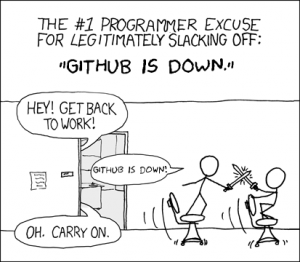
As said above, nowadays, Github is the main repository of Free Software source code. As such it is a favorite target for cyberattacks. DDOS hit it in March and August 2015. On December 15, 2015, an outage led to the inaccessibility of 5% of the repositories. The same occurred on November 15. And these are only the incident reported by Github itself. One can imagine that the mean outage rate of the platform is underestimated.
2.1.2 Chain reaction could block Free Software development

Today many dependency maintenance tools, as npm for javascript, Bundler for Ruby or even pip for Python can access an application source code directly from Github. Free Software projects getting more and more linked and codependents, if one component is down, all the developing process stop.

One of the best examples is the npmgate. Any company could legally demand that Github take down some source code from its repository, which could create a chain reaction and blocking the development of many Free Software projects, as suffered the Node.js community from the decisions of Npm, Inc, the company managing npm.

2.2 A historical precedent: SourceForge

Github didn t appear out of the blue. In his time, its predecessor, SourceForge, was also extremely popular.

Heavily centralized, based on strong interaction with the community, SourceForge is now seen as an aging SAAS (Software As A Service) and sees most of its customers fleeing to Github. Which creates lots of hurdles for those who stayed. The Gimp project suffered from spams and terrible advertising, which led to the departure of the VLC project, then from installers corrupted with adwares instead of the official Gimp installer for Windows. And finally, the Project Gimp s SourceForge account was hacked by SourceForge team itself!

These are very recent examples of what can do a commercial entity when it is under its stakeholders pressure. It is vital to really understand what it means to trust them with data and exchange centralization, where it could have tremendous repercussion on the day-to-day life and the habits of the Free Software and open source community.

2.3. Regarding proprietary software

2.3.1 One community, several opinions on proprietary software

Mostly based on ideology, this point deals with the definition every member of the community gives to Free Software and open source. Mostly about one thing: is it viral or not? Or GPL vs MIT/BSD.

Those on the side of the viral Free Software will have trouble to use a proprietary software as this last one shouldn t even exist. It must be assimilated, to quote Star Trek, as it is a connected black box, endangering privacy, corrupting for profit our uses and restrain our freedom to use as we re pleased what we own, etc.

Those on the side of complete freedom have no qualms using proprietary software as their very existence is a consequence of freedom without restriction. They even agree that code they developed may be a part of proprietary software, which is quite a common occurrence. This part of the Free Software community has no qualm using Github, which is well within their ideology parameters. Just take a look at the Janson amphitheater during Fosdem and check how many Apple laptops running on macOS are around.

FreeBSD, the main BSD project under the BSD license

2.3.2 Data loss and data restrictions linked to proprietary software use

Even without ideological consideration, and just focusing on Github infrastructure, the bug tracking system is a major problem by itself.

Bug report builds the memory of Free Software projects. It is the entrance point for new contributors, the place to find bug reporting, requests for new functions, etc. The project history can t be limited only to the code. It s very common to find bug reports when you copy and paste an error message in a search engine. Not their historical importance is precious for the project itself, but also for its present and future users.

Github gives the ability to extract bug reports through its API. What would happen if Github is down or if the platform doesn t support this feature anymore? In my opinion, not that many projects ever thought of this outcome. How could they move all the data generated by Github into a new bug tracking system? One old example now is Astrid, a TODO list bought by Yahoo a few years ago. Very popular, it grew fast until it was closed overnight, with only a few weeks for its users to extract their data. It was only a to-do list. The same situation with Github would be tremendously difficult to manage for several projects if they even have the ability to deal with it. Code would still be available and could still live somewhere else, but the project memory would be lost. A project like Debian has today more than 800,000 bug reports, which are a data treasure trove about problems solved, function requests and where the development stand on each. The developers of the Cpython project have anticipated the problem and decided not to use Github bug tracking systems.

Issues, the Github proprietary bug tracking system

Another thing we could lose if Github suddenly disappear: all the work currently done regarding the push requests (aka PRs). This Github function gives the ability to clone one project s Github repository, to modify it to fit your needs, then to offer your own modification to the original repository. The original repository s owner will then review said modification, and if he or she agrees with them will fuse them into the original repository. As such, it s one of the main advantages of Github, since it can be done easily through its graphic interface.

However reviewing all the PRs may be quite long, and most of the successful projects have several ongoing PRs. And this PRs and/or the proprietary bug tracking system are commonly used as a platform for comment and discussion between developers.

Code itself is not lost if Github is down (except one specific situation as seen below), but the peer review works materialized in the PRs and the bug tracking system is lost. Let s remember than the PR mechanism let you clone and modify projects and then generate PRs directly from its proprietary web interface without downloading a single code line on your computer. In this particular case, if Github is down, all the code and the work in progress is lost. Some also use Github as a bookmark place. They follow their favorite projects activity through the Watch function. This technological watch style of data collection would also be lost if Github is down.

Debian, one of the main Free Software projects with at least a thousand official contributors

2.4 Uniformization

The Free Software community is walking a thigh rope between normalization needed for an easier interoperability between its products and an attraction for novelty led by a strong need for differentiation from what is already there.

Github popularized the use of Git, a great tool now used through various sectors far away from its original programming field. Step by step, Git is now so prominent it s almost impossible to even think to another source control manager, even if awesome alternate solutions, unfortunately not as popular, exist as Mercurial.

A new Free Software project is now a Git repository on Github with README.md added as a quick description. All the other solutions are ostracized? How? None or very few potential contributors would notice said projects. It seems very difficult now to encourage potential contributors into learning a new source control manager AND a new forge for every project they want to contribute. Which was a basic requirement a few years ago. It s quite sad because Github, offering an original experience to its users, cut them out of a whole possibility realm. Maybe Github is one of the best web versioning control systems. But being the main one doesn t let room for a new competitor to grow. And it let Github initiate development newcomers into a narrow function set, totally unrelated to the strength of the Git tool itself.

3. Centralization, uniformization, proprietary software What s next? Laziness?

Fight against centralization is a main part of the Free Software ideology as centralization strengthens the power of those who manage it and who through it control those who are managed by it. Uniformization allergies born against main software companies and their wishes to impose a closed commercial software world was for a long time the main fuel for innovation thirst and intelligent alternative development. As we said above, part of the Free Software community was built as a reaction to proprietary software and their threat. The other part, without hoping for their disappearance, still chose a development model opposite to proprietary software, at least in the beginning, as now there s more and more bridges between the two.

The Github effect is a morbid one because of its consequences: at least centralization, uniformization, proprietary software usage as their bug tracking system. But some years ago the Dear Github buzz showed one more side effect, one I ve never thought about: laziness. For those who don t know what it is about, this letter is a complaint from several spokespersons from several Free Software projects which demand to Github team to finally implement, after years of polite asking, new functions. Since when Free Software project facing a roadblock request for clemency and don t build themselves the path they need? When Torvalds was involved in the Bitkeeper problem and the Linux kernel development team couldn t use anymore their revision control software, he developed Git. The mere fact of not being able to use one tool or functions lacking is the main motivation to seek alternative solutions and, as such, of the Free Software movement. Every Free Software community member able to code should have this reflex. You don t like what Github offers? Switch to Gitlab. You don t like it Gitlab? Improve it or make your own solution.

The Gitlab logo

Let s be crystal clear. I ve never said that every Free Software developers blocked should code his or her own alternative. We all have our own priorities, and some of us even like their beauty sleep, including me. But, to see that this open letter to Github has 1340 names attached to it, among them some spokespersons for major Free Software project showed me that need, willpower and strength to code a replacement are here. Maybe said replacement will be born from this letter, it would be the best outcome of this buzz.

In the end, Github usage is just another example of Internet usage massification. As Internet users are bound to go to massively centralized social network as Facebook or Twitter, developers are following the same path with Github. Even if a large fraction of developers realize the threat linked this centralized and proprietary organization, the whole community is following this centralization and uniformization trend. Github service is useful, free or with a reasonable price (depending on the functions you need) easy to use and up most of the time. Why would we try something else? Maybe because others are using us while we are savoring the convenience? The Free Software community seems to be quite sleepy to me.

The lion enjoying the hearth warm

About Me Carl Chenet, Free Software Indie Hacker, founder of the French-speaking Hacker News-like Journal du hacker. Follow me on social networks Translated from French by St phanie Chaptal. Original article written in 2015.

17 September 2017

Dirk Eddelbuettel: RcppClassic 0.9.7

A rather boring and otherwise uneventful release 0.9.7 of RcppClassic is now at CRAN. This package provides a maintained version of the otherwise deprecated first Rcpp API; no new projects should use it. Once again no changes in user-facing code. But this makes it the first package to use the very new and shiny pinp package as the backend for its vignette, now converted to Markdown---see here for this new version. We also updated three sources files for tabs versus spaces as the current g++ version complained (correctly !!) about misleading indents. Otherwise a file src/init.c was added for dynamic registration, the Travis CI runner script was updated to using run.sh from our r-travis fork, and we now strip the library after they have been built. Again, no user code changes. And no iterate: nobody should use this package. Rcpp is so much better in so many ways---this one is simply available as we (quite strongly) believe that APIs are contracts, and as such we hold up our end of the deal. Courtesy of CRANberries, there are changes relative to the previous release. Questions, comments etc should go to the rcpp-devel mailing list off the R-Forge page.

This post by Dirk Eddelbuettel originated on his Thinking inside the box blog. Please report excessive re-aggregation in third-party for-profit settings.

Iain R. Learmonth: Free Software Efforts (2017W37)

I d like to start making weekly reports again on my free software efforts. Part of the reason for these reports is for me to see how much time I m putting into free software. Hopefully I can keep these reports up.

Debian I have updated txtorcon (a Twisted-based asynchronous Tor control protocol implementation used by ooniprobe, magic-wormhole and tahoe-lafs) to its latest upstream version. I ve also added two new binary packages that are built by the txtorcon source package: python3-txtorcon and python-txtorcon-doc for Python 3 support and generated HTML documentation respectively. I have gone through the scapy (Python module for the forging and dissection of network packets) bugs and closed a couple that seem to have been silently fixed by new upstream releases and not been caught in the BTS. I ve uploaded a minor revision to include a patch that fixes the version number reported by scapy. I have prepared and uploaded a new package for measurement-kit (a portable C++11 network measurement library) from the Open Observatory of Network Interference, which at time of writing is still in the NEW queue. I have also updated ooniprobe (probe for the Open Observatory of Network Interference) to its latest upstream version. I have updated the Swedish debconf strings in the xastir (X Amateur Station Tracking and Information Reporting) package, thanks to the translators. I have updated the direwolf (soundcard terminal node controller for APRS) package to its latest upstream version and fixed the creation of the system user to run direwolf with systemd to happen at the time the package is installed. Unfortunately, it has been necessary to drop the PDF documentation from the package as I was unable to contact the upstream author and acquire the Microsoft Word sources for this release. I have reviewed and sponsored the uploads of the new packages comptext (GUI based tool to compare two text streams), comptty (GUI based tool to compare two radio teletype streams) and flnet (amateur radio net control station software) in the hamradio team. Thanks to Ana Custura for preparing those packages, comptext and comptty are now available in unstable. I have updated the Debian Hamradio Blend metapackages to include cubicsdr (a software defined radio receiver). This build also refreshes the list of packages that can now be included as they had not been packaged at the time of the last build. I have produced and uploaded an initial package for python-azure-devtools (development tools for Azure SDK and CLI for Python) and have updated python-azure (the Azure SDK for Python) to a recent git snapshot. Due to some issues with python-vcr it is currently not possible to run the test suite as part of the build process and I m watching the situation. I have also fixed the auto dependency generation for python3-azure, which had previously been broken. Bugs closed (fixed/wontfix): #873036, #871940, #869566, #873083, #867420, #861753, #855385, #855497, #684727, #683711

Tor Project I have been working through tickets for Atlas (a tool for looking up details about Tor relays and bridges) and have merged and deployed a number of fixes. Some highlights include: bandwidth sorting in search results is now semantically correct (not just an alphanumeric sort ignoring units), added when a relay was first seen to the details page along with the host name if a reverse DNS record has been found for the IP address of the relay and added support for the NoEdConsensus flag (although happily no relays had this flag at the time this support was added). The metrics team has been working on merging projects into the metrics team website to give a unified view of information about the Tor network. This week I have been working towards a prototype of a port of Atlas to the metrics website s style and this work has been published in my personal Atlas git repository. If you d like to have a click around, you can do so. A relay operators meetup will be happening in Montreal on the 14th of October. I won t be present, but I have taken this opportunity to ask operators if there s anything that they would like from Atlas that they are not currently getting. Some feedback has already been received and turned into code and trac tickets. I also attended the weekly metrics team meeting in #tor-dev. Bugs closed (fixed/wontfix): #6787, #9814, #21958, #21636, #23296, #23160

Sustainability I believe it is important to be clear not only about the work I have already completed but also about the sustainability of this work into the future. I plan to include a short report on the current sustainability of my work in each weekly report. I continue to be happy to spend my time on this work, however I do find myself in a position where it may not be sustainable when it comes to hardware. My desktop, a Sun Ultra 24, is now 10 years old and I m starting to see random reboots which so far have not been explained. It is incredibly annoying to have this happen during a long build. Further, the hard drives in my NAS which are used for the local backups and for my local Debian mirror are starting to show SMART errors. It is not currently within my budget to replace any of this hardware. Please contact me if you believe you can help.
This week's energy was provided by Club Mate
16 September 2017

Dirk Eddelbuettel: pinp 0.0.1: pinp is not PNAS

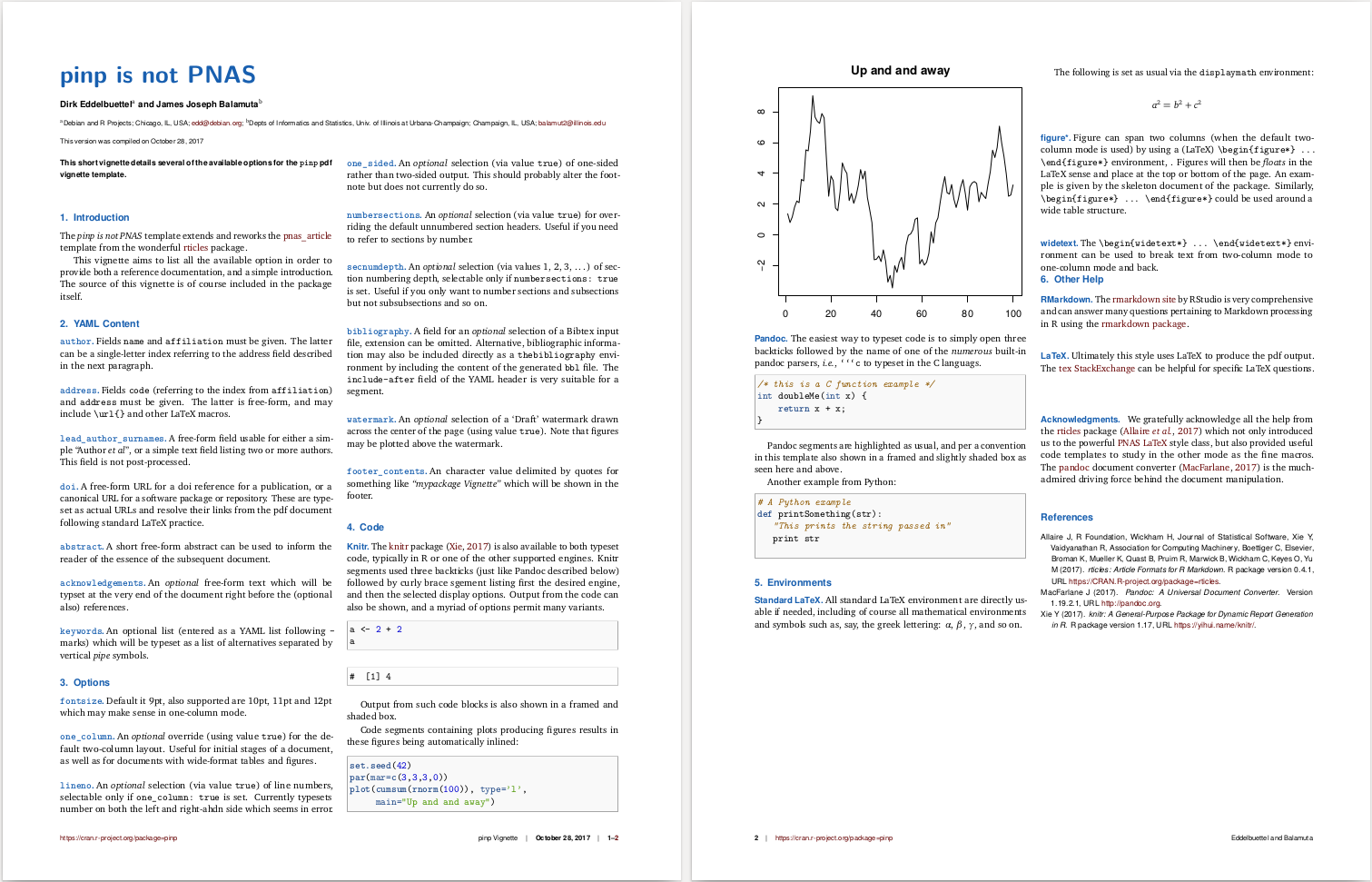
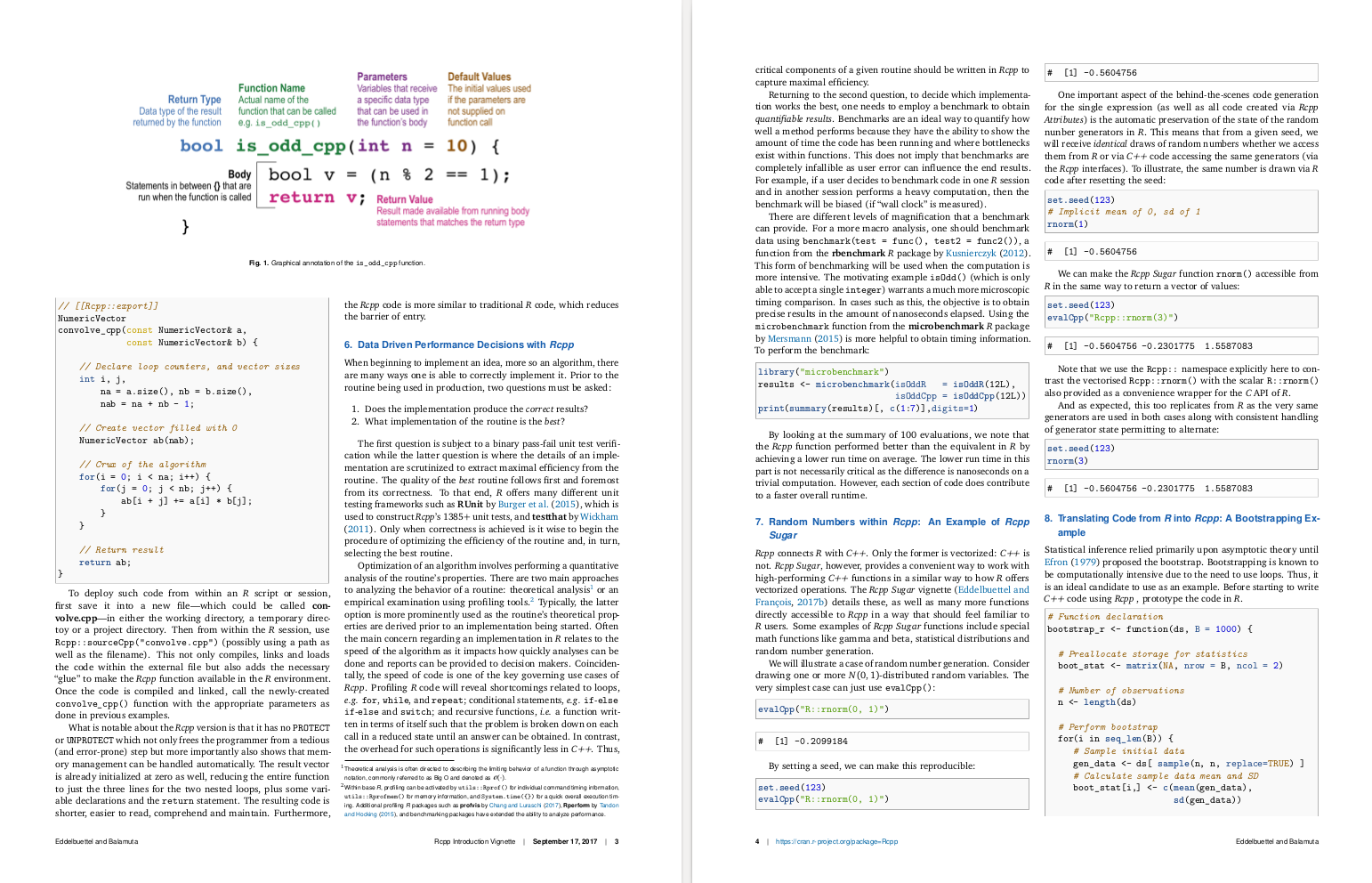
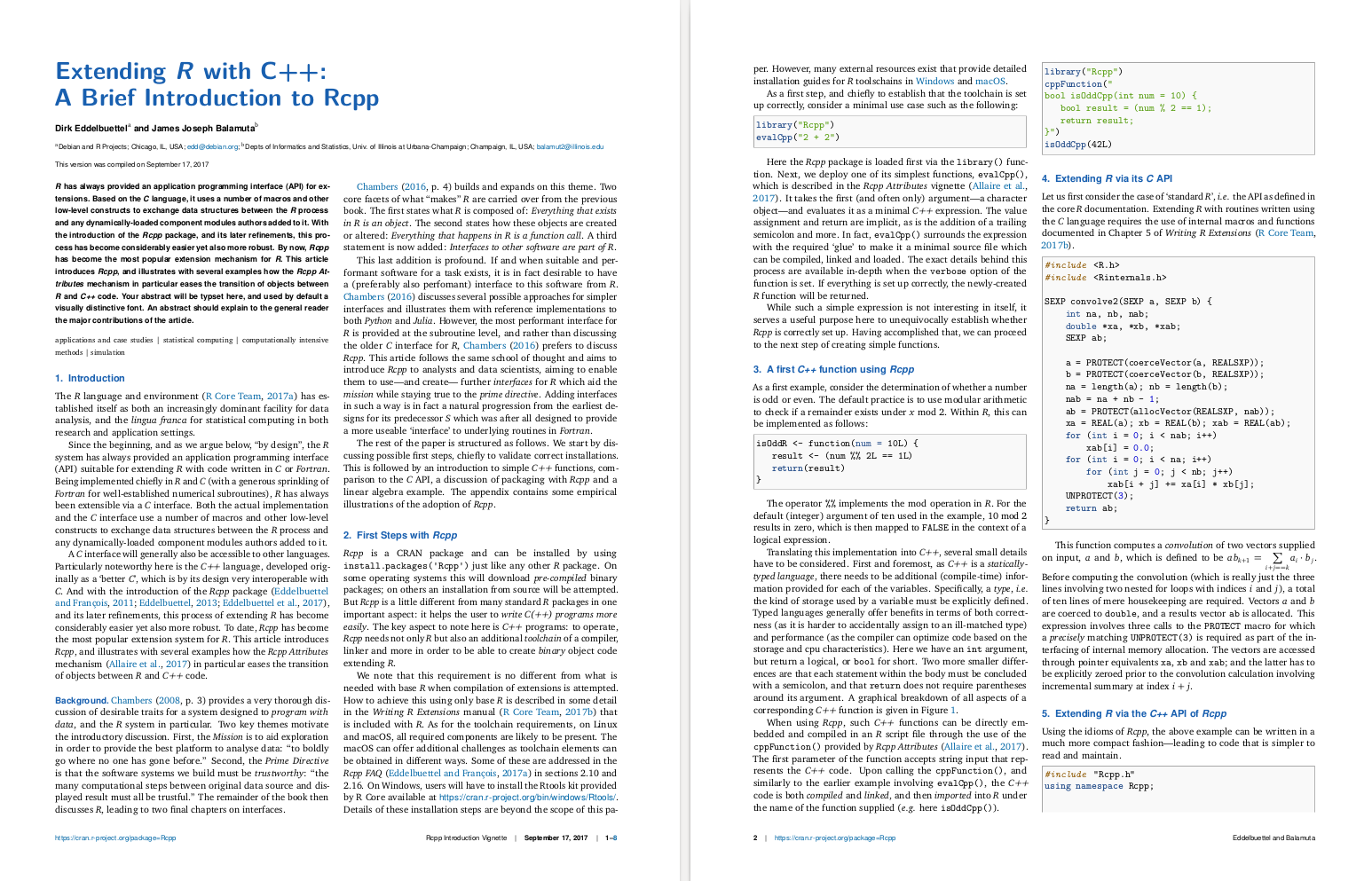
A brandnew and very exciting (to us, at least) package called pinp just arrived on CRAN, following a somewhat unnecessarily long passage out of incoming. It is based on the PNAS LaTeX Style offered by the Proceeding of the National Academy of Sciences of the United States of America, or PNAS for short. And there is already a Markdown version in the wonderful rticles packages. But James Balamuta and I thought we could do one better when we were looking to typeset our recent PeerJ Prepint as an attractive looking vignette for use within the Rcpp package. And so we did by changing a few things (font, color, use of natbib and Chicago.bst for references, removal of a bunch of extra PNAS-specific formalities from the frontpage) and customized a number of other things for easier use by vignettes directly from the YAML header (draft mode watermark, doi or url for packages, easier author naming in footer, bibtex file and more). We are quite pleased with the result which seems ready for the next Rcpp release---see e.g., these two teasers:
and
and the pinp package page or the GitHub repo have the full (four double-)pages of what turned a more dull looking 27 page manuscript into eight crisp two-column pages. We have few more things planned (i.e., switching to single column mode, turning on linenumbers at least in one-column mode). For questions or comments use the issue tracker off the GitHub repo.

This post by Dirk Eddelbuettel originated on his Thinking inside the box blog. Please report excessive re-aggregation in third-party for-profit settings.

Dirk Eddelbuettel: drat 0.1.3

A new version of drat arrived earlier today on CRAN as another no-human-can-delay-this automatic upgrade directly from the CRAN prechecks. It is mostly a maintenance release ensuring PACKAGES.rds is also updated, plus some minor other edits. drat stands for drat R Archive Template, and helps with easy-to-create and easy-to-use repositories for R packages. Since its inception in early 2015 it has found reasonably widespread adoption among R users because repositories with marked releases is the better way to distribute code. The NEWS file summarises the release as follows:

Changes in drat version 0.1.3 (2017-09-16)
  • Ensure PACKAGES.rds, if present, is also inserted in repo
  • Updated 'README.md' removing stale example URLs (#63)
  • Use https to fetch Travis CI script from r-travis

Courtesy of CRANberries, there is a comparison to the previous release. More detailed information is on the drat page.

This post by Dirk Eddelbuettel originated on his Thinking inside the box blog. Please report excessive re-aggregation in third-party for-profit settings.

14 September 2017

Dirk Eddelbuettel: RcppMsgPack 0.2.0

A new and much enhanced version of RcppMsgPack arrived on CRAN a couple of days ago. It came together following this email to the r-package-devel list which made it apparent that Travers Ching had been working on MessagePack converters for R which required the very headers I had for use from, inter alia, the RcppRedis package. So we joined our packages. I updated the headers in RcppMsgPack to the current upstream version 2.1.5 of MessagePack, and Travers added his helper functions allow direct packing / unpacking of MessagePack objects at the R level, as well as tests and a draft vignette. Very exciting, and great to have a coauthor! So now RcppMspPack provides R with both MessagePack header files for use via C++ (or C, if you must) packages such as RcppRedis --- and direct conversion routines at the R prompt. MessagePack itself is an efficient binary serialization format. It lets you exchange data among multiple languages like JSON. But it is faster and smaller. Small integers are encoded into a single byte, and typical short strings require only one extra byte in addition to the strings themselves.

Changes in version 0.2.0 (2017-09-07)
  • Added support for building on Windows
  • Upgraded to MsgPack 2.1.5 (#3)
  • New R functions to manipulate MsgPack objects: msgpack_format, msgpack_map, msgpack_pack, msgpack_simplify, mgspack_unpack (#4)
  • New R functions also available as msgpackFormat, msgpackMap, msgpackPack, msgpackSimplify, mgspackUnpack (#4)
  • New vignette (#4)
  • New tests (#4)

Courtesy of CRANberries, there is also a diffstat report for this release. More information is on the RcppRedis page. More information may be on the RcppMsgPack page. Issues and bugreports should go to the GitHub issue tracker.

This post by Dirk Eddelbuettel originated on his Thinking inside the box blog. Please report excessive re-aggregation in third-party for-profit settings.

Dirk Eddelbuettel: RcppRedis 0.1.8

A new minor release of RcppRedis arrived on CRAN last week, following the release 0.2.0 of RcppMsgPack which brought the MsgPack headers forward to release 2.1.5. This required a minor and rather trivial change in the code. When the optional RcppMsgPack package is used, we now require this version 0.2.0 or later. We made a few internal updates to the package as well.

Changes in version 0.1.8 (2017-09-08)
  • A new file init.c was added with calls to R_registerRoutines() and R_useDynamicSymbols()
  • Symbol registration is enabled in useDynLib
  • Travis CI was updated to using run.sh
  • The (optional MessagePack) code was updated for MsgPack 2.*

Courtesy of CRANberries, there is also a diffstat report for this release. More information is on the RcppRedis page.

This post by Dirk Eddelbuettel originated on his Thinking inside the box blog. Please report excessive re-aggregation in third-party for-profit settings.

13 September 2017

Vincent Bernat: Route-based IPsec VPN on Linux with strongSwan

A common way to establish an IPsec tunnel on Linux is to use an IKE daemon, like the one from the strongSwan project, with a minimal configuration1:
conn V2-1
  left        = 2001:db8:1::1
  leftsubnet  = 2001:db8:a1::/64
  right       = 2001:db8:2::1
  rightsubnet = 2001:db8:a2::/64
  authby      = psk
  auto        = route
The same configuration can be used on both sides. Each side will figure out if it is left or right . The IPsec site-to-site tunnel endpoints are 2001:db8: 1::1 and 2001:db8: 2::1. The protected subnets are 2001:db8: a1::/64 and 2001:db8: a2::/64. As a result, strongSwan configures the following policies in the kernel:
$ ip xfrm policy
src 2001:db8:a1::/64 dst 2001:db8:a2::/64
        dir out priority 399999 ptype main
        tmpl src 2001:db8:1::1 dst 2001:db8:2::1
                proto esp reqid 4 mode tunnel
src 2001:db8:a2::/64 dst 2001:db8:a1::/64
        dir fwd priority 399999 ptype main
        tmpl src 2001:db8:2::1 dst 2001:db8:1::1
                proto esp reqid 4 mode tunnel
src 2001:db8:a2::/64 dst 2001:db8:a1::/64
        dir in priority 399999 ptype main
        tmpl src 2001:db8:2::1 dst 2001:db8:1::1
                proto esp reqid 4 mode tunnel
[ ]
This kind of IPsec tunnel is a policy-based VPN: encapsulation and decapsulation are governed by these policies. Each of them contains the following elements: When a matching policy is found, the kernel will look for a corresponding security association (using reqid and the endpoint source and destination addresses):
$ ip xfrm state
src 2001:db8:1::1 dst 2001:db8:2::1
        proto esp spi 0xc1890b6e reqid 4 mode tunnel
        replay-window 0 flag af-unspec
        auth-trunc hmac(sha256) 0x5b68[ ]8ba2904 128
        enc cbc(aes) 0x8e0e377ad8fd91e8553648340ff0fa06
        anti-replay context: seq 0x0, oseq 0x0, bitmap 0x00000000
[ ]
If no security association is found, the packet is put on hold and the IKE daemon is asked to negotiate an appropriate one. Otherwise, the packet is encapsulated. The receiving end identifies the appropriate security association using the SPI in the header. Two security associations are needed to establish a bidirectionnal tunnel:
$ tcpdump -pni eth0 -c2 -s0 esp
13:07:30.871150 IP6 2001:db8:1::1 > 2001:db8:2::1: ESP(spi=0xc1890b6e,seq=0x222)
13:07:30.872297 IP6 2001:db8:2::1 > 2001:db8:1::1: ESP(spi=0xcf2426b6,seq=0x204)
All IPsec implementations are compatible with policy-based VPNs. However, some configurations are difficult to implement. For example, consider the following proposition for redundant site-to-site VPNs: Redundant VPNs between 3 sites A possible configuration between V1-1 and V2-1 could be:
conn V1-1-to-V2-1
  left        = 2001:db8:1::1
  leftsubnet  = 2001:db8:a1::/64,2001:db8:a6::cc:1/128,2001:db8:a6::cc:5/128
  right       = 2001:db8:2::1
  rightsubnet = 2001:db8:a2::/64,2001:db8:a6::/64,2001:db8:a8::/64
  authby      = psk
  keyexchange = ikev2
  auto        = route
Each time a subnet is modified on one site, the configurations need to be updated on all sites. Moreover, overlapping subnets (2001:db8: a6::/64 on one side and 2001:db8: a6::cc:1/128 at the other) can also be problematic. The alternative is to use route-based VPNs: any packet traversing a pseudo-interface will be encapsulated using a security policy bound to the interface. This brings two features:
  1. Routing daemons can be used to distribute routes to be protected by the VPN. This decreases the administrative burden when many subnets are present on each side.
  2. Encapsulation and decapsulation can be executed in a different routing instance or namespace. This enables a clean separation between a private routing instance (where VPN users are) and a public routing instance (where VPN endpoints are).

Route-based VPN on Juniper Before looking at how to achieve that on Linux, let s have a look at the way it works with a JunOS-based platform (like a Juniper vSRX). This platform as long-standing history of supporting route-based VPNs (a feature already present in the Netscreen ISG platform). Let s assume we want to configure the IPsec VPN from V3-2 to V1-1. First, we need to configure the tunnel interface and bind it to the private routing instance containing only internal routes (with IPv4, they would have been RFC 1918 routes):
interfaces  
    st0  
        unit 1  
            family inet6  
                address 2001:db8:ff::7/127;


routing-instances  
    private  
        instance-type virtual-router;
        interface st0.1;
     
 
The second step is to configure the VPN:
security  
    /* Phase 1 configuration */
    ike  
        proposal IKE-P1  
            authentication-method pre-shared-keys;
            dh-group group20;
            encryption-algorithm aes-256-gcm;
         
        policy IKE-V1-1  
            mode main;
            proposals IKE-P1;
            pre-shared-key ascii-text "d8bdRxaY22oH1j89Z2nATeYyrXfP9ga6xC5mi0RG1uc";
         
        gateway GW-V1-1  
            ike-policy IKE-V1-1;
            address 2001:db8:1::1;
            external-interface lo0.1;
            general-ikeid;
            version v2-only;
         
     
    /* Phase 2 configuration */
    ipsec  
        proposal ESP-P2  
            protocol esp;
            encryption-algorithm aes-256-gcm;
         
        policy IPSEC-V1-1  
            perfect-forward-secrecy keys group20;
            proposals ESP-P2;
         
        vpn VPN-V1-1  
            bind-interface st0.1;
            df-bit copy;
            ike  
                gateway GW-V1-1;
                ipsec-policy IPSEC-V1-1;
             
            establish-tunnels on-traffic;


We get a route-based VPN because we bind the st0.1 interface to the VPN-V1-1 VPN. Once the VPN is up, any packet entering st0.1 will be encapsulated and sent to the 2001:db8: 1::1 endpoint. The last step is to configure BGP in the private routing instance to exchange routes with the remote site:
routing-instances  
    private  
        routing-options  
            router-id 1.0.3.2;
            maximum-paths 16;
         
        protocols  
            bgp  
                preference 140;
                log-updown;
                group v4-VPN  
                    type external;
                    local-as 65003;
                    hold-time 6;
                    neighbor 2001:db8:ff::6 peer-as 65001;
                    multipath;
                    export [ NEXT-HOP-SELF OUR-ROUTES NOTHING ];


The export filter OUR-ROUTES needs to select the routes to be advertised to the other peers. For example:
policy-options  
    policy-statement OUR-ROUTES  
        term 10  
            from  
                protocol ospf3;
                route-type internal;
             
            then  
                metric 0;
                accept;


The configuration needs to be repeated for the other peers. The complete version is available on GitHub. Once the BGP sessions are up, we start learning routes from the other sites. For example, here is the route for 2001:db8: a1::/64:
> show route 2001:db8:a1::/64 protocol bgp table private.inet6.0 best-path
private.inet6.0: 15 destinations, 19 routes (15 active, 0 holddown, 0 hidden)
+ = Active Route, - = Last Active, * = Both
2001:db8:a1::/64   *[BGP/140] 01:12:32, localpref 100, from 2001:db8:ff::6
                      AS path: 65001 I, validation-state: unverified
                      to 2001:db8:ff::6 via st0.1
                    > to 2001:db8:ff::14 via st0.2
It was learnt both from V1-1 (through st0.1) and V1-2 (through st0.2). The route is part of the private routing instance but encapsulated packets are sent/received in the public routing instance. No route-leaking is needed for this configuration. The VPN cannot be used as a gateway from internal hosts to external hosts (or vice-versa). This could also have been done with JunOS security policies (stateful firewall rules) but doing the separation with routing instances also ensure routes from different domains are not mixed and a simple policy misconfiguration won t lead to a disaster.

Route-based VPN on Linux Starting from Linux 3.15, a similar configuration is possible with the help of a virtual tunnel interface3. First, we create the private namespace:
# ip netns add private
# ip netns exec private sysctl -qw net.ipv6.conf.all.forwarding=1
Any private interface needs to be moved to this namespace (no IP is configured as we can use IPv6 link-local addresses):
# ip link set netns private dev eth1
# ip link set netns private dev eth2
# ip netns exec private ip link set up dev eth1
# ip netns exec private ip link set up dev eth2
Then, we create vti6, a tunnel interface (similar to st0.1 in the JunOS example):
# ip tunnel add vti6 \
   mode vti6 \
   local 2001:db8:1::1 \
   remote 2001:db8:3::2 \
   key 6
# ip link set netns private dev vti6
# ip netns exec private ip addr add 2001:db8:ff::6/127 dev vti6
# ip netns exec private sysctl -qw net.ipv4.conf.vti6.disable_policy=1
# ip netns exec private sysctl -qw net.ipv4.conf.vti6.disable_xfrm=1
# ip netns exec private ip link set vti6 mtu 1500
# ip netns exec private ip link set vti6 up
The tunnel interface is created in the initial namespace and moved to the private one. It will remember its original namespace where it will process encapsulated packets. Any packet entering the interface will temporarily get a firewall mark of 6 that will be used only to match the appropriate IPsec policy4 below. The kernel sets a low MTU on the interface to handle any possible combination of ciphers and protocols. We set it to 1500 and let PMTUD do its work. We can then configure strongSwan5:
conn V3-2
  left        = 2001:db8:1::1
  leftsubnet  = ::/0
  right       = 2001:db8:3::2
  rightsubnet = ::/0
  authby      = psk
  mark        = 6
  auto        = route
  keyexchange = ikev2
  keyingtries = %forever
  ike         = aes256gcm16-prfsha384-ecp384!
  esp         = aes256gcm16-prfsha384-ecp384!
  mobike      = no
The IKE daemon configures the following policies in the kernel:
$ ip xfrm policy
src ::/0 dst ::/0
        dir out priority 399999 ptype main
        mark 0x6/0xffffffff
        tmpl src 2001:db8:1::1 dst 2001:db8:3::2
                proto esp reqid 1 mode tunnel
src ::/0 dst ::/0
        dir fwd priority 399999 ptype main
        mark 0x6/0xffffffff
        tmpl src 2001:db8:3::2 dst 2001:db8:1::1
                proto esp reqid 1 mode tunnel
src ::/0 dst ::/0
        dir in priority 399999 ptype main
        mark 0x6/0xffffffff
        tmpl src 2001:db8:3::2 dst 2001:db8:1::1
                proto esp reqid 1 mode tunnel
[ ]
Those policies are used for any source or destination as long as the firewall mark is equal to 6, which matches the mark configured for the tunnel interface. The last step is to configure BGP to exchange routes. We can use BIRD for this:
router id 1.0.1.1;
protocol device  
   scan time 10;
 
protocol kernel  
   persist;
   learn;
   import all;
   export all;
   merge paths yes;
 
protocol bgp IBGP_V3_2  
   local 2001:db8:ff::6 as 65001;
   neighbor 2001:db8:ff::7 as 65003;
   import all;
   export where ifname ~ "eth*";
   preference 160;
   hold time 6;
 
Once BIRD is started in the private namespace, we can check routes are learned correctly:
$ ip netns exec private ip -6 route show 2001:db8:a3::/64
2001:db8:a3::/64 proto bird metric 1024
        nexthop via 2001:db8:ff::5  dev vti5 weight 1
        nexthop via 2001:db8:ff::7  dev vti6 weight 1
The above route was learnt from both V3-1 (through vti5) and V3-2 (through vti6). Like for the JunOS version, there is no route-leaking between the private namespace and the initial one. The VPN cannot be used as a gateway between the two namespaces, only for encapsulation. This also prevent a misconfiguration (for example, IKE daemon not running) from allowing packets to leave the private network. As a bonus, unencrypted traffic can be observed with tcpdump on the tunnel interface:
$ ip netns exec private tcpdump -pni vti6 icmp6
tcpdump: verbose output suppressed, use -v or -vv for full protocol decode
listening on vti6, link-type LINUX_SLL (Linux cooked), capture size 262144 bytes
20:51:15.258708 IP6 2001:db8:a1::1 > 2001:db8:a3::1: ICMP6, echo request, seq 69
20:51:15.260874 IP6 2001:db8:a3::1 > 2001:db8:a1::1: ICMP6, echo reply, seq 69
You can find all the configuration files for this example on GitHub. The documentation of strongSwan also features a page about route-based VPNs.

  1. Everything in this post should work with Libreswan.
  2. fwd is for incoming packets on non-local addresses. It only makes sense in transport mode and is a Linux-only particularity.
  3. Virtual tunnel interfaces (VTI) were introduced in Linux 3.6 (for IPv4) and Linux 3.12 (for IPv6). Appropriate namespace support was added in 3.15. KLIPS, an alternative out-of-tree stack available since Linux 2.2, also features tunnel interfaces.
  4. The mark is set right before doing a policy lookup and restored after that. Consequently, it doesn t affect other possible uses (filtering, routing). However, as Netfilter can also set a mark, one should be careful for conflicts.
  5. The ciphers used here are the strongest ones currently possible while keeping compatibility with JunOS. The documentation for strongSwan contains a complete list of supported algorithms as well as security recommendations to choose them.

Reproducible builds folks: Reproducible Builds: Weekly report #124

Here's what happened in the Reproducible Builds effort between Sunday September 3 and Saturday September 9 2017: Media coverage GSoC and Outreachy updates Debian will participate in this year's Outreachy initiative and the Reproducible Builds is soliciting mentors and students to join this round. For more background please see the following mailing list posts: 1, 2 & 3. Reproduciblity work in Debian In addition, the following NMUs were accepted: Reproduciblity work in other projects Patches sent upstream: Packages reviewed and fixed, and bugs filed Reviews of unreproducible packages 3 package reviews have been added, 2 have been updated and 2 have been removed in this week, adding to our knowledge about identified issues. Weekly QA work During our reproducibility testing, FTBFS bugs have been detected and reported by: diffoscope development Development continued in git, including the following contributions: Mattia Rizzolo also uploaded the version 86 released last week to stretch-backports. reprotest development tests.reproducible-builds.org Misc. This week's edition was written by Bernhard M. Wiedemann, Chris Lamb, Holger Levsen, Mattia Rizzolo & reviewed by a bunch of Reproducible Builds folks on IRC & the mailing lists.

12 September 2017

Markus Koschany: My Free Software Activities in August 2017

Welcome to gambaru.de. Here is my monthly report that covers what I have been doing for Debian. If you re interested in Java, Games and LTS topics, this might be interesting for you. DebConf 17 in Montreal I traveled to DebConf 17 in Montreal/Canada. I arrived on 04. August and met a lot of different people which I only knew by name so far. I think this is definitely one of the best aspects of real life meetings, putting names to faces and getting to know someone better. I totally enjoyed my stay and I would like to thank all the people who were involved in organizing this event. You rock! I also gave a talk about the The past, present and future of Debian Games , listened to numerous other talks and got a nice sunburn which luckily turned into a more brownish color when I returned home on 12. August. The only negative experience I made was with my airline which was supposed to fly me home to Frankfurt again. They decided to cancel the flight one hour before check-in for unknown reasons and just gave me a telephone number to sort things out. No support whatsoever. Fortunately (probably not for him) another DebConf attendee suffered the same fate and together we could find another flight with Royal Air Maroc the same day. And so we made a short trip to Casablanca/Morocco and eventually arrived at our final destination in Frankfurt a few hours later. So which airline should you avoid at all costs (they still haven t responded to my refund claims) ? It s WoW-Air from Iceland. (just wow) Debian Games Debian Java Debian LTS This was my eighteenth month as a paid contributor and I have been paid to work 20,25 hours on Debian LTS, a project started by Rapha l Hertzog. In that time I did the following: Non-maintainer upload Thanks for reading and see you next time.

5 September 2017

Kees Cook: security things in Linux v4.13

Previously: v4.12. Here s a short summary of some of interesting security things in Sunday s v4.13 release of the Linux kernel: security documentation ReSTification
The kernel has been switching to formatting documentation with ReST, and I noticed that none of the Documentation/security/ tree had been converted yet. I took the opportunity to take a few passes at formatting the existing documentation and, at Jon Corbet s recommendation, split it up between end-user documentation (which is mainly how to use LSMs) and developer documentation (which is mainly how to use various internal APIs). A bunch of these docs need some updating, so maybe with the improved visibility, they ll get some extra attention. CONFIG_REFCOUNT_FULL
Since Peter Zijlstra implemented the refcount_t API in v4.11, Elena Reshetova (with Hans Liljestrand and David Windsor) has been systematically replacing atomic_t reference counters with refcount_t. As of v4.13, there are now close to 125 conversions with many more to come. However, there were concerns over the performance characteristics of the refcount_t implementation from the maintainers of the net, mm, and block subsystems. In order to assuage these concerns and help the conversion progress continue, I added an unchecked refcount_t implementation (identical to the earlier atomic_t implementation) as the default, with the fully checked implementation now available under CONFIG_REFCOUNT_FULL. The plan is that for v4.14 and beyond, the kernel can grow per-architecture implementations of refcount_t that have performance characteristics on par with atomic_t (as done in grsecurity s PAX_REFCOUNT). CONFIG_FORTIFY_SOURCE
Daniel Micay created a version of glibc s FORTIFY_SOURCE compile-time and run-time protection for finding overflows in the common string (e.g. strcpy, strcmp) and memory (e.g. memcpy, memcmp) functions. The idea is that since the compiler already knows the size of many of the buffer arguments used by these functions, it can already build in checks for buffer overflows. When all the sizes are known at compile time, this can actually allow the compiler to fail the build instead of continuing with a proven overflow. When only some of the sizes are known (e.g. destination size is known at compile-time, but source size is only known at run-time) run-time checks are added to catch any cases where an overflow might happen. Adding this found several places where minor leaks were happening, and Daniel and I chased down fixes for them. One interesting note about this protection is that is only examines the size of the whole object for its size (via __builtin_object_size(..., 0)). If you have a string within a structure, CONFIG_FORTIFY_SOURCE as currently implemented will make sure only that you can t copy beyond the structure (but therefore, you can still overflow the string within the structure). The next step in enhancing this protection is to switch from 0 (above) to 1, which will use the closest surrounding subobject (e.g. the string). However, there are a lot of cases where the kernel intentionally copies across multiple structure fields, which means more fixes before this higher level can be enabled. NULL-prefixed stack canary
Rik van Riel and Daniel Micay changed how the stack canary is defined on 64-bit systems to always make sure that the leading byte is zero. This provides a deterministic defense against overflowing string functions (e.g. strcpy), since they will either stop an overflowing read at the NULL byte, or be unable to write a NULL byte, thereby always triggering the canary check. This does reduce the entropy from 64 bits to 56 bits for overflow cases where NULL bytes can be written (e.g. memcpy), but the trade-off is worth it. (Besdies, x86_64 s canary was 32-bits until recently.) IPC refactoring
Partially in support of allowing IPC structure layouts to be randomized by the randstruct plugin, Manfred Spraul and I reorganized the internal layout of how IPC is tracked in the kernel. The resulting allocations are smaller and much easier to deal with, even if I initially missed a few needed container_of() uses. randstruct gcc plugin
I ported grsecurity s clever randstruct gcc plugin to upstream. This plugin allows structure layouts to be randomized on a per-build basis, providing a probabilistic defense against attacks that need to know the location of sensitive structure fields in kernel memory (which is most attacks). By moving things around in this fashion, attackers need to perform much more work to determine the resulting layout before they can mount a reliable attack. Unfortunately, due to the timing of the development cycle, only the manual mode of randstruct landed in upstream (i.e. marking structures with __randomize_layout). v4.14 will also have the automatic mode enabled, which randomizes all structures that contain only function pointers. A large number of fixes to support randstruct have been landing from v4.10 through v4.13, most of which were already identified and fixed by grsecurity, but many were novel, either in newly added drivers, as whitelisted cross-structure casts, refactorings (like IPC noted above), or in a corner case on ARM found during upstream testing. lower ELF_ET_DYN_BASE
One of the issues identified from the Stack Clash set of vulnerabilities was that it was possible to collide stack memory with the highest portion of a PIE program s text memory since the default ELF_ET_DYN_BASE (the lowest possible random position of a PIE executable in memory) was already so high in the memory layout (specifically, 2/3rds of the way through the address space). Fixing this required teaching the ELF loader how to load interpreters as shared objects in the mmap region instead of as a PIE executable (to avoid potentially colliding with the binary it was loading). As a result, the PIE default could be moved down to ET_EXEC (0x400000) on 32-bit, entirely avoiding the subset of Stack Clash attacks. 64-bit could be moved to just above the 32-bit address space (0x100000000), leaving the entire 32-bit region open for VMs to do 32-bit addressing, but late in the cycle it was discovered that Address Sanitizer couldn t handle it moving. With most of the Stack Clash risk only applicable to 32-bit, fixing 64-bit has been deferred until there is a way to teach Address Sanitizer how to load itself as a shared object instead of as a PIE binary. early device randomness
I noticed that early device randomness wasn t actually getting added to the kernel entropy pools, so I fixed that to improve the effectiveness of the latent_entropy gcc plugin. That s it for now; please let me know if I missed anything. As a side note, I was rather alarmed to discover that due to all my trivial ReSTification formatting, and tiny FORTIFY_SOURCE and randstruct fixes, I made it into the most active 4.13 developers list (by patch count) at LWN with 76 patches: a whopping 0.6% of the cycle s patches. ;) Anyway, the v4.14 merge window is open!

2017, Kees Cook. This work is licensed under a Creative Commons Attribution-ShareAlike 3.0 License.
Creative Commons License

2 September 2017

David Bremner: Indexing Debian's buildinfo

Introduction Debian is currently collecting buildinfo but they are not very conveniently searchable. Eventually Chris Lamb's buildinfo.debian.net may solve this problem, but in the mean time, I decided to see how practical indexing the full set of buildinfo files is with sqlite.

Hack
  1. First you need a copy of the buildinfo files. This is currently about 2.6G, and unfortunately you need to be a debian developer to fetch it.
     $ rsync -avz mirror.ftp-master.debian.org:/srv/ftp-master.debian.org/buildinfo .
    
  2. Indexing takes about 15 minutes on my 5 year old machine (with an SSD). If you index all dependencies, you get a database of about 4G, probably because of my natural genius for database design. Restricting to debhelper and dh-elpa, it's about 17M.
     $ python3 index.py
    
    You need at least python3-debian installed
  3. Now you can do queries like
     $ sqlite3 depends.sqlite "select * from depends where depend='dh-elpa' and depend_version<='0106'"
    
    where 0106 is some adhoc normalization of 1.6

Conclusions The version number hackery is pretty fragile, but good enough for my current purposes. A more serious limitation is that I don't currently have a nice (and you see how generous my definition of nice is) way of limiting to builds currently available e.g. in Debian unstable.

Antoine Beaupr : My free software activities, August 2017

Debian Long Term Support (LTS) This is my monthly Debian LTS report. This month I worked on a few major packages that took a long time instead of multiple smaller issues. Affected packages were Mercurial, libdbd-mysql-perl and Ruby.

Mercurial updates Mercurial was vulnerable to two CVEs: CVE-2017-1000116 (command injection on clients through malicious ssh URLs) and CVE-2017-1000115 (path traversal via symlink). The former is an issue that actually affects many other similar software like Git (CVE-2017-1000117), Subversion (CVE-2017-9800) and even CVS (CVE-2017-12836). The latter symlink issue is a distinct issue that came up during an internal audit. The fix, shipped as DLA-1072-1, involved a rather difficult backport, especially because the Mercurial test suite takes a long time to complete. This reminded me of the virtues of DEB_BUILD_OPTIONS=parallel=4, which sped up the builds considerably. I also discovered that the Wheezy build chain doesn't support sbuild's --source-only-changes flag which I had hardcoded in my sbuild.conf file. This seems to be simply because sbuild passes --build=source to dpkg-buildpackage, an option that is supported only in jessie or later.

libdbd-mysql-perl I have worked on fixing two issues with the libdbd-mysql-perl package, CVE-2017-10788 and CVE-2017-10789, which resulted in the DLA-1079-1 upload. Behind this mysteriously named package sits a critical piece of infrastructure, namely the mysql commandline client which is probably used and abused by hundreds if not thousands of home-made scripts, but also all of Perl's MySQL support, which is probably used by even a larger base of software. Through the Debian bug reports (Debian bug #866818 and Debian bug #866821), I have learned that the patches existed in the upstream tracker but were either ignored or even reverted in the latest 4.043 upstream release. It turns out that there are talks of forking that library because of maintainership issue. It blows my mind that such an important part of MySQL is basically unmaintained. I ended up backporting the upstream patches, which was also somewhat difficult because of the long-standing issues with SSL support in MySQL. The backport there was particularly hard to test, as you need to run that test suite by hand, twice: once with a server configured with a (valid!) SSL certificate and one without (!). I'm wondering how much time it is really worth spending on trying to fix SSL in MySQL, however. It has been badly broken forever, and while the patch is an improvement, I would actually still never trust SSL transports in MySQL over an untrusted network. The few people that I know use such transports wrap their connections around a simpler stunnel instead. The other issue was easier to fix so I submitted a pull request upstream to make sure that work isn't lost, although it is not clear what the future of that patch (or project!) will be at this point.

Rubygems I also worked on the rubygems issues, which, thanks to the "vendoring" practice of the Ruby community, also affects the ruby1.9 package. 4 distinct CVEs were triaged here (CVE-2017-0899, CVE-2017-0900, CVE-2017-0901 and CVE-2017-0902) and I determined the latter issue didn't affect wheezy as rubygems doesn't do its own DNS resolution there (later versions lookup SRV records). This is another package where the test suite takes a long time to run. Worse, the packages in Wheezy actually fails to build from source: the test suites just fail in various steps, particularly because of dh key too small errors for Rubygems, but also other errors for Ruby. I also had trouble backporting one test which I had to simply skip for Rubygems. I uploaded and announced test packages and hopefully I'll be able to complete this work soon, although I would certainly appreciate any help on this...

Triage I took a look at the sox, libvorbis and exiv2 issues. None had fixes available. sox and exiv2 were basically a list of fuzzing issues, which are often minor or at least of unknown severity. Those would have required a significant amount of work and I figured I would prioritize other work first. I also triaged CVE-2017-7506, which doesn't seem to affect the spice package in wheezy, after doing a fairly thorough audit of the code. The vulnerability is specifically bound to the reds_on_main_agent_monitors_config function, which is simply not present in our older version. A hostile message would fall through the code and not provoke memory allocation or out of bounds access, so I simply marked the wheezy version as not-affected, something which usually happens during the original triage but can also happen during the actual patching work, as in this case.

Other free software work This describes the volunteer work I do on various free software projects. This month, again, my internal reports show that I spent about the same time on volunteer and paid time, but this is probably a wrong estimate because I spent a lot of time at Debconf which I didn't clock in...

Debconf So I participated in the 17th Debian Conference in Montreal. It was great to see (and make!) so many friends from all over the world in person again, and I was happy to work on specific issues together with other Debian developers. I am especially thankful to David Bremner for fixing the syncing of the flagged tag when added to new messages (patch series). This allows me to easily sync the one tag (inbox) that is not statically assigned during notmuch new, by using flagged as a synchronization tool. This allows me to use notmuch more easily across multiple machines without having to sync all tags with dump/restore or using muchsync which wasn't working for me (although a new release came out which may fix my issues). The magic incantation looks something like this:
notmuch tag -inbox tag:inbox and not tag:flagged
notmuch tag +inbox not tag:inbox and tag:flagged
However, most of my time in the first week (Debcamp) was spent trying to complete the networking setup: configure switches, setup wiring and so on. I also configured an apt-cacher-ng proxy to serve packages to attendees during the conference. I configured it with Avahi to configure clients automatically, which led me to discover (and fix) issue Debian bug #870321) although there are more issues with the autodiscovery mechanism... I spent extra time to document the (somewhat simple) configuration of such a server in the Debian wiki because it was not the first time I had research that procedure... I somehow thought this was a great time to upgrade my laptop to stretch. Normally, I keep that device running stable because I don't use it often and I don't want to have major traumatizing upgrades every time I leave with it on a trip. But this time was special: there were literally hundreds of Debian developers to help me out if there was trouble. And there was, of course, trouble as it turns out! I had problems with the fonts on my display, because, well, I had suspended (twice) my laptop during the install. The fix was simply to flush the fontconfig cache, and I tried to document this in the fonts wiki page and my upgrades page. I also gave a short training called Debian packaging 101 which was pretty successful. Like the short presentation I made at the last Montreal BSP, the workshop was based on my quick debian development guide. I'm thinking of expanding this to a larger audience with a "102" course that would discuss more complex packaging problems. But my secret plan (well, secret until now I guess) is to make packaging procedures more uniform in Debian by training new Debian packagers using that same training for the next 2 decades. But I will probably start by just trying to do this again at the next Debconf, if I can attend.

Debian uploads I also sponsored two packages during Debconf: one was a "scratch an itch" upload (elpa-ivy) which I requested (Debian bug #863216) as part of a larger effort to ship the Emacs elisp packages as Debian packages. The other was an upload of diceware to build the documentation in a separate package and fix other issues I have found in the package during a review. I also uploaded a bunch of other fixes to the Debian archive:

Signing keys rotation I also started the process of moving my main OpenPGP certification key by adding a signing subkey. The subkey is stored in a cryptographic token so I can sign things on more than one machine without storing that critical key on all those devices physically. Unfortunately, this meant that I need to do some shenanigans when I want to sign content in my Debian work, because the new subkey takes time to propagate to the Debian archive. For example, I have to specify the primary key with a "bang" when signing packages (debsign -k '792152527B75921E!' ...) or use inline signatures in email sent for security announcement (since that trick doesn't work in Mutt or Notmuch). I tried to figure out how to better coordinate this next time by reading up documentation on keyring.debian.org, but there is no fixed date for key changes on the rsync interface. There are "monthly changes" so one's best bet is to look for the last change in their git repository.

GitLab.com and LFS migration I finally turned off my src.anarc.at git repository service by moving the remaining repos to GitLab. Unfortunately, GitLab removed support for git-annex recently, so I had to migrate my repositories to Git-LFS, which was an interesting experience. LFS is pretty easy to use, definitely simpler than git-annex. It also seems to be a good match for the use-case at hand, which is to store large files (videos, namely) as part of slides for presentations. It turns out that their migration guide could have been made much simpler. I tried to submit those changes to the documentation but couldn't fork the GitLab EE project to make a patch, so I just documented the issue in the original MR for now. While I was there I filed a feature request to add a new reference shortcut (GL-NNN) after noticing a similar token used on GitHub. This would be a useful addition because I often have numbering conflicts between Debian BTS bug numbers and GitLab issues in packages I maintain there. In particular, I have problems using GitLab issue numbers in Monkeysign, because commit logs end up in Debian changelogs and will be detected by the Debian infrastructure even though those are GitLab bug numbers. Using such a shortcut would avoid detection and such a conflict.

Numpy-stats I wrote a small tool to extract numeric statistics from a given file. I often do ad-hoc benchmarks where I store a bunch of numbers in a file and then try to make averages and so on. As an exercise in learning NumPy, I figured I would write such a simple tool, called numpy-stats, which probably sounds naive to seasoned Python scientists. My incentive was that I was trying to figure out what was the distribution of password length in a given password generator scheme. So I wrote this simple script:
for i in seq 10000 ; do
    shuf -n4 /usr/share/dict/words   tr -d '\n'
done > length
And then feed that data in the tool:
$ numpy-stats lengths 
 
  "max": 60, 
  "mean": 33.883293722913464, 
  "median": 34.0, 
  "min": 14, 
  "size": 143060, 
  "std": 5.101490225062775
 
I am surprised that there isn't such a tool already: hopefully I am wrong and will just be pointed towards the better alternative in the comments here!

Safe Eyes I added screensaver support to the new SafeEyes project, which I am considering as a replacement to the workrave project I have been using for years. I really like how the interruptions basically block the whole screen: way more effective than only blocking the keyboard, because all potential distractions go away. One feature that is missing is keystrokes and mouse movement counting and of course an official Debian package, although the latter would be easy to fix because upstream already has an unofficial build. I am thinking of writing my own little tool to count keystrokes, since the overlap between SafeEyes and such a counter isn't absolutely necessary. This is something that workrave does, but there are "idle time" extensions in Xorg that do not need to count keystrokes. There are already certain tools to count input events, but none seem to do what I want (most of them are basically keyloggers). It would be an interesting test to see if it's possible to write something that would work both for Xorg and Wayland at the same time. Unfortunately, preliminary research show that:
  1. in Xorg, the only way to implement this is to sniff all events, ie. to implement a keylogger
  2. in Wayland, this is completely unsupported. it seems some compositors could implement such a counter, but then it means that this is compositor specific, or, in other words, unportable
So there is little hope here, which brings to my mind "painmeter" as an appropriate name for this future programming nightmare.

Ansible I sent my first contribution to the ansible project with a small documentation fix. I had an eye opener recently when I discovered a GitLab ansible prototype that would manipulate GitLab settings. When I first discovered Ansible, I was frustrated by the YAML/Jinja DSL: it felt silly to write all this code in YAML when you are a Python developer. It was great to see reasonably well-written Python code that would do things and delegate the metadata storage (and only that!) to YAML, as opposed to using YAML as a DSL. So I figured I would look at the Ansible documentation on how this works, but unfortunately, the Ansible documentation is severly lacking in this area. There are broken links (I only fixed one page) and missing pieces. For example, the developing plugins page doesn't explain how to program a plugin at all. I was told on IRC that: "documentation around developing plugins is sparse in general. the code is the best documentation that exists (right now)". I didn't get a reply when asking which code in particular could provide good examples either. In comparison, Puppet has excellent documentation on how to create custom types, functions and facts. That is definitely a turn-off for a new contributor, but at least my pull request was merged in and I can only hope that seasoned Ansible contributors expand on this critical piece of documentation eventually.

Misc As you can see, I'm all over the place, as usual. GitHub tells me I "Opened 13 other pull requests in 11 repositories" (emphasis mine), which I guess means on top of the "9 commits in 5 repositories" mentioned earlier. My profile probably tells a more detailed story that what would be useful to mention here. I should also mention how difficult it is to write those reports: I basically do a combination of looking into my GitHub and GitLab profiles, the last 30 days of emails (!) and filesystem changes (!!). En vrac, a list of changes which may be of interest:
  • font-large (and its alias, font-small): shortcut to send the right escape sequence to rxvt so it changes its font
  • fix-acer: short script to hardcode the modeline (you remember those?!) for my screen which has a broken EDID pin (so autodetection fails, yay Xorg log files...)
  • ikiwiki-pandoc-quickie: fake ikiwiki renderer that (ab)uses pandoc to generate a HTML file with the right stylesheet to preview Markdown as it may look in this blog (the basic template is missing still)
  • git-annex-transfer: a command I've often been missing in git-annex, which is a way to transfer files between remotes without having to copy them locally (upstream feature request)
  • I linked the graphics of the Debian archive software architecture in the Debian wiki in the hope more people notice it.
  • I did some tweaks on my Taffybar to introduce a battery meter and hoping to have temperature sensors, which mostly failed. there's a pending pull request that may bring some sense into this, hopefully.
  • I made two small patches in Monkeysign to fix gpg.conf handling and multiple email output, a dumb bug I cannot believe anyone noticed or reported just yet. Thanks Valerie for the bug report! The upload of this in Debian is pending a review from the release team.

Daniel Silverstone: F/LOSS activity, August 2017

Shockingly enough, my focus started out on Gitano once more. We managed a 1.1 release of Gitano during the Debian conference's "camp" which occurs in the week before the conference. This was a joint effort of myself, Richard Maw, and Richard Ipsum. I have to take my hat off to Richard Maw, because without his dedication to features, 1.1 would lack some stuff which Richard Ipsum proposed around ruleset support for basic readers/writers and frankly 1.1 would be a weaker release without it. Because of the debconf situation, we didn't have a Gitano developer day which, while sad, didn't slow us down much...

Not Gitano Of course, not everything I did in August was Gitano related. In fact once I had completed the 1.1 release and uploaded everything to Debian I decided that I was going to take a break from Gitano until the next developer day. (In fact there's even some patch series still unread on the mailing list which I will get to when I start the developer day.) I have long been interested in STM32 microcontrollers, using them in a variety of projects including the Entropy Key which some of you may remember. Jorge Aparicio was working on Cortex-M3 support (among other microcontrollers) in Rust and he then extended that to include a realtime framework called RTFM and from there I got interested in what I might be able to do with Rust on STM32. I noticed that there weren't any pure Rust implementations of the USB device stack which would be necessary in order to make a device, programmed in Rust, appear on a USB port for a computer to control/use. This tweaked my interest. As many of my readers are aware, I am very bad at doing things without some external motivation. As such, I then immediately offered to give a talk at a conference which should be happening in November, just so that I'd be forced to get on with learning and implementing the stack. I have been chronicling my work in this blog, and you're encouraged to go back and read them if you have similar interests. I'm sure that as my work progresses, I'll be doing more and more of that and less of Gitano, for at least the next two months. To bring that into context as F/LOSS work, I did end up submitting some patches to Jorge's STM32F103xx repository to support a couple more clock configuration entries so that USB and ADCs can be set up cleanly. So at least there's that.

1 September 2017

Rapha&#235;l Hertzog: My Free Software Activities in August 2017

My monthly report covers a large part of what I have been doing in the free software world. I write it for my donors (thanks to them!) but also for the wider Debian community because it can give ideas to newcomers and it s one of the best ways to find volunteers to work with me on projects that matter to me. Debian LTS This month I was allocated 12h and during this time I did 4 days of front desk handling CVE triage (28 commits to the security tracker). I had a bit of time left and I opted to work on a package that had been lingering for a while: exiv2. It turns out the security researchers who requested the CVE did not even contact the upstream author so I opened 12 tickets on GitHub. The upstream author was unaware of those issues and is relatively unfamiliar with the general process of handling security updates. I started the work of reproducing each issue and so far they only affect the version 0.26 in experimental. Misc Debian/Kali work live-build and live-config. I pushed a few updates: dropping the useless xorriso hardlinks option (as discussed in https://bugs.kali.org/view.php?id=4109), adding a .disk/mkisofs file on request of Thomas Schmitt, fixing a severe issue with the handling of locales configuration that broke wayland sessions entirely. open-vm-tools and vmwgfx. The switch of GNOME to Wayland by default resulted in multiple regressions reported by Kali users, in particular for VMWare users where desktop resizing was no longer working. There was a patch available but it did not work for me, so I worked with Thomas Hellstrom (of VMWare) to identify the problems and he provided me an updated patch. I submitted this patch to Debian too (bug report, pull request). Linux 4.12 also showed another regression for VMWare users where the screen would not be refreshed/updated when you are using Wayland/KMS. I did multiple tests for Thomas and provided the requested data so that they could create a fix (which I incorporated into Kali and should come to Debian through the upstream stable tree). Packaging. I uploaded zim 0.67 to unstable. I fixed an RC bug on shiboken to get pyside and ubertooth back into testing. I had to hack the package to use gcc-6 on mips64el because that architecture is suffering from a severe gcc bug which probably broke a large part of the code compiled since the switch to gcc-7 (and which triggered a test failure in shiboken, fortunately) I wonder if anybody will make sure to recompile all packages that might have been misbuilt. Infrastructure. In a discussion on debian-devel, the topic of using tracker.debian.org to store who is maintaining what came up again. I responded to let know that this is something that I d like to see done and that I have already taken measures to go into this direction. I wanted to make an experiment with my zim package but quickly came on a problem with ftpmaster s lintian auto-rejects (which I submitted in #871575). The BTS is now linking to tracker.debian.org on its web interface. To continue and give a push to this move, I scanned all the files in the qa SVN repository and updated many occurrences of packages.qa.debian.org with tracker.debian.org. I also spotted a small problem in the way we handle autoremovals mails in tracker.debian.org, we often get them twice: I filed #871683 to get this fixed on release.debian.org. Bug reports. vmdebootstrap creates unbootable qemu image (#872999). bugs in udebs are not shown on view by source package (#872784). New upstream release of ethtool (#873692). Upstream bugreport on systemd: support a systemd.swap=no boot command-line option. I also shared some of my ideas/dreams in #859867 speaking of a helper tool to setup and maintain up-to-date build chroots and autopkgtest qemu images. More bug fixes and pull requests. I created a patch to fix a build failure of systemd when /tmp is an overlayfs (#854400, the pull request has been discarded). I fixed the RC bug #853570 on ncrack and forwarded my changes upstream (here and here). Thanks See you next month for a new summary of my activities.

No comment Liked this article? Click here. My blog is Flattr-enabled.

Russ Allbery: Review: Regeneration

Review: Regeneration, by Julie E. Czerneda
Series: Species Imperative #3
Publisher: DAW
Copyright: 2006
ISBN: 0-7564-0345-6
Format: Hardcover
Pages: 543
This is the third book of the Species Imperative trilogy, and this is the type of trilogy that's telling a single story in three books. You don't want to read this out of order, and I'll have to be cautious about aspects of the plot to not spoil the earlier books. Mac is still recovering from the effects of the first two books of the series, but she's primarily worried about a deeply injured friend. Worse, that friend is struggling to explain or process what's happened, and the gaps in her memory and her very ability to explain may point at frightening, lingering risks to humanity. As much as she wants to, Mac can't give her friend all of her focus, since she's also integral to the team trying to understand the broader implications of the events of Migration. Worse, some of the non-human species have their own contrary interpretations that, if acted on, Mac believes would be desperately risky for humanity and all the other species reachable through the transects. That set of competing priorities and motivations eventually sort themselves out into a tense and rewarding multi-species story, but they get off to an awkward start. The first 150 pages of Regeneration are long on worry, uncertainty, dread, and cryptic conversations, and short on enjoyable reading. Czerneda's recaps of the previous books are appreciated, but they weren't very smoothly integrated into the story. (I renew my occasional request for series authors to include a simple plot summary of the previous books as a prefix, without trying to weave it into the fiction.) I was looking forward to this book after the excellent previous volumes, but struggled to get into the story. That does change. It takes a bit too long, with a bit too much nameless dread, a bit too much of an irritating subplot between Fourteen and Oversight that I didn't think added anything to the book, and not enough of Mac barreling forward doing sensible things. But once Mac gets back into space, with a destination and a job and a collection of suspicious (or arrogant) humans and almost-incomprehensible aliens to juggle, Czerneda hits her stride. Czerneda doesn't entirely avoid Planet of the Hats problems with her aliens, but I think she does better than most of science fiction. Alien species in this series do tend to be a bit all of a type, and Mac does figure them out by drawing conclusions from biology, but those conclusions are unobvious and based on Mac's mix of biological and human social intuition. They refreshingly aren't as simple as biology completely shaping culture. (Czerneda's touch is more subtle than James White's Sector General, for example.) And Mac has a practical, determined, and selfless approach that's deeply likable and admirable. It's fun as a reader to watch her win people over by just being competent, thoughtful, observant, and unrelentingly ethical. But the best part of this book, by far, are the Sinzi. They first appeared in the second book, Migration, and seemed to follow the common SF trope of a wise elder alien race that can bring some order to the universe and that humanity can learn from. They, or more precisely the one Sinzi who appeared in Migration, was very good at that role. But Czerneda had something far more interesting planned, and in Regeneration they become truly alien in their own right, with their own nearly incomprehensible way of viewing the universe. There are so many ways that this twist can go wrong, and Czerneda avoids all of them. She doesn't undermine their gravitas, nor does she elevate them to the level of Arisians or other semi-angelic wise mentors of other series. Czerneda makes them different in profound ways that are both advantage and disadvantage, pulls that difference into the plot as a complicating element, and has Mac stumble yet again into a role that is accidentally far more influential than she intends. Mac is the perfect character to do that to: she has just the right mix of embarrassment, ethics, seat-of-the-pants blunt negotiation skills, and a strong moral compass. Given a lever and a place to stand, one can believe that Mac can move the world, and the Sinzi are an absolutely fascinating lever. There are also three separate, highly differentiated Sinzi in this story, with different goals, life experience, personalities, and levels of gravitas. Czerneda's aliens are good in general, but her focus is usually more on biology than individual differentiation. The Sinzi here combine the best of both types of character building. I think the ending of Regeneration didn't entirely work. After all the intense effort the characters put into understanding the complexity of the universe over the course of the series, the denouement has a mopping-up feel and a moral clarity that felt a bit too easy. But the climax has everything I was hoping for, there's a lot more of Mac being Mac, and I loved every moment of the Sinzi twist. Now I want a whole new series exploring the implications of the Sinzi's view of the universe on the whole history of galactic politics that sat underneath this story. But I'll settle for moments of revelation that sent shivers down my spine. This is a bit of an uneven book that falls short of its potential, but I'll remember it for a long time. Add it on to a deeply rewarding series, and I will recommend the whole package unreservedly. The Species Imperative is excellent science fiction that should be better-known than it is. I still think the romance subplot was unfortunate, and occasionally the aliens get too cartoony (Fourteen, in particular, goes a bit too far in that direction), but Czerneda never lingers too long on those elements. And the whole work is some of the best writing about working scientific research and small-group politics that I've read. Highly recommended, but read the whole series in order. Rating: 9 out of 10

Next.

Previous.