Simon Josefsson: How To Trust A Machine
Let s reflect on some of my recent work that started with understanding Trisquel GNU/Linux, improving transparency into apt-archives, working on reproducible builds of Trisquel, strengthening verification of apt-archives with Sigstore, and finally thinking about security device threat models. A theme in all this is improving methods to have trust in machines, or generally any external entity. While I believe that everything starts by trusting something, usually something familiar and well-known, we need to deal with misuse of that trust that leads to failure to deliver what is desired and expected from the trusted entity. How can an entity behave to invite trust? Let s argue for some properties that can be quantitatively measured, with a focus on computer software and hardware:
- Deterministic Behavior given a set of circumstances, it should behave the same.
- Verifiability and Transparency the method (the source code) should be accessible for understanding (compare scientific method) and its binaries verifiable, i.e., it should be possible to verify that the entity actually follows the intended deterministic method (implying efforts like reproducible builds and bootstrappable builds).
- Accountable the entity should behave the same for everyone, and deviation should be possible prove in a way that is hard to deny, implying efforts such as Certificate Transparency and more generic checksum logs like Sigstore and Sigsum.
- Liberating the tools and documentation should be available as free software to enable you to replace the trusted entity if so desired. An entity that wants to restrict you from being able to replace the trusted entity is vulnerable to corruption and may stop acting trustworthy. This point of view reinforces that open source misses the point; it has become too common to use trademark laws to restrict re-use of open source software (e.g., firefox, chrome, rust).
- Accountable binary software distribution remains unresolved in practice, although we have some software components around (e.g., apt-sigstore and
guix git authenticate). What is missing is using them for verification by default and/or to improve the signature process to use trustworthy hardware devices, and committing the signatures to transparency logs. - Trustworthy hardware to run trustworthy software on remains a challenge, and we owe FSF s Respect Your Freedom credit for raising awareness of this. Many modern devices requires non-free software to work which fails most of the criteria above and are thus inherently untrustworthy.
- Verifying rebuilds of currently published binaries on trustworthy hardware is unresolved.
- Completing a full-source rebuild from a small seed on trustworthy hardware remains, preferably on a platform wildly different than X86 such as Raptor s Talos II.
- We need improved security hardware devices and improved established practices on how to use them. For example, while Gnuk on the FST enable a trustworthy software and hardware solution, the best process for using it that I can think of generate the cryptographic keys on a more complex device. Efforts like Tillitis are inspiring here.

 Sometimes our booth also act as cloak room :). Ours was close to
the entrance door and we may be similar faces to folks. So people come
and drop their bags before they go to talks.
One thing I love about the such conference is that people have very
different hardwares that I never able to see otherwise. I remember KDE
booth had a Steam Value portable gaming board running KDE plasma. Then
a person have this eyeglass which act as a monitor. Then the usual
DJI drones but custom programmed. It was very lovely to meet and play
around with exotic hardwares.
 KDE Digikam 8.0.0 Snap
 I'm really
puzzled why someone invests lifetime to dig into company internal history
to try get something right, do a lengthy explanation to the whole team,
use the time of others, even mention that there was no explanation of
why it's not the default value anymore it should be, and repeat the same
mistake by not writing down anything in the commit message.
For the current company I'm inclined to propose a commit message validator.
For a potential future company I might join, I guess I ask for real world
git logs from repositories I should contribute to. Seems that this is another
valuable source of information to qualify the company culture. Next up to
the existence of whiteboards in the office.
I'm really happy that at least a majority of the people contributing to Debian
writes somewhat decent commit messages and changelogs. Let that be a reminder
to myself to improve in that area the next time I've to change something.

 The more I say, the more depressed I will become so will leave it for now. In many ways the destruction seems similar to the destruction that
 Way back at
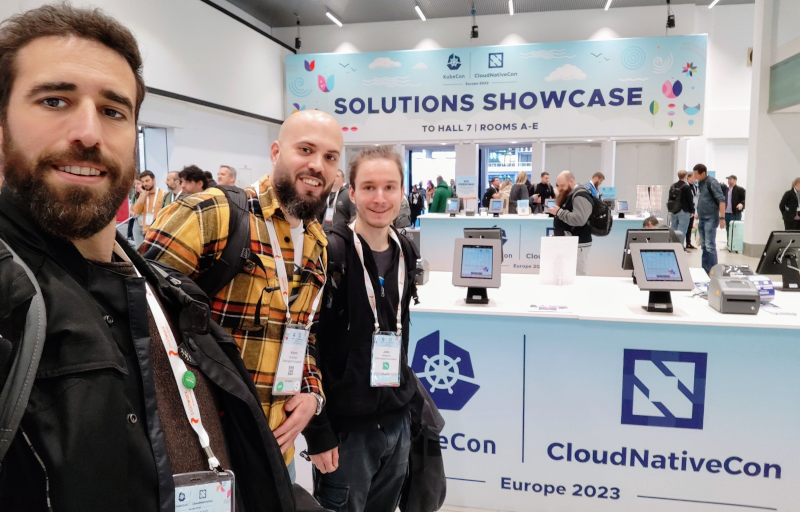
 This post serves as a report from my attendance to Kubecon and CloudNativeCon 2023 Europe that took place in
Amsterdam in April 2023. It was my second time physically attending this conference, the first one was in
Austin, Texas (USA) in 2017. I also attended once in a virtual fashion.
The content here is mostly generated for the sake of my own recollection and learnings, and is written from
the notes I took during the event.
The very first session was the opening keynote, which reunited the whole crowd to bootstrap the event and
share the excitement about the days ahead. Some astonishing numbers were announced: there were more than
10.000 people attending, and apparently it could confidently be said that it was the largest open source
technology conference taking place in Europe in recent times.
It was also communicated that the next couple iteration of the event will be run in China in September 2023
and Paris in March 2024.
More numbers, the CNCF was hosting about 159 projects, involving 1300 maintainers and about 200.000
contributors. The cloud-native community is ever-increasing, and there seems to be a strong trend in the
industry for cloud-native technology adoption and all-things related to PaaS and IaaS.
The event program had different tracks, and in each one there was an interesting mix of low-level and higher
level talks for a variety of audience. On many occasions I found that reading the talk title alone was not
enough to know in advance if a talk was a 101 kind of thing or for experienced engineers. But unlike in
previous editions, I didn t have the feeling that the purpose of the conference was to try selling me
anything. Obviously, speakers would make sure to mention, or highlight in a subtle way, the involvement of a
given company in a given solution or piece of the ecosystem. But it was non-invasive and fair enough for me.
On a different note, I found the breakout rooms to be often small. I think there were only a couple of rooms
that could accommodate more than 500 people, which is a fairly small allowance for 10k attendees. I realized
with frustration that the more interesting talks were immediately fully booked, with people waiting in line
some 45 minutes before the session time. Because of this, I missed a few important sessions that I ll
hopefully watch online later.
Finally, on a more technical side, I ve learned many things, that instead of grouping by session I ll group
by topic, given how some subjects were mentioned in several talks.
On gitops and CI/CD pipelines
Most of the mentions went to
 On etcd, performance and resource management
I attended a talk focused on etcd performance tuning that was very encouraging. They were basically talking
about the
 On jobs
I attended a couple of talks that were related to HPC/grid-like usages of Kubernetes. I was truly impressed
by some folks out there who were using Kubernetes Jobs on massive scales, such as to train machine learning
models and other fancy AI projects.
It is acknowledged in the community that the early implementation of things like Jobs and CronJobs had some
limitations that are now gone, or at least greatly improved. Some new functionalities have been added as
well. Indexed Jobs, for example, enables each Job to have a number (index) and process a chunk of a larger
batch of data based on that index. It would allow for full grid-like features like sequential (or again,
indexed) processing, coordination between Job and more graceful Job restarts. My first reaction was: Is that
something we would like to enable in



 In
 It seems I'm having a theme recently on this blog, of making emacs-related posts. Here's another.
I write a bunch of stuff in markdown, such as
 Previously, I explained

 I wrote the
 Wrong sort of shim, but canned language bindings would be handy
 This is what I imagine it looks like inside these libraries
