Search Results: "hug"

24 December 2007

Adam Rosi-Kessel: Jason s Lesson s Learned About the Legal Academy and Getting In

Pelican has decided to abandon his efforts to scale the walls of the legal academy and proposes this simple eight-step program for others who would follow in his footsteps:
  1. Don t do interdisciplinary work. The legal academy doesn t know what to make of it unless it is economics.
  2. Don t go to a school without a law review or grades. I did and it was a huge problem.
  3. Get on law review, clerk, write.
  4. Check the faculty listings at most law schools. Go to the most often listed schools: Harvard, Yale, etc. It does matter as law faculty select their own, usually. I was told by a faculty member as a 1L expressing interest in the academy that I should transfer immediately to Harvard if possible. I didn t.
  5. If you think you want to be a legal academic, look at what is on the FAR form in your first or second year. Orient your academic career to produce a good looking FAR.
  6. Remarkably, the legal academy does not care about your ability to raise research money or bring in grants.
  7. Don t publish in interdisciplinary journals. Publish only in law reviews writing only dense and impenetrable texts.
  8. Demonstrated impact of your work in policy or law is not relevant.
This critique could be extended broadly to much of the academy (not just law schools). I had once thought I might like to teach law, but now I can only really see myself as a clinician. Two contradictory academic trends: Technorati Tags: , , , , , , , ,

Erich Schubert: Training my AI

Some time ago I've been working on an AI to classify web pages. I've spidered (and classified!) about half a million web pages I'm using for training.This totals to about 40.000 categories and 100.000 useful tokens. I need 8 bytes of storage - two float values - for each combination, which is a matrix of about 27 Gigabytes. I'm using mmap to map my data files into memory for convenient access. On a 64 bit system, I can keep them mmapped all the time.This results in the following funny top output:
  PID USER      PR  NI  VIRT  RES  SHR S %CPU %MEM    TIME+  COMMAND
12443 erich     26  10 27.7g 309m  21m R  8.5 32.8  86:01.98 train
So according to top, the process is using 27 GB of virtual memory. That is the data files, actually. The 300 MB resident memory is the training data it's processing. At this point, all my data has been converted to 32-bit integers, so this is already condensed down a bit.It's also obvious that ext3 supports sparse files - running "du" on my database directory currently gives 1.5 GB (it just has started filling the matrix), adding the "apparent size" switch gives 29G.I hope that when the training run has finally completed (ETA is a couple of days), the AI will actually be able to classify webpages somewhat reliably. :-) You can think of it like a huge bayesian spam filter. Except that I've added some boosting that should improve results, some computational improvements for speed and scaled it up to 40.000 categories instead of just "spam".Other uses I'm planning for the AI is automatic email filtering into multiple folders (best to be employed on Google GMail, where an email can have multiple labels, not just one folder), automatic document classification for document and knowledge management systems, etc. pp.[Update: I havn't yet decided if or when I'll release the code as GPL. Right now, the code could require some cleanups. And I'm considering to start a business around this datamining and classification stuff, so I might want to keep it closed for some time at least. The business will most likely be around integrating the code though, so a public release might well be possible.]

23 December 2007

Martin-Éric Racine: Valga - Valka : 1 linn, 2 riiki - 1 pils ta, 2 valstis

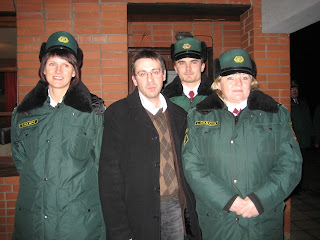
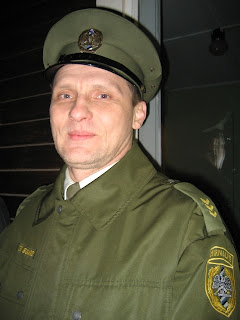
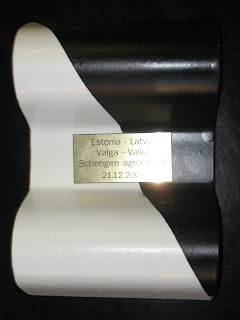
Thursday evening, I joined the inhabitants of the twin town of Valga-Valka, sitting smack on the Estonian-Latvian border, to celebrate their entry into the Schengen treaty. Ever since I first crossed the border there on a roadtrip from Tallinn to Fallingbostel, in year 2001, I knew I would have to return and, sure enough, I briefly passed through during last summer with an Estonian friend, on our way to an acquaintance's birthday party. Still, that told me nothing of the town's life and left me wanting for more. Upon hearing that year 2004 EU accession countries would join Schengen in December 2007, I immediately promised myself to show up and join the crowd. As it turns out, I missed Aleks Tapin of the All About Latvia blog by very little, having I caught his last-minute e-mail the next afternoon. Aleks blogged a great article depicting the Latvian side of life and providing some background info on the town, if you're curious. I arrived late-evening on Thursday via the Tallinn-Viljandi-Valga bus and checked into my hotel, then proceeded to checkpoint Valga II around 23:30, with the intention of grabbing a drink on the Latvian side and returning just before midnight for the celebrations. Hardly anyone was in sight, except for Latvian officer abana who was completing the inspection of a Russian car with three noisy passengers. Upon presenting her with my passport, officer abana cheerfully lead me to the office and slid my passport through a slot to officer Bukss, who was visibly surprised to have any tourist show up on the last day of his job to get their passport stamped. Upon explaining to him the reasons for my presence, he pointed me to a nearby bar where I could have a drink, visibly amused by the situation. I spent the next few minutes in a local casino in the company of three hilarious Latvian truck drivers, Zintars and Aivars, two Latvians with limited English language skills and Yuri, an ethnic Russian living in Ireland who was born stateless on the Latvian side of the town and who later acquired Estonian citizenship by claiming ancestral land on the Estonian side. Upon returning to the border, just minutes before midnight, I found myself in the middle of a huge crowd of villagers, police officers, border guards and politicians from both countries - barely getting noticed by anyone. I handed my passport to an Estonian border guard who emotionally commented to a civilian friend of his nearby that, "Wow! That was the last one!", handing me my passport back just as the midnight bells rang and the mayor of the Estonian side started his speech amidst pyrotechnics lining the road. I then had a chance to chat with the Estonian mayor, who promptly handed me a bilingual certificate, signed by the mayors of both towns, attesting that I was the first to cross the open border, while introducing me to his two young daughters with whom he was about to take a stroll on the Latvian side. The next morning, an even bigger and more symbolic event took place: the demolition of the fence that had been cutting the S prus/Rai a street in half. You can see a picture of what the street looked like before on Aleks' blog article [edit: or on Jens-Olaf's blog article]. After the fence was removed, it instead looked like this: The crowd then proceeded to checkpoint Valga III, where a stage had been setup for the politicians to make their speeches. An interesting fact is that, because of the way the border was drawn, along a creek leading to Pedeli river, an Estonian main road was technically on the Latvian border and thus aptly named "Raja" (border) street. The Estonian mayor commented in his speech that the the brand new supermarket standing behind us was also technically on borderland and could not have possibly been built earlier, weren't it for the Schengen treaty matter-of-factedly eliminating borders between participating EU countries. The speeches were closed by a youth group whose choreography featured six break-dancing boys, dressed as Estonian and Latvian border guards and as border posts. The choreography ended with the teenage border guards carrying away the human posts on their shoulders, just as a choir of young girls replaced them with songs in either languages. Before catching my bus back to Tallinn, I dropped by the Valga tourist info, only to face a nervous-looking Kapo officer in plain clothes. Upon mumbling something about the tourist info and wanting to grab maps, I noticed that a press conference was taking place behind. As he finally let me pass to the tourist info side of the building, a familiar voice said to me, "Hey! Weren't you at our place last summer with Martin Ranna?" Yup, the wife of the acquaintance whose birthday party I had attended last summer is working there and greeted with me refreshments and munchies she had cooked in prevision for the presidential visit! As was my luck, she had one of the commemorative plaques that had been given to the politicians at Valga III on hand: I was glad to see the town becoming one again, even though it is ethnically divided. There are already signs of people on both sides learning one another's languages and shopping on either side of town, not to mention plans of merging the municipal bus operations of the Estonian and Latvian halves of the town, so I'm sure that they'll get there in due course. For me, Schengen brought a much more practical and quite welcome change: the end of messy border crossing stamps that were rapidly filling my almost new passport, every time I visited the head office of our company in Tallinn. While Estonian border guards mostly stamp passports in an orderly fashion, being careful to fit exactly 8 stamps in a single page and to put entry and exit stamps side-by-side, Finnish border guards apparently are incapable of doing so, instead systematically wasting pages by either stamping sloppily in a way that makes it impossible for more than 4 stamps to appear on a given page or by flipping to a brand new page, every time I had to cross the border. In case anyone ever wondered why I'm currently representing Estonian interests abroad, despite living in Finland, this example is one of the many reasons: Finnish authorities routinely display arrogant carelessness towards the population and doubly so towards immigrants. It amounts to an accumulation of idiocy that has costly consequences on people's lives. For some, it's about being denied the public institutions' support when they need it the most and their life forever going downhill thereafter. For me, it has been about countless missed opportunities (jobs, love affairs, travel plans), plus very costly passport and residence permit renewals. Given this, I simply don't see myself ever representing Finnish interests ever again. Faith no more. Besides, the Estonians are fun and easy-going people. Siski ma m tlen, kas ma peaksen n d Eestisse kolima v i?
22 December 2007

Brandon Holtsclaw: New Computer Followup

First of all a GIANT thank you to all who made this possible. It was hugely a success. Today the parts arrived to piece my system back together , I’m typing this post on it as we speak. This means I’ll be able to get alot more done in a sane amount of time, in fact kdebindings-kde4 is calling my name tonight ( was far too large to compile before ). For those of you interested in the new system specs here they are: Time to get all my disk configurations and such upto-date :)
Everyone have a Happy and Safe Holiday Season !

20 December 2007

Lucas Nussbaum: Re: Is it hard for new contributors to help Debian? Can we improve things a bit?

Andreas Schuldei writes about my blog post about making it easier to contribute to Debian:
It is much more gratifying for a contributor if his effords have
immediate effects.

[…]

So what can people who want to help Debian do to achive more imminent gratification? Pick projects that let you help directly with direct svn/git/whatnot access (Security team, Debian Edu, Debian-Installer…)
While I agree that Instant Gratification is very important, I don’t think that the proposed solutions solve anything. It’s easy to have things sleep in an SVN repository instead of the BTS (lots of teams do that, sometimes for good reasons, like the lack of sponsors - hint: Games team). It doesn’t make things any better. What we need is tasks whose results will be available without too much wait in Debian unstable, for everybody. Also, I must admit that I know very little about the inner workings of the Security Team. But I have the idea that it involves quite a lot of procedures (helping with bugs tagged security probably doesn’t, but going further than that probably does). Contributing to Debian already involves A LOT of procedures. A new contributor, even very good technically, can easily get lost in all the different ways to package stuff and solve common problems. So we should identify tasks that don’t have huge requirements. Ubuntu has the concept of bite-size bugs. I started working on a page explaining the different ways someone can contribute to Debian. The goal is to provide a good entry point (not something that replaces existing documentation) and keep it at a manageable size. Its focus is mainly to replace the emails we write to people asking “I’d like to contribute, but I don’t know what I can do or where I should start!”. The page is available on wiki.d.o/HelpDebian/Start. Don’t hesitate to improve it (see also wiki.d.o/HelpDebian for a TODO list). When it will be good enough, I plan to move it out of the wiki (the content shouldn’t change much anyway) to eg http://help.debian.net/, so we can improve the design (I really like the idea of adding pictures of past Debconfs like Christian Perrier did in his FOSS.in talk).

18 December 2007

Bastian Venthur: On #422085 and #417256

Since I received a terrifying amount of insults via mail for not implementing this feature request after my last blog entry, where I asked for help developing rng, I’d like to make my position about this issue clear. Why I was opposed to implement it:
  1. I personally hated that some packages sent a huge amount of unrelated info with every bugreport for this package, even if it’s not meaningful for this bugreport. I made a quick check against my favorite package with a very long output and thought (and still think) that this info is not even relevant for the majority of bugreports of this package. So I thought it was not too much to ask, to write the reporter a friendly mail to post the output of this script, if it’s really needed.
  2. I was personally very annoyed by packages with very long presubj text, which I doubt anyone reads anyway. Since I don’t want rng to be annoying to the users, I decided to leave that feature away. An implementation of this feature would mean to pop up a window with some text the user should read before continuing to report the bug. I don’t like popups and don’t want rng to make use of them.
  3. I’m definitely opposed to a feature which will pop up a terminal where a user has to do something before he can proceed reporting a bug. Sorry, but this won’t happen in rng. I might consider such a thing if it could be scripted to use QT or even GTK but a terminal popping up in a GUI application is a no-go for me, sorry.
  4. I was personally very annoyed by some of the reactions on this bugreport. Since we’re all volunteers and stuff and this feature is maybe a nice-to-have but definitely not a must-have, I decided to put this issue very low on my to do list.
However, I agree that the stuff in /usr/share/bug isn’t completely useless. The opposite is true, it makes the life of maintainers easier and rng should make use of it where possible. So what can we do now? Maybe we can start all over and discuss this issue in a more friendly and constructive way? Here’s my offer: rng will support bugscripts, but it will not feature a terminal popping up asking a user questions. I’m developing a GUI application and a popping up terminal is not very GUI’ish for me. What can we do about this? Is there a way to implement this? Supporting presubj might be okay too, but I don’t want rng to be annoying. Popups are annoying and having to read the same stuff again and again when reporting multiple times on the same package is annoying too. Maybe rng could spawn a pop up with a checkbox “Don’t show this text again when reporting a bug against this package”? Maybe we could have an option in the (not yet implemented) preferences window where we could suppress those messages completely? And please, don’t use abusive language or even insults when contacting me about this issue. My rng-time is currently very limited and my motivation to work especially on this issue is already very low. We’re speaking here about a fully optional feature. Providing the output of some scripts or having to read a presubj is helpful, but not mandatory when reporting a bug. So please, be nice! I really don’t need all that stress right now.

17 December 2007

Russell Coker: Christmas and New Year

Christmas is billed as a family occasion and a huge amount of advertising money is spent convincing people that they need to have big expensive family events. This is good for the advertisers but not good for people who have no family to meet up with (orphans, people who live in different countries to their families, and people who don’t get along with their relatives). If any of your friends don’t have an event planned for Christmas day then it’s a good idea to invite them to your family party if possible. When I was younger there were two occasions when friends who didn’t have a possibility of attending a party with their own family attended a Christmas party with my family. Unfortunately I’m not in a position to make such an offer this year, but I encourage everyone who knows of someone with no plans to consider the possibility of inviting them to a party. Another possibility is that Linux people who have no option of a family party could arrange a Linux community Christmas party.

Frans Pop: aptitude upload not something to be proud of

Sometimes it is extremely tempting to wave a huge, heavy, spiked cluebat around. Today I've decided to give in to this temptation. The case in point is the upload today by their maintainer of first cwidget and later aptitude. The fact that the maintainer blogged about both uploads probably means that he's pretty happy about it. Unfortunately I, and people in the Debian release team, were less than amused. Reason is that the uploads set back a complex transition of apt and related packages by at least a week. This is a transition we'd already been following and trying to get into testing for over a month and which was finally as good as ready to go. So what was so wrong about these uploads and what could (should?) the maintainer have done? First of all he should have realized that aptitude has become a rather central package in Debian with strong ties to apt and thus to a lot of other packages. Second, he should have checked whether his previous uploads had already migrated to testing and, if not, why not. The excellent testing migration page for aptitude (which is linked from its PTS page clearly shows that it is tied in a transition involving about a 100 packages in total. The right thing to do in such a case is to contact the release team (preferably at the debian-release mailing list, or at #debian-release). This would undoubtedly have resulted in a request to delay the uploads a few days until the transition had finished. Unfortunately that did not happen and cwidget was uploaded. Because of an ABI bump it ended up in NEW. Because of the transition I did a quick request to Joerg Jaspert to please delay accepting cwidget until the transition was over. But then a third mistake, and arguably the most serious one of the lot, was made. aptitude was uploaded for i386, built against the cwidget library which had not yet been accepted into unstable. Basically that means that an uninstallable package was uploaded. And of course it meant that at that point all efforts to finalize the transition for apt went down the drain. Some alternatives were discussed on how to deal with the new situation, including a sourcefull upload of the previous version of aptitude, but in the end it was decided to just accept the delay as one of the more annoying facts of life and instead ask Joerg to accept cwidget from NEW. In the end the damage may be a bit less than a week if the buildds cooperate (which they probably won't with cwidget still stuck at the wrong priority) and the RMs decide to force things. I sincerely hope that this story will make all Debian Developers and Debian Maintainers a bit more aware of the broader context and consequences of uploads. Oh, as I'm not an RM myself you may wonder what my interest is in this. We've got this great new feature in Debian Installer that adds support for multiple CDs during an installation (a feature that was lost with the integration of base-installer into D-I). However, we can only upload the relevant D-I component after apt 0.7.9 has reached testing...

16 December 2007

Erich Schubert: Keeping the website up in rankings

My personal web site - which actually is not particularly interesting, IMHO - used to get in a lot of traffic via Google. It was highly ranked on several quite interesting search terms. For example, it's still number 1 on the search term "Halbleiterlaser" (semiconductor laser), which is the topic of my secondary school thesis. So I still win against Wikipedia on this one. For "flowers" I sometimes and up at #1 in Google image search (causing lots of people to hot-link certain images from my site... might be with some geo targeting though?) But I've lost other battles to Wikipedia by now, such as the search term "Liebeskummer" ("lovesickness"; I have some old old poetry online that people dig a lot; this still makes up the biggest share of my visitors)My rankings have dropped quite a lot the last year, down about 50% within a year. I don't know if this is because I'm blogging a lot less, because I'm not updating it often enough or because Google doesn't like the redesign as much as it did like the old one. (The redesign was 2 years ago, followed by a drop in visitor numbers but a recovery to like 70% within a month)Algorithmic changes of Googles ranking are just another possible reason; I always felt as if my placement was highly overrated anyway.I added at a Google sitemap some months ago and other things that people expect to help with their site being well included, but it didn't stop the numbers from going further down. For obvious reasons I didn't buy any links or anything; I'm not making my living with that page or anything, it's just a pet project thingy. (So obviously, don't make me any SEO offers for my page!)Still it's a pity: I used to have a couple of really major placements on Google - so much that I've had some inquires if I'd like to sell my personal homepage (nah, I don't want to have to get a new email address!), offers by reputable and huge dating sites to put up ads on my page and surprisingly high offers for including my web page in link farms - but I'd have issues with that (I'd like to keep control of what my page contains; including content that might get Google to ban my page is scary), and it would have required me to run my page on PHP (ugh).I wish there was an easy way to just keep the rankings I mysteriously had acquired the last years. :-) For some time it looked like I had some magic SEO capabilities, and friends suggested I should consider actually going into the SEO business. My page is still overrated by Google, but it seems like it has lost much of it's magic.P.S. A fun story followup: I've just noticed that someone in a french cooking forum hotlinks to a photo of mine, claiming that he had cooked the food I did. Isn't that hilarious? Should I substitute that image with a g*atsee?

12 December 2007

Biella Coleman: Less is More, Comments

Since most of the readers of this blog come from Debian Planet where you can’t really see if there are comments, I thought I would link to the comments from my recebt blog post on blogging as many make some nice points. Additionally, here is a link to Joe Reagle’s post aptly entitled blog anxieties where he places a tripartite religious framework to understand the life cycle of a blog. I also agree with Alisa who notes that blogging is as much about the writer as is the reader (and I tend to post stuff for the sake of remembering, archiving etc) but I still think that the issue of overabundance is huge for I am as much a a consumer as I am a producer of blogs. I love reading people’s blogs but I just can’t keep up if they do it too often. Tenured Radical also paid a visit and well, if you have not checked out her blog, she is a fantastic, fantastic writer/thinker and what I like about her blog most is that she weaves together just the right ratio of personal and public (for lack of better words). What I mean is that she tells her stories from the vantage point of her experiences, of her position etc. I can imagine a real person behind the posts, which is always part of the fun of blog reading, a form of imagination that frankly is not there with mainstream news and journalism.

11 December 2007

Adeodato Sim : unison -times

After more than one year using unison to synchronize most of $HOME between my laptop and desktop, I discovered yesterday that unison can propagate file modification time, which does not by default. Just pass -times (or set times = true in the configuration file). The first sync with -times results in a huge conflicts with “revprops” being changed in both sides. I resolved all of them in favour of the less recent file (there’s a menu option for that in unison-gtk). But boy did it take long to sync all files.

Michal Čihař: HAL Sleep Quirks

HAL Sleep Quirks is definitely good site for people having problem with suspend/hibernation in Linux. However I would like to find there one very special quirk: how to stop Gnome Power Manager (or whoever is responsible for this) thing that my suspend failed! It works without problems (and worked since I have this notebook), but I always get the popup that it failed. I know I can disable the popup, but there must be way to force this beast understand that suspend works for me :-).

Neil McGovern: Tor, privacy and anonymous browsing

An interesting discussion appeared on #debian on OFTC regarding TOR. One person was of the view that "many intelligence and other agencies are probably heavily involved in tor". As the discussion continued (yes, I should have pointed out it was OT for the channel...) it appeared that privicy and anonymity were getting confused.

Now, I'm not a huge TOR fan (being an oper on OFTC), but I seriously doubt that government agencies are 'heavily involved'. I was pointed at an article to back this claim up, but the article doesn't. Instead, it (and the original claim) raises a couple of interesting issues.

Firstly, there is a difference between privacy and anonymity, although closely related. Privacy allows you to keep information about yourself secret, and anonymity allows you to keep you yourself secret. In the case linked, although the people browsing were anonymous, and maintained privacy, this was broken when they revealed information about themselves. Breaking this privacy broke their anonymity. TOR doesn't even grantee complete anonymity:
Tor can't solve all anonymity problems. It focuses only on protecting the transport of data. You need to use protocol-specific support software if you don't want the sites you visit to see your identifying information. For example, you can use web proxies such as Privoxy while web browsing to block cookies and withhold information about your browser type. Also, to protect your anonymity, be smart. Don't provide your name or other revealing information in web forms.
[http://www.torproject.org/overview.html.en]

Used properly, TOR can be a very powerful tool to help, but certainly isn't a silver bullet. It needs to be used properly to prevent your identity being known (anonymity). However, without privacy, this is nothing.
Even without these safeguards, it would require significant resources (and may not be possible) to reliably retrieve useful information about one particular person. This leads to the Greater Internet Fuckwad Theory, which is the main issue I have with TOR, but that's a different post.

So, the question is: do you want privacy or anonymity when using the internet? You need to know what you want before you use a tool, as nothing can beat user education on how to keep your browsing details out of the 'wrong hands'.

10 December 2007

Steve Kemp: All the time anywhere

Thanks for the comments/mails on my previous post. I've now started the migration properly. All code currently held upon cvsrepository.org will be moved to http://repository.steve.org.uk/ - a nice system-agnostic name. So far I've only setup the pages for two project (my dotfiles and ~/bin) but I'm happy with the process, and the naming scheme appears sane to me now. Using sub-domains I need only install one CGI which is a big win, and using a simple set of templates + mod_rewrite all projects get the same look and feel. I've still got to tweak the stylesheet a little, but otherwise I'm happy with things. I can host both public and private repositories, and that all works magically. Of course the huge win is no longer needing to run a pserver for CVS! All future checkouts will be via HTTP, and the rare few people with commit access will be able to do so over SSH. Once things have been migrated I'll cause the cvsrepository names to redirect to the new locations, and keep that up until the domain expires as a transition period. (I think +1 year :)) The other job for the weekend is releasing a fixed security update for Samba, to fix the regressions.... That is in hand, but the buildds are being slow. If they're not all done I'll release it anyway today/tomorrow. I'm annoyed that I handled the timing so badly, but I hope that people don't hate me for it.

Steve Kemp: All the time anywhere

Thanks for the comments/mails on my previous post. I've now started the migration properly. All code currently held upon cvsrepository.org will be moved to http://repository.steve.org.uk/ - a nice system-agnostic name. So far I've only setup the pages for two project (my dotfiles and ~/bin) but I'm happy with the process, and the naming scheme appears sane to me now. Using sub-domains I need only install one CGI which is a big win, and using a simple set of templates + mod_rewrite all projects get the same look and feel. I've still got to tweak the stylesheet a little, but otherwise I'm happy with things. I can host both public and private repositories, and that all works magically. Of course the huge win is no longer needing to run a pserver for CVS! All future checkouts will be via HTTP, and the rare few people with commit access will be able to do so over SSH. Once things have been migrated I'll cause the cvsrepository names to redirect to the new locations, and keep that up until the domain expires as a transition period. (I think +1 year :)) The other job for the weekend is releasing a fixed security update for Samba, to fix the regressions.... That is in hand, but the buildds are being slow. If they're not all done I'll release it anyway today/tomorrow. I'm annoyed that I handled the timing so badly, but I hope that people don't hate me for it.

9 December 2007

Christian Perrier: Adventures in Mumbai

Some adventures on my way back from FOSS.in at Bangalore. I was planned to fly back through Mumbai, with a quick connection (05:30-07:00). However, the Paris flight got delayed "because of technical problems" and we finally took off at 11:00. However, while flying the deserts of Eastern Iran (so after 2 hours flight), some very bad vibrations were happening and, apparently, one engine of the 747 was shut down by the crew. Then we gently turn 180 degrees and were told that....we were going back to Mumbai..:-( So here am I, currently in Mumbai airport, in the VIP lounge (I didn't want to go to a random hotel with pay-per-use wireless), coping with my mail et keeping in touch with $HOME through an awfully jerky connection. FOSS.in was huge fun but it seems that coming back from it will not be fun at all. Well, that's how air transportation is, right?

7 December 2007

Erich Schubert: Updating Dell BIOS on Linux

... was a lot easier than expected. Just not very well documented.First of all, you need the appropriate utilities. Debian users can aptitude install libsmbios-bin Next identify your system. It will look something like this
$ sudo modprobe dcdbas
$ sudo getSystemId
Libsmbios:    0.13.10
System ID:    0x01D8
Service Tag:  ...REMOVED...
Express Service Code: ...although my warrany is over...
Product Name: MXC061
BIOS Version: A10
Vendor:       Dell Inc.
Is Dell:      1
The information you need is the "System ID".Now you need to get the so-called HDR file for your bios. This can either be extracted from their EXE file using wine (with -dump-hdr or so), or you can find it on the linux.dell.com server. This page contains a huge list, and there are tons of dirs like system_bios_ven_0x1028_dev_0x01d8_version_a10. 0x1028 apparently is "Dell". The second hex number is your System ID. The last number (A10 here) is the BIOS revision. Pick the appropriate directory. There should be a bios.hdr file in there.You can verify if the file is appropriate for your system:
$ sudo dellBiosUpdate -f bios.hdr -t
And do the update by calling
$ sudo modprobe dell_rbu
$ sudo dellBiosUpdate -f bios.hdr -u
When rebooting the next time, your screen might be garbled for a few seconds. At least it was for me. I was scared I might have trashed my system, but then it rebooted and had the new BIOS. So just give it some time (Fortunately I've done enough BIOS updates to know to just wait. I've even done a 'blind' video BIOS update on a Nvidia TNT. The first update had trashed the card, but I was able to redo the flash process without seeing anything on the screen, and guess what, the card worked again!)In case you're wondering how this works: as I understand it, the dell_rbu driver will reserve memory for the BIOS update. Being a kernel module, it can just lock the memory in place until the next reboot. It will store that address in CMOS for the Bios and set the update flag. On reboot, the current Bios will check if that the stored image is still intact (I bet they do some checksumming here!) and then load that into the BIOS flash. That way, you don't need to boot into a low-level system such as Dos or Dos-Mode anymore to do an update.

6 December 2007

Evan Prodromou: 15 Frimaire CCXVI

My friend Hugh McGuire just launched a new Web site: earideas. It's a curated collection of the best podcasts on the Web -- kind of an interesting choice. Hugh's best known for the Librivox project -- a collaborative effort of thousands to make public-domain audio books freely available on the Web. He's also the leader of datalibre.ca and the co-founder of Collectik, the social sharing site for podcast enthusiasts. All of which is to say that he's a massive-collaboration kind of guy. So why the curated collection? Says Hugh, "It s built specifically so that you don t have to do anything much more than you do when you turn on a radio." In other words, they're finding the best stuff for you. I think the site makes a nice complement to Collectik. In any event: the gang at earideas has asked for lists of people's top 5 favorite podcasts. I'm still not very much into the podcasting thing; I don't have a portable digital music player, and I haven't found listening to music on my laptop or desktop really useful. But I do listen some of the time, so I figure I could give my suggestions.
  1. Linuxcast by the personable and telegenic Don Marti. Great coverage of software and society in the Free world.
  2. FLOSS Weekly. The "weekly" part is a bit of a stretch, but this is a very good interview show about Free/Libre/Open Source Software. I miss Chris DiBona as host, but Randall Schwartz is no slouch, either.
  3. Destinyland. Destiny is perhaps one of the greatest pop culture researchers alive today. This very occasional podcast is just like having Destiny corner you at a party and talk for 90 minutes about the suspicious circumstances of Alfalfa's death. It's fascinating.
  4. CBC Radio 3 Podcast. Yeah, it may make me terribly unhip, but I like Radio 3.
  5. Radio Open Source. I want to hate this show for capitalizing on the name "open source" without actually providing any open content or talking about Free Software. But it's one of the best shows on the Web.
All right, that's my five. Good luck, Hugh and the rest of the gang at earideas.com. tags:

Million-dollar idea So, I use a Logitech Trackman Marble for my desktop computer -- sometimes called the one true pointing device. I think it's awesome, and I've had it for maybe 10 years. The only downside is that every 6-8 weeks I have to pop off the cover and clean out all the finger oils, dust, hand hair and cookie crumbs that have amalgamated to a greasy, fuzzy crud inside. It may be one of the most disgusting things I do regularly -- and remember, I have a 2-year-old, so that's saying something. Anyways, here's my idea for a device, free for you to use. It's a self-cleaning trackball (or mouse). Just like a self-cleaning oven, every few weeks you'd click a special button on the device and it would heat itself to 800 F for about 90 minutes until the dang thing is just glowing white-hot and it vaporizes any crud that may be inside. Then, you can go about your business with a smooth, clean mouse (or trackball) again. Viola! I think the idea would work for keyboards, too, but I really rarely clean my keyboard. Filthy keyboards seem to work fine most of the time, and when they don't work well you can just throw them away and get a new one. But there's no accounting for taste and anyways people may want to buy a matching set of self-cleaning keyboard and mouse rather than just one or the other on its own. You, reader, can use this awesome million-dollar idea on your own, free of charge. Enjoy! tags:

4 December 2007

Ondřej Čertík: M rida - wrap up

From November 28 till December 2, 2007, I attended a Debian QA and release teams work session in Extremadura, which is an autonomous community of western Spain, that managed to install Debian on 90000 computers in every school (technically a Debian based distribution called gnuLinEx) and Junta de Extremadura also sponsored this meeting.

I took photos of all participants, see my first, second and third posts. When I arrived at the Madrid airport where we first met, I set myself a goal to remember all names and faces, so I used my blog to help me and I think I succeeded in the end. :)

See also our wiki page that we used prior and during the meeting.

So what did we do besides throwing candies?


Lucas Nussbaum will send a summary email soon about the meeting, so I'll just speak for myself:


I worked with Gon ri on svnbuildstat, that is a service for building packages and show statistics about lintian/linda/piuparts checks. It for example contains all packages of the Debian Python Modules Team (that I am a member of) and many others. We discussed and started to work on how to create robust buildbots, that can be installed as a regular Debian package with zero (if possible) configuration, so that many people can just install them without pain, thus providing a huge scalability to the project.

We wrote a preliminary patch to pbuilder for killing the build if it exceeds given memory/disk usage. I had to learn the internals of pbuilder and I lost quite some time squashing some stupid bug I caused while writing the patch.

I spent most of my time with svnbuildstat, mostly learning and discussing things. This will be important for the future, but to also have some real results, I also fixed some packages I comaintain:

Together with Kumar Appaiah we fixed the python-numpy package and I had it uploaded, then I learned how to work with quilt instead of dpatch to handle patches in Debian packages, thanks to Holger's webpage, that contains a nice tutorial. Then I switched from dpatch to quilt in python-scipy and backported a patch from upstream svn to fix a segfault bug and had the package uploaded.

Then I finished the Cython package and had it uploaded. Cython is a marvelous package to speed up Python programs and interface C/C++ programs. I greatly recommend to try. If you don't like it, you can try some of at least 10 other ways to wrap C code in Python. I also used quilt in there to backport a patch from the upstream Mercurial repository to implement parsing @classmethods. Quilt is really a pleasure to work with.

Impressions from the meeting

I've been using Debian since 2001 as my only operating system on all of my computers, so I am not a complete beginner. But it never occured to me I could get involved in Debian more than a user and an occasional bug reporter. What a mistake.

I started packaging new things and fixing packages that I need for my work and that didn't work. This got me involved quite a bit in Debian. But in M rida it was the first time I could dring a beer (well, especially wine) with Debian Developers and I found out they are really cool people. They are all very skilled. Also something, that I love about Debian, is that the people involved in it share two common features, that are very important for them - respect to democracy and personal freedom. When I think about it, those are probably the first two items on my presonal list of values.

Of course, everytime there is a group of 1000+ people, there are good and bad people, more and less skilled, but important is the overall atmosphere - and that is as I described. I think Debian is truly unique. There is Gentoo, that has maybe 40 (?) active developers. There is Ubuntu, that has maybe 100 (?) developers, but it's basically a comercial distribution and there is not so many interesting work for non employees of Canonical. There is opensuse and fedora, where I am not sure about the numbers. The atmosphere in Debian can change in the future, one never knows, but as of the end of 2007, I think it's very cool to get involved.

Maybe it's not for everyone, but it's the right place for me.

30 November 2007

Daniel Burrows: The Dreaded I-Word

A popular and recurrent topic of conversation on the Internet has the following form:
Is (X) innovative?
I occasionally find myself reading these discussions; they have the same sort of macabre fascination for me that's often ascribed to train wrecks, messy divorces, and Usenet. Of course, the outcome (or rather the lack of one) is always predetermined. The only variable is how many pixels will be mutilated and how many absurd postures will be struck before the dust settles. Why do I say the outcome is predetermined? Because in not one of these discussions does the person posing the question precisely define what innovation is. If the discussion concerned, say, whether an object was blue, or made of concrete, or 5 meters by 6 meters, this would not be a real problem: while any hair can be split, there are commonly accepted definitions of blue, concrete, and meter that are sufficient for an informal discussion. But innovation is not blue, concrete, or meter. Different people have subtly, even radically different views of what constitutes innovation and how to measure it. Hence, any discussion involving more than one person quickly devolves into chaos. One person will say, X is innovative because of such-and-such, and another will reply, X is not innovative because of such-and-such unrelated reason. Both writers are correct by their own definitions of innovation; they are answering different questions, and so they end up talking past one another. Although these discussions never go anywhere, I think it's entertaining and enlightening to catalogue some of the definitions of innovation that the participants use. I've listed some popular definitions below; feel free to email me with more suggestions and I'll update the list. Of course, since people rarely bother to define their terms, most of these meanings have been inferred from the statements people have made about what is and is not innovative. As a result, some of them are fairly absurd and may not accurately reflect the opinions of the speakers, had the speakers stopped to think about what they were saying. Caveat lector. Conventions: Below, personal pronouns such as I and me refer to the speaker. The words product, idea, and technique are used interchangeably and as appropriate to refer to the thing whose innovativeness is in dispute.
  • The idea advanced the state of human knowledge.
  • The idea was an improvement over existing ideas.
  • The idea improved the state of practice within its field.
  • The idea was previously unknown.
  • The idea was previously unknown to its creator.
  • The idea was previously unknown to me.
  • The technique solved a problem thought to be unsolvable.
  • The technique solved a problem with no known solution.
  • The technique solved a problem with no solution known to me.
  • The technique solved a problem with no solution known to its inventor.
  • The product was aesthetically pleasing to me.
  • The product is entirely unlike any other product with which I am familiar.
  • The product is exactly the same as some other product with which I am familiar.
  • The product solved a problem more effectively than existing tools.
  • The product made its creator the wealthiest living human.
  • The product made its creator wealthy.
  • The product made someone wealthy.
  • The product reaped a huge profit for the corporation selling it.
  • The product was bought by many people.
  • The product was used by many people.
  • The product was useful to many people.
  • The product was useful to someone.
  • I bought the product.
  • The product was useful to me.
  • The product was created by (some particular entity, such as Toyota or Apple).
  • The product was not created by (some particular entity).
  • The product is good. (NB: of course good is another ambiguous term with many definitions, one of which appears to be innovative; the fun never stops!)
A Contrarian View This post charitably assumes that the purpose of the discussions I described, and the goal of the participants, is to arrive at a commonly agreed-upon answer to the opening question. In reality, though, most discussions on the Internet, particularly when they involve many anonymous or pseudonymous parties, are just tribal wars. Individuals decide which side to affiliate themselves with, then search for arguments that will tend to support their side or undercut the opposition. Facts and logic are largely irrelevant, except as weapons with which to smack one's opponents, and a dismissive put-down is as good as or better than a reality-based analysis. Actually changing your mind based on the evidence presented shows weakness, and is to be avoided at all costs. If you have to assert that up is down, do it. In this environment, using vague terms appears to be a bonus, since it gives you more wiggle room and opportunities to play gotcha!. If someone responds to your post with facts that rebut you based on the definition you were using, you can pick any other definition and say ...but what about..? Which is why these discussions (in which no-one is actually discussing anything) are both a fascinating window into human nature and a depressing commentary on human nature, and why I keep finding myself reading them.
PS: This post is the first long post that I've used ikiwiki to write. An advantage of my new workflow, where I write posts on the bus and commit them into a local git repository, is that I have a nice block of time to write down random thoughts that have occurred to me on the way to or from work; sometimes I forget what I was going to write over the course of the day, and when I get home I usually get deluged in email and real life. It's always amazing to me how long it takes to write posts when I actually think about what I'm doing. This post has taken me at least an hour to compose, and I think probably more (especially counting the composition I did in my head while, e.g., walking from point A to point B). It's a lot harder -- which means, of course, that it's fun; if I don't get distracted by a coding project, I'll be trying to take advantage of my new workflow to post more often.

Next.

Previous.