Search Results: "evo"

20 November 2006

Ben Armstrong: Towards a Debian Jr. Live CD

Debian Jr. development revived Recently there has been some lively discussion on the Debian Jr. list about how to arrange an account for a child of 1 to 3 years of age. Suggestions included using set-top box software like Freevo, tailoring DEs with panels and large buttons, using simpler WMs like fvwm, or using an “activity centre” app like Gcompris. Now, I respect those parents who hold that a child this young should interact more with the “real world”. While I wouldn’t go so far as to outright prohibit my young ones from computer use, I can see the wisdom in keeping it to a minimum. But, for better or worse, our family is one of several who have some experience helping our youngest members use our Debian systems. We would like to share what we’ve learned through the Debian Jr. project. Getting started with live.debian.net To that end, last week I was inspired to follow the Debian Live ISO Howto to produce my first rough draft of a Debian Jr. live CD built from scratch on Etch. For the final product, we’ll want to use a local partial Debian archive mirror, as it not only optimizes fetching packages for several build iterations, but also can be kept stable, which is important as we near release. But for this draft, I ran into trouble building the complete package list to populate the partial mirror, as cdebootstrap, which make-live uses, has no handy --print-debs switch like debootstrap does. So for now, I rely on approx to cache packages for optimization only. A straightforward process to create a working live CD The rest of the process was straightforward: using live-package, I created a package list1 containing Gnome and the Debian Jr. metapackages, I configured /etc/make-live.conf to point at my proxy, and then I ran the make-live script on the package list. The end result was ./debian-live/binary.iso, which successfully booted under qemu. At this stage, there is not much to show. To be truly useful, the live CD needs to be set up so that children and their guides can immediately find and use the material intended for them. We will need not only one live CD user, but four, varying in age range and role. (More about this in a future article.) However, it is an encouraging start, and shows that we may be able to produce something usable by the time Etch releases.

1 For this exercise, I simply combined /usr/share/make-live/lists/gnome with the junior-* metapackages in Etch, and added mozilla-firefox-gnome-support to satisfy Gnome’s web browser dependency and cut down on redundancy, resulting in the following list.

junior-art
junior-doc
junior-games-card
junior-games-gl
junior-games-net
junior-games-sim
junior-games-text
junior-gnome
junior-internet
junior-kde
junior-math
junior-programming
junior-puzzle
junior-sound
junior-system
junior-toys
junior-typing
junior-writing
mozilla-firefox-gnome-support
eject sudo
console-common locales
gdm gdm-themes gnome-desktop-environment gnome-cups-manager gnome-screensaver
gnome-themes-extras
rhythmbox synaptic
x-window-system-core

Julien Danjou: Freevo packaging on its way

So this week-end Cyril Lacoux began to work on packaging freevo, which never got into Debian for a reason I still ignore. All I found is a 4 year old ITP from Matt Zimmerman who closed id some weeks later because he decided to give up and use MythTV instead. ;-) There's now a project on Alioth and we will probably get a working package soon, since we began to commit this morning.

19 November 2006

Jos Parrella: Elections in Venezuela

In two weeks (Dec 3rd) there will be presidential elections in Venezuela. This will be the third time where Hugo Chavez, the current President, will be participating in the elections. The first time, in 1998, he won by 62%, then dropped to 59% in 2000 and currently some polls are giving him between 50 and 60 percent of vote intention. Since 1998, we’ve got a very active electoral movement and controversial situations which have raised very diverse opinions about our electoral system. If I recall correctly, in 1998 people voted using optic forms. In that moment, spanish Indra was the company in charge for the machines and most of the technology used in the elections. That was the time where the Supreme Electoral Council depended on the Executive power, i.e., the President. In 1999, Chavez proposed to rewrite the Constitution, and the National Electoral Council became an independent power. This Constitution was approved in two referenda in 1999, where touchscreen machines were used. In 2000, after the new Constitution was approved, new presidential elections were made. The same touchscreen machines were used and we made a transition between Indra and a multinational holding named Smartmatic. In 2004, after two millions and a half of signatures were gathered to recall Chavez presidency, the revocatory referendum was made, using the Smartmatic machines. Almost six million people voted to maintain Chavez in power. Of course, after eight years of the same party in the power, as well as other problems (namely a national strike and a Coup d’Etat in 2002), several ideas arised regarding the legitimacy of the election process.
Today, the National Electoral Council released a flyer in the press, where they try to issue these topics. I must recognize that, being a newbie voter, I was unaware of several of the things they published today. For example, 8 of every 10 venezuelans over 18 are signed for voting in the elections. That’s one of the higher percentages of public awareness about elections in Latin America, higher than, for example, Colombia. That means 16 million people are able to vote, and we’re used to get around 60 percent of participation. We do vote with touchscreen machines, and the results are completely computerized. The military guards all the equipment, and provides security to the randomly elected civilian which work as temporary personnel. Members of every involved party are present in all the election centers, as well as national and international observers. After you’re checked to vote, you have to give your fingerprint in a special biometric device. This is transmitted live, were possible, avoiding two people voting in the same day. After you vote, your finger is marked with silver nitrate, which goes away after two days or so. Of course, you’re only allowed to vote if you don’t have the mark in your fingers. The touchscreen machines prints a paper which you put into the traditional box. After the voting has concluded, more than half of the boxes will be opened and checked against the information in the machine. The boxes subject to this check are randomly selected, as well. A brief thought about the software used in the machines. In 2004 or so, we (the Free Software Community in Venezuela) struggled and made pressure to the National Electoral Council to reveal the code and publish it wide open. This has been achieved until some point, since every interested person or organization is allowed to take a peek at the code. Dozens of organizations have already done so and are impressed by the features that are now present in the code. Before the first vote is registered, the machine prints a zero-vote confirmation, and then subsequently randomizes the order of the votes registered in memory. Only after all the election centers are closed, the machines start transmitting information. This year, three hours past the closing time we’ll have the results. The final and most important, from my point of view, argument held to support our election system is the random queue organization at the election centres. The registry is sorted by ID number, the votes are randomly stored in the memory and the biometric device is used in a per-arrival basis. Therefore, since nobody takes the same time to vote, the queues will be unarranged therefore making it quite difficult to determine a possible vote sequence. This has been certified lately by the European Union, the Organization of American States and other organizations. Whoever wins this election, I’m quite confident about our election system. I just hope that other institutions in our Country start using reliable systems (for example, the national ID office) in order to give at least the feeling of being in a rightful State.

Sven Mueller: Why is VoIP/SIP so hard?

Eric has asked: Why is video conferencing so hard? Actually, I would extend that: Why is SIP so hard? It’s far from being easy to find suitable SIP clients which support chat, voice calls and preferably also video calls. Preferably, I would obviously like to find versions of the same client for different operating systems, but I would actually accept any sufficiently stable clients. Currently, my research is focussed on a Windows client, but I will soon also need one for Linux. As of now, the client closest to what I would like seems to be CounterPath’s eyebeam/X-Lite, which supports chat, voice and video, including proper presence support, but it has several problems, the most annoying ones being a nice “little” memory leak (going from 50MB total size to 350MB total size within a few days without much SIP activity) and the fact that it sometimes uses up 100% CPU while putting itself to high priority, which makes it almost impossible to recover from this without a hardware reset. I’m glad WengoPhone went GPL[*] for their 2.0 version. From what I saw, WengoPhone is quite promissing and the fact that it is now opensource makes it much more likely that it evolves quickly into a stable, portable and usable platform for SIP telephony. Anyway, if someone knows good SIP clients, which support at least voice and IM/chat and run on Windows or Linux (preferably both), I would surely be interested. [*] In case anyone wonders like I did: the source for the WengoPhone 2.0 pre-releases/release candidates is available only via a subversion checkout as described in their wiki.

18 November 2006

Adam Rosi-Kessel: Crash at Roslindale Medical Center

I live almost across from the Greater Roslindale Dental and Medical Center. I noticed this on a short walk this morning, viewing the Medical Center basement from the east looking west on Washington Street. I took these photos with my cell phone (I apologize for my thumb in the bottom image — it’s not the most ergonomic design for snapshots). Click on either image for slightly larger versions: I overheard someone say that an 87 year old man driving a car just flew into the building (not an easy feat considering the design of the intersection — no street actually points in this direction). He apparently at least survived the crash and was taken to the hospital. It’s hard to avoid thinking that this is an eminently predictable and avoidable problem. There are a lot of people out there who shouldn’t be driving. The state should revoke their licenses. The state should also provide a workable alternative for them to get around.

15 November 2006

Russell Coker: economics of a computer store (why they don't stoc...


In some mailing list discussions recently some people demonstrated a lack of knowledge of the economics of a shop. Having run a shop for a few years (an Internet Cafe) I have some practical knowledge of this. I will focus on small businesses in this article, but the same economic principles apply to large corporations too.

When running a shop the main problem you have is in managing stock. There are two ways of getting stock, one is to have wholesalers give it to you for a period in which you can try to sell it and you pay for it when it's sold, this is probably quite rare (I don't know of an example of it being done - and probably no retailer wants to talk about it in case they lose it). Often retailers consider themselves to be privileged if they are permitted to pay for hardware one month after they receive it! The more common way of getting stock is simply to buy it and hope you can sell it in a reasonable period of time (often the wholesaler will offer to buy the stock back at a 10% discount if you can't sell it).

To buy stock you need money, this can come from money that has accrued in the business account (if things are going really well) or from a mortgage taken out by the business owner if things aren't going so well. For small businesses things usually don't go so well so the money used to buy stock is borrowed at an interest rate of about 7% or 8% (I'm using numbers based on the current economic conditions in Australia, different numbers apply to different countries and different times but the same principles apply). The ideal situation is when there is money in the company bank account to cover the purchase of all stock, this means that the cost of owning stock is that you miss out on the 5.5% interest that the money will get in a term deposit.

Almost all stock has a use-by date of some form. Some items have a very short expiry (EG milk used to make hot chocolate in an Internet cafe, some have a moderate expiry date (computer systems become almost unsellable in about 18 months and lose value steadily month after month), but in the computer industry nothing has a long expiry date.

Let's assume for the sake of discussion that you want to run a small computer store that is open to passing trade (this means that you must have stock for an immediate sale). Let's assume that all items of computer hardware lose half their value over the period of 20 months at a steady rate of 2.5% of the original price per month (I think that most computer hardware loses value faster than that, but it's just an assumption to illustrate the point).

The next major issue is the profit margin on each sale. If you can make a 20% profit on a sale then an item that has lost 10% of it's value while gathering dust in your store will still be profitable. However the profit margins on computer sales are very small due to having a small number of major manufacturers (Intel, AMD, nVidia, ATI, Seagate, and WD) that have almost cartel positions in their markets and there being little to differentiate the stores apart from price. I have been told that 3% profit is typical for retail computer hardware sales by the small companies nowadays! Now if the stock will lose 2.5% of it's value per month, you pay 0.5% interest per month and you make a 3% profit then if an item remains in stock for a month then you lose money. So on average (by value) you need to have stock spending significantly less than a month in your store. Cheap items such as low-quality cases and PSUs can stay in stock for a while. More expensive items such as new CPUs and the motherboards to house them must be moved quickly.

What's the first thing that you do to reduce stock? You can keep stocks low, but there is a limit to how low you can go without losing sales. The next thing to do is to not stock items that customers won't often buy or items where there is a similar item that you can stock as a substitute. The classic example of this is hard drives, a customer will want a certain capacity for a certain price - if their preferred brand is not in stock they will almost always take a different brand if it has the same capacity at the same price. Stores often advertise prices on multiple brands of hard drive in each capacity, but often only try to keep one brand in stock.

Of course this is a problem for the more fussy buyer. If you want to buy two identical parts from the same store on different days you might discover that they don't have the stock on the second day and that they instead offer you something equivalent. Not only do retailers have issues with managing their investment in stock but wholesalers have the same problem. So if a retailer runs out of WD drives and discovers that their preferred wholesaler has also run out of WD drives then they just buy a different brand - most customers don't care anyway.

There are some companies I deal with that have a business model based on services. One of them sells hardware to customers at cost, but charges them for the time spend assembling them, transporting them, etc. The potential for a 3% profit on the hardware isn't worth persuing, they prefer to just charge for work and also save themselves the sales effort. Another company I know operates almost exclusively on the basis of ordering parts when customers request them (but still make a small profit margin on the sales), this means that the customer can be invoiced as soon as the hardware arrives. The down-side to this is that wholesalers have the same stock issues and they sometimes have excessive delays before the wholesaler can deliver the hardware.

Dell is the real winner out of this. As they operate by mail-order they don't need to have the stock immediately available, they have a few days to deliver it which gets them time to arrange the supply. They can also have a central warehouse per region which reduces the stock requirements again. A 3% profit on items that rapidly decrease in value makes it almost impossible to sustain a small business. But an organization such as Dell can sustain a successful business at that level.

Of course the down-side for the end-user is that Dell doesn't want to have too many models as that just makes it more complex for the sales channel. Also they have deals with major suppliers which presumably give them deep discounts in exchange for not selling rival products (this is why some brands of parts are conspicuously absent from Dell systems).

10 years ago there used to be a small computer store in every shopping area. Now in Australia there are a few large stores (which often only have a small section devoted to computers) and mail-order. There seems to be much less choice in computer hardware than there was, but it is much cheaper.


PS I've attached a picture of day 39 of the beard.

14 November 2006

Evan Prodromou: 22 Brumaire CCXV

My third and final article on the Web 2.0 conference came out today in LinuxWorld: Web 2.0 Summit: Open Source software borrows back from the open API Web. I tried to insist that they use the French Revolutionary Calendar for the byline but LW flatly refused. Go figure. The article turned out well, except that Chad Dickerson's name somehow ended up as "Brad Dickerson". D'oh. But I think overall it was pretty good series, and I concentrated on the stuff that I thought was fantastico. Which turned out to be the fun way to do it. I'm not sure whether it's best to take a breather right now and not worry about more conferences until March with SxSWi 2007, or if I should be finding other things to do. Really, I kinda have a lot of work to catch up on, some interesting projects to get started, and all kinds of stuff just goin' on. tags:

MTL I had beers at La ka this evening with Michael Lenczner of le sans Fil (our local, insanely good community wireless system in Montreal) and Civic Access and just generally an all-around good guy. We met... last year, maybe?... at one of Seb Paquet's Friends of Seb lunches. Man, Seb knows everybody. Anyways, a fun time was had. La ka is always a nice place to spend a few hours, especially with a Griffon Rousse in hand. Or so. We chatted about alternative office systems (my new obsession since Patrick Tanguay's presentation at BarCampMontreal), 802.11n (the new multi-antenna standard for wireless), and HAL, the incredible new system SF has for distributing locally-made art and culture on the local network of their hotspots. A great idea, and I hope it goes far... I want to use it in New York, Durban, KL and Perth. I think if I get around to talking to Boris sometime in the next week I'll have completed my post-barcamp trifecta. tags:

Smashing success! Sounds like The Kokoromi Collective had a Smashing success at their event the other night. A little bummed that we couldn't make it, but glad it turned out so well. tags:

13 November 2006

Evan Prodromou: 21 Brumaire CCXV

Long day today (yesterday, actually, but I'm post-dating this in the interest of chronological flow). The baby's having a hard time coming off of West Coast time; she got up late and took a loooong nap till half-past three. Which was fine, because I needed the time to work on my NSLU2, which needed some attention. The NSLU2, or "Slug", is a tiny Linux computer from Linksys, about the size of a two packs of Marlboros laid side-by-side. My brother Nate gave me one last year for Christmas (thanks, nate), and I've been using it for network backups, but on our trip to SF Nate showed me that he's running all kinds of wild services off of his. So I decided to start shifting over some responsibilities to the little bugger. Which was just about time. Sometime during our trip to San Francisco, my main home server started having fan problems; it kept overheating and shutting itself down. It's going to take some time to diagnose the problem, but I figured that this was as good a time as any to move the critical services over to the Slug. The main one that needed budging was DNS. Maj's main domain, as well as my two .san-francisco.ca.us domains, run from home, because it's too hard to get the registrar to change them. The Unslung system I use for the Slug has a BIND package, which is a good thing to run, anyways. I was running MaraDNS on the big server, because I always root for the underdog, but there wasn't a MaraDNS package for the Slug. So I rewrote my zone files and things are up and running now. I don't know what else I'm going to put on there. Jabberd? Asterisk? A home wiki? Just not sure. tags:

Blah blah blah When the baby got up, we went to our local Loblaws, out towards the end of rue Rachel across from Canadian Tire. It's a pretty fantastic place to buy groceries -- it's the old CPR Angus Shops, a repair and maintenance facility for the Canadian Pacific Railway. The building is huge, with giant cranes and beams still attached to the roof. Amita and I grabbed a crapload of groceries and brought them home to Maj, who'd just had a massage at the centre around the corner and was feeling really good. She'd rented Tristram Shandy, the 2005 movie based on the 18th-century level-twisting novel. Me and Amita June made some baked potatoes, and we all watched the movie, and a good time was had. tags:
 

H****e en vrac One thing I always want to buy when I'm at the store in Quebec is the quite commonly available communion wafers. Yeah, really! big ol' 5-inches-diameter communion wafers, in the snack section next to the Doritos and the Humpty Dumpty potato chips. Quebec society has a had a precipitous secularization -- from around 90% church attendance in the 1950s to less than 10% today. But Catholicism still infuses all parts of life. For example, in Quebec, you cuss by using words from the church, including, of course, hostie ("the host"). So I can't figure out why hostie are a tasty snack treat. Is it a deliberate snub to the sacrament of communion by a secular society? Or did the practice antedate the Quiet Revolution, and did the formerly religious Quebecois eat communion wafers for fun? Or is it just a snork-snork funny thing to do, when the name of the food is actually a naughty word? I dunno. I'm fascinated, but not enough to buy a big bag of communion wafers to eat. (They're never cheese- or BBQ-flavored, by the way; they have a pristine seriousness to them.) More info solicited. tags:

Opinity One of the services mentioned in the Web 2.0 Summit infrastructure workshop was Opinity. Opinity seems to be a distributed reputation system, kind of like claimID but with a little more soft information. I think it looks pretty cool, and I'm glad to see another addition to the growing OpenID identity provider market. tags:

12 November 2006

Biella Coleman: The Limits of Technological Uses

In the past and for my hacker course, I have taught Paul Ceruzzi’s History of Modern Computing but the book was a little too dry to fly high with first year students but thanks to Joe Reagle’s excellent syllabus on the Impacts of Technology, I read a short but very sweet (and teachable) piece by him entitled An Unforseen Revolution: Computers and Epectations that not only gives a window into the early history of the computer but provides a very nice conceptual entry as to why it is hard for inventors of a new technology, such as the computer, to foresee and fully come to terms with its future uses, full range of capabilities, and utlimately its impact. Basically the context of invention combined with the training of inventors (which in this case, the first American digital computer, the ENIAC was invented by a physicst and an engineer for mathematical computing) stitches and thus initially limits the vision (and thus use) of the technology largely to its original purpose, while precedding technologies provide the conceptual juice drunk to understand the meaning of new technologlogies. So while today we clearly think of computers as a meta-machine, that can be whatever-machine-in-the-world-we-so-desire (so long as someone programs it to be that machine), in its time, with people so accustomed to machines as having one function, the cultural imagination was stuck. As Ceruzzie humorously conveys, a machine having such general capabilities seemed absurd, like a toaster that could sew buttons on a shirt. But the computer was just such a device; it could do many things its designers never anticipated. p. 126 With the passing of time came new innovations (Ceruzzi identifies new developments in programming as key in this regard) and use in new settings (notably businesses), the stitches were loosened and finally unraveled so that the computer came to take on the meaning it has acquired today. One perennial topic of inquiry in the field of STS concerns how particular contexts and other factors shape new meanings, visions, and uses, or just limit them, along with unearthing the labor that goes into making new inventions or scientific theories more generally accepted. This is a great little piece to teach incoming students about some of these concerns in STS, and without a lot of heavy-handed anything. And to make the project of teaching really fun, add this short clip from the Muppets, where Dr. Bunsen Honeydew totally ignores the Very Large Gorilla about to gobble him up because of his blind faith in technology.

Biella Coleman: Google-Diagnosis

While anyone who has had a 1) medical condition and 2) access to Internet in the last five years probably knows that patients are increasingly using the net (and now google) to diagnose medical conditions, it is only now that the medial establishment is starting to recognize or really admit to the reality of this widespread phenomenon and even doing studies on them, such as the one released a few days ago by the BJP Googling for a diagnosis use of Google as a diagnostic aid: internet
based study
. The study sought to ascertain how effective google was as an aid in medical diagnosis. As various new outfits are reporting it is moderately high. What I love about this study and the corollary reporting is the naive tone they have to assume, transmitting the news as if the public knew very little about this, and would in fact, be induced into surprise!!!!!!!!!! when first facing the new. But in fact, I think it works in the opposite way. The surprise is that they took so long to admit to what was in front of us for many years now. While the news articles reporting on the study stay within the province of doctors, the report acknowledges, in fact opens with, the fact that patients may be forging the path in Internet-diagnosis. The authors write in their second paragraph:
It seems that patients use Google to diagnose their own medical disorders too. After evaluating a 16 year old water polo player who presented with acute subclavain vein thrombosis, one of us (HT) started to explain that the cuase of the thrombosis was uncertain when the patients father blurted out But of course, he has paget-von Schrotter symdnome. Having previously googled the symptoms, he gave us a mini-tutorial.. and the correct treatment for the syndrome. This experience led us to ask How googe is google in helping doctors to reach the right diagnosis
Again, what I love about the tone of this opening is that it is as if these doctors stumbled on a great but deeply hidden fact to make a breath-taking discovery, one that, however, since is it is SO very emergent and thus still not *really* verified by Science, they must proceed with great caution, qualifying with phrasees like It seems that patients use Google to diagnose their own medical disorders too . I am sure they and most doctors are personally are not so na ve but since this has been something virtually without no official acknowledgment among professionals and in the journals, the genre of writing just requires it to be framed cautiously. As fun to read are the comments, for they stretch from moral panic:
The implication that ‘googling’ be an adjunct to proper medical school training, continuing medical education through courses and reading peer reviewed journals is laughable and bordering on dangerous. I am shocked that this has been published by the BMJ.
to celebration:
For the modern dermatologist, the internet is indispensible and google is only the start, and for this reason a desktop computer with high speed internet access is an essential tool for all clinicians. Long live the information superhighway!
While others muse on the broader emacipatory possibilities
One can imagine the benefit to young doctor in developing country who now have access to a grand medical library in their hands.
I am especially interested in this very dynamic because it is one pillar propping my next project on psychiatric survivors, which exceeds the particular topic of challenges to psychiatry in its general focus on medical/patient reconfigurations following from Intent-based activism, self-help, diagnosis, and critique. And for those who think I have made a radical departure from my last project, here is where I see one (of two or three) threads of continuity: for patients are generating an enormous amount of amateur knowledge, that I think is not unlike the peer-to-peer production of software hacking, and it is a form labor usually accompanied by a strong critique of expertise and other medical practices. I am now reading some literature on patient activism, like the issue from the February 2006 in Social Science and Medicine that collects 11 articles on patient organization movements. For those who work on this topic, the collection is worth your while and the editorial introduction by Kyra Landzelius is stellar. It is not only written beautifully (which I think is rare for these openings because it is often a rote, unimaginative regurgitation but this was a pleasure to read) but provides an engrossing overview of some new trends and some of the diverging forms of politics that arise from what is really a motley bunch of organizations and contests in patient and anti-patient activsm. She opens by defining four spheres that shape and inform the forms of contents that are part and parcel of these patient movements, the four being: 1. Revolutionary feats in technoscientific engineering
2. Restructuring of healthcare systems across industrialized nations
3. A Revised contract between science and the public stemming from a criss of confidence in science
4. An upsurge in the articulation and diversification of health activisms (p. 530) These four are key but I was shocked that there was no specific inclusion—though it comes out plenty in the introduction in other ways of the Internet. For while I am no techno-determinist, the Internet I think, can’t be ignored for it has fundamentally changed the map and tenor of patient activism, allowing for more rapid connections between various stakeholders, providing a medium by which those officially unrecognized illnesses are given shape and form, and where an ethical cultivation of self-help, self-diagnosis, self-medication, along with copious critique and forging of alternatives is happening, right before our eyes, virtually in real time. It is the medium by which a new chapter of patient activism is being written and I think it is a real mistake not to give it serious attention and credit. And perhaps one of the most interesting things about it is that it without it, it would leave many otherwise home-bound, sick folks, without a medium by which to engage in political activity or even community self-help, for let’s face it, these take a lot time and energy. When you are sick and home-bound, for example, there may be a limited number of types of engagements you literally have the energy to partiicpate in and the Internet lowers the barrier of political entry because of its ease and because you can still type away, even when feeling otherwise totally awful… This may be a brute material point but nonetheless, key to understanding the political power of the Internet. Now of course the question left is will Google capitalize on this and create “Google Diagnosis”?

Evan Prodromou: 20 Brumaire CCXV

We're back in Montreal again after more than two weeks in San Francisco. It was great being in the Bay Area, especially since this time of year in Montreal is kind of crappy. Cold rain knocks all the red-yellow-orange leaves off the trees and into the gutter, where they turn brown and gray. Everything's damp and muddy and icy, but there's no snow yet. Blech. Our friend John Usher stayed at our apartment while we were gone, which was great for us since he watched our cats. We had our regular Friday Night Pizza together last night at 9PM, after a very long day in the plane. Traveling eastward is hard on the sense of time. But pizza night made it a little better. We went up to Le Comptoir on rue Masson this morning for breakfast. It's a nice little place that you can always get into, regardless of the time of day (like, say, if you try going out for brunch at 11:30 on a Saturday...). The menu is a little too much in the Montreal Kitchen Sink style (10+ pages of every kind of food under the sun), but the b n dictines are good, they have mimosas, and they serve caf au lait in big bowls. So what's not to like? John rented a new apartment in Old Montreal while we were away. He's been a vagabond since early this summer when he left McGill and went back to his hometown of Beer in Devon. His new place is great -- 2000 ft top-floor loft around the corner from Basilisque Notre Dame. I plan to abuse his hospitality and throw big parties in his home, if I can get away with it. One nice thing is that he found the place on Montreal Craigslist. I think that's a pretty good sign that CL in MTL is becoming worth using, although they still don't have an interface in French. I don't know how you get away with an non-localized international Web site in 2006. tags:

Web 2.0 Summit Wrap-up LinuxWorld.com published my article on Day 1 of the Web 2.0 Conference, which I have to say I think is pretty OK good. I had originally written a gossipy article about who was where and who announced what and what it meant for Linux users and the Open Source community. Don Marti, who edited the article, didn't like it. He told me to identify the key technologies mentioned at the conference that people could actually use and should know about, and write more about them. So I did, and I think the article is much better for it. Days 2 and 3 of the conference coverage come out next week. I really liked writing about the Web 2.0 Summit; it gave me a chance to talk to people in-depth about their work. I didn't draw as much out of the conference itself as I would have liked, but by working press on it, I had to find stuff that interested me and communicate that interest. Which made it fun. tags:

Que Rico I'm pretty psyched that planning for next spring's Wikitravel Get-together 2007 is going so well. The Get-together (despite my finest effort, this seems to be the final name for the event) will be a convocation of Wikitravellers from all over the world on one spot to meet, talk about issues, but most of all, travel. Our chosen destination for this year's event is Puerto Rico (the product of a months-long selection process, with two rounds of voting). Our coverage of PR in English Wikitravel is sub-optimal, and we hope that by bringing a bunch of wiki people to the island for a week to hang out and explore, we can greatly improve the travel guide for this big area. Participants will be doing research before the event (April 14-22 2007) to determine those parts of the island that need better first-hand coverage. Then, we'll convene in San Juan (Puerto Rico) for a weekend before spreading out to cover the rest of the island. We'll meet back up in SJ the next weekend for some discussions and meetings before flying off to our respective homes. It should be a really fun trip -- I've never been to the Caribbean at all, and I think PR sounds like a really amazing place to visit. And I think this style of meetup for Wikitravellers could be super-fun for future events; it will be cool to see how this one goes. tags:

Poppies One endearing custom in Canada for Remembrance Day is wearing small, red poppies on one's lapel, evoking the classic Canadian poem ''In Flanders Fields''. It's a beautiful tradition, but hard to watch a bit on this day in 2006, when Canadian soldiers are being killed not in Ypres, but in Kandahar by, among others, heroin drug-lords, for whom poppies have other meanings. tags:

11 November 2006

Holger Levsen: see you later

I just left a bunch of debian IRC channels, and only stayed in the DebConf ones and some technical ones I'm really interested in. While I can sadly admit this is related to be being frustrated by the way Debian has evolved recently, it's only partly because of that.

IRC is quite a timesink (ironically thats the name of my media server at home...) and I need to focus a lot more on stuff that brings money, cause I neglected that too much since I (again) became a freelancer more than two years ago.

Last weekend I've tested d-i on powerpc and I have 6 bugs or so to file, but I could only find the time to file one bug so far. Luckily the others are less serious :) (And even more luckily for me I have done my taxes now, which was the reason I only did the tests but didn't report them immediatly.)

I also have three blog posts half prepared, but no time and/or energy to finish them. One is about my new development toy, an imac, which I use for testing d-i and debian-edu powerpc. This is nothing really special, but the nice thing, besides bringing debian-edu to more archs than i386 (please contact me if you are interested in amd64...) about it is my old friend FAI, which helps me^w^wtakes care that I have to do nothing to get the machine back into the state I want it after I erased the installation to test stuff.

The 2nd one I will actually post later today and about the third one, I don't know.

I hope this plan works out and I will also find some time in future to work on the things in Debian I enjoy and/or find important. But at the moment unfortunatly doing stuff I don't enjoy is more important, as it pays the bills... Luckily this is only partly true, two out of three of my money projects are actually (mostly) fun. Only one is a pain, but it's the biggest and the most urgent one.

/me waves, see you later :-)

10 November 2006

Joachim Breitner: Teaching Linux with Games

I m still at the school in Ghana, and although I have quit, there are another five weeks to make use of. Linux is installed on quite a few machines, but it is not used very often, partly because the studentds don t know about it. I was instructed to boot to Windows by default, so they don t stumble over it either. To raise a more interest, I announced a Linux Gaming Tournament, and put up some posters. The participating students will compete in Frozen Bubble, the game formally known as Tuxracer and Tetrinet.As it turned out I got the permission to do so based on a misunderstanding: The principal thought I would create a game that itself would teach students to use Linux (maybe some kind of rally with hidden hints in various applications and folders, and whoever finds them wins). My original plan would not have been allowed, as there is a officially strict school policy against computer games, and because it is a boarding school, it is also a life policy for the students for four years.Because the tournament was already announced and students signed up for it, I will still be able to hold it, as an explicit exception to the rule. But what the administration would like to see, also to keep the interest in Linux up even after I will have removed the games again, is a longer lasting competition in a game with a more educational purpose. An old Mac game was named where the player has to run a business and in the process learns about spreadsheets.So, dear lazyweb, do you know of a game thatI know that the last two wishes would point to a web based game, but that defies the purpose to lure the people to start Linux.

5 November 2006

Aigars Mahinovs: Game On!

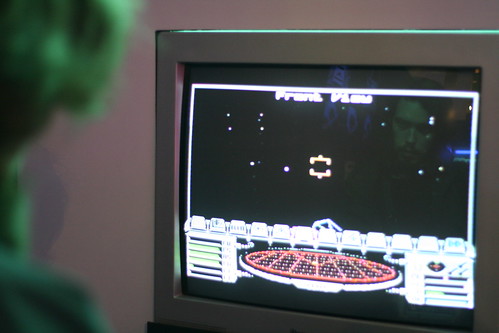
For the last couple weeks I have been concentrating on things related to my studies and on some events related to it. I posted pictures from these events on my Flickr photostream: a colleague from the institute finished his PhD and we had a goodbye dinner, my supervisor invited me to his son’s first birthday party. Also my friends Bunja and lastguru came to UK. With one I took photos of a night playground and squirrels and with other one some photos of the Eye and Babbage’s brain. However the main theme of this post is the Game On! exhibition in the London’s Science Museum. They have the best games playable there starting with the classic Pong, Lara Croft, Bomberman, Mortal Combat and up to Halo 2 on XBox 360. Even my non-gamer friend lastguru found a thing to drool upon - his childhood obsession: Elite. Elite! Update: Almost forgot to mention - the exhibition is great: it shows the evolution of gaming and allows to experience the most important games again and it also brings a huge amount of joy to anyone who has ever played these games before - the return to childhood is imminent. I never expected that something as simple as the original Pong can be so exciting in a good company. Very recommended!

1 November 2006

Ian Murdock

John Milan: “The days of purely desktop-based applications are clearly numbered, but so are the days of exclusively web-based apps. Both Microsoft and Google are racing toward a happy medium. However, they aren’t the only players in town, not by a long shot.”

30 October 2006

Axel Beckert: BarCamp Zurich -- Resume

The BarCamp Zurich 2006 is over. On the way there I thought about what I would do during time slots with no interesting talks. But when I tried to make up my personal schedule, I noticed that I rather would have the opposite problem: Too many interesting talks at the same time… Well, to many interesting talks at all, although I only went to tech talks and left out the biz talks. I first went to the Podcasting & Co. talk by Timo Hetzel, since I never heard or made a podcast, but was curious about podcasts in general. Besides statistics and rankings he spoke about where people listen to podcast (most listeners seem to do that during commuting), what people like in podcasts, why companies podcast, etc. And that a very big share of all podcast listeners use iTunes as podcast client and except juice (never heard of it before) all other podcast clients seem to be irrelevant. My conclusion: I haven’t missed anything not having listened to or made podcasts neither do I need to listen or make podcasts in the future. They’re irrelevant. To me. :-) Then I had to choose between the talks AJAX@localhost (PDF) by Harry Fuecks and Realtime Collaborative Text Editing and SubEthaEdit by the Coding Monkeys. I heard about realtime collaborative editing once know that it’s a challenging task for the developer. I also know what AJAX is (and that I would only use or recommend it for bells and whistles, but not for content in general), but “AJAX@localhost” sounded like writing normal applications using AJAX. It sounded interesting and evil at the same time. I had to go there! ;-) Others had similar expectations after reading the talk’s title, so I was quite surprised that it was about something completely different, namely about debugging AJAX on the localhost but under conditions usually only appearing if you’re running AJAX application not from localhost but from somewhere on the net: You may have different lags with every request, so some requests may reach the server before others, which may screw up the whole AJAX application, if the developers didn’t think about it and only tested it on localhost. (Hence the talk’s title…) My conlusion: I will use and recommend AJAX even more seldom, since there seem to be even more design misconceptions than I thought before. But I’ll once have a look at the Webtuesday meeting, he mentioned. For the third time-slot, I didn’t need long to decide where to go: I already knew a little bit about Microformats and I wanted to know more. Tag Trade also sounded interesting, but the second part of the talk’s title, Paid Learning sounded like business and so I had no scruples to cold-shoulder that talk. I probably didn’t learn anything really new in the microformats talk, but my knowledge about microformats is now more concrete, and after talking with Cédric Hüsler later during a break, I would even trust myself to start and define a new microformat. Then I went to the HG Caféteria together with Gürkan and two German guys. While waiting in the queue, we were talking about our jobs and our favourite Linux distributions. I got some rhubarb pie and a rum truffles, assuming that the Caféteria uses no alcohol in their products like all other SV restaurant I know. But this one seemed to have quite a lot of alcohol, since it felt like my breath was burning… Well, this resulted in my second SV feedback form submission… Next I went to Alex Schröder’s talk about multilingual websites, Oddmuse and the Emacs Wiki, although also the talk A-Life about simulating evolution sounded promising. Alex asked the listeners about their experiences with multilingual websites and showed what Oddmuse offers as partial solution to the general multilingualism problems. But regarding the comments from the auditorium, there probably won’t be a perfect solution until computers can translate perfectly… The next talk I visited was Gabor’s talk about his master thesis Organizing E-Mail which resulted in a soon to be released Mozilla Thunderbird extension called BuzzTrack. From the other concepts he showed, I found Microsoft’s SNARF (Social Network and Relationship Finder) and IBM’s Thread Arcs most interesting as well as the fact that there is no e-mail client seems to have a majority at all. Directly after Gabor I had my own talk about Understanding Shell Quoting, so I also couldn’t go to Adrian Heydecker’s talk about Learning with Hypertext and Search Engines. I had only about three and a half listeners of whom several to my surprise where here because they didn’t know what “shell quoting” is. I really didn’t expect that. But that seems to be one of the differences between a BarCamp and a Linux Conferences: People come here to see something new, something they haven’t heard about before. On Linux events most people come, because they already heard about some special topic and want to know more or learn something about it. On Linux event my shell talks usually were attracting many visitors while at a BarCamp, talks presenting an idea, a concept or a tool seem to much more interesting for the attendees. So for the next BarCamp I perhaps exhume my Website Meta Language talk which never seemed to hit the nerve of Linux event attendees, since it tried to “sell” a different concept of generating website than most were used to. At least one listener excepted the talk to be named “shell escaping”, but IMHO escaping is only one quoting technic and it’s not only used for quoting. But perhaps I should take the word “escaping” in the title though for the next time. Happily most of the listeners seem to have learned something new from the talk and Silvan Gebhardt was really happy about his new knowledge about ssh ~ escapes, although I mainly talked about how to quote them than how to use them. :-) During the last slot I visited the session about the upcoming BarCamp Alsace 2 and the yet to be planned BarCamp Rhine, a BarCamp to be held on a ship traveling from Basel in Switzerland down the Rhine, stopping in Strasbourg, Karlsruhe, Rhein-Main-Area and perhaps even Cologne and Amsterdam. Contrary to my initial thoughts, the day was over very fast and I had no single boring minute during the BarCamp. Wow! After we’ve been kicked out of the building by ETH janitors, we joined again at the Bar N-68. On the way there I met Urban M ller who attended BarCamp Zurich, too. We talked quite a lot and it was very interesting to see behind the scenes of e.g. map.search.ch. Later I joined the French speaking table, talking with Gregoire Japiot from WineCamp France and Alex Schröder. Around 9pm I left the N-68 as one of the last BarCampers, tired but with new knowledge, new ideas, new acquaintances and a new hobby: BarCamping. What a luck that BarCamps aren’t that often, otherwise I couldn’t afford this new hobby. ;-) As a relaxing end I met with Alex Schröder and Christophe Ducamp on Sunday morning for brunch in the restaurant Gloria in the Industriequartier. When we were leaving the Gloria I noticed their book board with a lots of BookCrossing books and I took “The Da Vinci Code” with me, since I saw the movie and people were telling me that the book is much better. I’ll see…

29 October 2006

Stefano Zacchiroli: dear old mutt

Dear old Mutt, ... My MUA of choice is Mutt. I've been using it for something like 8 years now and I like it: it's quick, powerful and well integrated with the Unix way of handling mail (e.g. procmail). But we all know that. My feeling today is that sooner or later I will be forced to abandon it. The main reason is that it seems to be a dead product, upstream development is not dead but I fail to see an overall plan for my beloved MUA. Other text based application have understood that they should be integrated in some way with the desktop and/or windowing environment in which they are run: Vim for example is able to deal with the mouse wheel event when run in an xterm or even has developed a GUI which is well integrated with the Gnome session mechanism. Why Mutt is not? Such feelings of today has been originated by Tomboy, a wonderful note taking tool with Wiki-like capabilities, integrated with Gnome. It has a plugin for drag and dropping Evolution mails on notes automatically providing links from the notes to your mailbox: that's ... wow, great! I'm already using Evolution as my organizer and I already have Gaim integrated with it for contacts. I fear the moment I will try it for mails because I'm pretty sure it also has an UI which can be easily used with keyboard without the need of the mouse. Since I'm using all this on my laptop which is always with me (and this means that the argument "Mutt can be used remotely using a 9600 GSM connection" is bogus), it seems I'm running out of arguments for sticking to Mutt. Oh, right, there is the procmail stuff, my last feeble chance of keep on using Mutt ...

24 October 2006

Ben Armstrong: Apt verb

In the English language, it is so trivial to create new words. In no domain is this quite so evident as the world of computers. Thus, informally amongst Debian users, you’ll often hear “apt-get it” or simply “apt it” which has the virtue of being equally apt a term for using aptitude. Now, I have no problem with people using these verbs. They’re precise, if a bit geeky. But really, shouldn’t there be a more general verb to cover this activity? Back when apt was new, and nobody else was installing packages this way, the lack of a general term made sense. But these days, in certain user communities, you might hear “yum it” instead. How many variants does the English language need? One per apt-like installer? Compare this with the evolution of instant messaging. Back when ICQ dominated the field, “ICQ” was synonymous with instant messaging. These days, although you might occasionally still hear people say “ICQ me” or “Jabber me” (where the protocol is important, because both participants must have access to that specific service) we can more generally say “message me,” encompassing in one fell swoop all possible protocols. Or if you prefer, the awkwardly geeky but more precise term, “IM me” (though arguably slightly less useful than “message me” because it seems to exclude irc, the king of all chat systems). So, what’s the equivalent verb that means “conveniently installing software from one or more software repositories by merely asking for the package by name”? My mind draws a blank.

18 October 2006

Steve McIntyre: LiMux - bringing Debian to Munich's local government

As promised yesterday in my report about the Munich BSP, I'd like to talk some more about LiMux, the project being run within the City of Munich to replace all of their desktop Windows systems with Linux. The team kindly offered us the use of their offices in central Munich as a base for the BSP last weekend, and on Sunday afternoon they gave us a demonstration and answered lots of our questions. The following is from my (known-faulty) memory...

Jan-Marek, LiMux and Florian Jan-Marek and Florian talked us through their setup. They're using FAI to automate installation of systems, along with LDAP to store lots of configuration information and GOsa as a user-friendly front-end to that configuration. They've integrated these to enable some very clever management features so that all aspects of the city-wide system can be maintained from one central point. As new machines are introduced onto the network, they can be configured into one class or another: simple desktop clients up to so-called "depot" servers, used as seeds for further clients. Individual user profiles can be tweaked, giving users access to new applications as they are needed. Shared resources like network storage and printers are set up automatically from the LDAP database. Access to USB storage devices can be controlled on a per-device, per-user basis for security. That's quite an impressive feature list. Most of the work has been in configuration and systems work rather than custom packages on the clients themselves - the vast majority of the packages installed come straight from the standard Debian archive, with some backports (like a newer version of KDE). Building on top of standard packages means that they have access to a huge amount of Free Software without having to do all of the work themselves. A small team (10-ish at the moment, growing to 100 or so in the future) can effectively deploy and manage desktops and associated servers for a huge number of users - they're expecting to be supporting on the order of 30,000 systems 2 years from now. The team have just recently made their first stable release and are starting to roll it out across the city, one department at a time. There are the familiar issues involved in the deployment, of course. For example, users don't want to help test pre-release versions to help nail bugs, but then complain loudly when they find bugs in the first release. And in such a large project to migrate from predominantly Windows (NT4!) desktops to KDE on Linux, a major part of the effort needed is in user training. There is quite a bit of support and custom work needed to convert people's MS Office macros over to working on top of OpenOffice. And there are still quite a number of users who will remain using Windows for specific applications that still don't have Linux equivalents yet. Apparently the "Wine Cellar" group will help on that front. *grin* In terms of collaborating with Debian, the LiMux team are expecting to help in a few ways. As bug reports are filed against their applications (apparently very few so far), they'll be pushed upstream along with (hopefully) fixes for them. They will also be devoting some full-time developer effort to security work; it would be good for both sides if this effort can be shared.

Tux in
the office! It was quite striking to see Tux, the Linux penguin, as a visible logo in local government offices! The team have clearly made some excellent progress on this exciting project, and I'm sure that I can speak for all of Debian in wishing them the best of luck in the future. I'll be watching with interest...

17 October 2006

Russell Coker: clean energy

There are many people claiming that nuclear power will solve all the ills of the world. However this does not seem to be possible. Firstly you have to consider the hidden costs of nuclear power such as deaths from the mining industry (ingesting uranium ore is a really bad thing) and the difficulty in disposing of radioactive waste. But rather than concentrating on the bad aspects of nuclear power (which are well documented) I will concentrate on some of the viable alternatives.

Wind power is a really good option, particularly for countries such as Australia that have a low population density and a large land area. The Chinese government is investing heavily in wind power, I think it's safe to assume that it's not because they are great environmentalists but because they simply need more energy than they can get from other sources and that they have strategic reasons for not wanting to rely on Australian coal and uranium or Arabian oil. Most energy sources have some drawbacks, but wind power has no side effects and isn't going to kill birds either (birds have evolved the ability to detect and avoid predatory birds, they can easily avoid large fixed objects such as fans from wind farms).

Two other good options are wave and tidal power. These are better than river based hydro-electricity because there is no need to create dams that remove forests. Wave and tidal power are both very predictable which is an advantage when compared to wind power which is less predictable. One solution to the unpredictability of wind power is to couple it with a river based hydro-electric system which can provide electricity when there is less wind. A hydro-electric system to compensate for days that are less windy would need a much smaller dam than one that is designed to provide the main power source.

The next issue is how to power vehicles (on air, land, and sea). Advocates of nuclear power often talk about hydrogen powered cars. However while hydrogen has a good ratio of energy to weight it is not very dense, so the energy density for volume is much less than petrol. Combining Prius technology with
hydrogen in an internal combustion engine still won't give the distance per tank of fuel as petrol does. Hydrogen with fuel cells in an all electric vehicle might allow you to drive the same distance as a non-hybrid car on petrol, but probably won't compare to the range of a hybrid Diesel vehicle.

Bio-Diesel is a good option for fuelling cars. Diesel engines give greater efficiency than Otto cycle (the most common car engine) or Atkinson cycle (as used in the Prius) engines. Not only is bio-Diesel renewable but it also produces exhaust that is less toxic than that which is produced from fossil fuels. See the VeggieVan site for more details on bio-Diesel. The toxic fossil fuels are linked to health problems in airline hostesses, AFAIK there has been no research on the impact of car exhaust on pedestrians.

One thing to note about bie-Diesel is that you can do it right now. According to a British TV documentary all you have to do is filter oil that was used for frying food (they used oil from a Mexican restaurant) and mix it with a small amount of ethanol and it's ready to use in your car. As restaurants currently have to pay to dispose of old frying oil this should be good for everyone!

Bio-Diesel could work for powering planes, there is already research in progress on this issue, but there are problems related to the viscosity of bio-Diesel at low temperatures. Maybe a blend of bio-Diesel and bio-Ethanol would work. Ethanol freezes at -114.3C and should lower the freeze temperature of bio-Diesel.

Bio-Diesel would of course work really well for ships. Supplying the amount of fuel that current ships need would be difficult. Some analysis shows that the deck area of a ship can collect enough sunlight to supply ~10% of the power needs of the ship. The Orcelle is a design for a totally clean ship that runs on solar, wind, and wave power. However with the proposed design the solar panels will not be angled effectively for collecting sunlight as they will be on sails. I think that there is a lot of potential in having a design based around sails, wave and solar power for generating electricity, and also a Diesel engine running on bio-Diesel fuel for supplying extra power when required (EG when sailing at night in calm weather). Building a ship that uses only wind, solar, and wave power would probably be significantly more expensive than the current Diesel design. Building a ship that uses 10% Diesel and 90% wind, solar, and wave power might be a lot cheaper.

There are lots of ways of producing the energy we need to maintain our current standard of living. If our government was to spend as much money researching them as it does protecting petroleum reserves then the problem would be solved.

Next.

Previous.