Search Results: "eric"

19 January 2009

Gunnar Wolf: About the recent events and possible outcomes in Israel and Palestine

Several friends, from different groups and backgrounds and with different points of view regarding the current war in Israel (and regarding the Arab-Israeli conflict in general) have asked me for an explanation on what is happening there, what is (my view of) the real conflict, its causes... and any possible answers. And yet I am quite far from being an authority, I do want to write something about it. Be prepared, as this post is quite long.
And yet, after writing frankly a lot more than what I expected... It is by far not enough. I have still much more to add, but I have to say "stop" at some point. So, here you have it: My points of view, as well as some explanation on why are we standing where we currently are.
I am writing this based just on my personal experiencie and, of course, my personal point of view. Furthermore, I wrote a good part of this text while riding a bus, with no network access, so I am offering very few references - In any case, it will allow me to make much more progress. References always take as much time as the text itself! About me Why am I writing this? Why do people ask for my opinion? I must start by explaining who I am, so the rest of this makes sense. I am a Mexican Jew. That means, I was born in a Jewish (albeit secular) family, and grew up in an environment with general Jewish culture. My direct family (say, my parents and brother, and to a lesser degree my closest cousins) are not at all religious, I'd even venture to say most of us are complete atheists. Yet, besides the cultural belonging (which is a mixture of a Eastern European culture with lots of Idish words and dishes and general humor), my family has a strong national identification - In other words, I grew up in a fully Zionist environment, which traces back to Poland.
My grandmother was member of Hashomer Hatzair in Poland, since the early years of its existence, late 1910s and early 1920s. What is it? To make it short, a Zionist Socialist, Kibbutzian youth movement. It has many similarities (and somewhat stems indirectly from) the Scouts many of you will be familiar with, but -obviously- has a way lengthier agenda. And, yes, nowadays I feel it is somewhat out of reach with the current state of the world - It was founded in 1913, and only slightly adjusted its principles since then.
I will talk more about Hashomer later on.
My grandmother arrived in the late 1920s to Mexico, for familiar and economic reasons, but still dreamt about living in Israel for a long time. As they grew up, first my uncle joined Hashomer in Mexico in the late 1940s, when it still pursued a very much Soviet-style ideals for Israel (one of the core points that changed during the 1950s); both my father and my mother joined in the late 1950s (in fact, that's where they met). My cousins and myself were very active in the 1980s and 1990s.
The Iszaevich family has something very unusual, I'd say, engraved in our genes. We live very deeply our ideologies. That's the only explanation I can find to the way we all have led our lives. I won't go into the other family members' details, but just into mine: I was fully convinced of all we taught to our younger members and what we discussed among ourselves. I am among the very few people who really learnt Hebrew at my school, and that was only because I really cared - I know some people that just after 12 years of pseudo-learning could maybe utter a few phrases.
After finishing high school I went with my Hashomer group, together with people my age from other similar-minded Mexican Zionist youth groups, to live and learn for a year in Israel, on what is usually known as shnat hajshar - A year to get ready. To get ready to what? But of course, to come and give back go the younger groups of the movement, and finally go back to Israel and settle there definitively. I came back to Mexico, and after one year I did the only thing that was logical: I became an Israeli and went to live to a kibutz - Zikim, a beautiful place just between Ashkelon and Gaza, very near the sea shore. It was a beautiful period in my life, and I really enjoyed it - But it didn't last for very long - I quickly grew to hate the Israeli society at large. A society full of rage, of hatred. Not just between Arabs and Israelis, as many would think from the outside, but between religious and seculars. And between immigrants and locals. And between leftists and rightists (in several dimensions, as it is one of the countries where you can most easily be a economic leftist while being a political rightist - a complex society it is). A society full of disrespect and intolerance. A very hypocritical society. And one of the things that most shocked me: I wanted to live in a society of proud of its existence, that's what I had learnt Israel was - But Israelis aspire and dream of being anything else (and mostly US-Americans) in a way that made me sick, more than anything I had previously seen in Mexico.
I loved the life at the Kibutz, and I loved being an agricultor, doing hard work every day and literally getting the fruit of it. However, I cannot live isolated to a 300-people universe - At least once a week you have to go to the city if you don't want to become insane. And I could not stand the sick Israeli society.
Anyway, to make things short: After six months as an Israeli, I came back to Mexico. I went through a long period of finding myself, as I could not uphold anymore my Hashomer ideology (if I am not going to live by it, how can I continue teaching it?). Many people do anyway, but for the first months, where my Hashomer work was basically all of my life, I felt really uncomfortable. So, in short, I severed all of my relations to the Jewish community, and even denied for a long time my Jewishness until I found a (I think) better balance.
Today I am at peace. But anyway, I wanted to talk about myself in the critical period that marked me in this regard: The 1990s. Enough, lets get down to business. Zionism 1870-1920 Many people argue that the Jews invaded the Palestinians homeland - And yes, nowadays I cannot counter this. But we cannot judge what happened then based on what we see now.
Modern Zionism started around the 1870s. The Jewish history is full of pogroms and persecution, in different countries all over Europe - And a group of young people decided the only solution was to build a place to call their own. And yes, this was full of idealism and in no small part the foolishness of youth. For several centuries and up to 1920, all of current Middle East were provinces of the Ottoman Empire. Before Zionism began, the population of today-Israel was very sparse, not more than 400,000 people - up to 5% of them Jewish, around 10% Christian Arabs, and the remainder, Muslim Arabs. Of course, the low population was mostly because the country was mostly hostile - A desert in the South, mostly swamps in the North, and some minor towns mostly in the hills. It was a mostly forgotten province, away from the central Turkish rule, and there had been no frictions with the local population. It was a nice place to go, thinking -again- as a fool youngster, or as an idealist. They said, lets take a folk without a land to a land without a folk.
The number of accomplishing Zionists (this is, people who actually went to Israel instead of just talking about doing so) was not high during the first decades. But towards the 1890s, it gained critical mass. The political Zionist movement was born, with Theodor Herzl as a leader, and they started pushing -politically- for different governments to concede a territory to Jews. They went to the Turks, and didn't really get much echo. Went to other colonial powers of the time, and got unfeasible promises with no real backing (i.e. Birobidjan in Eastern Russia, Uganda in Africa)... And, as it happens in strongly ideologized movements, the movement started splitting into different groups with slightly different positions.
And no, I am not talking about the People Front for the Liberation of Judea and the People Judean Liberation Front, but I very well could. Sometimes the differences are as ridiculous as that. But hey, I take that most of my readers are acquinted with the Free Software issues, right? Think BSD vs. GPL vs. OpenSource. To give a broad idea - Only in Mexico City, with a very small Jewish community (~30,000 people), in the mid-1990s we had over 10 such movements, with 50-150 youngsters attending each. And even though some were local, and even though some very important ideologies are not represented in this country, they are all different enough to exist as separate entities. British Mandate The Ottoman empire was divided after the first World War. Its possesions in Europe became independent states, while in Asia (and Africa, if you take the semi-independent Egypt and part of Sudan into account) they were taken over as colonies or protectorates by France and the UK - Evidently, attempting to secure a long-term dominion over the area. In some aspects, they failed. In some aspects, they were (and still are) tremendously successful. The division of people by setting arbitrary boundaries has led to countries sustainable only by force and a harsh rule (such as Iraq, Lebanon and Syria), or doomed to poverty (and thus submission) due to lack of natural resources (as Jordan). Focusing on Israel/Palestine, the UK entered the area by making mutually incompatible promises to arabs and Jews - i.e. the Hussein-McMahon letters and the Balfour declaration, both ambiguous enough to lead to... Well, today. The UK rule was disastrous to the region, both in giving (and taking away) power from all sorts of puppet regimes, and swiftly going away as soon as things started looking too complicated. Yes, typical colonialism.
So, while up to the 1920s there was no real animosity between Arabs and Jews (as i.e. the Faisal-Weizmann agreement shows), during the next decades the seeds of hatred started growing, from both sides.
Many people still quote the 1947 partition plan as the direct antecedent towards Israel's real existence - That was not the first partition plan that existed. Ten years earlier, the Peel commision suggested a similar partition involving forceful population transfer. And many people see the separation of Transjordan (now Jordan) from Palestine in 1922 as a first partition. It is understandable that both partition plans (much more the 1947 than the 1937 one) were accepted by Zionists: Going from having nothing to having something (and against all odds in the environment they lived) is acceptable.
From the Zionist side, two main groups rejected the partitions: The right-wing and religious groups, insisting that the whole of the Mandate should become Israel, and the left-wing groups, which advocated for a single, bi-national state, with equal rights for all of its population. Go over and read this last link, as it was quite interesting (to me at least) to see how this solution has kept existing and regarded by (relatively) many people, and has many interesting links. 1948 onwards: Where did the refugees come from? The November 1947 partition didn't exactly translate to a planned, smooth Israeli independence - It led to six months of revolts (basically, a civil war). By mid May, the UK government and troops abandoned the territory, and one day later, Israel declared its independence. And, of course, all neighbouring countries (and Iraq) sent their troops to invade Israel. The war lasted for over six months (cease-fire was signed in January 1949). There was an intense Arab campaign indicating the armies would enter Israel and devastate it, leaving no stone in place, indicating Arab population to temporarily leave the Jewish-destined areas. The war, they said, would not take more than a couple of months, and they would be able to go back home.
Only that... When the war ended, the results were far from what the Arab governments expected. Not only Israel continued to exist, but it conquered important territories.
Of course, the Israelis were not innocent from said exodus: During the 1947-1948 civil war, and the independence war, some of the existing so-called self-defense forces (some of them were really defensive, while some were quite aggressive, even terrorist) attacked Arab villages in strategic or predominantly Jewish areas to prompt them to leave - yes, what we today call ethnic cleansing.
I had (in my head) the number of 650,000 Arabs (from a total of slightly over a million) fleeing to neighbouring countries. Wikipedia states that it is somewhere between 367,000 and 950,000. A similar number of Jews were expelled from Arab countries, many of which arrived to settle at Israel (and many others went elsewhere - For instance, a good part of the Mexican Jewish community is from Syrian origins - Many of them fleed in those years). Israel didn't accept back the (relatively few) Arabs that requested to resettle, as they were seen as hostile population - but neither did the countries that "temporarily" accepted the Palestinians accepted them as citizens. The Palestinian refugee camps today, mainly in in Lebanon, Syria, and the occupied territories held by Israel have terrible living conditions, and its population -despite living there for over 60 years- have no civil rights at all. Note that I'm omitting Jordan here, although it has several camps as well, as their situation is way better.
The Arab population that didn't leave did receive full Israeli citizenship. No, their living standards are not up to level with the average Israeli. The country and the society do have a sensible degree of racism and segregation. But the situation is nowhere as terrible as it is in the camps.
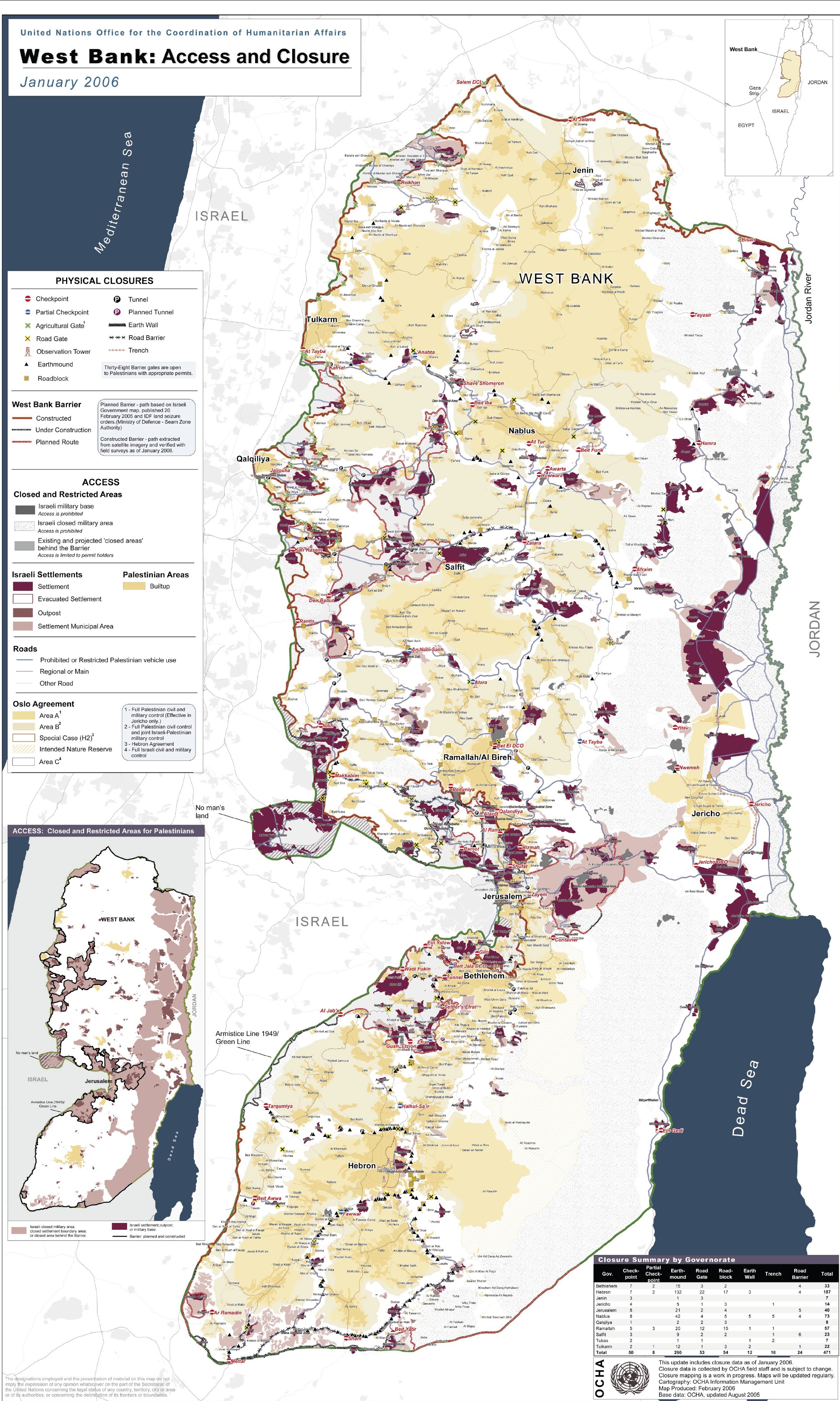
The areas which were originally to become Palestinian and were not conquered by Israel -this is, current-day West Bank and Gaza- bacame respectively Jordan and Egyptian territory. While Jordan did fully extend its soverignty covering the West Bank, Egypt didn't - Gaza is, since 1949, occupied military territory. Gaza, among the most densely populated areas in the world, has had their inhabitants under military rule ever since. When Israel returned the Sinai after signing the peace treaty with President Sadat, Egypt didn't accept Gaza back - And that's where today's greatest problem is born.
Now, Israel conquered those territories in 1967, along with the very sparsely populated Sinai and Golan. For the first ten years, the territories were basically only administered (yes, under a military rule). In 1977, with the first right-wing Israeli government, an extensive settlement policy began (and led partly to today's seemingly unsolvable situation). In 1980-1982, Israel withdrew from the Sinai. In 1981, Israel claimed full soverignty over the whole of Jerusalem and the Golan. In 1993, the "Oslo Agreement" was signed between Israel and the PLO, and it seemed we were heading towards a bright future. I lived in Israel between 1994 and 1996 - Yes, the most hope-filled period in the country's life.
Since 1996, I have tried to keep up to date with the country's evolution. All in all, even if I won't live there again, it is a country I learnt to love, a society I have long studied (even if in the end I did include many references, I wrote most of this text just off the top of my head, with the data I remember - so it might have several big errata). And yes, I keep the political stand I had 12 years ago: The only solution is to dialogue, to treat the current enemies -and not only their governments- with respect, recognizing their dignity and right to life, to self-determination. Only then we will change the status quo. How not to fight hatred Since 1993, the dream of peaceful coexistence seems to have faded. What we saw during the past three weeks, along to what we saw in Lebanon in 2006, is plainly a gross mistake if the goal is to achieve good, lasting peace.
Try to imagine how could life in Gaza be, even in the total absence of Israeli attacks. Just to set some numbers first: The Gaza strip hosts almost 1.5 million people on 360 km . When I lived in Israel, I was constantly surprised at how small a country it is - Israel tops at 550Km North to South, 150Km east to West (it is amazing, almost wherever you stand, except in the middle of the Negev, you can see the country's borders. Yes, I recognize as the border the so-called Green Line); over half of the territory is a desert, and it hosts seven million inhabitants. And it is hard to imagine how that country can be economically viable.
I do not find it feasible to imagine Gaza and the West Bank integrating a single country, and not only because they are separated by ~40Km, but because they are so sociologically different. People in the West Bank, yes, live opressed under military rule and subject to a much more constant, more visible apartheid-like state (as the territory is truly sprinkled with Jewish outposts which many Israelis refuse to recognize as their own, but still, which have incredibly higher living standards). The best land has been taken away from them, yes, but they have some space between cities to have some farming, to communicate, to... Breathe. Besides, West Bank inhabitants -even those in refugee camps- have much better living standards than anybody in Gaza. It is still an overpopulated area, but not nearly as much as Gaza.
Gazan population have been driven towards extremism. And yes, there was a civil war between Palestinian factions, as the world views between both populations are completely different - However hostile a Jenin inhabitant can be towards Israel, he does not lead the life -if it can so be called- you see at Khan Yunis.
But back to Gaza... What Israel is doing (and not only during this military operation terror campaign is wrong, from any rational point of view. Israel wants Hamas to become weaker? Then don't drive the population into supporting them!
Palestinians started giving over 50% of their support to Fatah (ex-PLO), and under 20% to Hamas. That was less than 15 years ago. However, Fatah has shown to be corrupt and inefficient at building infrastructure and improving life conditions, ineffective at negotiating a permanent agreement which secures dignity and sustainability to their people. Hamas stands as a religious, righteous organization. There are no serious corruption charges against any Hamas leaders. Hamas is clearly still at war - They didn't subscribe any peace agreement so far, and their stated #1 goal is to build a Muslim State in the whole of Israel. And the Hamas movement -like Hizbollah in Lebanon- has built quite a bit of infrastructure in the areas they control - Mainly housing. Yes, housing where they mix their own offices, many will accuse, getting human shields for free. But still, they are benefactors to a dehumanized, pauperized population.
I find it obvious that, if living conditions were at a basic level in the region, support of Hamas would decrease. Even more, of course, if they improved due to Israeli support. Israel controls this territory, so it is responsible for the well-being of its population, like it or not. And Gaza is simply too small and low on resources to survive by itself.
I was a bit surprised to find mention -although very brief- of a three state solution - And yes, this is close to what I would expect as a viable outcome. It is clear that Israel will not ever grant full citizenship to the Palestinians, as they would -euphemistically speaking- challenge the Jewish character of the State. Dropping the euphemism, Israel relies on apartheid in order not to become an Arab majority country. I might have some numbers wrong, but AFAIK, there are ~7 million Israelis, 20% of which are Arab citizens (which means, 1.4 million Arabs and probably 5 million Jews, with many other minor denominations for the difference), and ~4 million Palestinians live in the territories. Today, the country is already predominantly Arab, or at least is close to being so. So, Israel should permanently, formally disengage from all of the occupied territories. And in order to ensure violence stops, start a comprehensive, unconditional, long-term aid program. Start with giving them autonomy to regain their sea, as the Gaza port has long been closed. Allow the airport to operate again. Instead of bombing tunnels in the Egypt-Gaza borders, allow Gaza to trade with Egypt - Perhaps even to integrate territorialy, if the conditions are met. Treat their people with respect, and help them ease the terrible situation they have lived for so many decades - and then, undoubtely, terror will stop.
The West Bank? Possibly it could become a Palestinian state by itself. Possibly, it could integrate back to Jordan. That would be up to Jordans and Palestinians to decide. Of course, Jordan has already a large segment of its population defining itself as Palestinians, which counts both for and against. So, I won't venture into this supposition.
But anyway - Back to what prompted me to write this text -yes, a very or maybe even too long text - I hope somebody even takes the time to read it!- is to explain what is my point of view on the current situation, and why.
Today, a cease-fire was announced, after 23 days of murder and destruction. I sadly do not hold very high hopes for it to be lasting, much the less to be enough, to lead to what they call a de-escalation of the conflict. The most I can currently do is to voice my opinion, and hope that mine is just one more voice pointing to a sane solution, to a permanent, dignifying way out, for all people involved. Every people has the right for survival and for safety. We cannot deny this to any others. And certainly, we cannot expect anybody not to fight for their right to live.

Erich Schubert: U3 hackware

The U3 software that everybody so loathes is somewhat hacker technology. It's not entirely unlike the Sony rootkit, except it (as far as I know) by default doesn't install persistently.Fortunately, it doesn't work on Linux.What U3 essentially does is the following: It probably is just a matter of time until the first viruses find out how to install themselves onto the U3 partition and get auto-run whenever you plug in such a stick.So if you plan to buy a USB pen drive, make sure it doesn't bear the U3 logo. If you end up with such a hack-drive, grab the Uninstall application from U3, which unfortunately is Windows and Mac only. If anyone found a way to erase the U3 partition on Linux, please share. A low-level format on the usb-storage device is not sufficient.

16 January 2009

Petr Rockai: darcs 2.2.0

I am happy to announce general availability of darcs 2.2.0. Getting the release For this release, we have decided to provide two flavours, depending on the build system used:
  1. The source tarball, http://www.darcs.net/darcs-2.2.0.tar.gz, which can be built using the traditional autoconf-based system. This is the fully supported version. After downloading and unpacking, you can issue:
    $ ./configure
    $ make
    
    and possibly
    # make install
    
    More detailed instructions inside the tarball (file README). Please note that we had at least one report of build failure, with quickcheck-related message. The currently best workaround, if this happens to you, is to use the cabal version of the package instead, see below.
  2. Cabalised source. You can either download a tarball from http://hackage.haskell.org/packages/archive/darcs/2.2.0/darcs-2.2.0.tar.gz and build manually (see the build instructions in README inside the tarball), or, alternatively, you can use cabal-install to obtain a copy:
    $ cabal update
    $ cabal install darcs
    
    This will give you a darcs binary in ~/.cabal/bin you should probably add that to your PATH.
In addition to source tarballs, we expect binary packages for various UNIX platforms will be available in due time. For Windows users, Salvatore Insalaco has prepared a binary build, available from http://homepage.mac.com/kirby81_it/darcs/darcs-2.2.0-win1.zip. You just need to unpack the directory somewhere and add it to your path (if you like). Moreover, an experimental TortoiseDarcs release for darcs 2 has been made available by Kari Hoijarvi and is looking for home. It can be found at http://datafed.net/darcs (unfortunately, at the time of this writing, the site seemed unreachable If you can help with hosting, please mail Kari.) What s New The summary of changes since version 2.1.2 (released last November) follows: And a summary of issues that have been fixed in darcs since version 2.1.2 (compiled by Thorkil Naur): 525 amend-record => darcs patches show duplicate additions
971 darcs check fails (case sensitivity on filenames)
1006 darcs check and repair do not look for adds
1043 pull => mergeAfterConflicting failed in geteff (2.0.2+)
1101 darcs send cc recipient not included in success message
1117 Whatsnew should warn on non-recorded files
1144 Add darcs send in-reply-to or header In-Reply-To: x@y.z
1165 get should print last gotten tag
1196 Asking for changes in /. of directory that doesn t exist gives changes in entire repo
1198 Reproducible mergeConflictingNons failed in geteff with ix
1199 Backup files darcs added after external merge
1223 sporadic init.sh test failure (2.1.1rc2+472)
1238 wish: darcs help setpref should list all prefs
1247 make TAGS is broken
1249 2.1.2 (+ 342 patches) local drive detection on Windows error
1272 amend-record not the same as unrecord + record
1273 renameFile: does not exist (No such file or directory)
1223 sporadic init.sh test failure (2.1.1rc2+472) I would like to thank all contributors for making this release possible. Future The next release will be 2.2.1, fixing low-risk issues found in 2.2.0, or those that have been excluded for 2.2.0 due to freeze. This release will appear in two or three weeks time, depending on circumstances. The next major release will be 2.3, due in June or July this year. The focus of this release will be new features and further work on performance. Moreover, we expect that it will use Cabal as its default build system and will make first steps towards sustainable libdarcs API.

15 January 2009

Julien Blache: Antec PSU suck

How not to start your day, from the all-hardware-sucks department. For years, I ve been struggling to keep my machines quiet. I ve miserably failed for years, and pretty much gave up once I realised that the quiet parts I was looking for just did not exist. Last year, I finally found what I was looking for: I ve been very happy with this hardware for both my workstation and my filer. Well, until today. No need to mention that this hardware is not exactly cheap, but the price is right for the quality. So, wake up today, do random things, grab my TomTom, unplug it from the workstation it s sucking its power from, do things, plug it back in the USB port so it won t draw its battery. This is how it went: Check machine temp, PSU temp, attempt to restart PSU, check UPS, check cables, replace power cable and bypass UPS. Admit defeat for this round and accept the PSU as dead. Pull out the machine, rip out the fscking damn PSU. Grab the tools, crack the PSU open. Notice bulging and leaking capacitors. Yes, this PSU is anything but cheap, yet it uses el-cheapo chinese capacitors. Antec, you suck, big time. For the past decade everybody in the industry has known that el-cheapo chinese capacitors manufactured after 1999 are total crap, using an electrolyte that isn t actually one because its formula was stolen by industrial spies who got totally PWNED and ended up stealing a bad formula. (If you need a reference, google for singing capacitors . Note that singing capacitors can also happen with good parts used in a crappy electronic design. Like that 100 Mbps D-Link switch over there, or that Sony-Ericsson mobile phone charger. Hmm. Not everybody can hear it, I do.) A healthy, young capacitor should not bulge nor leak. A capacitor that leaks, bulges or sings is a crappy capacitor and needs to be replaced with a quality part ASAP. I ve been routinely replacing such capacitors on my older motherboards (manufactured between 1999 and 2001) in the past years. I ve not had the problem in ANY of my el-cheapo PSU, and did not replace any capacitor in any of them to date. Fortunately, the machine did not suffer any further damage, nor did the TomTom. Everything is up and running again with a spare PSU. I m now going to replace the fscking capacitors on this PSU, replace the fuse, probably R&R a couple of high-voltage transistors too (they have a tendency to fry before the fuse blows out) and get it back up and running. Then I ll do the same with the other PSU in the filer, because that machine has 8 disks attached, so draws more power and hence is much more vulnerable. Fuck you Antec.

13 January 2009

Christoph Haas: NFS: sec=sys or ruin your day

And once again I was bitten by problems on my Debian laptop mounting directories from the file server via NFS. After a Debian dist-upgrade I couldn t login to KDE any more. Shell login worked somehow but I quickly found out I could neither read nor write any files there. Apparently an ls -al showed me the right permissions (not just unmappable numeric UIDs or something of that kind) and an id -a confirmed that my LDAP PAM configuration still worked. But reading or writing any file just lead to Permission denied . I m not sure if it was an update in the nfs-common package in Sid. But I had the same problem before and it took me hours until I finally figured out that Debian s NFS seems to use non-standard defaults. Namely the sec parameter when mounting the NFS share. According to the Solaris documentation the default is sec=sys which means that NFS uses the locally acquired UIDs and GIDs. Like /etc/passwd, NIS or LDAP/PAM. But on Debian it seems to default to sec=krb5 or something. As I have close to no idea how to set up Kerberos and don t want to (and talking to other people hardly anyone has used Kerberos either) I figured that it s not really a sane default. I didn t even ask for NFSv4 - just NFSv3. Perhaps I undeliberately set some /etc/default/nfs-common configuration setting wrong or whatever. It was just strange. So I set sec=sys in the options of the NFS share of my /etc/fstab and the problem was fixed. Actually I wonder what network file systems other people use in a Debian environment. NFS somehow feels antiquated to me anyway.

Petr Rockai: darcs 2.2.0rc1

(This post is somewhat late, the final release is in two days. However, we still need testing and reports of possible issues.) I am pleased to announce that darcs 2.2 is coming along nicely. I would like to ask everyone to give a ride to darcs 2.2, release candidate 1. This release again comes in two flavours:
  1. The source tarball, http://repos.mornfall.net/darcs/darcs-2.2.0rc1.tar.gz, which can be built using the traditional autoconf-based buildsystem. This is the fully supported version. After downloading and unpacking, you can issue:
    $ ./configure
    $ make
    $ ./darcs --version
    
    or
    # make install
    
    More detailed instructions inside the tarball (file README).
  2. Cabalised source. You can either download a tarball from http://repos.mornfall.net/darcs/darcs-2.1.99.0.tar.gz and build manually (see the build instructions in README inside the tarball), or, alternatively, you can use cabal-install to obtain a copy (the release candidate is now available on hackage):
    $ cabal update  
    $ cabal install darcs
    
    This should give you a darcs binary in ~/.cabal/bin you should probably add that to your PATH.
This is a preliminary changelog since version 2.1.2 (released last November): Preliminary list of issues that have been fixed in darcs since version 2.1.2: 1223 sporadic init.sh test failure (2.1.1rc2+472)
525 amend-record => darcs patches show duplicate additions
1247 make TAGS is broken
1273 renameFile: does not exist (No such file or directory)
1165 get should print last gotten tag
1249 2.1.2 (+ 342 patches) local drive detection on Windows error
1238 wish: darcs help setpref should list all prefs
1199 Backup files darcs added after external merge
1043 pull => mergeAfterConflicting failed in geteff (2.0.2+)
1117 Whatsnew should warn on non-recorded files
1101 darcs send cc recipient not included in success message Thanks to Thorkil Naur for compiling this list. I would like to thank all contributors developers, testers, bystanders for helping darcs get along further. It s been hard times recently for darcs, as many of you probably know. Nevertheless, we are regaining confidence in future darcs development. No way are we going to leave darcs fall by the road. I am sure that this one time, I speak for everyone in our developer and user community.

10 January 2009

Andrew Pollock: [life/americania] The Story of Stuff

Sarah brought The Story of Stuff to my attention today. It's well worth 20 minutes of your time, irrespective of where you live.

9 January 2009

Axel Beckert: Draw a Bunny

I got tagged. By splitbrain. With a really silly but funny meme. The basic rule is: Draw a bunny. So here s my bunny:
             /\ /\
             ,. ,. 
             
             \' /
            / . .\
           (   Y  )
          __\  v'/
       _-^      \
     ,'  _        
    /      \    /
 _ ;          , \\
/        __;__\ \\
\_,\___________;\_;;
Nobody said, ASCII art is not allowed and I drew it myself with aewan (Ascii art Editor Without A Name) in an xterm. But aewan was not really a help here, Emacs would have done the same job. In fact I had to fix some non-ascii characters later by using Emacs anyway. Ok, and since this are the rules:
  1. Draw a Bunny (or more)
  2. Post it to your blog with the rules
  3. Name three other bloggers that should draw a bunny
You can draw your bunny however you like. Use pencil and paper, a drawing tablet or just your mouse. It doesn t matter. It also doesn t matter if it looks crappy or not. The important thing is the bunny!
here are the three blogger I m tagging. Ehm, that s harder than the bunny. Hmmm. I think, I ll stay with the DokuWiki on identi.ca crowd for tagging. So I herewith tag:
  1. foosel,
  2. chimeric, and
  3. jaypikay
Hope, they don t mind and join the fun. ;-)

7 January 2009

Felipe Augusto van de Wiel: 8 Jan 2009

Debian

Re: Blog rewrite upcoming
Erich, it seems that you got TONS of recommendations for different blog software, so you probably already received a recommendation for Chronicle: The Blog Compiler, it is written by Steve Kemp inspired by Joey's ikiwiki. I've been also wondering about using ikiwiki and/or chronicle. :-)


From the privacy-issues-department...
This is in my draft for a long time now...

Nico, I never understood what was so private about your debian.net page (Thanks WayBackMachine!).

PS: Happy 2009!

Jonathan McDowell: Role addresses

When I ran Black Cat we preferred customers to use role addresses (eg support@, sales@) rather than contact us directly. This had the advantage that more people got the mail, increasing the likelihood of it getting answered swiftly. However some people preferred to email one of us directly, even for trivial matters. Having a preference for using role addresses myself I can sort of understand why people did this; often there is a poor or non existant response from a company's generic email addresses, leaving no choice but to try and email a known contact. However in our case it would have led to a poorer chance of timely response.

These days I don't have to worry about these things in quite the same way, but there are a few things I'm on what could be considered a "role" address for. And still I get emailed directly about things. Which is still annoying. So please, if you are considering emailing me about something that isn't personal, consider whether you should be using a role address rather than emailing me directly.

(This semi rant brought to you as a way of testing if my MovableType upgrade worked)

Erich Schubert: Blog rewrite upcoming

I'm going to re-do my blog sometime soon.The host my current blog is running on is going to retire "anytime soonish" (I happen to be responsible for that, so I will know when). So I will need to move my blog someplace else (I want to merge it into my regular web page, too). Right now, it's based on an ancient version of Pyblosxom with a couple of custom hacks, and is pretty much unmaintainable.So I'm also looking for an appropriate blog software, but I'm not yet sure about my requirements, so I don't have a clear software favorite yet. I don't need a browser based editor, and I'm not interested in interactive features such as comments or trackbacks.Mnemosyne is one of my favourites, because it's a rather low-level, bare-bones approach. Its templating is XML-based (KID) and it's Python.Ikiwiki actually calls itself a "wiki compiler", but I know that some people use it for their blogs. It also does valid XHTML, although its templating isn't designed for XML safety.Features that I would like to have: I guess I'll just end up writing a blog software for myself. The current text files are an odd mixture of HTML and plain text anyway, so I'll need to write an importer for the old data myself anyway (plus then I can also do some URI mapping to redirect old links). My current web pages are generated via an XSLT transformation, so I maybe just re-use that for templating.The thing which probably gives the largest issues is pagination of list views. (Especially when you want the pagination to be stable even when new entries are added while a user is browsing the pages, which is nice to have because of search engines and links). I don't think a fully static rendering will work here.

Erich Schubert: Blog rewrite upcoming

I'm going to re-do my blog sometime soon.The host my current blog is running on is going to retire "anytime soonish" (I happen to be responsible for that, so I will know when). So I will need to move my blog someplace else (I want to merge it into my regular web page, too). Right now, it's based on an ancient version of Pyblosxom with a couple of custom hacks, and is pretty much unmaintainable.So I'm also looking for an appropriate blog software, but I'm not yet sure about my requirements, so I don't have a clear software favorite yet. I don't need a browser based editor, and I'm not interested in interactive features such as comments or trackbacks.Mnemosyne is one of my favourites, because it's a rather low-level, bare-bones approach. Its templating is XML-based (KID) and it's Python.Ikiwiki actually calls itself a "wiki compiler", but I know that some people use it for their blogs. It also does valid XHTML, although its templating isn't designed for XML safety.Features that I would like to have: I guess I'll just end up writing a blog software for myself. The current text files are an odd mixture of HTML and plain text anyway, so I'll need to write an importer for the old data myself anyway (plus then I can also do some URI mapping to redirect old links). My current web pages are generated via an XSLT transformation, so I maybe just re-use that for templating.The thing which probably gives the largest issues is pagination of list views. (Especially when you want the pagination to be stable even when new entries are added while a user is browsing the pages, which is nice to have because of search engines and links). I don't think a fully static rendering will work here.[Update: Sean pointed out that by using title-only in archive pages I can avoid having to paginate. Thanks! I also received TONS of software recommendations. Ranging from PHP over bash (URGH, I want valid XHTML) to mod_lisp based (no special Apache modules, please. Should run everywhere.)]

6 January 2009

Gunnar Wolf: Historias de la Historia del c mputo en m xico


Some months ago, I got a phone call from Rafael Fern ndez Flores. He wanted to interview me for a book he was working on regarding the history of computers in Mexico. The first computer in Latin America was installed in 1958 at my University (UNAM), and last year there were several activities conmemorating it. One of said activities is the publication of the book Historias de la Historia del c mputo en m xico, by Rafael Fern ndez and Margarita Ontiveros.
The book was printed in November, and Rafael gave me my copy in early December. It is quite an entertaining read - I mostly enjoyed the archaeological parts of it, referring to the 1950s and 1960s, and with many people that I know first hand (as my father is one of the founding researchers of the Centro de Investigaci n en Matem ticas Aplicadas, Sistemas y Servicios, CIMASS, now IIMAS).
I do believe, anyway, the book is focused too heavily on what happened in the large-scale computer world during a fundamental point in time for me (late 1970s, early 1980s) - It shows that the authors were very involved in the important projects the University set foot on, but they overlook fundamental pieces of the history. Very important developments were made in smaller venues (it was shocking for me to find only one mention, and just as a reference, to Fundaci n Arturo Rosenblueth and its great Centros Galileo, where many hundreds of kids (me included) learned to love computers, to program, and had a thriving socialization place. I also missed mentions of the BBS scene in Mexico, for which there are various exponents. And, just to single out one person, I found it absurd to have me interviewed and not to include La Mancha de la Calabaza que Ladra.
One of the last chapters -there are over 40 chapters, stemming from over 30 individual interviews- publishes the talk I had with Rafael. I must say there are small errata in its transcription (the first example that comes to my mind: I told him that one of the fruits of the OLPC project was the appearance of the now-popular netbooks, partly due to the appearance of lower cost parts, but I must reiterate I didn't say the Asus EEE is a part of said project). You can I am attaching my interview (as scanned, low-res images) to this post, in case you are interested.
Anyway - If the topic interests you, you will find many interesting passages, many passages you will surely laugh with and probably remember. The book is very well laid out. And it is a great joy to be part of it!

5 January 2009

Adrian von Bidder: I want one

Christmas is over, and unfortunately it comes with an Nvidia graphics chip, and I doubt the color calibration feature works under Linux. Nonetheless: I want one. Dual screen on a Laptop! Who wouldn't want that? And, in addition, a keyboard with a numeric keypad.

MJ Ray: journals.aol.com closure botched

America OnLine (AOL) killed their blogging service - actually, all their Hometown sites - last September and I only just noticed. AOL didn t kill it cleanly. They could have offered 301 Moved Permanently redirects to users new hosting (good - maybe no interruption to users), returning a 404 Not Found with an explanation (OK - software like RSS readers would detect the serious problem) or even simply taking the hostname offline (bad, but better than what they did). Instead, AOL 301-redirected everyone to a page on their own journal (which hasn t closed down) to sincerely apologize for any inconvenience . It wouldn t have been so much inconvenience if it had been closed down cleanly. I was only reading one journal there (Pripensulo) which I can t find anywhere else, but I m surprised by the incompetent webmastering. AOL s webmasters run managing massive (if bland) websites, after all, and if they re smart enough to do a 301 redirect to their apology, then they re smart enough to do a useful redirect or a 404 Not Found. Why didn t they? Don t they care about their users? Are they trying to take SEO points from all their users and give them to People Connection?

4 January 2009

Andrew Pollock: [tech] Mixing electricity and water: monitoring the cat water bowl with Nagios

(this is something I've had "in production" for many months now, I just haven't had the time or energy to do a proper write up about what I did) We have a cat water bowl, it looks like this: The cat water bowl Under "normal" circumstances, it usually lasts about seven days. So when our weekly routine is happening, we'll refill it on a Saturday whilst doing house chores, and it'll last until the following Saturday when it gets refilled. Unfortunately, sometimes our routine gets disrupted, and we forget. Sometimes, we travel and have a house-sitter, who may not pay as close attention to such things as ourselves. Once, one of our cats was licking the condensation off a chilled bottle of soft drink that was on the kitchen counter one evening, before we realised the water bowl needed refilling. Naturally, we felt like terrible pet owners. So I think it was some time around the 2008 Maker Faire, that I hatched the idea of having some sort of water sensor on the cat bowl, which would communicate to one of the various computers in house. At the Maker Faire, I bought a copy of Making things talk, and an Arduino starter kit, which consisted of a Diecimila board and a make-it-yourself proto shield. I also bought a little electronics starter kit, which consisted of a breadboard and various components, and a USB-TTL cable. I decided to use Bluetooth to communicate with the board, as I already had my MythTV setup using a Bluetooth keyboard and mouse, and it was within range of the water bowl. I decided against using Zigbee, because I didn't know anything about it, and I didn't want to add (or learn about) yet another wireless infrastructure just for this project. I should point out that I know very little about electronics. I'd never owned (or really used) a soldering iron until I embarked on this project. I took a basic soldering class at the Tech Shop, but I'd already assembled the proto shield by the time I took the class, so I'd pretty much figured it out. I had a very naive vision that I could just basically shove two wires in some water and it'd close a circuit and that would be my water sensor. Of course this didn't work, so I started hunting around on the Internet for a circuit that would do this. I happened upon a circuit (I don't seem to have retained the URL, so I can't link to it), which just consisted of a couple of transistors and some resistors. So I headed off to Fry's to try and buy the transistors I needed. I quickly discovered that I didn't have sufficient information to identify the transistors that I wanted, but I did happen to stumble upon a cheap assemble-it-yourself water alarm. It consisted of a PCB, and a transistor and some resistors and a buzzer. I bought a couple of these instead. Between studying the PCB and the circuit diagram that came with the alarm, I was able to reproduce it on my breadboard instead of on the PCB. Sure enough, placing the two probes in water closed the circuit. I replaced the buzzer with an LED so I could see what was going on. I attached the circuit to the Arduino proto shield, and had it feed into one of the digital I/O ports. I wrote some quick and dirty Wiring code so that when water not present (i.e. the circuit was open and no current was detected on that I/O port) the LED was switched on. Really at this point, I didn't need a microcontroller, I could have presumably achieved the same thing with a NOT gate. At this point, I wanted to make the sensor remotely queryable. I bought a BlueSMiRF Silver Bluetooth modem, which I attached to the TX and RX lines of the board (I first configured it by attaching the USB-TTL cable to it and using Minicom on my laptop). I extended the Wiring code to provide a rudimentary prompt, and accept a command to check if water was present. I think around this time it also dawned on me that I could use the digital I/O pins as a switch. When they're "high" they provide power. So rather than constantly running a current through the water, I only needed to briefly power up the water detection circuit, see if the circuit closed or not, and then report if water was present if it did. I much preferred this, as at the time, I was endeavouring to power the whole sensor off a 9 volt battery. I figured I'd get much better battery life if I wasn't running a current through the water the entire time. I should point out that I did some "tongue tests" in a glass of water while the circuit was powered up, and couldn't detect a difference between when the circuit was on or off. The last thing I wanted to be doing was zapping the cats! At this point, the Wiring and Arduino work was pretty much complete. I setup ser2net on the MythTV server, so that I could just connect to port 4000, and be connected to the water sensor.
apollock@icarus:~$ telnet teevee 4000
Trying 172.16.0.9...
Connected to teevee.andrew.net.au.
Escape character is '^]'.
ser2net port 4000 device /dev/rfcomm0 [9600 N81] (Debian GNU/Linux)
waterbowl> s
Water is present
waterbowl>
telnet> q
Connection closed.
apollock@icarus:~$
The Wiring code running on the Arduino board is checked in here. Next, I wanted to monitor this with Nagios. One thing I found with the Bluetooth connection was that it wasn't all that reliable. Not every connection to port 4000 resulted in a connection with the water sensor. I elected to write some standalone code that submitted results to Nagios by way of a passive check, rather than having Nagios try to actively monitor it. Again, trying to conserve energy, I decided to only check the sensor once every 8 hours. So I wrote a Python daemon, which tried to be as robust as possible. If at first it doesn't make a connection on its 8 hourly schedule, it keeps trying until it does. Nagios itself has some freshness detection for this monitor, so if no passive result is submitted within 8 hours and one minute, Nagios alerts that something is possibly wrong with the sensor itself. (The original intent was to deal with the situation where the battery went flat) This is the Nagios service definition I've got. Some of it may be unnecessary or redundant:
define service  
        host_name                       teevee
        service_description             Cat water bowl
        check_command                   check_stale!2!"Check water bowl monitor is on and reachable"
        normal_check_interval           480
        notification_interval           240
        active_checks_enabled           0
        check_freshness                 1
        freshness_threshold             28860
        max_check_attempts              1
        check_period                    24x7
        use                             generic-service
        stalking_options                o,w,c
        contact_groups                  everyone
 
The code for the Python daemon is checked in here. So everything was going swimmingly, apart from I couldn't get even 24 hours of monitoring on my conservative 3 times a day schedule, and the Bluetooth modem configured for all of its power saving options, and the water sensor itself only being powered on when it was performing a check. There wasn't much more I could do to try and reduce power consumption, at least with my limited electronics knowledge. Perhaps using Zigbee instead of Bluetooth would have helped, but I still think I'd have been going through 9 volt batteries more quickly than I'd have liked. I also had a brief foray into solar powering the board. I thought maybe the lighting in the house would be sufficient to power the board. Of course this didn't work out. I'd also have needed to make the code running on the board more self-sufficient, and have it just provide a water status indication whenever it had enough power to do so, instead of being a fairly dumb device like it currently is. This all felt a whole level more complicated, and out of my league, and I wasn't interested in attempting this sort of remote-sensing exercise at this time. The Arduino board can also be powered by USB, so as I already had some long USB type A to type B cables (that had funky lights in them to boot), I decided to just get a wall wart that had a USB type A receptacle, and powered the Arduino board that way. So much for being completely "wireless". (I could have also gotten a general purpose DC power supply that was capable of spitting out 9 volts, but I doubted I'd get one with a sufficiently long cable, which is why I went for the USB-powered option, as I already had a cable long enough) Speaking of wires, the most challenging part was the probes for the water sensor. As they were going to be permanently in the cats' drinking water, I didn't want to contaminate the water with them. I figured plain untinned copper wire would be okay, since water pipes are copper. Finding untinned, unstranded copper wire was a real challenge. I started out using some FM antenna cable, but that was stranded, and the shielding was a nightmare to strip. It was also reasonably difficult to make go where I wanted it. What I really wanted was something more solid, that would flex and stay where I put it. I cannibalised a spare IEC power cable, but it was also stranded copper wire. I finally managed to obtain some solid-core CAT-5 cable from a hardware store, and this has worked exactly as I wanted. I haven't done any further work on the setup since getting the CAT-5 cable for the probe. Further improvements that I'd like to do at some point: The finished product I had a lot of fun with this project. I had a real sense of achievement, being able to go from concept to completion, and learn a few things about electronics along the way. I'm normally not a fan of messing around with hardware. Some photos of the project are here.

Evan Prodromou: 15 Niv se CCXVII

I really like the This American Life podcast. It's probably one of my favorite pieces of public radio, and having a full high-quality public feed is fantastic. However, I've been a little grumpy about the long forewords that have been put into the show lately, asking for donations from podcast listeners. Here's the scoop: apparently WBEZ (Chicago Public Radio) is spending US$150K just on the bandwidth to keep the podcast on the air (not counting servers, staff, or whatever). This is not just small potatoes for WBEZ; they just laid off a dozen workers. So, podcast listeners should pay their fair share and help out Chicago Public Radio. Now, I'm a big fan of public radio, and I think everyone should become a member. However, I find the premise of this solicitation kind of faulty. First, there are a lot of technical ways they could cut down on their bandwidth requirements. Providing an alternative BitTorrent RSS feed, for example, would reduce their bandwidth requirements a lot. They'd need to put a bit of documentation on their site, but is that really harder than getting people to pony up $$? I think not. Second, they could change the redistribution requirements and let other people or organizations mirror the episodes. A Creative Commons license would let other people distribute the files, saving WBEZ a lot (possibly all) of the distribution costs. But that second option is probably not that interesting to WBEZ. Why not? Because they make money selling "This American Life" to other public radio stations. If they put it under a free-redistribution license, they wouldn't be able to get that income. So, in reality, the service announcements at the beginning of the podcasts aren't really asking listeners to keep the podcasts running. There are lots of ways to do that. What the announcements ask is for listeners to support a particular "business" model. There are even ways (like BitTorrent) to have their cake and eat it too. I'm still going to contribute to WBEZ, since I like the show and I'm glad it's produced the way it is. But I regret the disingenuous guilt-tripping that's going on. It's not a fair way to treat listeners and supporters. tags:

2 January 2009

John Goerzen: Kansas Adventure

Today, Terah and I set out for some geocaching. Jacob s daycare was back in session (he goes twice a week), but we both had the day off. Jacob enjoys geocaching, but he does make it a lot slower. So we dropped him off at day care today, and headed off. We were also scouting out good places for future tent camping along the way. We didn t know exactly where we d manage to go, so I had downloaded over 100 geocaches to my new GPS, prepared for many options! Not long after we found our second cache (in Canton, KS), Terah asked, Did you hear that hissing from the tire? No . We were about 5 miles from town. I happened to have an air tank with me (because of a different tire with a slow leak). I shot some air in it, and we made it to Canton Service just fine. They fixed both tires, and my uncle who was there getting tire work done himself was quite surprised to see us pull in bright and early at about 9:00! After our tire was fixed, we headed northeast. We found some more caches, and drove around the two lakes near Herington, KS. We saw hundreds of geese perched on the icy lake and hiked a bit in the area to find a cache. Then it was on to Council Grove for lunch. I do believe this is the first time we have ever walked into a place that looks like a restaurant and only after we are seated realize that we re in a museum. Council Grove has an amazing historic downtown the most history per capita of any town in the west! the travel information AM station proudly proclaims, with 25 historic sites and a population of 2500. Got a chuckle at that one. We drove by the oldest continuously operating restaurant west of the Mississippi (it was closed), so we turned around and stopped at the Trail Days Bakery and Cafe that we had passed a few blocks back. We walked in the side door, into what looked like a meticulously-restored old house. We were seated at a table, given menus, and the waiter explained, By the way, you re eating in a cafe that s also a museum. Please feel free to look around, and don t miss the basement and upstairs, too! So it turned out that the Trail Days Bakery and Cafe is in the historic Terwilliger House. The house was about to be razed, when Shirley and Ken McClintock heard about it and tried to get some people interested in saving it. When nobody else stepped up, they did they formed a non-profit, and with a lot of hard work from themselves and others, managed to restore it from its state as a run-down gas station to its former beauty. They operate the cafe as a way to raise funds for the preservation of the house and the other historic buildings they have moved to the site to restore. Oh, and Shirley and Ken were our cooks and waiters today! We showed up there at about 1PM, right at the tail end of the lunch rush. Another couple happened to be there at about the same time. They were traveling across Kansas from west to east, specifically avoiding the interstates so they could see the small towns along the way. We got to talking about geocaching and their home town near Colorado. Then we got to talking to Shirley about the music CDs that they had for sale and the history of the place, and the Ken told us all about the Native American pictograph that they had discovered carved into the wood in the house. By the time we left, we had probably been there almost two hours. Oh, by the way, Terah had ham and beans ( just like mom used to make , she said), and I had what can be best described as a sloppy joe made out of bison meat. Both were good, but eating in this beautiful old house was even nicer. Then we drove down the road a bit to the old apothecary. Yes, it s still a drugstore in every sense of the word: you can get your prescriptions filled there, and they also still have the original soda fountain (dating back to 1920 if memory serves), serving up all the stuff you used to find in a drugstore. We chose somewhat boring items, I guess: Terah had a chocolate shake (the made-in-front-of-you-fresh kind), and I had a root beer float. So, what would have been a quick lunch in a different town turned into a few hours in Council Grove thanks to a very helpful leaky tire this morning that threw us off schedule! After that, a few more caches on the way back towards home. We picked up Jacob, and he and I found the last cache of the day which he, of course, loved. Then home. We only found 8 caches, but had a lot of fun.

1 January 2009

Biella Coleman: 2008

When I return to PR, my blog tends to lie fallow. Between taking care of the house, outdoor distractions (like the very overgrown garden and the very enticing beach), and most especially visiting my mother, I turn away from the computer, from my analytical mind, from writing. But since we have edged into a new year, I thought I would spend a little bit of time ruminating on 2008, which was one of the most unforgettable for me. With each passing year, it seems that 12 months bleed right into the next 12 months. But within this swirl, there are a handful of years that retain their sharp edges (1992, 1996, 2005, 2005-2006 are the most memorable). 2008 now sits among those as it is the the year that a tube was placed into my mother s stomach and soon after she was taken from the hospital into a nursing home without even the chance to say goodbye to the dog who was her steadfast companion and the house, which was her home for over 20 years. Over the last 6 years while I have not written much about my mother and her Alzheimer s, I did so fairly consistently with at least 3 entries per year, that is until March 2008 when she was put in the nursing home. Soon after being admitted, I wrote one entry and since then have not had the heart to commit much to words, something of which I am ashamed of and have sworn I would write about at least once before another years passes us by. I don t have the desire to constantly write about my experiences with her but it seems to be that Alzheimer s is erased far too often from public view and I would rather not contribute to that type of very pervasive silencing either. The recipe for my silence has been made up of various ingredients. One was I was just really really busy. Last semester was frenetic so I often did not have an ounce of room/time to think, much less blog about such a difficult situation (and I spent a lot of time going back and forth to PR as well). Another is that I was trying to avoid the heartache that arises when you focus in, with some detail, care and attention, on something that is unavoidably painful. Each time I tried, I ultimately failed and told myself, I would do so later. Finally I was blogging less and less about these types of subjects so it just seemed a little out of place every time I tried to commit something to words. For me, one of the hardest things to accept and this probably fed into my silence is that I played a part in prolonging her life when I know she wanted out (with a capital O U and T). But at the time the feeding tube was placed in her, she was walking and talking and it did not seem right to refuse her food (and I hoped that with some food, she would then start to eat on her own as she can swallow just fine) not to mention that her caretaker (a devout Catholic) and my sister would have never at the time been ready to refuse the feeding tube and I was not exactly quite ready either. Well, what we did not foresee was that 5 days in the hospital did her in and when she left, she could no longer walk, she could barely talk, and yet due to the feeding tube, she gained back the dramatic weight that she had shed over a year so that her body at least looked far more alive than it had been for years thanks to the steady stream of nutrition being slowly pumped into her body. I just know she would not want to be alive under these conditions and yet at this point, there is not much I can do legally except refuse certain classes of treatments if she gets sick (such as respirator) or wait until she becomes completely vegetative and then go through the legal hoops, that ultimately may not be successful, to remove the feeding tube. It has been so hard for so many months that as I late I have been trying to approach the whole thing with at least one dash of Zen-like detachment (by which I mean an embrace/acceptance of suffering in this world) and just spend as much time as I can with my mother, which I did a lot over the summer and I am now doing this winter. I am most probably moving back over the summer as well as my sister is not faring all that well after being with her for so many years. Even though she no longer knows my name, or who I am, I can tell she notices my presence and there are days she even seems to be happy. In fact, over the summer, she had some pretty lively days when we could manage to joke about almost nothing. Those days were rare and precious and today they don t seem to happen at all (she did seem a bit excited that it was a New Year though I could not tell if she really knew what I was saying). Over the summer, generally I would climb into her bed and we would co-nap for a couple of hours. And then the worst were the days she was hysterical and crying, and the absolutely worst was when she was crying, pleading for her parents. Those were days that did not break my heart but my soul. Thankfully those days of hysterics seem to be happen less and less and my mother just seems to sleep a lot. I sometimes like to think she is like those really old cats or dogs who seem to spend interminable hours sleeping and resting and don t seem to be suffering all that much though I can still tell she is still in a bad mood from time to time. She also has a wonderful roommate, Ana, who also pretty advanced Alzheimer s though certainly not as bad as my mom. Unlike my mother, she is happy as a clam, so much so she is always saying things like Isn t this a great day? How wonderful the day is, etc. etc, which is a nice counterbalance to my mom! I sort of like that my mom s roommate is, personality wise, the polar opposite of my mother, who is not a fundamentally unhappy soul, but she was emotionally erratic one with quite a few peaks and valleys and this is still very much the case. Having Ana around (and her family) has transformed the way I have seen this illness and my mother s condition. I am certainly not thrilled that she is alive and in fact think how we end (or don t end) life is something we as a society should be ashamed of. I clearly want to see her released, freed like a bird from the cage of this world (my mother loved loved birds I think because they symbolized freedom), but spending time with Ana, who again seems quite content, made me realize how part of the Alzheimer s experience is rooted in one s personality. My mom has always been difficult and when she was sick but still quite functional, her personality made the illness difficult for her and those around her. She never really had much luck changing her karmic personality and it sure is not going to change now. But as I said she does seem to rest a lot. I just hope her last few months, possibly years, are if nothing else peaceful and tranquil.

Biella Coleman: 2008

When I return to PR, my blog tends to lie fallow. Between taking care of the house, outdoor distractions (like the very overgrown garden and the very enticing beach), and most especially visiting my mother, I turn away from the computer, from my analytical mind, from writing. But since we have edged into a new year, I thought I would spend a little bit of time ruminating on 2008, which was one of the most unforgettable for me. With each passing year, it seems that 12 months bleed right into the next 12 months. But within this swirl, there are a handful of years that retain their sharp edges (1992, 1996, 2005, 2005-2006 are the most memorable). 2008 now sits among those as it is the the year that a tube was placed into my mother s stomach and soon after she was taken from the hospital into a nursing home without even the chance to say goodbye to the dog who was her steadfast companion and the house, which was her home for over 20 years. Over the last 6 years while I have not written much about my mother and her Alzheimer s, I did so fairly consistently with at least 3 entries per year, that is until March 2008 when she was put in the nursing home. Soon after being admitted, I wrote one entry and since then have not had the heart to commit much to words, something of which I am ashamed of and have sworn I would write about at least once before another years passes us by. I don t have the desire to constantly write about my experiences with her but it seems to be that Alzheimer s is erased far too often from public view and I would rather not contribute to that type of very pervasive silencing either. The recipe for my silence has been made up of various ingredients. One was I was just really really busy. Last semester was frenetic so I often did not have an ounce of room/time to think, much less blog about such a difficult situation (and I spent a lot of time going back and forth to PR as well). Another is that I was trying to avoid the heartache that arises when you focus in, with some detail, care and attention, on something that is unavoidably painful. Each time I tried, I ultimately failed and told myself, I would do so later. Finally I was blogging less and less about these types of subjects so it just seemed a little out of place every time I tried to commit something to words. For me, one of the hardest things to accept???and this probably fed into my silence is that I played a part in prolonging her life when I know she wanted out (with a capital O U and T). But at the time the feeding tube was placed in her, she was walking and talking and it did not seem right to refuse her food (and I hoped that with some food, she would then start to eat on her own as she can swallow just fine) not to mention that her caretaker (a devout Catholic) and my sister would have never at the time been ready to refuse the feeding tube and I was not exactly quite ready either. Well, what we did not foresee was that 5 days in the hospital did her in and when she left, she could no longer walk, she could barely talk, and yet due to the feeding tube, she gained back the dramatic weight that she had shed over a year so that her body at least looked far more alive than it had been for years thanks to the steady stream of nutrition being slowly pumped into her body. I just know she would not want to be alive under these conditions and yet at this point, there is not much I can do legally except refuse certain classes of treatments if she gets sick (such as respirator) or wait until she becomes completely vegetative and then go through the legal hoops, that ultimately may not be successful, to remove the feeding tube. It has been so hard for so many months that as I late I have been trying to approach the whole thing with at least one dash of Zen-like detachment (by which I mean an embrace/acceptance of suffering in this world) and just spend as much time as I can with my mother, which I did a lot over the summer and I am now doing this winter. I am most probably moving back over the summer as well as my sister is not faring all that well after being with her for so many years. Even though she no longer knows my name, or who I am, I can tell she notices my presence and there are days she even seems to be happy. In fact, over the summer, she had some pretty lively days when we could manage to joke about almost nothing. Those days were rare and precious and today they don t seem to happen at all (she did seem a bit excited that it was a New Year though I could not tell if she really knew what I was saying). Over the summer, generally I would climb into her bed and we would co-nap for a couple of hours. And then the worst were the days she was hysterical and crying, and the absolutely worst was when she was crying, pleading for her parents. Those were days that did not break my heart but my soul. Thankfully those days of hysterics seem to be happen less and less and my mother just seems to sleep a lot. I sometimes like to think she is like those really old cats or dogs who seem to spend interminable hours sleeping and resting and don t seem to be suffering all that much though I can still tell she is still in a bad mood from time to time. She also has a wonderful roommate, Ana, who also pretty advanced Alzheimer s though certainly not as bad as my mom. Unlike my mother, she is happy as a clam, so much so she is always saying things like ???Isn t this a great day???? ???How wonderful the day is,??? etc. etc, which is a nice counterbalance to my mom! I sort of like that my mom s roommate is, personality wise, the polar opposite of my mother, who is not a fundamentally unhappy soul, but she was emotionally erratic one with quite a few peaks and valleys and this is still very much the case. Having Ana around (and her family) has transformed the way I have seen this illness and my mother s condition. I am certainly not thrilled that she is alive and in fact think how we end (or don t end) life is something we as a society should be ashamed of. I clearly want to see her released, freed like a bird from the cage of this world (my mother loved loved birds I think because they symbolized freedom), but spending time with Ana, who again seems quite content, made me realize how part of the Alzheimer s experience is rooted in one s personality. My mom has always been difficult and when she was sick but still quite functional, her personality made the illness difficult for her and those around her. She never really had much luck changing her karmic personality and it sure is not going to change now. But as I said she does seem to rest a lot. I just hope her last few months, possibly years, are if nothing else peaceful and tranquil.

Next.

Previous.