Search Results: "ed"

3 June 2011

Guillaume Mazoyer: Status report Jigsaw num. 1 for GSoC 2011

code.pngThe beginning of this Google Summer of Code has been busy and pretty cool. Not a lot of code was produced but I did learn a lot of things.

During this GSoC I will work on the next generation JDK. This means that I will (and I already have) compile the JDK. That s pretty awesome but it requires a lot of power. That s why Tom Marble created me an account on his 8 CPUs machine to help me.
Since I m probably going to sign some packages, I created a new GPG key with a 4096 RSA strength.
My old key was:

pub 1024D/F144A319 2008-10-18

And the new key is:

pub 4096R/EE2BBBC7 2011-05-03

I cross signed my keys using this great tutorial.

I read some documentation about Jigsaw and watched Tom s talk at DebConf 10.
I have spent a little more than a week to understand the current OpenJDK packaging to be able to rebuild it. I have learnt from where do the sources come from. The current packaging is a little hard to understand. There are sources that come from IcedTea, OpenJDK, and more.

After being able to rebuild the OpenJDK 6 package, I have downloaded the source of the OpenJDK 8 and Jigsaw. I used the Mercurial forest to get the sources.

For OpenJDK 8:
hg clone http://hg.openjdk.java.net/jdk8/jdk8 jdk8
cd jdk8 && sh get_sources.sh

For Jigsaw:
hg clone http://hg.openjdk.java.net/jigsaw/jigsaw jigsaw
cd jigsaw && sh get_sources.sh

I have managed to build the sources of OpenJDK 8 and Jigsaw using the same steps:
cd jigsaw
. jigbuild
. jdk/make/jdk_generic_profile.sh
export ALLOW_DOWNLOADS=true
make sanity
make all

Jigsaw specific:
make modules-sanity
make modules

Each build took several minutes. But they were successful. Tom helped me a lot to build OpenJDK 8 and Jigsaw by giving me a solution. For example, after getting the Mercurial forest, there were still missing source files and the build failed. Tom told me that I needed to export a environement variable: ALLOW_DOWNLOADS=true.
After building Jigsaw, I was able to see that the version string is not legal in Debian and that is a real problem.
I have written some simple Hello World examples to compile and run with Jigsaw. To modularize a program, it needs to contain a module-info.java files. This file includes the modules needed to run the program and the main class to run. For a classic hello world, the module-info.java files looks like:

module test.hello @ 1
requires jdk.base @ 7-ea;
class test.hello.Main;


Tom gave me some packages to build: jtharness and jtreg. I succesfully built jtharness using CDBS and its Ant helper but I ll have to repackage it to use javahelper instead of CDBS. I still didn t try to build jtreg because it requires jtharness.

My next plan is to get jtharness and jtreg packaged with javahelper soon and understand what modules does what in Jigsaw. Understaning modules will help me to write some more complex examples. I hope to start working on Jigsaw a little more soon (when I my internship will end [next week]).

Raphaël Hertzog: My Debian activities in May 2011

This is my monthly summary of my Debian related activities. If you re among the people who made a donation to support my work, then you can learn how I spent your money. Otherwise it s just an interesting status update on my various projects. I have been Doing some work towards Debian Rolling At the start of the month, the discussions about Debian rolling were still very active on debian-devel. Declaring that testing would be rolling did not make it (as I hoped), the argument that some RC bugs last for far too long in that distribution carried the discussion and thus the most consensual proposition ended up being the one of Josselin Mouette were rolling would be testing plus a few selected cherry-picked packages from unstable. I believe it s a workable solution if we only care about a subset of architectures. Otherwise the same reasons that keep the fixed packages out of testing would probably also apply for rolling. Given this, I did setup britney (the software that controls testing) on my laptop to investigate how we can create rolling. It turns out britney is a very specialized software with very few configuration knobs. At the same time Joachim Breitner made a proposition that immediately grabbed my attention. He suggests to use SAT solvers to find out the set of packages that should migrate from unstable to testing. I thought that rolling would be a good testbed for this new implementation of britney (which he calls SAT-britney) so I jumped right in this project. I was not at all familiar with this science field, so I looked up quite some documentation: I learned that all SAT solvers expect the problem to be presented in CNF form, and that DIMACS was the file format of choice to represent those boolean constraints. Several SAT solvers are available in Debian and picosat appears to be one of the best. Then I started some early coding/prototyping to play with the concept. You can find the result in this git repository, you can grab a copy with git clone git://git.debian.org/~hertzog/sat-britney.git. There s not much yet, except some Python code to generate a SAT problem that can be fed to a SAT solver. But I really look forward to this project. Representing Debian during Solutions Linux During the second week, I spent 3 days in Paris to help manage the Debian booth at Solutions Linux. We have responded to lots of queries but most visitors already knew Debian, and many of them use it at work and/or at home. We tried to recruit those people as new members for Debian France, the local association. We also sold all our remaining goodies. The Ubuntu people were interviewed by France 3 (an important TV channel) and we took this opportunity (with the consent of the Ubuntu guys) to show our Debian t-shirts in the background: you can watch the video here (in French), you can see me with Carl Chenet at 1:21. We have also been interviewed by Intelli n TV: here and here (both in French). I m not very good at this exercise. :-) Improving dpkg triggers The third week was a vacation week, in theory I should have stayed away from my computer but I really wanted to take this opportunity to improve the state of dpkg triggers in Debian. I already covered my work in another article: Trying to make dpkg triggers more useful and less painful. The result is not merged yet, I just asked a question to all package maintainers who are using triggers to be able to decide whether I ll merge it as is, or if I can make the new behavior the default one. Supporting users after Alioth s migration When I came back from my vacation, many services provided by Alioth.debian.org were non-functional after a migration to a new setup that involves two machines instead of one. Given that I used to be an Alioth admin, I know that in those periods you tend to be get bogged down on many user support requests. So I re-joined #alioth on IRC and tried to help a bit. I did investigate some of the reported problems and prepared fixes (updated scripts, configuration files, etc.) for some of the issues. I also created a list of remaining issues that should have lasted only a few days but that s still active because there are still regressions left. The most important things still missing are: Improving the 3.0 (quilt) source format I have made some proposals to change the way the new source format would work. The goals are to be less painful for packagers who are using a VCS, and to avoid unexpected changes slipping through a new patch generated by dpkg-source. It seems that the proposals are relatively consensual so I ll implement them at some point. Missing in action on my blog I did a lots of stuff for Debian between travel and vacation, and in the remaining time, I did not manage to write many articles for my blog. In fact, besides the article on my triggers work mentioned above I only published one interview: People behind Debian: Steve Langasek, release wizard. I ll try to do better this month! Thanks Many thanks to the people who gave me 151.61 in May. See you next month for a new summary of my activities.


One comment Liked this article? Click here. My blog is Flattr-enabled.

Josselin Mouette: Google Apps knows better what browser you can use

So I just read that Google will only support modern browsers starting 2 months from now.
As of August 1st, we will discontinue support for the following browsers and their predecessors: Firefox 3.5, Internet Explorer 7, and Safari 3. In these older browsers you may have trouble using certain features in Gmail, Google Calendar, Google Talk, Google Docs and Google Sites, and eventually these apps may stop working entirely.
Given the importance of Google, the impact is huge. This company has acquired the power to basically dictate what browser you can provide to your users - otherwise they won t be able to access what many of them now consider vital functionality. Such a decision denotes a grave misunderstanding of the workstation ecosystem from the Google people. It means they consider their only target to be nerdy users with home computers they can (and want to) upgrade and break every 3 months with the latest version of Windows or Fedora. What about corporate computers? What about non-techy people who buy a computer and stick with the OS that was sold with it for 4 years? I m afraid they are still the vast majority of web users. You can t decide to deploy a new version of IE of Firefox on a large number of computers for next month. Sometimes, this is not even possible (hello Windows 2000/XP users). For Debian squeeze, this means no more Firefox for you. Epiphany and Konqueror might still work, but Google loves sending JavaScript that make old versions of Webkit struggle. And anyway, this is just the beginning. In a few months they will tell us to upgrade again to Firefox 4.2 and IE 12. One week after their release, yeah! Let s quote a comment which should help understanding the reasoning behind such decisions.
Andy, while I understand staying on LTS, I think it's a little bit silly to use a mission critical machine for web browsing in that way. Also, there is no reason your browser has to be tied in lockstep to your OS. Two simple solutions:
1. Don't use the built-in browser for your main web browsing. Install Chrome, for example. or,
2. Since LTS is designed for servers and other "can't have any chance of downtime" machines, quit using that machine as your web browsing box and use a personal laptop for such things, which you can keep up to date with the current OS release instead of waiting 2 years.
Belief #1: the browser can (and should) be independent from the OS . It s interesting to note that the same people who say this are the ones who also jerk off at the idea of desktops and phones with tight web integration. This integration comes at a cost: this restricts your ability to change everything in the browser from one day to another. Belief #2: long-term OSes are for mission-critical servers only . Yeah sure, that s why Windows has a lifecycle of 3 years. Desktops are no different at all from servers on this matter. You don t upgrade your desktop every 6 months when you do serious work with it; the cost and the risk are just too high. And anyway, this comes again from the same people who want to upgrade every single component of said mission-critical servers every 2 months to install the latest version of their preferred web framework. Belief #3: people can upgrade their browsers or OSes . No really they can t. Many people wouldn t know how to do this, even with a step-by-step documentation. And in enterprise deployments, they are restricted from doing so. Thanks for spreading the clich that web developers are clueless, spotty nerds, incapable of understanding the needs of production environments. Apparently Google is not exempt from this disease.

2 June 2011

Erich Schubert: Managing user configuration files

Dear Lazyweb,
How do you manage your user configuration files? I have around four home directories I frequently use. They are sufficiently well enough in sync, but I have been considering to actually use some file management to synchronize them better. I'm talking about files such as shell config, ssh config, .vimrc etc.
I had some discussions about this before, and the consensus had been that some version control system probably is best. Git seemed to be a good candidate; I remember having read about things like this a dozen years ago when CVS was still common and Subversion was new.
So dear lazyweb, what are your experiences with managing your user configuration? What setup would you recommend?
Update: See vcs-home for various related links and at least five different ways of doing this. mr, a multi-repository VCS wrapper seems particularly well at this.

Joachim Breitner: Satire on Gender Issues at IIT Bombay

IIT Bombay, like most likely most Indian educational instituates, has some rules and regulations about the interaction between boys and girls that, at least to the uninitiated eye of a foreigner who was brought up in a liberal society, seem arbitrary and archaic. At IIT Bombay, for example, there may be no visits in hostels by students of the other gender (yes, there are separate boys and girls hostels) between 10pm and 7am, and during the day any such visit has to be registered at the reception security guard. And when there was need for more room for girls and they reassigned one wing of a boys hostel to the adjacent girls hostel, they closed the connection by bricking it and split the lawn by a fence. With barbed wire on top. I took this as a theme for a satirical inspection of these policies which comes to the conclusion that IIT Bombay is a very progressive institute that puts these rules in place as affirmative action towards same-gender relationships. After some discussion with the editors the text got actually published in the institutes bi-monthly newspaper Raintree , unfortunately only now, two weeks after I left India. You can read the text on the bottom of page 8 in the 6MB PDF file. I cannot predict how it will be received, but at least Utkarsh Raut, who illustrated the text, clearly got the message right. Thanks for the nice and very fitting drawing!
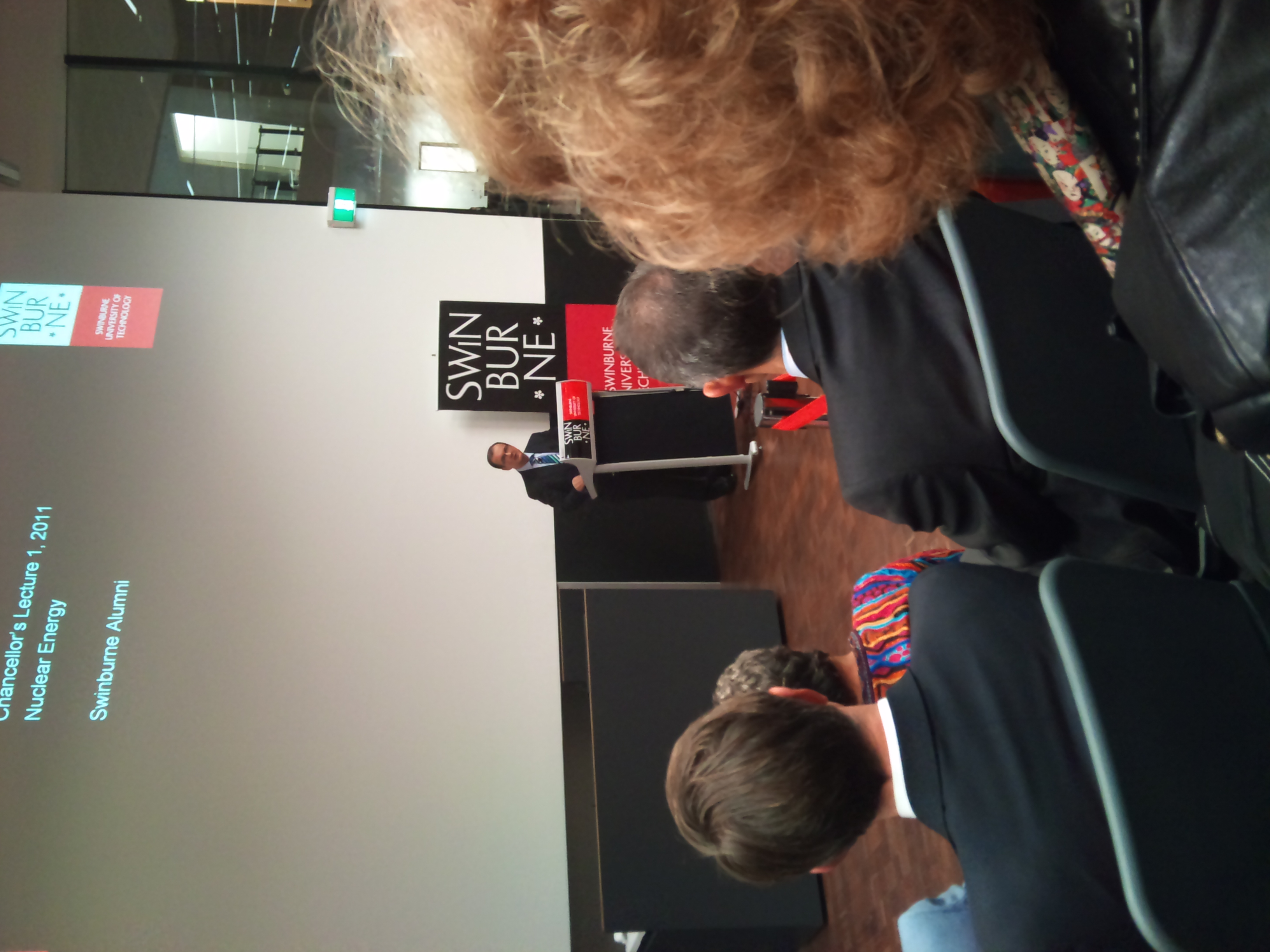
Russell Coker: Ziggy s Lecture about Nuclear Power

The Event Dr Ziggy Switkowski giving his lecture I just attended a lecture by Dr Ziggy Switkowski (see the above picture) on the topic of nuclear power, for a long time Ziggy has been the most prominent advocate of nuclear power in Australia, so naturally the talk was pro-nuclear. The lecture was free for alumni of Swinburne University and introduced by Swinburne s Chancellor who described Ziggy as a friend. Before the lecture started I handed out flyers for Beyond Zero Emissions [1] with a plan for zero carbon use in Australia by 2020. That was more difficult than handing out Greens polling cards on election day. The people who attended were there for a purpose and they could see the free food and wine on offer inside the building so getting them to stop and take a brochure wasn t easy. There were also people from Friends of the Earth [2] and some other anti-nuclear organisations giving out brochures. specter of nuclear contamination There were also some anti-nuclear protesters dressed as Uranium miners and the specter of nuclear contamination, they made for an interesting picture (which is amazingly good for a phone camera 20 minutes after sunset), but got in the way when I was handing out brochures. There were a few university security people at the door trying to keep the opposition away who were a bit annoying. There was also one policeman in attendance who was quite friendly, he asked whether there was a competition between the different groups as there is when handing out how-to-vote cards on election day. 15 minutes before the lecture was due to start I quit handing out the brochures and went inside for free food and drink (food always tastes better when the other team pays the bill). The Lecture I felt that Ziggy did a poor job of advocating nuclear power. There were a number of gaping flaws in his argument, but I have to commend him for his honesty in his appraisal of how hard it would be to develop a nuclear industry in Australia. Most nuclear advocates are a lot more optimistic about the process of building nuclear power plants and training all the people to run them. I will write a post tomorrow rebutting some of Ziggy s arguments. After the Lecture Immediately after the lecture the vice-chancellor stated that 500 people registered which made it the best attended such lecture that they have held. I don t know how many of the 500 attended, but I did notice that about 1/4 of the seats in the lecture hall were empty. It s rather sad that they can t get more people to such lectures, is TED.com stealing the audience? When I got out of the building I started handing out brochures to people as they left. I noticed that they were a lot friendlier than they were on the way in. I believe that people who left the lecture had greater interest in renewable energy because Ziggy just failed to make a good case for nuclear power. I expect that anyone who hadn t already made up their mind would immediately want to research the alternatives after watching Ziggy s lecture.

Craig Small: What happens without software testing

New TurboGears logo

Image via Wikipedia

Well jffnms 0.9.0 was a, well, its a good example of what can go wrong without adequate testing. Having it written in PHP makes it difficult to test, because you can have entire globs of code that are completely wrong but are not activated (because the if statement proves false for example) and you won t get an error. It also had some database migration problems. This is the most difficult and annoying part of releasing versions of JFFNMS. There are so many things to check, like: I ve been looking at sqlalchemy which is part of turbogears. It s a pretty impressive setup and lets you get on with writing your application and not mucking around with the low-level stuff. It s a bit of a steep learning curve learning python AND sqlalchemy AND turbogears but I ve got some rudimentary code running ok and its certainly worth it (python erroring on un-assigned varables but not forcing you to define them is a great compromise). The best thing is that you can develop on a sqlite database but deploy using mysql or postgresql with a minor change. Python and turbogears both emphasise automatic testing. Ideally the testing should cover all the code you write. The authors even suggest you write the test first then implement the feature. After chasing down several bugs, some of which I introduced fixing other bugs, automatic testing would make my life a lot easier and perhaps I wouldn t dread the release cycle so often.

Julien Blache: pommed v1.39: Linux 2.6.39 maintenance release

I ve just released pommed v1.39 ; this is a maintenance release for Linux 2.6.39, following the renaming of the mbp_backlight driver to apple_backlight.

Joey Hess: managing network effects through parasitism

Network effects are such a pernicious thing. They give us the internet, but they also give us an internet full of monopolistic worse-is-better players that use network effects to stifle improvements and competition. Sometimes the best you can manage is to be a parasite. facebook So I'm back on facebook ... sort of. a nearly empty facebook profile encouraging use of email or blog My strategy for facebook is to be as near to a featureless datapoint as I can. I won't post anything. I entered as bad quality information as I could get away with. I turned all privacy controls off, on the theory that this way I don't have to worry about facebook eroding privacy since everything about me on facebook is aggressively public. By never posting anything to facebook, I am trying to fight the network effect; trying to avoid increasing the value of facebook due to me being on it. I've adblocked the text entry field on facebook just to avoid the temptation. I want to erase the Like buttons too. Technologically, I think a good approach would be a browser plugin that does these things while extracting all available content and optionally sending it to a RECAP-type system. I only friend people who I need to keep up with and who have little or no other internet presence. This is because I am aware that each person I friend still propels facebook's network effect a little bit; even though they'll never see any useful information from me, they will know that they are able to talk to me via facebook. I only log into facebook once a week or so (this is easy when you're not interacting with it anyway), and read whatever sample of farmville and other posts facebook selects as "important" (worse than usual probably since I never give it feedback). So people I friend can't rely on me reading everything they do, which reduces the value a little more. I will probably delete this account occasionally, and then re-add it later. Just often enough to be really annoying. twitter Similarly, I no longer gate my identi.ca account to twitter, and have deleted as many tweets as I could stand to (one click and one keypress per tweet; no mass-delete; ugh!), and protected my account to avoid accidential new tweets leaking out. Since twitter is not quite as evil as facebook I feel slightly less bad about exposing more of my social graph there. Only the folks who are too lame to get on an OpenMicroBlogging site like identi.ca. phone Of course there was a network effect with the telephone as well, and while it got deregulated it's still pretty bad, and also a technology that I mostly dislike using. Oddly my phone behavior is backwards to the other two networks; I only make outgoing phone calls, never answering the phone (unless real life intervenes very severely). I listen to some random fraction of my voice mail and read whatever ones manage to get machine-transcribed.

1 June 2011

Junichi Uekawa: The increasing number of facebook "friends".

The increasing number of facebook "friends". Apparently I have 113 "friends" in facebook. So far I don't think I have seen any interesting things happening within facebook. I saw a breakdown when my mixi contacts exceeded 100 people, and I started deleting stale connections. I don't know who to delete in facebook because I only been approving people whom I know in facebook, unlike in mixi where I used to become Friends as if it was a routine ritual in tech conferences.

Vincent Bernat: GNOME Power Manager without GNOME desktop

When I installed my new laptop, I decided to switch from sleepd to GNOME Power Manager (GPM). The rationale behind this decision was to get screen dimming for free while keeping other features because GPM uses UPower which uses pm-suspend and pm-powersave behind the scene. This means that it is easy to execute scripts on suspend or when the AC is unplugged by putting them in /etc/pm. I don t use a full GNOME desktop. My desktop is running FVWM which is just a window manager. However, I already use some parts of the GNOME environment:

What s working It happens that most of the features just do not work. However, suspend when closing the lid works fine. The icon in the systray works fine too (but there is a small bug). The screen dimming feature on idle also works (but there are annoying bugs with it). The visual feedback when pressing brightness keys works too.

What s not working It seems that I am not the only one to have problem with GPM: there are currently 115 bugs opened in the Debian BTS. If you want to get some debug output from gnome-power-manager, run it with --verbose flag. --debug flag does nothing (and supersedes --verbose).

Nothing happens when pressing the power button I have configured GPM to ask me what to do when I press the power button. But when I press the button, nothing happens. Looking at the source, here is the snippet of code that is executed:
1
2
3
4
5
6
7
if (policy == GPM_ACTION_POLICY_INTERACTIVE)  
    GpmSession *session;
    egg_debug ("logout, reason: %s", reason);
    session = gpm_session_new ();
    gpm_session_logout (session);
    g_object_unref (session);
 
In fact, this is not GPM that will ask you the question, but GNOME session manager because GPM triggers logout. If you don t run a full GNOME session, nothing will happen. My workaround is just to set the action to Suspend .

Does not sleep when idle GPM is configured to go to sleep after 2 hours on AC or 30 minutes on battery. This does not work for me because idle detection is delegated to external programs. There are four variables used by GPM to determine if we are idle:
  • session_idle which is the idle hint from ConsoleKit,
  • idle_inhibited which is set when another program asks to disable idle detection (a video player which does not want the screen to be dimmed),
  • suspend_inhibited which means a program do not want we going to sleep (a music player for example)
  • x_idle which tells if X is idle or not (someone is moving the mouse or typing on the keyboard).
To allow GPM to suspend when we are idle, x_idle and session_idle must be true while suspend_inhibited and idle_inhibited must be false. For screen dimming purpose, you just need to have x_idle set to true and idle_inhibited set to false. Currently, only GNOME Screensaver seems to tell ConsoleKit if the session is idle or not. XScreenSaver does not contain anything about this. I am using xautolock with xlock and I am pretty sure they won t tell GPM if I am idle. You can use dbus-send to circumvent this problem:
 1
 2
 3
 4
 5
 6
 7
 8
 9
10
11
$ dbus-send --system --dest=org.freedesktop.ConsoleKit \
>   --type=method_call --print-reply --reply-timeout=2000 \
>   /org/freedesktop/ConsoleKit/Manager \
>   org.freedesktop.ConsoleKit.Manager.GetCurrentSession
method return sender=:1.6 -> dest=:1.106 reply_serial=2
   object path "/org/freedesktop/ConsoleKit/Session1"
$ dbus-send --system --dest=org.freedesktop.ConsoleKit \
>   --type=method_call --print-reply --reply-timeout=2000 \
>   /org/freedesktop/ConsoleKit/Session1 \
>   org.freedesktop.ConsoleKit.Session.SetIdleHint boolean:true          
method return sender=:1.6 -> dest=:1.108 reply_serial=2
While I understand what is the rationale behind those choices (no code duplicate and allowing external programs to hinder power management), it lacks some fallback in case you don t use GNOME Screensaver (which is the key component here). I first though this was bug #594706 but this is not the case. I have opened (and closed) bug #628755. UPDATED: Jump to the conclusion for an updated solution for this problem.

Brightness is not restored to the previous value after idle When GPM undims the screen, it does not restore the previous value. It seems to be bug #617310 which is marked as fixed in upstream. I did not investigate it.

Wrong number of batteries reported I only have one battery but after one suspend/resume cycle, GPM thinks I have two. Maybe this is a bug of UPower. Maybe this is bug #606434. I did not investigate it. Maybe there is an happy interaction with bug #456280.

Inability to set configure actions when the UPS runs out of battery This is bug #390602. In addition to laptop batteries, UPower also supports UPS. In this case, GPM displays a special icon to tell if the UPS is fully charged. However, there is no possibility to execute special actions when the UPS is unplugged, like hibernate after 10 minutes or something like this. This seems to be a problem with the interface because looking with gconftool-2, we can spot variables like low_ups or critical_ups which allow to set actions when the UPS is almost out of battery. Moreover, the UPS icon only displays after one suspend/resume cycle but I am too lazy to report and debug this issue. Since, the icon disappear if I restart GPM, I am confident that the bug is in GPM.

Conclusion The conclusion is that GPM is not really that buggy but it really needs to be run in a full-blown GNOME desktop. The main problem is not really GPM. New technologies like UPower and ConsoleKit get pushed by freedesktop.org initiative, they get implemented by GNOME (and, I suppose, KDE) because they have tons of people following the appropriate mailing lists and any alternative just gets crushed by all those unpublicized changes. UPDATED: I got several helpful comments about this problem. There are two possible solutions:
  1. Use xfce4-power-manager. It handles brightness control in a better way and don t need an external program to tell when the current session is idle. It still needs a session manager to ask what to do when using the power button. The drawback to this solution is that you start to pull another desktop environment into your environment. You had some parts of GNOME and now you have some parts of XFCE. This solution was proposed by Sylvain Collilieux.
  2. Use gnome-session, gnome-screensaver and keep gnome-power-manager. As pointed by Julien Valroff, gnome-screensaver needs gnome-session to detect idleness. However, gnome-session starts a whole GNOME desktop. Again, there are two solutions. The first one is to replace gnome-session by something lighter implementing the bare minimum to make gnome-screensaver happy. Another suggestion is to configure gnome-session to start your favorite environment.
I start mine from ~/.xsession and here is what I have added at the top of it:
 1
 2
 3
 4
 5
 6
 7
 8
 9
10
11
12
13
14
15
16
17
# If not done, restart ourself with gnome-session
if [ -z "$SESSION_MANAGER" ]; then
    [ -d ~/.config/autostart ]   mkdir ~/.config/autostart
    rm -f ~/.config/autostart/*
    cat <<EOF > ~/.config/autostart/xsession.desktop
[Desktop Entry]
Name=Xsession
Comment=Start .xsession
Exec=$(readlink -f $0)
Type=Application
X-GNOME-Autostart-enabled=true
EOF
    exec gnome-session --autostart=$HOME/.config/autostart
fi
# Otherwise, keep starting stuff
# [...]
exec fvwm-crystal

Tanguy Ortolo: Coding a new BitTorrent tracker?

The BitTorrent protocol works with trackers, that track the clients or peers that share a given file. This is one specific design of a peer-to-peer protocol, very appropriate for official distribution: for instance, Debian runs a tracker for distributing the installation images.The problem There exists many BitTorrent clients, but, for what I have seen, few BitTorrent tracker. Within Debian, I think the only trackers available are the original BitTorrent's one, and its fork BitTornado. Both suffer from serious drawbacks: Proposed solution Now that I have criticized a lot, let us be more constructive. All these issues could be fixed by modifying the code and the package (well, by adopting it, for the first one). I think it is not worth doing so, exactly because they implement both a client and a tracker: there are many good BitTorrent clients so there is no real need for them as clients, and because a tracker's job is quite different, and easier than a client's, it would be useless to maintain a client with the tracker. So, I am considering coding a BitTorrent tracker. Even though the tracker protocol is based on HTTP, it is completely stateful so it would be a standalone daemon rather than a CGI-style program. I would code it in Python because this is the language I currently prefer, and I may call it tbtt (the BitTorrent tracker, or Tanguy's BitTorrent tracker, or transport blind tout terrain (all terrain armoured transport)). If you have any information or suggestion, please comment! Perhaps I missed some existing tracker that would do the job instead of coding a new one?

Stephan Peijnik: How to force a local DNS resolver to be used using resolvconf

I know it has been a while, but after reading a blog post by Anand Kumria over at planet.debian.org I decided to have a quick look at one of the problems he described.

Basically, Anand wants to force the local resolver to be used for each and every network connection, may that connection be established manually or via NetworkManager. He wrote that fixing this configuration for every new connection manually is tedious, and I fully agree on that. So here is a solution to do this all automatically, using resolvconf:

After installing the resolvconf package every time /etc/resolv.conf is to be updated resolvconf takes care of that. Using the files in /etc/resolvconf this process can be controlled and the resulting file modified to fit one own's needs.

So at first we would like the local resolver to be used for every connection. This works by simply adding the "nameserver 127.0.0.1" directive to the /etc/resolvconf/resolv.conf.d/head file. Simple as that. Every time /etc/resolv.conf gets generated the contents of the head file are actually used as /etc/resolv.conf's header.

Using this method the local resolver is used for every connection. But Anand wanted to use only the local resolver and discard any resolvers possibly obtained via DHCP for example. Guess what, this is also possible using resolvconf.

Adding TRUNCATE_NAMESERVER_LIST_AFTER_127="yes" to /etc/default/resolvconf does exactly that. Now every nameserver directive after the 127.0.0.1 one is ignored and will not make it into /etc/resolv.conf. You can of course add more nameservers to the head file above the 127.0.0.1 directive.

Problem fixed I guess.
Don't forget to re-connect to the network or manually force re-creation of /etc/resolv.conf so the changes you made get populated. I really hope this is of use to some of you facing similar problems.

Andrew Cater: /etc/apt/sources.list

Since we have people posting to various lists for the correct format for an /etc/apt/sources.list file, here's one including the non-free repositories (which are not part of Debian proper but provided for the convenience of Debian users). Hope this helps somebody sometime.

#

deb http://ftp.uk.debian.org/debian/ squeeze main contrib non-free
deb-src http://ftp.uk.debian.org/debian/ squeeze main contrib non-free

deb http://ftp.uk.debian.org/debian/ squeeze-updates main contrib non-free
deb-src http://ftp.uk.debian.org/debian/ squeeze-updates main contrib non-free

deb http://security.debian.org/ squeeze/updates main contrib non-free
deb-src http://security.debian.org/ squeeze/updates main contrib non-free

and, of course, it wrapped in the browser. There's a single space between squeeze and main and between main and contrib and between contrib and non-free for example. There are six lines in total - three pairs.

Anand Kumria: First steps with DNSSEC

As you all probably know by know, DNSSEC has been enabled on the root ('.') since July 2010. And on most TLDs like .com shortly thereafter (in the specific case of .com, since March 2011). The Debian guide to turning on DNSSEC is useful but some things you need to know (after using it for a week or so).
BIND loves IPv6.
If you have 'listen-on-v6', set to yes and you roam to a non-IPv6 network. Your name resolutions can take 30+ seconds.Since I roam from a some networks they do have IP6 and some that do not, I have had to turn this setting off to achieve reasonable performance
Each new network requires manual intervention
Just like Andrew Cowie, I'm trying to get new features in NetworkManager. by blogging.My use case is simple if a bit geeky use the local resolver on my system irregardless of what I get dynamically (via DHCP) or automagically (via SLAAC).I can do this manually for each network I connect to, but it quickly looses its appeal.
Very little software takes advantage of DNSSEC (yet).
Apart from the happy DNSSEC campers, very little takes advantage of DNSSEC yet.Kind of like the early days of IP6. It would be nicer if websites stored the fingerprint of the SSL website in DNS and it could be cross-checked against what was sent.The effort to do so is underway at the IETF by the name of DANE.In fact publishing SSH key fingerprints via DNS is already possible RFC4255 but I am unaware of deployed support.
Things are progressing, and I suspect now is a great moment to get involved if you have spare time, in making it significantly harder for 3rd-parties to censor the Internet for everyone.

31 May 2011

Jordi Mallach: Quinze de maig

Two weeks ago, I was lucky to celebrate my 33th birthday with my closest friends in l'Alqueria. When asked to wish something before blowing the candles on Victor's delicious apple cake, I thought I have basically everything I'd want, but it'd be cool if some real changes happened in this world. Not long after, big demonstrations asking for Real Democracy Now happened throughout the Spanish state, and today, that Sunday seems to be an eternity away. Huge assemblies, thousands of strangers working together, more demonstrations, an election campaign eclipsed by #15m, hundreds of well thought, plausible claims published, the movement crossing the Spanish borders and leaking into France and Greece, the feeling that this is the good one, the basis for a fresh start that can make our lives better, our society a fair one and the possibility to stand in front of the fuckers who have made our lives a lot harder, to tell them it's not going to work like that anymore. All of this in 15 days. Unfortunately, revolution came when I'm in a crucial month to finish my studies and swamped with other little things, so I've been unable to be in the Valencian camp site for more than 3 days. Hopefully when I'm done on the 22nd people will still be taking the square, because Mako and Mika will be visiting then. Yay!

Guido G nther: GNOME Prepaid Manager, ModemManager and Huawei modems

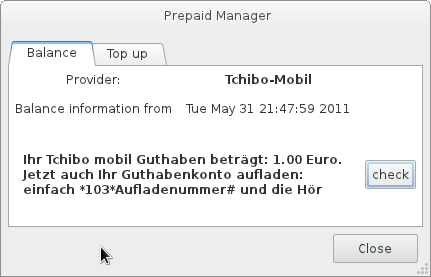
I've made a first release of GNOME Prepaid Manager a couple of days ago after switching to GTK+3, GSettings and PyGObject's GObject introspection but it still wasn't that useful since the very common Huawei chipsets (present in many UMTS USB sticks) weren't working due to some missing code in ModemManager. GNOME Prepaid Manager screenshot Thanks to Dan's great description I just got around to add that which should make ppm useful to more people. This blog is flattr enabled.

Mehdi Dogguy: First Tunisian Debian mirror

It seems that Tunisia hosts a new shiny complete Debian mirror since a few days. It s available at http://debian.mirror.tn. It even has all release architectures, which was a good surprise. Possibly, this new mirror will get its ftp.tn.debian.org some day if it implements all the requirements (which are listed here). As far as I know, this is the second complete Debian mirror in Africa. The first one is hosted in South Africa. Algeria hosts a Debian mirror too, but has i386 only. http://debian.mirror.tn had even a complete debian-cd/ directory when I had a look at it last Friday, but it disappeared over the week-end. I do wonder if it will come back at some point. It would make a lot of people happier, in my opinion. This new mirror is hosted by ATI (Tunisian Internet Agency), a government agency which organizes anything that has something to do with Internet :) (IP addressing, interconnection of ISPs, mail gateways, main registrar of .tn domain extension, ). During Ben Ali s era, they were known for Internet censorship. But, it seems that censorship was controlled directly by the palace. Since the revolution in Tunisia, ATI tried to clean his name and start a new life . At the same location, they also host other mirrors among which we can find: Ubuntu, Mozilla, Eclipse, CPAN, Apache and Fedora. So, I think I m not mistaken to say that there is a real intention to support Free Software. I hope they ll be able to go further and provide hosting for Free Software Clubs/Groups in Tunisia, or even help to organise FOSS events. Anyway It s nice to know that I ll have a decent Debian mirror to use this summer from Tunisia :) The revolution continues stay tuned!

Matthew Garrett: Rebooting

You'd think it'd be easy to reboot a PC, wouldn't you? But then you'd also think that it'd be straightforward to convince people that at least making some effort to be nice to each other would be a mutually beneficial proposal, and look how well that's worked for us.

Linux has a bunch of different ways to reset an x86. Some of them are 32-bit only and so I'm just going to ignore them because honestly just what are you doing with your life. Also, they're horrible. So, that leaves us with five of them.

Now, I'll admit that this all sounds pretty depressing. But people clearly sell computers with the expectation that they'll reboot correctly, so what's going on here?

A while back I did some tests with Windows running on top of qemu. This is a great way to evaluate OS behaviour, because you've got complete control of what's handed to the OS and what the OS tries to do to the hardware. And what I discovered was a little surprising. In the absence of an ACPI reboot vector, Windows will hit the keyboard controller, wait a while, hit it again and then give up. If an ACPI reboot vector is present, windows will poke it, try the keyboard controller, poke the ACPI vector again and try the keyboard controller one more time.

This turns out to be important. The first thing it means is that it generates two writes to the ACPI reboot vector. The second is that it leaves a gap between them while it's fiddling with the keyboard controller. And, shockingly, it turns out that on most systems the ACPI reboot vector points at 0xcf9 in system IO space. Even though most implementations nominally require two different values be written, it seems that this isn't a strict requirement and the ACPI method works.

3.0 will ship with this behaviour by default. It makes various machines work (some Apples, for instance), improves things on some others (some Thinkpads seem to sit around for extended periods of time otherwise) and hopefully avoids the need to add any more machine-specific quirks to the reboot code. There's still some divergence between us and Windows (mostly in how often we write to the keyboard controller), which can be cleaned up if it turns out to make a difference anywhere.

Now. Back to EFI bugs.

( Comments Comment on this)

Gunnar Wolf: Invitation Free Software in Mexico: Reflections and Opportunities

I was invited to be part of one of the panels to be present this Thursday (June 2) in a forum that promises to be interesting. The forum is organized by the Science and Technology comission of the Senate of the Republic (of Mexico ;-) ), Universidad Aut noma Metropolitana and Mozilla M xico. The day will be opened by Sen. Francisco Javier Castell n Fonseca and Richard Stallman; starting at 10:00, we will have thematic panels on: The full program (as well as details of interest of those that can physically attend) is attached to this post. I am looking forward to this forum. Not only it is a good opportunity to get our work known in one of those places where it matters, but it's also being organized by several interesting people I'm sure will have something interesting to contribute. And of course, we lacked time to build a better, more complete and more coherent proposal but there is a good probability we will have further such contacts. You might find interesting to read on the list we have been discussing; subscription seems to be open (although access to the archives is not Maybe it will be later on? In any case, I'm saving a mbox ;-) )
AttachmentSize
Activity program352.37 KB

Next.

Previous.