Search Results: "ag"

16 September 2010

Vincent Sanders: The turmoil of an entropy key release.

Last week we released 1.1.3 of the Entropy Key software. Poor Daniel struggled for days to get this out the door but finally he managed to build all the various debs, rpms and tars for the supported platforms and Rob got it all uploaded and announced.

The release is kinda strange in that it was the first in which the main changes were for performance. OK there is an improvement to resilience in the face of failed re-keying which some users were seeing in high load situations, but that high load was (in some cases) being caused by the daemon itself.

The process was mainly driven by one of our users, Nix, who was experiencing ekeyd using "too much" CPU on his system.

Of course on our servers during testing ekeyd it had used around a percent of CPU, certainly nothing that flagged as a problem in our own use (yes we eat our own dogfood ;-) Alas for this user on a 500MHz geode it was guzzling down 10% of his CPU which was clearly unacceptable.

This user however instead of guessing what the problem might be or simply leaving it up to us did something about it. He instrumented ekeyd, located the garbage collector tuning parameters as being incorrectly set and supplied a patch. Did he stop there? no! he then went on to profile the code further and clean up the hotspots. This resulted in ekeyd falling to less than 1% of the runtime of his system.

By reducing the CPU usage of ekeyd to this level it became more apparent where a previously reported bug was coming from, which enabled me to address it.

I know sometimes I complain about Open Source software but at times like this it makes me happy that we released the ekeyd software freely. This is how its supposed to be! Everyone working to make better software and benefiting together.

It has not just been on this occasion either, throughout the last year since our very first 1.0 release there has been helpful and useful feedback, patches from several users and even the odd thankyou mail. This project then has been a positive Open Source experience and I look forward to another constructive year maintaining this software.



Andrew McMillan: Changing an old habit

I'm a keen amateur photographer and have been since I was at school. Of course back then it involved smelly chemicals, strange lights and dark rooms. The expense and hassle of film eventually did it in for me and in 2000 I bought my first digital camera. After a series of increasingly sophisticated devices, back in 2007 I bought a Nikon D80 and soon thereafter I discovered that you can do things with raw camera files that have some analogies to the darkroom processing of my youth. For most of the time since then I've used UFraw for processing my raw images, combined with increasingly sophisticated batch files to harass it into shape. It has increasingly frustrated me that UFraw doesn't do several things that are essential to processing most files, since once the image leaves that programming it usually ends up in an 8-bpp processing path. It seems to me that the saving the processed image into an 8bpp format like jpeg is the last step before leaving the image alone. Of course this can't always be the case since sometimes a judicious use of the 'Resynthesizer' plugin can make some unsightly elements just disappear, or one needs to carefully apply some censorship to the 14 year old in the background so that the 7 year-old's parents can put the photo on the mantelpiece without worrying about what Granny will say about how much better children's manners were in her day. I'm hoping too, that when I have grandchildren I'll be able to tell them that 'in my day we only had 8 bits per pixel, and we were lucky', but The Gimp isn't there yet, no matter how much promise Gegl seems to offer. The thing that has particularly annoyed me is sharpening. UFraw doesn't, and as a result my workflow has either involved applying some blanket sharpening, much like the camera does, or moving the image into a second tool just to apply some sharpening. This week has been particularly demanding, as the school asked me to 'take some photographs of the production'. So of course that's a thousand-odd photos that I want to do a cull down to a hundred or so, and then I want to quickly do justice to the good ones so I can move on to other stuff. Well this time my frustration with UFraw hit that ceiling that got me to try something else. I've done this in the past, and found myself going full circle and ending up right back at UFraw with a few extra lines added to my script, but this time I tried rawstudio and in processing the 'can you do the class shots overnight please' test it produced much nicer results in much less time than I have ever been able to with UFraw. So I've switched, and the more I use it the more convinced I am that UFraw will be getting uninstalled pretty soon. That's not to say that rawstudio is perfect: it isn't. In particular it has some user interface failures that are kind of annoying to me, but they aren't enough to stop me using it. In fact I liked it so much that I immediately had to pull the nightly repository and build that, just to get the new saturation handling. The user-interface niggles that do get to me are: Things that I immediately love, over what UFraw gave me: Things that I immediately miss from UFraw: There are a bunch of things that RawStudio also does that I haven't particularly found a use for yet, but which I suspect I will quite like when I do. The image classification and stuff seems likely to be useful, for sure. In choosing to switch RawStudio I also looked at RawTherapee, which has recently relicensed under the GPL, but I chose RawStudio because it has vastly better performance on my laptop, and because I found the interface much more immediately accessible. RawTherapee also exceeds what UFraw can do in many ways, and looks like it might be useful for the really difficult cases, but learning to drive it with any facility could take some time. Especially if you only have an i7 740QM with 6G RAM, it would seem.

Michal Čihař: Arrows navigation for Lazygal

One of things I missed for quite a long time in Lazygal compared to lot of other galleries is navigation using keys in between the images. Well, it should be easy to implement, shouldn't it? A little bit of googling and reading jQuery documentation and the code is here :-). It seems to work fine in browsers which I use, you can try it yourself.

Dirk Eddelbuettel: BLAS, BLASter, BLAStest: Some benchmark results, and a benchmarking framework

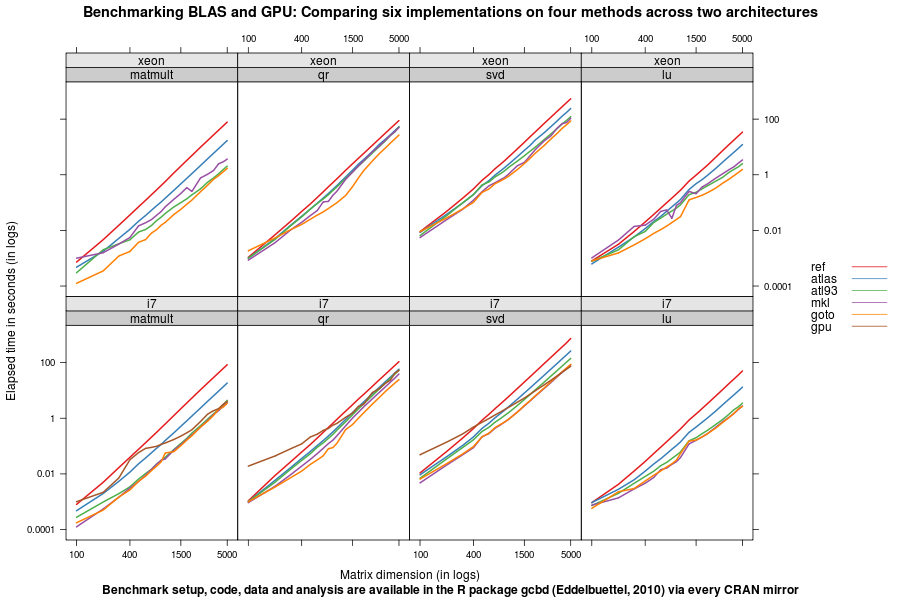
Usage of accelerated BLAS libraries seems to shrouded in some mystery, judging from somewhat regularly recurring requests for help on lists such as r-sig-hpc (gmane version), the R list dedicated to High-Performance Computing. Yet it doesn't have to be; installation can be really simple (on appropriate systems). Another issue that I felt needed addressing was a comparison between the different alternatives available, quite possibly including GPU computing. So a few weeks ago I sat down and wrote a small package to run, collect, analyse and visualize some benchmarks. That package, called gcbd (more about the name below) is now on CRAN as of this morning. The package both facilitates the data collection for the paper it also contains (in the vignette form common among R packages) and provides code to analyse the data---which is also included as a SQLite database. All this is done in the Debian and Ubuntu context by transparently installing and removing suitable packages providing BLAS implementations: that we can fully automate data collection over several competing implementations via a single script (which is also included). Contributions of benchmark results is encouraged---that is the idea of the package. The paper itself describes the background and technical details before presenting the results. The benchmark compares the basic reference BLAS, Atlas (both single- and multithreaded), Goto, Intel MKL and a GPU-based approach. This blog post is not the place to recap all results, so please do see the paper for more details. But one summary chart regrouping the main results fits well here: GPU/CPU Benchmark Results This chart, in a log/log form, shows how reference BLAS lags everything, how multithreaded newer Atlas improves over the standard Atlas package currently still the default in both distros, how the Intel MKL (available via Ubuntu) is fairly good but how Goto wins almost everything. GPU computing is compelling for really large sizes (at double precision) and too costly at small ones. It also illustrates variability and different computational cost across the methods tested: svd is more expensive than level-3 matrix multiplication, and the different implementations are less spread apart. More details are in the paper; code, data etc are in the package gcbd. The larger context is to do something like this benchmarking exercise, but across distributions, operating systems and possibly also GPU cards. Mark and I started to talk about this during and after R/Finance earlier this year and have some ideas. Time permitting, that work should be happening in the GPU/CPU Benchmarks (gdb) project, and that's why this got called gcbd as a simpler GPU/CPU Benchmarks on Debian Systems study.
15 September 2010

Gunnar Wolf: On enjoying history, opposed to what happens around me

Portadas de los discos de Diana Uribe I have always liked learning and understanding history. Since I discovered him, for a couple of years already I always try to catch Javier Garciadiego's program Conversaciones sobre historia, Saturday 9AM in the Horizonte 108 radio station (can be listened to online). This program started by going over the events just before the beginning of the 1910 revolution in Mexico - and along slightly over five years, one hour per week and following different threads, the program has reached the end of the Cristiada, in the early 1930s. Garciadiego has a very nice, followable, amenable way of telling history, and I have recommended his program to many friends. This last June, I spent some days in Guatemala City, for DrupalCamp Centroam rica. I stayed with my good Colombian friend, Dilson, and at his house he had framed a poster of the History of the Civilizations. Of course, I got my nose close to it, guessing as many faces as possible in the lot. And he showed me his last Christmas present: Two books, each of them with 6 CDs. One is Historia de las Civilizaciones, the second one is Historia de las independencias. They are made by Colombia's very well known and well regarded historian Diana Uribe. I copied the CDs in order to listen to them later And wow, was I impressed! Diana Uribe makes a great narrative about topics that to some people would seem boring and dry. As I said, I have always found passion in understanding the human processes that have shaped civilization and brought us all the way to where we stand now. Well, Diana Uribe manages to bring more "normal" people to this passion. While looking for information on her to share in this blog post, I found so many places offering download of her disks, with apparently young people talking about how she has got them all so excited and interested in history... That's, I think, the best "thank you" any academician can get: having non-specialists say how her work has opened up the passion of one of the world's least sexy professions to them. And yes there are so many "thank you" and "I want" commentaries, so much of what I would call "fan mail", that it took me a bit to find an online library carrying both works. And yes, at ~US$50 each, I do intend to buy them. Now, why am I writing this today? Well, yes, because I finished listening to the series today, but besides During this year, most of Latin American countries conmemorate their 200 years of existence. Most of the independentist struggles in the continent started in 1809-1810. And today is the "partying" day in Mexico Says the legend that in the night between September 15 and 16, 1810, a priest who is always painted as old and charismatic called on his small town urging the people to rise and fight for independence, and as a result of that, only 11 years later Mexico was a fully independent country, spanning from Costa Rica to California, and... well, a nice and very idealized myth. A century later, in 1910, after a very long stability and growth period (attained mostly through repression, the same abstract thing named as "the people" rose against the dictator Porfirio D az, who had been Mexico's president for 30 years. The revolution deeply changed the social face of the country, but politically... After ~15 years of fighting, the result was that a 30 year long dictatorship was replaced by a 70 year long one... And our political system still has not evolved beyond that model. Now, comparing what has not improved nor even stayed the same but went backwards... A century ago, the festivities of the hundred years of independence were a time for showing pride, for showing to the guests from more "civilized" countries how ours was by then a modern, thriving country worth believing in, worth investing in: Besides the important, majestic and well built monuments that were erected and still stand today (i.e. the Column of the Independence or Hemiciclo a Ju rez, many institutions that would socially shape the next century even after D az's death, even after he had been declared not the role model we wanted after all were born: The National University (nowadays the most important university in Latin America), the National School for Professors, the Railroad Technical School and many others (see Javier Aranda's note for some more details)... The celebration was well-thought and planned. Of course, it didn't go into some darker corners, the country was as uneven and unfair as it can be for the poorer indigenous population (which back then was a majority), and what not. But this year? Well, we are expecting an impressive show tonight (which I won't see, even though I'd like to, as I no longer have a TV and even if I had wanted to go downtown for the celebration, different government branches are insisting we should just sit and watch it by TV at home as it can be too crowded... so not even that was well thought out Of course not every Mexican can go to the same square and see the same de-facto president do the ritual, but some more redundancy could be thought, spreading acts through all of the city instead of concentrating the festivities all along Reforma. But anyway Leaving aside our current de-facto ruler's inabilities to do anything worthy, which are already well known and documented... I took this opportunity to listen to a great work, and am most happy to do it, and to be able to share it with you.

Iustin Pop: Virtual hardware failures

Note: The title is intentionally unclear; it can be read both as virtual failures and failures of virtual hardware , and I'm not sure which one is the better for the cases below. One of the funny things about virtualization is how virtual hardware fails. It often happens that my NFS-stored virtual machine images suffer an NFS glitch or something, at which point one can see in the kernel logs:
kernel: mptscsih: ioc0: attempting task abort! (sc=ffff880018320100)
kernel: sd 0:0:0:0: [sda] CDB: Read(10): 28 00 00 00 00 38 00 00 08 00
kernel: mptscsih: ioc0: task abort: FAILED (sc=ffff880018320100)
kernel: mptscsih: ioc0: attempting target reset! (sc=ffff880018320100)
kernel: sd 0:0:0:0: [sda] CDB: Read(10): 28 00 00 00 00 38 00 00 08 00
kernel: mptscsih: ioc0: target reset: SUCCESS (sc=ffff880018320100)
kernel: mptscsih: ioc0: attempting task abort! (sc=ffff880018320100)
kernel: sd 0:0:0:0: [sda] CDB: Read(10): 28 00 00 00 00 38 00 00 08 00
kernel: mptscsih: ioc0: task abort: FAILED (sc=ffff880018320100)
kernel: mptscsih: ioc0: attempting task abort! (sc=ffff88001eefcc00)
kernel: sd 0:0:0:0: [sda] CDB: Read(10): 28 00 00 98 01 a7 00 00 08 00
kernel: mptscsih: ioc0: task abort: FAILED (sc=ffff88001eefcc00)
kernel: mptscsih: ioc0: attempting target reset! (sc=ffff880018320100)
kernel: sd 0:0:0:0: [sda] CDB: Read(10): 28 00 00 00 00 38 00 00 08 00
kernel: mptscsih: ioc0: target reset: SUCCESS (sc=ffff880018320100)
While the NFS transient issues are probably a real bug, I have this image of a state machine inside the driver trying over and over the same error paths, in a futile attempt at fixing the hardware , and not locking onto/matching the real hardware behaviour. Or, this most recent case during boot and resource probing:
kernel:  e1000: 0000:00:08.0: e1000_probe: The EEPROM Checksum Is Not Valid
kernel:  /*********************/
kernel:  Current EEPROM Checksum : 0x031a
kernel:  Calculated              : 0x031a
kernel:  Offset    Values
kernel:  ========  ======
kernel:  00000000: 08 00 27 f6 f3 9b 00 00 ff ff 00 00 00 00 00 00
kernel:  00000010: 00 00 00 00 08 44 1e 00 86 80 0e 10 86 80 40 30
kernel:  00000020: 00 00 00 00 00 00 00 00 00 00 00 00 00 00 00 00
kernel:  00000030: 00 00 00 00 00 00 00 00 00 00 00 00 00 00 00 00
kernel:  00000040: 00 00 61 70 0c 28 c8 00 c8 00 00 00 00 00 00 00
kernel:  00000050: 00 00 00 00 00 00 00 00 00 00 00 00 00 00 02 06
kernel:  00000060: 00 00 00 00 00 00 00 00 00 00 00 00 00 00 00 00
kernel:  00000070: 00 00 00 00 00 00 00 00 00 00 00 00 00 00 1a 03
kernel:  Include this output when contacting your support provider.
kernel:  This is not a software error! Something bad happened to your hardware or
kernel:  EEPROM image. Ignoring this problem could result in further problems,
kernel:  possibly loss of data, corruption or system hangs!
kernel:  The MAC Address will be reset to 00:00:00:00:00:00, which is invalid
kernel:  and requires you to set the proper MAC address manually before continuing
kernel:  to enable this network device.
kernel:  Please inspect the EEPROM dump and report the issue to your hardware vendor
kernel:  or Intel Customer Support.
kernel:  /*********************/
kernel:  e1000: 0000:00:08.0: e1000_probe: Invalid MAC Address
kernel:  e1000: 0000:00:08.0: e1000_probe: (PCI:33MHz:32-bit) 00:00:00:00:00:00
kernel:  e1000: eth0: e1000_probe: Intel(R) PRO/1000 Network Connection
This is an emulated Intel NIC under VirtualBox. I have never seen it before, and it went away after a reboot. The most funny thing is the This is not a software error! message well, it definitely is :), but the driver has no way to know that. I think that these software-driven failures probably trigger some obscure error handling paths; I assume that the usual failures for real versus virtual hardware are quite different in nature, and that recovery is again different. This leads to using the wrong strategy for recovery, but fortunately nothing is really broken, just in the wrong state Since I'm not familiar with low-level driver details, I might be wrong of course; I'm just speculating on what I think goes on inside the driver. I'm not even mentioning virtual clock issues, as those are no longer funny

Christoph Berg: Upgrading only installed packages

When there a security update, just logging in to every host and issuing "apt-get install $pkg" doesn't work as the package might not be installed there. The fact that apt-get doesn't understand "apt-get upgrade $pkg" has bugged me for a long time. Recent aptitude versions support that, but that's not part of Lenny. Here's a shell function that does the trick:

upgrade ()  
        if [ "$*" ] ; then
                set -- $(dpkg -l "$@"   grep ^ii   awk '  print $2  ')
                if [ "$*" ] ; then
                        echo "apt-get install $@"
                        sudo apt-get install "$@"
                else
                        echo "Nothing to upgrade"
                fi
        else
                sudo apt-get upgrade
        fi
 
One application is upgrading a lot of hosts when logged in with clusterssh.

Martin Meredith: Freedom in Creativity

One of the things that I love about our Local LUG is the people. At our LUG, we have our resident geek artist, Antonio Roberts (aka hellocatfood) who, on the odd occasion, gets harassed into doing a talk for us. His talks are always fairly awesome. His previous talk about FLOSS + Art is the video with the highest views on our video archive, and tomorrow night, Thursday 16th September, at 19:30pm BST, he ll be delivering his next talk about his experience in the FLOSS community as an artist to us. Freedom in Creativity In his own words:-
This talk extends greatly on what was said and goes into issues of copyright and what experiences I ve had as an artist in the open source world
His previous talk was a bit of an eye-opener to me, as a pure geek with barely a trace of artistry in me, and it s always good to see the FLOSS world from the eyes of someone who doesn t exactly fit the stereotype of what you d normally expect to see. The video will be available after the event, at some point, but for those who re interested in gaining an insight into artistry and FLOSS, we ll be broadcasting the talk live over the interwebs. <script type="text/javascript"> var flattr_wp_ver = '0.9.11'; var flattr_uid = '34168'; var flattr_url = 'http://www.sourceguru.net/freedom-creativity/'; var flattr_btn = 'compact'; var flattr_hide = 0; var flattr_lng = 'en_GB'; var flattr_cat = 'text'; var flattr_tle = 'Freedom in Creativity'; var flattr_dsc = 'One of the things that I love about our Local LUG is the people. At our LUG, we have our resident geek artist, Antonio Roberts (aka hellocatfood) who, on the odd occasion, gets harassed into doing a talk for us. His talks are always fairly awesome. His previous talk about FLOSS + Art is the video with the highest views on our video archive, and tomorrow night, Thursday 16th September, at 19:30pm BST, he\'ll be delivering his next talk about his experience in the FLOSS community as an artist to us. In his own words:- This talk extends greatly on what was said and goes into issues of copyright and what experiences I ve had as an artist in the open source world His previous talk was a bit of an eye-opener to me, as a pure geek with barely a trace of artistry in me, and it\'s always good to see the FLOSS world from the eyes of someone who doesn\'t exactly fit the stereotype of what you\'d normally expect to see. The video will be available after the event, at some point, but for those who\'re interest'; var flattr_tag = 'art,artist,floss,lug,presentation,sblug birmingham lug,streaming,talk,video'; </script> <script src="http://api.flattr.com/button/load.js?v=0.2" type="text/javascript"></script>

Matthew Garrett: Thoughts on upstreams

Last month I gave a presentation on the interaction between Android and kernel upstream at Linuxcon. The video for that is now available here (requires registration). Contrary to stories you may have heard, I do not dropkick anyone through a window.

There's some parallels between the Android/upstream scenario and Canonical's approach to upstream. Mark wrote a lengthy defence of Canonical's focus on components that they feel need development, while not putting development effort into things they feel are good enough already. That's pretty consistent with the discussions I had with him at the Ubuntu development meeting in Oxford over six years ago. Back then the focus was on taking all the excellent software that already existed and concentrating on providing it as a single polished and integrated product. It was successful - what's easy to forget now is that the first release of Ubuntu was massively more usable out of the box than any other Linux distribution available at the time, and it's absolutely undeniable that its release spurred increased efforts on the part of competitors. But I don't think the same focus is being applied any more.

The most obvious (and most controversial) example is the Ayatana project. Ayatana's a pretty explicit statement that Canonical don't view the existing Gnome UI as being suitable for their vision of the Linux desktop. That's absolutely fine. However, unlike many of the papercut projects, Ayatana is a set of complete reimplementations of functionality that behave differently to their upstream equivalents. There's no meaningful sense in which that's not a fork of Gnome. And, let me emphasise, I don't think that's a bad thing.

Let's go back to Android. While we talk about how much we'd have preferred it if Google had interacted with upstream before implementing wakelocks, the realistic outcome is that there's no way that we'd have accepted them even if they'd been posted years before hardware shipped. If there'd been a productive outcome to that aspect of the conversation it would have involved Android having a very different power management policy. Sometimes you're not going to convince people that something is better without implementing it and seeing how well it works. The problem with wakelocks is not that they exist or that Google feels they work better than the alternative, but that they end up integrated into drivers in a way that can cause divergence between mainline and Android.

Ayatana potentially has the same outcome. At some level, well-integrated applications have to be aware of the environment in which they're running. The application indicator patches are an example of that. Carrying conditional code increases maintenance burden, reduces test coverage and is a net loss in the long run. If upstream Gnome never gains support for this functionality, and if Ubuntu continues to depend on it, then Canonical have a delta that they'll have to carry forever. That benefits nobody.

Forking because you believe that your approach is better is a completely valid development model, but in the long run can cause problems if you don't have a long-term strategy for how to resolve that fork. For all we criticise Google's ability to get Android code into the mainline kernel, they've put orders of magnitude more effort into doing so than Canonical have in terms of getting Ayatana's code into mainline Gnome. This isn't a function of Google's relative size - the Android kernel team is on the order of 10 people. It's not enough of a difference to explain the disparity.

Canonical would be perceived as much better team players if there was an indication of their long-term plan in terms of Unity and the Ayatana projects and getting that code into mainline Gnome and integrating with the Gnome shell. It's completely unsurprising that they're viewed with distrust until that happens.

Michal &#268;iha&#345;: Czech phpMyAdmin translation complete, how is yours?

I finally made some progress on Czech translation of phpMyAdmin and it has again reached 100%. It was first time since merging GSoC projects, which introduced quite a lot of new strings. Not that they would be hard to translate, but it was rather hard to find time for that. However there are still lot of translations which are quite behind and would need some love. So if you can translate, you're welcome to join our translators and translate! PS: If you're looking for more work, we're also translating documentation :-).

Christian Perrier: Paris Marathon 2011

Today, registration for the 2011 Paris Marathon (Apr 10th 2011) and 2011 Paris Half-marathon (March 6th 2011) was opening. I just registered for both. One will note that about 3 hours after the online registration opened, already more than 1200 people registered. As there are "only" 37000 places (plus 3000 for travel agencies and sponsors), people will, as usual, need to hurry (the half-marathon has 28500 places).

Christoph Berg: Firefox: HeaderControl

I'm a fan of LC_MESSAGES=de_DE and localized web pages -- almost. Unfortunately, the wording of many translations in Debian often drives me nuts. This applies mostly to web pages and package descriptions. Apologies to all hard-working translators -- the percentage of good translations does not outweigh the "wtf" cases for me. Still, I didn't want to switch to English for all the web. Rhonda pointed me to a Firefox ^W Iceweasel plugin: HeaderControl. Now *.debian.org is English for me (reading the constitution in German doesn't solve DAM problems anyway). Yay!

14 September 2010

Luca Falavigna: Invitation

lolcat Jokes off now, time to take it seriously ;)

Ingo Juergensmann: Upgrading request-tracker 3.6 to 3.8 on Squeeze

Today I had some problems with request-tracker in version 3.6 on Squeeze, coming from Lenny: although I was able to write mails to the ticket system and was able to receive mails from it when creating new tickets, I was unable to send replies to tickets to the requestor. Instead of dealing around with 3.6 I tried to upgrade to rt 3.8. Basically the upgrade went fairly well, except for my PostgreSQL database. It depends on postgresql-client which is a virtual package for postgresql-client-8.4. As learned lately postgresql-8.4 is somewhat uninstallable on Squeeze at the moment. So, I needed to make some sort of backport for rt3.8-db-postgresql_3.8.8-3_all.deb, which was quite easy. Instead of
Depends: $ misc:Depends , libdbd-pg-perl (>= 1.41),
postgresql-client (>= 7.4)
Suggests: postgresql postgresql (>= 7.4)
I changed the lines to this:
Depends: $ misc:Depends , libdbd-pg-perl (>= 1.41),
postgresql-client-8.3 (>= 7.4)
Suggests: postgresql-8.3 postgresql (>= 7.4)
Now I was able to install request-tracker3.8 successfully, upgrade the database and enjoy the new shiny version of rt. I'm unsure whether I needed to edit/save the Respond scrips as well to make the mail sending again or not. But that shouldn't be big show blocker either. Anyway, I think I'll write a bug report for rt 3.8 tomorrow... It's always fun to find yet another bug when a new release is upcoming... :-) UPDATE:
Bug report filed as #596926

Russell Coker: How to Start Learning Linux

I was asked for advice on how to start learning Linux. Rather than replying via email I m writing a blog post for future people who ask such questions and also to get comments from other people which may provide information I missed. Join a LUG The best thing to do is to start by joining your local Linux Users Group (LUG). Linux International maintains a list of LUGs that is reasonably comprehensive [1]. Even if there isn t a LUG near enough for you to attend meetings you can learn a lot from a mailing list of a LUG that s close to your region. There is usually no great reason not to join the mailing list of a LUG in a different region or country, but a local LUG is that the advice will often be tailored to issues such as the local prices of hardware and the practices of your government. Also note that Linux International doesn t list all LUGs, the MLUG group in Melbourne [2] and the BLUG group in Ballarat [3] aren t listed. Anyone who joins LUG (the group based in Melbourne, Victoria that I m a member of) will be advised of the smaller groups in the region if they ask on the list. As an aside it would probably make sense for the main LUV web page [4] to have links to local LUGs and to the LI page of users groups and for other LUGs to do the same. It s pretty common for a Google search to turn up the web site of a LUG that s near the ideal location but not quite right. Also it would be good if LUV could have a link to the Victorian Linux Users Group in Canada this should reduce the confusion a bit and they have a link to us [5]. Play with Linux Get a spare PC (with no important data) and try installing different distributions of Linux on it. Make sure that it never has anything particularly important so you can freely try things out without worrying about the risk of losing data. Part of the learning process usually involves breaking a system so badly that it needs to be reinstalled. Linux can run on really old hardware, an old system with 64M of RAM will do for learning (but 128M will really be preferred and 256M will be even better). Learn with other Beginners LUV has a very active beginners group, with a beginners mailing list and special beginners meetings. A group that has such things will be more helpful as you can easily learn from other people who are at a similar level to you. Also you can spend time learning Linux with friends, just spend a weekend with some friends who want to learn Linux and play with things you can often learn more by trying things than by reading books etc. Do some Programming One of the advantages of Linux (and other Free Software OSs) is that it comes with a full range of programming languages for free. You can get a much greater understanding of an OS by writing programs for it and a typical Linux distribution gives you all the tools you need. Any other Ideas? Does anyone have any other suggestions? Please leave a comment.

Mohammed Sameer: Twitter OAuth Proxy

I'm using Twitter plugin for Contacts and Conversations to twitter on my N900.

Twitter recently moved to OAuth. Problem is the Maemo package is outdated and seems to be unmaintained.

I did some research and came across a blog entry about exploring OAuth-protected APIs and some code. Nice idea but not usable for me.

I ended up sitting down and writing a small python script that will re-route your HTTP requests to api.twitter.com after adding all the OAuth bills and whistles, read the reply from twitter and send it back. Neat ? :-)

There's also supertweet.net which I've discovered after I finished writing my script but seems they don't support all of the twitter API call while my script does that.

The script is simple without much error checking but it's been working for me for a few days already.

Last thing, I'm not interested in running a service like supertweet. I'll not be implementing the full OAuth protocol. Need to use it ? Register your own application.

Get the code while hot!

git clone git@gitorious.org:twitter-proxy/twitter-proxy.git

Next step: Thinking of maintaining the twitter plugin for Maemo. I already compiled the latest code and it sort of works fine :-) read more

Kees Cook: my part in the ecosystem

I was asked to write about what I do at Canonical and what I do in the Free Software community at large. There is obviously a great deal of overlap, but I ll start with the things I m involved with when I m wearing my Ubuntu hat. My primary job at Canonical is keeping Ubuntu secure. This means that I, along with the rest of the Ubuntu Security Team, coordinate with other Free Software distributions and upstream projects to publish fixes together so that everyone in the community has the smallest possible window of vulnerability, no matter if they re running Ubuntu, Debian, RedHat/Fedora, SUSE/openSUSE, Gentoo, etc. Between vendor-sec, oss-security, and the steady stream of new CVEs, there is plenty going on. In addition to updates, the Security Team works on pro-active security protections. I work on userspace security hardening via patches to gcc and the kernel, and via build-wrapper script packages. Much of this work has been related trying to coordinate these changes with Debian, and to clean up unfinished pieces that were left unsolved by RedHat, who had originally developed many of the hardening features. Things like proper /proc/$pid/maps permissions, real AT_RANDOM implementation, upstreaming executable stack fixing patches, upstreaming kernel NX-emu, etc. Most of the kernel work I ve done has gotten upstream, but lately some of the more aggressive protections have been hitting frustrating upstream roadblocks. Besides the hardening work, I also improve and support the AppArmor Mandatory Access Control system, as well as write and improve confinement profiles for processes on Ubuntu. This work ends up improving everyone s experience with AppArmor, especially now that it has gotten accepted upstream in the Linux kernel. I audit code from time to time, both on the clock with Canonical and in my free time. I m no Tavis Ormandy, but I try. ;) I ve found various security issues in Xorg, Koffice, smb4k, libgd2, Inkscape, curl+GnuTLS, hplip, wpa_supplicant, Flickr Drupal module, poppler/xpdf, LimeSurvey, tunapie, and the Linux kernel. With my Canonical hat off, I do all kinds of random things around the Free Software ecosystem. I m a sysadmin for kernel.org. In Debian, I maintain a few packages, continue to try to push for security hardening, and contribute to the CVE triage efforts of the Debian Security Team. I ve written or maintain several weird projects, including MythTVFS for browsing MythTV recordings, GOPchop for doing non-encoding editing of MPEG2-PS streams, Perl s Device::SerialPort module, and the TAP paging server Sendpage. For a selection of things I ve contributed to other project, I ve implemented TPM RNG access in rng-tools, made contributions to Inkscape s build and print systems, implemented CryptProtect for Wine, wrote a PayPal IPN agent in PHP that actually checks SSL certificates unlike every other implementation I could find, added additional protocol-specific STARTTLS negotiations to OpenSSL, implemented the initial DVD navigation support in MPlayer, updated serial port logic in Scantool for communicating with vehicle CAN interfaces, tried to add support for new types of timeouts in Snort and Ettercap, fixed bugs in mutt, and added HPUX audio support to the Apple ][ emulator XGS. As you can see, I like making weird/ancient protocols, unfriendly file formats, and security features more accessible to people using Free Software. I ve done this through patches, convincing people to take those patches, auditing code, testing fixes and features, and doing packaging work. When I go to conferences, I attend UDS, DefCon, OSCon, and LinuxCon. I ve presented in the past at OSCon on various topics including security, testing, and video formats, and presented at the Linux Security Summit (miniconf before LinuxCon this year) on the need to upstream various out-of-tree security features available to the Linux kernel. I love our ecosystem, and I love being part of it. :)

Kartik Mistry: More uninteresting updates!

* Gwibber in experimental. Expect: 2.31.93-1 by tonight. + It is still slow. In short, it sucks at moment. Report bugs to upstream. Any improvement for Debian packaging (I moved it to pysupport (Thanks to Filip Chabik) * Life sucks. Why? + Festival time. I ve developed allergy to noise.
+ 31++ today. Still not much sign of getting wiser. And, no gift to me from myself.
+ Laptop is becoming pain now. 4GB is not enough!

Michal &#268;iha&#345;: Learning graphviz

While working on new Gammu documentation I came to need to include some graphs showing some workflows. Looking into Sphinx documentation (which is used for the documentation for Gammu), I've discovered nice integration with graphviz. Fortunately it was pretty easy to learn the basics, though I've never used it before and here it comes - message processing workflows for SMSD.

Rapha&#235;l Hertzog: How to customize dpkg-source s behaviour in your Debian source package

dpkg-source is the program that generates the Debian source package when a new package version is built. It offers many interesting command-line options but they are often not used because people don t know how to ensure that they are used every time the package is built. Let s fill that gap! It is possible to forward some options to dpkg-source by typing them on the dpkg-buildpackage command line but you d have to remember to type them every time. You could create a shell alias to avoid typing them but then you can t have different options for different packages. Not very practical. The proper solution has been implemented last year (in dpkg 1.15.5). It is now possible to put options in debian/source/options. Any long option (those starting with -- ) can be put in that file, one option per line with the leading -- stripped. Here s an example:
# Bzip2 compression for debian.tar
compression = "bzip2"
compression-level = 7
# Do not generate diff for changes in config.(sub guess)
extend-diff-ignore = "(^ /)config.(sub guess)$"
Notice that spaces around the equal sign are possible contrary on the command line. You can use quotes around the value but it s not required. The debian/source/options file is part of the source package so if someone else grabs the resulting source package and rebuilds everything, they will use the options that you defined in that file. You can also use debian/source/local-options but this time the file will not be included in the resulting source package. This is interesting for options that you want to use when you build from the VCS (Version Control Repository, aka git/svn/bzr/etc.) but that people downloading the resulting source package should not have. Some options (like --unapply-patches) are only allowed in that file to ensure a consistent experience for users of source packages. You can learn more about the existing options in the dpkg-source manual page. Read it, I m sure you ll learn something. Did you know that you can tell dpkg-source to abort if you have upstream changes not managed by an existing patch in debian/patches? It s --abort-on-uptream-changes and it s only allowed in debian/source/local-options. Be sure to subscribe to the RSS feed or to the email newsletter to not miss useful documentation for Debian contributors! Flattr this Share/Bookmark 3 comments Support my work

Next.

Previous.
