Search Results: "ag"

23 September 2010

Michal Čihař: Documentation translation

Some weeks ago, I've started to change documentation structure of Gammu to move from separate documents here and there into one comprehensive documentation which would cover it all. As a tool to do this I've chosen Sphinx, simply because I felt most convenient with the format and outputs it provides. So far the SMSD documentation has been converted from various places and formats, but it also opened up a question - how to deal with translations? So far we used po4a to translate man pages, however using it for generated man pages is slightly complicated (there are some macros which po4a does not understand and it seems to break encoding on the way). Translating whole new documentation is something what is unlikely to be finished, especially considering fact, that the only real existing translation so far is Czech which was done by me. For now I decided to keep old translated man pages and postpone the decision, but considering current situation, I will most likely just drop the translations for man pages unless I find some good solution how to translate Sphinx documents (po4a should be able to do that, but it will probably need some tuning).

Filed under: Coding Gammu Wammu 1 comments Flattr this

Dirk Eddelbuettel: R Project and Google Summer of Code: Wrapping up

As this year's admin, I wrote up the following summary which has now been posted at the R site in the appropriate slot. My thanks to this year's students, fellow mentors and everybody else who helped to make it happen. GSoC 2010 logo

Projects 2010 As in 2008 and 2009, the R Project has again participated in the Google Summer of Code during 2010. Based on ideas collected and disussed on the R Wiki, the projects and students listed below (and sorted alphabetically by student) were selected for participation and have been sponsored by Google during the summer 2010. The finished projects are available via the R / GSoC 2010 repository at Google Code, and in several cases also via their individual repos (see below). Informal updates and final summaries on the work was also provided via the GSoC 2010 R group blog.

rdx - Automatic Differentiation in R Chidambaram Annamalai, mentored by John Nash. Proposal: radx is a package to compute derivatives (of any order) of native R code for multivariate functions with vector outputs, f:R^m -> R^n, through Automatic Differentiation (AD). Numerical evaluation of derivatives has widespread uses in many fields. rdx will implement two modes for the computation of derivatives, the Forward and Reverse modes of AD, combining which we can efficiently compute Jacobians and Hessians. Higher order derivatives will be evaluated through Univariate Taylor Propagation. Delivered: Two packages radx: forward automatic differentiation in R and tada: templated automatic differentiation in C++ were created; see this blog post for details.

A GUI for Graphics using ggplot and Deducer by Ian Fellows, mentored by Hadley Wickham. Proposal: R puts the latest statistical techniques at one's fingertips through thousands of add-on packages available on the CRAN download servers. The price for all of this power is complexity. Deducer is a cross-platform cross-console graphical user interface built on top of R designed to reduce this complexity. This project proposes to extend the scope of Deducer by creating an innovative yet intuitive system for generating statistical graphics based on the ggplot2 package. Delivered: All of the major features have been implemented, and are outlined in the video links in this blog post.

rgeos - an R wrapper for GEOS by Colin Rundel, mentored by Roger Bivand. Proposal: At present there does not exist a robust geometry engine available to R, the tools that are available tend to be limited in scope and do not easily integrate with existing spatial analysis tools. GEOS is a powerful open source geometry engine written in C++ that implements spatial functions and operators from the OpenGIS Simple Features for SQL specification. rgeos will make these tools available within R and will integrate with existing spatial data tools through the sp package. Delivered: The rgeos project on R-Forge; see the final update blog post.

Social Relations Analyses in R by Felix Schoenbrodt, mentored by Stefan Schmukle. Proposal: Social Relations Analyses (SRAs; Kenny, 1994) are a hot topic both in personality and in social psychology. While more and more research groups adopt the methodology, software solutions are lacking far behind - the main software for calculating SRAs are two DOS programs from 1995, which have a lot of restrictions. My GSOC project will extend the functionality of these existing programs and bring the power of SRAs into the R Environment for Statistical Computing as a state-of-the-art package. Delivered: The TripleR package is now on CRAN and hosted on RForge.Net; see this blog post for updates.

NoSQL Interface for R by Yasuhisa Yoshida, mentored by Dirk Eddelbuettel. Proposal: So-called NoSQL databases are becoming increasingly popular. They generally provide very efficient lookup of key/value pairs. I'll provide several implementation of NoSQL interface for R. Beyond a sample interface package, I'll try to support generic interface similar to what the DBI package does for SQL backends Status: An initial prototype is available via RTokyoCabinet on Github. No updates were made since June; no communication occurred with anybody related to the GSoC project since June and the project earned a fail.

Last modified: Wed Sep 22 19:39:43 CDT 2010

Julien Danjou: Gnus news is good news!

As I already wrote too many times, I've started to use Gnus 6 months ago, and never looked back. At that time, I joined the ding mailing list in order to ask some dumb questions and, once, send a patch. There were very low activity on that list. Until Lars, the original Gnus author, came back. Three weeks ago, he started to wrote a new wash function to render HTML mails properly, with pictures. It's named gnus-html', and is (for now) based on w3m (but not on emacs-w3m, which is not part of Emacs). Last week, I've sent a set of patches to replace the usage of curl by the standard url-retrieve' function to fetch images, plus various enhancement. It seems that my work was good enough that Lars offered me write access to the git repository. I can therefore mess up the Gnus entirely. Hurrah! I've continued to work on gnus-html' and recently merged a set of patches improving image retrieval (which is now done in parallel) and starting to use url-cache' to cache image for a defined period of time. Of course, I found a bunch of tiny bug and special case while reading RSS feeds and various HTML mails, and fixed them all along. Lars added a libxml binding for Emacs 24, providing the html-parse-string' function. His future plan seems to be the abandon of w3m in favor of a native parsing via libxml to render HTML, and therefore, HTML mails. I should also mention the new nnimap' back-end; Gnus has been designed to read NNTP newsgroups, and not mails. Consequently, it had a very poor behaviour when used with a back-end such has IMAP. Lars took a week to rewrite entirely our dear nnimap' back-end, and make it act in a more expected way. There's still a bunch of bug and code to write, but it is at least usable and seems faster than the old code. Last thing I did was to rewrite the icon support in the group buffer. When I started to use Gnus, I was curious and tried to configure this. I never managed to make it work, and now know and understand why it was broken. So I ended rewriting entirely, and now it works. I never though I would understand, fix, and commit this code when reading the Gnus documentation this winter, but hell yeah, I did. Now I've still several little project to improve things in all sort of area. We'll see what I'll do next. :-) Flattr this

René Mayorga: 27 years

Yes, 27 years(earth year) spinning around the sun(our sun). Almost 11 years knowing about free software, and 10 years using Debian, and almost 4 years trying to work on Debian. At least for me is a good time to say cheers!, holding a beer and keep trying to still be around for at least 27 years more :)

Biella Coleman: Automated Message

So I suspect folks have received a message from a professor when on sabbatical and it usually goes something like this:
Thank you for your message. This is an automated reply.
I am on sabbatical leave and unable to reply to my email. For all matters concerning the __________________________ Department of __________ Contact ____________ .
Thank you for your patience,
Professor
I have been thinking of writing one myself, being I am also on sabbatical but thought I might be a bit more honest and forthcoming. This is what I have so far come up with:
Thank you for your message. This is an automated reply. I am on sabbatical leave and while I am able to reply to my email, in fact, I have a heck of a lot more time compared to when I teach, it is customary to write a message like this and claim otherwise. However, being on leave does relieve you of (most) all department responsibilities. And given the grueling pace of academic jobs and the contemporary burden of email avalanches we all suffer from, I am taking the license (the sabbatical license) to say: 1) I may never get back to you 2) I may but it may take longer than usual 3) honestly I suffer from MEAD (Massive Email Anxiety Disorder) and hate it when people don t respond to me, so I will likely get back to you but don t you get MEAD if I fail to do so. Thanks for your patience,
Gabriella Coleman
On leave 2010-2011

Bernd Zeimetz: monitoring scientific atlanta cable modems with munin

Usually I like to monitor as much as possible. but unfortunately my cable provider does not allow to access the cable modem via SNMP, so I had to find a different way to retrieve at least some basic information. After a bit of googling I figured out how to access the web interface of the Scientific Atlanta modems. The model here is a EPC2203 - seems to work for various models, though. These modems do not only provide access to the traffic within the cable network on their internal networking port (ever tried tcpdump on that?), but they also have their own IP (192.168.100.1). To be able to access the modem you should add something like
post-up ip addr add 192.168.100.2/31 dev extern0   true
to the configuration of the interface which is connected to the cable modem. Make sure you're not using the same network internally - or find a proper way to handle it. If you access http://192.168.100.1/ then, you'll be able to retrieve some basic information form the modem. If you google a bit longer, you might even be able to do more stuff! But to monitor the power levels and signal-to-noise ratio, this is all we need. I'm using Munin usually, as the web interface is just much easier to setup than the collectd CGI (hint, hint!!). Drop the following two scripts into the Munin plugins folder. wget, sed and grep is all they need, so it should be easy to get them working. cablemodem signalnoise.sh
#!/bin/sh
# Copyright (c) 2010 Bernd Zeimetz <bzed@debian.org>
#
# Permission to use, copy, modify, and/or distribute this software for any
# purpose with or without fee is hereby granted, provided that the above
# copyright notice and this permission notice appear in all copies.
#
# THE SOFTWARE IS PROVIDED "AS IS" AND THE AUTHOR DISCLAIMS ALL WARRANTIES
# WITH REGARD TO THIS SOFTWARE INCLUDING ALL IMPLIED WARRANTIES OF
# MERCHANTABILITY AND FITNESS. IN NO EVENT SHALL THE AUTHOR BE LIABLE FOR
# ANY SPECIAL, DIRECT, INDIRECT, OR CONSEQUENTIAL DAMAGES OR ANY DAMAGES
# WHATSOEVER RESULTING FROM LOSS OF USE, DATA OR PROFITS, WHETHER IN AN
# ACTION OF CONTRACT, NEGLIGENCE OR OTHER TORTIOUS ACTION, ARISING OUT OF
# OR IN CONNECTION WITH THE USE OR PERFORMANCE OF THIS SOFTWARE.
PATH=/bin:/sbin:/usr/bin:/usr/sbin
export PATH
if [ "$1" = "config" ]; then
        echo graph_title cable modem signal to noise ratio
        echo 'graph_args --base 1000'
        echo 'graph_vlabel dB'
        echo 'graph_category network'
        echo 'graph_info This graph shows the signal to noise ratio of the Scientific-Atlanta cable modem.'
        echo "signalnoise.label ratio"
        echo "signalnoise.info Signal to noise ratio"
        echo 'signalnoise.draw LINE2'
        echo 'signalnoise.type GAUGE'
        exit 0
fi
wget -q -O - http://192.168.100.1/system.asp  \
     grep 'Signal to Noise'   \
     sed 's,.* ,signalnoise.value ,;s, dB.*,,'
cablemodem powerlevel.sh
#!/bin/sh
# Copyright (c) 2010 Bernd Zeimetz <bzed@debian.org>
#
# Permission to use, copy, modify, and/or distribute this software for any
# purpose with or without fee is hereby granted, provided that the above
# copyright notice and this permission notice appear in all copies.
#
# THE SOFTWARE IS PROVIDED "AS IS" AND THE AUTHOR DISCLAIMS ALL WARRANTIES
# WITH REGARD TO THIS SOFTWARE INCLUDING ALL IMPLIED WARRANTIES OF
# MERCHANTABILITY AND FITNESS. IN NO EVENT SHALL THE AUTHOR BE LIABLE FOR
# ANY SPECIAL, DIRECT, INDIRECT, OR CONSEQUENTIAL DAMAGES OR ANY DAMAGES
# WHATSOEVER RESULTING FROM LOSS OF USE, DATA OR PROFITS, WHETHER IN AN
# ACTION OF CONTRACT, NEGLIGENCE OR OTHER TORTIOUS ACTION, ARISING OUT OF
# OR IN CONNECTION WITH THE USE OR PERFORMANCE OF THIS SOFTWARE
PATH=/bin:/sbin:/usr/bin:/usr/sbin
export PATH
if [ "$1" = "config" ]; then
        echo graph_title cable modem power level
        echo 'graph_args --base 1000'
        echo 'graph_vlabel dBmV'
        echo 'graph_category network'
        echo 'graph_info This graph shows receive and transmit power levels of the Scientific-Atlanta cable modem.'
        echo "receive.label receive"
        echo "receive.info Receive power level"
        echo 'receive.draw LINE2'
        echo 'receive.type GAUGE'
        echo "transmit.label transmit"
        echo "transmit.info Transmit power level"
        echo "transmit.draw LINE2"
        echo "transmit.type GAUGE"
        exit 0
fi
wget -q -O - http://192.168.100.1/system.asp   grep dBmV   \
    sed -e 's,.* ,,;s, dBmV.*,,' \
        -e '1s/^/receive.value /' \
        -e '2s/^/transmit.value /'
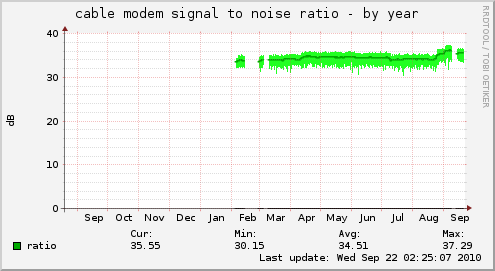
Munin plugin cablemodem powerlevel Munin plugin cablemodem signal noise ratio Guess you can easily figure out when I had issues with my cable connection.

22 September 2010

Vincent Sanders: I like driving in my car. It is not quite a Jaguar

I work from home, this is a good thing. I benefit from a 20 metre commute, comfortable working environment and generally low carbon lifestyle.

Except on Wednesdays, on Wednesday I have to get up early and go to the office, this is not usually too much of a chore and takes around 90 minutes each way.

Today was different, I made a small five minute diversion to collect a colleague to whom I was giving a lift and then due to a little problem near the M6/M61 junction spent a fun filled three hours sitting in traffic crawling along the M56. At least I had company instead of being on my own.

Before I did the return journey I decided to check the traffic news sites. Oh dear now the M60 was stuffed, I altered the route and only had to queue on the M56 for twenty minutes or so. I dropped my colleague off at his place (avoiding the worst bits of the M62/M66 junctions by use of a rather convoluted back route) and proceeded to queue on the M62 for a while for no apparent reason.

Basically I have spent almost seven hours in the car today to do a 150 miles or a little over 20 miles per hour average. I was just going to rant about the dreadful lack of any redundancy or resilience in the UK road system which often grinds to a complete and utter halt if there is a single failure.

However a different thought has wandered across my travel weary mind. It has occurred to me that this average speed is faster than anyone could reasonably expect to do this trip for the majority of human existence.

In 1810 and indeed for all time before, your best possible speed by good horse, for 150 miles, would have been two days (and your horse would have probably been very poorly afterwards) This assumes your horse could do the 75miles (120km) each way in times consistent with modern world endurance trials... across a mountain range! Yes the Pennines are only tiny but even so!

A hundred years later, in 1910, the British railway network was nearing its zenith in most measurable terms. The influence across the north of England was profound and pushed the industrial revolution ever faster towards its climax before the first world war. Even at this point in time my best reading of the available timetables says I would have needed to change trains four times each way, purchased eight separate tickets from six different companies and taken around nine hours to make the journey allowing for hanging around on platforms.

Another fifty years on, in 1960, the trans-pennine car journey would have been on poorly maintained trunk routes through the decaying cores of the declining post-industrial northern cities. The route would probably have involved the A646, A59 or the A58 which at this time were not the well maintained (if slightly shabby) roads of today but instead were dangerous twisty and, from the looks of the archive photographs, positively heaving with traffic. On these pre-motorway strips of tarmac the 150 mile round trip would have taken in excess of seven hours (even today's mapping systems suggest over four and a half hours would be needed)

So instead of being frustrated that my commute took an extended period today I have instead decided that I shall enjoy the fact it was faster and certainly more comfortable than at any time in the past. Well that and I need to get the cars air-conditioning fixed ;-)


Gunnar Wolf: Damage control: Cleaning up compromised SSH keys

This morning, my laptop was stolen from my parked car while I was jogging. I do not want to make a big deal out of it. Still, even though I am sure it was not targetted at my data (three other people at least were reporting similar facts in the same area), and the laptop's disk will probably just be reformatted, I am trying to limit the possible impact of my cryptographic identification being in somebody else's hands. GPG makes it easy: I had on that machine just my old 1024D key, so it is just matter of generating a revocation certificate. I have done that, and uploaded it to the SKS keyservers - Anyway, here is my revocation certificate:
-----BEGIN PGP PUBLIC KEY BLOCK-----
Version: GnuPG v1.4.10 (GNU/Linux)
Comment: A revocation certificate should follow
iHIEIBEIADIFAkyaOZwrHQJBIGNvbXB1dGVyIGNvbnRhaW5pbmcgdGhpcyBrZXkg
d2FzIHN0b2xlbgAKCRDYDvNai7UnrzWAAKC34eF76JQjxrZqSjNwcC0dU/5VbACg
gMIMmYg91Sl3y8KsZXdGj/rV7UE=
=rdlT
-----END PGP PUBLIC KEY BLOCK-----
But What worries me more is access to the computers my ssh key works for. Yes, the ssh key uses a nontrivial passphrase, but still SSH keys cannot be revoked (and this makes sense, as SSH should not add the delay, or potential impossibility, to check with a remote infrastructure whenever you want to start a session). So, I generated a new key (and stored it at ~/.ssh/id_rsa.new / ~/.ssh/id_rsa.new.pub) and came up with this snippet:
  1. $ OLDKEY=xyHywJuHD3nsfLh03G1TqUEBKSj6NlzMfB1T759haoAQ
  2. $ for host in $(cat .ssh/known_hosts cut -f 1 -d \ cut -f 1 -d ,
  3. sort uniq); do
  4. echo == $host
  5. ssh-copy-id -i .ssh/id_rsa.new.pub $host &&
  6. ssh $host "perl -n -i -e 'next if /$OLDKEY/;print' .ssh/authorized_keys"
  7. done
Points about it you might scratch your head about: Caveats: Oh, by the way: If you noticed me knocking on your SSH ports... please disregard. Possibly at some point I connected to that machine to do something, or it landed in my .ssh/known_hosts for some reason. I currently have 144 hosts registered. I am sure I triggered at least one raised eyebrow. And I will do it from a couple of different computers, to make it less probable that I miss some I have never connected from while at the particular computer I am sitting at right now. So... Any ideas on how to make this better?

Bernd Zeimetz: refactoring the guruplug server plus - part two

Although the modifications described in my last blog post about refactoring the GuruPlug resulted in a well working GuruPlug, I've decided to give it some more air to breath at the top of the case. The large round piece of plastic in the middle asked to be removed - and now a shiny 60mm fan grill protects the board from the bad world outside of the case. GuruPlug Server Plus case with fan grill (1/2) GuruPlug Server Plus case with fan grill (2/2) So far its working fine and not too hot. Guess I'll see what happens next summer.

Luca Bruno: Report from the Debian/Ubuntu Community Conference, ITA 2010

From the 17th to the 19th of September in Perugia, Italy, it took place the 5th edition of the Italian Debian Community Conference, which has been attended by many contributors and users. For the first time, the event has been organized in collaboration with the Italian Ubuntu community, as to create a new joint conference in order to foster shared contributions and emphasizing the large common ground of our projects. This new experimental kind of mini-conference was then labeled DUCC-IT, to reflect both the local profile and the mutual collaboration. After the initial social night, spent discussing of several ongoing free software efforts and having dinner all together, the conference official opening started on Saturday, temporarily housed at University of Perugia, with a series of talks and hands-on session aimed at recruiting new contributors to work on development, translations, documentation writing and marketing. It has been a good opportunity to celebrate the Software Freedom Day too, in collaboration with FSUG Italia and the participation of some local schools.

DUCC-IT '10 Group Photo The event been also attended by some members of the Debian Women and Ubuntu Women teams (whose goal is to promote women participation in both projects), who organized a round-table debate taking the Italian panorama as a study case. The discussion embraced different topics, ranging from the wide difference in numbers, to the deep causes of this phenomenon and how to improve the situation. With the help of the hacklab staff (hosting the debate), an audio/video streaming has been made available in real-time, and many remote participants joined us with comments and questions. This new kind of collaboration between our communities was found to be really positive and more events has already been drafted for the next year, including a translation sprint and a contributors meeting. We encourage worldwide local communities to try and engage in a similar experiment: organizing and joining a DUCC event will be pure fun. A detailed report of the conference will be soon available, completed by photos, participants comments, video records and slides for the talks.
We d really like to thank the Math Department of University of Perugia, the Projectz On Island hacklab, FSUG Italia, the Ubuntu-it community and everyone who contribute to this event.

Michal &#268;iha&#345;: Fixing phpMyAdmin bugs in Launchpad

Once in a time when looking at my Debian Developer's Packages Overview, I just start to think there is way too much bug reports for phpMyAdmin package in Launchpad. Today the threshold was 30 :-). Managing them is usually not that hard, because vast majority of them are just duplicates of same issue. Basically all problems come with the fact that dbconfig-common really does not behave nicely when database server is not configured and user tries to configure it. I know people should just answer no to first question, whether to use dbconfig-common, but they don't and it then horribly fails. Today I finally decided to ignore all errors from dbconfig-common in our packaging scripts, so you will get an error, but the package will be installed. As it seems that this is what most Ubuntu users expect after all. This also shows huge difference between Debian and Ubuntu users - such bug has never appeared in Debian bug tracker, but has zillions of duplicates in Launchpad in various incarnations (LP#618852, LP#621569 and the most favorite LP#456674).

MJ Ray: Best Email Server Features

I m putting together a list of email server features that you should look for. I m thinking:

Transport Layer Security support -
this successor to SSL means that your connection will be encrypted. You want this so that your email and your login details aren t being intercepted. Unless you trust everything between you and your mailserver completely, this is pretty much a minimum requirement.
A good login method, probably either CRAM-MD5 or APOP -
you want this so that you aren t simply sending your password over the network. Your connection might be encrypted, but this is a belt-and-braces approach.
IMAP rather than POP -
Internet Message Access Protocol usually offers many more features than the antiquated Post Office Protocol. POP usually shoves all your email through your virtual letterbox, junk or not, and dumps it on your computer. IMAP is more like telling a postman which email to deliver where and when. You can create folders on the server (as well as on your local computer), you can delete junk mail before you download its bodies and it s easier to access your email from multiple locations like your desktop and your phone. QMUL has a longer comparison but nearly everyone would be better off with IMAP.
Sieve configuration -
Now I m getting really optimistic. A Sieve file is an instruction file of standardised mail filtering rules. They re a little harder to write, but should be much easier to move between Sieve-compatible mailservers.
So do you agree with those as desirable features, and would you add more?

Jonathan McDowell: No, you can't have my password

I got pulled up on my password policy yesterday; I don't tell other people my passwords. The context was arranging that a friend could use my laptop while I was away at work - instead of telling her my login details so she could use that I created a new account. This provoked a "Don't you trust me?" response. I couldn't quite manage to successfully articulate the fact that I did trust her, I was aware that unsupervised physical access meant that it was easy enough to gain access anyway but that I just wouldn't hand over my password. It's not like there's anything confidential or that isn't backed up on there. The password is for that machine only. My GPG key doesn't live on it, so the biggest effort if it was attacked would be rolling the SSH key (that has a passphrase, of course) for that machine. And yet I couldn't bring myself to do it. This is nothing unique to this instance; I spent 13 years with Katherine and she never knew my passwords nor had root access to any of my machines. I can imagine situations where I'd share root, but even then I wouldn't share my personal password.

Do I come across as untrusting, or is anyone else like this too?

(In the interest of full disclosure I have actually handed over my password [more accurately, changed it temporarily to something else] to someone in a work context, but it was really, really hard for me to bite my tongue and not respond with a curt "Shouldn't you be able to gain the appropriate access as you are part of IT anyway?".)

21 September 2010

Russ Allbery: Lightweight DNS servers

Since I got a lot of responses to my previous journal entry about tinydns, I wanted to share the answers with everyone else (and with search engines) in case anyone else was wondering the same thing. The general consensus choice for a simple authoritative DNS server was NSD (which is also packaged for Debian, currently as nsd3). I took a brief look and indeed it would do what I want. It's still a bit more complicated than I would prefer, but nowhere near as bad as BIND, and it handles all modern DNS features (IPv6, DNSSEC, etc.). Several people mentioned unbound, which looks like a great solution for a different problem than the problem that I have. It's a caching DNS server rather than an authoritative DNS server, although it supports some authoritative overrides. There was also one recommendation of PowerDNS (Debian package pdns-server and friends), which I'd heard of before and which I think I'd turn to if I was looking for a full-featured DNS server. I think it's overkill for my tiny problem, but it has the neat feature that you can run an arbitrary command to provide DNS responses. That means that it could potentially replace lbnamed, should we need something with more features for some of the DNS tricks that we do with Stanford. Finally, tinydns development hasn't completely stopped since djb stopped working on it, and there are maintained forks that have patches to support new record types. Still no DNSSEC support that I'm aware of, but continuing to use it with patches to support SRV and AAAA records is quite appealing, since I much prefer the zone file format (the "standard" zone file format is a horrible bodge) and, of course, I'm already familiar with it. If a new version were packaged for Debian, I'd probably just keep using it. And as a bonus follow-up from my original post, on the topic of the divergent handling of iptables for IPv4 and IPv6, Martin Krafft recommended ferm, which looks very interesting but which I haven't yet investigated further.

Bastian Venthur: Weird Konsole Split

Can someone explain me the purpose of (KDE s) konsole s ability to split?
You can split horizontally or(!) vertically but the resulting terminals are just mirroring the activity of the first one. What is the usecase for that? Yakuake does splitting right. You can split several times horizontally and vertically and the resulting terminals are independent. You can also switch the focus of the terminals easily via keystrokes which makes yakuake an invaluable tool when working on the terminal under KDE. So what s the point of konsole s variant of splitting?

Richard Darst: The DebConf travel sponsorship process

This is a guest post by Michael Schultheiss, DebConf10 travel sponsorship team lead.DebConf doesn't just provide sponsored food and accommodation to attendees, it can also provide travel reimbursement to 20-30 attendees each year, from all over the world.The travel sponsorship team has historically been formed by a call to debian-devel-announce for developers to review sponsorship requests. This has resulted in one of the most transparent review teams of DebConf, which is by design since this is one of the hardest decisions to make. A team of about ten people will review applications. The travel sponsorship team is typically comprised of both people with past travel sponsorship team experience as well as new members to help make the process as fair as possible. The team will consider the listed workplans, the answer to the question "what do you do for Debian", their general knowledge of Debian contributors, and web searches of Debian lists, debian.org, and the web in general, looking for Debian and free software related activities.Applicants are rated on a 1-5 scale of contributor level and amount requested. These are averaged and sorted, and this is used as the basis of travel sponsorship - but is subject to human review for special cases. The team will then decide the cutoffs for the different queues - for example, DebConf10 used queue A which had money released first, queue B which was released after more fundraising, and queue C which was told "no". After these queues are decided, most of the selection team doesn't need to be as active, but anyone from that team can work with the organizers to decide percentages of funding of the queues and when to commit money to them, based on our budget.Attendees submit documentation for actual flight costs after the conference, and can be reimbursed for min(actual_costs, amount_requested).There are various problems with this system, which are pretty well known but not so easy to fix:These questions are hard to answer. I'm encouraged that there are some discussions on debconf-team which are working towards a better system. Most importantly, these people want to start early, which is almost guaranteed to result in a better outcome for everyone. If you are interested in working to improve the travel sponsorship process, I encourage you to get involved in the team and start early.Tags: debconf

Joey Hess: solar charge controller adventure

Xantrex controller, temporarily badly installed
As planned I have installed the Xantrex C-35 charge controller in the offgrid house. This was a bit of an adventure.. First I had to wait around in town all day for the UPS man to deliver the thing. Of course he didn't until 4, so by the time I got over to the house it was almost dusk. Further delayed by necessary visiting with the nearest neighbor (a country thing), who claims there are "panthers" up this holler.. So by the time I was ready to work, it was nearly too dark. First I checked the battery bank which I had left charging for a week without a controller or backflow diode. It had gained only half a volt (to 10.5v), so now I knew I really did need the controller in order for the sun to work for me while I am away. Then, barely able to see, I swapped that bank to provide house power. By 10 pm, using just my laptop, I'd drained 1.5 volts from it and it was as low as it should go. I had 4 hours of laptop battery. This was a bit of a problem since I tend to stay up until 3 am on it. Instead, I spent 2 hours, by kerosine lantern light, exposing, tracing, and testing wiring. I was able to find 2 wires that were clearly going to the battery bank and had current, and 2 others that were labeled as going to the panels, and, in the dead of night, had no current. Great, I thought, that's the wires I need, let's hook up the controller.. And I did, although only to the battery, since after all I couldn't be certain the other two wires were for the panels, without seeing voltage on them in the daytime. (This turned out to be probably wise, because in the morning, when I tried it, the controller reported no PV voltage. They turned out to be mislabled, and actually connected the battery to the breaker box.)
The problem with doing all that stuff at midnight is it took me quite a long time to wind down. I normally start winding down at 10 am and get to sleep at 3. Last night I got to sleep at 5. My four hours of battery for my laptop were nursed all hours through the night. Mostly thanks to powertop and the improved power saving of the kernel these days. And to not having wifi or anything enabled. I do wonder if my recent use of redshift to redden the screen causes the it to use less power at night, as I have never gotten five hours out of this laptop before.
Anyway, to get the controller hooked up to the PV array and actually charging the batteries, I ended up having to rip lots of wiring out of the wall, until I simplified the mess to something I could understand. And at the moment I've bypassed the PV array's breaker, which is certainly a safety hazard. So more wiring to do, but I did get it working. Finally, I hooked the house wiring up to the same battery bank that is being charged from the panel. This house had been using a 2 battery bank setup, because without a charge controller to moderate the PV voltage (17-25 volts), you can't also connect a load that expects 12 volts. The charge controller fixes that problem. The other battery bank is sitting unused for now. Later, I will equalize and connect the two, in order to get one large(ish) battery bank. Now, during the sunny fall daytime, I can use all the power I want; it's free from the sun. Battery bank shouldn't drain at all when I use power during the day, and the controller should charge them up and keep them topped off, so they'll be there for me at night. Now to verify that it's working like it's supposed to!
(I posted some documents and more thoughts from this here).

Daniel Kahn Gillmor: hotmail thinks powerpc means mobile

Apparently, live.com thinks that any browser coming from a ppc architecture is a mobile device. This sucks for the users of the hundreds of thousands of powerpc desktops still in service. I don't use hotmail myself, but i do support people who use it. I set one of my clients up with debian squeeze on their PPC machine because all the proprietary vendors have basically given up on that architecture -- debian represents the best way to get modern tools on these machines (and other machines too, but that's a different argument). However, this client couldn't get to their hotmail account, despite using the latest version of iceweasel (3.5.12). They were directed to a crippled interface that didn't include the ability to attach files, and was a gross waste of the desktop screen space. It appears to be the "mobile" version of live.com's services. However, the same version of iceweasel on an i686 test machine could access the standard version of hotmail with no trouble. My friend jeremyb helpfully suggested fiddling with the User Agent string exported by the browser. Some experimentation shows that the presence of the string "ppc" within any parenthetical expression in the UA makes live.com show the crappy interface. You can try it yourself (if you have a hotmail account) on your x86 or amd64 machine by adding (ppc) to the default valule of general.useragent.extra.firefoxComment in about:config. Stupid stupid stupid. I'd like to have fixed this by overriding the browser's reported architecture (or simply by removing it -- why does a web server need to know the hardware architecture of my client?). But there doesn't appear to be a way to do that with the way that mozilla constructs the UA. Instead, i needed to add a new string key named general.useragent.override which is not exposed by default in about:config. This raises some questions: Any ideas?Tags: browser, hotmail, powerpc, ppc, useragent, wtf

Rapha&#235;l Hertzog: Everything you need to know about conffiles: configuration files managed by dpkg

The Debian policy dictates that package upgrades must take care of preserving user changes to configuration files. This article will explain you how most packages ensure this. This is important knowledge for anyone who has to manage upgrades: knowing how it works lets you easily automate most of it and deal correctly with the fallout. How dpkg manages configuration files Most packages rely on dpkg to properly install configuration files. Dpkg keeps a checksum of the last installed version of configuration file. When it must install a new version, it calculates the checksum of the currently installed file and if it doesn t match anymore, it knows that the user has edited the file. In that case, instead of overwriting the configuration file, it asks the user what to do. You probably already have seen those questions, they look like this:
Configuration file  /etc/bash.bashrc'
 ==> Modified (by you or by a script) since installation.
 ==> Package distributor has shipped an updated version.
   What would you like to do about it ?  Your options are:
    Y or I  : install the package maintainer's version
    N or O  : keep your currently-installed version
      D     : show the differences between the versions
      Z     : start a shell to examine the situation
 The default action is to keep your current version.
*** bash.bashrc (Y/I/N/O/D/Z) [default=N] ?
In this specific example, if you answer Y or I (for yes or install ), dpkg will install the new version of /etc/bash.bashrc but it will also backup the current version in /etc/bash.bashrc.dpkg-old. If you answer N or O (for no or old ), dpkg will install the new version in /etc/bash.bashrc.dpkg-dist and /etc/bash.bashrc is left untouched. The two other answers allow you to examine the differences before taking a decision. Note that if you choose to start a shell, the new version is currently available as /etc/bash.bashrc.dpkg-new (and since Squeeze there are convenient environment variables $DPKG_CONFFILE_OLD and $DPKG_CONFFILE_NEW in case you want to create a custom review script). All configurations files managed by dpkg are called conffiles because that s the name of the field where they are recorded in the dpkg database. You can display the list of conffiles for any package:
$ dpkg --status bash
[...]
Conffiles:
 /etc/skel/.profile ecb6d3479ac3823f1da7f314d871989b
 /etc/skel/.bashrc 2afdd6c53990f2387a7ef9989af0bc07
 /etc/skel/.bash_logout 22bfb8c1dd94b5f3813a2b25da67463f
 /etc/bash.bashrc 5b3c3bc73d236e4e1b6f9b6c1ed5964e
[...]
The command dpkg-query --showformat='$ Conffiles \n' --show bash can give you the same information if you need to retrieve only that field. The 32 characters after the filename are the MD5 checksum of the original configuration file provided by the package. Avoiding the conffile prompt Every time that dpkg must install a new conffile that you have modified (and a removed file is only a particular case of a modified file in dpkg s eyes), it will stop the upgrade and wait your answer. This can be particularly annoying for major upgrades. That s why you can give predefined answers to dpkg with the help of multiple --force-conf* options: If you use Apt, you can pass options to dpkg with a command-line like this:
$ apt-get -o Dpkg::Options::="--force-confdef" -o Dpkg::Options::="--force-confold" dist-upgrade
You can also make those options permanent by creating /etc/apt/apt.conf.d/local:
Dpkg::Options  
   "--force-confdef";
   "--force-confold";
 
Bringing up the conffile prompt at any time The conffile prompt is only displayed when dpkg detects that the package provides an new version of the conffile. Thus reinstalling the same package will not bring up the prompt. But you can instruct dpkg to ask nevertheless with the --force-confask option. This is a new feature in Debian Squeeze. It will only ask for files that are locally modified.
If you want to read more articles like this one, click here to subscribe to my free newsletter. You can also follow me on Identi.ca, Twitter and Facebook.
Flattr this Share/Bookmark 4 comments Support my work

Next.

Previous.