Search Results: "uli"

9 December 2006

Julien Blache: ATI drivers suck

I am still trying to get the ATI drivers to work properly with my X1600 Mobility card. And things are only getting worse. I still cannot get the crt1 output to work, although the driver detects the VGA monitor connected to it. Enabling both lvds and crt1 doesn’t cut it. No, really, it doesn’t fucking work. No signal, no nothing. But now I am getting segfaults every time I try to use a multimedia player, be it vlc or xine, even when explicitely using a good old x11 video output (ie, no XVideo), and the machine won’t resume anymore after a suspend to ram when fglrx is loaded. Gee, instead of releasing such crappy drivers, can’t you just release the specs ? Moreover they won’t accept bug reports from me because the machine is a laptop. Morons.

8 December 2006

Evan Prodromou: 17 Frimaire CCXV

One problem with keeping your journal in the French Revolutionary Calendar is that you have to keep looking up what the date is. It is nice to know that there are functions for converting Julian dates to French Revolutionary dates in PHP. Also a nice link on that page to the strange and mellow http://bottoms-dream.de/ , which isn't anywhere near as pornographic as it sounds. tags:

Blinky Redux I had Blinky Hockey again tonight -- the first time in a month that I've gone. (Blinky is the pickup hockey team my friends Meg and Patti started. It's for people who don't play hockey so good but want to learn. Like me.) Last time we had it, I flew out to California at 6AM the next day for 2 weeks, so I missed two practices in between. And then last time I had everyone over for Thanksgiving dinner, and I fell asleep putting the baby down. Doh. So it was good to go out this time around. I've been going to our local hockey rink, Ar na Mont-Royal, for free skating from 4-5PM a couple of times per week since we got home, and I think I'm getting a little steadier on the ice. I still haven't got the whole stop-on-a-dime thing or skate-forwards-backwards-forwards thing, but I'm able to get around without going face down. Which is good. Tonight we did some more sophisticated drills and had a good scrimmage at the end of practice. I didn't score but I had an awesome shot. It would have been cool if it were a score. Anyways, I think I'm going to have to keep practicing on my own. Going to the Ar na is great, but maybe I should fill our parking lot out back with water, like this R ves de Glace site suggests. That'd be cool. tags:

Calendar wishlist So, I'm always trying to learn to use my calendar application, whatever's easiest and most available. I have a Treo 650 and Evolution, and they work OK, but they don't work great. I have a lot of things that I wish calendar programs had.
  • Project management integration. This is probably the biggest one for me. I can't believe that we have two different kinds of programs for planning the exact same information: what you're going to do with your time. On top of that it's remarkable that so few of project planner programs talk to calendars (or vice versa).
  • Hierarchical TODO lists. I'd like to break up tasks into sub-tasks that depend on each other.
  • Effort estimates. I'd like to be able to make notes about how long I think a task is going to take, and when I'll get it done.
  • Repeating TODOs. Probably the most egregiously un-ergonomic thing about modern calendaring programs. Almost everything I have to do in my life I have to do on a repeating schedule. I have to take out the recycling once a week before Wednesday morning. I have to pay rent before the 1st. I understand it's a tricky problem, but that doesn't mean I don't want a program to do it.
  • Open invitations. I'd like to be able to send open event invitations to mailing lists and have people RSVP automatically (if they want). All the systems I've used require that I know the email address of each invitee ahead of time. And they rarely work across calendaring systems.
  • Skipped TODOs. Sometimes I give myself a task todo and I just don't get around to doing it. I'd like to be able to mark a task as not done, but no longer important. I don't want to forget it forever, just remember that it never got done.
  • Logging. It'd be nice if there were more and nicer interfaces to say what I did with my day after it's done. When did I finish that module? When was the last time Niko came over for dinner? It would be nice if my calendar helped me remember the past as well as plan the future.
  • Sharing by default. I want to set up calendar sharing once, have my local and remote calendar synched transparently, and never worry about it again. CalDAV seems neat, but I have got no idea how to get it working.
  • More shared calendars. I like using shared calendars; I wish more organizations published them. I'd like it if Bell Canada published a calendar that told me when to pay my phone bill, and I'd like it if MSLUG published a calendar of their meetings. I'd like it if I could mark my phone bill as paid, and RSVP for an MSLUG meeting, through my calendar interface.
  • ACLs. Different people need to see different parts of my calendar. It'd be nice to have finer-grained control than "public" and "private".
tags:

5 December 2006

Julien Danjou: Where is my Etch

With your bug count in the air and your Etch on the ground
Try this trick and spin it, yeah
Your RM will collapse
But there's nothing in it
And you'll ask yourself Where is Debian?
Where is Debian?
Where is Debian? Way out in the money
See it dunkin' I was squasin' for free
Bugs were hiding behind the money
Except the little board
But they told me, he swears
Tryin' to release me me me
Where is Debian?
Where is Debian?
Where is Debian? Ooooh
With your bug count in the air and your Etch on the ground
Ooooh
Try this trick and spin it, yeah
Ooooh
Ooooh Thanks to The Pixies.

Brett Parker: And here goes the update...

Fantastic beginning to the weekend - was in Norwich from Thursday, saw the Dave and the Becca on thursday night - many many thanks to them for floor space thurs and fri and for generally just being fantastic people (with tea *and* coffee, no less - and a silly beepy tivo box for even more fun - and for introducing me to the american chopper type show thingummy - and for letting me watch the a-team!) Then, serious amounts of thanks to Noodles and Kathy (who I appear to not be able to find a link for :( ) for inviting me to the wedding and the reception - was fantastic - you're both such absolutely lovely people! Pictures so far appear to be available from Becca and Dave, Burly and Steve McIntyre - hopefully more soon... specially from Dave Noble (can't find him *bah* he needs more google juice the damned slacker ;) which should be cool! Saturday was absolutely brilliant - including talking about atmosperic physics, failing a-levels, and random universities doing questions (hey, I can't entirely remembere - someone bought a half barrel of nero and some port, and lots of red wine... I wasn't *entirely* sober ;). Saturday morning was a bit of a blur - I remember watching the A-Team and then food in the Glass House with Dave and Becca (thanks guys, you rock!) then I wandered to the Fat Cat and met with Eli and Dave Noble, a while later Rob and James and Kaz arrived and we played Munchkin, which was a very very silly game but quite fun (thanks James and Kaz - you're both mildly insane - but it's always fun when you come to the pub!). Went home with Eli, tried to escape because of the annoying giggly evil students from hell, started wandering back towards the train station and a random bench to sleep on, then got emotional black mail and ended up back at Eli's - ho hum. Went to catch train at around 10am Sunday morning - discovered trains from Norwich weren't running - replacement bus service from Norwich to Diss left Norwich at around 10:25am, got to Diss, had a 10 to 15 minute wait there (mmmmm, bacon roll and a coffee!) then straight to Liverpool Street, wandered straight off to the underground and got the circle line to Victoria, got to Victoria around 13:40 ish, wandered to look at the boards and saw a 14:17 from Victoria round half the planet to Brighton - thought to myself "not in any rush" and wandered off and found food and then wandered round the WHSmith in Victoria station.... got out of there, glanced at the board again, Victoria to Brighton train had been cancelled - wondered what to do - announcement over the tannoy that to get to Brighton the best idea was to travel to East Croyden and the train would meet us there. So, grabbed that train, got to East Croyden, jumped on the train (first 8 carriages Brighton, back four Plymouth... so, jumped on somewhere around the 7th carriage from what I thought was the front - turned out to be the back - wasn't entirely sure what was going on so when it stopped at Gatwick wandered further to the front of the train a lot, found an empty pair of seats and sat down. Got to Three Bridges and there was a delay, it was announced on the train as "We're waiting for the conductor, he's missed a train and is currently in a taxi, there's at least a 10 minute delay before he gets here", so a load of us bundled out of the train on the basis that that was very much long enough for a cigarette break - just as we were finishing the conductor turned up, so we all got back on the train for the "scenic" route to Brighton (yay for going round the coast), finally got in to Brighton at 17:05, so wasn't too bad, only about 6 and a half hours for a 3 and a half or 4 hour train journey ;). Grabbed chinese on the way home, watched some Morse - all was well with the world. Lots of beeping this morning around 8.30am, ignored it, finally re-woke up at about 10:30am (ish) - watched some more Morse, grabbed some lunch and then watched more Morse until going to the pub quiz tonight. Charly, Julius and Pieter turned up for a quick drink and then all left me to fend for my self at the quiz - I came in my usual place - very last (by over 20 points, no less ;) - but had fun, so who cares :) Anyways - it's now tuesday morning, so probably time for some good ol' fashioned sleep type stuff... might put on the next episode of Morse for the hell of it (might even manage to stay awake through it!). Tomorrow is probably more Morse, some work on the django packages (just got the first bug report in for those) and possibly applying some of the patches to the scrobbler packages to close some of those bug reports too. It appears that upstream for xmms-scrobbler has disappeared a bit, so might have to look at that a lot closer over the next few months - have some time off work soon - last day this year being the 15th (also happens to be when work are planning the "christmas do"). Wow - that was a ridiculously longer post than I though it was going to be! Night all!

2 December 2006

Jaldhar Vyas: The Real Meaning of Nalanda

Venkatesh Hariharan recently wrote an article on Indias traditions of knowledge and how Open Source meshes with them. Now having met him at foss.in and knowing of his work, I am 100% convinced he is on the side of the angels and their is no malice in what he wrote. However, his interpretation (really not his, but the conventional wisdom amongst the Indian elite.) of Indian history and culture is so monumentally wrong it bears correction. While I admit my hackles were raised by the cultural and theological mistakes made, there are implications for Open Source advocacy in India and the world at large too. He starts by giving the example of Nalanda, supposedly "the first university in the world." but more accurately a Buddhist vihara (monastery.) Its' very name indicated sharing. I use the past tense because Nalanda doesn't exist anymore. In fact except in a few border areas influenced by Tibet or Burma, Buddhism itself is so thoroughly extinct in the land of its birth, the place where it flourished for over 1500 years, that the only reason people like Hariharan or myself only know that there ever was such a thing due to the work of 19th century Western Indologists. How could this be? One theory is that a resurgent Hinduism coopted or persecuted the Buddhists into oblivion. However this is unsatisfactory. It does not explain why Jainism (a religion as old as Buddhism and equally heretical for exactly the same reasons from the Hindu point of view) still survives to this day and it doesn't explain how it could have happened for even the most advanced genocidal regimes of the 20th century have been unable to "disappear" undesirables to the extent which Buddhism disappeared. A more plausible explanation revolves around the fact that, as I mentioned before, places like Nalanda were Viharas. This doesn't mean that they can't have university-like properties too; after all the great academic institutions of Europe also had religious foundations but the monastic nature of a vihara is salient. A monastery is not a place you go to engage the world, its a place you go to escape it. To mix metaphors a bit, the viharas were cathedrals not bazaars. While there may have been a lively intellectual life within its walls, there is no evidence that Nalanda and its denizens interacted much with the surrounding culture. An economically unproductive institution of such vast size (15,000 monks at its peak) could only survive by the patronage of kings and other rich people. When that patronage dried up as for example when the medieval Muslim invasions swept away the old royalty, Nalanda and its sisters couldn't survive. Just as when a proprietary software company dies, its "intellectual property" often dies with it, when centralized Buddhism died, Buddhist ideas died with it. (Luckily Buddhism had spread to other countries by then and developed new, less monolithic forms so it was not lost to the world altogether.) In contrast Hinduism (and for that matter Jainism) while having all due respect for monks were and are primarily lay movements. The pursuit of morality (Dharma), wealth (artha) and pleasure (kama) in this world are equally valid human goals alongside liberation from the world (moksha.) and this manifested as the much maligned institution of caste. Hariharan quotes the conventional view probably familiar to Westerners from Anthropology 101, a lock-step hierarchy of four classes (varna is the Sanskrt word) with fixed occupations, with knowledge and privilege on top and ignorance and oppression at the bottom. The thing is, this view bears no relationship whatsoever with social reality in India now or historically. There is another Sanskrit word, jati, which can be translated as caste. There are thousands of these jatis and while Indian thinkers have periodically attempted to try and shoehorn them into the varna framework, they have had little success and varna is for all practical purposes just a theory. And this is not just a fall from some putative golden age (Like the canard that once caste was flexible and merit based and only later became rigid.) but the state of affairs throughout recorded history.

A jati consists of people who share a common (or fictive) kinship, who have particular food and ritual choices, and marry endogamously. While many jatis are associated with a particular occupation, many others are not. This is what caste means to a typical Indian (it is also the social organization prevalent amongst Jains, Sikhs, Muslims and Christians even if they don't accept its theological basis.) Yes, hierarchy and concommitantly oppression, are in some cases a byproduct of casteist thinking but they are hardly its raison d'etre. A comparison can be made to the Western nuclear family system. Some people think it is superior to any other form of social organization. Most people wouldn't go that far but go along with it as "the way it is." Some of those of a liberal persuasion might want tweaks of certain aspects of it. A very small fringe think it is nothing more than a nefarious plot to spread patriarchy, subjugation and racism etc. They are mostly considered kooks by the other groups. (Unfortunately when India and caste are concerned, the kooks are ruling the roost.) The diversity of jatis like the diversity of open source creates a certain resistence to disruption that a monoculture cannot. Thus though Hinduism also suffered grievously from invasions, it was able to hold on where Indian Buddhism could not. Brahmin (sic. That's an English mispronounciation.) is also misinterpreted as one who knows Brahma (masculine noun. The Creator God.) instead of Brahman (neuter noun. The supreme spirit pervading the Universe.) though even then it would be wrong because Brahmin, Brahma, and Brahman all come from a common root word brhati (feminine noun. Sacred speech.) as any Sanskrit dictionary will attest. Hariharan cites the example of the sacred scriptures (Sic. He means the Vedas) and the notorious statement of the Manusmrti saying that an unqualified person who hears them should have molten lead poured into their ears as examples of the proprietarization of knowledge. Now the long-suffering untouchables may have been afraid of many things but having lead earplugs was not one of them. There is no historical evidence that any such action was ever attempted. You can criticize the Manusmrti for even saying such a thing but that is a far cry from using it as evidence of historical attitudes. You see, the Manusmrti is not even in the most orthodox conception Hindu Sharia and the Vedas are not "Sacred Scriptures" in the sense that the Bible or Koran are. Rather they are part of a wide range of significant literary works respected in Hinduism of which other important examples are the two Epics the Mahabharata (which includes the Bhagavadgita), and the Ramayana, and the vast compendia of geneologies, philosophy, lore and legend called the Puranas. Hariharan actually missed a good chance to make his point here because while the Vedas are indeed "proprietary" the other works I mentioned are not and have in fact permeated all over India and even beyond its borders. Many Indian languages owe their literary existence to translation of the epics or Puranas. For instance one of the earliest monuments of Hindi literature is the Ramacharitamanasa, Saint Tulsidas's translation of the Ramayana. When he wrote it in the 16th century, he did face some opposition from those who didn't think such an august work should be rendered into a "vulgar" tongue, he also received encouragement from equally orthodox people (including those who believed the Vedas should be restricted to Brahmins) Today it is by many accounts the most popular Hindu holy book in existence. So really the whole idea that the Hindu canon shows a fall from open grace to rigidly controlled private property is just bogus. To those who have slogged their way though all this verbiage wondering what it has do with Linux and Open Source, let me assure you I am getting to the point :-) It's bad enough from my point of view as a devout Hindu that my religion would be misrepresented this way but from my point of view as a supporter of Free Software ideals, it is catastrophic. Linux and Open Source in India has spread, as in most parts of the world, primararily as a hobby amongst computer enthusiasts and for a hobby it's doing ok. However if you think of it as more than that, as a tool to enhance society and empower peoples lives, that is not nearly good enough. But how can one serve a society if one apparently has no clue about that societies history and mores? The developing world is littered with failed projects that were carried out with the purest of motives but no regard to what the putative clients actually wanted. Do we want Linux and Open Source deployments to go the same way? For a couple of years now I've been trying to get Indian and NRI programmers to get involved in localization in debian-installer and elsewhere but even with the small minority that are sympathetic to Open Source (a scandal in itself.) it is like pulling teeth. To their credit, Red Hat India pays people to work on such things but volunteerism is the heart of the Open Source movement as we all know so the apathy of Indian IT professionals is deeply troubling. Hariharan is trying to increase interest by appealing to the Indians' sense of cultural pride which is a good tactic--it has been successfuly applied by many non-western or minority cultures--but he is not going to be very successful if the vision of Indian culture he is presenting is as alien as Eskimo culture to the vast majority of the people. Western Open Source advocates also run into difficulties due to being tone-deaf in their understanding of how third-world cultures actually operate. When India declined to participate in the One Laptop Per Child (OLPC) project, some commentators on places like Slashdot were perplexed. Wouldn't a poor country want an inexpensive yet efficient pc using free software instead of high-priced imports? The thing they missed is that while people in India may be poor, thanks to a more-or-less democratic polity and more-or-less open communications, their frame of reference is no longer their village. Their trends are increasingly set in Mumbai, New York, Paris, and London. The forward-thinking amongst them know that computers are the key to the future. They also know Bill Gates is the richest man in the world thanks to something called "Windows" knowing which can get you a green card and your own chance of becoming rich. So if Linux comes along, presented as a cheap alternative which is "just as good", the fake Gucci handbag of IT if you will, it is not going to impress. Thinkpads and Dells appeal to the upwardly-mobile persons vanity, a third-world hand-cranked laptop does not. (This incidently is what is behind the "Nalanda university" meme too. Monasteries are yesterday. Universities are the in thing so we have to have some in our past and not just any but by golly, the first university in the world.) When they venture from pure technology into the realm of culture, Open Source advocates need to be a lot more sophisticated, not to mention accurate, in their arguments lest they fall on deaf ears. Platitudes and sentimentality about "spiritual" versus "material" culture aren't enough. There must be concrete demonstrations of the benefits of why the Open Source approach to knowledge is better. They must be more sensitive in their presentation to avoid needlessly antagonizing people who might otherwise be natural allies. I believe the Open Source ideal is good for India and the whole world, not just in software but for society at large and I wish Venkatesh Hariharan and all the others on the frontlines of the fight for openness the best of luck. But good intentions cannot excuse sloppy thinking.

1 December 2006

Pierre Habouzit: I hate closed-minded people ...

Edit: to be fair to the GCC crew, it seems the guy who closed me the bug to the face was not very representative of'em. Thanks to them to their very good compilation suite btw ! a bit of history I've been bitten today by a problem due to the fact that I use the gcc __attribute__((nonull(...))) as a hint in my C headers to say to the programmer that it's up to him to check if what it pass to my function is NULL, or not. I had written (erouneously) that bit of code:
/* in the .h */
__attribute__((nonnull(1)))
char *m_strrtrim(char *s);
/* in the .c */
char *m_strrtrim(char *s)
 
    ssize_t len = s ? strlen(s) : 0;
    while (len > 1 && isspace((unsigned char)s[len - 1]))
        len--;
    return s + len;
 
I've added the __attribute__((nonnull)) by mistake, and indeed sometimes used m_strrtrim on strings that I knew to be NULL. The point is, gcc is able to use the nonnull attribute to optimize code, and that's very legitimate. In my case, it optimized the s ? strlen(s) : 0 into strlen(s). And without surprise, it caused segfaults. I had a hard time finding that bug, because I've never thought that it could come from the header. As it could not come from the m_strrtrim function, I've looked very hard for stack overwrite and so on in the caller, but even valgrind did not catched anything interesting (except an invalid read size of 1 in strlen). It's when (in order to see if it was a gcc optimization bug) I've generated the preprocessed source that I saw the damn prototype in the preprocessor output, and that was suddently obvious to me why it segfaulted. the wishlist bug Since it was quite an unusual problem, that can make you loose a lot of time, because the bug lies very far from where it's revealed, I've opened a wishlist bug in gcc to ask for a warning when you test some pointer against NULL that you should already know to be non-NULL. like the warning about always true (or always false) comparisons for e.g.:
size_t len;
// ...
if (len >= 0)   ... // always true
if (len < 0)   ... // always false
That's gcc bug#30043. Or I should say was. My bugreport has indeed be closed a first time as INVALID, because the reader thought I said the gcc optimization was not legitimate (*sigh*). I reopened it explaining more precisely that I only begged for a warning, not for anything else, and that YES I DID READ THE DOC. The bug has just been closed as WONTFIX this time, with an explanation that still makes me stare at it with a blank look:
I don't think a warning is the right thing in this case because the developer should have read the documention [ ]
WTF !? If reading the documentation can make you a perfect programmer that never do any mistake, then god, I must be a super-mega-coder that always write perfect code ! Sadly, reading the doc do not prevent you to avoid cuts (aka segfaults) when you juggle with razorblades (aka code in C). I can understand that it's hard to do in the present state of GCC, and that's it's not an urgent feature, given how peculiar that request is. But I'm completely stunned to see that a guy that is in the compiler business just consider that a warning is useless, and that the documentation is the key answer. I use an over-long compilation line in my projects [1] [2] especially because a compiler is really better than me to catch many kind of errors. And it's vital to do so. I've seen too many people that only compile with gcc -g -O2 and optionnally with -Wall when they don't forget it. But from a guy in the compiler business, well, that's just yet-another-illusion that collapses.
Notes [1] -g -pipe -O2 -funsigned-char -fstrict-aliasing -Wall -Wextra -Wchar-subscripts -Wundef -Wshadow -Wcast-align -Wwrite-strings -Wsign-compare -Wunused -Wno-unused-value -Wuninitialized -Wpointer-arith -Wredundant-decls -Wmissing-prototypes [2] I usually also add some format string checks, to forbid to pass a non immediate format string, and also -Werror because a warning is in 90% of the cases an error, in 9% of the cases tasteless programming style, and in 0.9% trivial to workaround.

Julien Blache: mbpeventd v0.3 - MacBook Pro hotkeys event handler daemon

mbpeventd is an event handler daemon for the hotkeys found on the MacBook Pro. It also handles the keyboard backlight, turning it on automatically when the ambient light is low. Volume adjustment is currently not supported, but will be supported in a future version. Only the Core2 Duo MacBook Pro (MacBookPro2,2) is supported at the moment. If you own a Core Duo MacBookPro, please send me the output of the getSystemId or sysid command from the libsmbios-bin package so I can add support for this machine too (and you’ll volunteer to test the new version, of course ;-)). Sources and AMD64 package available on http://people.debian.org/~jblache/pkg/mbpeventd/ As usual, no warranty, your laptop may crash, burn or explode while using this software and it may rape your goldfish or whatever pet your happen to own. Works for me ™. Patches for MacBook support (LCD backlight for the Intel GPU) are welcome. Patches for ALSA sound support are welcome too. mbpeventd includes the Radeon Mobility X1600 backlight routines written by Nicolas BOICHAT. Thanks !

Julien Danjou: DeFuBu contest #5

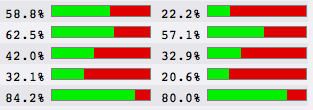
Bug Welcome to this 5th issue of the DeFuBu contest, the monthly championship of the funniest bug reported to the Debian BTS. The challengers How the vote has been done Four Debian related people voted for these bugs, Philipp Kern, Julien Louis, Cyril Brulebois and David Pashley. Full ranking Bugs Challengers The winners Congratulations to Joey Hess, two victories in a row :-) Notes To participate, simply drop me an email with a bug number. About DeFuBu
28 November 2006

MJ Ray: Business: Cooperatives SW

I attended the Cooperatives SW annual meeting in Taunton on Monday 27 November because it covers the new home of Turo Technology. Sadly, headline speaker Dame Pauline Green was unable to attend, but someone else from Cooperatives UK (I think it was John Goodman, but I can't find a name in my notes) gave the keynote presentation about the current state of the cooperatives and current trends. Among the figures, there was the pretty astonishing Global 300 which lists the biggest 300 cooperatives and mutuals in the world. The list contains some names I didn't expect and also some names in different positions than I expected. Some things are less surprising: almost every country has agricultural cooperatives and the UK (with mutual insurers, building societies and credit unions) and France are particularly strong in financial cooperatives. Apparently, the Global 300 will be updated as and when results are published, so watch that space. More items from the Cooperatives SW meeting soon.

Matthew Palmer: VLAN adventures

Have you ever had a need for a large number of "real" network interfaces on a Linux box? For security reasons, you don't just want to hook everyone up to a single switch and use virtual interfaces (because it's too easy for one of the connected devices to play silly buggers with his neighbours). Up to a certain point, you can stuff more NICs into a box, and when it fills up you can switch to those outrageously expensive 2- and 4-port NICs. But eventually you're going to run out of space[1] or money. At that point, you need something more interesting. For me, this week, that "more interesting" has been Ethernet VLANs. Linux Journal has a good intro to the technical aspects of how to setup VLANs and Linux. VLANs are some crazy stuff. They're implemented by wrapping a little number around every Ethernet frame indicating which VLAN the packet is "on", and the switch (you need a higher-end device, appropriately configured) makes sure that packets don't roam onto ports they're not meant to be on. For a single switch, this isn't very interesting, and you don't really need an IEEE standard to make it work -- just a lot of little jumpers. However, VLANs are mostly useful on larger networks, which tend to use more than one switch. So you need a way for your VLANs to roam amongst your switches -- hence the packet tagging. You stick the tag onto the packets and fling them off to another switch, and packets coming in with the tag are corraled into their VLAN. Naturally, you don't want end-user devices whacking their own VLAN tags onto packets (untrusted data, and all that), so you define most of your ports as being "untagged". Packets that come in on these ports are treated as regular ethernet frames and tagged with the appropriate VLAN ID, and packets that go out have their VLAN IDs stripped before being sent. (This implies that you can tunnel VLANs in VLANs, and I'm pretty sure that is doable in most switches, modulo some nasty problems that can, and probably will, occur). The ports that aren't designated "untagged" spit out tagged packets -- and this is where my interest lies. Like most every other computer-related standard, Linux can decipher and work with VLAN tags (the 8021q module is what you're looking for). You just load up the module, hook your NIC into the appropriate port on your very expensive switch, define your VLAN tags with vconfig, and suddenly you've got vlanN interfaces, which map to real RJ-45 ports, and you can hang network devices off these and get lots and lots of "real" network interfaces on your Linux router. It's all so simple, right? Nothing ever is, of course. The trials and tribulations I've had over the past two days have included: Thankfully, once all those dramas were done, the whole thing just kind of fell into place, and now I've got a machine which has up to 2048(ish) network interfaces (with huge, glaring caveats on that upper bound, of course). With a bit of luck, the live installation in a couple of days will go smoothly. You can stop sniggering now.
1. In this case, there wasn't a lot of space to begin with, as it's a 1RU box I'm working on, and the 4-port NIC didn't want to place nice with me for some reason anyway.

26 November 2006

Julien Blache: Debian AMD64 on the Core2 Duo 15 MacBook Pro

So I’ve got my shiny new laptop which should complement my 5 years old PowerBook G4 500 MHz and had a bit of fun installing Debian AMD64 on it. I did it the hard way, not using debian-installer as it was a given for me that both the kernel and debian-installer itself were unable to deal with the machine. Installation method: Note that you do not need to install BootCamp on Mac OS X. On the Core2 Duo machines, the firmware already includes the SMBIOS stuff, so you’d only install a useless Mac OS X GUI which you can’t use because you’ve repartitioned before running BootCamp Assistant :-) Current status: most of what should work with Linux sort of works (that is, to say, everything but the WiFi). Things that do not work: Everything else works, and works fine. Wrote a small daemon to handle the special keys for LCD backlight, sound, keyboard backlight and CD ejection. Still needs a bit of polishing, after what I’ll release and package it. rEFIt isn’t available in Debian AMD64 yet, so gptsync isn’t available and must be run from an i386 system for the time being (plus gptsync is buggy on 64bit architectures). Patches ready, waiting for GNU-EFI on amd64 (#383801). Suspend to RAM and suspend to disk both work, use s2ram -f -p -m until the machine makes it into the built-in whitelist. The machine is pretty nice, though I’d appreciate it if the fans weren’t running at 5500 rpm when I have the laptop on my laps. Might be related to both the applesmc and power consumption issues. WiFi remains the biggest issue, battery life comes second ex-aequo with DVI-I output and sound is third. I’m quite unhappy with having to taint my kernel by using the fglrx (and madwifi in the future) proprietary crap, and even more when it doesn’t work as good as it should. Maybe RMS was right about ATI.

25 November 2006

Biella Coleman: Play Money by Julian Dibbel

A few months ago I finished Play Money by Julian Dibbel and like his My Tiny Life before it, the writing style is simple yet sumptuous, or I guess just simply sumptuous. Like the travel writings that pre-figured anthropological writing, Dibbel takes us to a far-away exotic land (but only a click or two away) that are populated by a motley crew of wizard (or is lizard)? slayers, gold-diggers, money-makers, and virtual-world-builders. For many, these MMOGsare no strange-lands but are becoming weaved firmly and intimately into the fabric of everyday life, whether as entertainment, sociality, and or for a cadre of folks, as a source of income generation. I think the book has gotten enough coverage that I don’t need to rehearse its content in any detail but the basic story is that Julian embarks on a real world quest in the virtual land of quests to try to make enough money (to be specific make a little more than his monthly salary as a freelance writer) from trading and selling a slew of virtual objects and gold. In taking us along, he gives a compelling entry into the imaginative and morally complex world of these games. And better is that whether you know nothing about them or are a seasoned player, the book has much to offer. One of the reasons I respect Julian Dibbel is because he takes his sweeeet time to churn out a book-length manuscript. In a day and age when there is so much pressure to release quick and often, especially when writing about anything in the so-called virtual plane of existence, he waited nearly 8 years from the publication of his last book on gaming, My Tiny Life before publishing on a considerably higher-tech phenomenon. Following him on his most recent adventure, you learn that he threw himself into a variety of gaming environments persistently and consistently and did at least 3 years of research and writing (at one point in the book he confesses how excruciating writing for him, which is hard to believe as the words slip so nicely off the paper but whatever the extent of his writing angst is, he clearly spends a lot of care in crafting his sentences). And I am starting to think that if more people followed this ethic of long-term immersion, coupled with slow-brewed productive sparsity, we would get higher quality products (Yes, kinda like the Debian release cyclce). Like any good ethnographer, he gives an intimate portrait of life in these worlds of copious play where various types of real world economies have mushroomed apace with new technological developments. That is, he gives us a taste of what it is like, as he cleverly puts it to own unreality. Couched within tales of gaming gone real world economic, are hearty reflections on the place of play in social and economic life, the close resemblance and conceptual affinity between computers and games (and not just computer games, and here he does a fantastic job at explaining the Turing Test), self-doubts about writing in general and in particular about this topic, commodity fetishism, and the changing nature of capitalism in a world of ever-greater abstractions. All of this makes for an enjoyable read that if used in the classroom (which like A Tiny Life, I am sure will become standard for courses on Virtual Worlds) allows you to bring in some good supplemental material whether Edward Castranova’s Synthetic Worlds, Greg Lastowka and Dan Hunter’s The Laws of Virtual Worlds and or older heavy-hitters like Max Weber and Karl Marx. The only topic I think I would have liked to seen included is that of capitalist finance, because there are, I think, some real affinities, phenomenologically and conceptually, between finance capitalism and gaming the virtual game. Otherwise some of my favorite sections were on hackers and the object of the computer, but of course, I am biased that way. So here I leave you with a tasty morsel of something that was sumptuous to ingest: It is this endlessly repeatable collusion of freedom and determinism-the warp and woof of fixed rules and free play, of running code and variable input that sets both games and computers apart, together from the larger universe of information technologies they inhabit…. But only games share the universal machine’s game’s thoroughgoing commitment to the principle of recursion: the chained repetition of simple operations, each building on both the input of the moment and the outcomes of preceding steps. And only games, therefore, come close to capturing that precise mi of unpredictability and inevitability that makes the computer such a powerful simulator of our lived experience of the world. p. 104

24 November 2006

Evan Prodromou: 3 Frimaire CCXV

I think there's a certain special sloth that Americans get to experience on the day after Thanksgiving that we don't get on other parts of the year. Something about the combination of gluttony and wholesomeness makes Black Friday a very mellow, enjoyable time. Maybe it's the fact that it's officially now The Holiday Season, but the stressful tasklist of December hasn't started yet. Or maybe just that it's a day off of work for no good reason except it just is. Maybe it's the fridge full of leftovers that still taste kind of good. I dunno. We had a good Thanksgiving dinner yesterday evening. Maj, Amita June and I had planned to go visit family in New Brunswick (New Jersey) for the holiday, which was really nice to do last year. But our visas are running out in December, and although we're (probably) not going to have a problem renewing them, our lawyer said it was a bad time to leave the country. So, we stayed in Montreal for Thanksgiving. Canadians have their own Thanksgiving, of course, on the 2nd Monday of October, but not having grown up with that day as Thanksgiving, and with most of our family celebrating in November, it's hard to get motivated around Canadian Thanksgiving. And it's just not that big a deal in Quebec, anyways. So we had a good dinner here; John Usher, Niko, Jeff Waye, Meg and Patti all came over and had a good time of it. I cooked my first Thanksgiving dinner -- a big salmon, potatoes and sweet potatoes, roasted broccoli and wax beans, a great big salad. Every family has a Thanksgiving dish tradition -- one of the Prodromous' is a big pot of macaroni and cheese. So I made that, too. We all ate pretty well, drank some wine, talked about the future of music and how fun it is to play hockey. Unfortunately, I managed to miss my Blinky Hockey practice last night -- I tried to put the (overtired) baby to bed at 10PM and ended up falling asleep myself. All in all a good TG, even though far from family. tags:

Speaking of home All of Canada is abuzz right now about a recently-proposed bill by the ruling Conservative Party in Parliament to declare the Quebecois to be a nation within Canada. Sovereignty of Quebec has been an extremely contentious issue in Canada over the last 50 years (two sovereignist parties are major players at the federal and provincial level), and this form of recognition is an interesting step. The whole thing began with Michael Ignatieff, a candidate for the leadership of the opposition Liberal Party. He has stated publicly that Quebec is indeed a nation, and his followers are pushing to have that be part of the Liberal Party platform. The sovereignist Bloc Quebecois tried to steal their thunder by introducing a bill in parliament to the same effect. Their thunder was in turn stolen by the Government with the latest bill, which now has the support of all the parties and will almost definitely pass. The wording of the bill is interesting. First, it calls the Quebecois a nation -- the people themselves, not Quebec qua territory or government. Although the government has stated that this includes all people in Quebec, it's still pretty obviously targeted towards recognition of an ethnic group, French-speaking Quebecois, more than everybody who's living inside the borders. Second, it recognizes this group as a nation within Canada -- deflating the suggestion that it may become an independent state. I have to admit that the ambiguous nature of Quebec's status is one of the things I find fascinating about living in Montreal. As far as I can tell, few sovereignists hope for anything like a total split with Canada, but instead are looking for some sort of autonomous status. On the other side, even the staunchest federalists have seemed comfortable with granting Quebec more of an international profile, such as giving Quebec a formal role in UNESCO. My guess is that the nature of Quebec's relationship with Canada will change gradually until it reaches some stable point where everyone's comfortable. I don't know where that stable point is, but I think it'll be interesting to find out. At the turn of the 20th century, if you had told people that the British, Austrian, Turkish and Russian Empires would be dissolved and almost forgotten within 100 years, they would have scoffed. But in that short span of time, the idea of empire, spheres of influence, and Great Powers has passed from the world stage. We simply don't think in terms of Empire any more, but in terms of nation-states. My guess is that the 21st century will see a similar change in the idea of nation-state. With pressure from supranational organizations like the UN, EU, GATT and the International Criminal Court, as well as pressure from unrecognized nations like Quebec and Catalunya and Wales, I think the firm borders of the nation-state are going to loosen up a lot. What it will mean is anyone's guess, but I think if we're lucky we'll have a richer tapestry of nations and people participating in global politics and culture. And I think Quebec will be an important part of those changes. tags:

Thanks, Biella! I'm glad to see that Biella is going to give us the goods on PR. Our Wikitravel 2007 Get-together is going to be on the island of Puerto Rico, and Biella's from there, so she's going to make up a list of good places to check out. Great news! tags:

Edd Dumbill: New release of XmlIndexer search server

About 18 months or so ago I released the first version of XmlIndexer, a general purpose XML indexing web service based on Mono and Lucene.Net.I'm happy to announce now version 0.4 of this software which, thanks to improvements in Lucene.Net and patches from the Beagle hackers, is a lot more stable. Previous versions had some nasty locking issues that could kill the server quite dead.XmlIndexer is a simple indexer. Given a rulefile that maps XPaths to Lucene keys, it can be taught to index any XML file you should care to give it. I use it to provide search functionality to legacy applications, which then need only to expose their data as XML and call a few simple web services to perform a search.Of related interest is the new Apache Incubator Solr project, which provides a fancy search server based on Lucene, doing the same as my indexer, and much more.XmlIndexer requires Lucene.Net version 1.9.1. For extra points, apply the locking patches from Beagle to Lucene.Net before building. As a courtesy I include a Lucene.Net DLL I made this way in the download.Download: searchxml-0.4.tar.gz

23 November 2006

Edd Dumbill: Planet XMLhack updated

With apologies to all those who have waited too long, I've finally refreshed Planet XMLhack with bugfixes and updates. It's also moved server, so the changes might take a day or so to propagate for you.Changes of note include:Feel free to contact me with any other suggestions.

Edd Dumbill: Really really getting the testing religion

Writing tests is virtuous. It's the wholemeal bread of programming. Do it, and you'll be so much fitter. Except it tastes like cardboard and gets in the way of consuming the yummy treacle sponge of programming. But now I've got the testing religion. I view the lack of tests with the disapprobation of a reformed smoker tutting and huffing at the merest suggestion of a Marlboro Light. How did this happen and how can I be sure I won't backslide? The moment of transition was the first time that a test saved me from releasing software with a bad bug in it. The theoretical knowledge of virtue was translated into the palpitating relief of not disgracing myself in public. After that happened a few more times, I found myself desperately uncomfortable with the idea of releasing anything that didn't have decent test coverage. And so a virtuous habit is formed. It's not just driven by fear. With the right tools to hand, writing tests can be a lot of fun. You don't always need to be "in the zone". If you've got a spare half hour here and there, you can use it to increase the coverage of your tests. Getting better at testing is one of the ways I've become a much more proficient Rails developer over the last year of work on Expectnation. In case it helps anybody else, I thought I'd share some of the tools and techniques that are part of making Rails testing fun and effective. Continuous testing Whenever a checkin is made to our source repository, tests are run and the results emailed to everybody working on the project. As with the "you broke the build" disincentive, you need to be kept honest by frequent running of the tests. There are a variety of tools around to help you do continuous integration with Rails, most of which have some dependence on you using Subversion for source control. In the event, I just created my own script to do what we required. Coverage reports rcov coverage barsOne of the big mental hurdles with testing is knowing how many tests you should aim for.  You can't prove a negative: even if your tests are all passing it still doesn't tell you much about the tests you haven't written that might fail! We use rcov as part of the continuous integration process, and post the results to our project web site. The pretty red and green bars give you some idea of when you're starting to get adequate test coverage, and the line-by-line breakdown is invaluable. Tainting strings One of the easiest errors to make in Rails templates is to miss the call to h(), to escape any HTML in an output string. The only real way to catch these errors is through automation. The wonderful safe_erb plugin helps you do just that. By using Ruby's tainting mechanism for strings, it throws an exception if you render any external data unescaped. One of the beneficial side effects of safe_erb is that you then become very particular about ensuring your functional tests properly cover every action in your application.  Tests such as get 'index', which before seemed mundane and redundant, are now essential, as you want to test for tainted strings. In addition to the above techniques, there are a lot of fun shiny gadgets to help you write tests, such as ZenTest, but the three things above are the ones I've found to be of significant value. I ought to conclude with words of praise for Rails. It goes out of its way to make testing an important part of the development lifecycle, and the availability of the of unit, functional and integration test functionality makes it easy to get started. Every time I teach somebody about Rails' testing features, they end up finding it very enjoyable.
Don't forget, testing can be fun!

22 November 2006

Edd Dumbill: Three things I would be doing if we had Thanksgiving in the UK

Working as much with the US as with the UK, Thanksgiving is always a noticeable holiday for me, even if I still have to work. If I had the luxury of the holiday this year, I'd be
  1. Staying up all night to follow The Ashes. Sporting competitions founded in the 1880s don't have much regard for television and radio audience hours, alas.
  2. Going to evensong at York Minster. The intimate and historic choir is an amazing experience at this time of year, as the candles take over from the weak winter sun.
  3. Encouraging people to use the holiday to prepare their submissions for XTech 2007. Springtime in Paris and top technology seems like something to look forward to.
As it happens, I'll do No. 3 anyway and reluctantly miss out on the others. Happy Thanksgiving to my friends and colleagues in the US.

20 November 2006

Julien Danjou: Freevo packaging on its way

So this week-end Cyril Lacoux began to work on packaging freevo, which never got into Debian for a reason I still ignore. All I found is a 4 year old ITP from Matt Zimmerman who closed id some weeks later because he decided to give up and use MythTV instead. ;-) There's now a project on Alioth and we will probably get a working package soon, since we began to commit this morning.

19 November 2006

Jeff Bailey: Google for your Domain

I've been playing with Google for your Domain over the past couple of weeks for Angie and my's email. A few observations so far:

1) Still a bit worried that Google now has a pile of my data. I don't know that there's a way to resolve this. I'm wondering if there's a way of doing GPG overlays onto gmail? For the most part I don't really care, but it would be nice to preserve the option of doing a local decryption.

2) It's nice to use my email address for my Jabber account finally. No more having to remember to check the gmail account from time to time to see if someone decided sending an email there would be a good idea. I should probably do the same with my hotmail account.

3) Google talk and Orkut don't play along with GfyD.

4) Google's incremental improvements are cool. In the past week they added customised start pages, which means that I can see my mail and calendar from a start page. The start page isn't as fully featured as the original start page (historical searches, various customer applets, etc. don't work), but looks alot like it did awhile ago.

5) gmail doesn't have a way of filtering on mailing lists. This annoyed me at first, but now is more of a reminder that I should unsubscribe from lists that I don't actually read anyway. The volume on the rest is low enough that I can continue to filter by hand.

Update: It seems that gmail *can* filter on mailing lists, it's just not documented. I've just setup a filter for listid:bug-gnulist.gnu.org and it seems to work. Use it in the "Has the words" section of the filter. Bug #83778177 filed with gmail for an update to http://mail.google.com/support/bin/answer.py?answer=7190

Holger Levsen: stuff I did today

Prepared an upload for the new upstream version of tuxmath (two small bugfixes only), who thankfully got sponsored again and immediatly by by Kari Pahula - thanks again! A new upstream maintainer for tuxtype has also been found, btw & yay!

Finished setting up failive.debian.net, which in future will automatically build two fai-cds (currently only one), for fully automatatic installation of the booted system. To better reflect that those are not the usual live-cds, the vhost will soon be renamed to faicd.debian.net...

I also want to mention edulive.debian.net here, though I have done nothing about it today. This should become a replacement for the current handmade live-cd, but currently its stalled by ENOTIME and these two RC bugs.

Speaking of debian-edu, I spent some parts of this afternoon to create this statuspage for the skolelinux repository which got me more familar with dak and which will hopefully help us keeping the archive in a good state :-)

Testing d-i RC1 on powerpc newworld was boring: d-i worked flawlessly and the g-i mini.iso didn't boot. Will reburn and retry, but I don't have great hopes on that one. The mini.iso from beginning of November worked nicely though, so it's a minor issue.

Next.

Previous.