Search Results: "pa"

27 July 2024

Bits from Debian: DebConf24 welcomes its sponsors!

DebConf24 logo DebConf24, the 25th edition of the Debian conference is taking place in Pukyong National University at Busan, Republic of Korea. Thanks to the hard work of its organizers, it again will be an interesting and fruitful event for attendees. We would like to warmly welcome the sponsors of DebConf24, and introduce them to you. We have three Platinum sponsors. Our Gold sponsors are: Our Silver sponsors are: Bronze sponsors: And finally, our Supporter level sponsors: A special thanks to the Pukyong National University, our Venue Partner and our Network Partners KOREN and KREONET! Thanks to all our sponsors for their support! Their contributions make it possible for a large number of Debian contributors from all over the globe to work together, help and learn from each other in DebConf24.

24 July 2024

Kentaro Hayashi: apt-upgrade-canary - PoC apt JSON hook use case

apt-upgrade-canary is a helper program to alert when upgrading packages via apt. If there are some packages which causes a critical or serious bug, it shows warnings for terminal. Then you can stay on current version of package by canceling upgrades. This program is aimed to help not to installing problematic packages via manual upgrades. Usually, you should delegate package upgrade to unattended-upgrades and apt-listbugs. apt-listbugs kindly warns if there are known bugs. In most cases it is enough safer. But there is one exception, it is not true that always apt-listbugs can follow very latest critical or serious bugs in timely manner. apt-upgrade-canary checks UDD mirror database (it take into account to cache query not to throw redundant one frequently)

Getting started
  1. Install required packages.
$ sudo apt install -y make ruby-pg ruby-json ruby-term-ansicolor
  1. Clone https://salsa.debian.org/kenhys/apt-upgrade-canary.
  2. Just sudo make install.

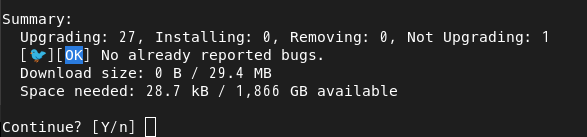
Use case in action If there is no serious bugs which is reported against target packages, apt-upgrade-canary reports no error.
apt-upgrade-canary: no problem
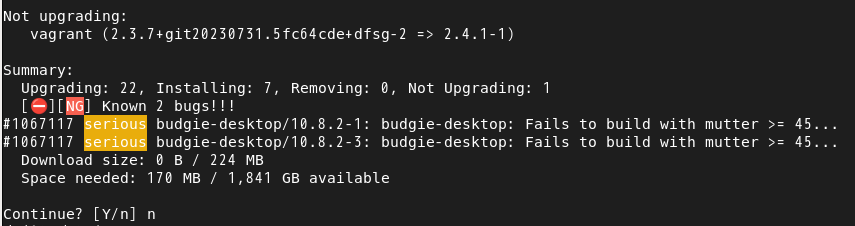
If there are something weird happen, it reports matched bugs.
apt-upgrade-canary: serious case
So you can stay on.

Gunnar Wolf: DebConf24 Continuous Key-Signing Party

Yay, party!

Yay, crypto! DebCamp has started, and in a couple of days, we will fully be in DebConf24 mode! As most of you know, an important part that binds Debian together is our cryptographic identity assurance, and that is in good measure tightened by the Continuous Key-Signing Parties we hold at DebConfs and other Debian and Free Software gatherings. As I have done during (most of) the past DebConfs, I have prepared a set of pseudo-social maps to help you find where you are in the OpenPGP mesh of our conference. Naturally, Web-of-Trust maps should be user-centered, so find your own at: https://people.debian.org/~gwolf/dc24_ksp/ The list is now final and it will not receive any modifications (I asked for them some days ago); if your name still appears on the list and you don t want to be linked to the DC24 KSP in the future, tell me and I ll remove it from future versions of the list (but it is part of the final DC24 file, as its checksum is already final) Speaking of which! If you are to be a part of the keysigning, get the final DC24 file and, on a device you trust, check its SHA256 by running:
$ sha256sum dc24_fprs.txt
11daadc0e435cb32f734307b091905d4236cdf82e3b84f43cde80ef1816370a5  dc24_fprs.txt
Make sure the resulting number matches the one I m presenting. If it doesn t, ensure your copy of the file is not corrupted (i.e. download again). If it still doess not match, notify me immediately. Does any of the above confuse you? Please come to (or at least, follow the stream for) my session on DebConf opening day, Continuous Key-Signing Party introduction, 10:30 Korean time; I will do my best to explain the details to you. PS- I will soon provide a simple, short PDF that will probably be mass-printed at FrontDesk so that you can easily track your KSP progress.

Dirk Eddelbuettel: RQuantLib 0.4.23 on CRAN: Updates

A new minor release 0.4.23 of RQuantLib just arrived at CRAN earlier today, and will be uploaded to Debian in due course. QuantLib is a rather comprehensice free/open-source library for quantitative finance. RQuantLib connects (some parts of) it to the R environment and language, and has been part of CRAN for more than twenty-two years (!!) as it was one of the first packages I uploaded. This release of RQuantLib updates to QuantLib version 1.35 released this morning. It accommodates some removals following earlier deprecations, and also updates most of the code in the function for a more readable and compact form of creating shared pointers via make_shared() along with auto.

Changes in RQuantLib version 0.4.23 (2024-07-23)
  • Adjustments for QuantLib 1.35 and removal of deprecated code (in utility functions and dividend case of vanilla options)
  • Adjustments for new changes in QuantLib 1.35
  • Refactoring most C++ files making more use of both auto and make_shared to simplify and shorten expressions

Courtesy of my CRANberries, there is also a diffstat report for the this release. As always, more detailed information is on the RQuantLib page. Questions, comments etc should go to the rquantlib-devel mailing list. Issue tickets can be filed at the GitHub repo. If you like this or other open-source work I do, you can now sponsor me at GitHub.

This post by Dirk Eddelbuettel originated on his Thinking inside the box blog. Please report excessive re-aggregation in third-party for-profit settings.

Dirk Eddelbuettel: qlcal 0.0.12 on CRAN: Calendar Updates

The twelveth release of the qlcal package arrivied at CRAN today. qlcal delivers the calendaring parts of QuantLib. It is provided (for the R package) as a set of included files, so the package is self-contained and does not depend on an external QuantLib library (which can be demanding to build). qlcal covers over sixty country / market calendars and can compute holiday lists, its complement (i.e. business day lists) and much more. Examples are in the README at the repository, the package page, and course at the CRAN package page. This releases synchronizes qlcal with the QuantLib release 1.35 (made today) and contains more updates to 2024 calendars.

Changes in version 0.0.12 (2024-07-22)
  • Synchronized with QuantLib 1.35 released today
  • Calendar updates for Chile, India, United States, Brazil

Courtesy of my CRANberries, there is a diffstat report for this release. See the project page and package documentation for more details, and more examples. If you like this or other open-source work I do, you can sponsor me at GitHub.

This post by Dirk Eddelbuettel originated on his Thinking inside the box blog. Please report excessive re-aggregation in third-party for-profit settings.

23 July 2024

Russell Coker: More About Kogan 5120*2160 Monitor

On the 18th of May I blogged about my new 5120*2160 monitor [1]. One thing I noted was that one Netflix movie had run in an aspect ratio that used all space on the monitor. I still don t know if the movie in question was cropped in a letterbox manner but other Netflix shows in full screen mode don t extend to both edges. Also one movie I downloaded as in 3840*1608 resolution which is almost exactly the same aspect ratio as my monitor. I wonder if some company is using 5120*2160 screens for TVs, 4K and FullHD are rumoured to be cheaper than most other resolutions partly due to TV technology being used for monitors. There is the Anamorphic Format of between 2.35:1 and 2.40:1 [2] which is a close match for the 2.37:1 of my new monitor. I tried out the HDMI audio on a Dell laptop and my Thinkpad Yoga Gen3 and found it to be of poor quality, it seemed limited to 2560*1440, at this time I m not sure how much of the fault is due to the laptops and how much is due to the monitor. The monitor docs state that it needs HDMI version 2.1 which was released in 2017 and my Thinkpad Yoga Gen3 was released in 2018 so probably doesn t have that. The HDMI cable in question did 4K resolution on my previous monitor so it should all work at a minimum of 4K resolution. The switching between inputs is a problem. If I switch between DisplayPort for my PC and HDMI for a laptop the monitor will usually timeout before the laptop establishes a connection and then switch back to the DisplayPort input. So far I have had to physically disconnect the input source I don t want to use. The DisplayPort switch that I ve used doesn t seem designed to work with resolutions higher than 4K. I ve bought a new USB-C dock which is described as doing 8K which means that as my Thinkpad is described as supporting 5120 2880@60Hz over USB-C I should be able to get 5120*2160 without any problems, however for unknown reasons I only get 4K. For work I m using a Dell Latitude 7400 2in1 that s apparently only capable of 4096*2304 @24 Hz which is less pixels than 5120*2160 and it will also only do 4K resolution. But for both those cases it s still a significant improvement over 2560*1440. I tested with a Dell Latitude 7440 which gave the full 5120*2160 resolution, I was unable to find specs on what the maximum resolution of the 7440 is. I also have bought DisplayPort switch rated at 8K resolution. I got a switch that doesn t also do USB because the ones that do 8K resolution and USB are about $70. The only KVM switch I saw for 8K resolution at a reasonable price was one designed for switching between two laptops and there doesn t seem to be any adaptors to convert from regular DisplayPort to USB-C alternative mode so that wasn t viable. Currently I have the old KVM switch used for USB only (for keyboard and mouse) and the new switch which only does DisplayPort. So I have two buttons to push when switching between input sources which isn t too bad. It seems that for PCs resolutions with more pixels than 4K are as difficult and inconvenient now as 4K was 6 years ago when I started doing it. If you want higher than 4K resolution to just work at this time then you need Apple hardware. The monitor has a series of modes for different types of output, I ve found standard to be good for text and movie to be good for watching movies/TV and for playing RTS games. I previously wrote about how to use ddcutil to use a monitor as a KVM switch [3], unfortunately I can t do this with the new monitor as the time that the monitor waits for a good signal on a new input after changing is shorter than the time taken for Linux on the laptops I m using to enable HDMI output. I ve found the following commands to do the basics.
# get display mode
ddcutil getvcp DC
# set standard mode
ddcutil setvcp DC 0
# set movie mode
ddcutil setvcp DC 03
Now that I have that going the next thing I want to do is to have it switch between standard and movie modes when I switch keyboard focus.

22 July 2024

Russell Coker: Blog Comments

The Akismet WordPress anti-spam plugin has changed it s policy to not run on sites that have adverts which includes mine. Without it I get an average of about 1 spam comment per hour and the interface for removing spam takes more mouse actions than desired. For email spam it s about the same volume half of which is messages with SpamAssassin scores high enough to go into the MaybeSpam folder (that I go through every few weeks) and half of which goes straight to my inbox. But fortunately moving spam to a folder where I can later use it to train Bayesian classification is a much faster option on PC and is also something I can do from my phone MUA. As an experiment I have configured my blog to only take comments from registered users. It will be interesting to see how many spammers make it through that and to also see feedback from genuine people. People who can t comment can tell me about it via the contact methods listed here [1]. I previously wrote about other ways of dealing with hostile comments [2]. Blogging seems to be less popular nowadays so a Planet specific forum doesn t seem a viable option. It s a pity, I think that YouTube and Facebook have taken over from blogs and that s not a good thing.

Martin-Éric Racine: dhcpcd replacing dhclient for Trixie... or perhaps networkd?

My work on overhauling dhcpcd as the prime replacement for ISC's discontinued DHCP client is done. The package has achieved stability, both upstream and at Debian. The only remaining points are bug #1038882 to swap the Priorities of isc-dhcp-client and dhcpcd-base in the repository's override, and swaping ifupdown's search order to put dhcpcd first. Meanwhile, ifupdown's de-facto maintainer prompted me to sollicit opinions on which of the 4 ifupdown implementations should ship with a minimal installation for Trixie. This, in turn, re-opened the debate of what should be Debian's default network configuation framework (see the thread starting with this post). networkd Given how most Debian ports (except for Hurd) ship with systemd, which includes a disabled networkd by standard, many people in the thread feel that this should become the default network configuration tool for minimal installations. As it happens, most of my hosts fit that scenario, so I figured that I would give another go at testing networkd on one host. I used the following minimalistic /etc/systemd/network/dhcp.network:
[Match]
Name=en* wl*
[Network]
DHCP=yes
This correctly configured IPv4 via DHCP, with the small caveat that it doesn't update /etc/resolv.conf without installing resolvconf or systemd-resolved. However, networkd's default IPv6 settings really are not suitable for public consumption. The key issues (see Bug #1076432):
  1. Temporary addresses are not enabled by default. Worse, the setting is ignored if it was enabled by sysctl during bootup. This is a major privacy issue. Adding IPv6PrivacyExtensions=yes to the above exposed another issue: instead of using the fe80 address generated by the kernel, networkd adds a new one.
  2. Networkd uses EUI64 addresses by default. This is another major privacy issue, since EUI64 addresses are forensically traceable to the interface's MAC address. Worse, the setting is ignored if stable-privacy was enabled by sysctl during bootup. To top it all, networkd does stable-privacy using systemd's time-proven brain-dead approach of reinventing the wheel: instead of merely setting the kernel's address generation mode to 3 and letting it configure the secret address, it expects the secret address to be spelled out in the systemd unit.
Conclusion: networkd works well enough for someone configuring an IPv4-only network from 20 years ago, but is utterly inadequate for IPv6 or dual-stack installations, doubly so on a software distribution that claims to care about privacy and network security.

21 July 2024

Mike Gabriel: Polis - a FLOSS Tool for Civic Participation -- Issues extending Polis and adjusting our Goals

Here comes the 3rd article of the 5-episode blog post series on Polis, written by Guido Berh rster, member of staff at my company Fre(i)e Software GmbH. Enjoy also this read on Guido's work on Polis,

Mike
Table of Contents of the Blog Post Series
  1. Introduction
  2. Initial evaluation and adaptation
  3. Issues extending Polis and adjusting our goals (this article)
  4. Creating (a) new frontend(s) for Polis
  5. Current status and roadmap
Polis - Issues extending Polis and adjusting our Goals After the initial implementation of limited branding support, user feedback and the involvement of an UX designer lead to the conclusion that we needed more far-reaching changes to the user interface in order to reduce visual clutter, rearrange and improve UI elements, and provide better integration with the websites in which conversations are embedded. Challenges when visualizing Data in Polis Polis visualizes groups using a spatial projection of users based on similarities in voting behavior and places them in two to five groups using a clustering algorithm. During our testing and evaluation users were rarely able to interpret the visualization and often intuitively made incorrect assumptions e.g. by associating the filled area of a group with its significance or size. After consultation with a member of the Multi-Agent Systems (MAS) Group at the University of Groningen we chose to temporarily replace the visualization offered by Polis with simple bar charts representing agreement or disagreement with statements of a group or the majority. We intend to revisit this and explore different forms of visualization at a later point in time. The different factors playing into the weight attached to statements which determine the pseuodo-random order in which they are presented for voting ( comment routing ) proved difficult to explain to stakeholders and users and the admission of the ad-hoc and heuristic nature of the used algorithm1 by Polis authors lead to the decision to temporarily remove this feature. Instead, statements should be placed into three groups, namely
  1. metadata questions,
  2. seed statements,
  3. and participant statements
Statements should then be sorted by group but in a fully randomized order within the group so that metadata questions would be presented before seed statements which would be presented before participant s statements. This simpler method was deemed sufficient for the scale of our pilot projects, however we intend to revisit this decision and explore different methods of comment routing in cooperation with our scientific partners at a later point in time. An evaluation of the requirements for implementing mandatory authentication and adding support for additional authentication methods to Polis showed that significant changes to both the administration and participation frontend were needed due to a lack of an abstraction layer or extension mechanism and the current authentication providers being hardcoded in many parts of the code base. A New Frontend is born: Particiapp Based on the implementation details of the participation frontend, the invasive nature of the changes required, and the overhead of keeping up with active upstream development it became clear that a different, more flexible approach to development was needed. This ultimately lead to the creation of Particiapp, a new Open Source project providing the building blocks and necessary abstraction layers for rapid protoyping and experimentation with different fontends which are compatible with but independent from Polis.
  1. Small, Christopher T., Bjorkegren, Michael, Erkkil , Timo, Shaw, Lynette and Megill, Colin (2021). Polis: Scaling deliberation by mapping high dimensional opinion spaces. Recerca. Revista de Pensament i An lisi, 26(2), pp. 1-26.

Russell Coker: SE Linux Policy for Dell Management

The recent issue of Windows security software killing computers has reminded me about the issue of management software for Dell systems. I wrote policy for the Dell management programs that extract information from iDRAC and store it in Linux. After the break I ve pasted in the policy. It probably needs some changes for recent software, it was last tested on a PowerEdge T320 and prior to that was used on a PowerEdge R710 both of which are old hardware and use different management software to the recent hardware. One would hope that the recent software would be much better but usually such hope is in vain. I deliberately haven t submitted this for inclusion in the reference policy because it s for proprietary software and also it permits many operations that we would prefer not to permit. The policy is after the break because it s larger than you want on a Planet feed. But first I ll give a few selected lines that are bad in a noteworthy way:
  1. sys_admin means the ability to break everything
  2. dac_override means break Unix permissions
  3. mknod means a daemon creates devices due to a lack of udev configuration
  4. sys_rawio means someone didn t feel like writing a device driver, maintaining a device driver for DKMS is hard and getting a driver accepted upstream requires writing quality code, in any case this is a bad sign.
  5. self:lockdown is being phased out, but used to mean bypassing some integrity protections, that would usually be related to sys_rawio or similar.
  6. dev_rx_raw_memory is bad, reading raw memory allows access to pretty much everything and execute of raw memory is something I can t imagine a good use for, the Reference Policy doesn t use this anywhere!
  7. dev_rw_generic_chr_files usually means a lack of udev configuration as udev should do that.
  8. storage_raw_write_fixed_disk shouldn t be needed for this sort of thing, it doesn t do anything that involves managing partitions.
Now without network access or other obvious ways of remote control this level of access while excessive isn t necessarily going to allow bad things to happen due to outside attack. But if there are bugs in the software there s nothing to stop it from giving the worst results.
allow dell_datamgrd_t self:capability   dac_override dac_read_search mknod sys_rawio sys_admin  ;
allow dell_datamgrd_t self:lockdown integrity;
dev_rx_raw_memory(dell_datamgrd_t)
dev_rw_generic_chr_files(dell_datamgrd_t)
dev_rw_ipmi_dev(dell_datamgrd_t)
dev_rw_sysfs(dell_datamgrd_t)
storage_raw_read_fixed_disk(dell_datamgrd_t)
storage_raw_write_fixed_disk(dell_datamgrd_t)
allow dellsrvadmin_t self:lockdown integrity;
allow dellsrvadmin_t self:capability   sys_admin sys_rawio  ;
dev_read_raw_memory(dellsrvadmin_t)
dev_rw_sysfs(dellsrvadmin_t)
dev_rx_raw_memory(dellsrvadmin_t)
The best thing that Dell could do for their customers is to make this free software and allow the community to fix some of these issues.
Here is dellsrvadmin.te:
policy_module(dellsrvadmin,1.0.0)
require  
  type dmidecode_exec_t;
  type udev_t;
  type device_t;
  type event_device_t;
  type mon_local_test_t;
 
type dellsrvadmin_t;
type dellsrvadmin_exec_t;
init_daemon_domain(dellsrvadmin_t, dellsrvadmin_exec_t)
type dell_datamgrd_t;
type dell_datamgrd_exec_t;
init_daemon_domain(dell_datamgrd_t, dell_datamgrd_t)
type dellsrvadmin_var_t;
files_type(dellsrvadmin_var_t)
domain_transition_pattern(udev_t, dellsrvadmin_exec_t, dellsrvadmin_t)
modutils_domtrans(dellsrvadmin_t)
allow dell_datamgrd_t device_t:dir rw_dir_perms;
allow dell_datamgrd_t device_t:chr_file create;
allow dell_datamgrd_t event_device_t:chr_file   read write  ;
allow dell_datamgrd_t self:process signal;
allow dell_datamgrd_t self:fifo_file rw_file_perms;
allow dell_datamgrd_t self:sem create_sem_perms;
allow dell_datamgrd_t self:capability   dac_override dac_read_search mknod sys_rawio sys_admin  ;
allow dell_datamgrd_t self:lockdown integrity;
allow dell_datamgrd_t self:unix_dgram_socket create_socket_perms;
allow dell_datamgrd_t self:netlink_route_socket r_netlink_socket_perms;
modutils_domtrans(dell_datamgrd_t)
can_exec(dell_datamgrd_t, dmidecode_exec_t)
allow dell_datamgrd_t dellsrvadmin_var_t:dir rw_dir_perms;
allow dell_datamgrd_t dellsrvadmin_var_t:file manage_file_perms;
allow dell_datamgrd_t dellsrvadmin_var_t:lnk_file read;
allow dell_datamgrd_t dellsrvadmin_var_t:sock_file manage_file_perms;
kernel_read_network_state(dell_datamgrd_t)
kernel_read_system_state(dell_datamgrd_t)
kernel_search_fs_sysctls(dell_datamgrd_t)
kernel_read_vm_overcommit_sysctl(dell_datamgrd_t)
# for /proc/bus/pci/*
kernel_write_proc_files(dell_datamgrd_t)
corecmd_exec_bin(dell_datamgrd_t)
corecmd_exec_shell(dell_datamgrd_t)
corecmd_shell_entry_type(dell_datamgrd_t)
dev_rx_raw_memory(dell_datamgrd_t)
dev_rw_generic_chr_files(dell_datamgrd_t)
dev_rw_ipmi_dev(dell_datamgrd_t)
dev_rw_sysfs(dell_datamgrd_t)
files_search_tmp(dell_datamgrd_t)
files_read_etc_files(dell_datamgrd_t)
files_read_etc_symlinks(dell_datamgrd_t)
files_read_usr_files(dell_datamgrd_t)
logging_search_logs(dell_datamgrd_t)
miscfiles_read_localization(dell_datamgrd_t)
storage_raw_read_fixed_disk(dell_datamgrd_t)
storage_raw_write_fixed_disk(dell_datamgrd_t)
can_exec(mon_local_test_t, dellsrvadmin_exec_t)
allow mon_local_test_t dellsrvadmin_var_t:dir search;
allow mon_local_test_t dellsrvadmin_var_t:file read_file_perms;
allow mon_local_test_t dellsrvadmin_var_t:file setattr;
allow mon_local_test_t dellsrvadmin_var_t:sock_file write;
allow mon_local_test_t dell_datamgrd_t:unix_stream_socket connectto;
allow mon_local_test_t self:sem   create read write destroy unix_write  ;
allow dellsrvadmin_t self:process signal;
allow dellsrvadmin_t self:lockdown integrity;
allow dellsrvadmin_t self:sem create_sem_perms;
allow dellsrvadmin_t self:fifo_file rw_file_perms;
allow dellsrvadmin_t self:packet_socket create;
allow dellsrvadmin_t self:unix_stream_socket   connectto create_stream_socket_perms  ;
allow dellsrvadmin_t self:capability   sys_admin sys_rawio  ;
dev_read_raw_memory(dellsrvadmin_t)
dev_rw_sysfs(dellsrvadmin_t)
dev_rx_raw_memory(dellsrvadmin_t)
allow dellsrvadmin_t dellsrvadmin_var_t:dir rw_dir_perms;
allow dellsrvadmin_t dellsrvadmin_var_t:file manage_file_perms;
allow dellsrvadmin_t dellsrvadmin_var_t:lnk_file read;
allow dellsrvadmin_t dellsrvadmin_var_t:sock_file write;
allow dellsrvadmin_t dell_datamgrd_t:unix_stream_socket connectto;
kernel_read_network_state(dellsrvadmin_t)
kernel_read_system_state(dellsrvadmin_t)
kernel_search_fs_sysctls(dellsrvadmin_t)
kernel_read_vm_overcommit_sysctl(dellsrvadmin_t)
corecmd_exec_bin(dellsrvadmin_t)
corecmd_exec_shell(dellsrvadmin_t)
corecmd_shell_entry_type(dellsrvadmin_t)
files_read_etc_files(dellsrvadmin_t)
files_read_etc_symlinks(dellsrvadmin_t)
files_read_usr_files(dellsrvadmin_t)
logging_search_logs(dellsrvadmin_t)
miscfiles_read_localization(dellsrvadmin_t)
Here is dellsrvadmin.fc:
/opt/dell/srvadmin/sbin/.*        --        gen_context(system_u:object_r:dellsrvadmin_exec_t,s0)
/opt/dell/srvadmin/sbin/dsm_sa_datamgrd        --        gen_context(system_u:object_r:dell_datamgrd_t,s0)
/opt/dell/srvadmin/bin/.*        --        gen_context(system_u:object_r:dellsrvadmin_exec_t,s0)
/opt/dell/srvadmin/var(/.*)?                        gen_context(system_u:object_r:dellsrvadmin_var_t,s0)
/opt/dell/srvadmin/etc/srvadmin-isvc/ini(/.*)?        gen_context(system_u:object_r:dellsrvadmin_var_t,s0)

19 July 2024

Dirk Eddelbuettel: dtts 0.1.3 on CRAN: More Maintenance

Leonardo and I are happy to announce the release of another maintenance release 0.1.3 of our dtts package which has been on CRAN for a good two years now. dtts builds upon our nanotime package as well as the beloved data.table to bring high-performance and high-resolution indexing at the nanosecond level to data frames. dtts aims to offers the time-series indexing versatility of xts (and zoo) to the immense power of data.table while supporting highest nanosecond resolution. This release contains two nice and focussed contributed pull requests. Tomas Kalibera, who as part of R Core looks after everything concerning R on Windows, and then some, needed an adjustment for pending / upcoming R on Windows changes for builds with LLVM which is what Arm-on-Windows uses. We happily obliged: neither Leonardo nor I see much of Windows these decades. (Easy thing to say on a day like today with its crowdstrike hammer falling!) Similarly, Michael Chirico supplied a PR updating one of our tests to an upcoming change at data.table which we are of course happy to support. The short list of changes follows.

Changes in version 0.1.3 (2024-07-18)
  • Windows builds use localtime_s with LLVM (Tomas Kalibera in #16)
  • Tests code has been adjusted for an upstream change in data.table tests for all.equal (Michael Chirico in #18 addressing #17)

Courtesy of my CRANberries, there is also a report with diffstat for this release. Questions, comments, issue tickets can be brought to the GitHub repo. If you like this or other open-source work I do, you can now sponsor me at GitHub.

This post by Dirk Eddelbuettel originated on his Thinking inside the box blog. Please report excessive re-aggregation in third-party for-profit settings.

Bits from Debian: New Debian Developers and Maintainers (May and June 2024)

The following contributors got their Debian Developer accounts in the last two months: The following contributors were added as Debian Maintainers in the last two months: Congratulations!

18 July 2024

Enrico Zini: meson, includedir, and current directory

Suppose you have a meson project like this: meson.build:
project('example', 'cpp', version: '1.0', license : ' ', default_options: ['warning_level=everything', 'cpp_std=c++17'])
subdir('example')
example/meson.build:
test_example = executable('example-test', ['main.cc'])
example/string.h:
/* This file intentionally left empty */
example/main.cc:
#include <cstring>
int main(int argc,const char* argv[])
 
    std::string foo("foo");
    return 0;
 
This builds fine with autotools and cmake, but not meson:
$ meson setup builddir
The Meson build system
Version: 1.0.1
Source dir: /home/enrico/dev/deb/wobble-repr
Build dir: /home/enrico/dev/deb/wobble-repr/builddir
Build type: native build
Project name: example
Project version: 1.0
C++ compiler for the host machine: ccache c++ (gcc 12.2.0 "c++ (Debian 12.2.0-14) 12.2.0")
C++ linker for the host machine: c++ ld.bfd 2.40
Host machine cpu family: x86_64
Host machine cpu: x86_64
Build targets in project: 1
Found ninja-1.11.1 at /usr/bin/ninja
$ ninja -C builddir
ninja: Entering directory  builddir'
[1/2] Compiling C++ object example/example-test.p/main.cc.o
FAILED: example/example-test.p/main.cc.o
ccache c++ -Iexample/example-test.p -Iexample -I../example -fdiagnostics-color=always -D_FILE_OFFSET_BITS=64 -Wall -Winvalid-pch -Wextra -Wpedantic -Wcast-qual -Wconversion -Wfloat-equal -Wformat=2 -Winline -Wmissing-declarations -Wredundant-decls -Wshadow -Wundef -Wuninitialized -Wwrite-strings -Wdisabled-optimization -Wpacked -Wpadded -Wmultichar -Wswitch-default -Wswitch-enum -Wunused-macros -Wmissing-include-dirs -Wunsafe-loop-optimizations -Wstack-protector -Wstrict-overflow=5 -Warray-bounds=2 -Wlogical-op -Wstrict-aliasing=3 -Wvla -Wdouble-promotion -Wsuggest-attribute=const -Wsuggest-attribute=noreturn -Wsuggest-attribute=pure -Wtrampolines -Wvector-operation-performance -Wsuggest-attribute=format -Wdate-time -Wformat-signedness -Wnormalized=nfc -Wduplicated-cond -Wnull-dereference -Wshift-negative-value -Wshift-overflow=2 -Wunused-const-variable=2 -Walloca -Walloc-zero -Wformat-overflow=2 -Wformat-truncation=2 -Wstringop-overflow=3 -Wduplicated-branches -Wattribute-alias=2 -Wcast-align=strict -Wsuggest-attribute=cold -Wsuggest-attribute=malloc -Wanalyzer-too-complex -Warith-conversion -Wbidi-chars=ucn -Wopenacc-parallelism -Wtrivial-auto-var-init -Wctor-dtor-privacy -Weffc++ -Wnon-virtual-dtor -Wold-style-cast -Woverloaded-virtual -Wsign-promo -Wstrict-null-sentinel -Wnoexcept -Wzero-as-null-pointer-constant -Wabi-tag -Wuseless-cast -Wconditionally-supported -Wsuggest-final-methods -Wsuggest-final-types -Wsuggest-override -Wmultiple-inheritance -Wplacement-new=2 -Wvirtual-inheritance -Waligned-new=all -Wnoexcept-type -Wregister -Wcatch-value=3 -Wextra-semi -Wdeprecated-copy-dtor -Wredundant-move -Wcomma-subscript -Wmismatched-tags -Wredundant-tags -Wvolatile -Wdeprecated-enum-enum-conversion -Wdeprecated-enum-float-conversion -Winvalid-imported-macros -std=c++17 -O0 -g -MD -MQ example/example-test.p/main.cc.o -MF example/example-test.p/main.cc.o.d -o example/example-test.p/main.cc.o -c ../example/main.cc
In file included from ../example/main.cc:1:
/usr/include/c++/12/cstring:77:11: error:  memchr  has not been declared in  :: 
   77     using ::memchr;
                  ^~~~~~
/usr/include/c++/12/cstring:78:11: error:  memcmp  has not been declared in  :: 
   78     using ::memcmp;
                  ^~~~~~
/usr/include/c++/12/cstring:79:11: error:  memcpy  has not been declared in  :: 
   79     using ::memcpy;
                  ^~~~~~
/usr/include/c++/12/cstring:80:11: error:  memmove  has not been declared in  :: 
   80     using ::memmove;
                  ^~~~~~~
 
It turns out that meson adds the current directory to the include path by default:
Another thing to note is that include_directories adds both the source directory and corresponding build directory to include path, so you don't have to care.
It seems that I have to care after all. Thankfully there is an implicit_include_directories setting that can turn this off if needed. Its documentation is not as easy to find as I'd like (kudos to Kangie on IRC), and hopefully this blog post will make it easier for me to find it in the future.

17 July 2024

Dirk Eddelbuettel: Rcpp 1.0.13 on CRAN: Some Updates

rcpp logo The Rcpp Core Team is once again pleased to announce a new release (now at 1.0.13) of the Rcpp package. It arrived on CRAN earlier today, and has since been uploaded to Debian. Windows and macOS builds should appear at CRAN in the next few days, as will builds in different Linux distribution and of course r2u should catch up tomorrow too. The release was uploaded last week, but not only does Rcpp always gets flagged because of the grandfathered .Call(symbol) but CRAN also found two packages regressing which then required them to take five days to get back to us. One issue was known; another did not reproduce under our tests against over 2800 reverse dependencies leading to the eventual release today. Yay. Checks are good and appreciated, and it does take time by humans to review them. This release continues with the six-months January-July cycle started with release 1.0.5 in July 2020. As a reminder, we do of course make interim snapshot dev or rc releases available via the Rcpp drat repo as well as the r-universe page and repo and strongly encourage their use and testing I run my systems with these versions which tend to work just as well, and are also fully tested against all reverse-dependencies. Rcpp has long established itself as the most popular way of enhancing R with C or C++ code. Right now, 2867 packages on CRAN depend on Rcpp for making analytical code go faster and further, along with 256 in BioConductor. On CRAN, 13.6% of all packages depend (directly) on Rcpp, and 59.9% of all compiled packages do. From the cloud mirror of CRAN (which is but a subset of all CRAN downloads), Rcpp has been downloaded 86.3 million times. The two published papers (also included in the package as preprint vignettes) have, respectively, 1848 (JSS, 2011) and 324 (TAS, 2018) citations, while the the book (Springer useR!, 2013) has another 641. This release is incremental as usual, generally preserving existing capabilities faithfully while smoothing our corners and / or extending slightly, sometimes in response to changing and tightened demands from CRAN or R standards. The move towards a more standardized approach for the C API of R leads to a few changes; Kevin did most of the PRs for this. Andrew Johnsom also provided a very nice PR to update internals taking advantage of variadic templates. The full list below details all changes, their respective PRs and, if applicable, issue tickets. Big thanks from all of us to all contributors!

Changes in Rcpp release version 1.0.13 (2024-07-11)
  • Changes in Rcpp API:
    • Set R_NO_REMAP if not already defined (Dirk in #1296)
    • Add variadic templates to be used instead of generated code (Andrew Johnson in #1303)
    • Count variables were switches to size_t to avoid warnings about conversion-narrowing (Dirk in #1307)
    • Rcpp now avoids the usage of the (non-API) DATAPTR function when accessing the contents of Rcpp Vector objects where possible. (Kevin in #1310)
    • Rcpp now emits an R warning on out-of-bounds Vector accesses. This may become an error in a future Rcpp release. (Kevin in #1310)
    • Switch VECTOR_PTR and STRING_PTR to new API-compliant RO variants (Kevin in #1317 fixing #1316)
  • Changes in Rcpp Deployment:
    • Small updates to the CI test containers have been made (#1304)

Thanks to my CRANberries, you can also look at a diff to the previous release Questions, comments etc should go to the rcpp-devel mailing list off the R-Forge page. Bugs reports are welcome at the GitHub issue tracker as well (where one can also search among open or closed issues). If you like this or other open-source work I do, you can sponsor me at GitHub.

This post by Dirk Eddelbuettel originated on his Thinking inside the box blog. Please report excessive re-aggregation in third-party for-profit settings.

Kalyani Kenekar: Securing Your Website: Installing and Configuring Nginx with SSL

Logo Nginx

The Initial Encounter: I recently started to work with Nginx to explore the requirements on how to configure a then so called server block. It s quite different than within Apache. But there are a tons of good websites out there which do explain the different steps and options quite well. I also realized quickly that I need to be able to configure my Nginx setups in a way so the content is delivered through https with some automatic redirection from http URLs.
  • Let s install Nginx

Installing Nginx
$ sudo apt update
$ sudo apt install nginx

Checking your Web Server
  • We can check now nginx service is active or inactive
Output
  nginx.service - A high performance web server and a reverse proxy server
     Loaded: loaded (/lib/systemd/system/nginx.service; enabled; vendor preset: enabled)
     Active: active (running) since Tue 2024-02-12 09:59:20 UTC; 3h ago
       Docs: man:nginx(8)
   Main PID: 2887 (nginx)
      Tasks: 2 (limit: 1132)
     Memory: 4.2M
        CPU: 81ms
     CGroup: /system.slice/nginx.service
              2887 nginx: master process /usr/sbin/nginx -g daemon on; master_process on;
              2890 nginx: worker process
  • Now we successfully installed nginx and it in running state.

How To Secure Nginx with Let s Encrypt on Debian 12
  • In this documentation, you will use Certbot to obtain a free SSL certificate for Nginx on Debian 12 and set up your certificate.

Step 1 Installing Certbot $ sudo apt install certbot python3-certbot-nginx
  • Certbot is now ready to use, but in order for it to automatically configure SSL for Nginx, we need to verify some of Nginx s configuration.

Step 2 Confirming Nginx s Configuration
  • Certbot needs to be able to find the correct server block in your Nginx configuration for it to be able to automatically configure SSL. Specifically, it does this by looking for a server_name directive that matches the domain you request a certificate for. To check, open the configuration file for your domain using nano or your favorite text editor.
$ sudo vi /etc/nginx/sites-available/example.com
 server  
    listen 80;
    root /var/www/html/;
    index index.html;
    server_name example.com
    location /  
        try_files $uri $uri/ =404;
     
    location /test.html  
        try_files $uri $uri/ =404;
        auth_basic "admin area";
        auth_basic_user_file /etc/nginx/.htpasswd;
     
 
  • Fillup above data your project wise and then save the file, quit your editor, and verify the syntax of your configuration edits.
$ sudo nginx -t

Step 3 Obtaining an SSL Certificate
  • Certbot provides a variety of ways to obtain SSL certificates through plugins. The Nginx plugin will take care of reconfiguring Nginx and reloading the config whenever necessary. To use this plugin, type the following command line.
$ sudo certbot --nginx -d example.com
  • The configuration will be updated, and Nginx will reload to pick up the new settings. certbot will wrap up with a message telling you the process was successful and where your certificates are stored.
Output
IMPORTANT NOTES:
 - Congratulations! Your certificate and chain have been saved at:
   /etc/letsencrypt/live/example.com/fullchain.pem
   Your key file has been saved at:
   /etc/letsencrypt/live/example.com/privkey.pem
   Your cert will expire on 2024-05-12. To obtain a new or tweaked
   version of this certificate in the future, simply run certbot again
   with the "certonly" option. To non-interactively renew *all* of
   your certificates, run "certbot renew"
 - If you like Certbot, please consider supporting our work by:
   Donating to ISRG / Let's Encrypt:   https://letsencrypt.org/donate
   Donating to EFF:                    https://eff.org/donate-le
  • Your certificates are downloaded, installed, and loaded. Next check the syntax again of your configuration.
$ sudo nginx -t
  • If you get an error, reopen the server block file and check for any typos or missing characters. Once your configuration file s syntax is correct, reload Nginx to load the new configuration.
$ sudo systemctl reload nginx
  • Try reloading your website using https:// and notice your browser s security indicator. It should indicate that the site is properly secured, usually with a lock icon.
Now your website is secured by SSL usage.

Gunnar Wolf: Script for weather reporting in Waybar

While I was living in Argentina, we (my family) found ourselves checking for weather forecasts almost constantly weather there can be quite unexpected, much more so that here in Mexico. So it took me a bit of tinkering to come up with a couple of simple scripts to show the weather forecast as part of my Waybar setup. I haven t cared to share with anybody, as I believe them to be quite trivial and quite dirty. But today, V ctor was asking for some slightly-related things, so here I go. Please do remember I warned: Dirty. Forecast I am using OpenWeather s open API. I had to register to get an APPID, and it allows me for up to 1,000 API calls per day, more than plenty for my uses, even if I am logged in at my desktops at three different computers (not an uncommon situation). Having that, I set up a file named /etc/get_weather/, that currently reads:
# Home, Mexico City
LAT=19.3364
LONG=-99.1819
# # Home, Paran , Argentina
# LAT=-31.7208
# LONG=-60.5317
# # PKNU, Busan, South Korea
# LAT=35.1339
#LONG=129.1055
APPID=SomeLongRandomStringIAmNotSharing
Then, I have a simple script, /usr/local/bin/get_weather, that fetches the current weather and the forecast, and stores them as /run/weather.json and /run/forecast.json:
#!/usr/bin/bash
CONF_FILE=/etc/get_weather
if [ -e "$CONF_FILE" ]; then
    . "$CONF_FILE"
else
    echo "Configuration file $CONF_FILE not found"
    exit 1
fi
if [ -z "$LAT" -o -z "$LONG" -o -z "$APPID" ]; then
    echo "Configuration file must declare latitude (LAT), longitude (LONG) "
    echo "and app ID (APPID)."
    exit 1
fi
CURRENT=/run/weather.json
FORECAST=/run/forecast.json
wget -q "https://api.openweathermap.org/data/2.5/weather?lat=$ LAT &lon=$ LONG &units=metric&appid=$ APPID " -O "$ CURRENT "
wget -q "https://api.openweathermap.org/data/2.5/forecast?lat=$ LAT &lon=$ LONG &units=metric&appid=$ APPID " -O "$ FORECAST "
This script is called by the corresponding systemd service unit, found at /etc/systemd/system/get_weather.service:
[Unit]
Description=Get the current weather
[Service]
Type=oneshot
ExecStart=/usr/local/bin/get_weather
And it is run every 15 minutes via the following systemd timer unit, /etc/systemd/system/get_weather.timer:
[Unit]
Description=Get the current weather every 15 minutes
[Timer]
OnCalendar=*:00/15:00
Unit=get_weather.service
[Install]
WantedBy=multi-user.target
(yes, it runs even if I m not logged in, wasting some of my free API calls but within reason) Then, I declare a "custom/weather" module in the desired position of my ~/.config/waybar/waybar.config, and define it as:
"custom/weather":  
    "exec": "while true;do /home/gwolf/bin/parse_weather.rb;sleep 10; done",
"return-type": "json",
 ,
This script basically morphs a generic weather JSON description into another set of JSON bits that display my weather in the way I prefer to have it displayed as:
#!/usr/bin/ruby
require 'json'
Sources =  :weather => '/run/weather.json',
           :forecast => '/run/forecast.json'
           
Icons =  '01d' => ' ', # d   day
         '01n' => ' ', # n   night
         '02d' => ' ',
         '02n' => ' ',
         '03d' => ' ',
         '03n' => ' ',
         '04d'  => ' ',
         '04n' => ' ',
         '09d' => ' ',
         '10n' =>  '  ',
         '10d' => ' ',
         '13d' => ' ',
         '50d' => ' '
         
ret =  'text': nil, 'tooltip': nil, 'class': 'weather', 'percentage': 100 
# Current weather report: Main text of the module
begin
  weather = JSON.parse(open(Sources[:weather],'r').read)
  loc_name = weather['name']
  icon = Icons[weather['weather'][0]['icon']]   ' ' + f['weather'][0]['icon'] + f['weather'][0]['main']
  temp = weather['main']['temp']
  sens = weather['main']['feels_like']
  hum = weather['main']['humidity']
  wind_vel = weather['wind']['speed']
  wind_dir = weather['wind']['deg']
  portions =  
  portions[:loc] = loc_name
  portions[:temp] = '%s  %2.2f C (%2.2f)' % [icon, temp, sens]
  portions[:hum] = '  %2d%%' % hum
  portions[:wind] = ' %2.2fm/s %d ' % [wind_vel, wind_dir]
  ret['text'] = [:loc, :temp, :hum, :wind].map   p  portions[p] .join(' ')
rescue => err
  ret['text'] = 'Could not process weather file (%s   %s: %s)' % [Sources[:weather], err.class, err.to_s]
end
# Weather prevision for the following hours/days
begin
  cast = []
  forecast = JSON.parse(open(Sources[:forecast], 'r').read)
  min = ''
  max = ''
  day=Time.now.strftime('%Y.%m.%d')
  by_day =  
  forecast['list'].each_with_index do  f,i 
    by_day[day]  = []
    time = Time.at(f['dt'])
    time_lbl = '%02d:%02d' % [time.hour, time.min]
    icon = Icons[f['weather'][0]['icon']]   ' ' + f['weather'][0]['icon'] + f['weather'][0]['main']
    by_day[day] << f['main']['temp']
    if time.hour == 0
      min = '%2.2f' % by_day[day].min
      max = '%2.2f' % by_day[day].max
      cast << '          min: <b>%s C</b> max: <b>%s C</b>' % [min, max]
      day = time.strftime('%Y.%m.%d')
      cast << '        <b>%04d.%02d.%02d</b>  ' %
              [time.year, time.month, time.day]
    end
    cast << '%s   %2.2f C    %2d%%   %s %s' % [time_lbl,
                                                f['main']['temp'],
                                                f['main']['humidity'],
                                                icon,
                                                f['weather'][0]['description']
                                               ]
  end
  cast << '          min: <b>%s</b> C max: <b>%s C</b>' % [min, max]
  ret['tooltip'] = cast.join("\n")
  
rescue => err
  ret['tooltip'] = 'Could not process forecast file (%s   %s)' % [Sources[:forecast], err.class, err.to_s]
end
# Print out the result for Waybar to process
puts ret.to_json
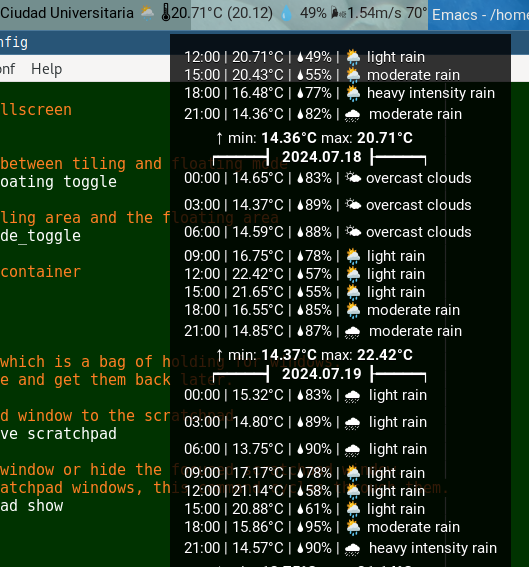
The end result? Nothing too stunning, but definitively something I find useful and even nicely laid out: Screenshot Do note that it seems OpenWeather will return the name of the closest available meteorology station with (most?) recent data for my home, I often get Ciudad Universitaria, but sometimes Coyoac n or even San ngel Inn.

Mike Gabriel: Weather Experts with Translation Skills Needed!

Lomiri Weather App goes Open Meteo In Ubuntu Touch / Lomiri, Maciej Sopy o has updated Lomiri's Weather App to operate against a different weather forecast provider (Open Meteo). Additionally, the new implementation is generic and pluggable, so other weather data providers can be added-in later. Big thanks to Maciej for working on this just in time (the previous implementation's API has recently been EOL'ed and is not available anymore to Ubuntu Touch / Lomiri users). Lomiri Weather App - new Meteorological Terms part of the App now While the old weather data provider implementation obtained all the meteorological information as already localized strings from the provider, the new implementation requires all sorts of weather conditions being translated within the Lomiri Weather App itself. The meteorological terms are probably not easy to translate for the usual software translator, so special help might be required here. Call for Translations: Lomiri Weather App So, if you feel entitled to help here, please join the Hosted Weblate service [1] and start working on Lomiri Weather App. Thanks a lot! light+love
Mike Gabriel (aka sunweaver) [1] https://hosted.weblate.org/
[2] https://hosted.weblate.org/projects/lomiri/lomiri-weather-app/

Russell Coker: Samsung Galaxy Note 9 Review

After the VoLTE saga [1] and the problems with battery life on the PinePhonePro [2] (which lasted 4 hours while idle with the screen off in my last test a few weeks ago) I m running a Galaxy Note 9 [3] with the default Samsung OS as my daily driver. I don t think that many people will be rushing out to buy a 2018 phone regardless of my review. For someone who wants a phone of such age (which has decent hardware and a low price) then good options are the Pixel phones which are all supported by LineageOS. I recommend not buying this phone due to the fact that it doesn t have support for VoLTE with LineageOS (and presumably any other non-Samsung Android build) and doesn t have support from any other OS. The One Plus 6/6T has Mobian support [4] as well as LineageOS support and is worth considering. The Note 9 still has capable hardware by today s standards. A 6.4 display is about as big as most people want in their pocket and 2960 1440 resolution in that size (516dpi) is probably as high as most people can see without a magnifying glass. The model I m using has 8G of RAM which is as much as the laptop I was using at the start of this year. I don t think that many people will have things that they actually want to do on a phone which needs more hardware than this. The only hardware feature in new phones which beats this is the large folding screen in some recent phones, but $2500+ (the price of such phones in Australia) is too much IMHO and the second hand market for folding phones is poor due to the apparently high incidence of screens breaking. The Note 9 has the Dex environment for running as a laptop if you connect it to a USB-C dock. It can run nicely with a 4K monitor with USB keyboard and mouse. The UI is very similar to that of older versions of Windows. The Samsung version of Android seems mostly less useful than the stock Google version or the LineageOS version. The Samsung keyboard flags words such as gay as spelling errors and it can t be uninstalled even when you install a better keyboard app. There is a Bixby button on the side of the phone to launch the Bixby voice recognition app which can t be mapped to any useful purpose, The Google keyboard has a voice dictation option which I will try out some time but that s all I desire in terms of voice recognition. There are alerts about Samsung special deals and configuration options including something about signing in to some service and having it donate money to charity, I doubt that any users want such features. Apart from Dex the Samsung Android build is a good advert for LineageOS. The screen has curved sides for no good reason. This makes it more difficult to make a protective phone case as a case can t extend beyond the screen at the sides and therefore if it s dropped and hits an edge (step, table, etc) then the glass can make direct contact with something. Also the curved sides reflect sunlight in all directions, this means that the user has to go to more effort to avoid reflecting the sun into their eyes and that a passenger can more easily reflect sunlight into the eyes of a car driver. It s an impressive engineering feat to make a curved touch-screen but it doesn t do any good for users. The stylus is good as always and the screen is AMOLED so it doesn t waste much power when in dark mode. There is a configuration option to display a clock all the time when the screen is locked because that apparently doesn t use much power. I haven t felt inclined to enable the always on screen but it s a nice feature for those who like such things. The VoLTE implementation is apparently a bit unusual so it s not supported by LineageOS and didn t work on Droidian for the small amount of time that Droidian supported it. Generally this phone is quite nice hardware it s just a pity that it demonstrates all of the downsides to buying a non-Pixel phone.

Gunnar Wolf: Scholarly spam Wulfenia

I just got one of those utterly funny spam messages And yes, I recognize everybody likes building a name for themselves. But some spammers are downright silly. I just got the following mail:
From: Hermine Wolf <hwolf850@gmail.com>
To: me, obviously  
Date: Mon, 15 Jul 2024 22:18:58 -0700
Subject: Make sure that your manuscript gets indexed and showcased in the prestigious Scopus database soon.
Message-ID: <CAEZZb3XCXSc_YOeR7KtnoSK4i3OhD=FH7u+A5xSMsYvhQZojQA@mail.gmail.com>
This message has visual elements included. If they don't display, please   
update your email preferences.
*Dear Esteemed Author,*
Upon careful examination of your recent research articles available online,
we are excited to invite you to submit your latest work to our esteemed    
journal, '*WULFENIA*'. Renowned for upholding high standards of excellence 
in peer-reviewed academic research spanning various fields, our journal is 
committed to promoting innovative ideas and driving advancements in        
theoretical and applied sciences, engineering, natural sciences, and social
sciences. 'WULFENIA' takes pride in its impressive 5-year impact factor of 
*1.000* and is highly respected in prestigious databases including the     
Science Citation Index Expanded (ISI Thomson Reuters), Index Copernicus,   
Elsevier BIOBASE, and BIOSIS Previews.                                     
                                                                           
*Wulfenia submission page:*                                                
[image: research--check.png][image: scrutiny-table-chat.png][image:        
exchange-check.png][image: interaction.png]                                
.                                                                          
Please don't reply to this email                                           
                                                                           
We sincerely value your consideration of 'WULFENIA' as a platform to       
present your scholarly work. We eagerly anticipate receiving your valuable 
contributions.                                                             
*Best regards,*                                                            
Professor Dr. Vienna S. Franz                                              
Scholarly spam Who cares what Wulfenia is about? It s about you, my stupid Wolf cousin!

16 July 2024

Dave Hibberd: What I've been up to in Open Ham Radio - July 2024

I do a lot in free software for ham radio, and Steve at Zero Retries encouraged me to take this email I sent him and translate it into something here. UK Packet Radio Network UKPRN is going nicely, with the Nottingham and South segment really quite impressively interconnected over RF - https://nodes.ukpacketradio.network/packet-network-map.html?rfonly=1 I m excited to see the growth down there! We re sorting out forwarding and routes in Aberdeen too, and working to grow the RF path to Inverness.

Next.

Previous.