A new Armadillo release 5.300.4 was prepared by Conrad the other day, and we prepared a new corresponding RcppArmadillo release 0.5.300.4.0 which is now on CRAN and in way into Debian.
Armadillo is a powerful and expressive C++ template library for linear algebra aiming towards a good balance between speed and ease of use with a syntax deliberately close to a Matlab.
This release brings a considerable amount of new code extending support for sparse matrices, support for Schur decompositions, and much more as shown in the extract from NEWS file:
Changes in RcppArmadillo version 0.5.300.4 (2015-08-03)
Upgraded to Armadillo 5.300.4 ("Plutocrazy Incorporated")
added generalised Schur decomposition: qz()
added .has_inf() and .has_nan()
expanded interp1() to handle out-of-domain locations
expanded sparse matrix class with .set_imag() and .set_real()
expanded imag(), real() and conj() to handle sparse matrices
expanded diagmat(), reshape() and resize() to handle sparse matrices
faster sparse sum()
faster row-wise sum(), mean(), min(), max()
updated physical constants to NIST 2014 CODATA values
fixes for handling sparse submatrix views
Armadillo can make use of GPUs by linking with NVIDIA NVBLAS (a GPU-accelerated implementation of BLAS), or by linking with AMD ACML (which can use GPUs via OpenCL)
Added importFrom statements for R functions not from base
Added explicit Rcpp::sourceCpp() reference as well
Updated one formatting detail in vignette to please TeXlive2015
It's been a while since I talked about Ceilometer and its companions, so I
thought I'd go ahead and write a bit about what's going on this side of
OpenStack. I'm not going to cover new features and fancy stuff today, but
rather a shallow overview of the new project processes we initiated.
Ceilometer growing
Ceilometer has grown a lot since that time
when we started it 3 years ago. It has evolved from a system designed to fetch
and store measurements, to a more complex system, with agents, alarms, events,
databases, APIs, etc.
All those features were needed and asked for by users and operators, but let's
be honest, some of them should never have ended up in the Ceilometer code
repository, especially not all at the same time.
The reality is we picked a pragmatic approach due to the rigidity of the
OpenStack Technical Committee in regards to new projects to become OpenStack
integrated and, therefore, blessed projects. Ceilometer was actually the
first project to be incubated and then integrated. We had to go through the
very first issues of that process.
Fortunately, now that time has passed, and all those constraints have been
relaxed. To me, the
OpenStack Foundation is turning into
something that looks like the
Apache Foundation, and there's, therefore,
no need to tie technical solutions to political issues.
Indeed, the
Big Tent
now allows much more flexibility to all of that. Back a year ago, we were
afraid to bring Gnocchi into Ceilometer. Was the Technical Committee going to
review the project? Was the project going to be in the scope of Ceilometer for
the Technical Committee? Now we don't have to ask ourselves those questions,
now that we have that freedom, it empowers us to actually do what we think is
good in term of technical design without worrying too much about political
issues.
Ceilometer development activity
Acknowledging Gnocchi
The first step in this new process was to continue working on
Gnocchi (a timeserie database and resource
indexer designed to overcome historical Ceilometer storage issue) and to decide
that it was not the right call to merge it into Ceilometer as some REST API v3,
but that it was better to keep it standalone.
We managed to get traction to Gnocchi, getting a few contributors and users.
We're even seeing talks proposed to the next Tokyo Summit where people leverage
Gnocchi, such as
"Service of predictive analytics on cost and performance in OpenStack",
"Suveil"
and
"Cutting Edge NFV On OpenStack: Healing and Scaling Distributed Applications".
We are also doing some progress on pushing Gnocchi outside of the OpenStack
community, as it can be a self-sufficient timeserie and resource database that
can be used without any OpenStack interaction.
Branching Aodh
Rather than continuing to grow Ceilometer, during the last summit we all
decided that it was time to reorganize and split Ceilometer into the different
components it is made of, leveraging a more
service-oriented architecture.
The alarm subsystem of Ceilometer being mostly untied to the rest of
Ceilometer, we decided it was the first and perfect candidate to do that. I
personally engaged into doing the work and created a new repository with only
the alarm code from Ceilometer, named Aodh.
Aodh is an Irish word meaning
fire. A word picked so it also had some relation to Heat, and because we have
some Irish influence around the project .
This made sense for a lot of reason. First because Aodh can now work completely
standalone, using either Ceilometer or Gnocchi as a backend or any new plugin
you'd write. I love the idea that OpenStack projects can work standalone like
Swift does for example without implying any other OpenStack component. I
think it's a proof of good design. Secondly, because it allows us to resonate
on a smaller chunk of software a reason really under-estimated today in
OpenStack. I believe that the size of your software should match a certain
ratio to the size of your team.
Aodh is, therefore, a new project under the OpenStack Telemetry program (or
what remains of OpenStack programs now), alongside Ceilometer and Gnocchi,
forked from the original Ceilometer alarm feature. We'll deprecate the latter
with the Liberty release, and we'll remove it in the Mitaka release.
Lessons learned
Actually, moving that code out of Ceilometer (in the case of Aodh), or not
merging it in (in the case of Gnocchi) had a few side effects that I admit I
think we probably under-estimated back then.
Indeed, the code size of Gnocchi or Aodh ended up being much smaller than the
entire Ceilometer project Gnocchi is 7 smaller and Aodh 5x smaller than
Ceilometer and therefore much more easy to manipulate and to hack on. That
allowed us to merge dozens of patches in a few weeks, cleaning-up and enhancing
a lot of small things in the code. Those tasks are very much harder in
Ceilometer, due to the bigger size of the code base and the small size of our
team. By having our small team working on smaller chunks of changes even when
it meant actually doing more reviews greatly improved our general velocity
and the number of bugs fixed and features implemented.
On the more sociological side, I think it gave the team the sensation of
finally owning the project. Ceilometer was huge, and it was impossible for
people to know every side of it. Now, it's getting possible for people inside a
team to cover a much larger portion of those smaller project, which gives them
a greater sense of ownership and caring. Which ends up being good for the
project quality overall.
That also means that we technically decided to have different core teams by
project (Ceilometer, Gnocchi, and Aodh) as they all serve different purposes and
can all be used standalone or with each others. Meaning we could have
contributors completely ignoring other projects.
All of that reminds me some discussion I heard about projects such as Glance,
trying to fit new features in - some that are really orthogonal to the original
purpose. It's now clear to me that having different small components
interacting together that can be completely owned and taken care of by a
(small) team of contributors is the way to go. People that can therefore trust
each others and easily bring new people in, makes a project really incredibly
more powerful. Having a project covering a too wide set of features make things
more difficult if you don't have enough manpower. This is clearly an issue that
big projects inside OpenStack are facing now, such as Neutron or Nova.
Joachim Breitner uploaded haskell-devscripts/0.9.11 which ads support for UTF-8 encoded debian/control file with all locales. Original patch by Chris Lamb.
reproducible.debian.net
Four armhf build hosts were provided by Vagrant Cascadian and have been configured to be used by jenkins.debian.net. Work on including armhf builds in the reproducible.debian.net webpages has begun. So far the repository comparison page just shows us which armhf binary packages are currently missing in our repo. (h01ger)
The scheduler has been changed to re-schedule more packages from stretch than sid, as the gcc5 transition has started This mostly affects build log age. (h01ger)
A new depwait status has been introduced for packages which can't be built because of missing build dependencies. (Mattia Rizzolo)
debbindiff development
Finally, on August 31st, Lunar released debbindiff 27 containing a complete overhaul of the code for the comparison stage. The new architecture is more versatile and extensible while minimizing code duplication. libarchive is now used to handle cpio archives and iso9660 images through the newly packaged python-libarchive-c. This should also help support a couple other archive formats in the future. Symlinks and devices are now properly compared. Text files are compared as Unicode after being decoded, and encoding differences are reported. Support for Sqlite3 and Mono/.NET executables has been added. Thanks to Valentin Lorentz, the test suite should now run on more systems. A small defiency in unquashfs has been identified in the process. A long standing optimization is now performed on Debian package: based on the content of the md5sums control file, we skip comparing files with matching hashes. This makes debbindiff usable on packages with many files. Fuzzy-matching is now performed for files in the same container (like a tarball) to handle renames. Also, for Debian .changes, listed files are now compared without looking the embedded version number. This makes debbindiff a lot more useful when comparing different versions of the same package.
Based on the rearchitecturing work has been done to allow parallel processing. The branch now seems to work most of the time. More test needs to be done before it can be merged.
The current fuzzy-matching algorithm, ssdeep, has showed disappointing results. One important use case is being able to properly compare debug symbols. Their path is made using the Build ID. As this identifier is made with a checksum of the binary content, finding things like CPP macros is much easier when a diff of the debug symbols is available. Good news is that TLSH, another fuzzy-matching algorithm, has been tested with much better results. A package is waiting in NEW and the code is ready for it to become available.
A follow-up release 28 was made on August 2nd fixing content label used for gzip2, bzip2 and xz files and an error on text files only differing in their encoding. It also contains a small code improvement on how comments on Difference object are handled.
This is the last release name debbindiff. A new name has been chosen to better reflect that it is not a Debian specific tool. Stay tuned!
Documentation update
Valentin Lorentz updated the patch submission template to suggest to write the kind of issue in the bug subject.
Small progress have been made on the Reproducible Builds HOWTO while preparing the related CCCamp15 talk.
Package reviews
235 obsolete
reviews have
been removed, 47 added and 113 updated this week.
42 reports for packages failing to build from source have been made by Chris West (Faux).
New issue added this week: haskell_devscripts_locale_substvars.
Misc.
Valentin Lorentz wrote a script to report packages tested as unreproducible installed on a system. We encourage everyone to run it on their systems and give feedback!
The list of available wifi channels
is slightly different from country to country. To ensure access to the
right channels and transmit power settings, one needs to set the right
regulatory domain in the wifi stack.
Linux
For most Linux-based computers, you can look and change the current
regulatory domain using these commands:
iw reg get
iw reg set CA
where CA is the two-letter country code
when the device is located.
On Debian and Ubuntu, you can make this setting permanent by putting the
country code in /etc/default/crda.
Finally, to see the list of channels that are available in the current
config, use:
iwlist wlan0 frequency
OpenWRT
On OpenWRT-based routers (including derivatives like
Gargoyle), looking and setting the
regulatory domain temporarily works the same way (i.e. the iw commands
above).
In order to persist your changes though, you need to use the
uci command:
uci set wireless.radio0.country=CA
uci set wireless.radio1.country=CA
uci commit wireless
where wireless.radio0 and wireless.radio1 are the wireless devices
specific to your router. You can look them up using:
uci show wireless
To test that it worked, simply reboot the router and then look at the
selected regulatory domain:
iw reg get
Scanning the local wifi environment
Once your devices are set to the right country, you should scan the local
environment to pick the least congested wifi channel. You can use the
Kismet spectools (free software)
if you have the hardware, otherwise
WifiAnalyzer
(proprietary) is a good choice on Android (remember to manually set the
available channels in the settings).
Princess Katya Nar Umbriel is publicly a bored, womanizing, and difficult
daughter to the rulers of Farraday. It's all an act, though, with the
full knowledge of her parents. As the second child, she's the leader of
the Order of Vestra: the equivalent of the Secret Service, devoted to
protecting the royal family and, by extension, the kingdom, particularly
against magical attacks.
Starbride is new to court and entirely out of place. From a northern
neighboring country, and far more comfortable in practical clothing than
the frilled court dresses that her mother wants her to wear, she has been
sent to court to make contacts. Her people are getting the bad side of
various trade contracts and desperately need some political maneuvering
space of their own. Starbride's best hope for this is to study law in the
palace library when she can manage to avoid the other courtiers. But then
she and Katya stumble across each other, outside of the roles they're
playing, and might have an opportunity for a deeper connection. One that
neither of them want to entangle in their personal worries.
This is the last of a set of books I picked up while looking for lesbian
romance with fantasy or science fiction elements. On the romance front,
it's one of the better entries in that set. Both Katya and Starbride are
likeable, in large part due to their mutual exasperation with the
trappings of the court. (Making the protagonists more serious,
thoughtful, and intelligent than the surrounding characters is an old
trick, but it works.) Wright has a good ear for banter, particularly the
kind when two people of good will are carefully feeling each other out.
And despite Katya's need to keep a deep secret from Starbride for some of
the book, The Pyramid Waltz mostly avoids irritating communication
failures as a plot driver.
The fantasy portion and the plot drivers, alas, are weaker. The world
building is not exactly bad, but it's just not that interesting. There
are a couple of moderately good ideas, in the form of pyramid magic and
secret (and dangerous) magical powers that run in the royal family, but
they're not well-developed. Pyramid magic turns out to look much like any
other generic fantasy magic system, with training scenes that could have
come from a Valdemar or Wheel of Time novel (and without as much dramatic
tension). And the royal family's secret, while better-developed and
integral to the plot, still felt rather generic and one-sided.
Maybe that's something Wright develops better in future novels in this
series, but that was another problem: the ending of The Pyramid
Waltz was rather weak. Partly, I think, this is because the cast is too
large and not well-developed. I cared about Katya and Starbird, and to a
lesser extent their servants and one of the Order members. (Wright has a
moderately interesting bit of worldbuilding about how servants work in
Starbride's culture, which I wish we'd seen more of.) But there are a
bunch of other Order of Vesta members, Katya's family, and various other
bits of history and hinted world views, none of which seemed to get much
depth. The ending climax involved a lot of revelations and twists that
primarily concerned characters I didn't care about. It lost something in
the process.
This book is clearly set up for a sequel. There is an ending, but it's
not entirely satisfying. Unfortunately, despite liking Katya and Starbird
a lot, the rest of the story wasn't compelling enough to make me want to
buy it, particularly since the series apparently goes through another
three books before reaching a real ending.
I enjoyed parts of this book, particularly Katya and Starbird feeling each
other out and discovering similarities in their outlook. Katya teasing
Starbird, and Starbird teasing herself, over her mother's choice of her
clothing was probably the best part. It's not bad for what it's trying to
do, but I think it's a bit too generic and not satisfying enough to really
recommend.
Followed by For Want of a Fiend.
Rating: 6 out of 10
The DebConf team have just published the first list of events scheduled for DebConf15 in Heidelberg, Germany, from 15 - 22 August 2015.
There are two specific events related to free real-time communications and a wide range of other events related to more general topics of encryption and privacy.
15 August, 17:00, Free Communications with Free Software (as part of the DebConf open weekend)
The first weekend of DebConf15 is an open weekend, it is aimed at a wider audience than the traditional DebConf agenda. The open weekend includes some keynote speakers, a job fair and various other events on the first Saturday and Sunday.
The RTC talk will look at what solutions exist for free and autonomous voice and video communications using free software and open standards such as SIP, XMPP and WebRTC as well as some of the alternative peer-to-peer communications technologies that are emerging. The talk will also look at the pervasive nature of communications software and why success in free RTC is so vital to the health of the free software ecosystem at large.
17 August, 17:00, Challenges and Opportunities for free real-time communications
This will be a more interactive session people are invited to come and talk about their experiences and the problems they have faced deploying RTC solutions for professional or personal use. We will try to look at some RTC/VoIP troubleshooting techniques as well as more high-level strategies for improving the situation.
Try the Debian and Fedora RTC portals
Have you registered for rtc.debian.org? It can successfully make federated SIP calls with users of other domains, including Fedora community members trying FedRTC.org.
You can use rtc.debian.org for regular SIP (with clients like Empathy, Jitsi or Lumicall) or WebRTC.
Can't get to DebConf15?
If you can't get to Heidelberg, you can watch the events on the live streaming service and ask questions over IRC.
To find out more about deploying RTC, please see the RTC Quick Start Guide.
Did you know?
Don't confuse Heidelberg, Germany with Heidelberg in Melbourne, Australia. Heidelberg down under was the site of the athlete's village for the 1956 Olympic Games.
My previous blog posts about deterministic Doom proved very popular.
The reason I was messing around with Doom's RNG was I was studying how early
versions of Doom performed random pitch-shifting of sound effects, a feature
that was removed early on in Doom's
history. By fixing the
random number table and replacing the game's sound effects with a
sine wave, one second long and tuned to middle-c, I was able to determine
the upper and lower bounds of the pitch shift.
Once I knew that, I was able to write some patches to re-implement pitch
shifting in Chocolate Doom,
which I'm pleased to say have been accepted. The patches have also made their
way into the related projects Crispy Doom
and Doom Retro.
I'm pleased with the final result. It's the most significant bit of C code I've
ever released publically, as well as my biggest Doom hack and the first time
I've ever done any audio manipulation in code. There was a load of other notes
and bits of code that I produced in the process. I've put them together on a
page here: More than you ever wanted to know about
pitch-shifting.
#793127 on pdf.js by Dhole: set TZ=UTC when calling zip.
#793300 on deejayd by Dhole: set TZ=UTC when calling zip.
reproducible.debian.net
Packages identified as failing to build from source with no bugs filed and older than 10 days are scheduled more often now (except in experimental). (h01ger)
Package reviews
178 obsolete
reviews have
been removed, 59 added and 122 updated this week.
New issue identified this week: random_order_in_ruby_rdoc_indices.
18 new bugs for packages failing to build from sources have been reported by Chris West (Faux), and h01ger.
#792673 on bup by use date from debian/changelog when generating version strings.
#792684 on cain by Chris Lamb: ensure stable permissions when creating source tarball.
#792709 on dict-jargon by Dhole: set timestamp in archive using the latest entry of debian/changelog.
#792727 on libaqbanking by Micha Lenk (upstream): sort source files in documentation.
#792763 on docbook-dsssl by Chris Lamb: sort input files when creating changelog.
#792770 on lynx-cur by Reiner Herrmann: use C locale when sorting configuration files.
#792771 on mu-cade by Reiner Herrmann: use C locale when sorting source files.
#792772 on titanion by Reiner Herrmann: use C locale when sorting source files.
#792783 on linuxlogo by Reiner Herrmann: use C locale when sorting source files.
#792821 on pkg-config by Juan Picca: use C locale when sorting source files.
#792828 on tiger by Daniel Kahn Gillmor: use C locale when listing soure files.
reproducible.debian.net
The statistics on the main page of reproducible.debian.net are now updated every five minutes. A random unreviewed package is suggested in the look at a package form on every build. (h01ger)
A new package set based new on the Core Internet Infrastructure census has been added. (h01ger)
Testing of FreeBSD has started, though no results yet. More details have been posted to the freebsd-hackers mailing list. The build is run on a new virtual machine running FreeBSD 10.1 with 3 cores and 6 GB of RAM, also sponsored by Profitbricks.
strip-nondeterminism development
Andrew Ayer released version 0.009 of strip-nondeterminism. The new version will strip locales from Javadoc, include the name of files causing errors, and ignore unhandled (but rare) zip64 archives.
debbindiff development
Lunar continued its major refactoring to enhance code reuse and pave the way to fuzzy-matching and parallel processing. Most file comparators have now been converted to the new class hierarchy.
In order to support for archive formats, work has started on packaging Python bindings for libarchive. While getting support for more archive formats with a common interface is very nice, libarchive is a stream oriented library and might have bad performance with how debbindiff currently works. Time will tell if better solutions need to be found.
Documentation update
Lunar started a Reproducible builds HOWTO intended to explain the different aspects of making software build reproducibly to the different audiences that might have to get involved like software authors, producers of binary packages, and distributors.
Package reviews
17 obsolete
reviews have
been removed, 212 added and 46 updated this week.
15 new bugs for packages failing to build from sources have been reported by Chris West (Faux), and Mattia Rizzolo.
Presentations
Lunar presented Debian efforts and some recipes on making software build reproducibly at Libre Software Meeting 2015. Slides and a video recording are available.
Misc.
h01ger, dkg, and Lunar attended a Core Infrastructure Initiative meeting. The progress and tools mode for the Debian efforts were shown. Several discussions also helped getting a better understanding of the needs of other free software projects regarding reproducible builds. The idea of a global append only log, similar to the logs used for Certificate Transparency, came up on multiple occasions. Using such append only logs for keeping records of sources and build results has gotten the name Binary Transparency Logs . They would at least help identifying a compromised software signing key. Whether the benefits in using such logs justify the costs need more research.
After a slight hiatus since the last release in early 2014, we are delighted to announce a new release of RcppZiggurat which is now on the CRAN network for R.
The RcppZiggurat package updates the code for the Ziggurat generator which provides very fast draws from a Normal distribution.
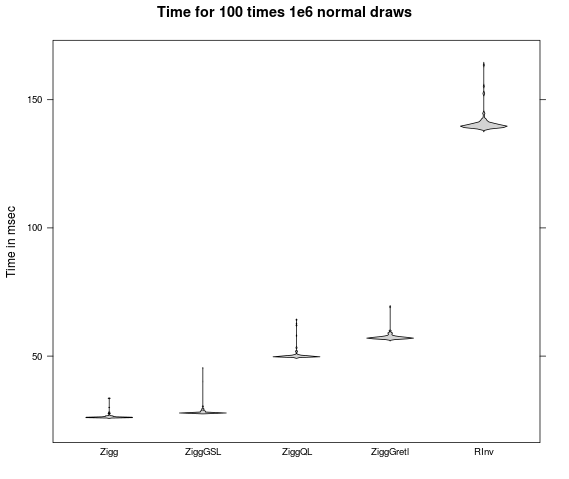
The package provides a simple C++ wrapper class for the generator improving on the very basic macros, and permits comparison among several existing Ziggurat implementations. This can be seen in the figure where Ziggurat from this package dominates accessing the implementations from the GSL, QuantLib and Gretl---all of which are still way faster than the default Normal generator in R (which is of course of higher code complexity).
This release contains a few internal cleanups relative to the last release. It was triggered by a very helpful email from Brian Ripley who notices compiler warnings on the Solaris platform due to my incorrect use of on integer variables.
The NEWS file entry below lists all changes.
Changes in version 0.1.3 (2015-07-25)
Use the SHR3 generator for the default implementation just like Leong et al do, making our default implementation identical to theirs (but 32- and 64-bit compatible)
Switched generators from float to double ensuring that results are identical on 32- and 64-bit platforms
Simplified builds with respect to GSL use via the RcppGSL package; added a seed setter for the GSL variant
Corrected use of fabs() to abs() on integer variables, with a grateful nod to Brian Ripley for the hint (based on CRAN checks on the beloved Slowlaris machines)
Accelerated Travis CI tests by relying exclusively on r-cran-* packages from the PPAs by Michael Rutter and myself
Updated DESCRIPTION and NAMESPACE according to current best practices, and R-devel CMD check --as-cran checks
Once more the NetSurf developers gathered to battle the forces of darkness, or as they are more commonly known web specifications.
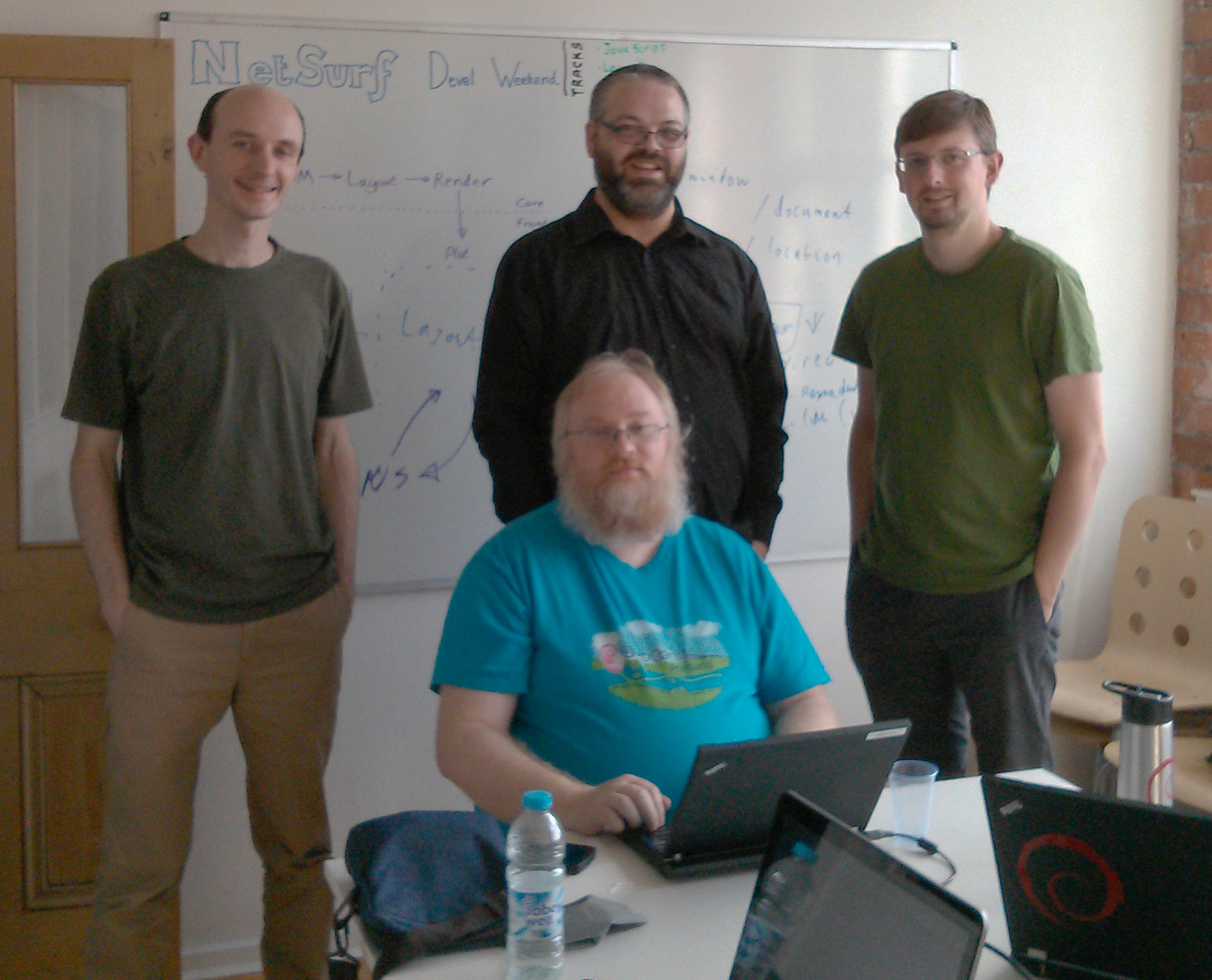
The fifth developer weekend was an opportunity for us to gather in a pleasant setting and work together in person. We were graciously hosted, once again, by Codethink in their Manchester offices.
Four developers managed to attend in person from around the UK: Michael Drake, John-Mark Bell, Daniel Silverstone and Vincent Sanders.
The main focus of the weekends activities was to address two areas that have become overwhelmingly important: JavaScript and Layout.
Although the browser obviously already has both these features they are somewhat incomplete and incapable of supporting the features of the modern web. JavaScriptThe discussion started with JavaScript and its implementation. We had previously looked at the feasibility of changing our JavaScript engine from Spidermonkey to DukTape. We had decided this was a change we wanted to make when DukTape was mature enough to support the necessary features.
The main reasons for the change are that Spidermonkey is a poor fit to NetSurf as it is relatively large and does not provide a stable API guarantee. The lack of a stable API requires extensive engineering to update to new releases. Additionally support for compiling on minority platforms is very challenging meaning that most platforms are stuck using version 1.7 or 1.85 (current release is version 31 with 38 due).
We started the move to Duktape by creating a development branch, integrating the Duktape library and open coding a minimal implementation of the core classes as a proof of concept. This work was mostly undertaken by Daniel with input from myself and John-Mark. This resulted in a build that was substantially smaller than using Spidermonkey with all the existing functionality our tests cover.
The next phase of this work is to take the prototype implementation and turn it into something that can be reliably used and covers the entire JavaScript DOM interface. This is no small job as there are at least 200 classes and 1500 methods and properties to implement. LayoutThe layout library design discussion was an extensive and very involved. The layout engine is a browsers most important component. It takes all the information processed by the CSS and DOM libraries, applies a vast number of involved rules and produces a list of operations that can be rendered.
This reimplementation of our rendering engine has been in planning for many years. The existing engine stems from the browsers earliest days more than a decade ago and has many shortcomings in architecture and implementation we hope to address.
The work has finally started on libnslayout with Michael taking the lead and defining the initial API and starting the laborious work of building the test harness, a feature the previous implementation lacked! The second war beginsFor a war you need people and it is a little unfortunate that this was our lowest ever turnout for the event. This is true of the project overall with declining numbers of commits and interest outside our core group. If anyone is interested we are always happy to have new contributors and there are opportunities to contribute in many areas from image assets, through translations, to C programming.
We discussed some ways to encourage new developers and try and get committed developers especially for the minority platform frontends. The RISC OS frontend for example has needed a maintainer since the previous one stepped down. There was some initial response from its community, culminating in a total of two patches, when we announced the port was under threat of not being releasable in future. Unfortunately nothing further came from this and it appears our oldest frontend may soon become part of our history.
We also covered some issues from the bug tracker mostly to see if there were any patterns that we needed to address before the forthcoming 3.4 release.
There was discussion about recent improvements to the CI system which generate distribution packages from the development branch and how this could be extended to benefit more users. This also included authorisation to acquire storage and other miscellaneous items necessary to keep the project infrastructure running.
We managed over 20 hours of work in the two days and addressed our current major shortcomings. Now it just requires a great deal of programming to complete the projects started here.
I sometimes get questions when people use my wireless access
point, which, for as long as I can remember, has been open to
everyone; that is without any form of password protection or
encryption. I arguably don't use the access point much myself, as I
prefer the wired connection for the higher bandwidth, security and reliability
it provides.
Apart from convenience for myself and visitors, the main reason why I
leave my wireless access open is that I believe in a free (both as in
beer and freedom) internet, built with principles of solidarity rather
than exploitation and profitability. In these days of ubiquitous
surveillance, freedom often goes hand in hand with anonymity, which
implies providing free internet access to everyone.
I also believe that, as more and more services get perniciously
transferred to the global internet, access to the network is becoming
a basic human right. This is therefore my small contribution to the
struggle, now also part of the R seau Libre
project.
So here were my friends question, in essence:
My credit card info was stolen when I used a wifi hotspot in an
airport... Should I use open wifi networks?
Is it safe to use my credit card for shopping online?
Here is a modified version of an answer I sent to a friend recently
which I thought could be useful to the larger internet community. The
short answer is "sorry about that", "it depends, you generally can,
but be careful" and "your credit card company is supposed to protect
you".
Sorry!
First off, sorry to hear that our credit card was stolen in an
airport! That has to be annoying... Did the credit card company
reimburse you? Normally, the whole point of credit cards is that they
protect you in case of theft like this and they are supposed to
reimburse you if you credit card gets stolen or abused...
The complexity and unreliability of passwords
Now of course, securing every bit of your internet infrastructure
helps in protecting against such attacks. However: there is a
trade-off! First off, it does makes it more complicated for people to
join the network. You need to make up some silly password (which has
its own security problems: passwords can be surprisingly
easy to guess!) that you will post on the
fridge or worst, forget all the time!
And if it's on the fridge, anyone with a view to that darn fridge, be
it one-time visitor or sneaky neighbor, can find the password and
steal your internet access (although, granted, that won't allow them
to directly spy on your internet connection).
In any case, if you choose to use a password, you should use the
tricks I wrote in the
koumbit wiki to
generate the password and avoid writing it on the fridge.
The false sense of security of wireless encryption
Second, it can also give a false sense of security: just because a
wifi access point appears "secure" (ie. that the communication between
your computer and the wifi access point is encrypted) doesn't mean the
whole connection is secure.
In fact, one attack that can be done against access points is exactly
to masquerade as an existing access point, with no security security
at all. That
way, instead of connecting to the real secure and trusted access
point, you connect to an evil one which spies on our connection. Most
computers will happily connect to such a hotspot even with degraded
security without warning.
It
may be what happened at the airport, in fact. Of course this
particular attack would be less likely to happen if you live in the
middle of the woods than an
airport, but it's some important distinction to keep in mind, because
the same attack can be performed after the wireless access point,
for example by your countryside internet access provider or someone
attacking it.
Your best protection for your banking details is to rely on good
passwords (for your back account) but also, and more importantly,
what we call end-to-end encryption. That is usually implemented using
the "HTTPS" with a pad lock icon in your
address bar. This ensures that the communication between your
computer and the bank or credit card company is secure, that is: that
no wifi access point or attacker between your computer and them can
intercept your credit card number.
The flaws of internet security
Now unfortunately, even the HTTPS protocol doesn't bring complete
security. For example, one attack that can be done is similar to the previous one and that is
to masquerade as a legitimate
bank site, but either strip out the encryption or even fake the
encryption.
So you also need to look at the address of the website you
are visiting. Attackers are often pretty clever and will use many
tricks to hide the real address of the website in the address bar.
To work around this, I always explicitly type my bank website address (https://accesd.desjardins.com/
in my case)
directly myself instead of clicking on links, bookmarks or using a
search engine to find my bank site.
In the case of credit cards, it is much trickier because when you buy
stuff online, you end up putting that credit card number on different
sites which you do not necessarily trust. There's no good solution
but complaining to your credit card company if you believe a
website you used has stolen your credit card details. You can also use
services like Paypal,
Dwolla or Bitcoin that hide your credit card details from the
seller, if they support the service.
I usually try to avoid putting my credit card details on sites I do
not trust, and limit myself to known parties
(e.g. Via Rail,
Air Canada, etc). Also, in general, I try to
assume the network connection between me and the website I visit is
compromised. This forced me to get familiar with online
security and use of encryption. It is more accessible to me than
trying to secure the infrastructure i am using, because i often do not
control it at all (e.g. internet cafes...).
Internet security is unfortunately a hard problem, and things are not
getting easier as more things move online. The burden is on us
programmers and system administrators to create systems that are more
secure and intuitive for our users so, as I said earlier, sorry the
internet sucks so much, we didn't think so many people would join the
acid trip of the 70s.
Some time ago, pabs documented his setup for easily connecting to one of
Debian's porterboxes based on the desired architecture. Similarly, he
submitted a wishlist bug against devscripts specifying some requirements
for a script to make this functionality generally accessible to the developer
community.
I have yet to follow up on that request mainly due to ENOTIME for developing
new scripts outright. I also have my own script I had been using to get
information on available Debian machines.
Recently, this came up again on IRC and jwilk decided to actually implement
pabs' DNS alias idea. Now, one can use $arch-porterbox.debian.net to connect
to a porterbox of the specified architecture.
Preference is given to debian.org domains when there are both debian.org
and debian.net porterboxes, and it's a simple use first listed machine if
there are multiple available porterboxes.
This is all well and good, but if you have SSH's StrictHostKeyChecking
enabled, SSH will rightly refuse to connect. However, OpenSSH 6.5 added a
feature called hostname canonicalization which can help. The below ssh_config
snippet allows one to run ssh $arch-porterbox or ssh
$arch-porterbox.debian.net and connect to one of the porterboxes, verifying
the host key against the canonical host name.
Like each month, here comes a report about the work of paid contributors to Debian LTS.
Individual reports
In June, 73.50 work hours have been dispatched among 7 paid contributors. Their reports are available:
Evolution of the situation
July has seen a nice increase in terms of sponsored hours (79.50 hours per month) but the trend is unlikely to continue for the next month, worse it might be negative. While most sponsors who joined us last year in July will renew their support, there are a few where I have no confirmation yet. Many thanks to those who confirmed early: Universit Lille 3, MyTux.
Our first milestone of funding the equivalent of a half-time position is unlikely to be reached before DebConf or even this summer. If you want to prove me wrong, it s time to get in touch with your management and convince your company to contribute a small amount.
In terms of security updates waiting to be handled, the situation is similar to last month: the dla-needed.txt file lists 24 packages awaiting an update (5 more than last month), the list of open vulnerabilities in Squeeze shows about 33 affected packages in total (3 less than last month).
Thanks to our sponsors
There are no new sponsors this month. But I decided to include the number of months that the sponsor has been with us. Since we value long-lasting relations, it seemed quite natural to add this.
(In order to avoid any ambiguity here, this is a personal opinion. The Free Software Foundation's opinion on this matter is here)
Canonical have a legal policy surrounding reuse of Intellectual Property they own in Ubuntu, and you can find it here. It's recently been modified to handle concerns raised by various people including the Free Software Foundation[1], who have some further opinions on the matter here. The net outcome is that Canonical made it explicit that if the license a piece of software is under explicitly says you can do something, you can do that even if the Ubuntu IP policy would otherwise forbid it.
Unfortunately, "Canonical have made it explicit that they're not attempting to violate the GPL" is about the nicest thing you can say about this. The most troubling statement is Any redistribution of modified versions of Ubuntu must be approved, certified or provided by Canonical if you are going to associate it with the Trademarks. Otherwise you must remove and replace the Trademarks and will need to recompile the source code to create your own binaries.. The apparent aim here is to avoid situations where people take Ubuntu, modify it and continue to pass it off as Ubuntu. But it reaches far further than that. Cases where this may apply include (but are not limited to):
Anyone producing a device that runs an operating system based on Ubuntu, even if it's entirely invisible to the user (eg, an embedded ARM device using Ubuntu as its base OS)
Anyone producing containers based on Ubuntu
Anyone producing cloud images (such as AMIs) based on Ubuntu
In each of these cases, a strict reading of the policy indicates that you are distributing a modified version of Ubuntu and therefore must either get it approved by Canonical or remove the trademarks and rebuild everything. The strange thing is that this doesn't limit itself to rebuilding packages that include Canonical's trademarks - there's a requirement that you rebuild all binaries.
Now obviously this is good engineering practice in a whole bunch of ways, but it's a huge pain in the ass. And to make things worse, Canonical won't clarify what they consider to be use of their trademarks. Many Ubuntu packages rebuilt from Debian include the word "ubuntu" in their version string. Many Ubuntu packages will contain the word "ubuntu" in maintainer email addresses. Many Ubuntu packages include references to Ubuntu (for instance, documentation might say "This configuration file is located under /etc/default in Debian and Ubuntu"). And many Ubuntu packages will include the compiler version string, which will include the word "ubuntu". Realistically, there's no risk of confusion by using the trademarks in this way, and as a consequence there would be no infringement under trademark law. But Canonical aren't using trademark law here. Canonical assert that they hold copyright over binaries that they have built form source, and require that for you to have permission to redistribute these binaries under copyright law you must remove the trademarks. This means that it doesn't matter whether your use of the trademarks would be infringing or not - you're required to remove them, because fuck you that's why.
This is a huge overreach. It's hostile to free software, in that it makes it significantly more difficult to produce derivative works of Ubuntu and doesn't benefit the community in the process. It's hostile to our understanding of IP law, in that it claims that the mechanical process of turning source code into binaries creates an independently copyrightable work. And in some cases it may make it impossible to create derivative works that interoperate with Ubuntu due to applications making assumptions about the presence of strings.
It'd be easy write this off as an over the top misinterpretation of the policy if it hadn't been confirmed by the Ubuntu Community Manager that any binaries shipped by Ubuntu under licenses that don't grant an explicit right to redistribute the binaries can't be redistributed without permission or rebuilding. When I asked for clarification from Canonical over a year ago, I got no response[2]. Perhaps Canonical don't want to force you to remove every single use of the word Ubuntu from derivative works, but their policy is written such that the natural reading is that they do, and they've refused every single opportunity they've been given to clarify the point.
So, we're left with a policy that makes it hugely impractical to redistribute modified versions of Ubuntu unless Canonical approve of it. That's not freedom, and it's certainly not Ubuntu. If Canonical are serious about participating in the free software community then they need to demonstrate their willingness to continue improving this policy to bring it closer to our goals. Failure to do so will give a strong indication of their priorities.
[1] While I'm a member of the FSF's board of directors, I'm not involved in the majority of the FSF's day to day activities and was not part of this process [2] Nebula's OS was a mixture of binary packages we pulled straight from Ubuntu and packages we rebuilt, so we were obviously pretty interested in what the answer was
Would you like to comment on why you think that DNSSEC+DANE are not a
possible and much better alternative?
Where DANE fails to be a feasible alternative to the current system is that
it is not widely acknowledged to be superior in every possible way . A
weak demonstration of this is that no browser has implemented DANE support,
and very few other TLS-using applications have, either. The only thing I
use which has DANE support that I m aware of is Postfix and SMTP is an
application in which the limitations of DANE have far less impact.
My understanding of the limitations of DANE, for large-scale deployment, are
enumerated below.
DNS Is Awful
Quoting Google security engineer Adam Langley:
But many (~4% in past tests) of users can t resolve a TXT record when they
can resolve an A record for the same name. In practice, consumer DNS is
hijacked by many devices that do a poor job of implementing DNS.
Consider that TXT records are far, far older than TLSA records. It seems
likely that TLSA records would fail to be retrieved greater than 4% of the
time. Extrapolate to the likely failure rate for lookup of TLSA records would
be, and imagine what that would do to the reliability of DANE verification.
It would either be completely unworkable, or else would cause a whole new
round of just click through the security error training. Ugh.
This also impacts DNSSEC itself. Lots of recursive resolvers don t validate
DNSSEC, and some providers mangle DNS responses in some way, which breaks
DNSSEC. Since OSes don t support DNSSEC validation by default (for
example, by having the name resolution APIs indicate DNSSEC validation
status), browsers would essentially have to ship their own validating
resolver code.
Some people have concerns around the single point of control for DNS
records, too. While the weakest link nature of the CA model is terribad,
there is a significant body of opinion that replacing it with a single,
minimally-accountable organisation like ICANN isn t a great trade.
Finally, performance is also a concern. Having to go out-of-band to
retrieve TLSA records delays page generation, and nobody likes slow page
loads.
DNSSEC Is Awful
Lots of people don t like DNSSEC, for all sorts of reasons. While I don t
think it is quite as bad as people make out (I ve deployed it for most
zones I
manage,
there are some legitimate issues that mean browser vendors aren t willing to
rely on DNSSEC.
1024 bit RSA keys are quite common throughout the DNSSEC system.
Getting rid of 1024 bit keys in the PKI has been a long-running effort;
doing the same for DNSSEC is likely to take quite a while. Yes, rapid
rotation is possible, by splitting key-signing and zone-signing (a good
design choice), but since it can t be enforced, it s entirely likely that
long-lived 1024 bit keys for signing DNSSEC zones is the rule, rather than
exception.
DNS Providers are Awful
While we all poke fun at CAs who get compromised, consider how often
someone s DNS control panel gets compromised. Now ponder the fact that, if
DANE is supported, TLSA records can be manipulated in that DNS control
panel. Those records would then automatically be DNSSEC signed by the DNS
provider and served up to anyone who comes along. Ouch.
In theory, of course, you should choose a suitably secure DNS provider, to
prevent this problem. Given that there are regular hijackings of
high-profile domains (which, presumably, the owners of those domains would
also want to prevent), there is something in the DNS service provider
market which prevents optimal consumer behaviour. Market for
lemons,
perchance?
Conclusion
None of these problems are unsolvable, although none are trivial. I like
DANE as a concept, and I d really, really like to see it succeed.
However, the problems I ve listed above are all reasonable objections, made
by people who have their hands in browser codebases, and so unless they re
fixed, I don t see that anyone s going to be able to rely on DANE on the
Internet for a long, long time to come.
A few days ago and while we were traveling, an updated release of our random package for truly (hardware-based) random numbers as provided by random.org arrived on CRAN.
Brian Ripley had pointed out to us that some of the curl implementations (which must now be used as https is mandatory at random.org) did not follow redirects. Which was bad luck, given that I had used a shortform https://random.org as opposed to the fuller-length https://wwwrandom.org variant providing the service. This has been rectified, and we used the opportunity to also update the DESCRIPTION and NAMESPACE file as R CMD check --as-cran now mandates more explicit imports.
Courtesy of CRANberries comes a diffstat report for this release. Current and previous releases are available here as well as on CRAN.
The Independent reports that David Cameron wishes to ban the instant messaging application WhatsApp due its use of end-to-end encryption.
That we might merely be pawns in manoeuvring for some future political compromise (or merely susceptible to cheap clickbait) should be cause for some concern, but what should worry us more is that if it takes scare stories about WhatsApp for our culture to awaken on the issues of privacy and civil liberties, then the central argument against surveillance was lost a long time ago.
However, the situation worsens once you analyse the disapproval in more detail. One is immediately struck by a predominant narrative of technical considerations; a ban would be "unworkable" or "impractical". A robust defence of personal liberty or a warning about the insidious nature of chilling effects? Perhaps a prescient John Locke quote to underscore the case? No. An encryption ban would "cause security problems."
The argument proceeds in a tediously predictable fashion: it was already difficult to keep track whether one should ipso facto be in favour of measures that benefit the economy, but we are suddenly co-opted as technocrats to consider the "damage" it could to do the recovery or the impact on a now-victimised financial sector. The coup-de-gr ce finally appeals to our already inflated self-regard and narcissism: someone could "steal your identity."
Perhaps even more disappointing is the reaction from more technically-minded circles who, frankly, should know better. Here, they give the outward impression of metaphorically stockpiling copies of the GnuPG source code in their bunkers, perhaps believing the shallow techno-utopianist worldview that all social and cultural problems can probably be solved with Twitter and a JavaScript intepreter.
The tragedy here is that I suspect that this isn't what the vast majority of people really believe. Given a hypothetical ban that could, somehow, bypass all of the stated concerns, I'm pretty upbeat and confident that most people would remain uncomfortable with it on some level.
So what, exactly, does it take for us to oppose this kind of intervention on enduring principled grounds instead of transient and circumventable practical ones? Is the problem just a lack of vocabulary to discuss these issues on a social scale? A lack of courage?
Whilst it's certainly easier to dissect illiberal measures on technical merit than to make an impassioned case for abstract freedoms, every time we gleefully cackle "it won't work" we are, in essence, conceding the central argument to the authoritarian and the censorious. If one is right but for the wrong reasons, were we even right to begin with?
So as a consequence of the weakdh issue(s)
Qualys SSL Labs started to cap the rating at a B level if you provide DH
cipher suites with 1K DH parameter. Now if you're terminating your TLS
connections on F5s BigIP you're currently not able to change the DH parameter (they're random but of a fixed size).
Finally there is a public comment from F5 written by Brian McHenry which is worth reading if you're running those boxes.
As a side note, what most people running on TMOS 11.6.x should've already done is
preferring ECDHE over DHE, which would look like this:
That of course does not bring back the somewhat overrated A grade on the SSL Labs
site. That boils down to choosing to provide DHE with 1K DH parameter or let
everyone else, who does not yet support ECDHE, use RSA with your 2K public key.
Honestly, for a public portal with a very wide range of users, I'm far from sure
which one is the better choice. Looking at the weakest link "RSA+3DES" with TLSv1.0
is nothing that can convince the paranoid, but this cipher setting would bring you
back the A grade:

 A new Armadillo release 5.300.4 was prepared by Conrad the other day, and we prepared a new corresponding RcppArmadillo release 0.5.300.4.0 which is now on CRAN and in way into Debian.
Armadillo is a powerful and expressive C++ template library for linear algebra aiming towards a good balance between speed and ease of use with a syntax deliberately close to a Matlab.
This release brings a considerable amount of new code extending support for sparse matrices, support for Schur decompositions, and much more as shown in the extract from
 It's been a while since I talked about Ceilometer and its companions, so I
thought I'd go ahead and write a bit about what's going on this side of
OpenStack. I'm not going to cover new features and fancy stuff today, but
rather a shallow overview of the new project processes we initiated.
Ceilometer growing
 Ceilometer development activity

 What happened in the
 The list of

 My previous blog posts about
 After a slight hiatus since

 Some time ago, pabs

 Like
 (In order to avoid any ambiguity here, this is a personal opinion. The Free Software Foundation's opinion on this matter is
 In
 The Independent reports that David Cameron