Search Results: "ag"

11 October 2010

Evgeni Golov: RC bugs 2010/40

Let s join gregora and zack (and others, too lazy to search for links/names) and fix some RC bugs in Debian!So what happened last week?What does that mean? Two bugs are (almost) closed, two need more work. And this leads me to a feature I miss from http://udd.debian.org/bugs.cgi: a comment field as http://bts.turmzimmer.net/ has it. Will ping lucas about this later today.Oh, and on a side-note, I joined http://ask.debian.net let s help our users :)

Benjamin Mako Hill: Piracy and Free Software

This essay is a summary of my presentation at the workshop Inlaws and Outlaws, held on August 19-20, 2010 in Split, Croatia. The workshop brought together advocates of piracy with participants in the free culture and free software movements.
In Why Software Should Not Have Owners, Richard Stallman explains that, if a friend asks you for a piece of software and the license of the software bars you from sharing, you will have to choose between being a bad friend or violating the license of the software. Stallman suggests that users will have to choose between the lesser of two evils and will choose to violate the license. He emphasizes that it's unfair to ask a user to make such a choice. Over the past few years, pirate parties have grown across much of the developed world. Of course, piracy remains the primary means of distributing media across most of the rest. Advocates of access to information have gathered and organized under the "pirate" banner, representing the choice of sharing with friends over compliance with license terms. The free/libre and open source software (FLOSS) and free culture movements seem to have a confused and conflicted reaction to all this. On one hand, major proponents of several pirate parties are FLOSS and free culture stalwarts and several pirate parties have made FLOSS advocacy a component of their political platforms. Pirate Parties' clear opposition to software patents and DRM resonates with both FLOSS and free culture communities. On the other hand, FLOSS leaders, including Stallman, have warned us about "pirate" anti-copyright policies. Free culture leaders, like Lawrence Lessig, have repeatedly and vociferously denounced piracy, treated even the intimation of an association with piracy as an affront, and systematically distanced themselves and their work from piracy. Should FLOSS and free culture advocates embrace pirates as comrades in arms or condemn them? Must we choose between being either with the pirates or against them? Our communities seem to have no clearly and consistently articulated consensus. I believe that, unintuitively, if you take a strong principled position in favor of information freedom and distinguish between principles and tactics, a more nuanced "middle ground" response to piracy is possible. In light of a principled belief that users should be able to share information, we can conclude there is nothing ethically wrong with piracy. Licenses have the power of the law but they are protected by unjust "intellectual property" laws. That said, principles are not the only reason activists choose to do things. Many political stunts are bad ideas not because they are wrong, but because they won't work and have negative side effects. Tactics matter too. Even though there might not be anything ethically wrong with piracy from the perspective of free software or free culture, it might still be a bad idea. There are at least three such tactical reasons that might motivate free software and culture to not support piracy or participate in pro-piracy movements and politics. First, a systematic disrespect for copyright undermines respect for all licenses which have been of a huge tactical benefit to free software and a increasingly important factor in the success of free culture. Copyleft licenses like the GPL or CC BY-SA have power only because copyright does. As Stallman has suggested, anti-copyright actions are anti-copyleft. That needn't be an argument against attempts to limit copyright. Indeed, I think we must limit and reduce copyright. But we must tread carefully. In the current copyright climate, I believe that copyleft offers a net advantage. Why should others respect our licenses if we don't respect theirs? Looking at the long term, we must weigh the benefits of promoting the systematic violation of proprietary licenses with the benefits of adherence to free software and free culture. Second, piracy is fundamentally reactionary. Part of its resonance as a political symbol comes from the fact that the piracy represents a way that consumers of media can fight back against a set of companies which have attacked them -- with lawsuits, DRM systems, and demonization in propaganda -- for sharing in ways that most consumers think are natural and socially positive. But piracy focuses on reaction rather the fundamental importance of sharing that drives it. As a result, most pirates do not support, or are even familiar with, a principled approach to access to information. As a result, many piracy advocates who speak out against DRM on DVDs will be as happy to use NetFlix to stream DRMed movies for $5 a month as they were to download for free. The best rallying cries do not always translate into be the most robust movements. Third, through its focus on a reaction, a dialog about piracy avoids engagement with the tough questions of what we will replace the current broken copyright system with. A principled position suggests that it is our ethical prerogative to create alternative models. The free software movement has succeeded because it created such a prerogative and then, slowly over time, provided examples of workable alternatives. A principled position on free software did not require that one provide working new systems immediately, but it makes the development of creative, sustainable approaches a priority. Attacking the system without even trying to speak about alternative modes of production is unsustainable. Free software and free culture call for a revolution. Piracy only calls for a riot. Piracy, in these three senses, can be seen as tactically unwise, without necessarily being unethical. By taking a principled position, one can go build on, and go beyond, RMS's comment. On free culture and free software's terms, we can suggest that piracy is not ethically wrong, but that it is an unwise way to try to promote sharing. Without being hypocritical, we can say: "I don't think piracy is unethical. But I also do not support it."

John Goerzen: Pump Organs and Music

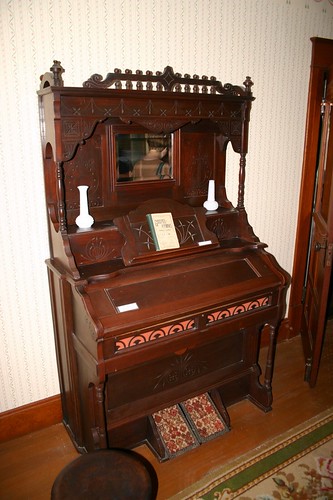
Two years ago, I wrote about Elvera Voth and the power of love. Back then I wrote about her memories of seeing of service workers, who would be away from their home for 7 years at a time. Elvera remembered a gathering of people at the train station to see them off, and how they sang some German hymns at the occasion. Elvera s done a lot since, including starting an arts in prison program. And today, she hosted a hymn sing at the pump organ in the Friesen House parlor. img_4305.jpg The Friesen House is nearly 100 years old, and was on my parents property before it got moved to the Mennonite Heritage and Agricultural Museum. We were among maybe 20 people that showed up for the event. We walked in a few minutes early and Elvera was sitting at the organ already, along with a few other early arrivals. Many of the people there were over 70, and the moment we walked in, she said, Oh good! Another generation! And, of course, asked about us, where we live, who we are related to, etc. The announcement in our church bulletin said to bring a copy of Gesangbuch mit Noten if you have one. That was a common hymn book in Mennonite churches in Kansas (songbook with notes and yes, there was one without notes that had only words.) I pulled out my copy, and just opened it up. I saw my grandma s beautiful handwriting saying it belonged to Mr. and Mrs. R. A. Klassen . This I brought along, but was perhaps the only one. Elvera recognized it and was pleased to hear where it came from. We had a great time, and it turned out to feel like the kind of afternoon people around here used to have: time with friends and family visiting and maybe singing on occasion. After some introduction and some stories, we got to the singing and started with hymn #1 in the 1969 (English) Mennonite Hymnal. That song had German words below as well, which we sang: Grosser Gott, wir loben dich! (Holy God, We Praise Thy Name) Elvera played the organ while we all sang. And then we turned to #556, O Have You Not Heard. We read through the German lyrics (to help those that don t speak German):
Ich weiss einen Strom, dessen herrliche Flut
fliesst wunderbar stille durchs Land,
doch strahlet und gl nzt er wie feurige Glut,
wem ist dieses W sser bekannt? O Seele, ich bitte dich: Komm!
Und such diesen herrlichen Strom!
Sein Wasser fliesst frei und m chtiglich,
o glaub s, es fliesset f r dich!
Elvera translated this herself, a much more powerful translation than we usually get in English. And then we sang, this time a cappella. Elvera told the story about the train station to this group, and then, of course, we sang O Power of Love, one of the songs sung on that occasion. For that, she asked us to stand up and form a circle around the organ, and again we sang mostly a cappella. Singing that song with Elvera left few dry eyes in the room for sure. Someone brought up Nun Ist Sie Erschienen, and so of course we sang that. It wasn t in any hymnal, but I suspect we were the only ones there that didn t have it completely memorized. Elvera told us the story of the museum s pump organ; it had been in her family, and she had paid to have it restored and eventually donated it to the museum. It had been used every evening at twilight for singing and devotions in the family. She also told us that the singing at the Newton train station the same one our family uses a few times a year was what inspired her to a career of choral music. In the end, we probably spent more time visiting than singing, but that was just fine. Next the group went over to the Preparatory School, an old schoolhouse also on the museum grounds. There we had a traditional Faspa, an afternoon meal with coffee, Zwieback and jam, cheese, and various cookies. We all visited for awhile longer and then went on our way. It was a wonderful afternoon, and I hope to have a chance to do that sort of thing again.

10 October 2010

Gregor Herrmann: RC bugs 2010/40

a rather active week, although most of my uploads were (again!) either packages prepared by others or packages where I just applied existing patches from the BTS. in case you haven't seen it yet: there will be a BSP at the Mini DebConf Paris at the end of october. .

Christian Perrier: GPG key transition

It's now time for me to move and use the new 4096 RSA GPG key which I created back in May 2009 and got signed during two DebConfs. It is now well connected and Debian keyring maintainers have included it in the Debian keyring in place of my good old C0143D2D (which was very very well connected...). Here's my transition document (shamelessly inspired from Zack's excellent text, itself inspired from Russ' excellent text). If you have signed my old key, you should have a fairly straightforward trust path to my new key. If that is compatible with your signing policy, please sign my new key. And, yes, doing this on 10/10/10 seemed to be a good idea...

Christian Perrier: First upload with new GPG key

Debian keyring maintainers did a batch of key updates in Debian keyring this week-end. As a consequence, I just uploaded samba 3.5.6 (which got release managers' approval for a freeze exceptions: thanks, guys) signed by this new key. It's now time to do a proper key transition (first step: learn how to do this appropriately by looking at others practices).

Joey Hess: first real Haskell program

I've finally started writing my first real program in Haskell. I've been learning Haskell since 2007. That is to say, I've been reading about it, over and over. Progress learning has been annoyingly slow because I have not been able to commit to using it in a real program. Because when I'm writing a real program I want the program now, and I can code in other languages ten to one hundred times faster than I can currently code in Haskell. Nasty viscious cycle. Probably best to avoid getting really good at specific programming languages to avoid it, in hindsight. Writing a real program in Haskell is important because I mostly learn by doing real things. Exercises don't work well for me. Up till now the only real thing I did in Haskell was write a 250 line xmonad config file in it. Which really helped a lot, but mostly only with beating some of its syntax into my head. I have a few hundred lines of git-annex done. I don't need this urgently so I am willing to spend a week writing it instead of dashing off a perl version tonight. I seem to have had bad luck on the parts I tackled first, and run into some swampier parts of the Haskell platform. I hope these problems are behind me, they sure made the first 8 hours fun. time First thing I needed was a data structure with a time stamp. There are multiple modules to handle time, mostly seemingly incompatible, deprecated, and/or possibly broken. Data.DateTime seems to be the current choice, but I don't entirely trust it. Check this weird thing out, it thinks that 0 seconds and 1 second after the Unix epoch are the same second.
Data.DateTime> map (toSeconds . fromSeconds) [-1,0,1,2,100,1000,100000,100000,1000000,100000000,100000000,1000000000,10000000000]
[-2,0,0,1,99,999,99999,99999,999999,99999999,99999999,1000000000,10000000000]
Rounding error? (Now it's not all bad... it does support dates right up until the heat death of the universe, on 32 bit even. No Y2038 bug here.) locking Huh, I read RealWorld_Haskell_ twice and never noticed that it seems to omit POSIX file locking. Which in my Real World is a necessity. Probably because it's so hard in Haskell, with multiple gotchas. First there's the lazy IO problem, which means that if you explicitly close a file, code that read from it may not have really run yet. I ended up needing this scariness from System.IO.Strict, which is sadly not packaged in Debian or part of the Haskell Platform:
hGetContentsStrict h  = hGetContents h >>= \s -> length s  seq  return s
Then there's the Haskell's interface for fcntl locking, which exposes rather more of fcntl locking than I like to think about, being spoiled by perl's 2-parameter interface to it.
waitToSetLock lockfd (ReadLock, AbsoluteSeek, 0, 0)
And then there's that lockfd, which is not a regalar file handle, but a fd number, which has to be obtained by calling handleToFd. And then there's the crazy interface that has handleToFd close the input handle! Which is problimatic if you were going to use the file after you locked it..

9 October 2010

Sylvain Le Gall: ocaml-gettext 0.3.0 is released

After three years, a new version of ocaml-gettext is out. I know that the delay is quite long... Been too busy to do anything regarding this. This new version is mainly a bug fix release: However, the major event of this release is the fact that it is now compatible with OCaml 3.10.0. This is a big news, because string extraction heavily rely on camlp4, which has changed a lot. I have also uploaded a debian package of ocaml-gettext. Plans for next release: Homepage Download
Sylvain Le Gall: Waiting for her in ~1month

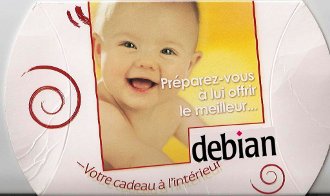
My wife is pregnant and we are expecting our second baby's arrival in about a month. Last time, she came back from her preparation lessons with a adverstisement "baby shower" gift pack. One of them catch my attention: English translation: be prepared to offer him the best... English translation: because Debian guarantee the quality and offering the quality is a proof of love OK, the swirl is the other way and I made a 5 minutes GIMP modification to cut-and-paste the Debian logo. But the message is here! Remember me: For those interested, the real thing is a soap called NUK(R).


Sylvain Le Gall: LLVM, OCaml and Debian

I hope some people from the OCaml community will enjoy this changelog, extracted from llvm 2.6-7, which has just been uploaded:
  [ Arthur Loiret ]
   
  [...]
  [ Sylvain Le Gall ]
  * Build a libllvm-ocaml-dev package, which contains the OCaml binding:
    Closes: #568556.
    - debian/debhelper.in/libllvm-ocaml-dev. dirs,doc-base,install,META : Add.
    - debian/control.in/source: Build-Depends on ocaml-nox (>= 3.11.2),
      ocaml-best-compilers   ocaml-nox, dh-ocaml (>= 0.9.1).
    - debian/packages.d/llvm.mk:
      + (llvm_packages): Add libllvm-ocaml-dev.
      + (libllvm-ocaml-dev_extra_binary): Define, install META file.
    - debian/rules.d/binary.mk: Add dh_installdirs and dh_ocaml.
    - debian/rules.d/vars.mk:
      + include /usr/share/ocaml/ocamlvars.mk.
      + Configure with --with-ocaml-libdir=$(OCAML_STDLIB_DIR)/llvm.
  * debian/rules.d/build.mk: Fix symlinks pointing to the $DESTDIR.
In other words: LLVM is now built with its OCaml bindings and a META file for findlib. It will take some days before reaching every architectures, but hopefully it will be in Squeeze (next Debian stable release). Thanks to Arthur Loiret for the quick upload.

Sylvain Le Gall: OCaml cryptokit and Java PBEWithMD5AndDES

During one of my project I need to interact with Java cryptographic extension. Some data has been encrypted using PBEWithMD5AndDES. I need to access it from OCaml. I take a look at available cryptographic extension in the Debian project for OCaml: cryptgps and cryptokit. I choose cryptokit, because its author is well known: Xavier Leroy. This article was my starting point. Of course, I keep in mind that the reference is there and that there is a good article covering it. Here is the result in OCaml:
 let decrypt passphrase salt ?(iterationCount=41) str =
   let key, iv =
     let rec hash_aux iter str =
       if iter > 0 then
         (* Rehash string *)
         hash_aux
           (iter - 1)
           (hash_string
              (Hash.md5 ())
              str)
       else
         (* Key = first 8 bytes of the MD5 hash *)
         String.sub str 0 8,
         (* IV = last 8 bytes of the MD5 hash *)
         String.sub str 8 8
     in
       (* Hash n times combination of passphrase and salt,
           return key and iv 
         *)
       hash_aux
         iterationCount
         (passphrase ^ salt)
   in
     transform_string
        (Cipher.des
           ~pad:Padding.length
           ~iv:iv
           key
           Cipher.Decrypt)
       str
The only missing information was the pad algorithm to use (Padding.length). For this piece of information, I need to browse the RSA documentation and test a little bit. Rewriting PBEWithMD5andDES is quite straightforward with cryptokit and OCaml. It takes 25 lines with C# and OCaml (only counting LoC, no comment, no empty constructor or declaration in C#). I was thinking that this task will require 2 or 3 days, but it has been done in 4 hours... Many thanks to cryptokit ;-)

Joachim Breitner: Goodby procmail, Hello Sieve

After having switched from Courier to Dovecot half a year ago I thought it was finally time to look into Sieve. For many years now I have maintained a procmail script to filter my incoming e-mail into numerous subfolders. Two features are important to me: For mailing lists, folders are created automatically based on the list names, with some adjustments for certain domains, such as putting all Debian lists into a folder of their own. And my procmail script was parsing the a dump of my evolution address book to put mail from people I know in a special folder. I did not know that at the first point is actually possible in Sieve but it is, using the variables extensions. And then the second was not hard to fix either, using this small and crude bash script, which creates a Sieve script recognizing these addresses, which is called from my main Sieve script:
#!/bin/bash
(
echo 'require ["fileinto"];'
echo 'if address ["From"] ['
/usr/lib/evolution/*/evolution-addressbook-export  
 perl -n -e 'print "\"$1\",\n" if /.*:(.*@[a-z0-9.]*)\s*$/'
 echo '"Justadummy"'
echo '  ]  '
echo ' fileinto "INBOX.Bekannte"; '
echo '  '
) > /tmp/bekannte
sieve-connect --user mail@joachim-breitner.de \
    --server 10.254.1.101 --port 2000 --notlsverify \
    --localsieve /tmp/bekannte --remotesieve bekannte  \
    --upload
I set up ManageSieve to be able to upload the scripts using sieve-connect. And finally I am able to do something that I have missed in all the years: Using the imap4flag extension, I can mark some mail automatically as read. This is useful for mail that is actually generated by me using program besides my e-mail client, such as bug reports sent by reportbug or patches submitted using darcs. I might even enable this feature for mailing list mails that I have sent.

Joachim Breitner: Goodbye procmail, Hello Sieve

After having switched from Courier to Dovecot half a year ago I thought it was finally time to look into Sieve. For many years now I have maintained a procmail script to filter my incoming e-mail into numerous subfolders. Two features are important to me: For mailing lists, folders are created automatically based on the list names, with some adjustments for certain domains, such as putting all Debian lists into a folder of their own. And my procmail script was parsing the a dump of my evolution address book to put mail from people I know in a special folder. I did not know that at the first point is actually possible in Sieve but it is, using the variables extensions. And then the second was not hard to fix either, using this small and crude bash script, which creates a Sieve script recognizing these addresses, which is called from my main Sieve script:
#!/bin/bash
(
echo 'require ["fileinto"];'
echo 'if address ["From"] ['
/usr/lib/evolution/*/evolution-addressbook-export  
 perl -n -e 'print "\"$1\",\n" if /.*:(.*@[a-z0-9.]*)\s*$/'
 echo '"Justadummy"'
echo '  ]  '
echo ' fileinto "INBOX.Bekannte"; '
echo '  '
) > /tmp/bekannte
sieve-connect --user mail@joachim-breitner.de \
    --server 10.254.1.101 --port 2000 --notlsverify \
    --localsieve /tmp/bekannte --remotesieve bekannte  \
    --upload
I set up ManageSieve to be able to upload the scripts using sieve-connect. And finally I am able to do something that I have missed in all the years: Using the imap4flag extension, I can mark some mail automatically as read. This is useful for mail that is actually generated by me using program besides my e-mail client, such as bug reports sent by reportbug or patches submitted using darcs. I might even enable this feature for mailing list mails that I have sent.

Alastair McKinstry: Tidally locked Benchmarks

Fresh up on arxiv.org is a paper by Kevin Heng, Kristen Menou and Peter Phillipps: Atmospheric circulation of tidally-locked exoplanets: a suite of benchmark tests for dynamical solvers. Kristen Menou was at exoclimes 2010 where one of the background topics was how to compare and validate our various models in exoplanetary climates. Earth-based climate modellers have test cases such as Held-Suarez which are used to compare the models, but to date no equivalents are used for exoplanetary models. This work fills that gap for Tidally-locked atmospheres (similar to Zarmina for example, and some 'Hot Jupiters'. I'm particularly interested in the tidally-locked Earth case; it's relevant for my own PhD work. Incidentally, for a good summary of the different ways we test climate models, see Steve Easterbrook's recent blog entry; he's been doing a tour of major modelling centres, learning how they do things. Worth a look. Tags , ,

Christian Perrier: Gently kicking my Czech and Spanish-speaking friends...

After pushing for completion to the Portuguese l10n team, I did the same work for Czech and Spanish teams, identifying what's missing for them to reach 100%. Doing this, I sent 15 intents to NMU various packages..dozens of mails to debian-l10n-czech and debian-l10n-spanish mailing lists. And I even "translated" debconf templates to Czech and Vietnamese for two packages..:-) (don't worry, these were trivial updates, of course. I still don't speak, read or write Czech and Vietnamese)

Petter Reinholdtsen: First version of a Perl library to control the Spykee robot

This summer I got the chance to buy cheap Spykee robots, and since then I have worked on getting Linux software in place to control them. The firmware for the robot is available from the producer, and using that source it was trivial to figure out the protocol specification. I've started on a perl library to control it, and made some demo programs using this perl library to allow one to control the robots. The library is quite functional already, and capable of controlling the driving, fetching video, uploading MP3s and play them. There are a few less important features too. Since a few weeks ago, I ran out of time to spend on this project, but I never got around to releasing the current source. I decided today that it was time to do something about it, and uploaded the source to my Debian package store at people.skolelinux.org. Because it was simpler for me, I made a Debian package and published the source and deb. If you got a spykee robot, grab the source or binary package: If you are interested in helping out with developing this library, please let me know.

David Paleino: Simple Python and Vala XML parsers

As some of you might know, I'm an OpenStreetMaper. In the last month, during those bits of spare time I had, I wrote a set of python scripts which compute some statistics over an OSM dump. I do this by parsing the whole XML tree, and national dumps are pretty huge (italy.osm is ~4G nowadays, and is not as well-mapped as Germany!), so I needed a way to do this without creating a memory-hungry beast. With Python, I could succesfully do this:
#!/usr/bin/python
# -*- coding: utf-8 -*-
import xml.etree.cElementTree as etree
def parse(filename):
    source = open(filename)
    context = etree.iterparse(source, events=("start", "end"))
    context = iter(context)
    event, root = context.next()
    for event, elem in context:
        if event == "end":
            root.clear()
            continue
        print elem.tag
if __name__ == '__main__':
    import sys
    parse(sys.argv[1])
And here the results:
$ /usr/bin/time ./parsexml.py ~/osmstats/dumps/italy.osm.bz2.20100912.out 1>/dev/null
413.22user 6.15system 8:57.80elapsed 77%CPU (0avgtext+0avgdata 21200maxresident)k
7739552inputs+0outputs (10major+1470minor)pagefaults 0swaps
However, since some time, I wanted to learn Vala, so I tried to do this very same task with it. Here's the code:
using Xml;
class XmlParser  
    public void parse_file(string path)  
        var handler = SAXHandler();
        void* user_data = null;
        handler.startElement = start_element;
        handler.user_parse_file(user_data, path);
     
    public void start_element(string name, string[] attr)  
        stdout.printf("%s\n", name);
     
 
int main(string[] args)  
    Parser.init();
    var parser = new XmlParser();
    parser.parse_file(args[1]);
    Parser.cleanup();
    return 0;
 
You need to compile it with: valac --pkg libxml-2.0 xml.vala And here's the result:
$ /usr/bin/time ./xml ~/osmstats/dumps/italy.osm.bz2.20100912.out 1>/dev/null
122.01user 4.03system 3:14.61elapsed 64%CPU (0avgtext+0avgdata 6352maxresident)k
7738984inputs+0outputs (0major+461minor)pagefaults 0swaps
Both these codes are, however, CPU-hungry. But at least they don't swap :-) Needless to say that I'm planning to switch my scripts to Vala for 2.0.

Christian Perrier: Gently kicking my Portuguese friends...

Today, I went through the status page of Portuguese translations for debconf tempaltes and gently pushed my friends from Portugal to do the final bits of work missing. When those translation are sent to the BTS, I'll be able to kick my maintainer friends to fix them and hopefully bring Portuguese to the 100% Grail. Russian, French, Swedish and German teams are nearly touching this Grail.. French should reach it when my NMU of qmail reaches unstable (5 days left in DELAYED). Russian and Swedish should when Andrew Pollock finishes fighting with isc-dhcp. German also needs fts, which I just sent to DELAYED/7-day and mailgraph which I haven't worked on yet (but the maintainer is). Fear my anger if you happen to break this by uploading uncoordinated new debconf templates!

8 October 2010

Tim Retout: myspell-hu

This evening's RC bug fixes were in magyarispell: I'm tempted to go to Paris for the mini-debconf at the end of the month. I've never visited France, despite my French roots - and it turns out it's quite easy for me to get there.

Joey Hess: getting to know my batteries

I should probably have researched the batteries in this old solar-powered house before I installed a charge controller. I had assumed that the 24 6-volt batteries in the house's battery bay were standard lead-acid deep cycle batteries. It wasn't until I stumbled over a receipt from 1997 that I learned that the batteries are really NiCads. Specifically Saft model STM5-180. Thirty of these were purchased in 1997 from TVA in Chatanooga, for $350 total. An amazing price, since a single deep cycle battery is in that ballpark, new. These batteries were used, they had been in a "bus" -- perhaps it was a 1995 Chrysler TEVan, or maybe one of the pilot electric buses running there in the late 90's. They were probably not in this '79 VW TVA Bus. All mentions of these batteries I can find involve electric vehicles -- it's unusual for them to be used to power a house. Being vented NiCads probably accounts for these batteries' long useful life -- surely at least 15 years. Still, with only twenty-four good ones left, they are probably toward the end of their lifespan and need to be taken care of in order to last. Once I realized they were NiCads, I knew the charge controller was charging them wrong. NiCads like to be charged at a higher voltage than the 13 or so volts used for lead acid. I would have liked to charge them at 16 volts, but that would feed back through the house wiring, and could fry 12 volt stuff. Checking ratings, 15 volts seemed the highest voltage I could risk. Coming back a week later, I found the batteries charged up to 13.4 volts. And they are now working great. Through several cloudy days, we had all the power we needed. And when the sun was out fully, I sometimes saw the solar panels charging the batteries at 125 watts -- fully half of the panels' rated capacity, and much better than before. The batteries start each evening at 13.4 volts, and only drop to 13.3 by morning. We started using electric lights more, and then just leaving them on all evening, and the nslu2 online all night, and the batteries remained at the magic 13.3 in the morning. This is because NiCad batteries have a near-constant voltage until they are perhaps 30% discharged. In other words, I had been charging them less than half full before. I have figured out how to combine the two banks the batteries are in into one large bank, and once I get the cables to do that, I hope to have battery capacity to get through up to a week of solid clouds in midwinter.
battery box and solar panel

Next.

Previous.