Search Results: "xam"

5 March 2017

Julien Viard de Galbert: Raspberry Pi 3 as desktop computer

For about six months I ve been using a Raspberry Pi 3 as my desktop computer at home. The overall experience is fine, but I had to do a few adjustments.
First was to use KeePass, the second to compile gcc for cross-compilation (ie use buildroot).
KeePass I m using KeePass + KeeFox to maintain my passwords on the various websites (and avoid reusing the same everywhere).
For this to work on the Raspberry Pi, one need to use mono from Xamarin:
sudo apt-key adv --keyserver hkp://keyserver.ubuntu.com:80 --recv-keys 3FA7E0328081BFF6A14DA29AA6A19B38D3D831EF
echo "deb http://download.mono-project.com/repo/debian wheezy main"   sudo tee /etc/apt/sources.list.d/mono-xamarin.list
sudo apt-get update
sudo apt-get upgrade
sudo apt-get install mono-runtime
The install instruction comes from mono-project and the initial pointer was found on raspberrypi forums, stackoverflow and Benny Michielsen s blog.
And for some plugin to work I think I had to apt-get install mono-complete. Compiling gcc Using the Raspberry Pi 3, I recovered an old project based on buildroot for the raspberry pi 2. And just for building the tool-chain I had a few issues. First the compilation would stop during mnp compilation:
 /usr/bin/gcc -std=gnu99 -c -DHAVE_CONFIG_H -I. -I.. -D__GMP_WITHIN_GMP -I.. -DOPERATION_divrem_1 -O2 -Wa,--noexecstack tmp-divrem_1.s -fPIC -DPIC -o .libs/divrem_1.o
tmp-divrem_1.s: Assembler messages:
tmp-divrem_1.s:129: Error: selected processor does not support ARM mode  mls r1,r4,r8,r11'
tmp-divrem_1.s:145: Error: selected processor does not support ARM mode  mls r1,r4,r8,r11'
tmp-divrem_1.s:158: Error: selected processor does not support ARM mode  mls r1,r4,r8,r11'
tmp-divrem_1.s:175: Error: selected processor does not support ARM mode  mls r1,r4,r3,r8'
tmp-divrem_1.s:209: Error: selected processor does not support ARM mode  mls r11,r4,r12,r3'
Makefile:768: recipe for target 'divrem_1.lo' failed
make[]: *** [divrem_1.lo] Error 1
I Googled the error and found this post on the Raspberry Pi forum not really helpful
But I finally found an explanation on Jan Hrach s page on the subject.
The raspbian distribution is still optimized for the first Raspberry Pi so basically the compiler is limited to the old raspberypi instructions. While I was compiling gcc for a Raspberry Pi 2 so needed the extra ones. The proposed solution is to basically update raspbian to debian proper. While this is a neat idea, I still wanted to get some raspbian specific packages (like the kernel) but wanted to be sure that everything else comes from debian. So I did some apt pinning. First I experienced that pinning is not sufficient so when updating source.list with plain debian Jessie, make sure to add theses lines before the raspbian lines:
# add official debian jessie (real armhf gcc)
deb http://ftp.fr.debian.org/debian/ jessie main contrib non-free
deb-src http://ftp.fr.debian.org/debian/ jessie main
deb http://security.debian.org/ jessie/updates main
deb-src http://security.debian.org/ jessie/updates main
deb http://ftp.fr.debian.org/debian/ jessie-updates main
deb-src http://ftp.fr.debian.org/debian/ jessie-updates main
Then run the following to get the debian gpg keys, but don t yet upgrade your system:
apt update
apt install debian-archive-keyring
Now, let s add the pinning.
First if you were using APT::Default-Release "stable"; in your apt.conf (as I did) remove it. It does not mix well with fine grained pinning we will then implement. Then, fill your /etc/apt/preferences file with the following:
# Debian
Package: *
Pin: release o=Debian,a=stable,n=jessie
Pin-Priority: 700
# Raspbian
Package: *
Pin: release o=Raspbian,a=stable,n=jessie
Pin-Priority: 600
Package: *
Pin: release o=Raspberry Pi Foundation,a=stable,n=jessie
Pin-Priority: 600
# Mono
Package: *
Pin: release v=7.0,o=Xamarin,a=stable,n=wheezy,l=Xamarin-Stable,c=main
Pin-Priority: 800
Note: You can use apt-cache policy (no parameter) to debug pinning.
The pinning above is mainly based on the origin field of the repositories (o=)
Finally you can upgrade your system:
apt update 
apt-cache policy gcc 
rm /var/cache/apt/archives/* 
apt upgrade 
apt-cache policy gcc
Note: Removing the cache ensure we download the packages from debian as raspbian is using the exact same naming but we now they are not compiled with a real armhf tool-chain. Second issue with gcc The build stopped on recipe for target 's-attrtab' failed. There are many references on the web, that one was easy, it just need more memory, so I added some swap on the external SSD I was already using to work on buildroot. Conclusion That s it for today, not bad considering my last post was more that 3 years ago

4 March 2017

intrigeri: Contribute your skills to Debian in Paris, May 13-14 2017

(There is a French translation of this announcement.) Join us in Paris, on May 13-14 2017, and we will find a way in which you can help Debian with your current set of skills! You might even learn one or two things in passing (but you don't have to). Debian is a free operating system for your computer. An operating system is the set of basic programs and utilities that make your computer run. Debian comes with dozens of thousands of packages, precompiled software bundled up for easy installation on your machine. A number of other operating systems, such as Ubuntu and Tails, are based on Debian. The upcoming version of Debian, called Stretch, will be released later this year. We need you to help us make it awesome :) Whether you're a computer user, a graphics designer, or a bug triager, there are many ways you can contribute to this effort. We also welcome experience in consensus decision-making, anti-harassment teams, and package maintenance. No effort is too small and whatever you bring to this community will be appreciated. Here's what we will be doing: Goals and principles Before diving into the exact content of this event, a few words from the organization team. This is a work in progress, and a statement of intent. Not everything is organized and confirmed yet. We want to bring together a heterogeneous group of people. This goal will guide our handling of sponsorship requests, and will help us make decisions if more people want to attend than we can welcome properly. In other words: if you're part of a group that is currently under-represented in computer communities, we would like you to be able to attend. We are committed to providing a friendly, safe and welcoming environment for all, regardless of level of experience, gender, gender identity and expression, sexual orientation, disability, personal appearance, body size, race, ethnicity, age, religion, nationality, or other similar personal characteristic. Attending this event requires reading and respecting our Code of Conduct, that sets the standards in terms of behaviour for the whole event, including communication (public and private) before, while and after. There will be a team ready to act if you feel you have been or are being harassed or made uncomfortable by an attendee. We believe that money should not be a blocker for contributing to Debian. We will sponsor travel and find a place to sleep for as many enthusiastic attendees as possible. The space where this event will take place is accessible to wheelchairs. We are trying to organize a translation into (probably French) sign language. Vegan food should be provided for lunch. If you have any specific needs regarding food, please let us know when registering, and we will do our best. What we will be doing There will be a number of stations, i.e. physical space dedicated to people with a given set of skills, hosted by someone who is ready to make this space welcoming and productive. A few stations are already organized, and are described below. If you want to host a station yourself, or would like us to organize another one, please let us know. For example, you may want to assess the state of Debian Stretch for a specific field of interest, be it audio editing, office work, network auditing or whatever you are doing with Debian :) Test the upcoming version of Debian We will test Debian Stretch and gather feedback. We are particularly interested in: Experienced Debian contributors will be ready to relay this feedback to the relevant teams so it is put to good use. Hypra collaborators will be there to bring a focus on universal access technologies. Design and graphics Truth be told, Debian lacks people who are good at design and graphics. There are definitely a good number of low-hanging fruits that can be tackled in a week-end, either in Debian per-se, or in upstream) projects, or in Debian derivatives. This station will be hosted by Juliette Belin. She designed the themes for the last two versions of Debian. Triage Release Critical bugs Bugs flagged as Release Critical are blocking the release of the upcoming version of Debian. To fix them, it helps to make sure the bug report documents the up-to-date status of the bug, and of its resolution. One does not need to be a programmer to do this work! For example, you can try and reproduce bugs in software you use... or in software you will discover. This helps package maintainers better focus their work. This station will be hosted by Solveig. She has experience in bug triaging, in Debian and elsewhere. Cyril Brulebois, a long-time Debian developer, will provide support and advice upon request. Fix Release Critical bugs There will be a Bug Squashing Party. Where? When? How to register? See https://wiki.debian.org/BSP/2017/05/fr/Paris for the exact address and time. Please register by the end of March if you want to attend this event! If you have any questions, please get in touch with us.

3 March 2017

Markus Koschany: My Free Software Activities in February 2017

Welcome to gambaru.de. Here is my monthly report that covers what I have been doing for Debian. If you re interested in Java, Games and LTS topics, this might be interesting for you. We have reached the end of Stretch s development cycle, a phase called full freeze. That means packages may only migrate to Testing aka Stretch after approval by the release team. Changes must be minimal and only address important or release critical bugs. This is usually the time when I stop uploading new upstream releases to unstable to avoid any disruptions. Of course there are exceptions but if you are unsure best practice is to use experimental instead. A lot of RC bugs are still open and affect the next release. In February I could close five one and triage two more. Debian Games Debian Java Debian LTS This was my twelfth month as a paid contributor and I have been paid to work 13 hours on Debian LTS, a project started by Rapha l Hertzog. In that time I did the following: Non-maintainer uploads Thanks for reading and see you next time.

2 March 2017

Jonathan McDowell: Rational thoughts on the GitHub ToS change

I woke this morning to Thorsten claiming the new GitHub Terms of Service could require the removal of Free software projects from it. This was followed by joeyh removing everything from github. I hadn t actually been paying attention, so I went looking for some sort of summary of whether I should be worried and ended up reading the actual ToS instead. TL;DR version: No, I m not worried and I don t think you should be either. First, a disclaimer. I m not a lawyer. I have some legal training, but none of what I m about to say is legal advice. If you re really worried about the changes then you should engage the services of a professional. The gist of the concerns around GitHub s changes are that they potentially circumvent any license you have applied to your code, either converting GPL licensed software to BSD style (and thus permitting redistribution of binary forms without source) or making it illegal to host software under certain Free software licenses on GitHub due to being unable to meet the requirements of those licenses as a result of GitHub s ToS. My reading of the GitHub changes is that they are driven by a desire to ensure that GitHub are legally covered for the things they need to do with your code in order to run their service. There are sadly too many people who upload code there without a license, meaning that technically no one can do anything with it. Don t do this people; make sure that any project you put on GitHub has some sort of license attached to it (don t write your own - it s highly likely one of Apache/BSD/GPL will suit your needs) so people know whether they can make use of it or not. I don t care is not a valid reason not to do this. Section D, relating to user generated content, is the one causing the problems. It s possibly easiest to walk through each subsection in order. D1 says GitHub don t take any responsibility for your content; you make it, you re responsible for it, they re not accepting any blame for harm your content does nor for anything any member of the public might do with content you ve put on GitHub. This seems uncontentious. D2 reaffirms your ownership of any content you create, and requires you to only post 3rd party content to GitHub that you have appropriate rights to. So I can t, for example, upload a copy of Friday by Rebecca Black. Thorsten has some problems with D3, where GitHub reserve the right to remove content that violates their terms or policies. He argues this could cause issues with licenses that require unmodified source code. This seems to be alarmist, and also applies to any random software mirror. The intent of such licenses is in general to ensure that the pristine source code is clearly separate from 3rd party modifications. Removal of content that infringes GitHub s T&Cs is not going to cause an issue. D4 is a license grant to GitHub, and I think forms part of joeyh s problems with the changes. It affirms the content belongs to the user, but grants rights to GitHub to store and display the content, as well as make copies such as necessary to provide the GitHub service. They explicitly state that no right is granted to sell the content at all or to distribute the content outside of providing the GitHub service. This term would seem to be the minimum necessary for GitHub to ensure they are allowed to provide code uploaded to them for download, and provide their web interface. If you ve actually put a Free license on your code then this isn t necessary, but from GitHub s point of view I can understand wanting to make it explicit that they need these rights to be granted. I don t believe it provides a method of subverting the licensing intent of Free software authors. D5 provides more concern to Thorsten. It seems he believes that the ability to fork code on GitHub provides a mechanism to circumvent copyleft licenses. I don t agree. The second paragraph of this subsection limits the license granted to the user to be the ability to reproduce the content on GitHub - it does not grant them additional rights to reproduce outside of GitHub. These rights, to my eye, enable the forking and viewing of content within GitHub but say nothing about my rights to check code out and ignore the author s upstream license. D6 clarifies that if you submit content to a GitHub repo that features a license you are licensing your contribution under these terms, assuming you have no other agreement in place. This looks to be something that benefits projects on GitHub receiving contributions from users there; it s an explicit statement that such contributions are under the project license. D7 confirms the retention of moral rights by the content owner, but states they are waived purely for the purposes of enabling GitHub to provide service, as stated under D4. In particular this right is revocable so in the event they do something you don t like you can instantly remove all of their rights. Thorsten is more worried about the ability to remove attribution and thus breach CC-BY or some BSD licenses, but GitHub s whole model is providing attribution for changesets and tracking such changes over time, so it s hard to understand exactly where the service falls down on ensuring the provenance of content is clear. There are reasons to be wary of GitHub (they ve taken a decentralised revision control system and made a business model around being a centralised implementation of it, and they store additional metadata such as PRs that aren t as easily extracted), but I don t see any indication that the most recent changes to their Terms of Service are something to worry about. The intent is clearly to provide GitHub with the legal basis they need to provide their service, rather than to provide a means for them to subvert the license intent of any Free software uploaded.

Antoine Beaupr : A short history of password hashers

These are notes from my research that led to the publication of the password hashers article. This article is more technical than the previous ones and compares the various cryptographic primitives and algorithms used in the various software I have reviewed. The criteria for inclusion on this list is fairly vague: I mostly included a password hasher if it was significantly different from the previous implementations in some way, and I have included all the major ones I could find as well.

The first password hashers Nic Wolff claims to be the first to have written such a program, all the way back in 2003. Back then the hashing algorithm was MD5, although Wolff has now updated the algorithm to use SHA-1 and still maintains his webpage for public use. Another ancient but unrelated implementation, is the Standford University Applied Cryptography's pwdhash software. That implementation was published in 2004 and unfortunately, that implementation was not updated and still uses MD5 as an hashing algorithm, but at least it uses HMAC to generate tokens, which makes the use of rainbow tables impractical. Those implementations are the simplest password hashers: the inputs are simply the site URL and a password. So the algorithms are, basically, for Wolff's:
token = base64(SHA1(password + domain))
And for Standford's PwdHash:
token = base64(HMAC(MD5, password, domain)))

SuperGenPass Another unrelated implementation that is still around is supergenpass is a bookmarklet that was created around 2007, originally using MD5 as well but now supports SHA512 now although still limited to 24 characters like MD5 (which needlessly limits the entropy of the resulting password) and still defaults MD5 with not enough rounds (10, when key derivation recommendations are more generally around 10 000, so that it's slower to bruteforce). Note that Chris Zarate, the supergenpass author, actually credits Nic Wolff as the inspiration for his implementation. Supergenpass is still in active development and is available for the browser (as a bookmarklet) or mobile (as an webpage). Supergenpass allows you to modify the password length, but also add an extra profile secret which adds to the password and generates a personalized identicon presumably to prevent phishing but it also introduces the interesting protection, the profile-specific secret only found later in Password Hasher Plus. So the Supergenpass algorithm looks something like this:
token = base64(SHA512(password + profileSecret + ":" + domain, rounds))

The Wijjo Password Hasher Another popular implementation is the Wijjo Password Hasher, created around 2006. It was probably the first shipped as a browser extension which greatly improved the security of the product as users didn't have to continually download the software on the fly. Wijjo's algorithm also improved on the above algorithms, as it uses HMAC-SHA1 instead of plain SHA-1 or HMAC-MD5, which makes it harder to recover the plaintext. Password Hasher allows you to set different password policies (use digits, punctuation, mixed case, special characters and password length) and saves the site names it uses for future reference. It also happens that the Wijjo Password Hasher, in turn, took its inspiration on different project, hashapass.com, created in 2006 and also based on HMAC-SHA-1. Indeed, hashapass "can easily be generated on almost any modern Unix-like system using the following command line pattern":
echo -n parameter \
  openssl dgst -sha1 -binary -hmac password \
  openssl enc -base64 \
  cut -c 1-8
So the algorithm here is obviously:
token = base64(HMAC(SHA1, password, domain + ":" + counter)))[:8]
... although in the case of Password Hasher, there is a special routine that takes the token and inserts random characters in locations determined by the sum of the values of the characters in the token.

Password Hasher Plus Years later, in 2010, Eric Woodruff ported the Wijjo Password Hasher to Chrome and called it Password Hasher Plus. Like the original Password Hasher, the "plus" version also keeps those settings in the extension and uses HMAC-SHA-1 to generate the password, as it is designed to be backwards-compatible with the Wijjo Password Hasher. Woodruff did add one interesting feature: a profile-specific secret key that gets mixed in to create the security token, like what SuperGenPass does now. Stealing the master password is therefore not enough to generate tokens anymore. This solves one security concern with Password Hasher: an hostile page could watch your keystrokes and steal your master password and use it to derive passwords on other sites. Having a profile-specific secret key, not accessible to the site's Javascript works around that issue, but typing the master password directly in the password field, while convenient, is just a bad idea, period. The final algorithm looks something like:
token = base64(HMAC(SHA1, password, base64(HMAC(SHA1, profileSecret, domain + ":" + counter))))
Honestly, that seems rather strange, but it's what I read from the source code, which is available only after decompressing the extension nowadays. I would have expected the simplest version:
token = base64(HMAC(SHA1, HMAC(SHA1, profileSecret, password), domain + ":" + counter))
The idea here would be "hide" the master password from bruteforce attacks as soon as possible... But maybe this is all equivalent. Regardless, Password Hasher Plus then takes the token and applies the same special character insertion routine as the Password Hasher.

LessPass Last year, Guillaume Vincent a french self-described "humanist and scuba diving fan" released the lesspass extension for Chrome, Firefox and Android. Lesspass introduces several interesting features. It is probably the first to include a commandline version. It also uses a more robust key derivation algorithm (PBKDF2) and takes into account the username on the site, allowing multi account support. The original release (version 1) used only 8192 rounds which is now considered too low. In the bug report it was interesting to note that LessPass couldn't do the usual practice of running the key derivation for 1 second to determine the number of rounds needed as the results need to be deterministic. At first glance, the LessPass source code seems clear and easy to read which is always a good sign, but of course, the devil is in the details. One key feature that is missing from Password Hasher Plus is the profile-specific seed, although it should be impossible, for a hostile web page to steal keystrokes from a browser extension, as far as I know. The algorithm then gets a little more interesting:
entropy = PBKDF2(SHA256, masterPassword, domain + username + counter, rounds, length)
where
    rounds=10000
    length=32
entropy is then used to pick characters to match the chosen profile. Regarding code readability, I got quickly confused by the PBKDF2 implementation: SubtleCrypto.ImportKey() doesn't seem to support PBKDF2 in the API, yet it's how it is used there... Is it just something to extract key material? We see later what looks like a more standard AES-based PBKDF2 implementation, but this code looks just strange to me. It could be me unfamilarity with newer Javascript coding patterns, however. There is also a lesspass-specific character picking routing that is also not base64, and different from the original Password Hasher algorithm.

Master Password A review of password hashers would hardly be complete without mentioning the Master Password and its elaborate algorithm. While the applications surrounding the project are not as refined (there is no web browser plugin and the web interface can't be easily turned into a bookmarklet), the algorithm has been well developed. Of all the password managers reviewed here, Master Password uses one of the strongest key derivation algorithms out there, scrypt:
key = scrypt( password, salt, cost, size, parallelization, length )
where
salt = "com.lyndir.masterpassword" + len(username) + name
cost = 32768
size = 8
parallelization = 2
length = 64
entropy = hmac-sha256(key, "com.lyndir.masterpassword" + len(domain) + domain + counter )
Master Password the uses one of 6 sets of "templates" specially crafted to be "easy for a user to read from a screen and type using a keyboard or smartphone" and "compatible with most site's password policies", our "transferable" criteria defined in the first passwords article. For example, the default template mixes vowels, consonants, numbers and symbols, but carefully avoiding possibly visibly similar characters like O and 0 or i and 1 (although it does mix 1 and l, oddly enough). The main strength of Master Password seems to be the clear definition of its algorithm (although Hashpass.com does give out OpenSSL commandline examples...), which led to its reuse in another application called freepass. The Master Password app also doubles as a stateful password manager...

Other implementations I have also considered including easypasswords, which uses PBKDF2-HMAC-SHA1, in my list of recommendations. I discovered only recently that the author wrote a detailed review of many more password hashers and scores them according to their relative strength. In the end, I ended up covering more LessPass since the design is very similar and LessPass does seem a bit more usable. Covering LessPass also allowed me to show the contrast and issues regarding the algorithm changes, for example. It is also interesting to note that the EasyPasswords author has criticized the Master Password algorithm quite severely:
[...] scrypt isn t being applied correctly. The initial scrypt hash calculation only depends on the username and master password. The resulting key is combined with the site name via SHA-256 hashing then. This means that a website only needs to break the SHA-256 hashing and deduce the intermediate key as long as the username doesn t change this key can be used to generate passwords for other websites. This makes breaking scrypt unnecessary[...]
During a discussion with the Master Password author, he outlined that "there is nothing "easy" about brute-force deriving a 64-byte key through a SHA-256 algorithm." SHA-256 is used in the last stage because it is "extremely fast". scrypt is used as a key derivation algorithm to generate a large secret and is "intentionnally slow": "we don't want it to be easy to reverse the master password from a site password". "But it' unnecessary for the second phase because the input to the second phase is so large. A master password is tiny, there are only a few thousand or million possibilities to try. A master key is 8^64, the search space is huge. Reversing that doesn't need to be made slower. And it's nice for the password generation to be fast after the key has been prepared in-memory so we can display site passwords easily on a mobile app instead of having to lock the UI a few seconds for every password." Finally, I considered covering Blum's Mental Hash (also covered here and elsewhere). This consists of an algorithm that can basically be ran by the human brain directly. It's not for the faint of heart, however: if I understand it correctly, it will require remembering a password that is basically a string of 26 digits, plus compute modulo arithmetics on the outputs. Needless to say, most people don't do modulo arithmetics every day...

1 March 2017

Thorsten Glaser: New GitHub Terms of Service r e q u i r e removing many Open Source works from it

Please use the correct (perma)link to bookmark this article, not the page listing all wlog entries of the last decade. Thank you.</update> Some updates inline and at the bottom. The new Terms of Service of GitHub became effective today, which is quite problematic there was a review phase, but my reviews pointing out the problems were not answered, and, while the language is somewhat changed from the draft, they became effective immediately. Now, the new ToS are not so bad that one immediately must stop using their service for disagreement, but it s important that certain content may no longer legally be pushed to GitHub. I ll try to explain which is affected, and why. I m mostly working my way backwards through section D, as that s where the problems I identified lie, and because this is from easier to harder. Note that using a private repository does not help, as the same terms apply. Anything requiring attribution (e.g. CC-BY, but also BSD, ) Section D.7 requires the person uploading content to waive any and all attribution rights. Ostensibly to allow basic functions like search to work , which I can even believe, but, for a work the uploader did not create completely by themselves, they can t grant this licence. The CC licences are notably bad because they don t permit sublicencing, but even so, anything requiring attribution can, in almost all cases, not written or otherwise, created or uploaded by our Users . This is fact, and the exceptions are few. Anything putting conditions on the right to use, display and perform the work and, worse, reproduce (all Copyleft) Section D.5 requires the uploader to grant all other GitHub users Note that section D.4 is similar, but granting the licence to GitHub (and their successors); while this is worded much more friendly than in the draft, this fact only makes it harder to see if it affects works in a similar way. But that doesn t matter since D.5 is clear enough. (This doesn t mean it s not a problem, just that I don t want to go there and analyse D.4 as D.5 points out the same problems but is easier.) This means that any and all content under copyleft licences is also no longer welcome on GitHub. Anything requiring integrity of the author s source (e.g. LPPL) Some licences are famous for requiring people to keep the original intact while permitting patches to be piled on top; this is actually permissible for Open Source, even though annoying, and the most common LaTeX licence is rather close to that. Section D.3 says any (partial) content can be removed though keeping a PKZIP archive of the original is a likely workaround. Affected licences Anything copyleft (GPL, AGPL, LGPL, CC-*-SA) or requiring attribution (CC-BY-*, but also 4-clause BSD, Apache 2 with NOTICE text file, ) are affected. BSD-style licences without advertising clause (MIT/Expat, MirOS, etc.) are probably not affected if GitHub doesn t go too far and dissociates excerpts from their context and legal info, but then nobody would be able to distribute it, so that d be useless. But what if I just fork something under such a licence? Only continuing to use GitHub constitutes accepting the new terms. This means that repositories from people who last used GitHub before March 2017 are excluded. Even then, the new terms likely only apply to content uploaded in March 2017 or later (note that git commit dates are unreliable, you have to actually check whether the contribution dates March 2017 or later). And then, most people are likely unaware of the new terms. If they upload content they themselves don t have the appropriate rights (waivers to attribution and copyleft/share-alike clauses), it s plain illegal and also makes your upload of them or a derivate thereof no more legal. Granted, people who, in full knowledge of the new ToS, share any User-Generated Content with GitHub on or after 1 March, 2017, and actually have the appropriate rights to do that, can do that; and if you encounter such a repository, you can fork, modify and upload that iff you also waive attribution and copyleft/share-alike rights for your portion of the upload. But especially in the beginning these will be few and far between (even more so taking into account that GitHub is, legally spoken, a mess, and they don t even care about hosting only OSS / Free works). Conclusion (Fazit) I ll be starting to remove any such content of mine, such as the source code mirrors of jupp, which is under the GNU GPLv1, now and will be requesting people who forked such repositories on GitHub to also remove them. This is not something I like to do but something I am required to do in order to comply with the licence granted to me by my upstream. Anything you ve found contributed by me in the meantime is up for review; ping me if I forgot something. (mksh is likely safe, even if I hereby remind you that the attribution requirement of the BSD-style licences still applies outside of GitHub.) (Pet peeve: why can t I adopt a licence with British spelling? They seem to require oversea barbarian spelling.) The others Atlassian Bitbucket has similar terms (even worse actually; I looked at them to see whether I could mirror mksh there, and turns out, I can t if I don t want to lose most of what few rights I retain when publishing under a permissive licence). Gitlab seems to not have such, but requires you to indemnify them YMMV. I think I ll self-host the removed content. And now? I m in contact with someone from GitHub Legal (not explicitly in the official capacity though) and will try to explain the sheer magnitude of the problem and ways to solve this (leaving the technical issues to technical solutions and requiring legal solutions only where strictly necessary), but for now, the ToS are enacted (another point of my criticism of this move) and thus, the aforementioned works must go off GitHub right now. That s not to say they may not come back later once this all has been addressed, if it will be addressed to allow that. The new ToS do have some good; for example, the old ToS said you allow every GitHub user to fork your repositories without ever specifying what that means. It s just that the people over at GitHub need to understand that, both legally and technically , any and all OSS licences grant enough to run a hosting platform already , and separate explicit grants are only needed if a repository contains content not under an OSI/OKFN/Copyfree/FSF/DFSG-free licence. I have been told that these are important issues and been thanked for my feedback; we ll see what comes from this. maybe with a little more effort on the coders side All licences on one of those lists or conformant to the DFSG, OSD or OKD should do . e.g. when displaying search results, add a note this is an excerpt, click HERE to get to the original work in its context, with licence and attribution where HERE is a backlink to the file in the repository It is understood those organisations never un-approve any licence that rightfully conforms to those definitions (also in cases like a grant saying just use any OSS licence which is occasionally used) Update: In the meantime, joeyh has written not one but two insightful articles (although I disagree in some details; the new licence is only to GitHub users (D.5) and GitHub (D.4) and only within their system, so, while uploaders would violate the ToS (they cannot grant the licence) and (probably) the upstream-granted copyleft licence, this would not mean that everyone else wasn t bound by the copyleft licence in, well, enough cases to count (yes it s possible to construct situations in which this hurts the copyleft fraction, but no, they re nowhere near 100%).

28 February 2017

Chris Lamb: Free software activities in February 2017

Here is my monthly update covering what I have been doing in the free software world (previous month):
Reproducible builds

Whilst anyone can inspect the source code of free software for malicious flaws, most software is distributed pre-compiled to end users. The motivation behind the Reproducible Builds effort is to permit verification that no flaws have been introduced either maliciously or accidentally during this compilation process by promising identical results are always generated from a given source, thus allowing multiple third-parties to come to a consensus on whether a build was compromised. (I have been awarded a grant from the Core Infrastructure Initiative to fund my work in this area.) This month I:
I also made the following changes to our tooling:
diffoscope

diffoscope is our in-depth and content-aware diff utility that can locate and diagnose reproducibility issues.

  • New features:
    • Add a machine-readable JSON output format. (Closes: #850791).
    • Add an --exclude option. (Closes: #854783).
    • Show results from debugging packages last. (Closes: #820427).
    • Extract archive members using an auto-incrementing integer avoiding the need to sanitise filenames. (Closes: #854723).
    • Apply --max-report-size to --text output. (Closes: #851147).
    • Specify <html lang="en"> in the HTML output. (re. #849411).
  • Bug fixes:
    • Fix errors when comparing directories with non-directories. (Closes: #835641).
    • Device and RPM fallback comparisons require xxd. (Closes: #854593).
    • Fix tests that call xxd on Debian Jessie due to change of output format. (Closes: #855239).
    • Add missing Recommends for comparators. (Closes: #854655).
    • Importing submodules (ie. parent.child) will attempt to import parent. (Closes: #854670).
    • Correct logic of module_exists ensuring we correctly skip the debian.deb822 tests when python3-debian is not installed. (Closes: #854745).
    • Clean all temporary files in the signal handler thread instead of attempting to pass the exception back to the main thread. (Closes: #852013).
    • Fix behaviour of setting report maximums to zero (ie. no limit).
  • Optimisations:
    • Don't uselessly run xxd(1) on non-directories.
    • No need to track libarchive directory locations.
    • Optimise create_limited_print_func.
  • Tests:
    • When comparing two empty directories, ensure that the mtime of the directory is consistent to avoid non-deterministic failures.
    • Ensure we can at least import the "deb_fallback" and "rpm_fallback" modules.
    • Add test for symlink differing in destination.
    • Add tests for --progress, --status-fd and profiling output options as well as the Deb Changes,Buildinfo,Dsc and RPM fallback comparisons.
    • Add get_data and @skip_unless_module_exists test helpers.
    • Mark impossible-to-reach code to improve test coverage.

buildinfo.debian.net

buildinfo.debian.net is my experiment into how to process, store and distribute .buildinfo files after the Debian archive software has processed them.

  • Drop raw_text fields now as we've moved these to Amazon S3.
  • Drop storage of Installed-Build-Depends and subsequently-orphaned Binary package instances to recover diskspace.

strip-nondeterminism

strip-nondeterminism is our tool to remove specific non-deterministic results from a completed build.

  • Print log entry when fixing a file. (Closes: #777239).
  • Run our entire testsuite in autopkgtests, not just the first test. (Closes: #852517).
  • Don't test for stat(2)'s blksize and block attributes. (Closes: #854937).
  • Use error() from Dh_Lib.pm over "manual" die().


Debian
Debian LTS

This month I have been paid to work 13 hours on Debian Long Term Support (LTS). In that time I did the following:
  • "Frontdesk" duties, triaging CVEs, etc.
  • Issued DLA 817-1 for libphp-phpmailer, correcting a local file disclosure vulnerability where insufficient parsing of HTML messages could potentially be used by attacker to read a local file.
  • Issued DLA 826-1 for wireshark which fixes a denial of service vulnerability in wireshark, where a malformed NATO Ground Moving Target Indicator Format ("STANAG 4607") capture file could cause a memory exhausion/infinite loop.

Uploads
  • python-django (1:1.11~beta1-1) New upstream beta release.
  • redis (3:3.2.8-1) New upstream release.
  • gunicorn (19.6.0-11) Use $ misc:Pre-Depends to populate Pre-Depends for dpkg-maintscript-helper.
  • dh-virtualenv (1.0-1~bpo8+1) Upload to jessie-backports.

I sponsored the following uploads: I also performed the following QA uploads:
  • dh-kpatches (0.99.36+nmu4) Make kernel kernel builds reproducible.
Finally, I made the following non-maintainer uploads:
  • cpio (2.12+dfsg-3) Remove rmt.8.gz to prevent a piuparts error.
  • dot-forward (1:0.71-2.2) Correct a FTBFS; we don't install anything to /usr/sbin, so use GNU Make's $(wildcard ..) over the shell's own * expansion.


FTP Team

As a Debian FTP assistant I ACCEPTed 116 packages: autobahn-cpp, automat, bglibs, bitlbee, bmusb, bullet, case, certspotter, checkit-tiff, dash-el, dash-functional-el, debian-reference, el-x, elisp-bug-hunter, emacs-git-messenger, emacs-which-key, examl, genwqe-user, giac, golang-github-cloudflare-cfssl, golang-github-docker-goamz, golang-github-docker-libnetwork, golang-github-go-openapi-spec, golang-github-google-certificate-transparency, golang-github-karlseguin-ccache, golang-github-karlseguin-expect, golang-github-nebulouslabs-bolt, gpiozero, gsequencer, jel, libconfig-mvp-slicer-perl, libcrush, libdist-zilla-config-slicer-perl, libdist-zilla-role-pluginbundle-pluginremover-perl, libevent, libfunction-parameters-perl, libopenshot, libpod-weaver-section-generatesection-perl, libpodofo, libprelude, libprotocol-http2-perl, libscout, libsmali-1-java, libtest-abortable-perl, linux, linux-grsec, linux-signed, lockdown, lrslib, lua-curses, lua-torch-cutorch, mariadb-10.1, mini-buildd, mkchromecast, mocker-el, node-arr-exclude, node-brorand, node-buffer-xor, node-caller, node-duplexer3, node-ieee754, node-is-finite, node-lowercase-keys, node-minimalistic-assert, node-os-browserify, node-p-finally, node-parse-ms, node-plur, node-prepend-http, node-safe-buffer, node-text-table, node-time-zone, node-tty-browserify, node-widest-line, npd6, openoverlayrouter, pandoc-citeproc-preamble, pydenticon, pyicloud, pyroute2, pytest-qt, pytest-xvfb, python-biomaj3, python-canonicaljson, python-cgcloud, python-gffutils, python-h5netcdf, python-imageio, python-kaptan, python-libtmux, python-pybedtools, python-pyflow, python-scrapy, python-scrapy-djangoitem, python-signedjson, python-unpaddedbase64, python-xarray, qcumber, r-cran-urltools, radiant, repo, rmlint, ruby-googleauth, ruby-os, shutilwhich, sia, six, slimit, sphinx-celery, subuser, swarmkit, tmuxp, tpm2-tools, vine, wala & x265. I additionally filed 8 RC bugs against packages that had incomplete debian/copyright files against: checkit-tiff, dash-el, dash-functional-el, libcrush, libopenshot, mkchromecast, pytest-qt & x265.

Urvika Gola: Outreachy- Week 8 & 9 Progress

Working with 9-Patch Images, Adapter Classes, Layouts in Android. Before starting this new task I never wondered .. How does that bubble around our chat messages wraps around the width of the text written by us?? . The image being used as the background of our messages are called 9-Patch images. They stretch themselves according to the text length and font size! Android will automatically resize to accommodate the contents , like

ninepatch_examples-1

Source- developer.android.com

How great it would be if the clothes we wear could also work the same way.
Fit according to the body-size. I could then still wear my childhood cute nostalgic dresses..
Below, are the 9-Patch image I edited. There are two set of bubble images which are different for incoming and outgoing SIP messages. bubble_incoming-9 bubble1-9 These images have to be designed a certain way and should be stored as the smallest size and leave 1px to all sides. Details are clearly explained in Android Documentation https://developer.android.com/guide/topics/graphics/2d-graphics.html#nine-patch Then, save the image by concatenating .9 between the file name and extension. For example if your image name is bubble.png. Rename it to bubble.9.png They should be stored like any other image file in res/drawable folder. Using 9-patch images these problems are taken care of
  1. The image proportions are set according to different screen sizes automatically.
    You don t have to create multiple PNGs of different pixels for multiple screen sizes.
  2. The image resizes itself accroding to the Text size set in the user s phone.
I had to modify the existing Lumicall SIP Message screen which had simple ListView as the chat message holder and replace it with 9-patch bubble images to make it more interactive
Voila! What a simple way to provide a simple yet valuable usability feature.

Elizabeth Ferdman: 12 Week Progress Update for PGP Clean Room

I worked on creating the whiptail and corresponding gpg scripts for 4 options for primary and/or secondary/subkey generation. 1) A Quick Generate Primary and Secondary Key task that only asks the user for the UID and password and creates an rsa4096 primary key, an rsa2048 secondary key and an rsa2048 laptop signing subkey. 2) A Custom Generate Primary and Secondary Key task that gives the user more flexibility in algo, usage and expiry, but still adheres to PGP best practices. For the primary key, the user chooses between rsa4096 key or an ECC curve, sign/cert or cert only for usage, and the expiry. For the secondary encryption key, the user also chooses between RSA and ECC, but can choose a key length between 2048 and 4096, and the expiry. 3) Generate Primary Key Only: Same as the primary key generation for #2 4) Generate a Custom Subkey: The user gets to choose between rsa<2048-4096>, dsa<2048-3072>, elg<2048-4096>, and an ECC curve, and choose the usage and expiry. The tricky part was making sure that the usage matched the algorithm. For example, DSA is only capable of sign and auth, while RSA can do sign, auth, and encrypt. ECC curves are capable of all usages, however, encrypt cannot overlap with sign/auth for any curve, even though the name of the curve is the same. So I used radio and checkboxes to make it as easy as possible for the user. These options follow the best practices outlined at riseup and Debian Wiki pages, such as:

27 February 2017

Matthew Garrett: The Fantasyland Code of Professionalism is an abuser's fantasy

The Fantasyland Institute of Learning is the organisation behind Lambdaconf, a functional programming conference perhaps best known for standing behind a racist they had invited as a speaker. The fallout of that has resulted in them trying to band together events in order to reduce disruption caused by sponsors or speakers declining to be associated with conferences that think inviting racists is more important than the comfort of non-racists, which is weird in all sorts of ways but not what I'm talking about here because they've also written a "Code of Professionalism" which is like a Code of Conduct except it protects abusers rather than minorities and no really it is genuinely as bad as it sounds.

The first thing you need to know is that the document uses its own jargon. Important here are the concepts of active and inactive participation - active participation is anything that you do within the community covered by a specific instance of the Code, inactive participation is anything that happens anywhere ever (ie, active participation is a subset of inactive participation). The restrictions based around active participation are broadly those that you'd expect in a very weak code of conduct - it's basically "Don't be mean", but with some quirks. The most significant is that there's a "Don't moralise" provision, which as written means saying "I think people who support slavery are bad" in a community setting is a violation of the code, but the description of discrimination means saying "I volunteer to mentor anybody from a minority background" could also result in any community member not from a minority background complaining that you've discriminated against them. It's just not very good.

Inactive participation is where things go badly wrong. If you engage in community or professional sabotage, or if you shame a member based on their behaviour inside the community, that's a violation. Community sabotage isn't defined and so basically allows a community to throw out whoever they want to. Professional sabotage means doing anything that can hurt a member's professional career. Shaming is saying anything negative about a member to a non-member if that information was obtained from within the community.

So, what does that mean? Here are some things that you are forbidden from doing:
Now, clearly, some of these are unintentional - I don't think the authors of this policy would want to defend the idea that you can't report something to the police, and I'm sure they'd be willing to modify the document to permit this. But it's indicative of the mindset behind it. This policy has been written to protect people who are accused of doing something bad, not to protect people who have something bad done to them.

There are other examples of this. For instance, violations are not publicised unless the verdict is that they deserve banishment. If a member harasses another member but is merely given a warning, the victim is still not permitted to tell anyone else that this happened. The perpetrator is then free to repeat their behaviour in other communities, and the victim has to choose between either staying silent or warning them and risk being banished from the community for shaming.

If you're an abuser then this is perfect. You're in a position where your victims have to choose between their career (which will be harmed if they're unable to function in the community) and preventing the same thing from happening to others. Many will choose the former, which gives you far more freedom to continue abusing others. Which means that communities adopting the Fantasyland code will be more attractive to abusers, and become disproportionately populated by them.

I don't believe this is the intent, but it's an inevitable consequence of the priorities inherent in this code. No matter how many corner cases are cleaned up, if a code prevents you from saying bad things about people or communities it prevents people from being able to make informed choices about whether that community and its members are people they wish to associate with. When there are greater consequences to saying someone's racist than them being racist, you're fucking up badly.

comment count unavailable comments

Steinar H. Gunderson: 10-bit H.264 tests

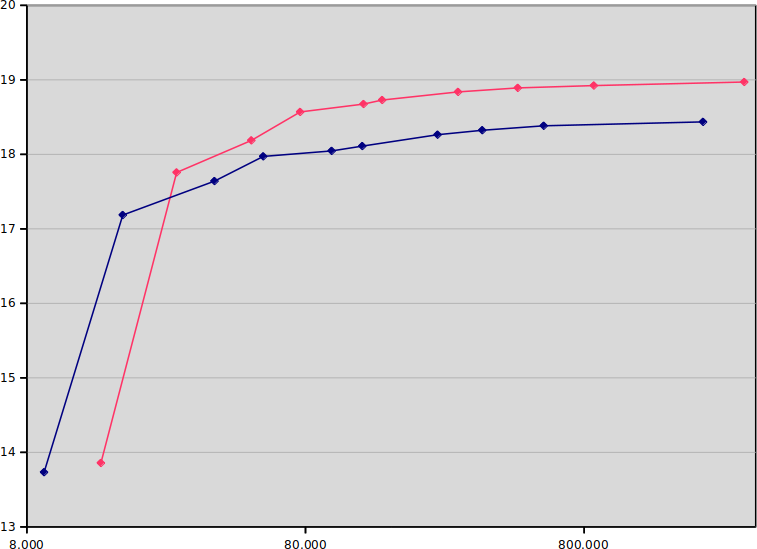
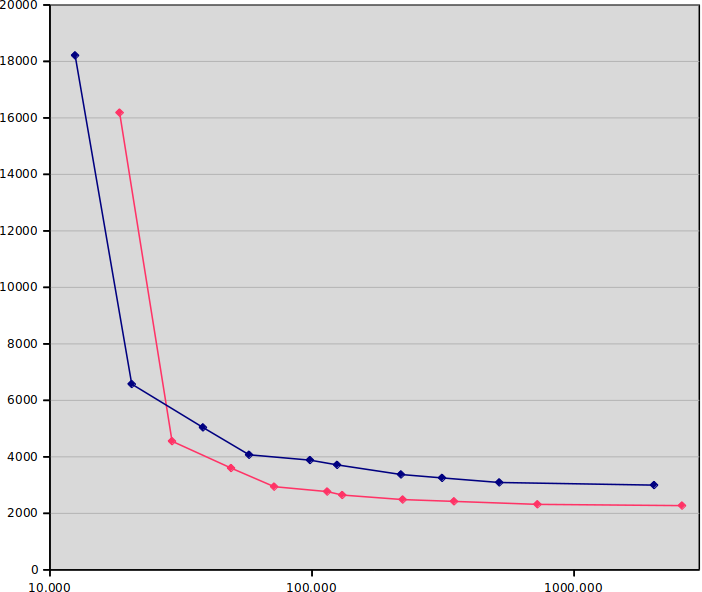
Following the post about 10-bit Y'CbCr earlier this week, I thought I'd make an actual test of 10-bit H.264 compression for live streaming. The basic question is; sure, it's better-per-bit, but it's also slower, so it is better-per-MHz? This is largely inspired by Ronald Bultje's post about streaming performance, where he largely showed that HEVC is currently useless for live streaming from software; unless you can encode at x264's veryslow preset (which, at 720p60, means basically rather simple content and 20 cores or so), the best x265 presets you can afford will give you worse quality than the best x264 presets you can afford. My results will maybe not be as scientific, but hopefully still enlightening. I used the same test clip as Ronald, namely a two-minute clip of Tears of Steel. Note that this is an 8-bit input, so we're not testing the effects of 10-bit input; it's just testing the increased internal precision in the codec. Since my focus is practical streaming, I ran the last version of x264 at four threads (a typical desktop machine), using one-pass encoding at 4000 kbit/sec. Nageru's speed control has 26 presets to choose from, which gives pretty smooth steps between neighboring ones, but I've been sticking to the ten standard x264 presets (ultrafast, superfast, veryfast, faster, fast, medium, slow, slower, veryslow, placebo). Here's the graph: The x-axis is seconds used for the encode (note the logarithmic scale; placebo takes 200 250 times as long as ultrafast). The y-axis is SSIM dB, so up and to the left is better. The blue line is 8-bit, and the red line is 10-bit. (I ran most encodes five times and averaged the results, but it doesn't really matter, due to the logarithmic scale.) The results are actually much stronger than I assumed; if you run on (8-bit) ultrafast or superfast, you should stay with 8-bit, but from there on, 10-bit is on the Pareto frontier. Actually, 10-bit veryfast (18.187 dB) is better than 8-bit medium (18.111 dB), while being four times as fast! But not all of us have a relation to dB quality, so I chose to also do a test that maybe is a bit more intuitive, centered around bitrate needed for constant quality. I locked quality to 18 dBm, ie., for each preset, I adjusted the bitrate until the SSIM showed 18.000 dB plus/minus 0.001 dB. (Note that this means faster presets get less of a speed advantage, because they need higher bitrate, which means more time spent entropy coding.) Then I measured the encoding time (again five times) and graphed the results: x-axis is again seconds, and y-axis is bitrate needed in kbit/sec, so lower and to the left is better. Blue is again 8-bit and red is again 10-bit. If the previous graph was enough to make me intrigued, this is enough to make me excited. In general, 10-bit gives 20-30% lower bitrate for the same quality and CPU usage! (Compare this with the supposed up to 50% benefits of HEVC over H.264, given infinite CPU usage.) The most dramatic example is when comparing the medium presets directly, where 10-bit runs at 2648 kbit/sec versus 3715 kbit/sec (29% lower bitrate!) and is only 5% slower. As one progresses towards the slower presets, the gap is somewhat narrowed (placebo is 27% slower and only 24% lower bitrate), but in the realistic middle range, the difference is quite marked. If you run 3 Mbit/sec at 10-bit, you get the quality of 4 Mbit/sec at 8-bit. So is 10-bit H.264 a no-brainer? Unfortunately, no; the client hardware support is nearly nil. Not even Skylake, which can do 10-bit HEVC encoding in hardware (and 10-bit VP9 decoding), can do 10-bit H.264 decoding in hardware. Worse still, mobile chipsets generally don't support it. There are rumors that iPhone 6s supports it, but these are unconfirmed; some Android chips support it, but most don't. I guess this explains a lot of the limited uptake; since it's in some ways a new codec, implementers are more keen to get the full benefits of HEVC instead (even though the licensing situation is really icky). The only ones I know that have really picked it up as a distribution format is the anime scene, and they're feeling quite specific pains due to unique content (large gradients giving pronounced banding in undithered 8-bit). So, 10-bit H.264: It's awesome, but you can't have it. Sorry :-)
23 February 2017

Stig Sandbeck Mathisen: Change all the passwords (again)

Looks like it is time to change all the passwords again. There s a tiny little flaw in a CDN used everywhere, it seems. Here s a quick hack for users of the pass password manager to qickly find the domains affected. It is not perfect, but it is fast. :)
#!/bin/bash
# Stig Sandbeck Mathisen <ssm@fnord.no>
# Checks the content of "pass" against the list of sites using cloudflare.
# Expect false positives, and possibly false negatives.
# TODO: remove the left part of each hostname from pass, to check domains.
set -euo pipefail
tempdir=$(mktemp -d)
trap 'echo >&2 "removing $ tempdir " ; rm -rf "$tempdir"' EXIT
git clone https://github.com/pirate/sites-using-cloudflare.git "$tempdir"
grep -F -x -f \
  <(pass git ls-files    sed -e s,/,\ ,g -e s/.gpg//   xargs -n 1   sort -u) \
  "$ tempdir /sorted_unique_cf.txt" \
    sort -u
Update: The previous example used parallel. Actually, I didn t need that. Turns out, using grep correctly is much faster than using grep the wrong way. Lession: Read the manual. :)

Joerg Jaspert: Automated wifi login

If you have the fortune to need to follow some silly Login button for some wifi, regularly, the following little script may help you avoid this idiotic (and useless) task. This example uses the WIFIonICE, the free wifi on german ICE trains, simply as I have it twice a day, and got annoyed by the pointless Login button. A friend pointed me at just wget-ting the login page, so I made Network-Manager do this for me. Should work for anything similar that doesn t need some elaborate webform filled out.
#!/bin/bash
# (Some) docs at
# https://wiki.ubuntuusers.de/NetworkManager/Dispatcher/
IFACE=$ 1:-"none" 
ACTION=$ 2:-"up" 
case $ ACTION  in
    up)
        CONID=$ CONNECTION_ID:-$(iwconfig $IFACE   grep ESSID   cut -d":" -f2   sed 's/^[^"]*"\ "[^"]*$//g') 
        if [[ $ CONID  == WIFIonICE ]]; then
            /usr/bin/timeout -k 20 15 /usr/bin/wget -q -O - http://www.wifionice.de/?login > /dev/null
        fi
        ;;
    *)
        # We are not interested in this
        :
        ;;
esac
This script needs to be put into /etc/NetworkManager/dispatcher.d and made executable, owned by the root user. It will run on every connection change, thats why the ACTION is checked. The case may be a bit much here, but it could be easily extended to do a lot more. Yay, no more silly Open this webpage and press login crap.

Gunnar Wolf: Spam: Tactics, strategy, and angry bears

I know spam is spam is spam, and I know trying to figure out any logic underneath it is a lost cause. However... I am curious. Many spam subjects are seemingly random, designed to convey whatever "information" they contain and fool spam filters. I understand that. Many spam subjects are time-related. As an example, in the last months there has been a surge of spam mentioning Donald Trump. I am thankful: Very easy to filter out, even before it reaches spamassassin. Of course, spam will find thousands of ways to talk about sex; cialis/viagra sellers, escort services, and a long list of WTF. However... Tactical flashlights. Bright enough to blind a bear. WTF I mean... Truly. Really. WTF What does that mean? Why is that even a topic? Who is interested in anything like that? How often does the average person go camping in the woods? Why do we need to worry about stupid bears attacking us? Why would a bear attack me? The list of WTF questions could go on forever. What am I missing? What does "tactical flashlight" mean that I just fail to grasp? Has this appeared in your spam?

22 February 2017

Antoine Beaupr : The case against password hashers

In previous articles, we have looked at how to generate passwords and did a review of various password managers. There is, however, a third way of managing passwords other than remembering them or encrypting them in a "vault", which is what I call "password hashing". A password hasher generates site-specific passwords from a single master password using a cryptographic hash function. It thus allows a user to have a unique and secure password for every site they use while requiring no storage; they need only to remember a single password. You may know these as "deterministic or stateless password managers" but I find the "password manager" phrase to be confusing because a hasher doesn't actually store any passwords. I do not think password hashers represent a good security tradeoff so I generally do not recommend their use, unless you really do not have access to reliable storage that you can access readily. In this article, I use the word "password" for a random string used to unlock things, but "token" to represent a generated random string that the user doesn't need to remember. The input to a password hasher is a password with some site-specific context and the output from a password hasher is a token.

What is a password hasher? A password hasher uses the master password and a label (generally the host name) to generate the site-specific password. To change the generated password, the user can modify the label, for example by appending a number. Some password hashers also have different settings to generate tokens of different lengths or compositions (symbols or not, etc.) to accommodate different site-specific password policies. The whole concept of password hashers relies on the concept of one-way cryptographic hash functions or key derivation functions that take an arbitrary input string (say a password) and generate a unique token, from which it is impossible to guess the original input string. Password hashers are generally written as JavaScript bookmarklets or browser plugins and have been around for over a decade. The biggest advantage of password hashers is that you only need to remember a single password. You do not need to carry around a password manager vault: there's no "state" (other than site-specific settings, which can be easily guessed). A password hasher named Master Password makes a compelling case against traditional password managers in its documentation:
It's as though the implicit assumptions are that everybody backs all of their stuff up to at least two different devices and backups in the cloud in at least two separate countries. Well, people don't always have perfect backups. In fact, they usually don't have any.
It goes on to argue that, when you lose your password: "You lose everything. You lose your own identity." The stateless nature of password hashers also means you do not need to use cloud services to synchronize your passwords, as there is (generally, more on that later) no state to carry around. This means, for example, that the list of accounts that you have access to is only stored in your head, and not in some online database that could be hacked without your knowledge. The downside of this is, of course, that attackers do not actually need to have access to your password hasher to start cracking it: they can try to guess your master key without ever stealing anything from you other than a single token you used to log into some random web site. Password hashers also necessarily generate unique passwords for every site you use them on. While you can also do this with password managers, it is not an enforced decision. With hashers, you get distinct and strong passwords for every site with no effort.

The problem with password hashers If hashers are so great, why would you use a password manager? Programs like LessPass and Master Password seem to have strong crypto that is well implemented, so why isn't everyone using those tools? Password hashing, as a general concept, actually has serious problems: since the hashing outputs are constantly compromised (they are sent in password forms to various possibly hostile sites), it's theoretically possible to derive the master password and then break all the generated tokens in one shot. The use of stronger key derivation functions (like PBKDF2, scrypt, or HMAC) or seeds (like a profile-specific secret) makes those attacks much harder, especially if the seed is long enough to make brute-force attacks infeasible. (Unfortunately, in the case of Password Hasher Plus, the seed is derived from Math.random() calls, which are not considered cryptographically secure.) Basically, as stated by Julian Morrison in this discussion:
A password is now ciphertext, not a block of line noise. Every time you transmit it, you are giving away potential clues of use to an attacker. [...] You only have one password for all the sites, really, underneath, and it's your secret key. If it's broken, it's now a skeleton-key [...]
Newer implementations like LessPass and Master Password fix this by using reasonable key derivation algorithms (PBKDF2 and scrypt, respectively) that are more resistant to offline cracking attacks, but who knows how long those will hold? To give a concrete example, if you would like to use the new winner of the password hashing competition (Argon2) in your password manager, you can patch the program (or wait for an update) and re-encrypt your database. With a password hasher, it's not so easy: changing the algorithm means logging in to every site you visited and changing the password. As someone who used a password hasher for a few years, I can tell you this is really impractical: you quickly end up with hundreds of passwords. The LessPass developers tried to facilitate this, but they ended up mostly giving up. Which brings us to the question of state. A lot of those tools claim to work "without a server" or as being "stateless" and while those claims are partly true, hashers are way more usable (and more secure, with profile secrets) when they do keep some sort of state. For example, Password Hasher Plus records, in your browser profile, which site you visited and which settings were used on each site, which makes it easier to comply with weird password policies. But then that state needs to be backed up and synchronized across multiple devices, which led LessPass to offer a service (which you can also self-host) to keep those settings online. At this point, a key benefit of the password hasher approach (not keeping state) just disappears and you might as well use a password manager. Another issue with password hashers is choosing the right one from the start, because changing software generally means changing the algorithm, and therefore changing passwords everywhere. If there was a well-established program that was be recognized as a solid cryptographic solution by the community, I would feel more confident. But what I have seen is that there are a lot of different implementations each with its own warts and flaws; because changing is so painful, I can't actually use any of those alternatives. All of the password hashers I have reviewed have severe security versus usability tradeoffs. For example, LessPass has what seems to be a sound cryptographic implementation, but using it requires you to click on the icon, fill in the fields, click generate, and then copy the password into the field, which means at least four or five actions per password. The venerable Password Hasher is much easier to use, but it makes you type the master password directly in the site's password form, so hostile sites can simply use JavaScript to sniff the master password while it is typed. While there are workarounds implemented in Password Hasher Plus (the profile-specific secret), both tools are more or less abandoned now. The Password Hasher homepage, linked from the extension page, is now a 404. Password Hasher Plus hasn't seen a release in over a year and there is no space for collaborating on the software the homepage is simply the author's Google+ page with no information on the project. I couldn't actually find the source online and had to download the Chrome extension by hand to review the source code. Software abandonment is a serious issue for every project out there, but I would argue that it is especially severe for password hashers. Furthermore, I have had difficulty using password hashers in unified login environments like Wikipedia's or StackExchange's single-sign-on systems. Because they allow you to log in with the same password on multiple sites, you need to choose (and remember) what label you used when signing in. Did I sign in on stackoverflow.com? Or was it stackexchange.com? Also, as mentioned in the previous article about password managers, web-based password managers have serious security flaws. Since more than a few password hashers are implemented using bookmarklets, they bring all of those serious vulnerabilities with them, which can range from account name to master password disclosures. Finally, some of the password hashers use dubious crypto primitives that were valid and interesting a decade ago, but are really showing their age now. Stanford's pwdhash uses MD5, which is considered "cryptographically broken and unsuitable for further use". We have seen partial key recovery attacks against MD5 already and while those do not allow an attacker to recover the full master password yet (especially not with HMAC-MD5), I would not recommend anyone use MD5 in anything at this point, especially if changing that algorithm later is hard. Some hashers (like Password Hasher and Password Plus) use a a single round of SHA-1 to derive a token from a password; WPA2 (standardized in 2004) uses 4096 iterations of HMAC-SHA1. A recent US National Institute of Standards and Technology (NIST) report also recommends "at least 10,000 iterations of the hash function".

Conclusion Forced to suggest a password hasher, I would probably point to LessPass or Master Password, depending on the platform of the person asking. But, for now, I have determined that the security drawbacks of password hashers are not acceptable and I do not recommend them. It makes my password management recommendation shorter anyway: "remember a few carefully generated passwords and shove everything else in a password manager". [Many thanks to Daniel Kahn Gillmor for the thorough reviews provided for the password articles.]
Note: this article first appeared in the Linux Weekly News. Also, details of my research into password hashers are available in the password hashers history article.

Lisandro Dami n Nicanor P rez Meyer: Developing an nrf51822 based embedded device with Qt Creator and Debian

I'm currently developing an nRF51822-based embedded device. Being one the Qt/Qt Creator maintainers in Debian I would of course try to use it for the development. Turns out it works pretty good... with some caveats.

There are already two quite interesting blog posts about using Qt Creator on MAC and on Windows, so I will not repeat the basics, as they are there. Both use qbs, but I managed to use CMake.

Instead I'll add some tips on the stuff that I needed to solve in order to make this happen on current Debian Sid.


Cheers!

21 February 2017

Shirish Agarwal: The Indian elections hungama

a person showing s(he) showing s(he) Before I start, I would like to point out #855549 . This is a normal/wishlist bug I have filed against apt, the command-line package manager. I sincerely believe having a history command to know what packages were installed, which were upgraded, which were purged should be easily accessible, easily understood and if the output looks pretty, so much the better. Of particular interest to me is having a list of new packages I have installed in last couple of years after jessie became the stable release. It probably would make for some interesting reading. I dunno how much efforts would be to code something like that, but if it works, it would be the greatest. Apt would have finally arrived. Not that it s a bad tool, it s just that it would then make for a heck of a useful tool. Coming back to the topic on hand, Now for the last couple of weeks we don t have water or rather pressure of water. Water crisis has been hitting Pune every year since 2014 with no end in sight. This has been reported in newspapers addendum but it seems it has been felling on deaf ears. The end result of it is that I have to bring buckets of water from around 50 odd metres. It s not a big thing, it s not like some women in some villages in Rajasthan who have to walk in between 200 metres to 5 odd kilometres to get potable water or Darfur, Western Sudan where women are often kidnapped and sold as sexual slaves when they get to fetch water. The situation in Darfur has been shown quite vividly in Darfur is Dying . It is possible that I may have mentioned about Darfur before. While unfortunately the game is in flash as a web resource, the most disturbing part is that the game is extremely depressing, there is a no-win scenario. So knowing and seeing both those scenarios, I can t complain about 50 metres. BUT .but when you extrapolate the same data over some more or less 3.3-3.4 million citizens, 3.1 million during 2011 census with a conservative 2.3-2.4 percent population growth rate according to scroll.in. Fortunately or unfortunately, Pune Municipal Corporation elections were held today. Fortunately or unfortunately, this time all the political parties bought majorly unknown faces in these elections. For e.g. I belong to ward 14 which is spread over quite a bit of area and has around 10k of registered voters. Now the unfortunate part of having new faces in elections, you don t know anything about them. Apart from the affidavits filed, the only thing I come to know is whether there are criminal cases filed against them and what they have shown as their wealth. While I am and should be thankful to ADR which actually is the force behind having the collated data made public. There is a lot of untold story about political push-back by all the major national and regional political parties even when this bit of news were to be made public. It took major part of a decade for such information to come into public domain. But for my purpose of getting clean air and water supply 24 7 to each household seems a very distant dream. I tried to connect with the corporators about a week before the contest and almost all of the lower party functionaries hid behind their political parties manifestos stating they would do the best without any viable plan. For those not knowing, India has been blessed with 6 odd national parties and about 36 odd regional parties and every election some 20-25 new parties try their luck every time. The problem is we, the public, don t trust them or their manifestos. First of all the political parties themselves engage in mud-slinging as to who s copying whom with the manifesto.Even if a political party wins the elections, there is no *real* pressure for them to follow their own manifesto. This has been going for many a year. OF course, we the citizens are to also blame as most citizens for one reason or other chose to remain aloof of the process. I scanned/leafed through all the manifestos and all of them have the vague-wording we will make Pune tanker-free without any implementation details. While I was unable to meet the soon-to-be-Corporators, I did manage to meet a few of the assistants but all the meetings were entirely fruitless. Diagram of Rain Water Harvesting I asked why can t the city follow the Chennai model. Chennai, not so long ago was at the same place where Pune is, especially in relation to water. What happened next, in 2001 has been beautifully chronicled in Hindustan Times . What has not been shared in that story is that the idea was actually fielded by one of Chennai Mayor s assistants, an IAS Officer, I have forgotten her name, Thankfully, her advise/idea was taken to heart by the political establishment and they drove RWH. Saying why we can t do something similar in Pune, I heard all kinds of excuses. The worst and most used being Marathas can never unite which I think is pure bullshit. For people unfamiliar to the term, Marathas was a warrior clan in Shivaji s army. Shivaji, the king of Marathas were/are an expert tactician and master of guerilla warfare. It is due to the valor of Marathas, that we still have the Maratha Light Infantry a proud member of the Indian army. Why I said bullshit was the composition of people living in Maharashtra has changed over the decades. While at one time both the Brahmins and the Marathas had considerable political and population numbers, that has changed drastically. Maharashtra and more pointedly, Mumbai, Pune and Nagpur have become immigrant centres. Why just a decade back, Shiv Sena, an ultra right-wing political party used to play the Maratha card at each and every election and heckle people coming from Uttar Pradesh and Bihar, this has been documented as the 2008 immigrants attacks and 9 years later we see Shiv Sena trying to field its candidates in Uttar Pradesh. So, obviously they cannot use the same tactics which they could at one point of time. One more reason I call it bullshit, is it s a very lame excuse. When the Prime Minister of the country calls for demonetization which affects 1.25 billion people, people die, people stand in queues and is largely peaceful, I do not see people resisting if they bring a good scheme. I almost forgot, as an added sweetener, the Chennai municipality said that if you do RWH and show photos and certificates of the job, you won t have to pay as much property tax as otherwise you would, that also boosted people s participation. And that is not the only solution, one more solution has been outlined in Aaj Bhi Khade hain talaab written by just-deceased Gandhian environmental activist Anupam Mishra. His Book can be downloaded for free at India Water Portal . Unfortunately, the said book doesn t have a good English translation till date. Interestingly, all of his content is licensed under public domain (CC-0) so people can continue to enjoy and learn from his life-work. Another lesson or understanding could be taken from Israel, the father of the modern micro-drip irrigation for crops. One of the things on my bucket lists is to visit Israel and if possible learn how they went from a water-deficient country to a water-surplus one. India labor Which brings me to my second conundrum, most of the people believe that it s the Government s job to provide jobs to its people. India has been experiencing jobless growth for around a decade now, since the 2008 meltdown. While India was lucky to escape that, most of its trading partners weren t hence it slowed down International trade which slowed down creation of new enterprises etc. Laws such as the Bankruptcy law and the upcoming Goods and Services Tax . As everybody else, am a bit excited and a bit apprehensive about how the actual implementation will take place. null Even International businesses has been found wanting. The latest example has been Uber and Ola. There have been protests against the two cab/taxi aggregators operating in India. For the millions of jobless students coming out of schools and Universities, there aren t simply enough jobs for them, nor are most (okay 50%) of them qualified for the jobs, these 50 percent are also untrainable, so what to do ? In reality, this is what keeps me awake at night. India is sitting on this ticking bomb-shell. It is really, a miracle that the youths have not rebelled yet. While all the conditions, proposals and counter-proposals have been shared before, I wanted/needed to highlight it. While the issue seems to be local, I would assert that they are all glocal in nature. The questions we are facing, I m sure both developing and to some extent even developed countries have probably been affected by it. I look forward to know what I can learn from them. Update 23/02/17 I had wanted to share about Debian s Voting system a bit, but that got derailed. Hence in order not to do, I ll just point towards 2015 platforms where 3 people vied for DPL post. I *think* I shared about DPL voting process earlier but if not, would do in detail in some future blog post.
Filed under: Miscellenous Tagged: #Anupam Mishra, #Bankruptcy law, #Chennai model, #clean air, #clean water, #elections, #GST, #immigrant, #immigrants, #Maratha, #Maratha Light Infantry, #migration, #national parties, #Political party manifesto, #regional parties, #ride-sharing, #water availability, Rain Water Harvesting

Reproducible builds folks: Reproducible Builds: week 95 in Stretch cycle

Here's what happened in the Reproducible Builds effort between Sunday February 12 and Saturday February 18 2017: Upcoming Events The Reproducible Build Zoo will be presented by Vagrant Cascadian at the Embedded Linux Conference in Portland, Oregon, February 22nd. Introduction to Reproducible Builds will be presented by Vagrant Cascadian at Scale15x in Pasadena, California, March 5th. Toolchain development and fixes Ximin Luo posted a preliminary spec for BUILD_PATH_PREFIX_MAP, bringing together work and research from previous weeks. Ximin refactored and consolidated much of our existing documentation on both SOURCE_DATE_EPOCH and BUILD_PATH_PREFIX_MAP into one unified page, Standard Environment Variables, with extended discussion on related solutions and how these all fit into people's ideas of what reproducible builds should look like in the long term. The specific pages for each variable still remain, at Timestamps Proposal and Build Path Proposal, only without content that was previously duplicated on both pages. Ximin filed #855282 against devscripts for debsign(1) to support buildinfo files, and wrote an initial series of patches for it with some further additions from Guillem Jover. Packages reviewed and fixed, and bugs filed Chris Lamb: Reviews of unreproducible packages 35 package reviews have been added, 1 have been updated and 17 have been removed in this week, adding to our knowledge about identified issues. 1 issue type has been added: Weekly QA work During our reproducibility testing, the following FTBFS bugs have been detected and reported by: diffoscope development diffoscope 77 was uploaded to unstable by Mattia Rizzolo. It included contributions from: strip-nondeterminism development strip-nondeterminism 0.031-1 was uploaded to unstable by Chris Lamb. It included contributions from: strip-nondeterminism 0.031-1~bpo8+1 was uploaded to jessie-backports by Mattia. tests.reproducible-builds.org Misc. This week's edition was written by Ximin Luo & reviewed by a bunch of Reproducible Builds folks on IRC & the mailing lists.

18 February 2017

Steve Kemp: Apologies for the blog-churn.

I've been tweaking my blog a little over the past few days, getting ready for a new release of the chronicle blog compiler (github). During the course of that I rewrote all the posts to have 100% lower-case file-paths. Redirection-pages have been auto-generated for each page which was previously mixed-case, but unfortunately that will have meant that the RSS feed updated unnecessarily: That triggered a lot of spamming, as the URLs would have shown up as being new/unread/distinct.

17 February 2017

Michal &#268;iha&#345;: What's coming in Weblate 2.12

Weblate should be released by end of February, so it's now pretty much clear what will be there. So let's look at some of the upcoming features. There were many improvements in search related features. They got performance improvements (this is especially noticeable on site wide search). Additionally you can search for strings within translation project. On related topic, search and replace is now available for component or project wide operations, what can help you in case of massive renaming in your translations. We have worked on improving machine translations as well, this time we've added support for Yandex. In case you know some machine translation service which we do not yet support, please submit that to our issue tracker. Biggest improvement so far comes for visual context feature - it allows you to upload screenshots which are later shown to translators to give them better idea where and in which context the translation is used. So far you had to manually upload screenshot for every source string, what was far from being easy to use. With Weblate 2.12 (and this is already available on Hosted Weblate right now) the screenshots management got way better. There is now separate interface to manage screenshots (see screenshots for Weblate as an example), you can assign every screenshot to multiple source strings, however you can also let Weblate automatically recognize texts on the screenshots using OCR and suggest strings to assign. This can save you quite a lot of effort, especially with screenshots with lot of strings. This feature is still in early phase, so the suggestions are not always 100% matching, but we're working to improve it further. There will be some more features as well, you can look at our 2.12 milestone at GitHub to follow the process.

Filed under: Debian English SUSE Weblate 0 comments

Next.

Previous.