Search Results: "sto"

4 August 2022

Abhijith PA: Trip to misty mountains in Munnar

Munnar is a hill station in Idukki district of Kerala, India. Home to 2nd largest tea plantation in the country. Lot of people visit here on summer and in winter as well. I live in the neighboring district of Munnar though I never made a visit. In my mind I pictured Munnar as a Tourist trap with lots of garbage lying around. I recently made a visit and it changed my perception of this place. Munnar!

Little background I never liked tea much. I am also not a coffee person either. But if I have to choose over two that will be coffee because of the strong aroma. Going to relatives house, they always offered hot tea defacto. I always find difficult say no to their friendly gesture. But I hate tea. A generation before me drinks lot of tea here at my place. You can see tea stalls in every corner and people sipping tea. I always wondered why people drink lot of tea on a hot country like India. The book I am currently trying to read has a chapter about Munnar and how it became a Tea plantation under the British rule. Well, around the same time. I watched a documentary program about the tea and Munnar.

Munnar Munnar on early evening Too much word here and there I decided to do a visit. I took a motorbike and started a journey to Munnar. Due to covid restrictions there weren t much tourists, so this was to my advantage. There are many water falls on the way to Munnar. Some are very close to road and some are far away but can be spotted. Munnar travel is just not about the destination because its never been a single spot. Enjoying the journey that the ride has to offer. I stayed at a hotel, little far away from town, though I never recommend hotels in Munnar. Try to find home stays and small establishments away from the town. There are British Era bungalows inside the plantations still maintained in good condition which can be booked per room or entire property. The lush greenery on the Mountains of tea plantation is very refreshing and feast to our eyes. The mornings and evenings of Munnar is something to watch, mountains wrapped in mist slowly uncovering with sunlight and again slipping to mist by dark evening. I planned only to visit places which are less explored by tourists. People here live a simple life. Most of them are plantation workers. The native people of Munnar are actually tribal folks but since the plantation boom many people from Tamil Nadu(neighboring state) and other parts of Kerala settled here. The houses of this plantation workers resembled Hobbit homes in Shire from Lord of the Rings as they are in the hill slides. The Kannan Devan hills, the biggest hill in area covers more than half of Munnar. Hobbit homes Two famous Tea companies from Munnar are Tata Tea and KDHP(Kanan Devan Hills Plantations Company (P) Limited) tea. KDHP is actually an employee owned Tea company ie a good share of this company is owned by the employees working there. This was interesting to me, so I bought a bag of speciality tea from KDHP store on my return. I don t drink tea on a daily basis but I will try it on special occasions.

1 August 2022

Sergio Talens-Oliag: Using Git Server Hooks on GitLab CE to Validate Tags

Since a long time ago I ve been a gitlab-ce user, in fact I ve set it up on three of the last four companies I ve worked for (initially I installed it using the omnibus packages on a debian server but on the last two places I moved to the docker based installation, as it is easy to maintain and we don t need a big installation as the teams using it are small). On the company I work for now (kyso) we are using it to host all our internal repositories and to do all the CI/CD work (the automatic deployments are triggered by web hooks in some cases, but the rest is all done using gitlab-ci). The majority of projects are using nodejs as programming language and we have automated the publication of npm packages on our gitlab instance npm registry and even the publication into the npmjs registry. To publish the packages we have added rules to the gitlab-ci configuration of the relevant repositories and we publish them when a tag is created. As the we are lazy by definition, I configured the system to use the tag as the package version; I tested if the contents of the package.json where in sync with the expected version and if it was not I updated it and did a force push of the tag with the updated file using the following code on the script that publishes the package:
# Update package version & add it to the .build-args
INITIAL_PACKAGE_VERSION="$(npm pkg get version tr -d '"')"
npm version --allow-same --no-commit-hooks --no-git-tag-version \
  "$CI_COMMIT_TAG"
UPDATED_PACKAGE_VERSION="$(npm pkg get version tr -d '"')"
echo "UPDATED_PACKAGE_VERSION=$UPDATED_PACKAGE_VERSION" >> .build-args
# Update tag if the version was updated or abort
if [ "$INITIAL_PACKAGE_VERSION" != "$UPDATED_PACKAGE_VERSION" ]; then
  if [ -n "$CI_GIT_USER" ] && [ -n "$CI_GIT_TOKEN" ]; then
    git commit -m "Updated version from tag $CI_COMMIT_TAG" package.json
    git tag -f "$CI_COMMIT_TAG" -m "Updated version from tag"
    git push -f -o ci.skip origin "$CI_COMMIT_TAG"
  else
    echo "!!! ERROR !!!"
    echo "The updated tag could not be uploaded."
    echo "Set CI_GIT_USER and CI_GIT_TOKEN or fix the 'package.json' file"
    echo "!!! ERROR !!!"
    exit 1
  fi
fi
This feels a little dirty (we are leaving commits on the tag but not updating the original branch); I thought about trying to find the branch using the tag and update it, but I drop the idea pretty soon as there were multiple issues to consider (i.e. we can have tags pointing to commits present in multiple branches and even if it only points to one the tag does not have to be the HEAD of the branch making the inclusion difficult). In any case this system was working, so we left it until we started to publish to the NPM Registry; as we are using a token to push the packages that we don t want all developers to have access to (right now it would not matter, but when the team grows it will) I started to use gitlab protected branches on the projects that need it and adjusting the .npmrc file using protected variables. The problem then was that we can no longer do a standard force push for a branch (that is the main point of the protected branches feature) unless we use the gitlab api, so the tags with the wrong version started to fail. As the way things were being done seemed dirty anyway I thought that the best way of fixing things was to forbid users to push a tag that includes a version that does not match the package.json version. After thinking about it we decided to use githooks on the gitlab server for the repositories that need it, as we are only interested in tags we are going to use the update hook; it is executed once for each ref to be updated, and takes three parameters:
  • the name of the ref being updated,
  • the old object name stored in the ref,
  • and the new object name to be stored in the ref.
To install our hook we have found the gitaly relative path of each repo and located it on the server filesystem (as I said we are using docker and the gitlab s data directory is on /srv/gitlab/data, so the path to the repo has the form /srv/gitlab/data/git-data/repositories/@hashed/xx/yy/hash.git). Once we have the directory we need to:
  • create a custom_hooks sub directory inside it,
  • add the update script (as we only need one script we used that instead of creating an update.d directory, the good thing is that this will also work with a standard git server renaming the base directory to hooks instead of custom_hooks),
  • make it executable, and
  • change the directory and file ownership to make sure it can be read and executed from the gitlab container
On a console session:
$ cd /srv/gitlab/data/git-data/repositories/@hashed/xx/yy/hash.git
$ mkdir custom_hooks
$ edit_or_copy custom_hooks/update
$ chmod 0755 custom_hooks/update
$ chown --reference=. -R custom_hooks
The update script we are using is as follows:
#!/bin/sh
set -e
# kyso update hook
#
# Right now it checks version.txt or package.json versions against the tag name
# (it supports a 'v' prefix on the tag)
# Arguments
ref_name="$1"
old_rev="$2"
new_rev="$3"
# Initial test
if [ -z "$ref_name" ]    [ -z "$old_rev" ]   [ -z "$new_rev" ]; then
  echo "usage: $0 <ref> <oldrev> <newrev>" >&2
  exit 1
fi
# Get the tag short name
tag_name="$ ref_name##refs/tags/ "
# Exit if the update is not for a tag
if [ "$tag_name" = "$ref_name" ]; then
  exit 0
fi
# Get the null rev value (string of zeros)
zero=$(git hash-object --stdin </dev/null   tr '0-9a-f' '0')
# Get if the tag is new or not
if [ "$old_rev" = "$zero" ]; then
  new_tag="true"
else
  new_tag="false"
fi
# Get the type of revision:
# - delete: if the new_rev is zero
# - commit: annotated tag
# - tag: un-annotated tag
if [ "$new_rev" = "$zero" ]; then
  new_rev_type="delete"
else
  new_rev_type="$(git cat-file -t "$new_rev")"
fi
# Exit if we are deleting a tag (nothing to check here)
if [ "$new_rev_type" = "delete" ]; then
  exit 0
fi
# Check the version against the tag (supports version.txt & package.json)
if git cat-file -e "$new_rev:version.txt" >/dev/null 2>&1; then
  version="$(git cat-file -p "$new_rev:version.txt")"
  if [ "$version" = "$tag_name" ]   [ "$version" = "$ tag_name#v " ]; then
    exit 0
  else
    EMSG="tag '$tag_name' and 'version.txt' contents '$version' don't match"
    echo "GL-HOOK-ERR: $EMSG"
    exit 1
  fi
elif git cat-file -e "$new_rev:package.json" >/dev/null 2>&1; then
  version="$(
    git cat-file -p "$new_rev:package.json"   jsonpath version   tr -d '\[\]"'
  )"
  if [ "$version" = "$tag_name" ]   [ "$version" = "$ tag_name#v " ]; then
    exit 0
  else
    EMSG="tag '$tag_name' and 'package.json' version '$version' don't match"
    echo "GL-HOOK-ERR: $EMSG"
    exit 1
  fi
else
  # No version.txt or package.json file found
  exit 0
fi
Some comments about it:
  • we are only looking for tags, if the ref_name does not have the prefix refs/tags/ the script does an exit 0,
  • although we are checking if the tag is new or not we are not using the value (in gitlab that is handled by the protected tag feature),
  • if we are deleting a tag the script does an exit 0, we don t need to check anything in that case,
  • we are ignoring if the tag is annotated or not (we set the new_rev_type to tag or commit, but we don t use the value),
  • we test first the version.txt file and if it does not exist we check the package.json file, if it does not exist either we do an exit 0, as there is no version to check against and we allow that on a tag,
  • we add the GL-HOOK-ERR: prefix to the messages to show them on the gitlab web interface (can be tested creating a tag from it),
  • to get the version on the package.json file we use the jsonpath binary (it is installed by the jsonpath ruby gem) because it is available on the gitlab container (initially I used sed to get the value, but a real JSON parser is always a better option).
Once the hook is installed when a user tries to push a tag to a repository that has a version.txt file or package.json file and the tag does not match the version (if version.txt is present it takes precedence) the push fails. If the tag matches or the files are not present the tag is added if the user has permission to add it in gitlab (our hook is only executed if the user is allowed to create or update the tag).

Junichi Uekawa: August.

August. I think I finally understood what's going on in io_uring.

31 July 2022

Russell Coker: Workstations With ECC RAM

The last new PC I bought was a Dell PowerEdge T110II in 2013. That model had been out for a while and I got it for under $2000. Since then the CPI has gone up by about 20% so it s probably about $2000 in today s money. Currently Dell has a special on the T150 tower server (the latest replacement for the T110II) which has a G6405T CPU that isn t even twice as fast as the i3-3220 (3746 vs 2219) in the T110II according to passmark.com (AKA cpubenchmark.net). The special price is $2600. I can t remember the details of my choices when purchasing the T110II but I recall that CPU speed wasn t a priority and I wanted a cheap reliable server for storage and for light desktop use. So it seems that the current entry model in the Dell T1xx server line is less than twice as fast as fast as it was in 2013 while costing about 25% more! An option is to spend an extra $989 to get a Xeon E-2378 which delivers a reasonable 18,248 in that benchmark. The upside of a T150 is that is uses buffered DDR4 ECC RAM which is pretty cheap nowadays, you can get 32G for about $120. For systems sold as workstations (as opposed to T1xx servers that make great workstations but aren t described as such) Dell has the Precision line. The Precision 3260 Compact Workstation currently starts at $1740, it has a fast CPU but takes SO-DIMMs and doesn t come with ECC RAM. So to use it as a proper workstation you need to discard the RAM and buy DDR5 unbuffered/unregistered ECC SO-DIMMS which don t seem to be on sale yet. The Precision 3460 is slightly larger, slightly more expensive, and also takes SO-DIMMs. The Precision 3660 starts at $2550 and takes unbuffered DDR5 ECC RAM which is available and costs half as much as the SO-DIMM equivalent would cost (if you could even buy it), but the general trend in RAM prices is that unbuffered ECC RAM is more expensive than buffered ECC RAM. The upside to Precision workstations is that the range of CPUs available is significantly faster than for the T150. The HP web site doesn t offer prices on their Z workstations and is generally worse than the Dell web site in most ways. Overall I m disappointed in the range of workstations available now. As an aside if anyone knows of any other company selling workstations in Australia that support ECC RAM then please let me know.

30 July 2022

Ian Jackson: chiark s skip-skip-cross-up-grade

Two weeks ago I upgraded chiark from Debian jessie i386 to bullseye amd64, after nearly 30 years running Debian i386. This went really quite well, in fact! Background chiark is my colo - a server I run, which lives in a data centre in London. It hosts ~200 users with shell accounts, various websites and mailing lists, moderators for a number of USENET newsgroups, and countless other services. chiark s internal setup is designed to enable my users to do a maximum number of exciting things with a minimum of intervention from me. chiark s OS install dates to 1993, when I installed Debian 0.93R5, the first version of Debian to advertise the ability to be upgraded without reinstalling. I think that makes it one of the oldest Debian installations in existence. Obviously it s had several new hardware platforms too. (There was a prior install of Linux on the initial hardware, remnants of which can maybe still be seen in some obscure corners of chiark s /usr/local.) chiark s install is also at the very high end of the installation complexity, and customisation, scale: reinstalling it completely would be an enormous amount of work. And it s unique. chiark s upgrade history chiark s last major OS upgrade was to jessie (Debian 8, released in April 2015). That was in 2016. Since then we have been relying on Debian s excellent security support posture, and the Debian LTS and more recently Freexian s Debian ELTS projects and some local updates, The use of ELTS - which supports only a subset of packages - was particularly uncomfortable. Additionally, chiark was installed with 32-bit x86 Linux (Debian i386), since that was what was supported and available at the time. But 32-bit is looking very long in the tooth. Why do a skip upgrade So, I wanted to move to the fairly recent stable release - Debian 11 (bullseye), which is just short of a year old. And I wanted to crossgrade (as its called) to 64-bit. In the past, I have found I have had greater success by doing direct upgrades, skipping intermediate releases, rather than by following the officially-supported path of going via every intermediate release. Doing a skip upgrade avoids exposure to any packaging bugs which were present only in intermediate release(s). Debian does usually fix bugs, but Debian has many cautious users, so it is not uncommon for bugs to be found after release, and then not be fixed until the next one. A skip upgrade avoids the need to try to upgrade to already-obsolete releases (which can involve messing about with multiple snapshots from snapshot.debian.org. It is also significantly faster and simpler, which is important not only because it reduces downtime, but also because it removes opportunities (and reduces the time available) for things to go badly. One downside is that sometimes maintainers aggressively remove compatibility measures for older releases. (And compatibililty packages are generally removed quite quickly by even cautious maintainers.) That means that the sysadmin who wants to skip-upgrade needs to do more manual fixing of things that haven t been dealt with automatically. And occasionally one finds compatibility problems that show up only when mixing very old and very new software, that no-one else has seen. Crossgrading Crossgrading is fairly complex and hazardous. It is well supported by the low level tools (eg, dpkg) but the higher-level packaging tools (eg, apt) get very badly confused. Nowadays the system is so complex that downloading things by hand and manually feeding them to dpkg is impractical, other than as a very occasional last resort. The approach, generally, has been to set the system up to want to be the new architecture, run apt in a download-only mode, and do the package installation manually, with some fixing up and retrying, until the system is coherent enough for apt to work. This is the approach I took. (In current releases, there are tools that will help but they are only in recent releases and I wanted to go direct. I also doubted that they would work properly on chiark, since it s so unusual.) Peril and planning Overall, this was a risky strategy to choose. The package dependencies wouldn t necessarily express all of the sequencing needed. But it still seemed that if I could come up with a working recipe, I could do it. I restored most of one of chiark s backups onto a scratch volume on my laptop. With the LVM snapshot tools and chroots. I was able to develop and test a set of scripts that would perform the upgrade. This was a very effective approach: my super-fast laptop, with local caches of the package repositories, was able to do many edit, test, debug cycles. My recipe made heavy use of snapshot.debian.org, to make sure that it wouldn t rot between testing and implementation. When I had a working scheme, I told my users about the planned downtime. I warned everyone it might take even 2 or 3 days. I made sure that my access arrangemnts to the data centre were in place, in case I needed to visit in person. (I have remote serial console and power cycler access.) Reality - the terrible rescue install My first task on taking the service down was the check that the emergency rescue installation worked: chiark has an ancient USB stick in the back, which I can boot to from the BIOS. The idea being that many things that go wrong could be repaired from there. I found that that install was too old to understand chiark s storage arrangements. mdadm tools gave very strange output. So I needed to upgrade it. After some experiments, I rebooted back into the main install, bringing chiark s service back online. I then used the main install of chiark as a kind of meta-rescue-image for the rescue-image. The process of getting the rescue image upgraded (not even to amd64, but just to something not totally ancient) was fraught. Several times I had to rescue it by copying files in from the main install outside. And, the rescue install was on a truly ancient 2G USB stick which was terribly terribly slow, and also very small. I hadn t done any significant planning for this subtask, because it was low-risk: there was little way to break the main install. Due to all these adverse factors, sorting out the rescue image took five hours. If I had known how long it would take, at the beginning, I would have skipped it. 5 hours is more than it would have taken to go to London and fix something in person. Reality - the actual core upgrade I was able to start the actual upgrade in the mid-afternoon. I meticulously checked and executed the steps from my plan. The terrifying scripts which sequenced the critical package updates ran flawlessly. Within an hour or so I had a system which was running bullseye amd64, albeit with many important packages still missing or unconfigured. So I didn t need the rescue image after all, nor to go to the datacentre. Fixing all the things Then I had to deal with all the inevitable fallout from an upgrade. Notable incidents: exim4 has a new tainting system This is to try to help the sysadmin avoid writing unsafe string interpolations. ( Little Bobby Tables. ) This was done by Exim upstream in a great hurry as part of a security response process. The new checks meant that the mail configuration did not work at all. I had to turn off the taint check completely. I m fairly confident that this is correct, because I am hyper-aware of quoting issues and all of my configuration is written to avoid the problems that tainting is supposed to avoid. One particular annoyance is that the approach taken for sqlite lookups makes it totally impossible to use more than one sqlite database. I think the sqlite quoting operator which one uses to interpolate values produces tainted output? I need to investigate this properly. LVM now ignores PVs which are directly contained within LVs by default chiark has LVM-on-RAID-on-LVM. This generally works really well. However, there was one edge case where I ended up without the intermediate RAID layer. The result is LVM-on-LVM. But recent versions of the LVM tools do not look at PVs inside LVs, by default. This is to help you avoid corrupting the state of any VMs you have on your system. I didn t know that at the time, though. All I knew was that LVM was claiming my PV was unusable , and wouldn t explain why. I was about to start on a thorough reading of the 15,000-word essay that is the commentary in the default /etc/lvm/lvm.conf to try to see if anything was relevant, when I received a helpful tipoff on IRC pointing me to the scan_lvs option. I need to file a bug asking for the LVM tools to explain why they have declared a PV unuseable. apache2 s default config no longer read one of my config files I had to do a merge (of my changes vs the maintainers changes) for /etc/apache2/apache2.conf. When doing this merge I failed to notice that the file /etc/apache2/conf.d/httpd.conf was no longer included by default. My merge dropped that line. There were some important things in there, and until I found this the webserver was broken. dpkg --skip-same-version DTWT during a crossgrade (This is not a fix all the things - I found it when developing my upgrade process.) When doing a crossgrade, one often wants to say to dpkg install all these things, but don t reinstall things that have already been done . That s what --skip-same-version is for. However, the logic had not been updated as part of the work to support multiarch, so it was wrong. I prepared a patched version of dpkg, and inserted it in the appropriate point in my prepared crossgrade plan. The patch is now filed as bug #1014476 against dpkg upstream Mailman Mailman is no longer in bullseye. It s only available in the previous release, buster. bullseye has Mailman 3 which is a totally different system - requiring basically, a completely new install and configuration. To even preserve existing archive links (a very important requirement) is decidedly nontrivial. I decided to punt on this whole situation. Currently chiark is running buster s version of Mailman. I will have to deal with this at some point and I m not looking forward to it. Python Of course that Mailman is Python 2. The Python project s extremely badly handled transition includes a recommendation to change the meaning of #!/usr/bin/python from Python 2, to Python 3. But Python 3 is a new language, barely compatible with Python 2 even in the most recent iterations of both, and it is usual to need to coinstall them. Happily Debian have provided the python-is-python2 package to make things work sensibly, albeit with unpleasant imprecations in the package summary description. USENET news Oh my god. INN uses many non-portable data formats, which just depend on your C types. And there are complicated daemons, statically linked libraries which cache on-disk data, and much to go wrong. I had numerous problems with this, and several outages and malfunctions. I may write about that on a future occasion.
(edited 2022-07-20 11:36 +01:00 and 2022-07-30 12:28+01:00 to fix typos)


comment count unavailable comments

29 July 2022

Bits from Debian: New Debian Developers and Maintainers (May and June 2022)

The following contributors got their Debian Developer accounts in the last two months: The following contributors were added as Debian Maintainers in the last two months: Congratulations!

26 July 2022

Michael Ablassmeier: Added remote capability to virtnbdbackup

Latest virtnbdbackup version now supports backing up remote libvirt hosts, too. No installation on the hypervisor required anymore:
virtnbdbackup -U qemu+ssh://usr@hypervisor/system -d vm1 -o /backup/vm1
Same applies for restore operations, other enhancements are: Next up: add TLS support for remote NBD connections.

25 July 2022

Bits from Debian: DebConf22 closes in Prizren and DebConf23 dates announced

DebConf22 group photo - click to enlarge On Sunday 24 July 2022, the annual Debian Developers and Contributors Conference came to a close. Hosting 260 attendees from 38 different countries over a combined 91 event talks, discussion sessions, Birds of a Feather (BoF) gatherings, workshops, and activities, DebConf22 was a large success. The conference was preceded by the annual DebCamp held 10 July to 16 July which focused on individual work and team sprints for in-person collaboration towards developing Debian. In particular, this year there have been sprints to advance development of Mobian/Debian on mobile, reproducible builds and Python in Debian, and a BootCamp for newcomers, to get introduced to Debian and have some hands-on experience with using it and contributing to the community. The actual Debian Developers Conference started on Sunday 17 July 2022. Together with activities such as the traditional 'Bits from the DPL' talk, the continuous key-signing party, lightning talks and the announcement of next year's DebConf (DebConf23 in Kochi, India), there were several sessions related to programming language teams such as Python, Perl and Ruby, as well as news updates on several projects and internal Debian teams, discussion sessions (BoFs) from many technical teams (Long Term Support, Android tools, Debian Derivatives, Debian Installer and Images team, Debian Science...) and local communities (Debian Brasil, Debian India, the Debian Local Teams), along with many other events of interest regarding Debian and free software. The schedule was updated each day with planned and ad-hoc activities introduced by attendees over the course of the entire conference. Several activities that couldn\'t be organized in past years due to the COVID pandemic returned to the conference\'s schedule: a job fair, open-mic and poetry night, the traditional Cheese and Wine party, the group photos and the Day Trip. For those who were not able to attend, most of the talks and sessions were recorded for live streams with videos made, available through the Debian meetings archive website. Almost all of the sessions facilitated remote participation via IRC messaging apps or online collaborative text documents. The DebConf22 website will remain active for archival purposes and will continue to offer links to the presentations and videos of talks and events. Next year, DebConf23 will be held in Kochi, India, from September 10 to September 16, 2023. As tradition follows before the next DebConf the local organizers in India will start the conference activites with DebCamp (September 03 to September 09, 2023), with particular focus on individual and team work towards improving the distribution. DebConf is committed to a safe and welcome environment for all participants. See the web page about the Code of Conduct in DebConf22 website for more details on this. Debian thanks the commitment of numerous sponsors to support DebConf22, particularly our Platinum Sponsors: Lenovo, Infomaniak, ITP Prizren and Google. About Debian The Debian Project was founded in 1993 by Ian Murdock to be a truly free community project. Since then the project has grown to be one of the largest and most influential open source projects. Thousands of volunteers from all over the world work together to create and maintain Debian software. Available in 70 languages, and supporting a huge range of computer types, Debian calls itself the universal operating system. About DebConf DebConf is the Debian Project's developer conference. In addition to a full schedule of technical, social and policy talks, DebConf provides an opportunity for developers, contributors and other interested people to meet in person and work together more closely. It has taken place annually since 2000 in locations as varied as Scotland, Argentina, and Bosnia and Herzegovina. More information about DebConf is available from https://debconf.org/. About Lenovo As a global technology leader manufacturing a wide portfolio of connected products, including smartphones, tablets, PCs and workstations as well as AR/VR devices, smart home/office and data center solutions, Lenovo understands how critical open systems and platforms are to a connected world. About Infomaniak Infomaniak is Switzerland\'s largest web-hosting company, also offering backup and storage services, solutions for event organizers, live-streaming and video on demand services. It wholly owns its datacenters and all elements critical to the functioning of the services and products provided by the company (both software and hardware). About ITP Prizren Innovation and Training Park Prizren intends to be a changing and boosting element in the area of ICT, agro-food and creatives industries, through the creation and management of a favourable environment and efficient services for SMEs, exploiting different kinds of innovations that can contribute to Kosovo to improve its level of development in industry and research, bringing benefits to the economy and society of the country as a whole. About Google Google is one of the largest technology companies in the world, providing a wide range of Internet-related services and products such as online advertising technologies, search, cloud computing, software, and hardware. Google has been supporting Debian by sponsoring DebConf for more than ten years, and is also a Debian partner sponsoring parts of Salsa's continuous integration infrastructure within Google Cloud Platform. Contact Information For further information, please visit the DebConf22 web page at https://debconf22.debconf.org/ or send mail to press@debian.org.

23 July 2022

Wouter Verhelst: Planet Grep now running PtLink

Almost 2 decades ago, Planet Debian was created using the "planetplanet" RSS aggregator. A short while later, I created Planet Grep using the same software. Over the years, the blog aggregator landscape has changed a bit. First of all, planetplanet was abandoned, forked into Planet Venus, and then abandoned again. Second, the world of blogging (aka the "blogosphere") has disappeared much, and the more modern world uses things like "Social Networks", etc, making blogs less relevant these days. A blog aggregator community site is still useful, however, and so I've never taken Planet Grep down, even though over the years the number of blogs that was carried on Planet Grep has been reducing. In the past almost 20 years, I've just run Planet Grep on my personal server, upgrading its Debian release from whichever was the most recent stable release in 2005 to buster, never encountering any problems. That all changed when I did the upgrade to Debian bullseye, however. Planet Venus is a Python 2 application, which was never updated to Python 3. Since Debian bullseye drops support for much of Python 2, focusing only on Python 3 (in accordance with python upstream's policy on the matter), that means I have had to run Planet Venus from inside a VM for a while now, which works as a short-term solution but not as a long-term one. Although there are other implementations of blog aggregation software out there, I wanted to stick with something (mostly) similar. Additionally, I have been wanting to add functionality to it to also pull stuff from Social Networks, where possible (and legal, since some of these have... scary Terms Of Use documents). So, as of today, Planet Grep is no longer powered by Planet Venus, but instead by PtLink. Rather than Python, it was written in Perl (a language with which I am more familiar), and there are plans for me to extend things in ways that have little to do with blog aggregation anymore... There are a few other Planets out there that also use Planet Venus at this point -- Planet Debian and Planet FSFE are two that I'm currently already aware of, but I'm sure there might be more, too. At this point, PtLink is not yet on feature parity with Planet Venus -- as shown by the fact that it can't yet build either Planet Debian or Planet FSFE successfully. But I'm not stopping my development here, and hopefully I'll have something that successfully builds both of those soon, too. As a side note, PtLink is not intended to be bug compatible with Planet Venus. For one example, the configuration for Planet Grep contains an entry for Frederic Descamps, but somehow Planet Venus failed to fetch his feed. With the switch to PtLink, that seems fixed, and now some entries from Frederic seem to appear. I'm not going to be "fixing" that feature... but of course there might be other issues that will appear. If that's the case, let me know. If you're reading this post through Planet Grep, consider this a public service announcement for the possibility (hopefully a remote one) of minor issues.

20 July 2022

Enrico Zini: Deconstruction of the DAM hat

Further reading Talk notes Intro Debian Account Managers Responsibility for official membership What DAM is not Unexpected responsibilities DAM warnings DAM warnings? House rules Interpreting house rules Governance by bullying How about the Community Team? How about DAM? How about the DPL? Concentrating responsibility Empowering developers What needs to happen

19 July 2022

Russell Coker: DDC as a KVM Switch

With the recent resurgence in Covid19 I ve been working from home a lot and using both my work laptop and personal PC on the same monitor. HDMI KVM switches start at $150 and I didn t feel like buying one. So I wrote a script to change inputs on my monitor. The following script locks the session on the local machine and switches the monitor s input to the other machine. I ran the command ddcutil vcpinfo grep Input which shows that (on my monitor at least) 60 is the VCP for input. Then I ran the command ddcutil getvcp 60 to get the current value and tried setting values sequentially to find the value for the other port. Below is the script I m using on one system, the other is the same but setting the different port via setvcp. The loginctl command is to lock the screen to prevent accidental keyboard or mouse input from messing anything up.
# lock the session, assumes that seat0 is the only session
loginctl lock-session $(loginctl list-sessions grep "seat0 *$" cut -c1-7)
# 0xf is DisplayPort, 0x11 is HDMI-1
ddcutil setvcp 60 0x11
For keyboard, mouse, and speakers I m using a USB 2.0 hub that I can switch between computers. I idly considered getting a three-pole double-throw switch (four pole switches aren t available at my local electronic store) to switch USB 2.0 as I only need to switch 3 of the 4 wires. But for the moment just plugging the hub into different systems is enough, I only do that a couple of times a day.

Craig Small: Linux Memory Statistics

Pretty much everyone who has spent some time on a command line in Linux would have looked at the free command. This command provides some overall statistics on the memory and how it is used. Typical output looks something like this:
             total        used        free      shared  buff/cache  available
Mem:      32717924     3101156    26950016      143608     2666752  29011928
Swap:      1000444           0     1000444
Memory sits in the first row after the headers then we have the swap statistics. Most of the numbers are directly fetched from the procfs file /proc/meminfo which are scaled and presented to the user. A good example of a simple stat is total, which is just the MemTotal row located in that file. For the rest of this post, I ll make the rows from /proc/meminfo have an amber background. What is Free, and what is Used? While you could say that the free value is also merely the MemFree row, this is where Linux memory statistics start to get odd. While that value is indeed what is found for MemFree and not a calculated field, it can be misleading. Most people would assume that Free means free to use, with the implication that only this amount of memory is free to use and nothing more. That would also mean the used value is really used by something and nothing else can use it. In the early days of free and Linux statistics in general that was how it looked. Used is a calculated field (there is no MemUsed row) and was, initially, Total - Free. The problem was, Used also included Buffers and Cached values. This meant that it looked like Linux was using a lot of memory for something. If you read old messages before 2002 that are talking about excessive memory use, they quite likely are looking at the values printed by free. The thing was, under memory pressure the kernel could release Buffers and Cached for use. Not all of the storage but some of it so it wasn t all used. To counter this, free showed a row between Memory and Swap with Used having Buffers and Cached removed and Free having the same values added:
             total       used       free     shared    buffers     cached
Mem:      32717924    6063648   26654276          0     313552    2234436
-/+ buffers/cache:    3515660   29202264
Swap:      1000444          0    1000444
You might notice that this older version of free from around 2001 shows buffers and cached separately and there s no available column (we ll get to Available later.) Shared appears as zero because the old row was labelled MemShared and not Shmem which was changed in Linux 2.6 and I m running a system way past that version. It s not ideal, you can say that the amount of free memory is something above 26654276 and below 29202264 KiB but nothing more accurate. buffers and cached are almost never all-used or all-unused so the real figure is not either of those numbers but something in-between. Cached, just not for Caches That appeared to be an uneasy truce within the Linux memory statistics world for a while. By 2014 we realised that there was a problem with Cached. This field used to have the memory used for a cache for files read from storage. While this value still has that component, it was also being used for tmpfs storage and the use of tmpfs went from an interesting idea to being everywhere. Cheaper memory meant larger tmpfs partitions went from a luxury to something everyone was doing. The problem is with large files put into a tmpfs partition the Free would decrease, but so would Cached meaning the free column in the -/+ row would not change much and understate the impact of files in tmpfs. Lucky enough in Linux 2.6.32 the developers added a Shmem row which was the amount of memory used for shmem and tmpfs. Subtracting that value from Cached gave you the real cached value which we call main_cache and very briefly this is what the cached value would show in free. However, this caused further problems because not all Shem can be reclaimed and reused and probably swapped one set of problematic values for another. It did however prompt the Linux kernel community to have a look at the problem. Enter Available There was increasing awareness of the issues with working out how much memory a system has free within the kernel community. It wasn t just the output of free or the percentage values in top, but load balancer or workload placing systems would have their own view of this value. As memory management and use within the Linux kernel evolved, what was or wasn t free changed and all the userland programs were expected somehow to keep up. The kernel developers realised the best place to get an estimate of the memory not used was in the kernel and they created a new memory statistic called Available. That way if how the memory is used or set to be unreclaimable they could change it and userland programs would go along with it. procps has a fallback for this value and it s a pretty complicated setup.
  1. Find the min_free_kybtes setting in sysfs which is the minimum amount of free memory the kernel will handle
  2. Add a 25% to this value (e.g. if it was 4000 make it 5000), this is the low watermark
  3. To find available, start with MemFree and subtract the low watermark
  4. If half of both Inactive(file) and Active(file) values are greater than the low watermark, add that half value otherwise add the sum of the values minus the low watermark
  5. If half of Slab Claimable is greater than the low watermark, add that half value otherwise add Slab Claimable minus the low watermark
  6. If what you get is less than zero, make available zero
  7. Or, just look at Available in /proc/meminfo
For the free program, we added the Available value and the +/- line was removed. The main_cache value was Cached + Slab while Used was calculated as Total - Free - main_cache - Buffers. This was very close to what the Used column in the +/- line used to show. What s on the Slab? The next issue that came across was the use of slabs. At this point, main_cache was Cached + Slab, but Slab consists of reclaimable and unreclaimable components. One part of Slab can be used elsewhere if needed and the other cannot but the procps tools treated them the same. The Used calculation should not subtract SUnreclaim from the Total because it is actually being used. So in 2015 main_cache was changed to be Cached + SReclaimable. This meant that Used memory was calculated as Total - Free - Cached - SReclaimable - Buffers. Revenge of tmpfs and the return of Available The tmpfs impacting Cached was still an issue. If you added a 10MB file into a tmpfs partition, then Free would reduce by 10MB and Cached would increase by 10MB meaning Used stayed unchanged even though 10MB had gone somewhere. It was time to retire the complex calculation of Used. For procps 4.0.1 onwards, Used now means not available . We take the Total memory and subtract the Available memory. This is not a perfect setup but it is probably going to be the best one we have and testing is giving us much more sensible results. It s also easier for people to understand (take the total value you see in free, then subtract the available value). What does that mean for main_cache which is part of the buff/cache value you see? As this value is no longer in the used memory calculation, it is less important. Should it also be reverted to simply Cached without the reclaimable Slabs? The calculated fields In summary, what this means for the calculated fields in procps at least is: Almost everything else, with the exception of some bounds checking, is what you get out of /proc/meminfo which is straight from the kernel.

18 July 2022

Bits from Debian: DebConf22 welcomes its sponsors!

DebConf22 is taking place in Prizren, Kosovo, from 17th to 24th July, 2022. It is the 23rd edition of the Debian conference and organizers are working hard to create another interesting and fruitful event for attendees. We would like to warmly welcome the sponsors of DebConf22, and introduce you to them. We have four Platinum sponsors. Our first Platinum sponsor is Lenovo. As a global technology leader manufacturing a wide portfolio of connected products, including smartphones, tablets, PCs and workstations as well as AR/VR devices, smart home/office and data center solutions, Lenovo understands how critical open systems and platforms are to a connected world. Infomaniak is our second Platinum sponsor. Infomaniak is Switzerland's largest web-hosting company, also offering backup and storage services, solutions for event organizers, live-streaming and video on demand services. It wholly owns its datacenters and all elements critical to the functioning of the services and products provided by the company (both software and hardware). The ITP Prizren is our third Platinum sponsor. ITP Prizren intends to be a changing and boosting element in the area of ICT, agro-food and creatives industries, through the creation and management of a favourable environment and efficient services for SMEs, exploiting different kinds of innovations that can contribute to Kosovo to improve its level of development in industry and research, bringing benefits to the economy and society of the country as a whole. Google is our fourth Platinum sponsor. Google is one of the largest technology companies in the world, providing a wide range of Internet-related services and products such as online advertising technologies, search, cloud computing, software, and hardware. Google has been supporting Debian by sponsoring DebConf for more than ten years, and is also a Debian partner sponsoring parts of Salsa's continuous integration infrastructure within Google Cloud Platform. Our Gold sponsors are: Roche, a major international pharmaceutical provider and research company dedicated to personalized healthcare. Microsoft, enables digital transformation for the era of an intelligent cloud and an intelligent edge. Its mission is to empower every person and every organization on the planet to achieve more. Ipko Telecommunications, provides telecommunication services and it is the first and the most dominant mobile operator which offers fast-speed mobile internet 3G and 4G networks in Kosovo. Ubuntu, the Operating System delivered by Canonical. U.S. Agency for International Development, leads international development and humanitarian efforts to save lives, reduce poverty, strengthen democratic governance and help people progress beyond assistance. Our Silver sponsors are: Pexip, is the video communications platform that solves the needs of large organizations. Deepin is a Chinese commercial company focusing on the development and service of Linux-based operating systems. Hudson River Trading, a company researching and developing automated trading algorithms using advanced mathematical techniques. Amazon Web Services (AWS), is one of the world's most comprehensive and broadly adopted cloud platforms, offering over 175 fully featured services from data centers globally. The Bern University of Applied Sciences with near 7,800 students enrolled, located in the Swiss capital. credativ, a service-oriented company focusing on open-source software and also a Debian development partner. Collabora, a global consultancy delivering Open Source software solutions to the commercial world. Arm: with the world s Best SoC Design Portfolio, Arm powered solutions have been supporting innovation for more than 30 years and are deployed in over 225 billion chips to date. GitLab, an open source end-to-end software development platform with built-in version control, issue tracking, code review, CI/CD, and more. Two Sigma, rigorous inquiry, data analysis, and invention to help solve the toughest challenges across financial services. Starlabs, builds software experiences and focus on building teams that deliver creative Tech Solutions for our clients. Solaborate, has the world s most integrated and powerful virtual care delivery platform. Civil Infrastructure Platform, a collaborative project hosted by the Linux Foundation, establishing an open source base layer of industrial grade software. Matanel Foundation, operates in Israel, as its first concern is to preserve the cohesion of a society and a nation plagued by divisions. Bronze sponsors: bevuta IT, Kutia, Univention, Freexian. And finally, our Supporter level sponsors: Altus Metrum, Linux Professional Institute, Olimex, Trembelat, Makerspace IC Prizren, Cloud68.co, Gandi.net, ISG.EE, IPKO Foundation, The Deutsche Gesellschaft f r Internationale Zusammenarbeit (GIZ) GmbH. Thanks to all our sponsors for their support! Their contributions make it possible for a large number of Debian contributors from all over the globe to work together, help and learn from each other in DebConf22. DebConf22 logo

17 July 2022

Russ Allbery: Review: Trang

Review: Trang, by Mary Sisson
Series: Trang #1
Publisher: Mary Sisson
Copyright: 2011
Printing: December 2013
ASIN: B004I6DAQ8
Format: Kindle
Pages: 374
In 2113, a radio mapping satellite near the Titan station disappeared. It then reappeared five days later, apparently damaged and broadcasting a signal that made computers crash. The satellite was immediately sent back to the Space Authority base in Beijing for careful examination, but the techs on the station were able to decode the transmission: a request for the contents of databases. The general manager of the station sent a probe to the same location and it too vanished, returning two days later with a picture of a portal, followed shortly by an alien probe. Five years later, Philippe Trang has been assigned as the first human diplomat to an alien space station in intergalactic space at the nexus of multiple portals. Humans will apparently be the eighth type of intelligent life to send a representative to the station. He'll have a translation system, a security detail, and the groundwork of five years of audiovisual communications with the aliens, including one that was able to learn English. But he'll be the first official diplomatic representative physically there. The current style in SF might lead you to expect a tense thriller full of nearly incomprehensible aliens, unexplained devices, and creepy mysteries. This is not that sort of book. The best comparison point I could think of is James White's Sector General novels, except with a diplomat rather than a doctor. The aliens are moderately strange (not just humans in prosthetic makeup), but are mostly earnest, well-meaning, and welcoming. Trang's security escort is more military than he expects, but that becomes a satisfying negotiation rather than an ongoing problem. There is confusion, misunderstandings, and even violence, but most of it is sorted out by earnest discussion and attempts at mutual understanding. This is, in other words, diplomat competence porn (albeit written by someone who is not a diplomat, so I wouldn't expect too much realism). Trang defuses rather than confronts, patiently sorts through the nuances of a pre-existing complex dynamic between aliens without prematurely picking sides, and has the presence of mind to realize that the special forces troops assigned to him are another culture he needs to approach with the same skills. Most of the book is low-stakes confusion, curiosity, and careful exploration, which could have been boring but wasn't. It helps that Sisson packs a lot of complexity into the station dynamics and reveals it in ways that I found enjoyably unpredictable. Some caveats: This is a self-published first novel (albeit by an experienced reporter and editor) and it shows. The book has a sort of plastic Technicolor feel that I sometimes see in self-published novels, where the details aren't quite deep enough, the writing isn't quite polished, and the dialog isn't quite as tight as I'm used to. It also meanders in a way that few commercial novels do, including slice-of-life moments and small asides that don't go anywhere. This can be either a bug or a feature depending on what you're in the mood for. I found it relaxing and stress-relieving, which is what I was looking for, but you may have a different experience. I will warn that the climax features a sudden escalation of stakes that I don't think was sufficiently signaled by the tone of the writing, and thus felt a bit unreal. Sisson also includes a couple deus ex machina twists that felt a bit predictable and easy, and I didn't find the implied recent history of one of the alien civilizations that believable. The conclusion is therefore not the strongest part of the book; if you're not enjoying the journey, it probably won't get better. But, all that said, this was fun, and I've already bought the second book in the series. It's low-stakes, gentle SF with a core of discovery and exploration rather than social dynamics, and I haven't run across much of that recently. The worst thing in the book is some dream glimpses at a horrific event in Trang's past that's never entirely on camera. It's not as pacifist as James White, but it's close. Recommended, especially if you liked Sector General. White's series is so singular that I previously would have struggled to find a suggestion for someone who wanted more exactly like that (but without the Bewitched-era sexism). Now I have an answer. Score another one for Susan Stepney, who is also how I found Julie Czerneda. Trang is also currently free for Kindle, so you can't beat the price. Followed by Trust. Rating: 8 out of 10

16 July 2022

Petter Reinholdtsen: Automatic LinuxCNC servo PID tuning?

While working on a CNC with servo motors controlled by the LinuxCNC PID controller, I recently had to learn how to tune the collection of values that control such mathematical machinery that a PID controller is. It proved to be a lot harder than I hoped, and I still have not succeeded in getting the Z PID controller to successfully defy gravity, nor X and Y to move accurately and reliably. But while climbing up this rather steep learning curve, I discovered that some motor control systems are able to tune their PID controllers. I got the impression from the documentation that LinuxCNC were not. This proved to be not true The LinuxCNC pid component is the recommended PID controller to use. It uses eight constants Pgain, Igain, Dgain, bias, FF0, FF1, FF2 and FF3 to calculate the output value based on current and wanted state, and all of these need to have a sensible value for the controller to behave properly. Note, there are even more values involved, theser are just the most important ones. In my case I need the X, Y and Z axes to follow the requested path with little error. This has proved quite a challenge for someone who have never tuned a PID controller before, but there is at least some help to be found. I discovered that included in LinuxCNC was this old PID component at_pid claiming to have auto tuning capabilities. Sadly it had been neglected since 2011, and could not be used as a plug in replacement for the default pid component. One would have to rewriting the LinuxCNC HAL setup to test at_pid. This was rather sad, when I wanted to quickly test auto tuning to see if it did a better job than me at figuring out good P, I and D values to use. I decided to have a look if the situation could be improved. This involved trying to understand the code and history of the pid and at_pid components. Apparently they had a common ancestor, as code structure, comments and variable names were quite close to each other. Sadly this was not reflected in the git history, making it hard to figure out what really happened. My guess is that the author of at_pid.c took a version of pid.c, rewrote it to follow the structure he wished pid.c to have, then added support for auto tuning and finally got it included into the LinuxCNC repository. The restructuring and lack of early history made it harder to figure out which part of the code were relevant to the auto tuning, and which part of the code needed to be updated to work the same way as the current pid.c implementation. I started by trying to isolate relevant changes in pid.c, and applying them to at_pid.c. My aim was to make sure the at_pid component could replace the pid component with a simple change in the HAL setup loadrt line, without having to "rewire" the rest of the HAL configuration. After a few hours following this approach, I had learned quite a lot about the code structure of both components, while concluding I was heading down the wrong rabbit hole, and should get back to the surface and find a different path. For the second attempt, I decided to throw away all the PID control related part of the original at_pid.c, and instead isolate and lift the auto tuning part of the code and inject it into a copy of pid.c. This ensured compatibility with the current pid component, while adding auto tuning as a run time option. To make it easier to identify the relevant parts in the future, I wrapped all the auto tuning code with '#ifdef AUTO_TUNER'. The end result behave just like the current pid component by default, as that part of the code is identical. The end result entered the LinuxCNC master branch a few days ago. To enable auto tuning, one need to set a few HAL pins in the PID component. The most important ones are tune-effort, tune-mode and tune-start. But lets take a step back, and see what the auto tuning code will do. I do not know the mathematical foundation of the at_pid algorithm, but from observation I can tell that the algorithm will, when enabled, produce a square wave pattern centered around the bias value on the output pin of the PID controller. This can be seen using the HAL Scope provided by LinuxCNC. In my case, this is translated into voltage (+-10V) sent to the motor controller, which in turn is translated into motor speed. So at_pid will ask the motor to move the axis back and forth. The number of cycles in the pattern is controlled by the tune-cycles pin, and the extremes of the wave pattern is controlled by the tune-effort pin. Of course, trying to change the direction of a physical object instantly (as in going directly from a positive voltage to the equivalent negative voltage) do not change velocity instantly, and it take some time for the object to slow down and move in the opposite direction. This result in a more smooth movement wave form, as the axis in question were vibrating back and forth. When the axis reached the target speed in the opposing direction, the auto tuner change direction again. After several of these changes, the average time delay between the 'peaks' and 'valleys' of this movement graph is then used to calculate proposed values for Pgain, Igain and Dgain, and insert them into the HAL model to use by the pid controller. The auto tuned settings are not great, but htye work a lot better than the values I had been able to cook up on my own, at least for the horizontal X and Y axis. But I had to use very small tune-effort values, as my motor controllers error out if the voltage change too quickly. I've been less lucky with the Z axis, which is moving a heavy object up and down, and seem to confuse the algorithm. The Z axis movement became a lot better when I introduced a bias value to counter the gravitational drag, but I will have to work a lot more on the Z axis PID values. Armed with this knowledge, it is time to look at how to do the tuning. Lets say the HAL configuration in question load the PID component for X, Y and Z like this:
loadrt pid names=pid.x,pid.y,pid.z
Armed with the new and improved at_pid component, the new line will look like this:
loadrt at_pid names=pid.x,pid.y,pid.z
The rest of the HAL setup can stay the same. This work because the components are referenced by name. If the component had used count=3 instead, all use of pid.# had to be changed to at_pid.#. To start tuning the X axis, move the axis to the middle of its range, to make sure it do not hit anything when it start moving back and forth. Next, set the tune-effort to a low number in the output range. I used 0.1 as my initial value. Next, assign 1 to the tune-mode value. Note, this will disable the pid controlling part and feed 0 to the output pin, which in my case initially caused a lot of drift. In my case it proved to be a good idea with X and Y to tune the motor driver to make sure 0 voltage stopped the motor rotation. On the other hand, for the Z axis this proved to be a bad idea, so it will depend on your setup. It might help to set the bias value to a output value that reduce or eliminate the axis drift. Finally, after setting tune-mode, set tune-start to 1 to activate the auto tuning. If all go well, your axis will vibrate for a few seconds and when it is done, new values for Pgain, Igain and Dgain will be active. To test them, change tune-mode back to 0. Note that this might cause the machine to suddenly jerk as it bring the axis back to its commanded position, which it might have drifted away from during tuning. To summarize with some halcmd lines:
setp pid.x.tune-effort 0.1
setp pid.x.tune-mode 1
setp pid.x.tune-start 1
# wait for the tuning to complete
setp pid.x.tune-mode 0
After doing this task quite a few times while trying to figure out how to properly tune the PID controllers on the machine in, I decided to figure out if this process could be automated, and wrote a script to do the entire tuning process from power on. The end result will ensure the machine is powered on and ready to run, home all axis if it is not already done, check that the extra tuning pins are available, move the axis to its mid point, run the auto tuning and re-enable the pid controller when it is done. It can be run several times. Check out the run-auto-pid-tuner script on github if you want to learn how it is done. My hope is that this little adventure can inspire someone who know more about motor PID controller tuning can implement even better algorithms for automatic PID tuning in LinuxCNC, making life easier for both me and all the others that want to use LinuxCNC but lack the in depth knowledge needed to tune PID controllers well. As usual, if you use Bitcoin and want to show your support of my activities, please send Bitcoin donations to my address 15oWEoG9dUPovwmUL9KWAnYRtNJEkP1u1b.

15 July 2022

Steve Kemp: So we come to Lisp

Recently I've been working with simple/trivial scripting languages, and I guess I finally reached a point where I thought "Lisp? Why not". One of the reasons for recent experimentation was thinking about the kind of minimalism that makes implementing a language less work - being able to actually use the language to write itself. FORTH is my recurring example, because implementing it mostly means writing a virtual machine which consists of memory ("cells") along with a pair of stacks, and some primitives for operating upon them. Once you have that groundwork in place you can layer the higher-level constructs (such as "for", "if", etc). Lisp allows a similar approach, albeit with slightly fewer low-level details required, and far less tortuous thinking. Lisp always feels higher-level to me anyway, given the explicit data-types ("list", "string", "number", etc). Here's something that works in my toy lisp:

;; Define a function,  fact , to calculate factorials (recursively).
(define fact (lambda (n)
  (if (<= n 1)
    1
      (* n (fact (- n 1))))))
;; Invoke the factorial function, using apply
(apply (list 1 2 3 4 5 6 7 8 9 10)
  (lambda (x)
    (print "%s! => %s" x (fact x))))
The core language doesn't have helpful functions to filter lists, or build up lists by applying a specified function to each member of a list, but adding them is trivial using the standard car, cdr, and simple recursion. That means you end up writing lots of small functions like this:
(define zero? (lambda (n) (if (= n 0) #t #f)))
(define even? (lambda (n) (if (zero? (% n 2)) #t #f)))
(define odd?  (lambda (n) (! (even? n))))
(define sq    (lambda (x) (* x x)))
Once you have them you can use them in a way that feels simple and natural:
(print "Even numbers from 0-10: %s"
  (filter (nat 11) (lambda (x) (even? x))))
(print "Squared numbers from 0-10: %s"
  (map (nat 11) (lambda (x) (sq x))))
This all feels very sexy and simple, because the implementations of map, apply, filter are all written using the lisp - and they're easy to write. Lisp takes things further than some other "basic" languages because of the (infamous) support for Macros. But even without them writing new useful functions is pretty simple. Where things struggle? I guess I don't actually have a history of using lisp to actually solve problems - although it's great for configuring my editor.. Anyway I guess the journey continues. Having looked at the obvious "minimal core" languages I need to go further afield: I'll make an attempt to look at some of the esoteric programming languages, and see if any of those are fun to experiment with.

13 July 2022

Reproducible Builds: Reproducible Builds in June 2022

Welcome to the June 2022 report from the Reproducible Builds project. In these reports, we outline the most important things that we have been up to over the past month. As a quick recap, whilst anyone may inspect the source code of free software for malicious flaws, almost all software is distributed to end users as pre-compiled binaries.

Save the date! Despite several delays, we are pleased to announce dates for our in-person summit this year: November 1st 2022 November 3rd 2022
The event will happen in/around Venice (Italy), and we intend to pick a venue reachable via the train station and an international airport. However, the precise venue will depend on the number of attendees. Please see the announcement mail from Mattia Rizzolo, and do keep an eye on the mailing list for further announcements as it will hopefully include registration instructions.

News David Wheeler filed an issue against the Rust programming language to report that builds are not reproducible because full path to the source code is in the panic and debug strings . Luckily, as one of the responses mentions: the --remap-path-prefix solves this problem and has been used to great effect in build systems that rely on reproducibility (Bazel, Nix) to work at all and that there are efforts to teach cargo about it here .
The Python Security team announced that:
The ctx hosted project on PyPI was taken over via user account compromise and replaced with a malicious project which contained runtime code which collected the content of os.environ.items() when instantiating Ctx objects. The captured environment variables were sent as a base64 encoded query parameter to a Heroku application [ ]
As their announcement later goes onto state, version-pinning using hash-checking mode can prevent this attack, although this does depend on specific installations using this mode, rather than a prevention that can be applied systematically.
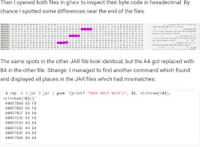
Developer vanitasvitae published an interesting and entertaining blog post detailing the blow-by-blow steps of debugging a reproducibility issue in PGPainless, a library which aims to make using OpenPGP in Java projects as simple as possible . Whilst their in-depth research into the internals of the .jar may have been unnecessary given that diffoscope would have identified the, it must be said that there is something to be said with occasionally delving into seemingly low-level details, as well describing any debugging process. Indeed, as vanitasvitae writes:
Yes, this would have spared me from 3h of debugging But I probably would also not have gone onto this little dive into the JAR/ZIP format, so in the end I m not mad.

Kees Cook published a short and practical blog post detailing how he uses reproducibility properties to aid work to replace one-element arrays in the Linux kernel. Kees approach is based on the principle that if a (small) proposed change is considered equivalent by the compiler, then the generated output will be identical but only if no other arbitrary or unrelated changes are introduced. Kees mentions the fantastic diffoscope tool, as well as various kernel-specific build options (eg. KBUILD_BUILD_TIMESTAMP) in order to prepare my build with the known to disrupt code layout options disabled .
Stefano Zacchiroli gave a presentation at GDR S curit Informatique based in part on a paper co-written with Chris Lamb titled Increasing the Integrity of Software Supply Chains. (Tweet)

Debian In Debian in this month, 28 reviews of Debian packages were added, 35 were updated and 27 were removed this month adding to our knowledge about identified issues. Two issue types were added: nondeterministic_checksum_generated_by_coq and nondetermistic_js_output_from_webpack. After Holger Levsen found hundreds of packages in the bookworm distribution that lack .buildinfo files, he uploaded 404 source packages to the archive (with no meaningful source changes). Currently bookworm now shows only 8 packages without .buildinfo files, and those 8 are fixed in unstable and should migrate shortly. By contrast, Debian unstable will always have packages without .buildinfo files, as this is how they come through the NEW queue. However, as these packages were not built on the official build servers (ie. they were uploaded by the maintainer) they will never migrate to Debian testing. In the future, therefore, testing should never have packages without .buildinfo files again. Roland Clobus posted yet another in-depth status report about his progress making the Debian Live images build reproducibly to our mailing list. In this update, Roland mentions that all major desktops build reproducibly with bullseye, bookworm and sid but also goes on to outline the progress made with automated testing of the generated images using openQA.

GNU Guix Vagrant Cascadian made a significant number of contributions to GNU Guix: Elsewhere in GNU Guix, Ludovic Court s published a paper in the journal The Art, Science, and Engineering of Programming called Building a Secure Software Supply Chain with GNU Guix:
This paper focuses on one research question: how can [Guix]((https://www.gnu.org/software/guix/) and similar systems allow users to securely update their software? [ ] Our main contribution is a model and tool to authenticate new Git revisions. We further show how, building on Git semantics, we build protections against downgrade attacks and related threats. We explain implementation choices. This work has been deployed in production two years ago, giving us insight on its actual use at scale every day. The Git checkout authentication at its core is applicable beyond the specific use case of Guix, and we think it could benefit to developer teams that use Git.
A full PDF of the text is available.

openSUSE In the world of openSUSE, SUSE announced at SUSECon that they are preparing to meet SLSA level 4. (SLSA (Supply chain Levels for Software Artifacts) is a new industry-led standardisation effort that aims to protect the integrity of the software supply chain.) However, at the time of writing, timestamps within RPM archives are not normalised, so bit-for-bit identical reproducible builds are not possible. Some in-toto provenance files published for SUSE s SLE-15-SP4 as one result of the SLSA level 4 effort. Old binaries are not rebuilt, so only new builds (e.g. maintenance updates) have this metadata added. Lastly, Bernhard M. Wiedemann posted his usual monthly openSUSE reproducible builds status report.

diffoscope diffoscope is our in-depth and content-aware diff utility. Not only can it locate and diagnose reproducibility issues, it can provide human-readable diffs from many kinds of binary formats. This month, Chris Lamb prepared and uploaded versions 215, 216 and 217 to Debian unstable. Chris Lamb also made the following changes:
  • New features:
    • Print profile output if we were called with --profile and we were killed via a TERM signal. This should help in situations where diffoscope is terminated due to some sort of timeout. [ ]
    • Support both PyPDF 1.x and 2.x. [ ]
  • Bug fixes:
    • Also catch IndexError exceptions (in addition to ValueError) when parsing .pyc files. (#1012258)
    • Correct the logic for supporting different versions of the argcomplete module. [ ]
  • Output improvements:
    • Don t leak the (likely-temporary) pathname when comparing PDF documents. [ ]
  • Logging improvements:
    • Update test fixtures for GNU readelf 2.38 (now in Debian unstable). [ ][ ]
    • Be more specific about the minimum required version of readelf (ie. binutils), as it appears that this patch level version change resulted in a change of output, not the minor version. [ ]
    • Use our @skip_unless_tool_is_at_least decorator (NB. at_least) over @skip_if_tool_version_is (NB. is) to fix tests under Debian stable. [ ]
    • Emit a warning if/when we are handling a UNIX TERM signal. [ ]
  • Codebase improvements:
    • Clarify in what situations the main finally block gets called with respect to TERM signal handling. [ ]
    • Clarify control flow in the diffoscope.profiling module. [ ]
    • Correctly package the scripts/ directory. [ ]
In addition, Edward Betts updated a broken link to the RSS on the diffoscope homepage and Vagrant Cascadian updated the diffoscope package in GNU Guix [ ][ ][ ].

Upstream patches The Reproducible Builds project detects, dissects and attempts to fix as many currently-unreproducible packages as possible. We endeavour to send all of our patches upstream where appropriate. This month, we wrote a large number of such patches, including:

Testing framework The Reproducible Builds project runs a significant testing framework at tests.reproducible-builds.org, to check packages and other artifacts for reproducibility. This month, the following changes were made:
  • Holger Levsen:
    • Add a package set for packages that use the R programming language [ ] as well as one for Rust [ ].
    • Improve package set matching for Python [ ] and font-related [ ] packages.
    • Install the lz4, lzop and xz-utils packages on all nodes in order to detect running kernels. [ ]
    • Improve the cleanup mechanisms when testing the reproducibility of Debian Live images. [ ][ ]
    • In the automated node health checks, deprioritise the generic kernel warning . [ ]
  • Roland Clobus (Debian Live image reproducibility):
    • Add various maintenance jobs to the Jenkins view. [ ]
    • Cleanup old workspaces after 24 hours. [ ]
    • Cleanup temporary workspace and resulting directories. [ ]
    • Implement a number of fixes and improvements around publishing files. [ ][ ][ ]
    • Don t attempt to preserve the file timestamps when copying artifacts. [ ]
And finally, node maintenance was also performed by Mattia Rizzolo [ ].

Mailing list and website On our mailing list this month: Lastly, Chris Lamb updated the main Reproducible Builds website and documentation in a number of small ways, but primarily published an interview with Hans-Christoph Steiner of the F-Droid project. Chris Lamb also added a Coffeescript example for parsing and using the SOURCE_DATE_EPOCH environment variable [ ]. In addition, Sebastian Crane very-helpfully updated the screenshot of salsa.debian.org s request access button on the How to join the Salsa group. [ ]

Contact If you are interested in contributing to the Reproducible Builds project, please visit our Contribute page on our website. However, you can get in touch with us via:

12 July 2022

Matthew Garrett: Responsible stewardship of the UEFI secure boot ecosystem

After I mentioned that Lenovo are now shipping laptops that only boot Windows by default, a few people pointed to a Lenovo document that says:

Starting in 2022 for Secured-core PCs it is a Microsoft requirement for the 3rd Party Certificate to be disabled by default.

"Secured-core" is a term used to describe machines that meet a certain set of Microsoft requirements around firmware security, and by and large it's a good thing - devices that meet these requirements are resilient against a whole bunch of potential attacks in the early boot process. But unfortunately the 2022 requirements don't seem to be publicly available, so it's difficult to know what's being asked for and why. But first, some background.

Most x86 UEFI systems that support Secure Boot trust at least two certificate authorities:

1) The Microsoft Windows Production PCA - this is used to sign the bootloader in production Windows builds. Trusting this is sufficient to boot Windows.
2) The Microsoft Corporation UEFI CA - this is used by Microsoft to sign non-Windows UEFI binaries, including built-in drivers for hardware that needs to work in the UEFI environment (such as GPUs and network cards) and bootloaders for non-Windows.

The apparent secured-core requirement for 2022 is that the second of these CAs should not be trusted by default. As a result, drivers or bootloaders signed with this certificate will not run on these systems. This means that, out of the box, these systems will not boot anything other than Windows[1].

Given the association with the secured-core requirements, this is presumably a security decision of some kind. Unfortunately, we have no real idea what this security decision is intended to protect against. The most likely scenario is concerns about the (in)security of binaries signed with the third-party signing key - there are some legitimate concerns here, but I'm going to cover why I don't think they're terribly realistic.

The first point is that, from a boot security perspective, a signed bootloader that will happily boot unsigned code kind of defeats the point. Kaspersky did it anyway. The second is that even a signed bootloader that is intended to only boot signed code may run into issues in the event of security vulnerabilities - the Boothole vulnerabilities are an example of this, covering multiple issues in GRUB that could allow for arbitrary code execution and potential loading of untrusted code.

So we know that signed bootloaders that will (either through accident or design) execute unsigned code exist. The signatures for all the known vulnerable bootloaders have been revoked, but that doesn't mean there won't be other vulnerabilities discovered in future. Configuring systems so that they don't trust the third-party CA means that those signed bootloaders won't be trusted, which means any future vulnerabilities will be irrelevant. This seems like a simple choice?

There's actually a couple of reasons why I don't think it's anywhere near that simple. The first is that whenever a signed object is booted by the firmware, the trusted certificate used to verify that object is measured into PCR 7 in the TPM. If a system previously booted with something signed with the Windows Production CA, and is now suddenly booting with something signed with the third-party UEFI CA, the values in PCR 7 will be different. TPMs support "sealing" a secret - encrypting it with a policy that the TPM will only decrypt it if certain conditions are met. Microsoft make use of this for their default Bitlocker disk encryption mechanism. The disk encryption key is encrypted by the TPM, and associated with a specific PCR 7 value. If the value of PCR 7 doesn't match, the TPM will refuse to decrypt the key, and the machine won't boot. This means that attempting to attack a Windows system that has Bitlocker enabled using a non-Windows bootloader will fail - the system will be unable to obtain the disk unlock key, which is a strong indication to the owner that they're being attacked.

The second is that this is predicated on the idea that removing the third-party bootloaders and drivers removes all the vulnerabilities. In fact, there's been rather a lot of vulnerabilities in the Windows bootloader. A broad enough vulnerability in the Windows bootloader is arguably a lot worse than a vulnerability in a third-party loader, since it won't change the PCR 7 measurements and the system will boot happily. Removing trust in the third-party CA does nothing to protect against this.

The third reason doesn't apply to all systems, but it does to many. System vendors frequently want to ship diagnostic or management utilities that run in the boot environment, but would prefer not to have to go to the trouble of getting them all signed by Microsoft. The simple solution to this is to ship their own certificate and sign all their tooling directly - the secured-core Lenovo I'm looking at currently is an example of this, with a Lenovo signing certificate. While everything signed with the third-party signing certificate goes through some degree of security review, there's no requirement for any vendor tooling to be reviewed at all. Removing the third-party CA does nothing to protect the user against the code that's most likely to contain vulnerabilities.

Obviously I may be missing something here - Microsoft may well have a strong technical justification. But they haven't shared it, and so right now we're left making guesses. And right now, I just don't see a good security argument.

But let's move on from the technical side of things and discuss the broader issue. The reason UEFI Secure Boot is present on most x86 systems is that Microsoft mandated it back in 2012. Microsoft chose to be the only trusted signing authority. Microsoft made the decision to assert that third-party code could be signed and trusted.

We've certainly learned some things since then, and a bunch of things have changed. Third-party bootloaders based on the Shim infrastructure are now reviewed via a community-managed process. We've had a productive coordinated response to the Boothole incident, which also taught us that the existing revocation strategy wasn't going to scale. In response, the community worked with Microsoft to develop a specification for making it easier to handle similar events in future. And it's also worth noting that after the initial Boothole disclosure was made to the GRUB maintainers, they proactively sought out other vulnerabilities in their codebase rather than simply patching what had been reported. The free software community has gone to great lengths to ensure third-party bootloaders are compatible with the security goals of UEFI Secure Boot.

So, to have Microsoft, the self-appointed steward of the UEFI Secure Boot ecosystem, turn round and say that a bunch of binaries that have been reviewed through processes developed in negotiation with Microsoft, implementing technologies designed to make management of revocation easier for Microsoft, and incorporating fixes for vulnerabilities discovered by the developers of those binaries who notified Microsoft of these issues despite having no obligation to do so, and which have then been signed by Microsoft are now considered by Microsoft to be insecure is, uh, kind of impolite? Especially when unreviewed vendor-signed binaries are still considered trustworthy, despite no external review being carried out at all.

If Microsoft had a set of criteria used to determine whether something is considered sufficiently trustworthy, we could determine which of these we fell short on and do something about that. From a technical perspective, Microsoft could set criteria that would allow a subset of third-party binaries that met additional review be trusted without having to trust all third-party binaries[2]. But, instead, this has been a decision made by the steward of this ecosystem without consulting major stakeholders.

If there are legitimate security concerns, let's talk about them and come up with solutions that fix them without doing a significant amount of collateral damage. Don't complain about a vendor blocking your apps and then do the same thing yourself.

[Edit to add: there seems to be some misunderstanding about where this restriction is being imposed. I bought this laptop because I'm interested in investigating the Microsoft Pluton security processor, but Pluton is not involved at all here. The restriction is being imposed by the firmware running on the main CPU, not any sort of functionality implemented on Pluton]

[1] They'll also refuse to run any drivers that are stored in flash on Thunderbolt devices, which means eGPU setups may be more complicated, as will netbooting off Thunderbolt-attached NICs
[2] Use a different leaf cert to sign the new trust tier, add the old leaf cert to dbx unless a config option is set, leave the existing intermediate in db

comment count unavailable comments

8 July 2022

Bits from Debian: DebConf22 Cheese and Wine Party

In less than two days we will be in Prizren to start DebCamp and DebConf22 \o/ This C&W is the 18th official DebConf Cheese and Wine party. The first C&W was improvised in Helsinki during DebConf 5, in the so-called "French" room. Cheese and Wine parties are now a tradition for DebConf. The event is very simple: bring good edible stuff from your country. We like cheese and wine, but we love the surprising stuff that people bring from all around the world or regions of Kosovo. So, you can bring non-alcoholic drinks or a typical food that you would like to share as well. Even if you don't bring anything, feel free to participate: our priorities are our attendants and free cheese. We have to organize for a great party. An important part is planning - We want to know what you are bringing, in order to prepare the labels and organizing other things. So, please go to our wiki page and add what you will bring! If you don't have time to buy before travel, we list some places where you can buy cheese and wine in . There are more information about C&W, what you can bring, vegan cheese, Kosovo customs regulations and non-alcoholic drinks at our site. C&W will happen on July 19th, 2022 (Tuesday) after 19h30min. We are looking forward to seeing you all here! DebConf22 banner open registration

6 July 2022

Russ Allbery: Review: A Master of Djinn

Review: A Master of Djinn, by P. Dj l Clark
Series: Dead Djinn Universe #1
Publisher: Tordotcom
Copyright: 2021
ISBN: 1-250-26767-6
Format: Kindle
Pages: 391
A Master of Djinn is the first novel in the Dead Djinn Universe, but (as you might guess from the series title) is a direct sequel to the novelette "A Dead Djinn in Cairo". The novelette is not as good as the novel, but I recommend reading it first for the character introductions and some plot elements that carry over. Reading The Haunting of Tram Car 015 first is entirely optional. In 1912 in a mansion in Giza, a secret society of (mostly) British men is meeting. The Hermetic Brotherhood of Al-Jahiz is devoted to unlocking the mysteries of the Soudanese mystic al-Jahiz. In our world, these men would likely be colonialist plunderers. In this world, they still aspire to that role, but they're playing catch-up. Al-Jahiz bored into the Kaf, releasing djinn and magic into the world and making Egypt a world power in its own right. Now, its cities are full of clockwork marvels, djinn walk the streets as citizens, and British rule has been ejected from India and Africa by local magic. This group of still-rich romantics and crackpots hopes to discover the knowledge lost when al-Jahiz disappeared. They have not had much success. This will not save their lives. Fatma el-Sha'arawi is a special investigator for the Ministry of Alchemy, Enchantments, and Supernatural Entities. Her job is sorting out the problems caused by this new magic, such as a couple of young thieves with a bottle full of sleeping djinn whose angry reaction to being unexpectedly woken has very little to do with wishes. She is one of the few female investigators in a ministry that is slowly modernizing with the rest of society (Egyptian women just got the vote). She's also the one called to investigate the murder of a secret society of British men and a couple of Cairenes by a black-robed man in a golden mask. The black-robed man claims to be al-Jahiz returned, and proves to be terrifyingly adept at manipulating crowds and sparking popular dissent. Fatma and the Ministry's first attempt to handle him is a poorly-judged confrontation stymied by hostile crowds, the man's duplicating bodyguard, and his own fighting ability. From there, it's a race between Fatma's pursuit of linear clues and the black-robed man's efforts to destabilize society. This, like the previous short stories, is a police procedural, but it has considerably more room to breathe at novel length. That serves it well, since as with "A Dead Djinn in Cairo" the procedural part is a linear, reactive vehicle for plot exposition. I was more invested in Fatma's relationships with the supporting characters. Since the previous story, she's struck up a romance with Siti, a highly competent follower of the old Egyptian gods (Hathor in particular) and my favorite character in the book. She's also been assigned a new partner, Hadia, a new graduate and another female agent. The slow defeat of Fatma's irritation at not being allowed to work alone by Hadia's cheerful competence and persistence (and willingness to do paperwork) adds a lot to the characterization. The setting felt a bit less atmospheric than The Haunting of Tram Car 015, but we get more details of international politics, and they're a delight. Clark takes obvious (and warranted) glee in showing how the reintroduction of magic has shifted the balance of power away from the colonial empires. Cairo is a bustling steampunk metropolis and capital of a world power, welcoming envoys from West African kingdoms alongside the (still racist and obnoxious but now much less powerful) British and other Europeans. European countries were forced to search their own mythology for possible sources of magic power, which leads to the hilarious scene of the German Kaiser carrying a sleepy goblin on his shoulder to monitor his diplomacy. The magic of the story was less successful for me, although still enjoyable. The angels from "A Dead Djinn in Cairo" make another appearance and again felt like the freshest bit of world-building, but we don't find out much more about them. I liked the djinn and their widely-varied types and magic, but apart from them and a few glimpses of Egypt's older gods, that was the extent of the underlying structure. There is a significant magical artifact, but the characters are essentially handed an instruction manual, use it according to its instructions, and it then does what it was documented to do. It was a bit unsatisfying. I'm the type of fantasy reader who always wants to read the sourcebook for the magic system, but this is not that sort of a book. Instead, it's the kind of book where the investigator steadily follows a linear trail of clues and leads until they reach the final confrontation. Here, the confrontation felt remarkably like cut scenes from a Japanese RPG: sudden vast changes in scale, clockwork constructs, massive monsters, villains standing on mobile platforms, and surprise combat reversals. I could almost hear the fight music and see the dialog boxes pop up. This isn't exactly a complaint I love Japanese RPGs but it did add to the feeling that the plot was on rails and didn't require many decisions from the protagonist. Clark also relies on an overused plot cliche in the climactic battle, which was a minor disappointment. A Master of Djinn won the Nebula for best 2021 novel, I suspect largely on the basis of its setting and refreshingly non-European magical system. I don't entirely agree; the writing is still a bit clunky, with unnecessary sentences and stock phrases showing up here and there, and I think it suffers from the typical deficiencies of SFF writers writing mysteries or police procedurals without the plot sophistication normally found in that genre. But this is good stuff for a first novel, with fun supporting characters (loved the librarian) and some great world-building. I would happily read more in this universe. Rating: 7 out of 10

Next.

Previous.