Search Results: "sten"

10 May 2013

Julien Danjou: Rant about Github pull-request workflow implementation

One of my recent innocent tweet about Gerrit vs Github triggered much more reponses and debate that I expected it to. I realize that it might be worth explaining a bit what I meant, in a text longer than 140 characters. <script async="async" charset="utf-8" src="http://platform.twitter.com/widgets.js"></script> The problems with Github pull-requests I always looked at Github from a distant eye, mainly because I always disliked their pull-request handling, and saw no value in the social hype it brings. Why? One click away isn't one click effort The pull-request system looks like an incredible easy way to contribute to any project hosted on Github. You're a click away to send your contribution to any software. But the problem is that any worthy contribution isn't an effort of a single click. Doing any proper and useful contribution to a software is never done right the first time. There's a dance you will have to play. A slowly rhythmed back and forth between you and the software maintainer or team. You'll have to dance it until your contribution is correct and can be merged. But as a software maintainer, not everybody is going to follow you on this choregraphy, and you'll end up with pull-request you'll never get finished unless you wrap things up yourself. So the gain in pull-requests here, isn't really bigger than a good bug report in most cases. This is where the social argument of Github isn't anymore. As soon as you're talking about projects bigger than a color theme for your favorite text editor, this feature is overrated. Contribution rework If you're lucky enough, your contributor will play along and follow you on this pull-request review process. You'll make suggestions, he will listen and will modify his pull-request to follow your advice. At this point, there's two technics he can use to please you. Technic #1: the Topping Github's pull-requests invite you to send an entire branch, eclipsing the fact that it is composed of several commits. The problem is that a lot of one-click-away contributors do not masterize Git and/or do not make efforts to build a logical patchset, and nothing warns them that their branch history is wrong. So they tend to change stuff around, commit, make a mistake, commit, fix this mistake, commit, etc. This kind of branch is composed of the whole brain's construction process of your contributor, and is a real pain to review. To the point I quite often give up. <figure> <figcaption> A typical case: 3 commits to build a 4 lines long file. </figcaption> </figure> Without Github, the old method that all software used, and that many software still use (e.g. Linux), is to send a patch set over e-mail (or any other medium like Gerrit). This method has one positive effect, that it forces the contributor to acknowledge the list of commits he is going to publish. So, if the contributor he has fixup commits in his history, they are going to be seen as first class citizen. And nobody is going to want to see that, neither your contributor, nor the software maintainers. Therefore, such a system tend to push contributors to write atomic, logical and self-contained patchset that can be more easily reviewed. Technic #2: the History Rewriter This is actually the good way to build a working and logical patchset using Git. Rewriting history and amending problematic patches using the famous git rebase --interactive trick. The problem is that if your contributor does this and then repush the branch composing your pull-request to Github, you will both lose the previous review done, each time. There's no history on the different versions of the branch that has been pushed. In the old alternative system like e-mail, no information is lost when reworked patches are resent, obviously. This is far better because it eases the following of the iterative discussions that the patch triggered. Of course, it would be possible for Github to enhance this and fix it, but currently it doesn't handle this use case correctly.. <figure> <figcaption> Exercise for the doubtful readers: good luck finding all revisions of my patch in the pull-request #157 of Hy.</figcaption> </figure> A quick look at OpenStack workflow It's not a secret for anyone that I've been contributing to OpenStack as a daily routine for the last 18 months. The more I contribute, the more I like the contribution workflow and process. It's already well and longly described on the wiki, so I'll summarize here my view and what I like about it. Gerrit To send a contribution to any OpenStack project, you need to pass via Gerrit. This is way simpler than doing a pull-request on Github actually, all you have to do is do your commit(s), and type git review. That's it. Your patch will be pushed to Gerrit and available for review. Gerrit allows other developers to review your patch, add comments anywhere on it, and score your patch up or down. You can build any rule you want for the score needed for a patch to be merged; OpenStack requires one positive scoring from two core developers before the patch is merged. Until a patch is validated, it can be reworked and amended locally using Git, and then resent using git review again. That simple. The historic and the different version of the patches are available, with the whole comments. Gerrit doesn't lose any historic information on your workflow. Finally, you'll notice that this is actually the same kind of workflow projects use when they work by patch sent over e-mail. Gerrit just build a single place to regroup and keep track of patchsets, which is really handy. It's also much easier for people to actually send patch using a command line tool than their MUA or git send-email. Gate testing Testing is mandatory for any patch sent to OpenStack. Unit tests and functionnals test are run for each version of each patch of the patchset sent. And until your patch passes all tests, it will be impossible to merge it. Yes, this implies that all patches in a patchset must be working commits and can be merged on their own, without the entire patchset going in! With such a restricution, it's impossible to have "fixup commits" merged in your project and pollute the history and the testability of the project. Once your patch is validated by core developers, the system checks that there is not any merge conflicts. If there's not, tests are re-run, since the branch you are pushing to might have changed, and if everything's fine, the patch is merged. This is an uncredible force for the quality of the project. This implies that no broken patchset can ever sneak in, and that the project pass always all tests. Conclusion: accessibility vs code review In the end, I think that one of the key of any development process, which is code review, is not well covered by Github pull-request system. It is, along with history integrity, damaged by the goal of making contributions easier. Choosing between these features is probably a trade-off that each project should do carefully, considering what are its core goals and the quality of code it want to reach. I tend to find that OpenStack found one of the best trade-off available using Gerrit and plugging testing automation via Jenkins on it, and I would probably recommend it for any project taking seriously code reviews and testing.

9 May 2013

Benjamin Mako Hill: The Remixing Dilemma: The Trade-off Between Generativity and Originality

This post was written with Andr s Monroy-Hern ndez. It is a summary of a paper just published in American Behavioral Scientist. You can also read the full paper: The remixing dilemma: The trade-off between generativity and originality. It is part of a series of papers I have written with Monroy-Hern ndez using data from Scratch. You can find the others on my academic website.
Remixing the reworking and recombination of existing creative artifacts represents a widespread, important, and controversial form of social creativity online. Proponents of remix culture often speak of remixing in terms of rich ecosystems where creative works are novel and highly generative. However, examples like this can be difficult to find. Although there is a steady stream of media being shared freely on the web, only a tiny fraction of these projects are remixed even once. On top of this, many remixes are not very different from the works they are built upon. Why is some content more attractive to remixers? Why are some projects remixed in deeper and more transformative ways?
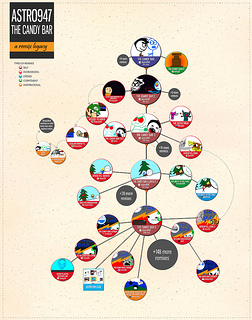
Remix Diagram
We try to shed light on both of these questions using data from Scratch a large online remixing community. Although we find support for several popular theories, we also present evidence in support of a persistent trade-off that has broad practical and theoretical implications. In what we call the remixing dilemma, we suggest that characteristics of projects that are associated with higher rates of remixing are also associated with simpler and less transformative types of derivatives.

Our study is focused on two interrelated research questions. First, we ask why some projects shared in remixing communities are more or less generative than others. Generativity a term we borrow from Jonathan Zittrain describes creative works that are likely to inspire follow-on work. Several scholars have offered suggestions for why some creative works might be more generative than others. We focus on three central theories:
  1. Projects that are moderately complicated are more generative. The free and open source software motto release early and release often suggests that simple projects will offer more obvious opportunities for contribution than more polished projects. That said, projects that are extremely simple (e.g., completely blank slates) may also uninspiring to would-be contributors.
  2. Projects by prominent creators are more generative. The reasoning for this claim comes from the suggestion that remixing can act as a form of cultural conversation and that the work of popular creators can act like a common medium or language.
  3. Projects that are remixes themselves are more generative. The reasoning for this final claim comes from the idea that remixing thrives through the accumulation of contributions from groups of people building on each other s work.
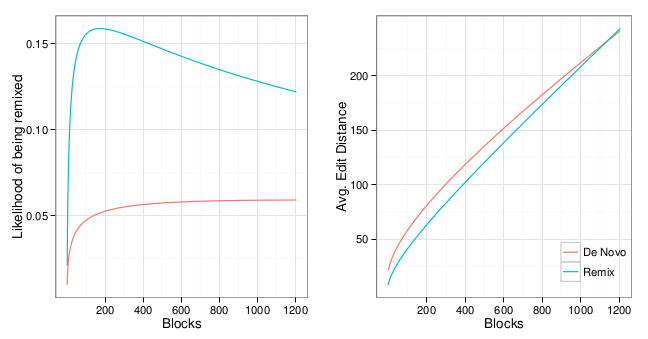
Our second question focuses on the originality of remixes and asks when more or less transformative remixing occurs. For example, highly generative projects may be less exciting if the projects produced based on them are all near-identical copies of antecedent projects. For a series of reasons including the fact that increased generativity might come by attracting less interested, skilled, or motivated individuals we suggest that each of the factors associated with generativity will also be associated with less original forms of remixing. We call this trade-off the remixing dilemma. We answer both of our research questions using a detailed dataset from Scratch, where young people build, share, and collaborate on interactive animations and video games. The community was built to support users of the Scratch programming environment, a desktop application with functionality similar to Flash created by the Lifelong Kindergarten Group at the MIT Media Lab. Scratch is designed to allow users to build projects by integrating images, music, sound, and other media with programming code. Scratch is used by more than a million users, most of them under 18 years old. To test our three theories about generativity, we measure whether or not, as well as how many times, Scratch projects were remixed in a dataset that includes every shared project. Although Scratch is designed as a remixing community, only around one tenth of all Scratch projects are ever remixed. Because more popular projects are remixed more frequently simply because of exposure, we control for the number of times each project is viewed. Our analysis shows at least some support for all three theories of generativity described above. (1) Projects with moderate amounts of code are remixed more often than either very simple or very complex projects. (2) Projects by more prominent creators are more generative. (3) Remixes are more likely to attract remixers than de novo projects. To test our theory that there is a trade-off between generativity and originality, we build a dataset that includes every Scratch remix and its antecedent. For each pair, we construct a measure of originality by comparing the remix to its antecedent and computing an edit distance (a concept we borrow from software engineering) to determine how much the projects differ. We find strong evidence of a trade-off: (1) Projects of moderate complexity are remixed more lightly than more complicated projects. (2) Projects by more prominent creators tend to be remixed in less transformative ways. (3) Cumulative remixing tends to be associated with shallower and less transformative derivatives. That said, our support for (1) is qualified in that we do not find evidence of the increased originality for the simplest projects as our theory predicted.
Two plots of estimated values for prototypical projects. Panel 1 (left) display predicted probabilities of being remixed. Panel 2 (right) display predicted edit distances. Both panels show predicted values for both remixes and de novo projects from 0 to 1,204 blocks (99th percentile).

Two plots of estimated values for prototypical projects. Panel 1 (left) displays predicted probabilities of being remixed. Panel 2 (right) displays predicted edit distances. Both panels show predicted values for both remixes and de novo projects from 0 to 1,204 blocks (99th percentile).

We feel that our results raise difficult but important challenges, especially for the designers of social media systems. For example, many social media sites track and display user prominence with leaderboards or lists of aggregate views. This technique may lead to increased generativity by emphasizing and highlighting creator prominence. That said, it may also lead to a decrease in originality of the remixes elicited. Our results regarding the relationship of complexity to generativity and originality of remixes suggest that supporting increased complexity, at least for most projects, may have fewer drawbacks. As supporters and advocates of remixing, we feel that although highly generative works that lead to highly original derivatives may be rare and difficult for system designers to support, understanding remixing dynamics and encouraging these rare projects remain a worthwhile and important goal. Benjamin Mako Hill, Massachusetts Institute of Technology
Andr s Monroy-Hern ndez, Microsoft Research
For more, see our full paper, The remixing dilemma: The trade-off between generativity and originality. Published in American Behavioral Scientist. 57-5, Pp. 643 663. (Official Link, Pay-Walled ).

8 May 2013

Steve Langasek: Plymouth is not a bootsplash

Congrats to the Debian release team on the new release of Debian 7.0 (wheezy)! Leading up to the release, a meme making the rounds on Planet Debian has been to play a #newinwheezy game, calling out some of the many new packages in 7.0 that may be interesting to users. While upstart as a package is nothing new in wheezy, the jump to upstart 1.6.1 from 0.6.6 is quite a substantial change. It does bring with it a new package, mountall, which by itself isn't terribly interesting because it just provides an upstart-ish replacement for some core scripts from the initscripts package (essentially, /etc/rcS.d/*mount*). Where things get interesting (and, typically, controversial) is the way in which mountall leverages plymouth to achieve this. What is plymouth? There is a great deal of misunderstanding around plymouth, a fact I was reminded of again while working to get a modern version of upstart into wheezy. When Ubuntu first started requiring plymouth as an essential component of the boot infrastructure, there was a lot of outrage from users, particularly from Ubuntu Server users, who believed this was an attempt to force pretty splash screen graphics down their throats. Nothing could be further from the truth. Plymouth provides a splash screen, but that's not what plymouth is. What plymouth is, is a boot-time I/O multiplexer. And why, you ask, would upstart - or mountall, whose job is just to get the filesystem mounted at boot - need a boot-time I/O multiplexer? Why use plymouth? The simple answer is that, like everything else in a truly event-driven boot system, filesystem mounting is handled in parallel - with no defined order. If a filesystem is missing or fails an fsck, mountall may need to interact with the user to decide how to handle it. And if there's more than one missing or broken filesystem, and these are all being found in parallel, there needs to be a way to associate each answer from the user to the corresponding question from mountall, to avoid crossed signals... and lost data. One possible way to handle this would be for mountall to serialize the fsck's / mounts. But this is a pretty unsatisfactory answer; all other things (that is, boot reliability) being equal, admins would prefer their systems to boot as fast as possible, so that they can get back to being useful to users. So we reject the idea of solving the problem of serializing prompts by making mountall serialize all its filesystem checks. Another option would be to have mountall prompt directly on the console, doing its own serialization of the prompts (even though successful mounts / fscks continue to be run in parallel). This, too, is not desirable in the general case, both because some users actually would like to have pretty splash screens at boot time, and this would be incompatible with direct console prompting; and because mountall is not the only piece of software that need to prompt at boot time (see also: cryptsetup). Plymouth: not just a pretty face Enter plymouth, which provides the framework for serializing requests to the user while booting. It can provide a graphical boot splash, yes; ironically, even its own homepage suggests that this is its purpose. But it can also provide a text-only console interface, which is what you get automatically when booting without a splash boot argument, or even handle I/O over a serial console. Which is why, contrary to the initial intuitions of the s390 porters upon seeing this package, plymouth is available for all of Debian's Linux architectures in wheezy, s390 and s390x included, providing a consistent architecture for boot-time I/O for systems that need it - which is any machine using a modern boot system, such as upstart or systemd. Room for improvement Now, having a coherent architecture for your boot I/O is one thing; having a bug-free splash screen is another. The experience of plymouth in Ubuntu has certainly not been bug-free, with plymouth making significant demands of the kernel video layer. Recently, the binary video driver packages in Ubuntu have started to blacklist the framebuffer kernel driver entirely due to stability concerns, making plymouth splash screens a non-starter for users of these drivers and regressing the boot experience. One solution for this would be to have plymouth offload the video handling complexity to something more reliable and better tested. Plymouth does already have an X backend, but we don't use that in Ubuntu because even if we do have an X server, it normally starts much later than when we would want to display the splash screen. With Mir on the horizon for Ubuntu, however, and its clean separation between system and session compositors, it's possible that using a Mir backend - that can continue running even after the greeter has started, unlike the current situation where plymouth has to cede the console to the display manager when it starts - will become an appealing option. This, too, is not without its downsides. Needing to load plymouth when using crypted root filesystems already makes for a bloated initramfs; adding a system compositor to the initramfs won't make it any better, and introduces further questions about how to hand off between initramfs and root fs. Keeping your system compositor running from the initramfs post-boot isn't really ideal, particularly for low-memory systems; whereas killing the system compositor and restarting it will make it harder to provide a flicker-free experience. But for all that, it does have its architectural appeal, as it lets us use plymouth as long as we need to after boot. As the concept of static runlevels becomes increasingly obsolete in the face of dynamic systems, we need to design for the world where the distinction between "booting" and "booted" doesn't mean what it once did.

Antoine Beaupr : Debian Wheezy et Debian Qu bec ce samedi!

[En fran ais ci-bas] As announced by Fabian we are launching the Debian Qu bec group this saturday, with a release party at UQAM. I may not be present as I was planning to go camping this weekend, but since the weather forecast is rainy so far, I may cancel. Tel qu'annonc par Fabian, nous lan ons le groupe Debian Qu bec ce samedi, avec un "release party". Je vais *peut- tre tre absent vu que je pr voyais sortir en camping, mais vu qu'ils pr voient de la pluie pour 4 jours, je vais peut- tre m'abstenir...

4 May 2013

Joerg Jaspert: Wheezy release

There was Lenny, there was Squeeze, now there is Wheezy. Another major release of Debian where I had the pleasure to do the ftpmaster work for the release. Like the last times, Mark joined to help with the work. But 2 FTPMasters aren t enough for one Wheezy, or so, so Ansgar had his first run aside from point releases. With the whole load of work the release team did in the past to prepare this, combined with all the changes in dak we had since Squeeze, it turned out to be rather easy for us. Again, a few moments and not a detailed log (times in CEST): Right now (that is, 21:08 CEST) I am mostly waiting for the CD build to finish. Current schedule seems to have that in some two and a half hours, after which we can push the mirrors and our press people announce it. Except if Murphy wants to show up, but lets hope that not. Thanks go out to everyone involved in preparing this release, be it in the past by fixing bugs, uploading packages, doing whatever was needed, as well as doing the work today.

Russ Allbery: Review: Democracy at Work

Review: Democracy at Work, by Richard Wolff
Publisher: Haymarket
Copyright: 2012
ISBN: 1-60846-247-1
Format: Kindle
Pages: 220
I've been reading (mostly on-line) and thinking quite a bit lately about workplace governance models, economic structure, and why the current organization of the US workplace bothers me so intensely, partly triggered by reading John Kenneth Galbraith's The Affluent Society. The economic monoculture has made that process particularly frustrating. It's rare to find a discussion, even in the context of organizational strategies that are considered radical, that avoids the standard frame of productivity and business value. Most discussion is long on tactics and short on strategy and examination of goals. Wolff's appearance on Moyers & Company was a rare breath of fresh air, enough so that I grabbed his book shortly afterwards. Wolff is a Marxian economist (meaning that he makes use of Marxist analysis of economics and capitalism while separating them from Marxist politics and Marx's advocacy of revolutionary socialism), which for me was part of the interest. Marxist thought of any branch is not common in the United States; we're regularly deprived of several sides in the international conversation on economic models. I was taught Marxist theory in elementary and high school (in retrospect, surprisingly even-handedly and well, despite the biases of my schooling), but none of the later developments of Marxist thought. I think that's a typical experience here; in the United States, Marxism culminated in Mao and Stalin, and no further development of the underlying theories is ever mentioned. Democracy at Work is subtitled A Cure for Capitalism and does indeed advocate a concrete alternative to capitalist business structures. But this is only the last third of the book (and in some ways the least useful, as I'll discuss in a moment). The first two-thirds of the book is basically a remedial education in modern, as opposed to historic, Marxian economics for US readers like myself who have never heard it before, cast in the context of the current financial crisis. This may well be old hat for Europeans, but if you've been wondering what (at least some) modern-day Marxists actually believe, or are saying to yourself "there are modern-day Marxists after the collapse of the Soviet Union?", I recommend this book to your attention. It's an excellent summary, which I read with the delightful feeling of an expanding viewpoint and the discovery of new directions from which to look at a problem. There's quite a bit in this section that's worth thinking about, including another take on the nature of the recent economic collapse and how that fits into a Marxian analysis of capitalist crises. But there was one point in Wolff's explanation that I found particularly helpful. He completely restructured my understanding of the Marxian analysis of worker exploitation and profit allocation. There are two angles of Marxist economic thought and socialist economics that get a great deal of attention, at least in the United States, in history and economics classes: the role (or lack thereof) of markets in price setting, and the ownership of the means of production. Defenders of capitalism like to focus on the former, since it's quite easy to identify the advantages of theoretical free markets in finding ideal prices and balancing supply and demand, whereas central planning of prices and production has resulted in some catastrophic and deadly failures. (Although I will note, with passing interest, that those failures predate large-scale computing, and there are now large corporations that manage budgets larger than some countries via centralized command-and-control economic practices.) Defenders of socialism are more likely to focus on the ownership of the means of production, since it's easy to show prima facie unfairness in owners of capital extracting vast profits without having to do any work themselves, only be lucky enough to start with large quantities of money. Wolff, however, argues that both of these focuses misses a core critique by Marx of the workplace structure in capitalism, and that, by ignoring that critique, supposedly Marxist countries did not create anything that was actually Marxist in implementation. The Soviet Union was just as much a capitalist country as the United States is. It was state capitalism rather than private capitalism, but the core capitalist structure was intact. Wolff arrives at this conclusion, which may be well-trodden ground in parts of the world that include active Marxist thought but which was quite startling to this American, by treating the ownership of capital as a partial distraction. He focuses on a more direct question and practical question: who determines what a worker does on a day-to-day basis and how that product is used? Who determines what profits are collected and how they are spent? In private capitalism, this is done by the owners of the capital: large shareholders, major investors, and the managerial class that they hire. In Soviet state capitalism, this is done by national politicians, bureaucrats, and the managerial class that they hire. In neither model is it done by the workers themselves. The Soviet model gives theoretical ownership of the capital to the workers, but that ownership is diffused, centralized, and politicized, redirected through the mechanisms of the state, and therefore is effectively ignored. Ownership and control is entirely captured by the political class. Both of these systems are capitalist in Wolff's view of Marx: there is a class of owners and managers, who control the terms and nature of work and who allocate the profits, and a class of workers, who have to do what they're told, are not paid full value for their labor, and don't have a say in how the profits their work generates are spent. At the most important level of day-to-day autonomy and empowerment, they are functionally identical. They are both equally hierarchical and exploitative; the only difference is in whether the system is controlled by rich individuals or by well-connected politicians. (And, as any study of modern politics quickly reveals, the distinction between those two groups in most countries is murky at best.) Wolff convincingly recasts modern economic history as a constant pendulum swing between private capitalism and state capitalism. Crises in one system push countries towards the other system; subsequent crises push the country back towards the first system. Regulation grows and shrinks, companies are nationalized and then privatized, but both systems are united in excluding the worker from any meaningful control over their work life. The first two-thirds of the book was full of insights like this for me. I didn't agree with all of it, but all of it was worthwhile and thought-provoking. But I was a bit leery of Wolff's proposed solution. My past experience with critics of capitalism is that the critique is often quite compelling, but the proposed solution is much less believable. And, sadly, that concern was warranted here as well. The core of Wolff's proposal is predictable but possibly sound: a restructuring of the workplace to be radically democratic. The business would be owned entirely and exclusively by the people who work for it, equally regardless of the job of the worker, and the workers would decide democratically or via elected repesentatives from among the workers how to allocate the profits of the business, what standards and business practices should be followed, and how the work is to be done. I was particularly interested to hear that this model (workers' self-directed enterprises) has apparently been successful in Spain in the form of the Mondragon Cooperative. Given all the tricky, small details that have to be resolved in an actual workplace, an existence proof is worth more than pounds of theory. Unfortunately, like a lot of proposed alternatives, Wolff's description of WSDEs is quite fuzzy and involves a lot of hand-waving. I was never able to build, from this book, a coherent and complete mental model of how such a workplace would function. Wolff tends to surround every specific in a halo of contingencies, possibilities, and alternative models, and is maddeningly nonspecific on such practical matters as how line management would work, how such a business would do financial planning or project approval, how competing interests in different parts of the organization would be balanced, and other practical governance matters that fill my work life. Maybe the answer to all of that is just "democracy," but I'm dubious. Democracy has a number of well-known flaws that I thought weren't adequately addressed. For example, democracies are often quite happy to further and reinforce existing prejudice (such as sexism or racism), and are prone to yielding control to the most charismatic. Democracies also have an informed voter problem, which seems like it would be particularly acute if democracy is going to make detailed business decisions. And, for larger organizations, control by pre-existing money could re-enter the equation via propaganda and campaigning around votes. Some of this gap in the book could be addressed via a more in-depth look at how Mondragon and any other real-life examples work, but that is sadly missing here. (I am interested enough now, though, that I'd read a good popular treatment of the history and methodology of Mondragon, although I don't think I'm up to working through an academic study.) The hierarchical, dictatorial management structure imposed by capitalism is so awful that WSDEs don't have a particularly high bar to meet to be fairer and more empowering than what we have today. The question, rather, is would they function sufficiently well that the business would be able to make effective decisions, and that's unclear to me from this book. This is, as Wolff spends some time discussing, particularly difficult when in direct competition with capitalist enterprises. This sort of endeavor will probably trade some degree of economic efficiency and raw marketplace power for improvements to fairness and empowerment, but that means it's going to require support from the surrounding society, which is a huge obstacle. I doubt there's a free lunch here: true fairness and equity also leading to improved economic efficiency in a capitalist context is a nice dream, but not horribly practical. Wolff also seems to suffer from something else I associate with Marxist thought: a preferential focus on a very narrowly-defined type of productive worker, apparently left over from Marx's original critique in the context of industrialization. Wolff inserts a very odd and quite awkward distinction in his WSDE model between workers who directly produce the product that's sold, and who in his model therefore produce the profits of the business, and all other workers in the business. He then gives special privileges to the former group to decide how much profit to return in worker compensation and how much to use for other purposes, thus making the supporting workers second-class citizens within this supposedly equal workplace. Speaking as someone who works in IT, and hence would be classified by Wolff into the supporting rather than directly productive category, I do not find this division at all convincing, and Wolff never provides a coherent explanation for why he introduced it. He only says that it's necessary for the governance of the business to not be exploitative, which seems to assume that there is a special economic role played by the workers who work directly on a saleable product. Maybe there is some analysis that could convince me of this, but, if so, it's not present in this book. It struck me as a recipe for continuing the exploitation of the most invisible and powerless workers in capitalism: janitors, groundskeepers, and other low-paid service jobs. I wish the whole book were as insightful and pointed as the first two-thirds, but alas I found the WSDE discussion to be somewhat muddled and utopian. "How do we get there from here" is always the hardest part of this type of discussion, and Wolff has no special skill in that department. But, despite that, I got a lot of fascinating ideas and new conceptual frameworks out of this book, and I'm tempted to read it again. I suspect some of this, similar to my discovery of promises and infinite streams in programming, is filling in of odd gaps in my personal education rather than a discovery of unusual, new ideas. But if you too have gotten your political education within the US capitalism ber alles bubble, this book may fill in similar gaps in your knowledge. If so, it's a very rewarding experience. If you're curious about a preview of Wolff's perspective without paying for the book, I recommend watching the first episode of Moyers & Company in which he appeared. Wolff is a clear and engaging speaker, and his interview provides a good feel for his discussion style and his general perspective. Rating: 8 out of 10

2 May 2013

Joey Hess: the #newinwheezy game: STM

Debian wheezy includes a bunch of excellent new Haskell libraries. I'm going to highlight one that should be interesting to non-Haskell developers, who may have struggled with writing non-buggy threaded programs in other languages: libghc-stm-dev I had given up on most threaded programs before learning about Software Transactional Memory. Writing a correct threaded program, when multiple threads needed to modify the same state, needed careful uses of locking. In my experience, locking is almost never gotten right the first time. A real life example I encountered is an app that displays a queue of files to be downloaded, and a list of files currently downloading. Starting a new download would go something like this:
startDownload = do
    file <- getQueuedFile
    startDownloadThread file
    push file currentDownLoads
But there's a point in time in which another thread, that refreshes the display, could then see an inconsistent state, where the file is in neither place. To fix this, you'd need to add lock checking around all accesses to the download queue and current downloads list, and lock them both here. (And be sure to always take the locks in the same order!) But, it's worse than that, because how is getQueuedFile implemented? If the queue is empty, it needs to wait on a file being added. But how can a file be added the queue if we've locked it in order to perform this larger startDownload operation? What should be really simple code has become really complex juggling of locks. STM deals with this in a much nicer way:
startDownload = atomically $ do
    file <- getQueuedFile
    startDownloadThread file
    push file currentDownLoads
Now the two operations are performed as one atomic transaction. It's not possible for any other thread to see an inconsistent state. No explicit locking is needed. And, getQueuedFile can do whatever waiting it needs to, also using STM. This becomes part of the same larger transaction, in a way that cannot deadlock. It might be implemented like this:
getQueuedFile = atomically $
    if empty downloadQueue
        then retry
        else pop downloadQueue
When the queue is empty and this calls "retry", STM automatically waits for the queue to change before restarting the transaction. So this blocks until a file becomes available. It does it without any locking, and without you needing to explicitly tell STM what you're waiting on. I find this beautiful, and am happier with it the more I use it in my code. Functions like getQueuedFile that run entirely in STM are building blocks that can be snapped together without worries to build more and more complex things. For non-Haskell developers, STM is also available in Clojure, and work is underway to add it to gcc. There is also Hardware Transactional Memory coming, to speed it up. Although in my experience it's quite acceptably fast already. However, as far as I know, all these other implementations of STM leave developers with a problem nearly as thorny as the original problem with locking. STM inherently works by detecting when a change is made that conflicts with another transaction, throwing away the change, and retrying. This means that code inside a STM transaction may run more than once. Wait a second.. Doesn't that mean this code has a problem?
startDownload = atomically $ do
    file <- getQueuedFile
    startDownloadThread file
    push file currentDownLoads
Yes, this code is buggy! If the download thread is started, but then STM restarts the transaction, the same file will be downloaded repeatedly. The C, Clojure, etc, STM implementations all let you write this buggy code. Haskell, however, does not. The buggy code I showed won't even compile. The way it prevents this involves, well, monads. But essentially, it is able to use type checking to automatically determine that startDownloadThread is not safe to put in the middle of a STM transaction. You're left with no choice but to change things so the thread is only spawned once the transaction succeeds:
startDownload = do
    file <- atomically $ do
        f <- getQueuedFile
        push f currentDownLoads
        return f
    startDownloadThread file
If you appreciate that, you may want to check out some other #newinwheezy stuff like libghc-yesod-dev, a web framework that uses type checking to avoid broken urls and XSS attacks, and also makes heavy use of threading, so is a great fit for using with STM. And libghc-quickcheck2-dev, which leverages the type system to automatically test properties about your program.

Russ Allbery: Review: The System of the World

Review: The System of the World, by Neal Stephenson
Series: The Baroque Cycle #3
Publisher: William Morrow
Copyright: 2004
ISBN: 0-06-052387-5
Format: Hardcover
Pages: 892
This is the third book of the three-volume Baroque Cycle. I think you could, if you really wanted, read it without reading the previous volumes; Stephenson is certainly long-winded enough that you can pick up most of what's going on while you read. It's been a year since I read the second volume, and I only resorted to Wikipedia a couple of times to remember plot elements (and mostly from the first book). However, I wouldn't recommended starting here. Many of the character relationships, and most of the underpinning of the plot, is established in the previous volumes and given more significance by them. You would also miss The Confusion, which is the best book of the series, although none of this series rises to the level at which I'd recommend it except under specific circumstances. Quicksilver establishes the characters of Daniel Waterhouse, a fictional Puritan whose family was close to Cromwell and who became a friend to Isaac Newton in the days following the Restoration; Jack Shaftoe, a vagabond who wanders Europe in a sequence of improbable adventures; and Eliza, who becomes a friend to Leibniz and a spy for William of Orange. The Waterhouse sections are prominent in Quicksilver: full of the early history of the Royal Society, alchemy, and a small amount of politics. Of those three characters, Eliza is by far the most interesting, which meant that I was delighted when The Confusion dropped Waterhouse almost entirely and mixed Eliza's further story with more improbable but entertaining sea adventures of Jack Shaftoe. You will immediately sense my root problem with The System of the World when you hear that it is almost entirely about Daniel Waterhouse. While Eliza and Jack both appear, they play supporting roles at best, and Eliza's wonderful sharp intelligence and pragmatic survival skills are left out almost entirely. Instead, this is a novel about Waterhouse's return to England after spending quite a bit of time in the American colonies working on calculating machines. He is almost immediately entangled in dangerous politics from multiple directions: the precarious national politics in England near the end of the reign of Queen Anne, Isaac Newton's attempts to maintain the currency of England as Master of the Mint, and a bombing attempt that may have been aimed at him, may have been aimed at Newton, and may have been aimed at someone else entirely. Much of the book consists of an extended investigation of this bombing plot, skullduggery involving counterfeiters, and attempts to use the currency and the Mint as part of the political conflict between Whigs and Tories, mixed in with attempts to construct a very early computer (this is Stephenson, after all). Leibniz and Eliza come into this only as confidants of the Hanoverians. All this may sound exciting, and there are parts of it that hold the attention. But this book sprawls as badly as Quicksilver did. There's just too much detail without either enough plot or enough clarity. Stephenson tries to make you feel, smell, and hear the streets of London and the concerns of an idiosyncratic group of semi-nobles during one of the more interesting junctures of British history, but he does that by nearly drowning you in it, and without providing enough high-level guidance. For most of the book, I felt like I was being given a tour of a house on my hands and knees with a magnifying glass. It's a bad sign when the reader of a historical novel is regularly resorting to Wikipedia, not to follow interesting tangents of supporting material, but to try to get a basic sense of the players and the politics involved because the author never explains them clearly. If you're more familiar with the details of British history than I am, and can more easily follow the casual intermixing of two or three forms of address for the same historical figure, you may not have that problem. But I think other structural issues remain, and one of the largest is Waterhouse himself. Jack Shaftoe, and particularly Eliza, are more interesting characters because they're characters. They're not always particularly believable, but they attack the world with panache and are constantly squirming into the center of things. Stephenson's portrayals of Newton, Leibniz, the Duke of Marlborough, Sophia of Hanover, Peter the Great, and the other historical figures who show up here are interesting for different reasons: Stephenson has history to draw on and elaborate, and it's fascinating to meet those people from a different angle than dry lists of accomplishments. History has a way of providing random details that are too bizarre to make up; Isaac Newton, for example, actually did disguise himself to infiltrate London criminal society in pursuit of counterfeiters while he was Master of the Mint! Waterhouse, for me, has none of these advantages. He is an invented character in whom I have no pre-existing interest. He drifts through events largely through personal connections, all of which seem to be almost accidental. He's welcome in the councils of the Royal Society because he's apparently a scientist, but the amount of actual science we see him doing is quite limited. His nonconformist background allies him squarely with the Whigs, but his actual position on religious matters seems much less set than the others around him. What he seems to want, more than anything else, is to help Leibniz in the development of a computer and to reconcile Newton and Leibniz. And he's not particularly effective at either. In short, he has little in the way of memorable character or dynamism, despite being the primary viewpoint character, and seems to exist mostly to know everyone and be everywhere that's important to the story. He feels like an authorial insertion more than a character. It's quite easy to believe that Stephenson himself would have loved to be in exactly the role and situation that Waterhouse finds himself in throughout the book, in the middle of the councils of the wise and powerful, in just the right position to watch the events of history. I can sympathize, but it doesn't make for engrossing reading. Novels live and die by the strength of their characters, particularly their protagonists; I want more than just a neutral viewpoint. The third major structural problem that I had with this book is that I think Stephenson buries his lede. After finishing it, I think this is a book with a point, a central premise around which all the events of the story turn, and which is the philosophical culmination of The Baroque Cycle as a whole. But Stephenson seems oddly unwilling to state that premise outright until the very end of the book. For the first half, one could be forgiven in thinking this is a story about alchemy and the oddly heavy gold that's been a part of the story since The Confusion, or perhaps about foundational but forgotten work on computation that preceded Babbage by a century. But those all turn out to be side stories, sometimes even without a proper conclusion. I appreciate honoring the intelligence of the reader, and I presume that Stephenson would like to guide the reader through the same process of realization that the characters go through, but I think he takes this much too far and fails to make the realization clear. I'll therefore state what I believe is the premise outright, since I think it's a stronger book with this idea in mind: The System of the World is a continuation of the transformational economics shown in The Confusion into the realm of politics. Specifically, it's about the replacement of people with systems, about the journey towards Parliamentary supremacy, central banking, and the persistent state, and about the application of scientific principles of consistency and reproducibility to politics and economics (however fitfully and arbitrarily). Quicksilver was about the rise of science; The Confusion was, in retrospect, about the rise of economics; and The System of the World tries to be about the rise of technocratic modern politics, barely perceptible among the squabbles between Tories and Whigs. I think that's a fascinating premise, and I would have loved to read a book that tackles it head-on. That's a concept that is much more familiar from the late 19th and early 20th centuries in the context of Marxism, early socialism, technological utopianism, and similar attempted applications of scientific analysis to political and human behavior for the betterment of human civilization. Shifting that 200 years earlier and looking at a similar question from the perspective of the giants of the Enlightenment feels full of of potential. There are moments when I think Stephenson captures the sense of a seismic shift in how economies are run, knowledge is established, and civilizations are knit together. But, most of the time, it just isn't clear. There's so much other stuff in this book, and in the whole series: so many false starts, digressions, abandoned plots, discarded characters, and awkward attempts at romance (as much as I like the characters, Stephenson's portrayal of the relationship between Eliza and Jack is simply ridiculous and not particularly funny) that the whole weight of the edifice crushes what I think is the core concept. Stephenson is never going to be sparse. When you start a Stephenson novel, you know it's going to be full of chunks of partly digested encyclopedia and random research findings that may have nothing to do with the plot. But his best books (Snow Crash, The Diamond Age, even Cryptonomicon) have an underlying structure off of which all of those digressions are hung. You can see the bones beneath the flesh, and the creature they create is one you want to get to know. I'm not sure there are any bones here, and that may be the peril, for Stephenson, of writing historical fiction. I wonder if he felt that the structure of history would provide enough structure by itself that he could wrap a few plots around the outside of it and call it good. If so, it didn't work, at least for me. A lot of things happen. Some of them are even exciting and tense. A lot of people meet, interact, and show off their views of the world. A great deal of history, research, and sense of place is described in painstaking detail. But at the end of the book, I felt like I had to reach for some sort of point and try to retrofit it to the story. Lots happened, but there wasn't a novel. And that makes it quite hard to get enthused by the book. If you adored Quicksilver, I suspect you will also like this. I think they're the most similar. If, like I did, you thought The Confusion was a significant step up in enjoyment in the series and were hoping the trend will continue, I'm sad to report that it didn't. If you were considering whether to read the whole series and were waiting to see what I thought of the end, my advice is to give The Baroque Cycle a pass unless you absolutely love Stephenson's digressions, don't care if they're about history instead of current technology, and cannot live without 3,000 pages of them. It's not that they're bad books, but they're very long books, they take a significant investment of time and attention, and I think that, for most readers, there are other books that would repay a similar investment with more enjoyment. Rating: 5 out of 10

29 April 2013

Guido G nther: Bits from the 6th Debian groupware meeting

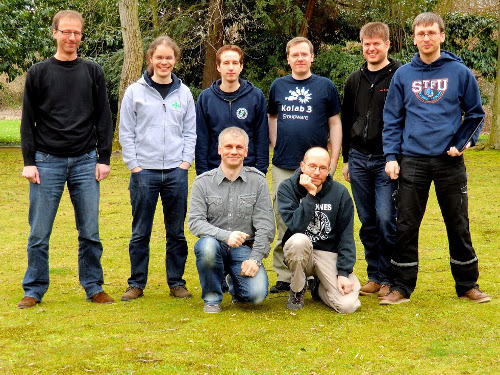
The sixth Debian Groupware Meeting was held in the LinuxHotel, Essen, Germany. We had one remote hacker from NYC which brings the number of attendants up to nine - an all time high! This is a short summary of what happened during the weekend: Groupphoto by Carsten Sch nert

Mart&iacute;n Ferrari: Setting up my server: netfilter

I was going to start this series with explaining how I did the remote set-up, but instead I will share something that happened today. One of the first things you want to do when putting a server directly connected to the Internet is some filtering. You don't want to have an application listening on the network by mistake, so a simple netfilter firewall is a good way to ensure you are only accepting connections on ports you explicitly allowed. I have been a long-time user of ferm, a simple tool that will read a configuration file written in a special structured syntax, and generates iptables commands from it. I have used it successfully to build very complex firewalls in previous jobs, and it had the huge benefit of keeping your firewall description readable and easy to modify by other people. This time I thought I may go with something simpler, as I only wanted a handful of very simple netfilter rules. I looked at Shorewall, and browsed a bit a few others. But in the end I decided against them: there was the need to learn the tools' concepts about different parts of the network, or there were more slanted towards command-line commands, so your actual configuration will be some files in /var/lib, totally managed by the tool. With ferm, I just need to write a very small configuration file, which reads almost like iptables commands, and that's it. In fact, the default configuration placed by the Debian package, already did 90% of what I wanted: accept incoming SSH connections, ICMP packets, and reject everything else. I took the example IPv6 configuration from /usr/share/doc/ferm/examples/ipv6.ferm and in 10 minutes it was ready:
table filter  
    chain INPUT  
        policy DROP;
        mod state state INVALID DROP;
        mod state state (ESTABLISHED RELATED) ACCEPT;
        interface lo ACCEPT;
        proto icmp ACCEPT; 
        # allow IPsec
        proto udp dport 500 ACCEPT;
        proto (esp ah) ACCEPT;
        proto tcp dport ssh ACCEPT;
        proto tcp dport (http https) ACCEPT;
     
    chain OUTPUT policy ACCEPT;
    chain FORWARD policy DROP;
 
domain ip6 table filter  
    chain INPUT  
        policy DROP;
        mod state state INVALID DROP;
        mod state state (ESTABLISHED RELATED) ACCEPT;
        interface lo ACCEPT;
        proto ipv6-icmp ACCEPT;
        proto tcp dport ssh ACCEPT;
        proto tcp dport (http https) ACCEPT;
     
    chain OUTPUT policy ACCEPT;
    chain FORWARD policy DROP;
 
It is important to note than when doing this kind of thing on a remote machine, you want to make sure you don't get locked out by accident. My method is that before activating any dangerous change, I drop an at job to disable the firewall in a few minutes:
# echo /etc/init.d/ferm stop   at now +10min
warning: commands will be executed using /bin/sh
job 4 at Mon Apr 29 02:47:00 2013
And if everything goes well, I just remove the job:
# atrm 4
Update: As paravoid pointed out in the comments, now (read: since many years ago, but I've never noticed) ferm has a --interactive mode which will revert the changes if you get locked out, much like the screen resolution changing dialog in Gnome.
Another thing that you definitely want to do, is to have some kind of protection against the almost constant influx of brute-force attacks against SSH. Apart from the obvious PermitRootLogin=no setting, there are a couple of popular methods to stop people probing random username/password combinations (I am assuming here that you actually have sensible passwords, or no passwords at all): running SSH in a non-standard port, and the great fail2ban daemon. Since I don't like non-standard stuff, I installed fail2ban, which by default it will inspect /var/log/auth.log for SSH login failures and insert netfilter rules to block the offenders. Problem is, I don't like much how fail2ban inserts rules and chains into my very tidy netfilter configuration which I had just created. So, I added an "action" to do things my way: only create a service-related chain and insert rules there, I will call that chain from my main ferm.conf. Ferm runs early in the boot sequence, so this won't be a problem during normal operation. The only caveat is that after changing a configuration in ferm, I need to restart fail2ban so it will recreate the netfilter chains and rules, which were wiped by ferm. This is my configuration, note that I am ignoring the port and protocol: the whole IP is blocked for a few minutes.
# cat /etc/fail2ban/jail.local 
[DEFAULT]
action = iptables-fixed[name=%(__name__)s]
# cat /etc/fail2ban/action.d/iptables-fixed.conf
[Definition]
actionstart = iptables -N fail2ban-<name>
              iptables -I fail2ban -j fail2ban-<name>
actionstop = iptables -D fail2ban -j fail2ban-<name>
             iptables -F fail2ban-<name>
             iptables -X fail2ban-<name>
actioncheck = iptables -n -L   grep -q fail2ban-<name>
actionban = iptables -I fail2ban-<name> 1 -s <ip> -j DROP
actionunban = iptables -D fail2ban-<name> -s <ip> -j DROP
[Init]
name = default

26 April 2013

Keith Packard: Shared Memory Fences

Shared Memory Fences In our last adventure, dri3k first steps, one of the future work items was to deal with synchronization between the direct rendering application and the X server. DRI2 handles this by performing a round trip each time the application starts using a buffer that was being used by the X server. As DRI3 manages buffer allocation within the application, there s really no reason to talk to the server, so this implicit serialization point just isn t available to us. As I mentioned last time, James Jones and Aaron Plattner added an explicit GPU serialization system to the Sync extension. These SyncFences serializing rendering between two X clients, but within the server there are hooks provided for the driver to use hardware-specific serialization primitives. The existing Linux DRM interfaces queue rendering to the GPU in the order requests are made to the kernel, so we don t need the ability to serialize within the GPU, we just need to serialize requests to the kernel. Simple CPU-based serialization gating access to the GPU will suffice here, at least for the current set of drivers. GPU access which is not mediated by the kernel will presumably require serialization that involves the GPU itself. We ll leave that for a future adventure though; the goal today is to build something that works with the current Linux DRM interfaces. SyncFence Semantics The semantics required by SyncFences is for multiple clients to block on a fence which a single client then triggers. All of the blocked clients start executing requests immediately after the trigger fires. There are four basic operations on SyncFences: SyncFences are the same as Events as provided by Python and other systems. Of course all of the names have been changed to keep things interesting. I ll call them Fences here, to be consistent with the current X usage. Using Pthread Primitives One fact about pthreads that I recently learned is that the synchronization primitives (mutexes, barriers and semaphores) are actually supposed to work across process boundaries, if those objects are in shared memory mapped by each process. That seemed like a great simplification for this project; allocate a page of shared memory, map into the X server and direct rendering application and use the existing pthreads APIs. Alas, the pthread objects are architecture specific. I m pretty sure that when that spec was written, no-one ever thought of running multiple architectures within the same memory space. I went and looked at the code to check, and found that each of these objects has a different size and structure on x86 and x86_64 architectures. That makes it pretty hard to use this API within X as we often have both 32- and 64- bit applications talking to the same (presumably 64-bit) X server. As a last resort, I read through a bunch of articles on using futexes directly within applications and decided that it was probably possible to implement what I needed in an architecture-independent fashion. Futexes Linux Futexes live in this strange limbo of being a not-quite-public kernel interface. Glibc uses them internally to implement locking primitives, but it doesn t export any direct interface to the system call. Certainly they re easy to use incorrectly, but it s unusual in the Linux space to have our fundamental tools locked away for our own safety . Fortunately, we can still get at futexes by creating our own syscall wrappers.
static inline long sys_futex(void *addr1, int op, int val1,
                 struct timespec *timeout, void *addr2, int val3)
 
    return syscall(SYS_futex, addr1, op, val1, timeout, addr2, val3);
 
For this little exercise, I created two simple wrappers, one to block on a futex:
static inline int futex_wait(int32_t *addr, int32_t value)  
    return sys_futex(addr, FUTEX_WAIT, value, NULL, NULL, 0);
 
and one to wake up all futex waiters:
static inline int futex_wake(int32_t *addr)  
    return sys_futex(addr, FUTEX_WAKE, MAXINT, NULL, NULL, 0);
 
Atomic Memory Operations I need atomic memory operations to keep separate cores from seeing different values of the fence value, GCC defines a few such primitives and I picked _syncboolcompareandswap and _syncvalcompareandswap. I also need fetch and store operations that the compiler won t shuffle around:
#define barrier() __asm__ __volatile__("": : :"memory")
static inline void atomic_store(int32_t *f, int32_t v)
 
    barrier();
    *f = v;
    barrier();
 
static inline int32_t atomic_fetch(int32_t *a)
 
    int32_t v;
    barrier();
    v = *a;
    barrier();
    return v;
 
If your machine doesn t make these two operations atomic, then you would redefine these as needed. Futex-based Fences These wake-all semantics of Fences greatly simplify reasoning about the operation as there s no need to ensure that only a single thread runs past Await, the only requirement is that no threads pass the Await operation until the fence is triggered. A Fence is defined by a single 32-bit integer which can take one of three values: With those, I built the fence operations as follows. Here s Await:
int fence_await(int32_t *f)
 
    while (__sync_val_compare_and_swap(f, 0, -1) != 1)  
        if (futex_wait(f, -1))  
            if (errno != EWOULDBLOCK)
                return -1;
         
     
    return 0;
 
The basic requirement that the thread not run until the fence is triggered is met by fetching the current value of the fence and comparing it with 1. Until it is signaled, that comparison will return false. The compareandswap operation makes sure the fence is -1 before the thread calls futex_wait, either it was already -1 in the case where there were other waiters, or it was 0 before and is now -1 in the case where there were no waiters before. This needs to be an atomic operation so that the fence value will be seen as -1 by the trigger operation if there are any threads in the syscall. The futex_wait call will return once the value is no longer -1, it also ensures that the thread won t block if the trigger occurs between the swap and the syscall. Here s the Trigger function:
int fence_trigger(int32_t *f)
 
    if (__sync_val_compare_and_swap(f, 0, 1) == -1)  
        atomic_store(f, 1);
        if (futex_wake(f) < 0)
            return -1;
     
    return 0;
 
The atomic compareandswap operation will make sure that no Await thread swaps the 0 for a -1 while the trigger is changing the value from 0 to 1; either the Await switches from 0 to -1 or the Trigger switches from 0 to 1. If the value before the compareandswap was -1, then there may be threads waiting on the Fence. An atomic store, constructed with two memory barriers and a regular store operation, to mark the Fence triggered is followed by the futex_wake call to unblock all Awaiting threads. The Query function is just an atomic fetch:
int fence_query(int32_t *f)
 
    return atomic_fetch(f) == 1;
 
Reset requires a compareandswap so that it doesn t disturb things if the fence has already been reset and there are threads waiting on it:
void fence_reset(int32_t *f)
 
    __sync_bool_compare_and_swap(f, 1, 0);
 
A Request for Review Ok, so we ve all tried to create synchronization primitives only to find that our obvious implementations were full of holes. I d love to hear from you if you ve identified any problems in the above code, or if you can figure out how to use the existing glibc primitives for this operation.

Russ Allbery: WebAuth 4.5.0

Time to finally release three months of work! This is a very large feature release for the multifactor support in WebAuth and for the integration with the user information service, which is the way that WebAuth interacts with local site policy. (Currently, you still have to write your own to a well-defined protocol, although we do hope to provide Perl modules to help with this in the future.) The major driving motivation for this release is to add the infrastructure required to set long-lived persistent cookies in a browser that contribute factors to authentications, which allows WebAuth to support "remember this device" functionality and to only require multifactor from devices from which a user has not previously authenticated. This includes a new token type, new attributes the user information service can send (including a way to invalidate such tokens), and new data that's sent back to the user information service. The user information service also now has the ability to add arbitrary additional factors to the current authentication, something that is intended to provide a hook for a local help desk to bypass multifactor for a user for some time if required. This release also contains substantial contributions by Benjamin Coddington at UVM to improve multifactor interactions, including sending the OTP type back to the user information service if WebLogin knows it, a mechanism for the user information service to communicate a message to the user that's displayed on the multifactor login page, opaque state that can be sent back and forth between WebLogin and the user information service, and the ability for the user information service to add specific authentication factors to the required set for a particular authentication. Other improvements in multifactor handling include the ability to set a lifetime on factors obtained via OTP login, a fix for a long-standing bug where an initial multifactor factor would satisfy a session requirement for random multifactor, and logging of even ignored errors when contacting the user information service. There are other changes too. This release touches almost every part of WebAuth. The change to WebAuthForceLogin in 4.4.0 was reverted since, on further consideration, the original semantics seemed more useful. Password change handling in WebLogin was fixed (it's been broken for some time). Apache 2.4 error logging for all modules is much improved, and mod_webauth and mod_webkdc now produce better error logs for all versions of Apache. And WebLogin now communicates password expiration times to its templates in seconds since epoch in addition to a pre-formatted English time for better localization support. William Orr contributed a new WebAuthLdapOperationalAttribute directive for mod_webauthldap that allows it to query operational attributes and include them in the environemnt. There are two backward-incompatible changes for WebLogin. First, WebAuth now supports a user checkbox indicating either to remember their login on that device or to not remember their login (local site templates can present it either way). However, proper implementation of this matching the normal expected wording of "remember me on this device" required changing the default, so a straight upgrade from an earlier version will result in no single sign-on. To preserve behavior, either a template change to add the checkbox (checked by default) or a configuration change are required. Second, support for getting password expiration times directly with remctl to a kadmin-remctl backend has been removed in favor of using data from the user information service by way of the WebKDC. Finally, I got to do a lot of cleanup of the API, fix diagosis of undef passed to Perl XS functions, and fixed a compilation error with Heimdal. You can get the latest release from the official WebAuth distribution site or from my WebAuth distribution pages.

Thorsten Glaser: mksh R45 released

The MirBSD Korn Shell R45 has been released today, and R44 has been named the new stable/bugfix-only series. (That s version 45.1, not 0.45, dear Homebrew/MacOSX packagers.) Packagers rejoice: the -DMKSH_GCC55009 dance is no longer needed, and even the run-time check for integer division is gone. Why? Because I realised one cannot use signed integers in C, at all, and rewrote the mksh(1) arithmetics code to use unsigned integers only. Special thanks to the people from musl libc and, to some lesser amount, Natureshadow for providing me with ideas what algorithms to replace some functionality with (signed shell arithmetic is, of course, still usable, it is just emulated using unsigned C integers now).

The following entertainment

	tg@blau:~ $ echo foo >/bar\ baz
	/bin/mksh: can't create /bar baz: Permission denied
	1 tg@blau:~ $ doch
	tg@blau:~ $ cat /bar\ baz
	foo
 

was provided by Tonnerre Lombard; like Swedish, German has got a number of words that cannot be expressed in English so I feel not up to the task of explaining this to people who don t know the German word doch , just rest assured it calls the last input line (be careful, this is literally a line, so don t use backslash-newline sequences) using sudo(8).

11 April 2013

Andrew Pollock: [life/repatexpat] Differences on how one purchases petrol

The differences between how one fuels one's car are quite pronounced, between California and Australia. Firstly, if you're paying with plastic, it's a given that you can pay at the pump. I could count on my hands the number of times I've had to walk into a gas station to pay for gas in the US. Having a small child, I was not looking forward to having to either leave her in the car so I could pay for my petrol, or having to deal with all of the rigmarole of getting her out of her car seat, just so she can accompany me inside the petrol station to make a brief transaction and then have to get her back into her car seat again. Not to mention how it drags out the whole process. Yesterday I had to wait for a pump while everyone leaves their car, queues inside to pay a single cashier, and then returns to their car and drives away. It'd be an interesting Productivity Commission report to see how much time is lost, just so people can be tempted by the high-margin items inside. Then there's pumping the petrol. California, being all hippy, requires all the fuel nozzles to have these fandangled "vapour recovery" things, which basically fit over the part of the pump that goes inside the fuel tank and does some sort of, well, vapour recovery. The upside, you're not sniffing fumes while you're pumping your petrol. The other fabulous thing about Californian fuel pumps is you can lock the handle down, so you don't have to stand there like a shag on a rock squeezing the handle while a $100 trickles into your car. You can get back in your car and listen to the radio. Or clean your windscreen. Or entertain your kid. I'd love to know why Australian pumps don't lock on any more. I have memories from my early childhood of them locking on. So yeah, I think Australians lose out quite badly when it comes to the petrol station experience. I was pleased to discover that the Woolworths branded Caltex petrol stations seem to have some sort of pay at the pump infrastructure, it just requires you to have their specific credit card or something. I need to do more research, because if I can pay at the pump, I will.

Russ Allbery: Review: Familiar

Review: Familiar, by J. Robert Lennon
Publisher: Greywolf
Copyright: 2012
ISBN: 1-55597-535-6
Format: Hardcover
Pages: 205
This is the first book of an experiment. I'm fairly well-read in science fiction and fantasy and increasingly well-read in non-fiction of interest (although there's always far more of that than I'll get to in a lifetime), but woefully unfamiliar with what's called "mainstream" literature. Under the principal that things people are excited about are probably exciting, I've wanted to read more and understand the appeal. Powell's, which I like to support anyway, has a very nice (albeit somewhat expensive) book club called Indiespensable, which sends its subscribers very nice editions of new works that Powell's thinks are interesting, with a special focus on independent publishers. So I signed up and hope to stick with it for at least a year. (The trick will be fitting these books in amongst my regular reading.) Familiar is the first feature selection I received. Elisa Brown is a mother with a dead son and a living one, a failing marriage, an affair, and a life that is, in short, falling apart. Then, while driving back from her annual pilgrimage from her son's grave, the world seems to twist and change. She finds herself dressed for business, wearing a nametag and apparently coming back from a work-related convention, driving a car that's entirely unfamiliar to her. When she gets home, everything else has changed too: her marriage seems to be on firmer ground, but based on rules she doesn't understand. She has a different job, different clothes, a different body in some subtle ways. And both of her sons are alive. I'm going to have to have a long argument with myself about where to (meaninglessly) categorize this on my review site, since in construction it is an alternate reality story and therefore a standard SF trope. Any SF reader is going to immediately assume Elisa has somehow been transported into an alternate reality with a key divergence point from her own. But that's not Lennon's focus. He stays ambiguous on the question of whether this is really happening or whether Elisa had some sort of nervous breakdown, and while some amount of investigation of the situation does take place, it's the sort of investigation that an average person with no access to special resources or scientific knowledge and a completely unbelievable story would be able to do: Internet conspiracy chatrooms and some rather dodgy characters. The focus is instead on Elisa's reaction to the situation, her choices about how to treat this new life, and on how she processes her complex emotions about her family and herself. I had profoundly mixed feelings about this book when I finished it, and revisiting it to review it, I still do. The writing is excellent: spare, evocative, and enjoyable to read. Lennon has a knack for subjective description of emotion and physical experience. The reader feels Elisa's deep discomfort with her changed body and her changed car, her swings between closed-off emotions and sudden emotional connection with a specific situation, and her struggle with the baffling question of how to come to terms with a whole new life. The part of the book from about the middle to nearly the end is excellent. Video games make an appearance and are handled surprisingly well. And when Elisa starts being blunt with people, I found myself both liking her and caring about what happens to her. On the other hand, Familiar also has some serious problems, and one of the biggest is the reaction I feared I'd have to mainstream literature: until Elisa started opening up and taking action, I found it extremely difficult to care about anyone in this book. They're all so profoundly petty, so closed off and engrossed in what seem like depressing and utterly boring lives. I'm sure that some of this is intentional and is there to lay the groundwork for Elisa's own self-discovery, but even towards the end of that self-discovery, everything here is so relentlessly middle-class suburbia that I felt stifled just reading about it. I think it's telling that no one in this book ever seems to have any substantial problem with money, or even with work. Elisa walks into a job that she's never done before and within a few weeks is doing it so well that she can take large amounts of time to wander around for plot purposes. This is a book about highly privileged people being miserable in a bubble. While those people certainly do exist, and I can believe that they act like this, I'm not sure how much I want to read about them. Thankfully, the plot does lead Elisa to poke some holes in that bubble, if never get out of it entirely. This is also another one of those stories in which every character has massive communication problems. Now, this deserves some caveats: Elisa's communication problems with her husband are part of the problem that starts the book and are clearly intentional, as are her communication difficulties with her children. And she's not really close enough to anyone to confide in them. But even with those caveats, no one in this book really talks to anyone else. It's amazing that anyone forms any connections at all, given how many walls and barriers they have around themselves. As someone with a bit of a thing for communication, this drove me nuts to read about, particularly in the first half of the book. But the worst problem is that Lennon completely blows the ending. And by that I don't just mean that I disliked the ending. I mean the ending is so unbelievable and so contrary to the entire rest of the book, at least the way I was reading and understanding it, that I think Familiar is a much better novel if you just remove the final scene entirely. It was such a bizarre and unnecessary twist that I found it infuriating. I don't want to spoil an ending, even a bad ending, so I'll only say this: it felt to me like Lennon just wasn't comfortable with his setting and plot driver and couldn't leave it alone. I think an experienced SF author wouldn't have made this mistake. There were two obvious possible conclusions to draw from the setting, plus a few interesting combinations, and I think someone comfortable with this sort of alternate reality story would have taken one of those options, any of which would have been a reasonable dismount for the plot. Alternately, they could have left it entirely ambiguous to the end and explored why the explanation may not actually matter. But Lennon seemed to me to have a tin ear for plausibility and for the normal flow of this sort of story and seems to have taken it as license for arbitrary events, thus completely violating the internal consistency and emergent rules that he'd spent the rest of the book building. I've mostly talked about my reactions to the characters and the writing and have not said much about the plot. That's somewhat intentional, since figuring out where the story will go is one of the best parts of this book. It's surprisingly tense and well-crafted for not having that much inherent dramatic tension. The excellent writing kept me reading through the first part, when I hated everyone in the story, and then Elisa started taking responsibility for her own life and actions and I started really enjoying the book while being constantly surprised. I think it's the sort of story that's best to take without too much foreknowledge of where it's going. I'm going to call this first experiment a qualfied success. Familiar was certainly interesting to read, and quite different from what I normally read despite the SF premise. If it weren't for the ending, I'd be recommending it to other people. Rating: 6 out of 10

8 April 2013

Matthias Klumpp: Tanglu status report

Hello everyone! I am very excited to report about the awesome progress we made with Tanglu, the new Debian-based Linux-Distribution. :) First of all, some off-topic info: I don t feel comfortable with posting too much Tanglu stuff to Planet-KDE, as this is often not KDE-related. So, in future Planet-KDE won t get Tanglu information, unless it is KDE-related ;-) You might want to take a look at Planet-Tanglu for (much) more information. So, what happened during the last weeks? Because I haven t had lectures, I nearly worked full-time on Tanglu, setting up most of the infrastructure we need. (this will change with the next week, where I have lectures again, and I also have work to do on other projects, not just Tanglu ^^) Also, we already have an awesome community of translators, designers and developers. Thanks to them, the Tanglu-Website is now translated to 6 languages, more are in the pipeline and will be merged later. Also, a new website based on the Django framework is in progress. The Logo-Contest We ve run a logo-contest, to find a new and official Tanglu logo, as the previous logo draft was too close to the Debian logo (I asked the trademark people at Debian). More than 30 valid votes (you had to be subscribed to a Tanglu Mailinglist) were received for 7 logo proposals, and we now have a final logo: Tanglu Logo (Text) I like it very much :) Fun with dak I decided to use dak, the Debian Archive Kit, to handle the Tanglu archive. Choosing dak over smaller and easy-to-use solutions had multiple reasons, the main reason is that dak is way more flexible than the smaller solution (like reprepro or min-dak) and able to handle the large archive of Tanglu. Also, dak is lightning fast. And I would have been involved with dak sooner or later anyway, because I will implement the DEP-11 extension to the Debian Archive later (making the archive application-friendly). duckWorking with dak is not exactly fun. The documentation is not that awesome, and dak contains many hardcoded stuff for Debian, e.g. it often expects the unstable suite to be present. Also, running dak on Debian Wheezy turned out to be a problem, as the Python module apt_pkg changed the API and dak naturally had problems with that. But with the great help of some Debian ftpmasters (many thanks to that!), dak is now working for Tanglu, managing the whole archive. There are still some quirks which need to be fixed, but the archive is in an usable state, accepting and integrating packages. The work on dak is also great for Debian: I resolved many issues with non-Debian dak installations, and made many parts of dak Wheezy-proof. Also, I added a few functions which might also be useful for Debian itself. All patches have of course been submitted to upstream-dak. ;-) Wanna-build and buildds GearThis is also nearly finished :) Wanna-build, the software which manages all buildds for an archive, is a bit complicated to use. I still have some issues with it, but it does it s job so far. (need to talk to the Debian wanna-build admins for help, e.g. wanna-build seems to be unable to handle arch:all-only packages, also, build logs are only submitted in parts) The status of Tanglu builds can be viewed at the provisoric Buildd-Status pages. Setting up a working buildd is also a tricky thing, it involves patching sbuild to escape bug #696841 and applying various workarounds to make the buildd work and upload packages correctly. I will write instructions how to set-up and maintain a buildd soon. At time, we have only one i386 buildd up and running, but more servers (in numbers: 3) are prepared and need to be turned into buildds. After working on Wanna-build and dak, I fully understand why Canonical developed Launchpad and it s Soyuz module for Ubuntu. But I think we might be able to achieve something similar, using just the tools Debian already uses (maybe a little less confortable than LP, but setting up an own LP instance would have been much more trouble). Debian archive import The import of packages from the Debian archive has finished. Importing the archive resulted in many issues and some odd findings (I didn t know that there are packages in the archive which didn t receive an upload since 2004!), but it has finally finished, and the archive is in a consistent state at time. To have a continuous package import from Debian while a distribution is in development, we need some changes to wanna-build, which will hopefully be possible. Online package search The Online-Package-Search is (after resolving many issues, who expected that? :P ) up and running. You can search for any package there. Some issues are remaining, e.g. the file-contents-listing doesn t work, and changelog support is broken, but the basic functionality is there. Tanglu Bugtracker We now also have a bugtracker which is based on the Trac software. The Tanglu-Bugtracker is automatically synced with the Tanglu archive, meaning that you find all packages in Trac to report bugs against them. The dak will automatically update new packages every day. Trac still needs a few confort-adjustments, e.g. submitting replies via email or tracking package versions. Tanglu base system tanglu-platform-smallThe Tanglu metapackages have been published in a first alpha version. We will support GNOME-3 and KDE4, as long as this is possible (= enough people working on the packaging). The Tanglu packages will also depend on systemd, which we will need in GNOME anyway, and which also allows some great new features in KDE. Side-effect of using systemd is at least for the start that Tanglu boots a bit slow, because we haven t done any systemd adjustments, and because systemd is very old. We will have to wait for the systemd and udev maintainers to merge the packages and release a new version first, before this will improve. (I don t want to do this downstream in Tanglu, because I don t know the plans for that at Debian (I only know the information Tollef Fog Heen & Co. provided at FOSDEM)) The community The community really surprised me! We got an incredible amount of great feedback on Tanglu, and most of the people liked the idea of Tanglu. I think we are one of the less-flamed new distributions ever started ;-) . Also, without the very active community, kickstarting Tanglu would not have been possible. My guess was that we might be able to have something running next year. Now, with the community help, I see a chance for a release in October :) The only thing people complained about was the name of the distribution. And to be really honest, I am not too happy with the name. But finding a name was an incredibe difficult process (finding something all parties liked), and Tanglu was a good compromise. Tanglu has absolutely no meaning, it was taken because it sounded interesting. The name was created by combining the Brazilian Tangerine (Clementine) and the German Iglu (igloo). I also dont think the name matters that much, and I am more interested in the system itself than the name of it. Also, companies produce a lot of incredibly weird names, Tanglu is relatively harmless compared to that ;-) . In general, thanks to everyone participating in Tanglu! You are driving the project forward! The first (planned) release I hereby announce the name of the first Tanglu release, 1.1 Aequorea Victoria . It is Daniel s fault that Tanglu releases will be named after jellyfishes, you can ask him why if you want ;-) I picked Aequorea, because this kind of jellyfish was particularly important for research in molecular biology. The GFP protein, a green fluorescent protein (=GFP), caused a small revolution in science and resulted in a Nobel Prize in 2008 for the researchers involved in GFP research (for the interested people: You can tag proteins with GFP and determine their position using light microscopy. GFP also made many other fancy new lab methods possible). Because Tanglu itself is more or less experimental at time, I found the connection to research just right for the very first release. We don t have a time yet when this version will be officially released, but I expect it to be in October, if the development speed increases a little and more developers get interested and work on it. Project Policy We will need to formalize the Tanglu project policy soon, both the technical and the social policies. In general, regarding free software and technical aspects, we strictly adhere to the Dbian Free Software Guidelines, the Debian Social Contract and the Debian Policy. Some extra stuff will be written later, please be patient! Tanglu OIN membership I was approached by the Open Invention Network, to join it as member. In general, I don t have objections to do that, because it will benefit Tanglu. However, the OIN has a very tolerant public stance on software patents, which I don t like that much. Debian did not join the OIN for this reason. For Tanglu, I think we could still join the OIN without someone thinking that we support the stance on software patents. Joining would simply be pragmatic: We support the OIN as a way to protect the Linux ecosystem from software patents, even if we don t like the stance on software patents and see it differently. Because this affects the whole Tanglu project, I don t want to decide this alone, but get some feedback from the Tanglu community before making a decision. Can I install Tanglu now? Yes and no. We don t provide installation images yet, so trying Tanglu is a difficult task (you need to install Debian and then upgrade it to Tanglu) if you want to experiment with it, I recomment trying Tanglu in a VM. I want to help! Great, then please catch one of us on IRC or subscribe to the mailinglists. The best thing is not to ask for work, but suggest something you want to do, others will then tell you if that is possible and maybe help with the task. Packages can for now only be uploaded by Debian Developers, Ubuntu Developers or Debian Maintainers who contacted me directly and whose keys have been verified. This will be changed later, but at the current state of the Tanglu archive (= less safety checks for packages), I only want people to upload stuff who definitely have the knowledge to create sane packages (you can also proove that otherwise, of course). We will later establish a new-member process. If you want to provide a Tanglu archive mirror, we would be very happy, so that the main server doesn t have to carry all the load. If you have experience in creating Linux Live-CDs or have worked with the Ubiquity installer, helping with these parts would be awesome! Unfortunately, we cannot reuse parts of Linux Mint Debian, because many of their packages don t build from source and are repackaged binaries, which is a no-go for the Tanglu main archive. Sneak peek And here is a screenshot of the very first Tanglu installation (currently more Debian than Tanglu):



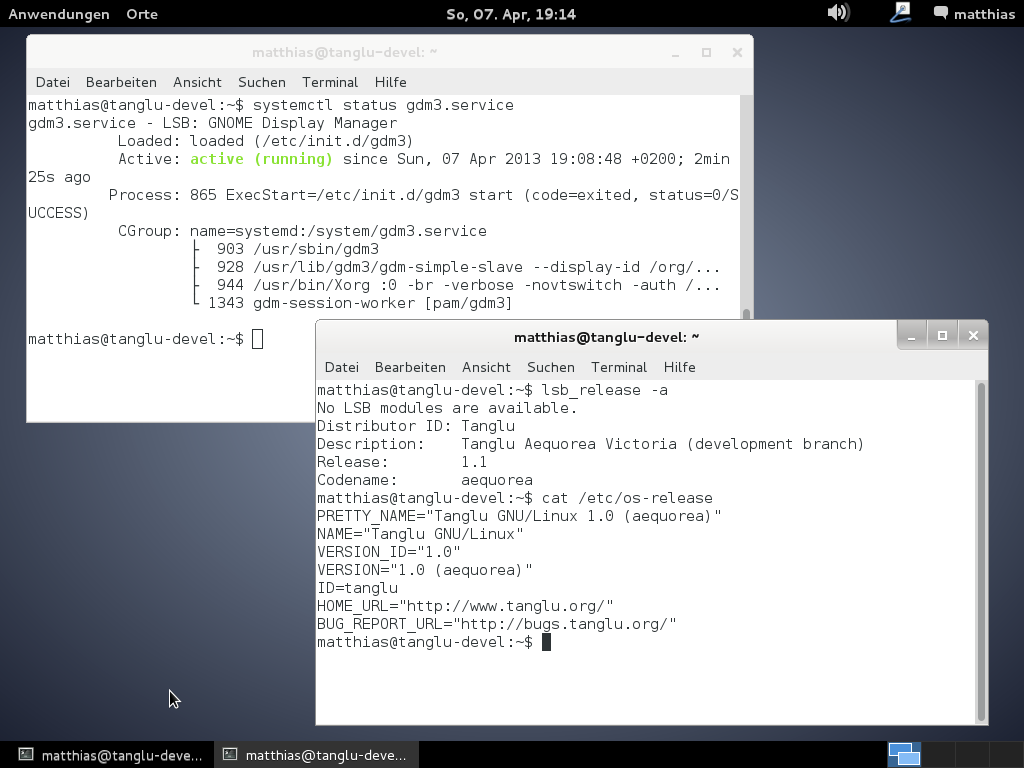
tanglu_sneak-peek_screenshot Something else I am involved in Debian for a very long time now, first as Debian Maintainer and then as Debian Developer and I never thought much about the work the Debian system administrators do. I didn t know how dak worked or how Wanna-build handles the buildds and what exactly the ftpmasters have to do. By not knowing, I mean I knew the very basic theory and what these people do. But this is something different than experiencing how much work setting up and maintaining the infrastructure is and what an awesome job the people do for Debian, keeping it all up and running and secure! Kudos for that, to all people maintaining Debian infrastructure! You rock! (And I will never ever complain about slow buildds or packages which stay in NEW for too long ;-) )

4 April 2013

Andrew Pollock: [life/repatexpat] Day #4 of repatriation -- delivery central

Today was spent at my apartment with Zoe. Harvey Norman were scheduled to deliver the fridge, washing machine and TV. Someone from Telstra was scheduled to come out and monkey with the MDF to get the naked ADSL happening, and my desk was scheduled to be delivered. My parents drove us over in the morning, with some of our suitcases. Zoe was very happy with her new room and bed. I was going to get a 1 hour advance warning of Harvey Norman coming, so we all went for a little walk around the neighbourhood to explore. It turns out there's a convenience store right next door, which is, well extremely convenient. I won't need to even hop in the car to get last minute bread or milk or anything like that. Very happy about that. There's also a really gorgeous little boutique deli/gourmet grocery that is easily within walking distance. The neighbourhood is indeed very nice. Mid-morning, Brent dropped around with his daughter to say hi. Zoe had a good time playing with her as well, and we went out for lunch at the Hawthorne Garage. At the end of lunch, Harvey Norman called to say they'd be an hour away, which was well timed. Zoe declined to nap again, so we just hung out waiting for the delivery. In the middle of them delivering, the desk delivery happened as well, and then as Brent was leaving, the Telstra guy turned up, so it all happened at once. I set up the TV and DVD player and Zoe happily christened it all by watching some Play School DVDs, and then my Dad came back and picked us up. So the apartment is now almost habitable. I just need my bed. That's scheduled for Saturday. I'm planning on sleeping there on Saturday night. In the furniture department, I'm still lacking a sofa, a dining table and something to put the TV on. Leah has volunteered to help me shop tomorrow, but I'm starting to think I should focus on resolving the lack of a car, then I can do any further shopping myself. Nick had set me up with a car wholesaler who was going to search for a used Subaru Forester for me, but so far he hasn't turned anything up, so I'm thinking I need to widen my net a little and use some other avenues as well. I'd really wanted for the car finding to be outsourced as much as possible so I could focus on other things, but it's not looking like that's going to be the case, and I really need mobility. I got a notification from Internode after I'd left today that the Internet should now be working, so I need to configure the ADSL router when I next get a chance and confirm that's the case, then I'm all sorted for being technologically able to work from home.

3 April 2013

Julien Danjou: Hy, Lisp in Python

I've meant to look at Hy since Paul Tagliamonte started to talk to me about it, but never took a chance until now. Yesterday, Paul indicated it was a good time for me to start looking at it, so I spent a few hours playing. But what's Hy? Python is very nice: it has a great community and a wide range of useful libraries. But let's face it, it misses a great language. Hy is an implementation of a Lisp on top of Python. Technically, Hy is built directly with a custom made parser (for now) which then translates expressions using the Python AST module to generate code, which is then run by Python. Therefore, it shares the same properties as Python, and is a Lisp-1 (i.e. with a single namespace for symbols and functions). If you're interested to listen Paul talking about Hy during last PyCon US, I recommend watching his lightning talk. As the name implies, it's only a few minutes long. <iframe allowfullscreen="allowfullscreen" class="shadow" frameborder="0" height="374" src="http://www.youtube.com/embed/1vui-LupKJI?wmode=transparent&amp;autohide=1&amp;egm=0&amp;hd=1&amp;iv_load_policy=3&amp;modestbranding=1&amp;rel=0&amp;showinfo=0&amp;showsearch=0#t=16m14s" width="500"></iframe> Does it work? I've been cloning the code and played around a bit with Hy. And to my greatest surprise and pleasure, it works quite well. You can imagine writing Python from there easily. Part of the syntax smells like Clojure's, which looks like a good thing since they're playing in the same area. You can try a Hy REPL in your Web browser if you want. Here's what some code look like:
(import requests)

(setv req (requests.get "http://hy.pault.ag"))
(if (= req.status_code 200)
(for (kv (.iteritems req.headers))
(print kv))
(throw (Exception "Wrong status code")))

This code would ouput:
('date', 'Wed, 03 Apr 2013 12:09:23 GMT')
('connection', 'keep-alive')
('content-encoding', 'gzip')
('transfer-encoding', 'chunked')
('content-type', 'text/html; charset=utf-8')
('server', 'nginx/1.2.6')
As you can see, it's really simple to write Lispy code that really uses Python idioms. There's obviously still a lots of missing features in Hy. The language if far from complete and many parts are moving, but it's really promising, and Paul's doing a great job implementing every idea. I actually started to hack a bit on Hy, and will try to continue to do so, since I'm really eager to learn a bit more about both Lisp and Python internals in the process. I've already send a few patches on small bugs I've encountered, and proposed a few ideas. It's really exciting to be able to influence early a language design that I'll love to use! Being a recent fan of Common Lisp, I tend to grab the good stuff from it to add them into Hy.

2 April 2013

Jon Dowland: GSettings

With GNOME 3, if you want to override a setting with a new site default, assuming your app has been updated to use the new gsettings API and doesn't still use the old gconf one, the best guide on what to do is still Ross Burton's blog post from two years ago, although you can find most of what you need to know buried deep in the GSettings C API specification, which is not the first place I would have looked (lesson learned!) Note: In this context I'm in the role of systems administrator, rather than distributor/vendor or software author. Whereas you are generally advised to use gsettings itself and not poke at the backend (dconf for Linux), the documentation seems to point sysadmins towards dconf hackery rather than gsettings. However gsettings worked for me, and I got nowhere with dconf direct. Some caveats worth knowing about: Today I had to create 40 guest accounts on our 70-seat Linux cluster, including randomly generate passwords, set up persistent storage on our NFS server, etc.; quickly. As a nice-to-have I also wanted to add some application icons to the GNOME 3 "Favourite Apps" menu for the guests. Would you like to guess which of those jobs was the easier of the two?

Jonathan McDowell: Building a new house server

I've moved (only a couple of blocks from where I was before), and as the new place has Webpass I've reluctantly given up my Sonic.net connection, along with its static IPv4 address and ISP IPv6 tunnel. Hard to resist a 200Mb/s ethernet connection for the same price I was paying for 18Mb/s ADSL2 though. However that leaves my DGN3500 router somewhat inappropriate for providing my net connection. Freed from the need for an ADSL/cable router I decided it was time to build an all in one house server (I'm a believer in as few always on boxes as possible). I already had a nettop acting as a media box, but wanted to build something that would handle: Probably in that order if it turns out I'm asking too much. The intention is the box is the only one that always needs to be on, so I wanted it to be low power consumption. I also wanted the option of hooking it up to the TV if it turned out to have enough grunt, so the case needed to be something suitable for the living room. I like Intel's approach to graphics drivers, in particular the existence of Free video acceleration support, so I went with an Intel Core i3-3220T as the processor. It's a 35W Ivybridge processor with HD 2500 graphics, plus I got it for a decent price. For the case I chose a CFI A2059. There's a local supplier I was able to pick it up from, it has a couple of large fans which helps keeps the noise down while keeping things cool and as I was aiming for backup / file sharing being more important than a media box the 2 hot swap bays tipped the balance away from an AV style case. The small case limits the motherboard options. I wanted twin GigE ports so the external was entirely separate from the internal (my switch does VLANs so I could have made do with a single port, but with a 200Mb/s connection I didn't really want to share the port). The Gigabyte GA-H77N-WIFI seemed to fit the bill, with the added advantage of a built in WiFi card (an Intel 2230 in a mini PCI-E slot) which leaves the PCI-E slot free for either a TV tuner or a second WiFi card to cover 5GHz. I maxed out the board with 2 8G G.SKILL DDR3-1600 DIMMs. I normally go Crucial because I've found them reliable, but these were slightly cheaper and available from the same place as the motherboard. Finally I added a Seagate ST4000DM000 for storage. It actually came from a Backup Plus that Costco were selling for about $20 less than the bare drive sells for. The plan is to add at least another 1T drive to RAID1 the most important bits (or possibly a 2T - it depends which of my existing drives I can tidy stuff off most easily). Of course it's running Debian and I took the opportunity to try out the RC1 Wheezy image. For extra giggles I did an EFI install; this all worked fine except I didn't end up with grub-efi installed at the end, instead I had grub-pc. I booted with legacy BIOS enabled and followed Tanguy's switch to UEFI boot instructions. Further notes on software setup to follow...

Next.

Previous.