Search Results: "sf"

11 December 2015

Antonio Terceiro: Bits from the Debian Continuous Integration project

It s been almost 2 years since the Debian Continuous Integration project has been launched, and it has proven to be a useful resource for the development of Debian. I have previously made a an introductory post, and this this is an update on the latest developments. Infrastructure upgrade Back in early 2014 when Debian CI was launched, there were less than 200 source packages with declared test suite metadata, and using a single worker machine polling the archive for updates and running tests sequentially in an infinite loop ( the simplest thing that could possibly work ) was OK-ish. Then our community started an incredible, slow and persistent effort to prepare source packages for automated testing, and we now have almost 5,000 of them. The original, over-simplistic design had to be replaced. The effort of transforming debci in a distributed system was started by Martin Pitt, who did an huge amount of work. In the latest months I was able to complete that work, to a point where I am confident in letting it run (mostly) unatended. We also had lots of contributions to the web UI from Brandon Fairchild, who was a GSOC intern in 2014, and continues to contribute to this date. All this work culminated in the migration from a single-worker model to a master/workers setup, currently with 10 worker nodes. On busy periods all of those worker nodes will go on for days with full utilization, but even then the turnaround between package upload and a test run is now a lot faster than it used to. Debian members can inspect the resource usage on those systems, as well as the length of the processing queue, by browsing to the corresponding munin instance (requires authentication via a SSL client certificated issued by sso.debian.org). The system is currenly being hosted on a Amazon EC2 account sponsored by Amazon. The setup is fully automated and reproducible. It is not fully (or at all) documented yet, but those interested should feel free to get in touch on IRC (OFTC, #debci) Testing backend changed from schroot to lxc Together with the infrastructure updates, we also switched to using lxc instead of schroot as backend. Most test suites should not be affected by this, but the default lxc settings might cause some very specific issues in a few packages. See for example #806542 ( liblinux-prctl-perl: autopkgtest failures: seccomp, capbset ) Adding support for KVM is also in the plans, and we will get to that at some point. Learn more If you want to learn more on how you can add tests for your package, a good first start is the debci online documentation (which is also available locally if you install debci ). You might also be interested in watching the live tutorial (WebM, 469 MB!) that has been presented at Debconf 15 earlier this year, full of tips and real examples from the archive. It would be awesome if someone wanted to transcribe that into a text tutorial ;-) How to get involved There are a few ways you can contribute: autodep8. if you are knowledgeable on a subset of packages that are very similar and can have their tests executed in a similar way, such as $Language libraries , you might consider writing a test metadata generator so that each package does not need to declare a debian/tests/control file explicitly, requiring only The Testsuite: header in debian/control. Ruby and Perl are already covered, and there is initial support for NodeJS. Adding support for new types of packages is very easy. See the source repository. If you manage to add support for your favorite language, please get in touch so we can discuss whitelisting the relavant packages in ci.debian.net so that they will get their tests executed even before being uploaded with the proper Testsuite: control field. autopkgtest. autopkgtest is responsible for actually running your tests, and you can use it to reproduce test runs locally. debci. debci is the system running in ci.debian.net (version 1.0, currently in testing, is exactly what is running up there, minus a version number and a changelog entry). It can also be used to have private clones of ci.debian.net, e.g. for derivatives or internal Debian-related development. See for example the Ubuntu autopkgtest site. Getting in touch For maintainer queries and general discussion: For the development of debci/autopkgtest/autodep8

Lunar: Reproducible builds: week 32 in Stretch cycle

The first reproducible world summit was held in Athens, Greece, from December 1st-3rd with the support of the Linux Foundation, the Open Tech Fund, and Google. Faidon Liambotis has been an amazing help to sort out all local details. People at ImpactHub Athens have been perfect hosts. North of Athens from the Acropolis with ImpactHub in the center Nearly 40 participants from 14 different free software project had very busy days sharing knowledge, building understanding, and producing actual patches. Anyone interested in cross project discussions should join the rb-general mailing-list. What follows focuses mostly on what happened for Debian this previous week. A more detailed report about the summit will follow soon. You can also read the ones from Joachim Breitner from Debian, Clemens Lang from MacPorts, Georg Koppen from Tor, Dhiru Kholia from Fedora, and Ludovic Court s wrote one for Guix and for the GNU project. The Acropolis from  Infrastructure Several discussions at the meeting helped refine a shared understanding of what kind of information should be recorded on a build, and how they could be used. Daniel Kahn Gillmor sent a detailed update on how .buildinfo files should become part of the Debian archive. Some key changes compared to what we had in mind at DebConf15: Hopefully, ftpmasters will be able to comment on the updated proposal soon. Packages fixed The following packages have become reproducible due to changes in their build dependencies: fades, triplane, caml-crush, globus-authz. The following packages became reproducible after getting fixed: Some uploads fixed some reproducibility issues, but not all of them: Patches submitted which have not made their way to the archive yet: akira sent proposals on how to make bash reproducible. Alexander Couzens submitted a patch upstream to add support for SOURCE_DATE_EPOCH in grub image generator (#787795). reproducible.debian.net An issue with some armhf build nodes was tracked down to a bad interaction between uname26 personality and new glibc (Vagrant Cascadian). A Debian package was created for koji, the RPM building and tracking system used by Fedora amongst others. It is currently waiting for review in the NEW queue. (Ximin Luo, Marek Marczykowski-G recki) diffoscope development diffoscope now has a dedicated mailing list to better accommodate its growing user and developer base. Going through diffoscope's guts together enabled several new contributors. Baptiste Daroussin, Ed Maste, Clemens Lang, Mike McQuaid, Joachim Breitner all contributed their first patches to improve portability or add new features. Regular contributors Chris Lamb, Reiner Herrmann, and Levente Polyak also submitted improvements. diffoscope hacking session in Athens The next release should support more operating systems, filesystem image comparison via libguestfs, HTML reports with on-demand loading, and parallel processing for the most noticeable improvements. Package reviews 27 reviews have been removed, 17 added and 14 updated in the previous week. Chris Lamb and Val Lorentz filed 4 new FTBFS reports. Misc. Baptiste Daroussin has started to implement support for SOURCE_DATE_EPOCH in FreeBSD in libpkg and the ports tree. Thanks Joachim Breitner and h01ger for the pictures.

9 December 2015

Daniel Pocock: Is WebRTC one of your goals for 2016?

WebRTC continues to gather momentum around the world. Over the next week, Paris will host a TADHack event on WebRTC (12-13 December) followed by Europe's most well known meeting of the WebRTC community, the annual WebRTC Conference and Expo, 16-18 December. 2015 has been a busy year for WebRTC developers, in the browser, on the server-side and even in documentation, with the online publication of The RTC Quick Start Guide. These efforts have all come together to create a stable foundation for many implementations in 2016. Demo The JSCommunicator demo video shows just how convenient WebRTC can be, looking at the first customer-facing WebRTC deployment on Wall Street, a project I put together back in 2014: This solution was implemented entirely with free, open source software integrated with a traditional corporate PBX. The project involved significant innovation to bring together a new technology like WebRTC with a very established corporate telephony infrastructure. For example, the solution makes use of the reSIProcate Python scripting to add the Avaya UUI headers to the SIP signaling, so it can integrate seamlessly with all existing Avaya customizations and desktop CRM software. Is this something you can imagine on your organization's web site or as part of your web-based product or service? DruCall module for Drupal - WebRTC without coding If you run a Drupal CMS or if you would like to, the DruCall module provides a very quick way to get started with WebRTC. On a Debian or Ubuntu server, you can automatically deploy the entire Drupal stack, Apache, MySQL and all module dependencies with $ sudo apt-get install -t jessie-backports drupal7-mod-drucall JSCommunicator, the generic SIP phone for web pages If you don't want to do any JavaScript development, JSCommunicator may be the way to go. JSCommunicator is a completely generic solution that can be completely re-branded just by tweaking the HTML and CSS. All phone features can be enabled and disabled using the configuration file. WebRTC plugins for CRM solutions As part of Google Summer of Code 2014, Juliana Louback created a WebRTC plugin for the xTuple enterprise CRM and ERP suite. The source code of the DruCall and xTuple plugins provide an excellent point of reference for developing similar plugins for other web applications. Both of them are based on JSCommunicator which is designed to embed easily into any existing HTML page or templating system. Get involved To find out more and discuss RTC using free software and open standards, please join us on the Free-RTC mailing list.

Vincent Fourmond: Announcing QSoas, a powerful y=f(x) data analysis software

Why a new data analysis software ?I'm a researcher at the interface between physics, chemistry and biology, and in our team, we pride ourselves on making the most of the data we acquire, especially through quantitative analysis and modelling. In fact, we spend a lot of time doing fitting simple formulas or complex differential equations to our data. As we were not really satisfied with the data fitting capacities of the software available, we've had our custom data processing/fitting tool, SOAS, for ages. However, that tool was hard to maintain (Fortran + Fortran libraries interfacing with X11 with ABI changing every once in a while without notice), impossible to port to non-X11 platforms, not very user-friendly, and not easy to extend at all. So, when I got my permanent position, a rewrote a completely new version from scratch, called QSoas using C++, Qt, Ruby and the GNU Scientific Library. The result is incomparably more powerful, more easy to maintain, more user-friendly, and more portable (I build it for Linux, Mac and Windows).
What does it do ?The main features of QSoas are:
What has it done already ?We've relied heavily on QSoas's functionalities for the past 3-4 years, and a great part of the team's publications just wouldn't be there without QSoas. More precisely on selected examples:
I hope it will also help you get more than you previously could from your data (and faster, too !).
I want it, where can I get it ?You can download QSoas version 1.0 on its website. The source code is fully available under the GNU General Public License. For those not too compilation-savvy, we sell pre-built binaries for windows and mac, in collaboration with Satt Sud-Est and eValorix. Compilation under Linux is very simple, but I'm willing to come up with a Debian package, should some of you want that. You should definitely have a look at the tutorial and the command reference.

8 December 2015

Vincent Sanders: I said it was wired like a Christmas tree

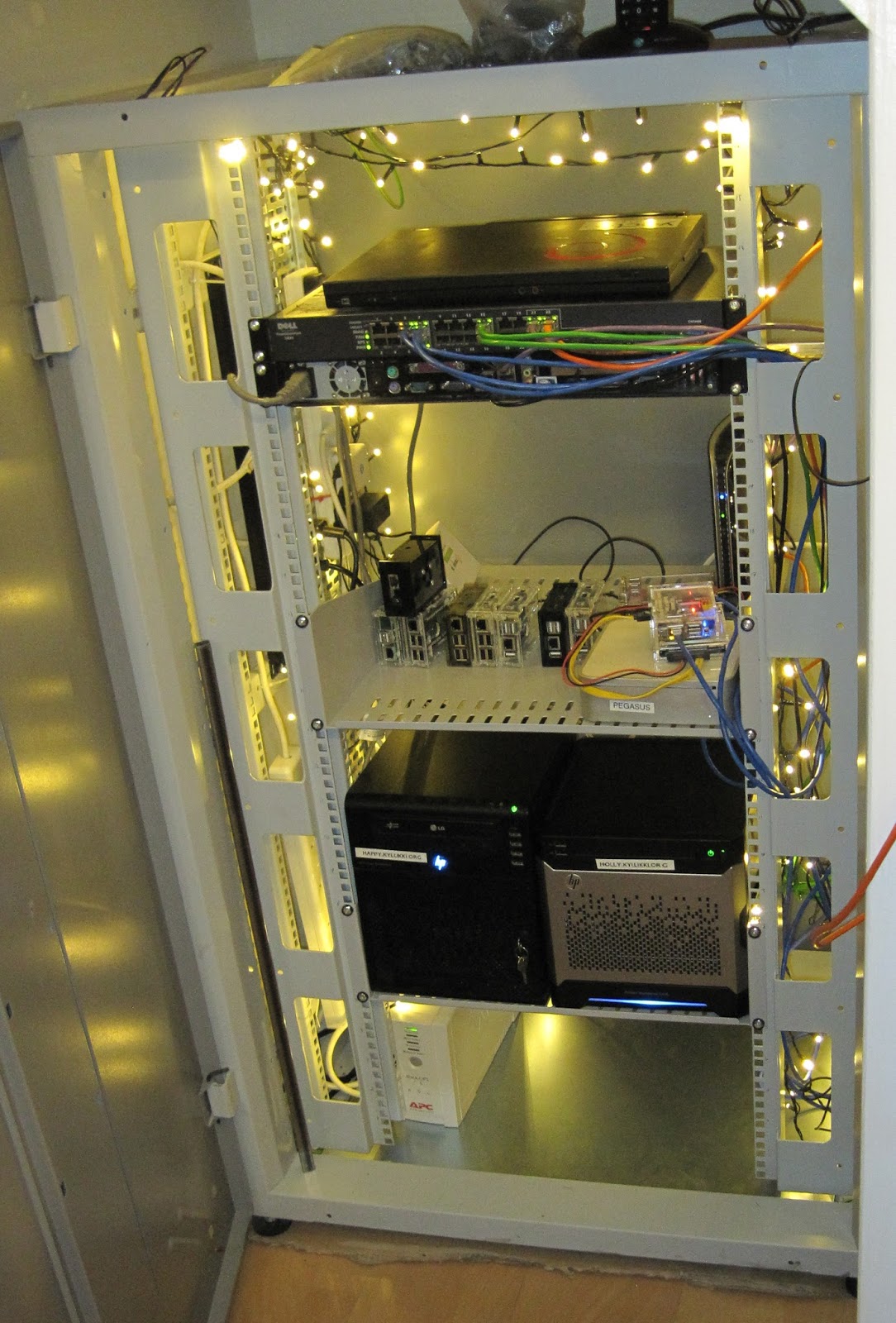
I have recently acquired a 27U high 19 inch rack in which I hope to consolidate all the computing systems in my home that do not interact well with humans.

My main issue is that modern systems are just plain noisy, often with multiple small fans whining away. I have worked to reduce this noise by using quieter components as replacements but in the end it is simply better to be able to put these systems in a box out of the way.

The rack was generously given to me by Andy Simpkins and aside from being a little dirty having been stored for some time was in excellent condition. While the proverbs "never look a gift horse in the mouth" and "beggars cannot be choosers" are very firmly at the front of my mind there were a few minor obstacles to overcome to make it fit in its new role with a very small budget.

The new home for the rack was to be a space under the stairs where, after careful measurement, I determined it would just fit. After an hour or two attempting to manoeuvre a very heavy chunk of steel into place I determined it was simply not possible while it was assembled. So I ended up disassembling and rebuilding the whole rack in a confined space.

The rack is 800mm wide IMRAK 1400 rather than the more common 600mm width which means it employs "cable reducing channels" to allow the mounting of standard width rack units. Most racks these days come with four posts in the corners to allow for longer kit to be supported front and back. This particular rack was not fitted with the rear posts and a brief call to the supplier indicated that any spares from them would be eyewateringly expensive (almost twice the cost of purchasing a new rack from a different supplier) so I had to get creative.

Shelves that did not require the rear rails were relatively straightforward and I bought two 500mm deep cantilever type from Orion (I have no affiliation with them beyond being a satisfied customer).

I took a trip to the local hardware store and purchased some angle brackets and 16mm steel square tube. From this I made support rails which means the racked kit has support to its rear rather than relying solely on being supported by its rack ears.

The next problem was the huge hole in the bottom of the rack where I was hoping to put the UPS and power switching. This hole is intended for use with raised flooring where cables enter from below, when not required it is filled in with a "bottom gland plate". Once again the correct spares for the unit were not within my budget.

Around a year ago I built several systems for open source projects from parts generously donated by Mythic Beasts (yes I did recycle servers used to build a fort). I still had some leftover casework from one of those servers so ten minutes with an angle grinder and a drill and I made myself a suitable plate.

The final problem I faced is that it is pretty dark under the stairs and while putting kit in the rack I could not see what I was doing. After some brief Googling I decided that all real rack lighting solutions were pretty expensive and not terribly effective.

At this point I was interrupted by my youngest son trying to assemble the Christmas tree and the traditional "none of the lights work" so we went off to the local supermarket to buy some bulbs. Instead we bought a 240 LED string for 10 (15usd) in the vague hope that next year they will not be broken.

I immediately had a light bulb moment and thought how a large number of efficient LED bulbs at a low price would be ideal for lighting a rack. So my rack is indeed both wired like and as a Christmas tree!

Now I just have to finish putting all the systems in there and I will be able to call the project a success.

7 December 2015

Jonathan Dowland: Download codes are distinct copies of albums

In CDs should come with download codes, I argued that CDs should come with a coupon to obtain a digital copy of the album, much like a lot of modern vinyl releases do. What didn't occur to me at the time is that there's a difference in how we think about copies of albums that we obtain that way, versus ripping a CD. When we rip a CD, we are making a personal copy of the media. We've bought a physical "token" that represents our "ownership" of the music, and we've made a copy of that privately for our own convenience. If we decide to get rid of the CD, then morally we really should get rid of the digital copy, too, as we've transferred our "ownership" to someone else. Of course we don't really own the music on the CD in the first place and in the UK it's technically not legal to make a copy, even a private copy for personal use, but that's another story. With a download code, the situation is quite different. If you buy a record with a download code, you have (at least) two copies of the album. You don't make a second copy yourself, it has already been made. And if you decide to pass on the physical album, I don't think there is any moral expectation that you should delete your digital copy.

6 December 2015

Jose M. Calhariz: Taking over the development of at daemon.

I decided some time ago to take over the development of at daemon. Here is a new release of at v3.1.17 From the Changelog:
at 3.1.17 (2015-08-31):
  Jose M Calhariz:
        at.1.in: Document behaviour when using past time, thanks Kelly Price (Closes: #639900).
        Makefile.in: On distclean remove at.allow.5, auto generated file.

3 December 2015

Bits from Debian: Software Freedom Conservancy needs your support!

Software Freedom Conservancy Logo "Software Freedom Conservancy helps promote, improve, develop, and defend Free, Libre, and Open Source Software (FLOSS) projects. Conservancy provides a non-profit home and infrastructure for FLOSS projects.", that is how Software Freedom Conservancy defines itself. Organizations like Conservancy allow free software developers to focus on what they do the best by doing copyleft enforcement, taking care of legal aspects and provide many services to its project members. Last August, Debian and Conservancy announced a partnership and formed the Copyright Aggregation Project where, among other things, Conservancy will be able to hold copyrights for some Debian works and ensure compliance with copyleft so that those works remain in free software. Recently, Conservancy launched a major fundraising campaign and needs more individual supporters to gain more sustainable and independent funding. This will allow the Conservancy to continue its efforts towards convincing more companies to comply with free software licenses such as the GPL and take legal actions when dialogue turns out to be unsuccessful. Conservancy needs your support now, more than ever! Many Debian Developers and Contributors have already become Conservancy supporters. Please consider signing up as a supporter on https://sfconservancy.org/supporter/!

Arturo Borrero Gonz lez: current status of HA stack on Debian


Let's analyse the current status of the HA (high availability) stack on Debian.

For me, the two most important packages are corosync and pacemaker.
It is widely known that Debian jessie was released without these two packages in shape.

But, why?
Problem 1One of the main problems was with the relationship between pacemaker and libqb.
In short, a libqb issue prevented pacemaker to be built for Debian jessie. And that wasn't fixed in time for the Debian jessie stable release.
You can read the Debian bug #768618 [pacemaker: FTBFS in jessie: build-dependency not installable: libqb-dev (>= 0.16.0.real)] to know a bit more about the issue.
Problem 2
While at it, the corosync package was in very bad shape.
To get an idea of what I mean for bad shape, just look at the size of the changelog of the first try to fix the package, almost 90 lines long.
Problem 3
Perhaps the most important problem: the Debian team behind the HA stack seems inactive.

This was sent by one of the members, 19 Jan 2015:
[...]
I wonder if there are any active members of the Debian linux-ha team.
[...]

So, there is clearly lack of manpower, lack of interest in maintaining the stack.
I'm sure the first 2 problems could have been resolved in time if the Debian team were active.
It's Debian! How is this possible!?I have asked that myself several times. Debian is a community and collaborative project. This means that the quality of the product (the OS itself) is directly related to the amount of effort spent on it (by people that in most cases aren't being paid for the task).
I believe that in such specific pieces of software, we require a bit more push from companies which are using it for their own benefit as well.

Also, perhaps the Debian QA team may step in and do something about the situation, let's say simply distributing a big REQUEST FOR HELP alert in all official Debian channels.
So, what if I need to run now corosync+pacemaker in Debian?
I'm sorry, you should stick to Debian wheezy :-(

Fortunately, the versions shipped in Debian wheezy are fine. Unfortunately, Debian wheezy contains lots of old software (such as the kernel).
What should I expect for Debian stretch?
Well, some good news: corosync and libqb have been already fixed and they look good.
The pacemaker package is still lacking the needed updates, but there are some people [slowly] working on it.
I myself have contributed a bit: tested some related packages, opened some bugs, and so on. See #801853 and #801870 for instance.

Note that the development status is not easy to follow. Among other things, the 'official' git packaging repos aren't being used.

From the user/sysadmin point of view, any important news will be reflected in the Debian package trackers. Here are links to both:
(BTW the new Debian tracker: what a nice tool)
I want to contribute!By now, I recommend you to head to the Debian IRC channel #debian-ha

2 December 2015

Daniel Pocock: Is giving money to Conservancy the best course of action?

There has been a lot of discussion lately about Software Freedom Conservancy's fundraiser. Various questions come to my mind: Is this the only way to achieve goals such as defending copyright? (There are other options, like corporate legal insurance policies) When all the options are compared, is Conservancy the best one? Maybe it is, but it would be great to confirm why we reached that conclusion. Could it be necessary to choose two or more options that complement each other? Conservancy may just be one part of the solution and we may get a far better outcome if money is divided between Conservancy and insurance and something else. What about all the other expenses that developers incur while producing free software? Many other professionals, like doctors, do work that is just as valuable for society but they are not made to feel guilty about asking for payment and reimbursement. (In fact, for doctors, there is no shortage of it from the drug companies). There seems to be an awkwardness about dealing with money in the free software world and it means many projects continue to go from one crisis to the next. Just yesterday on another mailing list there was discussion about speakers regularly asking for reimbursement to attend conferences and at least one strongly worded email appeared questioning whether people asking about money are sufficiently enthusiastic about free software or if they are only offering to speak in the hope their trip will be paid. The DebConf team experienced one of the more disappointing examples of a budget communication issue when developers who had already volunteered long hours to prepare for the event then had to give up valuable time during the conference to wash the dishes for 300 people. Had the team simply insisted that the high cost of local labor was known when the country was selected then the task could have been easily outsourced to local staff. This came about because some members of the community felt nervous about asking for budget and other people couldn't commit to spend. Rather than stomping on developers who ask about money or anticipate the need for it in advance, I believe we need to ask people if money was not taboo, what is the effort they could contribute to the free software world and how much would they need to spend in a year for all the expenses that involved. After all, isn't that similar to the appeal from Conservancy's directors? If all developers and contributors were suitably funded, then many people would budget for contributions to Conservancy, other insurances, attending more events and a range of other expenses that would make the free software world operate more smoothly. In contrast, the situation we have now (for event-related expenses) is that developers funding themselves or with tightly constrained budgets or grants often have to spend hours picking through AirBNB and airline web sites trying to get the best deal while those few developers who do have more flexible corporate charge cards just pick a convenient hotel and don't lose any time reading through the fine print to see if there are charges for wifi, breakfast, parking, hidden taxes and all the other gotchas because all of that will be covered for them. With developer budgets/wishlists documented, where will the money come from? Maybe it won't appear, maybe it will. But if we don't ask for it at all, we are much less likely to get anything. Mozilla has recently suggested that developers need more cash and offered to put $1 million on the table to fix the problem, is it possible other companies may see the benefit of this and put up some cash too? The time it takes to promote one large budget and gather donations is probably far more efficient than the energy lost firefighting lots of little crisis situations. Being more confident about money can also do a lot more to help engage people and make their participation sustainable in the long term. For example, if a younger developer is trying to save the equivalent of two years of their salary to pay a deposit on a house purchase, how will they feel about giving money to Conservancy or paying their own travel expenses to a free software event? Are their families and other people they respect telling them to spend or to save and if our message is not compatible with that, is it harder for us to connect with these people? One other thing to keep in mind is that budgeting needs to include the costs of those who may help the fund-raising and administration of money. If existing members of our projects are not excited about doing such work we have to be willing to break from the "wait for a volunteer or do-it-yourself" attitude. There are so many chores that we are far more capable of doing as developers that we still don't have time for, we are only fooling ourselves if we anticipate that effective fund-raising will take place without some incentives going back to those who do the work.

Michal Čihař: Supporting Software Freedom Conservancy

Last week the Software Freedom Conservancy has launched fundraiser to be able to continue operation under new circumstances, where some sponsors left them after GPL enforcement activities. I think Conservancy does quite a lot for free software ecosystem and GPL enforcement is something what has to be done, if we want to protect free software world. That's reason, why I've decided to become their supporter: Become a Conservancy Supporter!

Filed under: Debian English phpMyAdmin SUSE 0 comments

1 December 2015

Laura Arjona: Software Freedom Conservancy supporter

I think it s important that organizations as Software Freedom Conservancy exist.
They provide a non-profit home, infrastructure, and advice for FLOSS projects. They take care that the will of the project members, choosing free software licenses, is respected by third parties. They care about all the rest so free software contributors can focus in improving the software itself. They have an agreement with the Debian community to protect the freedoms that Debian Developers provide to the Debian end users (and derivative distributions). So I decided to join as supporter. I m happy that this week there is a matching fund so my donation will count double. I hope that many others join too, so the organization s voice and action continues loyal to their goals and representative of all the projects (wether big or small) under their umbrella. This way (small donations from many individuals as funding model), no single or few actors can use their big money as pressure to deviate or block Conservancy s action. We free software/free knowledge contributors know very well the power that many micro actions can provide, when coordinated towards the common good, isn t it?
Filed under: My experiences and opinion Tagged: Communities, Contributing to libre software, Debian, Economic Aspects, English, Free Software, licenses, Project Management

30 November 2015

Andrew Shadura: Support Software Freedom Conservancy

The Software Freedom Conservancy are desperately looking for financial support after one of their corporate supporters have stopped their sponsorship. This week, there s an anonymous pledge to match donations from new supporters. Becoming an SFC supporter will help them fight for our software freedom. I have signed up for a monthly donation, and I suggest you do so too here.

Petter Reinholdtsen: The GNU General Public License is not magic pixie dust

A blog post from my fellow Debian developer Paul Wise titled "The GPL is not magic pixie dust" explain the importance of making sure the GPL is enforced. I quote the blog post from Paul in full here with his permission:
Become a Software Freedom Conservancy Supporter!
The GPL is not magic pixie dust. It does not work by itself.
The first step is to choose a copyleft license for your code.
The next step is, when someone fails to follow that copyleft license, it must be enforced
and its a simple fact of our modern society that such type of work
is incredibly expensive to do and incredibly difficult to do.
-- Bradley Kuhn, in FaiF episode 0x57 As the Debian Website used to imply, public domain and permissively licensed software can lead to the production of more proprietary software as people discover useful software, extend it and or incorporate it into their hardware or software products. Copyleft licenses such as the GNU GPL were created to close off this avenue to the production of proprietary software but such licenses are not enough. With the ongoing adoption of Free Software by individuals and groups, inevitably the community's expectations of license compliance are violated, usually out of ignorance of the way Free Software works, but not always. As Karen and Bradley explained in FaiF episode 0x57, copyleft is nothing if no-one is willing and able to stand up in court to protect it. The reality of today's world is that legal representation is expensive, difficult and time consuming. With gpl-violations.org in hiatus until some time in 2016, the Software Freedom Conservancy (a tax-exempt charity) is the major defender of the Linux project, Debian and other groups against GPL violations. In March the SFC supported a lawsuit by Christoph Hellwig against VMware for refusing to comply with the GPL in relation to their use of parts of the Linux kernel. Since then two of their sponsors pulled corporate funding and conferences blocked or cancelled their talks. As a result they have decided to rely less on corporate funding and more on the broad community of individuals who support Free Software and copyleft. So the SFC has launched a campaign to create a community of folks who stand up for copyleft and the GPL by supporting their work on promoting and supporting copyleft and Free Software. If you support Free Software, like what the SFC do, agree with their compliance principles, are happy about their successes in 2015, work on a project that is an SFC member and or just want to stand up for copyleft, please join Christopher Allan Webber, Carol Smith, Jono Bacon, myself and others in becoming a supporter. For the next week your donation will be matched by an anonymous donor. Please also consider asking your employer to match your donation or become a sponsor of SFC. Don't forget to spread the word about your support for SFC via email, your blog and or social media accounts.
I agree with Paul on this topic and just signed up as a Supporter of Software Freedom Conservancy myself. Perhaps you should be a supporter too?

Stein Magnus Jodal: November contributions

The following is a short summary of my open source work in November. My hope is that keeping better track of what I m doing will help me reflect on how I spend my time, and help me to focus my efforts better.

Debian

Mopidy
  • Released Mopidy-Spotify 2.2.0: Fixes related to duplicate Starred playlists and albums from year 0.
  • Moved Mopidy s Travis CI testing from Ubuntu 12.04 to Ubuntu 14.04, to prepare for GStreamer 1.x, and eventually testing with Python 3.4. PR #1341
  • Worked on porting Mopidy from GStreamer 0.10 to PyGI and GStreamer 1.x. PR #1339
  • Briefly looked at what remains to get Mopidy running on both Python 2.7 and 3.4+ when we ve landed the port to GStreamer 1.x. Doesn t look too bad, except that ConfigParser doesn t want to work with bytes in Python 3, so there s no easy way to read a config file referring to a path on a non-UTF-8 file system.

Comics
  • Fixed two old crawlers. Added two new crawlers.
  • Needs to upgrade to Django 1.8 before the Django 1.7 security support ends this December.

29 November 2015

Dirk Eddelbuettel: gtrends 1.3.0 now on CRAN: Google Trends in R

Sometime earlier last year, I started to help Philippe Massicotte with his gtrendsR package---which was then still "hiding" in relatively obscurity on BitBucket. I was able to assist with a few things related to internal data handling as well as package setup and package builds--but the package is really largely Philippe's. But then we both got busy, and it wasn't until this summer at the excellent useR! 2015 conference that we met and concluded that we really should finish the package. And we both remained busy... Lo and behold, following a recent transfer to this GitHub repository, we finalised a number of outstanding issues. And Philippe was even kind enough to label me a co-author. And now the package is on CRAN as of yesterday. So install.packages("gtrendsR") away and enjoy! Here is a quiick demo:
## load the package, and if options() are set appropriately, connect
## alternatively, also run   gconnect("someuser", "somepassword")
library(gtrendsR)
## using the default connection, run a query for three terms
res <- gtrends(c("nhl", "nba", "nfl"))
## plot (in default mode) as time series
plot(res)
## plot via googeVis to browser
## highlighting regions (probably countries) and cities
plot(res, type = "region")
plot(res, type = "cities")
The time series (default) plot for this query came out as follows a couple of days ago:
Example of gtrendsR query and plot
One really nice feature of the package is the rather rich data structure. The result set for the query above is actually stored in the package and can be accessed. It contains a number of components:
R> data(sport_trend)
R> names(sport_trend)
[1] "query"     "meta"      "trend"     "regions"   "topmetros"
[6] "cities"    "searches"  "rising"    "headers"  
R>
So not only can one look at trends, but also at regions, metropolitan areas, and cities --- even plot this easily via package googleVis which is accessed via options in the default plot method. Furthermore, related searches and rising queries may give leads to dynamics within the search. Please use the standard GitHub issue system for bug reports, suggestions and alike.

This post by Dirk Eddelbuettel originated on his Thinking inside the box blog. Please report excessive re-aggregation in third-party for-profit settings.

Steve McIntyre: Supporting the Software Freedom Conservancy too!

Software Freedom Conservancy Supporter I'm happy to chip in and help the awesome folks at the Software Freedom Conservancy with funding for their work, standing up for copyleft. It's clear that there are a lot of people who will ignore the terms of Free Software licensing, whether by oversight or deliberately, so the SFC are doing an important job working to defend the Freedoms that lots of us are using every day as developers and users. It seems that some of SFC's corporate supporters have stopped sponsorship since the beginning of their lawsuit in Germany against VMware for GPL violations. Maybe some folks are happy to support SFC, but not when they really push things like this. Let's hope that we can find many more individual supporters to cover SFC's funding needs instead. This week, there's an anonymous pledge to match donations from new supporters so right now is an even better time to sign up! Thanks to Paul Wise for posting about this and indirectly prodding me to sign up too.

Matthew Garrett: What is hacker culture?

Eric Raymond, author of The Cathedral and the Bazaar (an important work describing the effectiveness of open collaboration and development), recently wrote a piece calling for "Social Justice Warriors" to be ejected from the hacker community. The primary thrust of his argument is that by calling for a removal of the "cult of meritocracy", these SJWs are attacking the central aspect of hacker culture - that the quality of code is all that matters.

This argument is simply wrong.

Eric's been involved in software development for a long time. In that time he's seen a number of significant changes. We've gone from computers being the playthings of the privileged few to being nearly ubiquitous. We've moved from the internet being something you found in universities to something you carry around in your pocket. You can now own a computer whose CPU executes only free software from the moment you press the power button. And, as Eric wrote almost 20 years ago, we've identified that the "Bazaar" model of open collaborative development works better than the "Cathedral" model of closed centralised development.

These are huge shifts in how computers are used, how available they are, how important they are in people's lives, and, as a consequence, how we develop software. It's not a surprise that the rise of Linux and the victory of the bazaar model coincided with internet access becoming more widely available. As the potential pool of developers grew larger, development methods had to be altered. It was no longer possible to insist that somebody spend a significant period of time winning the trust of the core developers before being permitted to give feedback on code. Communities had to change in order to accept these offers of work, and the communities were better for that change.

The increasing ubiquity of computing has had another outcome. People are much more aware of the role of computing in their lives. They are more likely to understand how proprietary software can restrict them, how not having the freedom to share software can impair people's lives, how not being able to involve themselves in software development means software doesn't meet their needs. The largest triumph of free software has not been amongst people from a traditional software development background - it's been the fact that we've grown our communities to include people from a huge number of different walks of life. Free software has helped bring computing to under-served populations all over the world. It's aided circumvention of censorship. It's inspired people who would never have considered software development as something they could be involved in to develop entire careers in the field. We will not win because we are better developers. We will win because our software meets the needs of many more people, needs the proprietary software industry either can not or will not satisfy. We will win because our software is shaped not only by people who have a university degree and a six figure salary in San Francisco, but because our contributors include people whose native language is spoken by so few people that proprietary operating system vendors won't support it, people who live in a heavily censored regime and rely on free software for free communication, people who rely on free software because they can't otherwise afford the tools they would need to participate in development.

In other words, we will win because free software is accessible to more of society than proprietary software. And for that to be true, it must be possible for our communities to be accessible to anybody who can contribute, regardless of their background.

Up until this point, I don't think I've made any controversial claims. In fact, I suspect that Eric would agree. He would argue that because hacker culture defines itself through the quality of contributions, the background of the contributor is irrelevant. On the internet, nobody knows that you're contributing from a basement in an active warzone, or from a refuge shelter after escaping an abusive relationship, or with the aid of assistive technology. If you can write the code, you can participate.

Of course, this kind of viewpoint is overly naive. Humans are wonderful at noticing indications of "otherness". Eric even wrote about his struggle to stop having a viscerally negative reaction to people of a particular race. This happened within the past few years, so before then we can assume that he was less aware of the issue. If Eric received a patch from someone whose name indicated membership of this group, would there have been part of his subconscious that reacted negatively? Would he have rationalised this into a more critical analysis of the patch, increasing the probability of rejection? We don't know, and it's unlikely that Eric does either.

Hacker culture has long been concerned with good design, and a core concept of good design is that code should fail safe - ie, if something unexpected happens or an assumption turns out to be untrue, the desirable outcome is the one that does least harm. A command that fails to receive a filename as an argument shouldn't assume that it should modify all files. A network transfer that fails a checksum shouldn't be permitted to overwrite the existing data. An authentication server that receives an unexpected error shouldn't default to granting access. And a development process that may be subject to unconscious bias should have processes in place that make it less likely that said bias will result in the rejection of useful contributions.

When people criticise meritocracy, they're not criticising the concept of treating contributions based on their merit. They're criticising the idea that humans are sufficiently self-aware that they will be able to identify and reject every subconscious prejudice that will affect their treatment of others. It's not a criticism of a desirable goal, it's a criticism of a flawed implementation. There's evidence that organisations that claim to embody meritocratic principles are more likely to reward men than women even when everything else is equal. The "cult of meritocracy" isn't the belief that meritocracy is a good thing, it's the belief that a project founded on meritocracy will automatically be free of bias.

Projects like the Contributor Covenant that Eric finds so objectionable exist to help create processes that (at least partially) compensate for our flaws. Review of our processes to determine whether we're making poor social decisions is just as important as review of our code to determine whether we're making poor technical decisions. Just as the bazaar overtook the cathedral by making it easier for developers to be involved, inclusive communities will overtake "pure meritocracies" because, in the long run, these communities will produce better output - not just in terms of the quality of the code, but also in terms of the ability of the project to meet the needs of a wider range of people.

The fight between the cathedral and the bazaar came from people who were outside the cathedral. Those fighting against the assumption that meritocracies work may be outside what Eric considers to be hacker culture, but they're already part of our communities, already making contributions to our projects, already bringing free software to more people than ever before. This time it's Eric building a cathedral and decrying the decadent hordes in their bazaar, Eric who's failed to notice the shift in the culture that surrounds him. And, like those who continued building their cathedrals in the 90s, it's Eric who's now irrelevant to hacker culture.

(Edited to add: for two quite different perspectives on why Eric's wrong, see Tim's and Coraline's posts)

comment count unavailable comments

28 November 2015

Daniel Pocock: Disabling Dynamic Currency Conversion (DCC) in Airbnb

In many travel-related web sites for airlines and hotels, there is some attempt to sting the customer with an extra fee by performing a currency conversion at an inflated exchange rate. Sometimes it is only about five percent and this may not appear to be a lot but in one case a hotel was trying to use a rate that increased the cost of my booking by 30%. This scheme/scam is referred to as Dynamic Currency Conversion (DCC). Sometimes the website says that they are making it "easy" for you by giving you a "guaranteed" exchange rate that "might" be better than the rate from your bank. Sometimes a hotel or restaurant in a tourist location insists that you have to pay in a currency that is not the same as the currency on your booking receipt or their menu card, this is also a DCC situation. Reality check: these DCC rates are universally bad. Last time I checked, my own credit card only has a 0.9% fee for currency conversion. Credit card companies have become a lot more competitive but the travel industry hasn't. Airbnb often claims that they want to help the little guy and empower people, at least that is the spin they were using when New York city authorities were scrutinizing their business model. Their PR blog tries to boast about the wonderful economic impact of Airbnb. But when it comes to DCC, the economic impact is universally bad for the customer and good for Airbnb's bosses. Most sites just turn on DCC by default and add some little opt-out link or checkbox that you have to click every time you book. Airbnb, however, is flouting regulations and deceiving people by trying to insist that you can't manually choose the currency you'll use for payment. Fortunately, Visa and Mastercard have insisted that customers do have the right to know the DCC exchange rate and choose not to use DCC. What are the rules? Looking at the Visa system, the Visa Product and Service Rules, page 371, s5.9.7.4 include the statement that the merchant (Airbnb) must "Inform the Cardholder that Dynamic Currency Conversion is optional". The same section also says that Airbnb must "Not use any language or procedures that may cause the Cardholder to choose Dynamic Currency Conversion by default". When you read the Airbnb help text about currencies, do you think the language and procedures there comply with Visa's regulations? What does Airbnb have to say about it? I wrote to Airbnb to ask about this. A woman called Eryn H replied "As it turns out we cannot provide our users with the option to disable currency conversion." She went on to explain "When it comes to currency converting, we have to make sure that the payments and payouts equal to be the same amount, this is why we convert it as well as offer to convert it for you. We took it upon ourselves to do this for our users as a courtesy, not so that we can inconvenience any users.". That, and the rest of Eryn's email, reads like a patronizing copy-and-paste response that we've all come to dread from some poorly trained customer service staff these days. Miss H's response also includes this little gem: "Additionally, if you pay in a currency that s different from the denominated currency of your payment method, your payment company (for example, your credit or bank card issuer) or third-party payment processor may apply a currency conversion rate or fees to your payment. Please contact your provider for information on what rates and fees may apply as these are not controlled by or known to Airbnb." and what this really means is that if Airbnb forces you to use a particular currency, with their inflated exchange rate and that is not the currency used by your credit card then you will have another currency conversion fee added by your bank, so you suffer the pain of two currency conversions. This disastrous scenario comes about because some clever person at Airbnb wanted to show users a little "courtesy", as Miss H describes it. What can users do? As DCC is optional and as it is not clear on the booking page, there are other things a user can do. At the bottom of the Airbnb page you can usually find an option to view prices in a different currency. You can also change your country of residence in the settings to ensure you view prices in the host currency. This allows you to see the real price, without the DCC steal. People have been able to email or call Airbnb and have DCC disabled for their account. Not all their telephone staff seem to understand these requests and apparently it is necessary to persist and call more than once. In the long term, the cost savings outweigh the time it may take even if you spend 20 minutes on the phone getting it fixed. Whatever you do, with any travel site, print a copy of the information page showing the price in host currency. After doing that for an Airbnb booking and before making any payment, send a message to the host quoting the total price in their currency and stating DCC is not authorized. If Airbnb does wrongly convert the currency, send a letter to the credit card company asking for a full refund/chargeback on the basis that the transaction in the wrong currency was not an authorized transaction. It is important to ensure that you do not agree to the payment using Verified-by-Visa or Mastercard Securecode and do not pay with a debit card as these things can undermine your chances of a successful chargeback. The chargeback rules are very clear about this. On the Visa website, the Guide for the Lodging Industry describes all the chargeback reason codes. On page 46, reason code 76 is described for cases such as these:
  • Cardholder was not advised that Dynamic Currency Conversion (DCC) would occur
  • Cardholder was refused the choice of paying in the merchant s local currency
If you feel that Airbnb's web site was not operating in compliance with these rules, while many other web sites have made the effort to do so, why shouldn't you demand a correction by your bank? Once enough people do this, don't be surprised if Airbnb fixes their site.

27 November 2015

Paul Wise: The GPL is not magic pixie dust

Become a Software Freedom Conservancy Supporter!
The GPL is not magic pixie dust. It does not work by itself.
The first step is to choose a copyleft license for your code.
The next step is, when someone fails to follow that copyleft license, it must be enforced
and its a simple fact of our modern society that such type of work
is incredibly expensive to do and incredibly difficult to do.
-- Bradley Kuhn, in FaiF episode 0x57 As the Debian Website used to imply, public domain and permissively licensed software can lead to the production of more proprietary software as people discover useful software, extend it and or incorporate it into their hardware or software products. Copyleft licenses such as the GNU GPL were created to close off this avenue to the production of proprietary software but such licenses are not enough. With the ongoing adoption of Free Software by individuals and groups, inevitably the community's expectations of license compliance are violated, usually out of ignorance of the way Free Software works, but not always. As Karen and Bradley explained in FaiF episode 0x57, copyleft is nothing if no-one is willing and able to stand up in court to protect it. The reality of today's world is that legal representation is expensive, difficult and time consuming. With gpl-violations.org in hiatus until some time in 2016, the Software Freedom Conservancy (a tax-exempt charity) is the major defender of the Linux project, Debian and other groups against GPL violations. In March the SFC supported a lawsuit by Christoph Hellwig against VMware for refusing to comply with the GPL in relation to their use of parts of the Linux kernel. Since then two of their sponsors pulled corporate funding and conferences blocked or cancelled their talks. As a result they have decided to rely less on corporate funding and more on the broad community of individuals who support Free Software and copyleft. So the SFC has launched a campaign to create a community of folks who stand up for copyleft and the GPL by supporting their work on promoting and supporting copyleft and Free Software. If you support Free Software, like what the SFC do, agree with their compliance principles, are happy about their successes in 2015, work on a project that is an SFC member and or just want to stand up for copyleft, please join Christopher Allan Webber, Carol Smith, Jono Bacon, myself and others in becoming a supporter. For the next week your donation will be matched by an anonymous donor. Please also consider asking your employer to match your donation or become a sponsor of SFC. Don't forget to spread the word about your support for SFC via email, your blog and or social media accounts.

Next.

Previous.