Search Results: "rra"

15 February 2011

Ritesh Raj Sarraf: laptop-mode-tools

I just released laptop-mode-tools version 1.56. This release adds many goodies. We now have a better calling application to rely upon, udev. The linux kernel generates many events based on conditions. udev is a framework that acts on those events and can call-in applications based on conditions. This is something I wanted to do for laptop-mode-tools. Power State read more

14 February 2011

Mark Brown: Updating the kernel on the Nexus S

Building the kernel for the Nexus S is straightforward the kernel is public as one would expect so it s simply a matter of building it using the standard Linux build system (the machine is called herring in the code). There is one gotcha, though the driver for the BCM4329 WiFi controller is a loadable kernel module rather than being built into the image. This means you need to copy it onto the device filesystem separately to flashing the kernel itself if you re only updating the kernel. The procedure I use for this is below it s straightforward but I m posting it here to make it a bit more discoverable. First we make the system partition writable:
adb root
adb remount
Then copy the BCM4329 driver over (the path to the driver here is running from the root of the kernel tree:
adb push drivers/net/wireless/bcm4329/bcm4329.ko /system/modules
Finally, reboot into the bootloader and flash the actual kernel:
adb reboot bootloader
fastboot flash zimage arch/arm/boot/zImage
fastboot reboot
Note that some of these commands may return before the operation they ve started has completed so you may need to wait for the phone at various points. As with updating the main system firmware the above requires an unlocked device which voids your warranty.

12 February 2011

David Welton: Book Review: Start Small, Stay Small, A Developer's Guide to Launching a Startup

<iframe frameborder="0" marginheight="0" marginwidth="0" scrolling="no" src="http://rcm.amazon.com/e/cm?lt1=_blank&amp;bc1=000000&amp;IS2=1&amp;bg1=FFFFFF&amp;fc1=000000&amp;lc1=0000FF&amp;t=dedasys-20&amp;o=1&amp;p=8&amp;l=as4&amp;m=amazon&amp;f=ifr&amp;asins=B003YH9MMI" style="width: 120px; height: 240px; float: left; margin-right: 10px;"></iframe> I tend to be a sucker for business books, to the point where I created (and later sold) a site to discuss them. Part of the motivation for creating that site was that a lot of them tend to contain one good idea, and an inordinate amount of fluff. This book does not - it's good material that could not easily be summarized because it's full of information. I think it's actually one of the more relevant books I've ever read in that, for my situation, the idea behind it really speaks to me. I work as a consultant during the days, and I like it a lot. Rather than working on the same old thing year after year, I get to meet new people, new clients, new situations, and help them out, which is motivating. However, consulting has its downsides too, in that it doesn't create a great deal of long-term value. Once you've finished up a project, it's on to the next one, or no money comes in. I'm also a bit older and more set in my ways: I did my time in the California Bay Area, and I don't relish going back and working like mad on a "Real Startup" with VC backing, crazy hours, and having the thing consume my life. The idea behind "Start Small, Stay Small" is to find and create really niche products: stuff that will earn you some extra money as a developer, but also niches that are small enough to not really be interesting to larger companies that need a lot of income to justify a forray into a particular market segment. This, then, becomes your 'competitive advantage': Microsoft, or even 37 Signals, simply isn't going to chase after a market that is worth 20,000 dollars a year. And yet for someone working on their own, if you manage to set up something that brings in that money, and mostly automate it so that it's not a second job, it's a tidy extra bit of money. Several projects like that might even be enough to live on, depending on your lifestyle. With that in mind, the authors, Rob Walling and Mike Taper, delve into the details of how to go about doing so. The whole thing is done under the assumption that you don't have a lot of time or money to throw at things that don't bring in concrete results in relatively short order. Various subjects discussed in detail include how to find a niche, how to create a sales web site, how to measure market demand, conversion rates, how to productively outsource less critical portions of your business, and much more. They also discuss what sorts of numbers to look at for various aspects of the business, and anchor the discussion with real numbers for many things, rather than just giving you a hand-wavy phrase that's not that useful in the real world. It's not a 'timeless' book as all the concrete numbers and techniques reference technologies, sites, and the market dynamics of 2011, but after all, that's part of what makes it good. Other things I didn't like so much were being sold on their for-pay "micropreneur community", and the relatively high price of the book but I think it's worth it given the real advice you get. If you don't like marketing, and think that products succeed or fail on their merits alone, of course the book will leave you cold, but of course you're wrong about that anyway!

10 February 2011

Adrian von Bidder: Freedom

LWN Coverage of Eben Moglen's FOSDEM keynote. A very thoughtful article on freedom and how to get there. While we can, technically, build these free systems that Eben Moglen talks about, history has shown that we won't. People don't care until it's too late until the police is on their doorstep with an arrest warrant (if the regime cares about such details at all.) So it's up to the small minority of people who actually cares and is prepared to pay the price (in money or in being isolated by not being on Facebook or whatever) to create systems that are both Free and also appealing to the uneducated masses. People will move to Free systems only when they're much cheaper and also offer more value as perceived by them, in terms of features, or coolness or whatever. Bling. We're almost there in terms of software (Firefox managed to get noticeable market share, and people at least talk about OpenOffice / LibreOffice.) We're nowhere close in terms of networks and content, though. Wikipedia and Openstreetmap are the rare exceptions, but there's not much in terms of social networking, searching, messaging, collaboration platforms etc.: all firmly in corporate hands. I'm not sure that Moglen's Freedom Box idea will succeed either: so far, I can't see the must have element for people who don't care about these things that might change the game.

8 February 2011

Mike Hommey: Knowing how much disk seeks hurt

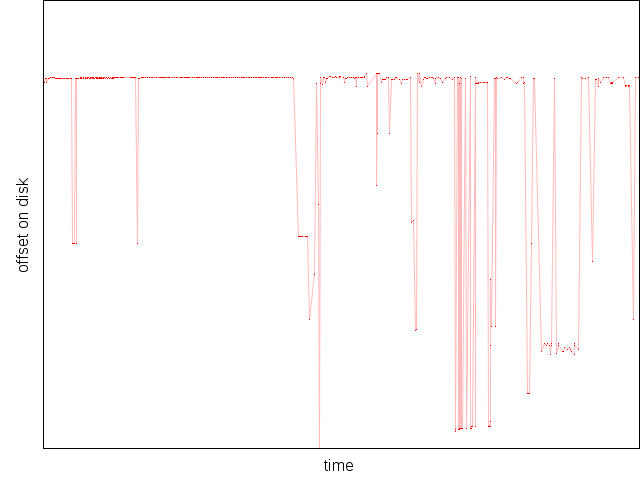
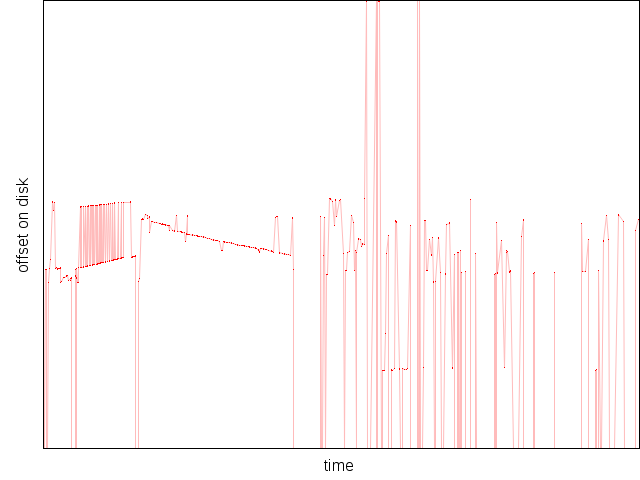
We all know disk seeks hurt. But we usually don t have a precise idea how much. How about getting that idea? Here is a little experiment I ran a few days ago. I took the output from the systemtap script tracking I/O I wrote, on a Firefox startup after boot. Each line of that output, which gives a timestamp (which we don t care about here), a file name, and an offset, represents a 4096 bytes read (one page). The first set of data points I got is how much time it takes to reproduce this read pattern after a reboot, and how that compares to Firefox startup time. For what it s worth, I did group following reads, to avoid doing too many system calls, and also avoided kernel readahead by using direct I/O, meaning I would only read exactly what the kernel reads when Firefox normally starts. All the following tests were done under the usual conditions (see previous posts), but I limited the tests to the x86-64 architecture, because all that really matters is the disk. I ll mention, however, that the amount of data read in these tests is 34,729,984 bytes, and that the original I/O pattern looks like this: Zooming around the main location where most I/O happen, we can see the pattern is still bumpy: This somehow looks familiar, doesn t it? We already know for a fact that even these patterns that, on the whole disk, look like pretty much insignificant, have an important impact on startup time. Try to imagine what kind of difference could be observed if we were reordering all these reads. Anyways, back to that I/O simulation, we first need to see how far it is from the actual Firefox startup. We would rather that simulated I/O + warm startup/hot cache end up close to the real thing. However, we need to keep in mind, as we saw in a previous post, that CPU scaling, when mixed with I/O, has an influence on startup time. Warm startup not involving I/O, the CPU can run at maximum speed the whole time. As such, for a fair comparison, we need to compare to cold startup time with the CPU forced at maximum speed, which we saw is faster than startup time with CPU scaling.
Average time (ms)
Simulated cold startup 2,764.26 0.42%
Warm startup 250.74 0.18%
Simulated cold + warm 3015
Real cold startup 3087.47 0.31%
Difference 72.47 (2.35%)
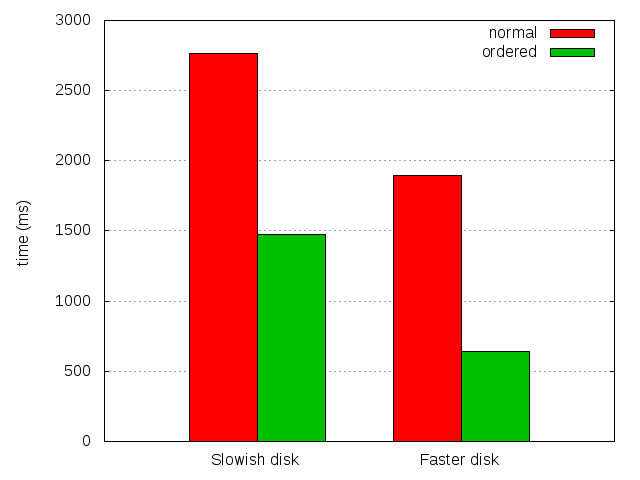
Close enough, I d say. The difference is most probably caused by metadata reads and a few other things, that isn t in the systemtap script scope. Now we know our simulated I/O is close to reality, what happens if we reorder all these reads according to the position on disk?
Average time (ms) Corresponding transfer rate
Simulated I/O 2,764.26 0.42% 12.56 MB/s
Reordered I/O 1,473.34 0.43% 23.57 MB/s
Difference 1,290.92 (46.7%) n/a
That s almost twice as fast ! And the disk doesn t even have a big throughput (around 30MB/s). Let s see what it does with a disk with a bigger throughput (85MB/s).
Average time (ms) Corresponding transfer rate
Simulated I/O 1,898.66 0.16% 18.29 MB/s
Reordered I/O 644.0 0.15% 53.93 MB/s
Difference 1,254.66 (66.08%) n/a
That s almost three times as fast ! The faster the disk, the bigger the improvement we can get by reordering and grouping I/O, which is not unexpected, but here we can see how much having to go back and forth on the disk hurt badly. Obviously, the numbers from the faster disk can t be directly compared to the ones from the slower disk, because the data was not arranged the same way on the disk, and file system fragmentation, as well as how the file system is filled also have their own share to add to the problem. And because it s more impressive to see on a graph than in a result table: Disks seeks hurt. Badly.

6 February 2011

Dirk Eddelbuettel: Wynton Marsalis and the Jazz at Lincoln Center Orchestra

Went to the CSO on Friday night to see the annual concert of Wynton Marsalis and the Jazz at Lincoln Center Orchestra. This year's concert featured one set with four pieces from the new Vitoria Suite album---see here for a raving review. Those pieces were indeed very nice and I may to grab the disc to hear the full suite. Thhis was followed by a number of pieces composed or arranged by different band members. All in all a great concert. Hard not to love when you twelve-man strong brass section featuring four trumpets, three trombones, five saxophones supported by a nice rhythm section of three. Recommended.

30 January 2011

Michal &#268;iha&#345;: Photo of a week 4

I have to cheat a little bit in fourth week as the picture is actually from last Sunday. I simply did not have time to take my camera out. The photo was taken at visit Glassworks Novosad a syn at Harrachov. Glass cutter

Filed under: English Photography 0 comments Flattr this!

26 January 2011

Martin Pitt: Na zdrav PyGI!

(Update: Link to Tomeu s blog post, repost for planet.gnome.org) Last week I was in Prague to attend the GNOME/Python 2011 Hackfest for gobject-introspection, to which Tomeu Vizoso kindly invited me after I started working with PyGI some months ago. It happened at a place called brmlab which was quite the right environment for a bunch of 9 hackers: Some comfy couches and chairs, soldering irons, lots of old TV tubes, chips, and other electronics, a big Pirate flag, really good Wifi, plenty of Club Mate and Coke supplies, and not putting unnecessary effort into mundane things like wallpapers. It was really nice to get to know the upstream experts John (J5) Palmieri and Tomeu Vizoso (check out Tomeu s blog post for his summary and some really nice photos). When sitting together in a room, fully focussing on this area for a full week, it s so much easier to just ask them about something and getting things done and into upstream than on IRC or bugzilla, where you don t know each other personally. I certainly learned a lot this week (and not only how great Czech beer tastes :-) )! So what did I do? Application porting After already having ported four Ubuntu PyGTK applications to GI before (apport, jockey, aptdaemon, and language-selector),
my main goal and occupation during this week was to start porting a bigger PyGTK application. I picked system-config-printer, as it s two magnitudes bigger than the previous projects, exercises quite a lot more of the GTK GI bindings, and thus also exposes a lot more GTK annotation and pygobject bugs. This resulted in a new pygi s-c-p branch which has the first 100 rounds of test, break, fix iterations. It now at least starts, and you can do a number of things with it, but a lot of functionality is still broken. As a kind of finger exercise and also to check for how well pygi-convert works for small projects now, I also ported computer-janitor. This went really well (I had it working after about 30 minutes), and also led me to finally fixing the unicode vs. str mess for GtkTreeView that you got so far with Python 2.x. pygobject and GTK fixes Porting system-config-printer and computer-janitor uncovered a lot of opportunities to improve pygi-convert.sh, a big perl -e kind of script to do the mechanical grunt work of the porting process. It doesn t fix up changed signatures (such as adding missing arguments which were default arguments in PyGTK, or the ubiquitous user_data argument for signal handlers), but at least it gets a lot of namespaces, method, and constant names right. I also fixed three annotation fixes in GTK+. We also collaboratively reviewed and tested Pavel s annotation branch which helped to fix tons of problems, especially after Steve Fr cinaux s excellent reference leak fix, so if you play around with current pygobject git head, you really also have to use the current GTK+ git head. Speaking of which, if you want to port applications and always stay on top of the pygobject/GTK development without having to clutter your package system with make install s of those, it works very well to have this in your ~/.bashrc:
export GI_TYPELIB_PATH=$HOME/projects/gtk/gtk:$HOME/projects/gtk/gdk
export PYTHONPATH=$HOME/projects/pygobject
Better GVariant/GDBus support The GNOME world is moving from the old dbus-glib python bindings to GDBus, which is integrated into GLib. However, dbus-python exposed a really nice and convenient way of doing D-Bus calls, while using GDBus from Python was hideously complicated, especially for nontrivial arguments with empty or nested arrays:
from gi.repository import Gio, GLib
from gi._gi import variant_type_from_string
d = Gio.bus_get_sync(Gio.BusType.SESSION, None)
notify = Gio.DBusProxy.new_sync(d, 0, None, 'org.freedesktop.Notifications',
    '/org/freedesktop/Notifications', 'org.freedesktop.Notifications', None)
vb = GLib.VariantBuilder()
vb.init(variant_type_from_string('r'))
vb.add_value(GLib.Variant('s', 'test'))
vb.add_value(GLib.Variant('u', 1))
vb.add_value(GLib.Variant('s', 'gtk-ok'))
vb.add_value(GLib.Variant('s', 'Hello World!'))
vb.add_value(GLib.Variant('s', 'Subtext'))
# add an empty array
eavb = GLib.VariantBuilder()
eavb.init(variant_type_from_string('as'))
vb.add_value(eavb.end())
# add an empty dict
eavb = GLib.VariantBuilder()
eavb.init(variant_type_from_string('a sv '))
vb.add_value(eavb.end())
vb.add_value(GLib.Variant('i', 10000))
args = vb.end()
result = notify.call_sync('Notify', args, 0, -1, None)
id = result.get_child_value(0).get_uint32()
print id
So I went to making the GLib.Variant constructor work properly with nested types and boxed variants, adding Pythonic GVariant iterators and indexing (so that you can treat GVariant dictionaries/arrays/tuples just like their Python equivalents), and finally a Variant.unpack() method for converting the return value of a D-Bus call back into a native Python data type. This looks a lot friendlier now:
from gi.repository import Gio, GLib
d = Gio.bus_get_sync(Gio.BusType.SESSION, None)
notify = Gio.DBusProxy.new_sync(d, 0, None, 'org.freedesktop.Notifications',
    '/org/freedesktop/Notifications', 'org.freedesktop.Notifications', None)
args = GLib.Variant('(susssasa sv i)', ('test', 1, 'gtk-ok', 'Hello World!',
    'Subtext', [],  , 10000))
result = notify.call_sync('Notify', args, 0, -1, None)
id = result.unpack()[0]
print id
I also prepared another patch in GNOME#640181 which will provide the icing on the cake, i. e. handle the variant building/unpacking transparently and make the explicit call_sync() unnecessary:
from gi.repository import Gio, GLib
d = Gio.bus_get_sync(Gio.BusType.SESSION, None)
notify = Gio.DBusProxy.new_sync(d, 0, None, 'org.freedesktop.Notifications',
    '/org/freedesktop/Notifications', 'org.freedesktop.Notifications', None)
result = notify.Notify('(susssasa sv i)', 'test', 1, 'gtk-ok', 'Hello World!',
            'Subtext', [],  , 10000)
print result[0]
I hope that I can get this reviewed and land this soon. Thanks to our sponsors! Many thanks to the GNOME Foundation and Collabora for sponsoring this event!

25 January 2011

Benjamin Mako Hill: Annual Free Software Foundation Fundraiser

<script type="text/javascript"> var fsf_widget_text = "Help protect your freedom!"; var fsf_widget_d_btn = "Donate"; var fsf_widget_share = "Share this widget."; var fsf_widget_size = "normal"; var fsf_associate_id = "3427"; </script> <script src="http://gplv3.fsf.org/static/widget/widget.js" type="text/javascript"></script>
The Free Software Foundation is in the last week of its annual fundraiser and has still has a bit of ground to make up. The FSF needs members and donations to merely sustain its basic activity protecting free software and engaging in minimal outreach. So as I've done in the last couple years, I've written a fundraising appeal for the organization. That why today my face is plastered, Jimmy Wales style, all over the FSF website. (For the record, the last bit was not my idea and I find it a little embarrassing.) My appeal this year begins with my feeling that as our lives become increasingly mediated by technology, the question of who controls technology becomes another way of asking "Who controls us?" Read the appeal for more. That statement, like much of the FSF's work, is not going to get very far with most users today. Most people don't think of technology as the source of control, power, or autonomy. They don't understand why software should be free or even what that might mean. Making this argument widely is something the FSF works hard to do. But supporting this work is a bit of a chicken-egg problem. The users we most need to reach have never heard our message and it can take some time to turn even the most receptive into supporters. For those of us that do care about technology and the power it has over its users, it's hugely important that we take action to support software freedom and organizations like the FSF that play a key place in this struggle. If we don't, nobody else will. The pool of people who might support the FSF today is small -- there are currently about 3,000 members -- but the stakes are huge: A choice between a world of DRM, locked down mobile phones, and non-free network services on one hand, and the possibility of a world where there are free alternatives on the other. The FSF won't win this fight alone, but it plays a critical role in it. The FSF is a small, humble, and responsible non-profit and a little money can have a big impact. If you are not an FSF associate member, now would be a great time to join. Membership is $120 per year ($60 for students) and payable monthly. In preparing this appeal, I realized that my membership had lapsed a couple months ago and that my partner Mika was still donating at the reduced student price. We've personally fixed both these things and made an addition donation. If you are a member, you can check your status or make a donation. If you are not yet, Please consider joining us.

24 January 2011

Clint Adams: Wicking and vents

There are certain people who are NIH-prone. Usually I consider this insane, but sometimes I sympathize. Certainly I have pulled a NIH once or thrice before. Maybe I'm one of those old curmudgeons who incorrectly remembers the past, but I have the feeling that software used to work a whole lot better. Admittedly it did less, but it was also less prone to weird semi-failures. I am probably repressing a bunch of kernel oopses in the '90s. Now though, I can waste a week and a half being miserable as SIP clients fail on me erratically, because I hate Twinkle and no one thought to tell me that Twinkle is really the only SIP client that works. The interoperability of CalDAV and GroupDAV servers and clients seems to be abysmal. The same even appears to be true of plain ol' WebDAV. There are multiple forks of Markdown. I blame John Gruber for not maintaining a strong-enough central standard. No working LUKS-encrypted live images appear to exist in the wild. The only reliable and useful backup software for my needs was abandoned in 2008. Everything in Rails is bloated and crazy, except for Redmine. How is Redmine able to transcend? I do not understand. There is no way you can run an Android phone on only free software. freeswitch is on crack.

23 January 2011

Michal &#268;iha&#345;: Photo of a week 3

Third week and I still have picture to publish. It was taken at Continental cup in nordic combined at Harrachov. Exhaustion

Filed under: English Photography 1 comments Flattr this!

22 January 2011

Joey Hess: command composition

Traditionally, Unix has operated by piping between commands ("find grep sort uniq"). I wonder if we are experiencing a shift to command composition being a more common model? I started thinking about this when I considered the following command line:
chronic mr run git annex get
Unpacking, that uses chronic, which arranges for quiet running of mr (unless it fails, then it shows the full output), which in turn runs git in every repository it knows about, and git is asked to run the git-annex subcommand, which in turn has a "get" subcommand of its own. So, in other words, this is a cron job that syncs large files in a set of git repos, quietly. You might want to make it run niced also, which adds 3 more commands:
chronic nice ionice -c3 trickle -d100 mr run git annex get
This is the most extreme example I know of (unless you tack in a "sudo"), but there does seem to have been a gradual shift to using more composition, and more subcommands. In git in particular, two-levels of subcommands is not unknown, for example "git remote add". Subcommands, especially as implemented in git (or earlier, in arch), are kind of a special case of command composition that adds a namespace. I'm sure that a count of commands with subcommands would show it exploded in the past 10-12 years. I'll bet a count of composable commands would also show a significant increase. Anyone have other examples of long compositions of commands?

Jose Luis Rivas Contreras: WordPress: Paginating with query_posts()

I discovered, in not a very amusing way that if you use query_posts() then the variables for paginating with The Loop stop working. Fixing this is easy, just add to paged option on the array the variable $paged, in this way:
query_posts(
    'posts_per_page'    => 15,
    'paged'                 => $paged,
);
Or if you don t use it like this, then:
query_posts('posts_per_page=15&paged=' . $paged);
After this, using posts_nav_link() actually works.

19 January 2011

Benjamin Mako Hill: An Only Slightly Fictionalized Story

Before heading back to graduate school, my brother worked full-time as a personal fitness and strength trainer. Like many trainers, he started out in an established gym and then struck out on his own once he had established an clientele base. Working on his own, he got almost all of his new business from referrals. Although one might think that a trainer's trusted long-term clients would be the source of most new business, it was mostly the newer, less established clients who referred new trainees. The established clients had already referred everyone in their social network that might be interested. That's how I learned about the weak ties of strength.

18 January 2011

Russell Coker: Conferences and People on the Autism Spectrum

There have been some recent discussions about issues related to the treatment of women at Free Software conferences, I ve written posts about Aspie Social Skills and Free Software [1] and Empathy, Autism, and Geeks [2] about this. But of course discussion continued on how Aspies supposedly cause problems that no-one seems to be noticing.Lisa of Chaotic Idealism wrote an interesting post about the NT social bias [3]. In summary NTs seem to think that Autism Spectrum Disorders are only about socialisation, not realising that for many people on the Spectrum it s sensory issues that are their main problem. Social problems are exacerbated by sensory issues and other causes of stress, so I think it s worth considering ways in which conferences can be planned to be less stressful for people on the Autism Spectrum, people who have SPD [4] that isn t associated with an ASD, and NTs who just get annoyed by loud noises etc.What Autism Conferences DoAutscape is one of only two conferences for people on the Autism Spectrum and the only one which clearly documents how they plan their conference [5]. The first noteworthy thing that they do is have badge colors to indicate what level of social interaction is desired by each delegate, I don t think that this is relevant to Free Software conferences as people who don t have sufficient social skills to suit at least a green badge probably won t be attending. But I think that when attending a conference about Free Software or any other equally geeky topic (if there is an equally geeky topic) it s worth keeping in mind the fact that there are probably a lot of people who would like to talk to you but lack the social skills to start a conversation.
No initiationRedPlease do not initiate any interaction with me.
Prior PermissionYellowPlease do not initiate unless I have already given you permission to approach me on a yellow badge.
Please initiateGreenI would like to socialise, but I have difficulty initiating. Please initiate with me.
NeutralWhite (or no badge)I am able to regulate my own interaction.
The next thing that they document is a black circle badge which indicates that the wearer shouldn t be photographed. Prior to reading that web site I wasn t aware of this being an Autistic issue, I was only aware of it being an issue for women who don t want zoomed-in pictures of themselves appearing on guys web sites (even pictures that aren t up-skirt or down-blouse can be unwelcome). A conference policy that prohibited photographs that zoom in on one person without that person s consent (or parental consent in the case of minors) would probably be a good idea.Another thing about badges is that it s a really good idea to have the delegate s name on both sides of the badge if the badge is attached in a way that permits it to turn. People on the Autism Spectrum tend to have some difficulty in recognising people and in remembering names. I find it inconvenient when someone expects me to recognise them but has their badge turned around so I can t see their name. Some people get really unhappy if they think that someone doesn t recognise them.Autscape has long breaks between activities and a leisure session each afternoon to allow delegates to recover from the stress of dealing with people. It seems to me that computer conferences in some cases could do with longer breaks between sessions. I find that a lot of the benefit of a conference is in what happens outside sessions and the standard practice of publishing videos of presentations makes personal meetings a more important part of the conference.Autscape has designated quiet spaces. I think that for computer conferences which have hack-labs (which seems to be most Free Software conferences nowadays even if they aren t labelled as such) it would be good to have some lab areas designated as quiet zones. I think that it is a really good thing to meet people you ve only known by email and then play some LAN based games against them and that this should be encouraged as part of a conference, but having that sort of thing separated from people who want to do some quiet coding is a really good idea. Whether people want to do quiet coding, read email, or just escape from the stress of a conference a quiet hack-lab would be a good place for it.An issue that s related to quiet spaces is the ability to escape from social situations. One of my pet hates is corporate meetings on boats, when the boat is in motion there is no escape. Corporate meetings that are only accessible by coach are also bad. Fortunately most conferences aren t like that.The Autscape web site states that they prohibit people from wearing perfume or aftershave to help people who are sensitive to smell. My observation of Free Software conferences is that encouraging everyone to have a shower every morning would be a good idea as there are stronger smells from unwashed people than from perfume.One thing that s interesting about the Autscape web site is that they have different color schemes available and have tested it in multiple web browsers including Safari and Konqueror (which apparently don t work so well). It s interesting to note that they test with such a variety of browsers including free software ones most corporations don t do that.Sensory Processing IssuesThe main SPD issues related to conferences seem to be noise and light related.For social events one difficulty that most people on the Spectrum seem to face is in listening to one person in a noisy crowded room. As well as that sudden noises and loud background noises can be very stressful. While it s sometimes impossible to avoid crowds (which can be another problem) it is often possible to select venues that have less noise problems. A venue with carpet on the floor and soft walls (anything other than brick or concrete) will be a lot quieter than one with hard surfaces that reflect noise. It seems that a quiet venue will benefit NTs as well, there seems to be a strong correlation between the price of food at restaurants and the amount of sound absorbing material on the floor and walls people who can afford a good dining experience seem to want it quiet.In terms of visual issues the relevant problems seem to be related to sudden transitions and lecture halls that are extremely dark. The only thing that can be done by conference organisers is to seek to have the lights in the lecture halls as bright as possible without preventing the viewing of the projector screen, this is usually done anyway.For social events the whole binge drinking at crowded bars thing doesn t work too well due to noise, poor lighting, crowds, and the smell of vomit. But there s no shortage of reasons to discourage binge drinking at conferences.FoodPsychology Today has a good article about preferences for food and picky eaters [6]. Lots of people on the Autism Spectrum have similar issues. The thing to do when arranging a conference meal is to have things neat and without needless combinations. Think about making food look more like what you would expect to see in a Japanese restaurant and less like Paella. Also having some very plain food on offer is a good thing, I think that bread-rolls for dinner and ice-cream for desert makes a viable meal. But any dish with a word like hash or mixed in it s name isn t a good option. Finally some combinations are really bad, I always find rare steak and potatoes on the same plate to be rather disgusting potato that s blood-stained doesn t appeal. The majority of conference meals satisfy these criteria.Autscape provides options of eating outside the main dining hall for people who can t tolerate the noise. For a Free Software conference it might be a better idea to provide seating outside the main area for people who are going to make noise. I don t mind people who want to get really drunk at the conference dinner, but I would prefer them to be in a separate room. Also when assisting a drunk friend to leave the venue before they cause more problems it would be convenient if there was a good place to take them to. The one occasion when I had to strongly encourage a friend to leave a conference dinner to reduce his embarrassment the next day (and reduce the annoyance for everyone else) there was no good place to take him so he just came back!ConclusionI don t expect that anyone will make any significant changes to conference plans after reading this post. I have tried to focus on things that would benefit NTs as well, but there are practical issues that get in the way such as the cost and availability of venues that are large enough. But there are some smaller ideas that can be implemented with relative ease.I hope that the people who are making claims about Autism and conference behavior will refer to this in future. If you think that there is a problem with the way people on the Spectrum act at conferences then the solution will more likely involve the suggestions I make here than anything else.

15 January 2011

Jordi Mallach: Hiking through the Pyrenean GR 11

Tomorrow, at this time, I'll probably be unsuccessfully trying to find a comfortable position on a seat of the Bilmanbus to Irun. Very early on Saturday, as soon as we get off the bus, Maria and I will quickly head to Hondarribia's beach in Cape Higer to symbolically wet our feet in the waters of the Cantabrian Sea. We won't have much time to enjoy the cold waters of the ocean, though. Soon after that, we'll have to take a deep breath, look East, and start walking if we want to achieve our utmost objective: take a bath in the beautiful beaches of the Cap de Creus, in the Mediterranean sea. In between, 30 days and 840 kilometres of thick woods, deep valleys, high peaks and cold waters, all of which shape incredible landscapes.
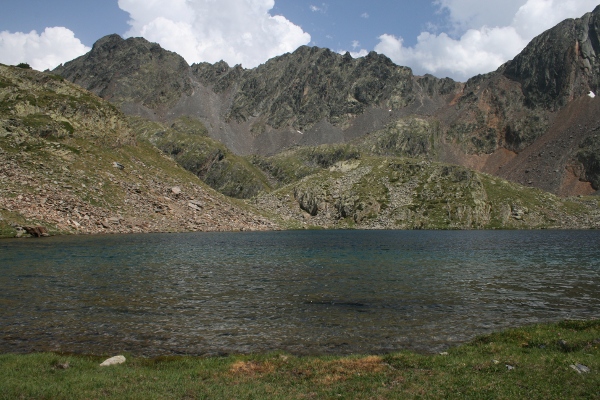

The Portella de Baiau, during our 2008 trip For a whole month, we'll be mostly disconnected from everything else that isn't our knee ache, our blisters, the Sun over our heads or where to get food. It's the first time I leave on a hiking trip as long and tough as this one, and I feel both uncertainty and eagerness. We've been so busy during the last few months that we've been unable to train at all for this, and I'm probably in the worst physical condition in a decade. It's too late to take care of that now, so we'll try to take good care of our legs and spine. In order to get back home in the Mediterranean, we'll have to be fast, some days joining two stages and skipping a few that we know are not that interesting (sections over asphalt, etc.). It's hard to make it in just one month, but we'll try our best. The plan is going to sleep not long after sunset, getting up at dawn, to be able to walk for a decent time before the heat starts being a handicap and just resting at midday, when the Sun is strongest. Of course, this means that I'm missing, yet again, this year's edition of DebConf in New York City, which is really sad because I was looking forward hanging around with Mako, Mika, Biella, micah, Clint and the rest of the NYC/ Boston gang, but when the idea of doing a long trip this summer popped up around January, it was clear DebConf seemed unlikely this year. I hope all of you have a lot of fun, and see you in a few weeks!

Jordi Mallach: De mar a mar, hiking across the Pyrenees

Two weeks ago, Maria and I completed one of our dreams when we arrived in Cap de Creus, where the Pyrenean range sinks in the Mediterranean. To get there, we walked hundreds of kilometres during a month, crossed dozens of steep valleys and enjoyed one of the richest experiences of our lives.

We managed to complete this challenge without facing major problems or pains, and after the first five our six days, our legs seemed to have gotten used to the daily effort and it started to be easier and easier. Our morale kept growing as days passed and we advanced east. When I started walking on a cold and rainy morning in Hondarribia, after barely no rest in the night bus to Ir n, I thought for myself that it was improbable that we'd manage to get anywhere near Catalunya, that one of us would get injuried way before, or we'd just give up and go for the easy beach vacation in the Basque Country.
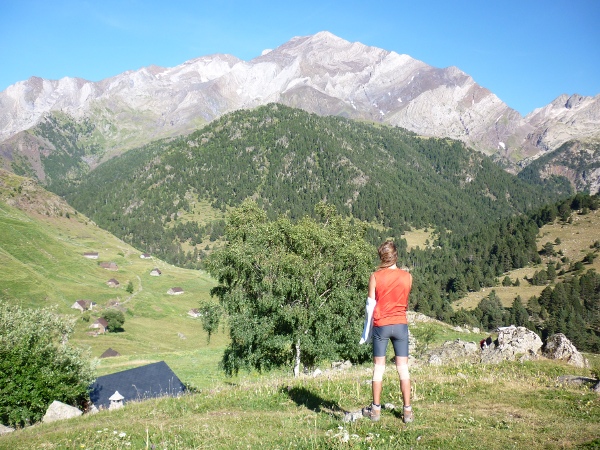

Biad s refuge, under Posets But we didn't, and after a somewhat painful start, with our boots soaking wet during the stages that crossed the enchanting Selva de Irati which ended up with me getting the biggest blister I've ever seen, we started to walk farther every day, extending the stages when we felt strong after reaching their official end. When we crossed from Nafarroa to Aragonese territory, the mental wall that I had built over the toughest stages in our quest started to fall apart. Days later, we found ourselves climbing down to Pineta, leaving Ordesa behind and enjoying a feeling that our adventure could not go better. The weather had been perfect for over a week and our legs and back were strong to go all over the way to the sea.


Ca n de A isclo, on our way to Pineta When we finally saw that huge blue stain on the horizon, the day before getting to the last mark, we got really excited. We had made it, but as we walked towards the cape, happiness slowly got mixed with melancholy. An unforgettable adventure was about to end, and we didn't want to face our return to the city and our routines. It had been many days surrounded only by awesome landscapes, and living without watches, with only sunlight and weariness marking the time to get in our sleeping bags.


At the very last red and white mark of our journey We've had plenty of time to meet great people. Starting with the Navarrian brothers we met in the early stage, which provided us with a good pace to follow while our leg muscles were still building up; or Kike and Ana, who drove from Pamplona to visit us during the first Aragonese stages (thanks for the supplies!). Tom s and Roger, young hikers from Matar , surprised us with their maturity and experience as mountaineers; we had the pleasure to join forces during four days, walking a really cool variant through the Infiernos and Collado del Letrero which avoided going through the ghost city of Panticosa. Roger and Tom s, we really hope to meet you soon! Andreu, Manel, Ghandi and Ga la visited us at the Vall de N ria and were unlucky to suffer a frightening hail and thunder storm when they left our shelter on their way back to their car. Thanks! All of you have been a very special part of our experience!

This adventure through GR 11 has been incredibly positive for us for several reasons. We've learned a lot about ourselves and strengthened our relation, and now I know how powerful drive can be; to get somewhere, no matter how far, it's really easy if you just believe you can do it and desire to get there. Maria and I are proud of what we've done, and no wonder we're looking for new challenges. An obvious one would be repeating this experience, going through the French side of the Pyrenees, but for now, the Corsican GR 20 seems the most appealing. We'll see, next summer!

12 January 2011

Dirk Eddelbuettel: RProtoBuf 0.2.2

Thanks to two patches by Murray Stokely, we have a nice new minor release 0.2.2 of RProtoBuf out on CRAN. RProtoBuf provides GNU R bindings for the Google Protobuf data encoding library used and released by Google. The NEWS file entry follows below:
0.2.2   2011-01-11
   o    Applied two patches by Murray Stokely which 
         - correct a typo preventing some functions from being called, 
         - add bounds checking in call to google protobuf library, 
         - add a new name method 
         - add a tiny unit test for the above
         - add more graceful error handling
         - add support for import patterns other than .proto$, 
         - add simple reading file that does not exist (exception) test
         - add simple repeated field unit test
And courtesy of CRANberries, here is the diff to the previous release 0.2.1:
 ChangeLog                                               35 
 DESCRIPTION                                              8 
 R/00classes.R                                           11 
 R/internals.R                                            7 
 R/wrapper_EnumDescriptor.R                               6 
 inst/NEWS                                               12 
 inst/THANKS                                          only
 inst/doc/Makefile                                        4 
 inst/doc/RProtoBuf-quickref.pdf                      binary
 inst/doc/RProtoBuf-unitTests.pdf                     binary
 inst/doc/RProtoBuf.pdf                                2362 +++++++++-----------
 inst/doc/unitTests-results/RProtoBuf-unitTests.html     20 
 inst/doc/unitTests-results/RProtoBuf-unitTests.txt      23 
 inst/unitTests/runit.addressbook.R                      11 
 inst/unitTests/runit.enums.R                         only
 inst/unitTests/runit.golden.message.R                    7 
 inst/unitTests/runit.import.R                        only
 man/EnumDescriptor-class.Rd                             42 
 man/EnumValueDescriptor-class.Rd                        23 
 man/readProtoFiles.Rd                                    3 
 src/DescriptorPoolLookup.cpp                            26 
 src/S4_classes.h                                         6 
 src/wrapper_EnumDescriptor.cpp                          25 
 src/wrapper_EnumValueDescriptor.cpp                     25 
 24 files changed, 1357 insertions(+), 1299 deletions(-)
As always, there is more information at the RProtoBuf page which has a draft package vignette, a 'quick' overview vignette and a unit test summary vignette. Questions, comments etc should go to the rprotobuf mailing list off the RProtoBuf page at R-Forge.

10 January 2011

Cyril Brulebois: Giving Squeeze s d-i rc1 a (snap)shot

Otavio Salvador requested early testers for squeeze debian-installer rc1. (This paragraph will be edited once the official announcement is published.) Graphical installer snapshots A few snapshots follow, using various non-Latin languages to make sure rendering was doing fine. To avoid any manual drawing, tiny imagemagick magick for the snapshots cropped to 800x300:
convert cropped-snap.png -fill none -stroke black -draw \
    "stroke-dasharray 10 10 path 'M 0,299 L 800,299'" dashed-cropped-snap.png
X/experimental + g-i = ? Premises: Result:
X/experimental + g-i = Win
Proof: g-i running with Xorg from experimental Comments:

8 January 2011

Dirk Eddelbuettel: RcppArmadillo 0.2.11

Just before Xmas, Conrad Sanderson released version 1.1.0 of Armadillo, his templated C++ library for linear algebra. Which I only noticed this week, so here comes version 0.2.11 of RcppArmadillo, our Rcpp-based integration into R. The only other change is the addition of an unexported function SHLIB which can be used to compiled a single source file into a loadable shared library file for R, while automagically find Rcpp and RcppArmadillo headers and the Rcpp library. The short NEWS file extract follows, also containing Conrad's entry for 1.1.0:
0.2.11  2011-01-06
    o   Upgraded to Armadillo Version 1.1.0    Climate Vandal 
         * Extended submatrix views, including access to elements whose
           indices are specified in a separate vector
         * Added handling of raw binary files by save/load functions
         * Added cumsum()
         * Added interpretation of matrices as triangular via
           trimatu()/trimatl() 
         * Faster solve(), inv() via explicit handling of triangular matrices 
         * The stream for logging of errors and warnings can now be changed 
    o   New unexported R function SHLIB, a small wrapper around R CMD SHLIB,
        which can be used as   Rscript -e "RcppArmadillo:::SHLIB('foo.cpp')"
And courtesy of CRANberries, here is the diff to the previous release 0.2.10:
 ChangeLog                                                   17 
 DESCRIPTION                                                 12 
 R/SHLIB.R                                                only
 inst/NEWS                                                   13 
 inst/doc/Makefile                                            5 
 inst/doc/RcppArmadillo-unitTests.pdf                     binary
 inst/doc/unitTests-results/RcppArmadillo-unitTests.html     16 
 inst/doc/unitTests-results/RcppArmadillo-unitTests.txt      34 
 inst/include/armadillo                                       9 
 inst/include/armadillo_bits/Col_meat.hpp                    25 
 inst/include/armadillo_bits/Col_proto.hpp                    5 
 inst/include/armadillo_bits/Cube_meat.hpp                   54 +
 inst/include/armadillo_bits/Cube_proto.hpp                   7 
 inst/include/armadillo_bits/Mat_meat.hpp                   469 ++++++++++++
 inst/include/armadillo_bits/Mat_proto.hpp                   54 +
 inst/include/armadillo_bits/Proxy.hpp                       63 +
 inst/include/armadillo_bits/Row_meat.hpp                    25 
 inst/include/armadillo_bits/Row_proto.hpp                    3 
 inst/include/armadillo_bits/arma_version.hpp                11 
 inst/include/armadillo_bits/auxlib_meat.hpp                102 ++
 inst/include/armadillo_bits/auxlib_proto.hpp                13 
 inst/include/armadillo_bits/debug.hpp                      101 +-
 inst/include/armadillo_bits/diskio_meat.hpp                280 +++++++
 inst/include/armadillo_bits/diskio_proto.hpp                 9 
 inst/include/armadillo_bits/field_meat.hpp                  23 
 inst/include/armadillo_bits/field_proto.hpp                  3 
 inst/include/armadillo_bits/fn_cumsum.hpp                only
 inst/include/armadillo_bits/fn_dot.hpp                      66 +
 inst/include/armadillo_bits/fn_elem.hpp                  only
 inst/include/armadillo_bits/fn_inv.hpp                      27 
 inst/include/armadillo_bits/fn_max.hpp                      17 
 inst/include/armadillo_bits/fn_mean.hpp                     17 
 inst/include/armadillo_bits/fn_median.hpp                   15 
 inst/include/armadillo_bits/fn_min.hpp                      21 
 inst/include/armadillo_bits/fn_misc.hpp                    604 ----------------
 inst/include/armadillo_bits/fn_prod.hpp                     15 
 inst/include/armadillo_bits/fn_solve.hpp                    22 
 inst/include/armadillo_bits/fn_stddev.hpp                   15 
 inst/include/armadillo_bits/fn_sum.hpp                      25 
 inst/include/armadillo_bits/fn_trimat.hpp                only
 inst/include/armadillo_bits/fn_var.hpp                      15 
 inst/include/armadillo_bits/forward_proto.hpp                7 
 inst/include/armadillo_bits/glue_solve_meat.hpp             32 
 inst/include/armadillo_bits/glue_solve_proto.hpp            12 
 inst/include/armadillo_bits/lapack_proto.hpp               103 ++
 inst/include/armadillo_bits/op_cumsum_meat.hpp           only
 inst/include/armadillo_bits/op_cumsum_proto.hpp          only
 inst/include/armadillo_bits/op_dot_meat.hpp                 46 +
 inst/include/armadillo_bits/op_dot_proto.hpp                 9 
 inst/include/armadillo_bits/op_find_meat.hpp                59 -
 inst/include/armadillo_bits/op_inv_meat.hpp                 13 
 inst/include/armadillo_bits/op_inv_proto.hpp                14 
 inst/include/armadillo_bits/op_trimat_meat.hpp           only
 inst/include/armadillo_bits/op_trimat_proto.hpp          only
 inst/include/armadillo_bits/podarray_meat.hpp                7 
 inst/include/armadillo_bits/span.hpp                         9 
 inst/include/armadillo_bits/subview_elem1_meat.hpp       only
 inst/include/armadillo_bits/subview_elem1_proto.hpp      only
 inst/include/armadillo_bits/subview_meat.hpp               321 ++++++--
 inst/include/armadillo_bits/subview_proto.hpp                1 
 inst/include/armadillo_bits/typedef.hpp                      4 
 inst/include/armadillo_bits/unwrap.hpp                     135 +++
 62 files changed, 2155 insertions(+), 829 deletions(-)
More information is on the RcppArmadillo page. Questions, comments etc should go to the rcpp-devel mailing list off the R-Forge page.

Next.

Previous.