Search Results: "reg"

23 October 2020

Dirk Eddelbuettel: RcppSpdlog 0.0.3: New features and much more docs

A good month after the initial two releases, we are thrilled to announce relase 0.0.3 of RcppSpdlog. This brings us release 1.8.1 of spdlog as well as a few local changes (more below). RcppSpdlog bundles spdlog, a wonderful header-only C++ logging library with all the bells and whistles you would want that was written by Gabi Melman, and also includes fmt by Victor Zverovic. This version of RcppSpdlog brings a new top-level function setLogLevel to control what events get logged, updates the main example to show this and to also make the R-aware logger the default logger, and adds both an extended vignette showing several key features and a new (external) package documentation site. The NEWS entry for this release follows.

Changes in RcppSpdlog version 0.0.3 (2020-10-23)
  • New function setLogLevel with R accessor in exampleRsink example
  • Updated exampleRsink to use default logger instance
  • Upgraded to upstream release 1.8.1 which contains finalised upstream use to switch to REprintf() if R compilation detected
  • Added new vignette with extensive usage examples, added compile-time logging switch example
  • A package documentation website was added

Courtesy of my CRANberries, there is also a diffstat report. More detailed information is on the RcppSpdlog page. If you like this or other open-source work I do, you can now sponsor me at GitHub. For the first year, GitHub will match your contributions.

This post by Dirk Eddelbuettel originated on his Thinking inside the box blog. Please report excessive re-aggregation in third-party for-profit settings.

Birger Schacht: An Analysis of 5 Million OpenPGP Keys

In July I finished my Bachelor s Degree in IT Security at the University of Applied Sciences in St. Poelten. During the studies I did some elective courses, one of which was about Data Analysis using Python, Pandas and Jupyter Notebooks. I found it very interesting to do calculations on different data sets and to visualize them. Towards the end of the Bachelor I had to find a topic for my Bachelor Thesis and as a long time user of OpenPGP I thought it would be interesting to do an analysis of the collection of OpenPGP keys that are available on the keyservers of the SKS keyserver network. So in June 2019 I fetched a copy of one of the key dumps of the one of the keyservers (some keyserver publish these copies of their key database so people who want to join the SKS keyserver network can do an initial import). At that time the copy of the key database contained 5,499,675 keys and was around 12GB. Using the hockeypuck keyserver software I imported the keys into an PostgreSQL database. Hockeypuck uses a table called keys to store the keys and in there the column doc stores the OpenPGP keys in JSON format (always with a data field containing the original unparsed data). For the thesis I split the analysis in three parts, first looking at the Public Key packets, then analysing the User ID packets and finally studying the Signature Packets. To analyse the respective packets I used SQL to export the data to CSV files and then used the pandas read_csv method to create a dataframe of the values. In a couple of cases I did some parsing before converting to a DataFrame to make the analysis step faster. The parsing was done using the pgpdump python library. Together with my advisor I decided to submit the thesis for a journal, so we revised and compressed the whole paper and the outcome was now

PUBLISHED in the Journal of Wireless Mobile Networks, Ubiquitous Computing, and Dependable Applications (JoWUA). I think the work gives some valuable insight in the development of the use of OpenPGP in the last 30 years. Looking at the public key packets we were able to compare the different public key algorithms and for example visualize how DSA was the most used algorithm until around 2010 when it was replaced by RSA. When looking at the less used algorithms a trend towards ECC based crytography is visible. What we also noticed was an increase of RSA keys with algorithm ID 3 (RSA Sign-Only), which are deprecated. When we took a deeper look at those keys we realized that most of those keys used a specific User ID string in the User ID packets which allowed us to attribute those keys to two software projects both using the Bouncy Castle Java Cryptographic API (resp. the Spongy Castle version for Android). We also stumbled over a tutorial on how to create RSA keys with Bouncycastle which also describes how to create RSA keys with code that produces RSA Sign-Only keys. In one of those projects, this was then fixed. By looking at the User ID packets we did some statistics about the most used email providers used by OpenPGP users. One domain stood out, because it is not the domain of an email provider: tellfinder.com is a domain used in around 45,000 keys. Tellfinder is a Big Data analysis software and the UID of all but two of those keys is TellFinder Page Archiver- Signing Key <support@tellfinder.com>. We also looked at the comments used in OpenPGP User ID fields. In 2013 Daniel Kahn Gillmor published a blog post titled OpenPGP User ID Comments considered harmful in which he pointed out that most of the comments in the User ID field of OpenPGP keys are duplicating information that is already present somewhere in the User ID or the key itself. In our dataset 3,133 comments were exactly the same as the name, 3,346 were the same as the domain and 18,246 comments were similar to the local part of the email address Last but not least we looked at the signature subpackets and the development of some of the preferences (Preferred Symmetric Algorithm, Preferred Hash Algorithm) that are being published using signature packets. Analysing this huge dataset of cryptographic keys of the last 20 to 30 years was very interesting and I learned a lot about the history of PGP resp. OpenPGP and the evolution of cryptography overall. I think it would be interesting to look at even more properties of OpenPGP keys and I also think it would be valuable for the OpenPGP ecosystem if these kinds analysis could be done regularly. An approach like Tor Metrics could lead to interesting findings and could also help to back decisions regarding future developments of the OpenPGP standard.

Enrico Zini: Hetzner build machine

This is part of a series of posts on compiling a custom version of Qt5 in order to develop for both amd64 and a Raspberry Pi. Building Qt5 takes a long time. The build server I was using had CPUs and RAM, but was very slow on I/O. I was very frustrated by that, and I started evaluating alternatives. I ended up setting up scripts to automatically provision a throwaway cloud server at Hetzner. Initial setup I got an API key from my customer's Hetzner account. I installed hcloud-cli, currently only in testing and unstable:
apt install hcloud-cli
Then I configured hcloud with the API key:
hcloud context create
Spin up I wrote a quick and dirty script to spin up a new machine, which grew a bit with little tweaks:
#!/bin/sh
# Create the server
hcloud server create --name buildqt --ssh-key   --start-after-create \
                     --type cpx51 --image debian-10 --datacenter  
# Query server IP
IP="$(hcloud server describe buildqt -o json   jq -r .public_net.ipv4.ip)"
# Update ansible host file
echo "buildqt ansible_user=root ansible_host=$IP" > hosts
# Remove old host key
ssh-keygen -f ~/.ssh/known_hosts -R "$IP"
# Update login script
echo "#!/bin/sh" > login
echo "ssh root@$IP" >> login
chmod 0755 login
I picked a datacenter in the same location as where we have other servers, to get quicker data transfers. I like that CLI tools have JSON output that I can cleanly pick at with jq. Sadly, my ISP doesn't do IPv6 yet. Since the server just got regenerated, I remove a possibly cached host key. Provisioning the machine One git server I need is behind HTTP authentication. Here's a quick hack to pass the relevant .netrc credentials to ansible before provisioning:
#!/usr/bin/python3
import subprocess
import netrc
import tempfile
import json
login, account, password = netrc.netrc().authenticators(" ")
with tempfile.NamedTemporaryFile(mode="wt", suffix=".json") as fd:
    json.dump( 
        "repo_user": login,
        "repo_password": password,
     , fd)
    fd.flush()
    subprocess.run([
        "ansible-playbook",
        "-i", "hosts",
        "-l", "buildqt",
        "--extra-vars", f"@ fd.name ",
        "provision.yml",
        ], check=True)
And here's the ansible playbook:
#!/usr/bin/env ansible-playbook
- name: Install and configure buildqt
  hosts: all
  tasks:
   - name: Update apt cache
     apt:
        update_cache: yes
        cache_valid_time: 86400
   - name: Create build user
     user:
        name: build
        comment: QT5 Build User
        shell: /bin/bash
   - name: Create sources directory
     become: yes
     become_user: build
     file:
        path: ~/sources
        state: directory
        mode: 0755
   - name: Download sources
     become: yes
     become_user: build
     get_url:
        url: "https:// / item "
        dest: "~/sources/ item "
        mode: 0644
     with_items:
      - "qt-everywhere-src-5.15.1.tar.xz"
      - "qt-creator-enterprise-src-4.13.2.tar.gz"
   - name: Populate home directory
     become: yes
     become_user: build
     copy:
        src: build
        dest: ~/
        mode: preserve
   - name: Write .netrc
     become: yes
     become_user: build
     copy:
        dest: ~/.netrc
        mode: 0600
        content:  
           machine  
           login  repo_user 
           password  repo_password 
   - name: Write .screenrc
     become: yes
     become_user: build
     copy:
        dest: ~/.screenrc
        mode: 0644
        content:  
           hardstatus alwayslastline
           hardstatus string '% = cw %-Lw% = KW %50>%n%f* %t% = cw %+Lw%< % = kK %-=%D %Y-%m-%d %c% - '
           startup_message off
           defutf8 on
           defscrollback 10240
   - name: Install base packages
     apt:
        name: git,mc,ncdu,neovim,eatmydata,devscripts,equivs,screen
        state: present
   - name: Clone git repo
     become: yes
     become_user: build
     git:
        repo: https:// @ / .git
        dest: ~/ 
   - name: Copy Qt license
     become: yes
     become_user: build
     copy:
        src: qt-license.txt
        dest: ~/.qt-license
        mode: 0600
Now everything is ready for a 16 core, 32Gb ram build on SSD storage. Tear down When done:
#!/bin/sh
hcloud server delete buildqt
The whole spin up plus provisioning takes around a minute, so I can do it when I start a work day, and take it down at the end. The build machine wasn't that expensive to begin with, and this way it will even be billed by the hour. A first try on a CPX51 machine has just built the full Qt5 Everywhere Enterprise including QtWebEngine and all its frills, for amd64, in under 1 hour and 40 minutes.

21 October 2020

Christian Kastner: RStudio is a refreshingly intuitive IDE

I currently need to dabble with R for a smallish thing. I have previously dabbled with R only once, for an afternoon, and that was about a decade ago, so I had no prior experience to speak of regarding the language and its surrounding ecosystem. Somebody recommended that I try out RStudio, a popular IDE for R. I was happy to see that an open-source community edition exists, in the form of a .deb package no less, so I installed it and gave it a try. It's remarkable how intuitive this IDE is. My first guess at doing something has so far been correct every. single. time. I didn't have to open the help, or search the web, for any solutions, either -- they just seem to offer themselves up. And it's not just my inputs; it's the output, too. The RStudio window has multiple tiles, and each tile has multiple tabs. I found this quite confusing and intimidating on first impression, but once I started doing some work, I was surprised to see that whenever I did something that produced output in one or more of the tabs, it was (again) always in an intuitive manner. There's a fine line between informing with relevant context and distracting with irrelevant context, but RStudio seems to have placed itself on the right side of it. This, and many other features that pop up here and there, like the live-rendering of LaTeX equations, contributed to what has to be one of the most positive experiences with an IDE that I've had so far.

Dirk Eddelbuettel: RcppZiggurat 0.1.6

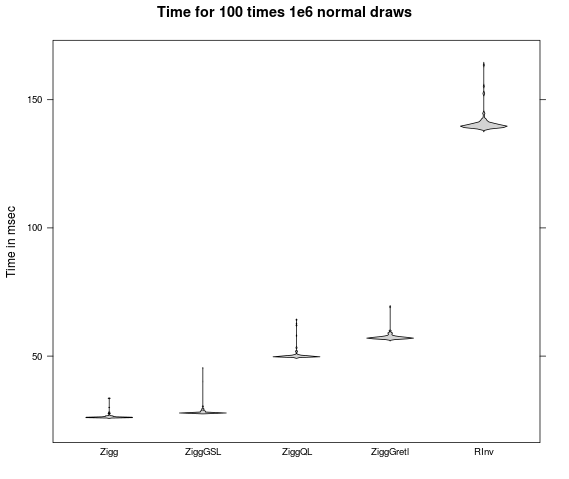
ziggurats A new release, now at version 0.1.6, of RcppZiggurat is now on the CRAN network for R. The RcppZiggurat package updates the code for the Ziggurat generator by Marsaglia and other which provides very fast draws from a Normal distribution. The package provides a simple C++ wrapper class for the generator improving on the very basic macros, and permits comparison among several existing Ziggurat implementations. This can be seen in the figure where Ziggurat from this package dominates accessing the implementations from the GSL, QuantLib and Gretl all of which are still way faster than the default Normal generator in R (which is of course of higher code complexity). This release brings a corrected seed setter and getter which now correctly take care of all four state variables, and not just one. It also corrects a few typos in the vignette. Both were fixed quite a while back, but we somehow managed to not ship this to CRAN for two years. The NEWS file entry below lists all changes.

Changes in version 0.1.6 (2020-10-18)
  • Several typos were corrected in the vignette (Blagoje Ivanovic in #9).
  • New getters and setters for internal state were added to resume simulations (Dirk in #11 fixing #10).
  • Minor updates to cleanup script and Travis CI setup (Dirk).

Courtesy of my CRANberries, there is a diffstat report for this release. More information is on the RcppZiggurat page. If you like this or other open-source work I do, you can now sponsor me at GitHub. For the first year, GitHub will match your contributions.

This post by Dirk Eddelbuettel originated on his Thinking inside the box blog. Please report excessive re-aggregation in third-party for-profit settings.

Reproducible Builds: Supporter spotlight: Civil Infrastructure Platform

The Reproducible Builds project depends on our many projects, supporters and sponsors. We rely on their financial support, but they are also valued ambassadors who spread the word about the Reproducible Builds project and the work that we do. This is the first installment in a series featuring the projects, companies and individuals who support the Reproducible Builds project. If you are a supporter of the Reproducible Builds project (of whatever size) and would like to be featured here, please let get in touch with us at contact@reproducible-builds.org. However, we are kicking off this series by featuring Urs Gleim and Yoshi Kobayashi of the Civil Infrastructure Platform (CIP) project.
Chris Lamb: Hi Urs and Yoshi, great to meet you. How might you relate the importance of the Civil Infrastructure Platform to a user who is non-technical? A: The Civil Infrastructure Platform (CIP) project is focused on establishing an open source base layer of industrial-grade software that acts as building blocks in civil infrastructure projects. End-users of this critical code include systems for electric power generation and energy distribution, oil and gas, water and wastewater, healthcare, communications, transportation, and community management. These systems deliver essential services, provide shelter, and support social interactions and economic development. They are society s lifelines, and CIP aims to contribute to and support these important pillars of modern society.
Chris: We have entered an age where our civilisations have become reliant on technology to keep us alive. Does the CIP believe that the software that underlies our own safety (and the safety of our loved ones) receives enough scrutiny today? A: For companies developing systems running our infrastructure and keeping our factories working, it is part of their business to ensure the availability, uptime, and security of these very systems. However, software complexity continues to increase, and the efforts spent on those systems is now exploding. What is missing is a common way of achieving this through refining the same tools, and cooperating on the hardening and maintenance of standard components such as the Linux operating system.
Chris: How does the Reproducible Builds effort help the Civil Infrastructure Platform achieve its goals? A: Reproducibility helps a great deal in software maintenance. We have a number of use-cases that should have long-term support of more than 10 years. During this period, we encounter issues that need to be fixed in the original source code. But before we make changes to the source code, we need to check whether it is actually the original source code or not. If we can reproduce exactly the same binary from the source code even after 10 years, we can start to invest time and energy into making these fixes.
Chris: Can you give us a brief history of the Civil Infrastructure Platform? Are there any specific success stories that the CIP is particularly proud of? A: The CIP Project formed in 2016 as a project hosted by Linux Foundation. It was launched out of necessity to establish an open source framework and the subsequent software foundation delivers services for civil infrastructure and economic development on a global scale. Some key milestones we have achieved as a project include our collaboration with Debian, where we are helping with the Debian Long Term Support (LTS) initiative, which aims to extend the lifetime of all Debian stable releases to at least 5 years. This is critical because most control systems for transportation, power plants, healthcare and telecommunications run on Debian-based embedded systems. In addition, CIP is focused on IEC 62443, a standards-based approach to counter security vulnerabilities in industrial automation and control systems. Our belief is that this work will help mitigate the risk of cyber attacks, but in order to deal with evolving attacks of this kind, all of the layers that make up these complex systems (such as system services and component functions, in addition to the countless operational layers) must be kept secure. For this reason, the IEC 62443 series is attracting attention as the de facto cyber-security standard.
Chris: The Civil Infrastructure Platform project comprises a number of project members from different industries, with stakeholders across multiple countries and continents. How does working together with a broad group of interests help in your effectiveness and efficiency? A: Although the members have different products, they share the requirements and issues when developing sustainable products. In the end, we are driven by common goals. For the project members, working internationally is simply daily business. We see this as an advantage over regional or efforts that focus on narrower domains or markets.
Chris: The Civil Infrastructure Platform supports a number of other existing projects and initiatives in the open source world too. How much do you feel being a part of the broader free software community helps you achieve your aims? A: Collaboration with other projects is an essential part of how CIP operates we want to enable commonly-used software components. It would not make sense to re-invent solutions that are already established and widely used in product development. To this end, we have an upstream first policy which means that, if existing projects need to be modified to our needs or are already working on issues that we also need, we work directly with them.
Chris: Open source software in desktop or user-facing contexts receives a significant amount of publicity in the media. However, how do you see the future of free software from an industrial-oriented context? A: Open source software has already become an essential part of the industry and civil infrastructure, and the importance of open source software there is still increasing. Without open source software, we cannot achieve, run and maintain future complex systems, such as smart cities and other key pieces of civil infrastructure.
Chris: If someone wanted to know more about the Civil Infrastructure Platform (or even to get involved) where should they go to look? A: We have many avenues to participate and learn more! We have a website, a wiki and you can even follow us on Twitter.

For more about the Reproducible Builds project, please see our website at reproducible-builds.org. If you are interested in ensuring the ongoing security of the software that underpins our civilisation and wish to sponsor the Reproducible Builds project, please reach out to the project by emailing contact@reproducible-builds.org.

20 October 2020

Dirk Eddelbuettel: RcppArmadillo 0.10.1.0.0

armadillo image Armadillo is a powerful and expressive C++ template library for linear algebra aiming towards a good balance between speed and ease of use with a syntax deliberately close to a Matlab. RcppArmadillo integrates this library with the R environment and language and is widely used by (currently) 786 other packages on CRAN. A little while ago, Conrad released version 10.1.0 of Armadillo, a a new major release. As before, given his initial heads-up we ran two full reverse-depends checks, and as a consequence contacted four packages authors (two by email, two via PR) about a miniscule required change (as Armadillo now defaults to C++11, an old existing setting of avoiding C++11 lead to an error). Our thanks to those who promptly update their packages truly appreciated. As it turns out, Conrad also softened the error by the time the release ran around. But despite our best efforts, the release was delayed considerably by CRAN. We had made several Windows test builds but luck had it that on the uploaded package CRAN got itself a (completely spurious segfault which can happen on a busy machine building machine things at once). Sadly it took three or four days for CRAN to reply our email. After which it took another number of days for them to ponder the behaviour of a few new deprecated messaged tickled by at the most ten or so (out of 786) packages. Oh well. So here we are, eleven days after I emailed the rcpp-devel list about the new package being on CRAN but possibly delayed (due to that seg.fault). But during all that time the package was of course available via the Rcpp drat. The changes in this release are summarized below as usual and are mostly upstream along with an improved Travis CI setup due to the aforementioned use of the bspm package for binaries at Travis.

Changes in RcppArmadillo version 0.10.1.0.0 (2020-10-09)
  • Upgraded to Armadillo release 10.1.0 (Orchid Ambush)
    • C++11 is now the minimum required C++ standard
    • faster handling of compound expressions by trimatu() and trimatl()
    • faster sparse matrix addition, subtraction and element-wise multiplication
    • expanded sparse submatrix views to handle the non-contiguous form of X.cols(vector_of_column_indices)
    • expanded eigs_sym() and eigs_gen() with optional fine-grained parameters (subspace dimension, number of iterations, eigenvalues closest to specified value)
    • deprecated form of reshape() removed from Cube and SpMat classes
    • ignore and warn on use of the ARMA_DONT_USE_CXX11 macro
  • Switch Travis CI testing to focal and BSPM

Courtesy of my CRANberries, there is a diffstat report relative to previous release. More detailed information is on the RcppArmadillo page. Questions, comments etc should go to the rcpp-devel mailing list off the R-Forge page. If you like this or other open-source work I do, you can now sponsor me at GitHub. For the first year, GitHub will match your contributions.

This post by Dirk Eddelbuettel originated on his Thinking inside the box blog. Please report excessive re-aggregation in third-party for-profit settings.

Steve Kemp: Offsite-monitoring, from my desktop.

For the past few years I've had a bunch of virtual machines hosting websites, services, and servers. Of course I want them to be available - especially since I charge people money to access at some of them (for example my dns-hosting service) - and that means I want to know when they're not. The way I've gone about this is to have a bunch of machines running stuff, and then dedicate an entirely separate machine solely for monitoring and alerting. Sure you can run local monitoring, testing that services are available, the root-disk isn't full, and that kind of thing. But only by testing externally can you see if the machine is actually available to end-users, customers, or friends.
A local-agent might decide "I'm fine", but if the hosting-company goes dark due to a fibre cut you're screwed.
I've been hosting my services with Hetzner (cloud) recently, and their service is generally pretty good. Unfortunately I've started to see an increasing number of false-alarms. I'd have a server in Germany, with the monitoring machine in Helsinki (coincidentally where I live!). For the past month I've started to get pinged with a failure every three/four days on average, "service down - dns failed", or "service down - timeout". When the notice would wake me up I'd go check and it would be fine, it was a very transient failure. To be honest the reason for this is my monitoring is just too damn aggressive, I like to be alerted immediately in case something is wrong. That means if a single test fails I get an alert, as rather than only if a test failed for something more reasonable like three+ consecutive failures. I'm experimenting with monitoring in a less aggressive fashion, from my home desktop. Since my monitoring tool is a single self-contained golang binary, and it is already packaged as a docker-based container deployment was trivial. I did a little work writing an agent to receive failure-notices, and ping me via telegram - instead of the previous approach where I had an online status-page which I could view via my mobile, and alerts via pushover. So far it looks good. I've tweaked the monitoring to setup a timeout of 15 seconds, instead of 5, and I've configured it to only alert me if there is an outage which lasts for >= 2 consecutive failures. I guess the TLDR is I now do offsite monitoring .. from my house, rather than from a different region. The only real reason to write this post was mostly to say that the process of writing a trivial "notify me" gateway to interface with telegram was nice and straightforward, and to remind myself that transient failures are way more common than we expect. I'll leave things alone for a moment, but it was a fun experiment. I'll keep the two systems in parallel for a while, but I guess I can already predict the outcome:

19 October 2020

Louis-Philippe V ronneau: Musings on long-term software support and economic incentives

Although I still read a lot, during my college sophomore years my reading habits shifted from novels to more academic works. Indeed, reading dry textbooks and economic papers for classes often kept me from reading anything else substantial. Nowadays, I tend to binge read novels: I won't touch a book for months on end, and suddenly, I'll read 10 novels back to back1. At the start of a novel binge, I always follow the same ritual: I take out my e-reader from its storage box, marvel at the fact the battery is still pretty full, turn on the WiFi and check if there are OS updates. And I have to admit, Kobo Inc. (now Rakuten Kobo) has done a stellar job of keeping my e-reader up to date. I've owned this model (a Kobo Aura 1st generation) for 7 years now and I'm still running the latest version of Kobo's Linux-based OS. Having recently had trouble updating my Nexus 5 (also manufactured 7 years ago) to Android 102, I asked myself:
Why is my e-reader still getting regular OS updates, while Google stopped issuing security patches for my smartphone four years ago?
To try to answer this, let us turn to economic incentives theory. Although not the be-all and end-all some think it is3, incentives theory is not a bad tool to analyse this particular problem. Executives at Google most likely followed a very business-centric logic when they decided to drop support for the Nexus 5. Likewise, Rakuten Kobo's decision to continue updating older devices certainly had very little to do with ethics or loyalty to their user base. So, what are the incentives that keep Kobo updating devices and why are they different than smartphone manufacturers'? A portrait of the current long-term software support offerings for smartphones and e-readers Before delving deeper in economic theory, let's talk data. I'll be focusing on 2 brands of e-readers, Amazon's Kindle and Rakuten's Kobo. Although the e-reader market is highly segmented and differs a lot based on geography, Amazon was in 2015 the clear worldwide leader with 53% of the worldwide e-reader sales, followed by Rakuten Kobo at 13%4. On the smartphone side, I'll be differentiating between Apple's iPhones and Android devices, taking Google as the barometer for that ecosystem. As mentioned below, Google is sadly the leader in long-term Android software support. Rakuten Kobo According to their website and to this Wikipedia table, the only e-readers Kobo has deprecated are the original Kobo eReader and the Kobo WiFi N289, both released in 2010. This makes their oldest still supported device the Kobo Touch, released in 2011. In my book, that's a pretty good track record. Long-term software support does not seem to be advertised or to be a clear selling point in their marketing. Amazon According to their website, Amazon has dropped support for all 8 devices produced before the Kindle Paperwhite 2nd generation, first sold in 2013. To put things in perspective, the first Kindle came out in 2007, 3 years before Kobo started selling devices. Like Rakuten Kobo, Amazon does not make promises of long-term software support as part of their marketing. Apple Apple has a very clear software support policy for all their devices:
Owners of iPhone, iPad, iPod or Mac products may obtain a service and parts from Apple or Apple service providers for five years after the product is no longer sold or longer, where required by law.
This means in the worst-case scenario of buying an iPhone model just as it is discontinued, one would get a minimum of 5 years of software support. Android Google's policy for their Android devices is to provide software support for 3 years after the launch date. If you buy a Pixel device just before the new one launches, you could theoretically only get 2 years of support. In 2018, Google decided OEMs would have to provide security updates for at least 2 years after launch, threatening not to license Google Apps and the Play Store if they didn't comply. A question of cost structure From the previous section, we can conclude that in general, e-readers seem to be supported longer than smartphones, and that Apple does a better job than Android OEMs, providing support for about twice as long. Even Fairphone, who's entire business is to build phones designed to last and to be repaired was not able to keep the Fairphone 1 (2013) updated for more than a couple years and seems to be struggling to keep the Fairphone 2 (2015) running an up to date version of Android. Anyone who has ever worked in IT will tell you: maintaining software over time is hard work and hard work by specialised workers is expensive. Most commercial electronic devices are sold and developed by for-profit enterprises and software support all comes down to a question of cost structure. If companies like Google or Fairphone are to be expected to provide long-term support for the devices they manufacture, they have to be able to fund their work somehow. In a perfect world, people would be paying for the cost of said long-term support, as it would likely be cheaper then buying new devices every few years and would certainly be better for the planet. Problem is, manufacturers aren't making them pay for it. Economists call this type of problem externalities: things that should be part of the cost of a good, but aren't for one a reason or another. A classic example of an externality is pollution. Clearly pollution is bad and leads to horrendous consequences, like climate change. Sane people agree we should drastically cut our greenhouse gas emissions, and yet, we aren't. Neo-classical economic theory argues the way to fix externalities like pollution is to internalise these costs, in other words, to make people pay for the "real price" of the goods they buy. In the case of climate change and pollution, neo-classical economic theory is plain wrong (spoiler alert: it often is), but this is where band-aids like the carbon tax comes from. Still, coming back to long-term software support, let's see what would happen if we were to try to internalise software maintenance costs. We can do this multiple ways. 1 - Include the price of software maintenance in the cost of the device This is the choice Fairphone makes. This might somewhat work out for them since they are a very small company, but it cannot scale for the following reasons:
  1. This strategy relies on you giving your money to an enterprise now, and trusting them to "Do the right thing" years later. As the years go by, they will eventually look at their books, see how much ongoing maintenance is costing them, drop support for the device, apologise and move on. That is to say, enterprises have a clear economic incentive to promise long-term support and not deliver. One could argue a company's reputation would suffer from this kind of behaviour. Maybe sometime it does, but most often people forget. Political promises are a great example of this.
  2. Enterprises go bankrupt all the time. Even if company X promises 15 years of software support for their devices, if they cease to exist, your device will stop getting updates. The internet is full of stories of IoT devices getting bricked when the parent company goes bankrupt and their servers disappear. This is related to point number 1: to some degree, you have a disincentive to pay for long-term support in advance, as the future is uncertain and there are chances you won't get the support you paid for.
  3. Selling your devices at a higher price to cover maintenance costs does not necessarily mean you will make more money overall raising more money to fund maintenance costs being the goal here. To a certain point, smartphone models are substitute goods and prices higher than market prices will tend to drive consumers to buy cheaper ones. There is thus a disincentive to include the price of software maintenance in the cost of the device.
  4. People tend to be bad at rationalising the total cost of ownership over a long period of time. Economists call this phenomenon hyperbolic discounting. In our case, it means people are far more likely to buy a 500$ phone each 3 years than a 1000$ phone each 10 years. Again, this means OEMs have a clear disincentive to include the price of long-term software maintenance in their devices.
Clearly, life is more complex than how I portrayed it: enterprises are not perfect rational agents, altruism exists, not all enterprises aim solely for profit maximisation, etc. Still, in a capitalist economy, enterprises wanting to charge for software maintenance upfront have to overcome these hurdles one way or another if they want to avoid failing. 2 - The subscription model Another way companies can try to internalise support costs is to rely on a subscription-based revenue model. This has multiple advantages over the previous option, mainly:
  1. It does not affect the initial purchase price of the device, making it easier to sell them at a competitive price.
  2. It provides a stable source of income, something that is very valuable to enterprises, as it reduces overall risks. This in return creates an incentive to continue providing software support as long as people are paying.
If this model is so interesting from an economic incentives point of view, why isn't any smartphone manufacturer offering that kind of program? The answer is, they are, but not explicitly5. Apple and Google can fund part of their smartphone software support via the 30% cut they take out of their respective app stores. A report from Sensor Tower shows that in 2019, Apple made an estimated US$ 16 billion from the App Store, while Google raked in US$ 9 billion from the Google Play Store. Although the Fortune 500 ranking tells us this respectively is "only" 5.6% and 6.5% of their gross annual revenue for 2019, the profit margins in this category are certainly higher than any of their other products. This means Google and Apple have an important incentive to keep your device updated for some time: if your device works well and is updated, you are more likely to keep buying apps from their store. When software support for a device stops, there is a risk paying customers will buy a competitor device and leave their ecosystem. This also explains why OEMs who don't own app stores tend not to provide software support for very long periods of time. Most of them only make money when you buy a new phone. Providing long-term software support thus becomes a disincentive, as it directly reduces their sale revenues. Same goes for Kindles and Kobos: the longer your device works, the more money they make with their electronic book stores. In my opinion, it's likely Amazon and Rakuten Kobo produce quarterly cost-benefit reports to decide when to drop support for older devices, based on ongoing support costs and the recurring revenues these devices bring in. Rakuten Kobo is also in a more precarious situation than Amazon is: considering Amazon's very important market share, if your device stops getting new updates, there is a greater chance people will replace their old Kobo with a Kindle. Again, they have an important economic incentive to keep devices running as long as they are profitable. Can Free Software fix this? Yes and no. Free Software certainly isn't a magic wand one can wave to make everything better, but does provide major advantages in terms of security, user freedom and sometimes costs. The last piece of the puzzle explaining why Rakuten Kobo's software support is better than Google's is technological choices. Smartphones are incredibly complex devices and have become the main computing platform of many. Similar to the web, there is a race for features and complexity that tends to create bloat and make older devices slow and painful to use. On the other hand, e-readers are simpler devices built for a single task: display electronic books. Control over the platform is also a key aspect of the cost structure of providing software updates. Whereas Apple controls both the software and hardware side of iPhones, Android is a sad mess of drivers and SoCs, all providing different levels of support over time6. If you take a look at the platforms the Kindle and Kobo are built on, you'll quickly see they both use Freescale I.MX SoCs. These processors are well known for their excellent upstream support in the Linux kernel and their relative longevity, chips being produced for either 10 or 15 years. This in turn makes updates much easier and less expensive to provide. So clearly, open architectures, free drivers and open hardware helps tremendously, but aren't enough on their own. One of the lessons we must learn from the (amazing) LineageOS project is how lack of funding hurts everyone. If there is no one to do the volunteer work required to maintain a version of LOS for your device, it won't be supported. Worse, when purchasing a new device, users cannot know in advance how many years of LOS support they will get. This makes buying new devices a frustrating hit-and-miss experience. If you are lucky, you will get many years of support. Otherwise, you risk your device becoming an expensive insecure paperweight. So how do we fix this? Anyone with a brain understands throwing away perfectly good devices each 2 years is not sustainable. Government regulations enforcing a minimum support life would be a step in the right direction, but at the end of the day, Capitalism is to blame. Like the aforementioned carbon tax, band-aid solutions can make things somewhat better, but won't fix our current economic system's underlying problems. For now though, I'll leave fixing the problem of Capitalism to someone else.

  1. My most recent novel binge has been focused on re-reading the Dune franchise. I first read the 6 novels written by Frank Herbert when I was 13 years old and only had vague and pleasant memories of his work. Great stuff.
  2. I'm back on LineageOS! Nice folks released an unofficial LOS 17.1 port for the Nexus 5 last January and have kept it updated since then. If you are to use it, I would also recommend updating TWRP to this version specifically patched for the Nexus 5.
  3. Very few serious economists actually believe neo-classical rational agent theory is a satisfactory explanation of human behavior. In my opinion, it's merely a (mostly flawed) lens to try to interpret certain behaviors, a tool amongst others that needs to be used carefully, preferably as part of a pluralism of approaches.
  4. Good data on the e-reader market is hard to come by and is mainly produced by specialised market research companies selling their findings at very high prices. Those particular statistics come from a MarketWatch analysis.
  5. If they were to tell people: You need to pay us 5$/month if you want to receive software updates, I'm sure most people would not pay. Would you?
  6. Coming back to Fairphones, if they had so much problems providing an Android 9 build for the Fairphone 2, it's because Qualcomm never provided Android 7+ support for the Snapdragon 801 SoC it uses.

17 October 2020

Dirk Eddelbuettel: digest 0.6.26: Blake3 and Tuning

And a new version of digest is now on CRAN will go to Debian shortly. digest creates hash digests of arbitrary R objects (using the md5, sha-1, sha-256, sha-512, crc32, xxhash32, xxhash64, murmur32, spookyhash, and blake3 algorithms) permitting easy comparison of R language objects. It is a fairly widely-used package (currently listed at 896k monthly downloads, 279 direct reverse dependencies and 8057 indirect reverse dependencies, or just under half of CRAN) as many tasks may involve caching of objects for which it provides convenient general-purpose hash key generation. This release brings two nice contributed updates. Dirk Schumacher added support for blake3 (though we could probably push this a little harder for performance, help welcome). Winston Chang benchmarked and tuned some of the key base R parts of the package. Last but not least I flipped the vignette to the lovely minidown, updated the Travis CI setup using bspm (as previously blogged about in r4 #30), and added a package website using Matertial for MkDocs. My CRANberries provides the usual summary of changes to the previous version. For questions or comments use the issue tracker off the GitHub repo. If you like this or other open-source work I do, you can now sponsor me at GitHub. For the first year, GitHub will match your contributions.

This post by Dirk Eddelbuettel originated on his Thinking inside the box blog. Please report excessive re-aggregation in third-party for-profit settings.

15 October 2020

Gunnar Wolf: I am who I am and that's all that I am

Mexico was one of the first countries in the world to set up a national population registry in the late 1850s, as part of the church-state separation that was for long years one of the national sources of pride. Forty four years ago, when I was born, keeping track of the population was still mostly a manual task. When my parents registered me, my data was stored in page 161 of book 22, year 1976, of the 20th Civil Registration office in Mexico City. Faithful to the legal tradition, everything is handwritten and specified in full. Because, why would they write 1976.04.27 (or even 27 de abril de 1976) when they could spell out d a veintisiete de abril de mil novecientos setenta y seis? Numbers seem to appear only for addresses. So, the State had record of a child being born, and we knew where to look if we came to need this information. But, many years later, a very sensible tecnification happened: all records (after a certain date, I guess) were digitized. Great news! I can now get my birth certificate without moving from my desk, paying a quite reasonable fee (~US$4). What s there not to like? Digitally certified and all! So great! But But Oh, there s a problem. Of course Making sense of the handwriting as you can see is somewhat prone to failure. And I cannot blame anybody for failing to understand the details of my record. So, my mother s first family name is Iszaevich. It was digitized as Iszaerich. Fortunately, they do acknowledge some errors could have made it into the process, and there is a process to report and correct errors. What s there not to like? Oh That they do their best to emulate a public office using online tools. I followed some links in that link to get the address to contact and yesterday night sent them the needed documents. Quite immediately, I got an answer that I must share with the world: Yes, the mailing contact is in the @gmail.com domain. I could care about them not using a @ .gob.mx address, but I ll let it slip. The mail I got says (uppercase and all):


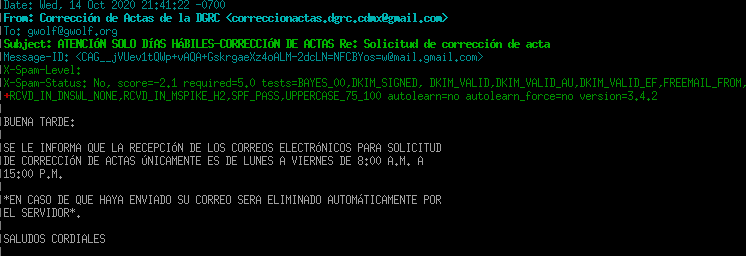
GOOD EVENING,
WE INFORM YOU THAT THE RECEPTION OF E-MAILS FOR REQUESTING
CORRECTIONS IN CERTIFICATES IS ONLY ACTIVE MONDAY THROUGH FRIDAY,
8:00 TO 15:00.
*IN CASE YOU SENT A MAIL OUTSIDE THE WORKING HOURS, IT WILL BE
AUTOMATICALLY DELETED BY THE SERVER*
CORDIAL GREETINGS,
I would only be half-surprised if they were paying the salary of somebody to spend the wee hours of the night receiving and deleting mails from their GMail account.

Rapha&#235;l Hertzog: Freexian s report about Debian Long Term Support, September 2020

A Debian LTS logo Like each month, here comes a report about the work of paid contributors to Debian LTS. Individual reports In September, 208.25 work hours have been dispatched among 13 paid contributors. Their reports are available: Evolution of the situation September was a regular LTS month with an IRC meeting. The security tracker currently lists 45 packages with a known CVE and the dla-needed.txt file has 48 packages needing an update. Thanks to our sponsors Sponsors that joined recently are in bold.

No comment Liked this article? Click here. My blog is Flattr-enabled.

Dirk Eddelbuettel: dang 0.0.12: Two new functions

A new release of the dang package is now on CRAN, roughly one year after the last release. The dang package regroups a few functions of mine that had no other home as for example lsos() from a StackOverflow question from 2009 (!!) is one, this overbought/oversold price band plotter from an older blog post is another. More recently added were helpers for data.table to xts conversion and a git repo root finder. This release adds two functions. One was mentioned just days ago in a tweet by Nathan and is a reworked version of something Colin tweeted about a few weeks ago: a little data wrangling off the kewl rtweet to find maximally spammy accounts per search topic. In other words those who include more than N hashtags for given search term. The other is something I, if memory serves, picked up a while back on one of the lists: a base R function to identify non-ASCII characters in a file. It is a C function that is not directly exported by and hence no accessible, so we put it here (with credits, of course). I mentioned it yesterday when announcing tidyCpp as I this C function was the starting point for the new tidyCpp wrapper around some C API of R functions. The (very short) NEWS entry follows.

Changes in version 0.0.12 (2020-10-14)
  • New functions muteTweets and checkPackageAsciiCode.
  • Updated CI setup.

Courtesy of CRANberries, there is a comparison to the previous release. For questions or comments use the issue tracker off the GitHub repo. If you like this or other open-source work I do, you can now sponsor me at GitHub. For the first year, GitHub will match your contributions.

This post by Dirk Eddelbuettel originated on his Thinking inside the box blog. Please report excessive re-aggregation in third-party for-profit settings.

14 October 2020

Dirk Eddelbuettel: tidyCpp 0.0.1: New package

A new package arrived on CRAN a few days ago. It offers a few headers files which wrap (parts) of the C API for R, but in a form that may be a little easier to use for C++ programmers. I have always liked how in Rcpp we offer good parts of the standalone R Math library in a namespace R::. While working recently with a particular C routine (for checking non-ASCII characters that will be part of the next version of the dang package which collecting various goodies in one place), I realized there may be value in collecting a few more such wrappers. So I started a few simple ones starting from simple examples. Currently we have five headers defines.h, globals.h, internals.h, math.h, and shield.h. The first four each correpond to an R header file of the same or similar name, and the last one brings a simple yet effective alternative to PROTECT and UNPROTECT from Rcpp (in a slightly simplified way). None of the headers are complete , for internals.h in particular a lot more could be added (as I noticed today when experimenting with another source file that may be converted). All of the headers can be accessed with a simple #include <tidyCpp> (which, following another C++ convention, does not have a .h or .hpp suffix). And a the package ships these headers, packages desiring to use them only need LinkingTo: tidyCpp. As usage examples, we (right now) have four files in the snippets/ directory of the package. Two of these, convolveExample.cpp and dimnamesExample.cpp both illustrate how one could change example code from Writing R Extensions. Then there are also a very simple defineExample.cpp and a shieldExample.cpp illustrating how much easier Shield() is compared to PROTECT and UNPROTECT. Finally, there is a nice vignette discussing the package motivation with two detailed side-by-side before and after examples that are the aforementioned convolution and dimnames examples. Over time, I expect to add more definitions and wrappers. Feedback would be welcome it seems to hit a nerve already as it currently has more stars than commits even though (prior to this post) I had yet to tweet or blog about it. Please post comments and suggestions at the GitHub repo. If you like this or other open-source work I do, you can now sponsor me at GitHub. For the first year, GitHub will match your contributions.

This post by Dirk Eddelbuettel originated on his Thinking inside the box blog. Please report excessive re-aggregation in third-party for-profit settings.

12 October 2020

Dirk Eddelbuettel: GitHub Streak: Round Seven

Six years ago I referenced the Seinfeld Streak used in an earlier post of regular updates to to the Rcpp Gallery:
This is sometimes called Jerry Seinfeld s secret to productivity: Just keep at it. Don t break the streak.
and then showed the first chart of GitHub streaking 366 days:
github activity october 2013 to october 2014
And five years ago a first follow-up appeared in this post about 731 days:
github activity october 2014 to october 2015
And four years ago we had a followup at 1096 days
github activity october 2015 to october 2016
And three years ago we had another one marking 1461 days
github activity october 2016 to october 2017
And two years ago another one for 1826 days
github activity october 2017 to october 2018
And last year another one bringing it to 2191 days
github activity october 2018 to october 2019
And as today is October 12, here is the newest one from 2019 to 2020 with a new total of 2557 days:
github activity october 2018 to october 2019
Again, special thanks go to Alessandro Pezz for the Chrome add-on GithubOriginalStreak.

This post by Dirk Eddelbuettel originated on his Thinking inside the box blog. Please report excessive re-aggregation in third-party for-profit settings.

Markus Koschany: My Free Software Activities in September 2020

Welcome to gambaru.de. Here is my monthly report (+ the first week in October) that covers what I have been doing for Debian. If you re interested in Java, Games and LTS topics, this might be interesting for you. Debian Games

warzone2100
Debian Java
pdfsam
Misc Debian LTS This was my 55. month as a paid contributor and I have been paid to work 31,75 hours on Debian LTS, a project started by Rapha l Hertzog. In that time I did the following: ELTS Extended Long Term Support (ELTS) is a project led by Freexian to further extend the lifetime of Debian releases. It is not an official Debian project but all Debian users benefit from it without cost. The current ELTS release is Debian 8 Jessie . This was my 28. month and I have been paid to work 15 hours on ELTS. Thanks for reading and see you next time.

Reproducible Builds: Restarting Reproducible Builds IRC meetings

The Reproducible Builds project intends to resume meeting regularly on IRC, starting today, Monday October 12th, at 18:00 UTC. Sadly, due to the unprecedented events in 2020, there will be no in-person Reproducible Builds event this year, but please join us on the #reproducible-builds channel on irc.oftc.net. An editable agenda is available. The cadence of these meetings will probably be every two weeks, although this will be discussed and decided on at the first meeting.

10 October 2020

William (Bill) Blough: sudo reboot


Benjy: The best-laid plans of mice... Arthur: And men. Frankie: What? Arthur: Best-laid plans of mice and men. Benjy: What have men got to do with it? -- The Hitchhiker's Guide to the Galaxy TV series
Last year, my intent had been to post monthy updates with details of the F/LOSS contributions I had made during the previous month. I wanted to do this as a way to summarize and reflect on what I had done, and also to hopefully motivate me to do more. Fast forward, and it's been over a year since my last blog post. So much for those plans. I won't go into specific detail about the F/LOSS contributions I've made in the past year. This isn't meant to be a "catch-up" post, per se. It's more of an acknowledgement that I didn't do what I set out to do, as well as something of a reset to enable me to continue blogging (or not) as I see fit. So, to summarize those contributions: All in all, I'm pretty happy with the contributions I've made in the past year. Historically, my F/LOSS activity had been somewhat sporadic, sometimes with months passing in between contributions. But looking through my notes from the past year, it appears that I made contributions every single month, with no skipped months. Of course, I would have liked to have done more, but I consider the improvement in consistency to be a solid win. As for the blog, well... Judging by the most recent year-long gap (as well as the gaps before that), I'm not likely to start regularly writing posts anytime soon. But then again, if sporadic F/LOSS contribtutions can turn into regular F/LOSS contributions, then maybe sporadic blog posts can turn into regular blog posts, too. Time will tell.

9 October 2020

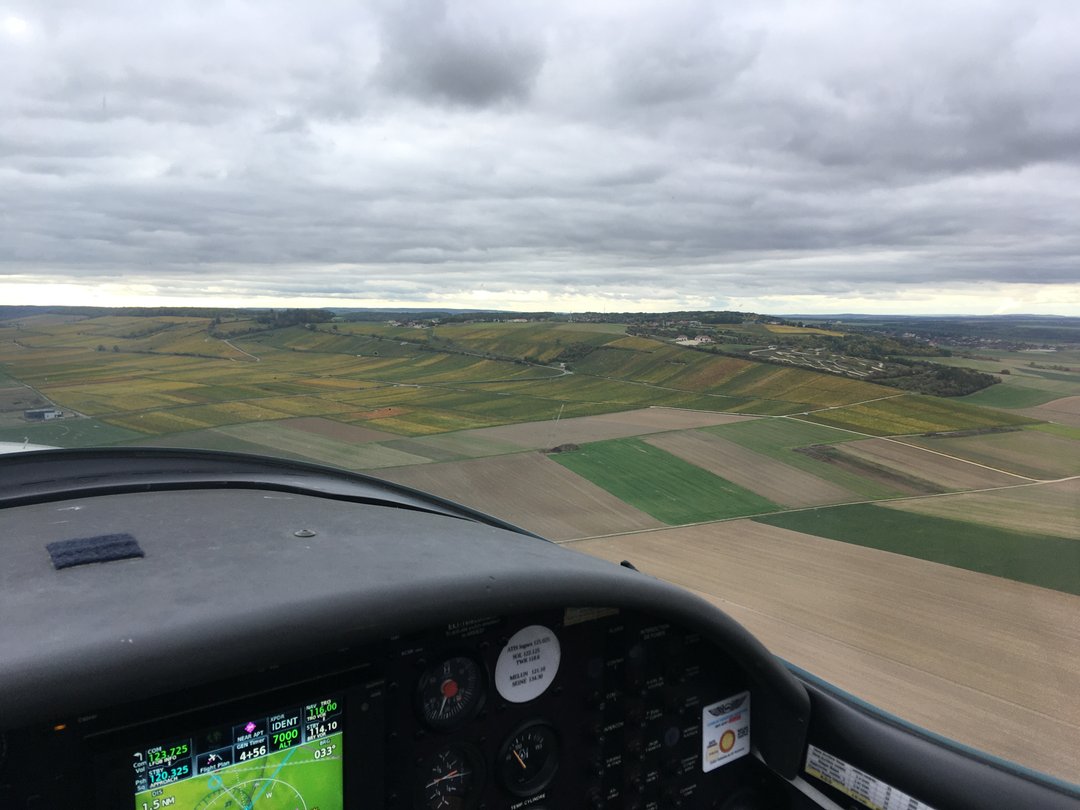
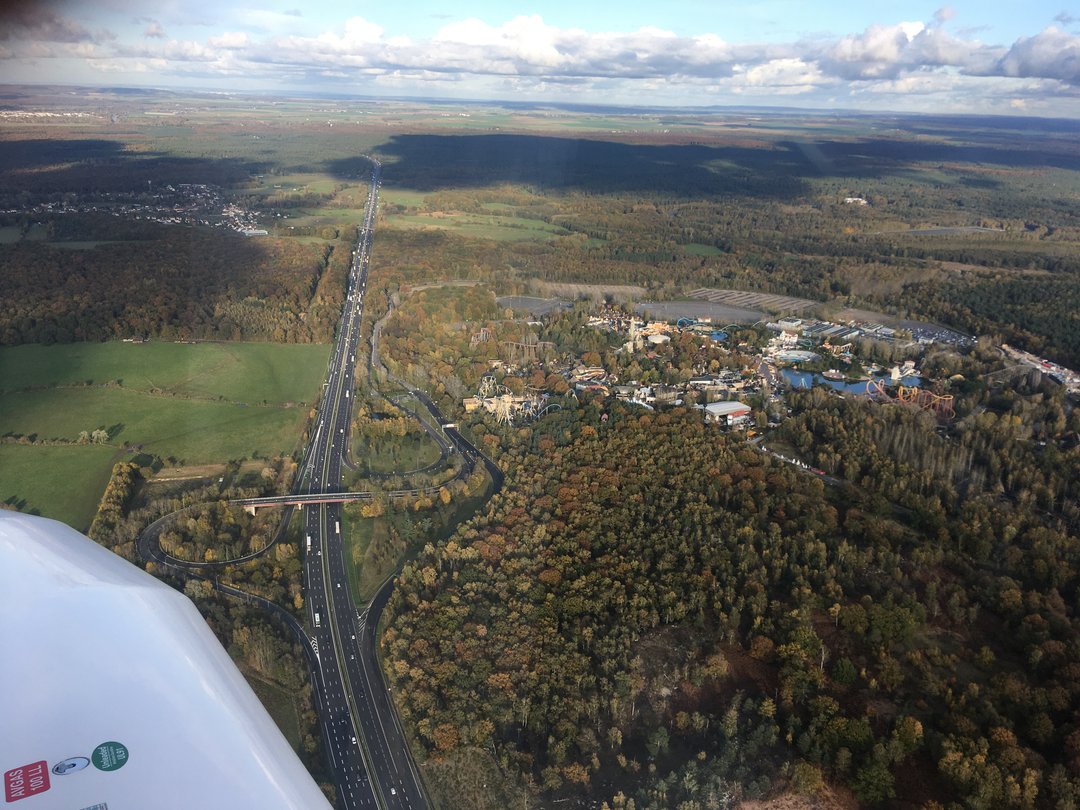
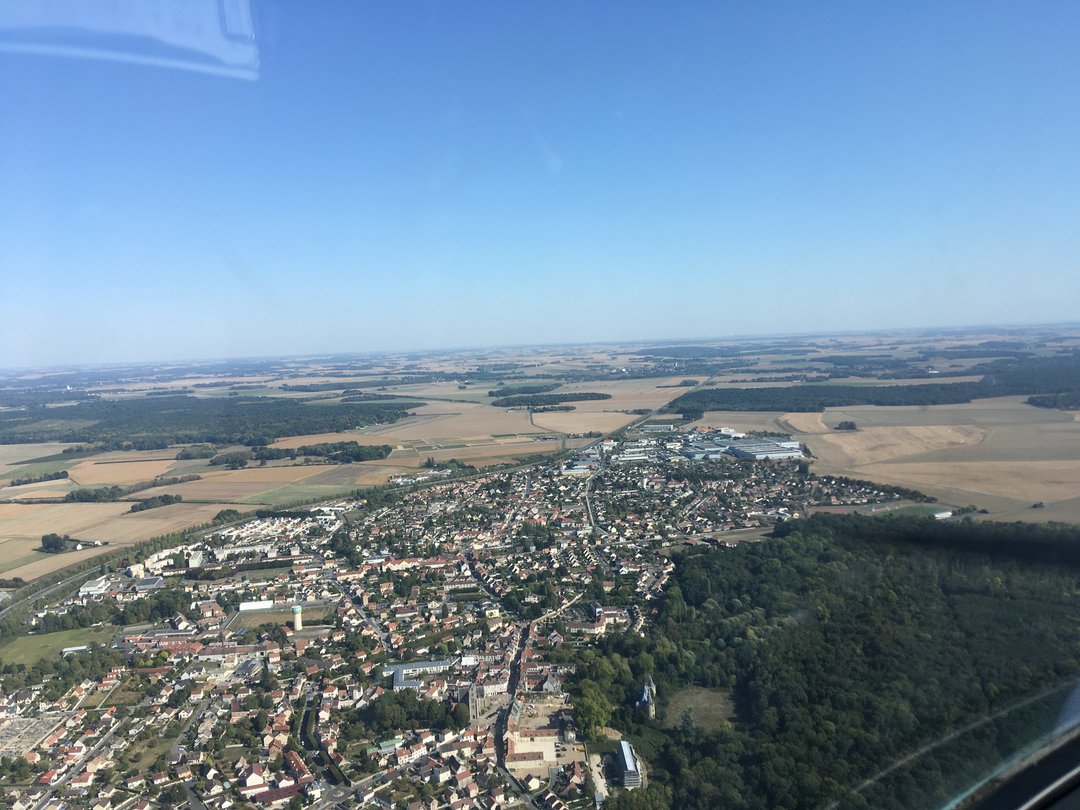
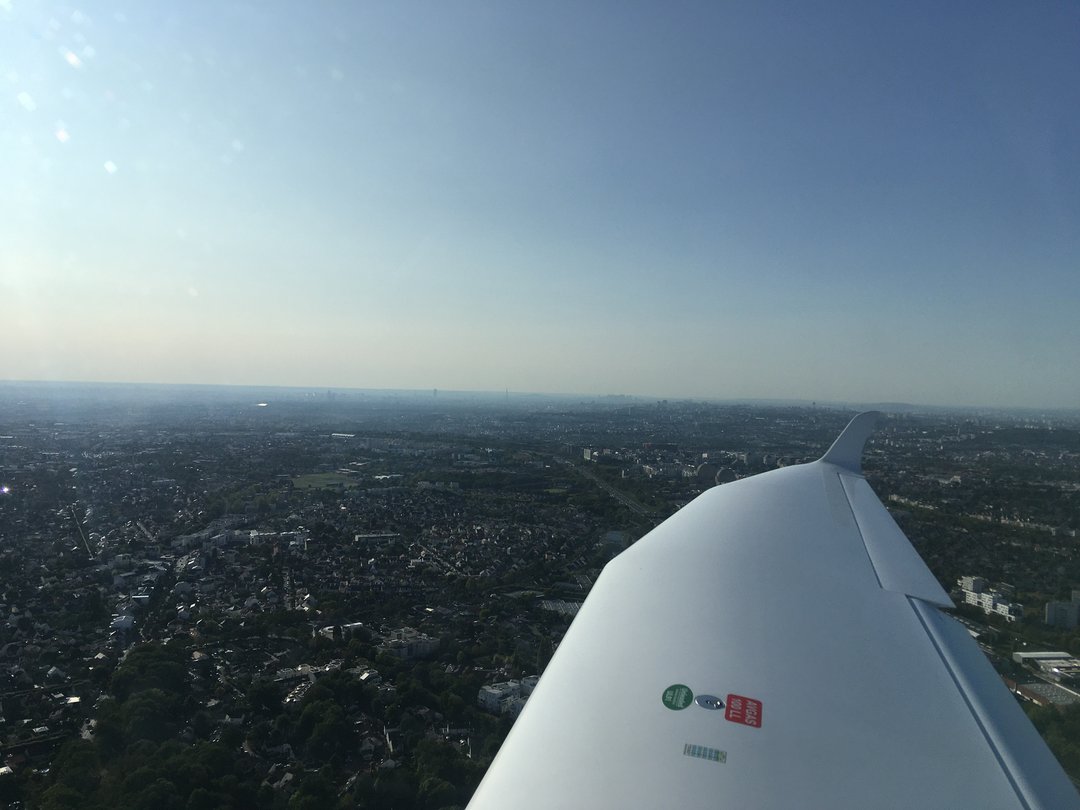
Yves-Alexis Perez: Airplane pilot

So, a bit more thank 18 months ago, I started a new adventure. After a few flights with a friend of mine in a Robin DR400 and Jodel aircrafts, I enlisted in a local flight club at the Lognes airfield (LFPL), and started a Pilot Private License training. A PPL is an international flight license for non commercial operations. Associated with a qualification like the SEP (Single Engine Piston), it enables you to fly basically anywhere in the world (or at least anywhere where French is spoken by the air traffic controllers) with passengers, under Visual Flight Rules (VFR).

A bit like with cars, training has two parts, theoretical and practical, both validated in a test. You don't have to pass the theoretical test before starting the practical training, and it's actually recommended to do both in parallel, especially since nowadays most of the theoretical training is done online (you still have to do 10h of in-person courses before taking the test).
So in March 2019 I started both trainings. Theoretical training is divided in various domains, like regulations, flight mechanics, meteorology, human factors etc. and you can obviously train in parallel. Practical is more sequential and starts with basic flight training (turns, climbs, descents), then take-off, then landing configuration, then landing itself. All of that obviously with a flight instructor sitting next to you (you're on the left seat but the FI is the pilot in command ). You then start doing circuit patterns, meaning you take off, do a circuit around the airfield, then land on the runway you just took off. Usually you actually don't do a complete landing but rather touch and go, and do it again in order to have more and more landing training.

Once you know how to take-off, do a pattern and land when everything is OK, you start practicing (still with your flight instructor aboard) various failures: especially engine failures at take off, but also flaps failure and stuff like that, all that while still doing patterns and practicing landings. At one point, the flight instructor deems you ready: he exits the plane, and you start your first solo flight: engine tests, take off, one pattern, landing.

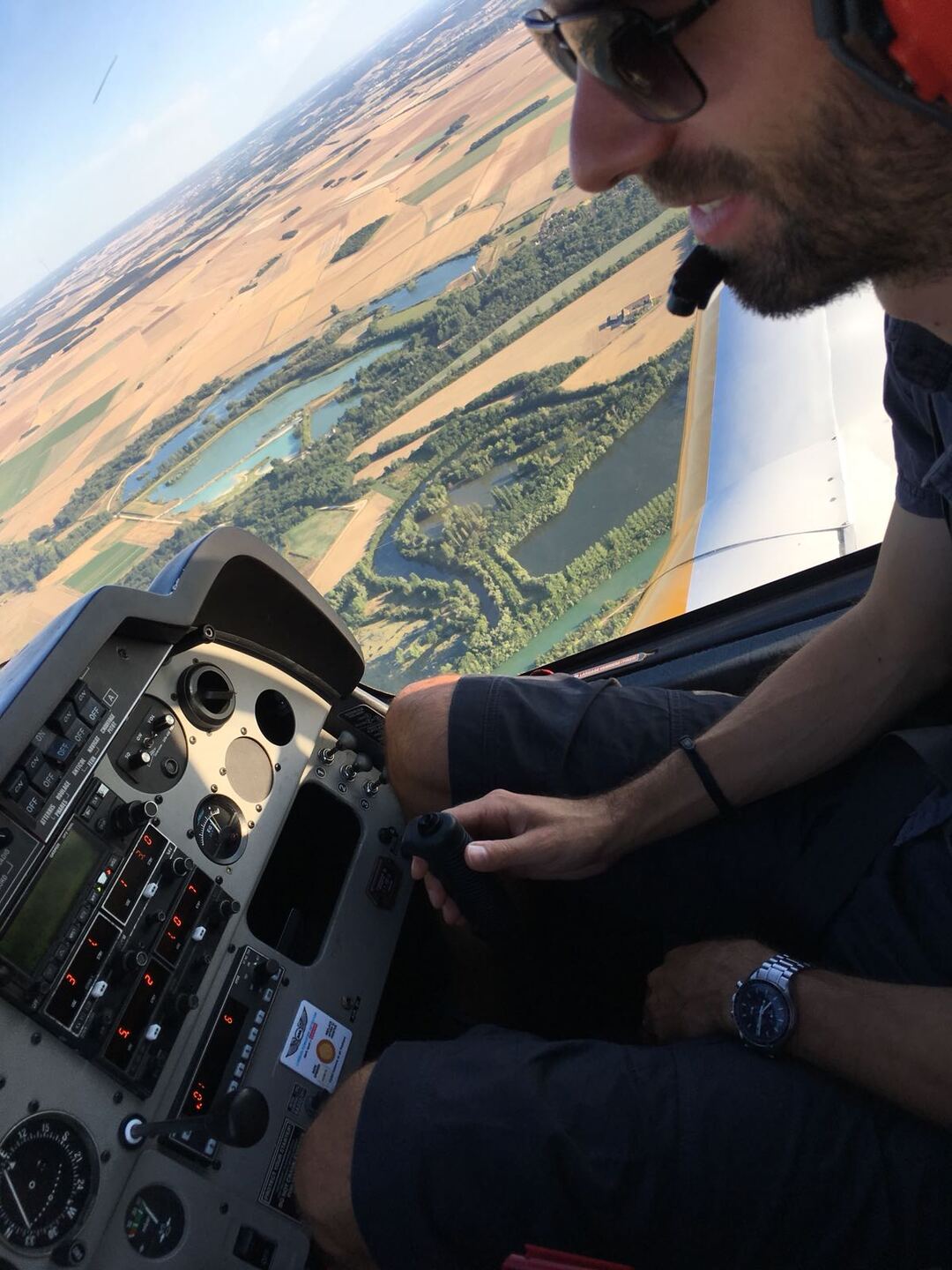
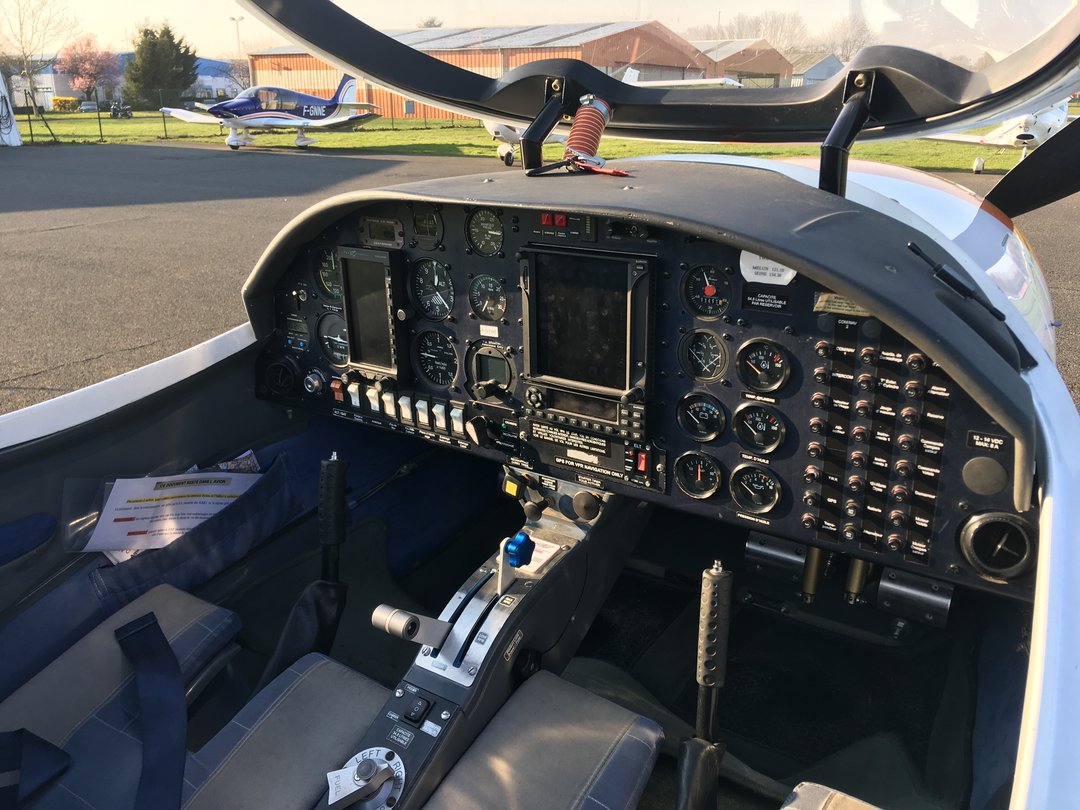
For me practical training was done in an Aquila AT-01/A210, which is a small 2-seater. It's really light (it can actually be used as an ultralight), empty weight is a bit above 500kg and max weight is 750. It doesn't go really fast (it cruises at around 100 knots, 185 km/h) but it's nice to fly. As it's really lightweight the wind really shakes it though and it can be a bit hard to land because it really glides very well (with a lift-to-drag ratio at 14). I tried to fly a lot in the beginning, so the basic flight training was done in about 6 months and 23 flight hours. At that point my instructor stepped out of the plane and I did my first solo flight. Everything actually went just fine, because we did repeat a lot before that, so it wasn't even that scary. I guess I will remember my whole life, as people said, but it was pretty uneventful, although the controller did scold me a little because when taxiing back to the parking I misunderstood the instructions and didn't stop where asked (no runway incursion though).

After the first solo flight, you keep practicing patterns and solo flights every once in a while, and start doing cross-country flights: you're not restricted to the local airfields (LFPL, LFAI, LFPK) but start planning trips to more remote airports, about 30-40 minutes away (for me it was Moret/LFPU, Troyes/LFQB, Pontoise/LFPT). Cross country flights requires you to plan the route (draw it on the map, and write a navigation log so you know what to do when in flight), but also check the weather, relevant information, especially NOTAMs - Notice To Air Men (I hope someone rename those Notice to Air Crews at one point), estimate the fuel needed etc. For me, flight preparation time was between once and twice the flight time. Early flight preparation is completed on the day by last-minute checks, especially for weather. During the briefing (with the flight instructor at first, but for the test with the flight examiner and later with yourself) you check in turn every bit of information to decide if you're GO or not for the flight. As a lot of things in aviation, safety is really paramount here.

Once you've practiced cross country flight a bit, you start learning what to do in case of failures during a non-local flights, for example an engine failure in a middle of nowhere, when you have to chose a proper field to land, or a radio failure. And again when you're ready for it (and in case of my local club, once you pass your theoretical exam) you go for cross-country solo flights (of the 10h of solo flight required for taking the test, 5h should be done in cross-country flights). I went again to Troyes (LFQB), then Dijon-Darois (LFGI) and did a three-legs flight to Chalons-Ecury (LFQK) and Pont sur Yonne (LFGO).

And just after that, when I was starting to feel ready for the test, COVID-19 lockdown happened, grounding everyone for a few months. Even after it was over, I felt a bit rusty and had to take some more training. I finally took the test in the beginning of summer, but the first attempt wasn't good enough: I was really stressed, and maybe not completely ready actually. So a bit more training during summer, and finally in September I took the final test part, which was successful this time.

After some paperwork, a new, shiny, Pilot Private License arrived at my door.

And now that I can fly basically when I want, the autumn is finally here with bad weather all day long, so actually planning real flights is a bit tricky. For now I'm still flying solo on familiar trips, but at some point I should be able to bring a passenger with me (on the Aquila) and at some point migrate to a four-seaters like the DR400, ubiquitous in France.

8 October 2020

Molly de Blanc: COVID and Reflections on Jessica Flanigan

One of the points Flanigan makes in her piece Seat Belt Mandates and Paternalism is that we re conditioned to use seat belts from a very early age. It s a thing we internalize and build into our understanding of the world. People feel bad when they don t wear a seat belt.(1) They re unsettled. They feel unsafe. They feel like they re doing something wrong. Masks have started to fit into this model as well. Not wearing a mask feels wrong. An acquaintance shared a story of crying after realizing they had left the house without a mask. For some people, mask wearing has been deeply internalized. We have regular COVID tests at NYU. Every other week I spit into a tube and then am told whether I am safe or sick. This allows me to hang out with my friends more confident than I would feel otherwise. This allows me to be closer to people than I would be otherwise. It also means that if I got sick, I would know, even if I was asymptomatic. If this happened, I would need to tell my friends. I would trace the places I ve been, the people I ve seen, and admit to them that I got sick. I would feel shame because something I did put me in that position. There were (are?) calls to market mask wearing and COVID protection with the same techniques we use around sex: wear protection, get tested, think before you act, ask consent before touching, be honest and open with the people around you about your risk factors. This is effective, at least among a swath of the population, but COVID has effectively become another STD. It s a socially transmitted disease that we have tabooified into creating shame in people who have it. The problem with this is, of course, that COVID isn t treatable in the same way syphilis and chlamydia are. Still, I would ask whether people don t report, or get tested, or even wear masks, because of shame? In some communities, wearing a mask is a sign that you re sick. It s stigmatizing.(2) I think talking about COVID the way we talk about sex is not the right approach because, in my experience, the ways I learned about sex were everything from factually wrong to deeply harmful. If what we re doing doesn t work, what does? (1) Yes, I know not everyone. (2) Many men who don t wear masks cite it as feeling emasculating, rather than stigmatizing.

Next.

Previous.