Search Results: "ema"

5 June 2020

Sean Whitton: spacecadetrebindings

I ve been less good at taking adequate typing breaks during the lockdown and I ve become concerned about how much chording my left hand does on its own during typical Emacs usage, with caps lock rebound to control, as I ve had it for years. I thought that now was as good a time as any to do something drastic about this. Here are my rebindings: Optional extras: This has the following advantages: The main disadvantage, aside from an adjustment period when I feel that someone has inserted a massive marshmellow between me and my computer, is that Ctrl-Alt combinations are a bit difficult; in Emacs, C-M-SPC is hard to do without. However I think I ve found a decent way to do it (thumb on control, curled ring finger on alt, possibly little finger on shift for Emacs infamous C-M-S-v standard binding).

4 June 2020

Reproducible Builds: Reproducible Builds in May 2020

Welcome to the May 2020 report from the Reproducible Builds project. One of the original promises of open source software is that distributed peer review and transparency of process results in enhanced end-user security. Nonetheless, whilst anyone may inspect the source code of free and open source software for malicious flaws, almost all software today is distributed as pre-compiled binaries. This allows nefarious third-parties to compromise systems by injecting malicious code into seemingly secure software during the various compilation and distribution processes. In these reports we outline the most important things that we and the rest of the community have been up to over the past month.

News The Corona-Warn app that helps trace infection chains of SARS-CoV-2/COVID-19 in Germany had a feature request filed against it that it build reproducibly. A number of academics from Cornell University have published a paper titled Backstabber s Knife Collection which reviews various open source software supply chain attacks:
Recent years saw a number of supply chain attacks that leverage the increasing use of open source during software development, which is facilitated by dependency managers that automatically resolve, download and install hundreds of open source packages throughout the software life cycle.
In related news, the LineageOS Android distribution announced that a hacker had access to the infrastructure of their servers after exploiting an unpatched vulnerability. Marcin Jachymiak of the Sia decentralised cloud storage platform posted on their blog that their siac and siad utilities can now be built reproducibly:
This means that anyone can recreate the same binaries produced from our official release process. Now anyone can verify that the release binaries were created using the source code we say they were created from. No single person or computer needs to be trusted when producing the binaries now, which greatly reduces the attack surface for Sia users.
Synchronicity is a distributed build system for Rust build artifacts which have been published to crates.io. The goal of Synchronicity is to provide a distributed binary transparency system which is independent of any central operator. The Comparison of Linux distributions article on Wikipedia now features a Reproducible Builds column indicating whether distributions approach and progress towards achieving reproducible builds.

Distribution work In Debian this month: In Alpine Linux, an issue was filed and closed regarding the reproducibility of .apk packages. Allan McRae of the ArchLinux project posted their third Reproducible builds progress report to the arch-dev-public mailing list which includes the following call for help:
We also need help to investigate and fix the packages that fail to reproduce that we have not investigated as of yet.
In openSUSE, Bernhard M. Wiedemann published his monthly Reproducible Builds status update.

Software development

diffoscope Chris Lamb made the changes listed below to diffoscope, our in-depth and content-aware diff utility that can locate and diagnose reproducibility issues. He also prepared and uploaded versions 142, 143, 144, 145 and 146 to Debian, PyPI, etc.
  • Comparison improvements:
    • Improve fuzzy matching of JSON files as file now supports recognising JSON data. (#106)
    • Refactor .changes and .buildinfo handling to show all details (including the GnuPG header and footer components) even when referenced files are not present. (#122)
    • Use our BuildinfoFile comparator (etc.) regardless of whether the associated files (such as the orig.tar.gz and the .deb) are present. [ ]
    • Include GnuPG signature data when comparing .buildinfo, .changes, etc. [ ]
    • Add support for printing Android APK signatures via apksigner(1). (#121)
    • Identify iOS App Zip archive data as .zip files. (#116)
    • Add support for Apple Xcode .mobilepovision files. (#113)
  • Bug fixes:
    • Don t print a traceback if we pass a single, missing argument to diffoscope (eg. a JSON diff to re-load). [ ]
    • Correct differences typo in the ApkFile handler. (#127)
  • Output improvements:
    • Never emit the same id="foo" anchor reference twice in the HTML output, otherwise identically-named parts will not be able to linked to via a #foo anchor. (#120)
    • Never emit an empty id anchor either; it is not possible to link to #. [ ]
    • Don t pretty-print the output when using the --json presenter; it will usually be too complicated to be readable by the human anyway. [ ]
    • Use the SHA256 over MD5 hash when generating page names for the HTML directory-style presenter. (#124)
  • Reporting improvements:
    • Clarify the message when we truncate the number of lines to standard error [ ] and reduce the number of maximum lines printed to 25 as usually the error is obvious by then [ ].
    • Print the amount of free space that we have available in our temporary directory as a debugging message. [ ]
    • Clarify Command [ ] failed with exit code messages to remove duplicate exited with exit but also to note that diffoscope is interpreting this as an error. [ ]
    • Don t leak the full path of the temporary directory in Command [ ] exited with 1 messages. (#126)
    • Clarify the warning message when we cannot import the debian Python module. [ ]
    • Don t repeat stderr from if both commands emit the same output. [ ]
    • Clarify that an external command emits for both files, otherwise it can look like we are repeating itself when, in reality, it is being run twice. [ ]
  • Testsuite improvements:
    • Prevent apksigner test failures due to lack of binfmt_misc, eg. on Salsa CI and elsewhere. [ ]
    • Drop .travis.yml as we use Salsa instead. [ ]
  • Dockerfile improvements:
    • Add a .dockerignore file to whitelist files we actually need in our container. (#105)
    • Use ARG instead of ENV when setting up the DEBIAN_FRONTEND environment variable at runtime. (#103)
    • Run as a non-root user in container. (#102)
    • Install/remove the build-essential during build so we can install the recommended packages from Git. [ ]
  • Codebase improvements:
    • Bump the officially required version of Python from 3.5 to 3.6. (#117)
    • Drop the (default) shell=False keyword argument to subprocess.Popen so that the potentially-unsafe shell=True is more obvious. [ ]
    • Perform string normalisation in Black [ ] and include the Black output in the assertion failure too [ ].
    • Inline MissingFile s special handling of deb822 to prevent leaking through abstract layers. [ ][ ]
    • Allow a bare try/except block when cleaning up temporary files with respect to the flake8 quality assurance tool. [ ]
    • Rename in_dsc_path to dsc_in_same_dir to clarify the use of this variable. [ ]
    • Abstract out the duplicated parts of the debian_fallback class [ ] and add descriptions for the file types. [ ]
    • Various commenting and internal documentation improvements. [ ][ ]
    • Rename the Openssl command class to OpenSSLPKCS7 to accommodate other command names with this prefix. [ ]
  • Misc:
    • Rename the --debugger command-line argument to --pdb. [ ]
    • Normalise filesystem stat(2) birth times (ie. st_birthtime) in the same way we do with the stat(1) command s Access: and Change: times to fix a nondeterministic build failure in GNU Guix. (#74)
    • Ignore case when ordering our file format descriptions. [ ]
    • Drop, add and tidy various module imports. [ ][ ][ ][ ]
In addition:
  • Jean-Romain Garnier fixed a general issue where, for example, LibarchiveMember s has_same_content method was called regardless of the underlying type of file. [ ]
  • Daniel Fullmer fixed an issue where some filesystems could only be mounted read-only. (!49)
  • Emanuel Bronshtein provided a patch to prevent a build of the Docker image containing parts of the build s. (#123)
  • Mattia Rizzolo added an entry to debian/py3dist-overrides to ensure the rpm-python module is used in package dependencies (#89) and moved to using the new execute_after_* and execute_before_* Debhelper rules [ ].

Chris Lamb also performed a huge overhaul of diffoscope s website:
  • Add a completely new design. [ ][ ]
  • Dynamically generate our contributor list [ ] and supported file formats [ ] from the main Git repository.
  • Add a separate, canonical page for every new release. [ ][ ][ ]
  • Generate a latest release section and display that with the corresponding date on the homepage. [ ]
  • Add an RSS feed of our releases [ ][ ][ ][ ][ ] and add to Planet Debian [ ].
  • Use Jekyll s absolute_url and relative_url where possible [ ][ ] and move a number of configuration variables to _config.yml [ ][ ].

Upstream patches The Reproducible Builds project detects, dissects and attempts to fix as many currently-unreproducible packages as possible. We endeavour to send all of our patches upstream where appropriate. This month, we wrote a large number of such patches, including:

Other tools Elsewhere in our tooling: strip-nondeterminism is our tool to remove specific non-deterministic results from a completed build. In May, Chris Lamb uploaded version 1.8.1-1 to Debian unstable and Bernhard M. Wiedemann fixed an off-by-one error when parsing PNG image modification times. (#16) In disorderfs, our FUSE-based filesystem that deliberately introduces non-determinism into directory system calls in order to flush out reproducibility issues, Chris Lamb replaced the term dirents in place of directory entries in human-readable output/log messages [ ] and used the astyle source code formatter with the default settings to the main disorderfs.cpp source file [ ]. Holger Levsen bumped the debhelper-compat level to 13 in disorderfs [ ] and reprotest [ ], and for the GNU Guix distribution Vagrant Cascadian updated the versions of disorderfs to version 0.5.10 [ ] and diffoscope to version 145 [ ].

Project documentation & website
  • Carl Dong:
  • Chris Lamb:
    • Rename the Who page to Projects . [ ]
    • Ensure that Jekyll enters the _docs subdirectory to find the _docs/index.md file after an internal move. (#27)
    • Wrap ltmain.sh etc. in preformatted quotes. [ ]
    • Wrap the SOURCE_DATE_EPOCH Python examples onto more lines to prevent visual overflow on the page. [ ]
    • Correct a preferred spelling error. [ ]
  • Holger Levsen:
    • Sort our Academic publications page by publication year [ ] and add Trusting Trust and Fully Countering Trusting Trust through Diverse Double-Compiling [ ].
  • Juri Dispan:

Testing framework We operate a large and many-featured Jenkins-based testing framework that powers tests.reproducible-builds.org that, amongst many other tasks, tracks the status of our reproducibility efforts as well as identifies any regressions that have been introduced. Holger Levsen made the following changes:
  • System health status:
    • Improve page description. [ ]
    • Add more weight to proxy failures. [ ]
    • More verbose debug/failure messages. [ ][ ][ ]
    • Work around strangeness in the Bash shell let VARIABLE=0 exits with an error. [ ]
  • Debian:
    • Fail loudly if there are more than three .buildinfo files with the same name. [ ]
    • Fix a typo which prevented /usr merge variation on Debian unstable. [ ]
    • Temporarily ignore PHP s horde](https://www.horde.org/) packages in Debian bullseye. [ ]
    • Document how to reboot all nodes in parallel, working around molly-guard. [ ]
  • Further work on a Debian package rebuilder:
    • Workaround and document various issues in the debrebuild script. [ ][ ][ ][ ]
    • Improve output in the case of errors. [ ][ ][ ][ ]
    • Improve documentation and future goals [ ][ ][ ][ ], in particular documentiing two real world tests case for an impossible to recreate build environment [ ].
    • Find the right source package to rebuild. [ ]
    • Increase the frequency we run the script. [ ][ ][ ][ ]
    • Improve downloading and selection of the sources to build. [ ][ ][ ]
    • Improve version string handling.. [ ]
    • Handle build failures better. [ ]. [ ]. [ ]
    • Also consider architecture all .buildinfo files. [ ][ ]
In addition:
  • kpcyrd, for Alpine Linux, updated the alpine_schroot.sh script now that a patch for abuild had been released upstream. [ ]
  • Alexander Couzens of the OpenWrt project renamed the brcm47xx target to bcm47xx. [ ]
  • Mattia Rizzolo fixed the printing of the build environment during the second build [ ][ ][ ] and made a number of improvements to the script that deploys Jenkins across our infrastructure [ ][ ][ ].
Lastly, Vagrant Cascadian clarified in the documentation that you need to be user jenkins to run the blacklist command [ ] and the usual build node maintenance was performed was performed by Holger Levsen [ ][ ][ ], Mattia Rizzolo [ ][ ] and Vagrant Cascadian [ ][ ][ ].

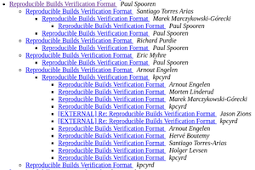
Mailing list: There were a number of discussions on our mailing list this month: Paul Spooren started a thread titled Reproducible Builds Verification Format which reopens the discussion around a schema for sharing the results from distributed rebuilders:
To make the results accessible, storable and create tools around them, they should all follow the same schema, a reproducible builds verification format. The format tries to be as generic as possible to cover all open source projects offering precompiled source code. It stores the rebuilder results of what is reproducible and what not.
Hans-Christoph Steiner of the Guardian Project also continued his previous discussion regarding making our website translatable. Lastly, Leo Wandersleb posted a detailed request for feedback on a question of supply chain security and other issues of software review; Leo is the founder of the Wallet Scrutiny project which aims to prove the security of Android Bitcoin Wallets:
Do you own your Bitcoins or do you trust that your app allows you to use your coins while they are actually controlled by them ? Do you have a backup? Do they have a copy they didn t tell you about? Did anybody check the wallet for deliberate backdoors or vulnerabilities? Could anybody check the wallet for those?
Elsewhere, Leo had posted instructions on his attempts to reproduce the binaries for the BlueWallet Bitcoin wallet for iOS and Android platforms.


If you are interested in contributing to the Reproducible Builds project, please visit our Contribute page on our website. However, you can get in touch with us via:

This month s report was written by Bernhard M. Wiedemann, Chris Lamb, Holger Levsen, Jelle van der Waa and Vagrant Cascadian. It was subsequently reviewed by a bunch of Reproducible Builds folks on IRC and the mailing list.

3 June 2020

Debian Project Leader: DPL Activity logs for April/May 2020

First month as DPL I survived my first month as DPL! I agree with previous DPLs who have described it as starting a whole new job. Fortunately it wasn't very stressful, but it certainly was very time consuming. On the very first day my inbox exploded with requests. I dealt with this by deferring anything that wasn't important right away and just started working through it. Fortunately the initial swell subsided as the month progressed. The bulk of my remaining e-mail backlog are a few media outlets who wants to do interviews. I'll catch up with those during this month. Towards the end of the month, most of my focus was on helping to prepare for an online MiniDebConf that we hosted over the last weekend in May. We had lots of fun and we had some great speakers sharing their knowledge and expertise during the weekend. Activity log As I do on my own blog for free software activities, I'll attempt to keep a log of DPL activities on this blog. Here's the log for the period 2020-04-21 to 2020-05-21: 2020-04-19: Handover session with Sam, our outgoing DPL. We covered a lot of questions I had and main areas that the DPL works in. Thanks to Sam for having taken the time to do this. 2020-04-21: First day of term! Thank you to everybody who showed support and have offered to help! 2020-04-21: Request feedback from the trademark team on an ongoing trademark dispute. 2020-04-21: Join the GNOME Advisory Board as a representative from Debian. 2020-04-21: Reply on an ongoing community conflict issue. 2020-04-21: Update Debian project summary for SPI annual report. 2020-04-21: Received a great e-mail introduction from Debian France and followed up on that. 2020-04-21: Posted "Bits from the new DPL" to debian-devel-announce. 2020-04-22: Became Debian's OSI Affilliate representative. 2020-04-22: Reply to a bunch of media inquiries for interviews, will do them later when initial priorities are on track. 2020-04-23: Resign as Debian FTP team trainee and mailing list moderator. In both these areas there are enough people taking care of it and I intend to maximise available time for DPL and technical areas in the project. 2020-04-25: Review outgoing mail for trademark team. 2020-04-25: Answer some questions in preparation for DAM/Front Desk delegation updates. 2020-04-26: Initiated wiki documentation for delegation updates process. 2020-04-27: Update delegation for the Debian Front Desk team. 2020-04-29: Schedule video call with Debian treasurer team. 2020-04-29: OSI affiliate call. Learned about some Open Source projects including OpenDev, OpenSourceMatters, FOSS Responders and Democracy Labs. 2020-05-04: Delivered my first talk session as DPL titled "Mixed Bag of Debian" at "Fique Em Casa Use Debian" (Stay at home and use Debian!), organised by Debian Brazil, where they had a different talk every evening during the month of May. Great initiative I hope other local groups consider copying their ideas! 2020-05-05: Had a 2 hour long call with the treasurer team. Feeling optimistic for the future of Debian's financing although it will take some time and a lot of work to get where we want to be. 2020-05-17: Respond to cloud delegation update.

Keith Packard: picolibc-ryu

Float/String Conversion in Picolibc: Enter Ry I recently wrote about this topic having concluded that the best route for now was to use the malloc-free, but imprecise, conversion routines in the tinystdio alternative. A few days later, Sreepathi Pai pointed me at some very recent work in this area: This is amazing! Thirty years after the papers referenced in the previous post, Ulf Adams came up with some really cool ideas and managed to reduce the math required for 64-bit conversion to 128 bit integers. This is a huge leap forward; we were doing long multi-precision computations before, and now it's all short enough to fit in registers (ok, a lot of registers, but still). Getting the Ry Code The code is available on github: https://github.com/ulfjack/ryu. Reading through it, it's very clear that the author focuses on performance with lots of tuning for common cases. Still, it's quite readable, especially compared with the newlib multi-precision based code. Picolibc String/Float conversion interface Picolibc has some pretty basic needs for the float/string conversion code, it wants four functions:
  1. __dtoa_engine
    int
    __dtoa_engine(double x, struct dtoa *dtoa, uint8_t max_digits, uint8_t max_decimals);
    
    This converts the double x to a string of decimal digits and a decimal exponent stored inside the 'dtoa' struct. It limits the total number of digits to max_digits and, optionally (when max_decimals is non-zero), limits the number of fractional digits to max_decimals - 1. This latter supports 'f' formats. Returns the number of digits stored, which is <= max_digits. Less if the number can be accurately represented in fewer digits.
  2. __ftoa_engine
    int
    __ftoa_engine(float x, struct ftoa *ftoa, uint8_t max_digits, uint8_t max_decimals);
    
    The same as __dtoa_engine, except for floats.
  3. __atod_engine
    double
    __atod_engine(uint64_t m10, int e10);
    
    To avoid needing to handle stdio inside the conversion function, __atod_engine receives fully parsed values, the base-10 significand (m10) and exponent (e10). The value to convert is m10 * pow(10, e10).
  4. __atof_engine
    float
    __atof_engine(uint32_t m10, int e10);
    
    The same as __atod_engine, except for floats.
With these, it can do printf, scanf, ecvt, fcvt, gcvt, strtod, strtof and atof. Porting Ry to Picolibc The existing Ry float-to-string code always generates the number of digits necessary for accurate output. I had to hack it up to generate correctly rounded shorter output when max_digits or max_decimals were smaller. I'm not sure I managed to do that correctly, but at least it appears to be passing all of the test cases I have. In normal operation, Ry iteratively removes digits from the answer that aren't necessary to disambiguate with neighboring values. What I changed was to keep removing digits using that method until the answer had few enough digits to fit in the desired length. There's some tricky rounding code that adjusts the final result and I had to bypass that if I'd removed extra digits. That was about the only change necessary to the core algorithm. I also trimmed the code to only include the general case and not the performance improvements, then wrapped it with code to provide the _engine interface. On the string-to-float side, most of what I needed to do was remove the string parsing bits at the start of the function and switch from performance-optimized to space-optimized versions of a couple of internal routines. Correctness Results Because these new functions are now 'exact', I was able to adjust the picolibc tests to compare all of the bits for string/float conversion instead of having to permit a bit of slop in the answers. With those changes, the picolibc test suite passes, which offers some assurance that things aren't completely broken. Size Results Snek uses the 32-bit float versions of the conversion routines, and for that, the size difference is:
   text    data     bss     dec     hex filename
  59068      44   37968   97080   17b38 snek-qemu-riscv-orig.elf
  59430      44   37968   97442   17ca2 snek-qemu-riscv-ryu.elf
    362
362 bytes added to gain accurate printf/strtof results seems like a good trade-off in this case. Performance I haven't measured performance at all, but I suspect that it won't be nearly as problematic on most platforms as the source code makes it appear. And that's because Ry is entirely integer arithmetic with no floating point at all. This avoids using the soft fp code for platforms without hardware float support. Pointers to the Code I haven't merged this to picolibc master yet, it's on the ryu branch: Review, especially of the hack above to return short results, would be greatly appreciated! Thanks again to Ulf Adams for creating this code and to Sreepathi Pai for sending me a note about it!

2 June 2020

Olivier Berger: Mixing NRELab s Antidote and Eclipse Che on the same k8s cluster

You may have heard of my search for Cloud solutions to run labs in an academic context, with a focus on free an open source solutions . You may read previous installments of this blog, or for a shorter, check the presentation I ve recorded last week. I ve become quite interested, in the latest month, in 2 projects: NRELab s Antidote and Eclipse Che. Antidote is the software that powers NRELabs, a labs platform for learning network automation, which runs on top of Kubernetes (k8s). The interesting thing is that for each learner, there can be a dedicated k8s namespace with multiple virtual nodes running on a separate network. This can be used in the context of virtual classes/labs where our students will perform network labs in parallel on the same cluster. Eclipse Che powers Eclipse on the Cloud , making available software development environments, for developers, on a Kubernetes Cloud. Developers typically work from a Web page instead of installing local development tools. Both projects seem quite complementary. For one, we both teach networks and software developments. So that would naturally appeal for many professors. Furthermore, Eclipse Che provides a few features that Antidote is lacking : authenticating users (with keycloak), and persisting their work in workspaces, between work sessions. Typically what we need in our academic context where students will work on the same labs during scheduled classes, week after week, during or off-hours. Thus it would be great to have more integration between the 2 environments. I intend to work on that front, but that takes time, as running stuff on Kubernetes isn t exactly trivial, at least when you re like me and want to use a vanilla kubernetes. I ve mainly relied on running k8s inside VMs using Vagrant and/or minikube so far. A first milestone I ve achieved is making sure that Antidote and Eclipse Che aren t incompatible. Antidote s selfmedicate script was actually running inside a Vagrant VM, where I had difficulties installing Eclipse Che (probably because of old software, or particular networking setup details). I ve overcome this hurdle, as I m now able to install both environments on a single Kubernetes VM (using my own Vagrant setup). Running Eclipse Che (alongsite Antidote) on a k8s Vagrant VM. This proves only that there s no show stopper there, but a lot of work remains. Stay tuned. Update: I ve finally managed to get it to work on the antidote-selfmedicate base too. See my branch at: https://github.com/olberger/antidote-selfmedicate/tree/che

Lisandro Dami n Nicanor P rez Meyer: Simplified Monitoring of Patients in Situations of Mass Hospitalization (MoSimPa) - Fighting COVID-19

I have been quite absent from Debian stuff lately, but this increased since COVID-19 hits us. In this blog post I'll try to sketch what I have been doing to help fight COVID-19 this last few months.

In the beginningWhen the pandemic reached Argentina the government started a quarantine. We engineers (like engineers around the world) started to think on how to put our abilities in order to help with the situation. Some worked toward providing more protection elements to medical staff, some towards increasing the number of ventilation machines at disposal. Another group of people started thinking on another ways of helping. In Bah a Blanca arised the idea of monitoring some variables remotely and in masse.

Simplified Monitoring of Patients in Situations of Mass Hospitalization (MoSimPa)

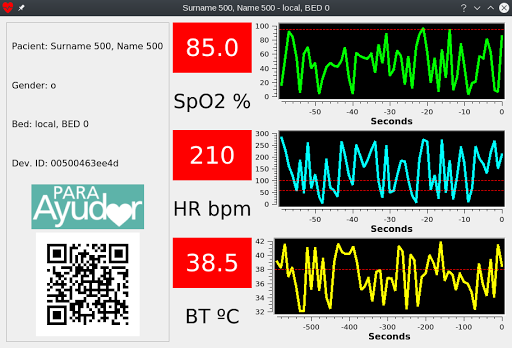
This is where the idea of remotely monitored devices came in, and MoSimPa (from the spanish of "monitoreo simplificado de pacientes en situaci n de internaci n masiva") started to get form. The idea is simple: oximetry (SpO2), heart rate and body temperature will be recorded and, instead of being shown in a display in the device itself, they will be transmitted and monitored in one or more places. In this way medical staff doesn't has to reach a patient constantly and monitoring could be done by medical staff for more patients at the same time. In place monitoring can also happen using a cellphone or tablet.

The devices do not have a screen of their own and almost no buttons, making them more cheap to build and thus more in line with the current economic reality of Argentina.


This is where the project Para Ayudar was created. The project aims to produce the aforementioned non-invasive device to be used in health institutions, hospitals, intra hospital transports and homes.

It is worth to note that the system is designed as a complementary measure for continuous monitoring of a pacient. Care should be taken to check that symptomps and overall patient status don't mean an inmediate life threat. In other words, it is NOT designed for ICUs.

All the above done with Free/Libre/Open Source software and hardware designs. Any manufacturing company can then use them for mass production.

The importance of early pneumonia detection


We were already working in MoSimPa when an NYTimes article caught or attention: "The Infection That s Silently Killing Coronavirus Patients". From the article:

A vast majority of Covid pneumonia patients I met had remarkably low oxygen saturations at triage seemingly incompatible with life but they were using their cellphones as we put them on monitors. Although breathing fast, they had relatively minimal apparent distress, despite dangerously low oxygen levels and terrible pneumonia on chest X-rays.

This greatly reinforced the idea we were on the right track.

The project from a technical standpoint


As the project is primarily designed for and by Argentinians the current system design and software documentation is written in spanish, but the source code (or at least most of it) is written in english. Should anyone need it in english please do not hesitate in asking me.

General system description

System schema

The system is comprised of the devices, a main machine acting as a server (in our case for small setups a Raspberry Pi) and the possibility of accessing data trough cell phones, tablets or other PCs in the network.

The hardware


As of today this is the only part in which I still can't provide schematics, but I'll update this blog post and technical doc with them as soon as I get my hands into them.

Again the design is due to be built in Argentina where getting our hands on hardware is not easy. Moreover it needs to be as cheap as possible, specially now that the Argentinian currency, the peso, is every day more depreciated. So we decided on using an ESP32 as the main microprocessor and a set of Maxim sensors devices. Again, more info when I have them at hand.

The software


Here we have many more components to describe. Firstly the ESP32 code is done with the Arduino SDK. This part of the stack will receive many updates soon, as soon as the first hardware prototypes are out.

For the rest of the stack I decided to go ahead with whatever is available in Debian stable. Why? Well, Raspbian provides a Debian stable-based image and I'm a Debian Developer, so things should go just natural for me in that front. Of course each component has its own packaging. I'm one of Debian's Qt maintainers then using Qt will also be quite natural for me. Plots? Qwt, of course. And with that I have most of my necessities fulfilled. I choose PostgreSql as database server and Mosquitto as MQTT broker.

Between the database and MQTT is mosimpa-datakeeper. The piece of software from which medical staff monitor patients is unsurprisingly called mosimpa-monitor.

mosimpa-monitor
MoSimPa's monitor main screen

mosimpa-monitor plots
Plots of a patient's data


mosimpa-monitor-alarms-setup
Alarm thresholds setup


And for managing patients, devices, locations and internments (CRUD anyone?) there is currently a Qt-based application called mosimpa-abm.

mosimpa-abm
ABM main screen


mosimpa-abm-internments
ABM internments view

The idea is to replace it with a web service so it doesn't needs to be confined to the RPi or require installations in other machines. I considered using webassembly but I would have to also build PostgreSql in order to compile Qt's plugin.

Translations? Of course! As I have already mentioned the code is written in English. Qt allows to easily translate applications, so I keep a Spanish one as the code changes (and we are primarily targeting spanish-speaking people). But of course this also means it can be easily translated to whichever language is necessary.

Even if I am a packager I still have some stuff to fix from the packaging itself, like letting datakeeper run with its own user. I just haven't got to it yet.


Certifications


We are working towards getting the system certified by ANMAT, which is the Argentinian equivalent for EEUU's FDA.

Funding


While all the people involved are working ad-honorem funding is still required in order to buy materials, create the prototypes, etc. The project created payments links with Mercado Pago (in spanish and argentinian pesos) and other bank methods (PDF, also in spanish).

I repeat the links here with an aproximation to US$.

- 500 AR$ (less than 8 US$)
- 1000 AR$ (less than 15 US$)
- 2000 AR$ (less than 30 US$)
- 3000 AR$ (less than 45 US$)
- 5000 AR$ (less than 75 US$)

You can check the actual convertion rate in https://www.google.com/search?q=argentine+peso+to+us+dollars

The project was also presented at a funding call of argentinian Agencia de Promoci n de la Investigaci n, el Desarrollo Tecnol gico y la Innovaci n (Agencia I+D+i). 900+ projects where presented and 64 funded, MoSimPa between them.

1 June 2020

Paul Wise: FLOSS Activities May 2020

Focus This month I didn't have any particular focus. I just worked on issues in my info bubble.

Changes

Issues

Review

Administration
  • nsntrace: talk to upstream about collaborative maintenance
  • Debian: deploy changes, debug issue with GPS markers file generation, migrate bls/DUCK from alioth-archive to salsa
  • Debian website: ran map cron job, synced mirrors
  • Debian wiki: approve accounts, ping folks with bouncing email

Communication

Sponsors The apt-offline work and the libfile-libmagic-perl backports were sponsored. All other work was done on a volunteer basis.

31 May 2020

Enrico Zini: Controversial inventors

Paul-F lix Armand-Delille (3 July 1874 in Fourchambault, Ni vre 4 September 1963) was a physician, bacteriologist, professor, and member of the French Academy of Medicine who accidentally brought about the collapse of rabbit populations throughout much of Europe and beyond in the 1950s by infecting them with myxomatosis.
Charles Franklin Kettering (August 29, 1876 November 25, 1958) sometimes known as Charles "Boss" Kettering[1] was an American inventor, engineer, businessman, and the holder of 186 patents.[2] He was a founder of Delco, and was head of research at General Motors from 1920 to 1947. Among his most widely used automotive developments were the electrical starting motor[3] and leaded gasoline.[4][5] In association with the DuPont Chemical Company, he was also responsible for the invention of Freon refrigerant for refrigeration and air conditioning systems. At DuPont he also was responsible for the development of Duco lacquers and enamels, the first practical colored paints for mass-produced automobiles. While working with the Dayton-Wright Company he developed the "Bug" aerial torpedo, considered the world's first aerial missile.[6] He led the advancement of practical, lightweight two-stroke diesel engines, revolutionizing the locomotive and heavy equipment industries. In 1927, he founded the Kettering Foundation, a non-partisan research foundation. He was featured on the cover of Time magazine on January 9, 1933.
John Charles Cutler (June 29, 1915 February 8, 2003) was a senior surgeon, and the acting chief of the venereal disease program in the United States Public Health Service. After his death, his involvement in several controversial and unethical medical studies of syphilis was revealed, including the Guatemala and the Tuskegee syphilis experiments.
Ivy Ledbetter Lee (July 16, 1877 November 9, 1934) was an American publicity expert and a founder of modern public relations. Lee is best known for his public relations work with the Rockefeller family. His first major client was the Pennsylvania Railroad, followed by numerous major railroads such as the New York Central, the Baltimore and Ohio, and the Harriman lines such as the Union Pacific. He established the Association of Railroad Executives, which included providing public relations services to the industry. Lee advised major industrial corporations, including steel, automobile, tobacco, meat packing, and rubber, as well as public utilities, banks, and even foreign governments. Lee pioneered the use of internal magazines to maintain employee morale, as well as management newsletters, stockholder reports, and news releases to the media. He did a great deal of pro bono work, which he knew was important to his own public image, and during World War I, he became the publicity director for the American Red Cross.[1]

Chris Lamb: Free software activities in May 2020

Here is my monthly update covering what I have been doing in the free software world during May 2020 (previous month): In Lintian, the static analysis tool for Debian packages:
Reproducible builds One of the original promises of open source software is that distributed peer review and transparency of process results in enhanced end-user security. However, whilst anyone may inspect the source code of free and open source software for malicious flaws, almost all software today is distributed as pre-compiled binaries. This allows nefarious third-parties to compromise systems by injecting malicious code into ostensibly secure software during the various compilation and distribution processes. The motivation behind the Reproducible Builds effort is to ensure no flaws have been introduced during this compilation process by promising identical results are always generated from a given source, thus allowing multiple third-parties to come to a consensus on whether a build was compromised. The initiative is proud to be a member project of the Software Freedom Conservancy, a not-for-profit 501(c)(3) charity focused on ethical technology and user freedom. Conservancy acts as a corporate umbrella allowing projects to operate as non-profit initiatives without managing their own corporate structure. If you like the work of the Conservancy or the Reproducible Builds project, please consider becoming an official supporter.
Elsewhere in our tooling, I made the following changes to diffoscope, our in-depth and content-aware diff utility that can locate and diagnose reproducibility issues, including preparing and uploading versions 142, 143, 144, 145 and 146 to Debian: I also performed a huge overhaul of diffoscope's website:
Lastly, I made a large number of changes to the main Reproducible Builds website and documentation:
Debian LTS This month I contributed 17 hours to Debian Long Term Support (LTS) and 9 hours on its sister Extended LTS project. You can find out more about the two projects via the following video:
Debian I filed the following bug reports in Debian this month: I also filed a number of bugs against packages that are not compatible with Django 3.x, (organised around a single master bug) including django-taggit, sorl-thumbnail, django-simple-captcha, django-cas-server, django-cors-headers, python-django-csp, django-pipeline, python-django-jsonfield, python-django-contact-form, django-model-utils, django-fsm, django-modeltranslation, django-oauth-toolkit, libthumbor, python-django-extensions, python-django-imagekit, python-django-navtag, python-django-tagging, djangorestframework, django-haystack, django-taggit, django-simple-captcha, python-django-registration, python-django-pyscss, python-django-compressor, python-django-crispy-forms & python-django-mptt,
Lastly, I made the following uploads to Debian: I also sponsored an upload for adminer (4.7.7-1), also uploading it to buster-backports.

Jonathan McDowell: OpenOCD snapshot uploaded to Debian experimental

One of the things I maintain in Debian is OpenOCD. I say maintain, but it s so far required very little work, as it s been 3 years since a release (0.10.0). I ve talked about doing a git snapshot package for some time (I have an email from last DebConf in my inbox about it, and that wasn t the first time someone had asked), but never got around to it. Spurred on by some moves towards a 0.11.0 release I ve built a recent snapshot and uploaded it to the experimental suite in Debian. Of particular interest is the support for more recent architectures that this brings - ARMv8/aarch64 and RISC-V being the big ones, but also MIPS64 and various other ARM improvements. I no longer have access to Xilinx Zynq or Mellanox Bluefield platforms to test against so I ve just done some some basic tests with a Sheevaplug and BusPirate/STM32F103, but those worked just fine. Builds should hopefully happen shortly. Enjoy!

30 May 2020

Sean Whitton: GNU Emacs' Transient Mark mode

Something I ve found myself doing as the pandemic rolls on is picking out and (re-)reading through sections of the GNU Emacs manual and the GNU Emacs Lisp reference manual. This has got me (too) interested in some of the recent history of Emacs development, and I did some digging into archives of emacs-devel from 2008 (15M mbox) regarding the change to turn Transient Mark mode on by default and set mark-even-if-inactive to true by default in Emacs 23.1. It s not always clear which objections to turning on Transient Mark mode by default take into account the mark-even-if-inactive change. I think that turning on Transient Mark mode along with mark-even-if-inactive is a good default. The question that remains is whether the disadvantages of Transient Mark mode are significant enough that experienced Emacs users should consider altering Emacs default behaviour to mitigate them. Here s one popular blog arguing for some mitigations. How might Transient Mark mode be disadvantageous? The suggestion is that it makes using the mark for navigation rather than for acting on regions less convenient:
  1. setting a mark just so you can jump back to it (i) is a distinct operation you have to think of separately; and (ii) requires two keypresses, C-SPC C-SPC, rather than just one keypress
  2. using exchange-point-and-mark activates the region, so to use it for navigation you need to use either C-u C-x C-x or C-x C-x C-g, neither of which are convenient to type, or else it will be difficult to set regions at the place you ve just jumped to because you ll already have one active.
There are two other disadvantages that people bring up which I am disregarding. The first is that it makes it harder for new users to learn useful ways in which to use the mark when it s deactivated. This happened to me, but it can be mitigated without making any behavioural changes to Emacs. The second is that the visual highlighting of the region can be distracting. So far as I can tell, this is only a problem with exchange-point-and-mark, and it s subsumed by the problem of that command actually activating the region. The rest of the time Emacs automatic deactivation of the region seems sufficient. How might disabling Transient Mark mode be disadvantageous? When Transient Mark mode is on, many commands will do something usefully different when the mark is active. The number of commands in Emacs which work this way is only going to increase now that Transient Mark mode is the default. If you disable Transient Mark mode, then to use those features you need to temporarily activate Transient Mark mode. This can be fiddly and/or require a lot of keypresses, depending on exactly where you want to put the region. Without being able to see the region, it might be harder to know where it is. Indeed, this is one of the main reasons for wanting Transient Mark mode to be the default, to avoid confusing new users. I don t think this is likely to affect experienced Emacs users often, however, and on occasions when more precision is really needed, C-u C-x C-x will make the region visible. So I m not counting this as a disadvantage. How might we mitigate these two sets of disadvantages? Here are the two middle grounds I m considering. Mitigation #1: Transient Mark mode, but hack C-x C-x behaviour
(defun spw/exchange-point-and-mark (arg)
  "Exchange point and mark, but reactivate mark a bit less often.

Specifically, invert the meaning of ARG in the case where
Transient Mark mode is on but the region is inactive."
  (interactive "P")
  (exchange-point-and-mark
   (if (and transient-mark-mode (not mark-active))
       (not arg)
     arg)))
(global-set-key [remap exchange-point-and-mark] &aposspw/exchange-point-and-mark)
We avoid turning Transient Mark mode off, but mitigate the second of the two disadvantages given above. I can t figure out why it was thought to be a good idea to make C-x C-x reactivate the mark and require C-u C-x C-x to use the action of exchanging point and mark as a means of navigation. There needs to a binding to reactivate the mark, but in roughly ten years of having Transient Mark mode turned on, I ve found that the need to reactivate the mark doesn t come up often, so the shorter and longer bindings seem the wrong way around. Not sure what I m missing here. Mitigation #2: disable Transient Mark mode, but enable it temporarily more often
(setq transient-mark-mode nil)
(defun spw/remap-mark-command (command &optional map)
  "Remap a mark-* command to temporarily activate Transient Mark mode."
  (let* ((cmd (symbol-name command))
         (fun (intern (concat "spw/" cmd)))
         (doc (concat "Call  "
                      cmd
                      "&apos and temporarily activate Transient Mark mode.")))
    (fset fun  (lambda ()
                 ,doc
                 (interactive)
                 (call-interactively #&apos,command)
                 (activate-mark)))
    (if map
        (define-key map (vector &aposremap command) fun)
      (global-set-key (vector &aposremap command) fun))))
(dolist (command &apos(mark-word
                   mark-sexp
                   mark-paragraph
                   mark-defun
                   mark-page
                   mark-whole-buffer))
  (spw/remap-mark-command command))
(with-eval-after-load &aposorg
  (spw/remap-mark-command &aposorg-mark-element org-mode-map)
  (spw/remap-mark-command &aposorg-mark-subtree org-mode-map))
;; optional
(global-set-key "\M-=" (lambda () (interactive) (activate-mark)))
;; resettle the previous occupant
(global-set-key "\C-cw" &aposcount-words-region)
Here we remove both of the disadvantages of Transient Mark mode given above, and mitigate the main disadvantage of not activating Transient Mark mode by making it more convenient to activate it temporarily. For example, this enables using C-M-SPC C-M-SPC M-( to wrap the following two function arguments in parentheses. And you can hit M-h a few times to mark some blocks of text or code, then operate on them with commands like M-% and C-/ which behave differently when the region is active.1 Comparing these mitigations Both of these mitigations handle the second of the two disadvantages of Transient Mark mode given above. What remains, then, is
  1. under the effects of mitigation #1, how much of a barrier to using marks for navigational purposes is it to have to press C-SPC C-SPC instead of having a single binding, C-SPC, for all manual mark setting2
  2. under the effects of mitigation #2, how much of a barrier to taking advantage of commands which act differently when the region is active is it to have to temporarily enable Transient Mark mode with C-SPC C-SPC, M-= or one of the mark-* commands?
These are unknowns.3 So I m going to have to experiment, I think, to determine which mitigation to use, if either. In particular, I don t know whether it s really significant that setting a mark for navigational purposes and for region marking purposes are distinct operations under mitigation #1. My plan is to start with mitigation #2 because that has the additional advantage of allowing me to confirm or disconfirm my belief that not being able to see where the region is will only rarely get in my way.

  1. The idea of making the mark-* commands activate the mark comes from an emacs-devel post by Stefan Monnier in the archives linked above.
  2. One remaining possibility I m not considering is mitigation #1 plus binding something else to do the same as C-SPC C-SPC. I don t believe there are any easily rebindable keys which are easier to type than typing C-SPC twice. And this does not deal with the two distinct mark-setting operations problem.
  3. Another way to look at this is the question of which of setting a mark for navigational purposes and activating a mark should get C-SPC and which should get C-SPC C-SPC.

Dirk Eddelbuettel: drat 0.1.6: Rewritten macOS binary support

drat user A new version of drat arrived on CRAN overnight, once again taking advantage of the fully automated process available for such packages with few reverse depends and no open issues. As we remarked at the last release fourteen months ago when we scored the same nice outcome: Being a simple package can have its upsides This release is mostly the work of Felix Ernst who took on what became a rewrite of how binary macOS packages are handled. If you need to distribute binary packages for macOS users, this may help. Two more small updates were made, see below for full details. drat stands for drat R Archive Template, and helps with easy-to-create and easy-to-use repositories for R packages. Since its inception in early 2015 it has found reasonably widespread adoption among R users because repositories with marked releases is the better way to distribute code. As your mother told you: Friends don t let friends install random git commit snapshots. Rolled-up releases it is. drat is easy to use, documented by five vignettes and just works. The NEWS file summarises the release as follows:

Changes in drat version 0.1.6 (2020-05-29)
  • Changes in drat functionality
    • Support for the various (current) macOS binary formats was rewritten (Felix Ernst in #89 fixing #88).
    • Travis CI use was updated to R 4.0.0 and bionic (Dirk).
    • A drat repo was added to the README (Thomas Fuller in #86)

Courtesy of CRANberries, there is a comparison to the previous release. More detailed information is on the drat page. If you like this or other open-source work I do, you can now sponsor me at GitHub. For the first year, GitHub will match your contributions.

This post by Dirk Eddelbuettel originated on his Thinking inside the box blog. Please report excessive re-aggregation in third-party for-profit settings.

28 May 2020

Antoine Beaupr : Upgrading my home server uplink

For more than a few decades now (!), I've been running my own server. First it was just my old Pentium 1 squatting on university networks, but eventually grew into a real server somewhere at the dawn of the millenia. Apart from the university days, the server was mostly hosted over ADSL links, first a handful of megabits, up to the current 25 Mbps down, 6 Mbps up that the Bell Canada network seems to allow to its resellers (currently Teksavvy Internet, or TSI).

Why change? Obviously, this speed is showing its age, and especially in this age of Pandemia where everyone is on videoconferencing all the time. But it's also inconvenient when I need to upload large files on the network. I also host a variety of services on this network, and I always worry that any idiot can (rather trivially) DoS my server, so I often feel I should pack a little more punch at home (although I have no illusions about my capacity of resisting any sort of DoS attack at home of course). Also, the idea of having gigabit links at home brings back the idea of the original internet, that everyone on the internet is a "peer". "Client" and "servers" are just a technical distinction and everyone should be able to run a server.

Requirements So I'm shopping for a replacement. The requirements are:
  1. higher speed than 25/6, preferably 100mbps down, 30mbps up, or more. ideally 1gbps symmetric.
  2. static or near-static IP address: I run a DNS server with its IP in the glue records (although the latter could possibly be relaxed). ideally a /29 or more.
  3. all ports open: I run an SMTP server (incoming and outgoing) along with a webserver and other experiments. ideally, no firewall or policy should be blocking me from hosting stuff, unless there's an attack or security issue, obviously.
  4. clean IP address: the SMTP server needs to have a good reputation, so the IP address should not be in a "residential space" pool.
  5. IPv6 support: TSI offers IPv6 support, but it is buggy (I frequently have to restart the IPv6 interface on the router because the delegated block stops routing, and they haven't been able to figure out the problem). ideally, a /56.
  6. less than 100$/mth, ideally close to the current 60$/mth I pay.
(All amounts in $CAD.)

Contestants I wrote a similar message asking major ISPs in my city for those services, including business service if necessary: I have not contacted those providers:
  • Bell Canada: i have sworn, two decades ago, never to do business with that company ever again. They have a near-monopoly on almost all telcos in Canada and I want to give them as little money as possible.
  • Videotron: I know for a fact they do not allow servers on their network, and their IPv6 has been in beta for so long it has become somewhat of a joke now
I might have forgotten some, let me know if you're in the area and have a good recommendation. I'll update this post with findings as they come in. Keep in mind that I am in a major Canadian city, less than a kilometer from a major telco exchange site, so it's not like I'm in a rural community. This should just work.

TSI First answer from TSI was "we do not provide 30mbps upload on residential services", even though they seem to have that package on their website. They confirmed that they "don't have a option more than 10 mbps upload." TSI were the first to respond, within 24h.

Oricom They offer a 100/30 link for 65$ plus 25$ for a static IP. No IPv6 yet, unlikely to come soon. No services blocked, they have their own PoP within Videotron's datacenters so clients come out from their IP address space. I can confirm that the IP is fairly static from the office. Oricom were the second to respond, within 24h, but required a phone call instead of an email exchange. Responded within 6 hours after leaving a voicemail.

Ebox Ebox claims my neighborhood supports 400mbps down, but offered me a 100/30 package with 350Go bandwidth per month for 54.95$/mth or unlimited for 65$/mth. Many ports are blocked, which makes it impossible for me to use their service:
  • port 25 blocked incoming
  • port 25 filtered outgoing (only allowed to their servers)
  • port 53 blocked incoming (!)
No static IP addressing, shared dynamic space so no garantee on reputation. IPv6 only on DSL, so no high speed IPv6. Ebox took the longest to respond, about 48 hours.

Beanfield / Openface Even though they have a really interesting service (50$/mth for unlimited 1gbps), they are not in my building. I did try to contact them over chat, they told me to call, and I left a message. They responded saying they mostly offer business services for now, no residential in Montreal.

27 May 2020

Russ Allbery: Review: Middlegame

Review: Middlegame, by Seanan McGuire
Publisher: Tor
Copyright: May 2019
ISBN: 1-250-19551-9
Format: Kindle
Pages: 528
Roger and Dodger are cuckoo children, alchemical constructs created by other alchemical constructs masquerading as humans. They are halves of the primal force of the universe, the Doctrine of Ethos (which is not what the Doctrine of Ethos is, but that is one of my lesser problems with this book), divided into language and math and kept separate to properly mature. In this case, separate means being adopted by families on opposite coasts of the United States, ignorant of each other's existence and closely monitored by agents Reed controls. None of that prevents Roger and Dodger from becoming each other's invisible friends at the age of seven, effortlessly communicating psychically even though they've never met. That could have been the start of an enjoyable story that hearkened back to an earlier age of science fiction: the secret science experiments discover that they have more power than their creators expected, form a clandestine alliance, and fight back against the people who are trying to control them. I have fond memories of Escape to Witch Mountain and would have happily read that book. Unfortunately, that isn't the story McGuire wanted to tell. The story she told involves ripping Roger and Dodger apart, breaking Dodger, and turning Roger into an abusive asshole. Whooboy, where to start. This book made me very angry, in a way that I would not have been if it didn't contain the bones of a much better novel. Four of them, to be precise: four other books that would have felt less gratuitously cruel and less apparently oblivious to just how bad Roger's behavior is. There are some things to like. One of them is that the structure of this book is clever. I can't tell you how it's clever because the structure doesn't become clear until more than halfway through and it completely changes the story in a way that would be a massive spoiler. But it's an interesting spin on an old idea, one that gave Roger and Dodger a type of agency in the story that has far-ranging implications. I enjoyed thinking about it. That leads me to another element I liked: Erin. She makes only fleeting appearances until well into the story, but I thought she competed with Dodger for being the best character of the book. The second of the better novels I saw in the bones of Middlegame was the same story told from Erin's perspective. I found myself guessing at her motives and paying close attention to hints that led to a story with a much different emotional tone. Viewing the ending of the book through her eyes instead of Roger and Dodger's puts it in a different, more complicated, and more thought-provoking light. Unfortunately, she's not McGuire's protagonist. She instead is one of the monsters of this book, which leads to my first, although not my strongest, complaint. It felt like McGuire was trying too hard to write horror, packing Middlegame with the visuals of horror movies without the underlying structure required to make them effective. I'm not a fan of horror personally, so to some extent I'm grateful that the horrific elements were ineffective, but it makes for some frustratingly bad writing. For example, one of the longest horror scenes in the book features Erin, and should be a defining moment for the character. Unfortunately, it's so heavy on visuals and so focused on what McGuire wants the reader to be thinking that it doesn't show any of the psychology underlying Erin's decisions. The camera is pointed the wrong way; all the interesting storytelling work, moral complexity, and world-building darkness is happening in the character we don't get to see. And, on top of that, McGuire overuses foreshadowing so much that it robs the scene of suspense and terror. Again, I'm partly grateful, since I don't read books for suspense and terror, but it means the scene does only a fraction of the work it could. This problem of trying too hard extends to the writing. McGuire has a bit of a tendency in all of her books to overdo the descriptions, but is usually saved by narrative momentum. Unfortunately, that's not true here, and her prose often seems overwrought. She also resorts to this style of description, which never fails to irritate me:
The thought has barely formed when a different shape looms over him, grinning widely enough to show every tooth in its head. They are even, white, and perfect, and yet he somehow can't stop himself from thinking there's something wrong with them, that they're mismatched, that this assortment of teeth was never meant to share a single jaw, a single terrible smile.
This isn't effective. This is telling the reader how they're supposed to feel about the thing you're describing, without doing the work of writing a description that makes them feel that way. (Also, you may see what I mean by overwrought.) That leads me to my next complaint: the villains. My problem is not so much with Leigh, who I thought was an adequate monster, if a bit single-note. There's some thought and depth behind her arguments with Reed, a few hints of her own motives that were more convincing for not being fully shown. The descriptions of how dangerous she is were reasonably effective. She's a good villain for this type of dark fantasy story where the world is dangerous and full of terrors (and reminded me of some of the villains from McGuire's October Daye series). Reed, though, is a storytelling train wreck. The Big Bad of the novel is the least interesting character in it. He is a stuffed tailcoat full of malicious incompetence who is only dangerous because the author proclaims him to be. It only adds insult to injury that he kills off a far more nuanced and creative villain before the novel starts, replacing her ambiguous goals with Snidely Whiplash mustache-twirling. The reader has to suffer through extended scenes focused on him as he brags, monologues, and obsesses over his eventual victory without an ounce of nuance or subtlety. Worse is the dynamic between him and Leigh, which is only one symptom of the problem with Middlegame that made me the most angry: the degree to this book oozes patriarchy. Every man in this book, including the supposed hero, orders around the women, who are forced in various ways to obey. This is the most obvious between Leigh and Reed, but it's the most toxic, if generally more subtle, between Roger and Dodger. Dodger is great. I had absolutely no trouble identifying with and rooting for her as a character. The nasty things that McGuire does to her over the course of the book (and wow does that never let up) made me like her more when she tenaciously refuses to give up. Dodger is the math component of the Doctrine of Ethos, and early in the book I thought McGuire handled that well, particularly given how difficult it is to write a preternatural genius. Towards the end of this book, her math sadly turns into a very non-mathematical magic (more on this in a moment), but her character holds all the way through. It felt like she carved her personality out of this story through sheer force of will and clung to it despite the plot. I wanted to rescue her from this novel and put her into a better book, such as the one in which her college friends (who are great; McGuire is very good at female friendships when she writes them) stage an intervention, kick a few people out of her life, and convince her to trust them. Unfortunately, Dodger is, by authorial fiat, half of a bound pair, and the other half of that pair is Roger, who is the sort of nice guy everyone likes and thinks is sweet and charming until he turns into an emotional trap door right when you need him the most and dumps you into the ocean to drown. And then somehow makes you do all the work of helping him feel better about his betrayal. The most egregious (and most patriarchal) thing Roger does in this book is late in the book and a fairly substantial spoiler, so I can't rant about that properly. But even before that, Roger keeps doing the the same damn emotional abandonment trick, and the book is heavily invested into justifying it and making excuses for him. Excuses that, I should note, are not made for Dodger; her failings are due to her mistakes and weaknesses, whereas Roger's are natural reactions to outside forces. I got very, very tired of this, and I'm upset by how little awareness the narrative voice showed for how dysfunctional and abusive this relationship is. The solution is always for Dodger to reunite with Roger; it's built into the structure of the story. I have a weakness for the soul-bound pair, in part from reading a lot of Mercedes Lackey at an impressionable age, but one of the dangerous pitfalls of the concept is that the characters then have to have an almost flawless relationship. If not, it can turn abusive very quickly, since the characters by definition cannot leave each other. It's essentially coercive, so as soon as the relationship shows a dark side, the author needs to be extremely careful. McGuire was not. There is an attempted partial patch, late in the book, for the patriarchal structure. One of the characters complains about it, and another says that the gender of the language and math pairs is random and went either way in other pairs. Given that both of the pairs that we meet in this story have the same male-dominant gender dynamic, what I took from this is that McGuire realized there was a problem but wasn't able to fix it. (I'm also reminded of David R. Henry's old line that it's never a good sign when the characters start complaining about the plot.) The structural problems are all the more frustrating because I think there were ways out of them. Roger is supposedly the embodiment of language, not that you'd be able to tell from most scenes in this novel. For reasons that I do not understand, McGuire expressed that as a love of words: lexicography, translation, and synonyms. This makes no sense to me. Those are some of the more structured and rules-based (and hence mathematical) parts of language. If Roger had instead been focused on stories collecting them, telling them, and understanding why and how they're told he would have had a clearer contrast with Dodger. More importantly, it would have solved the plot problem that McGuire solved with a nasty bit of patriarchy. So much could have been done with Dodger building a structure of math around Roger's story-based expansion of the possible, and it would have grounded Dodger's mathematics in something more interesting than symbolic magic. To me, it's such an obvious lost opportunity. I'm still upset about this book. McGuire does a lovely bit of world-building with Asphodel Baker, what little we see of her. I found the hidden alchemical war against her work by L. Frank Baum delightful, and enjoyed every excerpt from the fictional Over the Woodward Wall scattered throughout Middlegame. But a problem with inventing a fictional book to excerpt in a real novel is that the reader may decide that the fictional book sounds a lot better than the book they're reading, and start wishing they could just read that book instead. That was certainly the case for me. I'm sad that Over the Woodward Wall doesn't exist, and am mostly infuriated by Middlegame. Dodger and Erin deserved to live in a better book. Should you want to read this anyway (and I do know people who liked it), serious content warning for self-harm. Rating: 4 out of 10

26 May 2020

Russell Coker: Cruises and Covid19

Problems With Cruises GQ has an insightful and detailed article about Covid19 and the Diamond Princess [1], I recommend reading it. FastCompany has a brief article about bookings for cruises in August [2]. There have been many negative comments about this online. The first thing to note is that the cancellation policies on those cruises are more lenient than usual and the prices are lower. So it s not unreasonable for someone to put down a deposit on a half price holiday in the hope that Covid19 goes away (as so many prominent people have been saying it will) in the knowledge that they will get it refunded if things don t work out. Of course if the cruise line goes bankrupt then no-one will get a refund, but I think people are expecting that won t happen. The GQ article highlights some serious problems with the way cruise ships operate. They have staff crammed in to small cabins and the working areas allow transmission of disease. These problems can be alleviated, they could allocate more space to staff quarters and have more capable air conditioning systems to put in more fresh air. During the life of a cruise ship significant changes are often made, replacing engines with newer more efficient models, changing the size of various rooms for entertainment, installing new waterslides, and many other changes are routinely made. Changing the staff only areas to have better ventilation and more separate space (maybe capsule-hotel style cabins with fresh air piped in) would not be a difficult change. It would take some money and some dry-dock time which would be a significant expense for cruise companies. Cruises Are Great People like social environments, they want to have situations where there are as many people as possible without it becoming impossible to move. Cruise ships are carefully designed for the flow of passengers. Both the layout of the ship and the schedule of events are carefully planned to avoid excessive crowds. In terms of meeting the requirement of having as many people as possible in a small area without being unable to move cruise ships are probably ideal. Because there is a large number of people in a restricted space there are economies of scale on a cruise ship that aren t available anywhere else. For example the main items on the menu are made in a production line process, this can only be done when you have hundreds of people sitting down to order at the same time. The same applies to all forms of entertainment on board, they plan the events based on statistical knowledge of what people want to attend. This makes it more economical to run than land based entertainment where people can decide to go elsewhere. On a ship a certain portion of the passengers will see whatever show is presented each night, regardless of whether it s singing, dancing, or magic. One major advantage of cruises is that they are all inclusive. If you are on a regular holiday would you pay to see a singing or dancing show? Probably not, but if it s included then you might as well do it and it will be pretty good. This benefit is really appreciated by people taking kids on holidays, if kids do things like refuse to attend a performance that you were going to see or reject food once it s served then it won t cost any extra. People Who Criticise Cruises For the people who sneer at cruises, do you like going to bars? Do you like going to restaurants? Live music shows? Visiting foreign beaches? A cruise gets you all that and more for a discount price. If Groupon had a deal that gave you a cheap hotel stay with all meals included, free non-alcoholic drinks at bars, day long entertainment for kids at the kids clubs, and two live performances every evening how many of the people who reject cruises would buy it? A typical cruise is just like a Groupon deal for non-stop entertainment from 8AM to 11PM. Will Cruises Restart? The entertainment options that cruises offer are greatly desired by many people. Most cruises are aimed at budget travellers, the price is cheaper than a hotel in a major city. Such cruises greatly depend on economies of scale, if they can t get the ships filled then they would need to raise prices (thus decreasing demand) to try to make a profit. I think that some older cruise ships will be scrapped in the near future and some of the newer ships will be sold to cruise lines that cater to cheap travel (IE P&O may scrap some ships and some of the older Princess ships may be transferred to them). Overall I predict a decrease in the number of middle-class cruise ships. For the expensive cruises (where the cheapest cabins cost over $1000US per person per night) I don t expect any real changes, maybe they will have fewer passengers and higher prices to allow more social distancing or something. I am certain that cruises will start again, but it s too early to predict when. Going on a cruise is about as safe as going to a concert or a major sporting event. No-one is predicting that sporting stadiums will be closed forever or live concerts will be cancelled forever, so really no-one should expect that cruises will be cancelled forever. Whether companies that own ships or stadiums go bankrupt in the mean time is yet to be determined. One thing that s been happening for years is themed cruises. A group can book out an entire ship or part of a ship for a themed cruise. I expect this to become much more popular when cruises start again as it will make it easier to fill ships. In the past it seems that cruise lines let companies book their ships for events but didn t take much of an active role in the process. I think that the management of cruise lines will look to aggressively market themed cruises to anyone who might help, for starters they could reach out to every 80s and 90s pop group those fans are all old enough to be interested in themed cruises and the musicians won t be asking for too much money. Conclusion Humans are social creatures. People want to attend events with many other people. Covid 19 won t be the last pandemic, and it may not even be eradicated in the near future. The possibility of having a society where no-one leaves home unless they are in a hazmat suit has been explored in science fiction, but I don t think that s a plausible scenario for the near future and I don t think that it s something that will be caused by Covid 19.

25 May 2020

Russ Allbery: Review: The Last Emperox

Review: The Last Emperox, by John Scalzi
Series: Interdependency #3
Publisher: Tor
Copyright: April 2020
ISBN: 0-7653-8917-7
Format: Kindle
Pages: 318
This is the conclusion of the Interdependency trilogy, which is a single story told in three books. Start with The Collapsing Empire. You don't want to read this series out of order. All the pieces and players are in place, the causes and timeline of the collapse of the empire she is accidentally ruling are now clear, and Cardenia Wu-Patrick knows who her friends and enemies are. What she doesn't know is what she can do about it. Her enemies, unfettered Cardenia's ethics or desire to save the general population, have the advantage of clearer and more achievable goals. If they survive and, almost as important, remain in power, who cares what happens to everyone else? As with The Consuming Fire, the politics may feel a bit too on-the-nose for current events, this time for the way that some powerful people are handling (or not handling) the current pandemic. Also as with The Consuming Fire, Scalzi's fast-moving story, likable characters, banter, and occasional humorous descriptions prevent those similarities from feeling heavy or didactic. This is political wish fulfillment to be sure, but it doesn't try to justify itself or linger too much on its improbabilities. It's a good story about entertaining people trying (mostly) to save the world with a combination of science and political maneuvering. I picked up The Last Emperox as a palate cleanser after reading Gideon the Ninth, and it provided exactly what I was looking for. That gave me an opportunity to think about what Scalzi does in his writing, why his latest novel was one of my first thoughts for a palate cleanser, and why I react to his writing the way that I do. Scalzi isn't a writer about whom I have strong opinions. In my review of The Collapsing Empire, I compared his writing to the famous description of Asimov as the "default voice" of science fiction, but that's not quite right. He has a distinct and easily-recognizable style, heavy on banter and light-hearted description. But for me his novels are pleasant, reliable entertainment that I forget shortly after reading them. They don't linger or stand out, even though I enjoy them while I'm reading them. That's my reaction. Others clearly do not have that reaction, fully engage with his books, and remember them vividly. That indicates to me that there's something his writing is doing that leaves substantial room for difference of personal taste and personal reaction to the story, and the sharp contrast between The Last Emperox and Gideon the Ninth helped me put my finger on part of it. I don't feel like Scalzi's books try to tell me how to feel about the story. There's a moment in The Last Emperox where Cardenia breaks down crying over an incredibly difficult decision that she's made, one that the readers don't find out about until later. In another book, there would be considerably more emotional build-up to that moment, or at least some deep analysis of it later once the decision is revealed. In this book, it's only a handful of paragraphs and then a few pages of processing later, primarily in dialogue, and less focused on the emotions of the characters than on the forward-looking decisions they've made to deal with those emotions. The emotion itself is subtext. Many other authors would try to pull the reader into those moments and make them feel what the characters are feeling. Scalzi just relates them, and leaves the reader free to feel what they choose to feel. I don't think this is a flaw (or a merit) in Scalzi's writing; it's just a difference, and exactly the difference that made me reach for this book as an emotional break after a book that got its emotions all over the place. Calling Scalzi's writing emotionally relaxing isn't quite right, but it gives me space to choose to be emotionally relaxed if I want to be. I can pick the level of my engagement. If I want to care about these characters and agonize over their decisions, there's enough information here to mull over and use to recreate their emotional states. If I just want to read a story about some interesting people and not care too much about their hopes and dreams, I can choose to do that instead, and the book won't fight me. That approach lets me sidle up on the things that I care about and think about them at my leisure, or leave them be. This approach makes Scalzi's books less intense than other novels for me. This is where personal preference comes in. I read books in large part to engage emotionally with the characters, and I therefore appreciate books that do a lot of that work for me. Scalzi makes me do the work myself, and the result is not as effective for me, or as memorable. I think this may be part of what I and others are picking up on when we say that Scalzi's writing is reminiscent of classic SF from decades earlier. It used to be common for SF to not show any emotional vulnerability in the main characters, and to instead focus on the action plot and the heroics and martial virtues. This is not what Scalzi is doing, to be clear; he has a much better grasp of character and dialogue than most classic SF, adds considerable light-hearted humor, and leaves clear clues and hooks for a wide range of human emotions in the story. But one can read Scalzi in that tone if one wants to, since the emotional hooks do not grab hard at the reader and dig in. By comparison, you cannot read Gideon the Ninth without grappling with the emotions of the characters. The book will not let you. I think this is part of why Scalzi is so consistent for me. If you do not care deeply about Gideon Nav, you will not get along with Gideon the Ninth, and not everyone will. But several main characters in The Last Emperox (Mance and to some extent Cardenia) did little or nothing for me emotionally, and it didn't matter. I liked Kiva and enjoyed watching her strategically smash her way through social conventions, but it was easy to watch her from a distance and not get too engrossed in her life or her thoughts. The plot trundled along satisfyingly, regardless. That lack of emotional involvement precludes, for me, a book becoming the sort of work that I will rave about and try to press into other people's hands, but it also makes it comfortable and gentle and relaxing in a way that a more emotionally fraught book could not be. This is a long-winded way to say that this was a satisfying conclusion to a space opera trilogy that I enjoyed reading, will recommend mildly to others, and am already forgetting the details of. If you liked the first two books, this is an appropriate and fun conclusion with a few new twists and a satisfying amount of swearing (mostly, although not entirely, from Kiva). There are a few neat (albeit not horribly original) bits of world-building, a nice nod to and subversion of Asimov, a fair bit of political competency wish fulfillment (which I didn't find particularly believable but also didn't mind being unbelievable), and one enjoyable "oh no she didn't" moment. If you like the thing that Scalzi is doing, you will enjoy this book. Rating: 8 out of 10

24 May 2020

Enrico Zini: Music links

It's the end of the world as we know it, twice as fast
After Homemade Instruments Week on the facebook page, here is an article with some PVC pipes instruments! Percussion on PVC pipes A classic, long pipes for big bass, easy to tune by changing the length
"Ut queant laxis" or "Hymnus in Ioannem" is a Latin hymn in honor of John the Baptist, written in Horatian Sapphics and traditionally attributed to Paulus Diaconus, the eighth-century Lombard historian. It is famous for its part in the history of musical notation, in particular solmization. The hymn belongs to the tradition of Gregorian chant.

Fran ois Marier: Printing hard-to-print PDFs on Linux

I recently found a few PDFs which I was unable to print due to those files causing insufficient printer memory errors: I found a detailed explanation of what might be causing this which pointed the finger at transparent images, a PDF 1.4 feature which apparently requires a more recent version of PostScript than what my printer supports. Using Okular's Force rasterization option (accessible via the print dialog) does work by essentially rendering everything ahead of time and outputing a big image to be sent to the printer. The quality is not very good however.

Converting a PDF to DjVu The best solution I found makes use of a different file format: .djvu Such files are not PDFs, but can still be opened in Evince and Okular, as well as in the dedicated DjVuLibre application. As an example, I was unable to print page 11 of this paper. Using pdfinfo, I found that it is in PDF 1.5 format and so the transparency effects could be the cause of the out-of-memory printer error. Here's how I converted it to a high-quality DjVu file I could print without problems using Evince:
pdf2djvu -d 1200 2002.04049.pdf > 2002.04049-1200dpi.djvu

Converting a PDF to PDF 1.3 I also tried the DjVu trick on a different unprintable PDF, but it failed to print, even after lowering the resolution to 600dpi:
pdf2djvu -d 600 dow-faq_v1.1.pdf > dow-faq_v1.1-600dpi.djvu
In this case, I used a different technique and simply converted the PDF to version 1.3 (from version 1.6 according to pdfinfo):
ps2pdf13 -r1200x1200 dow-faq_v1.1.pdf dow-faq_v1.1-1200dpi.pdf
This eliminates the problematic transparency and rasterizes the elements that version 1.3 doesn't support.

23 May 2020

Rapha&#235;l Hertzog: Freexian s report about Debian Long Term Support, April 2020

A Debian LTS logo Like each month, here comes a report about the work of paid contributors to Debian LTS. Individual reports In April, 284.5 work hours have been dispatched among 14 paid contributors. Their reports are available: Evolution of the situation In April we dispatched more hours than ever and another was new too, we had our first (virtual) contributors meeting on IRC! Logs and minutes are available and we plan to continue doing IRC meetings every other month.
Sadly one contributor decided to go inactive in April, Hugo Lefeuvre.
Finally, we like to remind you, that the end of Jessie LTS is coming in less than two months!
In case you missed it (or missed to act), please read this post about keeping Debian 8 Jessie alive for longer than 5 years. If you expect to have Debian 8 servers/devices running after June 30th 2020, and would like to have security updates for them, please get in touch with Freexian. The security tracker currently lists 4 packages with a known CVE and the dla-needed.txt file has 25 packages needing an update. Thanks to our sponsors New sponsors are in bold.

No comment Liked this article? Click here. My blog is Flattr-enabled.

Reproducible Builds (diffoscope): diffoscope 145 released

The diffoscope maintainers are pleased to announce the release of diffoscope version 145. This version includes the following changes:
[ Chris Lamb ]
* Improvements:
  - Add support for Apple Xcode mobile provisioning .mobilepovision files.
    (Closes: reproducible-builds/diffoscope#113)
  - Add support for printing the signatures via apksigner(1).
    (Closes: reproducible-builds/diffoscope#121)
  - Use SHA256 over MD5 when generating page names for the HTML directory
    presenter, validate checksums for files referenced in .changes files
    using SHA256 too, and move to using SHA256 in "Too much input for diff"
    output too. (Closes: reproducible-builds/diffoscope#124)
  - Don't leak the full path of the temporary directory in "Command [..]
    exited with 1".  (Closes: reproducible-builds/diffoscope#126)
  - Identify "iOS App Zip archive data" files as .zip files.
    (Closes: reproducible-builds/diffoscope#116)
* Bug fixes:
  - Correct "differences" typo in the ApkFile handler.
    (Closes: reproducible-builds/diffoscope#127)
* Reporting/output improvements:
  - Never emit the same id="foo" TML anchor reference twice, otherwise
    identically-named parts will not be able to linked to via "#foo".
    (Closes: reproducible-builds/diffoscope#120)
  - Never emit HTML with empty "id" anchor lements as it is not possible to
    link to "#" (vs "#foo"). We use "#top" as a fallback value so it will
    work for the top-level parent container.
  - Clarify the message when we cannot find the "debian" Python module.
  - Clarify "Command [..] failed with exit code" to remove duplicate "exited
    with exit" but also to note that diffoscope is interpreting this as an
    error.
  - Add descriptions for the 'fallback' Debian module file types.
  - Rename the --debugger command-line argument to --pdb.
* Testsuite improvements:
  - Prevent CI (and runtime) apksigner test failures due to lack of
    binfmt_misc on Salsa CI and elsewhere.
* Codebase improvements:
  - Initially add a pair of comments to tidy up a slightly abstraction level
    violating code in diffoscope.comparators.mising_file and the
    .dsc/.buildinfo file handling, but replace this later by by inlining
    MissingFile's special handling of deb822 to prevent leaking through
    abstraction layers in the first place.
  - Use a BuildinfoFile (etc.) regardless of whether the associated files
    such as the orig.tar.gz and the .deb are present, but don't treat them as
    actual containers. (Re: reproducible-builds/diffoscope#122)
  - Rename the "Openssl" command class to "OpenSSLPKCS7" to accommodate other
    commands with this prefix.
  - Wrap a docstring across multiple lines, drop an inline pprint import and
    comment the HTMLPrintContext class, etc.
[ Emanuel Bronshtein ]
* Avoid build-cache in building the released Docker image.
  (Closes: reproducible-builds/diffoscope#123)
[ Holger Levsen ]
* Wrap long lines in older changelog entries.
You find out more by visiting the project homepage.

Next.

Previous.