Search Results: "don"

15 September 2022

Jonathan Dowland: things I'd like to 3D print, revisited

Back in November I wrote up a list of 25 things I would 3D print. Let's revisit the list and see how things have developed. Stuff I won't print
  • Some kind of 45 leaning prong to dry bottles and flasks on
  • A tea tray and coasters
  • Small tins to keep loose-leaf tea in
It was pointed out to me that you can't safely print things to store food in with most materials, as their porous/layered nature facilitates the growth of bacteria. So, I'll rule out those items.
A vinyl record.
The size of the grooves in a vinyl record are smaller than conventional FDM printers can achieve. Things I've printed
a replacement prop arm/foot for my computer keyboard
Someone has modelled the exact part I need, and it worked great: https://www.printables.com/model/59132-lenovo-keyboard-kt-1255
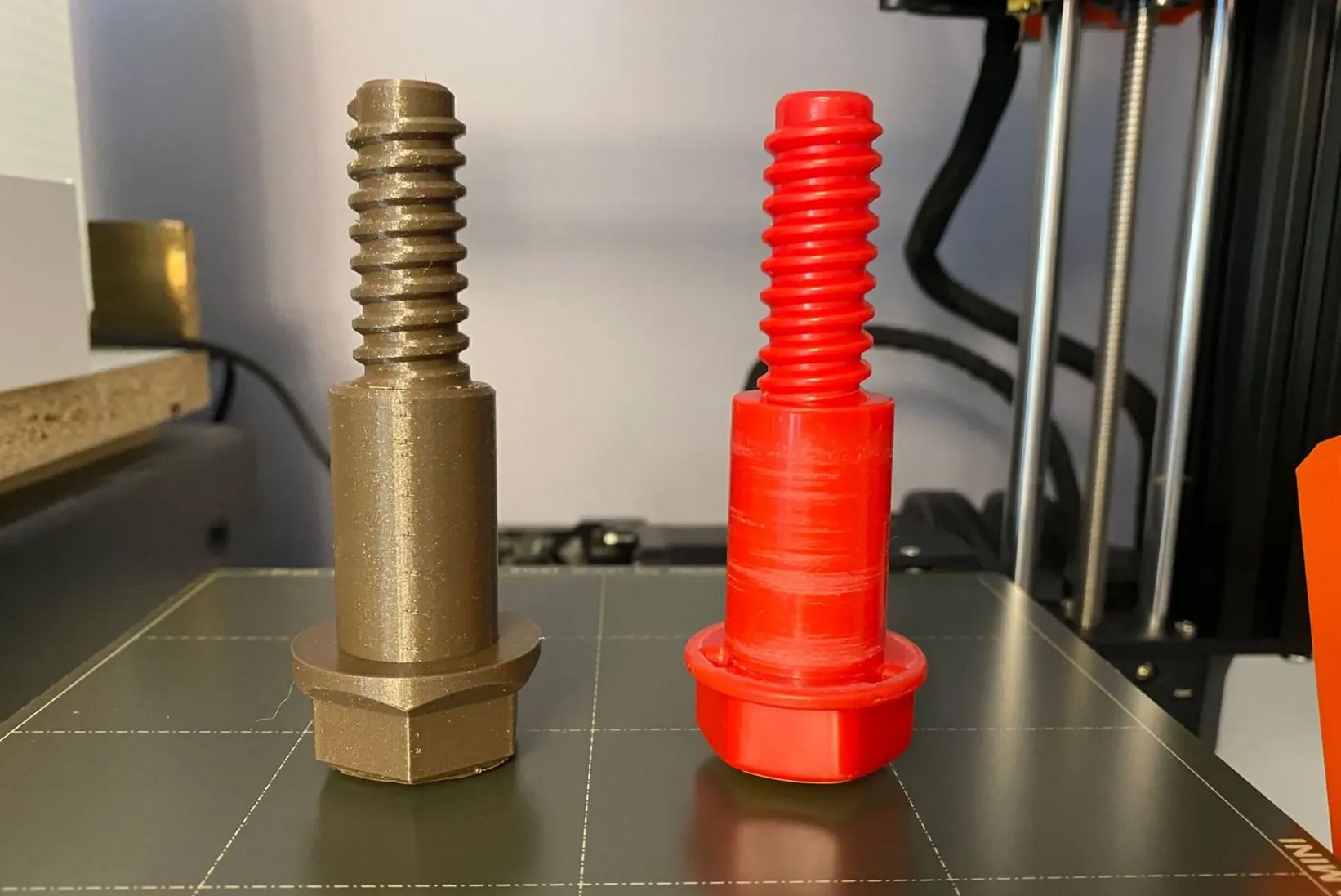
replacement toy bolt replacement toy bolt
replacement bits for an Early Learning Centre Build It Deluxe Set
I was amazed to find that someone has already modelled one of these, too, and it worked beautifully: https://www.printables.com/model/79243-elc-build-it-compatible-bolt
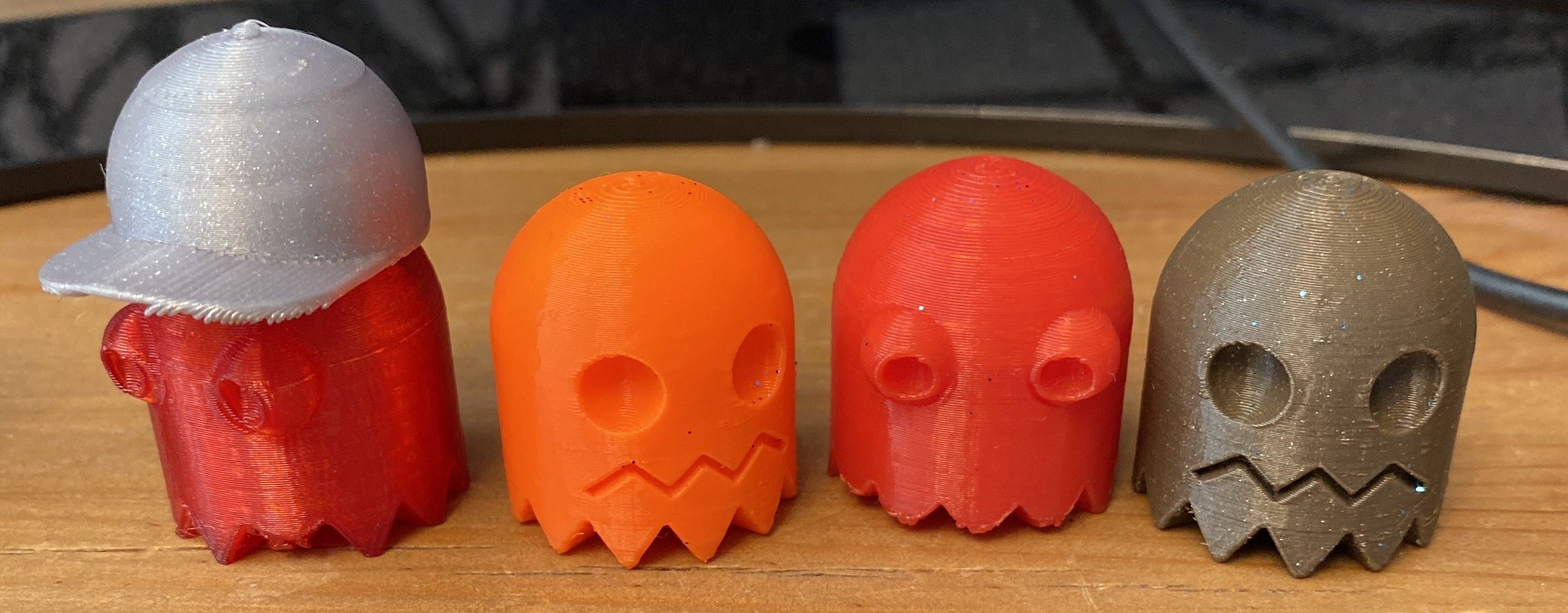
Little kids trinkets. Pacman ghosts
The Pacman ghost family so far The Pacman ghost family so far
So far, I've tried to print useful, functional things, but on a few occasions I've printed a little Pacman ghost when testing printer calibration or similar. I've mostly used these models: https://www.printables.com/model/199425-pac-man-ghost-v2
  • Lego storage/sorters
  • DIY bits-and-bobs sorter/storage (nuts and bolts etc)
I learned about a Slicer setting sometimes called "Vase mode" and found this interesting system of modular drawers that are designed to be printed in Vase mode, so I gave them a go: https://www.printables.com/model/139570-fast-printing-modular-drawer-system-vase-mode I printed one and four drawers for it and gave it to my daughter. It might be used for sorting Lego, or possibly as a chest-of-drawers for a dolls house.
A free-standing inclined vinyl record display stand
https://www.printables.com/model/174711-vinyl-stand-for-kallax
A bracket to install a Gotek drive in my Amiga 500
https://www.thingiverse.com/thing:2745049 Summary From my original list of 25 things to print, I've done 7 of them and determined 4 are not viable. The things in this list I've printed have been off-the-shelf models that other people have constructed. The things I haven't printed are designs I will do myself, which is one reason I haven't printed them yet: building your own designs is the hard part!

Matthew Garrett: git signatures with SSH certificates

Last night I complained that git's SSH signature format didn't support using SSH certificates rather than raw keys, and was swiftly corrected, once again highlighting that the best way to make something happen is to complain about it on the internet in order to trigger the universe to retcon it into existence to make you look like a fool. But anyway. Let's talk about making this work!

git's SSH signing support is actually just it shelling out to ssh-keygen with a specific set of options, so let's go through an example of this with ssh-keygen. First, here's my certificate:

$ ssh-keygen -L -f id_aurora-cert.pub
id_aurora-cert.pub:
Type: ecdsa-sha2-nistp256-cert-v01@openssh.com user certificate
Public key: ECDSA-CERT SHA256:(elided)
Signing CA: RSA SHA256:(elided)
Key ID: "mgarrett@aurora.tech"
Serial: 10505979558050566331
Valid: from 2022-09-13T17:23:53 to 2022-09-14T13:24:23
Principals:
mgarrett@aurora.tech
Critical Options: (none)
Extensions:
permit-agent-forwarding
permit-port-forwarding
permit-pty

Ok! Now let's sign something:

$ ssh-keygen -Y sign -f ~/.ssh/id_aurora-cert.pub -n git /tmp/testfile
Signing file /tmp/testfile
Write signature to /tmp/testfile.sig

To verify this we need an allowed signatures file, which should look something like:

*@aurora.tech cert-authority ssh-rsa AAA(elided)

Perfect. Let's verify it:

$ cat /tmp/testfile ssh-keygen -Y verify -f /tmp/allowed_signers -I mgarrett@aurora.tech -n git -s /tmp/testfile.sig
Good "git" signature for mgarrett@aurora.tech with ECDSA-CERT key SHA256:(elided)


Woo! So, how do we make use of this in git? Generating the signatures is as simple as

$ git config --global commit.gpgsign true
$ git config --global gpg.format ssh
$ git config --global user.signingkey /home/mjg59/.ssh/id_aurora-cert.pub


and then getting on with life. Any commits will now be signed with the provided certificate. Unfortunately, git itself won't handle verification of these - it calls ssh-keygen -Y find-principals which doesn't deal with wildcards in the allowed signers file correctly, and then falls back to verifying the signature without making any assertions about identity. Which means you're going to have to implement this in your own CI by extracting the commit and the signature, extracting the identity from the commit metadata and calling ssh-keygen on your own. But it can be made to work!

But why would you want to? The current approach of managing keys for git isn't ideal - you can kind of piggy-back off github/gitlab SSH key infrastructure, but if you're an enterprise using SSH certificates for access then your users don't necessarily have enrolled keys to start with. And using certificates gives you extra benefits, such as having your CA verify that keys are hardware-backed before issuing a cert. Want to ensure that whoever made a commit was actually on an authorised laptop? Now you can!

I'll probably spend a little while looking into whether it's plausible to make the git verification code work with certificates or whether the right thing is to fix up ssh-keygen -Y find-principals to work with wildcard identities, but either way it's probably not much effort to get this working out of the box.

Edit to add: thanks to this commenter for pointing out that current OpenSSH git actually makes this work already!

comment count unavailable comments

13 September 2022

Alberto Garc a: Adding software to the Steam Deck with systemd-sysext

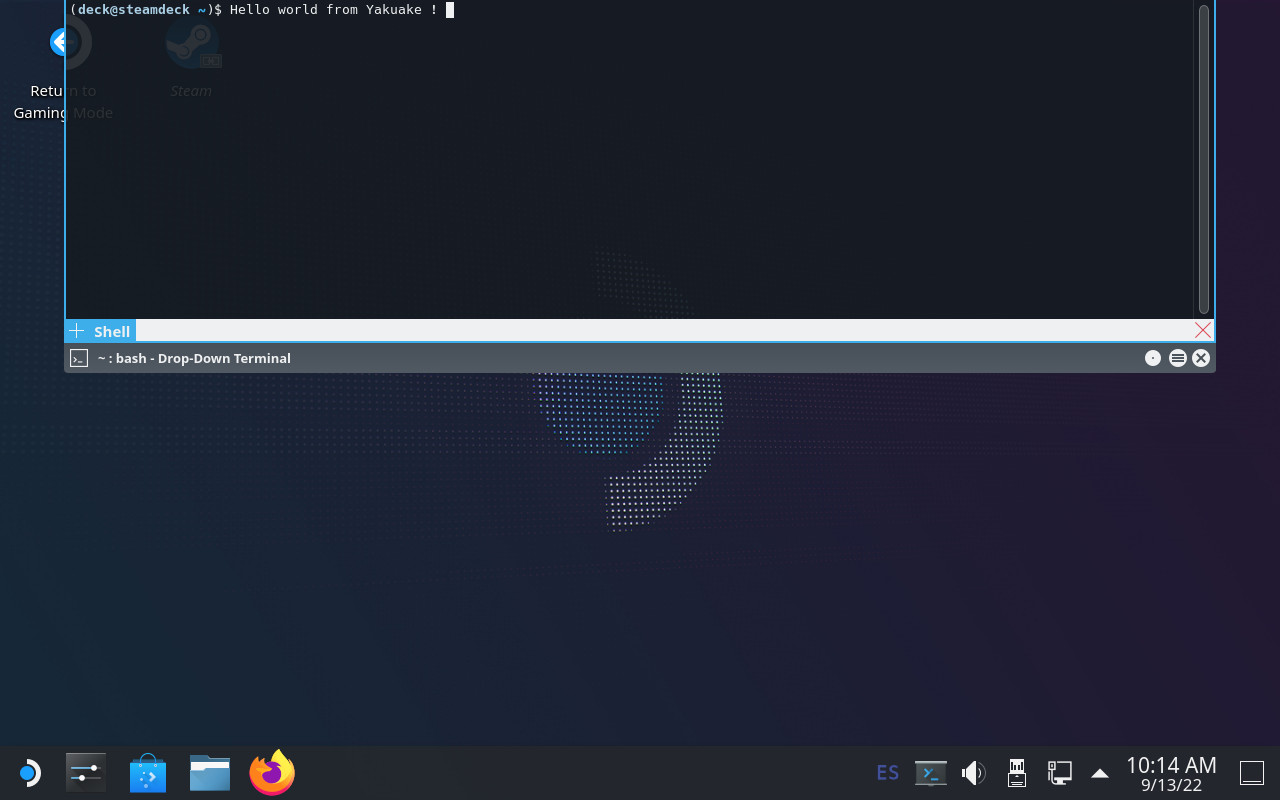
Yakuake on SteamOS Introduction: an immutable OS The Steam Deck runs SteamOS, a single-user operating system based on Arch Linux. Although derived from a standard package-based distro, the OS in the Steam Deck is immutable and system updates replace the contents of the root filesystem atomically instead of using the package manager. An immutable OS makes the system more stable and its updates less error-prone, but users cannot install additional packages to add more software. This is not a problem for most users since they are only going to run Steam and its games (which are stored in the home partition). Nevertheless, the OS also has a desktop mode which provides a standard Linux desktop experience, and here it makes sense to be able to install more software. How to do that though? It is possible for the user to become root, make the root filesytem read-write and install additional software there, but any changes will be gone after the next OS update. Modifying the rootfs can also be dangerous if the user is not careful. Ways to add additional software The simplest and safest way to install additional software is with Flatpak, and that s the method recommended in the Steam Deck Desktop FAQ. Flatpak is already installed and integrated in the system via the Discover app so I won t go into more details here. However, while Flatpak works great for desktop applications not every piece of software is currently available, and Flatpak is also not designed for other types of programs like system services or command-line tools. Fortunately there are several ways to add software to the Steam Deck without touching the root filesystem, each one with different pros and cons. I will probably talk about some of them in the future, but in this post I m going to focus on one that is already available in the system: systemd-sysext. About systemd-sysext This is a tool included in recent versions of systemd and it is designed to add additional files (in the form of system extensions) to an otherwise immutable root filesystem. Each one of these extensions contains a set of files. When extensions are enabled (aka merged ) those files will appear on the root filesystem using overlayfs. From then on the user can open and run them normally as if they had been installed with a package manager. Merged extensions are seamlessly integrated with the rest of the OS. Since extensions are just collections of files they can be used to add new applications but also other things like system services, development tools, language packs, etc. Creating an extension: yakuake I m using yakuake as an example for this tutorial since the extension is very easy to create, it is an application that some users are demanding and is not easy to distribute with Flatpak. So let s create a yakuake extension. Here are the steps: 1) Create a directory and unpack the files there:
$ mkdir yakuake
$ wget https://steamdeck-packages.steamos.cloud/archlinux-mirror/extra/os/x86_64/yakuake-21.12.1-1-x86_64.pkg.tar.zst
$ tar -C yakuake -xaf yakuake-*.tar.zst usr
2) Create a file called extension-release.NAME under usr/lib/extension-release.d with the fields ID and VERSION_ID taken from the Steam Deck s /etc/os-release file.
$ mkdir -p yakuake/usr/lib/extension-release.d/
$ echo ID=steamos > yakuake/usr/lib/extension-release.d/extension-release.yakuake
$ echo VERSION_ID=3.3.1 >> yakuake/usr/lib/extension-release.d/extension-release.yakuake
3) Create an image file with the contents of the extension:
$ mksquashfs yakuake yakuake.raw
That s it! The extension is ready. A couple of important things: image files must have the .raw suffix and, despite the name, they can contain any filesystem that the OS can mount. In this example I used SquashFS but other alternatives like EroFS or ext4 are equally valid. NOTE: systemd-sysext can also use extensions from plain directories (i.e skipping the mksquashfs part). Unfortunately we cannot use them in our case because overlayfs does not work with the casefold feature that is enabled on the Steam Deck. Using the extension Once the extension is created you simply need to copy it to a place where systemd-systext can find it. There are several places where they can be installed (see the manual for a list) but due to the Deck s partition layout and the potentially large size of some extensions it probably makes more sense to store them in the home partition and create a link from one of the supported locations (/var/lib/extensions in this example):
(deck@steamdeck ~)$ mkdir extensions
(deck@steamdeck ~)$ scp user@host:/path/to/yakuake.raw extensions/
(deck@steamdeck ~)$ sudo ln -s $PWD/extensions /var/lib/extensions
Once the extension is installed in that directory you only need to enable and start systemd-sysext:
(deck@steamdeck ~)$ sudo systemctl enable systemd-sysext
(deck@steamdeck ~)$ sudo systemctl start systemd-sysext
After this, if everything went fine you should be able to see (and run) /usr/bin/yakuake. The files should remain there from now on, also if you reboot the device. You can see what extensions are enabled with this command:
$ systemd-sysext status
HIERARCHY EXTENSIONS SINCE
/opt      none       -
/usr      yakuake    Tue 2022-09-13 18:21:53 CEST
If you add or remove extensions from the directory then a simple systemd-sysext refresh is enough to apply the changes. Unfortunately, and unlike distro packages, extensions don t have any kind of post-installation hooks or triggers, so in the case of Yakuake you probably won t see an entry in the KDE application menu immediately after enabling the extension. You can solve that by running kbuildsycoca5 once from the command line. Limitations and caveats Using systemd extensions is generally very easy but there are some things that you need to take into account:
  1. Using extensions is easy (you put them in the directory and voil !). However, creating extensions is not necessarily always easy. To begin with, any libraries, files, etc., that your extensions may need should be either present in the root filesystem or provided by the extension itself. You may need to combine files from different sources or packages into a single extension, or compile them yourself.
  2. In particular, if the extension contains binaries they should probably come from the Steam Deck repository or they should be built to work with those packages. If you need to build your own binaries then having a SteamOS virtual machine can be handy. There you can install all development files and also test that everything works as expected. One could also create a Steam Deck SDK extension with all the necessary files to develop directly on the Deck
  3. Extensions are not distribution packages, they don t have dependency information and therefore they should be self-contained. They also lack triggers and other features available in packages. For desktop applications I still recommend using a system like Flatpak when possible.
  4. Extensions are tied to a particular version of the OS and, as explained above, the ID and VERSION_ID of each extension must match the values from /etc/os-release. If the fields don t match then the extension will be ignored. This is to be expected because there s no guarantee that a particular extension is going to work with a different version of the OS. This can happen after a system update. In the best case one simply needs to update the extension s VERSION_ID, but in some cases it might be necessary to create the extension again with different/updated files.
  5. Extensions only install files in /usr and /opt. Any other file in the image will be ignored. This can be a problem if a particular piece of software needs files in other directories.
  6. When extensions are enabled the /usr and /opt directories become read-only because they are now part of an overlayfs. They will remain read-only even if you run steamos-readonly disable !!. If you really want to make the rootfs read-write you need to disable the extensions (systemd-sysext unmerge) first.
  7. Unlike Flatpak or Podman (including toolbox / distrobox), this is (by design) not meant to isolate the contents of the extension from the rest of the system, so you should be careful with what you re installing. On the other hand, this lack of isolation makes systemd-sysext better suited to some use cases than those container-based systems.
Conclusion systemd extensions are an easy way to add software (or data files) to the immutable OS of the Steam Deck in a way that is seamlessly integrated with the rest of the system. Creating them can be more or less easy depending on the case, but using them is extremely simple. Extensions are not packages, and systemd-sysext is not a package manager or a general-purpose tool to solve all problems, but if you are aware of its limitations it can be a practical tool. It is also possible to share extensions with other users, but here the usual warning against installing binaries from untrusted sources applies. Use with caution, and enjoy!

12 September 2022

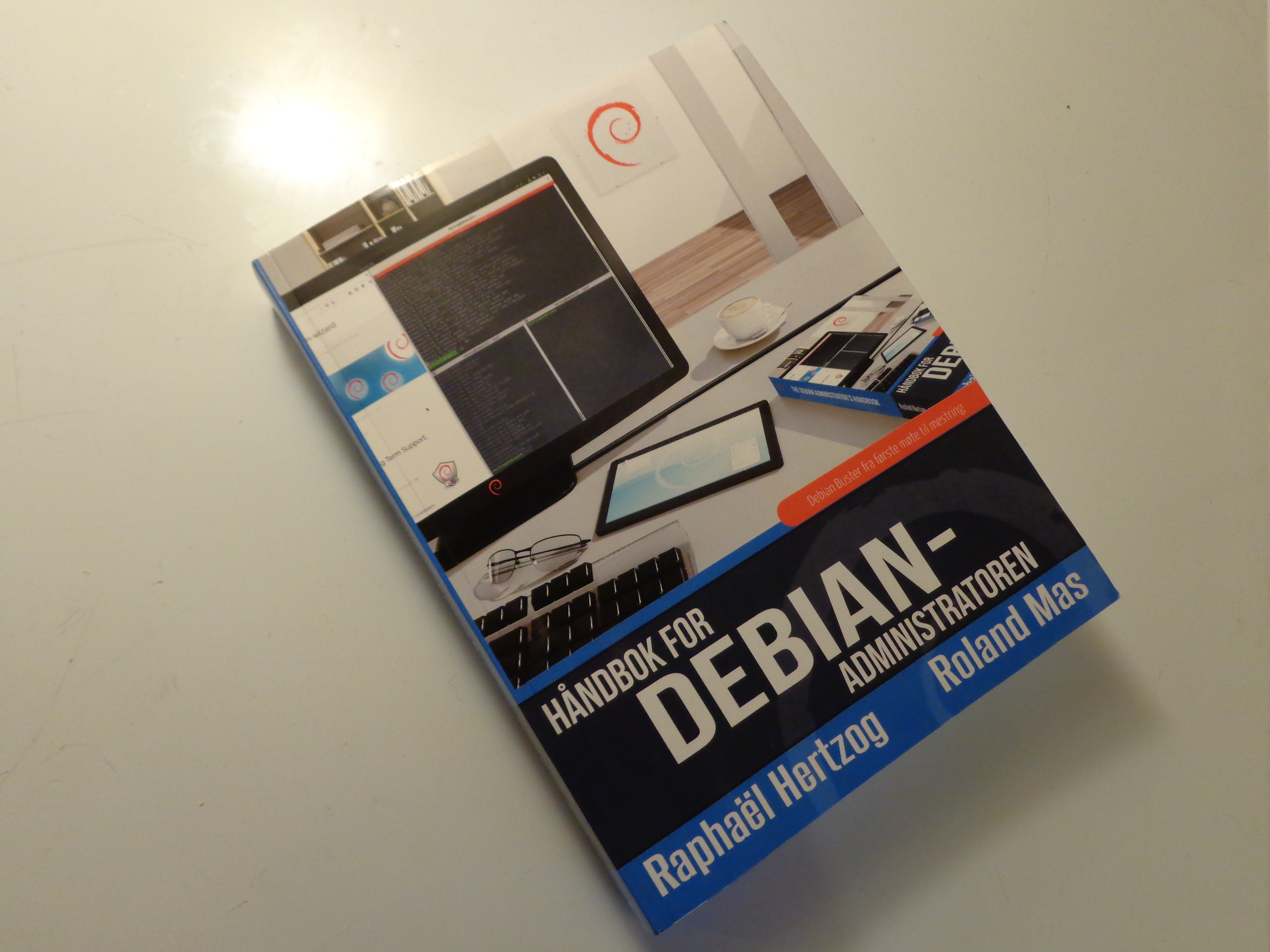
Petter Reinholdtsen: Time to translate the Bullseye edition of the Debian Administrator's Handbook

(The picture is of the previous edition.) Almost two years after the previous Norwegian Bokm l translation of the "The Debian Administrator's Handbook" was published, a new edition is finally being prepared. The english text is updated, and it is time to start working on the translations. Around 37 percent of the strings have been updated, one way or another, and the translations starting from a complete Debian Buster edition now need to bring their translation up from 63% to 100%. The complete book is licensed using a Creative Commons license, and has been published in several languages over the years. The translations are done by volunteers to bring Linux in their native tongue. The last time I checked, it complete text was available in English, Norwegian Bokm l, German, Indonesian, Brazil Portuguese and Spanish. In addition, work has been started for Arabic (Morocco), Catalan, Chinese (Simplified), Chinese (Traditional), Croatian, Czech, Danish, Dutch, French, Greek, Italian, Japanese, Korean, Persian, Polish, Romanian, Russian, Swedish, Turkish and Vietnamese. The translation is conducted on the hosted weblate project page. Prospective translators are recommeded to subscribe to the translators mailing list and should also check out the instructions for contributors. I am one of the Norwegian Bokm l translators of this book, and we have just started. Your contribution is most welcome. As usual, if you use Bitcoin and want to show your support of my activities, please send Bitcoin donations to my address 15oWEoG9dUPovwmUL9KWAnYRtNJEkP1u1b.

11 September 2022

Shirish Agarwal: Politics, accessibility, books

Politics I have been reading books, both fiction and non-fiction for a long long time. My first book was a comic most probably when I was down with Malaria when I was a kid. I must be around 4-5 years old. Over the years, books have given me great joy and I continue to find nuggets of useful information, both in fiction as well as non-fiction books. So here s to sharing something and how that can lead you to a rabbit hole. This entry would be a bit NSFW as far as language is concerned. NYPD Red 5 by James Patterson First of all, have no clue as to why James Patterson s popularity has been falling. He used to be right there with Lee Child and others, but not so much now. While I try to be mysterious about books, I would give a bit of heads-up so people know what to expect. This is probably more towards the Adult crowd as there is a bit of sex as well as quite a few grey characters. The NYPD Red is a sort of elite police task force that basically is for celebrities. In the book series, they do a lot of ass-kissing (figuratively more than literally). Now the reason I have always liked fiction is that however wild the assumption or presumption is, it does have somewhere a grain of truth. And each and every time I read a book or two, that gets cemented. One of the statements in the book told something about how 9/11 took a lot of police personnel out of the game. First, there were a number of policemen who were patrolling the Two Towers, so they perished literally during the explosion. Then there were policemen who were given the cases to close the cases (bring the cases to conclusion). When you are investigating your own brethren or even civilians who perished 9/11 they must have experienced emotional trauma and no outlet. Mental health even in cops is the same and given similar help as you and me (i.e. next to none.) But both of these were my assumptions. The only statement that was in the book was they lost a lot of bench strength. Even NYFD (New York Fire Department). This led me to me to With Crime At Record Lows, Should NYC Have Fewer Cops? This is more right-wing sentiment and in fact, there have been calls to defund the police. This led me to https://cbcny.org/ and one specific graph. Unfortunately, this tells the story from 2010-2022 but not before. I was looking for data from around 1999 to 2005 because that will tell whether or not it happened. Then I remembered reading in newspapers the year or two later how 9/11 had led NYC to recession. I looked up online and for sure NY was booming before 9/11. One can argue that NYC could come down and that is pretty much possible, everything that goes up comes down, it s a law of nature but it would have been steady rather than abrupt. And once you are in recession, the first thing to go is personnel. So people both from NYPD and NYFD were let go, even though they were needed the most then. As you can see, a single statement in a book can take you to places & time literally. Edit: Addition 11th September There were quite a few people who also died from New York Port Authority and they also lost quite a number of people directly and indirectly and did a lot of patrolling of the water bodies near NYC. Later on, even in their department, there were a lot of early retirements.

Kosovo A couple of days back I had a look at the Debconf 2023 BOF that was done in Kosovo. One of the interesting things that happened during the BOF is when a woman participant chimed in and asks India to recognize Kosovo. Immediately it triggered me and I opened the Kosovo Wikipedia page to get some understanding of the topic. Reading up on it, came to know Russia didn t agree and doesn t recognize Kosovo. Mr. Modi likes Putin and India imports a lot of its oil from Russia. Unrelatedly, but still useful, we rejected to join IPEF. Earlier, we had rejected China s BRI. India has never been as vulnerable as she is now. Our foreign balance has reached record lows. Now India has been importing quite a bit of Russian crude and has been buying arms and ammunition from them. We are also scheduled to buy a couple of warships and submarines etc. We even took arms and ammunition from them on lease. So we can t afford that they are displeased with India. Even though Russia has more than friendly relations with both China and Pakistan. At the same time, the U.S. is back to aiding Pakistan which the mainstream media in India refuses to even cover. And to top all of this, we have the Chip 4 Alliance but that needs its own article, truth be told but we will do with a paragraph  Edit Addition 11th September Seems Kosovo isn t unique in that situation, there are 3-4 states like that. A brief look at worldpopulationreview tells you there are many more.

Chip 4 Alliance For almost a decade I have been screaming about this on my blog as well as everywhere that chip fabrication is a national security thing. And for years, most people deny it. And now we have chip 4 alliance. Now to understand this, you have to understand that China for almost a decade, somewhere around 2014 or so came up with something called the big fund . Now one can argue one way or the other how successful the fund has been, but it has, without doubt, created ripples so strong that the U.S., Taiwan, Japan, and probably South Korea will join and try to stem the tide. Interestingly, in this grouping, South Korea is the weakest in the statements and what they have been saying. Within the group itself, there is a lot of tension and China would use that and there are a number of unresolved issues between the three countries that both China & Russia would exploit. For e.g. the Comfort women between South Korea and Japan. Or the 1985 Accord Agreement between Japan and the U.S. Now people need to understand this, this is not just about China but also about us. If China has 5-6x times India s GDP and their research budget is at the very least 100x times what India spends, how do you think we will be self-reliant? Whom are we fooling? Are we not tired of fooling ourselves  In diplomacy, countries use leverage. Sadly, we let go of some of our most experienced negotiators in 2014 and since then have been singing in the wind

Accessibility, Jitsi, IRC, Element-Desktop The Wikipedia page on Accessibility says the following Accessibility is the design of products, devices, services, vehicles, or environments so as to be usable by people with disabilities. The concept of accessible design and practice of accessible development ensures both direct access (i.e. unassisted) and indirect access meaning compatibility with a person s assistive technology. Now IRC or Internet Relay Chat has been accessible for a long time. I know of even blind people who have been able to navigate IRC quite effortlessly as there has been a lot of work done to make sure all the joints speak to each other so people with one or more disabilities still can use, and contribute without an issue. It does help that IRC and many clients have been there since the 1970s so most of them have had more than enough time to get all the bugs fixed and both text-to-speech and speech-to-text work brilliantly on IRC. Newer software like Jitsi or for that matter Telegram is lacking those features. A few days ago, discovered on Telegram I was shared that Samsung Voice input is also able to do the same. The Samsung Voice Input works wonder as it translates voice to text, I have not yet tried the text-to-speech but perhaps somebody can and they can share whatever the results can be one way or the other. I have tried element-desktop both on the desktop as well as mobile phone and it has been disappointing, to say the least. On the desktop, it is unruly and freezes once in a while, and is buggy. The mobile version is a little better but that s not saying a lot. I prefer the desktop version as I can use the full-size keyboard. The bug I reported has been there since its Riot days. I had put up a bug report even then. All in all, yesterday was disappointing

Russ Allbery: Review: Hogfather

Review: Hogfather, by Terry Pratchett
Series: Discworld #20
Publisher: Harper
Copyright: 1996
Printing: February 2014
ISBN: 0-06-227628-X
Format: Mass market
Pages: 402
Hogfather is the 20th Discworld novel and not a very good place to start. I recommend at least reading Soul Music first for a proper introduction to Susan, and you may want to start with Mort. When we last saw Susan, she was a student at the Quirm College for Young Ladies. Now she's a governess for two adorable youngsters, a job that includes telling them stories and dealing quite capably with monsters in the cellar. (She uses a poker.) It also includes answering questions like whether the Hogfather really exists or whether the presents just come from your parents.
"Look at it this way, then," she said, and took a deep mental breath. "Wherever people are obtuse and absurd... and wherever they have, by even the most generous standards, the attention span of a small chicken in a hurricane and the investigative ability of a one-legged cockroach... and wherever people are inanely credulous, pathetically attached to the certainties of the nursery and, in general, have as much grasp of the physical universe as an oyster has of mountaineering... yes, Twyla: there is a Hogfather.
Meanwhile, the Auditors, last seen meddling with Death in Reaper Man, approach the Assassin's Guild in Ankh-Morpork to hire the assassination of the Hogfather. This rather unusual assignment falls to Mister Teatime, an orphan who was taken in by the guild at an early age and trained to be an assassin. Teatime is a little unnerving, mostly because he enjoys being an assassin. Rather a lot. Hogfather has two major things to recommend it: it's a Death novel, and it features Susan, who is one of my favorite Discworld characters. It also has two major strikes against it, at least for me. The first is relatively minor but, for me, the most irritating. A bit of the way into the story, Pratchett introduces the Oh God of Hangovers fair, that's a good pun and then decides that's a good excuse for nausea and vomiting jokes. A lot of nausea and vomiting jokes. Look. I know a lot of people don't mind this. But I beg authors (and, even more so, filmmakers and cartoonists) to consider whether a joke that some of your audience might like is worth making other parts of your audience feel physically ill while trying to enjoy your work. It's not at all a pleasant experience, and while I handle it better in written form, it still knocks me out of the story and makes me want to skip over scenes with the obnoxious character who won't shut up about it. Thankfully this does stop by the end of the book, but there are several segments in the middle that were rather unpleasant. The second is that Pratchett tries to convince the reader of the mythical importance of the Santa Claus myth (for which Hogfather is an obvious stand-in, if with a Discworld twist), an effort for which I am a highly unsympathetic audience. I'm with Susan above, with an extra helping of deep dislike for telling children who trust you something that's literally untrue. Pratchett does try: he has Death makes a memorable and frequently-quoted point near the end of the book (transcribed below) that I don't entirely agree with but still respect. But still, the book is very invested in convincing Susan that people believing mythology is critically important to humanity, and I have so many problems with the literalness of "believing" and the use of trusting children for this purpose by adults who know better. There are few topics that bring out my grumpiness more than Santa Claus. Grumbling aside, though, I did enjoy this book anyway. Susan is always a delight, and I could read about her adventures as a governess for as long as Pratchett wanted to write them. Death is filling in for the Hogfather for most of the book, which is hilarious because he's far too good at it, in his painfully earnest and literal way, to be entirely safe. I was less fond of Albert's supporting role (who I am increasingly coming to dislike as a character), but the entire scene of Death as a mall Santa is brilliant. And Teatime is an effective, creepy villain, something that the Discworld series doesn't always deliver. The powers arrayed on Discworld are so strong that it can be hard to design a villain who effectively challenges them, but Teatime has a sociopathic Professor Moriarty energy with added creepiness that fills that role in this book satisfyingly. As is typical for Pratchett (at least for me), the plot was serviceable but not the highlight. Pratchett plays in some interesting ways with a child's view of the world, the Unseen University bumbles around as a side plot, and it comes together at the end in a way that makes sense, but the journey is the fun of the story. The conclusion felt a bit gratuitous, there mostly to wrap up the story than something that followed naturally from the previous plot. But it does feature one of the most quoted bits in Discworld:
"All right," said Susan. "I'm not stupid. You're saying humans need... fantasies to make life bearable." REALLY? AS IF IT WAS SOME KIND OF PINK PILL? NO. HUMANS NEED FANTASY TO BE HUMAN. TO BE THE PLACE WHERE THE FALLING ANGEL MEETS THE RISING APE. "Tooth fairies? Hogfathers? Little " YES. AS PRACTICE. YOU HAVE TO START OUT LEARNING TO BELIEVE THE LITTLE LIES. "So we can believe the big ones?" YES. JUSTICE. MERCY. DUTY. THAT SORT OF THING. "They're not the same at all!" YOU THINK SO? THEN TAKE THE UNIVERSE AND GRIND IT DOWN TO THE FINEST POWDER AND SIEVE IT THROUGH THE FINEST SIEVE AND THEN SHOW ME ONE ATOM OF JUSTICE, ONE MOLECULE OF MERCY. AND YET Death waved a hand. AND YET YOU ACT AS IF THERE IS SOME IDEAL ORDER IN THE WORLD, AS IF THERE IS SOME...SOME RIGHTNESS IN THE UNIVERSE BY WHICH IT MAY BE JUDGED. "Yes, but people have got to believe that, or what's the point " MY POINT EXACTLY.
Here's the thing, though: Susan is right. They're not the same sort of thing at all, and Pratchett doesn't present an argument that they are. Death's response is great, but it's also a non sequitur: it is true and correct but has nothing to do with Susan's argument. Justice is not a lie in the sense that Santa Claus is a lie: justice is something that humans can create, just like humans can create gift-giving or a tradition of imaginative story-telling. But this is not at all the same thing as encouraging children to believe in the literal existence of a fat man in red who comes down chimneys to deliver gifts by magic. And Death isn't even correct in Discworld! If one pays careful attention to the story, the consequences he's thinks would follow from the Auditors' attempt on the Hogfather not only don't happen, the exact opposite happens. This is the point of the Unseen University subplot, and it's also what happened in Reaper Man. The Auditors may be trying to kill mythology, but what the books show is that the real danger comes from the backlash. The force they're meddling with is far more powerful and persistent than they are. Death appears to be, by the stated events of the story, completely incorrect in his analysis of Discworld's metaphysics. Maybe Pratchett knows this? He did write a story that contradicts Death's analysis if one reads it carefully. But if so, this is not obvious from the text, or from Susan's reaction to Death's speech, which makes the metaphysics weirdly unsatisfying. So, overall, a mixed bag. Most of the book is very fun, but the metaphysics heavily rest on a pet peeve of mine, and I really could have done without the loving descriptions of the effects of hangovers. This is one of the more famous Discworld novels for the above quote, and on its own this is deserved (it's a great quote), but I think the logic is muddled and the story itself contradicts the implications. A rather odd reading experience. Followed by Jingo in publication order, and Thief of Time thematically. Rating: 7 out of 10

Andrew Cater: 202209110020 - Debian release day(s) - Cambridge - post 4

RattusRattus, Isy, smcv have all just left after a very long day. Steve is finishing up the final stages. The mayhem has quietened, the network cables are coiled, pretty much everything is tidied away. A new experience for two of us - I just hope it hasn't put them off too much.The IRC channels are quiet and we can put this one to bed after a good day's work well done.

10 September 2022

Joachim Breitner: rec-def: Behind the scenes

A week ago I wrote about the rec-def Haskell library, which allows you to write more recursive definitions, such as in this small example:
let s1 = RS.insert 23 s2
    s2 = RS.insert 42 s1
in RS.get s1
This will not loop (as it would if you d just used Data.Set), but rather correctly return the set S.fromList [23,42]. See the previous blog post for more examples and discussion of the user-facing side of this. For quick reference, these are the types of the functions involved here: The type of s1 and s2 above is not Set Int, but rather RSet Int, and in this post I ll explain how RSet works internally.

Propagators, in general The conceptual model behind an recursive equation like above is
  • There are a multiple cells that can hold values of an underlying type (here Set)
  • These cells have relations that explain how the values in the cells should relate to each other
  • After registering all the relations, some form of solving happens.
  • If the solving succeeds, we can read off the values from the cells, and they should satisfy the registered relation.
This is sometimes called a propagator network, and is a quite general model that can support different kind of relations (e.g. equalities, inequalities, functions), there can be various solving strategies (iterative fixed-points, algebraic solution, unification, etc.) and information can flow on along the edges (and hyper-edges) possibly in multiple directions. For our purposes, we only care about propagator networks where all relations are functional, so they have a single output cell that is declared to be a function of multiple (possibly zero) input cells, without affecting these input cells. Furthermore, every cell is the output of exactly one such relation.

IO-infested propagator interfaces This suggests that an implementation of such a propagator network could provide an interface with the following three operations:
  • Functions to declare cells
  • Functions to declare relations
  • Functions to read values off cells
This is clearly an imperative interface, so we ll see monads, and we ll simply use IO. So concretely for our small example above, we might expect
There is no need for an explicit solve function: solving can happen when declareInsert or getCell is called as a User I do not care about that. You might be curious about the implementation of newCell, declareInsert and getCell, but I have to disappoint you: This is not the topic of this article. Instead, I want to discuss how to turn this IO-infested interface into the pure interface seen above?

Pure, but too strict Obviously, we have to get rid of the IO somehow, and have to use unsafePerformIO :: IO a -> a somehow. This dangerous function creates a pure-looking value that, when used the first time, will run the IO-action and turn into that action s result. So maybe we can simply write the following: Indeed, the types line up, but if we try to use that code, nothing will happen. Our insert is too strict to be used recursively: It requires the value of c2 (as it is passed to declareInsert, which we assume to be strict in its arguments) before it can return c1, so the recursive example at the top of this post will not make any progress.

Pure, lazy, but forgetful To work around this, maybe it suffices if we do not run declareInsert right away, but just remember that we have to do it eventually? So let s introduce a new data type for RSet a that contains not just the cell (Cell a), but also an action that we still have to run before getting a value: This is better: insert is now lazy in its arguments (for this it is crucial to pattern-match on RSet only inside the todo code, not in the pattern of insert!) This means that our recursive code above does not get stuck right away.

Pure, lazy, but runs in circles But it is still pretty bad: Note that we do not run get s2 in the example above, so that cell s todo, which would declareInsert 42, will never run. This cannot work! We have to (eventually) run the declaration code from all involved cells before we can use getCell! We can try to run the todo action of all the dependencies as part of a cell s todo action: Now we certainly won t forget to run the second cell s todo action, so that is good. But that cell s todo action will run the first cell s todo action, and that again the second cell s, and so on.

Pure, lazy, terminating, but not thread safe This is silly: We only need (and should!) run that code once! So let s keep track of whether we ran it already: Ah, much better: It works! Our call to get c1 will trigger the first cell s todo action, which will mark it as done before calling the second cell s todo action. When that now invokes the first cell s todo action, it is already marked done and we break the cycle, and by the time we reach getCell, all relations have been correctly registered. In a single-threaded world, this would be all good and fine, but we have to worry about multiple threads running get concurrently, on the same or on different cells. In fact, because we use unsafePerformIO, we have to worry about this even when the program is not using threads. And the above code has problems. Imagine a second call to get c1 while the first one has already marked it as done, but has not finished processing all the dependencies yet: It will call getCell before all relations are registered, which is bad.

Recursive do-once IO actions Making this thread-safe seems to be possible, but would clutter both the code and this blog post. So let s hide that problem behind a nice and clean interface. Maybe there will be a separate blog post about its implementation (let me know if you are curious), or you can inspect the code in System.IO.RecThunk module yourself). The interface is simply
data Thunk
thunk :: IO [Thunk] -> IO Thunk
force :: Thunk -> IO ()
and the idea is that thunk act will defer the action act until the thunk is passed to force for the first time, and force will not return until the action has been performed (possibly waiting if another thread is doing that at the moment), and also until the actions of all the thunks returned by act have performed, recursively, without running into cycles. We can use this in our definition of RSet and get to the final, working solution: This snippet captures the essential ideas behind rec-def:
  • Use laziness to allow recursive definition to describe the propagator graph naturally
  • Use a form of explicit thunk to register the propagator graph relations at the right time (not too early/strict, not too late)

And that s all? The actual implementation in rec-def has a few more moving parts. In particular, it tries to support different value types (not just sets), possibly with different implementations, and even mixing them (e.g. in member :: Ord a => a -> RSet a -> RBool), so the generic code is in Data.Propagator.Purify, and supports various propagators underneath. The type RSet is then just a newtype around that, defined in Data.Recursive.Internal to maintain the safety of the abstraction, I went back and forth on a few variants of the design here, including one where there was a generic R type constructor (R (Set a), R Bool etc.), but then monomorphic interface seems simpler.

Does it really work? The big remaining question is certainly: Is this really safe and pure? Does it still behave like Haskell? The answer to these questions certainly depends on the underlying propagator implementation. But it also depends on what we actually mean by safe and pure ? For example, do we expect the Static Argument Transformation be semantics preserving? Or is it allowed to turn undefined values into defined ones (as it does here)? I am unsure myself yet, so I ll defer this discussion to a separate blog post, after I hopefully had good discussions about this here at ICFP 2022 in Ljubljana. If you are around and want to discuss, please hit me up!

9 September 2022

Reproducible Builds: Reproducible Builds in August 2022

Welcome to the August 2022 report from the Reproducible Builds project! In these reports we outline the most important things that we have been up to over the past month. As a quick recap, whilst anyone may inspect the source code of free software for malicious flaws, almost all software is distributed to end users as pre-compiled binaries. The motivation behind the reproducible builds effort is to ensure no flaws have been introduced during this compilation process by promising identical results are always generated from a given source, thus allowing multiple third-parties to come to a consensus on whether a build was compromised. As ever, if you are interested in contributing to the project, please visit our Contribute page on our website.

Community news As announced last month, registration is currently open for our in-person summit this year which is due to be held between November 1st November 3rd. The event will take place in Venice (Italy). Very soon we intend to pick a venue reachable via the train station and an international airport. However, the precise venue will depend on the number of attendees. Please see the announcement email for information about how to register.
The US National Security Agency (NSA), Cybersecurity and Infrastructure Security Agency (CISA) and the Office of the Director of National Intelligence (ODNI) have released a document called Securing the Software Supply Chain: Recommended Practices Guide for Developers (PDF) as part of their Enduring Security Framework (ESF) work. The document expressly recommends having reproducible builds as part of advanced recommended mitigations, along with hermetic builds. Page 31 (page 35 in the PDF) says:
Reproducible builds provide additional protection and validation against attempts to compromise build systems. They ensure the binary products of each build system match: i.e., they are built from the same source, regardless of variable metadata such as the order of input files, timestamps, locales, and paths. Reproducible builds are those where re-running the build steps with identical input artifacts results in bit-for-bit identical output. Builds that cannot meet this must provide a justification why the build cannot be made reproducible.
The full press release is available online.
On our mailing list this month, Marc Prud hommeaux posted a feature request for diffoscope which additionally outlines a project called The App Fair, an autonomous distribution network of free and open-source macOS and iOS applications, where validated apps are then signed and submitted for publication .
Author/blogger Cory Doctorow posted published a provocative blog post this month titled Your computer is tormented by a wicked god . Touching on Ken Thompson s famous talk, Reflections on Trusting Trust , the early goals of Secure Computing and UEFI firmware interfaces:
This is the core of a two-decade-old debate among security people, and it s one that the benevolent God faction has consistently had the upper hand in. They re the curated computing advocates who insist that preventing you from choosing an alternative app store or side-loading a program is for your own good because if it s possible for you to override the manufacturer s wishes, then malicious software may impersonate you to do so, or you might be tricked into doing so. [..] This benevolent dictatorship model only works so long as the dictator is both perfectly benevolent and perfectly competent. We know the dictators aren t always benevolent. [ ] But even if you trust a dictator s benevolence, you can t trust in their perfection. Everyone makes mistakes. Benevolent dictator computing works well, but fails badly. Designing a computer that intentionally can t be fully controlled by its owner is a nightmare, because that is a computer that, once compromised, can attack its owner with impunity.

Lastly, Chengyu HAN updated the Reproducible Builds website to correct an incorrect Git command. [ ]

Debian In Debian this month, the essential and required package sets became 100% reproducible in Debian bookworm on the amd64 and arm64 architectures. These two subsets of the full Debian archive refer to Debian package priority levels as described in the 2.5 Priorities section of the Debian Policy there is no canonical minimal installation package set in Debian due to its diverse methods of installation. As it happens, these package sets are not reproducible on the i386 architecture because the ncurses package on that architecture is not yet reproducible, and the sed package currently fails to build from source on armhf too. The full list of reproducible packages within these package sets can be viewed within our QA system, such as on the page of required packages in amd64 and the list of essential packages on arm64, both for Debian bullseye.
It recently has become very easy to install reproducible Debian Docker containers using podman on Debian bullseye:
$ sudo apt install podman
$ podman run --rm -it debian:bullseye bash
The (pre-built) image used is itself built using debuerrotype, as explained on docker.debian.net. This page also details how to build the image yourself and what checksums are expected if you do so.
Related to this, it has also become straightforward to reproducibly bootstrap Debian using mmdebstrap, a replacement for the usual debootstrap tool to create Debian root filesystems:
$ SOURCE_DATE_EPOCH=$(date --utc --date=2022-08-29 +%s) mmdebstrap unstable > unstable.tar
This works for (at least) Debian unstable, bullseye and bookworm, and is tested automatically by a number of QA jobs set up by Holger Levsen (unstable, bookworm and bullseye)
Work has also taken place to ensure that the canonical debootstrap and cdebootstrap tools are also capable of bootstrapping Debian reproducibly, although it currently requires a few extra steps:
  1. Clamping the modification time of files that are newer than $SOURCE_DATE_EPOCH to be not greater than SOURCE_DATE_EPOCH.
  2. Deleting a few files. For debootstrap, this requires the deletion of /etc/machine-id, /var/cache/ldconfig/aux-cache, /var/log/dpkg.log, /var/log/alternatives.log and /var/log/bootstrap.log, and for cdebootstrap we also need to delete the /var/log/apt/history.log and /var/log/apt/term.log files as well.
This process works at least for unstable, bullseye and bookworm and is now being tested automatically by a number of QA jobs setup by Holger Levsen [ ][ ][ ][ ][ ][ ]. As part of this work, Holger filed two bugs to request a better initialisation of the /etc/machine-id file in both debootstrap [ ] and cdebootstrap [ ].
Elsewhere in Debian, 131 reviews of Debian packages were added, 20 were updated and 27 were removed this month, adding to our extensive knowledge about identified issues. Chris Lamb added a number of issue types, including: randomness_in_browserify_output [ ], haskell_abi_hash_differences [ ], nondeterministic_ids_in_html_output_generated_by_python_sphinx_panels [ ]. Lastly, Mattia Rizzolo removed the deterministic flag from the captures_kernel_variant flag [ ].

Other distributions Vagrant Cascadian posted an update of the status of Reproducible Builds in GNU Guix, writing that:
Ignoring the pesky unknown packages, it is more like ~93% reproducible and ~7% unreproducible... that feels a bit better to me! These numbers wander around over time, mostly due to packages moving back into an "unknown" state while the build farms catch up with each other... although the above numbers seem to have been pretty consistent over the last few days.
The post itself contains a lot more details, including a brief discussion of tooling. Elsewhere in GNU Guix, however, Vagrant updated a number of packages such as itpp [ ], perl-class-methodmaker [ ], libnet [ ], directfb [ ] and mm-common [ ], as well as updated the version of reprotest to 0.7.21 [ ]. In openSUSE, Bernhard M. Wiedemann published his usual openSUSE monthly report.

diffoscope diffoscope is our in-depth and content-aware diff utility. Not only can it locate and diagnose reproducibility issues, it can provide human-readable diffs from many kinds of binary formats. This month, Chris Lamb prepared and uploaded versions 220 and 221 to Debian, as well as made the following changes:
  • Update external_tools.py to reflect changes to xxd and the vim-common package. [ ]
  • Depend on the dedicated xxd package now, not the vim-common package. [ ]
  • Don t crash if we can open a PDF file using the PyPDF library, but cannot subsequently parse the annotations within. [ ]
In addition, Vagrant Cascadian updated diffoscope in GNU Guix, first to to version 220 [ ] and later to 221 [ ].

Community news The Reproducible Builds project aims to fix as many currently-unreproducible packages as possible as well as to send all of our patches upstream wherever appropriate. This month we created a number of patches, including:

Testing framework The Reproducible Builds project runs a significant testing framework at tests.reproducible-builds.org, to check packages and other artifacts for reproducibility. This month, Holger Levsen made the following changes:
  • Debian-related changes:
    • Temporarily add Debian unstable deb-src lines to enable test builds a Non-maintainer Upload (NMU) campaign targeting 708 sources without .buildinfo files found in Debian unstable, including 475 in bookworm. [ ][ ]
    • Correctly deal with the Debian Edu packages not being installable. [ ]
    • Finally, stop scheduling stretch. [ ]
    • Make sure all Ubuntu nodes have the linux-image-generic kernel package installed. [ ]
  • Health checks & view:
    • Detect SSH login problems. [ ]
    • Only report the first uninstallable package set. [ ]
    • Show new bootstrap jobs. [ ] and debian-live jobs. [ ] in the job health view.
    • Fix regular expression to detect various zombie jobs. [ ]
  • New jobs:
    • Add a new job to test reproducibility of mmdebstrap bootstrapping tool. [ ][ ][ ][ ]
    • Run our new mmdebstrap job remotely [ ][ ]
    • Improve the output of the mmdebstrap job. [ ][ ][ ]
    • Adjust the mmdebstrap script to additionally support debootstrap as well. [ ][ ][ ]
    • Work around mmdebstrap and debootstrap keeping logfiles within their artifacts. [ ][ ][ ]
    • Add support for testing cdebootstrap too and add such a job for unstable. [ ][ ][ ]
    • Use a reproducible value for SOURCE_DATE_EPOCH for all our new bootstrap jobs. [ ]
  • Misc changes:
    • Send the create_meta_pkg_sets notification to #debian-reproducible-changes instead of #debian-reproducible. [ ]
In addition, Roland Clobus re-enabled the tests for live-build images [ ] and added a feature where the build would retry instead of give up when the archive was synced whilst building an ISO [ ], and Vagrant Cascadian added logging to report the current target of the /bin/sh symlink [ ].

Contact As ever, if you are interested in contributing to the Reproducible Builds project, please visit our Contribute page on our website. However, you can get in touch with us via:

Jonathan Dowland: memtest

Since I'm writing about my NAS, a month ago I happened to notice an odd kernel message:
Aug 8 04:04] list_del corruption. prev->next should be ffff90c96e9c2090,
but was ffff90c94e9c2090
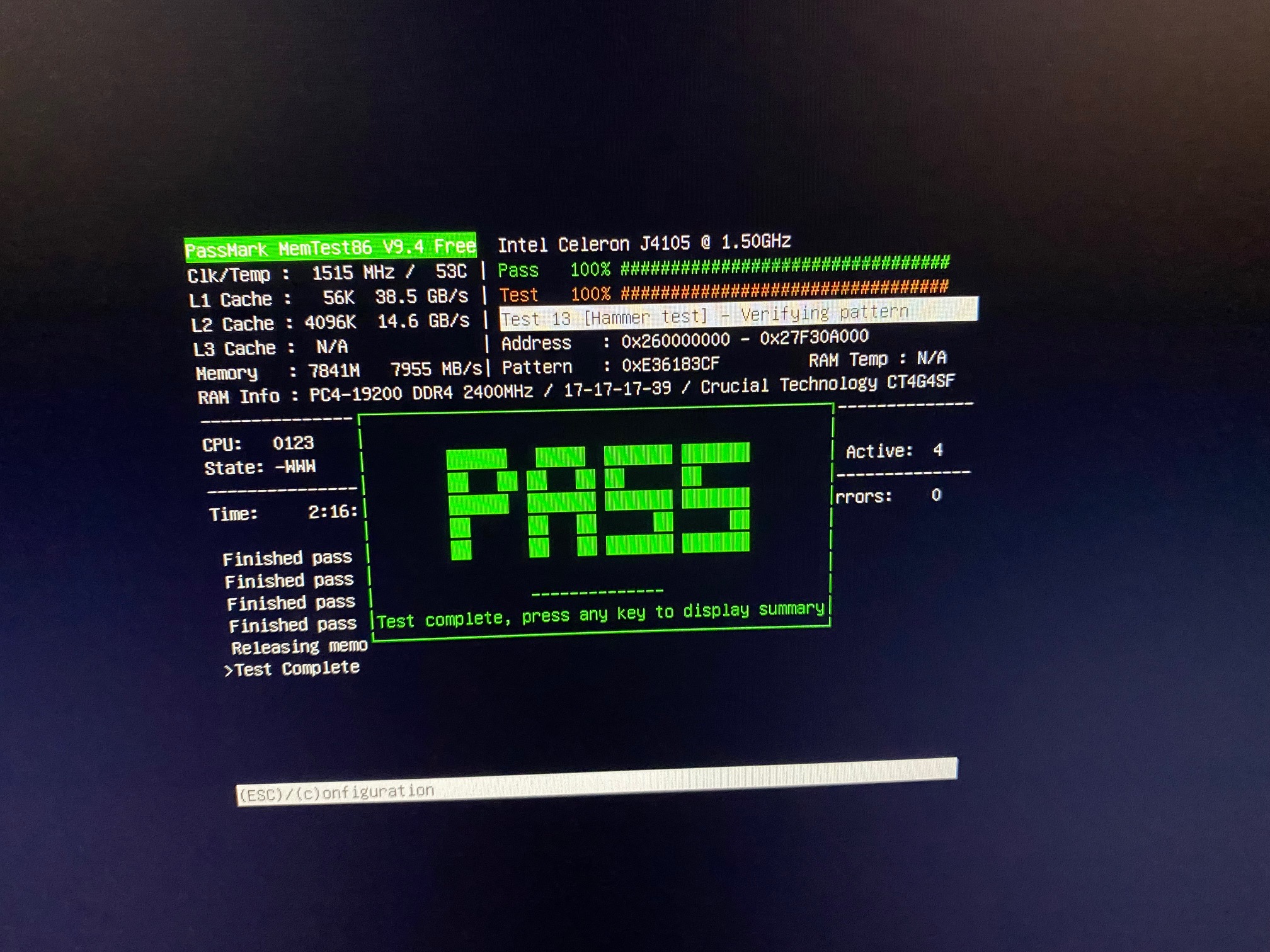
A kernel dev friend said "I'm familiar with that code ... you should run memtest86". This seemed like advice it would be foolish to ignore! I installed the memtest86 package, which on Debian stable, is actually the formerly open-source "memtest86" software, last updated in 2014, rather than the currently open-source "memtest86+". However the package (incorrectly, I think) Recommends: memtest86+ so I ended up with both. The package scripts integrate with GRUB, so both were added as boot options. Neither however, would boot on my NAS, which is a UEFI system: after selection from the GRUB prompt, I just had a blank screen. I focussed for a short while on display issues: I wondered if trying to run a 4k monitor over HDMI was too much to expect from a memory tester OS, but my mainboard has a VGA out as well. It has some quirky behaviour for the VGA out: the firmware doesn't use it at all, so output only begins appearing after something boots (GRUB for example). I fiddled about with the HDMI output, VGA output, and trying different RGB cables, to no avail. The issue was (likely) nothing to do with the video out, but rather that the packaged versions of memtest/memtest86+ don't work properly on UEFI systems. What did work, was Passmark Software's non-FOSS memtest86. It drew on HDMI, albeit in a postage stamp sized window. After some time (much less than I expected, some kind of magic modern memory matrix stuff going on I think), I got a clean bill of health:
memtest86(.com) passes
It's quite possible the FOSS versions of memtest (pcmemtest is another) have better support for UEFI in more recent versions than I installed (I just went with what's in Debian stable), and if not, then this is a worthy feature to work on.

8 September 2022

Antoine Beaupr : Complaint about Canada's phone cartel

I have just filed a complaint with the CRTC about my phone provider's outrageous fees. This is a copy of the complaint.
I am traveling to Europe, specifically to Ireland, for a 6 days for a work meeting. I thought I could use my phone there. So I looked at my phone provider's services in Europe, and found the "Fido roaming" services: https://www.fido.ca/mobility/roaming The fees, at the time of writing, at fifteen (15!) dollars PER DAY to get access to my regular phone service (not unlimited!!). If I do not use that "roaming" service, the fees are: That is absolutely outrageous. Any random phone plan in Europe will be cheaper than this, by at least one order of magnitude. Just to take any example: https://www.tescomobile.ie/sim-only-plans.aspx Those fine folks offer a one-time, prepaid plan for 15 for 28 days which includes: I think it's absolutely scandalous that telecommunications providers in Canada can charge so much money, especially since the most prohibitive fee (the "non-prepaid" plans) are automatically charged if I happen to forget to remove my sim card or put my phone in "airplane mode". As advised, I have called customer service at Fido for advice on how to handle this situation. They have confirmed those are the only plans available for travelers and could not accommodate me otherwise. I have notified them I was in the process of filing this complaint. I believe that Canada has become the technological dunce of the world, and I blame the CRTC for its lack of regulation in that matter. You should not allow those companies to grow into such a cartel that they can do such price-fixing as they wish. I haven't investigated Fido's competitors, but I will bet at least one of my hats that they do not offer better service. I attach a screenshot of the Fido page showing those outrageous fees.
I have no illusions about this having any effect. I thought of filing such a complain after the Rogers outage as well, but felt I had less of a standing there because I wasn't affected that much (e.g. I didn't have a life-threatening situation myself). This, however, was ridiculous and frustrating enough to trigger this outrage. We'll see how it goes...
"We will respond to you within 10 working days."

Response from CRTC They did respond within 10 days. Here is the full response:
Dear Antoine Beaupr : Thank you for contacting us about your mobile telephone international roaming service plan rates concern with Fido Solutions Inc. (Fido). In Canada, mobile telephone service is offered on a competitive basis. Therefore, the Canadian Radio-television and Telecommunications Commission (CRTC) is not involved in Fido's terms of service (including international roaming service plan rates), billing and marketing practices, quality of service issues and customer relations. If you haven't already done so, we encourage you to escalate your concern to a manager if you believe the answer you have received from Fido's customer service is not satisfactory. Based on the information that you have provided, this may also appear to be a Competition Bureau matter. The Competition Bureau is responsible for administering and enforcing the Competition Act, and deals with issues such as false or misleading representations, deceptive marketing practices and collusion. You can reach the Competition Bureau by calling 1-800-348-5358 (toll-free), by TTY (for deaf and hard of hearing people) by calling 1-866-694-8389 (toll-free). For more contact information, please visit http://www.competitionbureau.gc.ca/eic/site/cb-bc.nsf/eng/00157.html When consumers are not satisfied with the service they are offered, we encourage them to compare the products and services of other providers in their area and look for a company that can better match their needs. The following tool helps to show choices of providers in your area: https://crtc.gc.ca/eng/comm/fourprov.htm Thank you for sharing your concern with us.
In other words, complain with Fido, or change providers. Don't complain to us, we don't manage the telcos, they self-regulate. Great job, CRTC. This is going great. This is exactly why we're one of the most expensive countries on the planet for cell phone service.

Live chat with Fido Interestingly, the day after I received that response from the CRTC, I received this email from Fido, while traveling:
Date: Tue, 13 Sep 2022 10:10:00 -0400 From: Fido DONOTREPLY@fido.ca To: REDACTED Subject: Courriel d avis d itin rance Fido Roaming Welcome Confirmation Fido Date : 13 septembre 2022
Num ro de compte : [redacted] Bonjour
Antoine Beaupr ! Nous vous crivons pour vous indiquer qu au moins un utilisateur inscrit votre compte s est r cemment connect un r seau en itin rance.
Vous trouverez ci-dessous le message texte de bienvenue en itin rance envoy l utilisateur (ou aux utilisateurs), qui contenait les tarifs d itin rance
applicables. Message texte de bienvenue en itin rance Destinataire : REDACTED Date et heure : 2022-09-13 / 10:10:00
Allo, ici Fido : Bienvenue destination! Vous tes inscrit Fido Nomade alors utilisez vos donn es, parlez et textez comme vous le faites la
maison. Depuis le 1 mars 2022 le tarif cette destination pour 15 $/jour (+ taxes) et valide tous les jours jusqu' 23 h 59 HE, peu importe le fuseau
horaire dans lequel vous vous trouvez. Bon voyage! Des questions? Consultez fido.ca/m/itinerance ou composez +15149333436 (sans frais). Besoin d aide?
  • PLANIFIEZ UN VOYAGE AVEC Fido NomadeMC
    D couvrez nos options d itin rance et restez en contact l tranger sans vous soucier de votre
    facture.
D tails
  • G rez votre compte
    G rez vos produits et services Fido la maison ou sur la route gr ce Mon
    Compte.
D tails Ce courriel est produit automatiquement; veuillez ne pas y r pondre. Ce courriel (et toute pi ce jointe) est confidentiel. Si vous n tes pas le destinataire,
veuillez supprimer le pr sent message et en d truire toute copie. FIDO SOLUTIONS 800, RUE DE LA GAUCHETI RE OUEST
BUREAU 4000 MONTR AL (QU BEC) H5A 1K3
Fido
I found that message utterly confusing (and yes, I can read french). Basically, it says that some user (presumably me!) connected to the network with roaming. I did just disabled airplane mode on my phone to debug a Syncthing bug but had not enabled roaming. So this message seemed to say that I would be charged 15$ (per DAY!) for roaming from now on. Confused, I tried their live chat to try to clarify things, worried I would get charged even more for calling tech support on *611. This is a transcript of the chat:
F: Hi! What are we doing today? Type in your question or choose from the options below: * Track my Equipment Order * View Bill Online * Payment Options * iPhone 14 Pre-Order A: i received a message about roaming while abroad but i did not enable roaming on my phone, will i be charged anyways? F: I think I know what you re asking for. Select the topic that best matches your request or try rephrasing your question. A: no F: Thank you, this will help us to improve! Would you like to chat with a specialist? Chat with a specialist I'll get a specialist to help you with this. It appears that you're not signed in. Your session may have timed out. To save time and identify your account details, please sign in to My Account.
  • Sign in
  • I'm not able to sign in
Have any questions specific to your Fido account? To service you faster, please identify yourself by completing the form below. A: Personal info Form submitted F: Thank you! I'll connect you with the next available specialist. Your chat is being transferred to a Live Chat agent. Thanks for your patience. We are here to assist you and we kindly ask that our team members be treated with respect and dignity. Please note that abuse directed towards any Consumer Care Specialist will not be tolerated and will result in the termination of your conversation with us. All of our agents are with other customers at the moment. Your chat is in a priority sequence and someone will be with you as soon as possible. Thanks! Thanks for continuing to hold. An agent will be with you as soon as possible. Thank you for your continued patience. We re getting more Live Chat requests than usual so it s taking longer to answer. Your chat is still in a priority sequence and will be answered as soon as an agent becomes available. Thank you so much for your patience we're sorry for the wait. Your chat is still in a priority sequence and will be answered as soon as possible. Hi, I'm [REDACTED] from Fido in [REDACTED]. May I have your name please? A: hi i am antoine, nice to meet you sorry to use the live chat, but it's not clear to me i can safely use my phone to call support, because i am in ireland and i'm worried i'll get charged for the call F: Thank You Antoine , I see you waited to speak with me today, thank you for your patience.Apart from having to wait, how are you today? A: i am good thank you
[... delay ...]
A: should i restate my question? F: Yes please what is the concern you have? A: i have received an email from fido saying i someone used my phone for roaming it's in french (which is fine), but that's the gist of it i am traveling to ireland for a week i do not want to use fido's services here... i have set the phon eto airplane mode for most of my time here F: The SMS just says what will be the charges if you used any services. A: but today i have mistakenly turned that off and did not turn on roaming well it's not a SMS, it's an email F: Yes take out the sim and keep it safe.Turun off or On for roaming you cant do it as it is part of plan. A: wat F: if you used any service you will be charged if you not used any service you will not be charged. A: you are saying i need to physically take the SIM out of the phone? i guess i will have a fun conversation with your management once i return from this trip not that i can do that now, given that, you know, i nee dto take the sim out of this phone fun times F: Yes that is better as most of the customer end up using some kind of service and get charged for roaming. A: well that is completely outrageous roaming is off on the phone i shouldn't get charged for roaming, since roaming is off on the phone i also don't get why i cannot be clearly told whether i will be charged or not the message i have received says i will be charged if i use the service and you seem to say i could accidentally do that easily can you tell me if i have indeed used service sthat will incur an extra charge? are incoming text messages free? F: I understand but it is on you if you used some data SMS or voice mail you can get charged as you used some services.And we cant check anything for now you have to wait for next bill. and incoming SMS are free rest all service comes under roaming. That is the reason I suggested take out the sim from phone and keep it safe or always keep the phone or airplane mode. A: okay can you confirm whether or not i can call fido by voice for support? i mean for free F: So use your Fido sim and call on +1-514-925-4590 on this number it will be free from out side Canada from Fido sim. A: that is quite counter-intuitive, but i guess i will trust you on that thank you, i think that will be all F: Perfect, Again, my name is [REDACTED] and it s been my pleasure to help you today. Thank you for being a part of the Fido family and have a great day! A: you too
So, in other words:
  1. they can't tell me if I've actually been roaming
  2. they can't tell me how much it's going to cost me
  3. I should remove the SIM card from my phone (!?) or turn on airplane mode, but the former is safer
  4. I can call Fido support, but not on the usual *611, and instead on that long-distance-looking phone number, and yes, that means turning off airplane mode and putting the SIM card in, which contradicts step 3
Also notice how the phone number from the live chat (+1-514-925-4590) is different than the one provided in the email (15149333436). So who knows what would have happened if I would have called the latter. The former is mentioned in their contact page. I guess the next step is to call Fido over the phone and talk to a manager, which is what the CRTC told me to do in the first place... I ended up talking with a manager (another 1h phone call) and they confirmed there is no other package available at Fido for this. At best they can provide me with a credit if I mistakenly use the roaming by accident to refund me, but that's it. The manager also confirmed that I cannot know if I have actually used any data before reading the bill, which is issued on the 15th of every month, but only available... three days later, at which point I'll be back home anyways. Fantastic.

6 September 2022

Shirish Agarwal: Debian on Phone

History Before I start, the game I was talking about is called Cell To Singularity. Now I haven t gone much in the game as I have shared but think that the Singularity it refers to is the Technological Singularity that people think will happen. Whether that will happen or not is open to debate to one and all. This is going to be a bit long one. Confession Time :- When I was sharing in the blog post, I had no clue that we actually had sessions on it in this year s Debconf. I just saw the schedule yesterday and then came to know. Then I saw Guido s two talks, one at Debconf as well as one as Froscon. In fact, saw the Froscon talk first, and then the one at Debconf. Both the talks are nearly the same except for a thing here or a thing there. Now because I was not there so my understanding and knowledge would be disadvantageously asymmetrical to Guido and others who were there and could talk and share more. Having a Debian mobile or Debian on the mobile could also make Debian more popular and connectable to the masses, one of the things that were not pointed out in the Debian India BOF sadly. At the same time, there are some facts that are not on the table and hence not thought about. Being a B.Com person, I have been following not just the technical but also how the economics work and smartphone penetration in India is pretty low or historically been very low, say around 3-4% while the majority that people use, almost 90-95% of the market uses what are called non-smartphones or dumbphones. Especially during the pandemic and even after that the dumbphones market actually went up while smartphones stagnated and even came down. There is a lot of inventory at most of the dealers that they can t get rid of. From a dealer perspective, it probably makes more sense to buy and sell dumbphones more in number as the turnaround of capital is much faster and easier than for smartphones. I have seen people spend a number of hours and rightly so in order to make their minds up on a smartphone while for a dumbphone, it is a 10-minute thing. Ask around, figure out who is selling at the cheapest, and just buy. Most of these low-end phones are coming from China. In fact, even in the middle and getting even into smartphones, the Chinese are the masters from whom we buy, even as they have occupied Indian territory. In the top five, Samsung comes at number three of four (sharing about Samsung as a fan and having used them.) even though battery times are atrocious, especially with Android 12L. The only hope that most of the smartphone manufacturers have is lowering the sticker prices and hoping that 5G Adoption picks up and that is what they are betting on but that comes with its own share of drawbacks as can be seen.

GNOME, MATE, memory leaks, Payments FWIW, while I do have GNOME and do use a couple of tools from the GNOME stack, I hate GNOME with a passion. I have been a mate user for almost a decade now and really love the simplicity that mate has vis-a-vis GNOME. And with each release, MATE has only become better. So, it would be nice if we can have MATE on the mobile phone. How adaptive the apps might be on the smaller area, I dunno. It would be interesting to find out if and how people are looking at debugging memory leaks on mobile phones. Although finding memory leaks on any platform is good, finding them and fixing them on a mobile phone is pretty much critical as most phones have fixed & relatively small amounts of memory and it is and can get quickly exhausted. One of the things that were asked in the Q&A was about payments. The interesting thing is both UK and India are the same or markedly similar in regard as far as contactless payments being concerned. What most Indians have or use is basically UPI which is basically backed by your bank. Unlike in some other countries where you have a selection of wallets and even temporary/permanent virtual accounts whereby you can minimize your risks in case your mobile gets stolen or something, here we don t have that. There are three digital wallets that I know Paytm Not used (have heard it s creepy, but don t really know), Google pay (Unfortunately, this is the one I use, they bought multiple features, and in the last couple of years have really taken the game away from Paytm but also creepy.). The last one is Samsung Pay (haven t really used it as their find my phone app. always crashes, dunno how it is supposed to work.) But I do find that the apps. are vulnerable. Every day there is some or other news of fraud happening. Previously, only States like Bihar and Jharkhand used to be infamous for cybercrime as a hub, but now even States like Andhra Pradesh have joined and surpassed them :(. People have lost lakhs and crores, this is just a few days back. Some more info. on UPI can be found here and GitHub has a few implementation examples that anybody could look at and run away with it.

Balancing on three things For any new mobile phone to crack the market, it has to balance three things. One, achieve economies of scale. Unless, that is not taken care of or done, however good or bad the product might be, it remains a niche and dies after some time. While Guido shared about Openmoko and N900, one of the more interesting bits from a user perspective at least was the OLPC project. There are many nuances that the short article didn t go through. While I can t say for other countries, at least in India, no education initiative happens without corruption. And perhaps Nicholas s hands were tied while other manufacturers would and could do to achieve their sales targets. In India, it flopped because there was no way for volunteers to buy or get OLPC unless they were part of a school or college. There was some traction in FOSS communities, but that died down once OLPC did the partnership with MS-Windows, and proverbially broke the camel s back. FWIW, I think the idea, the concept, and even the machine were far ahead of their time. The other two legs are support and Warranty Without going into any details, I can share and tell there were quite a few OLPC type attempts using conventional laptops or using Android and FOSS or others or even using one of the mainstream distributions but the problems have always been polishing, training and support. Guido talked about privacy as a winning feature but fails to take into account that people want to know that their privacy isn t being violated. If a mobile phone answers to Hey Google does it mean it was passively gathering, storing, and sending info to third parties, we just don t know. The mobile phone could be part of the right to repair profile while at the same time it can force us to ask many questions about the way things currently are and going to be. Six months down the line all the flagships of all companies are working on being able to take and share through satellites (Satellite Internet) and perhaps maybe a few non-flagships. Of course, if you are going to use a satellite, then you are going to drain that much more quickly. In all and every event there are always gonna be tradeoffs. The Debian-mobile mailing list doesn t seem to have many takers. The latest I could find there is written by Paul Wise. I am in a similar boat (Samsung; SM-M526B; Lahaina; arm64-v8a) v12. It is difficult to know which release would work on your machine, make sure that the building from the source is not tainted and pristine and needs a way to backup and restore if you need to. I even tried installing GNURoot Debian and the Xserver alternative they had shared but was unable to use the touch interface on the fakeroot instance  . The system talks about a back key but what back key I have no clue.

Precursor Events Debconf 2023 As far as precursor events are concerned before Debconf 23 in India, all the festivals that we have could be used to showcase Debian. In fact, the ongoing Ganesh Chaturthi would have been the perfect way to showcase Debian and apps. according to the audience. Even the festival of Durga Puja, Diwali etc. can be used. When commercial organizations use the same festivals, why can t we? What perhaps we would need to figure out is the funding part as well as getting permissions from Municipal authorities. One of the things for e.g. that we could do is buy either a permanent 24 monitor or a 34 TV and use that to display Debian and apps. The bigger, the better. Something that we could use day to day and also is used for events. This would require significant amounts of energy so we could approach companies, small businesses and individuals both for volunteering as well as helping out with funding. Somebody asked how we could do online stuff and why it is somewhat boring. What could be done for e.g. instead of 4-5 hrs. of things, break it into manageable 45 minute pieces. 4-5 hrs. is long and is gonna fatigue the best of people. Make it into 45-minute negotiable chunks, and intersphere it with jokes, hacks, anecdotes, and war stories. People do not like or want to be talked down to but rather converse. One of the things that I saw many of the artists do is have shows and limit the audience to 20-24 people on zoom call or whatever videoconferencing system you have and play with them. The passive audience enjoys the play between the standup guy and the crowd he works on, some of them may be known to him personally so he can push that envelope a bit more. The same thing can be applied here. Share the passion, and share why we are doing something. For e.g. you could do smem -t -k less and give a whole talk about how memory is used and freed during a session, how are things different on desktop and ARM as far as memory architecture is concerned (if there is). What is being done on the hardware side, what is on the software side and go on and on. Then share about troubleshooting applications. Valgrind is super slow and makes life hell, is there some better app ? Doesn t matter if you are a front-end or a back-end developer you need to know this and figure out the best way to deal with in your app/program. That would have lot of value. And this is just an e.g. to help trigger more ideas from the community. I am sure others probably have more fun ideas as to what can be done. I am stopping here now otherwise would just go on, till later. Feel free to comment, feedback. Hope it generates some more thinking and excitement on the grey cells.

3 September 2022

James Valleroy: File sharing with bepasty

One of the apps running on my FreedomBox that I use frequently is bepasty. bepasty is essentially a self-hosted, free software pastebin. It allows you to paste text, or upload any type of file. You can also set an expiration date for when the file or text will automatically be deleted. If you are uploading multiple related files, you can organize them into a list. bepasty does not have user accounts. Instead, it has shared passwords, where each password is linked to a set of permissions. There are five permissions: Read, List, Create, Delete, and Admin. (The meanings are mostly straightforward, except for Admin, which means the ability to lock and unlock files.) This allows very fine-grained control. For example, if you want someone to be able to upload files to your bepasty, but not view or download anything, than you can generate a password with only the Create permission, and give this password to the person who will be uploading files. To simplify the initial setup in FreedomBox, we generate three passwords by default: one for viewers (List and Read), one for editors (List, Read, Create, and Delete), and one for admins (all permissions). In addition, when no password has been provided, the Read (but not List) permission is provided by default. This allows files to be easily shared by sending just their URLs (and no password required). The URLs contain some random characters, so it is not easy to guess. I mostly use bepasty for moving files between systems, whether its a physical machine or VPS, or a VM or container that I will use only briefly. Especially in the latter case, it s nice that I don t need to do any extra setup (such as copying SSH keys) before I copy my files over. The bepasty package is available in Debian stable (with a newer version in stable-backports and testing). The many use-cases that it provides, and the well-maintained Debian packaging, made it a compelling choice for integration into FreedomBox, which has included bepasty for one-click installation since version 20.14.

Shirish Agarwal: Fantasy, J.R.R. Tolkein

J.R.R. Tolkein Now unless you have been living under a rock cave, I am sure you know who Mr. Tolkein is. Apparently, the gentleman passed away on 2nd September 1973 at the sprightly age of 80. And this gives fans like me to talk about fantasy, fantasy authors, and the love-hate relationship we have with them. For a matter of record, I am currently reading Babylon Steel by Gaie Sebold. Now while I won t go into many details (I never like to, if I enjoy a book, I would want the book to be mysterious rather than give praise, simply so that the next person enjoys it as much as I did without having any expectations.) Now this book has plenty of sex so wouldn t recommend it for teenagers but more perhaps to mature audiences, although for the life of me couldn t find any rating on the book. I did come across common sense media but unfortunately, it isn t well known beyond perhaps some people who use it. They sadly don t have a google/Android app  And before anybody comments, I know that Android is no longer interested in supporting FOSS, their loss, not ours but that is entirely a blog post/article in itself. so let s leave that aside for now.

Fantasy So before talking about Mr. Tolkien and his creations let s talk and share a bit about fantasy. We know for a fact that the conscious mind functions at less than 5%, while the other bits are made by the subconscious and the unconscious mind (the three mind model.) So any thought or idea first germinates n either the unconscious or the subconscious part of the mind and then comes into the conscious mind. It is the reason we also dream. That s the subconscious and unconscious mind at work. While we say fantasy mostly to books, it is all around us and not just in prose but in song, dance, and all sorts of creativity are fantasy. Even Sci-fi actually comes from fantasy. Unfortunately, for reasons best known to people, they took out sci-fi and even divided fantasy into high fantasy and low fantasy. I am not going to go much into that but here s a helpful link for those who might want to look more into it. Now the question arises, why do people write? I have asked this question many a time to the authors I have met and the answers are as varied as they come. Two of the most common answers are the need to write (an itch they can t control or won t control) and the other is it s extremely healing. In my own case, even writing mere blog posts I found it unburdening & cathartetic. I believe this last part is what drove Mr. Tolkein and the story and arc that LOTR became. Tolkien, LOTR, World War I The casual reader might not know but if you followed or were curious about Mr. Tolkien, you would have found out that Mr. Tolkien served in World War 1 or what is known as the Great War. It was supposed to be the war that ended all wars but sadly didn t. One of the things that set apart Mr. Tolkein from many of his peers was that Mr. Tolkien was very straight about himself and corresponded with people far and wide. There is actually a book called The Letters of J.R.R. Tolkien that I hope to get at one of the used book depots. That book spans about 480 pages and gives all the answers as to why Mr. Tolkien made Middle-earth as it was made. I sadly haven t had the opportunity to get it and it is somewhat expensive. But I m sure that if World War 1 wouldn t have happened and Mr. Tolkein hadn t taken part and experienced what he experienced, we wouldn t have LOTR. I can bet losing his friends and comrades, and the pain he felt for those around him propelled him to write about land and a race called Hobbits. I haven t done enough fantasy reading but I do feel that his description of hobbits and the way they were and are is unique. The names and surnames he used were for humor as well as to make a statement about them. Having names such as Harfoots, Padfoot, Took and others just wouldn t be for fun, would it? Also, the responses and the behavior in the four books by Hobbits are almost human-like. It is almost like they are or were our cousins at one point in time but we allowed ourselves to forget. Even the corruption of humans has been shown as well as self-doubt. There is another part that I found and find fascinating, unlike most books where there is a single hero, in LOTR we have many heroes and heroines. This again, I would attribute to Mr. Tolkien and the heroism he saw on the battlefield and beyond it. All the tender emotions he shares with readers like us are because either he himself or others around him were subjected to grace and wonderment. This is all I derive from the books, those who have The letters of J.R.R. Tolkein , feel free to correct me. I was supposed to write this yesterday but real life has its own way. I could go on and on, perhaps at a later date or time I may expand on it, but it isn t a coincidence that Lord of the Rings: Rings of Power is starting broadcast on the same day when Mr. Tolkein died. In the very end, fantasy is something humans got and does not matter how rich or poor you are. If one were to look, both artists like Michaelangelo and many other artists, who often didn t have enough to have two square meals in the day, but still somehow were inspired to sketch models of airplanes, flying machines which are shockingly similar to the real thing. Many may not know that almost all primates, including apes, monkeys, squirrels, and even dolphins dream. And all of them have elaborate, complex dreams just as we do. Sadly, this info. is not known by most people otherwise, we would be so much empathetic towards our cousins in the animal kingdom.

2 September 2022

John Goerzen: Dead USB Drives Are Fine: Building a Reliable Sneakernet

OK, you re probably thinking. John, you talk a lot about things like Gopher and personal radios, and now you want to talk about building a reliable network out of USB drives? Well, yes. In fact, I ve already done it.

What is sneakernet? Normally, sneakernet is a sort of tongue-in-cheek reference to using disconnected storage to transport data or messages. By disconnect storage I mean anything like CD-ROMs, hard drives, SD cards, USB drives, and so forth. There are times when loading up 12TB on a device and driving it across town is just faster and easier than using the Internet for the same. And, sometimes you need to get data to places that have no Internet at all. Another reason for sneakernet is security. For instance, if your backup system is online, and your systems being backed up are online, then it could become possible for an attacker to destroy both your primary copy of data and your backups. Or, you might use a dedicated computer with no network connection to do GnuPG (GPG) signing.

What about reliable sneakernet, then? TCP is often considered a reliable protocol. That means that the sending side is generally able to tell if its message was properly received. As with most reliable protocols, we have these components:
  1. After transmitting a piece of data, the sender retains it.
  2. After receiving a piece of data, the receiver sends an acknowledgment (ACK) back to the sender.
  3. Upon receiving the acknowledgment, the sender removes its buffered copy of the data.
  4. If no acknowledgment is received at the sender, it retransmits the data, in case it gets lost in transit.
  5. It reorders any packets that arrive out of order, so that the recipient s data stream is ordered correctly.
Now, a lot of the things I just mentioned for sneakernet are legendarily unreliable. USB drives fail, CD-ROMs get scratched, hard drives get banged up. Think about putting these things in a bicycle bag or airline luggage. Some of them are going to fail. You might think, well, I ll just copy files to a USB drive instead of move them, and once I get them onto the destination machine, I ll delete them from the source. Congratulations! You are a human retransmit algorithm! We should be able to automate this! And we can.

Enter NNCP NNCP is one of those things that almost defies explanation. It is a toolkit for building asynchronous networks. It can use as a carrier: a pipe, TCP network connection, a mounted filesystem (specifically intended for cases like this), and much more. It also supports multi-hop asynchronous routing and asynchronous meshing, but these are beyond the scope of this particular article. NNCP s transports that involve live communication between two hops already had all the hallmarks of being reliable; there was a positive ACK and retransmit. As of version 8.7.0, NNCP s ACKs themselves can also be asynchronous meaning that every NNCP transport can now be reliable. Yes, that s right. Your ACKs can flow over tapes and USB drives if you want them to. I use this for archiving and backups. If you aren t already familiar with NNCP, you might take a look at my NNCP page. I also have a lot of blog posts about NNCP. Those pages describe the basics of NNCP: the packet (the unit of transmission in NNCP, which can be tiny or many TB), the end-to-end encryption, and so forth. The new command we will now be interested in is nncp-ack.

The Basic Idea Here are the basic steps to processing this stuff with NNCP:
  1. First, we use nncp-xfer -rx to process incoming packets from the USB (or other media) device. This moves them into the NNCP inbound queue, deleting them from the media device, and verifies the packet integrity.
  2. We use nncp-ack -node $NODE to create ACK packets responding to the packets we just loaded into the rx queue. It writes a list of generated ACKs onto fd 4, which we save off for later use.
  3. We run nncp-toss -seen to process the incoming queue. The use of -seen causes NNCP to remember the hashes of packets seen before, so a duplicate of an already-seen packet will not be processed twice. This command also processes incoming ACKs for packets we ve sent out previously; if they pass verification, the relevant packets are removed from the local machine s tx queue.
  4. Now, we use nncp-xfer -keep -tx -mkdir -node $NODE to send outgoing packets to a given node by writing them to a given directory on the media device. -keep causes them to remain in the outgoing queue.
  5. Finally, we use the list of generated ACK packets saved off in step 2 above. That list is passed to nncp-rm -node $NODE -pkt < $FILE to remove those specific packets from the outbound queue. The reason is that there will never be an ACK of ACK packet (that would create an infinite loop), so if we don t delete them in this manner, they would hang around forever.
You can see these steps follow the same basic outline on upstream s nncp-ack page. One thing to keep in mind: if anything else is running nncp-toss, there is a chance of a race condition between steps 1 and 2 (if nncp-toss gets to it first, it might not get an ack generated). This would sort itself out eventually, presumably, as the sender would retransmit and it would be ACKed later.

Further ideas NNCP guarantees the integrity of packets, but not ordering between packets; if you need that, you might look into my Filespooler program. It is designed to work with NNCP and can provide ordered processing.

An example script Here is a script you might try for this sort of thing. It may have more logic than you need really, you just need the steps above but hopefully it is clear.
#!/bin/bash
set -eo pipefail
MEDIABASE="/media/$USER"
# The local node name
NODENAME=" hostname "
# All nodes.  NODENAME should be in this list.
ALLNODES="node1 node2 node3"
RUNNNCP=""
# If you need to sudo, use something like RUNNNCP="sudo -Hu nncp"
NNCPPATH="/usr/local/nncp/bin"
ACKPATH=" mktemp -d "
# Process incoming packets.
#
# Parameters: $1 - the path to scan.  Must contain a directory
# named "nncp".
procrxpath ()  
    while [ -n "$1" ]; do
        BASEPATH="$1/nncp"
        shift
        if ! [ -d "$BASEPATH" ]; then
            echo "$BASEPATH doesn't exist; skipping"
            continue
        fi
        echo " *** Incoming: processing $BASEPATH"
        TMPDIR=" mktemp -d "
        # This rsync and the one below can help with
        # certain permission issues from weird foreign
        # media.  You could just eliminate it and
        # always use $BASEPATH instead of $TMPDIR below.
        rsync -rt "$BASEPATH/" "$TMPDIR/"
        # You may need these next two lines if using sudo as above.
        # chgrp -R nncp "$TMPDIR"
        # chmod -R g+rwX "$TMPDIR"
        echo "     Running nncp-xfer -rx"
        $RUNNNCP $NNCPPATH/nncp-xfer -progress -rx "$TMPDIR"
        for NODE in $ALLNODES; do
                if [ "$NODE" != "$NODENAME" ]; then
                        echo "     Running nncp-ack for $NODE"
                        # Now, we generate ACK packets for each node we will
                        # process.  nncp-ack writes a list of the created
                        # ACK packets to fd 4.  We'll use them later.
                        # If using sudo, add -C 5 after $RUNNNCP.
                        $RUNNNCP $NNCPPATH/nncp-ack -progress -node "$NODE" \
                           4>> "$ACKPATH/$NODE"
                fi
        done
        rsync --delete -rt "$TMPDIR/" "$BASEPATH/"
        rm -fr "$TMPDIR"
    done
 
proctxpath ()  
    while [ -n "$1" ]; do
        BASEPATH="$1/nncp"
        shift
        if ! [ -d "$BASEPATH" ]; then
            echo "$BASEPATH doesn't exist; skipping"
            continue
        fi
        echo " *** Outgoing: processing $BASEPATH"
        TMPDIR=" mktemp -d "
        rsync -rt "$BASEPATH/" "$TMPDIR/"
        # You may need these two lines if using sudo:
        # chgrp -R nncp "$TMPDIR"
        # chmod -R g+rwX "$TMPDIR"
        for DESTHOST in $ALLNODES; do
            if [ "$DESTHOST" = "$NODENAME" ]; then
                continue
            fi
            # Copy outgoing packets to this node, but keep them in the outgoing
            # queue with -keep.
            $RUNNNCP $NNCPPATH/nncp-xfer -keep -tx -mkdir -node "$DESTHOST" -progress "$TMPDIR"
            # Here is the key: that list of ACK packets we made above - now we delete them.
            # There will never be an ACK for an ACK, so they'd keep sending forever
            # if we didn't do this.
            if [ -f "$ACKPATH/$DESTHOST" ]; then
                echo "nncp-rm for node $DESTHOST"
                $RUNNNCP $NNCPPATH/nncp-rm -debug -node "$DESTHOST" -pkt < "$ACKPATH/$DESTHOST"
            fi
        done
        rsync --delete -rt "$TMPDIR/" "$BASEPATH/"
        rm -rf "$TMPDIR"
        # We only want to write stuff once.
        return 0
    done
 
procrxpath "$MEDIABASE"/*
echo " *** Initial tossing..."
# We make sure to use -seen to rule out duplicates.
$RUNNNCP $NNCPPATH/nncp-toss -progress -seen
proctxpath "$MEDIABASE"/*
echo "You can unmount devices now."
echo "Done."

This post is also available on my webiste, where it may be periodically updated.

1 September 2022

Emmanuel Kasper: OpenShift vs. AWS product mapping

If you know the Amazon Web Services portfolio, and you are interested in OpenShift or the OKD OpenShift community distribution, this is a table of corresponding technologies. OpenShift is Red Hat s Kubernetes distribution: it is basically the upstream Kubernetes delivered with monitoring, logging, CI/CD, underlying OS, tested upgrade paths not found with a manual kubernetes.io kubeadm install.
AWS OpenShift OpenShift upstream project
Cloud Trail Kubernetes API Server audit log Kubernetes
Cloud Watch OpenShift Monitoring Prometheus
AWS Artifact Compliance Operator OpenSCAP
AWS Trusted Advisor Insights
AWS Marketplace OpenShift Operator Hub
AWS Identity and Access Management (IAM) Red Hat SSO Keycloack
AWS Elastisc Beanstalk OpenShift Source2Image (S2I) Source2Image (S2I)
AWS S3 ODF Rados Gateway Rook RGW
AWS Elastic Bloc Storage ODF Rados Block Device Rook RBD
AWS Elastic File System ODF Ceph FS Rook CephFS
Amazon Simple Notification Service OpenShift Streams for Apache Kafka Apache Kafka
Amazon Guard Duty API Server audit log review, ACS Runtime detection Stackrox
Amazon Inspector Quay.io container scanner, ACS Vulnerability Assessment Clair, Stackrox
AWS Lambda Openshift Serverless* Knative
AWS Key Management System could be done with Hashicorp Vault Vault
AWS WAF NGINX Ingress Controller Operator with ModSecurity NGINX ModSecurity
Amazon Elasticache Redis Enterprise Operator Redis, memcached as alternative
AWS Relational Database Service Crunchy Data Operator PostgreSQL
* OpenShift Serverless requires the application to be packaged as a container, something AWS Lamda does not require.

Shirish Agarwal: Culture, Books, Friends

Culture Just before I start, I would like to point out that this post may or would probably be NSFW. Again, what is SFW (Safe at Work) and NSFW that so much depends on culture and perception of culture from wherever we are or wherever we take birth? But still, to be on the safe side I have put it as NSFW. Now there have been a few statements and ideas that gave me a pause. This will be a sort of chaotic blog post as I am in such a phase today. For e.g. while I do not know which culture or which country this comes from, somebody shared that in some cultures one can talk/comment May your poop be easy and with a straight face. I dunno which culture is this but if somebody asked me that I would just die from laughing or maybe poop there itself. While I can understand if it is a constipated person, but a whole culture? Until and unless their DNA is really screwed, I don t think so but then what do I know? I do know that we shit when we have extreme reactions of either joy or fear. And IIRC, this comes from mammal response when they were in dangerous situations and we got the same as humans evolved. I would really be interested to know which culture is that. I did come to know that the Japanese do wish that you may not experience hard work or something to that effect while ironically they themselves are becoming extinct due to hard work and not enough relaxation, toxic workplace is common in Japan according to social scientists and population experts. Another term that I couldn t figure out is The Florida Man Strikes again and this term is usually used when somebody does something stupid or something weird. While it is exclusively used in the American context, I am curious to know how that came about. Why does Florida have such people or is it an exaggeration? I have heard the term e.g. What happens in Vegas, stays in Vegas . Think it is also called Sin city although why just Vegas is beyond me?

Omicron-8712 Blood pressure machine I felt so stupid. I found another site or e-commerce site called Wellness Forever. They had the blood pressure machine I wanted, an Omron-8172. I bought it online and they delivered the same within half an hour. Amazon took six days and in the end, didn t deliver it at all. I tried taking measurements from it yesterday. I have yet to figure out what it all means but I did get measurements of 109 SYS, 88 DIA and Pulse is 72. As far as the pulse is concerned, guess that is normal, the others just don t know. If only I had known this couple of months ago. I was able to register the product as well as download and use the Omron Connect app. For roughly INR 2.5k you have a sort of health monitoring system. It isn t Star Trek Tricorder in any shape or form but it will have to do while the tricorder gets invented. And while we are on the subject let s not forget Elizabeth Holmes and the scam called Theranos. It really is something to see How Elizabeth Holmes modeled so much of herself on Steve Jobs mimicking how he left college/education halfway. A part of me is sad that Theranos is not real. Joe Scott just a few days ago shared some perspectives on the same just a few days ago. The idea in itself is pretty seductive, to say the least, and that is the reason the scam went on for more than a decade and perhaps would have been longer if some people hadn t gotten the truth out. I do see potentially, something like that coming on as A.I. takes a bigger role in automating testing. Half a decade to a decade from now, who knows if there is an algorithm that is able to do what is needed? If such a product were to come to the marketplace at a decent price, it would revolutionize medicine, especially in countries like India, South Africa, and all sorts of remote places. Especially, with all sorts of off-grid technologies coming and maturing in the marketplace. Before I forget, there is a game called Cell on Android that tells or shares about the evolution of life on earth. It also shares credence to the idea that life has come 6 times on Earth and has been destroyed multiple times by asteroids. It is in the idle sort of game format, so you can see the humble beginnings from the primordial soup to various kinds of cells and bacteria to finally a mammal. This is where I am and a long way to go.

Indian Bureaucracy One of the few things that Britishers gave to India, is the bureaucracy and the bureaucracy tests us in myriad ways. It would be full 2 months on 5th September and I haven t yet got a death certificate. And I need that for a sundry number of things. The same goes for a disability certificate. What is and was interesting is my trip to the local big hospital called Sassoon Hospital. My mum had shared incidents that occurred in the 1950s when she and the family had come to Pune. According to her, when she was alive, while Sassoon was the place to be, it was big and chaotic and you never knew where you are going. That was in 1950, I had the same experience in 2022. The term/adage the more things change, the more they remain the same seems to be held true for Sassoon Hospital. Btw, those of you who think the Devil exists, he is totally a fallacy. There is a popular myth that the devil comes to deal that he/she/they come to deal with you when somebody close to you passes, I was waiting desperately for him when mum passed. Any deal that he/she/they would have offered me I would have gladly taken, but all my wait was all for nothing. While I believe evil exists, that is manifested by humans and nobody else. The whole idea and story of the devil is just to control young children and nothing beyond that

Debconf 2023, friends, JPEGOptim, and EV s Quite a number of friends had gone to Albania this year as India won the right to host Debconf for the year 2023. While I did lurk on the Debconf orga IRC channel, I m not sure how helpful I would be currently. One news that warmed my heart is some people would be coming to India to check the site way before and make sure things go smoothly. Nothing like having more eyes (in this case bodies) to throw at a problem and hopefully it will be sorted. While I have not been working for the last couple of years, one of the things that I had to do and have been doing is moving a lot of stuff online. This is in part due to the Government s own intention of having everything on the cloud. One of the things I probably may have shared it more than enough times is that the storage most of these sites give is like the 1990s. I tried jpegoptim and while it works, it degrades the quality of the image quite a bit. The whole thing seems backward, especially as newer and newer smartphones are capturing more data per picture (megapixel resolution), case in point Samsung Galaxy A04 that is being introduced. But this is not only about newer phones, even my earlier phone, Samsung J-5/500 which I bought in 2016 took images at 5 MB. So it is not a new issue but a continuous issue. And almost all Govt. sites have the upper band fixed at 1 MB. But this is not limited to Govt. sites alone, most sites in India are somewhat frozen in the 1990s. And it isn t as if resources for designing web pages using HTML5, CSS3, Javascript, Python, or Java aren t available. If worse comes to worst, one can even use amp to make his, her or their point. But this is if they want to do stuff. I would be sharing a few photos with commentary, there are still places where I can put photos apart from social media

Friends Last week, Saturday suddenly all the friends decided to show up. I have no clue one way or the other why but am glad they showed up.
Mahendra, Akshat, Shirish and Sagar Sukhose (Mangesh's friend). Mahendra, Akshat, Shirish and Sagar Sukhose (Mangesh s friend) at Bal Gandharva..
Electric scooter as shared by Akshat seen in Albania Electric scooter as shared by Akshat seen in Albania
Somebody making a  real-life replica of Wall Street on F.C. Road (Commercial, all glass)Somebody making a real-life replica of Wall Street on F.C. Road (Commercial, all glass)
Ganesh Idol near my houseGanesh Idol near my house
Wearing new clothesWearing new clothes
I will have to be a bit rapid about what I am sharing above so here goes nothing

1. The first picture shows Mahendra, Akshat, me, and Sagar Sukhose (Mangesh s friend). The picture was taken by Mangesh Diwate. We talked quite a bit of various things that could be done in Debian. A few of the things that I shared were (bringing more stuff from BSD to Debian, I am sure there s still quite a lot of security software that could be advantageous to have in Debian.) The best person to talk to or guide about this would undoubtedly be Paul Wise or as he is affectionally called Pabs. He is one of the shy ones and yet knows so much about how things work. The one and only time I met him is 2016. The other thing that we talked about is porting Debian to one of the phones. This has been done in the past and done by a Puneitie some 4-5 years back. While I don t recollect the gentleman s name, I remember that the porting was done on a Motorola phone as that was the easiest to do. He had tried some other mobile but that didn t work. Making Debian available on phone is hard work. Just to have an idea, I went to the xda developers forum and found out that while M51 has been added, my specific phone model is not there. A Samsung Galaxy M52G Android (samsung; SM-M526B; lahaina; arm64-v8a) v12 . You look at the chat and you understand how difficult the process might be. One of the other ideas that Akshat pitched was Debian Astro, this is something that is close to the heart of many, including me. I also proposed to have some kind of web app or something where we can find and share about the various astronomy and related projects done by various agencies. While there is a NASA app, nothing comes close to JSR and that site just shares stuff, no speculation. There are so many projects taken or being done by the EU, JAXA, ISRO, and even middle-east countries are trying but other than people who are following some of the developments, we hear almost nothing. Even the Chinese have made some long strides but most people know nothing about the same. And it s sad to know that those developments are not being known, shared, or even speculated about as much as say NASA or SpaceX is. How do we go about it and how do we get people to contribute or ask questions around it would be interesting. 2. The second picture was something that was shared by Akshat. Akshat was sharing how in Albania people are moving on these electric scooters . I dunno if that is the right word for it or what. I had heard from a couple of friends who had gone to Vietnam a few years ago how most people in Vietnam had modified their scooters and they were snaking lines of electric wires charging scooters. I have no clue whether they were closer to Vespa or something like above. In India, the Govt. is in partnership with the oil, gas, and coal mafia just as it was in Australia (the new Govt. in Australia is making changes) the same thing is here. With the humongous profits that the oil sector provides the petro states and others, Corruption is bound to happen. We talk and that s the extent of things. 3. The third picture is from a nearby area called F.C. Road or Fergusson College Road. The area has come up quite sharply (commercially) in the last few years. Apparently, Mr. Kushal is making a real-life replica of Wall Street which would be given to commercial tenants. Right now the real estate market is tight in India, we will know how things pan out in the next few years. 4. Number four is an image of a Ganesh idol near my house. There is a 10-day festival of the elephant god that people used to celebrate every year. For the last couple of years because of the pandemic, people were unable to celebrate the festival as it is meant to celebrate. This time some people are going overboard while others are cautious and rightfully so. 5. Last and not least, one of the things that people do at this celebration is to have new clothes, so I shared a photo of a gentleman who had bought and was wearing new clothes. While most countries around the world are similar, Latin America is very similar to India in many ways, perhaps Gunnar can share. especially about religious activities. The elephant god is known for his penchant for sweets and that can be seen from his rounded stomach, that is also how he is celebrated. He is known to make problems disappear or that is supposed to be his thing. We do have something like 4 billion gods, so each one has to be given some work or quality to justify the same

Paul Wise: FLOSS Activities August 2022

Focus This month I didn't have any particular focus. I just worked on issues in my info bubble.

Changes

Issues

Debugging
  • Did extensive debugging on a libpst issue but failed to figure out the cause of the issue. Seems to be related to a change to freopen in glibc that fixed compatibility with POSIX.

Review
  • FOSSjobs: approved postings
  • Spam: reported 5 Debian bug reports and 23 Debian mailing list posts
  • Debian packages: sponsored psi-notify (twice)
  • Debian wiki: RecentChanges for the month
  • Debian BTS usertags: changes for the month
  • Debian screenshots:
    • approved bible-kjv edb-debugger lifeograph links mu-editor unattended-upgrades
    • rejected apt-listchanges/apt-listdifferences (semi-related log file), steam-devices (package description), myspell-es/lighttpd (selfie), fraqtive (Windows), wireguard (logo), kde-telepathy-contact-list (mobile hacking app)

Administration
  • Debian BTS: unarchive/reopen/triage bugs for reintroduced packages orage, scap-security-guide, libdatetime-format-datemanip-perl
  • Debian IRC: disable anti-spam channel modes for some channels
  • Debian servers: investigate full filesystems
  • Debian wiki: unblock IP addresses, approve accounts, ping accounts with bouncing email

Communication
  • Respond to queries from Debian users and contributors on the mailing lists and IRC.

Sponsors The sptag, libpst, purple-discord, circuitbreaker work was sponsored. All other work was done on a volunteer basis.

31 August 2022

Russell Coker: Links Aug 2022

Armor is an interesting technology from Manchester University for stopping rowhammer attacks on DRAM [1]. Unfortunately armor is a term used for DRAM that looks fancy for ricers so finding out whether it s used in production is difficult. The Reckless Limitless Scope of Web Browsers is an insightful analysis of the size of web specs and why it s impossible to implement them properly [2]. Framework is a company that makes laptop kits you can assemble and upgrade, interesting concept [3]. I ll keep buying second hand laptops for less than $400 but if I wanted to spend $1000 then I d consider one of these. FS has an insightful article about why unstructured job interviews (IE the vast majority of job interviews) give a bad result [4]. How a child killer inspired Ayn Rand and indirectly conservatives all around the world [5]. Ayn Rand s love of a notoriously sadistic child killer is well known, but this article has a better discussion of it than most. 60 Minutes had an interesting article on Foreign Accent Syndrome where people suddenly sound like they are from another country [6]. 18 minute video but worth watching. Most Autistic people have experience of people claiming that they must be from another country because of the way they speak. Having differences in brain function lead to differences in perceived accent is nothing new. The IEEE has an interesting article about the creation of the i860, the first million-transistor chip [7]. The Game of Trust is an interactive web site demonstrating the game theory behind trusting other people [8]. Here s a choose your own adventure game in Twitter (Nitter is a non-tracking proxy for Twitter) [9], can you get your pawn elected Emperor of the Holy Roman Empire?

30 August 2022

Jonathan Dowland: Venineth

My turntable is temporarily out of action so this post is in lieu of a crate digging update. Some time ago, I saw Matt Hoye raving about a little indie game called Venineth. I think he said it was the perfect little game to relax to. I don t regularly play games but I could sometimes do with some help relaxing. I was reminded about Venineth when I saw some buzz about Exo One, a similar-looking game, so I thought I d give Venineth a go.
picture of a vinyl record A scene near the start of Venineth
It s great fun: Relaxing, mildly challenging, and satisfying. It didn t run terribly well on my T470s but I ve since upgraded to a workstation which should handle it easily so I need to try it again. The reason this is a substitute for a crate digging post: although I ve not picked Venineth back up in a while, I have had the soundtrack on a reasonably heavy rotation. It s an immersive, synth driven instrumental album by polish musician Echo Ray that is good music to listen to when concentrating.

Next.

Previous.