Yesterday night, we had the opportunity to have for the first time my friend Kaz as a guest in my Operating Systems class. We are about to finish the semester, and he took the opportunity not just to show how the Ext4 filesystem is structured, but how it is implemented in a current Linux release.
Kaz took a very different approach from what I do: He did it really hands-on, starting with the explanation on how a hello world module would be created, and then digging in following the code of the ext4 module in Linux 3.14 (and some bits in the general filesystem-related includes).
Of course, for a ~2hr session, he did not go into the full details, but did show where the main structures of a filesystem are defined, including a general walkthrough on the general kernel coding style.
The class was very enjoyable and clear. We had the bad luck of the projector's lamp burning out at the beginning of the class, but still, you can see in the pictures the students were really into his exposition. I think the exposition did make it through and got the students involved and interested And that makes it really worth it!
Now... Sadly, due to a (most probably) human factor, I tried to record this talk but lost most of it :-( I have only the first part, but lost most of the second one. I have some bits recorded by a second camera, but have to check if they make sense by themselves, or do need the whole context. Anyway, I'll be reviewing those bits, and will update this post when I get around to cleaning+fixing+integrating them.
Some more photos...
Endlich tut mal jemand was gegen die
rechte Hetzpartei! Ein Arbeitskollege fragt, ob man die nicht
einfach mit einem langen Heckenschneider abmachen kann aber sie so
l cherlich zu machen hat auch was
Finally, someone is doing something against this Nazi party!
A coworker wondered whether it s legal to cut them off with a long
tool, but making them ridiculous like this is also funny
(Explanation: the Pro NRW people put their campaign
thingies (sorry, I don t speak English well) up on lamp posts very high,
because they are taken down by other citizens immediately otherwise,
so there s now people making fun of them for using long ladders (to
put them up there, so the offended citizens need equally long ladders
or tools with long arms) in leaning on the saying that lies have long
legs here: ladders.)
Republished by Slate. Translations available in French (Fran ais), Spanish (Espa ol), Chinese ( )
For almost 15 years, I have run my own email server which I use for all of my non-work correspondence. I do so to keep autonomy, control, and privacy over my email and so that no big company has copies of all of my personal email.
A few years ago, I was surprised to find out that my friend Peter Eckersley a very privacy conscious person who is Technology Projects Director at the EFF used Gmail. I asked him why he would willingly give Google copies of all his email. Peter pointed out that if all of your friends use Gmail, Google has your email anyway. Any time I email somebody who uses Gmail and anytime they email me Google has that email.
Since our conversation, I have often wondered just how much of my email Google really has. This weekend, I wrote a small program to go through all the email I have kept in my personal inbox since April 2004 (when Gmail was started) to find out.
One challenge with answering the question is that many people, like Peter, use Gmail to read, compose, and send email but they configure Gmail to send email from a non-gmail.com From address. To catch these, my program looks through each message s headers that record which computers handled the message on its way to my server and to pick out messages that have traveled through google.com, gmail.com, or googlemail.com. Although I usually filter them, my personal mailbox contains emails sent through a number of mailing lists. Since these mailing lists often hide the true provenance of a message, I exclude all messages that are marked as coming from lists using the (usually invisible) Precedence header.
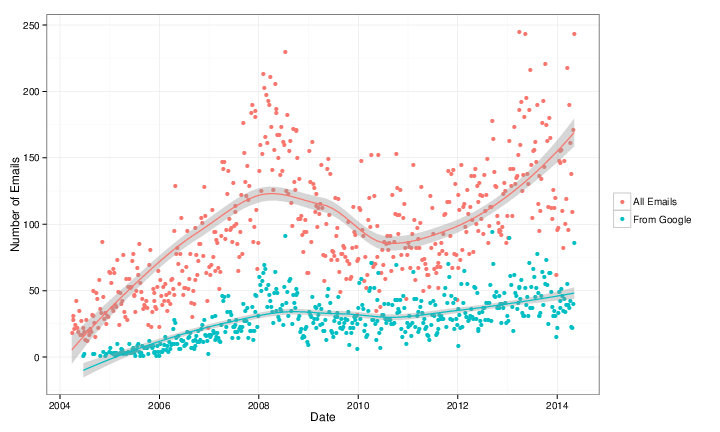
The following graph shows the numbers of emails in my personal inbox each week in red and the subset from Google in blue. Because the number of emails I receive week-to-week tends to vary quite a bit, I ve included a LOESS smoother which shows a moving average over several weeks.
From eyeballing the graph, the answer to seems to be that, although it varies, about a third of the email in my inbox comes from Google!
Keep in mind that this is all of my personal email and includes automatic and computer generated mail from banks and retailers, etc. Although it is true that Google doesn t have these messages, it suggests that the proportion of my truly personal email that comes via Google is probably much higher.
I would also like to know how much of the email I send goes to Google. I can do this by looking at emails in my inbox that I have replied to. This works if I am willing to assume that if I reply to an email sent from Google, it ends up back at Google. In some ways, doing this addresses the problem with the emails from retailers and banks since I am very unlikely to reply to those emails. In this sense, it also reflects a measure of more truly personal email.
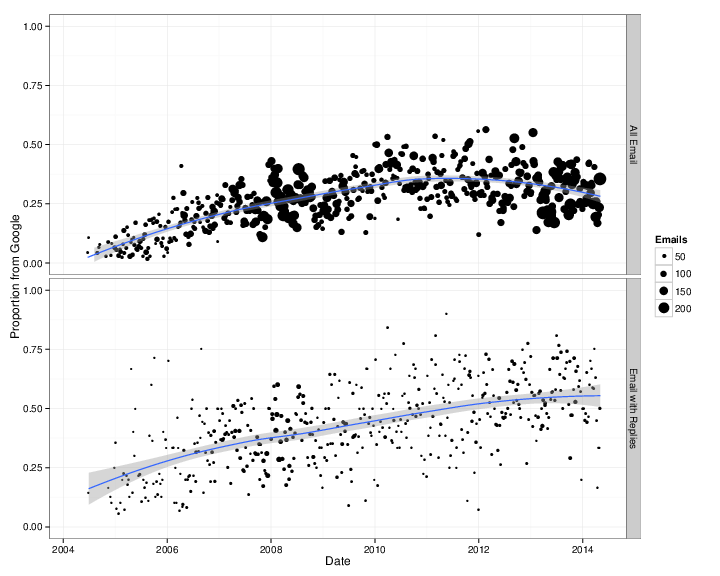
I ve broken down the proportions of emails I received that come from Google in the graph below for all email (top) and for emails I have replied to (bottom). In the graphs, the size of the dots represents the total number of emails counted to make that proportion. Once again, I ve included the LOESS moving average.
The answer is surprisingly large. Despite the fact that I spend hundreds of dollars a year and hours of work to host my own email server, Google has about half of my personal email! Last year, Google delivered 57% of the emails in my inbox that I replied to. They have delivered more than a third of all the email I ve replied to every year since 2006 and more than half since 2010. On the upside, there is some indication that the proportion is going down. So far this year, only 51% of the emails I ve replied to arrived from Google.
The numbers are higher than I imagined and reflect somewhat depressing news. They show how it s complicated to think about privacy and autonomy for communication between parties. I m not sure what to do except encourage others to consider, in the wake of the Snowden revelations and everything else, whether you really want Google to have all your email. And half of mine.
If you want to run the analysis on your own, you re welcome to the Python and R code I used to produce the numbers and graphs.
The DC15 team met Saturday at the Heidelberg
International Youth Hostel to kick
off the organisation of DebConf15. While a handful of team members
unfortunately had to excuse themselves, 18 people showed up, and the spirit
level was high.
Self-contained in beautiful surroundings
The youth hostel is the expected venue for DebConf15, which is slated to take
place in August 2015. It sleeps more than 400 people, and it features two large
conference rooms. Several smaller rooms can be used for team meetings and
impromptu birds-of-a-feather sessions.
The venue is located
a little bit outside of Heidelberg s centre, right on the side of the
Neckar river, north of the Heidelberg Zoo, west of a university
campus, and south of a sports field.
Fantastic, child-friendly DebConf venue
The large cafeteria and the plentiful outside space usable for eating, working,
chatting and playing make it a fantastic venue for DebConf. And far away from
traffic, with a play area, space to run around, and the zoo next door, it s
very suitable to families with children, too.
Become part of the team!
If you are interested in being part of the organisation of our conference, we
welcome you on our mailing
list and look forward to your contributions! There is also the
#debconf15-germany IRC channel on irc.debian.org, and we
have a list of DC15
sub-teams to give you an overview. Feel free to add yourself, or just help
out and someone will add you.
(Photos by Michael Banck and Richard Hartmann, used under the terms of the CC
by-sa licence 3.0)
Debian has recently received a donation of 8 build machines from Marvell. The new machines come with Quad core MV78460 Armada XP CPU's, DDR3 DIMM slot so we can plug in more memory, and speedy sata ports. They replace the well served Marvell MV78200 based builders - ones that have been building debian armel since 2009. We are planning a more detailed announcement, but I'll provide a quick summary: The speed increase provided by MV78460 can viewed by comparing build times on selected builds since early april: Qemu build times. We can now build Qemu in 2h instead of 16h -8x faster than before! Certainly a substantial improvement, so impressive kit from Marvell! But not all packages gain this amount of speedup: webkitgtk build times. This example, webkitgtk, builds barely 3x faster. The explanation is found from debian/rules of webkitgkt:
# Parallel builds are unstable, see #714072 and #722520
# ifneq (,$(filter parallel=%,$(DEB_BUILD_OPTIONS)))
#   NUMJOBS = $(patsubst parallel=%,%,$(filter parallel=%,$(DEB_BUILD_OPTIONS)))
#   MAKEARGUMENTS += -j$(NUMJOBS)
# endif
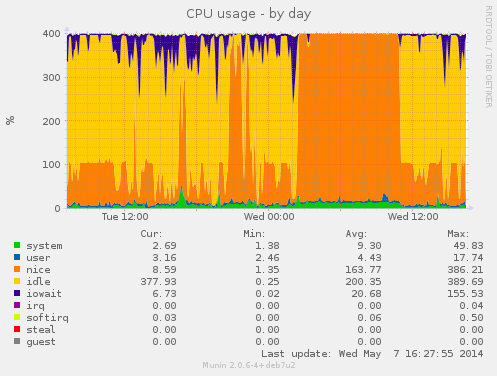
The old builders are single-core[1], so the regardless of parallel building, you can easily max out the cpu. New builders will use only 1 of 4 cores without parallel build support in debian/rules. During this buildd cpu usage graph, we see most time only one CPU is consumed. So for fast package build times.. make sure your packages supports parallel building. For developers, abel.debian.org is porter machine with Armada XP. It has schroot's for both armel and armhf. set "DEB_BUILD_OPTIONS=parallel=4" and off you go. Finally I'd like to thank Thomas Petazzoni, Maen Suleiman, Hector Oron, Steve McIntyre, Adam Conrad and Jon Ward for making the upgrade happen. Meanwhile, we have unrelated trouble - a bunch of disks have broken within a few days apart. I take the warranty just run out... [1] only from Linux's point of view. - mv78200 has actually 2 cores, just not SMP or coherent. You could run an RTOS on the other core while you run Linux on the other.
As promised, today I would like to write a bit about the making of
The Hacker's Guide to Python. It has
been a very interesting experimentation, and I think it is worth sharing it
with you.
The inspiration
All started out at the beginning of August 2013. I was spending my summer,
as the rest of the year, hacking on OpenStack.
As years passed, I got more and more deeply involved in the various tools
that we either built or contributed to within the OpenStack community. And I
somehow got the feeling that my experience with Python, the way we used it
inside OpenStack and other applications during these last years was worth
sharing. Worth writing something bigger than a few blog posts.
The OpenStack project is doing code reviews, and therefore so did I for
almost two years. That inspired a lot of topics, like
the definitive guide to method decorators
that I wrote at the time I started the hacker's guide. Stumbling upon the
same mistakes or misunderstanding over and over is, somehow, inspiring.
I also stumbled upon Nathan Barry's blog and book
Authority which were very helpful to
get started and some sort of guideline.
All of that brought me enough ideas to start writing a book about Python
software development for people already familiar with the language.
The writing
The first thing I started to do is to list all the topics I wanted to write
about. The list turned out to have subjects that had no direct interest for
a practical guide. For example, on one hand, very few developers know in
details how metaclasses work, but on the other hand, I never had to write a
metaclass during these last years. That's the kind of subject I decided not
to write about, dropped all subjects that I felt were not going to help my
reader to be more productive. Even if they could be technically interesting.
Then, I gathered all problems I saw during the code reviews I did during
these last two years. Some of them I only recalled in the days following the
beginning of that project. But I kept adding them to the table of contents,
reorganizing stuff as needed.
After a couple of weeks, I had a pretty good overview of the contents that
there I will write about. All I had to do was to fill in the blank (that
sounds so simple now).
The entire writing of the took hundred hours spread from August to November,
during my spare time. I had to stop all my other side projects for that.
The interviews
While writing the book, I tried to parallelize every thing I could. That
included asking people for interviews to be included in the book. I already
had a pretty good list of the people I wanted to feature in the book, so I
took some time as soon as possible to ask them, and send them detailed
questions.
I discovered two categories of interviewees. Some of them were very fast to
answer ( 1 week), and others were much, much slower. A couple of them even
set up Git repositories to answer the questions, because that probably
looked like an entire project to them. :-) So I had to not lose sight and
kindly ask from time to time if everything was alright, and at some point
started to kindly set some deadline.
In the end, the quality of the answers was awesome, and I like to think that
was because I picked the right people!
The proof-reading
Once the book was finished, I somehow needed to have people proof-reading
it. This was probably the hardest part of this experiment. I needed two
different types of reviews: technical reviews, to check that the content was
correct and interesting, and language review. That one is even more
important since English is not my native language.
Finding technical reviewers seemed easy at first, as I had ton of contacts
that I identified as being able to review the book. I started by asking a
few people if they would be comfortable reading a simple chapter and giving
me feedbacks. I started to do that in September: having the writing and the
reviews done in parallel was important to me in order to minimize latency
and the book's release delay.
All people I contacted answered positively that they would be interested in
doing a technical review of a chapter. So I started to send chapters to
them. But in the end, only 20% replied back. And even after that, a large
portion stopped reviewing after a couple of chapters.
Don't get me wrong: you can't be mad at people not wanting to spend their
spare time in book edition like you do.
However, from the few people that gave their time to review a few chapters,
I got tremendous feedback, at all level. That's something that was very
important and that helped a lot getting confident. Writing a book alone for
months without having anyone taking a look upon your shoulder can make you
doubt that you are creating something worth it.
As far as English proof-reading, I went ahead and used
ODesk to recruit a professional proof-reader. I looked
for people with the right skills: a good English level (being a native
English speaker at least), be able to understand what the book was about,
and being able to work with correct delays. I had mixed results from the
people I hired, but I guess that's normal. The only error I made was not to
parallelize those reviews enough, so I probably lost a couple of months on
that.
The toolchain
While writing the book, I did a few breaks to build a toolchain. What I call
a toolchain is set of tools used to render the final PDF, EPUB and MOBI
files of the guide.
After some research, I decided to settle on
AsciiDoc, using the
DocBook output, which is then being transformed to
LaTeX, and then to PDF, or either to EPUB directly. I realy on
Calibre to convert the EPUB file to MOBI. It
took me a few hours to do what I wanted, using some magic LaTeX tricks to
have a proper render, but it was worth it and I'm particularly happy with
the result.
For the cover design, I asked my talented friend
Nicolas to do something for me, and he
designed the wonderful cover and its little snake!
The publishing
Publishing in an interesting topic people kept asking me about. This is what
I had to answer a few dozens of time:
"Who is your editor?"
"Me."
I never had any plan for asking an editor to publish this book. Nowadays,
asking an editor to publish a book feels to me like asking a major company
to publish a CD. It feels awkward.
However, don't get me wrong: there can be a few upsides of having an editor.
They will find reviewers and review your book for you. Having the book
review handled for you is probably a very good thing, considering how it was
hard to me to get that in place. It can be especially important for a
technical book.
Also, your book may end up in brick and mortar stores and be part of a
collection, both improving visibility. That may improve your book's selling,
though the editor and all the intermediaries are going to keep the largest
amount of the money anyway.
"Oh, you will publish it yourself, great. So you will print it and sell it
to people?"
"Not really."
I've heard good stories about people using Gumroad to
sell electronic contents, so after looking for competitors in that market, I
picked them. I also had the idea to sell the book with Bitcoins, so I
settled on Coinbase, because they have a nice API to
do that.
Setting up everything was quite straight-forward, especially with Gumroad.
It only took me a few hours to do so. Writing the Coinbase application took
a few hours too.
"Oh, you will sell it only as an ebook? That's too bad. You need a paper
version. Many people will want a paper version."
My initial plan was to only sell online an electronic version. On the other
hand, since I kept hearing that a printed version should exist, I decided to
give it a try. I chose to work with Lulu because I knew
people using it, and it was pretty simple to set up.
The launch
Once I had everything ready, I built the selling page and connected
everything between Mailchimp, Gumroad, Coinbase, Google Analytics, etc.
Writing the launch email was really exciting. I used Mailchimp feature to
send the launch mail in several batches, just to have some margin in case of
a sudden last minute problem. But everything went fine. Hurrah!
I distributed around 200 copies of the ebook in the first 48 hours, for
about $5000. That covered all the cost I had from the writing the book, and
even more, so I was already pretty happy with the launch.
Retrospective
In retrospect, something that I didn't do the best way possible is probably
to build a solid mailing list of people interested, and to build an
important anticipation and incentive to buy the book at launch date. My
mailing list counted around 1500 people subscribed because they were
interested in the launch of the book subscribed; in the end, probably only
10-15% of them bought the book during the launch, which is probably a bit
lower than what I could expect.
But more than a month later, I distributed in total almost 500 copies of the
book (including physical units) for more than $10000, so I tend to think
that this was a success. I still sell a few copies of the book each weeks,
but the number are small compared to the launch.
I sold less than 10 copies of the ebook using Bitcoins, and I admit I'm a
bit disappointed and surprised about that.
Physical copies represent 10% of the book distribution. It's probably a lot
lower than most people that pushed me to do it thought it would be. But it
is still higher of what I thought it would be. So I still would advise to
have a paperback version of your book. At least because it's nice to have it
in your library.
I only got positive feedbacks, a few typo notices, and absolutely no refund
demand, which I really find amazing.
The good news is also that I've been contacted with a couple of Korean and
Chinese editors to get the book translated and published in those countries.
If everything goes well, the book should be translated in the upcoming
months and be available on these markets in 2015!
If you didn't get a copy,
it's still time to do so!
This morning Zoe woke up again at around 4am and ended up in bed with me. I
don't even remember why she woke up, and neither does she, but she's assuring
me it won't happen tomorrow morning. We'll see.
As a result of the disturbed night's sleep, we had a bit of a slow start to the
day. Zoe was happy to go off and watch some TV after she woke up for the day,
and that let me have a bit more of a doze before I got up, which made things
vaguely better for me.
ABC 4 Kids has been
showing a lot of ads for Ha Ha Hairies,
which airs at 10:20am, lately, and it's one of the shows that isn't available
on iView. Zoe had been
lamenting that she never got to see it, and asking me if she could. Today the
schedule was fairly open, so I made sure we were home at 10:20am. That involved
a quick dash out to Woolies first to get a few bits and pieces for Zoe's
birthday party.
While Zoe watched the Ha Ha Hairies, I did some bulk egg hard boiling
in the oven. After the Ha Ha Hairies and a little bit of general
mucking around, we drove out to Spotlight to pick up the helium tank I'd
rented. Zoe nearly fell asleep on the way out there.
We picked up the helium tank and headed back home. That errand alone probably
took a bit over an hour all up. We got back home and had lunch, but by the time
all of that was out of the way, Zoe seemed to have missed the window for her
nap. She did have a bit of a rest in bed, flipping through her library books,
and I got to read some of my book as well, so that was nice. During that time,
I got the call from Bunkers saying
they were about half an hour out with the delivery of Zoe's bunk bed (my
birthday present for her). That worked out well, as it was towards the start of
the two hour window they'd advised me of.
The bunk bed was delivered and then we popped out to Overflow to see if they had any
food covers for the party food (they did) so we picked up a few of them. Today
I learned that "As Seen On TV" is trademarked, and so "Similar To As Seen On
TV" is the trademark dodging thing to put on cheap knock-offs. As Overflow is
two doors down from Petbarn, we
stopped in there as well and grabbed some more kitty litter. One does not just
pop into Petbarn with Zoe, so we spent some time there looking at the fish and
assorting aquarium paraphernalia. They also had some hermit crabs now too.
On the way back home, we stopped in at (a different) Woolies to pick up the
half slab of chocolate mudcake that I'd ordered for Zoe's birthday cake. I'd
decided that the upright Minion
cake I'd initially wanted to do was just way too adventurous for my
abilities and not a good use of my time (and the quotes I'd sought for
outsourcing it had come in at over $300). I scaled things back to just a flat
slab Minion, which may still exceed my cake decorating abilities, but we'll
find out tomorrow.
There'd been a miscommunication at Woolworths, and my half slab hadn't been
boxed up and wasn't ready for my collection. All the bakery staff had already
gone home, and I didn't really want to come back tomorrow, because I had this
crazy idea of possibly starting on the cake tonight (not going to happen), so a
couple of non-bakery staff had to find the cake and figure out how to extract a
full slab from the baking tray and cut it in half and box it up. It provided
some entertainment for Zoe and I.
We finally got home, and I rehashed some frozen leftovers for dinner. I decided
to try something different for the bath time and bed time routine to see if
it'd reduce procrastination. I got Zoe to pick out the three books she wanted
to read at bed time before we got to story time, so we'd have something
concrete to negotiate with. I also threw in the possibility of a "bonus story"
if she didn't muck around. It seemed to work, and we had a fairly streamlined
bath time. There's no doubt she was pretty tired today, and she went to bed
without any fuss, so I'm hopeful that we'll have a good night tonight.
"This is the real Brazil" -- Fernao
After 3 days of travel, including 22 hours driving from Brasilia to the
coast of Bahia, I can't say much more. A few things not pictured above..
The two hours of car-swallowing potholes in an arrow-straight highway in
a flat plain, playing chicken against oncoming trucks.
Night swim in the river in Correntina, followed by a whole grilled fish and
ice cold guarana. Bliss.
Push starting the car in a small cattle-farming village when it wouldn't
start.
The first sight of ocean waves and the drum circle last night.
Background
I ve previously written about the claim that people use Autism as an excuse for bad behavior [1]. In summary it doesn t and such claims instead lead to people not being assessed for Autism.
I ve also previously written about empathy and Autism in the context of discussions about conference sexual harassment [2]. The main point is that anyone who s going to blame empathy disorders for the widespread mistreatment of women in society and divert the subject from the actions of average men to men in minority groups isn t demonstrating empathy.
Discussions of the actions of average men are so often derailed to cover Autism that the Geek Feminism Wiki has a page about the issue of blaming Autism [3].
The Latest Issue
Last year Shanley Kane wrote an informative article for Medium titled What Can Men Do about the treatment of women in the IT industry [4]. It s a good article, I recommend reading it. As an aside @shanley s twitter feed is worth reading [5].
In response to Shanley s article Jeff Atwood wrote an article of the same title this year which covered lots of other things [6]. He writes about Autism but doesn t seem to realise that officially Asperger Syndrome is now Autism according to DSM-V (they decided that separate diagnosis of Autism, Asperger Syndrome, and PDD-NOS were too difficult and merged them). Asperger Syndrome is now a term that refers to historic issues (IE research that was published before DSM-V) and slang use.
Gender and the Autism Spectrum
Jeff claims that autism skews heavily towards males at a 4:1 ratio and cites the Epidemiology of Autism Wikipedia page as a reference. Firstly that page isn t a great reference, I fixed one major error (which was obviously wrong to anyone who knows anything about Autism and also contradicted the cited reference) in the first section while writing this post.
The Wikipedia page cites a PDF about the Epidemiology of Autism that claims the 4.3:1 ratio of boys to girls [7]. However that PDF is a summary of other articles and the one which originated the 4.3:1 claim is behind a paywall. One thing that is worth noting in the PDF is that the section containing the 4.3:1 claim also references claims about correlations between race and Autism and studies contradicting such claims it notes the possibility of ascertainment bias . I think that anyone who reads that section should immediately consider the possibility of ascertainment bias in regard to the gender ratio.
Most people who are diagnosed with Autism are diagnosed as children. An Autism diagnosis of a child is quite subjective, an important part is an IQ test (where the psychologist interprets the intent of the child in the many cases where answers aren t clear) to compare social skills with IQ. So whether a child is diagnosed is determined by the psychologist s impression of the child s IQ vs the impression of their social skills.
Whether a child is even taken for assessment depends on whether they act in a way that s considered to be obviously different. Any child who is suspected of being on the Autism Spectrum will be compared other children who have been diagnosed (IE mostly boys) and this will probably increase the probability that a boy will be assessed. So an Aspie girl might not be assessed because she acts like other Aspie girls not like the Aspie boys her parents and teachers have seen.
The way kids act is not solely determined by neuro-type. Our society expects and encourages boys to be louder than girls and take longer and more frequent turns to speak, this is so widespread that I don t think it s possible for parents to avoid it if their kids are exposed to the outside world. Because of this boys who would be diagnosed with Asperger Syndrome by DSM-IV tend to act in ways that are obviously different from other kids. While the combination of Autism and the the social expectations on girls tends to result in girls who are quiet, shy, and apologetic. The fact that girls are less obviously different and that their differences cause fewer difficulties for parents and teachers makes them less likely to be assessed. Note that the differences in behavior of boys and girls who have been diagnosed is noted by the professionals (and was discussed at a conference on AsperGirls that my wife attended) while the idea that this affects assessment rates is my theory.
Jeff also cites the book The Essential Difference: Male And Female Brains And The Truth About Autism by Professor Simon Baron-Cohen (who s (in)famous for his Extreme Male Brain theory). The first thing to note about the Extreme Male Brain theory are that it depends almost entirely on the 4.3:1 ratio of males to females on the Autism Spectrum (which is dubious as I noted above). The only other evidence in support of it is subjective studies of children which suffer from the same cultural issues this is why double blind tests should be used whenever possible. The book Delusions of Gender by Cordelia Fine [8] debunks Simon Baron-Cohen s work among other things. The look inside feature of the Amazon page for Delusions of Gender allows you to read about Simon Baron-Cohen s work [9].
Now even if the Extreme Male Brain theory had any merit it would be a really bad idea to cite it (or a book based on it) if you want to make things better for women in the IT industry. Cordelia s book debunks the science and also shows how such claims about supposed essential difference are taken as exclusionary.
The Problem with Jeff Atwood
Jeff suggests in his post that men should listen to women. Then he and his followers have a huge flame-war with many women over twitter during which which he tweeted Trying to diversify my follows by following any female voices that engaged me in a civil, constructive way recently . If you only listen to women who agree with you then that doesn t really count as listening to women. When you have a stated policy of only listening to women who agree then it seems to be more about limiting what women may feel free to say around you. The Geek Feminism wiki page about the Tone Argument [10] says the following:
One way in which the tone argument frequently manifests itself is as a call for civility. A way to gauge whether a request for civility is sincere or not is to ask whether the person asking for civility has more power along whatever axes are contextually relevant (see Intersectionality) than the person being called incivil , less power, or equal power. Often, people who have the privilege of being listened to and taken seriously level accusations of incivility as a silencing tactic, and label as incivil any speech or behavior that questions their privilege. For example, some men label any feminist thought or speech as hostile or impolite; there is no way for anybody to question male power or privilege without being called rude or aggressive. Likewise, some white people label any critical discussion of race, particularly when initiated by people of color, as incivil.
Writing about one topic is also a really good idea. A blog post titled What Can Men Do should be about things that men can do. Not about Autism, speculation about supposed inherent differences between men and women which are based on bad research, gender diversity in various occupations, etc. Following up a post on What Can Men Do with discussion (in blog comments and twitter) about what women should do before they are allowed to join the conversation is ridiculous. Jeff s blog post says that men should listen to women, excluding women based on the tone argument is gross hypocrisy.
Swearing
Jeff makes a big deal of the fact that Shanley uses some profane language in her tweets. This combines a couple of different ways of silencing women. It s quite common for women to be held to a high standard of ladylike behavior, while men get a free pass on doing the same thing. One example of this is the Geek Feminism article about the results of Sarah Sharp s request for civility in the Linux kernel community [11]. That s not an isolated incident, to the best of my recollection in 20+ years my local Linux Users Group has had only one debate about profanity on mailing lists in that case a woman (who is no longer active in the group) was criticised for using lesser profanity than men used both before and after with no comment (as an experiment I used some gratuitous profanity a couple of weeks later and no-one commented).
There is also a common difference in interpretation of expressions of emotion, when a woman seems angry then she invariably has men tell her to change her approach (even when there are obvious reasons for her anger) while when a man is angry the possibility that other people shouldn t make him angry will usually be considered.
The issues related to the treatment of women have had a large affect on Shanley s life and her friend s lives. It s quite understandable that she is angry about this. Her use of profanity in tweets seems appropriate to the situation.
Other Links
Newsweek s Gentlemen in Technology article has a section about Jeff [12], it s interesting to note his history of deleting tweets and editing his post. I presume he will change his post in response to mine and not make any note of the differences.
Jacob Kaplan-Moss wrote a good rebuttal to Jeff s post [13]. It s a good article and has some other relevant links that are worth reading.
Some people seem to be justifying the way mobile networks try to discriminate against tethering. One comment even suggests that multiple devices is a valid justification. Really? Isn't it just as simple as measuring the actual volume of megabytes used, regardless of how many devices are connected?
Lets consider a couple of analogies:
A petrol station puts some fine print at the bottom of their sign in the street: cars with passengers pay an extra 0.05 per litre (or gallon). It is just a gimmick: the marketing man has worked out that he can put a lower price on his big sign this way and people with passengers may well be splitting the fuel bill between them. There is no technical reason for the charge however - the car actually uses more fuel carrying the extra weight anyway.
Or imagine this: the marketing man puts up small print that advises a higher charge of 0.05 per litre for fuelling an exotic car like a Ferrari. The only reason for this, of course, is that the Ferrari driver is probably busy (so he doesn't have time to shop around) and wealthy (so the extra charge won't deter him from making any purchase at all, because he has money to pay it).
Of course, these ideas sound a bit outlandish but the only difference between these crazy ideas and tethering charges is that mobile phone networks usually have the monopoly/duopoly to get away with it.
Mobile networks actually dread the idea of becoming commodities like fuel. They thrive on price discrimination and they seem to have an endless number of tricks to get extra money out of people who may have it by deliberately crippling parts of the service for everybody else. This goes against the ideals of innovation and efficiency and in the most extreme cases their practices are widely recognised for the sham that they are.
Revealing that you have connected a laptop to your phone may be like revealing you live in an affluent area or that you have an expensive car. Plenty of businesses try to exploit such knowledge when deciding how much they can charge you or other aspects of how they provide you with a service. This is why privacy is important in every feature of the technology we use.
This rogue behaviour by "creative" marketing men also helps to understand just what would happen in the world of technology if it wasn't for the use of free licenses, open standards, accessible encryption and net neutrality.
I'm moving. Well, not right here, right now. Rather less than two years. But I already know what my flat will look like and was able to influence that decision. And there will be more to influence, like what to do with common rooms in the builing, or what to put in the garden (voting for climbing facilities for my son of course!). It's this kind of co-housing project where you already know your neighbours beforehand and can find common grounds for decisions like that.
The co-housing project I'm moving to is called Que[e]rbau. And it will be living up to its name. It is specificly aimed at people who live tolerance and acceptance, and also potentially live an sorta alternative lifestyle, defining their own identity; but not limited to those. There also will be conventional families living there who specificly don't want to raise their kids in a conservative environment.
When I told about this plan to someone they asked me if I really want to do that. Their concerns were with respect to my son and if the house wouldn't become a target. I was puzzled at first, given that we have the Rainbow Parade, the Life Ball and most of all the Rosa Lila Villa since several years in Vienna and I'm not aware of any bigger disturbances it causes, rather the opposite.
After thinking a while about it it sounded a bit for the wish of a Don't Ask Don't Tell environment. Recently there was this great documentary done by Vice on youtube about YoungandGayinPutin's Russia (watch all five parts of it, it's worth it). In the light of that I don't think hiding does improve the situation, rather the opposite. Not speaking about it doesn't improve acceptance. And actually, I was approached by at least one person during the Debian Women MiniDebconf about how brave I am considered. I'm not sure if it really is brave, I just don't want to lie to myself anymore, and I very rarely had troubles through that. The more open and natural you behave, the less confrontation area you leave left, and people notice that.
Not totally unrelated to that, I created myself a new gpg key. It doesn't carry my official name anymore but just the name I prefer to be addressed with: Rhonda. It also carries a last name you might not have heard yet (it was adopted on the Discworld MUD several years ago, even before I wrote Mermaids; actually in connection with the person who partly triggered the poem), that's the reason I added a plain Rhonda UID to it for those who aren't aware of the last name. I will submit that key to keysigning parties from now on, and it of course is up to you if you feel comfortable with signing it.
After several weeks of review and discussion, the application and
selection period for the 2014 Google Summer of Code is over. 4,420
students proposed a total of 6,313 projects for this summer. From
those, 1,307 students have been accepted
(more
details), and Linaro is one of the 190 Open Source projects that
will be working with students this year.
In our first year as a GSOC mentoring organisation, we received 17
applications and Google allocated us 3 slots for student projects. It
was quite a challenge to pick just 3 projects from the excellent
field, and it's a shame that the limited number of slots meant we had
no choice but to disappoint some people. Thanks to all those who
applied!
I'm delighted to announce our 3 chosen interns for 2014:
Gaurav Minocha is a graduate student at the University of British
Columbia, Vancouver, Canada. His project is Linux Flattened Device
Tree Self-checking, mentored by Grant Likely from Linaro's Office of
the CTO.
Ricardo de Freitas Gesuatto is a student at Federal University of
S o Carlos (UFSCar), Brazil. He will be working on a project entitled
"Lightweight IP Stack on top of OpenDataPlane", mentored by Maxim
Uvarov from the Linaro Networking Group.
Varad Gautam is a student at Birla Institute of Technology and
Science, Pilani, India. He will be Porting UEFI to Low-Cost Embedded
Platform (BeagleBoneBlack). Leif Lindholm from the Linaro Enterprise
Group will be mentoring.
Please join me in welcoming these three new engineers to the Linaro
team!
We have a GSOC wiki ready for our students to use at
https://gsoc.linaro.org/
and hopefully they will start adding content there soon about
themselves and their projects (hint!). In the meantime, we have more
information about our original proposals and the GSOC program in the
main Linaro
wiki.
Starting today, the next phase of the program is the so-called
"bonding period". Students are encouraged to get to know people within
Linaro (especially their mentors!) and prepare to start work on their
projects, whatever is needed. The official start of the work period
for GSOC is May 19th, and
it runs
through to August 18th. We will give updates on progress through
the summer, and we're hoping to talk about our results at the next
Linaro Connect in September.
Good luck, folks!
We're excited to announce that 19 students have been selected
to work with Debian during the Google Summer of Code this year!
Here is the list of accepted students and projects:
As always, you will be able to follow their progress on the SoC coordination mailing-list
Congratulations to all the students and let's make sure we all have an amazing summer!
While researching some security-related stuff for a post I am currently writing, I found some interesting bits here and there that I though I should share, as they were new to me, and probably for many others.
DNSSEC
The first thing is DNSSEC. I knew about it, of course, but never bothered to dig much into it. While reading about many interesting applications of DNS for key distribution, and thinking of ways to use them, it is clear that DNSSEC is a precondition for any of that to work.
In case you don't know about it, it is an extension for the DNS service to make it safer, for example, to avoid the bad guys having you think that google.com points to sniffer.nsa.gov.
Apart from these ber-cool applications I was thinking about, avoiding DNS-based attacks becomes more and more relevant these days. And I think Debian and the rest of the Free Software world should work on making this available to all end-users as easily as possible.
While adoption still looks pretty low, there are some good news.
First, Google claims its public DNS supports DNSSEC. Of course, you need to trust Google servers, and the path between your machine and them. But if your resolver supports DNSSEC, you can use their servers and validate the answers.
On the other side, I am not too sure about their implementation, as half of the time, it would return a valid answer to a query for an invalid record: dig +dnssec sigfail.verteiltesysteme.net @8.8.8.8). Also, they have not published DNSSEC records for google.com, which seems crazy.
Some packages included in Debian already take advantage of DNSSEC, if available (more on that later), but more importantly, there are a couple of DNSSEC-enabled recursive servers, including bind, unbound, and the more commonly-used dnsmasq (there is a wiki page summarising Debian's status). Sadly, the default configuration for dnsmasq does not enable DNSSEC, and most people will not use it, even if it installed, because DHCP-provided servers are usually preferred. It seems to me that it would be wise to have a package that would install dnsmasq with DNSSEC enabled, and make it the only valid resolver for the system.
If you want to check if your resolver is correctly validating DNSSEC, you can use this test web page.
Another good news is that many top-level domains already support DNSSEC, and in my case, Gandi.net has support in place to set it up. So I am going to look into enabling it for my own domain.
SSHFP
One useful and simple advantage of using DNSSEC, is that you can store information there, and then trust it to be correct.
One new DNS RR (resource record) that is useful in this context is the SSHFP RR, which allows the sysadmin of a host to publish the host SSH key fingerprint in the DNS zone.
The ssh client, when enabling the VerifyHostKeyDNS option, will use that information to trust unknown hosts. One downside to this, is that either if you set the option to ask, or if your resolver does not support DNSSEC, you get the same message, which does not warn you about the extra risk.
To help you create your DNS records, you can just run this command:
$ ssh-keygen -r brie.tincho.org
brie.tincho.org IN SSHFP 1 1 6ac93c63379828b5b75847bc37d8ab2b48983343
brie.tincho.org IN SSHFP 2 1 cf0d11515367e3aa7eeb37056688f11b53c8ef23
DANE, S/MIME and GPG
Recently, while at FOSDEM, I attended talks that mentioned DANE. This proposed IETF standard introduces a mechanism to use DNS as a secure key distribution system, which could completely override the CA oligopoly, a very attractive proposition for many people.
In short, it is very similar to the SSHFP mechanism, but it is not restricted to SSH host keys: it can be used to distribute public key information for any TLS-enabled service. So, instead (or in addition to) of having a CA sign your certificate, and relying on the chain of trust by means of having a local copy of all root CA certificates, you use the chain of trust embedded in DNSSEC to make sure that the DNS RRs you publish are valid. Then, the client application can trust the fingerprint published for the relevant service to verify that it is talking to the right server.
This is a very exciting development, and I hope it gets widespread adoption. It is already supported in Postfix, there seem to be some work going on in Mozilla, as well as in Prosody which is a great start.
Another exciting development of this, is the generalisation of DANE for other entities, like email addresses. There are two draft RFCs being worked on right now to deploy S/MIME and OpenPGP key material using DNSSEC. This could also change completely the way we manage the Web of Trust.
Spring in the prairie is a bit of an odd thing this year. Here and there, near ditches and creeks, a short, soft blanket of lush green grass covers the ground. A few feet away, patches of green are visible between the brown shoots of last year s grass. Some trees are already turning green, purple, red, and white, while others stand still and brown, stubbornly insisting that spring is not here yet. To look at the thermometer may not be much guide either; two days after the temperature was nearly 90, we woke to see a dusting of snow on the ground.
It s been dry, terribly try in Kansas. Grass next to a gravel driveway or road often has a chalkish layer of dust on it, kicked up by passing cars or even a stiff wind. The earth thirsts.
It is somehow fitting to celebrate Easter, that spring holiday, in the midst of the dry ground, to remember that water is not the only thing that can quench thirst.
Easter morning began sleepily, as we got up early to head to a sunrise service. It was in a pasture just outside a small Kansas town, and we gathered there at about 6:15, wearing only light jackets against the breeze. A fire was burning, and there was water on hand to quickly douse any grass that caught first that wasn t supposed to and it was occasionally used.
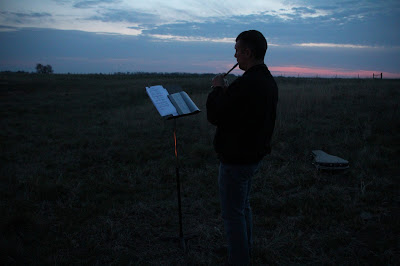
I was doing the prelude for the service, playing on my penny whistle. I enjoyed being able to do that, and was glad that the wind was calm enough that it didn t interfere too much with the music.
We sang some hymns, listened to some Bible readings, and just stood in silence, listening to the crackle of the fire, some country dogs playing, and watching the sky to the east transform as the sun came up.
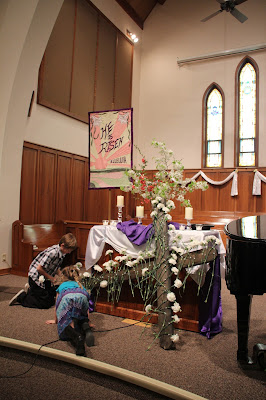
Then it was on to church for breakfast, and a break before the Easter service the pipe organ ringing, piano playing with it, and deep trombone and full sanctuary of people singing our 4-part Easter hymns celebrating the day. Laura had the idea of pinning carnations onto the cross, and we got to watch everyone come up and add theirs.
Jacob and Oliver enjoyed the sunrise service. They decided they would keep a watchful eye on the first and the dogs, they enjoyed muffins at breakfast and playing in the church after that. But if you are 4 or 7, what is Easter without an Easter egg hunt? And they got in several.
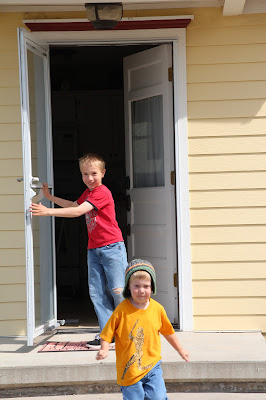
Laura and I hid some eggs around the yard. Jacob asked me to use a radio to tell them when the eggs were ready. Here they are, bounding out the door to begin the hunt!
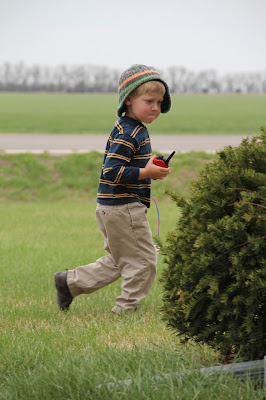
And, of course, if you are 4 or 7 and have a geek for a dad, you will naturally think to bring radios with you to the next hunt. To tell your brother what you re finding, of course.
It was a good weekend, and in fact, Jacob even volunteered to put up a wet floor sign after he spilled some water:
On the last car ride of the day, Jacob decided he would write a story about his Easter. He decided he would publish a big book, and be a famous author and make other children happy. Oliver, of course, decided he needed an Easter story also. We couldn t very well publish a book in the car, but I did manage to use my phone to capture their stories.
It s been a long and busy week, but there is much to be joyful about, even when tired.
It's fundamentally pointless to write this review.
Some number of you have already heard of Hyperbole and a Half.
Most of that group already own this book and are only reading this review
so that you can remember how much fun you had reading it. But, even
better, you could just stop reading this review and go read the book
again.
Some of you who have heard of Hyperbole and a Half didn't know that
Allie Brosh had published a book. If that's you, you're probably not
reading this review any more, since you're now at your favorite book
seller buying a copy of the book, rendering the review somewhat pointless.
For those of you who have not heard of
Hyperbole and a
Half, there's no need to read a review, because it's a blog. So, rather
than reading this review, you can just follow that link and read it for
yourself. If you find yourself laughing uncontrollably (and occasionally
crying) and going "where can I get more of this?", well, there's a book.
Which you could have also found out from the blog itself. Like I said,
not much point.
If you read the blog and don't particularly care for it, well, I greatly
respect your position. The diversity of taste in the human race is what
leads to our wonderful variety of culture, philosophy, and art, and I
appreciate your substantial contribution to that diversity. However, you
should now make a mental note to never trust my humor recommendations, and
you shouldn't let this review change your mind.
But, since I'm here, I may as well write a review anyway.
Hyperbole and a Half is, as mentioned, a blog by Allie Brosh. Most
of the posts are quite long and substantial and in the form of cartoons
mixed with text, usually (but not always) telling some sort of story. The
cartoon style is what is often called "MS Paint," meaning that it looks
like something drawn in Microsoft Paint with its most basic tools. (Other
examples of this style are the
Oatmeal and Homestuck, although Brosh stays consistently with a rawer art
style than either of those.) It looks extremely simple, like child
drawings (and early childhood inspires much of Brosh's material), but once
one gets used to it, one realizes that Brosh gets amazing expressiveness
and character out of the art style.
As an aside, yes, I am wholeheartedly recommending a book that is full of
material about young children. Brosh is that good.
The subtitle of this book is "unfortunate situations, flawed coping
mechanisms, mayhem, and other things that happened," and it's mostly based
on (exaggerated) incidents that occurred in Brosh's life. Most of them
are hilarious. Some of them are both hilarious and stunning psychological
insights. She has an amazing knack for storytelling and for exaggerating
just the right moments of the story, or summing up emotions in a wonderful
turn of phrase or a picture. She's also amazingly good at telling
embarrassing stories about herself in a way that makes you empathize rather
than just cringe, and then come away feeling like you understand both her
and yourself better.
If you've wandered around the Internet much, you have probably run across
the phrase "clean ALL the things!" and the corresponding picture. That's
from Hyperbole and a Half (specifically,
"This is Why I'll Never Be an Adult") and is included in this book
(improved; see below). It's even better in context.
But, beyond storytelling, the other thing Brosh is amazingly good at is
capturing internal mental states and emotions in a way that the reader
understands and those who have experienced the emotion immediately go
"yes, THAT." The apex of this is her two-part post on depression, which
is hands-down the best description of depression that I've ever read.
That judgment has been echoed by multiple friends of mine with
depression. And yes, both of those posts are included in the book as
well, although you can also read them on the web.
As you've probably noticed, this book is partly a collection of material
that's freely available on the web. Unlike some web comics collections,
it's not entirely a reprint collection; there are entirely new stories
here (which for me was enough by itself to buy the book). Brosh's
post on the
book says that it's about 50% new material. But the ones that aren't
original have been edited and improved, sometimes substantially. For
example, I did a quick comparison of the book version with the web version
of "This is Why I'll Never be an Adult" and found Brosh redrew all of the
cartoons for the story. The book is also gorgeous, if you care about such
things like I do: high quality paper, thick pages, vibrant colors, and a
comfortable heft to the hardcover version. It's the sort of book that
feels like it will survive for decades, which is good since I intend to
re-read it for decades.
Brosh has a lot of material on-line, so obviously only a small
fraction made it into the book and there's more to discover on the blog.
I can particularly recommend
"The Alot is Better Than You at Everything" and
"Boyfriend Doesn't Have Ebola. Probably.". The latter, which is mostly
about creating a better pain scale, is my favorite from the blog that
didn't make it into the book. And there are two more examples of the sort
of thing that you'll getting here.
So ends the probably pointless review. I absolutely adore Hyperbole
and a Half. It is my favorite web comic, even surpassing
XKCD, which is saying something. Even if there
were no material, I would have bought this book in hardcover to support
Brosh and to have a high-quality printing of the blog posts. The
reworkings and improvements of the republished material and the brand new
additions are just bonuses. But there's no need to take my word for it;
the best possible advertisement for Brosh's work is on-line, from which
you can easily determine if you'll enjoy this book as much as I did.
Even the back cover and the inside flaps are awesome.
Rating: 10 out of 10
I gave a talk this year at PyCon 2014, about one
of my favorite subjects: Hy. Many of my regular readers
will have no doubt explored Hy's thriving
GitHub org, played with
try-hy, or even installed it locally by
pip installing it. I was lucky enough to
be able to attend PyCon on behalf of Sunlight,
with a solid contingint of my colleagues. We put together a writeup on the
Sunlight blog
if anyone was interested in our favorite talks.
Tons of really amazing questions, and such an amazingly warm reception from
so many of my peers throughout this year's PyCon. Thank you so much to
everyone that attended the talk. As always, you should
Fork Hy on GitHub,
follow @hylang on the twitters, and
send in any bugs you find!
Hopefully I'll be able to put my talk up in blog-post form soon, but until then
feel free to look over the slides or just
watch the talk.
An extra shout-out to @akaptur for hacking on
Hy during the sprints, and giving the exception system
quite the workthrough.
Thanks, Allison!
 Yesterday night, we had the opportunity to have for the first time my friend Kaz as a guest in my Operating Systems class. We are about to finish the semester, and he took the opportunity not just to show how the Ext4 filesystem is structured, but how it is implemented in a current Linux release.
 Kaz took a very different approach from what I do: He did it really hands-on, starting with the explanation on how a hello world module would be created, and then digging in following the code of the ext4 module in Linux 3.14 (and some bits in the general filesystem-related includes).
 Of course, for a ~2hr session, he did not go into the full details, but did show where the main structures of a filesystem are defined, including a general walkthrough on the general kernel coding style.
 The class was very enjoyable and clear. We had the bad luck of the projector's lamp burning out at the beginning of the class, but still, you can see in the pictures the students were really into his exposition. I think the exposition did make it through and got the students involved and interested And that makes it really worth it!
 Now... Sadly, due to a (most probably) human factor, I tried to record this talk but lost most of it :-( I have only the first part, but lost most of the second one. I have some bits recorded by a second camera, but have to check if they make sense by themselves, or do need the whole context. Anyway, I'll be reviewing those bits, and will update this post when I get around to cleaning+fixing+integrating them.
 Some more photos...







 Debian has recently received a donation of 8 build machines from Marvell. The new machines come with


 During this buildd cpu usage graph, we see most time only one CPU is consumed. So for fast package build times.. make sure your packages supports parallel building. For developers, abel.debian.org is porter machine with Armada XP. It has schroot's for both armel and armhf. set "DEB_BUILD_OPTIONS=parallel=4" and off you go. Finally I'd like to thank Thomas Petazzoni, Maen Suleiman, Hector Oron, Steve McIntyre, Adam Conrad and Jon Ward for making the upgrade happen. Meanwhile, we have unrelated trouble - a bunch of disks have broken within a few days apart. I take the warranty just run out... [1] only from Linux's point of view. - mv78200 has actually 2 cores, just not SMP or coherent. You could run an RTOS on the other core while you run Linux on the other.
 As promised, today I would like to write a bit about the making of


 This morning Zoe woke up again at around 4am and ended up in bed with me. I
don't even remember why she woke up, and neither does she, but she's assuring
me it won't happen tomorrow morning. We'll see.
As a result of the disturbed night's sleep, we had a bit of a slow start to the
day. Zoe was happy to go off and watch some TV after she woke up for the day,
and that let me have a bit more of a doze before I got up, which made things
vaguely better for me.


 I'm moving. Well, not right here, right now. Rather less than two years. But I already know what my flat will look like and was able to influence that decision. And there will be more to influence, like what to do with common rooms in the builing, or what to put in the garden (voting for climbing facilities for my son of course!). It's this kind of co-housing project where you already know your neighbours beforehand and can find common grounds for decisions like that.
The co-housing project I'm moving to is called
 After several weeks of review and discussion, the application and
selection period for the 2014 Google Summer of Code is over. 4,420
students proposed a total of 6,313 projects for this summer. From
those, 1,307 students have been accepted
(
 While researching some security-related stuff for a post I am currently writing, I found some interesting bits here and there that I though I should share, as they were new to me, and probably for many others.