Search Results: "ah"

6 August 2013

Craig Small: Careful with apache upgrades

You might (or not if you don t visit) notice all my websites were down. A rushed apt-get dist-upgrade and I found two problems:
  1. PHP5 got removed, which is bad if you run a wordpress site that uses PHP to run
  2. The apache configuration has changed.
Yes, the NEWS entries did warn me, if I read them fully. Yes, I didn t read them enough. Apache now ignores configuration files that don t end in .conf To give a completely non-theoretical example, if you have your virtual hosts in files such as /etc/apache2/sites-enabled/enc.com.au then this will not be recognised and your sites will show the default It works page. Stuff that doesn t fall in the usual places where website stuff should go, which for my setup is a lot of things, will also be denied as the developers have tightened up the rules around what is permitted. Pretty simple to fix with a few <Directory blah> clauses. This isn t a criticism of the Debian apache developers. They do an awesome job of keeping the package workable, flexible but secure which isn t easy. Now it s all back working, I actually agree with the changes they have made. It is just that the latest changes are, well, tricky so be forewarned.

3 August 2013

Daniel Leidert: Setting up a network buildd with pbuilder, ccache, inoticoming and NFS

I recently bought an N54L HP microserver, which shall act as a build-daemon (buildd) for Debian packaging. The idea of my workflow is the following:
  1. do the maintenance tasks locally, usually using svn-buildpackage, quilt etc.pp
  2. build a source package locally
  3. upload the source to an incoming directory on the server
  4. watch this incoming directory and start a build process as soon as a package is uploaded
  5. put the result into an accessible directory
  6. support different vendors (debian, ubuntu)
  7. support different releases (experimental, unstable, stable, oldstable)
  8. support different architectures (amd64, i386)
  9. speed up the build process
Setting up the building environmentMy first idea was to use sbuild as described in several places. However I went with pbuilder for a long time having a setup I personally like. So I decided to stay with it. I reduce the time and work to update the configure files by using
  • one central file /etc/pbuilderrc.inc defining all the common/shared settings and
  • small configure files defining vendor, release, architecture and mirrors
Here are the relevant parts of my central configure snippet:

[..]
EXTRAPACKAGES="apt-utils debconf debconf-utils libfile-fcntllock-perl"
[..]
BASETGZ="/var/cache/pbuilder/base.$DISTRIBUTION.$ARCHITECTURE.tgz"
APTCACHE="/var/cache/pbuilder/aptcache/$DISTRIBUTION/$ARCHITECTURE/"
BUILDRESULT="/var/cache/pbuilder/result/$DISTRIBUTION/$ARCHITECTURE/"
[..]
case "$VENDOR" in
ubuntu)
MIRRORSITE="http://archive.ubuntu.com/ubuntu"
COMPONENTS="main restricted universe multiverse"
OTHERMIRROR="\
deb http://de.archive.ubuntu.com/ubuntu $DISTRIBUTION main restricted universe multiverse \
deb http://archive.ubuntu.com/ubuntu $DISTRIBUTION-updates main restricted universe multiverse \
deb http://security.ubuntu.com/ubuntu $DISTRIBUTION-security main restricted universe multiverse \
"
;;
*)
MIRRORSITE="http://ftp.debian.org/debian"
COMPONENTS="main contrib non-free"
OTHERMIRROR="\
deb http://ftp.de.debian.org/debian $DISTRIBUTION main contrib non-free \
"
;;
esac
[..]
DEBBUILDOPTS="-us -uc -j2"
AUTO_DEBSIGN=no
USE_PDEBUILD_INTERNAL=yes
[..]
You get the main idea, right? Create own files and directories for each architecture, release and vendor. Further I only want to pull build related packages into the build environment, not into the server environment. So I enabled USE_PDEBUILD_INTERNAL. I don't want to sign anything on the buildd itself and use both cores. That's what DEBBUILDOPTS and AUTO_DEBSIGN are used for. Further I saw some warnings reported during build processes. I therefor install the packages mentioned in EXTRAPACKAGES to every build enviroment. The following are the configure files for the unstable amd64 (default) and the stable i386 build environments:

VENDOR="debian"
DISTRIBUTION="sid"
ARCHITECTURE="amd64"

. /etc/pbuilderrc.inc

VENDOR="debian"
DISTRIBUTION="wheezy"
ARCHITECTURE="i386"

. /etc/pbuilderrc.inc

OTHERMIRROR+="\
deb http://security.debian.org $DISTRIBUTION/updates main contrib non-free \
"
Now to not having to update all of these environments manually there is a small parallelized script /usr/local/sbin/update-pbuilder-chroots:

#!/bin/sh

t=$(tempfile -p .upc. -s .list) exit 1

cat > $t << EOF
/etc/pbuilderrc.amd64.sid
/etc/pbuilderrc.i386.sid
/etc/pbuilderrc.amd64.wheezy
/etc/pbuilderrc.i386.wheezy
/etc/pbuilderrc.amd64.squeeze
/etc/pbuilderrc.i386.squeeze
EOF

parallel /usr/sbin/pbuilder update --override-config --configfile :::: $t tee -a /var/log/pbuilder.log

rm -f $t

exit 0
The script will make sure, that every change to the configuration file(s) will be considered (--override-config) and is run once a week via cron. The default build environment is updated on a daily base without this restriction:

@reboot root rm -rf /var/cache/pbuilder/build/*/ >> /dev/null 2>&1
@daily root test -x /usr/sbin/pbuilder && /usr/sbin/pbuilder update --configfile /etc/pbuilderrc.amd64.sid tee -a /var/log/pbuilder.log >> /dev/null 2>&1
@weekly root test -x /usr/local/sbin/update-pbuilder-chroots && /usr/local/sbin/update-pbuilder-chroots >> /dev/null 2>&1
Speeding up the build processSometimes it is necessary to recompile a package. The tool to speed up this process is ccache, which can be easily integrated into pbuilder by setting CCACHEDIR in /etc/pbuilderrc.inc. It acts like a cache for compiled files and avoids recompilation in several buildd runs.

CCACHEDIR=/var/cache/pbuilder/ccache
It is also possible to use a TMPFS for BUILDPLACE to speed up the build process itself. In this case APTCACHEHARDLINK must be disabled. Well, yeah, I don't do this.Watch an incoming directory and start the build processNot much to say about this except that the user nobody is used to run the pbuilder command. Therefor it is necessary to mention this in /etc/sudoers to allow him to do this via sudo command:

Defaults env_keep = "DH_OPTIONS DH_VERBOSE DEB_BUILD_OPTIONS DH_OPTIONS MAKEFLAGS CC CXX CPP F77 F90"
[..]
nobody ALL=NOPASSWD:/usr/sbin/pbuilder
The first line is only necessary, if a pbuilder command is started with one of these environmental variables set. This can be useful when e.g. debugging a build failure with a future gcc version that is not yet the default or when debugging a clang build issue or when creating non-stripped binary packages for creating a backtrace (BTW: When there is a common repository of all debugging symbols created?).Now to start the build process, I created an incoming directory with mods 777 at /var/cache/pbuilder/incoming/ and use inoticoming to watch it. This is started during boot via cron. The following shows the entry for the default unstable amd64 build environment:

@reboot root /usr/bin/inoticoming --logfile /var/log/inoticoming.log --pid-file /var/run/inoticoming.pid /var/cache/pbuilder/incoming --chdir /var/cache/pbuilder/incoming --suffix .dsc --stderr-to-log --stdout-to-log /bin/su -c '/usr/bin/sudo /usr/sbin/pbuilder build --autocleanaptcache ' nobody \;
Done. That's how the basic buildd works.Getting the resultsThe pbuilder BUILDRESULT directory with mods 777 is shared via NFS mount to the workstation. After successfully building the package, debsign and dput can be used as usual.Setting up the workstationI use svn-buildpackage for most of my packages. Because pbuilder won't download source tarballs on demand by default (maybe via hook?), the tarball must always be included building the source package, which then gets uploaded via dput to the buildd. This is considered in the command listed in svn-builder in ~/.svn-buildpackage.conf (note, below shows my personal layout):

svn-builder=debuild --post-dpkg-buildpackage-hook=\"dput -f buildd /usr/local/src/packages/$PACKAGE/%p_%v_source.changes\" --no-lintian -d -sa -us -uc -S
svn-override=origDir=/usr/local/src/packages/$PACKAGE
svn-override=buildArea=/usr/local/src/packages/$PACKAGE
[..]
The host buildd has been added to ~/.dput.cf:

[buildd]
fqdn = mybuildd
login = mylogin
method = scp
incoming = /var/cache/pbuilder/incoming
allow_unsigned_uploads = 1
run_lintian = 0
Done. Now the svn-buildpackage command will create a source package including the source tarball and upload it to the buildd, where the package building starts right after the upload.ConclusionsThis is the main setup which works nicely for the default build environment so far. On the TODO list is to extend this setup so I can easily deal with all the architectures and releases (point 6..8 at the beginning).

Russell Coker: Religious Conversion

Today I was in the center of Melbourne and I saw two stands run by Muslims advocating their faith. They had a selection of DVDs and brochures to give away and seemed friendly enough for anyone who wanted a chat. I think that this is a good thing, if the majority of the Australian population would think of the Muslim minority as people who give away DVDs rather than as potential suicide bombers then it would be a great benefit for society. Then I saw a Christian stand which had placards indicating that Jesus loves Muslims, which is fine. One of the workers on that stand then gleefully told me that there had been a Muslim stand in that area but the Muslims departed when they arrived. It would be good if advocates for the various religions could work together to promote positive things that they all agree on (generally related to being nice to other people). When they seem to be essentially bullying other religious groups into leaving the area they aren t making a good case for a kind and caring god. The Christian who was so happy about the Muslims departing then tried to convert me. He started by talking about a mobile phone not being able to appear from nothing which was the start of an utterly stupid argument about creationism. That was stupid firstly because it s obvious that evolution doesn t apply to consumer electronics, if I leave a phone lying on top of another phone overnight I m not going to get some little phones appearing as a result. But the bigger stupidity is in even promoting creationism in the first place. Advocating creationism is essentially claiming that god is so incapable that ze can t manage an evolutionary process. An all-seeing all-knowing god of infinite intelligence could just create a plasma cloud that will form into a solar system and evolve life. People who argue for creationism don t believe in a capable god, they believe in a being that resembles a god in the way a magician resembles someone who can actually perform magic. Arguing for creationism is arguing for a limited being which probably isn t worthy of worship (why worship space aliens who are probably only a few thousand years ahead of us). Regardless of the scientific evidence (which is strongly in favor of evolution) just logically thinking about the issue in regard to what a being with infinite powers might actually do suggests that ze could just as easily create or evolve all life and probably wouldn t care about what we believe. Genesis should be taken as metaphor because it s obvious that nothing that s taught in a year 7 science class could be taught to your typical stone age goat-herd, but even if it was taken literally it s not specified as a required belief (as opposed to a belief in a single god, repenting sins, and other beliefs which are required). The greatest stupidity however is the fact that even if it made any sense to promote creationism it wouldn t make sense to do so immediately. Any time you want to convert someone to a set of beliefs it s a good strategy to start with the ones which will seem least wacky. I can have have a conversation with Christians about positive things which we generally agree on such as donating to charity and trying to do good things in various ways. But when they start with the stupid stuff I walk away. When the weather is better I plan to interview representatives of the various religious groups who are trying to convert people on the street and rate them according to how wacky they are. I ll be a little limited in my ability to review them by the total lack of any right to free speech in Australia (our laws are much the same as those in the UK). But I should still be able to give them a reasonable review.

Paul Tagliamonte: Hy: The survival guide

One of my new favorite languages is a peppy little lisp called hy. I like it a lot since it's a result of a hilarious idea I had while talking with some coworkers over mexican food. Since I'm the most experienced Hypster on the planet, I figured I should write a survival guide. This will go a lot easier if you already know Lisp, but you can get away with quite a bit of Python. The Tao of Hy We don't have many rules (yet), but we do have quite a bit of philosophy. The collective Hyve Mind has spent quite a bit of time working out Hy's internals, and we do spend a bit of time looking at how the language feels . The following is a brief list of some of the design decisions we've picked out.
  1. Look like a lisp, DTRT with it (e.g. dashes turn to underscores, earmuffs turn to all-caps.)
  2. We're still Python. Most of the internals translate 1:1 to Python internals.
  3. Use unicode everywhere.
  4. Tests or it doesn't exist.
  5. Fix the bad decisions in Python 2 when we can (see true_division)
  6. When in doubt, defer to Python.
  7. If you're still unsure, defer to Clojure
  8. If you're even more unsure, you're fucked (see also: defer to Common Lisp)
Naturally, this doesn't cover everything, but if you can drop into that mindset, things start to make quite a bit of sense. The Style of Hy Although I am perhaps the least qualified person to do so (I still don't write idiomatic Lisp all the time), I'm going to set up a few ground-rules when it comes to idiomatic Hy code. We borrow quite a bit of syntax from Common Lisp and Clojure, so again, feel free to defer to either if you're not working on Hy internals. I prefer the Clojure Style Guidelines myself. As such, these are what we will defer to in the case that the Hy style is undefined. Clojure-isms Hy has quite a few Clojure-isms that I rather prefer, such as the threading macro, and dot-notation (for accessing methods on an Object), which I would rather see used throught the hylands.
;; good:
(with [fd (open "/etc/passwd")]
    (print (.readlines fd)))
;; bad:
(with [fd (open "/etc/passwd")]
    (print (fd.readlines)))
Some other hy devs very much disagree, and there's nothing syntactically invalid about the latter, and it will continue to be supported (in fact, it makes some things easier!), but it will not be considered for Hy internal code. We also very much encourage use of the threading macro throughout code where it makes sense.
;; good:
(import [sh [cat grep]])
(-> (cat "/usr/share/dict/words") (grep "-E" "tag$"))
;; bad:
(import [sh [cat grep]])
(grep (cat "/usr/share/dict/words") "-E" "tag$")
However, do use it when it helps aid in clarity, like all things, there are cases where it makes a mess out of something that ought to not be futzed with. Python-isms In addition to stealing quite a bit of syntax from Clojure, I'm going to take a few Python rules from PEP8 that apply to Hy as well. These are taken because PEP8 is a really great set of rules, and Hy code ends up pretty, well, Pythonic. The following are a collection of Pythonic rules that explicitly apply to Hy code. Trailing spaces is a huge one. Never ever ever shall it be OK to have trailing spaces on internal Hy code. For they suck. As with Python, you shall always double-space module-level definitions if seperated with a newline. All public functions must always contain docstrings. Inline comments shall be two spaces from the end of the code, if they are inline comments. They must always have a space between the comment character and the start of the comment. Hy-isms Indentation shall be two spaces, except where matching the indentation of the previous line.
;; good (and prefered):
(defn fib [n]
  (if (<= n 2)
      n
      (+ (fib (- n 1)) (fib (- n 2)))))
;; still OK:
(defn fib [n]
  (if (<= n 2) n (+ (fib (- n 1)) (fib (- n 2)))))
;; still OK:
(defn fib [n]
  (if (<= n 2)
    n
    (+ (fib (- n 1)) (fib (- n 2)))))
;; Stupid as hell
(defn fib [n]
    (if (<= n 2)
            n
      (+ (fib (- n 1)) (fib (- n 2)))))
Parens must never be alone, sad, all by their lonesome on their own line.
;; good (and prefered):
(defn fib [n]
  (if (<= n 2)
      n
      (+ (fib (- n 1)) (fib (- n 2)))))
;; Stupid as hell
(defn fib [n] 
    (if (<= n 2)
      n
      (+ (fib (- n 1)) (fib (- n 2)))
    )
)  ; GAH, BURN IT WITH FIRE
Don't use S-Expression syntax where vector syntax is really required. For instance, the fact that:
;; bad (and evil)
(defn foo (x) (print x))
(foo 1)
works is just because the compiler isn't overly strict. In reality, the correct syntax in places such as this is:
;; good (and prefered):
(defn foo [x] (print x))
(foo 1)
Notice This guide is, above all, a guide. This is also only truely binding for working on Hy code internally. This post is also super subject to change in the future, whenever I can be bothered to ensure that we have more of the de facto rules written down.

2 August 2013

Rapha&#235;l Hertzog: My Free Software Activities in July 2013

This is my monthly summary of my free software related activities. If you re among the people who made a donation to support my work (167.67 , thanks everybody!), then you can learn how I spent your money. Otherwise it s just an interesting status update on my various projects. The Debian Administrator s Handbook After the successful crowdfunding campaign, I had a bunch of rewards to ship: I subcontracted most of the job but I had to take care of the books with dedication. I also dealt regularly with books/stickers coming back to the sender (due to invalid address or people not picking up their parcels in the post-office). After the rewards, we had to take care to actually finalize the liberation of the French translation. I merged the translations we had in Git and Roland updated/translated a few strings that weren t in the original book in French. Then I have put the book online. Last but not least, I started to work on updating the English book for Debian 7 (Roland started way before me) and we have put some updated chapters up for review. Debian France Elections. After Debian France s general assembly, the new board of administrators voted the officers: I have been re-elected as President, Sylvestre continues as Treasurer but we have a new Secretary in the person of Alexandre Delano . Welcome Alexandre! I did the administrative work to register the new board/officers in the Tribunal d instance and to give access to the internal git repositories to the new members. Galette. I also did a bunch of tests on Galette s new features that Debian France ordered to the upstream author. They should all land in the next upstream release due in the next weeks. \o/ Accounting. I worked on the accounting to bring it up-to-date so that Sylvestre can pick up the work from now on. We re learning how to best use ledger for our needs. PTS rewrite I continued to spend about 12 hours a week to mentor Marko Lalic who is rewriting the Package Tracking System. I m pretty happy with the results so far so I marked him as pass for the mid-term evaluation required by Google. You can have a look at the documentation and the web interface is starting to show some content. The email interface is fully working and I have configured the real PTS to forward all mails to our test instance (pts.debian.net) so that you can use the rewritten PTS for real-life work. Mail your subscription commands to control@pts.debian.net and start using it! Thanks to the test driven development methodology we re using, we re pretty confident that it works reasonably well! :-) I also packaged python-django-jsonfield (still in NEW) since Marko has been using this python module in his code, and filed bug #717900 on sqlite3 to raise a limit that we have hit with queries made by the PTS. Kali Linux I used the Calxeda Highbank node donated to Debian by Offensive Security to test the new -armmp kernel flavor on it. It seemed to work except for a missing network driver (filed in #717269). Misc Debian work Issues with social networks. With the move of identi.ca to pump.io, we don t have any possibility to auto-post status updates based on RSS feeds. Identi.ca s @debian account was also configured to push updates to the @debian account on twitter.com (and from there it was grabbed in the Debian page on Facebook). This is also gone so to limit the damage, I setup twitterfeed.com so that the twitter/facebook accounts continue to have updates). If you re looking for a development project, here s an area that is not well covered by free software! We need code to do what twitterfeed does and we need that code to also support pump.io. Dpkg work. It s been a long time since I last pushed some code to dpkg s git repository. I took care of reworking and merging a patch submitted by Steve Langasek to fix #716948 (an issue with dpkg-maintscript-helper rm_conffile messing with conffiles that the package no longer owns). Git mail notification. When I was still administrator of Alioth, I wrote git-commit-notice (a fork of Git s post-receive-email) and many packaging projects are using this hook script to send commit notices to mailing lists. This script has not been updated for multiple years and it started spewing warnings recently due to deprecated features in Wheezy s git. So I looked at updating it and while doing so I discovered a much better replacement with git-multimail. Thus I adapted git-commit-notice to work on top of this new script. The result has now been installed on git.debian.org (this is to be properly announced in the next DeveloperNews). Misc work. I packaged sql-ledger 3.0.5-1, forwarded #714739 on publican, and I participated in discussions to move the French Debian planets to planet.debian.org. Thanks See you next month for a new summary of my activities.

10 comments Liked this article? Click here. My blog is Flattr-enabled.

1 August 2013

John Goerzen: A 4-year-old s sudden interest in German monorail

Today, Oliver and Jacob heard about monorails. I showed them a wikipedia article about monorails, and it had a picture of a monorail in Germany. Oliver, age 4: I have been on that monorail! Me: Sorry, Oliver, but that monorail is in Germany. You have never been to Germany. Oliver: But I HAVE been to Germany! Me: No, you have never been to Germany. Oliver: Dad, I HAVE been to Germany. I love Germany! Jacob, taking an interest: Dad, can we go to Germany sometime? Me: Yes, we probably could sometime. Jacob: Great! Then we could ride a Deutsche Bahn train! At this point, we had a brief discussion about the fact that we can t take a train from the United States to Germany, but we can fly there and then take trains. Oliver: Dad, we should go the the airport and tell them to take us to Germany right now!

Brett Parker: Of hosting companies that are completely opaque...

So, my current place of employ (for another 3 weeks and 1 day) have a bunch of dedicated servers from a large hosting company in the UK, occasionally they break their already truly broken internal networking (yes, it defaults to blocking nearly all TCP ports between servers in their own data center, but if you want to hit those same ports from outside their network, that's absolutely fine!), I get to deal with the same thread at least once a quarter, when something in their network decides to block one of the few ports that are allowed... that port is 22, and ssh is used "rather a lot" between the approx 50 servers we have with them. Just for shits and giggles, all of their infrastructure filters ICMP making traceroute mostly totally useless. tcptraceroute ain't no better. Repeating the same question, asking for what they did when it magically all then works again, and getting a "we didn't do anything!" response is somewhat taxing, almost as taxing as watching them run commands on the servers and them not actually know what they're doing, but appear to have a vague grasp on iptables being a firewall, and that they can maybe read the rules and go, "oh, you weren't lying.". Their support is also so far lagged that it's ridiculous, other than an auto response, it took 3 hours (during office hours) to get a "oh, yeah, what you've said, that all looks good, now give us access so that we can diagnose further..." when you do give them that... it'll be between 4 and 6 hours before they bother logging in, and closer to 8 to 10 hours for them to go "oh, it works now, but I don't know why!". NYARGH. These guys make bedroom ISPs look professional to the max. The only thing they have almost going for them is that if you order a new dedicated server it is usually spun up within the hour. And here endeth the vent.

30 July 2013

Daniel Pocock: Switzerland's scariest railway (video)

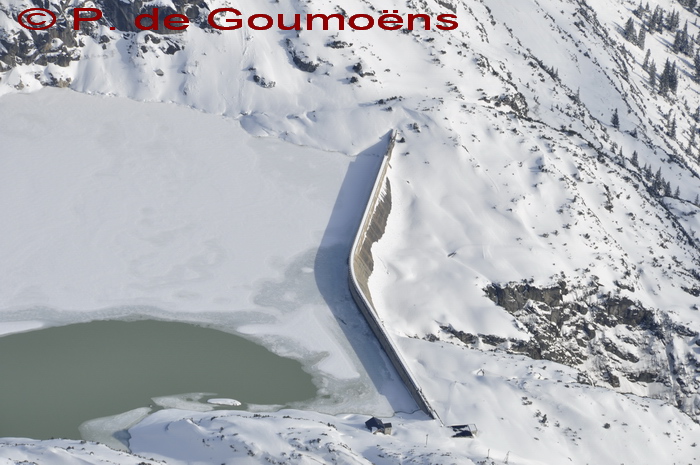
Although promoted as a funicular railway, the Gelmerbahn funicular has the appearance of a giant roller coaster and all of the fun too. For all those still having nightmares about recent rail tragedies in the age of non-stop surveillance and on-line replays, the 108 degree ascent (or descent) may not be your thing. On the other hand, for those who experience the London Underground each morning, "mind the gap" takes on a whole new meaning as you see your feet hanging out the bottom of the train and the tracks descending vertically into the valley below. <video controls="" height="340" poster="http://danielpocock.com/sites/danielpocock.com/files/gbahn-preview.jpg" width="560">

<source src="http://video.danielpocock.com/Gelmerbahn.webm" type="video/webm"></source>
Click to access video on original page
</video> and here are download links for those who prefer to download now and watch later (about 160MB): At the top At the top, there is a scenic two hour walk around Lake Gelmer, the path takes you across the top of a dam built for hydro-electric power generation. Lake Gelmer - hydro-electric dam Getting there from DebConf13 and the Debian 20th birthday For those coming to Switzerland for DebConf13 next month, the Gelmerbahn is probably a little bit too far for a day trip but makes an excellent place to stop during a 2 or 3 day tour around Switzerland. It is accessible using the all-day bus pass for the tour of 3 or 4 mountain passes or by train to Innertkirchen and then a short ride on the bus. The busses are irregular, use sbb.ch to plan the journey. Walking down the mountain from the lake to the bus stop takes about 90 minutes and for those who choose this option, the ticket is cheaper. More Swiss travel blogs Please click here to access some of my previous blogs about Swiss travel with videos and useful ideas for day trips.

28 July 2013

Hideki Yamane: now dpkg-deb uses xz for compression by default

from dpkg 1.17.0 's changelog

 dpkg (1.17.0) unstable; urgency=low
.
[ Guillem Jover ]
(snip)
* Switch dpkg-deb default compressor from gzip to xz. Build dpkg.deb using
gzip to make debootstrap life easier on non-Debian based systems.
Hallelujah, thanks! It'll reduce archive size and cut traffic, download time, too :-)

Then, I hope that dpkg would support "package delta" feature like yum's presto.

Francois Marier: FISL for foreigners HOWTO

FISL (pronounced FIZZ lay by the locals) is a large Free and Open Source software gathering in Porto Alegre, Brazil. While the primary audience of that conference is the Latin America "libre software" community, a number of overseas speakers also participate in that conference. This is my contribution to them: a short guide for international guests visiting the F rum Internacional do Software Livre.

Planning Before you fly out, make sure you look up the visa requirements for your country of citizenship. Many western countries will require a visa and you will need to visit the local Brazillian embassy ahead of time to get one. Next, have a look at the list of recommended immunizations. As with most destinations, it is recommended that your routine immunizations be up to date, but there are also other specialized ones such as Yellow Fever that are recommended by the Brazillian government. You should therefore visit a travel clinic a few weeks ahead of time. Other than that, I suggest reading up on the country and keeping an eye on the various travel advisories.

Arrival You will be flying at the Porto Alegre airport. If you need to exchange overseas money for Brazilian Reals, you can do that there. You'll probably also want to pick up a power adapter at the airport if you intend to charge your laptop while you're in the country :) Brazil has both 127V and 220V outlets using Type N sockets. Privacy note: using the free airport wifi will require giving your Passport details as part of the registration process.

Language If you don't speak Portuguese, expect a few challenges since most of the people you'll meet (including taxi drivers, many airport workers, some hotel staff) won't speak English. I highly recommend getting a phrase book before you leave and printing paper maps of where you are planning to go (to show to taxi drivers when you get lost). Native Spanish speakers seem to get by speaking Spanish to Portuguese speakers and understanding enough Portuguese to hold a conversation. I wouldn't count on it unless your Spanish is quite good though. Also, the official conference blog posts get eventually translated to English, but there is a delay, so you may want to subscribe to the Portuguese feed and use Google Translate to keep up with FISL news before you get there.

The conference FISL is a large conference and it has a very "decentralized" feel to it. From the outside, it looks like it's organized by an army of volunteers where everyone is taking care of some portion of it without a whole lot of top-down direction. It seems to work quite well! What this means for you as a foreign speaker however is that you're unlikely to be provided with a lot of information or help finding your way around the conference (i.e. no "speaker liaison"). There is a separate registration desk for speakers but that's about all of the attention you'll receive before you deliver your talk. So make sure you know where to go and show up in your assigned room early to speak with the person introducing you. If your talk is in English, it will be live-transated by an interpreter. It's therefore a good idea to speak a bit more slowly and to pause a bit more. Other than that, the organizers make an effort to schedule an English talk in each timeslot so non-Portuguese speakers should still be able to get a lot out of the conference. FISL was a lot of fun for me and I hope that some of these tips will help you enjoy the biggest FLOSS gathering in the southern hemisphere!

27 July 2013

Christian Perrier: [life] Running update July 27th 2013: Bubulle now runs in moutains

My last running update was sent after I had a great April month with two successful trail races (35km then 44km). The next target was Mont-Blanc marathon in Chamonix valley in early July, so it's time for me to send a new update before summer. May and June was mostly training. Huge training. Very long distances with 375km in May and over 430 in June (breaking my former monthly record by over 50 kilometers). Yes, that means over 14 kilometers every day..:-) I indeed achieved that with my "go to work partly by running" habits, which are now deeply included in my daily schedule. Much more convenient than bus ride (with the typical random schedules of RATP, which French people translate by "Rentre Avec Tes Pieds" or "Come back home by walking"....which is exactly what I'm doing). With such training (sometimes including extra rides in the forests, with short but steep ups and downs)....I was well prepared for THE early summer goal : Marathon du Mont-Blanc in Chamonix (not Ultra Trail du Mont-blanc : this one, I'm not ready for....yet).. My first mountain trail race, and what race! Imagine 42km in the moutain lovers heaven, namely the Chamonix Valley, with the Mont-Blanc, Aiguille Verte, Aiguille du Midi, Aiguilles Rouges, etc. above your head. Of course, not only in the valley but goind up and down "slightly"....in short 2200 meters positive climb..:-) I ran it with a female friend of mine, who I met in local races and through runners web forums. Sabine has about the same running skills than me and we developed a good and nice friendship, sharing our love for running in the nature. So, during May and June, we decided to run this race together as we were both registered for it. A first trial in a local 35km trail race two weeks before the MMB was very successful. We ended up in 3h40 and Sabine was ranked 5th female runner. And, moreover, we had a tremendous pleasure by crossing the finishing line together. So, we did it again in Chamonix. And, hell, we did it well: I had set the goal to 6 hours and 30 minutes and we completed the race in..... 6 hours and 34 minutes. Much much better than I and she would have expected. And, believe me, crossing the finishing line was again a special moment, particularly because the crowd at the end of this race make it look like l'Alpe d'Huez on the Tour de France. And, this on a wonderful sunny day, arriving at Planpraz, facing the Mont-Blanc. If you've ever been to Chamonix, you know what I mean. So, first moutain trail and, hell, not the last one! For those of you who can read French...or just want to see some pictures of a running bubulle, here is the link to the story. And these 42 kilometers were indeed so well done that the day after, while coming down from the famous Aiguille du Midi with Elisabeth (who came with me to Chamonix, of course)...I decided to run down from the cable car intermediate stop (2300m altitude) to Chamonix (1050m). Over 1200 meters down in 48 minutes... :-). Just a bit slower than the cable car....:) The remaining of July saw me again running back and forth to work and I'm indeed about to break my monthly record, eventually reaching 450 kilometers in one month and only two days NOT running in the whole month. Yeah, crazy. The upcoming Sunday, August 4th, just before going to Debconf 13, I'll spend a few days in Lanslebourg and will be running the EDF Cenis Tour trail, for 50 kilometers and 2600 meters positive climb. This time, a very "small" race, with no more than 150 runners. So, that will be another experience by running nearly entirely alone between 1400 and 2700 meters altitude. I'll post the outcome (or you'll probably hear about it at DC13....). See you, hopefully not in 3 months, for another update about running Bubulle.

24 July 2013

Daniel Leidert: Moving from (software) RAID 1 to RAID 5 and testing performance

Finally I finished migrating my new N54L from a 2-disk software RAID 1 (2x2TB WD20EFRX) to 3-disk RAID 5 (3x2TB WD20EFRX) using mdadm. I got an excellent mini HOWTO I followed. Resyncing and reshaping the RAID took several days ... top speed was 110.000K/s ... but left my data untouched. Finally growing the RAID now I have two partitions; one with 0.5GB (md0) and the other with 3.4GB (md1) which both host an EXT4 file system, whereas the first one is encrypted via LUKS and the second one is not. RAID device and file system configuration Below is a summary of the setup and the values I found working well for my system.
3-disk RAID 5 devicefile system
devicechunkstripe_cache_sizeread_ahead_kbtypeencryptionstridestripe-width
/dev/md064409632768ext4luks1632
/dev/md15121638432768ext4no128256
I've played around with the system a bit. Changing the chunk size on the fly however took a long time. /dev/md0 will contain some backups, so there probably will be a mixture of small and large files. So I've chosen to only test the values 64K, 128K and 512K (default) for this device. I left the other untouched as it will mainly contain large files. Performance measurement Below are the results using hdparm to measure performance. First lets take a look at the drives ...

$ hdparm -tT /dev/sd[bcd]
/dev/sdb:
Timing cached reads: 3268 MB in 2.00 seconds = 1634.54 MB/sec
Timing buffered disk reads: 438 MB in 3.00 seconds = 145.87 MB/sec

/dev/sdc:
Timing cached reads: 3292 MB in 2.00 seconds = 1646.32 MB/sec
Timing buffered disk reads: 392 MB in 3.01 seconds = 130.22 MB/sec

/dev/sdd:
Timing cached reads: 3306 MB in 2.00 seconds = 1653.18 MB/sec
Timing buffered disk reads: 436 MB in 3.00 seconds = 145.26 MB/sec

$ hdparm --direct -tT /dev/sd[bcd]
/dev/sdb:
Timing O_DIRECT cached reads: 468 MB in 2.01 seconds = 233.17 MB/sec
Timing O_DIRECT disk reads: 442 MB in 3.00 seconds = 147.15 MB/sec

/dev/sdc:
Timing O_DIRECT cached reads: 468 MB in 2.00 seconds = 233.69 MB/sec
Timing O_DIRECT disk reads: 392 MB in 3.01 seconds = 130.36 MB/sec

/dev/sdd:
Timing O_DIRECT cached reads: 468 MB in 2.00 seconds = 233.94 MB/sec
Timing O_DIRECT disk reads: 442 MB in 3.01 seconds = 146.93 MB/sec
... and now at the RAID devices ...

$ hdparm -tT /dev/md?
/dev/md0:
Timing cached reads: 3320 MB in 2.00 seconds = 1660.37 MB/sec
Timing buffered disk reads: 770 MB in 3.01 seconds = 256.05 MB/sec

/dev/md1:
Timing cached reads: 3336 MB in 2.00 seconds = 1668.07 MB/sec
Timing buffered disk reads: 742 MB in 3.01 seconds = 246.89 MB/sec

$ hdparm --direct -tT /dev/md?
/dev/md0:
Timing O_DIRECT cached reads: 974 MB in 2.00 seconds = 487.08 MB/sec
Timing O_DIRECT disk reads: 770 MB in 3.01 seconds = 256.17 MB/sec

/dev/md1:
Timing O_DIRECT cached reads: 784 MB in 2.00 seconds = 391.18 MB/sec
Timing O_DIRECT disk reads: 742 MB in 3.01 seconds = 246.42 MB/sec
... and now lets see, which actual speed we reach using dd. First lets check the encrypted device:

RAID-5 /dev/md0 (LUKS encrypted EXT4): chunk=64K, stripe_cache_size=4096,
readahead(blockdev)=65536, stride=16, stripe-width=32 ...

$ dd if=/dev/zero of=/mnt/md0/10g.img bs=1k count=10000000
10000000+0 Datens tze ein
10000000+0 Datens tze aus
10240000000 Bytes (10 GB) kopiert, 64,1227 s, 160 MB/s

$ dd if=/mnt/md0/10g.img of=/dev/null bs=1k count=10000000
10000000+0 Datens tze ein
10000000+0 Datens tze aus
10240000000 Bytes (10 GB) kopiert, 85,768 s, 119 MB/s
Well, read speed is consistently lower than write speed for the encrypted file system. Lets take a look at the non-encrypted device:

RAID-5 /dev/md1 (EXT4): chunk=512K, stripe_cache_size=16384,
readahead(blockdev)=65536, stride=128, stripe-width=256 ...

$ dd if=/dev/zero of=/mnt/md1/10g.img bs=1k count=10000000
10000000+0 Datens tze ein
10000000+0 Datens tze aus
10240000000 Bytes (10 GB) kopiert, 37,0016 s, 277 MB/s

$ dd if=/mnt/md1/10g.img of=/dev/null bs=1k count=10000000
10000000+0 Datens tze ein
10000000+0 Datens tze aus
10240000000 Bytes (10 GB) kopiert, 33,5901 s, 305 MB/s
Looks nice to me. How to set these values I use a mixture of udev, util-linux and e2fsprogs to set the values. First I checked, which values for stripe_cache_size and read_ahead_kb are working best for me. For the LUKS encrypted EXT4 I got varying results showing best performances with values of 4096, 8192 and 16384 for stripe_cache_size. I decided for the first value, because it appeared more often with the best performance than the others.

$ less /etc/udev/rules.d/90-local-n54l.rules grep stripe_cache
SUBSYSTEM=="block", KERNEL=="md0", ACTION=="add", TEST=="md/stripe_cache_size", TEST=="queue/read_ahead_kb", ATTR md/stripe_cache_size ="4096", ATTR queue/read_ahead_kb ="32768", ATTR bdi/read_ahead_kb ="32768"
SUBSYSTEM=="block", KERNEL=="md1", ACTION=="add", TEST=="md/stripe_cache_size", TEST=="queue/read_ahead_kb", ATTR md/stripe_cache_size ="16384", ATTR queue/read_ahead_kb ="32768", ATTR bdi/read_ahead_kb ="32768"
The read_ahead_kb value can also be set using blockdev. Note that this command expects a value of 512-byte sectors whereas read_ahead_kb is the size in kbyte. Therefor the difference in values:

$ blockdev --setra 65536 /dev/md[01]
Tuning the EXT4 file system performance with calculated values using tune2fs:

$ tune2fs -E stride=16,stripe-width=32 -O dir_index /dev/mapper/_dev_md0
$ tune2fs -E stride=128,stripe-width=256 -O dir_index /dev/md1
Disabling NCQ reduced the speed a lot for me, so I left the values as is and did not struggle with it:

$ cat /sys/block/sd[bcd]/device/queue_depth
31
31
31

22 July 2013

Matthew Garrett: ARM and firmware specifications

Jon Masters, Chief ARM Architect at Red Hat, recently posted a description of his expectations for baseline arm64 servers. The quick summary is that systems should implement UEFI and ACPI, and any more traditional ARM boot mechanisms should be ignored. This is an interesting departure from the status quo in the ARM world, and it's worth thinking about the benefits and drawbacks of this approach.

It's very easy to build a generic kernel for most x86 systems, since the PC platform is fairly well defined even if not terribly well specified. Where system hardware does vary, it's almost always exposed on an enumerable bus (such as PCI or USB) which allows the OS to bind appropriate drivers. Things are different in the ARM world. Even once you're past the point of different SoC vendors requiring different kernel setup code and drivers, you still have to cope with the fact that system vendors can wire these SoCs up very differently. Hardware is often attached via GPIO lines without any means to enumerate them. The end result is that you've traditionally needed a different kernel for every ARM board. This is viable if you're selling the OS and hardware as a single product, but less viable if there's any desire to run a generic OS on the hardware.

The solution that's been adopted for this in the Linux world is called Device Tree. Device Tree actually has significant history, having been used as the device descriptor format in Open Firmware. Since there was already support for it in the Linux kernel, adapting it for use in ARM devices was straightforward. Device Tree aware devices can pass a descriptor blob to the kernel at startup[1], and devices without that knowledge can have a blob build into the kernel.

So, if this problem is already solved, why the push to move to UEFI and ACPI? This push didn't actually originate in the Linux world - Microsoft mandate that Windows RT devices implement UEFI and ACPI, and were they to launch a Windows ARM server product would probably carry that over. That makes sense for Microsoft, since recent versions of Windows have been x86 only and so have grown all kinds of support for ACPI and UEFI. Supporting Device Tree would require Microsoft to rewrite large parts of Windows, whereas mandating UEFI and ACPI allowed them to reuse most of their existing Windows boot and driver code. As a result, largely at Microsoft's behest, ACPI 5 has grown a range of additional features for describing things like GPIO pinouts and I2C connections. Whatever your weird device layout, you can probably express it via ACPI.

This argument works less well for Linux. Linux already supports Device Tree, whereas it currently doesn't support ACPI or UEFI on ARM[2]. Hardware vendors are already used to working with Device Tree. Moving to UEFI and ACPI has the potential to uncover a range of exciting new kernel issues and vendor bugs. It's not obviously an engineering win.

So how about users? There's an argument that since server vendors are now mostly shipping ACPI and UEFI systems, having ARM support these technologies makes it easier for customers to replace x86 systems with ARM systems. This really doesn't fly for ACPI, which is entirely invisible to the user. There are no standard ACPI entry points for system configuration, and the bits of ACPI that are generically useful (such as configuring system wakeup times) are already abstracted away to a standard interface by the kernel. It's somewhat more compelling for UEFI. UEFI supports a platform-independent bytecode language (EFI Byte Code, or EBC), which means that customers can write their own system management utilities, build them for EBC and then deploy them to their servers without caring about whether they're x86 or ARM. Want a bootloader that'll hit an internal HTTP server in order to determine which system image to deploy, and which works on both x86 and ARM? Straightforward.

Arnd Bergmann has a interesting counterargument. In a nutshell, ARM servers aren't currently aiming for the same market as x86 servers, and as a result customers are unlikely to gain any significant benefit from shared functionality between the two.

So if there's no real benefit to users, and if there's no benefit to kernel developers, what's the point? The main one that springs to mind is that there is a benefit to distributions. Moving to UEFI means that there's a standard mechanism for distributions to interact with the firmware and configure the bootloader. The traditional ARM approach has been for vendors to ship their own version of u-boot. If that's in flash then it's not much of a problem[3], but if it's on disk then you have to ship a range of different bootloaders and know which one to install (and let's not even talk about initial bootstrapping).

This seems like the most compelling argument. UEFI provides a genuine benefit for distributions, and long term it probably provides some benefit to customers. The question is whether that benefit is worth the flux. The same distribution benefit could be gained by simply mandating a minimum set of u-boot functionality, which would seem much more straightforward. The customer benefit is currently unclear.

In the end it'll probably be a market decision. If Red Hat produce an ARM product that has these requirements, and if Suse produce an ARM product that will work with u-boot and Device Tree, it'll be up to vendors to decide whether the additional work to support UEFI/ACPI is worth it in order to be able to sell to customers who want Red Hat. I expect that large vendors like HP and Dell will probably do it, but the smaller ones may not. The customer demand issue is also going to be unclear until we learn whether using UEFI is something that customers actually care about, rather than a theoretical benefit.

Overall, I'm on the fence as to whether a UEFI requirement is going to stick, and I suspect that the ACPI requirement is tilting at windmills. There's nothing stopping vendors from providing a Device Tree blob from UEFI, and I can't think of any benefits they gain from using ACPI instead. Vendor interest in the generic parts of the ACPI spec has been tepid even in the x86 world (the vast majority of ACPI spec updates come from Microsoft and Intel, not any of the system vendors), and I don't see that changing with the introduction of a range of ARM vendors who are already happy with Device Tree.

We'll see. Linux is going to need to gain the support for UEFI and ACPI on ARM in any case, since there's already hardware shipping in that configuration. But with ARM vendors still getting to grips with Device Tree, forcing them to go through another change in how they do things is going to be hard work. Red Hat may be successful in enforcing these requirements at the cost of some vendor unhappiness, or Red Hat may find that their product doesn't boot on most of the available hardware. It's an aggressive gamble, and while it'll be interesting to see how it plays out, I'm not that optimistic.

[1] The blob could be pulled from the firmware, but it's not uncommon for it to be built into u-boot instead. This does mean that you have a device-specific u-boot even if you have a generic kernel, but that's typically true anyway.
[2] Patches have been posted for ARM UEFI support. They're not mergeable in their current form, but they should be in the near future. ACPI support is in development.
[3] Although not all u-boots are created equal - some vendors ship versions that will only boot off FAT, some vendors ship versions that will only boot off ext2. Having to special case this stuff in your installer is a pain.

comment count unavailable comments

20 July 2013

Eddy Petri&#537;or: GNU Make quirk

(Updated 2013-07-20: Correctly describe the issue and provide examples)

Make has several useful built-in functions, among which $(patsubst pattern,replacer,string). The pattern can contain the character % which is a wildcard meaning any string and that can be referred in the replacer parameter. Only the first occurrence of % is treated with this special meaning, just as the manual says.

What the manual doesn't say is that only the form %bla works, while the form bla% does NOT work GNU Make's '%' is not analogous to shell's '*', so you can't expect to remove substrings in the middle of a string without knowing the exact string until the part you want to remove.

This does not work if you want to obtain '../some/CPU12/include' in OTHERPATH:

PATH := ../some/prefCPU12/include
OTHERPATH := $(patsubst pref%,%,$(PATH))

default:
@echo "OTHERPATH = $(OTHERPATH)
The result will be:
OTHERPATH = ../some/prefCPU12/include
This bahaviour is somewhat asymetric to how subst behaves and how one would expect it to, considering '%' is explained as a glob pattern:

0 eddy@heidi /tmp $ cat makefile
PATH := ../some/prefCPU12/include
OTHERPATH := $(patsubst pref%,%,$(PATH))
SPATH := $(subst pref,,$(PATH))

default:
@echo "PATH = $(PATH)"
@echo "OTHERPATH = $(OTHERPATH)"
@echo "SPATH = $(SPATH)"
0 eddy@heidi /tmp $ make
PATH = ../some/prefCPU12/include
OTHERPATH = ../some/prefCPU12/include
SPATH = ../some/CPU12/include
Not sure what make developers would say about this, and I am not sure if having % work as a glob pattern and using it, instead of invoking sed would be better for performance, but sure I would like to have the option :-) .

14 July 2013

Joey Hess: New git-annex crowdfunding campaign

Having reached the end of my Kickstarter funded year working on the git-annex assistant, I've decided to try one more crowdfunding campaign, to see if I can get funded to work on it a little while longer. I went back and forth on this for a while. The Kickstarter funded development was extremely successful (one of the most productive years of my life). I certianly want to work on git-annex more, and have lots more stuff to do, particularly around security and encryption. On the other hand, it's hard to frame ongoing development as a normal Kickstarter campaign to start something new. Anyway, I've decided to go ahead and try it, and not do it through Kickstarter this time. So I have my own website set up and accepting donations, and hopefully I'll make enough to spend a few more months working on git-annex. campaign.joeyh.name ... And if not, I'll probably spend a few months working on git-annex part time, while looking for paying work with the rest of my time. By the way, I'm taking payments in both US Dollars (via Paypal) and Bitcoin (via Coinbase). Can't wait to see how this works out!

Paul Tagliamonte: ftp* and me

As some of y all may have heard, I ve joined the nav^Wftp-team. It s quite a big step for me, and a bit of a time commitment, but I really do believe in the work the ftp team is doing. I ve got quite a lot of work ahead of me (over 300 packages in NEW), but I m happy to help. See y all in NEW!

13 July 2013

Michael Stapelberg: Survey answers part 3: systemd is not portable and what this means for our ports

This blog post is the third of a series of posts dealing with the results of the Debian systemd survey. I intend to give a presentation at DebConf 2013, too, so you could either read my posts, or watch the talk, or both :-). The second-biggest concern in the survey results was that systemd is not portable to non-Linux systems, for example Debian GNU/kFreeBSD or Debian GNU/HURD. For convenience, I will from now on write kFreeBSD when I really mean all non-Linux ports. systemd not being portable is not an arbitrary decision Some people seem to think that the systemd upstream is just hostile to users of other operating systems when they hear that systemd is not portable. However, keep in mind that Lennart, Kay and other contributors have considerable experience with writing portable software such as Avahi and PulseAudio. The decision to only support Linux in systemd was thus not taken lightly. systemd s design requires many kernel features and certain semantics (e.g. procfs is not enough, /proc/$PID/exe needs to be supported), which are currently only available on Linux. Point 15 of Lennart s blog post 0pointer.de/blog/projects/the-biggest-myths.html contains an incomplete list of these features. Maintaining portable code increases complexity Since systemd is written in C, the canonical way to write portable code is by using conditional compilation, for example with ifdef statements. That makes the code harder to understand and reason about, but more importantly it blows up the test matrix. It also requires any new change to be tested on all supported systems, which is not feasible for most contributors. I think everybody agrees keeping complexity low is a good thing. What are the implications for our non-Linux ports? We, the Debian project, have two realistic options in my point of view:
  1. We stay with sysvinit, the least common denominator, forever.
  2. We use a modern init system such as systemd on Debian GNU/Linux.
In case we go with the first option, Debian will diverge more and more from virtually every other Linux distribution. This also means we are stuck with the limited features and capabilities that sysvinit has. A modern operating system needs to be able to adapt to a changing environment and the once static world in which sysvinit was developed has become much more dynamic. In our opinion, the only reasonable choice is the latter option: use systemd on Debian GNU/Linux. How will this work? For individual maintainers, this means they need to support two init systems. Luckily, systemd service files are usually really simple, but there still is additional maintenance work such as testing whether your service actually starts when using systemd. We think this maintenance overhead is justified due to the advantages a modern init system brings. Of course, not every maintainer can arrange it to install systemd and test his/her package. You are invited to contact us at pkg-systemd-maintainers@lists.alioth.debian.org at any time and we can help you out. Furthermore, automation can be introduced (and we have a proof of concept) to make it easier to spot mistakes and perform some simple tests, such as whether the service can be started. A concern that was voiced is that as sysvinit usage decreases, the init scripts would bit-rot and stop working at some point. If that happens, we rely on the users to file appropriate bug reports. This is no different from the situation today it is not feasible for maintainers to test every single combination of features all the time. Ports are different and that diversity is good The FreeBSD kernel and the Linux kernel are different, and each kernel provides distinct features that the other kernel does not have. As an example, Linux provides cgroups, which are heavily used by systemd. The FreeBSD kernel in turn offers the packet filter pf , which is not available on Linux. There certainly is value in having common infrastructure. But there also is value in providing the best features that each platform has to offer in case of Linux, that is clearly systemd as an init system IMO. Conclusion systemd is not portable because it relies on features only the Linux kernel provides an example is cgroups, which systemd uses to track processes in a reliable way. Not embracing these features and staying with sysvinit indefinitely is not a viable option if Debian wants to remain relevant for today s demands. In the short term, the migration to systemd will cause additional maintenance effort for individual package maintainers, but it will pay off in the long term.

12 July 2013

Marc 'Zugschlus' Haber: PowerDNS (pdns) 3.3-1~exp1 in Debian experimental

I have just uploaded PowerDNS 3.3-1~exp1 to Debian experimental. This new upstream version has introduced its own include directive, so Debian was able to drop its patch. Hence, our conffiles had to grow a .conf extension, which most of them didn t have in previous version. If anybody wants to test updates from PowerDNS 3.1 to the new 3.3-1~exp1 in Debian unstable, please go ahead and report bugs in the Debian BTS. The package is known to not offer seamless DNSSEC, I ll work on that before I upload to unstable. While we re at it: I would appreciate help with the PostgreSQL backend. Myself, I use mainly MySQL and am not too proficient in PostgreSQL. I ll accept both patches and more formal co-maintenance.

Justus Winter: Hi, I'm the one who wrote umount...

Everyone enjoys ASCII screenshots as much as I do, right? So here is the Hurd booting with my mtab-prototype bound to /run/mtab:
INIT: version 2.88 booting
Using makefile-style concurrent boot in runlevel S.
Activating swap...done.
Checking root file system...fsck from util-linux 2.20.1
hd2 : tray open or drive not ready
end_request: I/O error, dev 02:00, sector 0
/dev/hd0s1: clean, 44292/181056 files, 287759/723200 blocks
done.
Activating lvm and md swap...(default pager): Already paging to partition hd0s5!
done.
Checking file systems...fsck from util-linux 2.20.1
hd2 : tray open or drive not ready
end_request: I/O error, dev 02:00, sector 0
done.
Cleaning up temporary files... /tmp.
Mounting local filesystems...done.
Activating swapfile swap...(default pager): Already paging to partition hd0s5!
done.
Cleaning up temporary files....
Configuring network interfaces...inetutils-ifconfig: invalid arguments
ifup: failed to open pid file /run/network/ifup-/dev/eth0.pid: No such file or directory
Internet Systems Consortium DHCP Client 4.2.2
Copyright 2004-2011 Internet Systems Consortium.
All rights reserved.
For info, please visit https://www.isc.org/software/dhcp/
can't create /var/lib/dhcp/dhclient./dev/eth0.leases: No such file or directory
Listening on Socket//dev/eth0
Sending on   Socket//dev/eth0
DHCPDISCOVER on /dev/eth0 to 255.255.255.255 port 67 interval 4
DHCPREQUEST on /dev/eth0 to 255.255.255.255 port 67
DHCPOFFER from 10.0.2.2
DHCPACK from 10.0.2.2
can't create /var/lib/dhcp/dhclient./dev/eth0.leases: No such file or directory
bound to 10.0.2.15 -- renewal in 42550 seconds.
done.
Cleaning up temporary files....
Setting up X socket directories... /tmp/.X11-unix /tmp/.ICE-unix.
INIT: Entering runlevel: 2
Using makefile-style concurrent boot in runlevel 2.
Starting enhanced syslogd: rsyslogd.
Starting deferred execution scheduler: atd.
Starting periodic command scheduler: cron.
Starting system message bus: dbusFailed to set socket option"/var/run/dbus/system_bus_socket": Protocol not available.
Starting OpenBSD Secure Shell server: sshd.
GNU 0.3 (debian) (console)
login:
As you can see, the boot process looks quite clean. In particular, there are no issues left with Debians initscripts. The remaining noise comes from: This is accomplished by my mtab translator prototype. It's work in progress, but I have reworked and broken up my initial prototype. My initial prototype only patched libdiskfs, one of three libraries translator authors can use to write filesystem-like translators. I have made the necessary changes to the other two libraries and patched up any loose ends. This is the translator in action:
% fsysopts /run/mtab
/hurd/mtab /
% cat /run/mtab
/dev/hd0s1 / ext2fs writable,no-inherit-dir-group,store-type=typed 0 0
none /dev/ttyp0 /hurd/term name,/dev/ptyp0,type,pty-master 0 0
none /run /hurd/tmpfs writable,no-suid,no-exec,no-inherit-dir-group,no-sync,size=80484K 0 0
none /run/lock /hurd/tmpfs writable,no-suid,no-exec,no-inherit-dir-group,no-sync,size=5M 0 0
none /run/shm /hurd/tmpfs writable,no-suid,no-exec,no-inherit-dir-group,no-sync,size=259480K 0 0
I also patched the sysvinit package. My version includes and switches to runsystem.sysv that uses /sbin/init to start the system. It also carries all the necessary workarounds for the remaining sysvinit related issues. The resulting Debian/Hurd system is very nice, it is getting more and more similar to what a Debian user would expect: I have rebuild the hurd and sysvinit package and uploaded them into an apt repository:
deb http://teythoon.cryptobitch.de/gsoc/heap/debian unstable main
Please use unstable for now. Also make sure that you have a recovery plan for your Debian/Hurd installation if anything goes wrong. For your convenience there's a seed tarball containing packages with the appropriate sources.list.d snippets and the repository key: https://teythoon.cryptobitch.de/gsoc/heap/debian/seed.tar Currently /hurd/console is not started (I'll add a init script for that later), but for now you have to start a getty on the console. Make sure that your /etc/inittab contains a line like this:
7:2345:respawn:/sbin/getty 38400 console
The patched initscripts package contains the runsystem.sysv file and uses the Debian alternatives system to replace the runsystem.gnu variant. It also switches to the appropriate halt and reboot utilities. If you install the package, you must use halt-hurd or reboot-hurd to halt or reboot the system. Running halt or reboot is not harmful though, it just doesn't work. So here I am. I've been coding for the Hurd for four weeks now, and suddenly I'm the guy who wrote umount. My point is, if you ever wanted to work on an operating system, you might want to consider working on the Hurd. It the Debian/Hurd port is very decent and (according to #debian-hurds "Debian GNU/Hurd Doomsday-o-meter") 78.44% of all Debian packages are available, so you've got a familiar environment. Also, if your solution is right and your code is reasonably clean, it is not that hard to get your changes accepted. The list of open issues is long and might contain something that interests you. You could be the one implementing a read-ahead solution to massively improve Hurds overall performance. Also since Hurd is just a Hird of Unix replacing daemons running on-top the GNU Mach microkernel, most of the functionality lies within userspace processes. This makes the whole system very extensible and quite easy to work with. For an overview over the Hurd, see this page. Next week I'll focus on improving my mtab prototype, improving the sysvinit patches and upstreaming the ones that are ready. As always, in case I run out of stuff to do, I'll pick something from my list of issues, most likely the network related issues. In completely unrelated news, my Debian/Linux workstation died with a kernel panic while I was writing this blog entry. It's a good thing Emacs honors "save early, save often". M-x insert-monolithic-kernel-rant-here. This is it for this week, thanks for your attention :)

Daniel Pocock: Practical VPNs with strongSwan, Shorewall, Linux firewalls and OpenWRT routers

There is intense interest in communications privacy at the moment thanks to the Snowden scandal. Open source software has offered credible solutions for privacy and encryption for many years. Sadly, making these solutions work together is not always plug-and-play. In fact, secure networking, like VoIP, has been plagued by problems with interoperability and firewall/filtering issues although now the solutions are starting to become apparent. Here I will look at some of them, such as the use of firewall zones to simplify management or the use of ECDSA certificates to avoid UDP fragmentation problems. I've drawn together a lot of essential tips from different documents and mailing list discussions to demonstrate how to solve a real-world networking problem. A typical network scenario and requirements Here is a diagram of the network that will be used to help us examine the capabilities of these open source solutions. Some comments about the diagram:
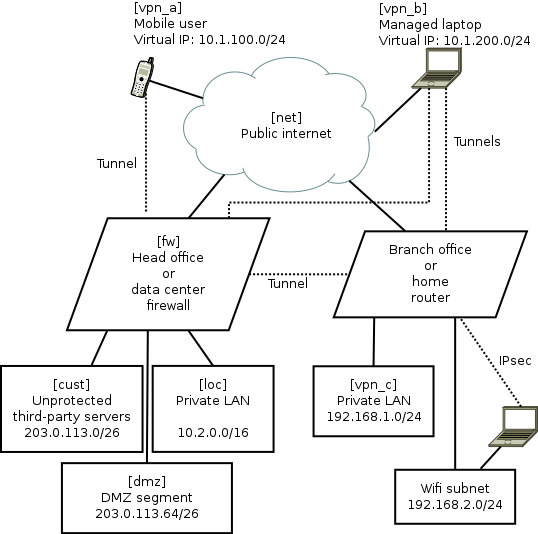
  • The names in square brackets are the zones for Shorewall, they are explained later.
  • The dotted lines are IPsec tunnels over the untrusted Internet.
  • The road-warrior users (mobiles and laptops) get virtual IP addresses from the VPN gateway. The branch offices/home routers do not use virtual IPs.
  • The mobile phones are largely untrusted: easily lost or stolen, many apps have malware, they can only tunnel to the central VPN and only access a very limited range of services.
  • The laptops are managed devices so they are trusted with access to more services. For efficiency they can connect directly to branch office/home VPNs as well as the central server.
  • Smart-phone user browsing habits are systematically monitored by mobile companies with insidious links into mass-media and advertising. Road-warriors sometimes plug-in at client sites or hotels where IT staff may monitor their browsing. Therefore, all these users want to tunnel all their browsing through the VPN.
  • The central VPN gateway/firewall is running strongSwan VPN and Shorewall firewall on Linux. It could be Debian, Fedora or Ubuntu. Other open source platforms such as OpenBSD are also very well respected for building firewall and VPN solutions, but Shorewall, which is one of the key ingredients in this recipe, only works on Linux at present.
  • The branch office/home network could be another strongSwan/Shorewall server or it could also be an OpenWRT router
  • The default configuration for most wifi routers creates a bridge joining wifi users with wired LAN users. Not here, it has been deliberately configured as an independent network. Road-warriors who attach to the wifi must use VPN tunnelling to access the local wired network. In OpenWRT, it is relatively easy to make the Wifi network an independent subnet. This is an essential security precaution because wifi passwords should not be considered secure: they are often transmitted to third parties, for example, by the cloud backup service in many newer smart phones.
Package mayhem The major components are packaged on all the major Linux distributions. Nonetheless, in every case, I found that it is necessary to re-compile fresh strongSwan packages from sources. It is not so hard to do but it is necessary and worth the effort. Here are related blog entries where I provide the details about how to re-build fresh versions of the official packages with all necessary features enabled: Using X.509 certificates as a standard feature of the VPN For convenience, many people building a point-to-point VPN start with passwords (sometimes referred to as pre-shared keys (PSK)) as a security mechanism. As the VPN grows, passwords become unmanageable. In this solution, we only look at how to build a VPN secured by X.509 certificates. The certificate concept is not hard. In this scenario, there are a few things that make it particularly easy to work with certificates:
  • strongSwan comes with a convenient command line tool, ipsec pki. Many of it's functions are equivalent to things you can do with OpenSSL or GnuTLS. However, the ipsec pki syntax is much more lightweight and simply provides a convenient way to do the things you need to do when maintaining a VPN.
  • Many of the routine activities involved in certificate maintainence can be scripted. My recent blog about using Android clients with strongSwan gives a sample script demonstrating how ipsec pki commands can be used to prepare a PKCS#12 (.p12) file that can be easily loaded into an Android device using the SD-card.
  • For building a VPN, there is no need to use a public certificate authority such as Verisign. Consequently, there is no need to fill in all their forms or make any payments for each device/certificate. Some larger organisations do choose to outsource their certificate management to such firms. For smaller organisations, an effective and sometimes better solution can be achieved by maintaining the process in-house with a private root CA.
UDP fragmentation during IPsec IKEv2 key exchange and ECDSA A common problem for IPsec VPNs using X.509 certificates is the fragmentation of key exchange datagrams during session setup. Sometimes it works, sometimes it doesn't. Various workarounds exist, such as keeping copies of all certificates from potential peers on every host. As the network grows, this becomes inconvenient to maintain and to some extent it eliminates the benefits of using PKI. Fortunately, there is a solution: Elliptic Curve Cryptography (ECC). Many people currently use RSA key-pairs. Best practice suggests using RSA keys of at least 2048 bits and often 4096 bits. Using ECC with a smaller 384-bit key is considered to be equivalent to a 7680 bit RSA key pair. Consequently, ECDSA certificates are much smaller than RSA certificates. Furthermore, at these key sizes, the key exchange packets are almost always smaller than the typical 1500 byte MTU. A further demand for ECDSA is arising due to the use of ECC within smart cards. Many smartcards don't support any RSA key larger than 2048 bits. The highly secure 384-bit ECC key is implemented in quite a few common smart cards. Smart card vendors have shown a preference for the ECC keys due to the US Government's preference for ECC and the lower computational overheads make them more suitable for constrained execution environments. Anyone who wants to use smart cards as part of their VPN or general IT security now, or in the future, needs to consider ECC/ECDSA. Making the network simple with Shorewall zones For this example, we are not just taking some easy point-to-point example. We have a real-world, multi-site, multi-device network with road warriors. Simplifying this architecture is important to help us understand and secure it. The solution? Each of these is abstracted to a "zone" in Shorewall. In the diagram above, the zone names are in square brackets. The purpose of each zone is described below:
Zone name Description
loc This is the private LAN and contains servers like databases, private source code respositories and NFS file servers
dmz This is the DMZ and contains web servers that are accessible from the public internet. Some of these servers talk to databases or message queues in the LAN network loc
vpn_a These are road warriors that are not very trustworthy, such as mobile devices. They are occasionally stolen and usually full of spyware (referred to by users as "apps"). They have limited access to ports on some DMZ servers, e.g. for sending and receiving mail using SMTP and IMAP (those ports are not exposed to the public Internet at large). They use the VPN tunnel for general internet access/browsing, to avoid surveillance by their mobile carrier.
vpn_b These are managed laptops that have a low probability of malware infection. They may well be using smart cards for access control. Consequently, they are more trusted than the vpn_a users and have access to some extra intranet pages and file servers. Like the smart-phone users, they use the VPN tunnel for general internet access/browsing, to avoid surveillance by third-party wifi hotspot operators.
vpn_c This firewall zone represents remote sites with managed hardware, such as branch offices or home networks with IPsec routers running OpenWRT.
cust These are servers hosted for third-parties or collaborative testing/development purposes. They have their own firewall arrangements if necessary.
net This zone represents traffic from the public Internet.
A practical Shorewall configuration Shorewall is chosen to manage the iptables and ip6tables firewall rules. Shorewall provides a level of abstraction that makes netfilter much more manageable than manual iptables scripting. The Shorewall concept of zones is very similar to the zones implemented in OpenWRT and this is an extremely useful paradigm for firewall management. Practical configuration of Shorewall is very well explained in the Shorewall quick start. The one thing that is not immediately obvious is a strategy for planning the contents of the /etc/shorewall/policy and /etc/shorewall/rules files. The exact details for making it work effectively with a modern IPsec VPN are not explained in a single document, so I've gathered those details below as well. An effective way to plan the Shorewall zone configuration is with a table like this:
Destination zone
loc dmz vpn_a vpn_b vpn_c cust net
Source zone loc \
dmz ? \ X X X
vpn_a ? ? \ X X
vpn_b ? ? X \ X
vpn_c X \
cust X ? X X X \
net X ? X X X \
The symbols in the table are defined:
Symbol Meaning
ACCEPT in policy file
X REJECT or DROP in policy file
? REJECT or DROP in policy file, but ACCEPT some specific ports in the rules file
Naturally, this modelling technique is valid for both IPv4 and IPv6 firewalling (with Shorewall6) Looking at the diagram in two dimensions, it is easy to spot patterns. Each pattern can be condensed into a single entry in the rules file. For example, it is clear from the first row that the loc zone can access all other zones. That can be expressed very concisely with a single line in the policy file:
loc all ACCEPT
Specific Shorewall tips for use with IPsec VPNs and strongSwan Shorewall has several web pages dedicated to VPNs, including the IPsec specific documentation.. Personally, I found that I had to gather a few details from several of these pages to make an optimal solution. Here are those tips:
  • Ignore everything about the /etc/shorewall/tunnels file. It is not needed and not used any more
  • Name the VPN zones (we call them vpn_a, vpn_b and vpn_c) in the zones file but there is no need to put them in the /etc/shorewall/interfaces file.
  • The /etc/shorewall/hosts file is not just for hosts and can be used to specify network ranges, such as those associated with the VPN virtual IP addresses. The ranges you put in this file should match the rightsourceip pool assignments in strongSwan's /etc/ipsec.conf
  • One of the examples suggests using mss=1400 in the /etc/shorewall/zones file. I found that is too big and leads to packets being dropped in some situations. To start with, try a small value such as 1024 and then try larger values later after you prove everything works. Setting mss for IPsec appears to be essential.
  • Do not use the routefilter feature in the /etc/shorewall/interfaces file as it is not compatible with IPsec
Otherwise, just follow the typical examples from the Shorewall quick start guide and configure it to work the way you want. Here is an example /etc/shorewall/zones file:
fw firewall
net ipv4
dmz ipv4
loc ipv4
cust ipv4
vpn_a ipsec mode=tunnel mss=1024
vpn_b ipsec mode=tunnel mss=1024
vpn_c ipsec mode=tunnel mss=1024
Here is an example /etc/shorewall/hosts file describing the VPN ranges from the diagram:
vpn_a eth0:10.1.100.0/24 ipsec
vpn_b eth0:10.1.200.0/24 ipsec
vpn_c eth0:192.168.1.0/24 ipsec
Here is an example /etc/shorewall/policy file based on the table above:
loc all ACCEPT
vpn_c all ACCEPT
cust net ACCEPT
net cust ACCEPT
all all REJECT
Here is an example /etc/shorewall/rules file based on the network:
SECTION ALL
# allow connections to the firewall itself to start VPNs:
# Rule  source    dest    protocol/port details
ACCEPT   all       fw                ah
ACCEPT   all       fw                esp
ACCEPT   all       fw                udp 500
ACCEPT   all       fw                udp 4500
# allow access to HTTP servers in DMZ:
ACCEPT   all       dmz               tcp 80
# allow connections from HTTP servers to MySQL database in private LAN:
ACCEPT   dmz       loc:10.2.0.43     tcp 3306
# allow connections from all VPN users to IMAPS server in private LAN:
ACCEPT vpn_a,vpn_b,vpn_c loc:10.2.0.58 tcp 993
# allow VPN users (but not the smartphones in vpn_a) to the
# PostgresQL database for PostBooks accounting system:
ACCEPT vpn_b,vpn_c loc:10.2.0.48      tcp 5432
SECTION ESTABLISHED
ACCEPT   all       all
SECTION RELATED
ACCEPT   all       all
Once the files are created, Shorewall can be easily activated with:
# shorewall compile && shorewall restart
strongSwan IPsec VPN setup Like Shorewall, strongSwan is also very well documented and I'm just going to focus on those specific areas that are relevant to this type of VPN project.
  • Allow the road-warriors to send all browsing traffic over the VPN means including leftsubnet=0.0.0.0/0 in the VPN server's /etc/ipsec.conf file. Be wary though: sometimes the road-warriors start sending the DHCP renewal over the tunnel instead of to their local DHCP server.
  • As we are using Shorewall zones for firewalling, you must set the options leftfirewall=no and lefthostaccess=no in ipsec.conf. Shorewall already knows about the remote networks as they are defined in the /etc/shorewall/hosts file and so firewall rules don't need to be manipulated each time a tunnel goes up or down.
  • As discussed above, X.509 certificates are used for peer authentication. In the certificate Distinguished Name (DN), store the zone name in the Organizational Unit (OU) component, for example, OU=vpn_c, CN=gw.branch1.example.org
  • In the ipsec.conf file, match the users to connections using wildcard specifications such as rightid="OU=vpn_a, CN=*"
  • Put a subjectAltName with hostname in every certificate. The --san option to the ipsec pki commands adds the subjectAltName.
  • Keep the certificate distinguished names (DN) short, this makes the certificate smaller and reduces the risk of fragmented authentication packets. Many examples show a long and verbose DN such as C=GB, O=Acme World Wide Widget Corporation, OU=Engineering, CN=laptop1.eng.acme.example.org. On a private VPN, it is rarely necessary to have all that in the DN, just include OU for the zone name and CN for the host name.
  • As discussed above, use the ECDSA scheme for keypairs (not RSA) to ensure that the key exchange datagrams don't suffer from fragmentation problems. For example, generate a keypair with the command ipsec pki --gen --type ecdsa --size 384 > user1Key.der
  • Road warriors should have leftid=%fromcert in their ipsec.conf file. This forces them to use the Distinguished Name and not the subjectAltName (SAN) to identify themselves.
  • For road warriors who require virtual tunnel IPs, configure them to request both IPv4 and IPv6 addresses (dual stack) with leftsourceip=%config4,%config6 and on the VPN gateway, configure the ranges as arguments to rightsourceip
  • To ensure that roadwarriors query the LAN DNS, add the DNS settings to strongswan.conf and make sure road warriors are using a more recent strongSwan version that can dynamically update /etc/resolv.conf. Protecting DNS traffic is important for privacy reasons. It also makes sure that the road-warriors can discover servers that are not advertised in public DNS records.
Central firewall/VPN gateway configuration Although they are not present in the diagram, IPv6 networks are also configured in these strongSwan examples. It is very easy to combine IPv4 and IPv6 into a single /etc/ipsec.conf file. As long as the road-warriors have leftsourceip=%config4,%config6 in their own configurations, they will operate dual-stack IPv4/IPv6 whenver they connect to the VPN. Here is an example /etc/ipsec.conf for the central VPN gateway:
config setup
        charonstart=yes
        charondebug=all
        plutostart=no
conn %default
        ikelifetime=60m
        keylife=20m
        rekeymargin=3m
        keyingtries=1
        keyexchange=ikev2
conn branch1
        left=198.51.100.1
        leftsubnet=203.0.113.0/24,10.0.0.0/8,2001:DB8:12:80:/64
        leftcert=fw1Cert.der
        leftid=@fw1.example.org
        leftfirewall=no
        lefthostaccess=no
        right=%any
        rightid=@branch1-fw.example.org
        rightsubnet=192.168.1.0/24
        auto=add
conn rw_vpn_a
        left=198.51.100.1
        leftsubnet=0.0.0.0/0,::0/0
        leftcert=fw1Cert.der
        leftid=@fw1.example.org
        leftfirewall=no
        lefthostaccess=no
        right=%any
        rightid="OU=vpn_a, CN=*"
        rightsourceip=10.1.100.0/24,2001:DB8:1000:100::/64
        auto=add
conn rw_vpn_b
        left=198.51.100.1
        leftsubnet=0.0.0.0/0,::0/0
        leftcert=fw1Cert.der
        leftid=@fw1.example.org
        leftfirewall=no
        lefthostaccess=no
        right=%any
        rightid="OU=vpn_b, CN=*"
        rightsourceip=10.1.200.0/24,2001:DB8:1000:200::/64
        auto=add
Sample branch office or home router VPN configuration Here is an example /etc/ipsec.conf for the Linux server or OpenWRT VPN at the branch office or home:
conn head_office
        left=%defaultroute
        leftid=@branch1-fw.example.org
        leftcert=branch1-fwCert.der
        leftsubnet=192.168.1.0/24,2001:DB8:12:80:/64
        leftfirewall=no
        lefthostaccess=no
        right=fw1.example.org
        rightid=@fw1.example.org
        rightsubnet=203.0.113.0/24,10.0.0.0/8,2001:DB8:1000::/52
        auto=start
# notice we only allow vpn_b users, not vpn_a
# these users are given virtual IPs from our own
# 192.168.1.0 subnet
conn rw_vpn_b
        left=branch1-fw.example.org
        leftsubnet=192.168.1.0/24,2001:DB8:12:80:/64
        leftcert=branch1-fwCert.der
        leftid=@branch1-fw.example.org
        leftfirewall=no
        lefthostaccess=no
        right=%any
        rightid="OU=vpn_b, CN=*"
        rightsourceip=192.168.1.160/27,2001:DB8:12:80::8000/116
        auto=add
Further topics Shorewall and Shorewall6 don't currently support a unified configuration. This can make it slightly tedious to duplicate rules between the two IP variations. However, the syntax for IPv4 and IPv6 configuration is virtually identical. Shorewall only currently supports Linux netfilter rules. In theory it could be extended to support other types of firewall API, such as pf used by OpenBSD and the related BSD family of systems. A more advanced architecture would split the single firewall into multiple firewall hosts, like the inner and outer walls of a large castle. The VPN gateway would also become a standalone host in the DMZ. This would require more complex routing table entries. Smart cards with PIN numbers provide an effective form of two-factor authentication that can protect certificates for remote users. Smart cards are documented well by strongSwan already so I haven't repeated any of that material in this article. Managing a private X.509 certificate authority in practice may require slightly more effort than I've described, especially when an organisation grows. Small networks and home users don't need to worry about these details too much, but for most deployments it is necessary to consider things like certificate revocation lists and special schemes to protect the root certificate's private key. EJBCA is one open source project that might help. Some users may want to consider ways to prevent the road-warriors from accidentally browsing the Internet when the IPsec tunnel is not active. Such policies could be implemented with some basic iptables firewalls rules in the road-warrior devices. Summary Using these strategies and configuration tips, planning and building a VPN will hopefully be much simpler. Please feel free to ask questions on the mailing lists for any of the projects discussed in this blog.

Next.

Previous.