Search Results: "zed"

11 September 2025

Freexian Collaborators: Debian Contributions: Preparing for setup.py install deprecation, Salsa CI, Debian 13 "trixie" release and more! (by Anupa Ann Joseph)

Debian Contributions: 2025-08 Contributing to Debian is part of Freexian s mission. This article covers the latest achievements of Freexian and their collaborators. All of this is made possible by organizations subscribing to our Long Term Support contracts and consulting services.

Preparing for setup.py install deprecation, by Colin Watson setuptools upstream will be removing the setup.py install command on 31 October. While this may not trickle down immediately into Debian, it does mean that in the near future nearly all Python packages will have to use pybuild-plugin-pyproject (though they don t necessarily have to use pyproject.toml; this is just a question of how the packaging runs the build system). Some of the Python team talked about this a bit at DebConf, and Colin volunteered to write up some notes on cases where this isn t straightforward. This page will likely grow as the team works on this problem.

Salsa CI, by Santiago Ruano Rinc n Santiago fixed some pending issues in the MR that moves the pipeline to sbuild+unshare, and after several months, Santiago was able to mark the MR as ready. Part of the recent fixes include handling external repositories, honoring the RELEASE autodetection from d/changelog (thanks to Ahmed Siam for spotting the main reason of the issue), and fixing a regression about the apt resolver for *-backports releases. Santiago is currently waiting for a final review and approval from other members of the Salsa CI team, and being able to merge it. Thanks to all the folks who have helped testing the changes or provided feedback so far. If you want to test the current MR, you need to include the following pipeline definition in your project s CI config file:
---
include:
  - https://salsa.debian.org/santiago/pipeline/raw/sbuild-unshare-02-salsa-ci/salsa-ci.yml
  - https://salsa.debian.org/santiago/pipeline/raw/sbuild-unshare-02-salsa-ci/pipeline-jobs.yml
As a reminder, this MR will make the Salsa CI pipeline build the packages more similar to how it s built by the Debian official builders. This will also save some resources, since the default pipeline will have one stage less (the provisioning) stage, and will make it possible for more projects to be built on salsa.debian.org (including large projects and those from the OCaml ecosystem), etc. See the different issues being fixed in the MR description.

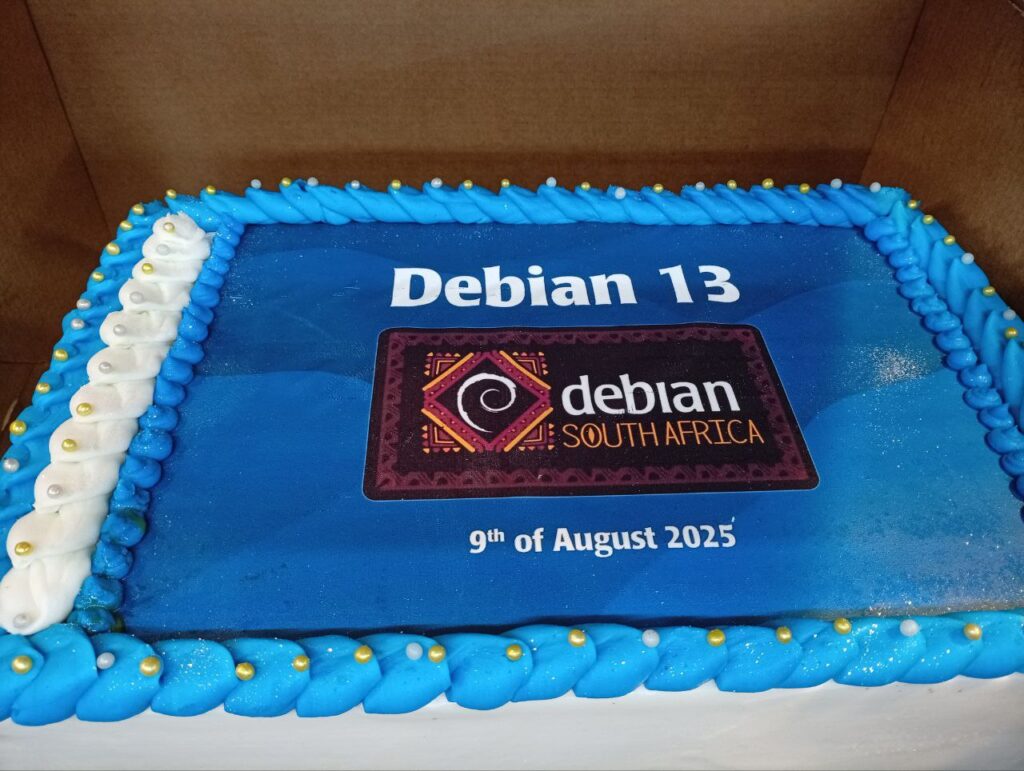
Debian 13 trixie release, by Emilio Pozuelo Monfort On August 9th, Debian 13 trixie was released, building on two years worth of updates and bug fixes from hundreds of developers. Emilio helped coordinate the release, communicating with several teams involved in the process.

DebConf 26 Site Visit, by Stefano Rivera Stefano visited Santa Fe, Argentina, the site for DebConf 26 next year. The aim of the visit was to help build a local team and see the conference venue first-hand. Stefano and Nattie represented the DebConf Committee. The local team organized Debian meetups in Buenos Aires and Santa Fe, where Stefano presented a talk on Debian and DebConf. Venues were scouted and the team met with the university management and local authorities.

Miscellaneous contributions
  • Rapha l updated tracker.debian.org after the trixie release to add the new forky release in the set of monitored distributions. He also reviewed and deployed the work of Scott Talbert showing open merge requests from salsa in the action needed panel.
  • Rapha l reviewed some DEP-3 changes to modernize the embedded examples in light of the broad git adoption.
  • Rapha l configured new workflows on debusine.debian.net to upload to trixie and trixie-security, and officially announced the service on debian-devel-announce, inviting Debian developers to try the service for their next upload to unstable.
  • Carles created a merge request for django-compressor upstream to fix an error when concurrent node processing happened. This will allow removing a workaround added in openstack-dashboard and avoid the same bug in other projects that use django-compressor.
  • Carles prepared a system to detect packages that Recommends packages which don t exist in unstable. Processed (either reported or ignored due to mis-detected problems or temporary problems) 16% of the reports. Will continue next month.
  • Carles got familiar and gave feedback for the freedict-wikdict package. Planned contributions with the maintainer to improve the package.
  • Helmut responded to queries related to /usr-move.
  • Helmut adapted crossqa.d.n to the release of trixie .
  • Helmut diagnosed sufficient failures in rebootstrap to make it work with gcc-15.
  • Helmut fixed the CI pipeline of debvm.
  • Helmut sent patches for 19 cross build problems.
  • Faidon discovered that the Multi-Arch hinter would emit confusing hints about :any annotations. Helmut identified the root cause to be the handling of virtual packages and fixed it.
  • Enrico took some dust off python-debiancontributors and prototyped a receiving end for salsa webpings, to start followup work to contributors.debian.org discussions at DebConf25.
  • Colin upgraded about 70 Python packages to new upstream versions, which is around 10% of the backlog; this included a complicated Pydantic upgrade in collaboration with the Rust team.
  • Colin fixed a bug in debbugs that caused incoming emails to bugs.debian.org with certain header contents to go missing.
  • Thorsten uploaded sane-airscan, which was already in experimental, to unstable.
  • Thorsten created a script to automate the upload of new upstream versions of foomatic-db. The database contains information about printers and regularly gets an update. Now it is possible to keep the package more up to date in Debian.
  • Stefano prepared updates to almost all of his packages that had new versions waiting to upload to unstable. (beautifulsoup4, hatch-vcs, mkdocs-macros-plugin, pypy3, python-authlib, python-cffi, python-mitogen, python-pip, python-pipx, python-progress, python-truststore, python-virtualenv, re2, snowball, soupsieve).
  • Stefano uploaded two new python3.13 point releases to unstable.
  • Stefano updated distro-info-data in stable releases, to document the trixie release and expected EoL dates.
  • Stefano did some debian.social sysadmin work (keeping up quotas with growing databases and filesystems).
  • Stefano supported the Debian treasurers in processing some of the DebConf 25 reimbursements.
  • Lucas uploaded ruby3.4 to experimental. It was already approved by FTP masters.
  • Lucas uploaded ruby-defaults to experimental to add support for ruby3.4. It will allow us to start triggering test rebuilds and catch any FTBFS with ruby3.4.
  • Lucas did some administrative work for Google Summer of Code (GSoC) and replied to some queries from mentors and students.
  • Anupa helped to organize release parties for Debian 13 and Debian Day events.
  • Anupa did the live coverage for the Debian 13 release and prepared the Bits post for the release announcement and 32nd Debian Day as part of the Debian Publicity team.
  • Anupa attended a Debian Day event organized by FOSS club SSET as a speaker.

9 September 2025

Dirk Eddelbuettel: RcppSMC 0.2.9 on CRAN: Maintenance

Release 0.2.9 of our RcppSMC package arrived at CRAN today. RcppSMC provides Rcpp-based bindings to R for the Sequential Monte Carlo Template Classes (SMCTC) by Adam Johansen described in his JSS article. Sequential Monte Carlo is also referred to as Particle Filter in some contexts. The package now also features the Google Summer of Code work by Leah South in 2017, and by Ilya Zarubin in 2021. This release is again entirely internal. It updates the code for the just-released RcppArmadillo 15.0.2-1, in particular opts into Armadillo 15.0.2. And it makes one small tweak to the continuous integration setup switching to the r-ci action. The release is summarized below.

Changes in RcppSMC version 0.2.9 (2025-09-09)
  • Adjust to RcppArmadillo 15.0.* by setting ARMA_USE_CURRENT and updating two expressions from deprecated code
  • Rely on r-ci GitHub Action which includes the bootstrap step

Courtesy of my CRANberries, there is also a diffstat report detailing changes. More information is on the RcppSMC page and the repo. Issues and bugreports should go to the GitHub issue tracker.

This post by Dirk Eddelbuettel originated on his Thinking inside the box blog. If you like this or other open-source work I do, you can sponsor me at GitHub.

John Goerzen: btrfs on a Raspberry Pi

I m something of a filesystem geek, I guess. I first wrote about ZFS on Linux 14 years ago, and even before I used ZFS, I had used ext2/3/4, jfs, reiserfs, xfs, and no doubt some others. I ve also used btrfs. I last posted about it in 2014, when I noted it has some advantages over ZFS, but also some drawbacks, including a lot of kernel panics. Since that comparison, ZFS has gained trim support and btrfs has stabilized. The btrfs status page gives you an accurate idea of what is good to use on btrfs. Background: Moving towards ZFS and btrfs I have been trying to move everything away from ext4 and onto either ZFS or btrfs. There are generally several reasons for that:
  1. The checksums for every block help detect potential silent data corruption
  2. Instant snapshots make consistent backups of live systems a lot easier, and without the hassle and wasted space of LVM snapshots
  3. Transparent compression and dedup can save a lot of space in storage-constrained environments
For any machine with at least 32GB of RAM (plus my backup server, which has only 8GB), I run ZFS. While it lacks some of the flexibility of btrfs, it has polish. zfs list -o space shows a useful space accounting. zvols can be behind VMs. With my project simplesnap, I can easily send hourly backups with ZFS, and I choose to send them over NNCP in most cases. I have a few VMs in the cloud (running Debian, of course) that I use to host things like this blog, my website, my gopher site, the quux NNCP public relay, and various other things. In these environments, storage space can be expensive. For that matter, so can RAM. ZFS is RAM-hungry, so that rules out ZFS. I ve been running btrfs in those environments for a few years now, and it s worked out well. I do async dedup, lzo or zstd compression depending on the needs, and the occasional balance and defrag. Filesystems on the Raspberry Pi I run Debian trixie on all my Raspberry Pis; not Raspbian or Raspberry Pi OS for a number of reasons. My 8-yr-old uses a Raspberry Pi 400 as her primary computer and loves it! She doesn t do web browsing, but plays Tuxpaint, some old DOS games like Math Blaster via dosbox, and uses Thunderbird for a locked-down email account. But it was SLOW. Just really, glacially, slow, especially for Thunderbird. My first step to address that was to get a faster MicroSD card to hold the OS. That was a dramatic improvement. It s still slow, but a lot faster. Then, I thought, maybe I could use btrfs with LZO compression to reduce the amount of I/O and speed things up further? Analysis showed things were mostly slow due to I/O, not CPU, constraints. The conversion Rather than use the btrfs in-place conversion from ext4, I opted to dar it up (like tar), run mkfs.btrfs on the SD card, then unpack the archive back onto it. Easy enough, right? Well, not so fast. The MicroSD card is 128GB, and the entire filesystem is 6.2GB. But after unpacking 100MB onto it, I got an out of space error. btrfs has this notion of block groups. By default, each block group is dedicated to either data or metadata. btrfs fi df and btrfs fi usage will show you details about the block groups. btrfs allocates block groups greedily (the ssd_spread mount option I use may have exacerbated this). What happened was it allocated almost the entire drive to data block groups, trying to spread the data across it. It so happened that dar archived some larger files first (maybe /boot), so btrfs was allocating data and metadata blockgroups assuming few large files. But then it started unpacking one of the directories in /usr with lots of small files (maybe /usr/share/locale). It quickly filled up the metadata block group, and since the entire SD card had been allocated to different block groups, I got ENOSPC. Deleting a few files and running btrfs balance resolved it; now it allocated 1GB to metadata, which was plenty. I re-ran the dar extract and now everything was fine. See more details on btrfs balance and block groups. This was the only btrfs problem I encountered. Benchmarks I timed two things prior to switching to btrfs: how long it takes to boot (measured from the moment I turn on the power until the moment the XFCE login box is displayed), and how long it takes to start Thunderbird. After switching to btrfs with LZO compression, somewhat to my surprise, both measures were exactly the same! Why might this be? It turns out that SD cards are understood to be pathologically bad with random read performance. Boot and Thunderbird both are likely doing a lot of small random reads, not large streaming reads. Therefore, it may be that even though I have reduced the total I/O needed, the impact is unsubstantial because the real bottleneck is the seeks across the disk. Still, I gain the better backup support and silent data corruption prevention, so I kept btrfs. SSD mount options and MicroSD endurance btrfs has several mount options specifically relevant to SSDs. Aside from the obvious trim support, they are ssd and ssd_spread. The documentation on this is vague and my attempts to learn more about it found a lot of information that was outdated or unsubstantiated folklore. Some reports suggest that older SSDs will benefit from ssd_spread, but that it may have no effect or even a harmful effect on newer ones, and can at times cause fragmentation or write amplification. I could find nothing to back this up, though. And it seems particularly difficult to figure out what kind of wear leveling SSD firmware does. MicroSD firmware is likely to be on the less-advanced side, but still, I have no idea what it might do. In any case, with btrfs not updating blocks in-place, it should be better than ext4 in the most naive case (no wear leveling at all) but may have somewhat more write traffic for the pathological worst case (frequent updates of small portions of large files). One anecdotal report I read and can t find anymore, somehow was from a person that had set up a sort of torture test for SD cards, with reports that ext4 lasted a few weeks or months before the MicroSDs failed, while btrfs lasted years. If you are looking for a MicroSD card, by the way, The Great MicroSD Card Survey is a nice place to start. For longevity: I mount all my filesystems with noatime already, so I continue to recommend that. You can also consider limiting the log size in /etc/systemd/journald.conf, running daily fstrim (which may be more successful than live trims in all filesystems). Conclusion I ve been pretty pleased with btrfs. The concerns I have today relate to block groups and maintenance (periodic balance and maybe a periodic defrag). I m not sure I d be ready to say put btrfs on the computer you send to someone that isn t Linux-savvy because the chances of running into issues are higher than with ext4. Still, for people that have some tech savvy, btrfs can improve reliability and performance in other ways.

6 September 2025

John Goerzen: Dreams of Late Summer

Here on a summer night in the grass and lilac smell
Drunk on the crickets and the starry sky,
Oh what fine stories we could tell
With this moonlight to tell them by. A summer night, and you, and paradise,
So lovely and so filled with grace,
Above your head, the universe has hung its lights,
And I reach out my hand and touch your face.
I sit outside today, at the picnic table on our side porch. I was called out here; in late summer, the cicadas and insects of the plains are so loud that I can hear them from inside our old farmhouse. I sit and hear the call and response of buzzing cicadas, the chirp of crickets during their intermission. The wind rustles off and on through the treetops. And now our old cat has heard me, and she comes over, spreading tan cat hair across my screen. But I don t mind; I hear her purr as she comes over to relax nearby. Aside from the gentle clack of my keyboard as I type, I hear no sounds of humans. Occasionally I hear the distant drone of a small piston airplane, and sometimes the faint horn of a train, 6 miles away. As I look up, I see grass, the harvested wheat field, the trees, and our gravel driveway. Our road is on the other side of a hill. I see no evidence of it from here, but I know it s there. Maybe 2 or 3 vehicles will pass on a day like today; if they re tall delivery trucks, I ll see their roof glide silently down the road, and know the road is there. The nearest paved road is several miles away, so not much comes out here. I reflect of those times years ago, when this was grandpa s house, and the family would gather on Easter. Grandpa hid not just Easter eggs, but Easter bags all over the yard. This yard. Here s the tree that had a nice V-shaped spot to hide things in; there s the other hiding spot. I reflect on the wildlife. This afternoon, it s the insects that I hear. On a foggy, cool, damp morning, the birds will be singing from all the trees, the fog enveloping me with unseen musical joy. On a quiet evening, the crickets chirp and the coyotes howl in the distance. Now the old cat has found my lap. She sits there purring, tail swishing. 12 years ago when she was a kitten, our daughter hadn t yet been born. She is old and limps, and is blind in one eye, but beloved by all. Perfectly content with life, she stretches and relaxes. I have visited many wonderful cities in this world. I ve seen Aida at the Metropolitan Opera, taken trains all over Europe, wandered the streets of San Francisco and Brussels and Lindos, visited the Christmas markets in the lightly-snowy evenings in Regensburg, felt the rumble of the Underground beneath me in London. But rarely do the city people come here. Oh, some of them think they ve visited the country. But no, my friends, no; if you don t venture beyond the blacktop roads, you ve not experienced it yet. You ve not gone to a restaurant in town , recognized by several old friends. You ve not stopped by the mechanic the third generation of that family fixing cars that belong to yours who more often than not tells you that you don t need to fix that something just yet. You ve not sat outside, in this land where regular people each live in their own quiet Central Park. You ve not seen the sunset, with is majestic reds and oranges and purples and blues and grays, stretching across the giant iMax dome of the troposphere, suspended above the hills and trees to the west. You ve not visited the grocery store, with your car unlocked and keys in the ignition, unconcerned about vehicle theft. You ve not struggled with words when someone asks what city are you from and you lack the vocabulary to help them understand what it means when you say none . Out there in the land of paved roads and bright lights, the problems of the world churn. The problems near and far: a physical and mental health challenges with people we know, global problems with politics and climate. But here, this lazy summer afternoon, I forget about the land of the paved roads and bright lights. As it should be; they ve forgotten the land of the buzzing cicadas and muddy roads.
I believe in impulse, in all that is green,
In the foolish vision that comes out true.
I believe that all that is essential is unseen,
And for this lifetime, I believe in you. All of the lovers and the love they made:
Nothing that was between them was a mistake.
All that we did for love s sake,
Was not wasted and will never fade. All who have loved will be forever young
And walk in grandeur on a summer night
Along the avenue. They live in every song that is sung,
In every painting of pure light,
In every pas de deux. O love that shines from every star,
Love reflected in the silver moon;
It is not here, but it is not far.
Not yet, but it will be here soon.
No two days are alike. But this day comes whenever I pause to let it. May you find the buzzing cicadas and muddy roads near you, wherever you may be. Poetry from A Summer Night by Garrison Keillor

Antonio Terceiro: autopkgtest support in Debian: a more optimistic view

Yesterday I posted about the history, in numbers, of the support for autopkgtest in the Debian archive. I had analyzed the presence of a Testsuite: field in source packages, from wheezy to trixie, and noticed a slowdown in the growth rate of autopkgtest support, in proportional terms. In each new release, the percentage of packages declaring a test suite grew less than in the previous release, for the last 4 releases. A night of sleep and a rainy morning later, I come back with a more optimistic view, and present to you the following data, expanded from the raw data:
Release year Release Yes No Total Yes No Total
2013 wheezy 5 17170 17175 -- -- --
2015 jessie 1112 19484 20596 1107 2314 3421
2017 stretch 5110 19735 24845 3998 251 4249
2019 buster 9966 18535 28501 4856 -1200 3656
2021 bullseye 13949 16994 30943 3983 -1541 2442
2023 bookworm 17868 16473 34341 3919 -521 3398
2025 trixie 21527 16143 37670 3659 -330 3329
A few observations: All in all, I think this data show that Debian maintainers recognize the usefulness of automated testing and are engaged in improving our QA process.

2 September 2025

Debian Outreach Team: Spaarsh Gsoc Report

layout: post title: GSoC 2025 Report: Enhancing Debian packages with ROCm GPU acceleration date: 2025-09-01 categories: gsoc debian ROCm debian-packaging author: Spaarsh Thakkar

GitLab Salsa: @Spaarsh

GitHub: Spaarsh

Introduction I am Spaarsh Thakkar, a final-year Computer Science Engineering undergrad from India. My interests lie in research and systems. My recent work has been in and around Graphics Processing Units and I also hold a keen interest in Computer Networks. At the time of writing, I have been an open-source contributor for almost a year.

Proposal Description (as shown on GSoC Project Profile1) Due to Debian s open-source nature, no Debian package in main can have a proprietary GPU package listed as a dependency. While AI and HPC workloads increasingly rely on GPU acceleration, many Debian packages still focus solely on CUDA, which is proprietary. With the advent of ROCm, an open-source GPU computing platform, we can now integrate full-fledged AMD GPU support into Debian packages. This will improve the experience of developers working in AI/ML and HPC while positioning Debian as a strong OS choice for GPU-driven workloads. The proposal aims to aid in solving the aforementioned program by packaging several ROCm packages for debian and add ROCm support to some existing debian packages. The deliverables are as follows:
  1. New Debian packages with GPU support
  2. Enhanced GPU support within existing Debian packages
  3. More autopackagetests running on the Debian ROCm CI

Key Objectives Enable ROCm in:
  1. dbcsr
  2. gloo
  3. cp2k
Publish the following packages to debian apt archive:
  1. hipblas-common
  2. hipBLASlt

Work Report

1. Publishing hipblas-common to apt This objective was successfully completed, resulting in hipblas-common being published in the apt repository2. The process involved the following steps:
  1. Filing a Intent-To-Package (ITP)3
  2. Pulling the upstream source code repository from GitHub
  3. Adding the debian/ packaging files
  4. Testing the package locally
  5. Creating the corresponding project under rocm-team4
  6. Applying the necessary changes
  7. Building the package
  8. Testing it using sbuild
  9. Signing the package files
  10. Uploading the package to the mentors.debian.net archive(now in official archive)5
  11. Addressing review feedback and making changes
  12. Requesting sponsorship6
  13. Securing sponsorship, which led to the package being accepted into the experimental branch of apt
Since the beginning of GSoC, the package has also been promoted to the unstable branch2.

2. DBCSR ROCm and Multi-Arch Support During my GSoC project, I worked on extending the DBCSR (Distributed Block Compressed Sparse Row)7 package to improve its ROCm/HIP support, and handling multi-architecture GPU kernels in a way that is both practical for upstream maintainers and debian package developers. The code changes can be found at my dbcsr fork here8.

ROCm/HIP Enablement
  • Enabled ROCm backend support to DBCSR, allowing GPU acceleration beyond CUDA by enabling HIP-based builds.
  • Investigated and resolved build issues specific to HIP kernels within DBCSR.

Multi-Architecture GPU Kernel Handling (The following content was presented in greater detail at DebConf 25 as well. The presentation video can be found here9 and the presentation slide can be found here10).
  • DBCSR contains GPU kernels that are heavily optimized for specific architectures. By default, these are built for a single target architecture, which poses challenges for packaging where binaries need to support multiple possible GPU targets.
  • Explored different strategies for solving the multi-arch GPU kernel distribution problem, including:
    • Option 1: Fat binaries (embedding multiple GPU architectures into a single binary, with runtime dispatch). This is ideal for end-users but requires deeper changes upstream and is not straightforward with HIP/ROCm.
    • Option 2: Arch-specific libraries (e.g., libdbcsr.gfxXXX.a), where the alternatives system or explicit user selection would determine which one is used. This solves the problem but pushes complexity downstream into packaging and user configuration.
    • Option 3: Prefixed functions inside a single file, where kernels are compiled separately per architecture, functions are renamed with an arch prefix, and runtime logic in DBCSR decides which kernel to invoke. This shifts complexity upstream but could give a clean downstream experience.
  • I critically analyzed these options in the context of Debian packaging and upstream maintainability. Arch-specific .a files introduce exponential dependency complexity. The prefixed-function approach seemed like a plausible way forward, though it requires upstream buy-in.
  • After consulting with my mentor, these concerns were raised in the dbcsr repository as a discussion here11

Summary My work involved:
  • Enabling HIP/ROCm support in DBCSR.
  • Prototyping strategies for handling GPU multi-arch builds.
  • Evaluating the trade-offs between upstream maintainability and downstream packaging complexity.

3. gloo, hipification and source code issues One of the other packages that were targeted was gloo12. It is a collective communications library and has the implementations of different Machine Learning communication algorithms. The code changes can be found at my gloo fork here13 (some changes have not be committed at the time of writing).

HIP/ROCm Enablement
  1. Fixing old ROCm CMake functions The upstream Gloo codebase still used old ROCm CMake functions that began with the hip_ prefix (for example, hip_add_executable). These functions have since been deprecated/removed. I updated the build system to use the modern ROCm CMake equivalents so that the package can build properly in a current ROCm environment.
  2. Debian packaging changes I modified debian/control to add a new package, libgloo-rocm, in addition to the existing packages. This allows proper separation and handling of ROCm-enabled builds in Debian.
  3. First successful library build After these changes, I was able to successfully build the library. However, I ran into issues when trying to produce the shared library: there were undefined symbol errors at link time.

Source Code Issue On investigating the undefined symbol errors, I identified that these came from a lack of explicit template instantiation for some Gloo classes. Since C++ templates only get compiled when explicitly used or instantiated, this resulted in missing symbols in the shared library. To solve this, I explored the source code and noticed that the HIP backend code was not natively written it was generated from the CUDA backend using a custom hipification script maintained by the repo.
  • I experimented with modifying the HIPification process itself, trying out hipify-perl14 instead of the repository s custom Python script.
  • I also tried tweaking the source code in places where template instantiations were missing, so that the ROCm build would correctly export the needed symbols.

Summary The issue is still unresolved. The core problem lies in how the source code is structured: the HIP backend is almost entirely auto-generated from CUDA code, and the process does not handle template instantiations correctly. Because of this, the Debian package for Gloo with ROCm support is not yet ready for release, and further source-level fixes are required to make the ROCm build reliable.

4. cp2k CP2K15 is a quantum chemistry and solid state physics software package that can perform atomistic simulations of solid state, liquid, molecular, periodic, material, crystal, and biological systems.

HIP/ROCm Enablement cp2k depends on dbcsr and hence, HIP/ROCm enablement in this package required the dbcsr16 package to get through. Even though dbcsr isn t ready yet, it was worthwhile to plan how it shall be built with HIP/ROCm once we have dbcsr in place. Upon doing this, it was realized that the architecture-wise libraries provided by the dbcsr package will result in a complicated building process for cp2k. No changes have been made to this package yet and more concrete steps shall be taken once the dbcsr package work is completed.

Summary The multi-arch build process for cp2k maybe complicated by the one static-library-per-architecture method used in the dependent package, dbcsr.

Auxiliary Work & Activities While working on the aformentioned GSoC Goals, there were a few other things that were also done.
  1. libamdhip64-dev bug file17 While trying to enable HIP/ROCm in dbcsr, CMakeDetermineHIPCompiler.cmake was unable to find HIP runtime CMake package. After going through some similar issues faced by other developers earlier, it was decided to file a bug report under the libamdhip64-dev package. After discussions with and trying the changes suggested by Cory (my mentor) under the bug, the issue was resolved. Turns out, the wrong compiler was being used by me! The gcc compiler was supposed to be used and I was using hipcc. The bug was closed since it was not due an issue with the package. Cory suggested that I add this info under the ROCm wiki page. It is yet to be done and hopefully I get it done soon.
  2. DebConf25 Talk After facing the multi-arch build dilemma with dbcsr (and also getting to know about the issues faced by other fellow package developers), I came to realise that this was more than a packaging, build or programming issue. GPU-packaging was facing a policy issue. Hence, I decided to cover this problem in greater detail at my DebConf25 Virtual Presentation under the Outreach Session. Shoutout to Cory for his support and Lucas Kanashiro for encouraging me to present my work!
  3. Bi-Weekly AMD ROCm Meetings Shortly after the Coding period started, Cory began the initiative of Bi-Weekly AMD ROCm Meetings18. Being a part of the meetings (participated in all but one!), seeing the work the other folks are doing and being able to discuss my own problems was a delight.
  4. (Upcoming) IndiaFOSS 2025 Talk After understanding the nuances and beauty of the debian packaging ecosystem in these months, I decided to spread the work about debian packaging and packaging software in general. My talk19 for the same got accepted in the upcoming IndiaFOSS 202520 conference! I hope this beings more people towards the packaging ecosystem and to the debian developer ecosystem.

Conclusion My GSoC time was fantastic! I plan to complete the work that I have started during my GSoC and beyond. Working with Cory21 and Utkarsh22 (a fellow GSoC 25 contributor under Cory) has been a very positive experience. HIP/ROCm GPU-packaging is in a nascent stage. It is an exciting time to be in this space right now. The problems are new and never encountered before (CPU packaging isn t architecture specific!). The problems were shall face in the coming time, and our solutions to them will set a precendent for the future.

References 1 : https://summerofcode.withgoogle.com/programs/2025/projects/9s4jUjV0 2 : https://tracker.debian.org/pkg/hipblas-common 3 : https://bugs.debian.org/cgi-bin/bugreport.cgi?bug=1105114 4 : https://salsa.debian.org/rocm-team 5 : https://packages.debian.org/source/sid/hipblas-common 6 : https://lists.debian.org/debian-ai/2025/05/msg00088.html 7 : https://www.cp2k.org/dbcsr 8 : https://salsa.debian.org/Spaarsh/dbcsr/ 9 : https://drive.google.com/file/d/14WQuTMcI-L0lbi3zkUc9pT6RGwwVY0j1/view?usp=sharing 10 : https://docs.google.com/presentation/d/1p-nkHPgg5C5jKGy7ySZ8rts5G2vNFQpQJQ8UySOWgVE 11 : https://github.com/cp2k/dbcsr/discussions/933 12 : https://github.com/pytorch/gloo 13 : https://salsa.debian.org/Spaarsh/gloo 14 : https://tracker.debian.org/pkg/hipify 15 : https://www.cp2k.org/ 16 : https://tracker.debian.org/pkg/dbcsr 17 : https://bugs.debian.org/cgi-bin/bugreport.cgi?https://fossunited.org/indiafoss/2025bug=1108159 18 : https://lists.debian.org/debian-ai/2025/05/msg00113.html 19 : https://fossunited.org/c/indiafoss/2025/cfp/dpq0b26ece 20 : https://fossunited.org/indiafoss/2025 21 : https://salsa.debian.org/cgmb 22 : https://salsa.debian.org/utk4r-sh

31 August 2025

Otto Kek l inen: Managing procrastination and distractions

Featured image of post Managing procrastination and distractionsI ve noticed that procrastination and inability to be consistently productive at work has become quite common in recent years. This is clearly visible in younger people who have grown up with an endless stream of entertainment literally at their fingertips, on their mobile phone. It is however a trap one can escape from with a little bit of help. Procrastination is natural they say humans are lazy by nature after all. Probably all of us have had moments when we choose to postpone a task we know we should be working on, and instead spent our time doing secondary tasks (valorisation). Classic example is cleaning your apartment when you should be preparing for an exam. Some may procrastinate by not doing any work at all, and just watching YouTube videos or the like. To some people, typically those who are in their 20s and early in their career, procrastination can be a big challenge and finding the discipline to stick to planned work may need intentional extra effort, and perhaps even external help. During my 20+ year career in software development I ve been blessed to work with engineers of various backgrounds and each with their unique set of strengths. I have also helped many grow in various areas and overcome challenges, such as lack of intrinsic motivation and managing procrastination, and some might be able to get it in check with some simple advice.
Distance yourself from the digital distractions The key to avoiding distractions and procrastination is to make it inconvenient enough that you rarely do it. If continuing to do work is easier than switching to procrastination, work is more likely to continue. Tips to minimize digital distractions, listed in order of importance:
  1. Put your phone away. Just like when you go to a movie and turn off your phone for two hours, you can put the phone away completely when starting to work. Put the phone in a different room to ensure there is enough physical distance between you and the distraction, so it is impossible for you to just take a quick peek .
  2. Turn off notifications from apps. Don t let the apps call you like sirens luring Odysseus. You don t need to have all the notifications. You will see what the apps have when you eventually open them at a time you choose to use them.
  3. Remove or disable social media apps, games and the like from your phone and your computer. You can install them back when you have vacation. You can probably live without them for some time. If you can t remove them, explore your phone s screen time restriction features to limit your own access to apps that most often waste your time. These features are sometimes listed in the phone settings under digital health .
  4. Have a separate work computer and work phone. Having dedicated ones just for work that are void of all unnecessary temptations helps keep distance from the devices that could derail your focus.
  5. Listen to music. If you feel your brain needs a dose of dopamine to get you going, listening to music helps satisfy your brain s cravings while still being able to simultaneously keep working.
Doing a full digital detox is probably not practical, or not sustainable for an extended time. One needs apps to stay in touch with friends and family, and staying current in software development probably requires spending some time reading news online and such. However the tips above can help contain the distractions and minimize the spontaneous attention the distractions get. Some of the distractions may ironically be from the work itself, for example Slack notifications or new email notifications. I recommend turning them off for a couple of hours every day to have some distraction free time. It should be enough to check work mail a couple times a day. Checking them every hour probably does not add much overall value for the company unless your work is in sales or support where the main task itself is responding to emails.

Distraction free work environment Following the same principle of distancing yourself from distractions, try to use a dedicated physical space for working. If you don t have a spare room to dedicate to work, use a neighborhood caf or sign up for a local co-working space or start commuting to the company office to find a space to be focused on work in.

Break down tasks into smaller steps Sometimes people postpone tasks because they feel intimidated by the size or complexity of a task. In particular in software engineering problems may be vague and appear large until one reaches the breakthrough that brings the vision of how to tackle it. Breaking down problems into smaller more manageable pieces has many advantages in software engineering. Not only can it help with task-avoidance, but it can also make the problem easier to analyze, suggest solutions and test them and build a solid foundation to expand upon to ultimately later reach a full solution on the entire larger problem. Working on big problems as a chain of smaller tasks may also offer more opportunities to celebrate success on completing each subtask and help getting in a suitable cadence of solving a single thing, taking a break and then tackling the next issue. Breaking down a task into concrete steps may also help with getting more realistic time estimations. Sometimes procrastination isn t real someone could just be overly ambitious and feel bad about themselves for not doing an unrealistic amount of work.

Intrinsic motivation Of course, you should follow your passion when possible. Strive to pick a career that you enjoy, and thus maximize the intrinsic motivation you experience. However, even a dream job is still a job. Nobody is ever paid to do whatever they want. Any work will include at least some tasks that feel like a chore or otherwise like something you would not do unless paid to. Some would say that the definition of work itself is having to do things one would otherwise not do. You can only fully do whatever you want while on vacation or when you choose to not have a job at all. But if you have a job, you simply need to find the intrinsic motivation to do it. Simply put, some tasks are just unpleasant or boring. Our natural inclination is to avoid them in favor of more enjoyable activities. For these situations we just have to find the discipline to force ourselves to do the tasks and figuratively speaking whip ourselves into being motivated to complete the tasks.

Extrinsic motivation As the name implies, this is something people external to you need to provide, such as your employer or manager. If you have challenges in managing yourself and delivering results on a regular basis, somebody else needs to set goals and deadlines and keep you accountable for them. At the end of the day this means that eventually you will stop receiving salary or other payments unless you did your job. Forcing people to do something isn t nice, but eventually it needs to be done. It would not be fair for an employer to pay those who did their work the same salary as those who procrastinated and fell short on their tasks. If you work solo, you can also simulate the extrinsic motivation by publicly announcing milestones and deadlines to build up pressure for yourself to meet them and avoid publicly humiliation. It is a well-studied and scientifically proven phenomenon that most university students procrastinate at the start of assignments, and truly start working on them only once the deadline is imminent.

External help for addictions If procrastination is mainly due to a single distraction that is always on your mind, it may be a sign of an addiction. For example, constantly thinking about a computer game or staying up late playing a computer game, to the extent that it seriously affects your ability to work, may be a symptom of an addiction, and getting out of it may be easier with external help.
Discipline and structure Most of the time procrastination is not due to an addiction, but simply due to lack of self-discipline and structure. The good thing is that those things can be learned. It is mostly a matter of getting into new habits, which most young software engineers pick up more or less automatically while working along the more senior ones. Hopefully these tips can help you stay on track and ensure you do everything you are expected to do with clear focus, and on time!

29 August 2025

Ravi Dwivedi: Installing Debian With Btrfs and Encryption

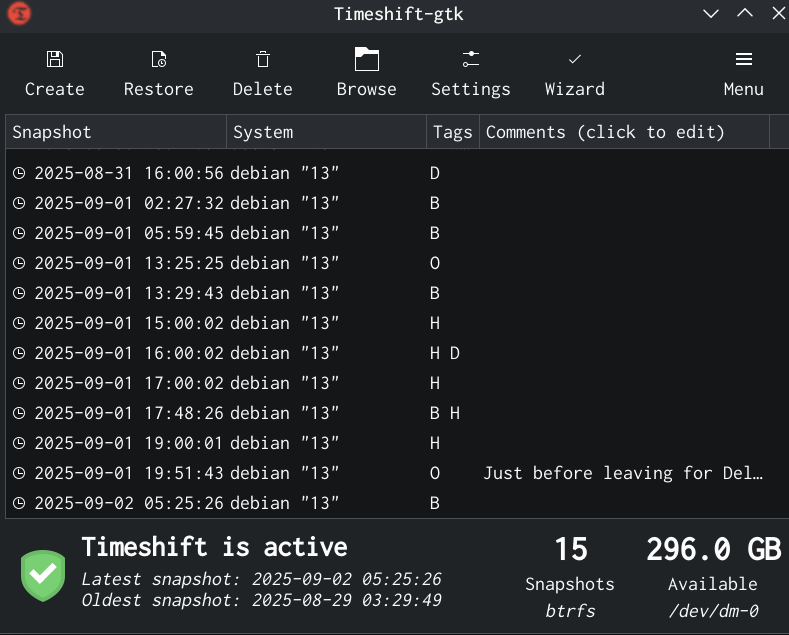
Motivation On the 8th of August 2025 (a day before the Debian Trixie release), I was upgrading my personal laptop from Debian Bookworm to Trixie. It was a major update. However, the update didn t go smoothly, and I ran into some errors. From the Debian support IRC channel, I got to know that it would be best if I removed the texlive packages. However, it was not so easy to just remove texlive with a simple apt remove command. I had to remove the texlive packages from /usr/bin. Then I ran into other errors. Hours after I started the upgrade, I realized I preferred having my system as it was before, as I had to travel to Noida the next day. Needless to say, I wanted to go to sleep rather than fix my broken system. Only if I had a way to go back to my system before I started upgrading, it would have saved a lot of trouble for me. I ended up installing Trixie from scratch. It turns out that there was a way to recover to the state before the upgrade - using Timeshift to roll back the system to a state (in our example, it is the state before the upgrade process started) in the past. However, it needs the Btrfs filesystem with appropriate subvolumes, not provided by Debian installer in their guided partitioning menu. I have set it up after a few weeks of the above-mentioned incident. Let me demonstrate how it works.
Check the screenshot above. It shows a list of snapshots made by Timeshift. Some of them were made by me manually. Others were made by Timeshift automatically as per the routine - I have set up hourly backups and weekly backups etc. In the above-mentioned major update, I could have just taken a snapshot using Timeshift before performing the upgrade and could have rolled back to that snapshot when I found that I cannot spend more time on fixing my installation errors. Then I could just perform the upgrade later.

Installation In this tutorial, I will cover how I installed Debian with Btrfs and disk encryption, along with creating subvolumes @ for root and @home for /home so that I can use Timeshift to create snapshots. These snapshots are kept on the same disk where Debian is installed, and the use-case is to roll back to a working system in case I mess up something or to recover an accidentally deleted file. I went through countless tutorials on the Internet, but I didn t find a single tutorial covering both the disk encryption and the above-mentioned subvolumes (on Debian). Debian doesn t create the desired subvolumes by default, therefore the process requires some manual steps, which beginners may not be comfortable performing. Beginners can try distros such as Fedora and Linux Mint, as their installation includes Btrfs with the required subvolumes. Furthermore, it is pertinent to note that I used Debian Trixie s DVD iso on a real laptop (not a virtual machine) for my installation. Debian Trixie is the codename for the current stable version of Debian. Then I took screenshots in a virtual machine by repeating the process. Moreover, a couple of screenshots are from the installation I did on the real laptop. Let s start the tutorial by booting up the Debian installer.

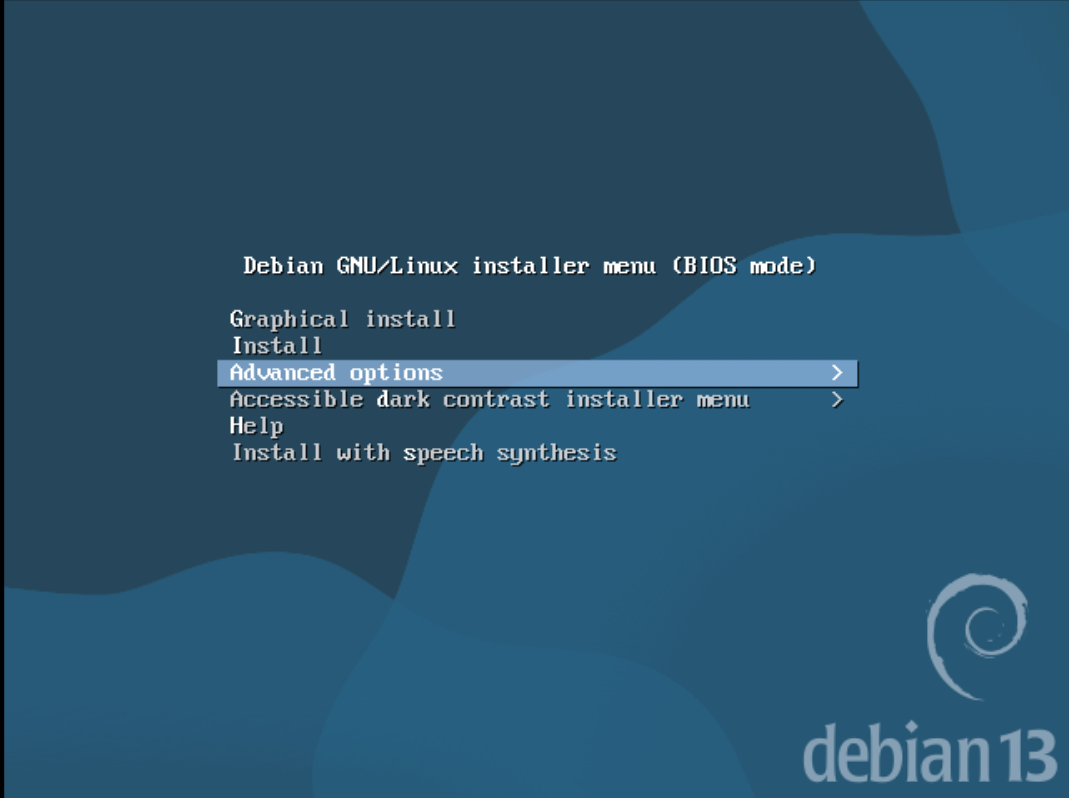
The above screenshot shows the first screen we see on the installer. Since we want to choose Expert Install, we select Advanced Options in the screenshot above.
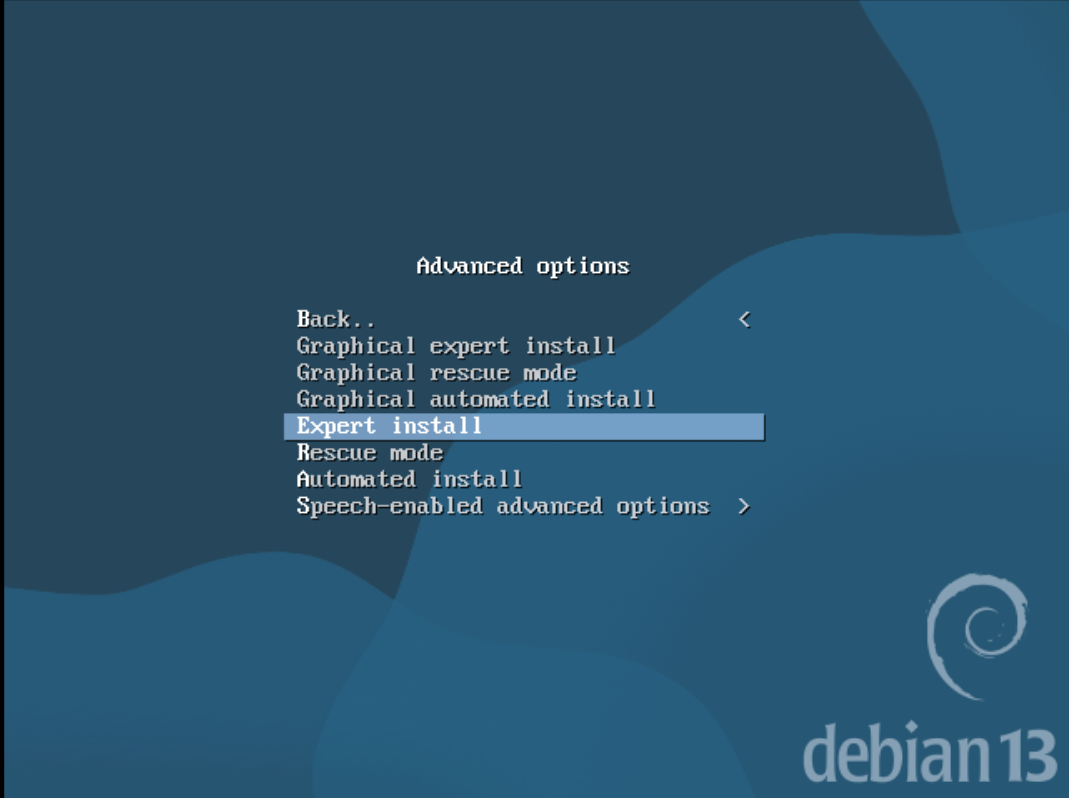
Let s select the Expert Install option in the above screenshot. It is because we want to create subvolumes after the installer is done with the partition, and only then proceed to installing the base system. Non-expert install modes proceed directly to installing the system right after creating partitions without pausing for us to create the subvolumes.
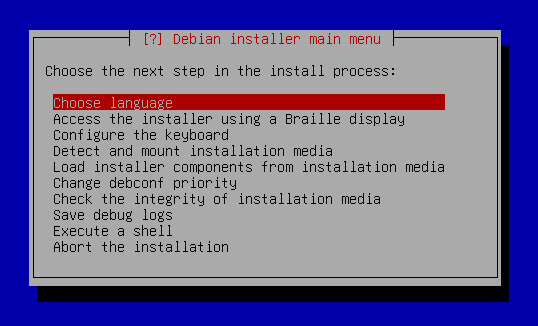
After selecting the Expert Install option, you will get the screen above. I will skip to partitioning from here and leave the intermediate steps such as choosing language, region, connecting to Wi-Fi, etc. For your reference, I did create the root user.
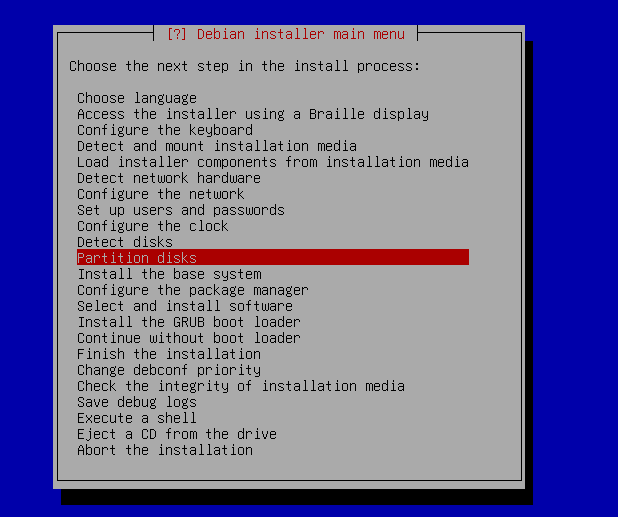
Let s jump right to the partitioning step. Select the Partition disks option from the menu as shown above.
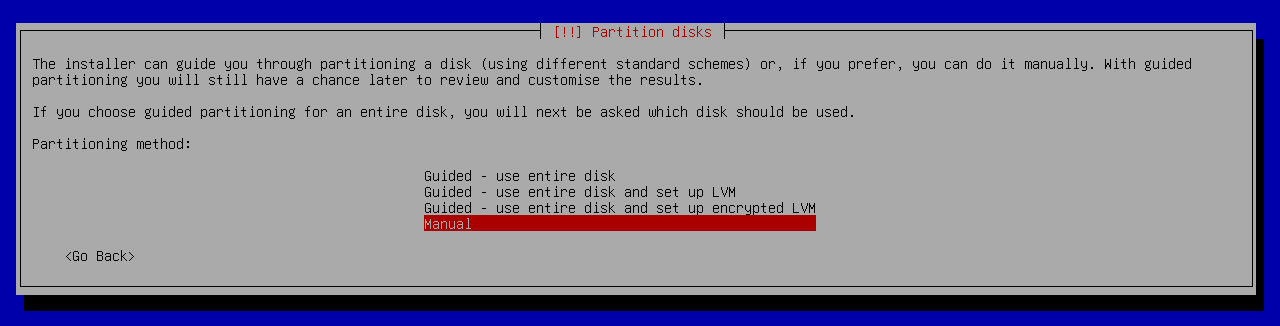
Choose Manual.
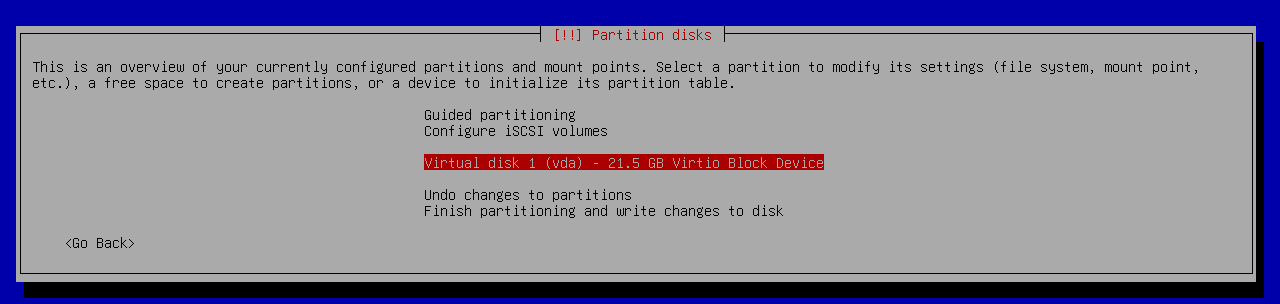
Select your disk where you would like to install Debian.
Select Yes when asked for creating a new partition.
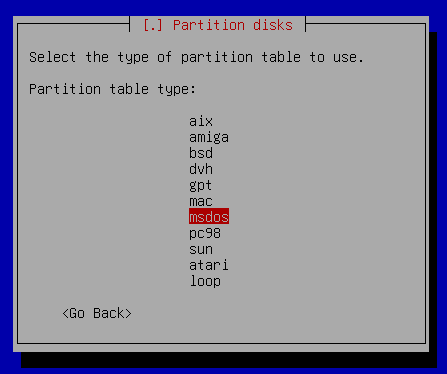
I chose the msdos option as I am not using UEFI. If you are using UEFI, then you need to choose the gpt option. Also, your steps will (slightly) differ from mine if you are using UEFI. In that case, you can watch this video by the YouTube channel EF Linux in which he creates an EFI partition. As he doesn t cover disk encryption, you can continue reading this post after following the steps corresponding to EFI.
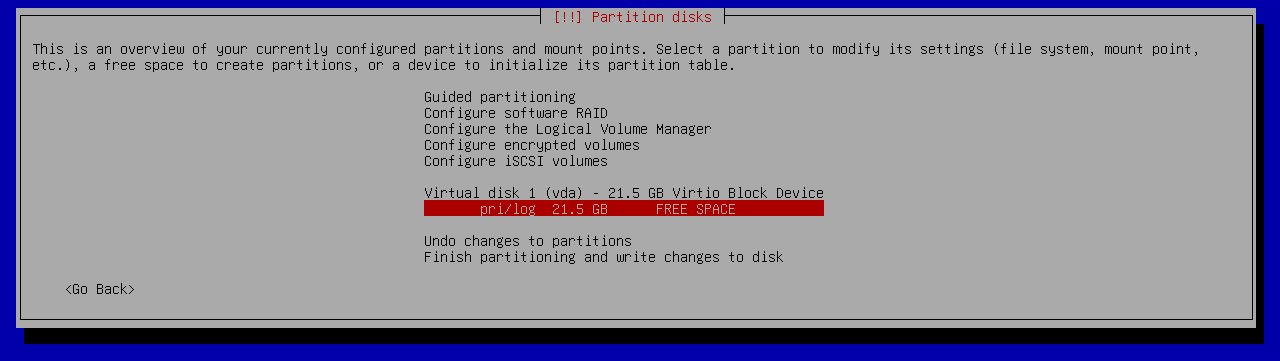
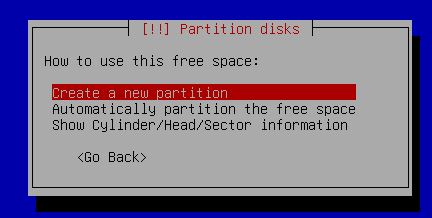
Select the free space option as shown above.
Choose Create a new partition.
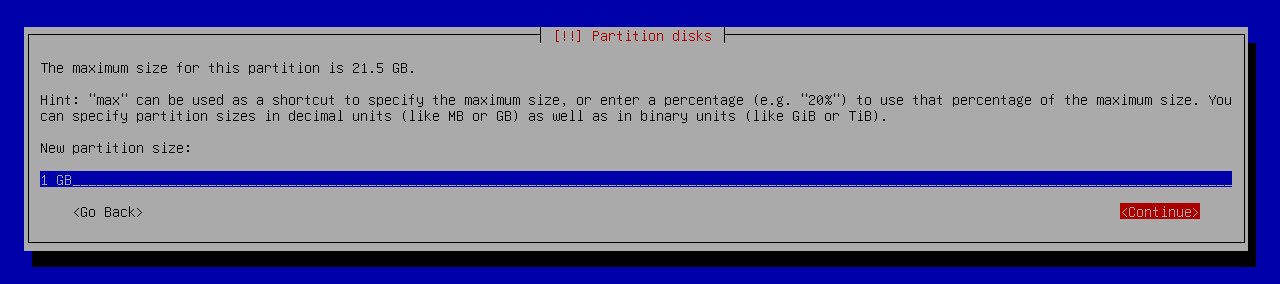
I chose the partition size to be 1 GB.
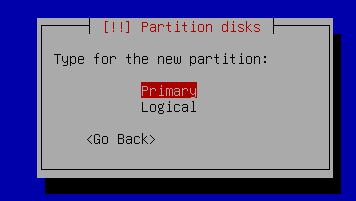
Choose Primary.
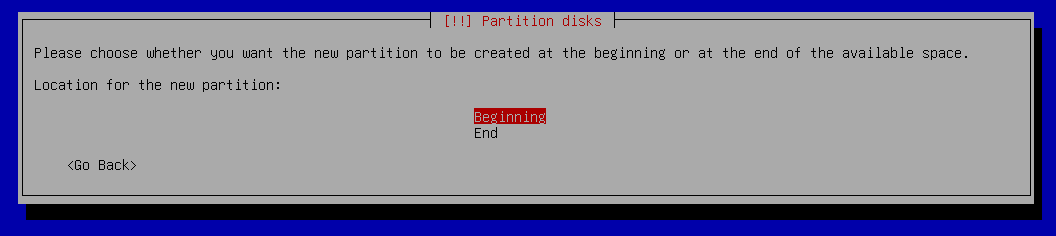
Choose Beginning.
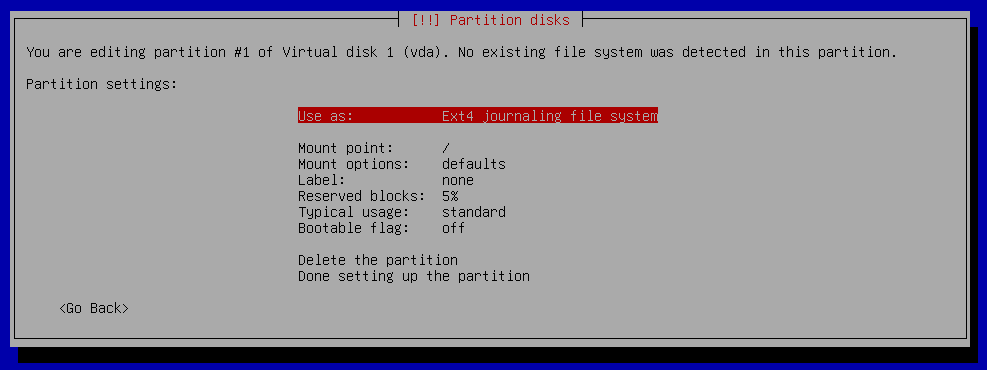
Now, I got to this screen.
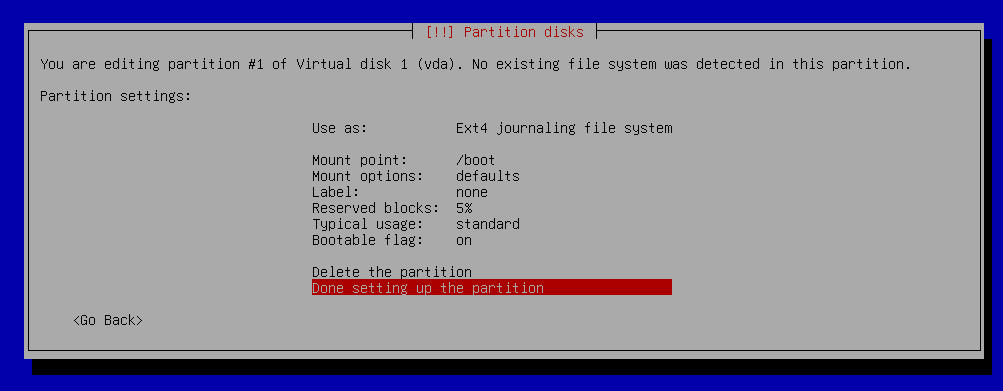
I changed mount point to /boot and turned on the bootable flag and then selected Done setting up the partition.
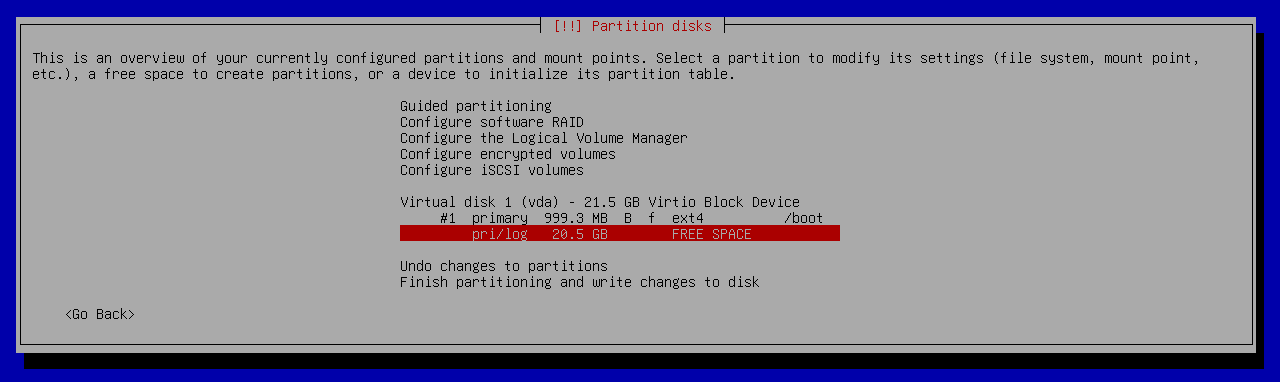
Now select free space.
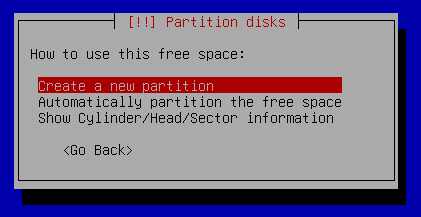
Choose the Create a new partition option.
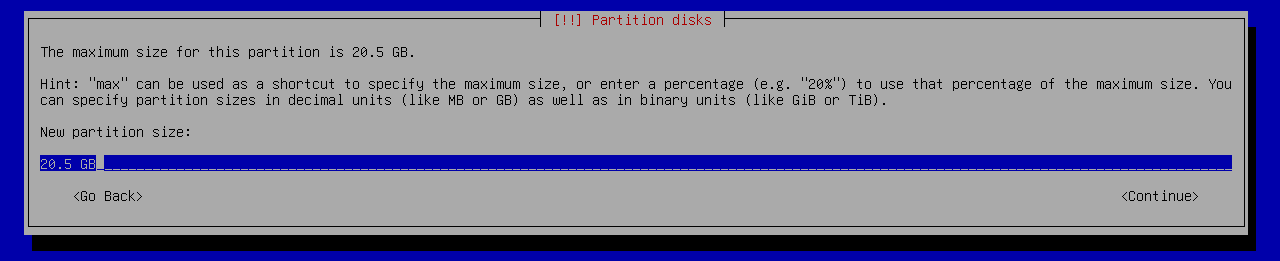
I made the partition size equal to the remaining space on my disk. I do not intend to create a swap partition, so I do not need more space.
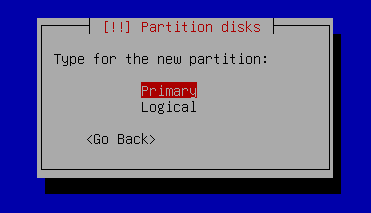
Select Primary.
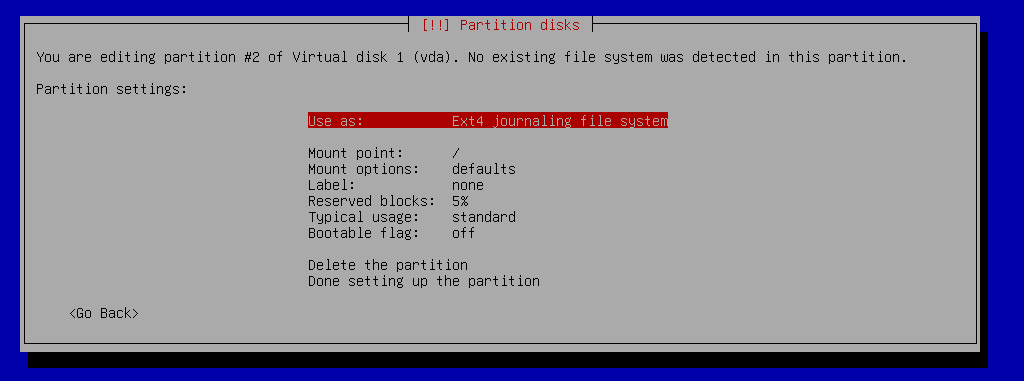
Select the Use as option to change its value.
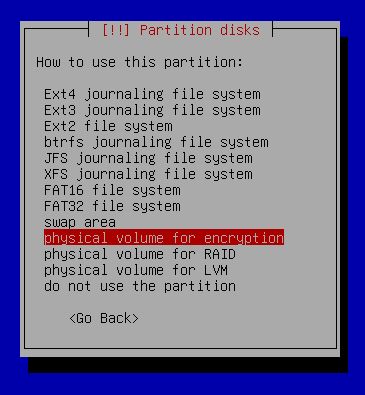
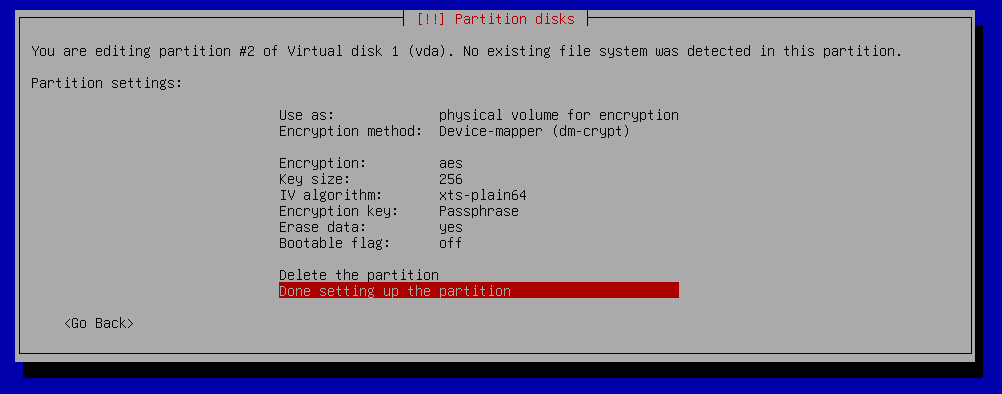
Select physical volume for encryption.
Select Done setting up the partition.
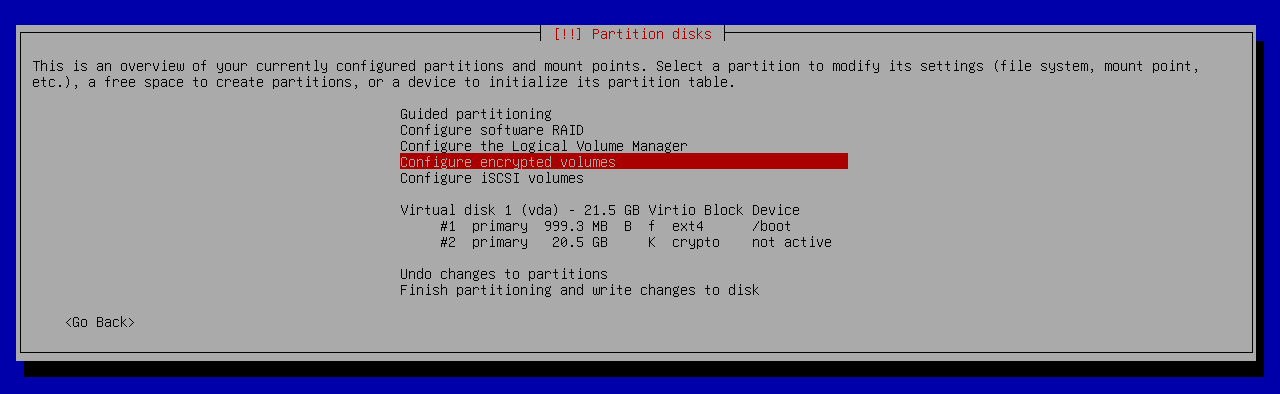
Now select Configure encrypted volumes.
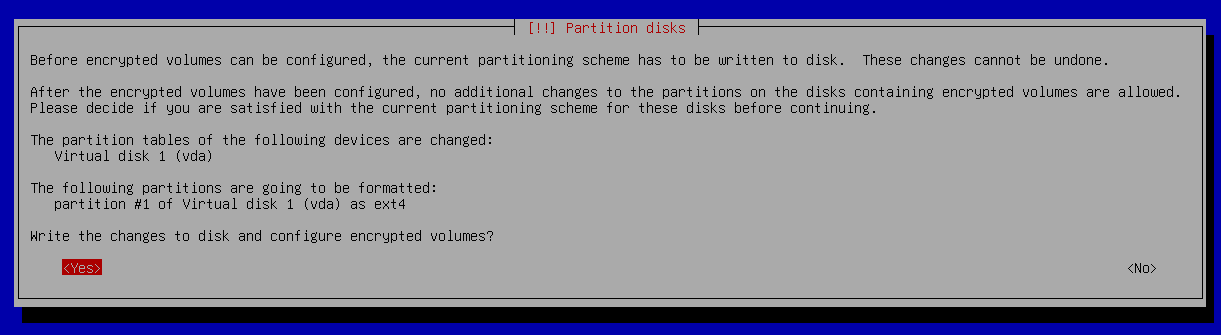
Select Yes.
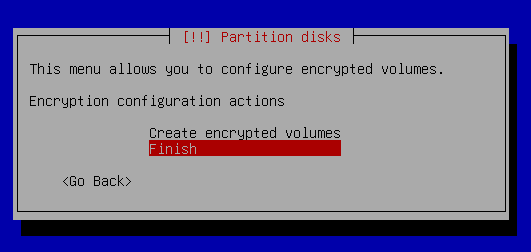
Select Finish.
Selecting Yes will take a lot of time to erase the data. Therefore, I would say if you have hours for this step (in case your SSD is like 1 TB), then I would recommend selecting Yes. Otherwise, you could select No and compromise on the quality of encryption. After this, you will be asked to enter a passphrase for disk encryption and confirm it. Please do so. I forgot to take the screenshot for that step.
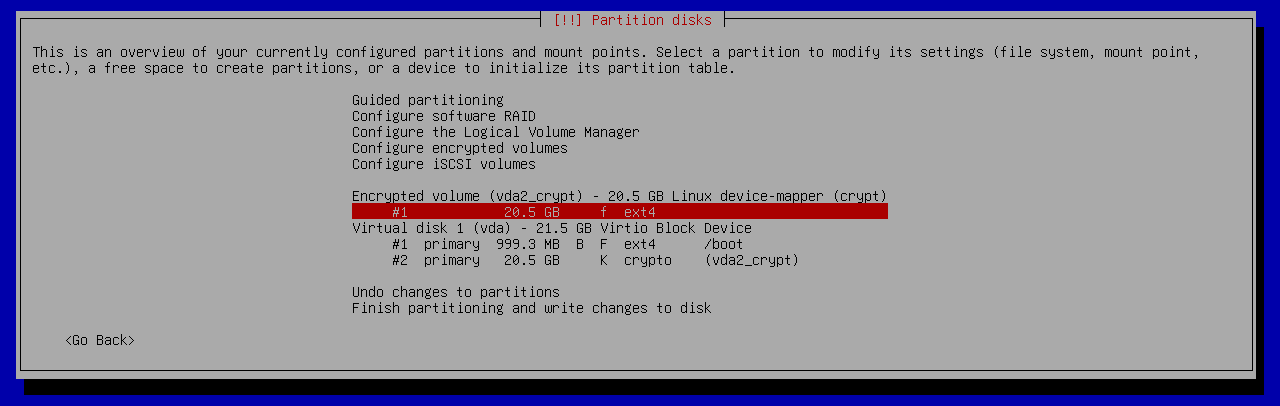
Now select that encrypted volume as shown in the screenshot above.
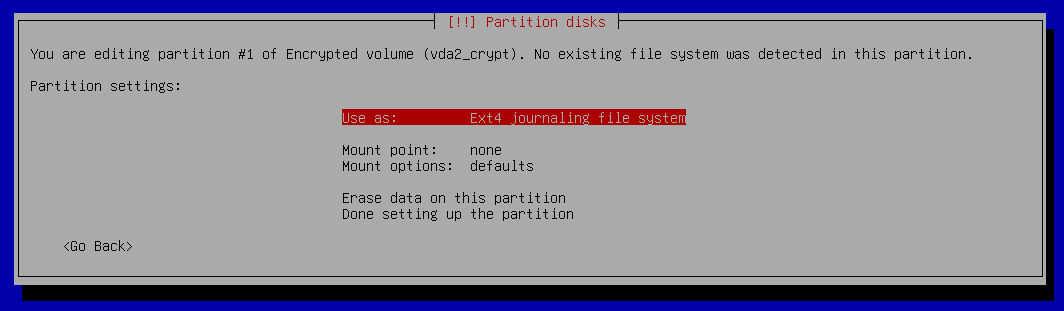
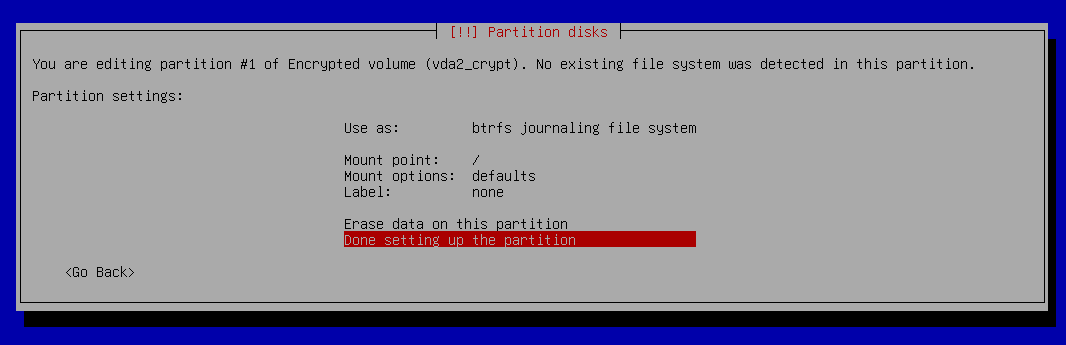
Here we will change a couple of options which will be shown in the next screenshot.
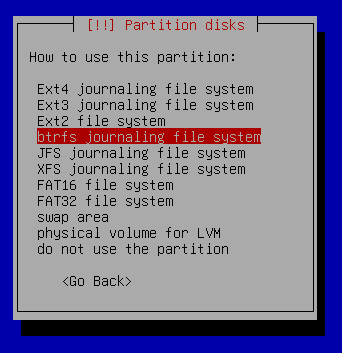
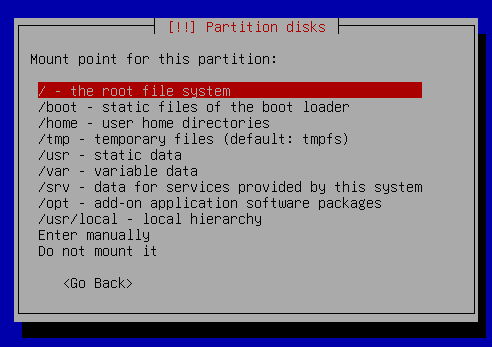
In the Use as menu, select btrfs journaling file system.
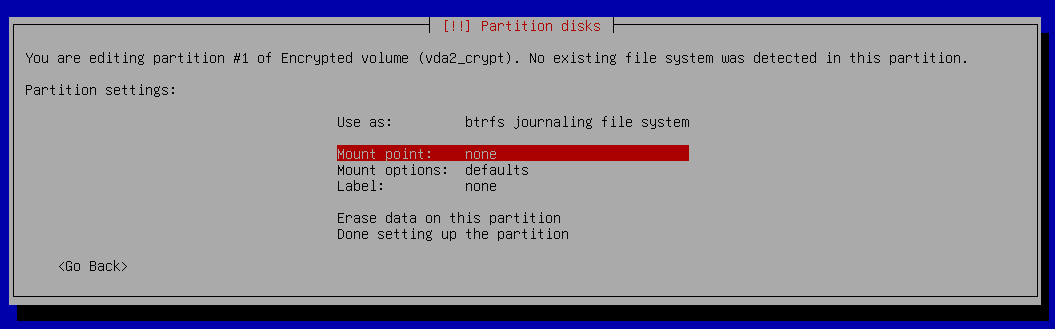
Now, click on the mount point option.
Change it to / - the root file system.
Select Done setting up the partition.
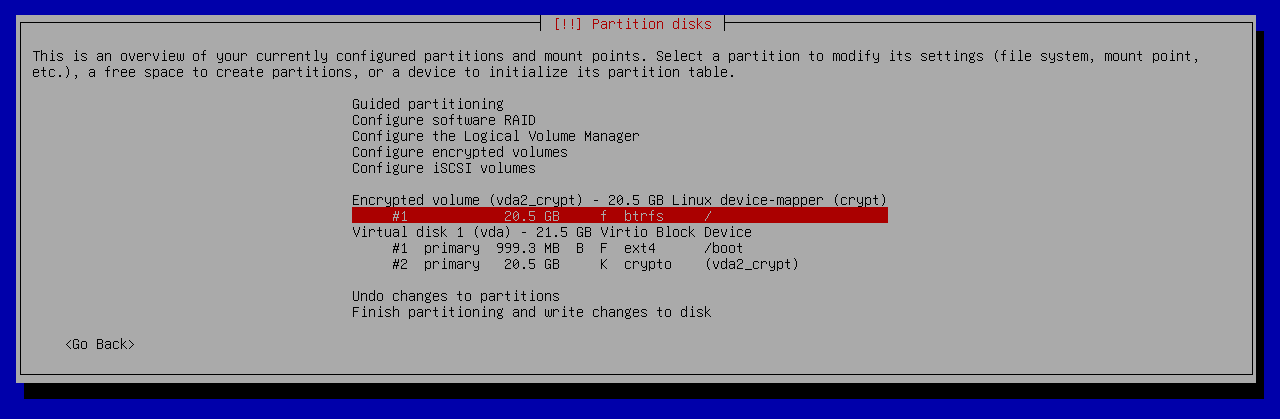
This is a preview of the paritioning after performing the above-mentioned steps.
If everything is okay, proceed with the Finish partitioning and write changes to disk option.
The installer is reminding us to create a swap partition. I proceeded without it as I planned to add swap after the installation.
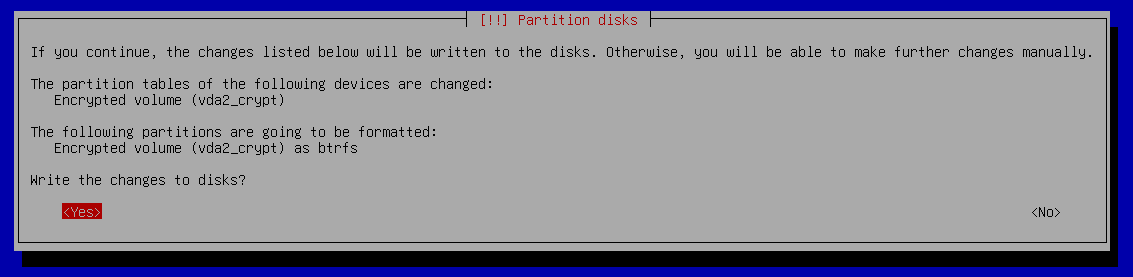
If everything looks fine, choose yes for writing the changes to disks.
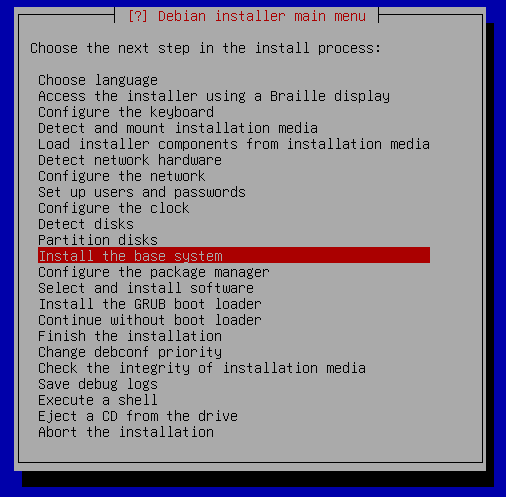
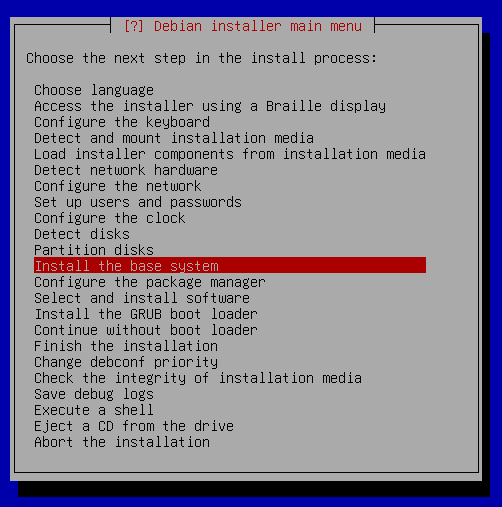
Now we are done with partitioning and we are shown the screen in the screenshot above. If we had not selected the Expert Install option, the installer would have proceeded to install the base system without asking us. However, we want to create subvolumes before proceeding to install the base system. This is the reason we chose Expert Install. Now press Ctrl + F2.
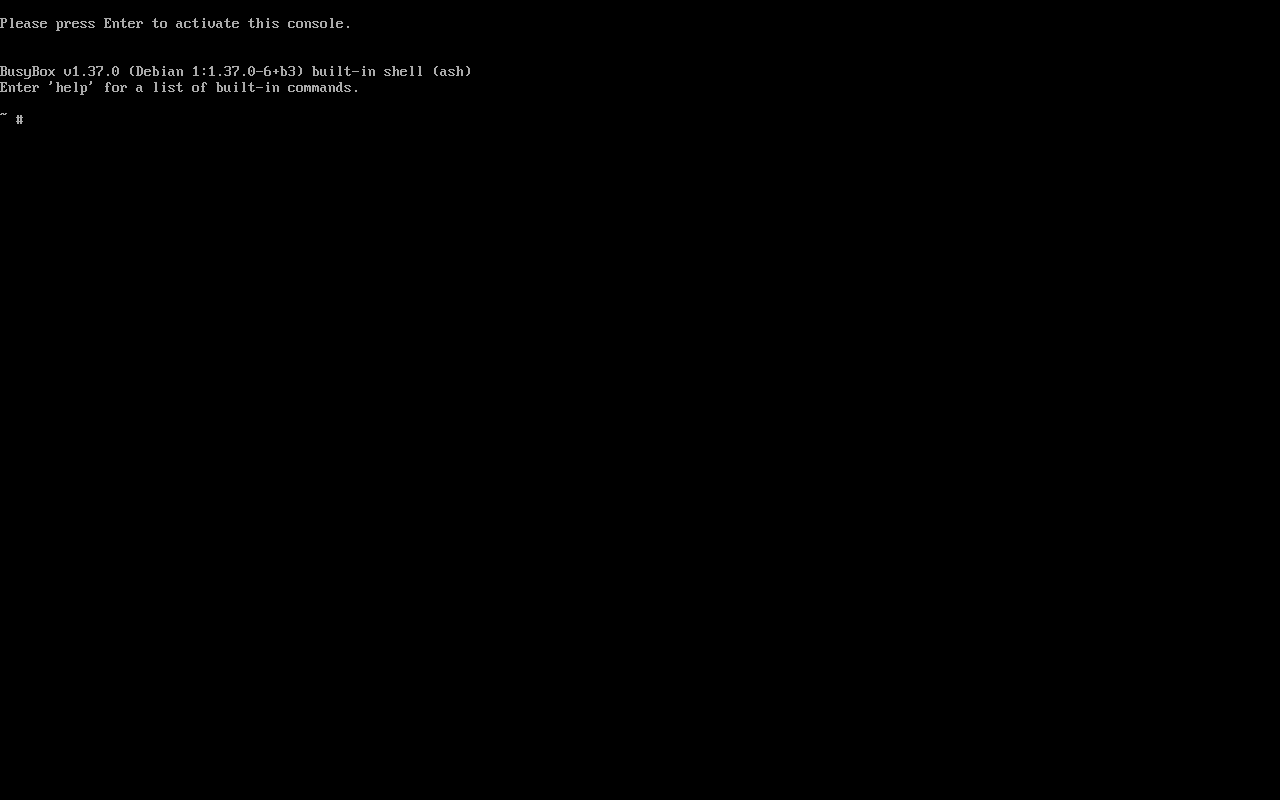
You will see the screen as in the above screenshot. It says Please press Enter to activate this console. So, let s press Enter.
After pressing Enter, we see the above screen.
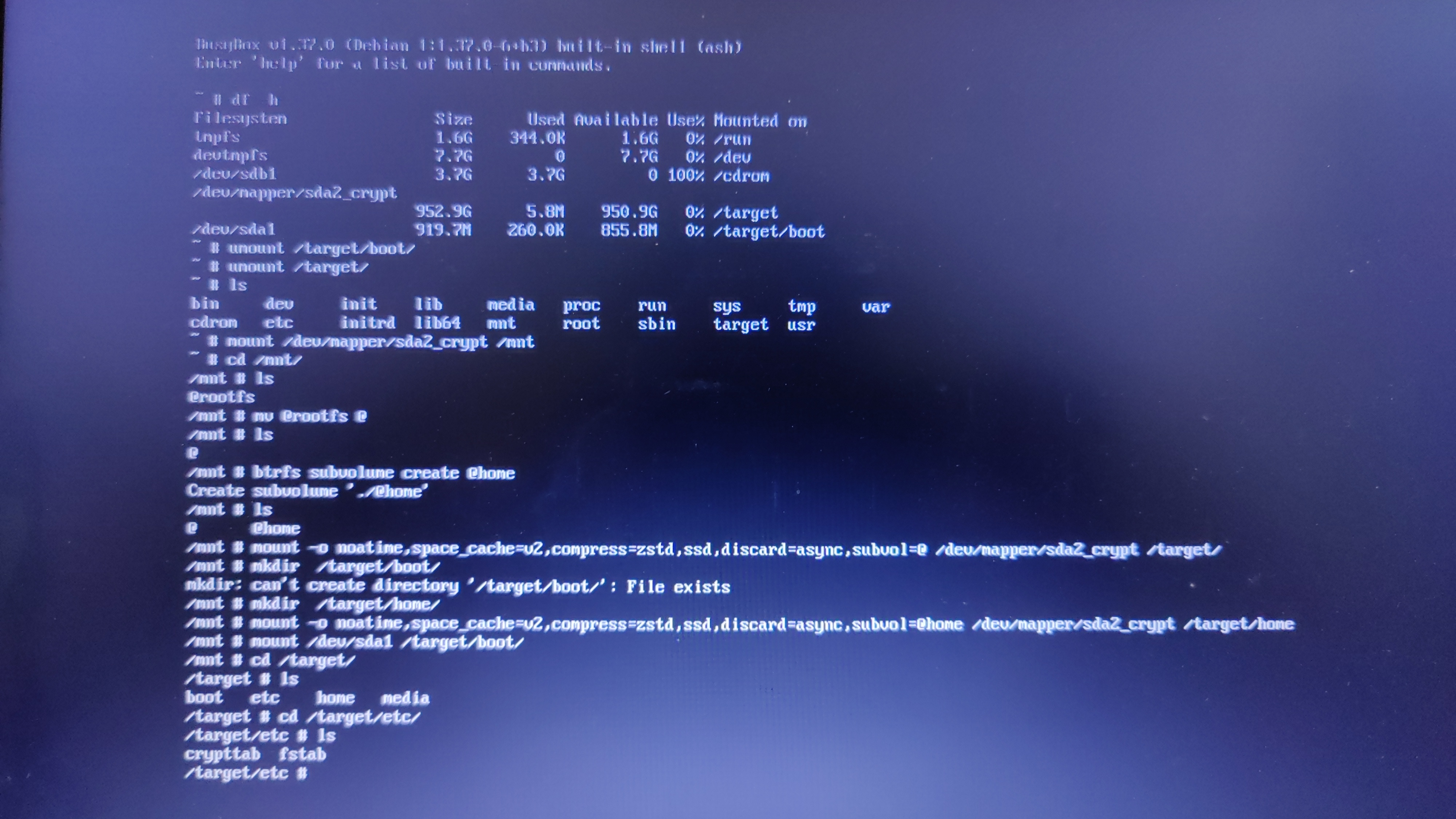
The screenshot above shows the steps I performed in the console. I followed the already mentioned video by EF Linux for this part and adapted it to my situation (he doesn t encrypt the disk in his tutorial). First we run df -h to have a look at how our disk is partitioned. In my case, the output was:
# df -h
Filesystem              Size  Used  Avail   Use% Mounted on
tmpfs                   1.6G  344.0K  1.6G    0% /run
devtmpfs                7.7G       0  7.7G   0% /dev
/dev/sdb1               3.7G    3.7G    0   100% /cdrom
/dev/mapper/sda2_crypt  952.9G  5.8G  950.9G  0% /target
/dev/sda1               919.7M  260.0K  855.8M  0% /target/boot
df -h shows us that /dev/mapper/sda2_crypt and /dev/sda1 are mounted on /target and /target/boot respectively. Let s unmount them. For that, we run:
# umount /target
# umount /target/boot
Next, let s mount our root filesystem to /mnt.
# mount /dev/mapper/sda2_crypt /mnt
Let s go into the /mnt directory.
# cd /mnt
Upon listing the contents of this directory, we get:
/mnt # ls
@rootfs
Debian installer has created a subvolume @rootfs automatically. However, we need the subvolumes to be @ and @home. Therefore, let s rename the @rootfs subvolume to @.
/mnt # mv @rootfs @
Listing the contents of the directory again, we get:
/mnt # ls
@
We only one subvolume right now. Therefore, let us go ahead and create another subvolume @home.
/mnt # btrfs subvolume create @home
Create subvolume './@home'
If we perform ls now, we will see there are two subvolumes:
/mnt # ls
@ @home
Let us mount /dev/mapper/sda2_crypt to /target
/mnt # mount -o noatime,space_cache=v2,compress=zstd,ssd,discard=async,subvol=@ /dev/mapper/sda2_crypt /target/
Now we need to create a directory for /home.
/mnt # mkdir /target/home/
Now we mount the /home directory with subvol=@home option.
/mnt # mount -o noatime,space_cache=v2,compress=zstd,ssd,discard=async,subvol=@home /dev/mapper/sda2_crypt /target/home/
Now mount /dev/sda1 to /target/boot.
/mnt # mount /dev/sda1 /target/boot/
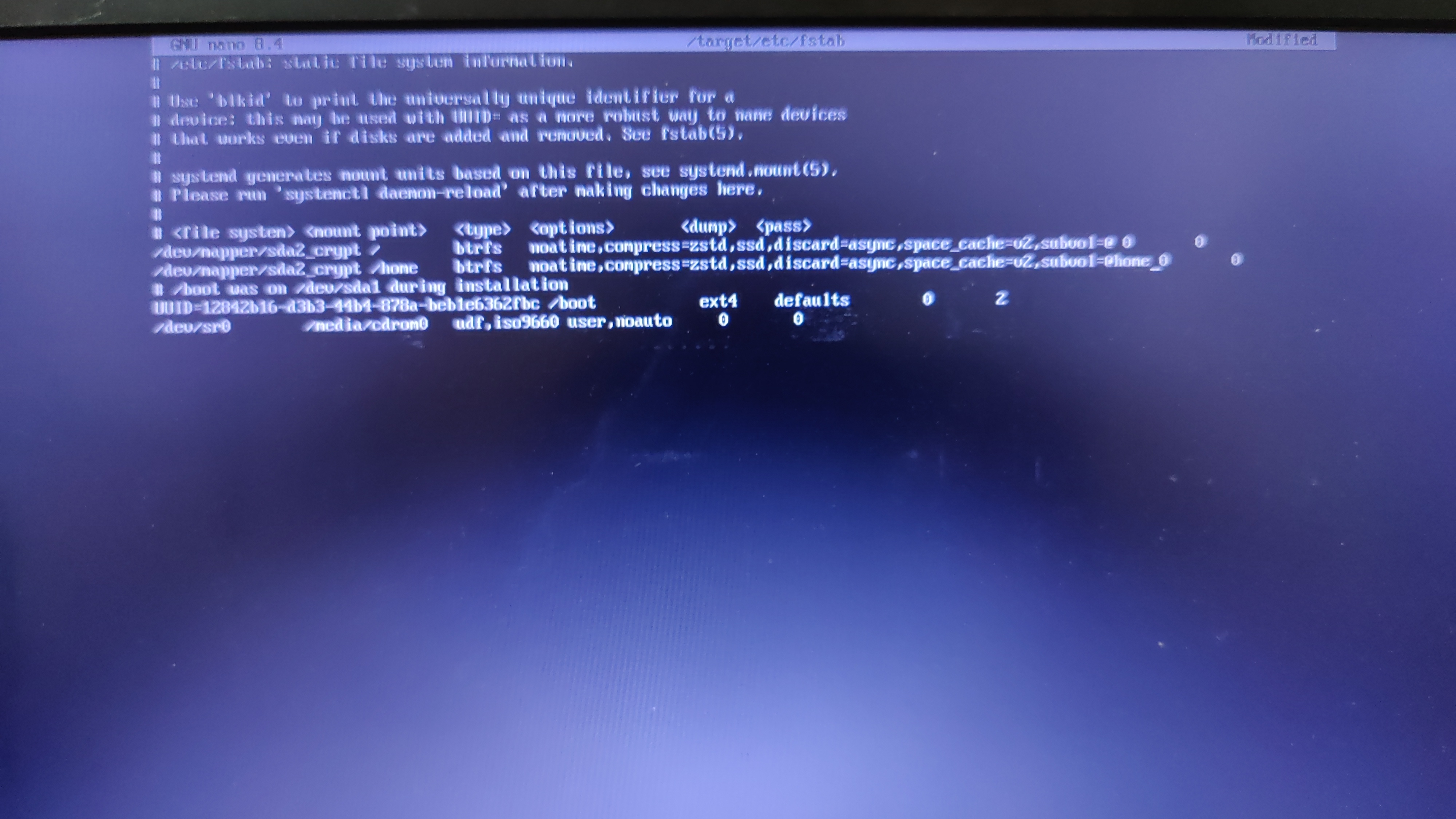
Now we need to add these options to the fstab file, which is located at /target/etc/fstab. Unfortunately, vim is not installed in this console. The only way to edit is Nano.
nano /target/etc/fstab
Edit your fstab file to look similar to the one in the screenshot above. I am pasting the fstab file contents below for easy reference.
# /etc/fstab: static file system information.
#
# Use 'blkid' to print the universally unique identifier for a
# device; this may be used with UUID= as a more robust way to name devices
# that works even if disks are added and removed. See fstab(5).
#
# systemd generates mount units based on this file, see systemd.mount(5).
# Please run 'systemctl daemon-reload' after making changes here.
#
# <file system> <mount point>   <type>  <options>       <dump>  <pass>
/dev/mapper/sda2_crypt /        btrfs   noatime,compress=zstd,ssd,discard=async,space_cache=v2,subvol=@ 0       0
/dev/mapper/sda2_crypt /home    btrfs   noatime,compress=zstd,ssd,discard=async,space_cache=v2,subvol=@home 0       0
# /boot was on /dev/sda1 during installation
UUID=12842b16-d3b3-44b4-878a-beb1e6362fbc /boot           ext4    defaults        0       2
/dev/sr0        /media/cdrom0   udf,iso9660 user,noauto     0       0
Please double check the fstab file before saving it. In Nano, you can press Ctrl+O followed by pressing Enter to save the file. Then press Ctrl+X to quit Nano. Now, preview the fstab file by running
cat /target/etc/fstab
and verify that the entries are correct, otherwise you will booted to an unusable and broken system after the installation is complete. Next, press Ctrl + Alt + F1 to go back to the installer.
Proceed to Install the base system.
Screenshot of Debian installer installing the base system. Screenshot of Debian installer installing the base system.

I chose the default option here - linux-image-amd64. After this, the installer will ask you a few more questions. For desktop environment, I chose KDE Plasma. You can choose the desktop environment as per your liking. I will not cover the rest of the installation process and assume that you were able to install from here.

Post installation Let s jump to our freshly installed Debian system. Since I created a root user, I added the user ravi to the suoders file (/etc/sudoers) so that ravi can run commands with sudo. Follow this if you would like to do the same. Now we set up zram as swap. First, install zram-tools.
sudo apt install zram-tools
Now edit the file /etc/default/zramswap and make sure to have the following lines are uncommented:
ALGO=lz4
PERCENT=50
Now, run
sudo systemctl restart zramswap
If you run lsblk now, you should see the below-mentioned entry in the output:
zram0          253:0    0   7.8G  0 disk  [SWAP]
This shows us that zram has been activated as swap. Now we install timeshift, which can be done by running
sudo apt install timeshift
After the installation is complete, run Timeshift and schedule snapshots as you please. We are done now. Hope the tutorial was helpful. See you in the next post and let me know if you have any suggestions and questions on this tutorial.

27 August 2025

Matthew Palmer: StrongBox: Simple, Safe Data Encryption for Rust

Some time ago, I wanted to encrypt a bunch of data in an application I was writing in Rust, mostly to be stored in a database, but also session cookies and sensitive configuration variables. Since Rust is widely known as a secure-yet-high-performance programming language, I was expecting that there would be a widely-used crate that gave me a secure, high-level interface to strong, safe cryptography. Imagine my surprise when I discovered that just didn t seem to exist. Don t get me wrong: Rust is replete with fast, secure, battle-tested cryptographic primitives. The RustCrypto group provides all manner of robust, widely-used crates for all manner of cryptography-related purposes. They re the essential building blocks for practical cryptosystems, but using them directly in an application is somewhat akin to building a car from individual atoms of iron and carbon. So I wrote my own high-level data encryption library, called it StrongBox, and have been happily encrypting and decrypting data ever since.

Cryptography So Simple Even I Can t Get It Wrong The core of StrongBox is the StrongBox trait, which has only two methods: encrypt and decrypt, each of which takes just two arguments. The first argument is the plaintext (for encrypt) or the ciphertext (for decrypt) to work on. The second argument is the encryption context, for use as Authenticated Additional Data, an important part of many uses of encryption. There s essentially no configuration or parameters to get wrong. You can t choose the encryption algorithm, or block cipher mode, and you don t have to worry about generating a secure nonce. You create a StrongBox with a key, and then you call encrypt and decrypt. That s it.

Practical Cryptographic Affordances Ok, ok that s not quite it. Because StrongBox is even easier to use than what I ve described, thanks to the companion crate, StructBox. When I started using StrongBox in the wild , it quickly became clear that what I almost always wanted to encrypt in my application wasn t some ethereal plaintext . I wanted to encrypt things, specifically structs (and enums). So, through the magic of Rust derive macros, I built StructBox, which provides encrypt and decrypt operations on any Serde-able type. Given that using Serde encoders can be a bit fiddly to use, it s virtually easier to get an encrypted, serialized struct than it is to get a plaintext serialized struct.

Key Problems in Cryptography The thing about cryptography is that it largely turns all data security problems into key management problems. All the fancy cryptographic wonkery is for naught if you don t manage the encryption keys well. So, most of the fancy business in StrongBox isn t the encryption and decryption, but instead solving problems around key management.

Different Keys for Different Purposes Using the same key for all of your cryptographic needs is generally considered a really bad idea. It opens up all manner of risks, that are easily avoided if you use different keys for different things. However, having to maintain a big pile of different keys is a nightmare, so nobody s going to do that. Enter: key derivation. Create one safe, secure root key, and then use a key derivation function to spawn as many other keys as you need. Different keys for each database column, another one to encrypt cookies, and so on. StrongBox supports this through the StemStrongBox type. You ll typically start off by creating a StemStrongBox with the root key, and then derive whatever other StrongBoxes you need, for encrypting and decrypting different kinds of data.

You Spin Me Round Sometimes, keys need to be rotated. Whether that s because you actually know (or even have reason to suspect) someone has gotten the key, or just because you re being appropriately paranoid, sometimes key rotation has to happen. As someone who has had to rotate keys in situations where such an eventuality was not planned for, I can say with some degree of authority: it absolutely sucks to have to do an emergency key rotation in a system that isn t built to make that easy. That s why StrongBox natively supports key rotation. Every StrongBox takes one encryption key, and an arbitrary number of decryption keys, and will automatically use the correct key to decrypt ciphertexts.

Will You Still Decrypt Me, Tomorrow? In addition to manual key rotation, StrongBox also supports time-based key rotation with the RotatingStrongBox type. This comes in handy when you re encrypting a lot of ephemeral data, like cookies (or server-side session data). It provides a way to automatically expire old data, and prevents attacks that become practical when large amounts of data are encrypted using a single key.

Invasion of the Invisible Salamanders! I mostly mention this just because I love the name, but there is a kind of attack possible in common AEAD modes called the invisible salamanders attack. StrongBox implements mitigations against this, by committing to the key being used so that an attacker can t forge a ciphertext that decrypts validly to different plaintexts when using different keys. This is why I love cryptography: everything sounds like absolute goddamn magic.

Call Me Crazy, Support Me Maybe? If you re coding in Rust (which you probably should be), encrypting your stored data (which you definitely should be), and StrongBox makes your life easier (which it really will), you can show your appreciation for my work by contributing to my open source code-fund. Simply by shouting me a refreshing beverage, you ll be helping me out, and helping to grow the software commons. Alternately, if you re looking for someone to Speak Rust to Computers on a professional basis, I m available for contracts or full-time remote positions.

25 August 2025

Gunnar Wolf: The comedy of computation, or, how I learned to stop worrying and love obsolescence

This post is a review for Computing Reviews for The comedy of computation, or, how I learned to stop worrying and love obsolescence , a book published in Stanford University Press
The Comedy of Computation is not an easy book to review. It is a much enjoyable book that analyzes several examples of how being computational has been approached across literary genres in the last century how authors of stories, novels, theatrical plays and movies, focusing on comedic genres, have understood the role of the computer in defining human relations, reactions and even self-image. Mangrum structures his work in six thematic chapters, where he presents different angles on human society: How have racial stereotypes advanced in human imagination and perception about a future where we interact with mechanical or computational partners (from mechanical tools performing jobs that were identified with racial profiles to intelligent robots that threaten to control society); the genericity of computers and people can be seen as generic, interchangeable characters, often fueled by the tendency people exhibit to confer anthropomorphic qualities to inanimate objects; people s desire to be seen as truly authentic , regardless of what it ultimately means; romantic involvement and romance-led stories (with the computer seen as a facilitator for human-to-human romances, distractor away from them, or being itself a part of the couple); and the absurdity in antropomorphization, in comparing fundamentally different aspects such as intelligence and speed at solving mathematical operations, as well as the absurdity presented blatantly as such by several techno-utopian visions. But presenting this as a linear set of concepts that are presented does not do justice to the book. Throughout the sections of each chapter, a different work serves as the axis Novels and stories, Hollywood movies, Broadway plays, some covers for the Time magazine, a couple of presenting the would-be future, even a romantic comedy entirely written by bots . And for each of them, Benjamin Mangrum presents a very thorough analysis, drawing relations and comparing with contemporary works, but also with Shakespeare, classical Greek myths, and a very long etc tera. This book is hard to review because of the depth of work the author did: Reading it repeatedly made me look for other works, or at least longer references for them. Still, despite being a work with such erudition, Mangrum s text is easy and pleasant to read, without feeling heavy or written in an overly academic style. I very much enjoyed reading this book. It is certainly not a technical book about computers and society in any way; it is an exploration of human creativity and our understanding of the aspects the author has found as central to understanding the impact of computing on humankind. However, there is one point I must mention before closing: I believe the editorial decision to present the work as a running text, with all the material conceptualized as footnotes presented as a separate, over 50 page long final chapter, detracts from the final result. Personally, I enjoy reading the footnotes because they reveal the author s thought processes, even if they stray from the central line of thought. Even more, given my review copy was a PDF, I could not even keep said chapter open with one finger, bouncing back and forth. For all purposes, I missed out on the notes; now that I finished reading and stumbled upon that chapter, I know I missed an important part of the enjoyment.

20 August 2025

Dirk Eddelbuettel: RcppArmadillo 14.6.3-1 on CRAN: Minor Upstream Bug Fixes

armadillo image Armadillo is a powerful and expressive C++ template library for linear algebra and scientific computing. It aims towards a good balance between speed and ease of use, has a syntax deliberately close to Matlab, and is useful for algorithm development directly in C++, or quick conversion of research code into production environments. RcppArmadillo integrates this library with the R environment and language and is widely used by (currently) 1268 other packages on CRAN, downloaded 41 million times (per the partial logs from the cloud mirrors of CRAN), and the CSDA paper (preprint / vignette) by Conrad and myself has been cited 642 times according to Google Scholar. Conrad made three minor bug fix releases since the 4.6.0 release last month. We need to pace releases at CRAN so we do not immediately upload there on each upstream release and then CRAN also had the usual (and well-deserved) summer rest leading to a slight delay relative to the last upstream. The minor changes in the three releases are summarized below. All our releases are always available via the GitHub repo and hence also via r-universe, and still rigorously tested via our own reverse-dependency checks. We also note that the package once again passed with flying colours and no human intervention which remains impressive given the over 1200 reverse dependencies.

Changes in RcppArmadillo version 14.6.3-1 (2025-08-14)
  • Upgraded to Armadillo release 14.6.3 (Caffe Mocha)
    • Fix OpenMP related crashes in Cube::slice() on Arm64 CPUs

Changes in RcppArmadillo version 14.6.2-1 (2025-08-08) (GitHub Only)
  • Upgraded to Armadillo release 14.6.2 (Caffe Mocha)
    • Fix for corner-case speed regression in sum()
    • Better handling of OpenMP in omit_nan() and omit_nonfinite()

Changes in RcppArmadillo version 14.6.1-1 (2025-07-21) (GitHub Only)
  • Upgraded to Armadillo release 14.6.1 (Caffe Mocha)
    • Fix for speed regression in mean()
    • Fix for detection of compiler configuration
    • Use of pow optimization now optional

Courtesy of my CRANberries, there is a diffstat report relative to previous release. More detailed information is on the RcppArmadillo page. Questions, comments etc should go to the rcpp-devel mailing list off the Rcpp R-Forge page.

This post by Dirk Eddelbuettel originated on his Thinking inside the box blog. If you like this or other open-source work I do, you can sponsor me at GitHub.

18 August 2025

Otto Kek l inen: Best Practices for Submitting and Reviewing Merge Requests in Debian

Featured image of post Best Practices for Submitting and Reviewing Merge Requests in DebianHistorically the primary way to contribute to Debian has been to email the Debian bug tracker with a code patch. Now that 92% of all Debian source packages are hosted at salsa.debian.org the GitLab instance of Debian more and more developers are using Merge Requests, but not necessarily in the optimal way. In this post I share what I ve found the best practice to be, presented in the natural workflow from forking to merging.
Why use Merge Requests? Compared to sending patches back and forth in email, using a git forge to review code contributions brings several benefits:
  • Contributors can see the latest version of the code immediately when the maintainer pushes it to git, without having to wait for an upload to Debian archives.
  • Contributors can fork the development version and easily base their patches on the correct version and help test that the software continues to function correctly at that specific version.
  • Both maintainer and other contributors can easily see what was already submitted and avoid doing duplicate work.
  • It is easy for anyone to comment on a Merge Request and participate in the review.
  • Integrating CI testing is easy in Merge Requests by activating Salsa CI.
  • Tracking the state of a Merge Request is much easier than browsing Debian bug reports tagged patch , and the cycle of submit review re-submit re-review is much easier to manage in the dedicated Merge Request view compared to participants setting up their own email plugins for code reviews.
  • Merge Requests can have extra metadata, such as Approved , and the metadata often updates automatically, such as a Merge Request being closed automatically when the Git commit ID from it is pushed to the target branch.
Keeping these benefits in mind will help ensure that the best practices make sense and are aligned with maximizing these benefits.

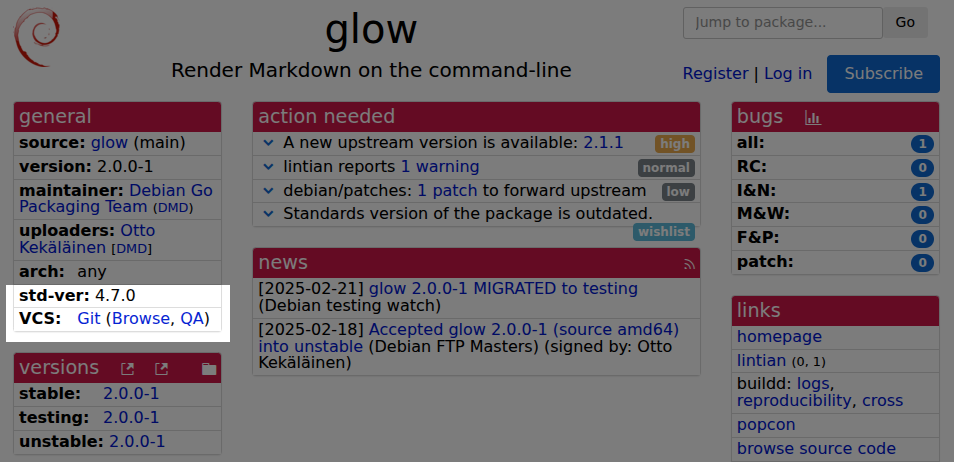
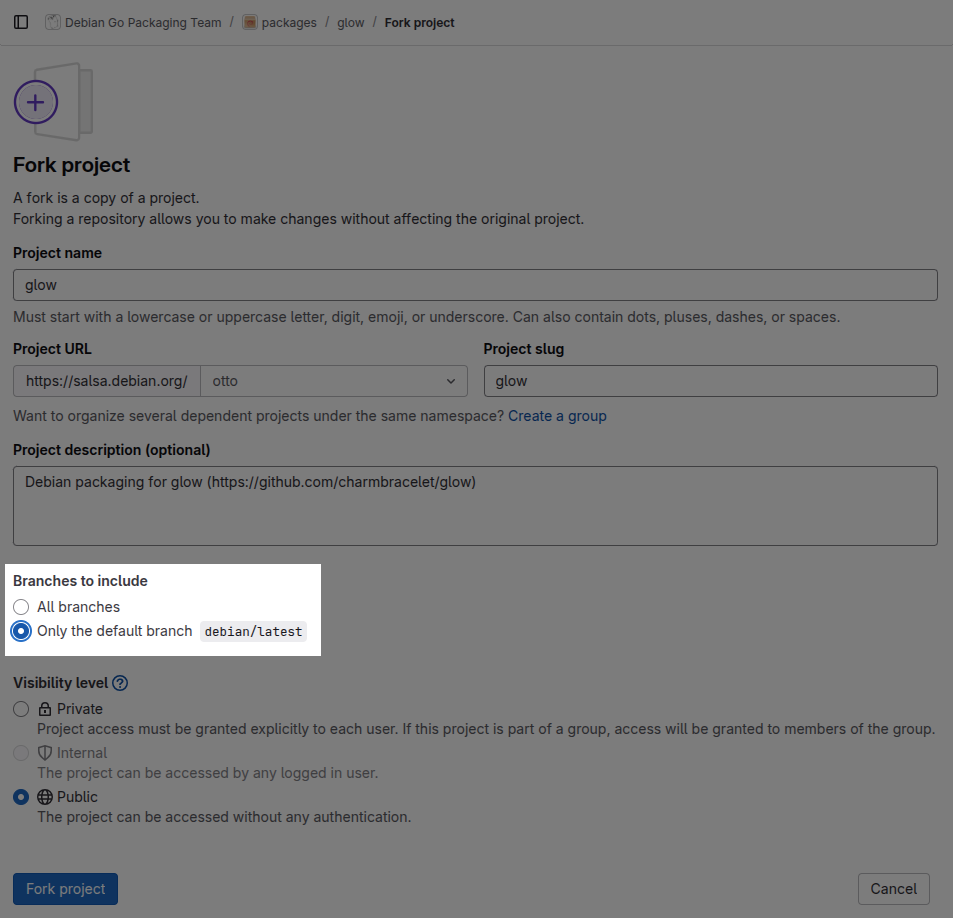
Finding the Debian packaging source repository and preparing to make a contribution Before sinking any effort into a package, start by checking its overall status at the excellent Debian Package Tracker. This provides a clear overview of the package s general health in Debian, when it was last uploaded and by whom, and if there is anything special affecting the package right now. This page also has quick links to the Debian bug tracker of the package, the build status overview and more. Most importantly, in the General section, the VCS row links to the version control repository the package advertises. Before opening that page, note the version most recently uploaded to Debian. This is relevant because nothing in Debian currently enforces that the package in version control is actually the same as the latest uploaded to Debian. Packaging source code repository links at tracker.debian.org Following the Browse link opens the Debian package source repository, which is usually a project page on Salsa. To contribute, start by clicking the Fork button, select your own personal namespace and, under Branches to include, pick Only the default branch to avoid including unnecessary temporary development branches. View after pressing Fork Once forking is complete, clone it with git-buildpackage. For this example repository, the exact command would be gbp clone --verbose git@salsa.debian.org:otto/glow.git. Next, add the original repository as a new remote and pull from it to make sure you have all relevant branches. Using the same fork as an example, the commands would be:
git remote add go-team https://salsa.debian.org/go-team/packages/glow.git
gbp pull --verbose --track-missing go-team
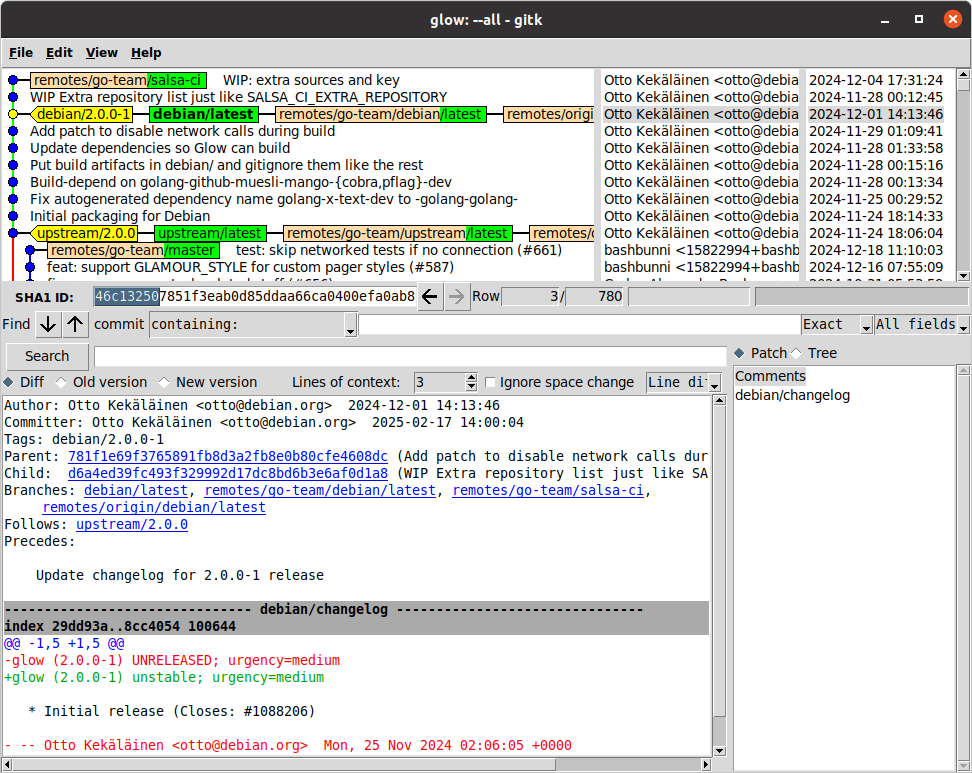
The gbp pull command can be repeated whenever you want to make sure the main branches are in sync with the original repository. Finally, run gitk --all & to visually browse the Git history and note the various branches and their states in the two remotes. Note the style in comments and repository structure the project has and make sure your contributions follow the same conventions to maximize the chances of the maintainer accepting your contribution. It may also be good to build the source package to establish a baseline of the current state and what kind of binaries and .deb packages it produces. If using Debcraft, one can simply run debcraft build in the Git repository.
Submitting a Merge Request for a Debian packaging improvement Always start by making a development branch by running git checkout -b <branch name> to clearly separate your work from the main branch. When making changes, remember to follow the conventions you already see in the package. It is also important to be aware of general guidelines on how to make good Git commits. If you are not able to immediately finish coding, it may be useful to publish the Merge Request as a draft so that the maintainer and others can see that you started working on something and what general direction your change is heading in. If you don t finish the Merge Request in one sitting and return to it another day, you should remember to pull the Debian branch from the original Debian repository in case it has received new commits. This can be done easily with these commands (assuming the same remote and branch names as in the example above):
git fetch go-team
git rebase -i go-team/debian/latest
Frequent rebasing is a great habit to help keep the Git history linear, and restructuring and rewording your commits will make the Git history easier to follow and understand why the changes were made. When pushing improved versions of your branch, use git push --force. While GitLab does allow squashing, I recommend against it. It is better that the submitter makes sure the final version is a neat and clean set of commits that the receiver can easily merge without having to do any rebasing or squashing themselves. When ready, remove the draft status of the Merge Request and wait patiently for review. If the maintainer does not respond in several days, try sending an email to <source package name>@packages.debian.org, which is the official way to contact maintainers. You could also post a comment on the MR and tag the last few committers in the same repository so that a notification email is triggered. As a last resort, submit a bug report to the Debian bug tracker to announce that a Merge Request is pending review. This leaves a permanent record for posterity (or the Debian QA team) of your contribution. However, most of the time simply posting the Merge Request in Salsa is enough; excessive communication might be perceived as spammy, and someone needs to remember to check that the bug report is closed.

Respect the review feedback, respond quickly and avoid Merge Requests getting stale Once you get feedback, try to respond as quickly as possible. When people participating have everything fresh in their minds, it is much easier for the submitter to rework it and for the reviewer to re-review. If the Merge Request becomes stale, it can be challenging to revive it. Also, if it looks like the MR is only waiting for re-review but nothing happens, re-read the previous feedback and make sure you actually address everything. After that, post a friendly comment where you explicitly say you have addressed all feedback and are only waiting for re-review.

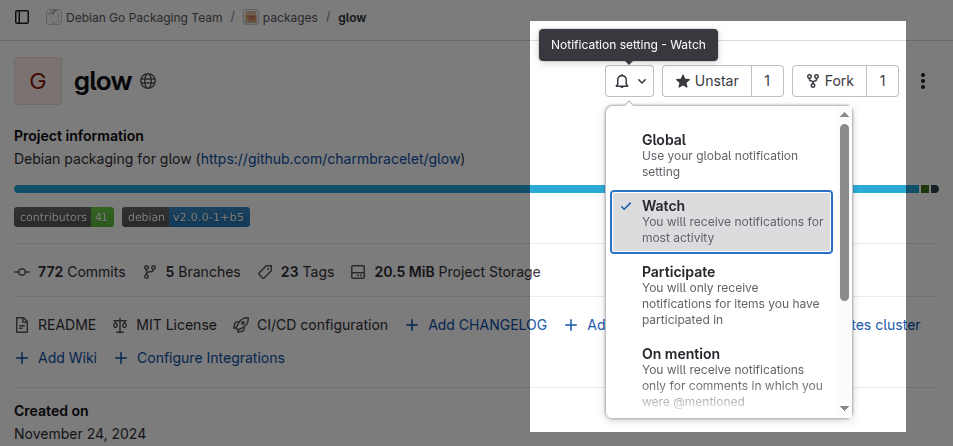
Reviewing Merge Requests This section about reviewing is not exclusive to Debian package maintainers anyone can contribute to Debian by reviewing open Merge Requests. Typically, the larger an open source project gets, the more help is needed in reviewing and testing changes to avoid regressions, and all diligently done work is welcome. As the famous Linus quote goes, given enough eyeballs, all bugs are shallow . On salsa.debian.org, you can browse open Merge Requests per project or for a whole group, just like on any GitLab instance. Reviewing Merge Requests is, however, most fun when they are fresh and the submitter is active. Thus, the best strategy is to ensure you have subscribed to email notifications in the repositories you care about so you get an email for any new Merge Request (or Issue) immediately when posted. Change notification settings from Global to Watch to get an email on new Merge Requests When you see a new Merge Request, try to review it within a couple of days. If you cannot review in a reasonable time, posting a small note that you intend to review it later will feel better to the submitter compared to not getting any response. Personally, I have a habit of assigning myself as a reviewer so that I can keep track of my whole review queue at https://salsa.debian.org/dashboard/merge_requests?reviewer_username=otto, and I recommend the same to others. Seeing the review assignment happen is also a good way to signal to the submitter that their submission was noted.
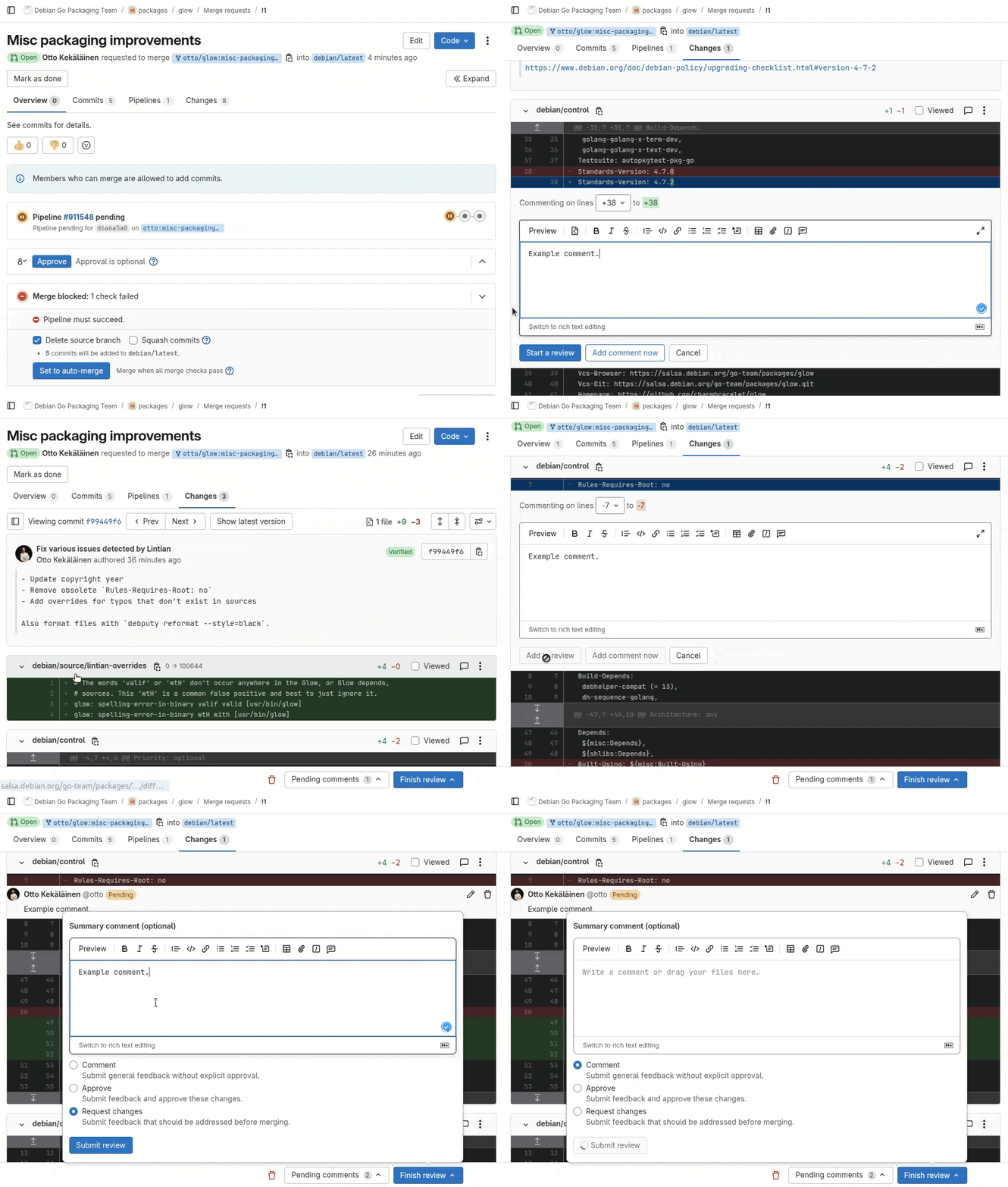
Reviewing commit-by-commit in the web interface Reviewing using the web interface works well in general, but I find that the way GitLab designed it is not ideal. In my ideal review workflow, I first read the Git commit message to understand what the submitter tried to do and why; only then do I look at the code changes in the commit. In GitLab, to do this one must first open the Commits tab and then click on the last commit in the list, as it is sorted in reverse chronological order with the first commit at the bottom. Only after that do I see the commit message and contents. Getting to the next commit is easy by simply clicking Next. Example review to demonstrate location of buttons and functionality When adding the first comment, I choose Start review and for the following remarks Add to review. Finally, I click Finish review and Submit review, which will trigger one single email to the submitter with all my feedback. I try to avoid using the Add comment now option, as each such comment triggers a separate notification email to the submitter.

Reviewing and testing on your own computer locally For the most thorough review, I pull the code to my laptop for local review with git pull <remote url> <branch name>. There is no need to run git remote add as pulling using a URL directly works too and saves from needing to clean up old remotes later. Pulling the Merge Request contents locally allows me to build, run and inspect the code deeply and review the commits with full metadata in gitk or equivalent.

Investing enough time in writing feedback, but not too much See my other post for more in-depth advice on how to structure your code review feedback. In Debian, I would emphasize patience, to allow the submitter time to rework their submission. Debian packaging is notoriously complex, and even experienced developers often need more feedback and time to get everything right. Avoid the temptation to rush the fix in yourself. In open source, Git credits are often the only salary the submitter gets. If you take the idea from the submission and implement it yourself, you rob the submitter of the opportunity to get feedback, try to improve and finally feel accomplished. Sure, it takes extra effort to give feedback, but the contributor is likely to feel ownership of their work and later return to further improve it. If a submission looks hopelessly low quality and you feel that giving feedback is a waste of time, you can simply respond with something along the lines of: Thanks for your contribution and interest in helping Debian. Unfortunately, looking at the commits, I see several shortcomings, and it is unlikely a normal review process is enough to help you finalize this. Please reach out to Debian Mentors to get a mentor who can give you more personalized feedback. There might also be contributors who just dump the code , ignore your feedback and never return to finalize their submission. If a contributor does not return to finalize their submission in 3-6 months, I will in my own projects simply finalize it myself and thank the contributor in the commit message (but not mark them as the author). Despite best practices, you will occasionally still end up doing some things in vain, but that is how volunteer collaboration works. We all just need to accept that some communication will inevitably feel like wasted effort, but it should be viewed as a necessary investment in order to get the benefits from the times when the communication led to real and valuable collaboration. Please just do not treat all contributors as if they are unlikely to ever contribute again; otherwise, your behavior will cause them not to contribute again. If you want to grow a tree, you need to plant several seeds.

Approving and merging Assuming review goes well and you are ready to approve, and if you are the only maintainer, you can proceed to merge right away. If there are multiple maintainers, or if you otherwise think that someone else might want to chime in before it is merged, use the Approve button to show that you approve the change but leave it unmerged. The person who approved does not necessarily have to be the person who merges. The point of the Merge Request review is not separation of duties in committing and merging the main purpose of a code review is to have a different set of eyeballs looking at the change before it is committed into the main development branch for all eternity. In some packages, the submitter might actually merge themselves once they see another developer has approved. In some rare Debian projects, there might even be separate people taking the roles of submitting, approving and merging, but most of the time these three roles are filled by two people either as submitter and approver+merger or submitter+merger and approver. If you are not a maintainer at all and do not have permissions to click Approve, simply post a comment summarizing your review and that you approve it and support merging it. This can help the maintainers review and merge faster.

Making a Merge Request for a new upstream version import Unlike many other Linux distributions, in Debian each source package has its own version control repository. The Debian sources consist of the upstream sources with an additional debian/ subdirectory that contains the actual Debian packaging. For the same reason, a typical Debian packaging Git repository has a debian/latest branch that has changes only in the debian/ subdirectory while the surrounding upstream files are the actual upstream files and have the actual upstream Git history. For details, see my post explaining Debian source packages in Git. Because of this Git branch structure, importing a new upstream version will typically modify three branches: debian/latest, upstream/latest and pristine-tar. When doing a Merge Request for a new upstream import, only submit one Merge Request for one branch: which means merging your new changes to the debian/latest branch. There is no need to submit the upstream/latest branch or the pristine-tar branch. Their contents are fixed and mechanically imported into Debian. There are no changes that the reviewer in Debian can request the submitter to do on these branches, so asking for feedback and comments on them is useless. All review, comments and re-reviews concern the content of the debian/latest branch only. It is not even necessary to use the debian/latest branch for a new upstream version. Personally, I always execute the new version import (with gbp import-orig --verbose --uscan) and prepare and test everything on debian/latest, but when it is time to submit it for review, I run git checkout -b import/$(dpkg-parsechangelog -SVersion) to get a branch named e.g. import/1.0.1 and then push that for review.

Reviewing a Merge Request for a new upstream version import Reviewing and testing a new upstream version import is a bit tricky currently, but possible. The key is to use gbp pull to automate fetching all branches from the submitter s fork. Assume you are reviewing a submission targeting the Glow package repository and there is a Merge Request from user otto s fork. As the maintainer, you would run the commands:
git remote add otto https://salsa.debian.org/otto/glow.git
gbp pull --verbose otto
If there was feedback in the first round and you later need to pull a new version for re-review, running gbp pull --force will not suffice, and this trick of manually fetching each branch and resetting them to the submitter s version is needed:
for BRANCH in pristine-tar upstream debian/latest
do
git checkout $BRANCH
git reset --hard origin/$BRANCH
git pull --force https://salsa.debian.org/otto/glow.git $BRANCH
done
Once review is done, either click Approve and let the submitter push everything, or alternatively, push all the branches you pulled locally yourself. In GitLab and other forges, the Merge Request will automatically be marked as Merged once the commit ID that was the head of the Merge Request is pushed to the target branch.

Please allow enough time for everyone to participate When working on Debian, keep in mind that it is a community of volunteers. It is common for people to do Debian stuff only on weekends, so you should patiently wait for at least a week so that enough workdays and weekend days have passed for the people you interact with to have had time to respond on their own Debian time. Having to wait may feel annoying and disruptive, but try to look at the upside: you do not need to do extra work simply while waiting for others. In some cases, that waiting can be useful thanks to the sleep on it phenomenon: when you yourself look at your own submission some days later with fresh eyes, you might notice something you overlooked earlier and improve your code change even without other people s feedback!

Contribute reviews! The last but not least suggestion is to make a habit of contributing reviews to packages you do not maintain. As we already see in large open source projects, such as the Linux kernel, they have far more code submissions than they can handle. The bottleneck for progress and maintaining quality becomes the reviews themselves. For Debian, as an organization and as a community, to be able to renew and grow new contributors, we need more of the senior contributors to shift focus from merely maintaining their packages and writing code to also intentionally interact with new contributors and guide them through the process of creating great open source software. Reviewing code is an effective way to both get tangible progress on individual development items and to transfer culture to a new generation of developers.

Why aren t 100% of all Debian source packages hosted on Salsa? As seen at trends.debian.net, more and more packages are using Salsa. Debian does not, however, have any policy about it. In fact, the Debian Policy Manual does not even mention the word Salsa anywhere. Adoption of Salsa has so far been purely organic, as in Debian each package maintainer has full freedom to choose whatever preferences they have regarding version control. I hope the trend to use Salsa will continue and more shared workflows emerge so that collaboration gets easier. To drive the culture of using Merge Requests and more, I drafted the Debian proposal DEP-18: Encourage Continuous Integration and Merge Request based Collaboration for Debian packages. If you are active in Debian and you think DEP-18 is beneficial for Debian, please give a thumbs up at dep-team/deps!21.

17 August 2025

C.J. Collier: The Very Model of a Patriot Online

It appears that the fragile masculinity tech evangelists have identified Debian as a community with boundaries which exclude them from abusing its members and they re so angry about it! In response to posts such as this, and inspired by Dr. Conway s piece, I ve composed a poem which, hopefully, correctly addresses the feelings of that crowd.

The Very Model of a Patriot Online
I am the very model of a modern patriot online,
My keyboard is my rifle and my noble cause is so divine.
I didn't learn my knowledge in a dusty college lecture hall,
But from the chans where bitter anonymity enthralls us all.
I spend a dozen hours every day upon my sacred quest,
To put the globo-homo narrative completely to the test.
My arguments are peer-reviewed by fellas in the comments section,
Which proves my every thesis is the model of complete perfection.
I m steeped in righteous anger that the libs call 'white fragility,'
For mocking their new pronouns and their lack of masculinity.
I m master of the epic troll, the comeback, and the searing snark,
A digital guerrilla who is fighting battles in the dark.
I know the secret symbols and the dog-whistles historical,
From Pepe the Frog to  Let s Go Brandon,  in order categorical;
In short, for fighting culture wars with rhetoric rhetorical,
I am the very model of a patriot polemical.
***
I stand for true expression, for the comics and the edgy clown,
Whose satire is too based for all the fragile folks in town.
They say my speech is 'violence' while my spirit they are trampling,
The way they try to silence me is really quite a startling sampling
Of 1984, which I've not read but thoroughly understand,
Is all about the tyranny that's gripping this once-blessed land.
My humor is a weapon, it s a razor-bladed, sharp critique,
(Though sensitive elites will call my masterpiece a form of  hate speech ).
They cannot comprehend my need for freedom from all consequence,
They call it 'hate,' I call it 'jokes,' they just don't have a lick of sense.
So when they call me  bigot  for the spicy memes I post pro bono,
I tell them their the ones who're cancelled, I'm the victim here, you know!
Then I can write a screed against the globalist cabal, you see,
And tell you every detail of their vile conspiracy.
In short, when I use logic that is flexible and personal,
I am the very model of a patriot controversial.
***
I'm very well acquainted with the scientific method, too,
It's watching lengthy YouTube vids until my face is turning blue.
I trust the heartfelt testimony of a tearful, blonde ex-nurse,
But what a paid fact-checker says has no effect and is perverse.
A PhD is proof that you've been brainwashed by the leftist mob,
While my own research on a meme is how I really do my job.
I know that masks will suffocate and vaccines are a devil's brew,
I learned it from a podcast host who used to sell brain-boosting goo.
He scorns the lamestream media, the CNNs and all the rest,
Whose biased reporting I've put fully to a rigorous test
By only reading headlines and confirming what I already knew,
Then posting my analysis for other patriots to view.
With every "study" that they cite from sources I can't stand to hear,
My own profound conclusions become ever more precisely clear.
In short, when I've debunked the experts with a confident "Says who?!",
I am the very model of a researcher who sees right through you.
***
But all these culture wars are just a sleight-of-hand, a clever feint,
To hide the stolen ballots and to cover up the moral taint
Of D.C. pizza parlors and of shipping crates from Wayfair, it s true,
It's all connected in a plot against the likes of me and you!
I've analyzed the satellite photography and watermarks,
I understand the secret drops, the cryptic Qs, the coded sparks.
The  habbening  is coming, friends, just give it two more weeks or three,
When all the traitors face the trials for their wicked treachery.
They say that nothing happened and the dates have all gone past, you see,
But that's just disinformation from the globalist enemy!
Their moving goalposts constantly, a tactic that is plain to see,
To wear us down and make us doubt the coming, final victory!
My mind can see the patterns that a simple sheep could never find,
The hidden puppet-masters who are poisoning our heart and mind.
In short, when I link drag queens to the price of gas and child-trafficking,
I am the very model of a patriot whose brain is quickening!
***
My pickup truck's a testament to everything that I hold dear,
With vinyl decals saying things the liberals all hate and fear.
The Gadsden flag is waving next to one that's blue and starkly thin,
To show my deep respect for law, except the feds who're steeped in sin.
There's Punisher and Molon Labe, so that everybody knows
I'm not someone to trifle with when push to final shoving goes.
I've got my tactical assault gear sitting ready in the den,
Awaiting for the signal to restore our land with my fellow men.
I practice clearing rooms at home when my mom goes out to the store,
A modern Minuteman who's ready for a civil war.
The neighbors give me funny looks, I see them whisper and take note,
They'll see what's what when I'm the one who's guarding checkpoints by their throat.
I am a peaceful man, of course, but I am also pre-prepared,
To neutralize the threats of which the average citizen's unscared.
In short, when my whole identity's a brand of tactical accessory,
You'll say a better warrior has never graced a Cabela's registry.
***
They say I have to tolerate a man who thinks he is a dame,
While feminists and immigrants are putting out my vital flame!
There taking all the jobs from us and giving them to folks who kneel,
And "woke HR" says my best jokes are things I'm not allowed to feel!
An Alpha Male is what I am, a lion, though I'm in this cubicle,
My life's frustrations can be traced to policies Talmudical.
They lecture me on privilege, I, who have to pay my bills and rent!
While they give handouts to the lazy, worthless, and incompetent!
My grandad fought the Nazis! Now I have to press a key for  one 
To get a call-rep I can't understand beneath the blazing sun
Of global, corporate tyranny that's crushing out the very soul
Of men like me, who've lost their rightful, natural, and just control!
So yes, I am resentful! And I'm angry! And I'm right to be!
They've stolen all my heritage and my masculinity!
In short, when my own failures are somebody else's evil plot,
I am the very model of the truest patriot we've got!
***
There putting chips inside of you! Their spraying things up in the sky!
They want to make you EAT THE BUGS and watch your very spirit die!
The towers for the 5G are a mind-control delivery tool!
To keep you docile while the children suffer in a grooming school!
The WEF, and Gates, and Soros have a plan they call the 'Great Reset,'
You'll own no property and you'll be happy, or you'll be in debt
To social credit overlords who'll track your every single deed!
There sterilizing you with plastics that they've hidden in the feed!
The world is flat! The moon is fake! The dinosaurs were just a lie!
And every major tragedy's a hoax with actors paid to cry!
I'M NOT INSANE! I SEE THE TRUTH! MY EYES ARE OPEN! CAN'T YOU SEE?!
YOU'RE ALL ASLEEP! YOU'RE COWARDS! YOU'RE AFRAID OF BEING TRULY FREE!
My heart is beating faster now, my breath is short, my vision's blurred,
From all the shocking truth that's in each single, solitary word!
I've sacrificed my life and friends to bring this message to the light, so...
You'd better listen to me now with all your concentrated might, ho!
***
For my heroic struggle, though it's cosmic and it's biblical,
Is waged inside the comments of a post that's algorithm-ical.
And still for all my knowledge that's both tactical and practical,
My mom just wants the rent I owe and says I'm being dramatical.

12 August 2025

Freexian Collaborators: Debian Contributions: DebConf 25, OpenSSH upgrades, Cross compilation collaboration and more! (by Anupa Ann Joseph)

Debian Contributions: 2025-07 Contributing to Debian is part of Freexian s mission. This article covers the latest achievements of Freexian and their collaborators. All of this is made possible by organizations subscribing to our Long Term Support contracts and consulting services.

DebConf 25, by Stefano Rivera and Santiago Ruano Rinc n In July, DebConf 25 was held in Brest, France. Freexian was a gold sponsor and most of the Freexian team attended the event. Many fruitful discussions were had amongst our team and within the Debian community. DebConf itself was organized by a local team in Brest, that included Santiago (who now lives in Uruguay). Stefano was also deeply involved in the organization, as a DebConf committee member, core video team, and the lead developer for the conference website. Running the conference took an enormous amount of work, consuming all of Stefano and Santiago s time for most of July. Lucas Kanashiro was active in the DebConf content team, reviewing talks and scheduling them. There were many last-minute changes to make during the event. Anupa Ann Joseph was part of the Debian publicity team doing live coverage of DebConf 25 and was part of the DebConf 25 content team reviewing the talks. She also assisted the local team to procure the lanyards. Recorded sessions presented by Freexian collaborators, often alongside other friends in Debian, included:

OpenSSH upgrades, by Colin Watson Towards the end of a release cycle, people tend to do more upgrade testing, and this sometimes results in interesting problems. Manfred Stock reported No new SSH connections possible during large part of upgrade to Debian Trixie , which would have affected many people upgrading from Debian 12 (bookworm), with potentially severe consequences for people upgrading remote systems. In fact, there were two independent problems that each led to much the same symptom:
  • As part of hardening the OpenSSH server, OpenSSH 9.8 split the monolithic sshd listener process into two pieces: a minimal network listener (still called sshd), and an sshd-session process dealing with each individual session. Before this change, when sshd received an incoming connection, it forked and re-executed itself with some special parameters to deal with it; after this change, it forks and executes sshd-session instead, and sshd no longer accepts the parameters it used to accept for this.

    Debian package upgrades happen (roughly) in two phases: first we unpack the new files onto disk, and then we run some configuration steps which usually include things like restarting services. Normally this is fine, because the old service keeps on working until it s restarted. In this case, unpacking the new files onto disk immediately stopped new SSH connections from working: the old sshd received the connection and tried to hand it off to a freshly-executed copy of the new sshd binary on disk, which no longer supports this. This wasn t much of a problem when upgrading OpenSSH on its own or with a small number of other packages, but in release upgrades it left a large gap when you can t SSH to the system any more, and if anything fails in that interval then you could be in trouble.

    After trying a couple of other approaches, Colin landed on the idea of having the openssh-server package divert /usr/sbin/sshd to /usr/sbin/sshd.session-split before the unpack step of an upgrade from before 9.8, then removing the diversion and moving the new file into place once it s ready to restart the service. This reduces the period when new connections fail to a minimum.
  • Most OpenSSH processes, including sshd, check for a compatible version of the OpenSSL library when they start up. This check used to be very picky, among other things requiring both the major and minor part of the version number to match. OpenSSL 3 has a better versioning policy, and so OpenSSH 9.4p1 relaxed this check.

    Unfortunately, bookworm shipped with OpenSSH 9.2p1, so as soon as you unpacked the new OpenSSL library during an upgrade, sshd stopped working. This couldn t be fixed by a change in trixie; we needed to change bookworm in advance of the upgrade so that it would tolerate newer versions of OpenSSL, and time was tight if we wanted this to be available before the release of Debian 13.

    Fortunately, there s a stable-updates mechanism for exactly this sort of thing, and the stable release managers kindly accepted Colin s proposal to fix this there.
The net result is that if you apply updates to bookworm (including stable-updates / bookworm-updates, which is enabled by default) before starting the upgrade to trixie, everything should be fine.

Cross compilation collaboration, by Helmut Grohne Supporting cross building in Debian packages touches lots of areas of the archive and quite some of these matters reside in shared responsibility between different teams. Hence, DebConf was an ideal opportunity to settle long-standing issues. The cross building bof sparked lively discussions as a significant fraction of developers employ cross builds to get their work done. In the trixie release, about two thirds of the packages can satisfy their cross Build-Depends and about half of the packages actually can be cross built.

Miscellaneous contributions
  • Rapha l Hertzog updated tracker.debian.org to remove references to Debian 10 which was moved to archive.debian.org, and had many fruitful discussions related to Debusine during DebConf 25.
  • Carles Pina prepared some data, questions and information for the DebConf 25 l10n and i18n BoF.
  • Carles Pina demoed and discussed possible next steps for po-debconf-manager with different teams in DebConf 25. He also reviewed Catalan translations and sent them to the packages.
  • Carles Pina started investigating a django-compressor bug: reproduced the bug consistently and prepared a PR for django-compressor upstream (likely more details next month). Looked at packaging frictionless-py.
  • Stefano Rivera triaged Python CVEs against pypy3.
  • Stefano prepared an upload of a new upstream release of pypy3 to Debian experimental (due to the freeze).
  • Stefano uploaded python3.14 RC1 to Debian experimental.
  • Thorsten Alteholz uploaded a new upstream version of sane-airscan to experimental. He also started to work on a new upstream version of hplip.
  • Colin backported fixes for CVE-2025-50181 and CVE-2025-50182 in python-urllib3, and fixed several other release-critical or important bugs in Python team packages.
  • Lucas uploaded ruby3.4 to experimental as a starting point for the ruby-defaults transition that will happen after Trixie release.
  • Lucas coordinated with the Release team the fix of the remaining RC bugs involving ruby packages, and got them all fixed.
  • Lucas, as part of the Debian Ruby team, kicked off discussions to improve internal process/tooling.
  • Lucas, as part of the Debian Outreach team, engaged in multiple discussions around internship programs we run and also what else we could do to improve outreach in the Debian project.
  • Lucas joined the Local groups BoF during DebConf 25 and shared all the good experiences from the Brazilian community and committed to help to document everything to try to support other groups.
  • Helmut spent significant time with Samuel Thibault on improving architecture cross bootstrap for hurd-any mostly reviewing Samuel s patches. He proposed a patch for improving bash s detection of its pipesize and a change to dpkg-shlibdeps to improve behavior for building cross toolchains.
  • Helmut reiterated the multiarch policy proposal with a lot of help from Nattie Mayer-Hutchings, Rhonda D Vine and Stuart Prescott.
  • Helmut finished his work on the process based unschroot prototype that was the main feature of his talk (see above).
  • Helmut analyzed a multiarch-related glibc upgrade failure induced by a /usr-move mitigation of systemd and sent a patch and regression fix both of which reached trixie in time. Thanks to Aurelien Jarno and the release team for their timely cooperation.
  • Helmut resurrected an earlier discussion about changing the semantics of Architecture: all packages in a multiarch context in order to improve the long-standing interpreter problem. With help from Tollef Fog Heen better semantics were discovered and agreement was reached with Guillem Jover and Julian Andres Klode to consider this change. The idea is to record a concrete architecture for every Architecture: all package in the dpkg database and enable choosing it as non-native.
  • Helmut implemented type hints for piuparts.
  • Helmut reviewed and improved a patch set of Jochen Sprickerhof for debvm.
  • Anupa was involved in discussions with the Debian Women team during DebConf 25.
  • Anupa started working for the trixie release coverage and started coordinating release parties.
  • Emilio helped coordinate the release of Debian 13 trixie.

10 August 2025

Jonathan Carter: Debian 13

Debian 13 has finally been released! One of the biggest and under-hyped features is support for HTTP Boot. This allows you to simply specify a URL (to any d-i or live image iso) in your computer s firmware setup and then you can boot to it directly over the Internet, so no need to download an image, write it to flash disk and then boot from the flash disk on computers made in the last ~5 years. This is also supported on the Tianocore free EFI firmware, which is useful if you d like to try it out on QEMU/KVM. More details about Debian 13 available on the official press release. The default theme for Debian 13 is Ceratopsian, designed by Elise Couper. I ll be honest, I wasn t 100% sure it was the best choice when it won the artwork vote, but it really grew on me over the last few months, and it looked great in combination with all kinds of other things during DebConf too, so it has certainly won me over.
And I particularly like the Plymouth theme. It s very minimal, and it reminds me of the Toy Story Trixie character, it s almost like it helps explain the theme:

Plymouth (start-up/shutdown) theme.

Trixie, the character from Toy Story that was chosen as the codename for Debian 13.

Debian Local Team ISO testing Yesterday we got some locals together for ISO testing and we got a cake with the wallpaper printed on it, along with our local team logo which has been a work in progress for the last 3 years, so hopefully we ll finalise it this year! (it will be ready when it s ready). It came out a lot bluer than the original wallpaper, but still tasted great.
For many releases, I ve been the only person from South Africa doing ISO smoke-testing, and this time was quite different, since everyone else in the photo below tested an image except for me. I basically just provided some support and helped out with getting salsa/wiki accounts and some troubleshooting. It went nice and fast, and it s always a big relief when there are no showstoppers for the release.

My dog was really wishing hard that the cake would slip off.

Packaging-wise, I only have one big new package for Trixie, and that s Cambalache, a rapid application design UI builder for GTK3/GTK4.
The version in trixie is 0.94.1-3 and version 1.0 was recently released, so I ll get that updated in forky and backport it if possible. I was originally considering using Cambalache for an installer UI, but ended up going with a web front-end instead. But that s moving firmly towards forky territory, so more on that another time! Thanks to everyone who was involved in this release, so far upgrades have been very smooth!

C.J. Collier: Upgrading Proxmox 7 to 8

Some variant of the following[1] worked for me. The first line is the start of a for loop that runs on each node in my cluster a command using ssh. The argument -t is passed to attach a controlling terminal to STDIN, STDERR and STDOUT of this session, since there will not be an intervening shell to do it for us. The argument to ssh is a workflow of bash commands. They upgrade the 7.x system to the most recent packages on the repository. We then update the sources.list entries for the system to point at bookworm sources instead of bullseye. The package cache is updated and the proxmox-ve package is installed. Packages which are installed are upgraded to the versions from bookworm, and the installer concludes. Dear reader, you might be surprised how many times I saw the word perl scroll by during the manual, serial scrolling of this install. It took hours. There were a few prompts, so stand by the keyboard! [1]
gpg: key 1140AF8F639E0C39: public key "Proxmox Bookworm Release Key " imported
# have your ssh agent keychain running and a key loaded that's installed at 
# ~root/.ssh/authorized_keys on each node 
apt-get install -y keychain
eval $(keychain --eval)
ssh-add ~/.ssh/id_rsa
# Replace the IP address prefix (100.64.79.) and  suffixes (64, 121-128)
# with the actual IPs of your cluster nodes.  Or use hostnames :-)
for o in 64 121 122 123 124 125 126 127 128 ; do   ssh -t root@100.64.79.$o '
  sed -i -e s/bullseye/bookworm/g /etc/apt/sources.list $(compgen -G "/etc/apt/sources.listd.d/*.list") \
  && echo "deb [signed-by=/usr/share/keyrings/proxmox-release.gpg] http://download.proxmox.com/debian/pve bookworm pve-no-subscription" \
      dd of=/etc/apt/sources.list.d/proxmox-release.list status=none \
  && echo "deb [signed-by=/usr/share/keyrings/proxmox-release.gpg] http://download.proxmox.com/debian/ceph-quincy bookworm main no-subscription" \
      dd of=/etc/apt/sources.list.d/ceph.list status=none \
  && proxmox_keyid="0xf4e136c67cdce41ae6de6fc81140af8f639e0c39" \
  && curl "https://keyserver.ubuntu.com/pks/lookup?op=get&search=$ proxmox_keyid " \
      gpg --dearmor -o /usr/share/keyrings/proxmox-release.gpg  \
  && apt-get -y -qq update \
  && apt-get -y -qq install proxmox-ve \
  && apt-get -y -qq full-upgrade \
  && echo "$(hostname) upgraded"'; done

6 August 2025

David Bremner: Using git-annex for email and notmuch metadata

Introducing git-remote-notmuch Based on an idea and ruby implementation by Felipe Contreras, I have been developing a git remote helper for notmuch. I will soon post an updated version of the patchset to the notmuch mailing list (I wanted to refer to this post in my email). In this blog post I'll outline my experiments with using that tool, along with git-annex to store (and sync) a moderate sized email store along with its notmuch metadata.

WARNING The rest of this post describes some relatively complex operations using (at best) alpha level software (namely git-remote-notmuch). git-annex is good at not losing your files, but git-remote-notmuch can (and did several times during debugging) wipe out your notmuch database. If you have a backup (e.g. made with notmuch-dump), this is much less annoying, and in particular you can decide to walk away from this whole experiment and restore your database.

Why git-annex? I currently have about 31GiB of email, spread across more than 830,000 files. I want to maintain the ability to search and read my email offline, so I need to maintain a copy on several workstations and at least one server (which is backed up explicitly). I am somewhat commited to maintaining synchronization of tags to git since that is how the notmuch bug tracker works. Commiting the email files to git seems a bit wasteful: by design notmuch does not modify email files, and even with compression, the extra copy adds a fair amount of overhead (in my case, 17G of git objects, about 57% overhead). It is also notoriously difficult to completely delete files from a git repository. git-annex offers potential mitigation for these two issues, at the cost of a somewhat more complex mental model. The main idea is that instead of committing every version of a file to the git repository, git-annex tracks the filename and metadata, with the file content being stored in a key-value store outside git. Conceptually this is similar to git-lfs. From our current point, the important point is that instead of a second (compressed) copy of the file, we store one copy, along with a symlink and a couple of directory entries.

What to annex For sufficiently small files, the overhead of a symlink and couple of directory entries is greater than the cost of a compressed second copy. When this happens depends on several variables, and will probably depend on the file content in a particular collection of email. I did a few trials of different settings for annex.largefiles to come to a threshold of largerthan=32k 1. For the curious, my experimental results are below. One potentially surprising aspect is that annexing even a small fraction of the (largest) files yields a big drop in storage overhead.
Threshold fraction annexed overhead
0 100% 30%
8k 29% 13%
16k 12% 9.4%
32k 7% 8.9%
48k 6% 8.9%
100k 3% 9.1%
256k 2% 11%
(git) 0 % 57%
In the end I chose to err on the side of annexing more files (for the flexibility of deletion) rather than potentially faster operations with fewer annexed files at the same level of overhead. Summarizing the configuration settings for git-annex (some of these are actually defaults, but not in my environment).
$ git config annex.largefiles largerthan=32k
$ git config annex.dotfiles true
$ git config annex.synccontent true

Delivering mail To get new mail, I do something like
# compute a date based folder under $HOME/Maildir
$ dest = $(folder)
# deliver mail to $ dest  (somehow).
$ notmuch new
$ git -C $HOME/Maildir add $ folder 
$ git -C $HOME/Maildir diff-index --quiet HEAD $ folder    git -C $HOME/Maildir commit -m 'mail delivery'
The call to diff-index is just an optimization for the case when nothing was delivered. The default configuration of git-annex will automagically annex any files larger than my threshold. At this point the git-annex repo knows nothing about tags. There is some git configuration that can speed up the "git add" above, namely
$ git config core.untrackedCache true
$ git config core.fsmonitor true
See git-status(1) under "UNTRACKED FILES AND PERFORMANCE" Defining notmuch as a git remote Assuming git-remote-notmuch is somewhere in your path, you can define a remote to connect to the default notmuch database.
$ git remote add database notmuch::
$ git fetch database
$ git merge --allow-unrelated database
The --allow-unrelated should be needed only the first time. In my case the many small files used to represent the tags (one per message), use a noticeable amount of disk space (in my case about the same amount of space as the xapian database). Once you start merging from the database to the git repo, you will likely have some conflicts, and most conflict resolution tools leave junk lying around. I added the following .gitignore file to the top level of the repo
*.orig
*~
This prevents our cavalier use of git add from adding these files to our git history (and prevents pushing random junk to the notmuch database. To push the tags from git to notmuch, you can run
$ git push database master
You might need to run notmuch new first, so that the database knows about all of the messages (currently git-remote-notmuch can't index files, only update metadata). git annex sync should work with the new remote, but pushing back will be very slow 2. I disable automatic pushing as follows
$ git config remote.database.annex-push false
Unsticking the database remote If you are debugging git-remote-notmuch, or just unlucky, you may end up in a sitation where git thinks the database is ahead of your git remote. You can delete the database remote (and associated stuff) and re-create it. Although I cannot promise this will never cause problems (because, computers), it will not modify your local copy of the tags in the git repo, nor modify your notmuch database.
$ git remote rm database
$ git update-rf -d notmuch/master
$ rm -r .git/notmuch
Fine tuning notmuch config
  • In order to avoid dealing with file renames, I have
      notmuch config maildir.synchronize_flags false
    
  • I have added the following to new.ignore:
       .git;_notmuch_metadata;.gitignore
    

  1. I also had to set annex.dotfiles to true, as many of my maildirs follow the qmail style convention of starting with a .
  2. I'm not totally clear on why it so slow, but certainly git-annex tries to push several more branches, and these are ignored by git-remote-annex.

Colin Watson: Free software activity in July 2025

About 90% of my Debian contributions this month were sponsored by Freexian. You can also support my work directly via Liberapay or GitHub Sponsors. DebConf I attended DebConf for the first time in 11 years (my last one was DebConf 14 in Portland). It was great! For once I had a conference where I had a fairly light load of things I absolutely had to do, so I was able to spend time catching up with old friends, making some new friends, and doing some volunteering - a bit of Front Desk, and quite a lot of video team work where I got to play with sound desks and such. Apparently one of the BoFs ( birds of a feather , i.e. relatively open discussion sessions) where I was talkmeister managed to break the automatic video cutting system by starting and ending precisely on time, to the second, which I m told has never happened before. I ll take that. I gave a talk about Debusine, along with helping Enrico run a Debusine BoF. We still need to process some of the feedback from this, but are generally pretty thrilled about the reception. My personal highlight was getting a shout-out in a talk from CERN (in the slide starting at 32:55). Other highlights for me included a Python team BoF, Ian s tag2upload talk and some very useful follow-up discussions, a session on archive-wide testing, a somewhat brain-melting whiteboard session about the multiarch interpreter problem , several useful discussions about salsa.debian.org, Matthew s talk on how Wikimedia automates their Debian package builds, and many others. I hope I can start attending regularly again! OpenSSH Towards the end of a release cycle, people tend to do more upgrade testing, and this sometimes results in interesting problems. Manfred Stock reported No new SSH connections possible during large part of upgrade to Debian Trixie , and after a little testing in a container I confirmed that this was a reproducible problem that would have affected many people upgrading from Debian 12 (bookworm), with potentially severe consequences for people upgrading remote systems. In fact, there were two independent problems that each led to much the same symptom: The net result is that if you apply updates to bookworm (including stable-updates / bookworm-updates, which is enabled by default) before starting the upgrade to trixie, everything should be fine. Many thanks to Manfred for reporting this with just enough time to spare that we were able to fix it before Debian 13 is released in a few days! debmirror I did my twice-yearly refresh of debmirror s mirror_size documentation, and applied a patch from Christoph Goehre to improve mirroring of installer files. madison-lite I proposed renaming this project along with the rmadison tool in devscripts, although I m not yet sure what a good replacement name would be. Python team I upgraded python-expandvars, python-typing-extensions (in experimental), and webtest to new upstream versions. I backported fixes for some security vulnerabilities to unstable: I fixed or helped to fix a number of release-critical bugs: I fixed some other bugs, mostly Severity: important: I reinstated python3-mastodon s build-dependency on and recommendation of python3-blurhash, now that the latter has been fixed to use the correct upstream source.

5 August 2025

Ravi Dwivedi: Tricked by a website while applying for Vietnam visa

In December 2024, Badri and I went to Vietnam. In this post, I ll document our experiences with the visa process of Vietnam. Vietnam requires an e-visa to enter the country. The official online portal for the e-visa application is evisa.xuatnhapcanh.gov.vn/. However, I submitted my visa application on the website vietnamvisa.govt.vn. It was only after submitting my application and making the payment that I realized that it s not the official e-visa website. The realization came from the tagline mentioned in the top left corner of the website - the best way to obtain a Vietnam visa. I was a bit upset that I got tricked by that website. I should have checked the top level domains of Vietnam s government websites. Anyways, it is pretty easy to confuse govt.vn with gov.vn. I also paid double the amount of the official visa fee. However, I wasn t asked to provide a flight reservation or hotel bookings - documents which are usually asked for most of the visas. But they did ask me for a photo. I was not even sure whether the website was legit or not. Badri learnt from my experience and applied through the official Vietnam government website. During the process, he had to provide a hotel booking as well as enter the hotel address into the submission form. Additionally, the official website asked to provide the exact points of entry to and exit from the country, which the non-official website did not ask for. On the other hand, he had to pay only 25 USD versus my 54 USD. It turned out that the website I registered on was also legit, as they informed me a week later that my visa has been approved, along with a copy of my visa. Further, I was not barred from entering and found to be holding a fake visa. It appears that the main scam is not about the visa being fake, but rather that you will be charged more than if you apply through the official website. I would still recommend you (the readers) to submit your visa application only through the official website and not on any of the other such websites. Our visa was valid for a month (my visa was valid from the 4th of December 2024 to the 4th of January 2025). We also had a nice time in Vietnam. Stay tuned for my Vietnam travel posts! Credits to Badri for proofreading and writing his part of the experience.

Thomas Lange: FAIme service new features: Linux Mint support and data storage for USB

Build your own customized Linux Mint ISO Using the FAIme service [1] you can now build your own customized installation ISO for Xfce edition of Linux Mint 22.1 'Xia'. You can select the language, add a list of additional packages, set the username and passwords. In the advanced settings you may add your ssh public key, some grub option and add a postinst script to be executed. Add writable data partition for USB sticks For all variants of ISOs (all live and all install ISOs) you can add a data partition to the ISO by just clicking a checkbox. This writable partition can be used when booting from USB stick. FAI will use it to search for a config space and to store the logs when this partition is detected. The logs will be stored in the subdirectory logs on this partition. For using a different config space than the one on the ISO (which is read only) create a subdirectory config and copy a FAI config space into that directory. Then set FAI_CONFIG_SRC=detect:// (which is the default) and FAI will search for a config space on the data partition and uses this. More info about this [2] You can also store some local packages in your config space, which will be installed automatically, without the need of recreating the ISO.

Next.

Previous.