Search Results: "weasel"

17 February 2010

Bastian Venthur: Links not opening in Thunderbird 3?

If you re using KDE and upgraded to Thunderbird 3 lately you might have the problem that links in emails don t open in a browser anymore. For my case that happened even without a user visible error message. If that sounds familiar for you, check the error console (Tools/Error-Console). If there is an error like:
Error: uncaught exception: [Exception... "Component returned failure
code: 0x80004005 (NS_ERROR_FAILURE)
[nsIExternalProtocolService.loadUrl]   nsresult:  0 80004005
(NS_ERROR_FAILURE)   location:  JS frame ::
chrome://communicator/content/contentAreaClick.js :: openLinkExternally
:: line 188   data: no]
Then Thunderbird just (silently) fails to launch the browser. Guido pointed me to gconftool. gconftool -R / grep url-handlers told me that some components of gnome still had Firefox configured as http-handler (which is strange since it was rebranded to iceweasel ages ago). Resetting them solved the problem for me. The sad part of the story: x-www-browser, sensible-browser and KDE s http handler where all correctly configured and pointed to iceweasel. All applications behaved correctly only Icedove used a (for me) hidden setting pointing to firefox.

13 February 2010

Mike Hommey: When will Iceweasel 3.6 come ?

That is a question I hear more and more, and I felt it had to be answered publicly. Short answer: when it s ready. The current target for Squeeze is 3.5, for various reasons, but the main is that it shares the same Gecko version as Iceape (SeaMonkey) and Icedove (Thunderbird), which means that while the security team (or myself) will have to update these three for security updates, they will share patches. So 3.6 is less a priority than having 3.5 in shape for the release. Last week, I wrote on a mailing list post that I was expecting 3.6 to come this week. Well, that was before I discovered the sad reality about the state of the current version. But 3.6 is still on the radar. I already went through all the patches we apply on 1.9.1, and rebasing should now be straightforward. Most of the 3.5 failures have now also been addressed: sparc and powerpc were fixed first, and I am now (re-re-re -re)building on arm for, I hope, the last time. Unfortunately, mips is still missing, and without a porterbox, I can t do much. I tried, some time ago, in qemu, but there is no way I m going to wait 50 hours for a build again ; it was already painful on a real arm box (where it takes 90 minutes just to link libxul.so). Anyways, 2 patches stolen from upstream and 5 patches sent (or almost sent for the one currently under validation) later, we should be down to one release architecture failing instead of four. Which is already good. On the other hand, a new 3.5 upstream release, with security fixes, is planned for next tuesday, which means some time will have to be spent for stable updates, too. So, in the next few days, expect that I ll be working on stable security updates, then unstable updates, including the three architectures fix, and then work on 3.6 will continue. Which means we can hope for a 3.6 release in experimental by the end of next week, or the following one, in the worst case. Update: *sigh* 4 patches on arm is not enough :(. At least this time I think I m done with xptcinvoke and xptcstubs. Update:In the end, 2 patches and disabling the JIT compiler did the trick on arm. The 2 other patches were actually addressing bugs that only existed because the JIT is doing something wrong with the stack alignment.

10 February 2010

Mike Hommey: Iceweasel upgrade homepage, a week later

When users upgrade Firefox, they are shown a special web page after restart. As this was obviously very Firefox oriented, this was disabled in Iceweasel. Until a week ago. A week ago, I created a (quite raw) web page that users of Iceweasel 3.5.6-2 would see after they install or upgrade. The idea behind this page was suggested by Moritz Muehlenhoff during my BoF at DebConf 9, and consisted of displaying a call for help message in a splash screen. What most looked like this in Iceweasel is the Firefox feature mentioned above. I unfortunately wasn t able to implement it until now. So, a week after these pages were put online and Iceweasel 3.5.6-2 was uploaded, even though I can t say it s a huge success, it at least led to some movement: More than 12000 users (still growing) saw the pages, out of which almost 1800 (roughly 15%) followed the link for a new logo. While there was no contribution for a new logo yet, there has already been several translations contributions for the web pages, in german, spanish and italian. Next iceweasel upload will consequently send users to a localized version of the web page when it exists. The server logs also allow to have some figures on the usage of localized versions of Iceweasel, but as this is based on user agent strings, it is not totally accurate, though somehow interesting:
  1. english: 58.3%
  2. german: 15.2%
  3. french: 7.9%
  4. spanish: 3.8%
  5. italian: 2.7%
  6. polish: 2.5%
  7. japanese: 2.2%
  8. russian: 2.1%
  9. portuguese: 1%
  10. czech: 0.6%
Another interesting figure is that apparently 2.4% of users haven t upgraded xulrunner-1.9.1 and are not using version 1.9.1.6 with their Iceweasel 3.5.6. I m afraid of what this can mean for stable security updates, although, as being security updates, they may be followed better. Somewhere around 7% of users have, at some point, changed their user agent string to include Firefox in it, because web sites suck. This is a very interesting figure because despite that being quite significant, we haven t got that many complaints (I m not saying there weren t, but I would have expected more, considering the amount of users involved). Fortunately, this was changed recently, so all these users could reset their user agent string. And last but not least, except amd64 and x86 users, we saw 14 powerpc users and 7 arm users.

4 February 2010

Mike Hommey: xulrunner 1.9.1.6-2 diff stats

As part of preparing xulrunner 1.9.2 (which would lead to Iceweasel 3.6), I have gone through all the patches currently applied to the latest xulrunner release, to keep track of what should be upstreamed, what needed feedback, what patches I needed to update in upstream bugzilla, etc. As I have talked about our differences with upstream on a few occasions already, and as I was doing this grunt work anyway, I thought it would be nice to make the results public. First, a few reference numbers (excluding changes to generated configure files): A few observations on the above data: The latter used to be true, but is not anymore: xulrunner 1.9.1.6-2 added a lot of changes and is now up to: 98 files changed, 1107 insertions(+), 517 deletions(-). What happened ? will you ask me. A lot happened: the test suite, attempts at correctly installing C++ headers and IDL files, bug fixes. Work has also been done such that make clean/distclean doesn t leave stuff around and that xulrunner can be properly built twice in a row. Differences between 1.9.1.6-1 and 1.9.1.6-2 look like this: 31 files changed, 341 insertions(+), 167 deletions(-). Some were stolen from bugzilla (13 files changed, 162 insertions(+), 70 deletions(-)): Many others were sent: A few others were filed without a patch, as I felt a proper upstreamable patch needed discussion (3 files changed, 16 insertions(+), 3 deletions(-)): A few changes are related to the way we build and how we run the test suite (5 files changed, 35 insertions(+), 18 deletions(-)): Finally, a few were related to the Debian changes history (2 files changed, 1 insertions(+), 26 deletions(-)): Going through the rest of the changes between upstream and the latest Debian release, we can split in 5 categories of changes:
Those that were picked from upstream, or sent and eventually applied in 1.9.2 or trunk (12 files changed, 68 insertions(+), 41 deletions(-)): Those that were picked from bugzilla or sent there, but are not applied upstream for various reasons (29 files changed, 138 insertions(+), 209 deletions(-)): Those that were reported but for which I wanted feedback for a proper fix, yet a patch was applied in Debian because this was necessary (6 files changed, 22 insertions(+), 13 deletions(-)): Those that are yet to be sent to bugzilla (15 files changed, 111 insertions(+), 54 deletions(-)): And finally, the changes that are either Debian specific or not deemed upstreamable (30 files changed, 460 insertions(+), 77 deletions(-) ; this can sound huge, but see the details below): Note, the numbers in the various diff stats obviously don t add up, since some changes overlap. All that information doesn t account the few additional components added in debian/filemonitor and debian/extra-stuff, that account for nearly 600 lines (excluding licensing boilerplate), but I ll talk about these in another post. This analysis also helped spotting another harmless merge error (the first one was spotted a few weeks ago and just left the enable-system-lcms around, without any effect): a variable replacement in a Makefile that doesn t have any effect, since the 2 variables have the same value. Only a pointless 1 line change.

31 January 2010

Cyril Brulebois: Saving Private G-I

(Disclaimer: this post is not about G.I.) Graphical installer Josselin posted his thoughts about g-i, and given at least the first parts sound doable, I m tempted to have a look at dealing with the needed udebs. Never touched anything like this before, but oh well, one learns every day. Time to learn a bit more about X11 as well. It looks like generating a new mini.iso (using d-i s trunk) wasn t that difficult, so hopefully once I m done with a few udebs, it should be possible to add them to this image and make sure those are usable, at least when loaded manually. Once that finished, gluing everything together is probably going to be another story, but hopefully that won t be impossible. Unrelated stories

30 January 2010

Mike Hommey: Feeling alone

The EFF is running an experiment to see how you can be identified with your web browser, without the use of cookies nor your IP address. I m apparently currently the only Iceweasel 3.5.6-1 amd64 (with an english locale) user who participated. I feel alone. One in 268977 so far. That s more than 18 bits of entropy.

27 January 2010

Mike Hommey: Ubuntu switches default search engine. Will Google react ?

Many have commented on the event. As I noted in a reply to Romain Beauxis s post, the only reason Google was the default search engine in Ubuntu, and is still in other distros is because Mozilla has a revenue deal with Google. Which means that actually, Mozilla might be getting money from Debian, Ubuntu and other distros users actions on the Google search engine. (maybe not from Debian, though, because of the search url including iceweasel instead of firefox). Now, at least, Ubuntu will be the one getting the money. One has to know that these revenue deals probably don t cost a dime to Google and Microsoft (through Yahoo), because they may be transferring revenue they get from the extra advertising revenue they can get from these users being using their search engine as default. Anyways, much more interesting to know is how Google is going to react on other services: some core functionalities of Firefox (geolocation, safe browsing) are based on Google services. These are actually a possible problem for Debian, depending on the agreement between Mozilla and Google, and I have yet to address the RC bug I filed on my own package about these. Now, since Google is going to get less advertising revenue from Ubuntu users in favour of one of its competitor, why should they provide the geolocation and safe browsing to these users ?

19 December 2009

Mike Hommey: Iceweasel bug triaging

I ve spent a few hours going through all the unclassified important bugs assigned to iceweasel. This resulted in In the closed bugs, there were several kind of bugs: It will feel good when it will be visible on the bug graph. Still 500+ to go *sigh* Who wants to jump on the bandwagon ? ;)

29 November 2009

Jonathan McDowell: DIY laptop SSD "upgrade"

I'm due a new laptop; my Portege R200 is over 4 years old now, I find it much slower than my desktop (no surprise; P-M 1.2GHz/1.2GB vs Core 2 2GHz/4GB), it's had a new battery and it has an annoying whine on the screen unless you press the side in just the right way. It's still better for long periods of use than my EEE 901, which is why I keep it. In particular I'm off to LCA2010 in January, along with some associated travel beforehand, and I'll want more than the EEE for that, but probably not a brand new laptop. Which meant that when the R200 started throwing disk errors recently I wasn't particularly happy.

Having decided it wasn't worth buying a new 1.8" drive I looked for alternatives. eBay offered plenty of options for 1.8" IDE to CF adaptors and I picked up a Kingston 32GB CF card from eBuyer. I copied across the data from the old drive using a USB adaptor, frobbed grub sufficiently that I got it installed on the CF, then swapped out the drive for the adaptor + CF. I had to do the swap a few times; the first I forgot to have a kernel with ext2 support (the HDD was ext3, but I went back to ext2 for the CF). The second I'd done my usual trick of forgetting to populate /dev with things like console and sda* (ie enough to get to the point where udev will run). And then grub needed some prodding to boot without intervention. I got there in the end and I'm currently writing this from said laptop.

I've made a few changes to the Debian install in an attempt to make things smoother; basically the same tricks people have been using on EEEs or other slow SSD devices. No swap, Iceweasel synchronous toolkit writes disabled, filesystems mounted with noatime, /tmp on tmpfs, various daemons that I don't really use disabled. It's still noticably slower than with the HDD, particularly on writes. However it's quieter and as long as it lasts for the next 3 months I'm happy (plus after that I can reuse the 32G CF card somewhere else, which I couldn't have done with a 1.8" HDD as easily).

Now, back to eying the Lenovo X200s (ugly, trackpoint but 1440x900 display, good battery life) and Toshiba R600 (slower, lower res but pretty and trackpad).as potential replacements. Maybe there'll be something even shinier in 12" by next year...

7 November 2009

Romain Francoise: Zeya: your music, anywhere


The 0.3 release of Zeya is now available in unstable. If you haven't heard of it, Zeya is a web music player that brings your music to any <audio>-capable browser like Iceweasel/Firefox or Google Chrome, turning your collection into a personal online streaming service, using only Free Software (Zeya is licensed under the Affero GPLv3).

Phil has more details about this release, as you can see I contributed a few new features like a search function (100% client-side) and some performance improvements. It's been great fun hacking on Zeya in this cycle and there's plenty of interesting new stuff to add in the near future; feel free to join the team if you want to contribute!

Sha Liu: Chrome on Debian


I just installed google chrome on Debian. It s really awesome that I can t believe my eyes at first! I found that most sites I visited usually are well displayed in the layout. And the fonts in it are much better than in my iceweasel. From the screenshots down below, I can say that no one could tell I m using Debian instead of Windows xp! Although the linux version of Chrome has been released for a while, I told myself that iceweasel is good enough with my collection of add-ons and Chrome is just another beautiful and fancy browser which doesn t have much more practical value in everyday use. Now I found I m WRONG! Except the "speed boom" on openning and loading web page, the fine layout and its simplicity is really fascinating! I really recommend it to others who still have doubt in Chrome. At least, it offers another good choice of browser to you. If you re interested, you can download it here and installed it with "dpkg -i google-chrome-unstable_current_i386.deb". And voila, you can now enjoy it!
my chrome screenshot 1
chrome my chrome screenshot 2
chrome2 my firefox screenshot
firefox

17 October 2009

Eugene V. Lyubimkin: Debian packages with big number of bugs

While working on Debian, I often don't realize how some important packages lack manpower to handle issues. Examples that touched me are 'apt' and 'perl'. As someone told many times, it would be good if someone with free time, especially newcomers to Debian, help triaging/reproducing bugs in the BTS, writing patches etc. This activity usually doesn't require helper to be a DD or DM, and will usually be more appreciated than preparing 11th web server or 30th window manager to Debian archive. Just ask maintainer(s). Also, you may want to read http://wiki.debian.org/HelpDebian to get the wider picture.

I tried to quickly find a table with Debian packages with highest bug rates over the Debian BTS, but failed, so I constructed my own one, with the help of UDD. This list contains BTS packages with number of bugs > 100 and is available here. The top ten:


          source            rc_bugs   all_bugs 
--------------------------+---------+----------
 wnpp                             0       3024
 installation-reports            10       2119
 apt                              4        682
 linux-2.6                        0        617
 aptitude                         0        576
 iceweasel                        3        490
 openssh                          1        417
 evolution                        0        362
 util-linux                       1        344
 dpkg                             1        343

13 October 2009

Stefano Zacchiroli: TeX gadget of the day: detexify

decompile TeX symbols Here is the best TeX gadget ever: Detexify. It is basically a decompiler for TeX symbols: you draw them using the mouse and you get back the corresponding TeX markup. It (claims to) supports all of the comprehensive LaTeX symbol list, so that you can avoid browsing through it again and again in the future (and keeping various printed copies of it: at home, in the office, ...). I've used in the past some other drawing-based search engines, but I've always found them no more than toys. This is the first service that I find very useful based on similar technology. Also, source code is available from GitHub (which is unfortunately down at the time of writing, so I can't check the license ...). Note that the web interface relies on some HTML5 elements (e.g. canvas), so you'll need recent browsers such as Firefox/Iceweasel 3.5 to use it. (Thanks to Roberto Di Cosmo that pointed me to the service.)

10 October 2009

Andrea Veri: Bits from September / October

Debian maintainer: Some days ago I had the great announcement that my Debian Maintainer s application was accepted and thanks to Jonathan McDowell my key is finally into the debian-maintainers keyring. (which is now part of the debian-keyring itself thanks to the ftp-masters / keyring maintainer work that made the changes on both DAK and keyring) I applied on the 22th of August, and thanks to Reinhard s advocation, everything went on the right side. Many thanks to all the people who made this possible. Pkg-mozext: Around 3 weeks ago I started being involved with the pkg-mozext team working on the new policy and to mozilla-devscripts transition for all iceweasel / icedove extensions. The work is going great so far and we managed to update several extensions that are now part of the team itself. For a fast look at our package list, feel free to browse pkg-mozext s QA page. A lot of work needs to be done, so if anyone wanna jump in, I would suggest to read our guidelines / policy into the team s Wiki Page. Pkg-gnome: GNOME 2.28 is now released, and the pkg-gnome team is now working hard to provide all the needed updates into unstable and experimental. Everything is going great and we are cleaning up everything listed on our schedule. Ephipany is under transition (gecko > webkit) so there are still some open issues / bugs, but now it looks fine so far and it can be used without any particular problem.

Mike Hommey: Iceweasel 3.5.3 in unstable, and fixing RC bugs as a side-effect

I finally started the xulrunner 1.9.1 transition in unstable, and uploaded Iceweasel 3.5.3 there. One of the nice additions to the latest xulrunner (which has actually been in experimental for a couple weeks) is a dh_xulrunner script that adds the proper xulrunner package to shlibs:Depends, which means we are getting nearer to being able to handle xulrunner transitions with binNMUs only. We are still far from it, but it is a step closer. At least, transitions should get a bit easier. The way it works is very hackish, but it apparently works well enough for the packages that currently depend on xulrunner-dev. I also added a xulrunner dh sequence, for the dh users. Anyways, as a side effect of the starting transition, I ended up fixing 4 RC bugs on a single package: Another package with 3 RC bugs is impacted by this transition, but it looks like a good candidate for removal. That s 7 RC bugs adressed by this transition, while not directly related to xulrunner.

27 September 2009

Steve Kemp: Looks like me an Vincent caught you boys at breakfast

It is interesting that Fran ois Marier recently posted a brief "howto" document on debugging problems caused by overly-agressive filtering with privoxy, as I've recently been having problems with that tool. My home network frequently changes configuration depending on what I'm concentrating upon, but every few months I'll start/cease using the following tools: Recently I was experimenting with XSS attacks against various browsers, which meant using them for real. As not all browsers have the same anti-advert setups I was running privoxy to filter out web-annoyances, and I spotted a major flaw with it. Unfortunately I can only describe the problem, not reproduce it, or track it down. I'm 80% certain the bug is in privoxy, but the stack is suitably high that determining that for sure is problematic. In short the issue is that HTTP requests would end up being sent to the wrong host: After that clicking around consistently sends requests to the first HTTP host which was accessed succesfully. So, for example, attempting to visit http://foo.com/bar/ will send the request to http://steve.org.uk/bar - which then gives a 404. In terms of setup I use a dnsmasq DNS cache, privoxy and iceweasel from Debian unstable. From the symptoms I'm not sure if iceweasel's "KeepAlive" system is to blame, or if privoxy has a bad cache of hosts. Perhaps it is dnsmasq returning bogus DNS data, or my cable connection itself having DNS issues. Anyway once the symptoms present themselves closing the browser and restarting the cache fixes it. Until the next time which might be hours or days later. I'd report it as a bug - but I don't know where it should be. Privoxy caching things it shouldn't? iceweasel having keepalive issues? dnsmasq returning wrong DNS entries? I'd ask "Have you seen this before, internet world?" but I guess if you have tracked it down it'd be fixed by now, and it clearly isn't! Anyway for the moment I've uninstalled privoxy. ObFilm: Pulp Fiction

21 September 2009

Andrew Cater: Slowing down?

Trends are deceptive - but I haven't come back to this blogging in a while :)

I did my first Windows XP install for a while today for friends. Their machine had slowed to a crawl and _needed_ a disk format and reinstall. Three sets of media to find, three sets of 20 digit codes to type in. Printer software not found - so they'll have to go and download a huge program bundle from the manufacturer's site. [And it always takes an alleged 39 minutes from first reboot irrespective of the actual speed of the hardware :) ]

New hardware put in - a DVD writer to replace a CD writer which had lasted ten years and moved between at least two machines - that's spectacular in this day and age. The new drive is also 10% of the cost of the old one - 17 instead of about 200.

Total time to put on Windows XP, an AV product, get Firefox and to get part way through an Office 2007 install was about three hours. That's without setting up any accounts, shared directories (or network - the attached wireless router didn't need any changes).

I could do a Debian install onto the 40G disk in well under half that to include X windows, openoffice.org, iceweasel and a desktop environment. It would also run far better in 512M which is what this machine has.

Thankfully, they have data backups and an older laptop which has been the family workhorse - and a new netbook which attached to the network readily, has more disk than all other machines in the house combined, and cost less today than the "big machine" cost ten years ago at about 3 x the performance.

Intelligent questions were asked about Linux - I _wish_ I'd known about Ken Starks' radio advert or had it to hand at the time. See the Blog of Helios at http://linuxlock.blogspot.com for details - it's Free/Libre/Open Source under a CC Atttribute Share-alike 3.0 licence, and is available in a short version used in the radio advertisement .ogg or .mp3 or the longer version (.ogg .mp3 All in all, a balanced and a reasoned argument for switching based on nearly everybody's real life experience :(

[UPDATE] - The owner of the machine was up until 1 a.m - 11 hours total - because the machine decided to do a defrag. :(

15 September 2009

Mike Hommey: Would you like iceweasel 3.0 and 3.5 to be co-installable ?

Hi lazyweb, I m wondering if there a lot of demand for such a feature, being to be able to install 2 (or more) major releases of iceweasel on the same computer. If there is a strong demand, I may consider allowing it. Please reply in the comments on this blog with your feelings, for or against the implementation of this co-installability. Thanks. PS: you may also forward this query to other sites and send people back here to leave their opinion.

3 September 2009

Julian Andres Klode: Chromium


I have just switched to Chromium as my primary browser. I am running the daily-built version from the Ubuntu Jaunty PPA at https://edge.launchpad.net/~chromium-daily/+archive/ppa on my Debian unstable box. It seems quite stable, plugins are also working (with the enable-plugins option) and it can use the system s GTK+ theme for most parts (the buttons, etc. inside webpages are not rendered using GTK+ yet, but the UI is). It currently cannot print and it also has some formatting issues on some websites, and it s not passing the ACID3 test yet (there is a X in the top-right corner). I could have switched to Midori instead, but Midori is missing a cache it seems (the option can not be enabled). I ran the V8 and SunSpider benchmarks to compare Iceweasel 3.5, Midori 0.1.9 (using WebKit GTK+ 1.1.12) and Chromium 4.0.206.0 (r25168). The result was that Iceweasel was 10x times slower than the others in the V8 benchmark and about 5 times slower in the SunSpider benchmark. The others were almost equally fast, but Chromium won the V8 benchmark with 2338 points compared to Midori s 1666. More details are in the PDF Browser Performance, which should have been an ODP, but uploading ODPs is not allowed on wordpress.com. I also ran the V8 benchmark on Arora some time ago, but it was almost as slow as iceweasel. All tests were done on my laptop running Debian GNU/Linux unstable (amd64 architecture). Posted in General

1 September 2009

Adnan Hodzic: Debian Start! (beta)

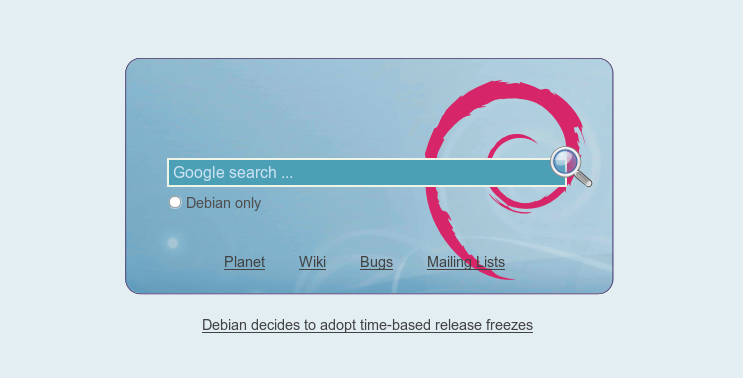
First of all, thank you for all your comments/feedback on previous Start! entries. What kept me busy for last ~25hrs (literally) was making Start! to be properly rendered in all of the browsers and resolutions except IE of course. In the end, I ended up writing the whole thing from scratch, 709 lines which also passed W3 Validator, pretty sweet Smile Whole thing is a combination of html + css + php + javascript; it ll work fine even if you have JavaScript disabled, but for full experience I recommend you got it enabled. It works/renders properly in pretty much every browser (links, Iceweasel/Firefox, Epiphany, Konqueror, Opera, Chrome) except IE (surprisingly 4.15% of Start! users use IE). Either way, now that we have the rendering problem solved, what you can expect from next version is options dialog, with hopefully interesting options Smile After that, possible multilingual support (if required) and that should round up to the final v1.0 Smile Comments of any kind as always are welcome Grin start.debian.net

Next.

Previous.