Search Results: "wart"

7 February 2008

Martin F. Krafft: Best stewart ever

I would like to suggest to my readers to ask airplane crews for explanations of their rules. If we can get a larger number of people to inquire about the reasons behind the do s and dont s on airplanes, maybe the airline companies will adopt the practice. In the context of a previous post on the lack of explanation of the motivations behind airline rules, I was utterly impressed when the steward on the Air New Zealand flight from Melbourne to Wellington asked me to turn off my music player so that I would hear when they asked us to evacuate the plane or similar. While I doubt that I would continue to listen to The Flower Kings in an exceptional event, his explanation actually got me to turn off the player, which I had previously never done (rebel me!). I know it s a bit ridiculous, but I was previously so set on the idea of small devices like a music player interfering with the airplane instruments that I failed to see this obvious bit of logic. The steward thus gets my best steward award. When you fly, ask the crew about the reasons for the rules they impose on you, the passengers! NP: The Flower Kings: Unfold the Future

30 January 2008

Rob Bradford: gnome.conf.au

Awesomeness. Thanks to Jeff for organising it. My talks went really well, thanks to everyone who attended, asked questions and gave feedback. Huge kudos to the other participants. Some great things were shown off and discussed. I’d also like to use this opportunity to promote Josh Stewart’s Gloss. It’s a replacement MythTV frontend using Clutter. He’d love to get some more MythTV users to test it.
Snowman in Melbourne
A Snowman in Melbourne

16 January 2008

Ian Murdock: Sun acquires MySQL

Jonathan Schwartz: “We announced big news today - our preliminary results for our fiscal second quarter, and as importantly, that we’re acquiring MySQL AB.”

14 January 2008

MJ Ray: BeCTA advice, DfES e-Consultation

You may have seen the British Educational Communications and Technology Agency (Becta) advising:-
"Schools and colleges should make pupils, teachers and parents aware of the range of free-to-use products (such as office productivity suites) that are available, and how to use them,"
in reports like http://www.informationweek.com/windows/showArticle.jhtml?articleID=205602879&cid=RSSfeed_TechWeb There's also a consultation on "Home Access to Technology" running until Wednesday 2 April at http://www.dcsf.gov.uk/consultations/conDetails.cfm?consultationId=1522 where you may like to suggest that free software is a good route forwards. (Thanks to Christopher Dawkins for informing ALUG.) Are there other related things we could be doing? (Comments form goes to fsfe-uk.)

31 December 2007

MJ Ray: Strange Traditions: Dinner for One

The last day of each year sees one of the strangest traditions I've ever noticed. A 40-year-old English-language film of an 80-year-old music hall comedy is played repeatedly on various stations in Germany - and in Austria, Switzerland, Denmark and Australia too. There's not only the film, but edited versions, localised versions, spoofs and other shows based around it too. The film still isn't shown on any English stations, as far as I can tell. I'd never heard of it before getting satellite TV. So, to see what the fuss is about, grab your Dinner for One times (may contain annoying ads if you switch Javascript on) and sit down with the satellite TV (best), or enjoy this description and script from analoguesat, a German-language description or this BBC report which includes this snippet:-
"To the end of his life, Freddie Frinton heartily disliked Germany and the Germans, thanks to his own wartime experience. He refused to allow a German-language version to be made. That is what has led to the extraordinary fact that today the Germans as a nation have embraced a trifling one-act play in English as their all-time favourite entertainment."
Anyway, the last joke is on we English. It's much better than the aging boy bands on our TV at New Year, isn't it? (Updated 2008-01-03 with 1 comment)

25 December 2007

Adeodato Sim : Moving to ikiwiki

As many others, I’ve moved this blog to ikiwiki. In fact, I’ve moved my whole 3-page website to ikiwiki, and it only felt natural to migrate the blog as well (I may miss hobix’s webpage, though). Anyway, this gives me a bit more flexibility when creating the RSS feeds, so I’ve now created a separate feed for Planet Debian (which won’t have only Debian-related content, mind you), and left the old RSS URL to include all posts, e.g. some more personal ones, or some that I’d find unsuitable for the planet. If you’re interested, here is the full feed. I run ikiwiki in my laptop to generate static html, and rsync the generated output to the webserver. I have a Bazaar branch in my laptop as well, but it doesn’t interact with ikiwiki in any way. Finally, I’m very grateful that Joey committed this minutes after me mentioning on IRC, and I’m very grateful as well to whoever wrote the typography plugin. Migrating the old blog wasn’t hard, just tedious and boring, particularly since I didn’t want to keep using Textile, but migrate to Markdown. I switched off usedirs to keep old URLs working (I’d rather not mess with redirections), and used the date option of the meta plugin, so that the “Posted” information for old entries when inlining would be accurate. This still left the “Last modified” timestamp in the individual pages wrong, so I just used a script that would change the mtime of the entries in the filesystem to their creation time. One wart I’ve found is that I’m very used to having both a filename and a title for each entry, and have the filename just present in the navigation bar of the browser, and the title shown in big inside the page. You can do this in ikiwiki by using the title option of the meta plugin, and giving a H1 element in the entry content. However, this makes the H1 show in the RSS feed, which I had always noticed in Zack’s blog, and always found inconvenient. Oh well. It also makes for the same title to appear twice in the default [[inline]] page; to solve it, I just hide with CSS the H1 there — zack, e.g., does not use [[meta title]], and aligns the permalink to the right. Update: So I was washing the dishes and it struck me: maybe with a conditional! And, effectively, it is possible, given that there is a convenient included test. So now I start my entries with:
  [[meta title="This is the long title"]]
  [[if test="!included()"
       then="# This is the long title"]]
Yay! Update (2007-12-27): Lars does it differently, by only providing [[meta title]], and modifying the page template to include:
  <h1><TMPL_VAR TITLE></h1>
Update (2007-12-29): I finally decided, at least for now, that is cleaner not having the title duplicated in two lines, and went with a template. I didn’t want the <h1>title</h1> bit in all pages, though, and Joey pointed out that I could use a different template for blog entries using the pagetemplate_plugin.

15 December 2007

Lars Wirzenius: Python optparse: what options got set?

While writing some code for EoC 2 to parse the command line, I needed a generic way to find which command line options were set by the user. That is, after I've parsed a command line, and have the return value of the optparse.OptionParser.parse_args method, how do I find which options were set? The return value is an instance of optparse.Values, which does not have a convenient method for that. So what I do is this:
classattrs = dir(optparse.Values)
for name in [_ for _ in dir(options) if _ not in classattrs]:
    print name, getattr(options, name)
Slightly tricky, and it may stop working in a future version if they change things in the in (undocumented, therefore private) interface, but it's nice to be able to work around library design warts like this when the language itself is nicely powerful.

14 December 2007

Martin F. Krafft: Surveys on the console

As part of my research, I may have to conduct a survey among Debian contributors. The word "survey" usually elicits frowns because surveys are often misconducted. MJ has taken the time to draft up some advice to surveyors. Problems with surveys generally fall into one of two categories: content and presentation. I'll refrain from making statements about content (Wikipedia has some stuff on questionaire construction) and instead concentrate on presentation in the following. Commonly in the digital age, surveys are administered via a web page or e-mail. In my recent Ph.D. transfer report, I identified a number of shortcomings with these approaches: Asking Debian contributors to click radio buttons on a web page is a bit like expecting a mountain biking champion to ride a tricycle across a paddock: painful, if not offensive. Furthermore, web surveys can only be taken while on-line, when most of us have better things to do. E-mail surveys address some of these problems, but create new ones: answers cannot be constrained to a domain (think multiple-choice), character set and formatting issues make evaluation difficult, and it's impossible to prevent users from attaching comments or modifying responses. In thinking about the issue, I came up with a third means to administer a survey: a console tool. Think of a Debian package which provides a console application controlled by a study-specific data file. The data file specifies the questions and their answer domains, and the tool presents those to the participant. Since most of Debian happens on the console anyway, such an approach to surveys seems more appropriate. Interaction with the survey tool would be as easy as pressing the 2 or 4 keys to select one of the multiple choices, and the tool would immediately move on to the next question (and not wait for the user to hit enter). Obviously, n and p should allow navigation back and forth across the set, and c would spawn a text editor to give the user a chance to attach a comment to his/her current response, in which s/he might criticise the question or provide additional information. Finally, the tool should be able to pick up where it left off, should the user chose to exit/suspend the survey for now. Integration with debconf or another interface abstraction is also worth consideration. There is more to it: people change their minds and should thus be able to amend responses. With their consent, it might be valuable to track such changes and inquire about their motivations. As I was thinking about how to realise this, I suddenly arrived at version control: use Git as a backend storage. The set of cool features this would enable seems to be endless: it works off-line and can be used to track aforementioned changes, but also offers the possibility to create a squashed result in case the participant prefers to submit only the final result. Furthermore, it's a trivial change between anonymous submissions, and submissions authenticated by a GPG signature. In addition, the survey tool should be able to display questions according to previous responses (control flow). For instance, if the survey determines that a given user is a contributor to the bug tracking system, but not a project member, it wouldn't make sense to ask when s/he received his/her Debian account. Furthermore, questions could be dynamically creatable from context, so that the survey can drill into depth depending on previous responses, rather than asking the same questions to all participants. I am currently applying for funding to outsource the development of such a tool. If you are interested in coding it up and getting paid for it, speak to me. Here are some more specifications to keep in mind before jumping on: These are likely to be incomplete, but should convey the basic picture. Feedback is always welcome! NP: Oceansize: Frames Update: James Andrewartha pointed me to purity, which asks multiple-choice questions on the console. It has the kind of interface which I envision. Also, Chris Lamb suggested this personality survey as a base line. Well, actually he just suggested I look into it.

11 December 2007

Julien Danjou: Fruit Fly in the box

awesome 2.0 just released. Great. Someone on #awesome pointed me to a post of Don Stewart comparing the rise of the new tiled window managers. This is quite encouraging, and I hope awesome will grow more with the next releases!

6 December 2007

Evan Prodromou: 15 Frimaire CCXVI

My friend Hugh McGuire just launched a new Web site: earideas. It's a curated collection of the best podcasts on the Web -- kind of an interesting choice. Hugh's best known for the Librivox project -- a collaborative effort of thousands to make public-domain audio books freely available on the Web. He's also the leader of datalibre.ca and the co-founder of Collectik, the social sharing site for podcast enthusiasts. All of which is to say that he's a massive-collaboration kind of guy. So why the curated collection? Says Hugh, "It s built specifically so that you don t have to do anything much more than you do when you turn on a radio." In other words, they're finding the best stuff for you. I think the site makes a nice complement to Collectik. In any event: the gang at earideas has asked for lists of people's top 5 favorite podcasts. I'm still not very much into the podcasting thing; I don't have a portable digital music player, and I haven't found listening to music on my laptop or desktop really useful. But I do listen some of the time, so I figure I could give my suggestions.
  1. Linuxcast by the personable and telegenic Don Marti. Great coverage of software and society in the Free world.
  2. FLOSS Weekly. The "weekly" part is a bit of a stretch, but this is a very good interview show about Free/Libre/Open Source Software. I miss Chris DiBona as host, but Randall Schwartz is no slouch, either.
  3. Destinyland. Destiny is perhaps one of the greatest pop culture researchers alive today. This very occasional podcast is just like having Destiny corner you at a party and talk for 90 minutes about the suspicious circumstances of Alfalfa's death. It's fascinating.
  4. CBC Radio 3 Podcast. Yeah, it may make me terribly unhip, but I like Radio 3.
  5. Radio Open Source. I want to hate this show for capitalizing on the name "open source" without actually providing any open content or talking about Free Software. But it's one of the best shows on the Web.
All right, that's my five. Good luck, Hugh and the rest of the gang at earideas.com. tags:

Million-dollar idea So, I use a Logitech Trackman Marble for my desktop computer -- sometimes called the one true pointing device. I think it's awesome, and I've had it for maybe 10 years. The only downside is that every 6-8 weeks I have to pop off the cover and clean out all the finger oils, dust, hand hair and cookie crumbs that have amalgamated to a greasy, fuzzy crud inside. It may be one of the most disgusting things I do regularly -- and remember, I have a 2-year-old, so that's saying something. Anyways, here's my idea for a device, free for you to use. It's a self-cleaning trackball (or mouse). Just like a self-cleaning oven, every few weeks you'd click a special button on the device and it would heat itself to 800 F for about 90 minutes until the dang thing is just glowing white-hot and it vaporizes any crud that may be inside. Then, you can go about your business with a smooth, clean mouse (or trackball) again. Viola! I think the idea would work for keyboards, too, but I really rarely clean my keyboard. Filthy keyboards seem to work fine most of the time, and when they don't work well you can just throw them away and get a new one. But there's no accounting for taste and anyways people may want to buy a matching set of self-cleaning keyboard and mouse rather than just one or the other on its own. You, reader, can use this awesome million-dollar idea on your own, free of charge. Enjoy! tags:

Brandon Holtsclaw: Debian Powers the world

Looks like Microsoft Researches new website InkblotPasswords[.com] , aimed at helping users come up with hard to crack passwords ( while at the same time saving them in a database ) is powered by Debian and Python :) From Netcraft :
Apache/1.3.34 (Debian) mod_python/2.7.11 Python/2.4.4c0 mod_ssl/2.8.25 OpenSSL/0.9.8c

5 December 2007

Jonathan McDowell: A year passes

Katherine and I celebrated our first wedding anniversary over the weekend. We still don't think marriage has changed us or our relationship that much; having lived together for many years beforehand was really a much bigger step. A number of fairly major other events have happened to me in the past year, which I don't think either of us could have predicated. All in all I think I'm in a better place than I was last year. 5:30 starts are painful (it's 2 hours door to door with trains at 6am or 8am and nothing in between), but at least I get to come home to Katherine rather than an empty house, and it's nice to be working in an office again rather than on my own. We will eventually get the Castlerock house sorted (there are still lots of things in boxes, the TV isn't even hooked up, the wireless coverage is patchy in the study, the kitchen isn't quite finished yet, the living room is barely started yet, need I go on?). And I'm sure it'll stop raining for at least one day during the year. Please?

3 December 2007

Michael Prokop: git[-svn] in 30 minutes

… or something like that… I planned to write a short note about how to start with using git-svn so I can provide a pointer to some of my colleagues. It turned out that git has too many nice features that you should be aware of. :) Hopefully my notes (now being a reference for myself as well, thx to gebi for all the help and feedback) are useful anyway. If you think something (more or less essential, or at least something most of us should be aware of) is missing: please feel free to mention that in the comment section of my blog entry, thanks. Disclaimer: I’m still happy with mercurial for what I - and we at grml in general - use it: linear, but anyway distributed development. git on the other hand provides some really nice features. Rebasing and branching with git is really great - so non-linear development just works. As usual: use the right tool for the right job. git is a bit complicate to use. Not only but especially in the beginning. On the other hand I’m not such a big friend of subversion. If you wanthave to use subversion (Graz University of Technology for example provides a svn service to their students and employees) but prefer to work with git instead you should be aware of git-svn. git-svn gives you bidirectional operation between subversion and git. First of all make sure you have all you might need when working with git. Make sure to use a current version of git (I’m refering to version >=1.5.3). Just execute the following command line on your Debian system to install all relevant packages:
aptitude install \
git-buildpackage git-core git-cvs git-daemon-run \
git-doc git-email git-gui git-load-dirs git-svn \
gitk gitweb qgit
Now let’s start with some general and basic configuration:
# Remove directories from the SVN tree if there
# are no files left behind, configure it globaly:
git config --global svn.rmdir=true
# Want some more global, personal git configuration?
for line in  
  user.name=Michael Prokop 
  user.email=foo@example.invalid 
  color.diff=auto 
  color.diff.new=cyan 
  color.diff.old=magenta 
  color.diff.frag=yellow 
  color.diff.meta=green 
  color.diff.commit=normal 
do
  git config --global $line
done
Check out man git-config for much more details about configuration options. First tip: set ‘g’ as an alias for git so you don’t have to type that much. I’ll write the long version in the following examples so copy/paste works for everyone. Make sure to use the short options of git itself as well: use ‘git co’ for example instead of ‘git checkout’. You can define your own aliases inside git as well - either manually in ~/.gitconfig or running something like:
git config --global alias.st status
Enough pre-configuration for now. It’s time to checkout the SVN repository:
# Check out the SVN repository and set 'svn/' as
# prefix for the branches:
git svn clone -s --prefix=svn/ \
https://svn.tugraz.at/svn/$project foobar && 
cd foobar
# Adjust svn:ignore settings within git:
git svn show-ignore >> .git/info/exclude
# List all branches:
git branch -a
# List all remote branches:
git branch -r
# Rebase your local changes against the
# latest changes in SVN (kind of 'svn up'):
git svn rebase
# Checkout a specific branch:
git checkout $branch
Ok so far? But what do we have to do if we want to work on the upstream source and are allowed to commit/push directly to the repository? Let’s see how to work on that without using branches:
# Hack:
$EDITOR foobar
# Check status
git st[atus]
# List diff:
git diff [foobar]
# Commit it with a commit message using $EDITOR:
git commit -a
# Now commit your changes (that were committed
# previously using git) to SVN, as well as
# automatically updating your working HEAD:
git svn dcommit
But what should we do if we do not have commit rights? Let’s create our own branch and send a patch via mail to upstream:
# Make a new branch:
git checkout -b mikas_demo_patch
# and hack...
$EDITOR
# Commit all changes:
git ci -a -m 'Best patch but worst commit msg ever'
# ... and prepare patch[es]:
git format-patch -s -p -n master
# Now send mail(s) either use git-send-email:
git send-email --to foo@example.invalid *.patch
# ... or if you prefer mutt instead (short zsh syntax):
for f in *.patch ; mutt -H $f
You got a mail from someone else and would like to incorporate changes from the attached patch in your repository? Just store the mail in a seperate mailbox (use save-message in mutt for example, keybinding ’s’ by default), then execute:
# Apply a [series of] patch[es] from a mailbox
git am /path/to/mailbox
Want to work on a seperate branch and rebase your work with upstream?
# First of all make sure to use recent sources...
# So pull when using plain git:
git pull -u
# .. or when using git-svn use:
git svn rebase
# Then create a new branch:
git checkout -b mika
# Hack:
$EDITOR
# Commit:
git ci -a -m 'Best patch but worst commit msg ever'
# Switch to master branch:
git checkout master
# Pull again when using plain git:
git pull -u
# .. or when using git-svn use:
git svn rebase
# Finally switch back
git checkout mika
# Now rebase it with plain git using:
git rebase origin/master
# ... or when using git-svn:
git svn rebase
# Now check out the last 5 commits:
git log -n5
Another branch-session might look like:
git co -b foo
$EDITOR
git ci -a -m 'foo changes'
git co master
git co -b bar
$EDITOR
git ci -a -m 'bar changes''
git co foo
git rebase bar
git log -n5
git st
git branch
Pfuhhh? Right. :) Now it’s time to check out another cool feature: git stash, which is just great when pulling into a dirty tree or when suffering from interrupted workflow. Demo:
git stash
git pull / fetch+rebase
$EDITOR # fix conflicts
git commit -a -m "Fix in a hurry"
git stash apply
git stash clear # unless you want to keep the stash
git reset rocks as well:
# List all recent actions:
git reflog
# Now undo the last action:
git reset --hard HEAD@ 0 
How to get rid of branches?
# Delete a branch. The branch must be fully merged:
git branch -d remove_me_branch
# Delete a branch irrespective of its index status:
git branch -D remove_me_branch
# Delete a remote branch:
git push reponame :branch
Repack a git repository to minimize its disk usage:
git pack-refs --prune
git reflog expire --all
git repack -a -d -f -l
git prune
git rerere gc
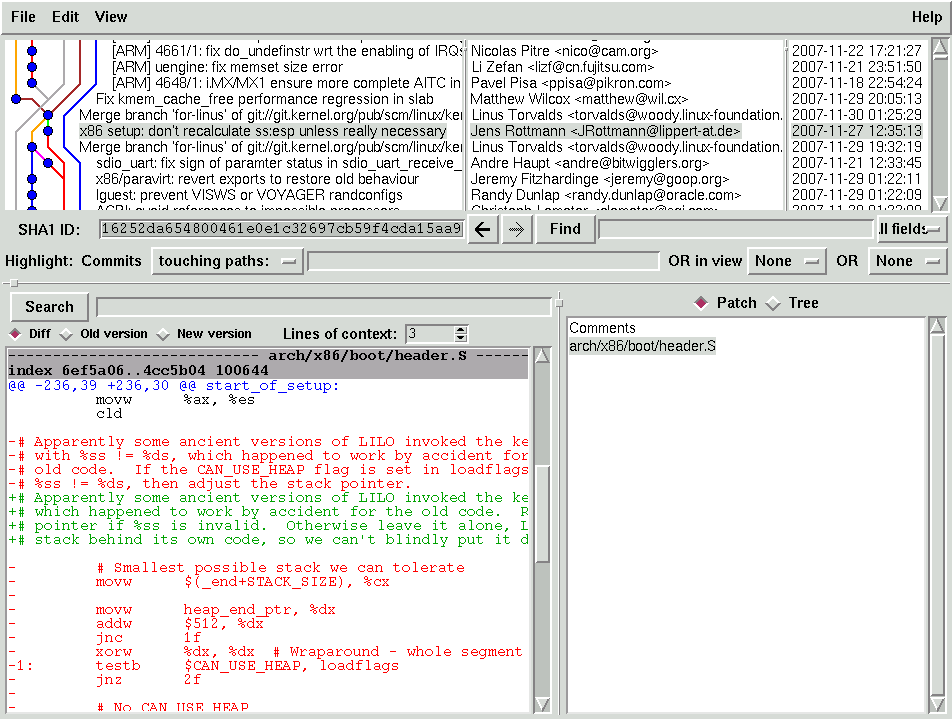
Use git cherry to find commits not merged upstream. Another really cool feature is the interactive rebasing: git rebase –interactive Make sure you are aware of gitk: Screenshot of gitk … and don’t forget to set readable fonts for gitk, like:
[ -r ~/.gitk ]   cat > ~/.gitk << EOF
set mainfont  Arial 10 
set textfont   Courier 10 
set uifont  Arial 10 bold 
EOF
If you prefer a Qt based interface check out qgit. Useful ressources:

28 November 2007

Andrew McMillan: Which is the more interesting hackspace: X or Linux?

A curiously interesting thread has sprung up on the Xorg mailing list recently regarding the lack of bandwidth the developers might have for accepting patches. Bernardo Innocenti, who hacks on OLPC stuff amongst other things, wants to get some patches reviewed for acceptance, but there aren't enough people around with the time and inclination to review and accept his work. He did a quick and dirty analysis of Xorg LoC vs Linux LoC, to give a "X codebase is roughly 1/2 Linux codebase" (which surprised me, actually, I'd always thought it was larger) and then a similarly rough analysis that suggests that Xorg has roughly 1/20th of the developer base. To some extent Bernardo's metrics are arguable, but the basic facts are that Linux gets the lions share of the developers. Is this what we should expect? Is this a healthy way for the free and open source software community to support the development of what I personally would like to see as the future desktop base? Linux does a fantastic job as an OS, right now. It's been doing it for years, really, but we still need to get behind some of the differential further up the stack. And all credit to those stalwarts of X development who are shouldering more than their fair share of the burden. So if you were looking for an open source software project where you can be appreciated, don't overlook X.

Russell Coker: Creepy Social Networking

Cory Doctorow wrote an interesting article about social networking [1]. One of his points is “Imagine how creepy it would be to wander into a co-worker’s cubicle and discover the wall covered with tiny photos of everyone in the office, ranked by “friend” and “foe,” with the top eight friends elevated to a small shrine decorated with Post-It roses and hearts“, another concerns the issue of forced “friends” where colleagues and casual acquaintances demand to be added to a friends list. He speculates that the reason for social networking systems to be a fad is that once too many people you don’t really like force themselves into your friends list then you will feel compelled to join a different service. I believe that the practice of ranking friends is simply a bad idea and wonder whether anyone who has completed high-school has ever used it seriously. If you publicly rank your friends then you will alienate other friends (particularly any who might have ranked you more highly than you ranked them). Everyone who has used social networking systems has discovered the pressure to avoid alienating people that you don’t actually like. It seems obvious that alienating people who you do like is even more of a problem. In my previous post about Better Social Networking [2] I suggested having multiple lists on your social networking server that are published to different people. That would allow segregating the lists as a way of dealing with some demands to be listed. People who are associated with work (colleagues, managers, and in an example Cory used students at a school where a teacher worked) would be on a work list. The work list would point to the work profiles of other people which would match whatever the standards are for the industry in question (which would still allow quite a range, the standards for sys-admins of ISPs differ significantly from those for primary school teachers). I’m sure that someone who worked for an ISP in Amsterdam would understand that a work-based friend request made to someone who teaches primary school in a part of the world that is religiously conservative would understand why that request would be declined (but the same person might add them to a personal friends list). Another way of alleviating such problems is to not require that listing be bi-directional. Current social networking systems involve one party making a friend request to another which is listed as pending in the GUI for both parties. The options are to either leave it in that state (which is an annoyance) or reject it (which may cause offence). With a uni-directional listing one party would add the other and hope for the best. If they aren’t obsessive about such things they may not even notice that the other party didn’t reciprocate. Also it would allow for famous people receiving links from many people to their public profile without any expectation of reciprocation. Of course a distributed social networking system such as I suggest would inherently have uni-directional links as there would be no central repository to force them to be all bi-directional.

25 November 2007

Gunnar Wolf: Klezmerson!

Yesterday I went with Nadezhda to the always interesting teatro/bar el Vicio. as she found that Klezmerson were going to play there. We tried to get some more friends to join, but gave too short notice, and ended up having a great night out just by ourselves. Just as a side rant: I just hate that places I want to refer to, and I want other people to get to know, have Flash-only sites! You can read some more things about Klezmerson at -ugh- their MySpace site, even get some of their music there.Their name give away their basic lines: Klezmer and son. The common line to all of the songs they performed is a strong Klezmer feel. Benjam n Shwartz and Mar a Emilia Jimenez (violin/keyboard and flute respectively) are responsible IMHO for most of that spirit, as their instruments are the most traditional ones, and they carry the melodies. But the rythms they play to are plain crazy and extremely well engineered - Cuban son, Colombian cumbia, jazz, rock, and... Well, I'm not a musician. But I really, really enjoyed them. Of course, bought their CD as well.Congratulations to a very surprising and unexpected band!

18 November 2007

Theodore Ts'o: Does perfect code exist? (Abstractions, Part 1)

Bryan Cantrill recently wrote a blog entry, where among other things, he philosophized on the concept of “perfect code”. He compares software to math, arguing that Euclid’s greatest common denominator algorithm shows no sign of wearing out, and that when code achieves perfection (or gets close to perfection), “it sediments into the information infrastructure” and the abstractions defined by that code becomes “the bedrock that future generations may build upon”. Later, in the comments of his blogs, when pressed to give some examples of such perfection, he cites a clever algorithm coded by his mentor to divide a high resolution timestamp by a billion extremely efficiently, and Solaris’s “cyclic subsystem”, a timer dispatch function. Watching his talk at Google where his introduction and sidebar book review on Scott Rosenberg’s “On Dreaming in Code”, it’s clear that he very passionately believes that it is possible to write perfect code, and that one should strive for that at all times. Perhaps that’s because he mostly writes code for operating systems, where the requirements change slowly, and for one OS in particular, Solaris, which tries far harder than most software projects to keep published interfaces stable for as long as possible. In contrast, the OS I’ve spent a lot of time hacking around, Linux, quite proudly states that at least inside the kernel, interfaces can not and should not be stable. Greg Kroah-Hart’s “Stable API Nonsense” is perhaps one of the strongly and most passionate expositions of that philosophy. I can see both sides of the argument, and in their place, both have something to offer. To Bryan’s first point, it is absolutely true that interfaces can become “bedrock” upon which entire ecosystems are built. Perhaps one of the most enduring and impactful example would be the Unix programming interface, which has since become enshrined by POSIX.2 and successor standards. I would argue, though, that it is the interface that is important, and not the code which initially implemented it. If the interface is powerful enough, and if it appears at the right time, and the initial implementation is good enough (not perfect!), then it can establish itself by virtue of the software which uses it becoming large enough that it assumes an important all out of scale with its original intention. Of course, sometimes such an interface is not perfect. There is an apocryphal story that when S. Feldman at AT&T labs first wrote the ‘make’ utility, that he did so rather quickly, and then put it available for his fellow lab members to use, and then went home to sleep. In some versions of the story he had stayed up late and/or pulled an all-nighter to write it, so he slept a long time. When he came back to work, he had come up with a number of ways to improve the syntax of the Makefile. Unfortunately, (so goes the story) that too many teams were already using the ‘make’ utility, so he didn’t feel he could change the Makefile syntax. I have no evidence that this ever took place, and I suspect it is an urban myth that was invented to explain why Makefiles have a rather ugly and unfortunate syntax that many would call defects, including the use of syntactically significant tab characters which are indistinguishable from other forms of leading whitespace. Another example which is the bane of filesystem designers everywhere are the Unix readdir(2), telldir(2), and seekdir(2) interfaces. These interfaces fundamentally assume that directories are stored in linear linked lists, and filesystems that wish to use more sophisticated data structures, such as b-trees, have to go to extraordinary lengths in order support these interfaces. Very few programs use telldir(2) and seekdir(2), but some filesystems such as JFS maintain two b-trees instead of one just to cater to telldir/seekdir. And yet, it is absolutely true that interfaces can be the bedrock for an entire industry. Certainly no matter what its warts, the Unix/Posix interface has proven the test of time, and it has been responsible for the success of many a company and many billions of dollars of market capitalization. But is this the same as perfect code? No, but if billions of dollars of user applications are going to be depending on that code, it’s best if code which implement such an interface be high quality, and should attempt to achieve perfection. But what does it mean for code to be perfect? For a particular environment, if the requirements can be articulated clearly, I can accept that code can reach perfection, in that it becomes as fast as possible (for the given computer platform), and it handles all exception cases, etc., etc. Unfortunately, in the real world, the environment and the requirements inevitably change over time. For example, Bryan’s cyclic subsystem, which he proudly touts as being if not perfect, almost so, and which executes at least 100 times a second on every Solaris system in the world. I haven’t looked at the cyclic system in any detail, since I don’t want to get myself contaminated (the CDDL and GPLv2 licenses are intentionally incompatible, and given that companies — including Sun — have sued over IPR issues, well, one can’t be too careful), but waking up the CPU from its low-power state 100 times a second isn’t a good thing at all if you are worried about energy conservation in data centers — or in laptops. For example, on my laptop, it is possible to keep wakeups down to no more than 30-35 times a second and it would be possible to do more but for an abstraction limitation. Suppose for example an process wants to be sleep and then receive a wakeup 1 milliseconds later, and so requests this via usleep(). At the same time, another application wants to sleep until some file descriptor activity takes place, or after 1.2 milliseconds takes place. 0.3 milliseconds later, a third process requests a sleep, this time for 0.8 milliseconds. Now, it could be that in all of the above cases, the applications don’t actually need exact timing; if they all get their wakeups plus or minus some fraction of a millisecond, they would be quite cool with that. Unfortunately, the standard timer interfaces have no way of expressing this, and so the OS can’t combine the three wakeups at T+1.0, T+1.1, and T+1.2 milliseconds into one wakeup at T+1.1ms. So this is where Greg K-H’s “Stable API Nonsense” comes into play. We may not be able to solve this problem at the userspace level, but we darn well can solve this problem inside the kernel. Inside the kernel, we can change the timer abstraction to allow device drivers and kernel routines to provide a timer delta plus a notion of how much accuracy is required for a particular timer request. Doing so might change a timer structure that previously external device drivers had depended upon — but too bad, that’s why stable ABI/API’s are not supported for internal kernel interfaces. Is this that the interface could have been extended? Well, perhaps, and perhaps not; if an interface is well designed, it is possible it can be extended in an API and/or ABI compatible way. There usually is a performance cost to doing so, and sometimes it may make sense to pay that that cost, and sometimes it may not. I’ll talk more about that in a future essay. Yet note what happened to the timer implementation. We have a pretty sophisticated timer implementation inside Linux, that uses heap data structures and buckets of timers for efficiency. So while I might not call it perfect, it is pretty good. But, oops! Thanks to this new requirement of energy efficiency, it will likely need to get changed to support variable levels of accuracy and the ability to fire multiple timers that are (more or less) coming due in a single CPU wakeup cycle. Does that make it no longer perfect, or no longer pretty good? Well, it just had a new requirement impact the code, and if criteria for perfection is for the abstraction defined by the code to be “bedrock” and never-changing, and no need to make any changes in said code over multiple years, I would argue that little to no code, even OS code, can ever achieve perfection by that definition — unless that code is no longer being used. (This is the first of a multi-part series of essays on abstractions that I have planned. The next essay which I plan to write will be entitled “Layer surfing, or jumping between layers”, and will be coming soon to a blog near you….)

7 November 2007

Benjamin Mako Hill: Revealing Errors

Groups that campaign for free technology, like the Free Software Foundation and the Electronic Frontier Foundation, tend to be supported primarily by technologists. Both groups have struggled to communicate their messages to non-geeks. I have written an article and helped create a new weblog, both called Revealing Errors, that attempt to address a root cause of this issue in what I hope is both an insightful and entertainingly manner. Geeks support groups like the FSF and EFF because, as people who understand technology, they understand just how powerful technology is. Geeks know that control of our communication technologies is control over what we can say, who we can say it to, and how and when we can say it. In an increasingly technologically mediated age, control over technology is not only the power to control our actions; it is the power to limit our possible actions. Our freedom to our technology is our freedom, full stop. This message fails to resonate with non-geeks but it does not fail because non-geeks are happy to hand over their freedom. It fails to resonate simply because the vast majority of people do not understand that technology, and control over it, is powerful enough to impact their freedom. Most people fail to see the power because, quite simply, most people fail to see technology. While we all see the effects of technologies, the technologies themselves are frequently hidden. We see emails but not mail transport agents. We see text messages but not the mobile phone network. Before one can argue that such systems must be free, one must reveal their existence. Technologists are keenly aware of the existence of these systems. To everyone else, they are completely invisible. Marc Weisner of Xerox PARC cited eyeglasses as an ideal technology because, with spectacles, "you look at the world, not the eyeglasses." When technology works smoothly, its nature and effects are invisible. But technologies do not always work smoothly. A tiny fracture or a smudge on a lens renders glasses quite visible to the wearer indeed. Similarly, people see their MTAs when messages bounce. They see Windows on their ATM or phone when the system crashes. Technological errors are moments when usually invisible technology becomes visible. They are, in this sense, also an educational opportunity. /copyrighteous/images/blue_screen.jpg I have recently published an article in Media/Culture Journal from the University of Melbourne within a special issue called Error. If you are interested in learning more about what I'm trying to do or looking at some examples, please read the article. With support and ontributions from Aaron Swartz, I have also created a new weblog, Revealing Errors, that reveals errors that reveal technology by posting descriptions of errors with commentary on what the error reveals. I've posted a few examples there already and I will be updating it regularly. The goal is to help explain the power and influence of technology in the service of broadening the base of people who can get excited about freedom to technology. Eventually, I hope to be able to communicate this message to a less technical audience. With that said, I hope that even seasoned technologists will learn things about their technological environment through the analysis and interaction. I hope readers of this blog will subscribe to it and, if possible, comment on and contribute to the project as it moves forward.

4 November 2007

Romain Francoise: Shared links for 2007-11-04

26 October 2007

Ian Murdock: Fighting the good fight

Jonathan Schwartz: “[L]ater this week, we’re going to use our defensive portfolio to respond to Network Appliance, filing a comprehensive reciprocal suit. As a part of this suit, we are requesting a permanent injunction to remove all of their filer products from the marketplace, and are examining the original NFS license - on which Network Appliance was started. By opting to litigate vs. innovate, they are disrupting their customers and employees across the world. “In addition to seeking the removal of their products from the marketplace, we will be going after sizable monetary damages. And I am committing that Sun will donate half of those proceeds to the leading institutions promoting free software and patent reform (in specific, The Software Freedom Law Center and the Peer to Patent initiative), and to the legal defense of free software innovators. We will continue to fund the aggressive reexamination of spurious patents used against the community (which we’ve been doing behind the scenes on behalf of several open source innovators). Whatever’s left over will fuel a venture fund fostering innovation in the free software community.” Bravo.

Next.

Previous.