Search Results: "stone"

2 August 2017

Jonathan Dowland: Debian on the Raspberry Pi3

Back in November, Michael Stapelberg blogged about running (pure) Debian on the Raspberry Pi 3. This is pretty exciting because Raspbian still provide 32 bit packages, so this means you can run a true ARM64 OS on the Pi. Unfortunately, one of the major missing pieces with Debian on the Pi3 at this time is broken video support. A helpful person known as "SandPox" wrote to me in June to explain that they had working video for a custom kernel build on top of pure Debian on the Pi, and they achieved this simply by enabling CONFIG_FB_SIMPLE in the kernel configuration. On request, this has since been enabled for official Debian kernel builds. Michael and I explored this and eventually figured out that this does work when building the kernel using the upstream build instructions, but it doesn't work when building using the Debian kernel package's build instructions. I've since ran out of time to look at this more, so I wrote to request help from the debian-kernel mailing list, alas, nobody has replied yet. I've put up the dmesg.txt for a boot with the failing kernel, which might offer some clues. Can anyone help figure out what's wrong? Thanks to Michael for driving efforts for Debian on the Pi, and to SandPox for getting in touch to make their first contribution to Debian. Thanks also to Daniel Silverstone who loaned me an ARM64 VM (from Scaleway) upon which I performed some of my kernel builds.

1 August 2017

Russ Allbery: Review: The Fifth Season

Review: The Fifth Season, by N.K. Jemisin
Series: The Broken Earth #1
Publisher: Orbit
Copyright: 2015
ISBN: 0-316-22930-X
Format: Kindle
Pages: 497
The world of The Fifth Season is one of near-constant seismic activity. Volcanoes, massive earthquakes, and all the catastrophes that follow them are a constant threat. Civilization barely survives the turmoil, and only because of two things: strict cultural rules about how to handle a "fifth season" of heavy seismic activity and its aftermath (called stonelore), and the orogenes. Orogenes are humans (well, there is some debate about that) who have an organ that others don't, a biological ability to manipulate the seismic activity and the earth itself. They can protect others by damping down activity, smoothing faults, and redirecting seismic shock waves, but they can also destroy: pull earth out of shape, set off quakes, and create paths for magma to surface. And, to gather the power to manipulate the earth, they draw energy from everything around them, including from other people, often fatally. Orogenes are feared and hated by the typical person. The Stillness, the ironically-named continent on which this book is set, is very old and has had numerous civilizations destroyed by some seismic catastrophe. The landscape is scattered with useless or dangerous remnants of previous forgotten civilizations; the history, likewise, with only the stonelore and some muddled mythology available to most people. The current rulers have kept their empire for a surprising length of time, however, due mostly to the stable ground beneath their centrally-located capital. That stability comes from Fulcrum-trained orogenes, who are taken from their family as children and trained harshly to serve their society by suppressing or fixing dangerous seismic events. Fulcrum orogenes don't have an awful life (well, most of them; for some, it is pure torture), but they're effectively slaves, kept under the watchful eye of Guardians who have mysterious powers of their own. Against this background, The Fifth Season tells three interwoven stories. Essun lives in a small village (comm) at the start of the book, leading a quiet life, until one of her children is beaten to death by her husband following a seismic event that he thinks the child stopped. He's taken their other child and left. Essun, severely traumatized, heads after him to attempt a rescue, or at least revenge. Damaya is a child from another comm who is sold to the Guardians by her parents when she demonstrates orogenic ability, and who goes through Fulcrum training. And Syenite is a Fulcrum orogene, assigned to a field mission with a difficult but very senior orogene named Alabaster. All of these stories eventually interweave, and eventually reveal where they fit in the somewhat unobvious chronology of the story, but it takes some time to get there. It also takes some time for the primary characters to have much in the way of agency. Essun starts with the most, once she recovers her senses enough to start her hunt for revenge. Syenite is ambitious but junior, and Damaya is a child, trying to navigate an unknown world of student politics and strict rules. And all three of the main characters are orogenes, rogga when one is being insulting, and this world does not like orogenes. At all. The Fifth Season starts with an unusual narrative style: a conversational narrator who begins with some of the world background and some mysterious scenes that didn't make sense until much later in the book (late enough that I didn't remember them or make sense of them until I re-read them for this review). The book then focuses on Essun, whose scenes are written in second person present. Normally I think second person feels weirdly intrusive and off-putting, but once I got used to it here, I think it works as well as I've seen it work anywhere. I also see why Jemisin did it: Essun starts the story so traumatized that she's partly disassociating. First person wouldn't have worked, and the second-person voice gives that trauma some immediacy and emotional heft that would have been hard to achieve in third person. The story starts slowly, and builds slowly, as the world is introduced and Jemisin lays down the texture and history of the world. The world-building is ambitious in tracing down the ramifications of the seismic chaos and the implications of orogene ability (although it's best to think of it as pure magic, despite the minor science fiction trappings). But through that world-building, what this story is building is a deep, powerful, frustrated rage. The Fifth Season is an angry book. It's a book about outcasts, about slaves. About people who, even if they're succeeding within the parameters they're given, are channeled and stymied and controlled. It's a story about smiling, kind paternalism hiding lies, control, and abuse, about how hard it is to find enough space from the smothering destructiveness of a totalitarian culture to let yourself relax. It's a story about the horrible things people are willing to do to those they don't consider fully human, and all the ways in which safety, expediency, tradition, culture, and established social roles conspire to keep people within the box where they belong. And it's a story about how being constantly on edge, constantly dreading the next abuse, breaking under it, and being left wanting to burn the whole world to the ground. I struggled at the start of this book, but it grew on me, and by about halfway through it had me hooked completely. At first, Syenite's part of the story (the most traditionally told) was my favorite, but the coming-of-age stories of her and Damaya were overtaken by Essun's far more complex, cautious, and battle-weary tale. And I loved Jemisin's world-building. There's a lot of depth here, a lot of things going on that are unexplained but clearly important, and a restraint and maturity in how the world is revealed that makes it feel older and more layered than Jemisin's The Hundred Thousand Kingdoms. The major drawback of this book is that it is very much the first book of a series, and it doesn't so much have an ending as a hard stop. It's not quite a cliff-hanger, but it's nearly as unsatisfying as one. Most of the major questions of the book who the stone eaters are and what they want, and the fate of Essun's husband and child, just to name two are still unresolved at the end of the story. There is a bit of emotional closure, but not a true moment of catharsis for all of the rage. Hopefully that will be coming in a future book. This is a very unusual story, mixing fantasy and a sort of magic (orogeny) with some science fiction elements and a deep history. It's gritty, textured, emotional, and furious, and very much worth reading. I'm looking forward to the next book in the series. Followed by The Obelisk Gate. Rating: 8 out of 10

31 July 2017

Daniel Silverstone: F/LOSS activity, July 2017

Once again, my focus was on Gitano, which we're working toward a 1.1 for. We had another one of our Gitano developer days which was attended by Richard maw and myself. You are invited to read the wiki page but a summary of what happened, which directly involved me, is: Other than that, related to Gitano during July I: I don't think I've done much non-Gitano F/LOSS work in July, but I am now in Montr al for debconf 2017 so hopefully more to say next month.

18 July 2017

Daniel Silverstone: Yay, finished my degree at last

A little while back, in June, I sat my last exam for what I hoped would be the last module in my degree. For seven years, I've been working on a degree with the Open University and have been taking advantage of the opportunity to have a somewhat self-directed course load by taking the 'Open' degree track. When asked why I bothered to do this, I guess my answer has been a little varied. In principle it's because I felt like I'd already done a year's worth of degree and didn't want it wasted, but it's also because I have been, in the dim and distant past, overlooked for jobs simply because I had no degree and thus was an easy "bin the CV". Fed up with this, I decided to commit to the Open University and thus began my journey toward 'qualification' in 2010. I started by transferring the level 1 credits from my stint at UCL back in 1998/1999 which were in a combination of basic programming in Java, some mathematics including things like RSA, and some psychology and AI courses which at the time were aiming at a degree called 'Computer Science with Cognitive Sciences'. Then I took level 2 courses, M263 (Building blocks of software), TA212 (The technology of music) and MS221 (Exploring mathematics). I really enjoyed the mathematics course and so... At level 3 I took MT365 (Graphs, networks and design), M362 (Developing concurrent distributed systems), TM351 (Data management and analysis - which I ended up hating), and finally finishing this June with TM355 (Communications technology). I received an email this evening telling me the module result for TM355 had been posted, and I logged in to find I had done well enough to be offered my degree. I could have claimed my degree 18+ months ago, but I persevered through another two courses in order to qualify for an honours degree which I have now been awarded. Since I don't particularly fancy any ceremonial awarding, I just went through the clicky clicky and accepted my qualification of 'Batchelor of Science (Honours) Open, Upper Second-class Honours (2.1)' which grants me the letters 'BSc (Hons) Open (Open)' which, knowing me, will likely never even make it onto my CV because I'm too lazy. It has been a significant effort, over the course of the past few years, to complete a degree without giving up too much of my personal commitments. In addition to earning the degree, I have worked, for six of the seven years it has taken, for Codethink doing interesting work in and around Linux systems and Trustable software. I have designed and built Git server software which is in use in some universities, and many companies, along with a good few of my F/LOSS colleagues. And I've still managed to find time to attend plays, watch films, read an average of 2 novel-length stories a week (some of which were even real books), and be a member of the Manchester Hackspace. Right now, I'm looking forward to a stress free couple of weeks, followed by an immense amount of fun at Debconf17 in Montr al!

9 July 2017

Niels Thykier: Approaching the exclusive sub-minute build time club

For the first time in at least two years (and probably even longer), debhelper with the 10.6.2 upload broke the 1 minute milestone for build time (by mere 2 seconds look for Build needed 00:00:58, [ ] ). Sadly, the result it is not deterministic and the 10.6.3 upload needed 1m + 5s to complete on the buildds. This is not the result of any optimizations I have done in debhelper itself. Instead, it is the result of questionable use of developer time for the sake of meeting an arbitrary milestone. Basically, I made it possible to parallelize more of the debhelper build (10.6.1) and finally made it possible to run the tests in parallel (10.6.2). In 10.6.2, I also made the most of the tests run against all relevant compat levels. Previously, it would only run the tests against one compat level (either the current one or a hard-coded older version). Testing more than one compat turned out to be fairly simple given a proper test library (I wrote a Test::DH module for the occasion). Below is an example, which is the new test case that I wrote for Debian bug #866570.
$ cat t/dh_install/03-866570-dont-install-from-host.t
#!/usr/bin/perl
use strict;
use warnings;
use Test::More;
use File::Basename qw(dirname);
use lib dirname(dirname(__FILE__));
use Test::DH;
use File::Path qw(remove_tree make_path);
use Debian::Debhelper::Dh_Lib qw(!dirname);
plan(tests => 1);
each_compat_subtest  
  my ($compat) = @_;
  # #866570 - leading slashes must *not* pull things from the root FS.
  make_path('bin');
  create_empty_file('bin/grep-i-licious');
  ok(run_dh_tool('dh_install', '/bin/grep*'));
  ok(-e "debian/debhelper/bin/grep-i-licious", "#866570 [$ compat ]");
  ok(!-e "debian/debhelper/bin/grep", "#866570 [$ compat ]");
  remove_tree('debian/debhelper', 'debian/tmp');
 ;
I have cheated a bit on the implementation; while the test runs in a temporary directory, the directory is reused between compat levels (accordingly, there is a clean up step at the end of the test). If you want debhelper to maintain this exclusive (and somewhat arbitrary) property (deterministically), you are more than welcome to help me improve the Makefile.  I am not sure I can squeeze any more out of it with my (lack of) GNU make skills.
Filed under: Debhelper, Debian

8 July 2017

Daniel Silverstone: Gitano - Approaching Release - Access Control Changes

As mentioned previously I am working toward getting Gitano into Stretch. A colleague and friend of mine (Richard Maw) did a large pile of work on Lace to support what we are calling sub-defines. These let us simplify Gitano's ACL files, particularly for individual projects. In this posting, I'd like to cover what has changed with the access control support in Gitano, so if you've never used it then some of this may make little sense. Later on, I'll be looking at some better user documentation in conjunction with another friend of mine (Lars Wirzenius) who has promised to help produce a basic administration manual before Stretch is totally frozen.

Sub-defines With a more modern lace (version 1.3 or later) there is a mechanism we are calling 'sub-defines'. Previously if you wanted to write a ruleset which said something like "Allow Steve to read my repository" you needed:
define is_steve user exact steve
allow "Steve can read my repo" is_steve op_read
And, as you'd expect, if you also wanted to grant read access to Jeff then you'd need yet set of defines:
define is_jeff user exact jeff
define is_steve user exact steve
define readers anyof is_jeff is_steve
allow "Steve and Jeff can read my repo" readers op_read
This, while flexible (and still entirely acceptable) is wordy for small rulesets and so we added sub-defines to create this syntax:
allow "Steve and Jeff can read my repo" op_read [anyof [user exact jeff] [user exact steve]]
Of course, this is generally neater for simpler rules, if you wanted to add another user then it might make sense to go for:
define readers anyof [user exact jeff] [user exact steve] [user exact susan]
allow "My friends can read my repo" op_read readers
The nice thing about this sub-define syntax is that it's basically usable anywhere you'd use the name of a previously defined thing, they're compiled in much the same way, and Richard worked hard to get good error messages out from them just in case.

No more auto_user_XXX and auto_group_YYY As a result of the above being implemented, the support Gitano previously grew for automatically defining users and groups has been removed. The approach we took was pretty inflexible and risked compilation errors if a user was deleted or renamed, and so the sub-define approach is much much better. If you currently use auto_user_XXX or auto_group_YYY in your rulesets then your upgrade path isn't bumpless but it should be fairly simple:
  1. Upgrade your version of lace to 1.3
  2. Replace any auto_user_FOO with [user exact FOO] and similarly for any auto_group_BAR to [group exact BAR].
  3. You can now upgrade Gitano safely.

No more 'basic' matches Since Gitano first gained support for ACLs using Lace, we had a mechanism called 'simple match' for basic inputs such as groups, usernames, repo names, ref names, etc. Simple matches looked like user FOO or group !BAR. The match syntax grew more and more arcane as we added Lua pattern support refs ~^refs/heads/$ user /. When we wanted to add proper PCRE regex support we added a syntax of the form: user pcre ^/.+?... where pcre could be any of: exact, prefix, suffix, pattern, or pcre. We had a complex set of rules for exactly what the sigils at the start of the match string might mean in what order, and it was getting unwieldy. To simplify matters, none of the "backward compatibility" remains in Gitano. You instead MUST use the what how with match form. To make this slightly more natural to use, we have added a bunch of aliases: is for exact, starts and startswith for prefix, and ends and endswith for suffix. In addition, kind of match can be prefixed with a ! to invert it, and for natural looking rules not is an alias for !is. This means that your rulesets MUST be updated to support the more explicit syntax before you update Gitano, or else nothing will compile. Fortunately this form has been supported for a long time, so you can do this in three steps.
  1. Update your gitano-admin.git global ruleset. For example, the old form of the defines used to contain define is_gitano_ref ref ~^refs/gitano/ which can trivially be replaced with: define is_gitano_ref ref prefix refs/gitano/
  2. Update any non-zero rulesets your projects might have.
  3. You can now safely update Gitano
If you want a reference for making those changes, you can look at the Gitano skeleton ruleset which can be found at https://git.gitano.org.uk/gitano.git/tree/skel/gitano-admin/rules/ or in /usr/share/gitano if Gitano is installed on your local system. Next time, I'll likely talk about the deprecated commands which are no longer in Gitano, and how you'll need to adjust your automation to use the new commands.

1 July 2017

Daniel Silverstone: F/LOSS activity, June 2017

It seems to be becoming popular to send a mail each month detailing your free software work for that month. I have been slowly ramping my F/LOSS activity back up, after years away where I worked on completing my degree. My final exam for that was in June 2017 and as such I am now in a position to try and get on with more F/LOSS work. My focus, as you might expect, has been on Gitano which reached 1.0 in time for Stretch's release and which is now heading gently toward a 1.1 release which we have timed for Debconf 2017. My friend a colleague Richard has been working hard on Gitano and related components during this time too, and I hope that Debconf will be an opportunity for him to meet many of my Debian friends too. But enough of that, back to the F/LOSS. We've been running Gitano developer days roughly monthly since March of 2017, and the June developer day was attended by myself, Richard Maw, and Richard Ipsum. You are invited to read the wiki page for the developer day if you want to know exactly what we got up to, but a summary of my involvement that day is: Other than that, related to Gitano during June I: My non-Gitano F/LOSS related work in June has been entirely centred around the support I provide to the Lua community in the form of the Lua mailing list and website. The host on which it's run is ailing, and I've had to spend time trying to improve and replace that. Hopefully I'll have more to say next month. Perhaps by doing this reporting I'll get more F/LOSS done. Of course, July's report will be sent out while I'm in Montr al for debconf 2017 (or at least for debcamp at that point) so hopefully more to say anyway.

30 June 2017

Michal Čihař: Weblate 2.15

Weblate 2.15 has been released today. It is slightly behind schedule what was mostly caused by my vacation. As with 2.14, there are quite a lot of security improvements based on reports we got from HackerOne program and various new features. Full list of changes: If you are upgrading from older version, please follow our upgrading instructions. You can find more information about Weblate on https://weblate.org, the code is hosted on Github. If you are curious how it looks, you can try it out on demo server. You can login there with demo account using demo password or register your own user. Weblate is also being used on https://hosted.weblate.org/ as official translating service for phpMyAdmin, OsmAnd, Turris, FreedomBox, Weblate itself and many other projects. Should you be looking for hosting of translations for your project, I'm happy to host them for you or help with setting it up on your infrastructure. Further development of Weblate would not be possible without people providing donations, thanks to everybody who have helped so far! The roadmap for next release is just being prepared, you can influence this by expressing support for individual issues either by comments or by providing bounty for them.

Filed under: Debian English SUSE Weblate

24 May 2017

Michal Čihař: Weblate 2.14.1

Weblate 2.14.1 has been released today. It is bugfix release fixing possible migration issues, search results navigation and some minor security issues. Full list of changes: If you are upgrading from older version, please follow our upgrading instructions. You can find more information about Weblate on https://weblate.org, the code is hosted on Github. If you are curious how it looks, you can try it out on demo server. You can login there with demo account using demo password or register your own user. Weblate is also being used on https://hosted.weblate.org/ as official translating service for phpMyAdmin, OsmAnd, Turris, FreedomBox, Weblate itself and many other projects. Should you be looking for hosting of translations for your project, I'm happy to host them for you or help with setting it up on your infrastructure. Further development of Weblate would not be possible without people providing donations, thanks to everybody who have helped so far! The roadmap for next release is just being prepared, you can influence this by expressing support for individual issues either by comments or by providing bounty for them.

Filed under: Debian English SUSE Weblate

20 May 2017

Ritesh Raj Sarraf: Patanjali Research Foundation

PSA: Research in the domain of Ayurveda

http://www.patanjaliresearchfoundation.com/patanjali/
I am so glad to see this initiative taken by the Patanjali group. This is a great stepping stone in the health and wellness domain. So far, Allopathy has been blunt in discarding alternate medicine practices, without much solid justification. The only, repetitive, response I've heard is "lack of research". This initiative definitely is a great step in that regard. Ayurveda (Ancient Hindu art of healing) has a huge potential to touch lives. For the Indian sub-continent, this has the potential of a blessing. The Prime Minister of India himself inaugurated the research centre.

Categories:

Keywords:

Like:

17 May 2017

Michal Čihař: Weblate 2.14

Weblate 2.14 has been released today slightly ahead of the schedule. There are quite a lot of security improvements based on reports we got from HackerOne program, API extensions and other minor improvements. Full list of changes: If you are upgrading from older version, please follow our upgrading instructions. You can find more information about Weblate on https://weblate.org, the code is hosted on Github. If you are curious how it looks, you can try it out on demo server. You can login there with demo account using demo password or register your own user. Weblate is also being used on https://hosted.weblate.org/ as official translating service for phpMyAdmin, OsmAnd, Turris, FreedomBox, Weblate itself and many other projects. Should you be looking for hosting of translations for your project, I'm happy to host them for you or help with setting it up on your infrastructure. Further development of Weblate would not be possible without people providing donations, thanks to everybody who have helped so far! The roadmap for next release is just being prepared, you can influence this by expressing support for individual issues either by comments or by providing bounty for them.

Filed under: Debian English SUSE Weblate

5 May 2017

Daniel Silverstone: Yarn architecture discussion

Recently Rob and I visited Soile and Lars. We had a lovely time wandering around Helsinki with them, and I also spent a good chunk of time with Lars working on some design and planning for the Yarn test specification and tooling. You see, I wrote a Rust implementation of Yarn called rsyarn "for fun" and in doing so I noted a bunch of missing bits in the understanding Lars and I shared about how Yarn should work. Lars and I filled, and re-filled, a whiteboard with discussion about what the 'Yarn specification' should be, about various language extensions and changes, and also about what functionality a normative implementation of Yarn should have. This article is meant to be a write-up of all of that discussion, but before I start on that, I should probably summarise what Yarn is.
Yarn is a mechanism for specifying tests in a form which is more like documentation than code. Yarn follows the concept of BDD story based design/testing and has a very Cucumberish scenario language in which to write tests. Yarn takes, as input, Markdown documents which contain code blocks with Yarn tests in them; and it then runs those tests and reports on the scenario failures/successes. As an example of a poorly written but still fairly effective Yarn suite, you could look at Gitano's tests or perhaps at Obnam's tests (rendered as HTML). Yarn is not trying to replace unit testing, nor other forms of testing, but rather seeks to be one of a suite of test tools used to help validate software and to verify integrations. Lars writes Yarns which test his server setups for example. As an example, lets look at what a simple test might be for the behaviour of the /bin/true tool:
SCENARIO true should exit with code zero
WHEN /bin/true is run with no arguments
THEN the exit code is 0
 AND stdout is empty
 AND stderr is empty
Anyone ought to be able to understand exactly what that test is doing, even though there's no obvious code to run. Yarn statements are meant to be easily grokked by both developers and managers. This should be so that managers can understand the tests which verify that requirements are being met, without needing to grok python, shell, C, or whatever else is needed to implement the test where the Yarns meet the metal. Obviously, there needs to be a way to join the dots, and Yarn calls those things IMPLEMENTS, for example:
IMPLEMENTS WHEN (\S+) is run with no arguments
set +e
"$ MATCH_1 " > "$ DATADIR /stdout" 2> "$ DATADIR /stderr"
echo $? > "$ DATADIR /exitcode"
As you can see from the example, Yarn IMPLEMENTS can use regular expressions to capture parts of their invocation, allowing the test implementer to handle many different scenario statements with one implementation block. For the rest of the implementation, whatever you assume about things will probably be okay for now.
Given all of the above, we (Lars and I) decided that it would make a lot of sense if there was a set of Yarn scenarios which could validate a Yarn implementation. Such a document could also form the basis of a Yarn specification and also a manual for writing reasonable Yarn scenarios. As such, we wrote up a three-column approach to what we'd need in that test suite. Firstly we considered what the core features of the Yarn language are: We considered unusual (or corner) cases and which of them needed defining in the short to medium term: All of this comes down to how to interpret input to a Yarn implementation. In addition there were a number of things we felt any "normative" Yarn implementation would have to handle or provide in order to be considered useful. It's worth noting that we don't specify anything about an implementation being a command line tool though... There's bound to be more, but right now with the above, we believe we have two roughly conformant Yarn implementations. Lars' Python based implementation which lives in cmdtest (and which I shall refer to as pyyarn for now) and my Rust based one (rsyarn).
One thing which rsyarn supports, but pyyarn does not, is running multiple scenarios in parallel. However when I wrote that support into rsyarn I noticed that there were plenty of issues with running stuff in parallel. (A problem I'm sure any of you who know about threads will appreciate). One particular issue was that scenarios often need to share resources which are not easily sandboxed into the $ DATADIR provided by Yarn. For example databases or access to limited online services. Lars and I had a good chat about that, and decided that a reasonable language extension could be:
USING database foo
with its counterpart
RESOURCE database (\S+)
LABEL database-$1
GIVEN a database called $1
FINALLY database $1 is torn down
The USING statement should be reasonably clear in its pairing to a RESOURCE statement. The LABEL statement I'll get to in a moment (though it's only relevant in a RESOURCE block, and the rest of the statements are essentially substituted into the calling scenario at the point of the USING. This is nowhere near ready to consider adding to the specification though. Both Lars and I are uncomfortable with the $1 syntax though we can't think of anything nicer right now; and the USING/RESOURCE/LABEL vocabulary isn't set in stone either. The idea of the LABEL is that we'd also require that a normative Yarn implementation be capable of specifying resource limits by name. E.g. if a RESOURCE used a LABEL foo then the caller of a Yarn scenario suite could specify that there were 5 foos available. The Yarn implementation would then schedule a maximum of 5 scenarios which are using that label to happen simultaneously. At bare minimum it'd gate new users, but at best it would intelligently schedule them. In addition, since this introduces the concept of parallelism into Yarn proper, we also wanted to add a maximum parallelism setting to the Yarn implementation requirements; and to specify that any resource label which was not explicitly set had a usage limit of 1.
Once we'd discussed the parallelism, we decided that once we had a nice syntax for expanding these sets of statements anyway, we may as well have a syntax for specifying scenario language expansions which could be used to provide something akin to macros for Yarn scenarios. What we came up with as a starter-for-ten was:
CALLING write foo
paired with
EXPANDING write (\S+)
GIVEN bar
WHEN $1 is written to
THEN success was had by all
Again, the CALLING/EXPANDING keywords are not fixed yet, nor is the $1 type syntax, though whatever is used here should match the other places where we might want it.
Finally we discussed multi-line inputs in Yarn. We currently have a syntax akin to:
GIVEN foo
... bar
... baz
which is directly equivalent to:
GIVEN foo bar baz
and this is achieved by collapsing the multiple lines and using the whitespace normalisation functionality of Yarn to replace all whitespace sequences with single space characters. However this means that, for example, injecting chunks of YAML into a Yarn scenario is a pain, as would be including any amount of another whitespace-sensitive input language. After a lot of to-ing and fro-ing, we decided that the right thing to do would be to redefine the ... Yarn statement to be whitespace preserving and to then pass that whitespace through to be matched by the IMPLEMENTS or whatever. In order for that to work, the regexp matching would have to be defined to treat the input as a single line, allowing . to match \n etc. Of course, this would mean that the old functionality wouldn't be possible, so we considered allowing a \ at the end of a line to provide the current kind of behaviour, rewriting the above example as:
GIVEN foo \
bar \
baz
It's not as nice, but since we couldn't find any real uses of ... in any of our Yarn suites where having the whitespace preserved would be an issue, we decided it was worth the pain.
None of the above is, as of yet, set in stone. This blog posting is about me recording the information so that it can be referred to; and also to hopefully spark a little bit of discussion about Yarn. We'd welcome emails to our usual addresses, being poked on Twitter, or on IRC in the common spots we can be found. If you're honestly unsure of how to get hold of us, just comment on this blog post and I'll find your message eventually. Hopefully soon we can start writing that Yarn suite which can be used to validate the behaviour of pyyarn and rsyarn and from there we can implement our new proposals for extending Yarn to be even more useful.

30 April 2017

Russ Allbery: Review: Periodic Tales

Review: Periodic Tales, by Hugh Aldersey-Williams
Publisher: HarperCollins
Copyright: February 2011
ISBN: 0-06-207881-X
Format: Kindle
Pages: 451
Perhaps my favorite chapter in Randall Munroe's What If? is his examination of what would happen if you assembled a periodic table from square blocks of each element. As with most What If? questions, the answer is "everyone in the vicinity dies," but it's all about the journey. The periodic table is full of so many elements that we rarely hear about but which have fascinating properties. It was partly in the memory of that chapter that I bought Periodic Tales on impulse after seeing a mention of it somewhere on the Internet (I now forget where). Hugh Aldersey-Williams is a journalist and author, but with a background in natural sciences. He also has a life-long hobby of collecting samples of the elements and attempting to complete his own private copy of the periodic table, albeit with considerably more precautions and sample containment than Munroe's thought experiment. Periodic Tales is inspired by that collection. It's a tour and cultural history of many of the elements, discussing their discovery, their role in commerce and industry, their appearance, and often some personal anecdotes. This is not exactly a chemistry book, although there's certainly some chemistry here, nor is it a history, although Aldersey-Williams usually includes some historical notes about each element he discusses. The best term might be an anthropology of the elements: a discussion of how they've influenced culture and an examination of the cultural assumptions and connections we've constructed around them. But primarily it's an idiosyncratic and personal tour of the things Aldersey-Williams found interesting about each one. Periodic Tales is not comprehensive. The completionist in me found that a bit disappointing, and there are a few elements that I think would have fit the overall thrust of the book but are missing. (Lithium and its connection to mental health and now computer batteries comes to mind.) It's also not organized in the obvious way, either horizontally or vertically along the periodic table. Instead, Aldersey-Williams has divided the elements he talks about into five major but fairly artificial divisions: power (primarily in the economic sense), fire (focused on burning and light), craft (the materials from which we make things), beauty, and earth. Obviously, these are fuzzy; silver appears in craft, but could easily be in power with gold. I'm not sure how defensible this division was. But it does, for good or for ill, break the reader's mind away from a purely chemical and analytical treatment and towards broader cultural associations. This cultural focus, along with Aldersey-Williams's clear and conversational style, are what pull this book firmly away from being a beautified recitation of facts that could be gleamed from Wikipedia. It also leads to some unexpected choices of focus. For example, the cultural touchstone he chooses for sodium is not salt (which is a broad enough topic for an entire book) but sodium street lights, the ubiquitous and color-distorting light of modern city nights, thus placing salt in the "fire" category of the book. Discussion of cobalt is focused on pigments: the brilliant colors of paint made possible by its many brightly-colored compounds. Arsenic is, of course, a poison, but it's also a source of green, widely used in wallpaper (and Aldersey-Williams discusses the connection with the controversial death of Napoleon). And the discussion of aluminum starts with a sculpture, and includes a fascinating discussion of "banalization" as we become used to use of a new metal, which the author continues when looking a titanium and its currently-occurring cultural transition between the simply new and modern and a well-established metal with its own unique cultural associations. One drawback of the somewhat scattered organization is that, while Periodic Tales provides fascinating glimmers of the history of chemistry and the search to isolate elements, those glimmers are disjointed and presented in no particular order. Recently-discovered metals are discussed alongside ancient ones, and the huge surge in elemental isolation in the 1800s is all jumbled together. Wikipedia has a very useful timeline that helps sort out one's sense of history, but there was a part of me left wanting a more structured presentation. I read books like this primarily for the fascinating trivia. Mercury: known in ancient times, but nearly useless, so used primarily for ritual and decoration (making the modern reader cringe). Relative abundancies of different elements, which often aren't at all what one might think. Rare earths (not actually that rare): isolated through careful, tedious work by Swedish mining chemists whom most people have never heard of, unlike the discoverers of many other elements. And the discovery of the noble gases, which is a fascinating bit of disruptive science made possible by new technology (the spectroscope), forcing a rethinking of the periodic table (which had no column for noble gases). I read a lot of this while on vacation and told interesting tidbits to my parents over breakfast or dinner. It's that sort of book. This is definitely in the popular science and popular writing category, for all the pluses and minuses that brings. It's not a detailed look at either chemistry or history. But it's very fun to read, it provides a lot of conversational material, and it takes a cultural approach that would not have previously occurred to me. Recommended if you like this sort of thing. Rating: 7 out of 10

15 April 2017

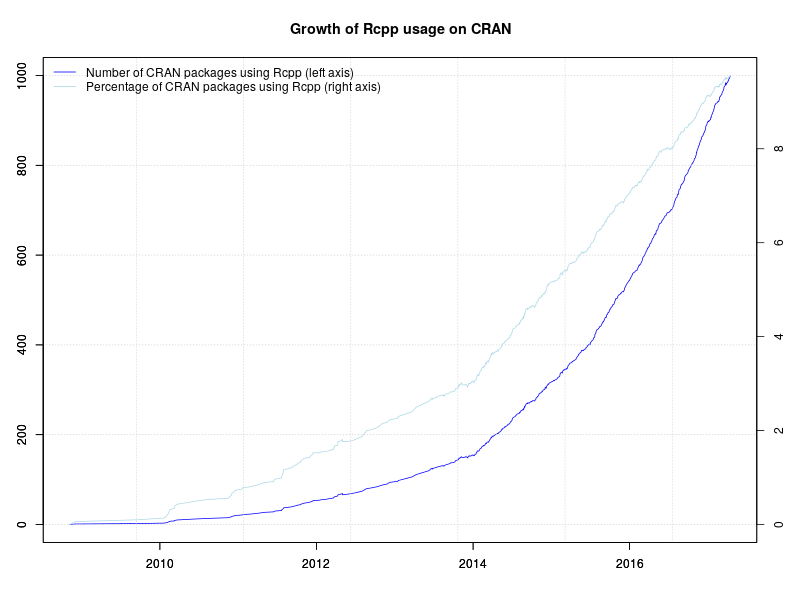
Dirk Eddelbuettel: Rcpp now used by 1000 CRAN packages

800 Rcpp packages Moments ago Rcpp passed a big milestone as there are now 1000 packages on CRAN depending on it (as measured by Depends, Imports and LinkingTo, but excluding Suggests). The graph is on the left depicts the growth of Rcpp usage over time. One easy way to compute such reverse dependency counts is the tools::dependsOnPkgs() function that was just mentioned in yesterday's R^4 blog post. Another way is to use the reverse_dependencies_with_maintainers() function from this helper scripts file on CRAN. Lastly, devtools has a function revdep() but it has the wrong default parameters as it includes Suggests: which you'd have to override to get the count I use here (it currently gets 1012 in this wider measure). Rcpp cleared 300 packages in November 2014. It passed 400 packages in June 2015 (when I only tweeted about it), 500 packages in late October 2015, 600 packages last March, 700 packages last July, 800 packages last October and 900 packages early January. The chart extends to the very beginning via manually compiled data from CRANberries and checked with crandb. The next part uses manually saved entries. The core (and by far largest) part of the data set was generated semi-automatically via a short script appending updates to a small file-based backend. A list of packages using Rcpp is kept on this page. Also displayed in the graph is the relative proportion of CRAN packages using Rcpp. The four per-cent hurdle was cleared just before useR! 2014 where I showed a similar graph (as two distinct graphs) in my invited talk. We passed five percent in December of 2014, six percent July of 2015, seven percent just before Christmas 2015, eight percent last summer, and nine percent mid-December 2016. Ten percent is next; we may get there during the summer. 1000 user packages is a really large number. This puts a whole lot of responsibility on us in the Rcpp team as we continue to keep Rcpp as performant and reliable as it has been. And with that a very big Thank You! to all users and contributors of Rcpp for help, suggestions, bug reports, documentation or, of course, code.

This post by Dirk Eddelbuettel originated on his Thinking inside the box blog. Please report excessive re-aggregation in third-party for-profit settings.

13 April 2017

Michal Čihař: Weblate 2.13.1

Weblate 2.13.1 has been released quickly after 2.13. It fixes few minor issues and possible upgrade problem. Full list of changes: If you are upgrading from older version, please follow our upgrading instructions. You can find more information about Weblate on https://weblate.org, the code is hosted on Github. If you are curious how it looks, you can try it out on demo server. You can login there with demo account using demo password or register your own user. Weblate is also being used on https://hosted.weblate.org/ as official translating service for phpMyAdmin, OsmAnd, Aptoide, FreedomBox, Weblate itself and many other projects. Should you be looking for hosting of translations for your project, I'm happy to host them for you or help with setting it up on your infrastructure. Further development of Weblate would not be possible without people providing donations, thanks to everybody who have helped so far! The roadmap for next release is just being prepared, you can influence this by expressing support for individual issues either by comments or by providing bounty for them.

Filed under: Debian English SUSE Weblate 0 comments

12 April 2017

Michal Čihař: Weblate 2.13

Weblate 2.13 has been released today pretty much on the schedule. The most important change being more fine grained access control and some smaller UI improvements. There are other new features and bug fixes as well. Full list of changes: If you are upgrading from older version, please follow our upgrading instructions. You can find more information about Weblate on https://weblate.org, the code is hosted on Github. If you are curious how it looks, you can try it out on demo server. You can login there with demo account using demo password or register your own user. Weblate is also being used on https://hosted.weblate.org/ as official translating service for phpMyAdmin, OsmAnd, Aptoide, FreedomBox, Weblate itself and many other projects. Should you be looking for hosting of translations for your project, I'm happy to host them for you or help with setting it up on your infrastructure. Further development of Weblate would not be possible without people providing donations, thanks to everybody who have helped so far! The roadmap for next release is just being prepared, you can influence this by expressing support for individual issues either by comments or by providing bounty for them.

Filed under: Debian English Gammu phpMyAdmin SUSE Weblate 0 comments

5 April 2017

Norbert Preining: Gaming: Quern Undying Thoughts

I have been an addict of Myst like games since the very beginning. Solving mind boggling riddles by logical means (instead of weapons) was always my preferred gaming. And it seems 2016 had a great share of games fitting to my taste: Obduction, The Eyes of Ara, The Witness, and last but not least Quern Undying Thoughts. Due to work, research, online courses, diapers, and some real life (these are also the excuses for my long silence on this blog) it took me ages to complete this games, but with a bit of help I finally manged it. Those who have ever played any game from the Myst series (Myst, Riven etc) know what you get: Several worlds/areas to explore, finding clues, solving riddles, lots of reading, leading to a finish where you have to decide between two fates. The game leads you through a variety of surrounding, from open air with gorgeous views and lovely crafted details, caves with dark corners and hidden chambers, even diving excursions are included, till you reach the final showdown at a huge underground facility. The graphics of the game are extremely beautifully crafted which makes you want to book a trip to this island. Click to view slideshow. I have to admit that due to the long time over which I had to play the game, as well as my missing Sherlock Holmes traits, some of the riddles were really hard for me. Sometimes the clues are so insidiously hidden or inconspicuously placed that one just easily misses them. But that makes the game a real challenge. For me Quern manages a great balance between a riddle game and an exploration game. I don t like games where you just have to go around and click each and every nook to make sure you find all pieces (typical example, the room series), but on the other hand games that only consists of solving riddles without searching for them are half the fun. Myst, Riven, and Quern, too, all of them strike a delicate balance between these two poles and deliver an absolute astonishing experience. Fully recommended, 100/100 for me!

1 April 2017

David Kalnischkies: Winning the Google Open Source Lottery

I don't know about you, but I frequently get mails announcing that I was picked as the lucky winner of a lottery, compensation program or simply as "business associate". Obvious Spam of course, that never happens in reality. Just like my personal "favorite" at the moment: Mails notifying me of inheritance from a previously (more or less) unknown relative. Its just that this is what has happend basically a few weeks ago in reality to me (over the phone through) and I am still dealing with the bureaucracy required of teaching the legal system that I have absolutely no intention of becoming the legal successor of someone I haven't seen in 20 years, regardless of how close the family relation is on paper but that might be the topic of another day. On the 1st March a mail titled "Google Open Source Peer Bonus Program" looked at first as if it would fall into this lottery spam class. It didn't exactly help that the mail was multipart HTML and text, but the text really only the text, not mentioning the embedded links used in the HTML part. It even included a prominent and obvious red flag: "Please fill out the form". 20% Bayes score didn't come from nothing. Still, for better or worse the words "Open Source" made it unlikely to be spam similar to how the word PGP indicates authenticity. So it happened, another spam message became true for me. I wonder which one will be next You have probably figured out by now that I didn't know that program before. Kinda embarrassing for a previous Google Summer of Code student (GSoC is run by the same office), but the idea behind it is simple: Google employees can nominate contributors to open source stuff for a small monetary "thank you!" gift card. Earlier this week winners for this round were announced 52 contributors including yours truly. You might be surprised, but the rational given behind my name is APT (I got a private mail with the full rational from my "patron", just in case you wonder if at least I would know more). It is funny how a guy who was taken aback by the prospect of needing a package manager like YaST to use Linux contributed just months later the first patch to apt and has roughly 8 years later amassed more than 2400 commits. It's birthday season in my family with e.g. mine just a few days ago, so its seems natural that apt has its own birthday today just as if it would be part of my family: 19th years this little bundle of bugs joy is now! In more sober moments I wonder sometimes how apt and I would have turned out if we hadn't meet. Would apt have met someone else? Would I? Given that I am still the newest team member and only recently joined Debian as DD at all APT has some strange ways of showing that it loves you: It e.g. helps users compose mails which end in a dilemma to give a recent example. Perhaps you need to be a special kind of crazy1 to consider this good, but as I see it apt has a big enough userbase that regardless of what your patch is doing, someone will like it. That drastically increases the chances that someone will also like it enough to say so in public offsetting complains from all those who don't like the (effects of the) patch which are omnipresent. And twice in a blue moon some of those will even step forward and thank you explicitly. Not that it would be necessary, but it is nice anyhow. So, thanks for the love supercow, Google & apt users! Or in other words: APT might very well be one of the most friendly (package manager related) project to contribute to as the language-specific managers have smaller userbases and hence a smaller chance of having someone liking your work (in public) so contribute a patch or two and be loved, too! Disclaimer: I get no bonus for posting this nor are any other strings attached. Birthdays are just a good time to reflect. In terms of what I do with my new found riches (in case I really receive them I haven't yet so that could still be an elaborate scam ): APT is a very humble program, but even it is thinking about moving away from a dev-box with less than 4 GB of RAM and no SSD, so it is happily accepting the gift and expects me to upgrade sooner now. What kind of precedence this sets for the two decades milestone next year? If APT isn't obsolete by then We will see.

  1. which even ended up topping Hacker News around New Year's Eve who would have thought that apt and reproducibility bugs are top news ;)

Russ Allbery: Review: Two Serpents Rise

Review: Two Serpents Rise, by Max Gladstone
Series: Craft #2
Publisher: Tor
Copyright: October 2013
ISBN: 1-4668-0204-9
Format: Mobi
Pages: 350
This is the second book in the Craft Sequence, coming after Three Parts Dead, but it's not a sequel. The only thing shared between the books is the same universe and magical system. Events in Two Serpents Rise were sufficiently distant from the events of the first book that it wasn't obvious (nor did it matter) where it fit chronologically. Caleb is a gambler and an investigator for Red King Consolidated, the vast firm that controls the water supply, and everything else, in the desert city of Dresediel Lex. He has a fairly steady and comfortable job in a city that's not comfortable for many, one of sharp divisions between rich and poor and which is constantly one water disturbance away from riot. His corporate work life frustrates his notorious father, a legendary priest of the old gods who were defeated by the Red King and who continues to fight an ongoing terrorist resistance to the new corporate order. But Caleb has as little as possible to do with that. Two Serpents Rise opens with an infiltration of the Bright Mirror Reservoir, one of the key components of Dresediel Lex's water supply. It's been infested with Tzimet: demon-like creatures that, were they to get into the city's water supply, would flow from faucets and feed on humans. Red King Incorporated discovered this one and sealed the reservoir before the worst could happen, but it's an unsettling attack. And while Caleb is attempting to determine what happened, he has an unexpected encounter with a cliff runner: a daredevil parkour enthusiast with an unexpected amulet of old Craft that would keep her invisible from most without the magical legacy Caleb is blessed (or cursed) with. He doesn't think her presence is related to the attack, but he can't be sure, particularly with the muddling fact that he finds her personally fascinating. Like Three Parts Dead, you could call Two Serpents Rise an urban fantasy in that it's a fantasy that largely takes place in cities and is concerned with such things as infrastructure, politics, and the machinery of civilization. However, unlike Three Parts Dead, it takes itself much more seriously and has less of the banter and delightful absurdity of the previous book. The identification of magic with contracts and legalities is less amusingly creative here and more darkly sinister. Partly this is because the past of Dresediel Lex is full of bloodthirsty gods and human sacrifice, and while Red King Consolidated has put an end to that practice, it lurks beneath the surface and is constantly brought to mind by some grisly artifacts. I seem to always struggle with fantasy novels based loosely on central American mythology. An emphasis on sacrifice and terror always seems to emerge from that background, and it verges too close to horror for me. It also seems prone to clashes of divine power and whim instead of thoughtful human analysis. That's certainly the case here: instead of Tara's creative sleuthing and analysis, Caleb's story is more about uncertainty, obsession, gambling, and shattering revelations. Magical rituals are described more in terms of their emotional impact than their world-building magical theory. I think this is mostly a matter of taste, and it's possible others would like Two Serpents Rise better than the previous book, but it wasn't as much my thing. The characters are a mixed bag. Caleb was a bit too passive to me, blown about by his father and his employer and slow to make concrete decisions. Mal was the highlight of the book for me, but I felt at odds with the author over that, which made the end of the book somewhat frustrating. Caleb has some interesting friends, but this is one of those books where I would have preferred one of the supporting cast to be the protagonist. That said, it's not a bad book. There are some very impressive set pieces, the supporting cast is quite good, and I am wholeheartedly in favor of fantasy novels that are built around the difficulties of water supply to a large, arid city. This sort of thing has far more to do with human life than the never-ending magical wars over world domination that most fantasy novels focus on, and it's not at all boring when told properly. Gladstone is a good writer, and despite the focus of this book not being as much my cup of tea, I'll keep reading this series. Followed by Full Fathom Five. Rating: 7 out of 10

25 March 2017

Russ Allbery: Spring haul

Work has been hellishly busy lately, so that's pretty much all I've been doing. The major project I'm working on should be basically done in the next couple of weeks, though (fingers crossed), so maybe I'll be able to surface a bit more after that. In the meantime, I'm still acquiring books I don't have time to read, since that's my life. In this case, two great Humble Book Bundles were too good of a bargain to pass up. There are a bunch of books in here that I already own in paperback (and hence showed up in previous haul posts), but I'm running low on shelf room, so some of those paper copies may go to the used bookstore to make more space. Kelley Armstrong Lost Souls (sff)
Clive Barker Tortured Souls (horror)
Jim Butcher Working for Bigfoot (sff collection)
Octavia E. Butler Parable of the Sower (sff)
Octavia E. Butler Parable of the Talents (sff)
Octavia E. Butler Unexpected Stories (sff collection)
Octavia E. Butler Wild Seed (sff)
Jacqueline Carey One Hundred Ablutions (sff)
Richard Chizmar A Long December (sff collection)
Jo Clayton Skeen's Leap (sff)
Kate Elliot Jaran (sff)
Harlan Ellison Can & Can'tankerous (sff collection)
Diana Pharoh Francis Path of Fate (sff)
Mira Grant Final Girls (sff)
Elizabeth Hand Black Light (sff)
Elizabeth Hand Saffron & Brimstone (sff collection)
Elizabeth Hand Wylding Hall (sff)
Kevin Hearne The Purloined Poodle (sff)
Nalo Hopkinson Skin Folk (sff)
Katherine Kurtz Camber of Culdi (sff)
Katherine Kurtz Lammas Night (sff)
Joe R. Lansdale Fender Lizards (mainstream)
Robert McCammon The Border (sff)
Robin McKinley Beauty (sff)
Robin McKinley The Hero and the Crown (sff)
Robin McKinley Sunshine (sff)
Tim Powers Down and Out in Purgatory (sff)
Cherie Priest Jacaranda (sff)
Alastair Reynolds Deep Navigation (sff collection)
Pamela Sargent The Shore of Women (sff)
John Scalzi Miniatures (sff collection)
Lewis Shiner Glimpses (sff)
Angie Thomas The Hate U Give (mainstream)
Catherynne M. Valente The Bread We Eat in Dreams (sff collection)
Connie Willis The Winds of Marble Arch (sff collection)
M.K. Wren Sword of the Lamb (sff)
M.K. Wren Shadow of the Swan (sff)
M.K. Wren House of the Wolf (sff)
Jane Yolen Sister Light, Sister Dark (sff)

Next.

Previous.