Search Results: "sten"

5 September 2025

Antonio Terceiro: Past halfway there: history of autopkgtest support in Debian

The Release of Debian 13 ("Trixie") last month marked another milestone on the effort to provide automated test support for Debian packages in their installed form. We have achieved the mark of 57% of the source packages in the archive declaring support for autopkgtest.
Release Packages with tests Total number of packages % of packages with tests
wheezy 5 17175 0%
jessie 1112 20596 5%
stretch 5110 24845 20%
buster 9966 28501 34%
bullseye 13949 30943 45%
bookworm 17868 34341 52%
trixie 21527 37670 57%
The code that generated this table is provided at the bottom. The growth rate has been consistently decreasing at each release after stretch. That probably means that the low hanging fruit -- adding support en masse for large numbers of similar packages, such as team-maintained packages for a given programming language -- has been picked, and from now on the work gets slightly harder. Perhaps there is a significant long tail of packages that will never get autopkgtest support. Looking for common prefixes among the packages missing a Testsuite: field gives me us the largest groups of packages missing autopkgtest support:
$ grep-dctrl -v -F Testsuite --regex -s Package -n . trixie   cut -d - -f 1   uniq -c   sort -n  tail -20
     50 apertium
     50 kodi
     51 lomiri
     53 maven
     55 libjs
     57 globus
     66 cl
     67 pd
     72 lua
     79 php
     88 puppet
     91 r
    111 gnome
    124 ruby
    140 ocaml
    152 rust
    178 golang
    341 fonts
    557 python
   1072 haskell
There seems to be a fair amount of Haskell and Python. If someone could figure out a way of testing installed fonts in a meaningful way, this would a be a good niche where we can cover 300+ packages. There is a another analysis that can be made, which I didn't: which percentage of new packages introduced in a given release have declared autopkgtest support, compared with the total of new packages in that release? My data only counts the totals, so we start with the technical debt of the almost all of the 17,000 packages with no tests in wheezy, which was the stable at the time I started Debian CI. How many of those got tests since then? Note that not supporting autopkgtest does not mean that a package is not tested at all: it can run build-time tests, which are also useful. Not supporting autopkgtest, though, means that their binaries in the archive can't be automatically tested in their installed, but then there is a entire horde of volunteers running testing and unstable on a daily basis who test Debian and report bugs. This is the script that produced the table in the beginning of this post:
#!/bin/sh
set -eu
extract()  
  local release
  local url
  release="$1"
  url="$2"
  if [ ! -f "$ release " ]; then
    rm -f "$ release .gz"
    curl --silent -o $ release .gz "$ url "
    gunzip "$ release .gz"
  fi
  local with_tests
  local total
  with_tests="$(grep-dctrl -c -F Testsuite --regex . $release)"
  total="$(grep-dctrl -c -F Package --regex . $release)"
  echo "  $ release    $ with_tests    $ total    $((100*with_tests/total))%  "
 
echo "  **Release**   **Packages with tests**   **Total number of packages**   **% of packages with tests**  "
echo " ------------- ------------------------- ------------------------------ ------------------------------ "
for release in wheezy jessie stretch buster; do
  extract "$ release " "http://archive.debian.org/debian/dists/$ release /main/source/Sources.gz"
done
for release in bullseye bookworm trixie; do
  extract "$ release " "http://ftp.br.debian.org/debian/dists/$ release /main/source/Sources.gz"
done

31 August 2025

Otto Kek l inen: Managing procrastination and distractions

Featured image of post Managing procrastination and distractionsI ve noticed that procrastination and inability to be consistently productive at work has become quite common in recent years. This is clearly visible in younger people who have grown up with an endless stream of entertainment literally at their fingertips, on their mobile phone. It is however a trap one can escape from with a little bit of help. Procrastination is natural they say humans are lazy by nature after all. Probably all of us have had moments when we choose to postpone a task we know we should be working on, and instead spent our time doing secondary tasks (valorisation). Classic example is cleaning your apartment when you should be preparing for an exam. Some may procrastinate by not doing any work at all, and just watching YouTube videos or the like. To some people, typically those who are in their 20s and early in their career, procrastination can be a big challenge and finding the discipline to stick to planned work may need intentional extra effort, and perhaps even external help. During my 20+ year career in software development I ve been blessed to work with engineers of various backgrounds and each with their unique set of strengths. I have also helped many grow in various areas and overcome challenges, such as lack of intrinsic motivation and managing procrastination, and some might be able to get it in check with some simple advice.

Distance yourself from the digital distractions The key to avoiding distractions and procrastination is to make it inconvenient enough that you rarely do it. If continuing to do work is easier than switching to procrastination, work is more likely to continue. Tips to minimize digital distractions, listed in order of importance:
  1. Put your phone away. Just like when you go to a movie and turn off your phone for two hours, you can put the phone away completely when starting to work. Put the phone in a different room to ensure there is enough physical distance between you and the distraction, so it is impossible for you to just take a quick peek .
  2. Turn off notifications from apps. Don t let the apps call you like sirens luring Odysseus. You don t need to have all the notifications. You will see what the apps have when you eventually open them at a time you choose to use them.
  3. Remove or disable social media apps, games and the like from your phone and your computer. You can install them back when you have vacation. You can probably live without them for some time. If you can t remove them, explore your phone s screen time restriction features to limit your own access to apps that most often waste your time. These features are sometimes listed in the phone settings under digital health .
  4. Have a separate work computer and work phone. Having dedicated ones just for work that are void of all unnecessary temptations helps keep distance from the devices that could derail your focus.
  5. Listen to music. If you feel your brain needs a dose of dopamine to get you going, listening to music helps satisfy your brain s cravings while still being able to simultaneously keep working.
Doing a full digital detox is probably not practical, or not sustainable for an extended time. One needs apps to stay in touch with friends and family, and staying current in software development probably requires spending some time reading news online and such. However the tips above can help contain the distractions and minimize the spontaneous attention the distractions get. Some of the distractions may ironically be from the work itself, for example Slack notifications or new email notifications. I recommend turning them off for a couple of hours every day to have some distraction free time. It should be enough to check work mail a couple times a day. Checking them every hour probably does not add much overall value for the company unless your work is in sales or support where the main task itself is responding to emails.

Distraction free work environment Following the same principle of distancing yourself from distractions, try to use a dedicated physical space for working. If you don t have a spare room to dedicate to work, use a neighborhood caf or sign up for a local co-working space or start commuting to the company office to find a space to be focused on work in.

Break down tasks into smaller steps Sometimes people postpone tasks because they feel intimidated by the size or complexity of a task. In particular in software engineering problems may be vague and appear large until one reaches the breakthrough that brings the vision of how to tackle it. Breaking down problems into smaller more manageable pieces has many advantages in software engineering. Not only can it help with task-avoidance, but it can also make the problem easier to analyze, suggest solutions and test them and build a solid foundation to expand upon to ultimately later reach a full solution on the entire larger problem. Working on big problems as a chain of smaller tasks may also offer more opportunities to celebrate success on completing each subtask and help getting in a suitable cadence of solving a single thing, taking a break and then tackling the next issue. Breaking down a task into concrete steps may also help with getting more realistic time estimations. Sometimes procrastination isn t real someone could just be overly ambitious and feel bad about themselves for not doing an unrealistic amount of work.

Intrinsic motivation Of course, you should follow your passion when possible. Strive to pick a career that you enjoy, and thus maximize the intrinsic motivation you experience. However, even a dream job is still a job. Nobody is ever paid to do whatever they want. Any work will include at least some tasks that feel like a chore or otherwise like something you would not do unless paid to. Some would say that the definition of work itself is having to do things one would otherwise not do. You can only fully do whatever you want while on vacation or when you choose to not have a job at all. But if you have a job, you simply need to find the intrinsic motivation to do it. Simply put, some tasks are just unpleasant or boring. Our natural inclination is to avoid them in favor of more enjoyable activities. For these situations we just have to find the discipline to force ourselves to do the tasks and figuratively speaking whip ourselves into being motivated to complete the tasks.

Extrinsic motivation As the name implies, this is something people external to you need to provide, such as your employer or manager. If you have challenges in managing yourself and delivering results on a regular basis, somebody else needs to set goals and deadlines and keep you accountable for them. At the end of the day this means that eventually you will stop receiving salary or other payments unless you did your job. Forcing people to do something isn t nice, but eventually it needs to be done. It would not be fair for an employer to pay those who did their work the same salary as those who procrastinated and fell short on their tasks. If you work solo, you can also simulate the extrinsic motivation by publicly announcing milestones and deadlines to build up pressure for yourself to meet them and avoid publicly humiliation. It is a well-studied and scientifically proven phenomenon that most university students procrastinate at the start of assignments, and truly start working on them only once the deadline is imminent.

External help for addictions If procrastination is mainly due to a single distraction that is always on your mind, it may be a sign of an addiction. For example, constantly thinking about a computer game or staying up late playing a computer game, to the extent that it seriously affects your ability to work, may be a symptom of an addiction, and getting out of it may be easier with external help.

Discipline and structure Most of the time procrastination is not due to an addiction, but simply due to lack of self-discipline and structure. The good thing is that those things can be learned. It is mostly a matter of getting into new habits, which most young software engineers pick up more or less automatically while working along the more senior ones. Hopefully these tips can help you stay on track and ensure you do everything you are expected to do with clear focus, and on time!

30 August 2025

Utkarsh Gupta: FOSS Activites in August 2025

Here s my monthly but brief update about the activities I ve done in the F/L/OSS world.

Debian
Debian 13 was released! Woot! Whilst I didn t get a chance to do much, here s still a few things that I worked on:
  • Helped Anshul with Golang 1.25 packaging and upload.
  • Assited Anshul in fixing Golang bugs in the stable release via a -pu.
  • Mentoring for newcomers.
  • Moderation of -project mailing list.

Ubuntu
I joined Canonical to work on Ubuntu full-time back in February 2021. Whilst I can t give a full, detailed list of things I did, here s a quick TL;DR of what I did:
  • Released Questing snapshot 4! \o/
  • Prepared for 25.10 Beta, held weekly release syncs, et al.
  • Granted FFe and triaged a bunch of other bugs from both, Release team and Archive Admin POV. :)
  • Got a recognition award for helping Chlo with Google Guest Agent packages.
  • Preparing for the a round of internal review, 360s, and trying to not be sick. :)

Debian (E)LTS
This month I have worked 16.00 hours on Debian Long Term Support (LTS) and 4.50 hours on its sister Extended LTS project and did the following things:
  • [LTS] Prepared the LTS update for wordpress, bumping the package from 5.7.11 to 5.7.13.
    • Prepared an update for stable, too, and pinged Craig. Haven t heard yet.
    • Got incredibly sick so will carry on the coordination work and release the updates to all the releases. Everything s mostly ready and tested.
    • Gave Salvatore a quick heads up via IRC.
  • [E/LTS] Frontdesk duty from 28th July to 04th August.
  • [E/LTS] Helped Daniel Leidert in showing him around as he did his first frontdesk rota. Yay!
    • We paired on an hour long meets call and discussed various toolings and workflows.
    • Pair-reviewed a few CVEs together.
    • Also discussed how to triage newly supported packages for ELTS, too!
  • [LTS] Attended the monthly LTS meeting on Jitsi. Summary here.
    • [ELTS] Raised questions about installing debusine on Ubuntu.
      • Still trying to play around to get a bit more comfortable before starting to do actual uploads there.
  • [LTS] Helping a few folks - like assisting Lee to see if we have a reproducer for CVE-2025-27613 for git, et al.
  • [Stable] Been working on fixing 2 packages:
    • ruby-graphql: The Debian Security team asked to fix that via p-u so prepared a patch update.
    • ruby-saml: The update is finally ready but not tested yet - should be a quick one though.
    • Got incredibly sick and couldn t move things forward but will take care of the work in the following month.

Until next time.
:wq for today.

29 August 2025

Noah Meyerhans: Determining Network Online Status of Dualstack Cloud VMs

When a Debian cloud VM boots, it typically runs cloud-init at various points in the boot process. Each invocation can perform certain operations based on the host s static configuration passed by the user, typically either through a well known link-local network service or an attached iso9660 drive image. Some of the cloud-init steps execute before the network comes up, and others at a couple of different points after the network is up. I recently encountered an unexpected issue when configuring a dualstack (uses both IPv6 and legacy IPv4 networking) VM to use a custom apt server accessible only via IPv6. VM provisioning failed because it was unable to access the server in question, yet when I logged in to investigate, it was able to access the server without any problem. The boot had apparently gone smoothly right up until cloud-init s Package Update Upgrade Install module called apt-get update, which failed and broke subsequent provisioning steps. The errors reported by apt-get indicated that there was no route to the service in question, which more accurately probably meant that there was not yet a route to the service. But there was shortly after, when I investigated. This was surprising because the apt-get invocations occur in a cloud-init sequence that s explicitly ordered after the network is configured according to systemd-networkd-wait-online. Investigation eventually led to similar issues encountered in other environments reported in Debian bug #1111791, systemd: network-online.target reached before IPv6 address is ready . The issue described in that bug is identical to mine, but the bug is tagged wontfix. The behavior is considered correct.

Why the default behavior is the correct one While it s a bit counterintuitive, the systemd-networkd behavior is correct, and it s also not something we d want to override in the cloud images. Without explicit configuration, systemd can t accurately infer the intended network configuration of a given system. If a system is IPv6-only, systemd-networkd-wait-online will introduce unexpected delays in the boot process if it waits for IPv4, and vice-versa. If it assumes dualstack, things are even worse because it would block for a long time (approximately two minutes) in any single stack network before failing, leaving the host in degraded state. So the most reasonable default behavior is to block until any protocol is configured. For these same reasons, we can t change the systemd-networkd-wait-online configuration in our cloud images. All of the cloud environments we support offer both single stack and dual stack networking, so we preserve systemd s default behavior. What s causing problems here is that IPv6 takes significantly longer to configure due to its more complex router solicitation + router advertisement + DHCPv6 setup process. So in this particular case, where I ve got a dualstack VM that needs to access a v6-only apt server during the provisioning process, I need to find some mechanism to override systemd s default behavior and wait for IPv6 connectivity specifically.

What won t work Cloud-init offers the ability to write out arbitrary files during provisioning. So writing a drop-in for systemd-networkd-wait-online.service is trivial. Unfortunately, this doesn t give us everything we actually need. We still need to invoke systemctl daemon-reload to get systemd to actually apply the changes after we ve written them, and of course we need to do that before the service actually runs. Cloud-init provides a bootcmd module that lets us run shell commands very early in the boot process , but it runs too early: it runs before we ve written out our configuration files. Similarly, it provides a runcmd module, but scripts there are towards the end of the boot process, far too late to be useful. Instead of using the bootcmd facility, to simply reload systemd s config, it seemed possible that we could both write the config and trigger the reload, similar to the following:
 bootcmd:
- mkdir -p /etc/systemd/system/systemd-networkd-wait-online.service.d
- echo "[Service]" > /etc/systemd/system/systemd-networkd-wait-online.service.d/10-netplan.conf
- echo "ExecStart=" >> /etc/systemd/system/systemd-networkd-wait-online.service.d/10-netplan.conf
- echo "ExecStart=/usr/lib/systemd/systemd-networkd-wait-online --operational-state=routable --any --ipv6" >> /etc/systemd/system/systemd-networkd-wait-online.service.d/10-netplan.conf
- systemctl daemon-reload
But even that runs too late, as we can see in the logs that systemd-networkd-wait-online.service has completed before bootcmd is executed:
root@sid-tmp2:~# journalctl --no-pager -l -u systemd-networkd-wait-online.service
Aug 29 17:02:12 sid-tmp2 systemd[1]: Starting systemd-networkd-wait-online.service - Wait for Network to be Configured...
Aug 29 17:02:13 sid-tmp2 systemd[1]: Finished systemd-networkd-wait-online.service - Wait for Network to be Configured
.
root@sid-tmp2:~# grep -F 'config-bootcmd ran' /var/log/cloud-init.log
2025-08-29 17:02:14,766 - handlers.py[DEBUG]: finish: init-network/config-bootcmd: SUCCESS: config-bootcmd ran successfully and took 0.467 seconds
At this point, it s looking like there are few options left!

What eventually worked I ended up identifying two solutions to the issue, both of which involve getting some other component of the provisioning process to run systemd-networkd-wait-online.

Solution 1 The first involves getting apt-get itself to wait for IPv6 configuration. The apt.conf configuration interface allows the definition of an APT::Update::Pre-Invoke hook that s executed just before apt s update operation. By writing the following to a file in /etc/apt/apt.conf.d/, we re able to ensure that we have IPv6 connectivity before apt-get tries accessing the network. This cloud-config snippet accomplishes that:
 - path: /etc/apt/apt.conf.d/99-wait-for-ipv6
content:  
APT::Update::Pre-Invoke   "/usr/lib/systemd/systemd-networkd-wait-online --operational-state=routable --any --ipv6";  
This is safe to leave in place after provisioning, because the delay will be negligible once IPv6 connectivity is established. It s only during address configuration that it ll block for a noticeable amount of time, but that s what we want. This solution isn t entirely correct, though, because it s only apt-get that s actually affected by it. Other service that start after the system is ostensibly online might only see IPv4 connectivity when they start. This seems acceptable at the moment, though.

Solution 2 The second solution is to simply invoke systemd-networkd-wait-online directly from a cloud-init bootcmd. Similar to the first solution, it s not exactly correct because the host has already reached network-online.target, but it does block enough of cloud-init that package installation happens only after it completes. The cloud-config snippet for this is
bootcmd:
- [/usr/lib/systemd/systemd-networkd-wait-online, --operational-state=routable, --any, --ipv6]
In either case, we still want to write out a snippet to configure systemd-networkd-wait-online to wait for IPv6 connectivity for future reboots. Even though cloud-init won t necessarily run in those cases, and many cloud VMs never reboot at all, it does complete the solution. Additionally, it solves the problem for any derivative images that may be created based on the running VM s state. (At least if we can be certain that instances of those derivative images will never run in an IPv4-only network!)
write_files:
- path: /run/systemd/system/systemd-networkd-wait-online.service.d/99-ipv6-wait.conf
content:  
[Service]
ExecStart=
ExecStart=/lib/systemd/systemd-networkd-wait-online --any --operational-state=routable --ipv6

How to properly solve it One possible improvement would be for cloud-init to support a configuration key allowing the admin to specify the required protocols. Based on the presence of this key, cloud-init could reconfigure systemd-networkd-wait-online.service accordingly. Alternatively it could set the appropriate RequiredFamilyForOnline= value in the generated .network file. cloud-init supports multiple network configuration backends, so each of those would need to be updated. If using the systemd-networkd configuration renderer, this should be straightforward, but Debian uses the netplan renderer, so that tool might also need to be taught to pass such a configuration along to systemd-networkd.

17 August 2025

C.J. Collier: The Very Model of a Patriot Online

It appears that the fragile masculinity tech evangelists have identified Debian as a community with boundaries which exclude them from abusing its members and they re so angry about it! In response to posts such as this, and inspired by Dr. Conway s piece, I ve composed a poem which, hopefully, correctly addresses the feelings of that crowd.
The Very Model of a Patriot Online
I am the very model of a modern patriot online,
My keyboard is my rifle and my noble cause is so divine.
I didn't learn my knowledge in a dusty college lecture hall,
But from the chans where bitter anonymity enthralls us all.
I spend a dozen hours every day upon my sacred quest,
To put the globo-homo narrative completely to the test.
My arguments are peer-reviewed by fellas in the comments section,
Which proves my every thesis is the model of complete perfection.
I m steeped in righteous anger that the libs call 'white fragility,'
For mocking their new pronouns and their lack of masculinity.
I m master of the epic troll, the comeback, and the searing snark,
A digital guerrilla who is fighting battles in the dark.
I know the secret symbols and the dog-whistles historical,
From Pepe the Frog to  Let s Go Brandon,  in order categorical;
In short, for fighting culture wars with rhetoric rhetorical,
I am the very model of a patriot polemical.
***
I stand for true expression, for the comics and the edgy clown,
Whose satire is too based for all the fragile folks in town.
They say my speech is 'violence' while my spirit they are trampling,
The way they try to silence me is really quite a startling sampling
Of 1984, which I've not read but thoroughly understand,
Is all about the tyranny that's gripping this once-blessed land.
My humor is a weapon, it s a razor-bladed, sharp critique,
(Though sensitive elites will call my masterpiece a form of  hate speech ).
They cannot comprehend my need for freedom from all consequence,
They call it 'hate,' I call it 'jokes,' they just don't have a lick of sense.
So when they call me  bigot  for the spicy memes I post pro bono,
I tell them their the ones who're cancelled, I'm the victim here, you know!
Then I can write a screed against the globalist cabal, you see,
And tell you every detail of their vile conspiracy.
In short, when I use logic that is flexible and personal,
I am the very model of a patriot controversial.
***
I'm very well acquainted with the scientific method, too,
It's watching lengthy YouTube vids until my face is turning blue.
I trust the heartfelt testimony of a tearful, blonde ex-nurse,
But what a paid fact-checker says has no effect and is perverse.
A PhD is proof that you've been brainwashed by the leftist mob,
While my own research on a meme is how I really do my job.
I know that masks will suffocate and vaccines are a devil's brew,
I learned it from a podcast host who used to sell brain-boosting goo.
He scorns the lamestream media, the CNNs and all the rest,
Whose biased reporting I've put fully to a rigorous test
By only reading headlines and confirming what I already knew,
Then posting my analysis for other patriots to view.
With every "study" that they cite from sources I can't stand to hear,
My own profound conclusions become ever more precisely clear.
In short, when I've debunked the experts with a confident "Says who?!",
I am the very model of a researcher who sees right through you.
***
But all these culture wars are just a sleight-of-hand, a clever feint,
To hide the stolen ballots and to cover up the moral taint
Of D.C. pizza parlors and of shipping crates from Wayfair, it s true,
It's all connected in a plot against the likes of me and you!
I've analyzed the satellite photography and watermarks,
I understand the secret drops, the cryptic Qs, the coded sparks.
The  habbening  is coming, friends, just give it two more weeks or three,
When all the traitors face the trials for their wicked treachery.
They say that nothing happened and the dates have all gone past, you see,
But that's just disinformation from the globalist enemy!
Their moving goalposts constantly, a tactic that is plain to see,
To wear us down and make us doubt the coming, final victory!
My mind can see the patterns that a simple sheep could never find,
The hidden puppet-masters who are poisoning our heart and mind.
In short, when I link drag queens to the price of gas and child-trafficking,
I am the very model of a patriot whose brain is quickening!
***
My pickup truck's a testament to everything that I hold dear,
With vinyl decals saying things the liberals all hate and fear.
The Gadsden flag is waving next to one that's blue and starkly thin,
To show my deep respect for law, except the feds who're steeped in sin.
There's Punisher and Molon Labe, so that everybody knows
I'm not someone to trifle with when push to final shoving goes.
I've got my tactical assault gear sitting ready in the den,
Awaiting for the signal to restore our land with my fellow men.
I practice clearing rooms at home when my mom goes out to the store,
A modern Minuteman who's ready for a civil war.
The neighbors give me funny looks, I see them whisper and take note,
They'll see what's what when I'm the one who's guarding checkpoints by their throat.
I am a peaceful man, of course, but I am also pre-prepared,
To neutralize the threats of which the average citizen's unscared.
In short, when my whole identity's a brand of tactical accessory,
You'll say a better warrior has never graced a Cabela's registry.
***
They say I have to tolerate a man who thinks he is a dame,
While feminists and immigrants are putting out my vital flame!
There taking all the jobs from us and giving them to folks who kneel,
And "woke HR" says my best jokes are things I'm not allowed to feel!
An Alpha Male is what I am, a lion, though I'm in this cubicle,
My life's frustrations can be traced to policies Talmudical.
They lecture me on privilege, I, who have to pay my bills and rent!
While they give handouts to the lazy, worthless, and incompetent!
My grandad fought the Nazis! Now I have to press a key for  one 
To get a call-rep I can't understand beneath the blazing sun
Of global, corporate tyranny that's crushing out the very soul
Of men like me, who've lost their rightful, natural, and just control!
So yes, I am resentful! And I'm angry! And I'm right to be!
They've stolen all my heritage and my masculinity!
In short, when my own failures are somebody else's evil plot,
I am the very model of the truest patriot we've got!
***
There putting chips inside of you! Their spraying things up in the sky!
They want to make you EAT THE BUGS and watch your very spirit die!
The towers for the 5G are a mind-control delivery tool!
To keep you docile while the children suffer in a grooming school!
The WEF, and Gates, and Soros have a plan they call the 'Great Reset,'
You'll own no property and you'll be happy, or you'll be in debt
To social credit overlords who'll track your every single deed!
There sterilizing you with plastics that they've hidden in the feed!
The world is flat! The moon is fake! The dinosaurs were just a lie!
And every major tragedy's a hoax with actors paid to cry!
I'M NOT INSANE! I SEE THE TRUTH! MY EYES ARE OPEN! CAN'T YOU SEE?!
YOU'RE ALL ASLEEP! YOU'RE COWARDS! YOU'RE AFRAID OF BEING TRULY FREE!
My heart is beating faster now, my breath is short, my vision's blurred,
From all the shocking truth that's in each single, solitary word!
I've sacrificed my life and friends to bring this message to the light, so...
You'd better listen to me now with all your concentrated might, ho!
***
For my heroic struggle, though it's cosmic and it's biblical,
Is waged inside the comments of a post that's algorithm-ical.
And still for all my knowledge that's both tactical and practical,
My mom just wants the rent I owe and says I'm being dramatical.

15 August 2025

Freexian Collaborators: Monthly report about Debian Long Term Support, July 2025 (by Roberto C. S nchez)

Like each month, have a look at the work funded by Freexian s Debian LTS offering.

Debian LTS contributors In July, 17 contributors have been paid to work on Debian LTS, their reports are available:
  • Adrian Bunk did 19.0h (out of 19.0h assigned).
  • Andrej Shadura did 5.0h (out of 0.0h assigned and 8.0h from previous period), thus carrying over 3.0h to the next month.
  • Bastien Roucari s did 18.5h (out of 18.75h assigned), thus carrying over 0.25h to the next month.
  • Ben Hutchings did 12.5h (out of 3.25h assigned and 15.5h from previous period), thus carrying over 6.25h to the next month.
  • Carlos Henrique Lima Melara did 10.0h (out of 10.0h assigned).
  • Chris Lamb did 18.0h (out of 18.0h assigned).
  • Daniel Leidert did 18.75h (out of 17.25h assigned and 1.5h from previous period).
  • Emilio Pozuelo Monfort did 18.75h (out of 18.75h assigned).
  • Guilhem Moulin did 15.0h (out of 14.0h assigned and 1.0h from previous period).
  • Jochen Sprickerhof did 2.0h (out of 16.5h assigned and 2.25h from previous period), thus carrying over 16.75h to the next month.
  • Lee Garrett did 7.0h (out of 0.0h assigned and 23.25h from previous period), thus carrying over 16.25h to the next month.
  • Markus Koschany did 9.0h (out of 18.75h assigned), thus carrying over 9.75h to the next month.
  • Roberto C. S nchez did 10.25h (out of 18.5h assigned and 2.75h from previous period), thus carrying over 11.0h to the next month.
  • Santiago Ruano Rinc n did 7.25h (out of 12.75h assigned and 2.25h from previous period), thus carrying over 7.75h to the next month.
  • Sylvain Beucler did 18.75h (out of 18.75h assigned).
  • Thorsten Alteholz did 15.0h (out of 15.0h assigned).
  • Utkarsh Gupta did 15.0h (out of 1.0h assigned and 14.0h from previous period).

Evolution of the situation In July, we released 24 DLAs.
  • Notable security updates:
    • angular.js, prepared by Bastien Roucari s, fixes multiple vulnerabilities including input sanitization and potential regular expression denial of service (ReDoS)
    • tomcat9, prepared by Markus Koschany, fixes an assortment of vulnerabilities
    • mediawiki, prepared by Guilhem Moulin, fixes several information disclosure and privilege escalation vulnerabilities
    • php7.4, prepared by Guilhem Moulin, fixes several server side request forgery and denial of service vulnerabilities
This month s contributions from outside the regular team include an update to thunderbird, prepared by Christoph Goehre (the package maintainer). LTS Team members also contributed updates of the following packages:
  • commons-beanutils (to stable and unstable), prepared by Adrian Bunk
  • djvulibre (to oldstable, stable, and unstable), prepared by Adrian Bunk
  • git (to stable), prepared by Adrian Bunk
  • redis (to oldstable), prepared by Chris Lamb
  • libxml2 (to oldstable), prepared by Guilhem Moulin
  • commons-vfs (to oldstable), prepared by Daniel Leidert
Additionally, LTS Team member Santiago Ruano Rinc n proposed and implemented an improvement to the debian-security-support package. This package is available so that interested users can quickly determine if any installed packages are subject to limited security support or are excluded entirely from security support. However, there was not previously a way to identify explicitly supported packages, which has become necessary to note exceptions to broad exclusion policies (e.g., those which apply to substantial package groups, like modules belonging to the Go and Rust language ecosystems). Santiago s work has enabled the notation of exceptions to these exclusions, thus ensuring that users of debian-security-support have accurate status information concerning installed packages.

DebCamp 25 Security Tracker Sprint The previously announced security tracker sprint took place at DebCamp from 7-13 July. Participants included 8 members of the standing LTS Team, 2 active Debian Developers with an interest in LTS, 3 community members, and 1 member of the Debian Security Team (who provided guidance and reviews on proposed changes to the security tracker); participation was a mix of in person at the venue in Brest, France and remote. During the days of the sprint, the team tackled a wide range of bugs and improvements, mostly targeting the security tracker. The sprint participants worked on the following items: As can be seen from the above list, only a small number of changes were brought to completion during the sprint week itself. Given the very compressed timeframe involved, the broad scope of tasks which were under consideration, and the highly sensitive data managed by the security tracker, this is not entirely unexpected and in no way diminishes the great work done by the sprint participants. The LTS Team would especially like to thank Salvatore Bonaccorso of the Debian Security Team for making himself available throughout the sprint to answer questions, for providing guidance on the work, and for helping the work by reviewing and merging the MRs which were able to merged during the sprint itself. In the weeks that follow the sprint, the team will continue working towards completing the in progress items.

Thanks to our sponsors Sponsors that joined recently are in bold.

14 August 2025

Jonathan McDowell: Local Voice Assistant Step 4: openWakeWord

People keep asking me when I ll write the next instalment of my local voice assistant journey. I didn t mean for it to be so long since the last one, things have been busier than I d like. Anyway. Last time we d built Tensorflow, so now it s time to sort out openWakeWord. As a reminder we re trying to put a local voice satellite on my living room Debian media machine. The point of openWakeWord is to run on the machine the microphone is connected to, listening for the wake phrase ( Hey Jarvis in my case), and only then calling back to the central server to do a speech to text operation. It s wrapped up for Wyoming as wyoming-openwakeword. Of course I ve packaged it up - available at https://salsa.debian.org/noodles/wyoming-openwakeword. Trixie only released yesterday, so I m still running all of this on bookworm. That means you need python3-wyoming from Trixie - 1.6.0-1 will install fine without needing rebuilt - and the python3-tflite-runtime we built last time. Like the other pieces I m not sure about how this could land in Debian; it s unclear to me that the pre-trained models provided would be accepted in main. As usual I start it with with a systemd unit file dropped in /etc/systemd/service/wyoming-openwakeword.service:
[Unit]
Description=Wyoming OpenWakeWord server
After=network.target
[Service]
Type=simple
DynamicUser=yes
ExecStart=/usr/bin/wyoming-openwakeword --uri tcp://[::1]:10400/ --preload-model 'hey_jarvis' --threshold 0.8
MemoryDenyWriteExecute=false
ProtectControlGroups=true
PrivateDevices=false
ProtectKernelTunables=true
ProtectSystem=true
RestrictRealtime=true
RestrictNamespaces=true
[Install]
WantedBy=multi-user.target
I m still playing with the threshold level. It defaults to 0.5, but the device lives under the TV and seems to get a bit confused by it sometimes. There s some talk about using speex for noise suppression, but I haven t explored that yet (it s yet another Python module to bind to the C libraries I d have to look at). This is a short one; next post is actually building the local satellite on top to tie everything together.

12 August 2025

Freexian Collaborators: Debian Contributions: DebConf 25, OpenSSH upgrades, Cross compilation collaboration and more! (by Anupa Ann Joseph)

Debian Contributions: 2025-07 Contributing to Debian is part of Freexian s mission. This article covers the latest achievements of Freexian and their collaborators. All of this is made possible by organizations subscribing to our Long Term Support contracts and consulting services.

DebConf 25, by Stefano Rivera and Santiago Ruano Rinc n In July, DebConf 25 was held in Brest, France. Freexian was a gold sponsor and most of the Freexian team attended the event. Many fruitful discussions were had amongst our team and within the Debian community. DebConf itself was organized by a local team in Brest, that included Santiago (who now lives in Uruguay). Stefano was also deeply involved in the organization, as a DebConf committee member, core video team, and the lead developer for the conference website. Running the conference took an enormous amount of work, consuming all of Stefano and Santiago s time for most of July. Lucas Kanashiro was active in the DebConf content team, reviewing talks and scheduling them. There were many last-minute changes to make during the event. Anupa Ann Joseph was part of the Debian publicity team doing live coverage of DebConf 25 and was part of the DebConf 25 content team reviewing the talks. She also assisted the local team to procure the lanyards. Recorded sessions presented by Freexian collaborators, often alongside other friends in Debian, included:

OpenSSH upgrades, by Colin Watson Towards the end of a release cycle, people tend to do more upgrade testing, and this sometimes results in interesting problems. Manfred Stock reported No new SSH connections possible during large part of upgrade to Debian Trixie , which would have affected many people upgrading from Debian 12 (bookworm), with potentially severe consequences for people upgrading remote systems. In fact, there were two independent problems that each led to much the same symptom:
  • As part of hardening the OpenSSH server, OpenSSH 9.8 split the monolithic sshd listener process into two pieces: a minimal network listener (still called sshd), and an sshd-session process dealing with each individual session. Before this change, when sshd received an incoming connection, it forked and re-executed itself with some special parameters to deal with it; after this change, it forks and executes sshd-session instead, and sshd no longer accepts the parameters it used to accept for this.

    Debian package upgrades happen (roughly) in two phases: first we unpack the new files onto disk, and then we run some configuration steps which usually include things like restarting services. Normally this is fine, because the old service keeps on working until it s restarted. In this case, unpacking the new files onto disk immediately stopped new SSH connections from working: the old sshd received the connection and tried to hand it off to a freshly-executed copy of the new sshd binary on disk, which no longer supports this. This wasn t much of a problem when upgrading OpenSSH on its own or with a small number of other packages, but in release upgrades it left a large gap when you can t SSH to the system any more, and if anything fails in that interval then you could be in trouble.

    After trying a couple of other approaches, Colin landed on the idea of having the openssh-server package divert /usr/sbin/sshd to /usr/sbin/sshd.session-split before the unpack step of an upgrade from before 9.8, then removing the diversion and moving the new file into place once it s ready to restart the service. This reduces the period when new connections fail to a minimum.
  • Most OpenSSH processes, including sshd, check for a compatible version of the OpenSSL library when they start up. This check used to be very picky, among other things requiring both the major and minor part of the version number to match. OpenSSL 3 has a better versioning policy, and so OpenSSH 9.4p1 relaxed this check.

    Unfortunately, bookworm shipped with OpenSSH 9.2p1, so as soon as you unpacked the new OpenSSL library during an upgrade, sshd stopped working. This couldn t be fixed by a change in trixie; we needed to change bookworm in advance of the upgrade so that it would tolerate newer versions of OpenSSL, and time was tight if we wanted this to be available before the release of Debian 13.

    Fortunately, there s a stable-updates mechanism for exactly this sort of thing, and the stable release managers kindly accepted Colin s proposal to fix this there.
The net result is that if you apply updates to bookworm (including stable-updates / bookworm-updates, which is enabled by default) before starting the upgrade to trixie, everything should be fine.

Cross compilation collaboration, by Helmut Grohne Supporting cross building in Debian packages touches lots of areas of the archive and quite some of these matters reside in shared responsibility between different teams. Hence, DebConf was an ideal opportunity to settle long-standing issues. The cross building bof sparked lively discussions as a significant fraction of developers employ cross builds to get their work done. In the trixie release, about two thirds of the packages can satisfy their cross Build-Depends and about half of the packages actually can be cross built.

Miscellaneous contributions
  • Rapha l Hertzog updated tracker.debian.org to remove references to Debian 10 which was moved to archive.debian.org, and had many fruitful discussions related to Debusine during DebConf 25.
  • Carles Pina prepared some data, questions and information for the DebConf 25 l10n and i18n BoF.
  • Carles Pina demoed and discussed possible next steps for po-debconf-manager with different teams in DebConf 25. He also reviewed Catalan translations and sent them to the packages.
  • Carles Pina started investigating a django-compressor bug: reproduced the bug consistently and prepared a PR for django-compressor upstream (likely more details next month). Looked at packaging frictionless-py.
  • Stefano Rivera triaged Python CVEs against pypy3.
  • Stefano prepared an upload of a new upstream release of pypy3 to Debian experimental (due to the freeze).
  • Stefano uploaded python3.14 RC1 to Debian experimental.
  • Thorsten Alteholz uploaded a new upstream version of sane-airscan to experimental. He also started to work on a new upstream version of hplip.
  • Colin backported fixes for CVE-2025-50181 and CVE-2025-50182 in python-urllib3, and fixed several other release-critical or important bugs in Python team packages.
  • Lucas uploaded ruby3.4 to experimental as a starting point for the ruby-defaults transition that will happen after Trixie release.
  • Lucas coordinated with the Release team the fix of the remaining RC bugs involving ruby packages, and got them all fixed.
  • Lucas, as part of the Debian Ruby team, kicked off discussions to improve internal process/tooling.
  • Lucas, as part of the Debian Outreach team, engaged in multiple discussions around internship programs we run and also what else we could do to improve outreach in the Debian project.
  • Lucas joined the Local groups BoF during DebConf 25 and shared all the good experiences from the Brazilian community and committed to help to document everything to try to support other groups.
  • Helmut spent significant time with Samuel Thibault on improving architecture cross bootstrap for hurd-any mostly reviewing Samuel s patches. He proposed a patch for improving bash s detection of its pipesize and a change to dpkg-shlibdeps to improve behavior for building cross toolchains.
  • Helmut reiterated the multiarch policy proposal with a lot of help from Nattie Mayer-Hutchings, Rhonda D Vine and Stuart Prescott.
  • Helmut finished his work on the process based unschroot prototype that was the main feature of his talk (see above).
  • Helmut analyzed a multiarch-related glibc upgrade failure induced by a /usr-move mitigation of systemd and sent a patch and regression fix both of which reached trixie in time. Thanks to Aurelien Jarno and the release team for their timely cooperation.
  • Helmut resurrected an earlier discussion about changing the semantics of Architecture: all packages in a multiarch context in order to improve the long-standing interpreter problem. With help from Tollef Fog Heen better semantics were discovered and agreement was reached with Guillem Jover and Julian Andres Klode to consider this change. The idea is to record a concrete architecture for every Architecture: all package in the dpkg database and enable choosing it as non-native.
  • Helmut implemented type hints for piuparts.
  • Helmut reviewed and improved a patch set of Jochen Sprickerhof for debvm.
  • Anupa was involved in discussions with the Debian Women team during DebConf 25.
  • Anupa started working for the trixie release coverage and started coordinating release parties.
  • Emilio helped coordinate the release of Debian 13 trixie.

9 August 2025

Thorsten Alteholz: My Debian Activities in July 2025

Debian LTS This was my hundred-thirty-third month that I did some work for the Debian LTS initiative, started by Raphael Hertzog at Freexian. During my allocated time I uploaded or worked on: I also continued my work on suricata, which turned out to be more challenging than expected. This month I also did a week of FD duties and attended the monthly LTS/ELTS meeting. Debian ELTS This month was the eighty-fourth ELTS month. Unfortunately my allocated hours were far less than expected, so I couldn t do as much work as planned. Most of the time I spent with FD tasks and I also attended the monthly LTS/ELTS meeting. I further listened to the debusine talks during debconf. On the one hand I would like to use debusine to prepare uploads for embargoed ELTS issues, on the other hand I would like to use debusine to run the version of lintian that is used in the different releases. At the moment some manual steps are involved here and I tried to automate things. Of course like for LTS, I also continued my work on suricata. Debian Printing This month I uploaded a new upstream version of: Guess what, I also started to work on a new version of hplip and intend to upload it in August. This work is generously funded by Freexian! Debian Astro This month I uploaded new upstream versions of: I also uploaded the new package boinor. This is a fork of poliastro, which was retired by upstream and removed from Debian some months ago. I adopted it and rebranded it at the desire of upstream. boinor is the abbreviation of BOdies IN ORbit and I hope this software is still useful. Debian Mobcom Unfortunately I didn t found any time to work on this topic. misc On my fight against outdated RFPs, I closed 31 of them in July. Their number is down to 3447 (how can you dare to open new RFPs? :-)). Don t be afraid of them, they don t bite and are happy to be released to a closed state. FTP master The peace will soon come to an end, so this month I accepted 87 and rejected 2 packages. The overall number of packages that got accepted was 100.

6 August 2025

Colin Watson: Free software activity in July 2025

About 90% of my Debian contributions this month were sponsored by Freexian. You can also support my work directly via Liberapay or GitHub Sponsors. DebConf I attended DebConf for the first time in 11 years (my last one was DebConf 14 in Portland). It was great! For once I had a conference where I had a fairly light load of things I absolutely had to do, so I was able to spend time catching up with old friends, making some new friends, and doing some volunteering - a bit of Front Desk, and quite a lot of video team work where I got to play with sound desks and such. Apparently one of the BoFs ( birds of a feather , i.e. relatively open discussion sessions) where I was talkmeister managed to break the automatic video cutting system by starting and ending precisely on time, to the second, which I m told has never happened before. I ll take that. I gave a talk about Debusine, along with helping Enrico run a Debusine BoF. We still need to process some of the feedback from this, but are generally pretty thrilled about the reception. My personal highlight was getting a shout-out in a talk from CERN (in the slide starting at 32:55). Other highlights for me included a Python team BoF, Ian s tag2upload talk and some very useful follow-up discussions, a session on archive-wide testing, a somewhat brain-melting whiteboard session about the multiarch interpreter problem , several useful discussions about salsa.debian.org, Matthew s talk on how Wikimedia automates their Debian package builds, and many others. I hope I can start attending regularly again! OpenSSH Towards the end of a release cycle, people tend to do more upgrade testing, and this sometimes results in interesting problems. Manfred Stock reported No new SSH connections possible during large part of upgrade to Debian Trixie , and after a little testing in a container I confirmed that this was a reproducible problem that would have affected many people upgrading from Debian 12 (bookworm), with potentially severe consequences for people upgrading remote systems. In fact, there were two independent problems that each led to much the same symptom: The net result is that if you apply updates to bookworm (including stable-updates / bookworm-updates, which is enabled by default) before starting the upgrade to trixie, everything should be fine. Many thanks to Manfred for reporting this with just enough time to spare that we were able to fix it before Debian 13 is released in a few days! debmirror I did my twice-yearly refresh of debmirror s mirror_size documentation, and applied a patch from Christoph Goehre to improve mirroring of installer files. madison-lite I proposed renaming this project along with the rmadison tool in devscripts, although I m not yet sure what a good replacement name would be. Python team I upgraded python-expandvars, python-typing-extensions (in experimental), and webtest to new upstream versions. I backported fixes for some security vulnerabilities to unstable: I fixed or helped to fix a number of release-critical bugs: I fixed some other bugs, mostly Severity: important: I reinstated python3-mastodon s build-dependency on and recommendation of python3-blurhash, now that the latter has been fixed to use the correct upstream source.

4 August 2025

Scarlett Gately Moore: Fostering Constructive Communication in Open Source Communities

I write this in the wake of a personal attack against my work and a project that is near and dear to me. Instead of spreading vile rumors and hearsay, talk to me. I am not known to be hard to talk to and am wide open for productive communication. I am disheartened and would like to share some thoughts of the importance of communication. Thanks for listening. Open source development thrives on collaboration, shared knowledge, and mutual respect. Yet sometimes, the very passion that drives us to contribute can lead to misunderstandings and conflicts that harm both individuals and the projects we care about. As contributors, maintainers, and community members, we have a responsibility to foster environments where constructive dialogue flourishes.

The Foundation of Healthy Open Source Communities At its core, open source is about people coming together to build something greater than what any individual could create alone. This collaborative spirit requires more than just technical skills it demands emotional intelligence, empathy, and a commitment to treating one another with dignity and respect. When disagreements arise and they inevitably will the manner in which we handle them defines the character of our community. Technical debates should focus on the merits of ideas, implementations, and approaches, not on personal attacks or character assassinations conducted behind closed doors.

The Importance of Direct Communication One of the most damaging patterns in any community is when criticism travels through indirect channels while bypassing the person who could actually address the concerns. When we have legitimate technical disagreements or concerns about someone s work, the constructive path forward is always direct, respectful communication. Consider these approaches:
  • Address concerns directly: If you have technical objections to someone s work, engage with them directly through appropriate channels
  • Focus on specifics: Critique implementations, documentation, or processes not the person behind them
  • Assume good intentions: Most contributors are doing their best with the time and resources available to them
  • Offer solutions: Instead of just pointing out problems, suggest constructive alternatives

Supporting Contributors Through Challenges Open source contributors often juggle their community involvement with work, family, and personal challenges. Many are volunteers giving their time freely, while others may be going through difficult periods in their lives job searching, dealing with health issues, or facing other personal struggles. During these times, our response as a community matters enormously. A word of encouragement can sustain someone through tough periods, while harsh criticism delivered thoughtlessly can drive away valuable contributors permanently.

Building Resilient Communities Strong open source communities are built on several key principles: Transparency in Communication: Discussions about technical decisions should happen in public forums where all stakeholders can participate and learn from the discourse. Constructive Feedback Culture: Criticism should be specific, actionable, and delivered with the intent to improve rather than to tear down. Recognition of Contribution: Every contribution, whether it s code, documentation, bug reports, or community support, has value and deserves acknowledgment. Conflict Resolution Processes: Clear, fair procedures for handling disputes help prevent minor disagreements from escalating into community-damaging conflicts.

The Long View Many successful open source projects span decades, with contributors coming and going as their life circumstances change. The relationships we build and the culture we create today will determine whether these projects continue to attract and retain the diverse talent they need to thrive. When we invest in treating each other well even during disagreements we re investing in the long-term health of our projects and communities. We re creating spaces where innovation can flourish because people feel safe to experiment, learn from mistakes, and grow together.

Moving Forward Constructively If you find yourself in conflict with another community member, consider these steps:
  1. Take a breath: Strong emotions rarely lead to productive outcomes
  2. Seek to understand: What are the underlying concerns or motivations?
  3. Communicate directly: Reach out privately first, then publicly if necessary
  4. Focus on solutions: How can the situation be improved for everyone involved?
  5. Know when to step back: Sometimes the healthiest choice is to disengage from unproductive conflicts

A Call for Better Open source has given us incredible tools, technologies, and opportunities. The least we can do in return is treat each other with the respect and kindness that makes these collaborative achievements possible. Every contributor whether they re packaging software, writing documentation, fixing bugs, or supporting users is helping to build something remarkable. Let s make sure our communities are places where that work can continue to flourish, supported by constructive communication and mutual respect. The next time you encounter work you disagree with, ask yourself: How can I make this better? How can I help this contributor grow? How can I model the kind of community interaction I want to see? Our projects are only as strong as the communities that support them. Let s build communities worthy of the amazing software we create together. https://gofund.me/506c910c

1 August 2025

Sergio Cipriano: How I deployed this Website

How I deployed this Website I will describe the step-by-step process I followed to make this static website accessible on the Internet.

DNS I bought this domain on NameCheap and am using their DNS for now, where I created these records:
Record Type Host Value
A sergiocipriano.com 201.54.0.17
CNAME www sergiocipriano.com

Virtual Machine I am using Magalu Cloud for hosting my VM, since employees have free credits. Besides creating a VM with a public IP, I only needed to set up a Security Group with the following rules:
Type Protocol Port Direction CIDR
IPv4 / IPv6 TCP 80 IN Any IP
IPv4 / IPv6 TCP 443 IN Any IP

Firewall The first thing I did in the VM was enabling ufw (Uncomplicated Firewall). Enabling ufw without pre-allowing SSH is a common pitfall and can lock you out of your VM. I did this once :) A safe way to enable ufw:
$ sudo ufw allow OpenSSH      # or: sudo ufw allow 22/tcp
$ sudo ufw allow 'Nginx Full' # or: sudo ufw allow 80,443/tcp
$ sudo ufw enable
To check if everything is ok, run:
$ sudo ufw status verbose
Status: active
Logging: on (low)
Default: deny (incoming), allow (outgoing), disabled (routed)
New profiles: skip
To                           Action      From
--                           ------      ----
22/tcp (OpenSSH)             ALLOW IN    Anywhere                  
80,443/tcp (Nginx Full)      ALLOW IN    Anywhere                  
22/tcp (OpenSSH (v6))        ALLOW IN    Anywhere (v6)             
80,443/tcp (Nginx Full (v6)) ALLOW IN    Anywhere (v6) 

Reverse Proxy I'm using Nginx as the reverse proxy. Since I use the Debian package, I just needed to add this file:
/etc/nginx/sites-enabled/sergiocipriano.com
with this content:
server  
    listen 443 ssl;      # IPv4
    listen [::]:443 ssl; # IPv6
    server_name sergiocipriano.com www.sergiocipriano.com;
    root /path/to/website/sergiocipriano.com;
    index index.html;
    location /  
        try_files $uri /index.html;
     
 
server  
    listen 80;
    listen [::]:80;
    server_name sergiocipriano.com www.sergiocipriano.com;
    # Redirect all HTTP traffic to HTTPS
    return 301 https://$host$request_uri;
 

TLS It's really easy to setup TLS thanks to Let's Encrypt:
$ sudo apt-get install certbot python3-certbot-nginx
$ sudo certbot install --cert-name sergiocipriano.com
Saving debug log to /var/log/letsencrypt/letsencrypt.log
Deploying certificate
Successfully deployed certificate for sergiocipriano.com to /etc/nginx/sites-enabled/sergiocipriano.com
Successfully deployed certificate for www.sergiocipriano.com to /etc/nginx/sites-enabled/sergiocipriano.com
Certbot will edit the nginx configuration with the path to the certificate.

HTTP Security Headers I decided to use wapiti, which is a web application vulnerability scanner, and the report found this problems:
  1. CSP is not set
  2. X-Frame-Options is not set
  3. X-XSS-Protection is not set
  4. X-Content-Type-Options is not set
  5. Strict-Transport-Security is not set
I'll explain one by one:
  1. The Content-Security-Policy header prevents XSS and data injection by restricting sources of scripts, images, styles, etc.
  2. The X-Frame-Options header prevents a website from being embedded in iframes (clickjacking).
  3. The X-XSS-Protection header is deprecated. It is recommended that CSP is used instead of XSS filtering.
  4. The X-Content-Type-Options header stops MIME-type sniffing to prevent certain attacks.
  5. The Strict-Transport-Security header informs browsers that the host should only be accessed using HTTPS, and that any future attempts to access it using HTTP should automatically be upgraded to HTTPS. Additionally, on future connections to the host, the browser will not allow the user to bypass secure connection errors, such as an invalid certificate. HSTS identifies a host by its domain name only.
I added this security headers inside the HTTPS and HTTP server block, outside the location block, so they apply globally to all responses. Here's how the Nginx config look like:
add_header Content-Security-Policy "default-src 'self'; style-src 'self';" always;
add_header X-Frame-Options "DENY" always;
add_header X-Content-Type-Options "nosniff" always;
add_header Strict-Transport-Security "max-age=31536000; includeSubDomains" always;
I added always to ensure that nginx sends the header regardless of the response code. To add Content-Security-Policy header I had to move the css to a separate file, because browsers block inline styles under strict CSP unless you allow them explicitly. They're considered unsafe inline unless you move to a separate file and link it like this:
<link rel="stylesheet" href="./resources/header.css">

Guido G nther: Free Software Activities July 2025

Another short status update of what happened on my side last month - a lot shorter than usual due to real life events (that will also affect August) but there was some progress on stevia and it landed in Debian too now. See below for details on the above and more: phosh phoc phosh-mobile-settings stevia (formerly phosh-osk-stub) phosh-vala-plugins xdg-desktop-portal-phosh feedbackd-device-themes livi Debian foliate Cellbroadcastd git-buildpackage wayland-protocols Reviews This is not code by me but reviews on other peoples code. The list is (as usual) slightly incomplete. Thanks for the contributions! Help Development If you want to support my work see donations. Comments? Join the Fediverse thread

31 July 2025

Michael Ablassmeier: libvirt - incremental backups for raw devices

Skimming through the latest libvirt releases, to my surprise, i found that latest versions (>= v10.10.0) have added support for the QCOW data-file setting. Usually the incremental backup feature using bitmaps was limited to qcow2 based images, as there was no way to store the bitmaps persistently within raw devices. This basically ruled out proper incremental backups for direct attached luns, etc. In the past, there were some discussions how to implement this, mostly by using a separate metadata qcow image, holding the bitmap information persistently. These approaches have been discussed again lately and required features were implemented In order to be able to use the feature, you need to configure the virtual machines and its disks in a special way: Lets assume you have a virtual machine that uses a raw device /tmp/datafile.raw 1) Create an qcow image (same size as the raw image):
 # point the data-file to a temporary file, as create will overwrite whatever it finds here
 qemu-img create -f qcow2 /tmp/metadata.qcow2 -o data_file=/tmp/TEMPFILE,data_file_raw=true ..
 rm -f /tmp/TEMPFILE
2) Now use the amend option to point the qcow image to the right raw device using the data-file option:
 qemu-img amend /tmp/metadata.qcow2 -o data_file=/tmp/datafile.raw,data_file_raw=true
3) Reconfigure the virtual machine configuration to look like this:
    <disk type='file' device='disk'>
      <driver name='qemu' type='qcow2' cache='none' io='native' discard='unmap'/>
      <source file='/tmp/metadata.qcow2'>
        <dataStore type='file'>
          <format type='raw'/>
          <source file='/tmp/datafile.raw'/>
        </dataStore>
      </source>
      <target dev='vda' bus='virtio'/>
    </disk>
Now its possible to create persistent checkpoints:
 virsh checkpoint-create-as vm6 --name test --diskspec vda,bitmap=test
 Domain checkpoint test created
and the persistent bitmap will be stored within the metadata image:
 qemu-img info  /tmp/tmp.16TRBzeeQn/vm6-sda.qcow2
 [..]
    bitmaps:
        [0]:
            flags:
                [0]: auto
            name: test
            granularity: 65536
Hoooray. Added support for this in virtnbdbackup v2.33

30 July 2025

Bits from Debian: New Debian Developers and Maintainers (May and June 2025)

The following contributors got their Debian Developer accounts in the last two months: The following contributors were added as Debian Maintainers in the last two months: Congratulations!

Utkarsh Gupta: FOSS Activites in July 2025

Here s my 70th monthly but brief update about the activities I ve done in the F/L/OSS world.

Debian
This was my 79th month of actively contributing to Debian. I became a DM in late March 2019 and a DD on Christmas 19! \o/ Debian was in freeze throughout so whilst I didn t do many uploads, there s a bunch of other things I did:
  • Attended DebConf25 in Brest, France.
    • Lead the bursary BOF and discussions.
    • Participated in other sessions, especially around the FTP masters.
    • I ve started to look at things with my trainee hat on.
    • Participated in the Debian Security Tracker sprints during DebCamp. More on that below.
  • Mentoring for newcomers.
  • Moderation of -project mailing list.

Ubuntu
This was my 54th month of actively contributing to Ubuntu. I joined Canonical to work on Ubuntu full-time back in February 2021. Whilst I can t give a full, detailed list of things I did (there s so much and some of it might not be public yet!), here s a quick TL;DR of what I did:
  • Released Questing snapshot 3! \o/
  • EOL d Oracular. o/
  • Participated in the mid-cycle sprints.
  • Got a recognition award for leading 24.04.2 LTS release and leading the Release Management team.
  • Preparing for the 24.04.3 LTS release early next month.

Debian (E)LTS
Debian Long Term Support (LTS) is a project to extend the lifetime of all Debian stable releases to (at least) 5 years. Debian LTS is not handled by the Debian security team, but by a separate group of volunteers and companies interested in making it a success. And Debian Extended LTS (ELTS) is its sister project, extending support to the stretch and jessie release (+2 years after LTS support). This was my 70th month as a Debian LTS and 57th month as a Debian ELTS paid contributor.
I only worked for 15.00 hours for LTS and 5.00 hours for ELTS and did the following things:
  • [LTS] Released DLA 4263-1 for ruby-graphql.
    • Coordinated with upstream due to lack of clarity on 1.11.4 being affected & not having a clear reproducer.
    • As 1.11.4 was still partially vulnerable and the backport was non-trivial, it was probably conveinent to bump the upstream version to 1.11.12 instead, fixing:
    • CVE-2025-27407): a remote code execution.
    • Salsa repository: https://salsa.debian.org/lts-team/packages/ruby-graphql.
    • Coordinated with the Security team for a p-u fix or a DSA.
  • [E/LTS] Frontdesk duty from 28th July to 04th August.
  • [LTS] Attended the monthly LTS meeting on IRC. Summary here.

Debian Security Tracker sprint 2025 Thanks to the LTS team for also organizing a security tracker sprint during DebCamp25. I attended the sprint and spent 10 hours working on the following tasks: That s all. A quicky shoutout to Roberto for organizing the sprints remotely and being awake at odd hours. <3
Until next time.
:wq for today.

26 July 2025

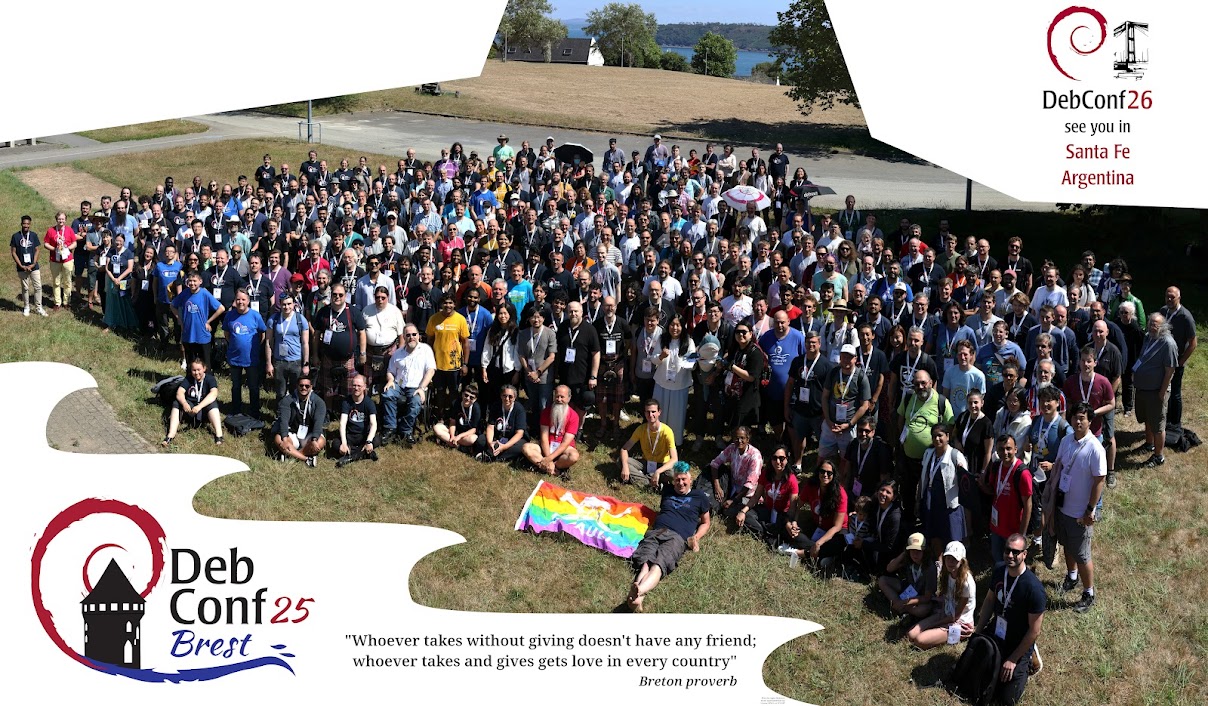
Bits from Debian: DebConf25 closes in Brest and DebConf26 announced

DebConf25 group photo - click to enlarge On Saturday 19 July 2025, the annual Debian Developers and Contributors Conference came to a close. Over 443 attendees representing 50 countries from around the world came together for a combined 169 events (including some which took place during the DebCamp) including more than 50 Talks, 39 Short Talks, 5 Discussions, 59 Birds of a Feather sessions ("BoF" informal meeting between developers and users), 10 workshops, and activities in support of furthering our distribution and free software, learning from our mentors and peers, building our community, and having a bit of fun. The conference was preceded by the annual DebCamp hacking session held 7 through 13 July where Debian Developers and Contributors convened to focus on their individual Debian-related projects or work in team sprints geared toward in-person collaboration in developing Debian. This year, a session was dedicated to prepare the BoF "Dealing with Dormant Packages: Ensuring Debian's High Standards"; another, at the initiative of our DPL, to prepare suggestions for the BoF Package Acceptance in Debian: Challenges and Opportunities"; and an afternoon around Salsa-CI. As has been the case for several years, a special effort has been made to welcome newcomers and help them become familiar with Debian and DebConf by organizing a sprint "New Contributors Onboarding" every day of Debcamp, followed more informally by mentorship during DebConf. The actual Debian Developers Conference started on Monday 14 July 2025. In addition to the traditional "Bits from the DPL" talk, the continuous key-signing party, lightning talks, and the announcement of next year's DebConf26, there were several update sessions shared by internal projects and teams. Many of the hosted discussion sessions were presented by our technical core teams with the usual and useful "Meet the Technical Committee", the "What's New in the Linux Kernel" session, and a set of BoFs about Debian packaging policy and Debian infrastructure. Thus, more than a quarter of the discussions dealt with this theme, including talks about our tools and Debian's archive processes. Internationalization and Localization have been the subject of several talks. The Python, Perl, Ruby, Go, and Rust programming language teams also shared updates on their work and efforts. Several talks have covered Debian Blends and Debian-derived distributions and other talks addressed the issue of Debian and AI. More than 17 BoFs and talks about community, diversity, and local outreach highlighted the work of various teams involved in not just the technical but also the social aspect of our community; four women who have made contributions to Debian through their artwork in recent years presented their work. The one-day session "DebConf 2025 Academic Track!", organized in collaboration with the IRISA laboratory was the first session welcoming fellow academics at DebConf, bringing together around ten presentations. The schedule was updated each day with planned and ad hoc activities introduced by attendees over the course of the conference. Several traditional activities took place: a job fair, a poetry performance, the traditional Cheese and Wine party (this year with cider as well), the Group Photos, and the Day Trips. For those who were not able to attend, most of the talks and sessions were broadcasted live and recorded; currently the videos are made available through this link. Almost all of the sessions facilitated remote participation via IRC and Matrix messaging apps or online collaborative text documents which allowed remote attendees to "be in the room" to ask questions or share comments with the speaker or assembled audience. DebConf25 saw over 441 T-shirts, 3 day trips, and up to 315 meals planned per day. All of these events, activities, conversations, and streams coupled with our love, interest, and participation in Debian and F/OSS certainly made this conference an overall success both here in Brest, France and online around the world. The DebConf25 website will remain active for archival purposes and will continue to offer links to the presentations and videos of talks and events. Next year, DebConf26 will be held in Santa Fe, Argentina, likely in July. As tradition follows before the next DebConf the local organizers in Argentina will start the conference activities with DebCamp with a particular focus on individual and team work towards improving the distribution. DebConf is committed to a safe and welcome environment for all participants. See the web page about the Code of Conduct on the DebConf25 website for more details on this. Debian thanks the commitment of numerous sponsors to support DebConf25, particularly our Platinum Sponsors: AMD, EDF, Infomaniak, Proxmox, and Viridien. We also wish to thank our Video and Infrastructure teams, the DebConf25 and DebConf committees, our host nation of France, and each and every person who helped contribute to this event and to Debian overall. Thank you all for your work in helping Debian continue to be "The Universal Operating System". See you next year! About Debian The Debian Project was founded in 1993 by Ian Murdock to be a truly free community project. Since then the project has grown to be one of the largest and most influential Open Source projects. Thousands of volunteers from all over the world work together to create and maintain Debian software. Available in 70 languages, and supporting a huge range of computer types, Debian calls itself the universal operating system. About DebConf DebConf is the Debian Project's developer conference. In addition to a full schedule of technical, social and policy talks, DebConf provides an opportunity for developers, contributors and other interested people to meet in person and work together more closely. It has taken place annually since 2000 in locations as varied as Scotland, Bosnia and Herzegovina, India, Korea. More information about DebConf is available from https://debconf.org/. About AMD The AMD ROCm platform includes programming models, tools, compilers, libraries, and runtimes for AI and HPC solution development on AMD GPUs. Debian is an officially supported platform for AMD ROCm and a growing number of components are now included directly in the Debian distribution. For more than 55 years AMD has driven innovation in high-performance computing, graphics and visualization technologies. AMD is deeply committed to supporting and contributing to open-source projects, foundations, and open-standards organizations, taking pride in fostering innovation and collaboration within the open-source community. About EDF EDF is a leading global utility company focused on low-carbon power generation. The group uses advanced engineering and scientific computing tools to drive innovation and efficiency in its operations, especially in nuclear power plant design and safety assessment. Since 2003, the EDF Group has been using Debian as its main scientific computing environment. Debian's focus on stability and reproducibility ensures that EDF's calculations and simulations produce consistent and accurate results. About Infomaniak Infomaniak is Switzerland's leading developer of Web technologies. With operations all over Europe and based exclusively in Switzerland, the company designs and manages its own data centers powered by 100% renewable energy, and develops all its solutions locally, without outsourcing. With millions of users and the trust of public and private organizations across Europe - such as RTBF, the United Nations, central banks, over 3,000 radio and TV stations, as well as numerous cities and security bodies - Infomaniak stands for sovereign, sustainable and independent digital technology. The company offers a complete suite of collaborative tools, cloud hosting, streaming, marketing and events solutions, while being owned by its employees and self-financed exclusively by its customers. About Proxmox Proxmox develops powerful, yet easy-to-use Open Source server software. The product portfolio from Proxmox, including server virtualization, backup, and email security, helps companies of any size, sector, or industry to simplify their IT infrastructures. The Proxmox solutions are built on Debian, we are happy that they give back to the community by sponsoring DebConf25. About Viridien Viridien is an advanced technology, digital and Earth data company that pushes the boundaries of science for a more prosperous and sustainable future. Viridien has been using Debian-based systems to power most of its HPC infrastructure and its cloud platform since 2009 and currently employs two active Debian Project Members. Contact Information For further information, please visit the DebConf25 web page at https://debconf25.debconf.org/ or send mail to press@debian.org.

Birger Schacht: My DebConf 25 review

DebConf 25 happened between 14th July and 19th July and I was there. It was my first DebConf (the big one, I was at a Mini DebConf in Hamburg a couple of years ago) and it was interesting. DebConf 25 happened at a Campus University at the outskirts of Brest and I was rather reluctant to go at first (EuroPython 25 was happening at the same time in Prague), but I decided to use the chance of DebConf happening in Europe, reachable by train from Vienna. We took the nighttrain to Paris, then found our way through the maze that is the Paris underground system and then got to Brest with the TGV. On our way to the Conference site we made a detour to a supermarket, which wasn t that easy because is was a national holiday in France and most of the shops were closed. But we weren t sure about the food situation at DebConf and we also wanted to get some beer. At the conference we were greeted by very friendly people at the badge station and the front desk and got our badges, swag and most important the keys to pretty nice rooms on the campus. Our rooms had a small private bathroom with a toilet and a shower and between the two rooms was a shared kitchen with a refrigerator and a microwave. All in all, the accommodation was simple but provided everything we needed and especially a space to have some privacy. During the next days I watched a lot of talks, met new people, caught up with old friends and also had a nice time with my travel buddies. There was a beach near the campus which I used nearly every day. It was mostly sunny except for the last day of the conference, which apparently was not common for the Brest area, so we got lucky regarding the weather. Landscape view of the sea at Dellec beach Given that we only arrived in the evening of the first day of DebConf, I missed the talk When Free Software Communities Unite: Tails, Tor, and the Fight for Privacy (recording), but I watched it on the way home and it was also covered by LWN. On Tuesday I started the day by visiting a talk about tag2upload (recording). The same day there was also an academic track and I watched the talk titled Integrating Knowledge Graphs into the Debian Ecosystem (recording) which presented a property graph showing relationships between various entities like packages, maintainers or bugs (there is a repository with parts of a paper, but not much other information). The speaker also mentioned the graphcast framework and the ontocast framework which sound interesting - we might have use for something liked this at $dayjob. In the afternoon there was a talk about the ArchWiki (recording) which gave a comprehensive insight in how the ArchWiki and the community behind it works. Right after that was a Debian Wiki BoF. There are various technical limitations with the current wiki software and there are not enough helping hands to maintain the service and do content curation. But the BoF had some nice results: there is now a new debian-wiki mailinglist, an IRC channel, a MediaWiki installation has been set up during DebConf, there are efforts to migrate the data and most importantly: and handful of people who want to maintain the service and organize the content of the wiki. I think the input from the ArchWiki folks gave some ideas how that team could operate. Tag at the wall at Dellec beach Wednesday was the day of the daytrip. I did not sign up for any of the trips and used the time to try out tag2upload, uploaded the latest labwc release to experimental and spent the rest of the day at the beach. Other noteworthy session I ve attended were the Don t fear the TPM talk (recording), which showed me a lot of stuff to try out, the session about lintian-ng (no recording), which is an experimental approach to make lintian faster, the review of the first year of wcurls existence (no recording yet) and the summary of Rust packaging in Debian (no recording yet). In between the sessions I started working on packaging wlr-sunclock (#1109230).


What did not work Vegan food. I might be spoiled by other conferences. Both at EuroPycon last year (definitely bigger, a lot more commercial) and at PyCon CZ 23 (similar in size, a lot more DIY) there was catering with explicitly vegan options. As I ve mentioned in the beginning, we went to a supermarket before we went to the conference and we had to go there one more time during the conference. I think there was a mixture between a total lack of awareness and a LOT of miscommunication. The breakfasts at the conference consisted of pastries and baguettes - I asked at the first day what the vegan options were and the answer was I don t know, maybe the baguette? and we were asked to only take as much baguette as the people who also got pastries. The lunch was prepared by the Restaurant associatif de Kern vent which is a canteen at the university campus. When we asked if there is vegan food, the people there said that there was only a vegetarian option so we only ate salad. Only later we heard via word of mouth that one has to explicitly ask for a vegan meal which was apparently prepared separatly and you had to find the right person that knows about it (I think thats very Debian-like ). But even then a person once got a vegetarian option offered as vegan food. One problem was also the missing / confusing labeling of the food. At the conference dinner there was apparently vegan food, but it was mixed with all the other food. There were some labels but with hundreds of hungry people around and caterers removing empty plates and dropping off plates with other stuff, everything gets mixed up. In the end we ate bread soaked in olive oil, until the olive oil got taken away by the catering people literally while we were dipping the bread in it. And when these issues were raised, some of the reactions can be summarized as You re holding it wrong which was really frustrating. The dinners at the conference hall were similar. At some point I had the impression that vegan and vegetarian was simply seen as the same thing. Dinner menu at the conference If the menus would be written like a debian/copyright file it would probably have looked like this:
Food: *
Diet: Vegan or Vegetarian
But the thing is that Vegan and Vegetarian cannot be mixed. Its similar to non compatible licenses. Once you mix vegan food with vegan food with vegetarian food it s not vegan anymore. Don t get me wrong, I know its hard to organize food for hundreds of people. But if you don t know what it means to provide a vegan option, just communicate the fact so people can look alternatives in advance. During the week some of the vegan people shared food, which was really nice and there were also a lot of non-vegan people who tried to help, organized extra food or simply listened to the hangry rants. Thanks for that!

Paris Saturday was the last day of DebConf and it was a rainy day. On Sunday morning we took the TGV back to Paris and then stayed there for one night because the next night train back to Vienna was on Monday. Luckily the weather was better in Paris. The first thing we did was to look up a vegan burger place. In the evening we strolled along the Seine and had a couple of beers at the Jardins du Trocad ro. Monday the rain also arrived in Paris and we mostly went from one cafe to the next, but also managed to visit Notre Dame.

Conclusio The next DebConf will be in Argentina and I think its likely that DebConf 27 will also not happen anywhere in trainvelling distance. But even if, I think the Mini DebConfs are more my style of happening (there is one planned in Hamburg next spring, and a couple of days ago I learned that there will be a Back to the Future musical show in Hamburg during that time). Nonetheless I had a nice time and I stumbled over some projects I might get more involved in. Thanks also to my travel buddies who put up with me

Matthew Palmer: Object deserialization attacks using Ruby's Oj JSON parser

tl;dr: there is an attack in the wild which is triggering dangerous-but-seemingly-intended behaviour in the Oj JSON parser when used in the default and recommended manner, which can lead to everyone s favourite kind of security problem: object deserialization bugs! If you have the oj gem anywhere in your Gemfile.lock, the quickest mitigation is to make sure you have Oj.default_options = mode: :strict somewhere, and that no library is overwriting that setting to something else.

Prologue As a sensible sysadmin, all the sites I run send me a notification if any unhandled exception gets raised. Mostly, what I get sent is error-handling corner cases I missed, but now and then things get more interesting. In this case, it was a PG::UndefinedColumn exception, which looked something like this:
PG::UndefinedColumn: ERROR:  column "xyzzydeadbeef" does not exist
This is weird on two fronts: firstly, this application has been running for a while, and if there was a schema problem, I d expect it to have made itself apparent long before now. And secondly, while I don t profess to perfection in my programming, I m usually better at naming my database columns than that. Something is definitely hinky here, so let s jump into the mystery mobile!

The column name is coming from outside the building! The exception notifications I get sent include a whole lot of information about the request that caused the exception, including the request body. In this case, the request body was JSON, and looked like this:
 "name":":xyzzydeadbeef", ... 
The leading colon looks an awful lot like the syntax for a Ruby symbol, but it s in a JSON string. Surely there s no way a JSON parser would be turning that into a symbol, right? Right?!? Immediately, I thought that that possibly was what was happening, because I use Sequel for my SQL database access needs, and Sequel treats symbols as database column names. It seemed like too much of a coincidence that a vaguely symbol-shaped string was being sent in, and the exact same name was showing up as a column name. But how the flying fudgepickles was a JSON string being turned into a Ruby symbol, anyway? Enter Oj.

Oj? I barely know aj A long, long time ago, the standard Ruby JSON library had a reputation for being slow. Thus did many competitors flourish, claiming more features and better performance. Strong amongst the contenders was oj (for Optimized JSON ), touted as The fastest JSON parser and object serializer . Given the history, it s not surprising that people who wanted the best possible performance turned to Oj, leading to it being found in a great many projects, often as a sub-dependency of a dependency of a dependency (which is how it ended up in my project). You might have noticed in Oj s description that, in addition to claiming fastest , it also describes itself as an object serializer . Anyone who has kept an eye on the security bug landscape will recall that object deserialization is a rich vein of vulnerabilities to mine. Libraries that do object deserialization, especially ones with a history that goes back to before the vulnerability class was well-understood, are likely to be trouble magnets. And thus, it turns out to be with Oj. By default, Oj will happily turn any string that starts with a colon into a symbol:

>> require "oj"
>> Oj.load(' "name":":xyzzydeadbeef","username":"bob","answer":42 ')
=>  "name"=>:xyzzydeadbeef, "username"=>"bob", "answer"=>42 

How that gets exploited is only limited by the creativity of an attacker. Which I ll talk about more shortly but first, a word from my rant cortex.

Insecure By Default is a Cancer While the object of my ire today is Oj and its fast-and-loose approach to deserialization, it is just one example of a pervasive problem in software: insecurity by default. Whether it s a database listening on 0.0.0.0 with no password as soon as its installed, or a library whose default behaviour is to permit arbitrary code execution, it all contributes to a software ecosystem that is an appalling security nightmare. When a user (in this case, a developer who wants to parse JSON) comes across a new piece of software, they have by definition no idea what they re doing with that software. They re going to use the defaults, and follow the most easily-available documentation, to achieve their goal. It is unrealistic to assume that a new user of a piece of software is going to do things the right way , unless that right way is the only way, or at least the by-far-the-easiest way. Conversely, the developer(s) of the software is/are the domain experts. They have knowledge of the problem domain, through their exploration while building the software, and unrivalled expertise in the codebase. Given this disparity in knowledge, it is tantamount to malpractice for the experts the developer(s) to off-load the responsibility for the safe and secure use of the software to the party that has the least knowledge of how to do that (the new user). To apply this general principle to the specific case, take the Using section of the Oj README. The example code there calls Oj.load, with no indication that this code will, in fact, parse specially-crafted JSON documents into Ruby objects. The brand-user user of the library, no doubt being under pressure to Get Things Done, is almost certainly going to look at this Using example, get the apparent result they were after (a parsed JSON document), and call it a day. It is unlikely that a brand-new user will, for instance, scroll down to the Further Reading section, find the second last (of ten) listed documents, Security.md , and carefully peruse it. If they do, they ll find an oblique suggestion that parsing untrusted input is never a good idea . While that s true, it s also rather unhelpful, because I d wager that by far the majority of JSON parsed in the world is untrusted , in one way or another, given the predominance of JSON as a format for serializing data passing over the Internet. This guidance is roughly akin to putting a label on a car s airbags that driving at speed can be hazardous to your health : true, but unhelpful under the circumstances. The solution is for default behaviours to be secure, and any deviation from that default that has the potential to degrade security must, at the very least, be clearly labelled as such. For example, the Oj.load function should be named Oj.unsafe_load, and the Oj.load function should behave as the Oj.safe_load function does presently. By naming the unsafe function as explicitly unsafe, developers (and reviewers) have at least a fighting chance of recognising they re doing something risky. We put warning labels on just about everything in the real world; the same should be true of dangerous function calls. OK, rant over. Back to the story.

But how is this exploitable? So far, I ve hopefully made it clear that Oj does some Weird Stuff with parsing certain JSON strings. It caused an unhandled exception in a web application I run, which isn t cool, but apart from bombing me with exception notifications, what s the harm? For starters, let s look at our original example: when presented with a symbol, Sequel will interpret that as a column name, rather than a string value. Thus, if our save an update to the user code looked like this:

# request_body has the JSON representation of the form being submitted
body = Oj.load(request_body)
DB[:users].where(id: user_id).update(name: body["name"])

In normal operation, this will issue an SQL query along the lines of UPDATE users SET name='Jaime' WHERE id=42. If the name given is Jaime O Dowd , all is still good, because Sequel quotes string values, etc etc. All s well so far. But, imagine there is a column in the users table that normally users cannot read, perhaps admin_notes. Or perhaps an attacker has gotten temporary access to an account, and wants to dump the user s password hash for offline cracking. So, they send an update claiming that their name is :admin_notes (or :password_hash). In JSON, that ll look like "name":":admin_notes" , and Oj.load will happily turn that into a Ruby object of "name"=>:admin_notes . When run through the above update the user code fragment, it ll produce the SQL UPDATE users SET name=admin_notes WHERE id=42. In other words, it ll copy the contents of the admin_notes column into the name column which the attacker can then read out just by refreshing their profile page.

But Wait, There s More! That an attacker can read other fields in the same table isn t great, but that s barely scratching the surface. Remember before I said that Oj does object serialization ? That means that, in general, you can create arbitrary Ruby objects from JSON. Since objects contain code, it s entirely possible to trigger arbitrary code execution by instantiating an appropriate Ruby object. I m not going to go into details about how to do this, because it s not really my area of expertise, and many others have covered it in detail. But rest assured, if an attacker can feed input of their choosing into a default call to Oj.load, they ve been handed remote code execution on a platter.

Mitigations As Oj s object deserialization is intended and documented behaviour, don t expect a future release to make any of this any safer. Instead, we need to mitigate the risks. Here are my recommended steps:
  1. Look in your Gemfile.lock (or SBOM, if that s your thing) to see if the oj gem is anywhere in your codebase. Remember that even if you don t use it directly, it s popular enough that it is used in a lot of places. If you find it in your transitive dependency tree anywhere, there s a chance you re vulnerable, limited only by the ingenuity of attackers to feed crafted JSON into a deeply-hidden Oj.load call.
  2. If you depend on oj directly and use it in your project, consider not doing that. The json gem is acceptably fast, and JSON.parse won t create arbitrary Ruby objects.
  3. If you really, really need to squeeze the last erg of performance out of your JSON parsing, and decide to use oj to do so, find all calls to Oj.load in your code and switch them to call Oj.safe_load.
  4. It is a really, really bad idea to ever use Oj to deserialize JSON into objects, as it lacks the safety features needed to mitigate the worst of the risks of doing so (for example, restricting which classes can be instantiated, as is provided by the permitted_classes argument to Psych.load). I d make it a priority to move away from using Oj for that, and switch to something somewhat safer (such as the aforementioned Psych). At the very least, audit and comment heavily to minimise the risk of user-provided input sneaking into those calls somehow, and pass mode: :object as the second argument to Oj.load, to make it explicit that you are opting-in to this far more dangerous behaviour only when it s absolutely necessary.
  5. To secure any unsafe uses of Oj.load in your dependencies, consider setting the default Oj parsing mode to :strict, by putting Oj.default_options = mode: :strict somewhere in your initialization code (and make sure no dependencies are setting it to something else later!). There is a small chance that this change of default might break something, if a dependency is using Oj to deliberately create Ruby objects from JSON, but the overwhelming likelihood is that Oj s just being used to parse ordinary JSON, and these calls are just RCE vulnerabilities waiting to give you a bad time.

Is Your Bacon Saved? If I ve helped you identify and fix potential RCE vulnerabilities in your software, or even just opened your eyes to the risks of object deserialization, please help me out by buying me a refreshing beverage. I would really appreciate any support you can give. Alternately, if you d like my help in fixing these (and many other) sorts of problems, I m looking for work, so email me.

20 July 2025

Michael Prokop: What to expect from Debian/trixie #newintrixie

Trixie Banner, Copyright 2024 Elise Couper Update on 2025-07-28: added note about Debian 13/trixie support for OpenVox (thanks, Ben Ford!) Debian v13 with codename trixie is scheduled to be published as new stable release on 9th of August 2025. I was the driving force at several of my customers to be well prepared for the upcoming stable release (my efforts for trixie started in August 2024). On the one hand, to make sure packages we care about are available and actually make it into the release. On the other hand, to ensure there are no severe issues that make it into the release and to get proper and working upgrades. So far everything is looking pretty well and working fine, the efforts seemed to have payed off. :) As usual with major upgrades, there are some things to be aware of, and hereby I m starting my public notes on trixie that might be worth for other folks. My focus is primarily on server systems and looking at things from a sysadmin perspective. Further readings As usual start at the official Debian release notes, make sure to especially go through What s new in Debian 13 + issues to be aware of for trixie (strongly recommended read!). Package versions As a starting point, let s look at some selected packages and their versions in bookworm vs. trixie as of 2025-07-20 (mainly having amd64 in mind):
Package bookworm/v12 trixie/v13
ansible 2.14.3 2.19.0
apache 2.4.62 2.4.64
apt 2.6.1 3.0.3
bash 5.2.15 5.2.37
ceph 16.2.11 18.2.7
docker 20.10.24 26.1.5
dovecot 2.3.19 2.4.1
dpkg 1.21.22 1.22.21
emacs 28.2 30.1
gcc 12.2.0 14.2.0
git 2.39.5 2.47.2
golang 1.19 1.24
libc 2.36 2.41
linux kernel 6.1 6.12
llvm 14.0 19.0
lxc 5.0.2 6.0.4
mariadb 10.11 11.8
nginx 1.22.1 1.26.3
nodejs 18.13 20.19
openjdk 17.0 21.0
openssh 9.2p1 10.0p1
openssl 3.0 3.5
perl 5.36.0 5.40.1
php 8.2+93 8.4+96
podman 4.3.1 5.4.2
postfix 3.7.11 3.10.3
postgres 15 17
puppet 7.23.0 8.10.0
python3 3.11.2 3.13.5
qemu/kvm 7.2 10.0
rsync 3.2.7 3.4.1
ruby 3.1 3.3
rust 1.63.0 1.85.0
samba 4.17.12 4.22.3
systemd 252.36 257.7-1
unattended-upgrades 2.9.1 2.12
util-linux 2.38.1 2.41
vagrant 2.3.4 2.3.7
vim 9.0.1378 9.1.1230
zsh 5.9 5.9
Misc unsorted apt The new apt version 3.0 brings several new features, including: systemd systemd got upgraded from v252.36-1~deb12u1 to 257.7-1 and there are lots of changes. Be aware that systemd v257 has a new net.naming_scheme, v257 being PCI slot number is now read from firmware_node/sun sysfs file. The naming scheme based on devicetree aliases was extended to support aliases for individual interfaces of controllers with multiple ports. This might affect you, see e.g. #1092176 and #1107187, the Debian Wiki provides further useful information. There are new systemd tools available: The tools provided by systemd gained several new options: Debian s systemd ships new binary packages: Linux Kernel The trixie release ships a Linux kernel based on latest longterm version 6.12. As usual there are lots of changes in the kernel area, including better hardware support, and this might warrant a separate blog entry. To highlight some changes with Debian trixie: See Kernelnewbies.org for further changes between kernel versions. Configuration management For puppet users, Debian provides the puppet-agent (v8.10.0), puppetserver (v8.7.0) and puppetdb (v8.4.1) packages. Puppet s upstream does not provide packages for trixie, yet. Given how long it took them for Debian bookworm, and with their recent Plans for Open Source Puppet in 2025, it s unclear when (and whether at all) we might get something. As a result of upstream behavior, also the OpenVox project evolved, and they already provide Debian 13/trixie support (https://apt.voxpupuli.org/openvox8-release-debian13.deb). FYI: the AIO puppet-agent package for bookworm (v7.34.0-1bookworm) so far works fine for me on Debian/trixie. Be aware that due to the apt-key removal you need a recent version of the puppetlabs-apt for usage with trixie. The puppetlabs-ntp module isn t yet ready for trixie (regarding ntp/ntpsec), if you should depend on that. ansible is available and made it with version 2.19 into trixie. Prometheus stack Prometheus server was updated from v2.42.0 to v2.53, and all the exporters that got shipped with bookworm are still around (in more recent versions of course). Trixie gained some new exporters: Virtualization docker (v26.1.5), ganeti (v3.1.0), libvirt (v11.3.0, be aware of significant changes to libvirt packaging), lxc (v6.0.4), podman (v5.4.2), openstack (see openstack-team on Salsa), qemu/kvm (v10.0.2), xen (v4.20.0) are all still around. Proxmox already announced their PVE 9.0 BETA, being based on trixie and providing 6.14.8-1 kernel, QEMU 10.0.2, LXC 6.0.4, OpenZFS 2.3.3. Vagrant is available in version 2.3.7, but Vagrant upstream does not provide packages for trixie yet. Given that HashiCorp adopted the BSL, the future of vagrant in Debian is unclear. If you re relying on VirtualBox, be aware that upstream doesn t provide packages for trixie, yet. VirtualBox is available from Debian/unstable (version 7.1.12-dfsg-1 as of 2025-07-20), but not shipped with stable release since quite some time (due to lack of cooperation from upstream on security support for older releases, see #794466). Be aware that starting with Linux kernel 6.12, KVM initializes virtualization on module loading by default. This prevents VirtualBox VMs from starting. In order to avoid this, either add kvm.enable_virt_at_load=0 parameter into kernel command line or unload the corresponding kvm_intel / kvm_amd module. If you want to use Vagrant with VirtualBox on trixie, be aware that Debian s vagrant package as present in trixie doesn t support the VirtualBox package version 7.1 as present in Debian/unstable (manually patching vagrant s meta.rb and rebuilding the package without Breaks: virtualbox (>= 7.1) is known to be working). util-linux The are plenty of new options available in the tools provided by util-linux: Now no longer present in util-linux as of trixie: The following binaries got moved from util-linux to the util-linux-extra package: And the util-linux-extra package also provides new tools: OpenSSH OpenSSH was updated from v9.2p1 to 10.0p1-5, so if you re interested in all the changes, check out the release notes between those versions (9.3, 9.4, 9.5, 9.6, 9.7, 9.8, 9.9 + 10.0). Let s highlight some notable behavior changes in Debian: There are some notable new features: Thanks to everyone involved in the release, looking forward to trixie + and happy upgrading!
Let s continue with working towards Debian/forky. :)

Next.

Previous.