Search Results: "sesse"

16 December 2008

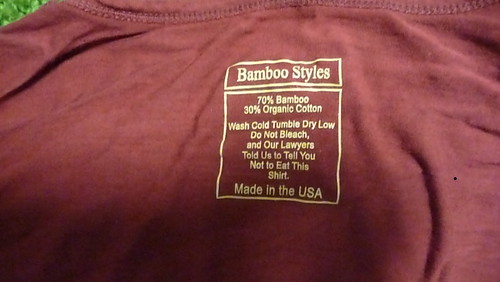
Biella Coleman: Do Not Eat the Laundry


do-not-eat, originally uploaded by the biella.
America is a land brimming with paradoxes, one of them being our simultaneous obsession with freedom and rules. We purport to be the land of the free (and while this is and may not be true, we do hold steadfast to this idea). But we also love rules rules and rules, and wait there are more and more and more rules, too many rules, which often come in the form of the form of a sign, this one being one of my favorites. (shall not produce grease laden fumes?! yes, I think it was written by an academic). So I appreciate small reminders that poke fun of and holes in our love of rules and warnings, such as the one I found on my new bamboo-based shirt, pictured above. I have taken a huge liking for bamboo shirts as of late (I am obsessed with the tactile and can only stand soft cloth, which is why I love bamboo-based cloth) and I ordered a few shirts of the Internet. I only noticed the warning when I pulled the shirt out of the dryer late the other night and it was by far one of the only times I smiled from left to right at 1 am when doing laundry. More people should take the time to plant these easter-egg type jokes as they are, I am sure, much appreciated.

24 November 2008

Gunnar Wolf: You insensitive clods. s/lo/ol/

It's sad that today in Planet Debian we have hit an Eurocentric geographically discriminating meme. Particularly, one I'd love to take part of. Well, at least I can assure you we have reached the usual low temperature of 2 Celsius in Mexico City... As always, people say it's so cold that this year we _will_ get snow. And as always, I'm sure it's just wishful thinking ;-)
So, even with Marcelo's frozen Z calo live again for this winter, I can only reinforce our tropical paradise stereotypes by reminding you that this is less than 500Km away from home - All year 'round:

Ingo Juergensmann: First snow picture

Following the first snow picture meme on planet.d.o, this is my contribution. First snow this morning. Really not that much, I've to admit.

First snow in Warnemuende


P.S.: For the interested people: there's now a new RSS feed for my photo category.

31 October 2008

MJ Ray: Recent Events: London LinuxExpo, Toronto Free Software and Open Source Symposium, Public Sector Online, Get Online Day, the Global Financial Crisis, c&binet

Today’s the last day for the Gov.UK Consultation on Forced ISP Snooping: Please Say NO. I didn’t get to LinuxExpo, partly because of Monday Machine-Mangling Madness but I saw LinuxExpo 2008 Robert Castelo from the Drupal point-of-view. I also didn’t get to Public Sector Online (report by Andrew Lewin with links to more) and I definitely didn’t travel to Toronto, so the report on the Free Software and Open Source Symposium from Randy Metcalfe is pretty welcome. I wrote about the Social Enterprise Photography Competition and Cooperatives South-West Trade Fair last Friday - the photography competition deadline has been extended to 7 November. So you’ve still time to capture a vision of a more progressive approach to business that values people and the planet as well as profit. Last Friday was Get Online Day but TTLLP didn’t do anything for it this year - I took one look and reached similar conclusions to Graham Jones: Get online…! Oh - you are…! Related to that: on Tuesday, I got really annoyed about how many branches of government (national, regional, sub-regional and local) are obsessed about the private sector and are paying even less attention to other types of businesses, includingbuying off-the-shelf software which doesn’t conform to their stated policies about accessibility and interoperability. (Sorry if you saw evidence of that outburst… yes, local councillors are pretty powerless and get as annoyed about incompetent government services as everyone else.) It seems I’m not the only one feeling that good cooperative businesses are being overlooked. The ICA have recently sent an open letter to the Governments of the G-8 reminding them that co-operative financial institutions are an alternative secure, stable and sustainable model of business owned and controlled by people. Finally, a bit of advance notice here: “The inaugural Creativity & Business International Network (c&binet) will take place at The Grove in Hertfordshire from 26 28 October 2009” - is this something that free software and free culture supporters should get involved with? (And why did they pick a name that includes an XML special character?)

22 August 2008

Joey Hess: vacation

This "beach trip" was unusual, as its ocracode shows: OBX1.1 P5/6/4 L6 S12+b----c---- U10(mountains,freshwater,etc) T0 f0 b0 Rd Bb----m----n---- F+ SC----s--g0 H----f0i0.5 V+++s--m0 E-r-- Here are 4 generations of Hess's on a visit to the Bluff Mountain Preserve, which is not normally open to the public and has what is supposed to be the only fen in the southern Appalachians. photo photo Also, I no longer have a car after that trip. I am, however, looking at various electric bicycles. As someone who hates being posessed by posessions, I'm happy that losing my car doesn't really bother me. Oh, and Leo has kitty-laryngitis.

31 July 2008

Jaldhar Vyas: Don't Copy That Colloquoy

It seems I have been wrong about the origins of the Seville Orange joke Rather than Algernon Sidney It would appear to have been quipped by an 18th century Anglo-Irish actor named James Quin as recounted in "Lives of the Players" by John Galt (not that John Galt but this one) in 1831.
Quin once, in the character of Cato, received a blow in his face by an orange thrown from the upper gallery; such a circumstance would have disconcerted many an actor possessed of less presence of mind, but instead of being disturbed, he wiped his face, and taking it up, observed, "It was not a Seville orange."
A proto-version of the joke does date back to Sidney's time. It was made by none less than William Shakespeare in "Much Ado About Nothing" Act II, Scene 1:
DON PEDRO: Why, how now, count! wherefore are you sad?
CLAUDIO: Not sad, my lord.
DON PEDRO: How then? Sick?
CLAUDIO: Neither, my lord.
BEATRICE: The count is neither sad, nor sick, nor merry, nor well; but civil count, civil as an orange, and something of that jealous complexion.
Note Don Pedro is from Aragon which is close enough to Seville for Elizabethan comedy purposes. But while 300+ years is impressive, this joke from Sumeria c. 19th-16th centuries BC is older by far:
Something which has never occurred since time immemorial: a young woman did not fart in her husband's lap.
See The world's ten oldest jokes

1 July 2008

Joey Hess: random media

Just some stuff I've been rotting my mind with late at night lately..

15 June 2008

Clint Adams: Grapes and honeydew

I'm in Manitoba, drinking port and eating Jarlsberg and fontina. This is not a pleasant combination, yet I have no intention of aborting the mission. Robert DeNiro is wearing a rubber fat suit and shouting belligerently about carpentry. I still have never been to Winnipeg. Throughout the years, people have informed me that various animals are unable to swim. In the first Diplomacy game I ever played, it was frequently mentioned that sheep cannot swim. At the Parade of the Flailing Clowns, it was observed that chimps cannot swim. The chimpanzee cannot swim, apparently, because of a total lack of body fat. That's right; chimps have absolutely 0 body fat. Not a single gram. Tell someone obsessed with eating low-fat meat this factoid. You shall observe an order for potted chimp meat being placed immediately. On the other hand, if you point out that goat is lower in fat than chicken, this person will appear nonplussed, and continue to maintain the same diet, because even though goat is a leaner meat, it is red meat and therefore higher in fat than chicken, which is higher in fat than goat. You can witness the same sort of behavior when pointing out the farmed nature of farm-raised fish to a free-ranger. There is a classification for this kind of interplay between faith, logic, and rationality. It is either insanity or religion; I forget the difference.

18 May 2008

Russell Coker: Debian SSH Problems

It has recently been announced that Debian had a serious bug in the OpenSSL code [1], the most visible affect of this is compromising SSH keys - but it can also affect VPN and HTTPS keys. Erich Schubert was one of the first people to point out the true horror of the problem, only 2^15 different keys can be created [2]. It should not be difficult for an attacker to generate 2^15 host keys to try all combinations for decrypting a login session. It should also be possible to make up to 2^15 attempts to login to a session remotely if an attacker believes that an authorized key was being used - that would take less than an hour at a rate of 10 attempts per second (which is possible with modern net connections) and could be done in a day if the server was connected to the net by a modem. John Goerzen has some insightful thoughts about the issue [3]. I recommend reading his post. One point he makes is that the person who made the mistake in question should not be lynched. One thing I think we should keep in mind is the fact that people tend to be more careful after they have made mistakes, I expect that anyone who makes a mistake in such a public way which impacts so many people will be very careful for a long time… Steinar H. Gunderson analyses the maths in relation to DSA keys, it seems that if a DSA key is ever used with a bad RNG then it can be cracked by someone who sniffs the network [4]. It seems that it is safest to just not use DSA to avoid this risk. Another issue is that if a client supports multiple host keys (ssh version 2 can use three different key types, one for the ssh1 protocol, one for ssh2 with RSA, and one for ssh2 with DSA) then a man in the middle attack can be implemented by forcing a client to use a different key type - see Stealth’s article in Phrack for the details [5]. So it seems that we should remove support for anything other than SSHv2 with RSA keys. To remove such support from the ssh server edit /etc/ssh/sshd_config and make sure it has a line with “Protocol 2“, and that the only HostKey line references an RSA key. To remove it from the ssh client (the important thing) edit /etc/ssh/ssh_config and make sure that it has something like the following: Host *
Protocol 2
HostKeyAlgorithms ssh-rsa
ForwardX11 no
ForwardX11Trusted no You can override this for different machines. So if you have a machine that uses DSA only then it would be easy to add a section: Host strange-machine
Protocol 2
HostKeyAlgorithms ssh-dsa So making the default configuration of the ssh client on all machines you manage has the potential to dramatically reduce the incidence of MITM attacks from the less knowledgable users. When skilled users who do not have root access need to change things they can always edit the file ~/.ssh/config (which has the same syntax as /etc/ssh/ssh_config) or they can use command-line options to override it. The command ssh -o “HostKeyAlgorithms ssh-dsa” user@server will force the use of DSA encryption even if the configuration file requests RSA. Enrico Zini describes how to use ssh-keygen to get the fingerprint of the host key [6]. One thing I have learned from comments on this post is how to get a fingerprint from a known hosts file. A common situation is that machine A has a known hosts file with an entry for machine B. I want to get the right key in machine C and there is no way of directly communicating between machine A and machine C (EG they are in different locations with no network access). In that situation the command “ssh-keygen -l -f ~/.ssh/known_hosts” can be used to display all the fingerprints of hosts that you have connected to in the past, then it’s a simple matter of grepping the output. Docunext has an interesting post about ways of mitigating such problems [7]. One thing that they suggest is using fail2ban to block IP addresses that appear to be trying to do brute-force attacks. It’s unfortunate that the version of fail2ban in Debian uses /tmp/fail2ban.sock for it’s Unix domain socket for talking to the server (the version in Unstable uses /var/run/fail2ban/fail2ban.sock). They also mention patching network drivers to add entropy to the kernel random number generator. One thing that seems interesting is the package randomsound (currently in Debian/Unstable) which takes ALSA sound input as a source of entropy, note that you don’t need to have any sound input device connected. When considering fail2ban and similar things, it’s probably best to start by restricting the number of machines which can connect to your SSH server. Firstly if you put it on a non-default port then it’ll take some brute-force to find it. This will waste some of the attacker’s time and also make the less persistent attackers go elsewhere. One thing that I am considering is having a few unused ports configured such that any IP address which connects to them gets added to my NetFilter configuration - if you connect to such ports then you can’t connect to any other ports for a week (or until the list becomes too full). So if for example I had port N configured in such a manner and port N+100 used for ssh listening then it’s likely that someone who port-scans my server would be blocked before they even discovered the SSH server. Does anyone know of free software to do this? The next thing to consider is which IP addresses may connect. If you were to allow all the IP addresses from all the major ISPs in your country to connect to your server then it would still be a small fraction of the IP address space. Sure attackers could use machines that they already cracked in your country to launch their attacks, but they would have to guess that you had such a defense in place, and even so it would be an inconvenience for them. You don’t necessarily need to have a perfect defense, you only need to make the effort to reward ratio be worse for attacking you than for attacking someone else. Note that I am not advocating taking a minimalist approach to security, merely noting that even a small increment in the strength of your defenses can make a significant difference to the risk you face. Update: based on comments I’m now considering knockd to open ports on demand. The upstream site for knockd is here [8], and some documentation on setting it up in Debian is here [9]. The concept of knockd is that you make connections to a series of ports which act as a password for changing the firewall rules. An attacker who doesn’t know those port numbers won’t be able to connect. Of course anyone who can sniff your network will discover the ports soon enough, but I guess you can always login and change the port numbers once knockd has let you in. Also thanks to Helmut for advice on ssh-keygen.

16 May 2008

Daniel Stone: faq: dsa keys

A quick FAQ: the reason all DSA keys have been removed from fd.o and we aren't accepting any new ones is that they are vulnerable to man-in-the-middle attacks if they have ever been used (not just generated) on a system with a predictable RNG: see Steinar's summary of the maths. We're going with precedent of debian.org rejecting DSA keys, and a general desire to be safe rather than sorry. RSA keys are the default in OpenSSH anyway, so I'm not really sure why you'd want to generate DSA.

13 April 2008

Clint Adams: The Legend of Bagger Baggs

One day the Stranger arrived. He was a tall and lanky teen, his face peppered with acne and sparse pubescent hair. He wore a wide-brimmed hat, a long coat, a scarf, and he was Strange. Some newcomers prefer to observe, to gauge the breadth and nuance of Social Custom, and to keep low profiles until they are comfortable enough to risk a misstep. This newcomer preferred to wield a bean bag, and to go door to door, knocking, introducing himself, and asking if there might be any nice conversation lurking inside in which he might join. Predictably, most people were horrified, frightened, and offended. They responded in a hostile fashion, and branded him Bean Bag Boy, or Bag Boy for short. A few others viewed him instead as a free spirit, a visionary, a unique character, and a Cool Guy. Perhaps they bought into the crap that society spews forth as part of its Campaign for Cognitive Dissonance. Perhaps they were just confused. Those that admired him branded him Doctor Who, a moniker of affection and respect. I will never understand this, even though I know which drugs they were on (Prozac, Zoloft, LSD, THC, psylocybin, and PCP, respectively). Bag Boy learned to keep mostly to those who appreciated his insane ramblings. Had he been motivated and competent, he probably could have been a minor cult leader. Instead, he fell out of public view for a while. When he returned, he had two younger companions: a boy and a girl. It became immediately obvious what to call them. The female, whose name, eerily enough, was Baggs, would be Bag Girl. Since Bag Boy already possessed that name, the male would have to be Little Bag. Little Bag was an enigma unto himself, and went on to have many adventures of his own. Once he called me a Zenmaster, so I will refrain from mentioning him for a long time. Bag Girl was no less a character. She detested being called by either her given name or her surname, and instead preferred to brandish an agglutinative designation of her own choosing: one part temporal adjective, one part finite act of performance. This contrasted delightfully with her appearance, which was not dissimilar to a three-foot-tall chinchilla. Most were content to call her by her chosen appellation, though some would add her real surname (to which she fumed bitterly), and one insisted on calling her by her given name, as a hostile act of hatred. Bag Girl's main hobby was a menagerie of characters that she explained were her multiple personalities. Unlike persons suffering from dissociative identity disorder, Bag Girl had full knowledge of her personalities and their doings. One of these personalities was a 90-year-old elf named Galiganda Dulin. Another was a man named Sayjon, who bore a suspicious resemblance to Pink Floyd's fascist alter ego from The Wall. In fact, Bag Girl had been profoundly affected by The Wall, although she had watched it while on LSD, so interpolation based on these data may be tainted.

15 March 2008

Pierre Habouzit: a RC Bug a day

keeps the release away. That's why, following Sesse last year, I started to work on (at least), one RC bug a day. If I do that alone, and that no new RC bugs are opened[1], we will release in 460 days; now if 10 DD do the same, it becomes 46 FWIW, today, I made Luk (Claes) reassign and downgrade #470453 and sent a DELAYED/2 NMU for #470002. And you, what did you do for the release ?
Notes [1] har har har

8 March 2008

Clint Adams: The Legend of Bagger Baggs

One day the Stranger arrived. He was a tall and lanky teen, his face peppered with acne and sparse pubescent hair. He wore a wide-brimmed hat, a long coat, a scarf, and he was Strange. Some newcomers prefer to observe, to gauge the breadth and nuance of Social Custom, and to keep low profiles until they are comfortable enough to risk a misstep. This newcomer preferred to wield a bean bag, and to go door to door, knocking, introducing himself, and asking if there might be any nice conversation lurking inside in which he might join. Predictably, most people were horrified, frightened, and offended. They responded in a hostile fashion, and branded him Bean Bag Boy, or Bag Boy for short. A few others viewed him instead as a free spirit, a visionary, a unique character, and a Cool Guy. Perhaps they bought into the crap that society spews forth as part of its Campaign for Cognitive Dissonance. Perhaps they were just confused. Those that admired him branded him Doctor Who, a moniker of affection and respect. I will never understand this, even though I know which drugs they were on (Prozac, Zoloft, LSD, THC, psylocybin, and PCP, respectively). Bag Boy learned to keep mostly to those who appreciated his insane ramblings. Had he been motivated and competent, he probably could have been a minor cult leader. Instead, he fell out of public view for a while. When he returned, he had two younger companions: a boy and a girl. It became immediately obvious what to call them. The female, whose name, eerily enough, was Baggs, would be Bag Girl. Since Bag Boy already possessed that name, the male would have to be Little Bag. Little Bag was an enigma unto himself, and went on to have many adventures of his own. Once he called me a Zenmaster, so I will refrain from mentioning him for a long time. Bag Girl was no less a character. She detested being called by either her given name or her surname, and instead preferred to brandish an agglutinative designation of her own choosing: one part temporal adjective, one part finite act of performance. This contrasted delightfully with her appearance, which was not dissimilar to a three-foot-tall chinchilla. Most were content to call her by her chosen appellation, though some would add her real surname (to which she fumed bitterly), and one insisted on calling her by her given name, as a hostile act of hatred. Bag Girl's main hobby was a menagerie of characters that she explained were her multiple personalities. Unlike persons suffering from dissociative identity disorder, Bag Girl had full knowledge of her personalities and their doings. One of these personalities was a 90-year-old elf named Galiganda Dulin. Another was a man named Sayjon, who bore a suspicious resemblance to Pink Floyd's fascist alter ego from The Wall. In fact, Bag Girl had been profoundly affected by The Wall, although she had watched it while on LSD, so interpolation based on these data may be tainted.

7 February 2008

Biella Coleman: On Confidence, Geekdom, and Desire

So a few folks left some interesting comments in response to my link to the article on the rise of the alpha-girl based on the research of Harvard psychologist, Dan Kindlon. My response to both Joe and Karl is that it is worthy to lower the barriers to entry not because girls will change the cultural ecology of geekdom in positive ways (though they may) or because geekdom is inherently “omg totally awesome!!!!!!!!!!!!!!!!!!!!” but for a much more mundane reason: it may allow girls to follow interests and eventually discover a passion. I think it is a great idea if more women were involved in geekdom and open source development not because it is inherently great but because I am sure there a lot of women out there who would enjoy it (and by extension, I am sure a lot who would not). By highlighting this article I am not advocating some forced hacker-female-labor-migration-policy but pointing to the fact that social conditions outside of geekdom play a role in ensuring more participation among women. But let me explain a few things before I argue my position a little further. First a little clarification, especially now that I have read the article. By alpha the author does not mean dominant, aggressive, and totally jerky, which is what might immediately come to mind when you read/hear alpha (especially if one knows any alpha-geeks or alpha-lawyers for that matter, who are much worse, imho). And I certainly don’t want any more alpha-anything (alpha-women, alpha-dogs, alpha-cats, alpha-hamsters ) given our world is already chock-full of alpha-jerks. By using the term, the author basically means confidence, which apparently is on the rise among girls, leaving them much more likely to be go-getters, undaunted by explicit and implicit barriers and obstacles and thus more likely then ever to enter arenas that have been thought of as traditionally male or in fact totally dominated by males. If this trend is indeed in place, I think it is great and I hope that this eventually translates into more girls/women populating traditionally male areas whether it is neurology, movie directing, hacking, or surfing. What I appreciate about the article is that his research can help us question the idea that women are naturally averse to competition due to their estrogenic hormones while boys, brimming with testosterone, just love it and exude it. I never identified with that conventional well-worn script, in part because I guess I am fairly confident and somewhat competitive. Being in academia for the last 10 years, I have witnessed a lot of really confident women that have helped inspire me and keep me going, especially when times got rough. What is fascinating about the article (and by extension probably his book) is that gender parity and equity and changes in the psychological makeup of women have not changed overnight but have taken a much longer time to settle in place. We are only now bearing the fruits of structural and educational changes first instituted decades ago and that tackled some serious forms of discrimination. As a result, we are seeing girls and women donning a deeper confidence that may help them participate with more success in the arenas they want to whether it be sports or in the workplaces (though there are certainly still major barriers and issues, which are addressed in the article). So why would someone want to participate in the world of free software and hacking in particular? My first answer is there may be any number of reasons why anyone, female or male or transgender or whatever, may want to do so for the love of technology, to feel an intense belonging to a community who share your passions and who work together to create something with a lot of value, to enjoy the challenge of learning, to spread freedom to every corner of the earth, etc… It is not that geekdom is inherently fun and exciting but that it will be interesting to some slice of the population men or women (or other) and what is the harm in lowering the barriers to entry, especially if it brings enjoyment and frankly a lot of economic security too? There are a number of girls/women who already find it worthwhile and I am sure many more who would. And the point is not to create some policy to make sure that we shuttle women into hackerdom but as a society we should equip them with the necessary psychological tools so that if they think this is worthwhile, and discover that they love it, etc, they will dare to venture in there and more importantly, stay if they want to. In terms of Karls point that a lot of people are professional geeks in part because they d have trouble being anything else; like being gay, it s not a choice, I think that is far too narrow of an assessment, not to mention an outdated caricature of geeks. While there is certainly a class of socially awkward geeks (if that is what you mean??), I would say they are in the minority though they may certainly stand out precisely because they are the odd ducks and because the stereotype is so entrenched. Many geeks I have met, while they may pretty darn focused on geekdom, also have full and rich lives/personalities that cannot be easily collapsed into one immutable personality type. Yes they may be obsessed with tech but aren’t doctors, academics, musicians, lawyers sort of fanatical too? I spend like my whole week working on academic stuff (part of necessity, part out of love). And at least hacking has way better conferences and economic perks, which may help explain why people stay :-) Finally, I think you assume a little to strongly that we do what we do because we have a pre-formed existing desired to do so. While I think this is the case for many things (and I knew the minute I learned about anthropology, I wanted to be one, which was odd but it proved to be correct), I think desire is also formed as much through experience and hence the importance of exposure to different worlds and experiences. I know that there are many things I could have never imagined I would have loved–karoake and sailing are two things that come to mind—until I tried them about both took some degree of courage. In the later case, it took a lot of guts to move onto some ship at the age of 18 instead of going to college and I am so glad I did. This is an instance where confidence and an initial curiosity led to discovering a love and passion I never knew I had. So if desire can be formed and not just expressed, I think it is key to make sure people have all sorts of opportunities to cultivate the passions they never knew they had.
15 January 2008

Romain Francoise: Shared links for 2008-01-15

3 January 2008

MJ Ray: MSN Santa Sex Scandal

I missed this one when it happened earlier last month, but I'm still putting it on my 2007 page of Bad Technology. Thanks to a colleague for pointing it out. Apparently MSN's Santa-bot made inappropriate comments to children and was exposed in Microsoft's sex-obsessed RoboSanta spouts filth at children The Register After that, it was almost inevitable that it would be taken off-line, even if just for a short while, so I think the next headline could have been predicted:- Microsoft kills Santa Claus The Register What surprised me was the ham-fisted PR attempt described in Microsoft accuses kids of bullying Santa into sex chat The Register If it was a mistake, then admit it. How did it happen? Unruly programmers wanting easter eggs at Christmas, did someone make the Santa-bot by modifying a porno-bot, or was it a learning bot finally corrupted by all the abuse it was sent - like Arnold on UEA/tsw's #pubfood IRC? Truly bizarre.

6 December 2007

Anthony Towns: Asus eeePC

Okay, so any excuse to bring out the Laphroaig is fine by me, but the cute little eeePC is better than most. That it’s cute and popular is all very well, but what really makes my day is this is the first device I’ve seen that both doesn’t hide the fact it’s running Linux, and is available in maintstream stores in Australia. A random review from the Sydney Morning Herald:

You also don’t get Windows. Asus has adopted the free Linux operating system that’s been slowly yet steadily growing in popularity over the past decade. This keeps the cost down and makes better use of its relatively modest hardware, which would creak under the weight of Windows. It does mean not being able to use your favourite Windows software but, fortunately, the Eee PC comes with dozens of programs, including the familiar Firefox web browser and Skype for online phone calls.
That came out on the day the eeePC was released in Australia. Three days later, they did a followup:
Taiwan computer maker Asus might have underestimated the local demand for its diminutive Eee PC, as the $499 laptop is now virtually sold out in Australia.
From that, there’s a brief take on who’s actually buying them:
“We’ve had customers coming in buying two or three units for the family - the mix of customer has been probably novices more than the tech types,” he said.
It’s really good to see that Linux is getting credit in pretty much all those stories, no matter how mainstream. Xandros is pretty rarely mentioned, and I don’t think I’ve seen Debian mentioned yet. But even without the credit, it’s still pretty cool that with the eeePC and Dell’s trysting with Ubuntu, the real in-roads to pre-installed consumer Linux these days are building on Debian. I’d always expected that Red Hat or SuSE or someone with more commercial muscle would get through that door first (they’ve certainly had box sets more readily available!), but apparently elitist, freedom obsessed, techno-geekery actually works better, somehow. At least when there’s a company to put a smiley face in front of it all :) The other interesting thing about choosing Xandros, is that it presumably means the eeePC is covered by Microsoft’s patent protection scheme – which means no baseless threats against eeePC users from Microsoft, but also that Microsoft’s probably getting a cut of whatever Xandros receives from each eeePC sale. Whether you think that’s a problem or not, the result is probably going to be that it’s the thin edge of the wedge: it’s removed Microsoft from blocking a Linux preinstall on consumer hardware, which means we can see that regular people like Linux systems enough that they sell out in days. And that means Linux systems are a fact of life, and if Microsoft try to stop them by making it difficult for you to sell Windows systems, well, that’ll just make it difficult to sell Windows systems – which is another win for Linux. And once you get to the point where the argument for paying off Microsoft doesn’t rely on keeping your OEM deal for Windows, but is just a matter of whether their patents are actually valid… Oh, also nice from the promoting free software angle, is that the first thing you see if you decide to visit Asus’s eeePC site to check the gizmo is the news item:
2007.11.27 ASUSTek is committed to meet the requirements of the GNU General…
Add the fact that an eeePC running a Debian-derivative has access to all the software in the Debian repositories for no cost, and the new government’s planned rebates and investments in IT probably mean that parents can get close to a full refund, and you’re getting pretty close to a choice of spending nothing and getting a popular, reasonably functional and very portable laptop with all the software you could ever want, that just happens to be running Linux, or paying an extra few hundred or thousand dollars to get a Windows laptop, and then probably pirating whatever software you end up needing. In any event, to my mind, that makes 2007 the year of the Linux on the desktop: everything from here is just a simple matter of quantity. What’s next?

14 November 2007

Eddy Petrișor: Lesson relearned: when Linux networking weirdess occurs...

My relearned lesson for the day: when Linux networking weirdness occurs in a NAT environment, remember to try MTU clamping.

Thanks to the comments by Justin and Sesse, I was fast-tracked to the core of the problems I have been experiencing since Thursday, MTU issues. What's worse (from my pov) is that I have encountered this issue before with the provider I had in Timi oara, but, since that ISP was using PPPoE and my current ISP in Bucharest doesn't, I never really made the connection. I even had a commented out iptables rule for MTU clamping in my firewall script.

The rule I am talking about looks like this:

iptables -t mangle -A POSTROUTING -p tcp --tcp-flags SYN,RST SYN -o $EXT_IF -j TCPMSS --clamp-mss-to-pmtu

or like the one I have been using (seems more logical to me):

iptables -I FORWARD -p tcp --tcp-flags SYN,RST SYN -j TCPMSS --clamp-mss-to-pmtu


Note that this is not a fix, but a workaround and the real problem is over-zealous admins or weird setups[1] which think that banning TCP fragmentation (or the entire ICMP traffic) is a way to secure networks.


Once again, thanks to everybody who read and/or commented about my issue.

[1] Sesse told me that in his case there was a transparent proxy involved when he exeprienced MTU weirdness.

15 October 2007

Joey Hess: SF authors: sheesh

"To make a thief, make an owner; to create crime, create laws."
(Le Guin, The Dispossessed) It's sad that the amazing author of that quote has gotten involved in a kerfluffle over copyright issues. Copyright seems to be where even the best SF authors stop being able to make credible guesses about the future, or even acknowlege the reality of the present. Disappointing that Le Guin has been cheapened by this nonsensical, transitory concept of owning one's words.

Next.

Previous.