Search Results: "rui"

5 September 2017

Chris Lamb: Ask the dumb questions

In the same way it vital to ask the "smart questions", it is equally important to ask the dumb ones. Whilst your milieu might be say comparing and contrasting the finer details of commission structures between bond brokers, if you aren't quite sure of the topic learn to be bold and confident enough to boldly ask: I'm sorry, but what actually is a bond? Don't consider this to be an all-or-nothing affair. After all, you might have at least some idea about what a bond is. Rather, adjust your tolerance to also ask for clarification when you are merely slightly unsure or merely slightly uncertain about a concept, term or reference.
So why do this? Most obviously, you are learning something and expanding your knowledge about the world, but a clarification can avoid problems later if you were mistaken in your assumptions. Not only that, asking "can you explain that?" or admitting "I don't follow " is not only being honest with yourself, the vulnerability you show when admitting one's ignorance opens yourself to others leading to closer friendships and working relationships. We clearly have a tendency to want to come across as knowledgable or perhaps more honestly we don't want to appear dumb or uninformed as it will bruise our ego. But the precise opposite is true: nodding and muddling your way through conversations you only partly understand is unlikely to cultivate true feelings of self-respect and a healthy self-esteem. Since adopting this approach I have found I've rarely derailed the conversation. In fact, speaking up not only encourages and flatters others that you care about their subject, it has invariably lead to related matters which are not only more inclusive but actually novel and interesting to all present.
So push through the voice in your head and be that elephant in the room. After all, you might not the only person thinking it. If it helps, try reframing it to yourself as helping others You'll be finding it effortless soon enough. Indeed, asking the dumb question is actually a positive feedback loop where each question you pose helps you make others in the future. Excellence is not an act, but a habit.

3 September 2017

Lior Kaplan: FOSScamp Syros 2017 day 1

During Debconf17 I was asked by Daniel Pocock if I can attend FOSScamp Syros to help with Debian s l10n in the Balkans. I said I would be happy to, although my visit would be short (2.5 days) due to previous plans. The main idea of camp is to have FOSS people meet for about 1 week near a beach. So it s sun, water and free software. This year it takes place in Syros, Greece. After take the morning ferry, I met with the guys at noon. I didn t know how would it be, as it s my first time with this group/meeting, but they were very nice and welcoming. 10 minutes after my arrival I found myself setting with two of the female attendees starting to work on Albanian (sq) translation of Debian Installer. It took my a few minutes to find my where to check out the current level1 files, as I thought they aren t in SVN anymore, but ended up learning the PO files is the only part of the installer still on SVN. As the girls were quick with the assinged levle1 sublevels, I started to look for the level2 and level3 files, and it was annoying to have the POT files very accessible, but no links to the relevant git repositories. I do want to have all the relevant links in one central place, so people who want to help with translation could do that. While some of the team member just used a text editor to edit the files, I suggested to them using either poedit or granslator, both I used a few years ago. Yaron Shahrabani also recommended virtaal to me, but after trying it for a while I didn t like it (expect it s great feature showing the diff with fuzzy messages). For the few people who also have Windows on their machine, both poedit and Virtaal have windows binaries for download. So you don t have to have Linux in order to help with translations. In parallel, I used the free time to work on the Hebrew translation for level1, as it s been a while since either me or Omer Zak worked on it. Quite soon the guys started to send me the files for review, and I did find some errors using diff. Especially when not everyone use a PO editor. I also missed a few strings during the review, which got fixed later on by Christian Perrier. Team work indeed (: I found it interesting to see the reactions and problems for the team to work with the PO files, and most projects now use some system (e.g. Pootle) for online web translation. Which saves some of the head ace, but also prevents from making some review and quality check before submitting the files. It s a good idea to explore this option for Debian as well. A tip for those who do want to work with PO files, either use git s diff features or use colordiff to check your changes (notice less will require -R parameter to keep the color). Although I met the guys only at noon, the day was very fruitful for Debian Installer l10n: Some files are still work in progress and will be completed tomorrow. My goal is to have Albanian at 100% during the camp and ready for the next d-i alpha. I must admit that I remember d-i to have many more strings as part of the 3 levels, especially levels 2+3 which were huge (e.g. the iso codes). Except all the work and FOSS related conversations, I found a great group who welcomed me quickly, made me feel comfortable and taught me a thing or two about Greece and the Syros specifically. TIP: try the dark chocolate with red hot chili pepper in the icecream shop.
Filed under: Debian GNU/Linux, i18n & l10n

17 August 2017

Sean Whitton: DebCamp/DebConf17: reports on sprints and BoFs

In addition to my personal reflections on DebCamp/DebConf17, here is a brief summary of the activities that I had a hand in co-ordinating. I won t discuss here many other small items of work and valuable conversations that I had during the two weeks; hopefully the fruits of these will show themselves in my uploads to the archive over the next year. Debian Policy sprint & BoF Debian Emacs Team meeting/sprint Unfortunately we didn t make any significant progress towards converting all addons to use dh_elpa, as the work is not that much fun. Might be worth a more focused sprint next year. Report on team website Git for Debian packaging BoF & follow-up conversations The BoF was far more about dgit than I had wanted; however, I think that this was mostly because people had questions about dgit, rather than any unintended lecturing by me. I believe that several people came away from DebConf thinking that starting to use dgit would improve Debian for themselves and for users of their packages.

14 August 2017

Jamie McClelland: Diversity doesn't help the bottom line

A Google software engineer's sexist screed against diversity has been making the rounds lately. Most notable are the offensive and mis-guided statements about gender essentialism, which honestly make the thing hard to read at all. What seems lost in the hype, however, is that his primary point seems quite accurate. In short: If Google successfully diversified it's workforce, racial and gender tensions would increase not decrease, divisiveness would spread and, with all liklihood, Google could be damaged. Imagine what would happen if the thousands of existing, mostly male, white and Asian engineers, the majority of whom are convinced that they play no part in racism and sexism, were confronted with thousands of smart and ambitious women, African Americans and Latinos who were becoming their bosses, telling them to work in different ways, and taking "their" promotions. It would be a revolution! I'd love to see it. Google's bosses definitely do not. That's why none of the diversity programs at Google or any other major tech company are having any impact - because they are not designed to have an impact. They are designed to boost morale and make their existing engineers feel good about what they do. Google has one goal: to make money. And one strategy: to design software that that people want to use. One of their tactics that is highly effective is building tight knit groups of programmers who work well together. If the creation of hostile, racist and sexist environments is a by-product - well, it's not one that affects their bottom line. Would Google make better software with a more diverse group of engineers? Definitely! For one, if African American engineers were working on their facial recognition software, it's doubtful it would have mistaken people with black faces for gorillas. However, if the perceived improvement in software outweighed the risks of diversification, then Google would not waste any time on feel-good programs and trainings - they would simply build a jobs pipeline and change their job outreach programs to recruit substantially more female, African Americans and Latino candidates. In the end, this risk avoidance and failure to perceive the limitations of homogeneity is the achiles heel of corporate software design. Our challenge is to see what we can build outside the confines of corporate culture that prioritizes profits, production efficiency, and stability. What can we do with teams that are willing to embrace racial and gender tension, risk diviseveness and be willing to see benefits beyond releasing version 1.0?

1 August 2017

Paul Wise: FLOSS Activities July 2017

Changes

Issues

Review

Administration
  • Debian: fsck/reboot a buildd, reboot a segfaulting buildd, report/fix broken hoster contact, ping hoster about down machines, forcibly reset backup machine, merged cache patch for network-test.d.o, do some samhain dances, fix two stunnel services, update an IP address in LDAP, fix /etc/aliases on one host, reboot 1 non-responsive VM
  • Debian mentors: security updates, reboot
  • Debian wiki: whitelist several email addresses
  • Debian build log scanner: deploy my changes
  • Debian PTS: deploy my changes
  • Openmoko: security updates & reboots

Communication
  • Ping Advogato users on Planet Debian about updating/removing their feeds since it shut down
  • Invite deepin to the Debian derivatives census
  • Welcome Deepin to the Debian derivatives census
  • Inquire about the status of GreenboneOS, HandyLinux

Sponsors All work was done on a volunteer basis.

29 July 2017

Norbert Preining: Gaming: The Long Dark

I normally don t play survival games or walking simulators, but The Long Dark by Hinterland Games, which I purchased back then when it was still in early access on Steam, took me into new realms. You are tossed out into the Canadian wilderness with hardly anything, and your only aim is to survive, find shelter, food, craft tools, hunt for food, explore. And while everything by now is Sandbox mode, on August 1st the first episode of Story mode is released. Best time to get the game! You will be greeted with some icy nights, but also with great vistas, relaxed evenings at a fire place, you will try to survive on moldy food and rotten energy bars, but also feast on the fireside while reading a good book. A real treat this game! Sandbox mode features five different areas to explore. Each one is large enough to spend weeks (in game time) wandering around. The easiest area to start with is Mystery Lake, with plenty of shelter (several huts) and abundance of resources. And just in case you are getting bored, all the areas are connected via tunnels or caves and one can wander of into the neighboring places. My home in Mystery Lake was always the Camp Office, the usual suspect. Nice views, fishing huts nearby to get fresh fish, lots of space. After managing to get from your starting place (which is arbitrary as far as I see) to one of the shelters, one starts collecting food, wood, savaging every accessible place for tools, weapons, burning material. And soon the backpack becomes to heavy, and one needs to store stuff and decide what to take. This is a very well done part of the game. The backpack is not limited by number of items, but you are limited in weight you can carry. That includes clothes (which can get quite heavy) and all the items in your backpack. In addition, the longer the day and the more tired you become, the less weight you can carry. And if the backpack starts getting too heavy you crawl to a very slow movement. There are many influences of the outside world on the player s condition: temperature, the wetness of your clothes, hunger, thirst, exhaustion, but also infections and bruises, all need to be taken care of, otherwise the end is coming faster than one wishes for. I have only two things to complain: First, if one walks outside, or runs outside, the own body temperature does not rise. This is unrealistically and should have been taken into account. The other thing is the difficulty: I have played weeks in game time in the easiest level, without any problem. But the moment I switched to the second level of difficulty (of 5!), I not even manage it for 2(!) days. Wolves, starvation, thirst, any of those kills me within an instant. I don t want to know how the hardest level feels, but it has a certain steep step here. The game takes a very realistic view onto the weather: Every day is different, sunny, foggy, blizzard, windy, often changing very quickly. It is wise to plan one s activities according to the weather, as it is very unforgiving. With beautifully crafted landscapes, loads of areas to explore, your own pride to survive for at least a few weeks, and lots of tools to find and craft and try out, this games, even while it is still in Sandbox mode, is a real feat. My absolute favorite since I have finished the Talos Principle and Portal series, absolutely recommendable!

28 July 2017

Joachim Breitner: How is coinduction the dual of induction?

Earlier today, I demonstrated how to work with coinduction in the theorem provers Isabelle, Coq and Agda, with a very simple example. This reminded me of a discussion I had in Karlsruhe with my then colleague Denis Lohner: If coinduction is the dual of induction, why do the induction principles look so different? I like what we observed there, so I d like to share this. The following is mostly based on my naive understanding of coinduction based on what I observe in the implementation in Isabelle. I am sure that a different, more categorial presentation of datatypes (as initial resp. terminal objects in some category of algebras) makes the duality more obvious, but that does not necessarily help the working Isabelle user who wants to make sense of coninduction.

Inductive lists I will use the usual polymorphic list data type as an example. So on the one hand, we have normal, finite inductive lists:
datatype 'a list = nil   cons (hd : 'a) (tl : "'a list")
with the well-known induction principle that many of my readers know by heart (syntax slightly un-isabellized):
P nil   ( x xs. P xs   P (cons x xs))     xs. P xs

Coinductive lists In contrast, if we define our lists coinductively to get possibly infinite, Haskell-style lists, by writing
codatatype 'a llist = lnil   lcons (hd : 'a)  (tl : "'a llist")
we get the following coinduction principle:
(  xs ys.
    R xs ys'   (xs = lnil) = (ys = lnil)  
               (xs   lnil   ys'   lnil  
	         hd xs = hd ys   R (tl xs) (tl ys)))  
  (  xs ys. R xs ys   xs = ys)
This is less scary that it looks at first. It tell you if you give me a relation R between lists which implies that either both lists are empty or both lists are nonempty, and furthermore if both are non-empty, that they have the same head and tails related by R, then any two lists related by R are actually equal. If you think of the infinte list as a series of states of a computer program, then this is nothing else than a bisimulation. So we have two proof principles, both of which make intuitive sense. But how are they related? They look very different! In one, we have a predicate P, in the other a relation R, to point out just one difference.

Relation induction To see how they are dual to each other, we have to recognize that both these theorems are actually specializations of a more general (co)induction principle. The datatype declaration automatically creates a relator:
rel_list :: ('a   'b   bool)   'a list   'b list   bool
The definition of rel_list R xs ys is that xs and ys have the same shape (i.e. length), and that the corresponding elements are pairwise related by R. You might have defined this relation yourself at some time, and if so, you probably introduced it as an inductive predicate. So it is not surprising that the following induction principle characterizes this relation:
Q nil nil  
( x xs y ys. R x y   Q xs ys   Q (cons x xs) (cons y ys))  
( xs ys   rel_list R xs ys   Q xs ys)
Note how how similar this lemma is in shape to the normal induction for lists above! And indeed, if we choose Q xs ys (P xs xs = ys) and R x y (x = y), then we obtain exactly that. In that sense, the relation induction is a generalization of the normal induction.

Relation coinduction The same observation can be made in the coinductive world. Here, as well, the codatatype declaration introduces a function
rel_llist :: ('a   'b   bool)   'a llist   'b llist   bool
which relates lists of the same shape with related elements only that this one also relates infinite lists, and therefore is a coinductive relation. The corresponding rule for proof by coinduction is not surprising and should remind you of bisimulation, too:
( xs ys.
    R xs ys   (xs = lnil) = (ys = lnil)  
              (xs   lnil   ys   lnil  
	        Q (hd xs) (hd ys)   R (tl xs) (tl ys)))  
(  xs ys   R xs ys   rel_llist Q xs ys)
It is even more obvious that this is a generalization of the standard coinduction principle shown above: Just instantiate Q with equality, which turns rel_llist Q into equality on the lists, and you have the theorem above.

The duality With our induction and coinduction principle generalized to relations, suddenly a duality emerges: If you turn around the implication in the conclusion of one you get the conclusion of the other one. This is an example of cosomething is something with arrows reversed . But what about the premise(s) of the rules? What happens if we turn around the arrow here? Although slighty less immediate, it turns out that they are the same as well. To see that, we start with the premise of the coinduction rule, reverse the implication and then show that to be equivalent to the two premises of the induction rule:
( xs ys.
    R xs ys   (xs = lnil) = (ys = lnil)  
              (xs   lnil   ys   lnil  
	        Q (hd xs) (hd ys)   R (tl xs) (tl ys)))
=   case analysis (the other two cases are vacuously true)  
  ( xs ys.
    xs = lnil   ys = lnil  
    R xs ys   (xs = lnil) = (ys = lnil)  
              (xs   lnil   ys   lnil  
	        Q (hd xs) (hd ys)   R (tl xs) (tl ys)))
  ( xs ys.
    xs   lnil   ys   lnil
    R xs ys   (xs = lnil) = (ys = lnil)  
              (xs   lnil   ys   lnil  
	        Q (hd xs) (hd ys)   R (tl xs) (tl ys)))
=   simplification  
  ( xs ys.  xs = lnil   ys = lnil   R xs ys
  ( x xs y ys.  R (cons x xs) (cons y ys)   (Q x y   R xs ys))
=   more rewriting  
  R nil nil
  ( x xs y ys. Q x y   R xs ys   R (cons x xs) (cons y ys))

Conclusion The coinduction rule is not the direct dual of the induction rule, but both are specializations of more general, relational proof methods, where the duality is clearly present. More generally, this little excursion shows that it is often beneficial to think of types less as sets, and more as relations this way of thinking is surprisingly fruitful, and led to proofs of parametricity and free theorems and other nice things.

3 July 2017

Antoine Beaupr : My free software activities, June 2017

Debian Long Term Support (LTS) This is my monthly Debian LTS report. This time I worked on Mercurial, sudo and Puppet.

Mercurial remote code execution I issued DLA-1005-1 to resolve problems with the hg server --stdio command that could be abused by "remote authenticated users to launch the Python debugger, and consequently execute arbitrary code, by using --debugger as a repository name" (CVE-2017-9462). Backporting the patch was already a little tricky because, as is often the case in our line of work, the code had changed significantly in newer version. In particular, the commandline dispatcher had been refactored which made the patch non-trivial to port. On the other hand, mercurial has an extensive test suite which allowed me to make those patches in all confidence. I also backported a part of the test suite to detect certain failures better and to fix the output so that it matches the backported code. The test suite is slow, however, which meant slow progress when working on this package. I also noticed a strange issue with the test suite: all hardlink operations would fail. Somehow it seems that my new sbuild setup doesn't support doing hardlinks. I ended up building a tarball schroot to build those types of packages, as it seems the issue is related to the use of overlayfs in sbuild. The odd part is my tests of overlayfs, following those instructions, show that it does support hardlinks, so there maybe something fishy here that I misunderstand. This, however, allowed me to get a little more familiar with sbuild and the schroots. I also took this opportunity to optimize the builds by installing an apt-cacher-ng proxy to speed up builds, which will also be useful for regular system updates.

Puppet remote code execution I have issued DLA-1012-1 to resolve a remote code execution attack against puppetmaster servers, from authenticated clients. To quote the advisory: "Versions of Puppet prior to 4.10.1 will deserialize data off the wire (from the agent to the server, in this case) with a attacker-specified format. This could be used to force YAML deserialization in an unsafe manner, which would lead to remote code execution." The fix was non-trivial. Normally, this would have involved fixing the YAML parsing, but this was considered problematic because the ruby libraries themselves were vulnerable and it wasn't clear we could fix the problem completely by fixing YAML parsing. The update I proposed took the bold step of switching all clients to PSON and simply deny YAML parsing from the server. This means all clients need to be updated before the server can be updated, but thankfully, updated clients will run against an older server as well. Thanks to LeLutin at Koumbit for helping in testing patches to solve this issue.

Sudo privilege escalation I have issued DLA-1011-1 to resolve an incomplete fix for a privilege escalation issue (CVE-2017-1000368 from CVE-2017-1000367). The backport was not quite trivial as the code had changed quite a lot since wheezy as well. Whereas mercurial's code was more complex, it's nice to see that sudo's code was actually simpler and more straightforward in newer versions, which is reassuring. I uploaded the packages for testing and uploaded them a year later. I also took extra time to share the patch in the Debian bugtracker, so that people working on the issue in stable may benefit from the backported patch, if needed. One issue that came up during that work is that sudo doesn't have a test suite at all, so it is quite difficult to test changes and make sure they do not break anything.

Should we upload on fridays? I brought up a discussion on the mailing list regarding uploads on fridays. With the sudo and puppet uploads pending, it felt really ... daring to upload both packages, on a friday. Years of sysadmin work hardwired me to be careful on fridays; as the saying goes: "don't deploy on a friday if you don't want to work on the weekend!" Feedback was great, but I was surprised to find that most people are not worried worried about those issues. I have tried to counter some of the arguments that were brought up: I wonder if there could be a disconnection here between the package maintainer / programmer work and the sysadmin work that is at the receiving end of that work. Having myself to deal with broken updates in the past, I'm surprised this has never come up in the discussions yet, or that the response is so underwhelming. So far, I'll try to balance the need for prompt security updates and the need for stable infrastructure. One does not, after all, go without the other...

Triage I also did small fry triage: Hopefully some of those will come to fruitition shortly.

Other work My other work this month was a little all over the place.

Stressant Uploaded a new release (0.4.1) of stressant to split up the documentation from the main package, as the main package was taking up too much space according to grml developers. The release also introduces limited anonymity option, by blocking serial numbers display in the smartctl output.

Debiman Also did some small followup on the debiman project to fix the FAQ links.

Local server maintenance I upgraded my main server to Debian stretch. This generally went well, althought the upgrade itself took way more time than I would have liked (4 hours!). This is partly because I have a lot of cruft installed on the server, but also because of what I consider to be issues in the automation of major Debian upgrades. For example, I was prompted for changes in configuration files at seemingly random moments during the upgrade, and got different debconf prompts to answer. This should really be batched together, and unfortunately I had forgotten to use the home-made script I established when i was working at Koumbit which shortens the upgrade a bit. I wish we would improve on our major upgrade mechanism. I documented possible solutions for this in the AutomatedUpgrade wiki page, but I'm not sure I see exactly where to go from here. I had a few regressions after the upgrade:
  • the infrared remote control stopped working: still need to investigate
  • my home-grown full-disk encryption remote unlocking script broke, but upstream has a nice workaround, see Debian bug #866786
  • gdm3 breaks bluetooth support (Debian bug #805414 - to be fair, this is not a regression in stretch, it's just that I switched my workstation from lightdm to gdm3 after learning that the latter can do rootless X11!)

Docker and Subsonic I did my first (and late?) foray into Docker and containers. My rationale was that I wanted to try out Subsonic, an impressive audio server which some friends have shown me. Since Subsonic is proprietary, I didn't want it to contaminate the rest of my server and it seemed like a great occasion to try out containers to keep things tidy. Containers may also allow me to transparently switch to the FLOSS fork LibreSonic once the trial period is over. I have learned a lot and may write more about the details of that experience soon, for now you can look at the contributions I made to the unofficial Subsonic docker image, but also the LibreSonic one. Since Subsonic also promotes album covers as first-class citizens, I used beets to download a lot of album covers, which was really nice. I look forward to using beets more, but first I'll need to implement two plugins.

Wallabako I did a small release of wallabako to fix the build with the latest changes in the underlying wallabago library, which led me to ask upstream to make versionned releases. I also looked into creating a separate documentation site but it looks like mkdocs doesn't like me very much: the table of contents is really ugly...

Small fry That's about it! And that was supposed to be a slow month...

7 June 2017

Jeremy Bicha: GNOME Tweak Tool 3.25.2

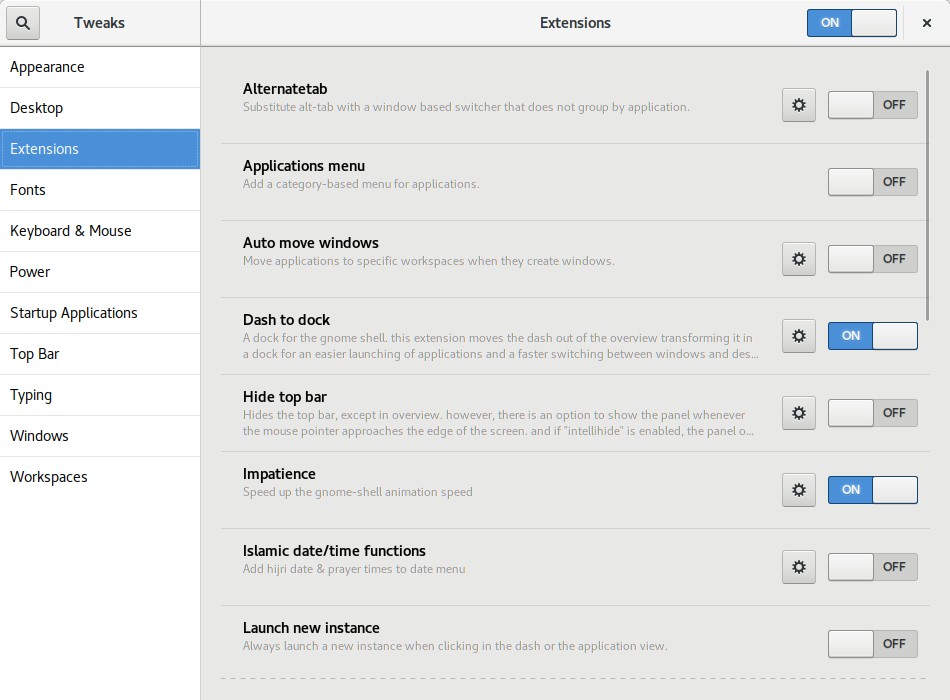
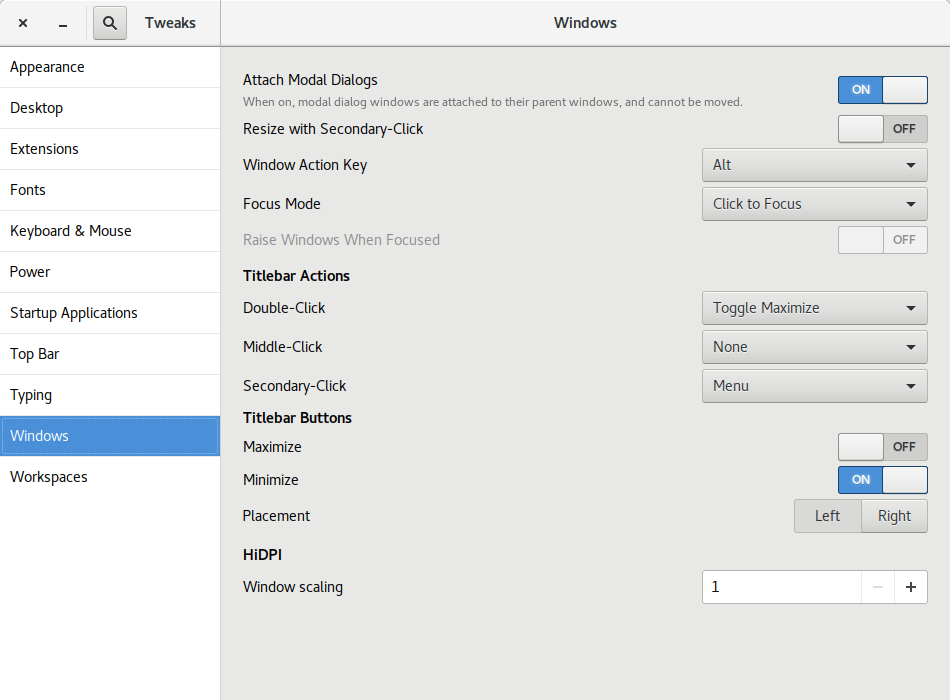
Today, I released the first development snapshot (3.25.2) of what will be GNOME Tweak Tool 3.26. Many of the panels have received UI updates. Here are a few highlights. Before this version, Tweak Tool didn t report its own version number on its About dialog! Also, as far as I know, there was no visible place in the default GNOME install for you to see what version of GTK+ is on your system. Especially now that GNOME and GTK+ releases don t share the same version numbers any more, I thought it was useful information to be in a tweak app. Florian M llner updated the layout of the GNOME Shell Extensions page: Rui Matos added a new Disable While Typing tweak to the Touchpad section. Alberto Fanjul added a Battery Percentage tweak for GNOME Shell s top bar. I added a Left/Right Placement tweak for the window buttons (minimize, maximize, close) . This screenshot shows a minimize and close button on the left. I think it s well known that Ubuntu s window buttons have been on the left for years but GNOME has kept the window buttons on the right. In fact, the GNOME 3 default is a single close button (see the other screenshots). For Unity (Ubuntu s default UI from 2011 until this year), it made sense for the buttons to be on the left because of how Unity s menu bar worked (the right side was used by the indicator system status menus). I don t believe the Ubuntu Desktop team has decided yet which side the window buttons will be on or which buttons there will be. I m ok with either side but I think I have a slight preference towards putting them on the right like Windows does. One reason I m not too worried about the Ubuntu default is that it s now very easy to switch them to the other side! If Ubuntu includes a dock like the excellent Dash to Dock in the default install, I think it makes sense for Ubuntu to add a minimize button by default. My admittedly unusual opinion is that there s no need for a maximize button.
  1. For one thing, GNOME is thoroughly tested with one window button; adding a second one shouldn t be too big of a deal, but maybe adding a 3rd button might not work as well with the design of some apps.
  2. When I maximize an app, I either double-click the titlebar or drag the app to the top of the screen so a maximize button just isn t needed.
  3. A dedicated maximize just doesn t make as much sense when there is more than one possible maximization state. Besides traditional maximize, there is now left and right semi-maximize. There s even a goal for GNOME 3.26 to support quarter-tiling .
Other Changes and Info

29 May 2017

Clint Adams: Dots and dashes

The Canadians were on LSD. The sex-toy bag was full of booze and Olivia lost her buttplug and we had to search the kitchen drawers before she juiced the grapefruits.
Posted on 2017-05-29
Tags: mintings

27 May 2017

Russ Allbery: On time management

Last December, the Guardian published a long essay by Oliver Burkeman entitled "Why time management is ruining our lives". Those who follow my book reviews know I read a lot of time management books, so of course I couldn't resist this. And, possibly surprisingly, not to disagree with it. It's an excellent essay, and well worth your time. Burkeman starts by talking about Inbox Zero:
If all this fervour seems extreme Inbox Zero was just a set of technical instructions for handling email, after all this was because email had become far more than a technical problem. It functioned as a kind of infinite to-do list, to which anyone on the planet could add anything at will.
This is, as Burkeman develops in the essay, an important critique of time management techniques in general, not just Inbox Zero: perhaps you can become moderately more efficient, but what are you becoming more efficient at doing, and why does it matter? If there were a finite amount of things that you had to accomplish, with leisure the reward at the end of the fixed task list, doing those things more efficiently makes perfect sense. But this is not the case in most modern life. Instead, we live in a world governed by Parkinson's Law: "Work expands to fill the time available for its completion." Worse, we live in a world where the typical employer takes Parkinson's Law, not as a statement on the nature of ever-expanding to-do lists, but a challenge to compress the time made available for a task to try to force the work to happen faster. Burkeman goes farther into the politics, pointing out that a cui bono analysis of time management suggests that we're all being played by capitalist employers. I wholeheartedly agree, but that's worth a separate discussion; for those who want to explore that angle, David Graeber's Debt and John Kenneth Galbraith's The Affluent Society are worth your time. What I want to write about here is why I still read (and recommend) time management literature, and how my thinking on it has changed. I started in the same place that most people probably do: I had a bunch of work to juggle, I felt I was making insufficient forward progress on it, and I felt my day contained a lot of slack that could be put to better use. The alluring promise of time management is that these problems can be resolved with more organization and some focus techniques. And there is a huge surge of energy that comes with adopting a new system and watching it work, since the good ones build psychological payoff into the tracking mechanism. Starting a new time management system is fun! Finishing things is fun! I then ran into the same problem that I think most people do: after that initial surge of enthusiasm, I had lists, systems, techniques, data on where my time was going, and a far more organized intake process. But I didn't feel more comfortable with how I was spending my time, I didn't have more leisure time, and I didn't feel happier. Often the opposite: time management systems will often force you to notice all the things you want to do and how slow your progress is towards accomplishing any of them. This is my fundamental disagreement with Getting Things Done (GTD): David Allen firmly believes that the act of recording everything that is nagging at you to be done relieves the brain of draining background processing loops and frees you to be more productive. He argues for this quite persuasively; as you can see from my review, I liked his book a great deal, and used his system for some time. But, at least for me, this does not work. Instead, having a complete list of goals towards which I am making slow or no progress is profoundly discouraging and depressing. The process of maintaining and dwelling on that list while watching it constantly grow was awful, quite a bit worse psychologically than having no time management system at all. Mark Forster is the time management author who speaks the best to me, and one of the points he makes is that time management is the wrong framing. You're not going to somehow generate more time, and you're usually not managing minutes and seconds. A better framing is task management, or commitment management: the goal of the system is to manage what you mentally commit to accomplishing, usually by restricting that list to something far shorter than you would come up with otherwise. How, in other words, to limit your focus to a small enough set of goals that you can make meaningful progress instead of thrashing. That, for me, is now the merit and appeal of time (or task) management systems: how do I sort through all the incoming noise, distractions, requests, desires, and compelling ideas that life throws at me and figure out which of them are worth investing time in? I also benefit from structuring that process for my peculiar psychology, in which backlogs I have to look at regularly are actively dangerous for my mental well-being. Left unchecked, I can turn even the most enjoyable hobby into an obligation and then into a source of guilt for not meeting the (entirely artificial) terms of the obligation I created, without even intending to. And here I think it has a purpose, but it's not the purpose that the time management industry is selling. If you think of time management as a way to get more things done and get more out of each moment, you're going to be disappointed (and you're probably also being taken advantage of by the people who benefit from unsustainable effort without real, unstructured leisure time). I practice Inbox Zero, but the point wasn't to be more efficient at processing my email. The point was to avoid the (for me) psychologically damaging backlog of messages while acting on the knowledge that 99% of email should go immediately into the trash with no further action. Email is an endless incoming stream of potential obligations or requests for my time (even just to read a longer message) that I should normallly reject. I also take the time to notice patterns of email that I never care about and then shut off the source or write filters to delete that email for me. I can then reserve my email time for moments of human connection, directly relevant information, or very interesting projects, and spend the time on those messages without guilt (or at least much less guilt) about ignoring everything else. Prioritization is extremely difficult, particularly once you realize that true prioritization is not about first and later, but about soon or never. The point of prioritization is not to choose what to do first, it's to choose the 5% of things that you going to do at all, convince yourself to be mentally okay with never doing the other 95% (and not lying to yourself about how there will be some future point when you'll magically have more time), and vigorously defend your focus and effort for that 5%. And, hopefully, wholeheartedly enjoy working on those things, without guilt or nagging that there's something else you should be doing instead. I still fail at this all the time. But I'm better than I used to be. For me, that mental shift was by far the hardest part. But once you've made that shift, I do think the time management world has a lot of tools and techniques to help you make more informed choices about the 5%, and to help you overcome procrastination and loss of focus on your real goals. Those real goals should include true unstructured leisure and "because I want to" projects. And hopefully, if you're in a financial position to do it, include working less on what other people want you to do and more on the things that delight you. Or at least making a well-informed strategic choice (for the sake of money or some other concrete and constantly re-evaluated reason) to sacrifice your personal goals for some temporary external ones.

24 May 2017

Jonathan Dowland: yakking

I've written a guest post for the Yakking Blog "A WadC successor in Haskell?. It's mainly on the topic of Haskell with WadC as a use-case for a thought experiment. Yakking is a collaborative blog geared towards beginner software engineers that is put together by some friends of mine. I was talking to them about contributing a blog post on a completely different topic a while ago, but that has not come to fruition (there or anywhere, yet). When I wrote up the notes that formed the basis of this blog post, I realised it might be a good fit. Take a look at some of their other posts, and if you find it interesting, subscribe!

17 May 2017

Daniel Pocock: Hacking the food chain in Switzerland

A group has recently been formed on Meetup seeking to build a food computer in Zurich. The initial meeting is planned for 6:30pm on 20 June 2017 at ETH, (Zurich Centre/Zentrum, R mistrasse 101). The question of food security underlies many of the world's problems today. In wealthier nations, we are being called upon to trust a highly opaque supply chain and our choices are limited to those things that major supermarket chains are willing to stock. A huge transport and storage apparatus adds to the cost and CO2 emissions and detracts from the nutritional value of the produce that reaches our plates. In recent times, these problems have been highlighted by the horsemeat scandal, the Guacapocalypse and the British Hummus crisis. One interesting initiative to create transparency and encourage diversity in our diets is the Open Agriculture (OpenAg) Initiative from MIT, summarised in this TED video from Caleb Harper. The food produced is healthier and fresher than anything you might find in a supermarket and has no exposure to pesticides. An open source approach to food An interesting aspect of this project is the promise of an open source approach. The project provides hardware plans, a a video of the build process, source code and the promise of sharing climate recipes (scripts) to replicate the climates of different regions, helping ensure it is always the season for your favour fruit or vegetable. Do we need it? Some people have commented on the cost of equipment and electricity. Carsten Agger recently blogged about permaculture as a cleaner alternative. While there are many places where people can take that approach, there are also many overpopulated regions and cities where it is not feasible. Some countries, like Japan, have an enormous population and previously productive farmland contaminated by industry, such as the Fukushima region. Growing our own food also has the potential to reduce food waste, as individual families and communities can grow what they need. Whether it is essential or not, the food computer project also provides a powerful platform to educate people about food and climate issues and an exciting opportunity to take the free and open source philosophy into many more places in our local communities. The Zurich Meetup group has already received expressions of interest from a diverse group including professionals, researchers, students, hackers, sustainability activists and free software developers. Next steps People who want to form a group in their own region can look in the forum topic "Where are you building your Food Computer?" to find out if anybody has already expressed interest. Which patterns from the free software world can help more people build more food computers? I've already suggested using Debian's live-wrapper to distribute a runnable ISO image that can boot from a USB stick, can you suggest other solutions like this? Can you think of any free software events where you would like to see a talk or exhibit about this project? Please suggest them on the OpenAg forum. There are many interesting resources about the food crisis, an interesting starting point is watching the documentary Food, Inc. If you are in Switzerland, please consider attending the meeting on at 6:30pm on 20 June 2017 at ETH (Centre/Zentrum), Zurich. One final thing to contemplate: if you are not hacking your own food supply, who is?

12 May 2017

Norbert Preining: Gaisi Takeuti, 1926-2017

Two days ago one of the most influential logician of the 20th century has passed away, Gaisi Takeuti ( ). I had the pleasure to meet this excellent man, teacher, writer, thinker several times while he was the president of the Kurt G del Society. I don t want to recall his achievements in mathematical logic, in particular proof theory, because I am not worth to write about such a genius. I want to recall a few personal stories from my own experience. I came into contact with Prof. Takeuti via is famous book Proof Theory, which my then Professor, now colleague and friend Matthias Baaz used for teaching us students proof theory. Together with Shoenfield s Mathematical Logic these two books became the foundation of my whole logic education. Now again in print, back then the Proof Theory was a rare precious. Few prints did remain in the library, and over the years one by one disappeared, until the last copy we had access to was my copy where I had scribbled pages and pages of notes and proofs. Matthias later on used these copies for his lectures, I should have written on the back-side! I remember well my first meeting with Prof. Takeuti: I was on the Conference on Internationalization in 2003 in Tsukuba, long before I moved to Japan. Back then I was just finishing my PhD and without much experience. When I arrived in the hotel, without fail there was a message of Prof. Takeuti inviting me for dinner the following day. We had dinner in a specialty restaurant of his area, together with is lovely wife. I was soo nervous about Japanese manners and stuttered Japanese phrases just to be stopped by Prof. Takeuti pouring himself a glass of sake and telling me: Relax, and forget the rules and fill your own glass when you want to. I am well aware that this liberal attitude didn t extend to Japanese colleagues, where he, descendant from a Samurai family, was at times very, extremely strict. The dinner was decided upon already, not easy since I was still strict vegetarian back than (now I would have enjoyed the dinner much more!), but for the last course we could decide. I remember with a smile how Prof. Takeuti suggested in Japanese various sweets, just to be interrupted by his wife with No Gaisi, no! . I asked what is going on and she explained that he wants to order a Japanese sweet for me I agreed, and that was probably the worst dish I had in Japan. Slippy noodles swimming in a cold broth, to be picked with chopsticks and put into a semi-sweet soja-sauce. I finished it, but it wasn t good. I should have thought twice when Prof. Takeuti s wife ordered a normal fruit salad. Scientifically he was simply a genius and famous for not reading a lot but reinventing everything. One of my research areas, G del logics, was reinvented by him as Intuitionistic Fuzzy Logic (for an overview see my talk at the Collegium Logicum 2016: G del Logics a short survey). But I want to recall one of my favorite articles of him: A Conservative Extension of Peano Arithmetic . This was published as part 2 of Volume 17 of Publications of the Mathematical Society of Japan, retypeset pdf is available here, JSTOR page. Therein he develops classical (real and complex) analysis over Peano s arithmetic. He shows that any arithmetical theorem proved in analytic number theory is a theorem in Peano s arithmetic. The proof uses Gentzen s cut elimination theorem, the center piece of modern proof theory. With Georg Kreisel having passed away in 2015, and now Gaisi Takeuti, we loose two of the greatest, if not the greatest minds in logic.

9 May 2017

Benjamin Mako Hill: Surviving an Eternal September: How an Online Community Managed a Surge of Newcomers

Attracting newcomers is among the most widely studied problems in online community research. However, with all the attention paid to challenge of getting new users, much less research has studied the flip side of that coin: large influxes of newcomers can pose major problems as well! The most widely known example of problems caused by an influx of newcomers into an online community occurred in Usenet. Every September, new university students connecting to the Internet for the first time would wreak havoc in the Usenet discussion forums. When AOL connected its users to the Usenet in 1994, it disrupted the community for so long that it became widely known as The September that never ended . Our study considered a similar influx in NoSleep an online community within Reddit where writers share original horror stories and readers comment and vote on them. With strict rules requiring that all members of the community suspend disbelief, NoSleep thrives off the fact that readers experience an immersive storytelling environment. Breaking the rules is as easy as questioning the truth of someone s story. Socializing newcomers represents a major challenge for NoSleep.
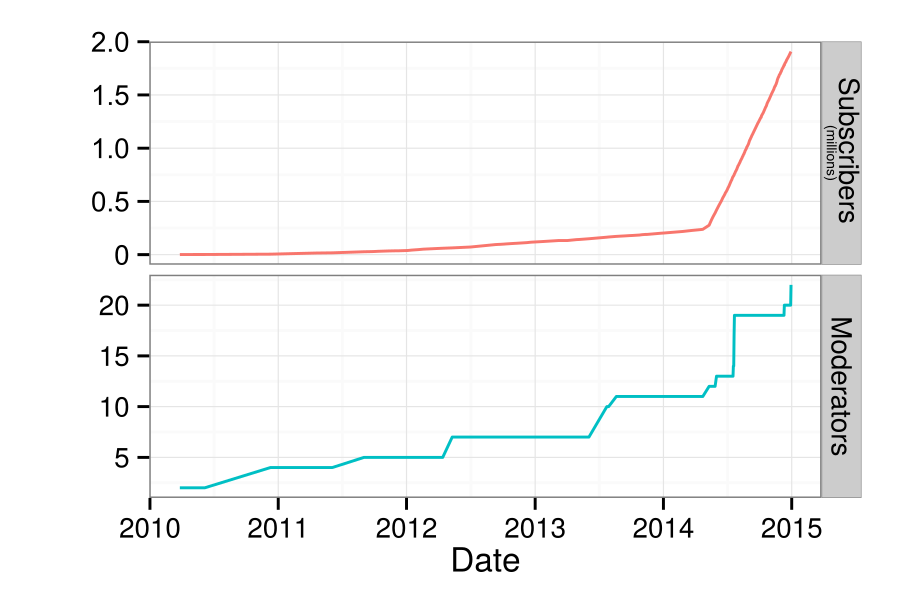
Number of subscribers and moderators on /r/NoSleep over time.
On May 7th, 2014, NoSleep became a default subreddit i.e., every new user to Reddit automatically joined NoSleep. After gradually accumulating roughly 240,000 members from 2010 to 2014, the NoSleep community grew to over 2 million subscribers in a year. That said, NoSleep appeared to largely hold things together. This reflects the major question that motivated our study: How did NoSleep withstand such a massive influx of newcomers without enduring their own Eternal September? To answer this question, we interviewed a number of NoSleep participants, writers, moderators, and admins. After transcribing, coding, and analyzing the results, we proposed that NoSleep survived because of three inter-connected systems that helped protect the community s norms and overall immersive environment. First, there was a strong and organized team of moderators who enforced the rules no matter what. They recruited new moderators knowing the community s population was going to surge. They utilized a private subreddit for NoSleep s staff. They were able to socialize and educate new moderators effectively. Although issuing sanctions against community members was often difficult, our interviewees explained that NoSleep s moderators were deeply committed and largely uncompromising. That commitment resonates within the second system that protected NoSleep: regulation by normal community members. From our interviews, we found that the participants felt a shared sense of community that motivated them both to socialize newcomers themselves as well as to report inappropriate comments and downvote people who violate the community s norms. Finally, we found that the technological systems protected the community as well. For instance, post-throttling was instituted to limit the frequency at which a writer could post their stories. Additionally, Reddit s Automoderator , a programmable AI bot, was used to issue sanctions against obvious norm violators while running in the background. Participants also pointed to the tools available to them the report feature and voting system in particular to explain how easy it was for them to report and regulate the community s disruptors.

This blog post was written with Charlie Kiene. The paper and work this post describes is collaborative work with Charlie Kiene and Andr s Monroy-Hern ndez. The paper was published in the Proceedings of CHI 2016 and is released as open access so anyone can read the entire paper here. A version of this post was published on the Community Data Science Collective blog.

8 May 2017

Russ Allbery: Review: Chimes at Midnight

Review: Chimes at Midnight, by Seanan McGuire
Series: October Daye #7
Publisher: DAW
Copyright: 2013
ISBN: 1-101-63566-5
Format: Kindle
Pages: 346
Chimes at Midnight is the seventh book of the October Daye series and builds heavily on the previous books. Toby has gathered quite the group of allies by this point, and events here would casually spoil some of the previous books in the series (particularly One Salt Sea, which you absolutely do not want spoiled). I strongly recommend starting at the beginning, even if the series is getting stronger as it goes along. This time, rather than being asked for help, the book opens with Toby on a mission. Goblin fruit is becoming increasingly common on the streets of San Francisco, and while she's doing all she can to find and stop the dealers, she's finding dead changelings. Goblin fruit is a pleasant narcotic to purebloods, but to changelings it's instantly and fatally addictive. The growth of the drug trade means disaster for the local changelings, particularly since previous events in the series have broken a prominent local changeling gang. That was for the best, but they were keeping goblin fruit out, and now it's flooding into the power vacuum. In the sort of idealistic but hopelessly politically naive move that Toby is prone to, she takes her evidence to the highest local authority in faerie: the Queen of the Mists. The queen loathes Toby and the feeling is mutual, but Toby's opinion is that this shouldn't matter: these are her subjects and goblin fruit is widely recognized as a menace. Even if she cares nothing for their lives, a faerie drug being widely sold on the street runs the substantial risk that someone will give it to humans, potentially leading to the discovery of faerie. Sadly, but predictably, Toby has underestimated the Queen's malevolence. She leaves the court burdened not only with the knowledge that the Queen herself is helping with the distribution of goblin fruit, but also an impending banishment thanks to her reaction. She has three days to get out of the Queen's territory, permanently. Three days that the Luidaeg suggests she spend talking to people who knew King Gilad, the former and well-respected king of the local territory who died in the 1906 earthquake, apparently leaving the kingdom to the current Queen. Or perhaps not. As usual, crossing Toby is a very bad idea, and getting Toby involved in politics means that one should start betting heavily against the status quo. Also, as usual, things initially go far too well, and then Toby ends up in serious trouble. (I realize the usefulness of raising the stakes of the story, but I do prefer the books of this series that don't involve Toby spending much of the book ill.) However, there is a vast improvement over previous books in the story: one key relationship (which I'll still avoid spoiling) is finally out of the precarious will-they, won't-they stage and firmly on the page, and it's a relationship that I absolutely love. Watching Toby stomp people who deserve to be stomped makes me happy, but watching Toby let herself be happy and show it makes me even happier. McGuire also gives us some more long-pending revelations. I probably should have guessed the one about one of Toby's long-time friends and companions much earlier, although at least I did so a few pages before Toby found out. I have some strong suspicions about Toby's own background that were reinforced by this book, and will be curious to see if I'm right. And I'm starting to have guesses about the overall arc of the series, although not firm ones. One of my favorite things in long-running series is the slow revelation of more and more world background, and McGuire does it in just the way I like: lots of underlying complexity, reveals timed for emotional impact but without dragging on things that the characters should obviously be able to figure out, and a whole bunch of layered secrets that continue to provide more mystery even after one layer is removed. The plot here is typical of the plot of the last couple of novels in the series, which is fine by me since my favorite part of this series is the political intrigue (and Toby realizing that she has far more influence than she thinks). It helps that I thought Arden was great, given how central she is to this story. I liked her realistic reactions to her situation, and I liked her arguments with Toby. I'm dubious how correct Toby actually was, but we've learned by now that arguments from duty are always going to hold sway with her. And I loved Mags and the Library, and hope we'll be seeing more of them in future novels. The one quibble I'll close with, since the book closed with it, is that I found the ending rather abrupt. There were several things I wanted to see in the aftermath, and the book ended before they could happen. Hopefully that means they'll be the start of the next book (although a bit of poking around makes me think they may be in a novella). If you've liked the series so far, particularly the couple of books before this one, this is more of what you liked. Recommended. Followed by The Winter Long. Rating: 8 out of 10

29 April 2017

Russ Allbery: Review: Neverness

Review: Neverness, by David Zindell
Publisher: Bantam Spectra
Copyright: May 1988
Printing: July 1989
ISBN: 0-553-27903-3
Format: Mass market
Pages: 552
Mallory Ringess is a Pilot, one of the people who can guide a lightship through interstellar space from inside the dark cocoon and biotech interface that allows visualization of the mathematics of interstellar travel. At the start of the book, he's young, arrogant, impulsive, and has a deeply unhealthy relationship with Leopold Soli, the Lord Pilot and supposedly his uncle by marriage (although they share a remarkable physical resemblance). An encounter with his uncle in a bar provokes a rash promise, and Ringess finds himself promising to attempt to map the Solid State Entity in search of the Elder Eddas, a secret of life from the mythical Ieldra that might lead to mankind's immortality. The opening of Neverness is Ringess's initial voyage and brash search, in which he proves to be a capable mathematician who can navigate a region of space twisted and deformed by becoming part of a transcendent machine intelligence. The knowledge he comes away with, though, is scarcely more coherent than the hints Soli relates at the start of the story: the secret of mankind is somehow hidden in its deepest past. That, in turn, provokes a deeply bizarre trip into the ice surrounding his home city of Neverness to attempt to steal biological material from people who have recreated themselves as Neanderthals. Beyond that point, I would say that things get even weirder, but weird still implies some emotional connection with the story. I think a more accurate description is that the book gets more incoherently mystical, more hopelessly pretentious, and more depressingly enthralled by childish drama. It's the sort of thing that one writes if one is convinced that the Oedipal complex is the height of subtle characterization. I loathed this book. I started loathing this book partway through Ringess's trip through the Solid State Entity, when Zindell's prose reached for transcendent complexity, tripped over its own shoelaces, and fell headlong into overwrought babbling. I continued reading every page because there's a perverse pleasure in hate-reading a book one dislikes this intensely, and because I wanted to write a review on the firm foundation of having endured the entire experience. The paperback edition I have has a pull quote from Orson Scott Card on the cover, which includes the phrase "excellent hard science fiction." I'm not sure what book Card read, because if this is hard science fiction, Lord of the Rings is paranormal romance. Even putting aside the idea that one travels through interstellar space by proving mathematical theorems in artificially dilated time (I don't think Zindell really understands what a proof is or why you write one), there's the whole business with stopping time with one's mind, reading other people's minds, and remembering one's own DNA. The technology, such as it is, makes considerably less sense than Star Wars. The hard SF requirement to keep technology consistent with extrapolated science is nowhere to be found here. The back-cover quote from the St. Louis Post-Dispatch is a bit more on-target: "Reminiscent of Gene Wolfe's New Sun novels... really comes to life among the intrigues of Neverness." This is indeed reminiscent of Gene Wolfe, in that it wouldn't surprise me at all if Zindell fell in love with the sense of antiquity, strangeness, and hints of understood technology that Wolfe successfully creates and attempted to emulate Wolfe in his first novel. Sadly, Zindell isn't Wolfe. Almost no one is, which is why attempting to emulate the extremely difficult feat Wolfe pulls off in the Book of the New Sun in your first novel is not a good idea. The results aren't pretty. There is something to be said for resplendent descriptions, rich with detail and ornamental prose. That something is "please use sparingly and with an eye to the emotional swings of the novel." Wolfe does not try to write most of a novel that way, which is what makes those moments of description so effective. Wolfe is also much better at making his mysteries and allusions subtle and unobtrusive, rather than having the first-person protagonist beat the reader over the head with them for pages at a time. This is a case where showing is probably better than telling. Let me quote a bit of description from the start of the book:
She shimmers, my city, she shimmers. She is said to be the most beautiful of all the cities of the Civilized Worlds, more beautiful even than Parpallaix or the cathedral cities of Vesper. To the west, pushing into the green sea like a huge, jewel-studded sleeve of city, the fragile obsidian cloisters and hospices of the Farsider's Quarter gleamed like black glass mirrors. Straight ahead as we skated, I saw the frothy churn of the Sound and their whitecaps of breakers crashing against the cliffs of North Beach and above the entire city, veined with purple and glazed with snow and ice, Waaskel and Attakel rose up like vast pyramids against the sky. Beneath the half-ring of extinct volcanoes (Urkel, I should mention, is the southernmost peak, and though less magnificent than the others, it has a conical symmetry that some find pleasing) the towers and spires of the Academy scattered the dazzling false winter light so that the whole of the Old City sparkled.
That's less than half of that paragraph, and the entire book is written like that, even in the middle of conversations. Endless, constant words piled on words about absolutely everything, whether important or not, whether emotionally significant or not. And much of it isn't even description, but philosophical ponderings that are desperately trying to seem profound. Here's another bit:
Although I knew I had never seen her before, I felt as if I had known her all my life. I was instantly in love with her, not, of course, as one loves another human being, but as a wanderer might love a new ocean or a gorgeous snowy peak he has glimpsed for the first time. I was practically struck dumb by her calmness and her beauty, so I said the first stupid thing which came to mind. "Welcome to Neverness," I told her.
Now, I should be fair: some people like this kind of description, or at least have more tolerance for it than I do. But that brings me to the second problem: there isn't a single truly likable character in this entire novel. Ringess, the person telling us this whole story, is a spoiled man-child, the sort of deeply immature and insecure person who attempts to compensate through bluster, impetuousness, and refusing to ever admit that he made a mistake or needed to learn something. He spends a good portion of the book, particularly the deeply bizarre and off-putting sections with the fake Neanderthals, attempting to act out some sort of stereotyped toxic masculinity and wallowing in negative emotions. Soli is an arrogant, abusive asshole from start to finish. Katherine, Ringess's love interest, is a seer who has had her eyes removed to see the future (I cannot express how disturbing I found Zindell's descriptions of this), has bizarre and weirdly sexualized reactions to the future she never explains, and leaves off the ends of all of her sentences, which might be be the most pointlessly irritating dialogue quirk I've seen in a novel. And Ringess's mother is a man-hating feminist from a separatist culture who turns into a master manipulator (I'm starting to see why Card liked this book). I at least really wanted to like Bardo, Ringess's closest friend, who has a sort of crude loyalty and unwillingness to get pulled too deep into the philosophical quicksand lurking underneath everything in this novel. Alas, Zindell insists on constantly describing Bardo's odious eating, belching, and sexual habits every time he's on the page, thus reducing him to the disgusting buffoon who gets drunk a lot and has irritating verbal ticks. About the only person I could stand by the end of the book was Justine, who at least seems vaguely sensible (and who leaves the person who abuses her), but she's too much of a non-entity to carry sustained interest. (There is potential here for a deeply scathing and vicious retelling of this story from Justine's point of view, focusing on the ways she was belittled, abused, and ignored, but I think Zindell was entirely unaware of why that would be so effective.) Oh, and there's lots of gore and horrific injury and lovingly-described torture, because of course there is. And that brings me back to the second half of that St. Louis Post-Dispatch review quote: "... really comes to life among the intrigues of Neverness." I would love to know what was hiding behind the ellipses in this pull quote, because this half-sentence is not wrong. Insofar as Neverness has any real appeal, it's in the intrigues of the city of Neverness and in the political structure that rules it. What this quote omits is that these intrigues start around page 317, more than halfway through the novel. That's about the point where faux-Wolfe starts mixing with late-career Frank Herbert and we get poet-assassins, some revelations about the leader of the Pilot culture, and some more concrete explanations of what this mess of a book is about. Unfortunately, you have to read through the huge and essentially meaningless Neanderthal scenes to get there, scenes that have essentially nothing to do with the interesting content of this book. (Everything that motivates them turns out to be completely irrelevant to the plot and useless for the characters.) The last 40% of the book is almost passable, and characters I cared about might have even made it enjoyable. Still, a couple of remaining problems detract heavily, chief among them the lack of connection of the great revelation of the story to, well, anything in the story. We learn at the very start of the novel that the stars of the Vild are mysteriously exploding, and much of the novel is driven by uncovering an explanation and solution. The characters do find an explanation, but not through any investigation. Ringess is simply told what is happening, in a wad of exposition, as a reward for something else entirely. It's weirdly disconnected from and irrelevant to everything else in the story. (There are some faint connections to the odd technological rules that the Pilot society lives under, but Zindell doesn't even draw attention to those.) The political intrigue in Neverness is similar: it appears out of nowhere more than halfway through the book, with no dramatic foundation for the motives of the person who has been keeping most of the secrets. And the final climax of the political machinations involves a bunch of mystical nonsense masquerading as science, and more of the Neanderthal bullshit that ruins the first half of the book. This is a thoroughly bad book: poorly plotted, poorly written, clotted and pretentious in style, and full of sociopaths and emotionally stunted children. I read the whole thing because I'm immensely stubborn and make poor life choices, but I was saying the eight deadly words ("I don't care what happens to these people") by a hundred pages in. Don't emulate my bad decisions. (Somehow, this novel was shortlisted for the Arthur C. Clarke award in 1990. What on earth could they possibly have been thinking?) Neverness is a stand-alone novel, but the ending sets up a subsequent trilogy that I have no intention of reading. Followed by The Broken God. Rating: 2 out of 10

21 April 2017

Rhonda D'Vine: Home

A fair amount of things happened since I last blogged something else than music. First of all we did actually hold a Debian Diversity meeting. It was quite nice, less people around than hoped for, and I account that to some extend to the trolls and haters that defaced the titanpad page for the agenda and destroyed the doodle entry for settling on a date for the meeting. They even tried to troll my blog with comments, and while I did approve controversial responses in the past, those went over the line of being acceptable and didn't carry any relevant content. One response that I didn't approve but kept in my mailbox is even giving me strength to carry on. There is one sentence in it that speaks to me: Think you can stop us? You can't you stupid b*tch. You have ruined the Debian community for us. The rest of the message is of no further relevance, but even though I can't take credit for being responsible for that, I'm glad to be a perceived part of ruining the Debian community for intolerant and hateful people. A lot of other things happened since too. Mostly locally here in Vienna, several queer empowering groups were founding around me, some of them existed already, some formed with the help of myself. We now have several great regular meetings for non-binary people, for queer polyamory people about which we gave an interview, a queer playfight (I might explain that concept another time), a polyamory discussion group, two bi-/pansexual groups, a queer-feminist choir, and there will be an European Lesbian* Conference in October where I help with the organization and on June 21st I'll finally receive the keys to my flat in Que[e]rbau Seestadt. I'm sooo looking forward to it. It will be part of the Let me come Home experience that I'm currently in. Another part of that experience is that I started changing my name (and gender marker) officially. I had my first appointment in the corresponding bureau, and I hope that it won't last too long because I have to get my papers in time for booking my flight to Montreal, and somewhen along the process my current passport won't contain correct data anymore. So for the people who have it in their signing policy to see government IDs this might be your chance to finally sign my key then. I plan to do a diversity BoF at debconf where we can speak more directly on where we want to head with the project. I hope I'll find the time to do an IRC meeting beforehand. I'm just uncertain how to coordinate that one to make it accessible for interested parties while keeping the destructive trolls out. I'm open for ideas here.

/personal permanent link Comments: 3 Flattr this

1 April 2017

Mike Hommey: Progress on git-cinnabar memory usage

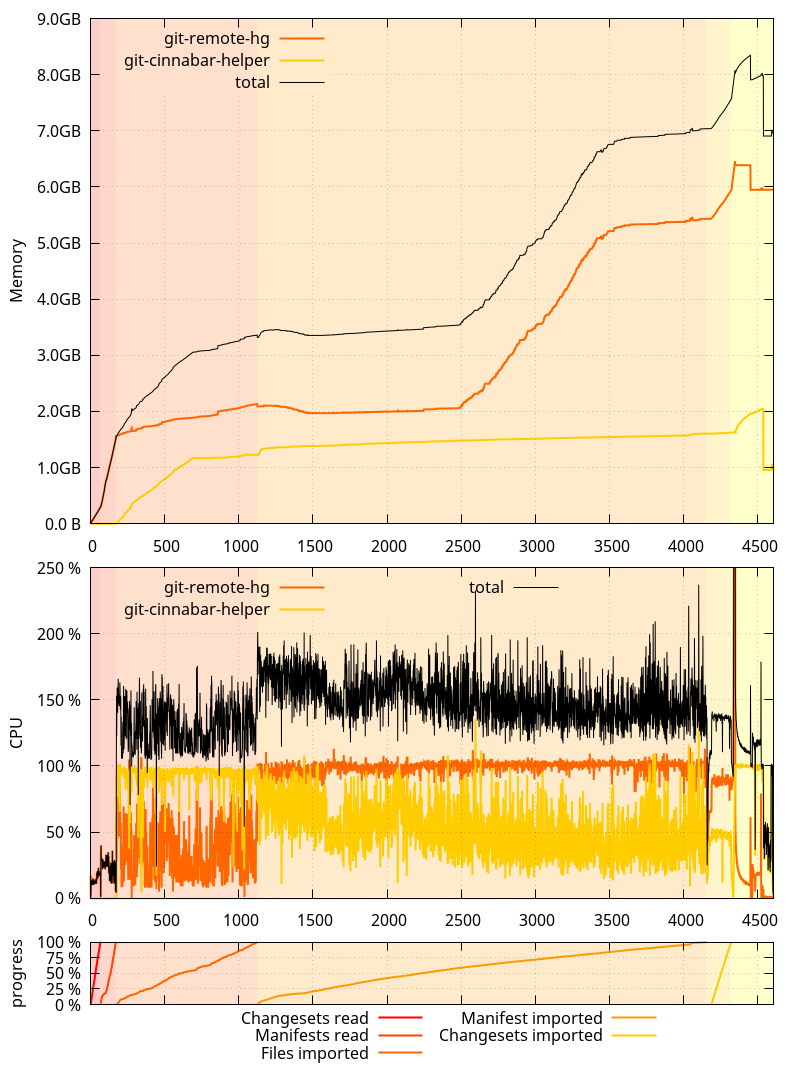
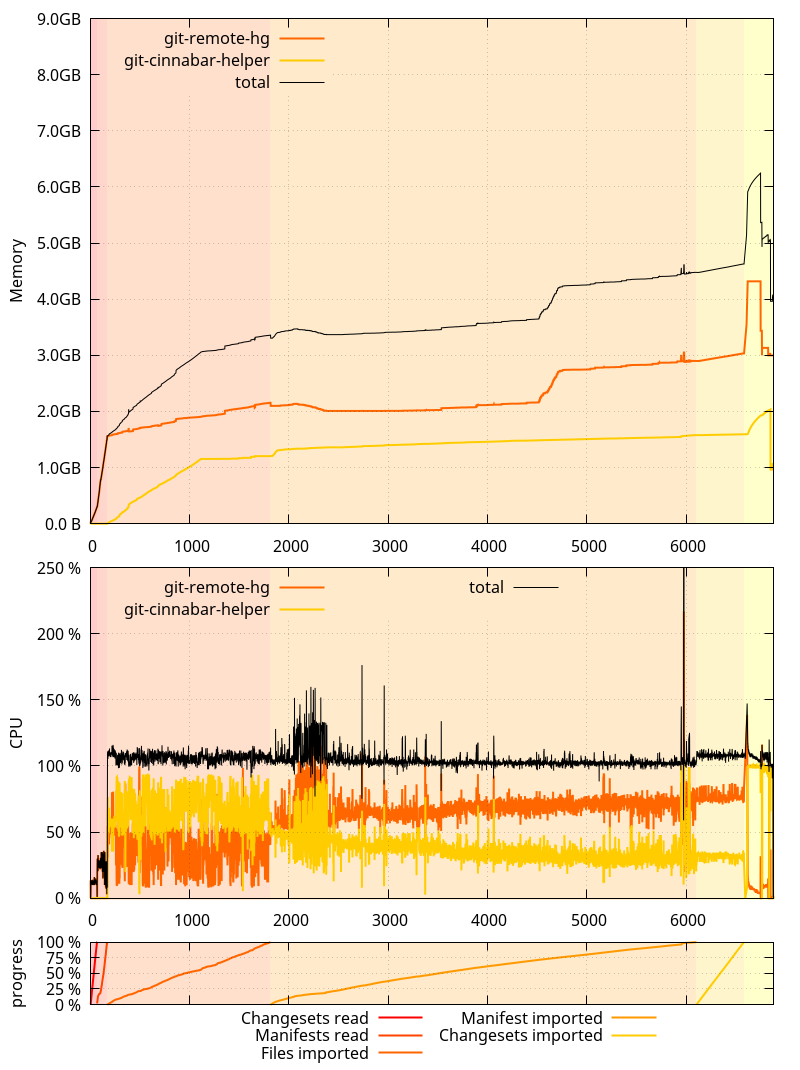
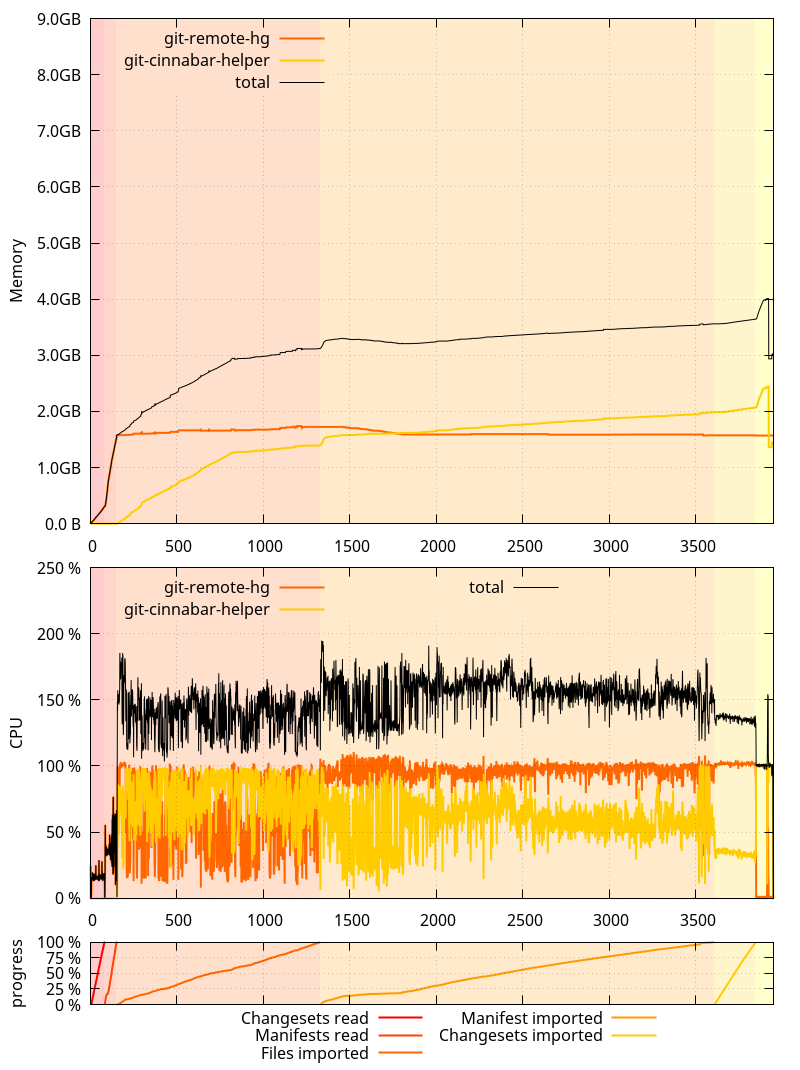
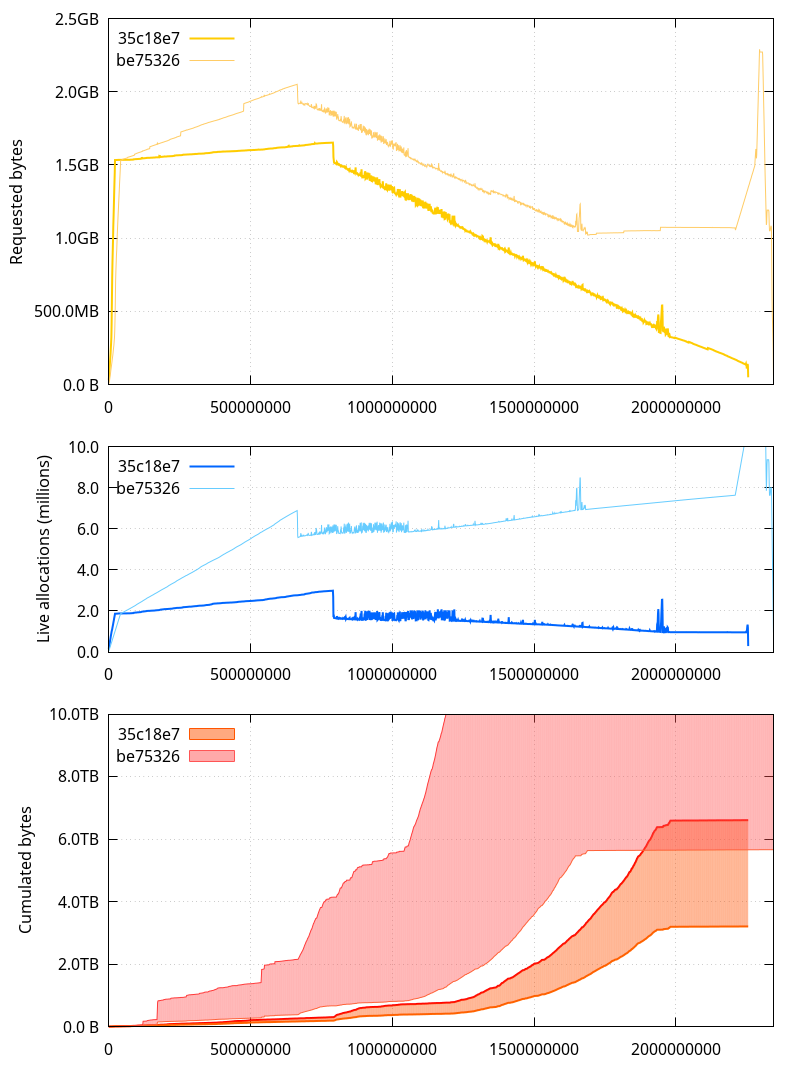
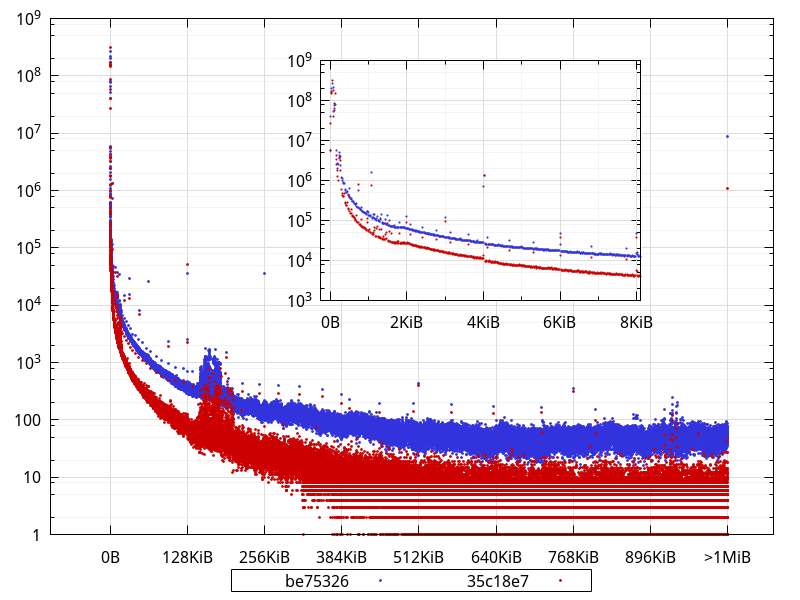
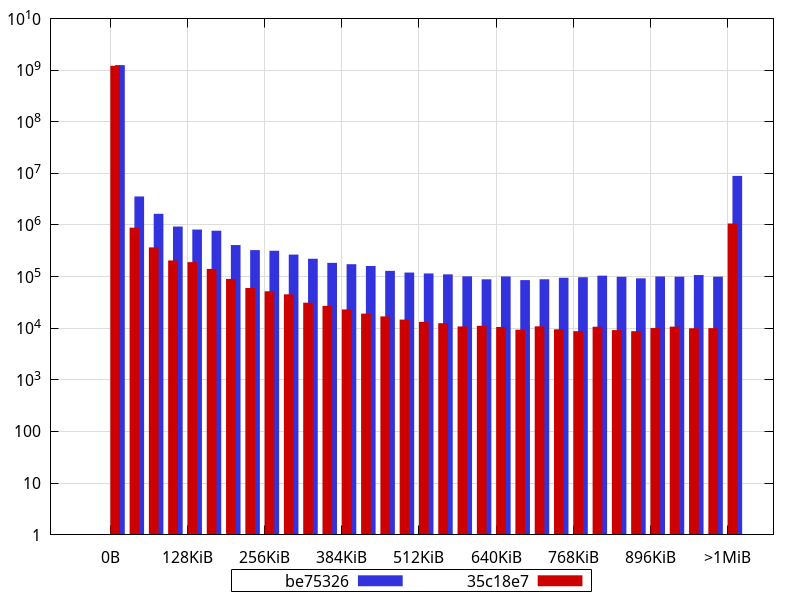
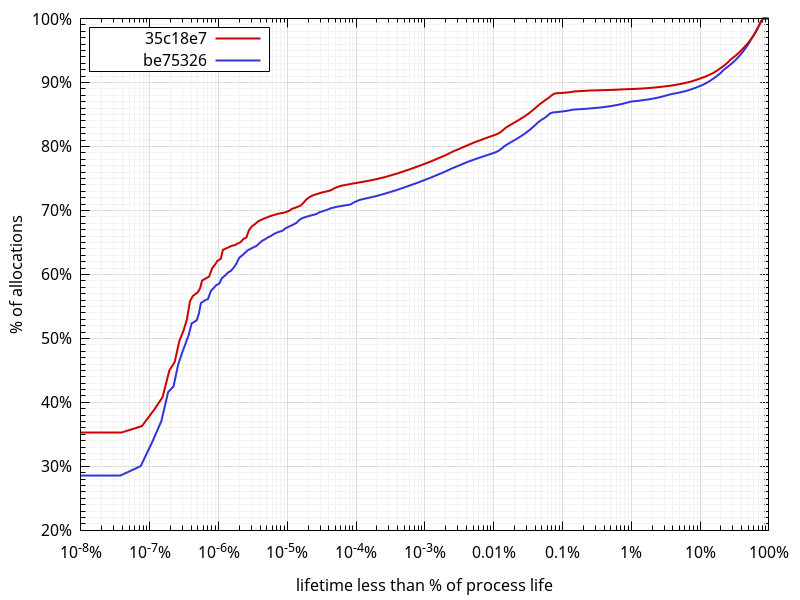
This all started when I figured out that git-cinnabar was using crazy amounts of memory when cloning mozilla-central. That pointed to memory allocation patterns that triggered a suboptimal behavior in the glibc memory allocator, and, while overall, git-cinnabar wasn t really abusing memory all things considered, it happened to be realloc()ating way too much. It also turned out that recent changes on the master branch had made most uses of fast-import synchronous, making the whole process significantly slower. This is where we started from on 0.4.0: And on the master branch as of be75326: An interesting thing to note here is that the glibc allocator runaway memory use was, this time, more pronounced on 0.4.0 than on master. It was the opposite originally, but as I mentioned in the past ASLR is making it not happen exactly the same way each time. While I m here, one thing I failed to mention in the previous posts is that all these measurements were done by cloning a local mercurial clone of mozilla-central, served from localhost via HTTP to eliminate the download time from hg.mozilla.org. And while mozilla-central itself has received new changesets since the first post, the local clone has not been updated, such that all subsequent clone tests I did were cloning the exact same repository under the exact same circumstances. After last blog post, I focused on the low hanging fruits identified so far: And this is how things now look on the master branch as of 35c18e7: So where does that put us? On a more granular level: What this means is that there s still room for improvement. But at this point, I d rather focus on other things. Logging all the memory allocations with the python allocator disabled still resulted in a 6.5GB compressed log file, containing 2.6 billion calls to malloc, calloc, free and realloc (down from 2.7 billions in be75326). The number of allocator calls done by the git-remote-hg process is down to 2.25 billions (from 2.34 billion in be75326). Surprisingly, while more things were moved to the helper, it still made less allocations than in be75326: 345 millions, down from 363 millions. Presumably, this is because the number of commands processed by the fast-import code was reduced. Let s now take a look at the various metrics we analyzed previously (the horizontal axis represents the number of allocator calls that happened before the measurement): A few observations to make here: [*] The upper bound is the sum of all sizes ever given to malloc, calloc, realloc etc. and the lower bound is the same, but removing the size of allocations passed as input to realloc (in practical words, this pretends reallocs never happened and that the final size for a given reallocated pointer is the one that counts) So presumably, some of the changes led to more short-lived allocations. Considering python uses its own allocator for sizes smaller than 512 bytes, it s probably not so much of a problem. But let s look at the distribution of buffer sizes (including all sizes given to realloc). (Bucket size is 16 bytes) What is not completely obvious from the logarithmic scale is that, in fact, 98.4% of the allocations are less than 512 bytes with the current master (35c18e7), and they were 95.5% with be75326. Interestingly, though, in absolute numbers, there are less allocations smaller than 512 bytes in current master than in be75326 (1,194,268,071 vs 1,214,784,494). This suggests the extra allocations that happen during some phases are larger than that. There are clearly less allocations across the board (apart from very few exceptions), and close to an order of magnitude less allocations larger than 1MiB. In fact, widening the bucket size to 32KiB shows an order of magnitude difference (or close) for most buckets: An interesting thing to note is how some sizes are largely overrepresented in the data with buckets of 16 bytes, like 768, 1104, 2048, 4128, with other smaller bumps for e.g. 2144, 2464, 2832, 3232, 3696, 4208, 4786, 5424, 6144, 6992, 7920 While some of those are powers of 2, most aren t, and some of them may actually represent objects sized with a power of 2, but that have an extra PyObject overhead. While looking at allocation stats, I got to wonder what the lifetimes of those allocations looked like. So I scanned the allocator logs and measured the distance between when an allocation is made and when it is freed, ignoring reallocs. To give a few examples of what I mean, the following allocation for p gets a lifetime of 0:
void *p = malloc(42);
free(p);
The following a lifetime of 1:
void *p = malloc(42);
void *other = malloc(42);
free(p);
And the following a lifetime of 1 as well:
void *p = malloc(42);
p = realloc(p, 84);
free(p);
(that is, it is not counted as two malloc/free pairs) The further away the free is from the corresponding malloc, the larger the lifetime. And the largest the lifetime can ever be is the total number of allocator function calls minus two, in the hypothetical case the very first allocation is freed as the very last (minus two because we defined the lifetime as the distance). What comes out of this data: All in all, what the data shows is that we re definitely in a better place now than we used to be a few days ago, and that there is still work to do on the memory front, but: So at this point, I won t look any deeper into the memory usage of the git-remote-hg python process, and will instead focus on the planned metadata storage changes. They will allow to share the metadata more easily (allowing faster and more straightforward gecko-dev graft), and will allow to import manifests earlier, which, as mentioned already, will help reduce memory use, but, more importantly, will allow to do more actual work while downloading the data. On slow networks, this is crucial to make clones and pulls faster.

29 March 2017

Daniel Pocock: Brexit: If it looks like racism, if it smells like racism and if it feels like racism, who else but a politician could argue it isn't?

Since the EU referendum got under way in the UK, it has become almost an everyday occurence to turn on the TV and hear some politician explaining "I don't mean to sound racist, but..." (example) Of course, if you didn't mean to sound racist, you wouldn't sound racist in the first place, now would you? The reality is, whether you like politics or not, political leaders have a significant impact on society and the massive rise in UK hate crimes, including deaths of Polish workers, is a direct reflection of the leadership (or profound lack of it) coming down from Westminster. Maybe you don't mean to sound racist, but if this is the impact your words are having, maybe it's time to shut up? Choosing your referendum Why choose to have a referendum on immigration issues and not on any number of other significant topics? Why not have a referendum on nuking Mr Putin to punish him for what looks like an act of terrorism against the Malaysian Airlines flight MH17? Why not have a referendum on cutting taxes or raising speed limits, turning British motorways into freeways or an autobahn? Why choose to keep those issues in the hands of the Government, but invite the man-in-a-white-van from middle England to regurgitate Nigel Farage's fears and anxieties about migrants onto a ballot paper? Even if David Cameron sincerely hoped and believed that the referendum would turn out otherwise, surely he must have contemplated that he was playing Russian Roulette with the future of millions of innocent people? Let's start at the top For those who are fortunate enough to live in parts of the world where the press provides little exposure to the antics of British royalty, an interesting fact you may have missed is that the Queen's husband, Prince Philip, Duke of Edinburgh is actually a foreigner. He was born in Greece and has Danish and German ancestry. Migration (in both directions) is right at the heart of the UK's identity. Queen and Prince Philip Home office minister Amber Rudd recently suggested British firms should publish details about how many foreign people they employ and in which positions. She argued this is necessary to help boost funding for training local people. If that is such a brilliant idea, why hasn't it worked for the Premier League? It is a matter of public knowledge how many foreigners play football in England's most prestigious division, so why hasn't this caused local clubs to boost training budgets for local recruits? After all, when you consider that England hasn't won a World Cup since 1966, what have they got to lose? Kevin Pietersen All this racism, it's just not cricket. Or is it? One of the most remarkable cricketers to play for England in recent times, Kevin Pietersen, dubbed "the most complete batsman in cricket" by The Times and "England's greatest modern batsman" by the Guardian, was born in South Africa. In the five years he was contracted to the Hampshire county team, he only played one match, because he was too busy representing England abroad. His highest position was nothing less than becoming England's team captain. Are the British superior to every other European citizen? One of the implications of the rhetoric coming out of London these days is that the British are superior to their neighbours, entitled to have their cake and eat it too, making foreigners queue up at Paris' Gare du Nord to board the Eurostar while British travelers should be able to walk or drive into European countries unchallenged. This superiority complex is not uniquely British, you can observe similar delusions are rampant in many of the places where I've lived, including Australia, Switzerland and France. America's Donald Trump has taken this style of politics to a new level. Look in the mirror Theresa May: after British 10-year old schoolboys Robert Thompson and Jon Venables abducted, tortured, murdered and mutilated 2 year old James Bulger in 1993, why not have all British schoolchildren fingerprinted and added to the police DNA database? Why should "security" only apply based on the country where people are born, their religion or skin colour? Jon Venables and Robert Thompson In fact, after Brexit, people like Venables and Thompson will remain in Britain while a Dutch woman, educated at Cambridge and with two British children will not. If that isn't racism, what is? Running foreigner's off the roads Theresa May has only been Prime Minister for less than a year but she has a history of bullying and abusing foreigners in her previous role in the Home Office. One example of this was a policy of removing driving licenses from foreigners, which has caused administrative chaos and even taken away the licenses of many people who technically should not have been subject to these regulations anyway. Shouldn't the DVLA (Britain's office for driving licenses) simply focus on the competence of somebody to drive a vehicle? Bringing all these other factors into licensing creates a hostile environment full of mistakes and inconvenience at best and opportunities for low-level officials to engage in arbitrary acts of racism and discrimination. Of course, when you are taking your country on the road to nowhere, who needs a driving license anyway? Run off the road What does "maximum control" over other human beings mean to you? The new British PM has said she wants "maximum control" over immigrants. What exactly does "maximum control" mean? Donald Trump appears to be promising "maximum control" over Muslims, Hitler sought "maximum control" over the Jews, hasn't the whole point of the EU been to avoid similar situations from ever arising again? This talk of "maximum control" in British politics has grown like a weed out of the UKIP. One of their senior figures has been linked to kidnappings and extortion, which reveals a lot about the character of the people who want to devise and administer these policies. Similar people in Australia aspire to jobs in the immigration department where they can extort money out of people for getting them pushed up the queue. It is no surprise that the first member of Australia's parliament ever sent to jail was put there for obtaining bribes and sexual favours from immigrants. When Nigel Farage talks about copying the Australian immigration system, he is talking about creating jobs like these for his mates. Even if "maximum control" is important, who really believes that a bunch of bullies in Westminster should have the power to exercise that control? Is May saying that British bosses are no longer competent to make their own decisions about who to employ or that British citizens are not reliable enough to make their own decisions about who they marry and they need a helping hand from paper-pushers in the immigration department? maximum control over Jewish people Echoes of the Third Reich Most people associate acts of mass murder with the Germans who lived in the time of Adolf Hitler. These are the stories told over and and over again in movies, books and the press. Look more closely, however, and it appears that the vast majority of Germans were not in immediate contact with the gas chambers. Even Gobels' secretary writes that she was completely oblivious to it all. Many people were simply small cogs in a big bad machine. The clues were there, but many of them couldn't see the big picture. Even if they did get a whiff of it, many chose not to ask questions, to carry on with their comfortable lives. Today, with mass media and the Internet, it is a lot easier for people to discover the truth if they look, but many are still reluctant to do so. Consider, for example, the fingerprint scanners installed in British post offices and police stations to fingerprint foreigners and criminals (as if they have something in common). If all the post office staff refused to engage in racist conduct the fingerprint scanners would be put out of service. Nonetheless, these people carry on, just doing their job, just following orders. It was through many small abuses like this, rather than mass murder on every street corner, that Hitler motivated an entire nation to serve his evil purposes. Technology like this is introduced in small steps: first it was used for serious criminals, then anybody accused of a crime, then people from Africa and next it appears they will try and apply it to all EU citizens remaining in the UK. How will a British man married to a French woman explain to their children that mummy has to be fingerprinted by the border guard each time they return from vacation? The Nazis pioneered biometric technology with the tracking numbers branded onto Jews. While today's technology is electronic and digital, isn't it performing the same function? There is no middle ground between "soft" and "hard" brexit An important point for British citizens and foreigners in the UK to consider today is that there is no compromise between a "soft" Brexit and a "hard" Brexit. It is one or the other. Anything less (for example, a deal that is "better" for British companies and worse for EU citizens) would imply that the British are a superior species and it is impossible to imagine the EU putting their stamp on such a deal. Anybody from the EU who is trying to make a life in the UK now is playing a game of Russian Roulette - sure, everything might be fine if it morphs into "soft" Brexit, but if Theresa May has her way, at some point in your life, maybe 20 years down the track, you could be rounded up by the gestapo and thrown behind bars for a parking violation. There has already been a five-fold increase in the detention of EU citizens in British concentration camps and they are using grandmothers from Asian countries to refine their tactics for the efficient removal of EU citizens. One can only wonder what type of monsters Theresa May has been employing to run such inhumane operations. This is not politics Edmund Burke's quote "The only thing necessary for the triumph of evil is for good men to do nothing" comes to mind on a day like today. Too many people think it is just politics and they can go on with their lives and ignore it. Barely half the British population voted in the referendum. This is about human beings treating each other with dignity and respect. Anything less is abhorrent and may well come back to bite.


Next.

Previous.