Search Results: "rkd"

29 September 2017

Dirk Eddelbuettel: Rcpp 0.12.13: Updated vignettes, and more

The thirteenth release in the 0.12.* series of Rcpp landed on CRAN this morning, following a little delay because Uwe Ligges was traveling and whatnot. We had announced its availability to the mailing list late last week. As usual, a rather substantial amount of testing effort went into this release so you should not expect any surprise. This release follows the 0.12.0 release from July 2016, the 0.12.1 release in September 2016, the 0.12.2 release in November 2016, the 0.12.3 release in January 2017, the 0.12.4 release in March 2016, the 0.12.5 release in May 2016, the 0.12.6 release in July 2016, the 0.12.7 release in September 2016, the 0.12.8 release in November 2016, the 0.12.9 release in January 2017, the 0.12.10.release in March 2017, the 0.12.11.release in May 2017, and the 0.12.12 release in July 2017 making it the seventeeth release at the steady and predictable bi-montly release frequency. Rcpp has become the most popular way of enhancing GNU R with C or C++ code. As of today, 1069 packages (and hence 73 more since the last release) on CRAN depend on Rcpp for making analytical code go faster and further, along with another 91 in BioConductor. This releases contains a large-ish update to the documentation as all vignettes (apart from the unit test one, which is a one-off) now use Markdown and the (still pretty new) pinp package by James and myself. There is also a new vignette corresponding to the PeerJ preprint James and I produced as an updated and current Introduction to Rcpp replacing the older JSS piece (which is still included as a vignette too). A few other things got fixed: Dan is working on const iterators you would expect with modern C++, Lei Yu spotted error in Modules, and more. See below for details.

Changes in Rcpp version 0.12.13 (2017-09-24)
  • Changes in Rcpp API:
    • New const iterators functions cbegin() and cend() have been added to several vector and matrix classes (Dan Dillon and James Balamuta in #748) starting to address #741).
  • Changes in Rcpp Modules:
    • Misplacement of one parenthesis in macro LOAD_RCPP_MODULE was corrected (Lei Yu in #737)
  • Changes in Rcpp Documentation:
    • Rewrote the macOS sections to depend on official documentation due to large changes in the macOS toolchain. (James Balamuta in #742 addressing issue #682).
    • Added a new vignette Rcpp-introduction based on new PeerJ preprint, renamed existing introduction to Rcpp-jss-2011 .
    • Transitioned all vignettes to the 'pinp' RMarkdown template (James Balamuta and Dirk Eddelbuettel in #755 addressing issue #604).
    • Added an entry on running 'compileAttributes()' twice to the Rcpp-FAQ (##745).

Thanks to CRANberries, you can also look at a diff to the previous release. As always, even fuller details are on the Rcpp Changelog page and the Rcpp page which also leads to the downloads page, the browseable doxygen docs and zip files of doxygen output for the standard formats. A local directory has source and documentation too. Questions, comments etc should go to the rcpp-devel mailing list off the R-Forge page.

This post by Dirk Eddelbuettel originated on his Thinking inside the box blog. Please report excessive re-aggregation in third-party for-profit settings.

26 September 2017

Norbert Preining: Debian/TeX Live 2017.20170926-1

A full month or more has past since the last upload of TeX Live, so it was high time to prepare a new package. Nothing spectacular here I have to say, two small bugs fixed and the usual long list of updates and new packages. From the new packages I found fontloader-luaotfload and interesting project. Loading fonts via lua code in luatex is by now standard, and this package allows for experiments with newer/alternative font loaders. Another very interesting new-comer is pdfreview which lets you set pages of another PDF on a lined background and add notes to it, good for reviewing. Enjoy. New packages abnt, algobox, beilstein, bib2gls, cheatsheet, coelacanth, dijkstra, dynkin-diagrams, endofproofwd, fetchcls, fixjfm, fontloader-luaotfload, forms16be, hithesis, ifxptex, komacv-rg, ku-template, latex-refsheet, limecv, mensa-tex, multilang, na-box, notes-tex, octave, pdfreview, pst-poker, theatre, upzhkinsoku, witharrows. Updated packages 2up, acmart, acro, amsmath, animate, babel, babel-french, babel-hungarian, bangorcsthesis, beamer, beebe, biblatex-gost, biblatex-philosophy, biblatex-source-division, bibletext, bidi, bpchem, bxjaprnind, bxjscls, bytefield, checkcites, chemmacros, chet, chickenize, complexity, curves, cweb, datetime2-german, e-french, epstopdf, eqparbox, esami, etoc, fbb, fithesis, fmtcount, fnspe, fontspec, genealogytree, glossaries, glossaries-extra, hvfloat, ifptex, invoice2, jfmutil, jlreq, jsclasses, koma-script, l3build, l3experimental, l3kernel, l3packages, latexindent, libertinust1math, luatexja, lwarp, markdown, mcf2graph, media9, nddiss, newpx, newtx, novel, numspell, ocgx2, philokalia, phfqit, placeat, platex, poemscol, powerdot, pst-barcode, pst-cie, pst-exa, pst-fit, pst-func, pst-geometrictools, pst-ode, pst-plot, pst-pulley, pst-solarsystem, pst-solides3d, pst-tools, pst-vehicle, pst2pdf, pstricks, pstricks-add, ptex-base, ptex-fonts, pxchfon, quran, randomlist, reledmac, robustindex, scratch, skrapport, spectralsequences, tcolorbox, tetex, tex4ht, texcount, texdef, texinfo, texlive-docindex, texlive-scripts, tikzducks, tikzsymbols, tocloft, translations, updmap-map, uplatex, widetable, xepersian, xetexref, xint, xsim, zhlipsum.

24 September 2017

Julian Andres Klode: APT 1.5 is out

APT 1.5 is out, after almost 3 months the release of 1.5 alpha 1, and almost six months since the release of 1.4 on April 1st. This release cycle was unusually short, as 1.4 was the stretch release series and the zesty release series, and we waited for the latter of these releases before we started 1.5. In related news, 1.4.8 hit stretch-proposed-updates today, and is waiting in the unapproved queue for zesty. This release series moves https support from apt-transport-https into apt proper, bringing with it support for https:// proxies, and support for autodetectproxy scripts that return http, https, and socks5h proxies for both http and https. Unattended updates and upgrades now work better: The dependency on network-online was removed and we introduced a meta wait-online helper with support for NetworkManager, systemd-networkd, and connman that allows us to wait for network even if we want to run updates directly after a resume (which might or might not have worked before, depending on whether update ran before or after network was back up again). This also improves a boot performance regression for systems with rc.local files: The rc.local.service unit specified After=network-online.target, and login stuff was After=rc.local.service, and apt-daily.timer was Wants=network-online.target, causing network-online.target to be pulled into the boot and the rc.local.service ordering dependency to take effect, significantly slowing down the boot. An earlier less intrusive variant of that fix is in 1.4.8: It just moves the network-online.target Want/After from apt-daily.timer to apt-daily.service so most boots are uncoupled now. I hope we get the full solution into stretch in a later point release, but we should gather some experience first before discussing this with the release time. Balint Reczey also provided a patch to increase the time out before killing the daily upgrade service to 15 minutes, to actually give unattended-upgrades some time to finish an in-progress update. Honestly, I d have though the machine hung up and force rebooted it after 5 seconds already. (this patch is also in 1.4.8) We also made sure that unreadable config files no longer cause an error, but only a warning, as that was sort of a regression from previous releases; and we added documentation for /etc/apt/auth.conf, so people actually know the preferred way to place sensitive data like passwords (and can make their sources.list files world-readable again). We also fixed apt-cdrom to support discs without MD5 hashes for Sources (the Files field), and re-enabled support for udev-based detection of cdrom devices which was accidentally broken for 4 years, as it was trying to load libudev.so.0 at runtime, but that library had an SONAME change to libudev.so.1 we now link against it normally. Furthermore, if certain information in Release files change, like the codename, apt will now request confirmation from the user, avoiding a scenario where a user has stable in their sources.list and accidentally upgrades to the next release when it becomes stable. Paul Wise contributed patches to allow configuring the apt-daily intervals more easily apt-daily is invoked twice a day by systemd but has more fine-grained internal timestamp files. You can now specify the intervals in seconds, minutes, hours, and day units, or specify always to always run (that is, up to twice a day on systemd, once per day on non-systemd platforms). Development for the 1.6 series has started, and I intent to upload a first alpha to unstable in about a week, removing the apt-transport-https package and enabling compressed index files by default (save space, a lot of space, at not much performance cost thanks to lz4). There will also be some small clean ups in there, but I don t expect any life-changing changes for now. I think our new approach of uploading development releases directly to unstable instead of parking them in experimental is working out well. Some people are confused why alpha releases appear in unstable, but let me just say one thing: These labels basically just indicate feature-completeness, and not stability. An alpha is just very likely to get a lot more features, a beta is less likely (all the big stuff is in), and the release candidates just fix bugs. Also, we now have 3 active stable series: The 1.2 LTS series, 1.4 medium LTS, and 1.5. 1.2 receives updates as part of Ubuntu 16.04 (xenial), 1.4 as part of Debian 9.0 (stretch) and Ubuntu 17.04 (zesty); whereas 1.5 will only be supported for 9 months (as part of Ubuntu 17.10). I think the stable release series are working well, although 1.4 is a bit tricky being shared by stretch and zesty right now (but zesty is history soon, so ).
Filed under: Debian, Ubuntu

17 September 2017

Dirk Eddelbuettel: RcppClassic 0.9.7

A rather boring and otherwise uneventful release 0.9.7 of RcppClassic is now at CRAN. This package provides a maintained version of the otherwise deprecated first Rcpp API; no new projects should use it. Once again no changes in user-facing code. But this makes it the first package to use the very new and shiny pinp package as the backend for its vignette, now converted to Markdown---see here for this new version. We also updated three sources files for tabs versus spaces as the current g++ version complained (correctly !!) about misleading indents. Otherwise a file src/init.c was added for dynamic registration, the Travis CI runner script was updated to using run.sh from our r-travis fork, and we now strip the library after they have been built. Again, no user code changes. And no iterate: nobody should use this package. Rcpp is so much better in so many ways---this one is simply available as we (quite strongly) believe that APIs are contracts, and as such we hold up our end of the deal. Courtesy of CRANberries, there are changes relative to the previous release. Questions, comments etc should go to the rcpp-devel mailing list off the R-Forge page.

This post by Dirk Eddelbuettel originated on his Thinking inside the box blog. Please report excessive re-aggregation in third-party for-profit settings.

16 September 2017

Dirk Eddelbuettel: pinp 0.0.1: pinp is not PNAS

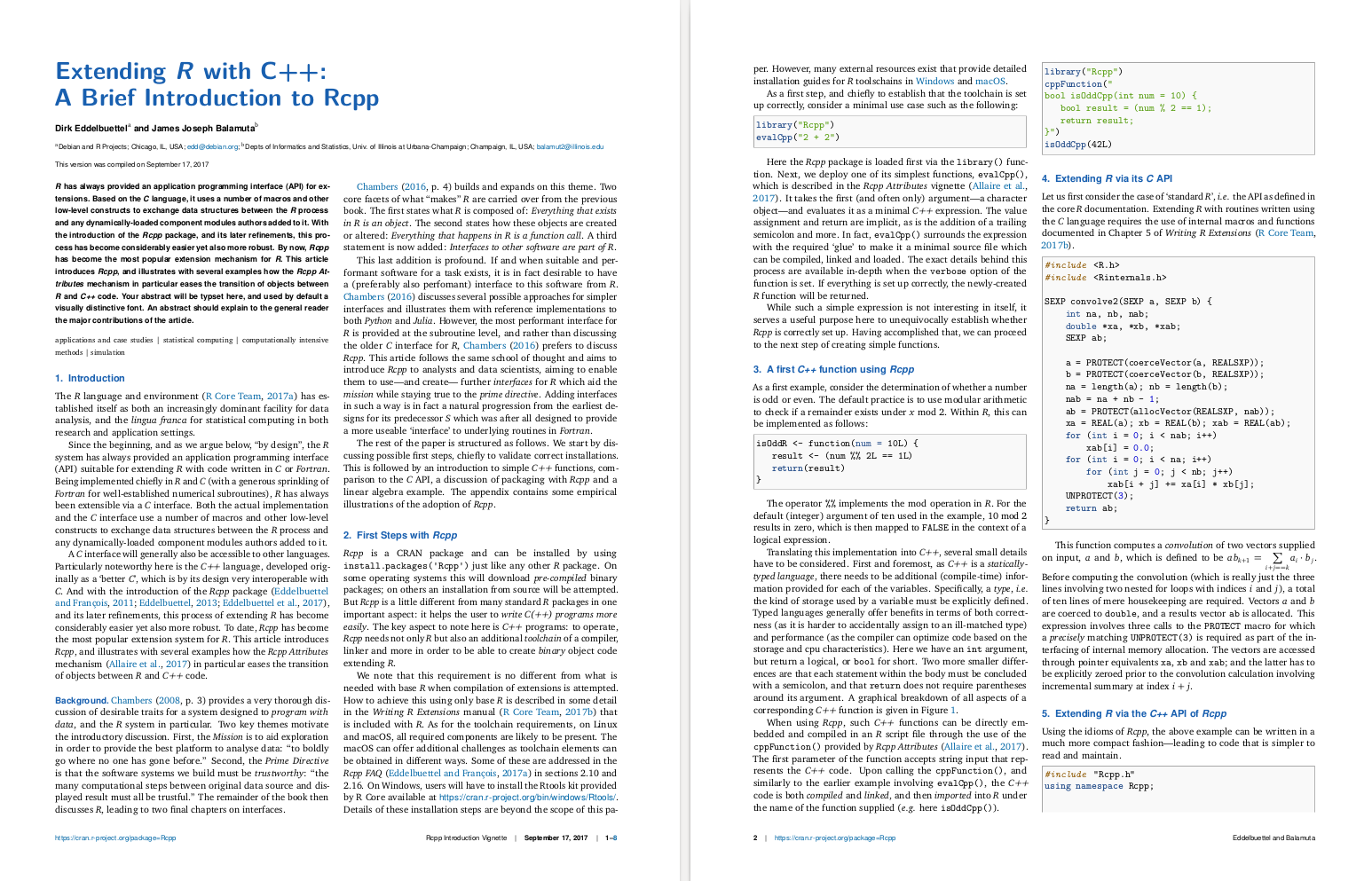
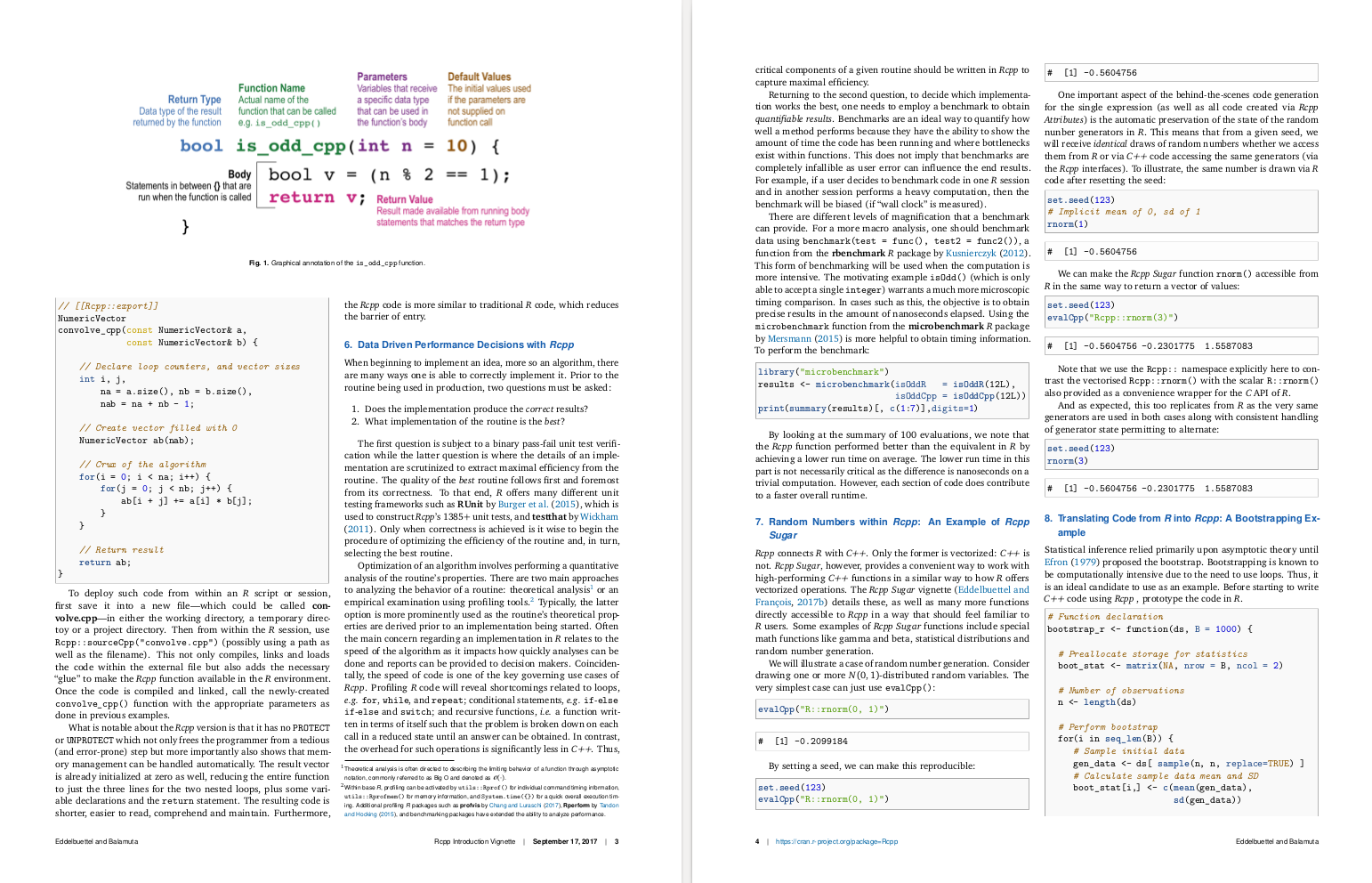
A brandnew and very exciting (to us, at least) package called pinp just arrived on CRAN, following a somewhat unnecessarily long passage out of incoming. It is based on the PNAS LaTeX Style offered by the Proceeding of the National Academy of Sciences of the United States of America, or PNAS for short. And there is already a Markdown version in the wonderful rticles packages. But James Balamuta and I thought we could do one better when we were looking to typeset our recent PeerJ Prepint as an attractive looking vignette for use within the Rcpp package. And so we did by changing a few things (font, color, use of natbib and Chicago.bst for references, removal of a bunch of extra PNAS-specific formalities from the frontpage) and customized a number of other things for easier use by vignettes directly from the YAML header (draft mode watermark, doi or url for packages, easier author naming in footer, bibtex file and more). We are quite pleased with the result which seems ready for the next Rcpp release---see e.g., these two teasers:
and
and the pinp package page or the GitHub repo have the full (four double-)pages of what turned a more dull looking 27 page manuscript into eight crisp two-column pages. We have few more things planned (i.e., switching to single column mode, turning on linenumbers at least in one-column mode). For questions or comments use the issue tracker off the GitHub repo.

This post by Dirk Eddelbuettel originated on his Thinking inside the box blog. Please report excessive re-aggregation in third-party for-profit settings.

10 September 2017

Joachim Breitner: Less parentheses

Yesterday, at the Haskell Implementers Workshop 2017 in Oxford, I gave a lightning talk titled syntactic musings , where I presented three possibly useful syntactic features that one might want to add to a language like Haskell. The talked caused quite some heated discussions, and since the Internet likes heated discussion, I will happily share these ideas with you

Context aka. Sections This is probably the most relevant of the three proposals. Consider a bunch of related functions, say analyseExpr and analyseAlt, like these:
analyseExpr :: Expr -> Expr
analyseExpr (Var v) = change v
analyseExpr (App e1 e2) =
  App (analyseExpr e1) (analyseExpr e2)
analyseExpr (Lam v e) = Lam v (analyseExpr flag e)
analyseExpr (Case scrut alts) =
  Case (analyseExpr scrut) (analyseAlt <$> alts)
analyseAlt :: Alt -> Alt
analyseAlt (dc, pats, e) = (dc, pats, analyseExpr e)
You have written them, but now you notice that you need to make them configurable, e.g. to do different things in the Var case. You thus add a parameter to all these functions, and hence an argument to every call:
type Flag = Bool
analyseExpr :: Flag -> Expr -> Expr
analyseExpr flag (Var v) = if flag then change1 v else change2 v
analyseExpr flag (App e1 e2) =
  App (analyseExpr flag e1) (analyseExpr flag e2)
analyseExpr flag (Lam v e) = Lam v (analyseExpr (not flag) e)
analyseExpr flag (Case scrut alts) =
  Case (analyseExpr flag scrut) (analyseAlt flag <$> alts)
analyseAlt :: Flag -> Alt -> Alt
analyseAlt flag (dc, pats, e) = (dc, pats, analyseExpr flag e)
I find this code problematic. The intention was: flag is a parameter that an external caller can use to change the behaviour of this code, but when reading and reasoning about this code, flag should be considered constant. But this intention is neither easily visible nor enforced. And in fact, in the above code, flag does change , as analyseExpr passes something else in the Lam case. The idiom is indistinguishable from the environment idiom, where a locally changing environment (such as variables in scope ) is passed around. So we are facing exactly the same problem as when reasoning about a loop in an imperative program with mutable variables. And we (pure functional programmers) should know better: We cherish immutability! We want to bind our variables once and have them scope over everything we need to scope over! The solution I d like to see in Haskell is common in other languages (Gallina, Idris, Agda, Isar), and this is what it would look like here:
type Flag = Bool
section (flag :: Flag) where
  analyseExpr :: Expr -> Expr
  analyseExpr (Var v) = if flag then change1 v else change2v 
  analyseExpr (App e1 e2) =
    App (analyseExpr e1) (analyseExpr e2)
  analyseExpr (Lam v e) = Lam v (analyseExpr e)
  analyseExpr (Case scrut alts) =
    Case (analyseExpr scrut) (analyseAlt <$> alts)
  analyseAlt :: Alt -> Alt
  analyseAlt (dc, pats, e) = (dc, pats, analyseExpr e)
Now the intention is clear: Within a clearly marked block, flag is fixed and when reasoning about this code I do not have to worry that it might change. Either all variables will be passed to change1, or all to change2. An important distinction! Therefore, inside the section, the type of analyseExpr does not mention Flag, whereas outside its type is Flag -> Expr -> Expr. This is a bit unusual, but not completely: You see precisely the same effect in a class declaration, where the type signature of the methods do not mention the class constraint, but outside the declaration they do. Note that idioms like implicit parameters or the Reader monad do not give the guarantee that the parameter is (locally) constant. More details can be found in the GHC proposal that I prepared, and I invite you to raise concern or voice support there. Curiously, this problem must have bothered me for longer than I remember: I discovered that seven years ago, I wrote a Template Haskell based implementation of this idea in the seal-module package!

Less parentheses 1: Bulleted argument lists The next two proposals are all about removing parentheses. I believe that Haskell s tendency to express complex code with no or few parentheses is one of its big strengths, as it makes it easier to visualy parse programs. A common idiom is to use the $ operator to separate a function from a complex argument without parentheses, but it does not help when there are multiple complex arguments. For that case I propose to steal an idea from the surprisingly successful markup language markdown, and use bulleted lists to indicate multiple arguments:
foo :: Baz
foo = bracket
          some complicated code
          that is evaluated first
          other complicated code for later
          even more complicated code
I find this very easy to visually parse and navigate. It is actually possible to do this now, if one defines ( ) = id with infixl 0 . A dedicated syntax extension (-XArgumentBullets) is preferable:
  • It only really adds readability if the bullets are nicely vertically aligned, which the compiler should enforce.
  • I would like to use $ inside these complex arguments, and multiple operators of precedence 0 do not mix. (infixl -1 would help).
  • It should be possible to nest these, and distinguish different nesting levers based on their indentation.

Less parentheses 1: Whitespace precedence The final proposal is the most daring. I am convinced that it improves readability and should be considered when creating a new language. As for Haskell, I am at the moment not proposing this as a language extension (but could be convinced to do so if there is enough positive feedback). Consider this definition of append:
(++) :: [a] -> [a] -> [a]
[]     ++ ys = ys
(x:xs) ++ ys = x : (xs++ys)
Imagine you were explaining the last line to someone orally. How would you speak it? One common way to do so is to not read the parentheses out aloud, but rather speak parenthesised expression more quickly and add pauses otherwise. We can do the same in syntax!
(++) :: [a] -> [a] -> [a]
[]   ++ ys = ys
x:xs ++ ys = x : xs++ys
The rule is simple: A sequence of tokens without any space is implicitly parenthesised. The reaction I got in Oxford was horror and disgust. And that is understandable we are very used to ignore spacing when parsing expressions (unless it is indentation, of course. Then we are no longer horrified, as our non-Haskell colleagues are when they see our code). But I am convinced that once you let the rule sink in, you will have no problem parsing such code with ease, and soon even with greater ease than the parenthesised version. It is a very natural thing to look at the general structure, identify compact chunks of characters , mentally group them, and then go and separately parse the internals of the chunks and how the chunks relate to each other. More natural than first scanning everything for ( and ), matching them up, building a mental tree, and then digging deeper. Incidentally, there was a non-programmer present during my presentation, and while she did not openly contradict the dismissive groan of the audience, I later learned that she found this variant quite obvious to understand and more easily to read than the parenthesised code. Some FAQs about this:
  • What about an operator with space on one side but not on the other? I d simply forbid that, and hence enforce readable code.
  • Do operator sections still require parenthesis? Yes, I d say so.
  • Does this overrule operator precedence? Yes! a * b+c == a * (b+c).
  • What is a token? Good question, and I am not not decided. In particular: Is a parenthesised expression a single token? If so, then (Succ a)+b * c parses as ((Succ a)+b) * c, otherwise it should probably simply be illegal.
  • Can we extend this so that one space binds tighter than two spaces, and so on? Yes we can, but really, we should not.
  • This is incompatible with Agda s syntax! Indeed it is, and I really like Agda s mixfix syntax. Can t have everything.
  • Has this been done before? I have not seen it in any language, but Lewis Wall has blogged this idea before.
Well, let me know what you think!

2 September 2017

Antoine Beaupr : My free software activities, August 2017

Debian Long Term Support (LTS) This is my monthly Debian LTS report. This month I worked on a few major packages that took a long time instead of multiple smaller issues. Affected packages were Mercurial, libdbd-mysql-perl and Ruby.

Mercurial updates Mercurial was vulnerable to two CVEs: CVE-2017-1000116 (command injection on clients through malicious ssh URLs) and CVE-2017-1000115 (path traversal via symlink). The former is an issue that actually affects many other similar software like Git (CVE-2017-1000117), Subversion (CVE-2017-9800) and even CVS (CVE-2017-12836). The latter symlink issue is a distinct issue that came up during an internal audit. The fix, shipped as DLA-1072-1, involved a rather difficult backport, especially because the Mercurial test suite takes a long time to complete. This reminded me of the virtues of DEB_BUILD_OPTIONS=parallel=4, which sped up the builds considerably. I also discovered that the Wheezy build chain doesn't support sbuild's --source-only-changes flag which I had hardcoded in my sbuild.conf file. This seems to be simply because sbuild passes --build=source to dpkg-buildpackage, an option that is supported only in jessie or later.

libdbd-mysql-perl I have worked on fixing two issues with the libdbd-mysql-perl package, CVE-2017-10788 and CVE-2017-10789, which resulted in the DLA-1079-1 upload. Behind this mysteriously named package sits a critical piece of infrastructure, namely the mysql commandline client which is probably used and abused by hundreds if not thousands of home-made scripts, but also all of Perl's MySQL support, which is probably used by even a larger base of software. Through the Debian bug reports (Debian bug #866818 and Debian bug #866821), I have learned that the patches existed in the upstream tracker but were either ignored or even reverted in the latest 4.043 upstream release. It turns out that there are talks of forking that library because of maintainership issue. It blows my mind that such an important part of MySQL is basically unmaintained. I ended up backporting the upstream patches, which was also somewhat difficult because of the long-standing issues with SSL support in MySQL. The backport there was particularly hard to test, as you need to run that test suite by hand, twice: once with a server configured with a (valid!) SSL certificate and one without (!). I'm wondering how much time it is really worth spending on trying to fix SSL in MySQL, however. It has been badly broken forever, and while the patch is an improvement, I would actually still never trust SSL transports in MySQL over an untrusted network. The few people that I know use such transports wrap their connections around a simpler stunnel instead. The other issue was easier to fix so I submitted a pull request upstream to make sure that work isn't lost, although it is not clear what the future of that patch (or project!) will be at this point.

Rubygems I also worked on the rubygems issues, which, thanks to the "vendoring" practice of the Ruby community, also affects the ruby1.9 package. 4 distinct CVEs were triaged here (CVE-2017-0899, CVE-2017-0900, CVE-2017-0901 and CVE-2017-0902) and I determined the latter issue didn't affect wheezy as rubygems doesn't do its own DNS resolution there (later versions lookup SRV records). This is another package where the test suite takes a long time to run. Worse, the packages in Wheezy actually fails to build from source: the test suites just fail in various steps, particularly because of dh key too small errors for Rubygems, but also other errors for Ruby. I also had trouble backporting one test which I had to simply skip for Rubygems. I uploaded and announced test packages and hopefully I'll be able to complete this work soon, although I would certainly appreciate any help on this...

Triage I took a look at the sox, libvorbis and exiv2 issues. None had fixes available. sox and exiv2 were basically a list of fuzzing issues, which are often minor or at least of unknown severity. Those would have required a significant amount of work and I figured I would prioritize other work first. I also triaged CVE-2017-7506, which doesn't seem to affect the spice package in wheezy, after doing a fairly thorough audit of the code. The vulnerability is specifically bound to the reds_on_main_agent_monitors_config function, which is simply not present in our older version. A hostile message would fall through the code and not provoke memory allocation or out of bounds access, so I simply marked the wheezy version as not-affected, something which usually happens during the original triage but can also happen during the actual patching work, as in this case.

Other free software work This describes the volunteer work I do on various free software projects. This month, again, my internal reports show that I spent about the same time on volunteer and paid time, but this is probably a wrong estimate because I spent a lot of time at Debconf which I didn't clock in...

Debconf So I participated in the 17th Debian Conference in Montreal. It was great to see (and make!) so many friends from all over the world in person again, and I was happy to work on specific issues together with other Debian developers. I am especially thankful to David Bremner for fixing the syncing of the flagged tag when added to new messages (patch series). This allows me to easily sync the one tag (inbox) that is not statically assigned during notmuch new, by using flagged as a synchronization tool. This allows me to use notmuch more easily across multiple machines without having to sync all tags with dump/restore or using muchsync which wasn't working for me (although a new release came out which may fix my issues). The magic incantation looks something like this:
notmuch tag -inbox tag:inbox and not tag:flagged
notmuch tag +inbox not tag:inbox and tag:flagged
However, most of my time in the first week (Debcamp) was spent trying to complete the networking setup: configure switches, setup wiring and so on. I also configured an apt-cacher-ng proxy to serve packages to attendees during the conference. I configured it with Avahi to configure clients automatically, which led me to discover (and fix) issue Debian bug #870321) although there are more issues with the autodiscovery mechanism... I spent extra time to document the (somewhat simple) configuration of such a server in the Debian wiki because it was not the first time I had research that procedure... I somehow thought this was a great time to upgrade my laptop to stretch. Normally, I keep that device running stable because I don't use it often and I don't want to have major traumatizing upgrades every time I leave with it on a trip. But this time was special: there were literally hundreds of Debian developers to help me out if there was trouble. And there was, of course, trouble as it turns out! I had problems with the fonts on my display, because, well, I had suspended (twice) my laptop during the install. The fix was simply to flush the fontconfig cache, and I tried to document this in the fonts wiki page and my upgrades page. I also gave a short training called Debian packaging 101 which was pretty successful. Like the short presentation I made at the last Montreal BSP, the workshop was based on my quick debian development guide. I'm thinking of expanding this to a larger audience with a "102" course that would discuss more complex packaging problems. But my secret plan (well, secret until now I guess) is to make packaging procedures more uniform in Debian by training new Debian packagers using that same training for the next 2 decades. But I will probably start by just trying to do this again at the next Debconf, if I can attend.

Debian uploads I also sponsored two packages during Debconf: one was a "scratch an itch" upload (elpa-ivy) which I requested (Debian bug #863216) as part of a larger effort to ship the Emacs elisp packages as Debian packages. The other was an upload of diceware to build the documentation in a separate package and fix other issues I have found in the package during a review. I also uploaded a bunch of other fixes to the Debian archive:

Signing keys rotation I also started the process of moving my main OpenPGP certification key by adding a signing subkey. The subkey is stored in a cryptographic token so I can sign things on more than one machine without storing that critical key on all those devices physically. Unfortunately, this meant that I need to do some shenanigans when I want to sign content in my Debian work, because the new subkey takes time to propagate to the Debian archive. For example, I have to specify the primary key with a "bang" when signing packages (debsign -k '792152527B75921E!' ...) or use inline signatures in email sent for security announcement (since that trick doesn't work in Mutt or Notmuch). I tried to figure out how to better coordinate this next time by reading up documentation on keyring.debian.org, but there is no fixed date for key changes on the rsync interface. There are "monthly changes" so one's best bet is to look for the last change in their git repository.

GitLab.com and LFS migration I finally turned off my src.anarc.at git repository service by moving the remaining repos to GitLab. Unfortunately, GitLab removed support for git-annex recently, so I had to migrate my repositories to Git-LFS, which was an interesting experience. LFS is pretty easy to use, definitely simpler than git-annex. It also seems to be a good match for the use-case at hand, which is to store large files (videos, namely) as part of slides for presentations. It turns out that their migration guide could have been made much simpler. I tried to submit those changes to the documentation but couldn't fork the GitLab EE project to make a patch, so I just documented the issue in the original MR for now. While I was there I filed a feature request to add a new reference shortcut (GL-NNN) after noticing a similar token used on GitHub. This would be a useful addition because I often have numbering conflicts between Debian BTS bug numbers and GitLab issues in packages I maintain there. In particular, I have problems using GitLab issue numbers in Monkeysign, because commit logs end up in Debian changelogs and will be detected by the Debian infrastructure even though those are GitLab bug numbers. Using such a shortcut would avoid detection and such a conflict.

Numpy-stats I wrote a small tool to extract numeric statistics from a given file. I often do ad-hoc benchmarks where I store a bunch of numbers in a file and then try to make averages and so on. As an exercise in learning NumPy, I figured I would write such a simple tool, called numpy-stats, which probably sounds naive to seasoned Python scientists. My incentive was that I was trying to figure out what was the distribution of password length in a given password generator scheme. So I wrote this simple script:
for i in seq 10000 ; do
    shuf -n4 /usr/share/dict/words   tr -d '\n'
done > length
And then feed that data in the tool:
$ numpy-stats lengths 
 
  "max": 60, 
  "mean": 33.883293722913464, 
  "median": 34.0, 
  "min": 14, 
  "size": 143060, 
  "std": 5.101490225062775
 
I am surprised that there isn't such a tool already: hopefully I am wrong and will just be pointed towards the better alternative in the comments here!

Safe Eyes I added screensaver support to the new SafeEyes project, which I am considering as a replacement to the workrave project I have been using for years. I really like how the interruptions basically block the whole screen: way more effective than only blocking the keyboard, because all potential distractions go away. One feature that is missing is keystrokes and mouse movement counting and of course an official Debian package, although the latter would be easy to fix because upstream already has an unofficial build. I am thinking of writing my own little tool to count keystrokes, since the overlap between SafeEyes and such a counter isn't absolutely necessary. This is something that workrave does, but there are "idle time" extensions in Xorg that do not need to count keystrokes. There are already certain tools to count input events, but none seem to do what I want (most of them are basically keyloggers). It would be an interesting test to see if it's possible to write something that would work both for Xorg and Wayland at the same time. Unfortunately, preliminary research show that:
  1. in Xorg, the only way to implement this is to sniff all events, ie. to implement a keylogger
  2. in Wayland, this is completely unsupported. it seems some compositors could implement such a counter, but then it means that this is compositor specific, or, in other words, unportable
So there is little hope here, which brings to my mind "painmeter" as an appropriate name for this future programming nightmare.

Ansible I sent my first contribution to the ansible project with a small documentation fix. I had an eye opener recently when I discovered a GitLab ansible prototype that would manipulate GitLab settings. When I first discovered Ansible, I was frustrated by the YAML/Jinja DSL: it felt silly to write all this code in YAML when you are a Python developer. It was great to see reasonably well-written Python code that would do things and delegate the metadata storage (and only that!) to YAML, as opposed to using YAML as a DSL. So I figured I would look at the Ansible documentation on how this works, but unfortunately, the Ansible documentation is severly lacking in this area. There are broken links (I only fixed one page) and missing pieces. For example, the developing plugins page doesn't explain how to program a plugin at all. I was told on IRC that: "documentation around developing plugins is sparse in general. the code is the best documentation that exists (right now)". I didn't get a reply when asking which code in particular could provide good examples either. In comparison, Puppet has excellent documentation on how to create custom types, functions and facts. That is definitely a turn-off for a new contributor, but at least my pull request was merged in and I can only hope that seasoned Ansible contributors expand on this critical piece of documentation eventually.

Misc As you can see, I'm all over the place, as usual. GitHub tells me I "Opened 13 other pull requests in 11 repositories" (emphasis mine), which I guess means on top of the "9 commits in 5 repositories" mentioned earlier. My profile probably tells a more detailed story that what would be useful to mention here. I should also mention how difficult it is to write those reports: I basically do a combination of looking into my GitHub and GitLab profiles, the last 30 days of emails (!) and filesystem changes (!!). En vrac, a list of changes which may be of interest:
  • font-large (and its alias, font-small): shortcut to send the right escape sequence to rxvt so it changes its font
  • fix-acer: short script to hardcode the modeline (you remember those?!) for my screen which has a broken EDID pin (so autodetection fails, yay Xorg log files...)
  • ikiwiki-pandoc-quickie: fake ikiwiki renderer that (ab)uses pandoc to generate a HTML file with the right stylesheet to preview Markdown as it may look in this blog (the basic template is missing still)
  • git-annex-transfer: a command I've often been missing in git-annex, which is a way to transfer files between remotes without having to copy them locally (upstream feature request)
  • I linked the graphics of the Debian archive software architecture in the Debian wiki in the hope more people notice it.
  • I did some tweaks on my Taffybar to introduce a battery meter and hoping to have temperature sensors, which mostly failed. there's a pending pull request that may bring some sense into this, hopefully.
  • I made two small patches in Monkeysign to fix gpg.conf handling and multiple email output, a dumb bug I cannot believe anyone noticed or reported just yet. Thanks Valerie for the bug report! The upload of this in Debian is pending a review from the release team.

31 July 2017

Chris Lamb: Free software activities in July 2017

Here is my monthly update covering what I have been doing in the free software world during July 2017 (previous month): I also blogged about my recent lintian hacking and installation-birthday package.
Reproducible builds

Whilst anyone can inspect the source code of free software for malicious flaws, most software is distributed pre-compiled to end users. The motivation behind the Reproducible Builds effort is to permit verification that no flaws have been introduced either maliciously or accidentally during this compilation process by promising identical results are always generated from a given source, thus allowing multiple third-parties to come to a consensus on whether a build was compromised. (I have generously been awarded a grant from the Core Infrastructure Initiative to fund my work in this area.) This month I:
  • Assisted Mattia with a draft of an extensive status update to the debian-devel-announce mailing list. There were interesting follow-up discussions on Hacker News and Reddit.
  • Submitted the following patches to fix reproducibility-related toolchain issues within Debian:
  • I also submitted 5 patches to fix specific reproducibility issues in autopep8, castle-game-engine, grep, libcdio & tinymux.
  • Categorised a large number of packages and issues in the Reproducible Builds "notes" repository.
  • Worked on publishing our weekly reports. (#114 #115, #116 & #117)

I also made the following changes to our tooling:
diffoscope

diffoscope is our in-depth and content-aware diff utility that can locate and diagnose reproducibility issues.

  • comparators.xml:
    • Fix EPUB "missing file" tests; they ship a META-INF/container.xml file. [ ]
    • Misc style fixups. [ ]
  • APK files can also be identified as "DOS/MBR boot sector". (#868486)
  • comparators.sqlite: Simplify file detection by rewriting manual recognizes call with a Sqlite3Database.RE_FILE_TYPE definition. [ ]
  • comparators.directory:
    • Revert the removal of a try-except. (#868534)
    • Tidy module. [ ]

strip-nondeterminism

strip-nondeterminism is our tool to remove specific non-deterministic results from a completed build.

  • Add missing File::Temp imports in the JAR and PNG handlers. This appears to have been exposed by lazily-loading handlers in #867982. (#868077)

buildinfo.debian.net

buildinfo.debian.net is my experiment into how to process, store and distribute .buildinfo files after the Debian archive software has processed them.

  • Avoid a race condition between check-and-creation of Buildinfo instances. [ ]


Debian My activities as the current Debian Project Leader are covered in my "Bits from the DPL emails to the debian-devel-announce mailing list.
Patches contributed
  • obs-studio: Remove annoying "click wrapper" on first startup. (#867756)
  • vim: Syntax highlighting for debian/copyright files. (#869965)
  • moin: Incorrect timezone offset applied due to "84600" typo. (#868463)
  • ssss: Add a simple autopkgtest. (#869645)
  • dch: Please bump $latest_bpo_dist to current stable release. (#867662)
  • python-kaitaistruct: Remove Markdown and homepage references from package long descriptions. (#869265)
  • album-data: Correct invalid Vcs-Git URI. (#869822)
  • pytest-sourceorder: Update Homepage field. (#869125)
I also made a very large number of contributions to the Lintian static analysis tool. To avoid duplication here, I have outlined them in a separate post.

Debian LTS

This month I have been paid to work 18 hours on Debian Long Term Support (LTS). In that time I did the following:
  • "Frontdesk" duties, triaging CVEs, etc.
  • Issued DLA 1014-1 for libclamunrar, a library to add unrar support to the Clam anti-virus software to fix an arbitrary code execution vulnerability.
  • Issued DLA 1015-1 for the libgcrypt11 crypto library to fix a "sliding windows" information leak.
  • Issued DLA 1016-1 for radare2 (a reverse-engineering framework) to prevent a remote denial-of-service attack.
  • Issued DLA 1017-1 to fix a heap-based buffer over-read in the mpg123 audio library.
  • Issued DLA 1018-1 for the sqlite3 database engine to prevent a vulnerability that could be exploited via a specially-crafted database file.
  • Issued DLA 1019-1 to patch a cross-site scripting (XSS) exploit in phpldapadmin, a web-based interface for administering LDAP servers.
  • Issued DLA 1024-1 to prevent an information leak in nginx via a specially-crafted HTTP range.
  • Issued DLA 1028-1 for apache2 to prevent the leakage of potentially confidential information via providing Authorization Digest headers.
  • Issued DLA 1033-1 for the memcached in-memory object caching server to prevent a remote denial-of-service attack.

Uploads
  • redis:
    • 4:4.0.0-1 Upload new major upstream release to unstable.
    • 4:4.0.0-2 Make /usr/bin/redis-server in the primary package a symlink to /usr/bin/redis-check-rdb in the redis-tools package to prevent duplicate debug symbols that result in a package file collision. (#868551)
    • 4:4.0.0-3 Add -latomic to LDFLAGS to avoid a FTBFS on the mips & mipsel architectures.
    • 4:4.0.1-1 New upstream version. Install 00-RELEASENOTES as the upstream changelog.
    • 4:4.0.1-2 Skip non-deterministic tests that rely on timing. (#857855)
  • python-django:
    • 1:1.11.3-1 New upstream bugfix release. Check DEB_BUILD_PROFILES consistently, not DEB_BUILD_OPTIONS.
  • bfs:
    • 1.0.2-2 & 1.0.2-3 Use help2man to generate a manpage.
    • 1.0.2-4 Set hardening=+all for bindnow, etc.
    • 1.0.2-5 & 1.0.2-6 Don't use upstream's release target as it overrides our CFLAGS & install RELEASES.md as the upstream changelog.
    • 1.1-1 New upstream release.
  • libfiu:
    • 0.95-4 Apply patch from Steve Langasek to fix autopkgtests. (#869709)
  • python-daiquiri:
    • 1.0.1-1 Initial upload. (ITP)
    • 1.1.0-1 New upstream release.
    • 1.1.0-2 Tidy package long description.
    • 1.2.1-1 New upstream release.

I also reviewed and sponsored the uploads of gtts-token 1.1.1-1 and nlopt 2.4.2+dfsg-3.

Debian bugs filed
  • ITP: python-daiquiri Python library to easily setup basic logging functionality. (#867322)
  • twittering-mode: Correct incorrect time formatting due to "84600" typo. (#868479)

1 July 2017

Paul Wise: FLOSS Activities June 2017

Changes

Issues

Review

Administration
  • Debian: redirect 2 users to support channels, redirect 1 person to the mirrors team, investigate SMTP TLS question, fix ACL issue, restart dead exim4 service
  • Debian mentors: service restarts, security updates & reboot
  • Debian QA: deploy my changes
  • Debian website: release related rebuilds, rebuild installation-guide
  • Debian wiki: whitelist several email addresses, whitelist 1 domain
  • Debian package tracker: deploy my changes
  • Debian derivatives census: deploy my changes
  • Openmoko: security updates & reboots.

Communication

Sponsors All work was done on a volunteer basis.

20 June 2017

Norbert Preining: TeX Live 2017 hits Debian/unstable

Yesterday I uploaded the first packages of TeX Live 2017 to Debian/unstable, meaning that the new release cycle has started. Debian/stretch was released over the weekend, and this opened up unstable for new developments. The upload comprised the following packages: asymptote, cm-super, context, context-modules, texlive-base, texlive-bin, texlive-extra, texlive-extra, texlive-lang, texworks, xindy.
I mentioned already in a previous post the following changes: The last two changes are described together with other news (easy TEXMF tree management) in the TeX Live release post. These changes more or less sum up the new infra structure developments in TeX Live 2017. Since the last release to unstable (which happened in 2017-01-23) about half a year of package updates have accumulated, below is an approximate list of updates (not split into new/updated, though). Enjoy the brave new world of TeX Live 2017, and please report bugs to the BTS! Updated/new packages:
academicons, achemso, acmart, acro, actuarialangle, actuarialsymbol, adobemapping, alkalami, amiri, animate, aomart, apa6, apxproof, arabluatex, archaeologie, arsclassica, autoaligne, autobreak, autosp, axodraw2, babel, babel-azerbaijani, babel-english, babel-french, babel-indonesian, babel-japanese, babel-malay, babel-ukrainian, bangorexam, baskervaldx, baskervillef, bchart, beamer, beamerswitch, bgteubner, biblatex-abnt, biblatex-anonymous, biblatex-archaeology, biblatex-arthistory-bonn, biblatex-bookinother, biblatex-caspervector, biblatex-cheatsheet, biblatex-chem, biblatex-chicago, biblatex-claves, biblatex-enc, biblatex-fiwi, biblatex-gb7714-2015, biblatex-gost, biblatex-ieee, biblatex-iso690, biblatex-manuscripts-philology, biblatex-morenames, biblatex-nature, biblatex-opcit-booktitle, biblatex-oxref, biblatex-philosophy, biblatex-publist, biblatex-shortfields, biblatex-subseries, bibtexperllibs, bidi, biochemistry-colors, bookcover, boondox, bredzenie, breqn, bxbase, bxcalc, bxdvidriver, bxjalipsum, bxjaprnind, bxjscls, bxnewfont, bxorigcapt, bxpapersize, bxpdfver, cabin, callouts, chemfig, chemformula, chemmacros, chemschemex, childdoc, circuitikz, cje, cjhebrew, cjk-gs-integrate, cmpj, cochineal, combofont, context, conv-xkv, correctmathalign, covington, cquthesis, crimson, crossrefware, csbulletin, csplain, csquotes, css-colors, cstldoc, ctex, currency, cweb, datetime2-french, datetime2-german, datetime2-romanian, datetime2-ukrainian, dehyph-exptl, disser, docsurvey, dox, draftfigure, drawmatrix, dtk, dviinfox, easyformat, ebproof, elements, endheads, enotez, eqnalign, erewhon, eulerpx, expex, exsheets, factura, facture, fancyhdr, fbb, fei, fetamont, fibeamer, fithesis, fixme, fmtcount, fnspe, fontmfizz, fontools, fonts-churchslavonic, fontspec, footnotehyper, forest, gandhi, genealogytree, glossaries, glossaries-extra, gofonts, gotoh, graphics, graphics-def, graphics-pln, grayhints, gregoriotex, gtrlib-largetrees, gzt, halloweenmath, handout, hang, heuristica, hlist, hobby, hvfloat, hyperref, hyperxmp, ifptex, ijsra, japanese-otf-uptex, jlreq, jmlr, jsclasses, jslectureplanner, karnaugh-map, keyfloat, knowledge, komacv, koma-script, kotex-oblivoir, l3, l3build, ladder, langsci, latex, latex2e, latex2man, latex3, latexbug, latexindent, latexmk, latex-mr, leaflet, leipzig, libertine, libertinegc, libertinus, libertinust1math, lion-msc, lni, longdivision, lshort-chinese, ltb2bib, lualatex-math, lualibs, luamesh, luamplib, luaotfload, luapackageloader, luatexja, luatexko, lwarp, make4ht, marginnote, markdown, mathalfa, mathpunctspace, mathtools, mcexam, mcf2graph, media9, minidocument, modular, montserrat, morewrites, mpostinl, mptrees, mucproc, musixtex, mwcls, mweights, nameauth, newpx, newtx, newtxtt, nfssext-cfr, nlctdoc, novel, numspell, nwejm, oberdiek, ocgx2, oplotsymbl, optidef, oscola, overlays, pagecolor, pdflatexpicscale, pdfpages, pdfx, perfectcut, pgfplots, phonenumbers, phonrule, pkuthss, platex, platex-tools, polski, preview, program, proofread, prooftrees, pst-3dplot, pst-barcode, pst-eucl, pst-func, pst-ode, pst-pdf, pst-plot, pstricks, pstricks-add, pst-solides3d, pst-spinner, pst-tools, pst-tree, pst-vehicle, ptex2pdf, ptex-base, ptex-fontmaps, pxbase, pxchfon, pxrubrica, pythonhighlight, quran, ran_toks, reledmac, repere, resphilosophica, revquantum, rputover, rubik, rutitlepage, sansmathfonts, scratch, seealso, sesstime, siunitx, skdoc, songs, spectralsequences, stackengine, stage, sttools, studenthandouts, svg, tcolorbox, tex4ebook, tex4ht, texosquery, texproposal, thaienum, thalie, thesis-ekf, thuthesis, tikz-kalender, tikzmark, tikz-optics, tikz-palattice, tikzpeople, tikzsymbols, titlepic, tl17, tqft, tracklang, tudscr, tugboat-plain, turabian-formatting, txuprcal, typoaid, udesoftec, uhhassignment, ukrainian, ulthese, unamthesis, unfonts-core, unfonts-extra, unicode-math, uplatex, upmethodology, uptex-base, urcls, variablelm, varsfromjobname, visualtikz, xassoccnt, xcharter, xcntperchap, xecjk, xepersian, xetexko, xevlna, xgreek, xsavebox, xsim, ycbook.

13 June 2017

Gunnar Wolf: Reporting progress on the translation infrastructure

Some days ago, I blogged asking for pointers to get started with the translation of Made with Creative Commons. Thank you all for your pointers and ideas! To the people that answered via private mail, via IRC, via comments on the blog. We have made quite a bit of progress so far; I want to test some things before actually sending a call for help. What do we have?
Git repository set up
I had already set up a repository at GitLab; right now, the contents are far from useful, they merely document what I have done so far. I have started talking with my Costa Rican friend Leo Arias, who is also interested in putting some muscle behind this translation, and we are both the admins to this project.
Talked with the authors
Sarah is quite enthusiastic about us making this! I asked her to hold a little bit before officially announcing there is work ongoing... I want to get bits of infrastructure ironed out first. Important Talking with her, she discussed the tools they used for authoring the book. It made me less of a purist :) Instead of starting from something "pristine", our master source will be the PDF export of the Google Docs document.
Markdown conversion
Given that translation tools work over the bits of plaintext, we want to work with the "plainest" rendition of the document, which is Markdown. I found that Pandoc does a very good approximation to what we need (that is, introduces very little "ugly" markup elements). Converting the ODT into Markdown is as easy as:
$ pandoc -f odt MadewithCreativeCommonsmostup-to-dateversion.odt -t markdown > MadewithCreativeCommonsmostup-to-dateversion.md
Of course, I want to fine-tune this as much as possible.
Producing a translatable .po file
I have used Gettext to translate user interfaces; it is a tool very well crafted for that task. Translating a book is quite different: How and where does it break and join? How are paragraphs "strung" together into chapters, parts, a book? That's a task for PO 4 Anything (po4a). As simple as this:
po4a-gettextize -f text -m MadewithCreativeCommonsmostup-to-dateversion.md -p MadewithCreativeCommonsmostup-to-dateversion.po -M utf-8
I tested the resulting file with my good ol' trusty poedit, and it works... Very nicely!
What is left to do?

7 June 2017

Alexander Wirt: New blog

After a long time I decided to move my blog again to something with git and markdown in the background. I decided to give hugo a chance on my uberspace account. Uberspace is a nice, geek driven hoster in germany from geeks for geeks. The blog itself is hosted on github, it pushes commits to a simple golang based webhook service based on adnanh/webhook.

6 June 2017

Gunnar Wolf: Made with Creative Commons: Starting a translation project

Dear Lazyweb, About a week ago, I learnt about the release of an interesting book by the fine people at Creative Commons: Made with Creative Commons. The book itself is, of course, CC BY-SA-licensed. I downloaded it and started reading right away. Some minutes later, I ordered a dead-tree copy, which arrived a couple of days ago. (I'm linking to the publisher's page, but bought it from Amazon M xico... Shipping it from Denmark would not have been as cheap and fast, I guess). Anyway, given my workplace, given the community I know, given I know something like this is much needed... I will start a Spanish translation of the content. There are at least two other people interested in participating, and I haven't yet publicized my intentions (this is the first public statement about it). So, dear Lazyweb: What I need is a good framework for doing this. I started by creating a Git repository, and we were discussing to translate to Markdown (to later format according to the desired output) but then I thought... If we want the translation to be updateable, and to be able to properly accept other people's work, maybe a better format is warranted? So, my current idea is to create a Markdown version for the English original, and find a way to shoehorn^Wseparate it by paragraphs and feed it to Gettext, which is the best translation framework I have used (but is meant for code translation, not for full-text)... Dear lazyweb: What tools do you recommend me to use? Quite important to me: Are they Free tools? Are they easy to use by third-parties, maybe incorporating work via Git? Or, at least, via a Web front-end that allows me as a project lead to review and approve/fix/reject strings? Thanks, lazyweb!

17 May 2017

Jamie McClelland: Late to the Raspberry Pi party

I finally bought my first raspberry pi to setup as a router and wifi access point. It wasn't easy. I first had to figure out what to buy. I think that was the hardest part. I ended up with: I already have a cable matters USB to ethernet device, which will provide the second ethernet connection so this device can actually work as a router. I studiously followed the directions to download the raspbian image and copy it to my micro sd card. I also touched a file on the boot partition called ssh so ssh would start automatically. Note: I first touched the ssh file on the root partition (sdb2) before realizing it belonged on the boot partition (sdb1). And, despite ambiguous directions found on the Internet, lowercase 'ssh' for the filename seems to do the trick. Then, I found the IP address with the help of NMAP (sudo nmap -sn 192.168.69.*) and tried to ssh in but alas...
Connection reset by 192.168.69.116 port 22
No dice. So, I re-mounted the sdb2 partition of the micro sd card and looked in var/log/auth.log and found:
May  5 19:23:00 raspberrypi sshd[760]: error: Could not load host key: /etc/ssh/ssh_host_ed25519_key
May  5 19:23:00 raspberrypi sshd[760]: fatal: No supported key exchange algorithms [preauth]
May  5 19:23:07 raspberrypi sshd[762]: error: key_load_public: invalid format
May  5 19:23:07 raspberrypi sshd[762]: error: Could not load host key: /etc/ssh/ssh_host_rsa_key
May  5 19:23:07 raspberrypi sshd[762]: error: key_load_public: invalid format
May  5 19:23:07 raspberrypi sshd[762]: error: Could not load host key: /etc/ssh/ssh_host_dsa_key
May  5 19:23:07 raspberrypi sshd[762]: error: key_load_public: invalid format
May  5 19:23:07 raspberrypi sshd[762]: error: Could not load host key: /etc/ssh/ssh_host_ecdsa_key
May  5 19:23:07 raspberrypi sshd[762]: error: key_load_public: invalid format
How did that happen? And wait a minute...
0 jamie@turkey:~$ ls -l /mnt/etc/ssh/ssh_host_ecdsa_key
-rw------- 1 root root 0 Apr 10 05:58 /mnt/etc/ssh/ssh_host_ecdsa_key
0 jamie@turkey:~$ date
Fri May  5 15:44:15 EDT 2017
0 jamie@turkey:~$
Are the keys embedded in the image? Isn't that wrong? I fixed with:
0 jamie@turkey:mnt$ sudo rm /mnt/etc/ssh/ssh_host_*
0 jamie@turkey:mnt$ sudo ssh-keygen -q -f /mnt/etc/ssh/ssh_host_rsa_key -N '' -t rsa
0 jamie@turkey:mnt$ sudo ssh-keygen -q -f /mnt/etc/ssh/ssh_host_dsa_key -N '' -t dsa
0 jamie@turkey:mnt$ sudo ssh-keygen -q -f /mnt/etc/ssh/ssh_host_ecdsa_key -N '' -t ecdsa
0 jamie@turkey:mnt$ sudo ssh-keygen -q -f /mnt/etc/ssh/ssh_host_ed25519_key -N '' -t ed25519
0 jamie@turkey:mnt$
NOTE: I just did a second installation and this didn't happen. Maybe something went wrong as I experiment with SSH vs ssh on the boot partition? Then I could ssh in. I removed the pi user account and added my ssh key to /root/.ssh/authorized_keys and put a new name "mondragon" in the /etc/hostname file. And... I upgraded to Debian stretch and rebooted. Then, I followed these instructions for fixing the wifi (replacing the firmware does still work for me). I plugged my cable matters USB/Ethernet adapter into the device so it would be recognized, but left it dis-connected. Next I started to configure the device to be a wifi access point using this excellend tutorial, but decided I wanted to setup my networks using systemd-networkd instead. Since /etc/network/interaces already had eth0 set to manual (because apparently it is controlled by dhcpcd instead), I didn't need any modifications there. However, I wanted to use the dhcp client built-in to systemd-networkd, so to prevent dhcpcd from obtaining an IP address, I purged dhcpcd:
apt-get purge dhcpcd5
I was planning to also use systemd-networkd to name the devices (using *.link files) but nothing I could do could convince systemd to rename them, so I gave up and added /etc/udev/rules.d/70-persistent-net.rules:
    SUBSYSTEM=="net", ACTION=="add", DRIVERS=="?*", ATTR address =="b8:27:eb:ce:b5:c3", ATTR dev_id =="0x0", ATTR type =="1", NAME:="wan"
    SUBSYSTEM=="net", ACTION=="add", DRIVERS=="?*", ATTR address =="a0:ce:c8:01:20:7d", ATTR dev_id =="0x0", ATTR type =="1", NAME:="lan"
    SUBSYSTEM=="net", ACTION=="add", DRIVERS=="?*", ATTR address =="b8:27:eb:9b:e0:96", ATTR dev_id =="0x0", ATTR type =="1", NAME:="wlan"
(If you are copying and pasting the mac addresses will have to change.) Then I added the following files:
root@mondragon:~# head /etc/systemd/network/*
==> /etc/systemd/network/50-lan.network <==
[Match]
Name=lan
[Network]
Address=192.168.69.1/24
==> /etc/systemd/network/55-wlan.network <==
[Match]
Name=wlan
[Network]
Address=10.0.69.1/24
==> /etc/systemd/network/60-wan.network <==
[Match]
Name=wan
[Network]
DHCP=v4
IPForward=yes
IPMasquerade=yes
root@mondragon:~#
Sadly, IPMasquerade doesn't seem to work either for some reason, so...
root@mondragon:~# cat /etc/systemd/system/masquerade.service 
[Unit]
Description=Start masquerading because Masquerade=yes not working in wan.network.
[Service]
Type=oneshot
ExecStart=/sbin/iptables -t nat -A POSTROUTING -o wan -j MASQUERADE
[Install]
WantedBy=network.target
root@mondragon:~#
And, systemd DHCPServer worked, but then it didn't and I couldn't figure out how to debug, so...
apt-get install dnsmasq
Followed by:
root@mondragon:~# cat /etc/dnsmasq.d/mondragon.conf 
# Don't provide DNS services (unbound does that).
port=0
interface=lan
interface=wlan
# Only provide dhcp services since systemd-networkd dhcpserver seems
# flakey.
dhcp-range=set:cable,192.168.69.100,192.168.69.150,255.255.255.0,4h
dhcp-option=tag:cable,option:dns-server,192.168.69.1
dhcp-option=tag:cable,option:router,192.168.69.1
dhcp-range=set:wifi,10.0.69.100,10.0.69.150,255.255.255.0,4h
dhcp-option=tag:wifi,option:dns-server,10.0.69.1
dhcp-option=tag:wifi,option:router,10.0.69.1
root@mondragon:~#
It would probably be simpler to have dnsmasq provide DNS service also, but I happen to like unbound:
apt-get install unbound
And...
root@mondragon:~# cat /etc/unbound/unbound.conf.d/server.conf 
server:
    interface: 127.0.0.1
    interface: 192.168.69.1
    interface: 10.0.69.1
    access-control: 192.168.69.0/24 allow
    access-control: 10.0.69.0/24 allow
    # We do query localhost for our stub zone: loc.cx
    do-not-query-localhost: no
    # Up this level when debugging.
    log-queries: no
    logfile: ""
    #verbosity: 1
    # Settings to work better with systemcd
    do-daemonize: no
    pidfile: ""
root@mondragon:~# 
Now on to the wifi access point.
apt-get install hostapd
And the configuration file:
root@mondragon:~# cat /etc/hostapd/hostapd.conf
# This is the name of the WiFi interface we configured above
interface=wlan
# Use the nl80211 driver with the brcmfmac driver
driver=nl80211
# This is the name of the network
ssid=peacock
# Use the 2.4GHz band
hw_mode=g
# Use channel 6
channel=6
# Enable 802.11n
ieee80211n=1
# Enable WMM
wmm_enabled=1
# Enable 40MHz channels with 20ns guard interval
ht_capab=[HT40][SHORT-GI-20][DSSS_CCK-40]
# Accept all MAC addresses
macaddr_acl=0
# Use WPA authentication
auth_algs=1
# Require clients to know the network name
ignore_broadcast_ssid=0
# Use WPA2
wpa=2
# Use a pre-shared key
wpa_key_mgmt=WPA-PSK
# The network passphrase
wpa_passphrase=xxxxxxxxxxxx
# Use AES, instead of TKIP
rsn_pairwise=CCMP
root@mondragon:~#
The hostapd package doesn't have a systemd start up file so I added one:
root@mondragon:~# cat /etc/systemd/system/hostapd.service 
[Unit]
Description=Hostapd IEEE 802.11 AP, IEEE 802.1X/WPA/WPA2/EAP/RADIUS Authenticator
Wants=network.target
Before=network.target
Before=network.service
[Service]
ExecStart=/usr/sbin/hostapd /etc/hostapd/hostapd.conf
[Install]
WantedBy=multi-user.target
root@mondragon:~#
My last step was to modify /etc/ssh/sshd_config so it only listens on the lan and wlan interfaces (listening on wlan is a bit of a risk, but also useful when mucking with the lan network settings to ensure I don't get locked out).

14 May 2017

Steve Kemp: Some minor updates ..

The past few weeks have been randomly busy, nothing huge has happened, but several minor diversions. Coding
I made a new release of my console-based mail-client, with integrated Lua scripting, this is available for download over at https://lumail.org/ I've also given a talk (!!) on using a literate/markdown configuration for GNU Emacs. In brief I created two files:
~/.emacs/init.md
This contains both my configuration of GNU Emacs as well as documentation for the same. Neat.
~/.emacs/init.el
This parse the previous file, specifically looking for "code blocks" which are then extracted and evaluated.
This system is easy to maintain, and I'm quite happy with it :)
Fuzzing
Somebody nice took the time to report a couple of bugs against my simple bytecode-intepretting virtual-machine project - all found via fuzzing. I've done some fun fuzzing of my own in the past, so this was nice to see. I've now resolved those bugs, and updated the README.md file to include instructions on fuzzing it. (Which I started doing myself, after receiving the first of the reports )
Finally I have more personal news too: I had a pair of CT-scans carried out recently, and apparently here in sunny Finland (that's me being ironic, it was snowing in the first week of May) when you undergo a CT-scan you can pay to obtain your data on CD-ROM. I'm 100% definitely going to get a copy of my brain-scan data. I'll be able to view a 3d-rendered model of my own brain on my desktop. (Once upon a time I worked for a company that produced software, sold to doctors/surgeons, for creating 3d-rendered volumes from individual slices. I confirmed with the radiologist that handled my tests that they do indeed use the standard DICOM format. Small world.)

5 May 2017

Daniel Silverstone: Yarn architecture discussion

Recently Rob and I visited Soile and Lars. We had a lovely time wandering around Helsinki with them, and I also spent a good chunk of time with Lars working on some design and planning for the Yarn test specification and tooling. You see, I wrote a Rust implementation of Yarn called rsyarn "for fun" and in doing so I noted a bunch of missing bits in the understanding Lars and I shared about how Yarn should work. Lars and I filled, and re-filled, a whiteboard with discussion about what the 'Yarn specification' should be, about various language extensions and changes, and also about what functionality a normative implementation of Yarn should have. This article is meant to be a write-up of all of that discussion, but before I start on that, I should probably summarise what Yarn is.
Yarn is a mechanism for specifying tests in a form which is more like documentation than code. Yarn follows the concept of BDD story based design/testing and has a very Cucumberish scenario language in which to write tests. Yarn takes, as input, Markdown documents which contain code blocks with Yarn tests in them; and it then runs those tests and reports on the scenario failures/successes. As an example of a poorly written but still fairly effective Yarn suite, you could look at Gitano's tests or perhaps at Obnam's tests (rendered as HTML). Yarn is not trying to replace unit testing, nor other forms of testing, but rather seeks to be one of a suite of test tools used to help validate software and to verify integrations. Lars writes Yarns which test his server setups for example. As an example, lets look at what a simple test might be for the behaviour of the /bin/true tool:
SCENARIO true should exit with code zero
WHEN /bin/true is run with no arguments
THEN the exit code is 0
 AND stdout is empty
 AND stderr is empty
Anyone ought to be able to understand exactly what that test is doing, even though there's no obvious code to run. Yarn statements are meant to be easily grokked by both developers and managers. This should be so that managers can understand the tests which verify that requirements are being met, without needing to grok python, shell, C, or whatever else is needed to implement the test where the Yarns meet the metal. Obviously, there needs to be a way to join the dots, and Yarn calls those things IMPLEMENTS, for example:
IMPLEMENTS WHEN (\S+) is run with no arguments
set +e
"$ MATCH_1 " > "$ DATADIR /stdout" 2> "$ DATADIR /stderr"
echo $? > "$ DATADIR /exitcode"
As you can see from the example, Yarn IMPLEMENTS can use regular expressions to capture parts of their invocation, allowing the test implementer to handle many different scenario statements with one implementation block. For the rest of the implementation, whatever you assume about things will probably be okay for now.
Given all of the above, we (Lars and I) decided that it would make a lot of sense if there was a set of Yarn scenarios which could validate a Yarn implementation. Such a document could also form the basis of a Yarn specification and also a manual for writing reasonable Yarn scenarios. As such, we wrote up a three-column approach to what we'd need in that test suite. Firstly we considered what the core features of the Yarn language are: We considered unusual (or corner) cases and which of them needed defining in the short to medium term: All of this comes down to how to interpret input to a Yarn implementation. In addition there were a number of things we felt any "normative" Yarn implementation would have to handle or provide in order to be considered useful. It's worth noting that we don't specify anything about an implementation being a command line tool though... There's bound to be more, but right now with the above, we believe we have two roughly conformant Yarn implementations. Lars' Python based implementation which lives in cmdtest (and which I shall refer to as pyyarn for now) and my Rust based one (rsyarn).
One thing which rsyarn supports, but pyyarn does not, is running multiple scenarios in parallel. However when I wrote that support into rsyarn I noticed that there were plenty of issues with running stuff in parallel. (A problem I'm sure any of you who know about threads will appreciate). One particular issue was that scenarios often need to share resources which are not easily sandboxed into the $ DATADIR provided by Yarn. For example databases or access to limited online services. Lars and I had a good chat about that, and decided that a reasonable language extension could be:
USING database foo
with its counterpart
RESOURCE database (\S+)
LABEL database-$1
GIVEN a database called $1
FINALLY database $1 is torn down
The USING statement should be reasonably clear in its pairing to a RESOURCE statement. The LABEL statement I'll get to in a moment (though it's only relevant in a RESOURCE block, and the rest of the statements are essentially substituted into the calling scenario at the point of the USING. This is nowhere near ready to consider adding to the specification though. Both Lars and I are uncomfortable with the $1 syntax though we can't think of anything nicer right now; and the USING/RESOURCE/LABEL vocabulary isn't set in stone either. The idea of the LABEL is that we'd also require that a normative Yarn implementation be capable of specifying resource limits by name. E.g. if a RESOURCE used a LABEL foo then the caller of a Yarn scenario suite could specify that there were 5 foos available. The Yarn implementation would then schedule a maximum of 5 scenarios which are using that label to happen simultaneously. At bare minimum it'd gate new users, but at best it would intelligently schedule them. In addition, since this introduces the concept of parallelism into Yarn proper, we also wanted to add a maximum parallelism setting to the Yarn implementation requirements; and to specify that any resource label which was not explicitly set had a usage limit of 1.
Once we'd discussed the parallelism, we decided that once we had a nice syntax for expanding these sets of statements anyway, we may as well have a syntax for specifying scenario language expansions which could be used to provide something akin to macros for Yarn scenarios. What we came up with as a starter-for-ten was:
CALLING write foo
paired with
EXPANDING write (\S+)
GIVEN bar
WHEN $1 is written to
THEN success was had by all
Again, the CALLING/EXPANDING keywords are not fixed yet, nor is the $1 type syntax, though whatever is used here should match the other places where we might want it.
Finally we discussed multi-line inputs in Yarn. We currently have a syntax akin to:
GIVEN foo
... bar
... baz
which is directly equivalent to:
GIVEN foo bar baz
and this is achieved by collapsing the multiple lines and using the whitespace normalisation functionality of Yarn to replace all whitespace sequences with single space characters. However this means that, for example, injecting chunks of YAML into a Yarn scenario is a pain, as would be including any amount of another whitespace-sensitive input language. After a lot of to-ing and fro-ing, we decided that the right thing to do would be to redefine the ... Yarn statement to be whitespace preserving and to then pass that whitespace through to be matched by the IMPLEMENTS or whatever. In order for that to work, the regexp matching would have to be defined to treat the input as a single line, allowing . to match \n etc. Of course, this would mean that the old functionality wouldn't be possible, so we considered allowing a \ at the end of a line to provide the current kind of behaviour, rewriting the above example as:
GIVEN foo \
bar \
baz
It's not as nice, but since we couldn't find any real uses of ... in any of our Yarn suites where having the whitespace preserved would be an issue, we decided it was worth the pain.
None of the above is, as of yet, set in stone. This blog posting is about me recording the information so that it can be referred to; and also to hopefully spark a little bit of discussion about Yarn. We'd welcome emails to our usual addresses, being poked on Twitter, or on IRC in the common spots we can be found. If you're honestly unsure of how to get hold of us, just comment on this blog post and I'll find your message eventually. Hopefully soon we can start writing that Yarn suite which can be used to validate the behaviour of pyyarn and rsyarn and from there we can implement our new proposals for extending Yarn to be even more useful.

29 April 2017

Antoine Beaupr : My free software activities, April 2017

Debian Long Term Support (LTS) This is my monthly Debian LTS report. My time this month was spent working on various hairy security issues, most notably XBMC (now known as Kodi) and yaml-cpp.

Kodi directory transversal I started by looking in CVE-2017-5982, a "directory traversal" vulnerability in XBMC (now known as Kodi) which is a technical term for "allow attackers to read any world-readable file on your computer from the network". It's a serious vulnerability which has no known fix. When you enable the "remote control" interface in Kodi, it allows anyone with the password (which is disabled by default) to download any files Kodi has read access to on the machine it's running. Considering Kodi is often connected to multiple services, this may mean elevated compromise and more nasty stuff. I furthered the investigation done with my own analysis which showed the problem is difficult to solve: Kodi internally uses the facility to show thumbnails and media to the user, and there are no clear way of restricting which paths Kodi should have access to. Indeed, Kodi is designed to access mounted file systems and paths in arbitrary locations. In Debian bug #855225, I further confirmed confirmed wheezy and jessie-backports as vulnerable and therefore showed with good certainty that stretch and sid are vulnerable as well. I also suggested possible workaround, but at this point, it's in upstream's hands, as the changes will be intrusive. The file transfer mechanism need to be revamped all over Kodi, or authentication (with a proper password policy), need to be enforced.

Squirrelmail Next I looked at that old webmail software, Squirrelmail, which suffers from a remote code execution vulnerability (CVE-2017-7692) when sending mails with sendmail on the commandline. This is arguably an edge case, but considering the patch was simple, I figured I would provide an update to the LTS community. I tried to get a coordinated release for jessie, since the code is the same, but this wasn't completed at the time of writing. A patch is available and will hopefully be picked up by another LTS worker soon.

Fop and Batik Those issues (CVE-2017-5661 and CVE-2017-5662) were more difficult. The patches weren't clearly documented and there were no upstream references other than security advisories for the first release in years (in the case of batik) or months (in the case of fop), which made it hard to track down the issues. Fortunately, I was able to track down the upstream issues (FOP-2668 and BATIK-1139) where I got confirmation on what the proper fixes were. I could then release DLA-927-1 and DLA-926-1 with the backported patches. I do not use fop or batik. In fact, even after reading the homepage of both products, I couldn't quite figure out what use people could possibly have for that thing. Before uploading the packages, I therefore made packages available for testing for fop and batik.

libsndfile Next up was libsndfile which a bunch of overflows when parsing various audio files. I backported a patch for CVE-2017-7585 CVE-2017-7586 and CVE-2017-7741 which all seemed to be fixed by a single patch usptream. CVE-2017-7742 was also fixed, although with a separate patch. In all of those, i could only test CVE-2017-7741 and CVE-2017-7742, as the others were missing test cases. I provided a test package for a few days then I also figured it would be best to incorporate the security fixes done in stable, which brought in fixes for CVE-2015-7805, CVE-2014-9756 and CVE-2014-9496. So in the end, I ported patches from wheezy to jessie and uploaded the jessie version (reverting certain build changes) into wheezy and uploaded DLA-928-1 with the results.

yaml-cpp I then turned to yaml-cpp, a C++ parser for YAML. This one didn't have a known upstream fix, but I figured I would give it a shot anyways. I ended up writing my first C++ code in years which is still pending review and merge upstream. It's not an easy problem to fix: this is basically an excessive recursion problem that can be used to smash the stack. I figured I could introduce a recursion limit, but as the discussion showed, this is a limited approach: stack size varies on different platforms and it's not easy to find the right limit. The real solution is to rewrite the code to avoid recursion but that's a major code refactoring I didn't feel belong in a LTS update. Besides, this could be better handled by upstream, so I will leave things at that for now. It does make you wonder how much code out there is recursing on untrusted data structures...

kedpm Finally, a friend over at Koumbit.org reported Debian bug #860817, as information leak in kedpm, a password manager I previously maintained. I requested and got assigned CVE-2017-8296 and provided a fix for wheezy and jessie. For unstable and the coming stretch release, I have requested kedpm to be completely removed from Debian (Debian bug #860817) which involved a release notes update (Debian bug #861277). It's unfortunate to see software go, but kedpm wasn't maintained. I wasn't the original author: I just gave a few patches and ended up maintaining that software and not using it. It's a bad situation to be in, as you don't really know what's working and not with the tools you are supposed to be responsible for. There are more modern alternatives available now and I encourage everyone to switch.

Triage Looking for more work, I peeked a bit in the secretary tasks to triage some pending issues. I found that trafficserver could be crashed with simple requests (CVE-2017-5659) so I looked into that issue. My analysis showed that the patch is long and complex and could be difficult to backport to the old version available in wheezy. I also couldn't reproduce the issue in wheezy, so it may be a bug introduced only later, although I couldn't confirm that directly. I also triaged wireshark, where I just noted the maintainer expressed concern that we were taking up issues too fast and will probably take care of this one. I also postponed various issues in GnuTLS (marked "no-dsa") as they affect only a (unfortunately) rarely used part of GnuTLS that has been removed in later version: OpenPGP support.

Other free software work

Debiman I finally got around contributing to the debiman project. I worked on ensuring that there is a dman compatibility in debiman, by shipping dman in the debian-goodies package (Debian bug #860920). I also submitted a pull request to fix the fix about page title, document the custom assets repository, fix a stray bracket and link to the link to venerable man7.org project After a discussion on IRC, I also filed a few more issues: I'm happy to be able to contribute to this important service and I hope the new FAQ I created will be online soon!

XMonad and Emacs I started using writeroom-mode again as part of my work on LWN. As it turns out, my setup was not exactly working: I had to port my config to the new version and windows weren't "sticky" as they should be, a known issue with Xmonad. Indeed, Xmonad doesn't obey the "static" or "all desktops" standard directives. Writeroom is a "distraction-free writing" mode for Emacs, so the irony of working on such a deep distraction in establishing a distraction free environment is not lost on me. Needing to scratch that particular itch, and with the help of clever people from the IRC channel, I was able to make Emacs tell Xmonad to show its window (or "frame" as Emacs likes to call it) on all desktops. This involved creating a new function which I think could be useful in the CopyWindow library:
--   Toggle between "copyToAll" or "killAllOtherCopies". Copies to all
-- workspaces, or remove from all other workspaces, depending on
-- previous state (checked with "wsContainingCopies").
copyToAllToggle :: X ()
copyToAllToggle = do
    -- check which workspaces have copies
    copies <- wsContainingCopies
    if null copies
      then windows copyToAll -- no workspaces, make sticky
      else killAllOtherCopies -- already other workspaces, unstick
There are probably better ways of implementing this directly in the CopyWindow code - wsContainingCopies, in particular, is probably overkill. But it's all I can use directly from my xmonad.hs, so that's what I did. The other bit I needed was something to trigger that function from the outside. I rejected the ServerMode hook because it looked a bit too complicated and there is a built-in facility within X that works without this, which, from Emacs' point of view, is the x-send-client-message function. So I made up a new message identifier and wrote a event hook handler to process it:
--   handle X client messages that tell Xmonad to make a window appear
-- on all workspaces
--
-- this should really be using _NET_WM_STATE and
-- _NET_WM_STATE_STICKY. but that's more complicated: then we'd need
-- to inspect a window and figure out the current state and act
-- accordingly. I am not good enough with Xmonad to figure out that
-- part yet.
--
-- Instead, just check for the relevant message and check if the
-- focused window is already on all workspaces and toggle based on
-- that.
--
-- this is designed to interoperate with Emacs's writeroom-mode module
-- and called be called from elisp with:
--
-- (x-send-client-message nil 0 nil "XMONAD_COPY_ALL_SELF" 8 '(0))
myClientMessageEventHook :: Event -> X All
myClientMessageEventHook (ClientMessageEvent  ev_message_type = mt, ev_data = dt ) = do
  dpy <- asks display
  -- the client message we're expecting
  copyAllMsg <- io $ internAtom dpy "XMONAD_COPY_ALL_SELF" False
  -- if the event matches the message we expect, toggle sticky state
  when (mt == copyAllMsg && dt /= []) $ do
    copyToAllToggle
  -- we processed the event completely
  return $ All True
All that was left was to hook that into Emacs, and I was done! Whoohoo! Full screen total domination, distraction free work! :) I would love to hear from others what they think of that approach, if they have improvements or if the above copyToAllToggle function could be merged in. Ideally, Xmonad would just parse the STICKY client messages and do the right thing - maybe even directly in CopyWindow - but I have found this enough Haskell for one day. You can see the diff on my home directory to see exactly the changes involved to make this configuration work.

Emacs packaging Speaking of Emacs, after complaining in the noisy #emacs IRC channel about the poor TLS configuration of marmelade.org -- and filing a bug (Debian bug #861106) regarding the use of SHA-1 in certificate pinning -- I was told we shouldn't expect trust from third-party ELPA repositories. Marmelade seems to be dead, as the maintainer is "behind the great firewall of China" and MELPA still hasn't figured out how to sign packages. In the end, it seems like there are tons of elpa packages in Debian and that if your favorite one is missing, that's a bug that can be filed and fixed. I first discovered that 6 of the packages I used were already packaged: And so I went ahead and filed a ton more bugs for the packages I am using but that aren't in Debian just yet: Of those, I can't recommend multiple-cursors (MC) enough: I used it at least 4 times just writing this text. It's just awesome. The other ones are also all great in their own right of course, but I feel they are more specific to my workflow whereas MC is just amazing.

ikiwiki I did some more work on ikiwiki the software driving this blog. I created a new plugin to, at least, fix anchors in the table of contents to be human readable. This is something I had done on the MoinMoin wiki almost a decade ago -- which I called then NicerHeadingIds and that I have always found frustrating with Ikiwiki. It turns out the problem was both easier and hairier than I thought. Right from the start, something weird was happening: something was already adding nice headings, but they were somewhat broken. It turns out that multimarkdown already inserts those headers, but I wasn't satisfied with the way they were generated. But even worse, I had the headinganchors plugin enabled, but that plugin wasn't taking effect, because of multimarkdown. And even if it would take effect, it doesn't behave well with non-ASCII characters, which gets turned in their numeric presentation. So I also wrote the i18nheadinganchors plugin that creates better headings and patched the toc plugin so that it can reuse existing anchors if they exist, while keeping backwards compatibility. I hope this gets merged in a future ikiwiki release so I do not have to carry this patch locally too long... In other news, I have upgraded the ikiwiki-hosting package to the latest version and sent a patch upstream to provide HSTS support.

Other stuff I have migrated all my public repos hosted on my home server to either Gitlab.com or Github. I also have repositories on 0xacab and it seemed ludicrous to have 4 different, canonical, places where my code was hosted. I have now about 40 different projects on Gitlab and about 60 on Github, although most of the latter are forks of existing projects. I also made a manpage for stressant and moved the documentation to RTFD which makes it neatly accessible. I also made small incremental improvements (like --directory support). I installed Rainloop on this server to give a nice, mobile-friendly webmail. Instructions to replicate this setup are in mail. In the constant git-annex documentation effort, I tried to draft a user guide that could be a basis for restructuring the documentation to be more easily accessible. I also helped a friend put his documentation on the wiki in splitting a repository. Finally, I also looked into Android stuff a little more. I wrote a usability review of the F-Droid privileged extension that will bring good changes, I hope. I also opened the discussion regarding reproducible builds to try and clarify exactly how those worked to help the Wallabag people ship consistently signed alphas. So far, it seems that it will remain a standard practice on F-Droid to ship packages that are not signed by the official upstream signature, unfortunately, unless upstream provides a reproducible build that is publicly available... Switching to such build is also a hairy issue, as, obviously, the signature changes, which raises the alarm we are trying to avoid in the first place.

17 March 2017

Antonio Terceiro: Patterns for Testing Debian Packages

At the and of 2016 I had the pleasure to attend the 11th Latin American Conference on Pattern Languages of Programs, a.k.a SugarLoaf PLoP. PLoP is a series of conferences on Patterns (as in Design Patterns ), a subject that I appreciate a lot. Each of the PLoP conferences but the original main big conference has a funny name. SugarLoaf PLoP is called that way because its very first edition was held in Rio de Janeiro, so the organizers named it after a very famous mountain in Rio. The name stuck even though a long time has passed since it was held in Rio for the last time. 2016 was actually the first time SugarLoaf PLoP was held outside of Brazil, finally justifying the Latin American part of its name. I was presenting a paper I wrote on patterns for testing Debian packages. The Debian project funded my travel expenses through the generous donations of its supporters. PLoP s are very fun conferences with a relaxed atmosphere, and is amazing how many smart (and interesting!) people gather together for them. My paper is titled Patterns for Writing As-Installed Tests for Debian Packages , and has the following abstract:
Large software ecosystems, such as GNU/Linux distributions, demand a large amount of effort to make sure all of its components work correctly invidually, and also integrate correctly with each other to form a coherent system. Automated Quality Assurance techniques can prevent issues from reaching end users. This paper presents a pattern language originated in the Debian project for automated software testing in production-like environments. Such environments are closer in similarity to the environment where software will be actually deployed and used, as opposed to the development environment under which developers and regular Continuous Integration mechanisms usually test software products. The pattern language covers the handling of issues arising from the difference between development and production-like environments, as well as solutions for writing new, exclusive tests for as-installed functional tests. Even though the patterns are documented here in the context of the Debian project, they can also be generalized to other contexts.
In practical terms, the paper documents a set of patterns I have noticed in the last few years, when I have been pushing the Debian Continous Integration project. It should be an interesting read for people interested in the testing of Debian packages in their installed form, as done with autopkgtest. It should also be useful for people from other distributions interested in the subject, as the issues are not really Debian-specific. I have recently finished the final version of the paper, which should be published in the ACM Digital Library at any point now. You can download a copy of the paper in PDF. Source is also available, if you are into markdown, LaTeX, makefiles and this sort of thing. If everything goes according to plan, I should be presenting a talk on this at the next Debconf in Montreal.

17 February 2017

Dirk Eddelbuettel: littler 0.3.2

max-heap image The third release of littler as a CRAN package is now available, following in the now more than ten-year history as a package started by Jeff in the summer of 2006, and joined by me a few weeks later. littler is the first command-line interface for R and predates Rscript. It is still faster, and in my very biased eyes better as it allows for piping as well shebang scripting via #!, uses command-line arguments more consistently and still starts faster. It prefers to live on Linux and Unix, has its difficulties on OS X due to yet-another-braindeadedness there (who ever thought case-insensitive filesystems where a good idea?) and simply does not exist on Windows (yet -- the build system could be extended -- see RInside for an existence proof, and volunteers welcome!). This release brings several new examples script to run package checks, use the extraordinary R Hub, download RStudio daily builds, and more -- see below for details. No internals were changed. The NEWS file entry is below.

Changes in littler version 0.3.2 (2017-02-14)
  • Changes in examples
    • New scripts getRStudioServer.r and getRStudioDesktop.r to download daily packages, currently defaults to Ubuntu amd64
    • New script c4c.r calling rhub::check_for_cran()
    • New script rd2md.r to convert Rd to markdown.
    • New script build.r to create a source tarball.
    • The installGitHub.r script now use package remotes (PR #44, #46)

Courtesy of CRANberries, there is a comparison to the previous release. Full details for the littler release are provided as usual at the ChangeLog page. The code is available via the GitHub repo, from tarballs off my littler page and the local directory here -- and now of course all from its CRAN page and via install.packages("littler"). Binary packages are available directly in Debian as well as soon via Ubuntu binaries at CRAN thanks to the tireless Michael Rutter. Comments and suggestions are welcome at the GitHub repo.

This post by Dirk Eddelbuettel originated on his Thinking inside the box blog. Please report excessive re-aggregation in third-party for-profit settings.

9 February 2017

Iustin Pop: Solarized colour theme

Solarized A while back I was looking for some information on the web, and happened upon a blog post about the subject. I don't remember what I was looking for, but on the same blog, there was a screen shot of what I then learned was the Solarized theme. This caught my eye that I decided to try it myself ASAP. Up until last year, I've been using for many years the 'black on light yellow' xterm scheme. This is good during the day, but too strong during night, so on some machines I switched to 'white on black', but this was not entirely satisfying. The solarized theme promises to have consistent colours over both light and dark background, which would help to make my setups finally consistent, and extends to a number of programs. Amongst these, there are themes for mutt on both light and dark backgrounds using only 16 colours. This was good, as my current hand-built theme is based on 256 colours, and this doesn't work well in the Linux console. So I tried changing my terminal to the custom colours, played with it for about 10 minutes, then decided that its contrast is too low, bordering on unreadable. I switch to another desktop where I still had open an xterm using white-on-black, and this being at night my eyes immediately go 'no no no too high contrast'. In about ten minutes I got so used to it that the old theme was really really uncomfortable. There was no turning back now Interestingly, the light theme was not that much better than black-on-light-yellow, as that theme is already pretty well behaved. But I still migrated for consistency. Programs/configs Starting from the home page and the internet, I found resources for: 16 vs 256 colours The solarized theme/configuration can be done in two ways: Upstream recommends the custom ones, as they are precisely tuned, instead of using the approximated ones; honestly I don't know if they would make a difference. It's too bad upstream went silent a few years back, as technically it's possible to override also colours above 16 in the 256-colour palette, but in any case, each of the two options has its own cons: So either way it's not perfect. Desktop-wide consistency Also not perfect is that for proper consistent look, many more programs would have to be changed; but I don't see that happening in today's world. I've seen for example 3 or 4 Midnight Commander themes, but none of them were actually in the spirit of solarized, even though they were tweaked for solarized. Even between vim and emacs, which both have one canonical solarized theme, the look is close but not really the same (looking at the markdown source for this blog post: URLs, headers and spelling mistakes are all different), but this might be due not necessarily the theme itself. So no global theme consistency (I'd wish), but still, I find this much better on the eyes and not lower on readability after getting used to it. Thanks Ethan!

Next.

Previous.