Search Results: "ressu"

30 December 2012

Keith Packard: MicroPeakSerial

MicroPeak Serial Interface Flight Logging for MicroPeak MicroPeak was original designed as a simple peak-recording altimeter. It displays the maximum height of the last flight by blinking out numbers on the LED. Peak recording is fun and easy, but you need a log across apogee to check for unexpected bumps in baro data caused by ejection events. NAR also requires a flight log for altitude records. So, we wondered what could be done with the existing MicroPeak hardware to turn it into a flight logging altimeter. Logging the data The 8-bit ATtiny85 used in MicroPeak has 8kB of flash to store the executable code, but it also has 512B (yes, B as in bytes ) of eeprom storage for configuration data. Unlike the code flash, the little eeprom can be rewritten 100,000 times, so it should last for a lifetime of rocketry. The original MicroPeak firmware already used that to store the average ground pressure and minimum pressure (in Pascals) seen during flight; those are used to compute the maximum height that is shown on the LED. If we store just the two low-order bytes of the pressure data, we d have room left for 251 data points. That means capturing data at least every 32kPa, which is about 3km at sea level. 251 points isn t a whole lot of storage, but we really only need to capture the ascent and arc across apogee, which generally occurs within the first few seconds of flight. MicroPeak samples air pressure once every 96ms, if we record half of those samples, we ll have data every 192ms. 251 samples every 192ms captures 48 seconds of flight. A flight longer than that will just see the first 48 seconds. Of course, if apogee occurs after that limit, MicroPeak will still correctly record that value, it just won t have a continuous log. Downloading the data Having MicroPeak record data to the internal eeprom is pretty easy, but it s not a lot of use if you can t get the data into your computer. However, there aren t a whole lot of interfaces avaialble on MicroPeak. We ve only got: First implementation I changed the MicroPeak firmware to capture data to eeprom and made a test flight using my calibrated barometric chamber (a large syringe). I was able to read out the flight data using the AVR programming pins and got the flight logging code working that way. The plots I created looked great, but using an AVR programmer to read the data looked daunting for most people as it requires: With the hardware running at least $120 retail, and requiring a pile of software installed from various places around the net, this approach didn t seem like a great way to let people easily capture flight data from their tiny altimeter. The Blinking LED The only other interface available is the MicroPeak LED. It s a nice LED, bright and orange and low power. But, it s still just a single LED. However, it seemed like it might be possible to have it blink out the data and create a device to watch the LED and connect that to a USB port. The simplest idea I had was to just blink out the data in asynchronous serial form; a start bit, 8 data bits and a stop bit. On the host side, I could use a regular FTDI FT230 USB to serial converter chip. Those even have a 3.3V regulator and can supply a bit of current to other components on the board, eliminating the need for an external power supply. To see the LED blink, I needed a photo-transistor that actually responds to the LED s wavelength. Most photo-transistors are designed to work with infrared light, which nicely makes the whole setup invisible. There are a few photo-transistors available which do respond in the visible range, and ROHM RPM-075PT actually has its peak sensitivity right in the same range as the LED. In between the photo-transistor and the FT230, I needed a detector circuit which would send a 1 when the light was present and a 0 when it wasn t. To me, that called for a simple comparator made from an op-amp. Set the voltage on the negative input to somewhere between light and dark and then drive the positive input from the photo-transistor; the output would swing from rail to rail. Bit-banging async The ATtiny85 has only a single serial port , which is used on MicroPeak to talk to the barometric sensor in SPI mode. So, sending data out the LED requires that it be bit-banged directly modulated with the CPU. I wanted the data transmission to go reasonably fast, so I picked a rate of 9600 baud as a target. That means sending one bit every 104 S. As the MicroPeak CPU is clocked at only 250kHz, that leaves only about 26 cycles per bit. I need all of the bits to go at exactly the same speed, so I pack the start bit, 8 data bits and stop bit into a single 16 bit value and then start sending. Of course, every pass around the loop would need to take exactly the same number of cycles, so I carefully avoided any conditional code. With that, 14 of the 26 cycles were required to just get the LED set to the right value. I padded the loop with 12 nops to make up the remaining time. At 26 cycles per bit, it s actually sending data at a bit over 9600 baud, but the FT230 doesn t seem to mind. A bit of output structure I was a bit worried about the serial converter seeing other light as random data, so I prefixed the data transmission with MP ; that made it easy to ignore anything before those two characters as probably noise. Next, I decided to checksum the whole transmission. A simple 16-bit CRC would catch most small errors; it s easy enough to re-try the operation if it fails after all. Finally, instead of sending the data in binary, I displayed each byte as two hex digits, and sent some newlines along to keep the line lengths short. This makes it easy to ship flight logs in email or whatever. Here s a sample of the final data format:
MP
dc880100fec000006800f56d8f63b059
73516447273fa93728301927d91b7712
730bbf0491fe88f7c5ee8ee896e3fadc
9dd9d3d502d1afcea2cbafc6b4c34ec1
bfbfcabf10c03dc05dc070c084c08fc0
9cc0abc0b9c0c1c0ccc0dcc020c152c4
71c9a6cf45d623db7de05ee758edd9f2
b4f9fd00aa074311631a9221c4291330
c035873b2943084bbb52695c0c67eb6b
d26ee5707472fb74a4781f7dee802b84
09860a87e786ad868a866e8659865186
4e8643863e863986368638862e862d86
2f862d86298628862a86268629862686
28862886258625862486
d925
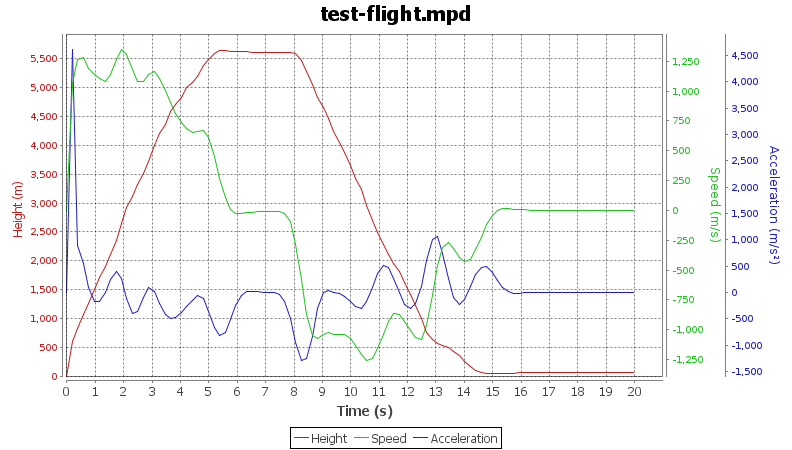
Making the photo-transistor go fast enough The photo-transistor acts as one half of a voltage divider on the positive op-amp terminal, with a resistor making the other half. However, the photo-transistor acts a bit like a capacitor, so when I initially chose a fairly large value for the resistor, it actually took too long to switch between on and off the transistor would spend a bunch of time charging and discharging. I had to reduce the resistor to 1k for the circuit to work. Remaining hardware design I prototyped the circuit on a breadboard using a through-hole op-amp that my daughter designed into her ultrasonic guided robot and a prefabricated FTDI Friend board. I wanted to use the target photo-transistor, so I soldered a couple of short pieces of wire onto the SMT pads and stuck that into the breadboard. Once I had that working, I copied the schematic to gschem, designed a board and had three made at OSHPark for the phenomenal sum of $1.35. Aside from goofing up on the FT230 USB data pins (swapping D+ and D-), the board worked perfectly. The final hardware design includes an LED connected to the output of the comparator that makes it easier to know when things are lined up correctly, otherwise it will be essentially the same. Host software Our AltosUI code has taught us a lot about delivering code that runs on Linux, Mac OS X and Windows, so I m busy developing something based on the same underlying Java bits to support MicroPeak. Here s a sample of the graph results so far: Production plans I ve ordered a couple dozen raw boards from OSH Park, and once those are here, I ll build them and make them available for sale in a couple of weeks. The current plan is to charge $35 for the MicroPeak serial interface board, or sell it bundled with MicroPeak for $75.

25 December 2012

Russ Allbery: Review: A Paradise Built in Hell

Review: A Paradise Built in Hell, by Rebecca Solnit
Publisher: Penguin
Copyright: 2009
Printing: 2010
ISBN: 0-14-311807-2
Format: Trade paperback
Pages: 319
A Paradise Built in Hell is a book with an agenda. Solnit's goal is to convince the reader that nearly everything we're shown in movies and popular culture about human behavior during disasters is wrong. Not only is destructive mass panic unusual verging on nonexistent, spontaneous cooperation and acts of startling courage and resourcefulness are commonplace. The heroes that we hear about afterwards are more the norm than the exception. Disasters are far more likely to bring out the best in people than the worst. They break down barriers and form spontaneous human communities that survivors remember for a lifetime. Rather than natural disasters leading inevitably to an exacerbating human crisis in the absence of strong authority, Solnit argues that they are an amazing human opportunity, and that the most negative and destructive human behavior during crises is not from untrained victims but from the panic of the elites who are supposedly responsible for protecting the public. I think her analysis and presentation is both deeply appealing and deeply flawed. The flaws involve extrapolation and generalization beyond the applicability of her research, and I'll say more about that in a moment. But the appeal is still surprising and satisfying, and I think there's a lot of truth in this book despite its one-sided presentation. I like to tell people, half-jokingly, that I'm an anarchosyndicalist. It's my political alliegance of the heart: the political structure that I know would never work, but that matches the world I want to live in. (I suspect much of the belief in libertarianism is of this form.) Now I have a book to point people at when they ask what the appeal of anarchosyndicalism is. The sense of spontaneous community, of bonding, of reaching out to other people to do something necessary, together, that Solnit describes here in the aftermath of a disaster matches that vision of a world without imposed economic authority, where people spontaneously collaborate to solve problems. A Paradise Built in Hell is structured by disaster, providing a tour of major disasters and their aftermath interspersed with extended musings on what the human reactions mean and how disaster communities functioned. The major disasters discussed are the 1906 San Francisco earthquake, the Halifax explosion, the 1985 Mexico City earthquake, 9/11, and Hurricane Katrina. Solnit moves through them in chronological order, closing the book with Katrina, which had (at least for me) the most infuriating and uplifting mixes of community bonding and elite panic. But both of those factors are present from the beginning in the 1906 earthquake: spontaneous human organization that (from multiple first-hand accounts) transformed people's lives mixed with a military reaction and elite panic that possibly did more damage to the city than the earthquake did. Elite panic is the dark side of Solnit's celebration of human altruism and spontaneous community organization. The primary picture she paints is of ordinary people responding with great courage and creativity and finding, in their reaction, a transformative experience and a sense of purpose that often becomes the most powerful and positive experience of their life. But this is at odds with a deeply-entrenched elite belief in mass panic, in the necessity of keeping information from the public to suppress their reaction, and in the need to re-establish "order." And with that, Solnit is absolutely scathing, and with some justification. Along with detailed accounts of these major disasters, Solnit also gives the reader a tour of the research literature on disasters, research that has shown that the panic and chaos that is at the center of practically every disaster movie ever made is essentially a myth. Mass panic in disasters is not only rare, it's close to non-existent. As you might expect, the handling of Katrina by both the government and by neighboring white communities is the subject of the harshest attacks. The material on Katrina presented here is enough to make anyone want to throw out the current playbook on how we react to disasters (and lest one think Solnit is unfair, her research matches very closely with other research and journalism on Katrina that I've seen from a wide variety of sources). But Solnit shows that this is a pattern: the combination of our media-driven belief in how people will react to disasters combined with the elite need to re-establish control plays out in many major disasters, and almost always negatively. Even in 9/11, the official response in some cases hampered and undermined an already-effective unofficial response. This is very interesting and has concrete implications for public policy around disasters. But where Solnit moves onto thinner anarchosyndicalist ice is the story that she tells about disasters as dramatic upheavals of the established social order that could point to a revolution in how we interact with each other. Solnit is deeply inspired by human altruism during disasters, and her enthusiasm is somewhat contageous, but it was useful to read this book shortly after Bruce Schneier's Liars and Outliers. I think Solnit, in her understandable eagerness to find a way to extend disaster behavior to general life, does not understand the relationships between what Schneier terms moral, reputational, and institutional pressures. And that's the core of why we need to both enable spontaneous human response in disasters and have organized first responders and supporting infrastructure, and why disaster communities will break down when extended beyond the disaster. When I first mentioned A Paradise Built in Hell to my mother, her first reaction was dubiousness due to her memory of the 1977 New York City blackout. There was a disaster that resulted in widespread looting and destruction, rather than the positive reaction Solnit describes. Solnit does have a cogent argument for why looting is poorly analyzed (we don't, for example, distinguish between breaking into stores to get desperately needed supplies and doing so for personal gain) and should not be a priority in a life-threatening disaster. But it's not completely convincing; in some disasters, particularly ones like the 1977 power outage that were not particularly life-threatening, the looting has been the most destructive part of the disaster. Schneier provides what I think is the missing piece, both to this and to why the wonderful behavior during disasters doesn't last into everyday life. During a life-threatening disaster, moral pressures are massively increased. Nearly all of us have self-images and moral beliefs that provide very strong incentives to help others and collaborate in the face of life-threatening emergencies, incentives that override other motives and lead to the sort of behavior that Solnit celebrates. But moral pressures have inherent limitations. That moral reaction applies most strongly to small groups (such as bands of survivors), and will start to break down as larger society re-establishes itself. And disasters, like a power outage, that are not immediately life-threatening will not provoke the same intensification of moral pressures: we don't have strong moral beliefs and internal stories about staying quietly at home during power outages the way that we do for saving people from burning buildings or pulling them out of rubble. Once larger communities have reformed and that short-term emergency reaction has dissipated, the need for institutional pressures (police, law, and formal authority structures) will return. I wish Solnit had been able to read Schneier's book before writing hers. I think his analysis structure provides a healthy dose of realism and perspective to her desire for a self-organizing communal world, and might have blunted her enthusiastic but somewhat unrealistic hopes for finding some key to a revolution in human organization in the heart of disasters. But if A Paradise Built in Hell is unlikely to lead to a radical change in how we organize societies, it should at least provoke a radical rethinking of some of our unnecessary pessimism about our fellow humans. The evidence is substantial and compelling: crisis brings out the best in people, not the worst, and the ordinary people who happen to be around are capable of becoming some of the most amazing disaster response teams that we can imagine. This has numerous mundane implications for social policy. We should consider simple training for the general public, for example, to strengthen that reaction, should allow for it in legal structures and training of first responders (around looting, for instance), and should do everything we can to kill the destructive myth that people cannot be trusted in disasters or that mass panic will be as much of a threat as the disaster. But the best part of this book is that it provides a concrete, well-documented, and well-defended reason to let go of some of our cynicism and to extend a bit of trust to our fellow humans. There sadly aren't earth-shaking implications for everyday society, but there is a wealth of evidence that shows that we're better people in the crunch than we believe we are, or that we expect of others. And the more that we can embrace the dissolution of boundaries and social hierarchies in the middle of disasters, the more we are likely to be surprised by deep human connection and a sense of shared, focused purpose. Solnit is a bit long-winded with her agenda, but that bright hope has stuck with me. Recommended. Rating: 8 out of 10

18 December 2012

Russ Allbery: Review: Liars and Outliers

Review: Liars and Outliers, by Bruce Schneier
Publisher: John Wiley
Copyright: 2012
ISBN: 1-118-14330-2
Format: Hardcover
Pages: 285
One of the perils of buying a book written by a blogger one reads regularly is that the book may be little more than a rehashing of their blog, with insufficient original material to warrant the time investment. Sometimes it's still nice to support them financially, but it may not make sense to read the book. I've been following Schneier's blog for years (as should anyone with an interest in security), including through the entire process of writing Liars and Outliers, and was a bit worried that might be the case here. Thankfully, I can reassure any other worried potential readers that is not the case. This is substantial new material establishing a firm framework for thinking about incentives and controls in any society or organization. Liars and Outliers talks about security mechanisms, but it's not, at its core, a book about security. Rather, it's a book about incentives, order, and how order is established. It's a comprehensive reductionist analysis of how societies create predictability and compliance to allow us to trust other people who we have never met before and will never meet again. It's a unique (at least in my experience) combination of anthropology, sociology, security analysis, and political science. Schneier cuts across fields in an idiosyncratic but illuminating way that reminded me of (on an entirely separate topic) Jane Jacobs. This is not a prescriptive book, nor is a collection of answers, solutions, or even deep analysis of particular problems. Rather, it's an attempt to construct a general framework for analyzing societal dilemmas: conflicts between individual desires and social good, how those conflicts are resolved, and how societies can weigh the scales and influence the statistical outcomes. The closest Schneier comes to telling the reader how to solve problems is a checklist, at the end of the book, for designing effective societal pressures. Its primary contribution is vocabulary and structure. It also passes one of my litmus tests for any book about human behavior: Schneier complicates, broadens, deepens, and expands understanding, and points out complex interactions and complex feedback in effects we're inclined to consider simple, rather than simplifying or eliminating human complexity. One point I found refreshing about this book is that Schneier is scrupulous in refusing to define either society or individuals as good or bad, to the point of carefully defining terminology used in all of the social dilemmas. Following societal rules is called compliance; not following those rules is called defection. In some cases, defection is morally correct (Schneier's most frequent example is in the civil rights struggles of the 1960s in the United States). In all cases, social pressures are tools, which can be used to encourage compliance with moral or immoral systems, and which are deployed by totalitarian dictatorships and utopian communes alike. Schneier explicitly puts out of scope for this book the questions of how societal goals should be determined, how they change, and whether any given societal rule or interest is moral or immoral. He focuses, rather, only on the mechanisms, with a primary goal of informing and deepening debates over how best to encourage behavior that societies want to encourage and discourage behavior societies want to discourage. He also emphasizes discourage, as opposed to eliminate. Early on, Schneier shows some of the results of game theory, as well as basic common sense, that indicate that no healthy society can totally eliminate defection. Not only would that stifle valuable and important reform, such as changes in civil rights, but the degree of pressure required is immense. Defectors are natural and will always exist, and are sometimes valuable and necessary. Rather, the goal of a society is to reduce defectors to a level where most people can ignore their existence most of the time, a state that leads to the level of risk and trust required to have a functioning and healthy society. The word society, similarly, is intentionally broad, and can refer to just about any collection of people, from a circle of friends to a corporation, institution, or country. However, as Schneier points out early in the book, small societies rarely need much in the way of formal pressure and appear almost magically self-governing. That's the first property that he disassembles, resulting in a general classification of societal pressures into four categories: moral, reputational, institutional, and security systems. The last is an odd category that's partly orthagonal to the other three. Moral pressure is internalized conscience: the normal tendency of nearly everyone to follow their own moral code, a code that's at least partly constructed and certainly heavily influenced by the surrounding society. Reputational pressure is, in a sense, externalized morality: it's the informal reactions of others around one to one's past actions. Included in reputational pressure is shunning of every kind, from cutting off a friendship to boycotts against corporations, but it also includes confrontation from another member of one's society, the more subtle effects of our individual desires to be liked and respected, and all the various aspects of "face", honor, and respect within a community. Small communities are frequently self-governing, in Schneier's model, because they're small enough that moral and reputational pressures are sufficient and no other pressures are required. We're so used to applying moral and reputational pressure to other humans almost unconsciously that we sometimes don't even notice its existence, leading to that "magical" self-governing property. But Schneier puts pressures in a sequence: pressures that work extremely well with small groups often don't scale. Moral pressure works best with small groups and reputational pressure with somewhat larger groups, but when societies scale beyond the limits of reputational pressure when, for example, one frequently interacts with people whose reputations are unknown to you and whose subsequent opinion of you will not be relevant institutional pressure is required to force compliance. Institutional pressure is the sort of pressure that we all tend to think of first when we look for ways to enforce rules: laws, policies, contracts, and other codes of behavior that carry with them formal punishments and some enforcement mechanism. But even in societies so large that institutional pressures are frequently required, such as whole countries, moral and reputational pressures still exist and are extremely important. One of Schneier's most interesting points is his analysis of how institutional pressures can paradoxically undermine reputational and moral pressures, resulting in more defection than if the institutional pressure hadn't existed. This is just the basic framework of Schneier's analysis, hopefully giving you a feel for the structure of the book. He goes much deeper into the complicated interactions between the various levels of pressure, and then dives into an extensive look at competing societal dilemmas: cases where there is more than one society in play simultaneously, possibly demanding contradictory actions. Liars and Outliers also includes a wonderful analysis of organizational entities within the same framework, including their much-different reactions to moral, reputational, and institutional pressures. One of the most cogent analyses of the difficulties of regulating both corporations and governmental institutions falls out of that analysis, once one looks at them in light of Schneier's basic framework. Pressures quickly become complex and multi-layered, and human reactions to pressures are frequently counter-intuitive. Schneier draws extensively on game theory to show that some counter-intuitive responses are actually emergent properties of logical analysis of the situation, but that others are more uniquely human and have little or nothing to do with a mathematical cost-benefit analysis. I haven't even mentioned his discussion of security systems, and how they can extend moral, reputational, and institutional pressures, as well as add a new type of pressure (making a defecting action impossible) that scales even better than institutional pressures. Liars and Outliers has all of the supporting infrastructure you would expect in a scholarly book: notes, extensive references, and a good index. I suspect it will end up being used as at least additional reading in college classes. The notes are, unfortunately, end notes, making the full context of the book much harder to read than was necessary, but at least Schneier does separate the notes from the references so that one doesn't chase notes for further explanation and find a simple citation. As with any book like this, one always wishes it could end in a simple prescription to fix everything, but of course it doesn't. But that's also a measure of a good scholarly work. Human and organizational motivations are complex and tricky, and any framework for analyzing them needs to be able to represent that complexity. Schneier here has constructed a very powerful one, one that I started using in discussions before I'd even finished the book. Perhaps the most valuable contribution of Liars and Outliers to public discussion is clear terminology and categories, which can be of great help in finding the core components of a problem. Liars and Outliers can be slow going, particularly early on when Schneier is still defining terms and setting up the background of his analysis. One can get a bit tired of the analysis matrices of societal dilemmas. But stick with it through the groundwork, since the analyses of competing societal dilemmas and of the impact of societal pressures on organizations are exceptional. Highly recommended, particularly for anyone who is designing or implementing societal pressures: managers, political activists, or anyone in a security-related field. Rating: 8 out of 10

23 November 2012

Keith Packard: MicroPeak

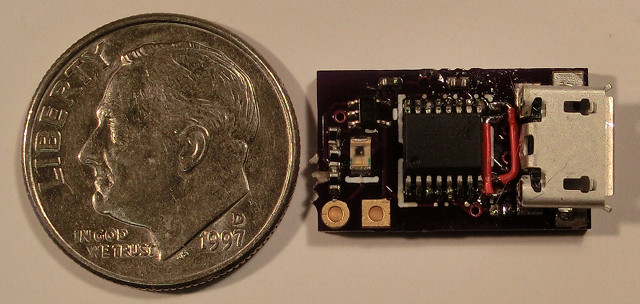
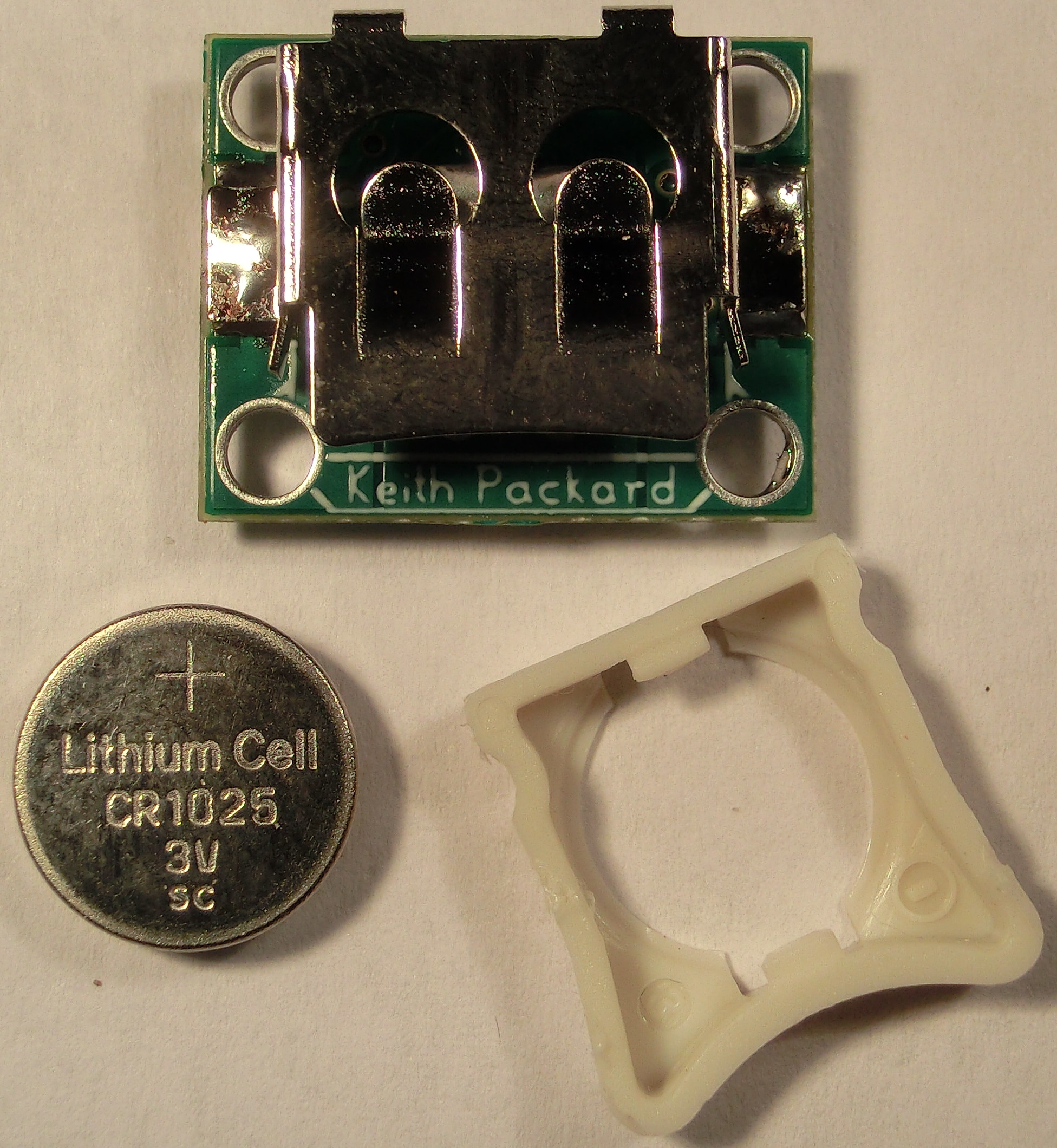
MicroPeak tiny peak-recording altimeter now available MicroPeak is a miniature peak-recording altimeter. About the same size and weight as a US dime (with battery), MicroPeak offers fabulous accuracy (20cm or 8in at sea level) and wide range (up to 31km or 101k ). The size of the board was predicated with the premise that we needed a battery included to avoid having wiring running between the altimeter and the board, we found some small lithium coin-cell battery holders for the CR1025 battery. These battery holders are rated to hold the battery secure up to 150gs. We d already started playing with the Measurement Specialties MS5607 pressure sensor which offers amazing accuracy while using very little power. Taking full-precision measurements every 96ms consumes about .2mA on average. Once on the ground, we stop taking measurements entirely, dropping the power use to around 1 A. It s also pretty small, measuring only 5mm x 3mm. For a CPU, this little project didn t need much. The 8-bit ATtiny85 comes in a 20qwfn package which is only 4mm x 4mm. When run at full speed (8MHz), it consumes a couple of mA of power. Reduce the clock to a pokey 250kHz and the CPU has enough CPU power to track altitude while consuming less than .2mA on average. To avoid losing the battery, we wanted to avoid having it removed while the board wasn t in use. So, we added a little power switch to the board. The one we found is good to at least 50g. Finally, we wanted to find a nice bright LED to show the state of the device and to blink out the final altitude. The OSRAM LO T67K are bright-orange surface-mount LEDs that run happily on 2mA. We used OSHPark.com to create prototype circuit boards for this project. Because of the small size of the board, each prototype run cost only $2 for three boards. It takes a couple of weeks to get boards, but it s really hard to beat the price. All of the schematic and circuit board artwork are published under the TAPR Open Hardware License and are available via git. All of the source code is published under the GPLv2 and is included in the main AltOS source repository.

22 October 2012

Petter Reinholdtsen: Amazon steal books from customer and throw out her out without any explanation

A blog post from Martin Bekkelund today tell the story of how Amazon erased the books from a customer's kindle, locked the account and refuse to tell the customer why. If a real book store did this to a customer, it would be called breaking into private property and theft. The story has spread around the net today. A bit more background information is available in Norwegian from digi.no. It is no surprise that digital restriction mechanisms (DRM) are used this way, as it has been warned about such abuse since DRM was introduced many years back. And Amazon proved in 2009 that it was willing to break into customers equipment and remove the books people had bought, when it removed the book 1984 by George Orwell from all the customers who had bought it. From the official comments, it even sounded like Amazon would never do that again. And here we are, three years later. And thought this action is against Norwegian regulations and law, it is according to the terms of use as written by Amazon, and it is hard to hold Amazon accountable to Norwegian laws. It is just yet another example of unacceptable terms of use on the web, and how they are used to remove customer rights. Luckily for electronic books, there are alternatives without unacceptable terms. For example Project Gutenberg (about 40,000 books), Project Runenberg (1,652 books) and The Internet Archive (3,641,797 books) have heaps of books without DRM, which can read by anyone and shared with anyone. Update 2012-10-23: This story broke in the morning on Monday. In the evening after the story had spread all across the Internet, Amazon restored the account of the user, as reported by digi.no and NRK. Apparently public pressure work. The story from Martin have seen several twitter messages per minute the last 24 hours, which is quite a lot, and is still drawing a lot of attention. But even when the account is restored, the fundamental problem still exist. I recommend reading two opinions from Simon Phipps and Glen Moody if you want to learn more about the fundamentals and more details about the original story.

27 August 2012

Robert Collins: Why platform specific package systems exist and won t go away

A while back mdz blogged about challenges facing Ubuntu and other Linux distributions. He raises the point that runtime libraries for Python / Ruby etc have a unique set of issues because they tend to have their own packaging systems. Merely a month later he attended Debconf 2010 where a presentation was given on the issues that Java packages have on Dpkg based systems. Since then the conversation seems to have dried up. I ve been reminded of it recently in discussions within Canonical looking at how we deploy web services. Matt suggested some ways forward, including: I think its time we revisit and expand on those points. Nothing much has changed in how Ubuntu or other distributions approach integration with other packaging systems but the world has kept evolving. Internet access is growing ever more ubiquitous, more platforms are building packaging systems clojure, scala, node.js, to name but three, and a substantial and ever growing number of products expect to operate in a hybrid fashion with an evolving web service plus a local client which is kept up to date via package updates. Twitter, Facebook and Google Plus are three such products. Android has demonstrated a large scale app store on top of Linux, with its own custom packaging format. In order to expand them, we need some background context on the use cases that these different packaging systems need to support. Platforms such as antivirus scanners, node.js, Python, Clojure and so forth care a great deal about getting their software out to their users. They care about making it extremely easy to get the latest and greatest versions of their libraries. I say this because the evidence is all around us: every successful development community / product has built a targeted package management system which layers on top of Windows, and Mac OSX, and *nux. The only rational explanation I can come up for this behaviour is that the lower level operating system package management tools don t deliver what they need. E.g. this isn t as shallow as wanting a packaging system written in their own language, which would be easy to write off as parochialism rather than a thoughtful solution to their problems. In general packaging systems provide a language for shipping source or binary form, from one or more repositories, to users machines. They may support replications, and they may support multiple operating systems. They generally end up as graph traversal engines, pulling in dependencies of various sorts you can see the DOAP specification for an attempt at generic modelling of this. One problem that turns up rapidly when dealing with Linux distribution package managers is that the versions upstream packages have, and the versions a package has in e.g. Debian, differ. They differ because at some stage, someone will need to do a new package for the distribution when no upstream change has been made. This might be to apply a local patch, or it might be to correct a defect caused by a broken build server. Whatever the cause, there is a many to one relationship between the package versions that end users see via dpkg / rpm etc, and those that upstream ship. It is a near certainty that once this happens to a library package, that comparing package versions across different distribution packages becomes hard. You cannot reliably infer whether a given package version is sufficient as a dependency or not, when comparing binary packages between Red Hat and Debian. Or Debian and Ubuntu. The result of this is that even when the software (e.g. rpm) is available on multiple distributions (say Ubuntu and RHEL), or even on multiple operating systems (say Ubuntu and Windows), that many packages will /have/ to be targeted specifically to build and execute properly. (Obviously, compilation has to proceed separately for different architectures, its more the depedency metadata that says and build with version X of dependency Y that has to be customised). The result of this is that there is to the best of my knowledge no distribution of binary packages that targets Debian/Ubuntu and RHEL and Suse and Windows and Mac OS X, although there are vibrant communities building distributions of and for each in isolation. Some of the ports systems come close, but they are still focused on delivering to a small number of platforms. There s nothing that gives 99% coverage of users. And that means that to reach all their users, they have to write or adopt a new system. For any platform X, there is a strong pressure to have the platform be maintainable by folk that primarily work with X itself, or with the language that X is written in. Consider Python there is strong pressure to use C, or Python, and nothing else, for any tools that is somewhat parochial, but also just good engineering reducing variables and making the system more likely to be well maintained. The closest system I know of Steam is just now porting to Ubuntu (and perhaps Linux in general), and has reached its massive popularity by focusing entirely on applications for Windows, with Mac OSX a recent addition. Systems like pypi which have multi platform eggs do target the wide range of platforms I listed above, but they do so both narrowly and haphazardly: whether a binary or source package is available for a given platform is up to the maintainer of the package, and the packages themselves are dealing with a very narrow subset of the platforms complexity: Python provides compilation logic, they don t create generic C libraries with stable ABI s for use by other programs, they don t have turing complete scripts for dealing with configuration file management and so forth. Anti virus updaters similarly narrow the problem they deal with, and add constraints on latency- updates of anti virus signatures are time sensitive when a new rapidly spreading threat is detected. A minor point, but it adds to the friction of considering a single packaging tool for all needs is the different use cases of low level package management tools like dpkg or rpm vs the use cases that e.g. pypi has. A primary use case for packages on pypi is for them to be used by people that are not machine administrators. They don t have root, and don t want it. Contrast that with dpkg or rpm where the primary use case (to date) is the installation of system wide libraries and tools. Things like man page installation don t make any sense for non-system-wide package systems, whereas they are a primary feature for e.g. dpkg. In short, the per-platform/language tools are (generally):
  1. Written in languages that are familiar to the consumers of the tools.
  2. Targeted at use on top of existing platforms, by non-privileged users, and where temporary breakage is fine.
  3. Intended to get the software packaged in them onto widely disparate operating systems.
  4. Very narrow they make huge assumptions about how things can fit together, which their specific language/toolchain permits, and don t generalise beyond that.
  5. Don t provide for security updates in any specific form: that is left up to folk that ship individual things within the manager.
operating system package managers:
  1. Are written in languages which are very easy to bootstrap onto an architecture, and to deploy onto bare metal (as part of installation).
  2. Designed for delivering system components, and to avoid be able to upgrade the toolchain itself safely.
  3. Originally built to install onto one operating system, ports to other operating systems are usually fragile and only adopted in niche.
  4. Are hugely broad they install data, scripts, binaries, and need to know about late binding, system caches etc for every binary and runtime format the operating system supports
  5. Make special provision to allow security updates to be installed in a low latency fashion, without requiring anything consuming the package that is updated to change [but usually force-uninstalling anything that is super-tightly coupled to a library version].
Anti virus package managers:
  1. Exist to update daemons that run with system wide escalated privileges, or even file system layer drivers.
  2. Update datasets in realtime.
  3. Without permitting updates that are produced by third parties.
Given that, lets look at the routes Matt suggested Decoupling applications from the core as a strategy makes an assumption that the core and applications are partitionable. If they are not, then applications and the core will share common elements that need to be updated together. Consider, for instance, a Python application. If you run with a system installed Python, and it is built without zlib for some reason, but the Python application requires zlib, you have a problem. A classic example of this problem is facing Ubuntu today, with all the system provided tools moving to Python 3, but vast swathes of Python applications still being unported to Python 3 at all. Currently, the Python packaging system virtualenv/buildout + distribute don t provide a way to install the Python runtime itself, but will happily install their own components for everything up the stack from the runtime. Ubuntu makes extensive use of Python for its own tools, so the system Python has a lot of packages installed which buildout etc cannot ignore this often leads to issues with e.g. buildout, when the bootstrap environment has (say) zope.interfaces, but its then not accessible from the built-out environment that disables the standard sys.path (to achieve more robust separation). If we want to pursue decoupling, whether we build a new package manager or use e.g. virtualenv (or gem or npm or ), we ll need to be aware of this issue and perhaps offer, for an extended time, a dedicated no-frills, no-distro-packages install, to avoid it, and to allow an extended supported period for application authors without committing to a massive, distro sponsored porting effort. While its tempting to say we should install pip/npm/lein/maven and other external package systems, this is actually risky: they often evolve sufficiently fast that Ubuntu will be delivering an old, incompatible version of the tool to users well before Ubuntu goes out of support, or even befor the next release of Ubuntu. Treating data as a service. All the cases I ve seen so far of applications grabbing datasets from the web have depended on web infrastructure for validating the dataset. E.g. SSL certificates, or SSL + content checksums. Basically, small self-rolled distribution systems. I m likely ignorant of details here, and I depend on you, dear reader, to edumacate me. There is potential value in having data repackaged, when our packaging system has behind-firewall support, and the adhoc system that (for instance) a virus scanner system has does not. In this case, I specifically mean the problem of updated a machine which has no internet access, not even via a proxy. The challenge I see it is again the cross platform issue: The vendor will be supporting Ubuntu + Debian + RHEL + Suse, and from their perspective its probably cheaper to roll their own solution than to directly support dpkg + rpm + whatever Apple offer + Windows the skills to roll an adhoc distribution tool are more common than the skills to integrate closely with dpkg or rpm What about creating a set of interfaces for talking to dpkg / rpm / the system packagers on Windows and Mac OSX ? Here I think there is some promise, but it needs as Matt said careful thought. PackageKit isn t sufficient, at least today. There are, I think, two specific cases to cater to:
  1. The anti-virus / fresh data set case.
  2. The egg/gem/npm/ specific case.
For the egg/gem/npm case, we would need to support a pretty large set of common functionality, on Windows/Mac OSX / *nux (because otherwise upstream won t adopt what we create: losing 90% of their users (windows) or 5% (mac) isn t going to be well accepted :) . We d need to support multiple installations (because of mutually incompatible dependencies between applications), and we d need to support multiple language bindings in some fashion some approachable fashion where the upstream will feel capable of fixing and tweaking what we offer. We re going to need to support offline updates, replication, local builds, local repositories, and various signing strategies to match the various tradeoffs made by the upstream tools. For the anti-virus / fresh data case, we d need to support a similar set of operating systems, though I strongly suspect that there would be more tolerance for limited support in that most things in that space either have very platform specific code, or they are just a large-scale form of the egg/gem/npm problem, which also wants easy updates. What next? We should validate this discussion with at least two or three upstreams. Find out whats missing I suspect a lot and whats wrong I hope not much :) . Then we ll be in a position to decide if there is a tractable, widespread solution *possible*. Separately, we should stop fighting with upstreams that have their own packaging systems. They are satisfying different use cases than our core distro packaging systems are designed to solve. We should stop mindlessly repackaging things from e.g. eggs to debs, unless we need that specific thing as part of the transitive runtime or buildtime dependencies for the distribution itself. In particular, if us folk that build system packaging tools adopt and use the upstream application packaging tools, we can learn in a deep way the (real) advantages they have, and become more able to reason about how to unify the various engineering efforts going into them and perhaps even eventually satisfy them using dpkg/rpm on our machines.

14 August 2012

Asheesh Laroia: Zooming in

She zoomed in on the git commits to check that the new contributors were thanked properly. She was not looking for bad programmers or bad community managers. She was looking for the kinds of misses that even excellent programmers and community managers can make under pressure.
A mis-quote of "Can Hospital Chains Improve the Medical Industry?".

1 August 2012

Bdale Garbee: Early Retirement

I am pleased to announce that HP accepted my application for participation in this year's Enhanced Early Retirement program. After 26.5 years, my last day at HP will be 31 August 2012. This isn't because I have a problem with HP, quite the contrary! I feel immensely privileged to have worked on so many interesting things with so many smart people for so long. And there are many exciting things happening right now, including high profile projects like Odyssey and Moonshot expanding both ends of the server scaling continuum with Linux, and the immense commitment to and investment in Open Source represented by the use of Open Stack and Ubuntu LTS in building HP Cloud. The temptation to stay and continue to help guide HP's Open Source engagement was strong. I'm certainly under no pressure to leave... in fact, I think I managed to shock my management with my decision to retire! But I'm very excited about "taking a break" from full-time employment for a while to focus more time on things that matter a lot to me. My son and I have a number of projects we'd like to work on together as he enters high school. The side business I started two years ago with Keith Packard to design, build, and sell avionics solutions for high power model rockets is growing and could use more attention. I'm in the midst of designing the processor board for another amateur radio satellite. And of course, I'm looking forward to putting more "quality time" towards Free Software projects like FreedomBox and Debian! Since they do not depend on my employment status, I do not expect any immediate changes in the various roles I play outside of HP. I will continue to serve on the board of the Linux Foundation representing individual affiliates, on the board of the FreedomBox Foundation, as Chairman of the Debian Technical Committee, and as President of Software in the Public Interest. And while I hope to travel less than I have in recent years, I look forward to continuing to speak and otherwise participate in key Free Software conferences around the world from time to time. After I retire, the primary point of contact with HP on Open Source matters will be the Director of HP's Open Source Program Office, Phil Robb. But if there are open issues regarding HP and Open Source that I can help with over the next month, feel free to contact me and I'll see what I can do to help.

25 July 2012

Vincent Sanders: Fowlers Delight?

Fowler published his paper on Continuous Integration (CI) way back in 2000. Personally at the time I was a much more naive developer, I was not really an adherent to the whole XP community and had worked for a series of companies where the idea of a release build was of a month long process and the concept that the whole codebase could be built and tested on every commit was a comical notion at best.

By the time the time the 2006 edition of the paper came out however I was convinced. Ever since then I have tried to make the projects I worked on have as many CI features as possible. It is one reason I ran the ARM Kernel autobuilder for years as an attempt to provide at least build coverage.

I especially like the way these concepts mean that releases are much less "scary" events and release anxiety is reduced to a minimum. When every commit produces something that is of release quality a project really is doing it right.

The reason I mention any of this is I have recently set up the NetSurf projects CI server. The heavy lifting is being done by a Jenkins instance running on a VPS fulfilling the "Every Commit Should Build the Mainline on an Integration Machine" part of the Fowler guidelines.

Setting up Jenkins was much less trouble than many of the previous systems I have used. I have been a little underwhelmed by the support for plain old make based projects which you have to resort to shell scripts for, but leaving that aside the rest was straightforward. The documentation could do with a purge pass for the old hudson name and the error reporting (especially under memory pressure) is not great.

And there lies my one real issue with the tool, memory. The VPS has 512MByte RAM and runs nothing beyond a web server, jenkins and the C compiler to build the project components. One would hope that was plenty of memory, doing the builds by hand it did seem gcc is happy in that space, alas Jenkins is a Java application and guzzles RAM (over 60% of RSS right now) and causes itself out of memory exceptions with distressing frequency.

The project is left with the choices:
It is such a pity too, aside from the RAM issues it is all going well and it has already encouraged us to get the toolchains for the less commonly built targets (ppc amiga and windows for a start) working.

6 July 2012

Paul Tagliamonte: Thinkpad t520i Palmrest

Hello, Internets! After a bit of a disappointment with Lenovo, they ve come through with flying colors, My 520i s palmrest fractured in a couple of really gnarly ways. The machine was still usable, but the fractures were really bad, looked really gnarly and creaked a bit when I put any pressure around it. After having fancyhands call them a few times, each time returning a different part number, I complained on twitter only tagging @lenovo as an afterthought which (to my surprise) got a fast response and helpful email service. Here I am, 3 days later with a replaced palmrest. Nice ending, but I hope it won t happen again :)

26 June 2012

Russ Allbery: Review: Quiet

Review: Quiet, by Susan Cain
Publisher: Crown
Copyright: 2012
ISBN: 0-307-45220-4
Format: Kindle
Pages: 263
I've always been an introvert. This is something that surprises some people when they first meet me since they equate introversion with shyness, and I'm not at all shy. It surprises others because I'm quite vocal and outspoken in meetings, but introversion also doesn't imply a lack of self-confidence. I can run meetings, give presentations, and argue my perspective in front of just about anyone, but I don't like parties, I crave time by myself, and I could happily go for weeks without seeing another human being. I'm an introvert because I find people draining rather than invigorating, written communication far easier and more comfortable than spoken, and superficial social contact more irritating and frustrating than enjoyable. If you think think that means there may be something wrong with me, or that I would be happier if "drawn out of my shell," I wish you would read this book. But I suspect its core audience will be people like me: those who are tired of being pushed to conform with extrovert beliefs about social interaction, those who are deeply disgusted by the word "antisocial" or feel pangs of irrational guilt when hearing it, or those who just want to read an examination of interpersonal interactions that, for once, is written by and about people who like quiet and solitude just like they do. I first encountered Susan Cain via her TED talk, which I think is both the best possible summary of this book and the best advertisement for it. If you've not already seen it, watch it; it's one of the best TED talks I've seen, good enough that I've watched it three times. If you then want more of the same, buy Quiet. Quiet has, I think, three messages. First, it's a tour of the science: what is introversion and extroversion? Is there evidence that these are real physiological differences? (Spoiler: yes.) What do we know about introversion? How do we know those things what experiments have been done and what methods have been used? Here, it's a good general introduction, although Cain is careful to point out that it only scratches the surface and there's much more scientific depth. For example, she touches on the connections between introversion and sensitivity to stimulus and points out that they're two separate, if related, categorizations, but doesn't have the space here to clarify the distinctions and tease them apart. But she lays a reasonable foundation, particularly in defense of introversion as a natural, physiologically grounded, scientifically analyzable, common, and healthy way of interacting with the world. (For those who are curious about the distinctions between introversion and sensitivity, and the argument that most of what Cain says here about introversion is actually about sensitivity, see the blog post by Elaine Aron.) The second message, the one that resonated with me the most, was Cain's passionate defense of introversion. Business culture (at least in the United States, which is what both Cain and I know) is strongly biased towards extroversion; at least faking extroversion seems to be required for some career advancement. Extrovert culture dominates politics and most public discourse. It's common to find people who consider introversion, particularly in children, to be a sign of unhappiness, poor social adjustment, psychological problems, or other issues that should be "cured" or changed. Cain's gentle but firm passion in defense of introversion is a breath of fresh air. She attacks open plan offices, the current obsession with group learning and social school settings, and the modern group-think bias towards collaboration over solitude and concentration, and she does that with a combination of polite frustration and the conclusions of multiple studies. Introverts will be cheering as she constructs solid arguments and musters evidence against things that we've always found miserable and then been told we were wrong, short-sighted, or socially inept for finding miserable. I am so utterly on her side in this argument that I have no way of knowing how persuasive it will be, but it's lovely just to hear someone put into words what I feel. This defense does skew the book. Quiet is not, and does not purport to be, an even-handed presentation of introversion and extroversion. It's written proudly and unabashedly from the introvert's point of view. I'm fine with that: I, like Cain, think the US is saturated in extrovert perspectives and extrovert advice, particularly in the business world, and could use some balancing by activism from the other perspective. But be aware that this is not the book to look to for an objective study of all angles of the introvert/extrovert dichotomy, and I'm not sure her descriptions of extroversion are entirely fair or analogous to those of introversion. The extroversion described here seems somewhat extreme to me. I'm dubious how many extroverts would recognize themselves in it, which partly undermines the argument. The third message of the book, once Cain has won the introvert's heart, is some advice on how to be a proud introvert, to make the space and find the quiet that one desires, and to balance that against places where one may want and need to act like an extrovert for a while. Cain thankfully does not try to make this too much of the book, nor does she hold up any particular approach as The Answer. All the answers are going to be individual. But she does offer some food for thought, particularly around how to be conscious of and make delibrate choices about one's energy expenditures and one's recharge space. She also captures beautifully something that I've not seen explained this well before: the relief that an introvert can feel in the company of an extrovert who helps navigate social situations, make conversation, and keep discussions going until they can reach the depth and comfort level where the introvert can engage. I wish anyone in a position of authority over social situations would read this book, or at least watch the TED talk and be aware of the issues. Particularly managers, since (at least in my relatively limited experience) workplace culture is so far skewed towards extroversion that it can be toxic to introverts. Many of the techniques used by extrovert managers, and the goals and advice they give their employees, are simply wrong for introverts, and even damaging. Cain speaks well to the difficulties of empathy between people with very different interaction preferences, such as the problems with extroverts trying to "draw out" introverts who have hit social overload (or sensitive people who have hit stimulus overload). She also discusses something that I'd previously not thought about, namely how the pressure towards extroversion leads people to act extroverted even when naturally introverted, and how it's therefore very difficult to tell from behavior (and sometimes even to tell internally!) what one's natural interaction style is. But mostly I recommend this book if you're an introvert, if the TED talk linked above speaks to you. Even if we can't convince the world to respect introversion more, or at least stop treating it as abnormal, it's a lovely feeling to read a book from someone who gets it. Who understands. Who fills a book with great stories about introverts and how they construct their worlds and create quiet space in which to be themselves. Rating: 9 out of 10

14 June 2012

Russell Coker: The Financial Value of a University Degree

I ve read quite a few articles about the value of a degree. Most of them come from the US where the combination of increasing tuition fees and uncertain job market makes a degree seem like a risky investment. I think that most analysis of the value of a degree are missing some important points. The Value of Money at Different Times The value of money is different at various stages of your life. The impression that I get is that when a married couple have their house fully paid off and they either don t/won t have children or their children are old enough to leave home the amount of money that they earn seems to matter a lot less. Doing a university degree involves 3 or 4 years not earning money (or more if doing post-graduate studies), which is usually starting at the age of 18. Effectively getting a degree involves giving up some money while young for the opportunity to earn more when older. Any analysis based on directly comparing the money spent on the degree to the amount of financial return without considering when money is needed is not very useful. I think that a reasonable analysis would exclude income earned after the age of about 45. By that age most people have either achieved a solid financial position and learned to live within their means or messed up their finances so badly that they won t live long enough to recover. A Degree as a Signal The Wikipedia page on economic signalling gives education as an example of a signal. A signal in this case means something that doesn t inherently mean anything but which signifies something else. So completing a degree doesn t necessarily mean that you learned anything relevant to work, but if you are able to do it then it means that you can probably also do things which are economically useful for an employer. This raises the question of how else one might signal their ability to work. One obvious answer is by working, someone who has remained steadily employed for 3 or 4 years has demonstrated their ability to work reliably and get along with other people which should be at least as useful as a signal. It s Not Only the Degree Most analysis seem to compare average income of people with degrees with the average of income with people who didn t attend university. That is based on the assumption that the degree was the only difference. When I was young my parents spent a moderate amount of money on a full set of paper encyclopedias (about 2 meters of shelf space). I m sure that this gave me some educational benefit as they intended, and it was something that was apparently quite rare I don t recall seeing a full encyclopedia in anyone else s house before the Wikireader [1]. My parents also bought me quite a lot of computer gear (back when hardware was really expensive), were always available to drive me to computer users group meetings etc, and did everything else that seemed likely to have an educational benefit. The value of such learning opportunities is significant. I think that almost everyone who had similar learning opportunities to me when they were young will probably have experienced similar support and pressure to attend university. I also think that almost everyone who receives such opportunities will be able to earn more than the median income even if they don t attend university. To a large extent people who are going to be successful attend university. A university degree doesn t make anyone successful if they couldn t succeed without a degree. There are some careers that just aren t options if you don t have a relevant degree (such as medicine and law). But I believe that anyone who is capable of completing a difficult course such as medicine or law (or any other career that has legal requirements for a degree) is capable of being successful without a degree in many other fields. So comparing the wages of a doctor or a lawyer to an average person doesn t make sense, it makes more sense to try and compare their wages to someone of similar skill who didn t have such a qualification. Conclusion It seems to me that the question is, of the people who had great learning opportunities when they were young and who wanted to succeed, would they have earned much less if they hadn t attended university? The next question is, of the people who might earn significantly less without getting a degree, would that salary difference really have mattered, or would it just be a matter of earning some luxury money when they are too old to really need it? Related posts:
  1. Ideas for a Home University There seems to be a recent trend towards home-schooling. The...
  2. university degrees Recently someone asked me for advice on what they can...
  3. Microsoft Hires University Drop-Out for Recruiting Campaign news.com.au reports that MS has hired former Miss Australia Erin...

30 April 2012

John Goerzen: Review: Amateur Radio Handhelds (HTs), APRS, and Battery Tuning Tips

There are a lot of opinions about handhelds for amateur radio users (these handhelds are often known as HTs). I ve used three of them, two with APRS capability, and thought it s about time I write about them. First, I ll talk about the units in particular, then I ll get to some broader Yaesu vs. Kenwood generalizations and conclusions. Yaesu VX-7R a rugged first HT without APRS Cost: $350 as of 4/30/2012 This was the first HT I got as a ham, at the suggestion of Mike AE0MW. It truly does make a great first handheld for a ham. Radio-wise, one unique feature is a receive that s wideband enough to cover both broadcast FM and broadcast AM, the various ham bands, and plenty of others besides. The battery life quoted in the manual is 6 hours on 2m and 5.5 hours on 440 (using standard 6s TX / 6s RX / 48s squelched metric), and in my experience it seems it must be even better in some cases. The real piece of news about this unit, though, is just how rugged it is. It says submersible across the front and I absolutely believe it. I have personal experience with its ruggedness. I once was at an event and put the radio on my car roof while helping one of my children into the car. I then started driving home and forgot it there. When we got home, I realized what had happened, and also realized what that mysterious CLUNK along the busy county road was. So I drove 45 minutes back to where I heard the clunk, and found the VX-7R still lying in the roadway, where it had been for 1.5 hours on the 55 MPH road. The thing was really beat up. It had obviously been hit by numerous vehicles. The antenna was ripped off, taking the SMA mount with it. But wouldn t you know it, the darn thing still powered up. I took it to a local amateur radio shop, and about $80 later it was repaired. Incredible. The only real problem was the antenna connector. I took this radio with me on my bicycle many days, mounted on my handlebars. It got bounced around, but still worked great. Some days I listened to FM radio from it while riding my bike, monitoring a local repeater while I rode. Other days, I spent most of my ride (about an hour each way) chatting with people on the repeaters I have a mobile antenna mounted on the bike, fed to the VX-7R, and a headset. It all worked fine never a problem at all. The ruggedness has its downside. All of the connectors on the radio, except for DC in, are screw-down even the speaker/mic connector. This obviously helps keep water out, but means that it can take a lot longer than normal to do a simple thing like plug in a speaker/mic. It doesn t need any tools, but can get a little annoying. The radio physically is small (unless you install the belt clip, which has an odd peg-based mechanism that protrudes unnecessarily far and is surprisingly non-rugged). It can easily fit into a pocket. The other downsides of the VX-7R mostly surround its interface. I m not one of the Yaesu haters that seem to be so common. I find the interface usable if you read the manual; it seems a lot of people that complain about it don t. But it is quirky. The SET mode is one long menu in sort of a ring. You scroll with the knob, and when you get to the end, it repeats to the beginning. There are one or two shortcut keys to a specific setting, but overall either you use the thing so much you know exactly where you re going, or you re twisting the knob for awhile until the option you want rolls around. (I know of nobody that uses it so much they know exactly where they re going.) They do have options grouped into categories, but it doesn t help much because there s no quick way to skip between categories. The dual transceivers work less elegantly than on the TH-D72A or VX-8GR. Instead of being two equal transceivers A and B, they are main and sub . The sub transceiver is not broadband receive like the main receiver is. But there are also other limitations that have no apparent logic. For instance, you can program memory groups into the device putting, say, all the local repeaters into a certain group, or all the public safety frequencies (to use as a scanner). You can go to the special set menu, select group, then activate SCAN, and it will scan only the memories in that group. But you can t select the special group mode on the sub transceiver for no apparent reason. One other complaint is that the AC charger introduces so much noise to a transmission that you cannot really use the VX-7R to transmit while the charger is connected. Yaesu sells a programming cable that plugs into the speaker/mic port on one end, and a DB-9 serial port on the other, and includes programming software. For an incredibly high price. For far less, I found a similar cable on eBay that has a USB port on the other end (with a built-in USB/serial converter), and used VX-7R Commander though now that Chirp is available for Linux, I ll probably switch to it. I would probably continue to recommend this transceiver for a new ham. The ruggedness, plus the broadband RX, are features that should make it appealing. It is an excellent emergency preparedness/response radio due to those properties; having TX and RX on ham bands, plus RX on broadcast and public safety could be quite the asset. However, for someone that has any interest in APRS, one of the other two radios I mention is probably a better choice. At only $10 more, the VX-8GR sacrifices ruggedness and broadband receive for APRS functionality and could make a compelling alternative to the VX-7R at the same price point. The very low-power transmit at 50MHz and 220MHz on the VX-7R strikes me as a gimmick feature at best that has very little actual use. Shipped battery: FNB-80LI, 7.4V, 1400 mAh, lithium-ion Kenwood TH-D72A / D72E The Cadillac HT, with APRS and GPS Cost: $464 as of April 30, 2012 It s hard to use any word but incredible to describe this HT, though it does have its own rough edges. Starting with the basics, it has dual transceivers with full duplex (meaning you can be transmitting on one band while receiving on another). Its stored memory system and memory bank scanning system are both a lot easier and faster to use than Yaesu s, and work the same on both transceivers A and B, though perhaps offer slightly less flexibility than Yaesu s (on the VX-7R, a single memory can be a member of more than one group). The quoted operating time is 6 hours, which is probably accurate with APRS and GPS off, matching (or nearly matching) the VX-7R. The TH-D72A has the usual mic and speaker ports. Unlike Yaesu, Kenwood has used the same jack for years, so it is not necessary to purchase new accessories with each upgrade. The unit also has both serial (Kenwood connector) and standard mini USB ports, and even ships with a USB cable. The USB port is designed to interface to a PC, and the radio presents itself as a serial-over-USB device. Kenwood also includes MCP-4A, the programming software for the unit, free. This is one example of several things that Kenwood includes for free but are costly add-ons with Yaesu. Kenwood s configuration menu system is hierarchical. You can scroll through the four top-level menus (RADIO, GPS, APRS, and SKY), then navigate through sub menus. The result is that it s both faster and easier to find what you want than on the Yaesu menus. Plus, as you navigate, the radio shows you the shortcut key to get to a particular option (each level of menu is numbered starting) so, for instance, Menu-1-1-0 takes me directly to the configuration for RX battery saver interval far faster than I could get there on the VX-7R or VX-8GR. Only the APRS menu gets a bit crowded with this setup. The D72A supports Kenwood s Sky Command II an intriguing way of making it essentially a remote for a Kenwood HF rig such as the TS-2000. It works by engaging a crossband repeater for the audio, and setting up a AX.25 packet link for the control. It works, but as the response time to frequency adjustments is measured in seconds, is klunky for tuning around a HF band. A nifty, though perhaps not supremely useful, feature with some hackable potential that I haven t explored yet. The TH-D72A is one of only two shipping general-purpose amateur radios that have a built-in GPS the other is the Yaesu VX-8GR, which I ll review below. The GPS works well, and can get a fix indoors if desired. It has a system of saving waypoints, which you can then navigate back to later (using distance/bearing indicators). It also has a track log. While the track log can t be viewed on the unit, it can be downloaded with the included MCP-4A software and saved in a variety of formats including Google s KML for later importing into Google Maps or Google Earth. I enjoy this feature on trips to see where I went later on. There is also a GPS-only mode, which disables all of the other radio circuitry on the radio for very low power consumption. The GPS navigation screens all support heading-up or north-up indicators. But where this radio really shines is APRS. The D72 has all the basics you d expect sending and receiving beacons, sending and receiving messages and bulletins, etc. It has built-in support for being a digipeater in many different ways, including new-N UI-Trace. Coupled with an MFJ VHF amplifier, this could make a nice temporary (or even permanent) digi. The message interface permits sending, receiving, and shortcuts for replying to messages. Beacon transmission can be completely manual, at set intervals, or using SmartBeaconing. Outbound beacons also support proportional pathing (meaning adjusting via-path to not have wide coverage with every transmission). Also, if not using SmartBeaconing, a decay algorithm can be used to send beacons less frequently when the station s location isn t changing. An alternative tells the system to transmit a beacon every time PTT is released, subject to rate limiting by interval. So lots of choices there. For incoming beacons, there are various filters by callsign pattern, packet type, etc. that control whether they will be processed at all, and what kind of alert (visual or audible) to present. Beacons are also placed in a received beacon list, sorted with the most recent at the top (duplicates from the same station are always removed, so only the most recent is presented.) A long press of the LIST button shows time received and type of device next to the callsign. Selecting a specific beacon shows status text, comment, device type, bearing/distance (with graphical north-up or heading-up display), telemetry (weather information and the like), and a little bit of info about the via-path. Pretty nice to see weather reports from local weather stations on there. You can sort the list by received time, station call, or distance from your position but it doesn t stay sorted by anything other than received time, and takes several seconds to re-sort. Seems like a bit of an oversight there. The D72A supports QSY information in beacons. This can automatically insert the frequency of the other band on the transceiver into your transmitted beacons for you, or give you a quick way to tune to the frequency mentioned on others beacons. Either way, a nice touch. The D72 also supports query packets, such as packets asking your station to transmit its position right now. The TH-D72A can directly interface with several types of weather stations via serial link to read weather sensor information and transmit it into APRS packets directly, with no need for a PC to be in the picture at all. But if you do hook up a PC to it, there are quite a few more possibilities. You can hook it up to PC APRS software (or a hardware device such as the AVMAP) to see locations of other APRS stations on a map. It can emit APRS packets, plus even GPS sentences, down the USB port to the PC. Moreover, in PACKET mode, it acts as a full TNC, with a fairly robust TNC command set. In short, it can do more than APRS; it can also do regular AX.25 such as DX clusters, BBS, nodes, etc. As far as I know, this is the only HT that can interface with a PC in this manner, and only Kenwood s mobile D710 has the same kind of feature set at that. Kenwood includes a lot of documentation with the TH-D72A. The 51-page printed manual is a summary or introductory guide. The included CD-ROM supplies another 75 pages of detailed reference material, and the 92-page in-depth APRS manual has a level of detail that true geeks like me appreciate. I ve referred to Kenwood s documentation more than once while figuring out things about the VX-8GR (which woefully under-documents things like SmartBeaconing). That said, it appears that at least some of the documentation has been copied from the earlier TH-D7A. Page 4 of the printed book is a good example. It talks about the memory effect of the battery, and warns against unplugging and replugging the charger because the charge cycle will be reset and the battery will be over-charged (I find it hard to believe that a Li-Ion charge controller would be that stupid, and furthermore direct observation suggests that it isn t.) Parts of the in-depth APRS guide appear to have been written for the D710, but that s a really minor nit. Unlike Yaesu, Kenwood issues periodic firmware updates to the D72A, which you can apply over USB. They have fixed bugs and added features to the unit over time. Now onto the things that aren t so good about the D72A. I ll start with the battery system, since we were already discussing it. Despite shipping with a much larger battery than the VX-8GR (1800 mAh vs. 1100 mAh), it only manages roughly equal battery life with APRS and GPS engaged. (It will probably do better as a simple voice unit, however.) This has been confirmed by numerous reports on the Internet. I will discuss this topic more below. There is very little else to fault the D72A on, feature-wise. I have a minor nit in that it is impossible to cause the keylock feature to also lock PTT. It would be nice to be able to see raw APRS packets on beacons and messages. Other than that, I can t think of a feature it really lacks. Compared to the VX-7R and VX-8GR, the TH-D72A is significantly larger physically, in every dimension. It is not uncomfortably large, and still fits in my hand fine. But its size is enough different that it feels like the design is dated and could have been more compact if Kenwood would have bothered. It s a nit, sure, but a nontrivial one. With the single exception of the sturdy metal belt clip, the D72 doesn t feel nearly as rugged as the VX-7R, and not even as rugged as the VX-8GR. The keys have a squishy feel to them, the PTT button works fine but has a cheap plastic design (as opposed to the rubberized versions on Yaesu s HTs). The manual doesn t mention it, but one Kenwood brochure mentions and IP54 weatherproofing. That means it is protected against limited ingress of dust and against water sprayed from all directions limited ingress permitted. Contrast that to the VX-7R, which is rated for 30 minutes of submersion at 3ft and has a magnesium case. It seems to be specced similarly to the VX-8GR, though the VX-8GR certainly feels a lot more solid. I have no proof, as I m not about to sacrifice my HTs for science, but I doubt that the TH-D72A would have survived over an hour on a busy road as well as the VX-7R did, and probably not even as well as the VX-8GR would. The case is plastic a stout plastic, but still plastic. Like the VX-8GR, and unlike the VX-7R, the D72A does not have broadband receive. It can receive some bands adjacent to the ham bands it supports, which includes a lot of bands of interest to people with scanners, but still can t receive broadcast FM signals like the VX-7R. Shipped battery: PB-45L, 1800 mAh, lithium-ion Yaesu VX-8GR: Cheaper APRS & GPS Cost: $360 as of 4/30/2012 One could probably call this Yaesu s closest competitor to the D72A. At about $100 cheaper, it doesn t have a featureset that matches Kenwood s, but it does have a few innovations that the D72A lacks. Starting with the basics, it lacks the VX-7R s broadband receive, with the receive roughly matching the TH-D72A s. The 8GR is a dual-transceiver HT, and it works this effectively (moreso than the VX-7R). Yaesu has a bad habit of changing connectors on radios with regularity, and charging an arm and a leg for accessories to boot. Even within the VX-8 line, the 8GR uses different accessories than the 8DR, and of course has different plugs than the 7R (though it appears that the DC power plug is the same, and with some luck you might be able to use a VX-7R speaker/mic on the 8GR, though not the reverse). The menu system on the 8GR is still similar to the 7R, though Yaesu has done several things to improve it. For one, scrolling through the menu now shows several lines of context on the screen at once, making it faster to scan. Also, there are more ways to jump into the menu at a certain location than before and even a small bit of clumsily-implemented hierarchy (there are several settings on the SmartBeaconing page, for instance). The menu key now toggles between various displays: the default frequency/status display, a GPS display, an APRS staion list, and an APRS message list. Just about everything operationally takes more keypresses than the D72A. On the D72A, it s one or two keys (a physical button or F+button) to do almost everything: toggle GPS state, change TNC/APRS state (turn on or off), etc. All of that is in the scrolling menus on the 8GR. The quickest way there, which is documented in the manual, is to press MENU until a certain screen comes up, then press and hold MENU to bring up the settings (defaulting to a certain APRS-related category), then scroll and change settings. It s a pain to turn APRS on and off, because you have to do this process for both the GPS and the APRS modem. Inexplicably, there is a hotkey to change the APRS beacon method (manual, auto, or SmartBeaconing) but not to turn APRS itself on or off. (The D72A has a hotkey to toggle the beaconing, though not to change its method; though in truth, if you do it frequently, the menu shortcuts will get you there rapidly.) Physically, the VX-8GR is closer to the size of the 7R than the size of the D72A, and notably is significantly smaller than the D72A (at least with the standard battery). As noted in the D72A review, the VX-8GR feels more rugged than the D72A, though whether that is actually true or not is hard to pin down. It is definitely less rugged than the VX-7R. The keys require more pressure than the D72A, and in this they are similar to the 7R, but feel satisfyingly solid. Unlike the other radios here, the 8GR does not have a dedicated volume knob, having only one dial on the top. To adjust volume, you hold the volume button on the left while twisting the knob. In practice, this is probably not usually very annoying, but if the radio is on your belt or otherwise not in your hand, this would be a frustration. (I think it would be particularly annoying if using it with a speaker/mic). Setting 99 will let you change the key so you don t have to hold it in, which could probably go a long way to making the situation more tolerable. One unique feature of the VX-8GR, as far as I know completely unique to it, is a vibrating alert. This would most frequently be used with APRS to provide a nearly-silent alert of incoming messages and the like. The screen of the 8G, while similar in size to both the D72A and the 7R, appears to be higher-resolution (or if not, they make better use of it). More information is packed onto the screen at once, and although the D72A does have a small font, it uses it so rarely that lots of scrolling is needed. The 8GR uses a smaller font than the D72A to show content of messages and the like, which makes a much faster experience since there is a lot less scrolling. Neither radio has a setting to change this behavior, so if your eyesight isn t good, you may prefer the D72A anyhow. The VX-8GR supports a heading-up or a north-up view of the received GPS data, but strangely it does not support this when navigating to a received beacon (north-up is the only option). Unlike the TH-D72A, you can engage keylock on the 8GR while someone s beacon is on the display. Also unlike the TH-D72A, you can lock out the PTT key on the 8GR. However, the keylock feature is just a quick press of the power button, which makes me a bit nervous. And worse, if you tell it to lock the PTT key, then it also won t transmit any automatic APRS beacons! There are a lot of things the D72A supports in the APRS area that the 8GR doesn t. Here s a summary of features missing in the 8GR compared to the D72A: voice alert (can t even do it manually since tone/CTCSS are locked out in APRS mode), quick replying to messages, TNC mode (meaning you can t use it with PC-based APRS programs), full AX.25 packet mode, full PC linking, weather station inputs, built-in digipeater mode, heading-up display, GPS track logs, QSY in beacons, quick tuning to others QSY info, responding to position queries, proportional pathing, automatic decay, beaconing on PTT release, sorting of beacon list, hotkey access to many features, and I m sure the list goes on. On the flipside, the only thing feature-wise that you get on the 8GR s APRS implementation that the D72A lacks is ability to inspect raw APRS packets. The VX-8GR has the lowest-capacity battery of the three radios covered in this post, and this is an oft-cited problem for users of the unit. Yeasu does seem to do a much better job of power management than Kenwood, though, so in full APRS and GPS mode, the battery life is roughly the same, amazingly enough. It is unlikely that the talk time on the 8GR would match either the 7R or the D72A, however. Kenwood and Yaesu both have a battery saver feature which cuts power to the RX circuit except for brief checks for signals. Yaesu completely disables this while the APRS modem is on (and STILL matches Kenwood s battery life, despite the smaller battery!) Kenwood doesn t, though recommends changing the signal-check interval from 0.2s to 0.03s in order to avoid truncating APRS packets. Yaesu offers an 1800 mAh extended-life battery which should significantly exceed Kenwood s battery life. Aftermarket vendors have 2000 mAh batteries as well. Either way, expect APRS to be a drain on batteries. More on that below. Although Yaesu includes 168 pages of documentation with the 8GR, don t expect it to match the quality and detail of Kenwood s 218 pages. There are a lot of gimmicky/useless features on the 8GR (WIRES, for one) that get extensive treatment, and there is a fair bit of repetition. I particularly single out the SmartBeaconing documentation on the 8GR as being, at best, woefully incomplete and probably also inaccurate to boot. Read the D72A manuals to figure out how that feature works on your 8GR. I bought the VX-8GR intending it to be something akin to a more versatile TinyTrak. On that score, it mostly succeeds. It may be my go-to rig for use at bicycle rides, marathons, emergencies, etc., while the D72A will probably be the one that goes with me on trips. Shipped battery: FNB-101LI, 7.4V, 1100 mAh, lithium-ion Not covered: VX-8DR poor value for the dollar Cost: $434 ($550 with GPS and GPS connector) Yaesu s top-of-the-line HT is sometimes considered to be the VX-8DR. It maintains the broadband capability of the 7R, is probably almost as rugged as the 7R, and has APRS built in, like the 8GR. It even has an option to add a Bluetooth board. What is doesn t have built-in is a GPS. You can add one on for $77 for the FGPS-2 plus $39 for the CT-136 connector which connects the GPS to the unit. But then you have a unit a lot less rugged than even the D72A (that s a small connector for the GPS), a lot less small, with the same APRS featureset as the 8GR (meaning a lot less than the D72A), which costs about $100 more than the D72A. Frankly I think this makes for a poor APRS package, and would probably only be reasonable for someone that wants other 8DR features and has a desire for some very occasionaly APRS work. Battery Life and APRS One of my first surprises with APRS HTs was the poor battery life I saw. Doing my research seemed to suggest that, contrary to popular opinion, the transmitted beacons were not the culiprit, but the receive circuits were to blame. Because it is not acceptable to cut off the first 200ms of an AX.25 packet like it is with a repeater, the RX circuit is either engaged much more frequently (Kenwood) or continuously (Yaesu), putting a lot more drain on the battery. (This has also been confirmed by multiple others that have done testing) The GPS receiver also adds drain, and on the D72A, so does the TNC, which is always active when APRS is. If you don t care about received beacons, you can dramatically raise the battery life on the D72A by setting the power saver to 1 second or greater as high as 14 hours by one report. On either unit, raising the squelch should have some effect (though not as much; but in any case, weak packets won t decode anyhow, so there s no sense in letting them in.) On the 8GR, getting the extended life 1800 mAh (or aftermarket version) could produce battery life in nearly that same region, without compromising on the RX side of things. Conclusions If you want a HT capable of APRS, seriously think of the TH-D72A before anything else. It is $100 more expensive than the 8GR, but has more than $100 worth of extra features (and included things, like PC link cable and software, that are extra on the 8GR), so it has a better value. If you re particularly budget-conscious or want the most ruggedness you can find, the 7R and 8GR are solid contenders if you can sacrifice the extra APRS features. Update May 1: Clarified what the lack of TNC mode on the VX-8GR means, and also how the VX-8GR PTT keylock also locks out APRS transmissions.

6 April 2012

Raphaël Hertzog: People Behind Debian: Francesca Ciceri, Member of the Debian Press & Publicity Teams

Francesca Ciceri, photo by Andrew McMillan, CC-BY-SA 2.0

I met Francesca in Debconf 11 in Banja Luka. If I recall correctly, it s Enrico Zini who introduced me to her, because she was the madamezou (her IRC nickname) who started to get involved in the publicity team. Since then and despite having a bachelor thesis to complete she got way more involved and even gained official responsibilities in the project. Before starting with the interview, I wanted to mention that Francesca is drafting a diversity statement for Debian I was expecting the discussions to go nowhere but she listened to all objections and managed to improve the text and build a consensus around it. Thank you for this and keep up the good work, Francesca! Rapha l: Who are you? Francesca: My name is Francesca, I m 30 and I studied Social Sciences. Currently I live in Italy but I m planning to go abroad (not a lot of jobs here for geeky social scientists). Apart for Debian and FLOSS world in general, I have unrestrained passions for chocolate; zombie movies; sci-fi; zombie books; knitting sewing crafting and DIY in general; zombie videogames; bicycles; pulling apart objects to look inside them; splatter B movies, David Foster Wallace s books, playing trumpet, and did I already mentioned zombies? Days are too short for all this stuff, but I try to do my best. Raphael: How did you start contributing to Debian? Francesca: Some years ago I was stuck in bed for literally some months, due to a grave series of migraine attacks. I wasn t able to do anything: no social life, no books or television. So, I decided to turn on the laptop and do something constructive with it: I was already a Debian user and it seemed quite logical to me to try to give back to the community. I am not a coder and I ve not studied Computer Science, so my first step was to join an Italian Debian on-line community (Debianizzati) and help with tutorials, users support, wiki management. In a couple of months I learnt many things: helping other users with their problems forces you to do lots of research! My first contributions to the Debian project were mostly translations of the main website. Translators are the perfect typos spotters: they work so precisely on the text to be translated that they finish to do a great QA job. This is how I ve started to contribute to the Debian website: with very simple things, fixing typos or wrong links or misplaced wml tags. I still remember my first commit to the website: the idea was to undercase some tags, but it ended up that I misplaced some of them and in addition I fixed them only in the English page and not on the translations as well. When after a couple of minutes, K re Thor Olsen a long time contributor of the team and now webmaster reverted my commit, I felt so stupid and full of shame. But, to my great surprise, no one treated me like an idiot for that error: Gerfried Fuchs, one of the guru of the team, replies me in a really helpful and polite way explaining what I did wrong and how to do things correctly. I think this episode was a turning point in my Debian life: there s this idea that Debian Developers are just a bunch of arrogant assholes and maybe it was true in the past, but for my experience they are not. Well, at least the ones I met and work with ;) .
To my great surprise, no one treated me like an idiot for that error.
Since then, I joined the WWW team and helped them apply the shiny new design provided by Kalle S derman. A lot of work was done during the week immediately before the release of the new website. Oh that was a week! We worked night and day to have the new design ready for February 6th, and it was fantastic when we finally published it, simultaneously with the release of Squeeze. At the same time, I started to contribute more actively to the Debian Publicity team, not only translating news but also writing them. It can sound scary for a non native English speaker to write something from scratch in English, but you have to keep in mind that your text will be reviewed by native speakers before being published. And we have some fantastic reviewers in the English localisation team: particularly Justin B Rye, who is tireless in his effort and more recently Moray Allan. I think I m particularly lucky to work with all these people: there s a special mood in both Publicity and WWW team, which makes you feel happy to do things and at the same time pushes you to do more just because it s fun to work with them sharing jokes, ideas, rants, patches and hugs. Rapha l: I believe that you have been trough the new member process very quickly. You re now a Non-Uploading Debian Developer. How was the experience and what does this mean to you? Francesca: Becoming a Debian Developer was not so obvious for me, because I didn t need to be a DD for the work I do in Debian. For instance, I don t maintain packages, so I had no reasons to want to become a DD in order to have uploading rights. For a while I didn t really feel the necessity of being a DD. Luckily, some people started to pester me about it, asking me to apply for the NM process. I remember Martin Zobel-Helas doing this for an entire week every single day, and Gerfried Fuchs doing it as well. Suddenly, I realized that people I worked with felt that I deserved the DD status and that I simply had thought I didn t. As a non coder and a woman, there probably was a bit of impostor syndrome involved. Having people encouraging me, gave me more confidence and the desire to finally become a DD. And so I did. The process for non uploading DD is identical to the one to become an uploading DD, with one exception: in the second part of the process (named Tasks and Skills) instead of questions about how to create and maintain packages, there are questions about the non packaging work you usually do in Debian. The general resolution which created the possibility to become a non uploading DD gave us a chance to recognize the great effort of Debian contributors who work in various area (translations, documentation, artworks, etc.) that were not always considered as important as packaging efforts. And this is great because if you are a regular contributor, if you love Debian and you are committed to the project, there are no reasons to not be an official member of it. With regards to this, I like the metaphor used by Meike Reichle in her recent talk about the Debian Women Project (video recording here):
a Debian Developer status is a lot like a citizenship in a country that you re living in. If you live in a country and you don t have citizenship, you can find a job, buy a house, have a family [...] but if this country at any point in time decides to go into a direction that you don t like, there s nothing you can do about it. You are not in the position to make any change or to make any effect on that country: you just live there, but there s no way that you can excercise influence on the people who run this country.
Rapha l: You recently joined the Debian Press Team. What does it involve and how are you managing this new responsibility? Francesca: The Press Team is basically the armed wing of the Publicity Team: it handles announcements that need to be kept private until the release, moderate the debian-announce and debian-news mailing list and maintain contacts with press people from outside the project. The real job, so, is done within the Publicity Team. The most important part of our work is to write announcements and the newsletter: while the newsletter is published bi-weekly, the announcements need to be write in a shorter timeframe. Localization is really important in spreading Debian word, so we work closely with translators: both announcements and DPN are usually translated in four or five different languages. The publicity work could be stressful, as we have strict deadlines, we need to take quick decisions and often do last-minute changes. Personally, I like it: I work better under pressure. But I know that is sometimes difficult for contributors to accept that we can t debate endlessly on details, we have just to go on and do our best in a given timeframe.
The publicity work could be stressful, as we have strict deadlines, [ ]. Personally, I like it.
Raphael: You re one of the main editor behind the Debian Project News. What s the role and scope of this newsletter? Francesca: Debian Project News is our beloved newsletter, direct successor of the Debian Weekly News founded by Joey Hess in 1999 and later kept alive by Martin Schulze. In 2007, Debian Weekly News was discontinued but in 2008 the project was revived by Alexander Reichle Schmehl. The idea behind DPN is to provide our users an overview of what is happening inside and outside the project. As the core team of editors is formed by three people, the main problem is to be able to collect enough news from various sources: in this sense we are always glad when someone points us to interesting blogposts, mails and articles. DPN is also a good chance for non coders to contribute to Debian: propose news, write paragraphs and review the draft before the publication are quite easy tasks but very useful. English native speakers can do a proofread (as no one of the main editors is a native speaker) while others can always translate DPN in their native language. People who want to help us can take a look at our wiki page.
DPN is also a good chance for non coders to contribute to Debian.
Just yesterday I realized that since January we don t miss or delay an issue: so I d like to thank the fantastic team of editors, reviewers and translators who made it possible. The team is now working on another way of spreading Debian s message: a long-time project is finally becoming real. Stay tuned, surprise arriving! Raphael: You re trying to organize IRC training sessions but that doesn t seem to take off in Debian, while it s quite common in the Ubuntu community. How do you explain that? Francesca: I m not sure about it: both Debian users and contributors seemed to appreciate this initiative in the past. I was quite surprised by the amount of Debian members present during the various sessions and by the amount of interesting questions asked by the users. So the only reason I can think about is that I need to put more enthusiasm in convincing the teams to do it: they need more encouragement (or to be pestered more!). I, for myself, think that IRC training sessions are a great way to promote our work, to share our best practice, to talk about our project to a wider audience. And I ll sure try to organize more of them. Help, suggestions, ideas are really welcome! Raphael: If you could spend all your time on Debian, what would you work on? Francesca: There is a project I d like to give more love, but I always end up without the time to do it: the debian-community.org project. Back in 2007, Holger Levsen founded it with the aim of reducing the gap between Debian contributors and Debian users, giving all an opportunity to contribute, share ideas and more. The project was discontinued and I d really like to revive it: in these years various things have changed, but I think that the core idea of having a node to connect existing local communities is still good and doable. In Debian we don t have the wide and well articulated local infrastructure present in other distributions (Ubuntu, particularly, but also Fedora): even if I don t like too centralized structures, I think that a better connection between the project and local groups of users and on-line communities would be a step forward for the project. Being part of the Events Team, I m aware of how much we need to improve our communication with local groups. An example is the events organization: sometimes, Publicity and Events teams even don t know about regional Debian related events (like booth at conferences, workshops, talks, install parties, etc) and this is a shame because we could offer a lot of help in organizing and promoting local events. What we lack is better communication. And debian-community.org project could give us exactly this. Could be a cluster of local groups, a platform for events organization and even a useful resource for newbies who want to find a local group near them. I started some effort in this sense, sending a proposal about it, working on a census of Debian local groups. Any help is appreciated! I m really curious to see how many Debian communities (from all around the world and the web) are out there, and I d love to have members from these communities better connected with the Debian Project. Raphael: What s the biggest problem of Debian? Probably the bikeshedding feticism of almost all of us. It s the other side of the coin of Debian s commitment to technical excellence and our perfectionism, but sometimes it leads just to endless discussions about details, and it is a blocker for various initiatives. In Debian, you have to be really patient and in a way stubborn to push some changes. This is frustrating sometimes. On the other hand, I really appreciate how people take some times to think to each proposals, give some feedback and discuss about it: the process could be annoying, indeed, but the result is often an improvement of the initial proposal. Raphael: Is there someone in Debian that you admire for their contributions? Most of my teammates are simply brilliant and adorable and hard-working. But I have to admit that I particularly admire David Pr vot: beside being a webmaster he does a lot of things, from French translations to DPN editing. All his contributions have a great quality and he s able to push you always further in doing things and doing them better. He is a good example of how I d like to be as contributor: smart, tireless, friendly.
Thank you to Francesca for the time spent answering my questions. I hope you enjoyed reading her answers as I did. Note that older interviews are indexed on wiki.debian.org/PeopleBehindDebian.

Subscribe to my newsletter to get my monthly summary of the Debian/Ubuntu news and to not miss further interviews. You can also follow along on Identi.ca, Google+, Twitter and Facebook.

3 comments Liked this article? Click here. My blog is Flattr-enabled.

18 March 2012

Andrew Pollock: [life] Guantanamo: My Journey

I first learned that David Hicks had written an autobiography when I saw some press coverage of there being an attempt by the Australian Government to ban the sale of it, so I asked my sister if she could get me a copy for my birthday before any ban happened. The book doesn't appear to be available on Amazon. I sat down and tried to read it almost immediately, but at the time found his writing style to be rather inarticulate, so I put the book down for a month or so. When I next had a platelet donation to make, I took it along with me, and forced myself to read it for duration of the donation. On the second reading, I managed to engage with the book, and from that point on, once I made it through his early years in that initial forced reading session, it ended up being quite enthralling. I plugged my way through the 456 pages in a bit over a month I guess. We'll never truly know the full story of David Hicks, because I'm sure that unless there's some sort of inquiry (and even then, there's multiple country's governments involved), the full story won't come out. I was always sympathetic to Hicks' plight, since I don't believe that anyone should be held without due process let alone for anywhere near as long as he was. Certainly, the way the book reads, Hicks comes across as a very young, naive, but principled individual. Like many Australians, he got the travel bug, and by way of it, got to interact with some different cultures, which awakened a hunger for social justice in him (at least that's my interpretation of his portrayal). I guess I have a different mental image of torture than Hicks did, because I didn't really find any incidences of what I'd consider torture in his story. There was plenty of despicable, inhumane treatment though, so I can see how the line might get blurry, particularly if you're the one experiencing it. Specifically on the (mis)treatment of the detainees: it was pretty bad, based on the book. I'm surprised there haven't been more whistle blowers that have come out. I can't believe that the many soldiers who were stationed there could treat detainees the way Hicks says they were treated and then can look themselves in the mirror. The ICRC seemed well apprised of the detainees conditions (since they seemed to have the most access to them of any non-military people). I don't know what confidentiality is imposed on them in return for that access, though. The fact that he's able to string a sentence together at all after the treatment he describes for the length of time he received it, I think is pretty amazing. I couldn't imagine having to endure what he says he went through. I did feel quite appalled by my own country's complete disregard for his plight, and similarly in the way the US Government treated these detainees for as long as they did. Given there are still 171 detainees in Guantanamo today, it makes me wonder what the conditions and treatment are like there now. It certainly seems to have fallen out of the mainstream press. Overall, not the most well written book, but a fascinating and shocking account of what happened to one person. I think Hicks should be congratulated for the courage to relive his experiences to get them down on paper, and Random House should also be congratulated for publishing his work, which I'm sure put them under some political pressure. I have no idea how well the book has sold, or how widely it has been read, but I certainly recommend it.

3 February 2012

Pietro Abate: QA tools for FOSS distributions

I'm going to deliver this talk at fosdem 2012, room H.1301 (CrossDistribution Devroom) at 16:30 on Sat. If you are interested, please come by. In particular I'd like to talk with all the developers out there that are using our work (of edos fame) and to discuss with them future plans to migrate their programs to the new generation of mancoosi - powered QA tools. Scroll down to get the slides . fosdem link : http://fosdem.org/2012/schedule/event/distro_qa_tools

Abstract FOSS distributions are increasingly over pressure to deliver stable releases including the most up to date upstream software. Time-based release strategies has exacerbated this problem putting even more pressure on QA teams. The recently concluded Mancoosi project has developed a number of tools to automatically analyse large packages collections for a range of problems, from installability checks to speculative analysis of software repositories. In this talk I'll present four command line tools to identify and correct potential problems as soon as possible during the release cycle. In particular :
  • Debcheck: This tools helps to identify all broken packages within a repository and provides a detailed explanation of the problem. This can be used to prevent shipping releases that contain packages that cannot be installed because of missing or malformed dependencies.
  • Buildcheck: Given a Sources file and a set of binary repositories, this tool identifies those source packages that cannot be compiled because their build dependencies cannot be satisfied.
  • Outdated: This tool identifies those broken packages that need special attention because of outdated meta-data.
  • Challenged: This tool performs a speculative analysis of the repository to identify those packages that, if upgraded to a specific version, would break a large number of other packages in the repository. This tool would be particularly useful during the upgrade of a specific component to evaluate its impact on the software archive.
Most of our tools support both rpm (version 4 and 5) and deb based distributions. The mancoosi team.
AttachmentSize
main.pdf504.46 KB

2 February 2012

Jamie McClelland: Servers4All... unless someone complains

On Wednesday, February 1, a new virtual server May First/People Link recently rented went offline. We contracted the virtual server through Server4All because we need their un-metered 100Mbit connection to help us handle the bandwidth for Sahara Reporters, one of the most important independent news sources for Saharan Africa. With the server offline, the web site was down as well. We scrambled to setup alternative caching servers to handle the bandwidth. When I logged into our control panel, I saw the message: This virtual server has been suspended by the administrator. Please contact support. I immediately contacted support and then received the message:
Hello
We have received the following complaint associated with your server/service.
IP: 76.73.121.164
To prevent any further abuse we have suspended this service. In order to
resume, we request you to cooperate with our investigation as promptly as
possible. Please respond to us with the following details:
(1) What has caused the complaint
(2) What is the server used for. Purpose?
(3) How can you resolve the complaint and make sure it will not be repeated.
Depending on the nature of the complaint and your response, we will put back
the server online.  Please note, this has violated our Terms Of Service. We
expect your response within 24 hours, otherwise your account will be
terminated permanently.  Thank you
What?? What complaint?? I followed up but had to wait til the next day to get the response.
Here is the full log,
An email advertizing the Domain Name: saharareporters.com
has been sent to the blacklist.woody.ch spamtrap.
This Domain does resolve to IP addresses one of which your are responsible:
76.73.121.164
Please investigate why this Domain has been advertized.
Attached you find the headers and reports in ARF for automatic processing.
Feedback is appreciated.
Actual listing periods:
Bounce: 1 Hour in DNS.
Whitelisted IP: Not lised in DNS.
Spam: 24 hours in DNS.
Every Hit: 14 days in evidence DB.
For any questions or Feedback, contact abuse@woody.ch
From: is intentionally set to a bit-bucket.
Kind regards
-Benoit Panizzon-
There is no attachment. I went to woody.ch and it was in German. Then tried blacklist.woody.ch, but no luck. Finally I found the Woody's World Blacklist Page. I plugged in our IP address into their checker and I got:
Output from the Check, if empty the IP is not listed.
164.121.73.76.[name of the blacklist] being tested.
Host 164.121.73.76.blacklist.woody.ch not found: 3(NXDOMAIN)
Host 164.121.73.76.rbl.maps.vix.com not found: 3(NXDOMAIN)
Host 164.121.73.76.relays.mail-abuse.org not found: 3(NXDOMAIN)
;; connection timed out; no servers could be reached
Host 164.121.73.76.relays.ordb.org not found: 3(NXDOMAIN)
Host 164.121.73.76.dev.null.dk not found: 3(NXDOMAIN)
Host 164.121.73.76.blackholes.five-ten-sg.com not found: 3(NXDOMAIN)
Host 164.121.73.76.bl.spamcop.net not found: 3(NXDOMAIN)
Host 164.121.73.76.relays.visi.com not found: 3(NXDOMAIN)
164.121.73.76.blacklist.spambag.org has address 208.91.197.182
164.121.73.76.blacklist.spambag.org descriptive text "v=spf1 -all"
So, Woody's World thinks we are listed in spambag.org. I went to spambag.org and learned that the domain is for sale. I then tried blacklist.spambag.org and got the same page. This page has many links all pointing to advertisements. The "RBL List" link takes me to a page advertising "5 foods you must not eat." Next, out of curiousity, I tried Mxtoolbox. I got one hit from Barricuda. Barricuda says the reputation of the IP address is "poor". Why? According to Barricuda, the reasons could be: Keep in mind, this IP address is not used for sending email. It's just the web site. I then took a step back and re-read the complaint and noticed that it says that the domain name saharareporters.com was listed in a spam email. Hm. More concerted searching for the terms "woody spamtrap blacklist" and I found a pattern in URLs that suggested I plug in the following: http://news.scoutnet.org/rblhostlist.php?id=saharareporters.com.uri And sure enough, there was a result. In short, it was a classic Nigerian Oil scam in which the person claims to be "JAMES IBORI ex-governor of DELTA STATE oil city." The scammer acknowledges that he has been arrested, but promises lots of cash to the person who can help him. In an effort to boost their credibility, the scammer included a link to a Sahara Reporters article about the real James Ibori. And that, my friends, is enough to have one of the most prominent independent African news organization taken offline. But, Sahara Reporters shouldn't necessarily feel singled out. Sahara Reporters should feel singled out. They exist to illuminate news from Africa. They were taken offline because a series of individuals don't know the difference between a prominent independent African news service and a criminal scammer. To most of the Internet, Nigeria and email scams are synonymous. That has to change. Although Sahara Reporters is particularly vulnerable, any site hosted with Server4All can potentially be taken down. All you have to do is write a fake spam/scam email, including a link to the web site you want to be taken offline, and then send that email to: listme@blacklist.woody.ch. I'm currently following up with both Woody's World and Server4All. However, once this particular issue is resolved, we're left with a much bigger and ominous problem. If your hosting provider (or their upstream provider) takes your site offline when it receives a complaint first and then asks questions second, you have a big problem. All of our legal fights over our rights to keep content online are moot if our providers, without any legal pressure to do so, still take down our services based on spurious complaints.

1 February 2012

Nikita Youshchenko: Skype everywhere

For years, I ve been using Jabber for all my IM needs. There is a private jabber server here, it runs several transports, so there was no problem to keep connectivity with people. until recent. Looks like now everybody is moving to skype. Quite a few of my contacts no longer use anything else. This is starting to cause problems. I feel quite discomfortable about moving to proprietary software that is a questionable quality (1) implementation of a secret protocol. But pressure increases: staying away from skype already does cause difficulties. (1) After recent unclean shutdown of server that hosts desktop sessions for thin clients here, quite a few users have been unable to login to Skype without erasing entire ~/.Skype directory. And there is no working jabber transport for skype. Bad. I m aware that some multi-protocol IM clients can talk skype via api provided by official skype client. This is better than nothing, but still uncomfortable.

10 January 2012

John Goerzen: Social Overload

I m finding social media is becoming a bit annoying. I enjoy using it to keep in touch with all sorts of people, but my problem is the proliferation of services that don t integrate well with each other. Right now, I have: So my problems are:
  1. Posting things multiple places. I currently can post on identi.ca, which automatically posts to twitter, which automatically posts to Facebook. But then I d still have to post to Google+, assuming it s something that I d like to share with both my Facebook friends and my Google+ circles it usually is.
  2. The situation is even worse for re-tweeting/re-sharing other people s posts. That is barely possible between platforms and usually involves cutting and pasting. Though this is somewhat more rare.
  3. It s probably possible to make my blog posts automatically generate a tweet, but not to automatically generate a G+ post.
All the hassle of posting things multiple places leads me to just not bother at all some of the time, which is annoying too. There are some tools that would take G+ content and put it on Twitter, but without a character counter on G+, I don t think this would be useful. Anyone else having similar issues? How are you coping?

8 January 2012

Russell Coker: My First Cruise

A few weeks ago I went on my first cruise, from Sydney to Melbourne on the Dawn Princess. VacationsToGo.com (a discount cruise/resort web site) has a review of the Dawn Princess [1], they give it 4 stars out of a possible 6. The 6 star ships seem to have discount rates in excess of $500 per day per person, much more than I would pay. The per-person rate is based on two people sharing a cabin, it seems that most cabins can be configured as a double bed or twin singles. If there is only one person in a cabin then they pay almost double the normal rate. It seems that most cruise ships have some support for cabins with more than two people (at a discount rate), but the cabins which support that apparently sell out early and don t seem to be available when booking a cheap last-minute deal over the Internet. So if you want a cheap cruise then you need to have an even number of people in your party. The cruise I took was two nights and cost $238 per person, it was advertised at something like $220 but then there are extra fees when you book (which seems to be the standard practice). The Value of Cruises To book a hotel room that is reasonably comfortable (4 star) in Melbourne or Sydney you need to spend more than $100 per night for a two person room if using Wotif.com. The list price of a 4 star hotel room for two people in a central city area can be well over $300 per night. So the cost for a cruise is in the range of city hotel prices. The Main Dining Room (MDR) has a quality of food and service that compares well with city restaurants. The food and service in the Dawn Princess MDR wasn t quite as good as Walter s Wine Bar (one of my favorite restaurants). But Walter s costs about $90 for a four course meal. The Dawn Princess MDR has a standard 5 course meal (with a small number of options for each course) and for no extra charge you can order extra serves. When you make it a 7 course meal the value increases. I really doubt that I could find any restaurant in Melbourne or Sydney that would serve a comparable meal for $119. You could consider a cruise to be either paying for accommodation and getting everything else for free or to be paying for fine dining in the evening and getting everything else for free. Getting both for the price of one (along with entertainment etc) is a great deal! I can recommend a cruise as a good holiday which is rather cheap if you do it right. That is if you want to spend lots of time swimming and eating quality food. How Cruise Companies Make Money There are economies of scale in running a restaurant, so having the MDR packed every night makes it a much more economic operation than a typical restaurant which has quiet nights. But the expenses in providing the services (which involves a crew that is usually almost half the number of passengers) are considerable. Paying $119 per night might cover half the wages of an average crew member but not much more. The casino is one way that the cruise companies make money. I can understand that someone taking a luxury vacation might feel inclined to play blackjack or something else that seems sophisticated. But playing poker machines on a cruise ship is rather sad not that I m complaining, I m happy for other people to subsidise my holidays! Alcohol is rather expensive on board. Some cruise companies allow each passenger to take one bottle of wine and some passengers try to smuggle liquor on board. On the forums some passengers report that they budget to spend $1000 per week on alcohol! If I wanted a holiday that involved drinking that much I d book a hotel at the beach, mix up a thermos full of a good cocktail in my hotel room, and then take my own deck-chair to the beach. It seems that the cruise companies specialise in extracting extra money from passengers (I don t think that my experience with the Dawn Princess is unusual in any way). Possibly the people who pay $1000 per night or more for a cruise don t get the nickel-and-dime treatment, but for affordable cruises I think it s standard. You have to be in the habit of asking the price whenever something is offered and be aware of social pressure to spend money. When I boarded the Dawn Princess there was a queue, which I joined as everyone did. It turned out that the queue was to get a lanyard for holding the key-card (which opens the cabin door and is used for payment). After giving me the lanyard they then told me that it cost $7.95 so I gave it back. Next time I ll take a lanyard from some computer conference and use it to hold the key-card, it s handy to have a lanyard but I don t want to pay $7.95. Finally some things are free at some times but not at others, fruit juice is free at the breakfast buffet but expensive at the lunch buffet. Coffee at the MDR is expensive but it was being served for free at a cafe on deck. How to have a Cheap Cruise VacationsToGo.com is the best discount cruise site I ve found so far [2]. Unfortunately they don t support searching on price, average daily price, or on a customised number of days (I can search for 7 days but not 7 or less). For one of the cheaper vessels it seems that anything less than $120 per night is a good deal and there are occasional deals as low as $70 per night. Princess cruises allows each passenger to bring one bottle of wine on board. If you drink that in your cabin (to avoid corkage fees) then that can save some money on drinks. RumRunnerFlasks.com sells plastic vessels for smuggling liquor on board cruise ships [3]. I wouldn t use one myself but many travelers recommend them highly. Chocolate and other snack foods are quite expensive on board and there are no restrictions on bringing your own, so the cheap options are to bring your own snack food or to snack from the buffet (which is usually open 24*7). Non-alcoholic drinks can be expensive but you can bring your own and use the fridge in your cabin to store it, but you have to bring cans or pressurised bottles so it doesn t look like you are smuggling liquor on board. Generally try not to pay for anything on board, there s enough free stuff if you make good choices. Princess offers free on-board credit (money for buying various stuff on-board) for any cruise that you book while on a cruise. The OBC starts at $25 per person and goes as high as $150 per person depending on how expensive the cruise is. Generally booking cruises while on-board is a bad idea as you can t do Internet searches. But as Princess apparently doesn t allow people outside the US to book through a travel agent and as they only require a refundable deposit that is not specific to any particular cruise there seems no down-side. In retrospect I should have given them a $200 on the off chance that I ll book another cruise with them some time in the next four years. Princess provide a book of discount vouchers in every cabin, mostly this is a guide to what is most profitable for them and thus what you should avoid if you want a cheap holiday. But there are some things that could be useful such as a free thermos cup with any cup of coffee if you buy coffee then you might as well get the free cup. Also they have some free contests that might be worth entering. Entertainment It s standard practice to have theatrical shows on board, some sort of musical is standard and common options include a magic show and comedy (it really depends on which cruise you take). On the Dawn Princess the second seating for dinner started at 8PM (the time apparently varies depending on the cruise schedule) which was the same time as the first show of the evening. I get the impression that this sort of schedule is common so if you want to see two shows in one night then you need to have the early seating for dinner. The cruise that I took lasted two nights and had two shows (a singing/dancing show and a magic show), so it was possible to have the late seating for dinner and still see all the main entertainment unless you wanted to see one show twice. From reading the CruiseCritic.com forum [4] I get the impression that the first seating for dinner is the most popular. On some cruises it s easy to switch from first to second seating but not always possible to switch from second to first. Therefore the best strategy seems to be to book the first seating. Things to do Before Booking a Cruise Read the CruiseCritic.com forum for information about almost everything. Compare prices for a wide variety of cruises to get a feel for what the best deals are. While $100 per night is a great deal for the type of cruise that interests me and is in my region it may not be a good match for the cruises that interest you. Read overview summaries of cruise lines that operate in your area. Some cruise lines cater for particular age groups and interests and are thus unappealing to some people EG anyone who doesn t have children probably won t be interested in Disney cruises. Read reviews of the ships, there is usually a great variation between different ships run by one line. One factor is when the ships have been upgraded with recently developed luxury features. Determine what things need to be booked in advance. Some entertainment options on board support a limited number of people and get booked out early. For example if you want to use the VR golf simulator on the Dawn Princess you should probably check in early and make a reservation as soon as you are on board. The forums are good for determining what needs to be booked early. Also see my post about booking a cruise and some general discussion of cruise related things [5]. Related posts:
  1. Cruises It seems that in theory cruises can make for quite...
  2. Combat Wasps One of the many interesting ideas in Peter F. Hamilton s...
  3. Victoria Hotel Melbourne I have just stayed at the Victoria Hotel Melbourne. I...

Next.

Previous.