Search Results: "radu"

29 July 2014

Christian Perrier: [life] Running update July 26th 2014

Dog, long time since I blogged about my running activities. Apparently, I didn't since.....I posted a summary for 2013. So, well, that will be a long update as many things happened during the first half of 2014 when it comes at running, for me. January: I was recovering from a fatigue fracture injury inherited from last races in 2013. As a consequence, I resumed running only on Jan 7th. Therefore I cancelled my participation to the "Semi Raid 28", an night orienteering raid of about 50-60km in southern neighbourhood of Paris. Instead, I actually offerred my help to organizers in collecting orienteering signs after the race (the longest one : 120km). So, I ended up spending over 24 hours running in woods and hunting down hidden signs with the same information than runners. My only advantage was that I was able to use my car to go from one point to another. Still, I ended up running over 70km in many small parts, often alone in the dark woods with my headlamp, on very muddy areas...and collecting nearly 80 huge signs. February: Everything was going well and I for instance ran a great half-marathon in Bullion (south of Paris) in 1h3821" (great for a quite hilly race)....until I twisted my left ankle while running back from work. A quite severe twist, though no bone damage, thankfully. I had to stop running, again, for 3 years. Biking to/from work was the replacement activity.... March: I resumed running on March 10th, one week before a quite difficult trail race in my neighbourhood (30km "only" but up to 800 meters positive climb). That race was a preparation (and a test after the injury) for my 3rd participation to "Paris Ecotrail", a 80km trail race in woods of the South-West area of Paris, ending in the Eiffel Tower area. Indeed, both went very well, though I was very careful with my ankle. I finally broke my record at Ecotrail, finishing the race in 9h08 (to be compared to 9h36 last year and 11h15 the year before). April: Paris marathon was scheduled one week after Ecotrail. Everybody will tell you that running a marathon one week after a 80km race is kinda crazy.....which is why I made it..:-). That was my 3rd Paris marathon and my 12th marathon overall. However, this year, no record in sight. The challenge was running the marathon....dressed as SpongeBob (you know me, right?). I actually had great fun doing that and was happy to get zillions of cheering all over the race, from the crowd. I finally completed the race in 4h30, which is, after all, not that far from the time of my very first marathon (4h12). The only drawback was that the succession of quite very long distance runs made my left knee suffer as it never happened before. As a consequence, I (again) had to stop running for nearly one month before we found that I was quite sensitive to pronation, which the succession of long and slow races made worse. May: so finally afterthese (very) long weeks, I could gradually resume running, which finally culminated in mid-May with the 50km race "trail des Cerfs", in the Rambouillet Forest, closed to our place. This quite long but not too difficult trail race ("only" 800 meters positive climb overall) was completed in 5h16, which was completely unexpected, given the low training during the previous weeks. June: no race during that month. The entire month was focused on preparing the Montagn'hard race of July 5th: so several training sessions with a lot of climbing either by running or by fast walking (nordic style) as well as downhill run training (always important for moutain trail). July: the second "big peak" of my 2014 season was scheduled for July 5th: "La Montagn'hard", a moutain trail race close to Les Contamines in the neighbourhood of Chamonix, the french moutaineering Mekkah. "Only" 60 kilometers....but close to 5000 meters positive climb. Montagn'hard is among the thoughest moutain trail races in France and therefore a "must do" for trail runners. This race week-end includes also a 105km ultra-race, which is often said to be as hard, even maybe harder, than the very famous "Ultra Trail du Mont-Blanc" trail in Chamonix. Still, for my second only season in moutain trail running, I decided to be "wise" and stick with the "medium" version (after all, my experience, as of now with moutain trails were only two quite "short" ones). Needless to say, it has indeed been a GREAT race. The environment is wonderful ("Miage" side of the Mont-Blanc range), the race goes through great place (Col de Tricot, noticeably) and I made a great result by finishing80th out of 325+ runners, in 12h18, while my target time was around 13 hours. This is where I am now. Nearly one month after Montagn'hard, I'm deeply training for my next Big Goal: The "Sur la Trace des Ducs de Savoie" or "TDS", one of the 4 races of the Ultra Trail du Mont-Blanc week, in end August (during DebConf): 120km, nearly 7500m positive climp, between Courmayeur and Chamonix, through several passes, up to 2600m height. Yet another challenge: my first "over 24h" race, with a full night out in the moutains. You'll certainly hear again from me about that...:-)

27 July 2014

Christian Perrier: [life] Running update July 26th 2014

Dog, long time since I blogged about my running activities. Apparently, I didn't since...... So, well, that will be a long update as many things happened during the first half of 2014 when it comes at running, for me. January: I was recovering from a fatigue fracture injury inherited from last races in 2013. As a consequence, I resumed running only on Jan 7th. Therefore I cancelled my participation to the "Semi Raid 28", an night orienteering raid of about 50-60km in southern neighbourhood of Paris. Instead, I actually offerred my help to organizers in collecting orienteering signs after the race (the longest one : 120km). So, I ended up spending over 24 hours running in woods and hunting down hidden signs with the same information than runners. My only advantage was that I was able to use my car to go from one point to another. Still, I ended up running over 70km in many small parts, often alone in the dark woods with my headlamp, on very muddy areas...and collecting nearly 80 huge signs. February: Everything was going well and I for instance ran a great half-marathon in Bullion (south of Paris) in 1h3821" (great for a quite hilly race)....until I twisted my left ankle while running back from work. A quite severe twist, though no bone damage, thankfully. I had to stop running, again, for 3 years. Biking to/from work was the replacement activity.... March: I resumed running on March 10th, one week before a quite difficult trail race in my neighbourhood (30km "only" but up to 800 meters positive climb). That race was a preparation (and a test after the injury) for my 3rd participation to "Paris Ecotrail", a 80km trail race in woods of the South-West area of Paris, ending in the Eiffel Tower area. Indeed, both went very well, though I was very careful with my ankle. I finally broke my record at Ecotrail, finishing the race in 9h08 (to be compared to 9h36 last year and 11h15 the year before). April: Paris marathon was scheduled one week after Ecotrail. Everybody will tell you that running a marathon one week after a 80km race is kinda crazy.....which is why I made it..:-). That was my 3rd Paris marathon and my 12th marathon overall. However, this year, no record in sight. The challenge was running the marathon....dressed as SpongeBob (you know me, right?). I actually had great fun doing that and was happy to get zillions of cheering all over the race, from the crowd. I finally completed the race in 4h30, which is, after all, not that far from the time of my very first marathon (4h12). The only drawback was that the succession of quite very long distance runs made my left knee suffer as it never happened before. As a consequence, I (again) had to stop running for nearly one month before we found that I was quite sensitive to pronation, which the succession of long and slow races made worse. May: so finally afterthese (very) long weeks, I could gradually resume running, which finally culminated in mid-May with the 50km race "trail des Cerfs", in the Rambouillet Forest, closed to our place. This quite long but not too difficult trail race ("only" 800 meters positive climb overall) was completed in 5h16, which was completely unexpected, given the low training during the previous weeks. June: no race during that month. The entire month was focused on preparing the Montagn'hard race of July 5th: so several training sessions with a lot of climbing either by running or by fast walking (nordic style) as well as downhill run training (always important for moutain trail). July: the second "big peak" of my 2014 season was scheduled for July 5th: "La Montagn'hard", a moutain trail race close to Les Contamines in the neighbourhood of Chamonix, the french moutaineering Mekkah. "Only" 60 kilometers....but close to 5000 meters positive climb. Montagn'hard is among the thoughest moutain trail races in France and therefore a "must do" for trail runners. This race week-end includes also a 105km ultra-race, which is often said to be as hard, even maybe harder, than the very famous "Ultra Trail du Mont-Blanc" trail in Chamonix. Still, for my second only season in moutain trail running, I decided to be "wise" and stick with the "medium" version (after all, my experience, as of now with moutain trails were only two quite "short" ones). Needless to say, it has indeed been a GREAT race. The environment is wonderful ("Miage" side of the Mont-Blanc range), the race goes through great place (Col de Tricot, noticeably) and I made a great result by finishing80th out of 3250+ runners, in 12h18, while my target time was around 13 hours. This is where I am now. Nearly one month after Montagn'hard, I'm deeply training for my next Big Goal: The "Sur la Trace des Ducs de Savoie" or "TDS", one of the 4 races of the Ultra Trail du Mont-Blanc week, in end August (during DebConf): 120km, nearly 7500m positive climp, between Courmayeur and Chamonix, through several passes, up to 2600m height. Yet another challenge: my first "over 24h" race, with a full night out in the moutains. You'll certainly hear again from me about that...:-)

2 July 2014

Russ Allbery: Review: Lockstep

Review: Lockstep, by Karl Schroeder
Publisher: Tor
Copyright: March 2014
ISBN: 0-7653-3726-6
Format: Hardcover
Pages: 351
Toby McGonigal's family fled an Earth dominated by trillionaires and vicious class conflict, and attempt, instead, a very risky and precarious settlement on a trans-Neptunian object. It's the last unclaimed but marginally habitable space left in the solar system, and securing their claim requires constant bureaucratic hoop-jumping. That's what sent Toby on a solo mission to a distant moon of their home to claim it and solidify their title. But, while in cold sleep, his craft hits a small chunk of rock, and he wakes up near another world: cold, silent, dead... but apparently with lifeless cities. Another trip through suspended animation in a desperate attempt to conserve resources against the distant hope of rescue has him awakening in a society both utterly foreign and yet strangely familiar. Schroeder is one of the better big idea writers in science fiction, but I found Lockstep to be a mixed bag. He does a surprisingly good job with the core conceit of the novel (more on that in a moment), even though it's a tricky one to make believable. Surrounding that, though, are a lot of less convincing bits that I kept having to not think about too hard, such as Toby crossing the path of another trans-Neptunian object after the accident (space is really, really big and really, really empty), or the implications of later revelations about the time scales involved in parts of the plot. Some parts of the world building, even if scientifically plausible, struck me as sloppy; for example, a religion plays a prominent role in the plot, but the nature of that religion was not particularly believable, nor was its interaction with the plot climax. I won't go into details about the religion, since it's a major plot point, but the short version is that religions tend to mature from the concrete to the abstract, not the other way around. That said, the core conceit is both surprising and considerably better-defended in the book than I thought it could be. The world into which Toby awakes is the world of the locksteps: a society that uses suspended animation in a universal and coordinated way to build a functional society on the far outskirts of the solar system. Humans emerge for some short period of time, like a month, and build, trade, interact, and consume. They welcome ships traveling from other trans-Neptunian worlds and prepare for their own journeys. And then they go into suspended animation for an extended period 15 years and 30 years are common choices while robots slowly gather more resources and energy, and repair and replace what's consumed in the month of active life. Ships travel with passengers in suspended animation, allowing the vast distances between these cold worlds to be reached during the sleep period. And, since all members of the lockstep sleep and wake on the same schedule, there is no wrenching desynchronization with the surrounding society during travel. One may spend thirty years in transit, but no time passes for anyone else in the lockstep while you're traveling either. A world can effectively trade with all other worlds within a thirty year travel radius without noticing the elapsed time. This is a technological system that at first doesn't sound like it would work, but Schroeder does a great job defending it and chasing down implications. The lockstep civilization serves as a sort of anchor and time capsule separate from the more frantic pace of the so-called fast worlds. The trans-Neptunian lockstep worlds are remote enough and poor enough to not attract too much unwanted attention, and are thus tolerated by fast societies that may have more available resources. (Although, to be sure, automated robot defenses have to carry a lot of weight here given how helpless the locksteps are during a sleep cycle.) I'm not sure I completely bought the sociology, but it works well enough to carry the weight of the story, and I've never seen a science fiction construction that uses the common technology of suspended animation in quite this way before. Schroeder sets up some nice stabilizing tensions between resources and time, adds some believable political reasons for this fragile society to survive, and uses some of its obvious political vulnerabilities as story drivers. The plot, unfortunately, isn't as good as the big idea, and particularly suffers at the start of the book. Toby is a teenager without much experience (Lockstep is marketed as young adult), and is immediately thrown into a strange and quickly hostile environment. This means that he spends the first half of the book reacting to a blizzard of new information, and the plot tends to revert to a tour of Schroeder's constructed world. Toby is also a bit of a cipher and a bit of an everyman, without many feelings or opinions beyond the obvious feelings that any teenage boy would go through in this situation. That makes the sense of a world tour even stronger. This flaw does not persist through the whole book. Toby does eventually start making decisions and doing things, some of the supporting characters add additional depth, and I found the unwinding of the plot surprisingly satisfying. The nature of time in this world lets Schroeder have both epic sweep and personal connection at the same time, which lets him pull off some neat contrasts between the personal and the political. I also liked Toby's gradual piecing together of what actually happened while he was asleep, both in the construction of society as a whole and in the personal conflicts between people he knew well. Some of the ease of grand manipulation seemed dubious to me, but, in Schroeder's defense, people do develop a reverence for and stories about things that have lasted a very long time, and Schroeder's setup gives him quite a lot to work with in that department. So, a mixed bag. The core concept is thought-provoking and up to Schroeder's usual standards. The surrounding world-building isn't as much, and I think Schroeder reaches for some too-easy explanations and still underplays just how many disruptive things can happen over the span of time that this book covers. The characterization I found weak and unsatisfying for much of the book, but it gets moderately better in the end. There's a bit too much tour, and a bit too much world exploration instead of plot, but it's a fascinating world and I still enjoyed the tour. With stronger characters and a few fewer dubious supporting pillars in the world background, I think this would have been an excellent book. As is, it's an enjoyable novel set firmly in the big idea and deep future end of science fiction, and I'm always happy to see more stories like that. It's not the best that Schroeder has done, but I still recommend it. Rating: 7 out of 10

1 July 2014

Martin Pitt: deb, click, schroot, LXC, QEMU, phone, cloud: One autopkgtest to Rule Them All!

We currently use completely different methods and tools of building test beds and running tests for Debian vs. Click packages, for normal uploads vs. CI airline landings vs. upstream project merge proposal testing, and keep lots of knowledge about Click package test metadata external and not easily accessible/discoverable. Today I released autopkgtest 3.0 (and 3.0.1 with a few minor updates) which is a major milestone in unifying how we run package tests both locally and in production CI. The goals of this are: So, let s dive into the new features! New runner: adt-virt-ssh We want to run tests on real hardware such as a laptop of a particular brand with a particular graphics card, or an Ubuntu phone. We also want to restructure our current CI machinery to run tests on a real OpenStack cloud and gradually get rid of our hand-maintained QA lab with its test machines. While these use cases seem rather different, they both have in common that there is an already existing machine which is pretty much only accessible with ssh. Once you have an ssh connection, they look pretty much the same, you just need different initial setup (like fiddling with adb, calling nova boot, etc.) to prepare them. So the new adt-virt-ssh runner factorizes all the common bits such as communicating with adt-run, auto-detecting sudo availability, doing SSH connection sharing etc., and delegates the target specific bits to a setup script . E. g. we could specify --setup-script ssh-setup-nova or --setup-script ssh-setup-adb which would then get called with open at the appropriate time by adt-run; it calls the nova commands to create a VM, or run a few adb commands to install/start ssh and install the public key. Then autopkgtest does its thing, and eventually calls the script with cleanup again. The actual protocol is a bit more involved (see manpage), but that s the general idea. autopkgtest now ships readymade scripts for these two use cases. So you could e. g. run the libpng tests in a temporary cloud VM:
# if you don't have one, create it with "nova keypair-create"
$ nova keypair-list
[...]
  pitti   9f:31:cf:78:50:4f:42:04:7a:87:d7:2a:75:5e:46:56  
# find a suitable image
$ nova image-list 
[...]
  ca2e362c-62c9-4c0d-82a6-5d6a37fcb251   Ubuntu Server 14.04 LTS (amd64 20140607.1) - Partner Image                           ACTIVE    
$ nova flavor-list 
[...]
  100   standard.xsmall    1024        10     10                 1       1.0           N/A        
# now run the tests: please be patient, this takes a few mins!
$ adt-run libpng --setup-commands="apt-get update" --- ssh -s /usr/share/autopkgtest/ssh-setup/nova -- \
   -f standard.xsmall -i ca2e362c-62c9-4c0d-82a6-5d6a37fcb251 -k pitti
[...]
adt-run [16:23:16]: test build:  - - - - - - - - - - results - - - - - - - - - -
build                PASS
adt-run: @@@@@@@@@@@@@@@@@@@@@@@@@@@@@@@@@@@@@@@@ tests done.
Please see man adt-virt-ssh for details how to use it and how to write setup scripts. There is also a commented /usr/share/autopkgtest/ssh-setup/SKELETON template for writing your own for your use cases. You can also not use any setup script and just specify user and host name as options, but please remember that the ssh runner cannot clean up after itself, so never use this on important machines which you can t reset/reinstall! Test dependency installation without apt/root Ubuntu phones with system images have a read-only file system where you can t install test dependencies with apt. A similar case is using the null runner without root. When apt-get install is not available, autopkgtest now has a reduced fallback mode: it downloads the required test dependencies, unpacks them into a temporary directory, and runs the tests with $PATH, $PYTHONPATH, $GI_TYPELIB_PATH, etc. pointing to the unpacked temp dir. Of course this only works for packages which are relocatable in that way, i. e. libraries, Python modules, or command line tools; it will totally fail for things which look for config files, plugins etc. in hardcoded directory paths. But it s good enough for the purposes of Click package testing such as installing autopilot, libautopilot-qt etc. Click package support autopkgtest now recognizes click source directories and *.click package arguments, and introduces a new test metadata specification syntax in a click package manifest. This is similar in spirit and capabilities to DEP-8 debian/tests/control, except that it s using JSON:
    "x-test":  
        "unit": "tests/unittests",
        "smoke":  
            "path": "tests/smoketest",
            "depends": ["shunit2", "moreutils"],
            "restrictions": ["allow-stderr"]
         ,
        "another":  
            "command": "echo hello > /tmp/world.txt"
         
     
For convenience, there is also some magic to make running autopilot tests particularly simple. E. g. our existing click packages usually specify something like
    "x-test":  
        "autopilot": "ubuntu_calculator_app"
     
which is enough to do what I mean , i. e. implicitly add the autopilot test depends and run autopilot with the specified test module name. You can specify your own dependencies and/or commands, and restrictions etc., of course. So with this, and the previous support for non-apt test dependencies and the ssh runner, we can put all this together to run the tests for e. g. the Ubuntu calculator app on the phone:
$ bzr branch lp:ubuntu-calculator-app
# built straight from that branch; TODO: where is the official" download URL?
$ wget http://people.canonical.com/~pitti/tmp/com.ubuntu.calculator_1.3.283_all.click
$ adt-run ubuntu-calculator-app/ com.ubuntu.calculator_1.3.283_all.click --- \
      ssh -s /usr/share/autopkgtest/ssh-setup/adb
[..]
Traceback (most recent call last):
  File "/tmp/adt-run.KfY5bG/tree/tests/autopilot/ubuntu_calculator_app/tests/test_simple_page.py", line 93, in test_divide_with_infinity_length_result_number
    self._assert_result("0.33333333")
  File "/tmp/adt-run.KfY5bG/tree/tests/autopilot/ubuntu_calculator_app/tests/test_simple_page.py", line 63, in _assert_result
    self.main_view.get_result, Eventually(Equals(expected_result)))
  File "/usr/lib/python3/dist-packages/testtools/testcase.py", line 406, in assertThat
    raise mismatch_error
testtools.matchers._impl.MismatchError: After 10.0 seconds test failed: '0.33333333' != '0.3'
Ran 33 tests in 295.586s
FAILED (failures=1)
Note that the current adb ssh setup script deals with some things like applying the autopilot click AppArmor hooks and disabling screen dimming, but it does not do the first-time setup (connecting to network, doing the gesture intro) and unlocking the screen. These are still on the TODO list, but I need to find out how to do these properly. Help appreciated! Click app tests in schroot/containers But, that s not the only thing you can do! autopkgtest has all these other runners, so why not try and run them in a schroot or container? To emulate the environment of an Ubuntu Touch session I wrote a --setup-commands script:
adt-run --setup-commands /usr/share/autopkgtest/setup-commands/ubuntu-touch-session \
    ubuntu-calculator-app/ com.ubuntu.calculator_1.3.283_all.click --- schroot utopic
This will actually work in the sense of running (and succeeding) the autopilot tests, but it will fail due to a lot of libust[11345/11358]: Error: Error opening shm /lttng-ust-wait... warnings on stderr. I don t know what these mean, just that I also see them on the phone itself occasionally. I also wrote another setup-commands script which emulates read-only apt , so that you can test the unpack only fallback. So you could prepare a container with click and the App framework preinstalled (so that it doesn t always take ages to install them), starting from a standard adt-build-lxc container:
$ sudo lxc-clone -o adt-utopic -n click
$ sudo lxc-start -n click
  # run "sudo apt-get install click ubuntu-sdk-libs ubuntu-app-launch-tools" there
  # then "sudo powerdown"
# current apparmor profile doesn't allow remounting something read-only
$ echo "lxc.aa_profile = unconfined"   sudo tee -a /var/lib/lxc/click/config
Now that container has enough stuff preinstalled to be reasonably fast to set up, and the remaining test dependencies (mostly autopilot) work fine with the unpack/$*_PATH fallback:
$ adt-run --setup-commands /usr/share/autopkgtest/setup-commands/ubuntu-touch-session \
          --setup-commands /usr/share/autopkgtest/setup-commands/ro-apt \
          ubuntu-calculator-app/ com.ubuntu.calculator_1.3.283_all.click \
          --- lxc -es click
This will successfully run all the tests, and provided you have apt-cacher-ng installed, it only takes a few seconds to set up. This might be a nice thing to do on merge proposals, if you don t have an actual phone at hand, or don t want to clutter it up. autopkgtest 3.0.1 will be available in Utopic tomorrow (through autosyncs). If you can t wait to try it out, download it from my people.c.c page . Feedback appreciated!

23 June 2014

Wouter Verhelst: The art of soccer, and ivory towers

Twenty years ago, I was sixteen and in high school. The school at the time, if memory serves right, was the "Kunsthumaniora voor muziek en woord van het gemeenschapsonderwijs" in Brussels (which translates approximately to "art high school for music and word of the communal educational branch"... that's not entirely right, but it's late and I'm too tired to look for a dictionary). I was taking drama classes there. No, I'm not making this up. Except maybe the sixteen bit I might be off by one or two years. Hey, I did a lot of things during high school. Stop looking at me like that. At one point in time during my stint in drama, a group of educational interns the sort of people who would be teaching some sort of stuff somewhere after their graduation cooperated with our school to come up with a whole day of classes around one subject. I'll never forget the title: "Can art rescue the democracy?" If that sounds pompous and silly, that's because it was. However, I was at art school, fer crying out loud, so I drank it up like it was cool-aid. Which it wasn't. It was worse. At the end of the day (literally, that is), the educational interns had booked some hot shot art person for a debate. I've since completely forgotten his name. He must've been not that hot shot after all, since I never even once read anything about him in the next few years. Of course I can't exclude the most recent decade, not remembering him and all, but whatever. I also don't remember whether he was a hot shot art critic, a hot shot artist, or just some random hot shot person who writes about art, but doesn't actually do it himself. Whatever. One of the main topics during the whole day was the point about how artsy people find it extremely difficult to define what art actually is. I mean, it's all they do all day, but they can't come up with a decent definition of the damn thing. During the afternoon break, just before the debate with this maybe-sortof-semi hot shot art person, I walk around the playground and think about the whole thing. And come up with some personal definition of art. My definition. As the time of the debate comes up, the hot shot art person sits in the front of the gym behind some table, and the whole school (literally) is sitting in chairs in the rest of the gym. Some questions are asked. Many of those are just shot down. At some point, I raise my finger when it's asked if anyone has further questions. I walk up to the microphone. I ask him: "Could we maybe define art as that thing that, though it might be easy to reproduce, in no case is easy to produce?" He sits (he never got up, really). He thinks. I stand, and wait. After a few seconds of this, he answers. He seems impressed. His reply is something along the lines of "that's not a perfect definition, but it's pretty good. There's a lot to be said for that, and I urge you to write about art when you grow older". I never followed his advice. I got a bit more interested in art, but quickly found out that art consists of one group of people who spend their time doing things other people find pretty, and another group of people who spend their time doing things that makes other people "think", whatever that is. They may not have a brain, they may be silly as hell, but they still want to "think". It's not for me, it's never been. Art, that is -- not the think bit. That is something I don't mind doing. Don't get me wrong. I still like art. I like going to museums from time to time; I like the performing arts. I mean, I play the flute. Not the piano, not the guitar, not the flipping drums, the flute. Which I like, for what it's worth. But if the intent is to make people think, there are better ways to do that. If I want to make people think, I'm not going to make some obscure object that may or may not have a message, in the hope that a millionaire with no better use for his money would buy it just to make his friends jealous, after which he's going to put it in a safe for a few years so he can sell it at a higher value. Without thinking about it. If I want to make people think, I'm not going to write a play or piece of music that's so obscure it will make people all confused, so they can fill their evening afterwards drinking cocktails at a reception, claiming it was all nice and thought-provoking, quoting little parts of it to people they've never met, just so they can make their social status look more than it actually is. Good thing I never finished drama school, I suppose. No, if I want to make people think, I'll try doing so where it actually matters. Like, say, in politics. Not that I have any political ambitions, mind you. But I think the answer to that question of twenty years ago should be a firm "no." Art cannot rescue democracy. Not if they don't have a lot of interesting things to say to anyone but themselves. Maybe the reverse is true, though; maybe democracy can rescue art. Not that I care much. Why is all this relevant today? A few days ago, as I was driving somewhere, there was some show on the radio relating to the current exploits of the Belgian national soccer team. There are a lot of them these days. Radio shows about that subject, that is not Belgian national soccer teams. I suppose having a lot of competition makes it hard to find a new angle to come up with, and still keep things interesting. I also suppose having a lot of stuff going on about that squad gets people annoyed if they're not the least bit interested. I suppose that could be a new angle. Presumably that radio host supposed the same, because he'd been looking for, and asking questions of, people who didn't like soccer and who weren't going to watch the match. Most of them said they weren't interested and added one or two words about what they were going to be doing instead. One of them said that "they" would be better off spending money on "art and culture", rather than on soccer. No, I don't know who "they" were, he didn't say. Never mind that, let me go on now. I don't know who this dude was; they the radio people didn't say. He sounded like someone between 50 and 65, and had a somewhat tenor-y voice. I suspect he had two kids, and a mercedes. Yes, I just made that up. The part about the kids. And the car. No, it doesn't matter. But it's still likely. He sounded like that sort of guy. Whoever this dude was, though, I'd like to just say one thing: Dude, you're an idiot. There's a time and a place for everything. The time and place for art is "everywhen", and "in any random art gallery, opera house, or theatre, out of the public eye". Not because the rest of us doesn't want to deal with art, but because artsy people like it that way. They like to feel all pompous and important, and therefore use difficult words. Words that nobody except those along with them in their ivory tower like to use. Words that don't actually mean anything. But in doing so, they make this Art thing uninteresting to look at for people who don't care about their pompous and silly words. And strengthen the walls of their ivory tower. Only to complain later on that nobody ever shows up at art galleries, and that the really good ones keep going out of business. The time and place for the world championship soccer is "once every four years", and "everywhere". Not because soccer people want to annoy you although, yes, I'll grant you that the KBVB has gone a little overboard with the merchandising this time around but rather because it's so simple. You kick the ball, and you hit the goal. There, done. Everyone can do it. Yes, true, there are some pompous people talking about it on TV, too. And yes, true, some people are better at it than others. But nobody claims you can't do soccer unless you're part of the "in" club. There are plenty of people who claim you can't do art unless you are. And if everyone can do it, then everyone can understand it. If you can understand it, it's easier to enjoy it. This is why so few people enjoy cricket or baseball outside of the few countries where it's popular. That's also why so few people enjoy art: because you make it so difficult. And people just don't care. They want to be entertained. I'm not saying that soccer is the best sport in the world, or that watching it is the most entertaining thing one can do. It isn't. In fact, beyond the national team, I'm not really following it all that well myself. If through some weird spacial anomaly the world championship would suddenly cease to exist and I would be the only person alive remembering it, I don't think I'd spend a lot of time trying to get it back. But don't compare it to art. Because, well, in the grand scheme of things, neither of those two really matters all that much. That is all.

Mario Lang: Slashdot did not improve

I used to read Slashdot, many many years ago. However, when they started to do more and more "Your rights online" articles, I gradually stopped to read them. Someone just sent me a link to a slashdot article: m.slashdot.org. If I try to open this with Lynx, I get the following error page:
It looks like your browser doesn't support JavaScript or it is disabled.
Please use the desktop site instead.
OK FaceBook^WSlashdot, all the geeks formerly employed by you have obviously left. And no, I am not going to read you anytime soon. BTW, the link to the "desktop site" goes here, which looses the reference to the particular story, if you notice. So your redirection site is totally useless. Thanks for nothing. Hush hush, to the ethernal internet graveyard where you belong.

18 June 2014

Keith Packard: TeleGPS-Battery-Life

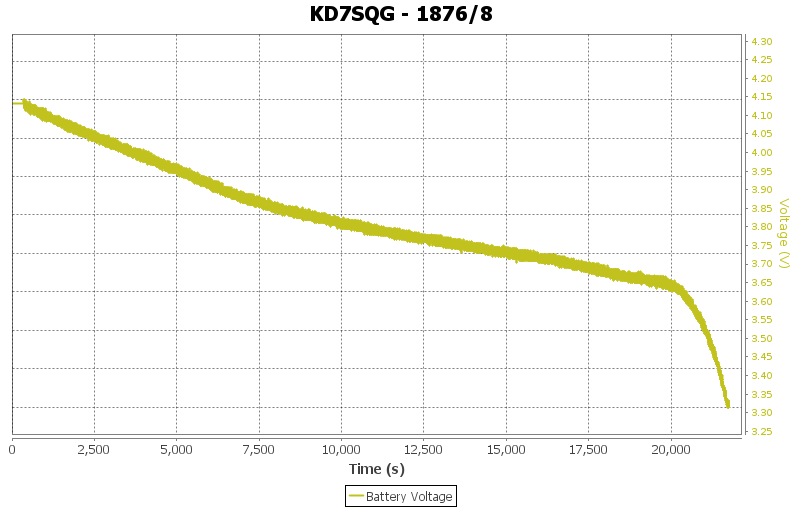
TeleGPS Battery Life I charged up one of the 160mAh batteries that we sell. (The ones we ve got now are labeled 200mAh; the 160mAh rating is something like a minimum that we expect to be able to ever get at that size.) I connected the battery to a TeleGPS board, hooked up a telemetry monitoring setup on my laptop and set the device in the window of my office. This let me watch the battery voltage through the day without interrupting my other work. Of course, because the telemetry was logged to a file, I ve now got a complete plot of the voltage data: It looks like a pretty typical lithium polymer discharge graph; slightly faster drop from the 4.1V full charge voltage down to about 3.9V, then a gradual drop to 3.65 at which point it starts to dive as the battery is nearly discharged. Because we run the electronics at 3.3V, and the LDO has a dropout of about 100mV, it s best if the battery stays above 3.4V. That occurred at around 21500 seconds of run time, or almost exactly six hours. We also have an 850mAh battery in the shop; I d expect that to last a bit more than four times as long, or about a day. Maybe I ll get bored enough at some point to hook one up and verify that guess.
24 May 2014

John Goerzen: End of a year

AAAAHHH! LOOK OUT! A SHARK! Such were the cries a few first graders raised Monday. Laura and I had gone to school to eat lunch with Jacob this was his last week of first grade. We stayed for recess after lunch, and Jacob and his friend told us to pretend to be a shark lurking underneath the bridges and things of the playground. I was told that adults are too old to climb up here. So Laura and I started chasing Jacob and his friend around the playground equipment. And, much to their delight, they were usually able to evade us. And, to their even greater delight, sometimes I could reach up and brush a shoe or leg. Pretty soon Laura had enough of the game, but about then other kids started to notice what was going on. Shark-taunting began ( nana-booboo! ), and pretty soon half a dozen first-graders were running away from the shark! Eventually, it was time to go in, and it had been a great time. Jacob had been proud to have Laura and me there to eat lunch with him. He got to be the first in his class to go to lunch, happily slipping into the tour guide role he loves. Sometimes he would tell us in exacting detail what would happen. Other times, I d ask something like how will we know when lunch is over, and he d get a sly smile and say, You will see! The next day was Jacob s last at school, and Oliver had also recently finished preschool. So Laura and I planned a graduation party . We came up with some ideas of things they might like to do, and let them choose. Thankfully they both agreed on a choice: water slide. My parents gave them water slides one time, and we got one out, hooked it up to the hose, and let them have fun. And boy, did they ever! IMG_3222 And after the better part of an hour running with delight on the water slide, they decided to turn another slide into a water slide. So I helped them rig up a hose on our slide, and they d slide down it, and splash into a giant mud puddle at the bottom. Or, as the case may be, just stand in the mud, enjoying it. IMG_3275 We then went out to eat at one of their favorite restaurants and even had time to play in a park. Yes, a wonderful celebration. All four of us were wearing smiles that day. It reminded me of Jacob s school year, but also of the past year it was about a year ago that Jacob and Oliver first had the chance to really meet Laura. I have many photos and stories from the past year that I ll be sharing in the next little while. What an incredible year it has been!

30 April 2014

Russell Coker: Links April 2014

Yves Rossy is the Jetman, he flys with a wing and four jet engines strapped to his body, he gave an interesting TED talk about flying along with some exciting videos [1]. Larry Brilliant gave an informative and inspiring TED talk about stopping pandemics [2]. I thought that Smallpox was the last disease to be eradicated but I was wrong. Michael Shermer gave an interesting TED talk about pattern recognition and self deception [3]. It s a pity that the kissing prank shown at the end only pranked women, they should be less sexist and prank men too. Raffaello D Andrea gave an interesting TED presentation about Athletic quadcopters [4]. It s very impressive and has the potential for several new human/machine sports. Lisa D wrote an insightful article about Prejudice Spillover discussing the way that people who aren t in minority groups only seem to care about injustice when a member of the majority is targetted by mistake [5]. Ron Garret wrote an insightful post about the Divine Right of Billionaires which debunks some stupid arguments by a billionaire [6]. Ron says that it s often instructive to examine incorrect arguments, especially when those arguments are advanced by smart people and demonstrates it in this post. Lisa D wrote an interesting post about her problems with financial aid bureaucracy [7]. She intended the post to be a personal one about her situation, but I think it illustrates problems with the various aid programs. If aid was available to her with less bureaucracy then she would be doing paid work, completing her studies, and heading towards post-graduate studies. Mark Shuttleworth wrote an insightful article about ACPI, security, and device tree [8]. It s the first time I ve seen a good argument for device tree. TED presented an interesting video-conference interview with Edward Snowden [9]. It s unusually long by TED standards but definitely worth watching. Tom Meagher (who s wife was raped and murdered two years ago) wrote an insightful article about rape culture [10]. Key Lay (the Victorian Chief Commissioner of Police) wrote a good article encouraging men to act to stop violence against women [11]. It s particularly noteworthy when a senior police officer speaks out about this given the difficulties women have had in reporting such crimes to police. Emily Baker wrote an insightful article about the lack of support for soldiers who survive war [12]. A lot of attention and money is spent remembering the soldiers who died in the field but little on those who live suffer afterwards, more soldiers die from suicide than enemy fire. Daniel Pocock wrote an informative article about the failings of SMS authentication for online banking [13]. While he has good points I think he s a little extreme. Stopping the least competent attackers is still a significant benefit as most potential attackers aren t that competent. Jess Zimmerman wrote an interesting article for Time about the Not All Men argument that is a current trend in derailing discussions about the treatment of women [14]. The Belle Jar has an insightful article Why Won t You Educate Me About Feminism about some ways that men pretend to care about the treatment of women [15]. Jon Evans wrote an article for Tech Crunch about the Honywell Bubble Count measure of diversity in people you follow on social media [16]. Currently on Twitter I follow 57 accounts of which 15 are companies and organisations, so I follow 42 people. I follow 13 women 31%, for a visible minority group other than my own it s 2/42 or 5%, for people who live in other countries I think it s 8/42 (although it s difficult to determine where some people live) which is 19%. So my Honywell number is 55. The Top Stocks forum has an interesting post by a Coal Seam Gas (CSG) worker [17]. It seems that CSG is even worse than I thought. Ashe Dryden wrote an informative post for Model View Culture about the backlash that members of minority groups (primarily women) receive when they speak out [18].

22 April 2014

Steve McIntyre: Linaro welcomes GSOC 2014 students

After several weeks of review and discussion, the application and selection period for the 2014 Google Summer of Code is over. 4,420 students proposed a total of 6,313 projects for this summer. From those, 1,307 students have been accepted (more details), and Linaro is one of the 190 Open Source projects that will be working with students this year. In our first year as a GSOC mentoring organisation, we received 17 applications and Google allocated us 3 slots for student projects. It was quite a challenge to pick just 3 projects from the excellent field, and it's a shame that the limited number of slots meant we had no choice but to disappoint some people. Thanks to all those who applied! I'm delighted to announce our 3 chosen interns for 2014: Please join me in welcoming these three new engineers to the Linaro team! We have a GSOC wiki ready for our students to use at https://gsoc.linaro.org/ and hopefully they will start adding content there soon about themselves and their projects (hint!). In the meantime, we have more information about our original proposals and the GSOC program in the main Linaro wiki. Starting today, the next phase of the program is the so-called "bonding period". Students are encouraged to get to know people within Linaro (especially their mentors!) and prepare to start work on their projects, whatever is needed. The official start of the work period for GSOC is May 19th, and it runs through to August 18th. We will give updates on progress through the summer, and we're hoping to talk about our results at the next Linaro Connect in September. Good luck, folks!

19 April 2014

Thomas Goirand: OpenStack 2014.1, aka Icehouse, is out

The new version of OpenStack is out, and I have just finished uploading it all into Debian Sid. With a total of 38 packages that I uploaded yesterday (which was exhausting!), most, if not all, were only moving from Experimental to Sid with only tiny updates, and this represents the achievement of 6 months of packaging work. The new feature list is impressive, and I would like to highlight some part of it: For the moment, I haven t packaged Sahara (eg: Hadoop as a service), but it might come later as a customer of us might require it. There s a lot less unit tests issues in the packages I uploaded to Sid: all SQLAlchemy issues have been dealt with. I wasn t confident with the Havana release that Sid / Testing would be a good environment for OpenStack, but this time with Icehouse, I think it should be much better. Please test this brand new release and report issues on the BTS. As always, the packages are available also as Wheezy backports through the usual channels (see the official install guide).

1 March 2014

Michael Prokop: Jenkins on-demand slave selection through labels

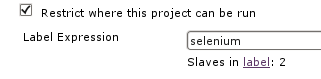
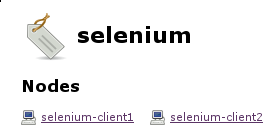
Problem description: One of my customers had a problem with their Selenium tests in the Jenkins continuous integration system. While Perl s Test::WebDriver still worked just fine the Selenium tests using Ruby s selenium-webdriver suddenly reported failures. The problem was caused by Debian wheezy s upgrade of the Iceweasel web browser. Debian originally shipped Iceweasel version 17.0.10esr-1~deb7u1 in wheezy, but during a security-update version 24.3.0esr-1~deb7u1 was brought in through the wheezy-security channel. Because the selenium tests are used in an automated fashion in a quite large and long-running build pipeline we immediately rolled back to Iceweasel version 17.0.10esr-1~deb7u1 so everything can continue as expected. Of course we wanted to get the new Iceweasel version up and running, but we didn t want to break the existing workflow while working on it. This is where on-demand slave selection through labels comes in. Basics: As soon as you re using Jenkins slaves you can instruct Jenkins to run a specific project on a particular (slave) node. By attaching labels to your slaves you can also use a label instead of a specific node name, providing more flexibility and scalability (to e.g. avoid problems if a specific node is down or you want to scale to more systems). Then Jenkins decides which of the nodes providing the according label should be considered for job execution. In the following screenshot a job uses the selenium label to restrict its execution to the slaves providing selenium and currently there are two nodes available providing this label: TIP 1: Visiting $JENKINS_SERVER/label/$label/ provides a list of slaves that provide that given $label (as well as list of projects that use $label in their configuration), like:
TIP 2: Execute the following script on $JENKINS_SERVER/script to get a list of available labels of your Jenkins system:
import hudson.model.*
labels = Hudson.instance.getLabels()
labels.each  label -> println label.name  
Solution: In the according customer setup we re using the swarm plugin (with automated Debian deployment through Grml s netscript boot option, grml-debootstrap + Puppet) to automatically connect our Jenkins slaves to Jenkins master without any manual intervention. The swarm plugin allows you to define the labels through the -labels command line option. By using the NodeLabel Parameter plugin we can configure additional parameters in Jenkins jobs: node and label . The label parameter allows us to execute the jobs on the nodes providing the requested label: This is what we can use to gradually upgrade from the old Iceweasel version to the new one by keeping a given set of slaves at the old Iceweasel version while we re upgrading other nodes to the new Iceweasel version (same for the selenium-server version which we want to also control). We can include the version number of the Iceweasel and selenium-server packages inside the labels we announce through the swarm slaves, with something like:
if [ -r /etc/init.d/selenium-server ] ; then
  FLAGS="selenium"
  ICEWEASEL_VERSION="$(dpkg-query --show --showformat='$ Version ' iceweasel)"
  if [ -n "$ICEWEASEL_VERSION" ] ; then
    ICEWEASEL_FLAG="iceweasel-$ ICEWEASEL_VERSION%%.* "
    EXTRA_FLAGS="$EXTRA_FLAGS $ICEWEASEL_FLAG"
  fi
  SELENIUM_VERSION="$(dpkg-query --show --showformat='$ Version ' selenium-server)"
  if [ -n "$SELENIUM_VERSION" ] ; then
    SELENIUM_FLAG="selenium-$ SELENIUM_VERSION%-* "
    EXTRA_FLAGS="$EXTRA_FLAGS $SELENIUM_FLAG"
  fi
fi
Then by using -labels $FLAGS EXTRA_FLAGS in the swarm invocation script we end up with labels like selenium iceweasel-24 selenium-2.40.0 for the slaves providing the Iceweasel v24 and selenium v2.40.0 Debian packages and selenium iceweasel-17 selenium-2.40.0 for the slaves providing Iceweasel v17 and selenium v2.40.0. This is perfect for our needs, because instead of using the selenium label (which is still there) we can configure the selenium jobs that should continue to work as usual to default to the slaves with the iceweasel-17 label now. The development related jobs though can use label iceweasel-24 and fail as often as needed without interrupting the build pipeline used for production. To illustrate this here we have slave selenium-client2 providing Iceweasel v17 with selenium-server v2.40. When triggering the production selenium job it will get executed on selenium-client2, because that s the slave providing the requested labels: Whereas the development selenium job can point to the slaves providing Iceweasel v24, so it will be executed on slave selenium-client1 here: This setup allowed us to work on the selenium Ruby tests while not conflicting with any production build pipeline. By the time I m writing about this setup we ve already finished the migration to support Iceweasel v24 and the infrastructure is ready for further Iceweasel and selenium-server upgrades.

23 February 2014

Vincent Cheng: Hello, Planet Debian! (also, RFH: sponsorship-requests)

Hi Debian! Just to briefly introduce myself, I'm Vincent (vcheng@d.o, vincent_c on OFTC/Freenode) and I'm a recent graduate of the NM process, having attained DD-ship (is that even a word?) about a month ago in January. Before that, I was a DM since mid-2012, and just another contributor for a few years prior to that. Most of my contributions to the Project are related to packaging, especially packages maintained within the Debian Games Team. Outside of Debian, well, I'm just another 20-year-old, 3rd-year undergrad student studying at the University of British Columbia, working towards a major in computer science. I anticipate that I'll be able to ditch academia for good in 2016; just 2 more years to go... More about my life story in my AM's report. It's fairly boring, if I say so myself. This blog post isn't just about me; I'd like to touch upon another topic that I consider important, i.e. attracting new contributors, and in many cases that involves package sponsorship. That's one of the many things I'd like to work on as a DD, and to that effect I've dedicated a large chunk of the time I currently spend on Debian sponsoring various packages, including packages that I'm not familiar with. I would love to see the sponsorship-requests queue empty one day, but I admit that I find that increasingly unlikely to happen, now that I've gotten a taste of the time commitment involved with sponsoring. Team maintenance and sponsorship seems to work relatively well in Debian; why does that success not translate over to sponsorship-requests / debian-mentors@l.d.o, where a considerable amount of RFS requests don't see any response at all, and merely get closed once those packages get removed from mentors.debian.net (AFAIK they automatically get removed after 20 weeks)? Well, I'm not here to offer an answer for that, but I will point out that there was a relevant thread that originated on debian-devel a month ago: <87ha8lzl7n.fsf@inf-8660.int-evry.fr> (and no, I'm not talking about the giant init-related threads that pop up on debian-devel every other week or so and drown out everything else on the list...). Are DDs in general reluctant to engage in "fly-by sponsoring"? Most packages coming through the sponsorship-requests queue are not team-maintained, and are sent from sponsorees who are not already in contact with a sponsor, and who have no other way of getting in touch with a potential sponsor (assuming that there isn't an existing team or a DD who happens to be interested in that package). Regardless of the merits of fly-by sponsoring (many arguments in favour of, and against, this type of sponsorship have already been discussed in that thread; no need to re-iterate them here), it's discouraging for potential contributors new to Debian, who may just give up and move on to something else. I've now had the opportunity to be a sponsor (rather than just a sponsoree), and I acknowledge that being a sponsor is more work than I imagined it to be a month ago, and it can be quite tedious and not-fun at times. I suppose I can draw a parallel between sponsoring packages and RC bug fixing; neither is what I'd consider to be a highly enjoyable way of spending my leisure time, and both can eat up a large chunk of time and effort; both often involve working on something that you aren't familiar with. But both are beneficial to Debian. No, beneficial isn't a strong enough word; how about "essential" instead? Yeah, that makes more sense. Without dedicated RC bug squashers, Debian would never be able to make a release; without dedicated sponsors, the size of Debian's archive would be smaller and of lesser quality, and its community also a lot smaller. With all that said...I hope this blog post inspires at least a few DDs, possibly more, to dedicate a little bit more of their time towards sponsoring packages. :)

11 February 2014

Andrew Pollock: [life] Day 14, Kindergarten and a make up swim class

Zoe woke up pretty early today, at around 5:30am. I also officially became a Xoogler at some point overnight. I used this transition as the opportunity to move from my Nexus 4 to my Nexus 5, so I could have a clean start on a phone that had never had work credentials on it. I started that process before breakfast, and mostly had a usable phone by the time we biked to Kindergarten. Zoe was a bit more like her usual clingy self at drop off today, so I spent a bit longer getting her settled. I got home and pretty much spent the rest of the day sorting out my phone. I can say many good things about Android, but seamless device migration isn't one of them. I'll probably factory reset my Nexus 4 tomorrow. I biked back to Kindergarten to pick up Zoe, and sure enough, she was fast asleep again. It turned out that she'd gone down about 30 minutes later today, so she was deeply asleep, and didn't take too kindly to being woken up. She was very sad, and it took forever just to leave the Kindergarten. We were well and truly the last ones out. Then she saw Megan having a trial tennis lesson at the tennis courts on the way to the bike, and wanted to do that too, and we burned some more time, while I tried to talk her out of that. Zoe had a make up swim class today to cover the one she'd missed on Saturday when she went down to Canberra with Sarah. That was at 3:15pm. We were a tad late for it. Weekday swim classes are much quieter than the weekend ones, so I used the opportunity to talk to one of the swim school staff about progressing Zoe to the next level. They conducted an assessment on the spot, and graduated her! She's moving from "Platypus" to "Octopus", starting next week. The class time options were pretty crappy though, something like 11:45am on Saturday, or a late afternoon weekday. We've opted for a weekday class after Kindergarten for the rest of this quarter and will try and get an earlier Saturday class next quarter. There's a reasonable gap between the end of Kindergarten and the start of swim class, so I'll have to figure out how best to use that time. I might make our library visit in between, even though it means a bit of back and forth. The upside is Saturday mornings are now wide open. We had a celebratory ice cream when we got home from swim class, and went out for a babyccino after dinner. I think it's important to celebrate achievements. I managed to get Zoe to bed slightly early tonight in light of her reduced nap time, but she just woke up briefly at 10:30pm. She seems to be particularly sensitive to mosquitoes, and has a bite on her forehead, right at the hairline, and it was giving her some grief. I gave her some antihistamine and she's gone back to bed fairly easily. Fingers crossed she sleeps okay for the rest of the night.

10 February 2014

Matthew Garrett: IBM's remote firmware configuration protocol

I spent last week looking into the firmware configuration protocol used on current IBM system X servers. IBM provide a tool called ASU for configuring firmware settings, either in-band (ie, running on the machine you want to reconfigure) or out of band (ie, running on a remote computer and communicating with the baseboard management controller - IMM in IBM-speak). I'm not a fan of using vendor binaries for this kind of thing. They tend to be large (ASU is a 20MB executable) and difficult to script, so I'm gradually reimplementing them in Python. Doing that was fairly straightforward for Dell and Cisco, both of whom document their configuration protocol. IBM, on the other hand, don't. My first plan was to just look at the wire protocol, but it turns out that it's using IPMI 2.0 to communicate and that means that the traffic is encrypted. So, obviously, time to spend a while in gdb.

The most important lesson I learned last time I did this was "Check whether the vendor tool has a debug option". ASU didn't mention one in its help text and there was no sign of a getopt string, so this took a little longer - but nm helpfully showed a function called DebugLog and setting a breakpoint on that in gdb showed it being called a bunch of the time, so woo. Stepping through the function revealed that it was checking the value of a variable, and looking for other references to that variable in objdump revealed a -l argument. Setting that to 255 gave me rather a lot of output. Nearby was a reference to --showsptraffic, and passing that as well gave me output like:

BMC Sent: 2e 90 4d 4f 00 06 63 6f 6e 66 69 67 2e 65 66 69
BMC Recv: 00 4d 4f 00 21 9e 00 00

which was extremely promising. 2e is IPMI-speak for an OEM specific command, which seemed pretty plausible. 4d 4f 00 is 20301 in decimal, which is the IANA enterprise number for IBM's system X division (this is required by the IPMI spec, it wasn't an inspired piece of deduction on my behalf). 63 6f 6e 66 69 67 2e 65 66 69 is ASCII for config.xml. That left 90 and 06 to figure out. 90 appeared in all of the traces, so it appears to be the command to indicate that the remaining data is destined for the IMM. The prior debug output indicated that we were in the QuerySize function, so 06 presumably means query the size. And this is supported by the response - 00 (a status code), 4d 4f 00 (the IANA enterprise number again, to indicate that the responding device is speaking the same protocol as you) and 21 9e 00 00 - or, in rational endianness, 40481, an entirely plausible size.

Once I'd got that far the rest started falling into place fairly quickly. 01 rather than 06 indicated a file open request, returning a four byte file handle of some description. 02 was read, 03 was write and 05 was close. Hacking this together with pyghmi meant I could open a file and read it. Success!

Well, kind of. I was getting back a large blob of binary. The debug trace showed calls to an EfiDecompress function, so on a whim I tried just decompressing it using the standard UEFI compression format. Shockingly, it worked and now I had a 345K XML blob and presumably many more problems than I'd previously had. Parsing the XML was fairly straightforward, and now I could retrieve the full set of config options, along with the default, current and possible values for them.

Making changes was pretty much just the reverse of this. A small XML blob containing the new values is compressed and written to asu_update.efi. One of the elements is a random identifier, which will then appear in another file called config_log along with a status. Just keep re-reading this until the value changes to CM_DONE and we're good.

The in-band configuration appears to be identical, but rather than sending commands over the wire they're send through the system's IPMI controller directly. Yes, this does mean that it's sending compressed XML through a single io port. Yes, I'd rather be drinking.

I've documented the protocol here and hope to be able to release this code before too long - right now I'm trying to nail down the interface a little, but it's broadly working.

comment count unavailable comments

5 February 2014

Daniel Pocock: Debian SIP without reading the manual

Most people don't have time to read manuals. The Debian SIP service has a reasonably thorough user guide with screenshots but some people may just want to have this level of detail if they really have to troubleshoot a problem. WebRTC is the fastest way to start Just set up your db.debian.org RTC password and use it to log in to the https://rtc.debian.org site. It all runs in the browser, no plugin or configuration required. Firewall/NAT trouble The current range of WebRTC browsers seem to work well for consumer and small office networks with NAT routers or mobile/cell networks. Corporate networks with an outright block on UDP will be supported soon. Supported browsers The Chromium 31 package on wheezy appears to work fine and was used in some of the demos at DebConf13 For Iceweasel/Firefox users, it is not possible to use the version 17 package from wheezy at all. At the time of writing, Iceweasel 24 is in jessie and sid while version 27 is available upstream. Mozilla gradually introduced WebRTC support on both desktop and Android between versions 20 to 24 and it is still evolving. If you don't want to use Chromium and don't want to upgrade your desktop/laptop beyond wheezy, consider trying Firefox on an Android device. Your friends can call you too There is no excuse for them to pester you with proprietary solutions any more. They can dial your debian.org SIP address from https://freephonebox.net. You can even link to it from your web site or blog by adding the dial parameter to the URL, like https://freephonebox.net?dial=pocock%40debian.org Please complain Bug reports and questions are always welcome. A good place for questions or complaints where the cause of the bug is not obvious is the Free-RTC mailing list.

22 January 2014

Gunnar Wolf: Finally: A student once again

Formally, today is my first day as a student on a formal, scholarized institution Basically for the first time in almost twenty years! Yes, those that know me know that I aspire to live the life of academia. I have worked at public universities for almost all of my adult life (between 1997 and 1999 I worked at a local ISP and at a private school), and have had a minor academic position ( T cnico Acad mico ) for almost ten years. And not having a proper degree limited me from pursuing anything further. Then, in early 2010 I presented the written exam. By late 2010, the corresponding oral exam. That allowed me to get my formal diploma in December 2010. By the end of 2011, I requested to be a teacher in the Engineering Faculty of UNAM, and started teaching Operating Systems a year ago, in January 2012. So, a good advance in the last few years... But I know that if I just sit here, I won't be able to advance my position towards really entering the Sacred Halls of Academia. And there are some rituals I have to comply with. One of those rituals is... Devoting some long time to studying under the formal structures. Ok, so I'm finally a postgraduate student I have enrolled in Especialidad en Seguridad Inform tica y Tecnolog as de la Informaci n, a short (one year) postgraduate program in ESIME Culhuac n, of Instituto Polit cnico Nacional (a small campus of Mexico's second-largest university). Some friends have asked me, why am I starting with a Specialization and not a Masters degree. Some simple reasons: Just as when I went to Tijuana in 2010 to do my written exam, once I got and started with the paperwork, I didn't want to let it go If I postpone it, I will probably lose the push to do it by May-July, when the Masters admission process starts. Also, this specialization can be linked with the masters degree on the same topic given at the same campus. This program is one year long, and the masters two But having them both takes 2.5 years. So, not such a bad deal after all. And finally, because, after such a long time without being scholarized, I fear not having an easy time getting to grips with the discipline. I can commit to overworking myself for a year If it's too much for me, I'll just stay with that degree and give up. I expect to like it and continue... But it's also a safe bet :-) Now, there has to be a downside to picking up this path: Of course, my free time will be harshly reduced. I have reduced my Debian involvement in the last year, as I devoted a huge chunk of my time to teaching and book-writing... This year... We shall see what happens. I can for now only confirm what I have said publicly but inside our team only: I have requested to my peers and to our DPL to step down as a DebConf chair. I love organizing DebConf, but I don't want to be formally committed to a position I just cannot fulfill as I did when I started with it. As for package maintenance, by far most of my packges are team maintained, and those that are not are relatively easy to keep track of. And of course, I'll keep an eye on my keyring-maint duties as well Will even try to link that work with what I do at school! Anyway, lets see what comes now!

30 November 2013

Gunnar Wolf: On errors in exams - Short rant

Blogging from a phone... first time ever. I don't want to forget some specifics for this :) I have just completed an exam to try to enter a postgraduate program (I'll talk more about it once it becomes real ). The exam is administered by CENEVAL, the same evaluation agency Where I presented my graduation equivalency exam some years ago - Only this exam is for all of the postgraduate studies on many national universities and is thus basically just a psychometric test. The exam had 162 questions, all to be filled in a optical reader sheet, on five subjects: mathematical reasoning, Spanish grammar and comprehension, Project management, Computers and technology, And English reading and understanding. It was all in all a fun exam to take, mostly due to the math reasoning part. But... on the Subject I Know I am an expert, I have to complain (and intend to find a easy to do so formally). First, I spotted two absolute mistakes (and answered based on What I knew others would, but knowing the answer is wrong technically). One was a subtlety, on how and why have hard drives should be defragmented (and part of my quip is that it's an obsolete habit, but besides, the answers were all erroneous), but a second one was... just wrong. It asked on what should not be part of an "Internet link" (can only guess they meant An URL). The 4 options were valid parts of a URL - including one very seldom used by most people, but very often by many of us: the @ sign. Anyway, answered it, but my other main gripe is that most of the section was in specific use of Office software. Not only In Office-like, which would be bad enough to begin with, but on specific ways of using Mainly Excel And PowerPoint. Syntax issues, or the name of the menu under which to look for specific functions.
Anyway, I will wait the stipulated 10 days for the exam to be rated, but will anyway look die a way to contact the very opaque and secretive CENEVAL. Not to demand to be better treated, but to try to correct those known mistakes and errors.

29 November 2013

Steve Kemp: A difficult day

Today was my last day working at Bytemark, and I found it a lot harder than expected. For better or worse I finished earlier than expected; having been gradually removing my accounts and privileges over the past few weeks I'd revoked my OpenVPN key this morning. Mid-afternoon my openvpn connection tried to renegotiate session keys, or similar, and failed. So I stopped work a few hours early. That meant I managed to avoid sending my "goodbye world" email, which is probably for the best - after all a lovely company, lovely people, and a good environment, what can you say besides things that are lovely? I think I largely wrapped things up neatly, and I'm pleased that one of my photos is hanging on the office wall. (I look forward to seeing that actually, I've only rarely made canvas prints.) The only other thing of note this week has been the sharp rise in blogspam I've detected. Black Friday alive and well, on the internets ..

11 November 2013

Daniel Pocock: Outreach Program for Women applications

The deadline for Outreach Program for Women applications is very imminent and a range of applications have now appeared on the OPW wiki It is great to see Debian has attracted a diverse range of women who all appear to have coding experience. Code samples have been submitted in Java, C++ and Python among other things and they come from a range of locations around the globe, including Brazil, the UK, Iran and India. Experience counts Looking through the records of some of these applications, it is interesting to see a range of experience and connections in industry and the wider open source family:
  • translator for O'Reilly
  • IBM internship
  • Linux module programming
  • Working alongside one of the Mercurial contributors in a previous role
Funding needed Recent emails from the OPW organisors and DPL have highlighted the need to raise more funding to ensure that Debian can offer OPW internships to the selected applicants. Solving the biggest problem of GSoC 2014 Many of these applicants are students and will be eligible for GSoC 2014. According to the Google FAQ, even students who graduate in 2014 are eligible as long as they are enrolled in a course on the cut-off date 21 April 2014 One of the biggest challenges facing GSoC mentors is the selection of students who are capable of completing good work and have a long term interest in open source. One of the best ways to overcome that challenge is to start forming relationships with potential GSoC students well in advance and get to know them as they make small contributions over an extended period of time. The interest that these candidates have expressed in Debian and OPW suggests that some of them may well be suitable for Debian to help them get onto this track for the next GSoC. Not only will this make the GSoC 2014 selection process easier but it may help us to select more GSoC candidates with a long term outlook. Women in science, engineering and the wider business world More news items have appeared recently about women in science and engineering and other leadership roles:

In the early 1950s, Morgan was the only female analyst among 900 rocket scientists at North American Aviation. She was also one of the few without a college degree.

"What I saw a thousand times during the downturn was, 'We'd like to give her that opportunity, but we need to go with the sure thing - we can't afford diversity right now,'" - Sallie Krawcheck, former chief executive at Merrill Lynch

Next.

Previous.