Search Results: "pm"

19 October 2025

Colin Watson: Mistaken dichotomies about dgit

In Could the XZ backdoor have been detected with better Git and Debian packaging practices? , Otto contrasts git-buildpackage managed git repositories with dgit managed repositories , saying that the dgit managed repositories cannot incorporate the upstream git history and are thus less useful for auditing the full software supply-chain in git . Otto does qualify this earlier with a package that has not had the history recorded in dgit earlier , but the last sentence of the section is a misleading oversimplification. It s true for repositories that have been synthesized by dgit (which indeed was the focus of that section of Otto s article), but it s not true in general for repositories that are managed by dgit. I suspect this was just slightly unclear writing, so I don t want to nitpick here, but rather to take the opportunity to try to clear up some misconceptions around dgit that I ve often heard at conferences and seen on mailing lists. I m not a dgit developer, although I m a happy user of it and I ve tried to help out in various design discussions over the years.
dgit and git-buildpackage sit at different layers It seems very common for people to think of git-buildpackage and dgit as alternatives, as the example I quoted at the start of this article suggests. It s really better to think of dgit as a separate and orthogonal layer. You can use dgit together with tools such as git-buildpackage. In that case, git-buildpackage handles the general shape of your git history, such as helping you to import new upstream versions, and dgit handles gatewaying between the archive and git. The advantages become evident when you start using tag2upload, in which case you can just use git debpush to push a tag and the tag2upload service deals with building the source package and uploading it to the archive for you. This is true regardless of how you put your package s git history together. (There s currently a wrinkle around pristine-tar support, so at the moment I personally tend to use dgit push-source for new upstream versions and git debpush for new Debian revisions, since I haven t yet convinced myself that I see no remaining value in pristine upstream tarballs.)
dgit supports complete history If the maintainer has never used dgit, and so dgit clone synthesizes a repository based on the current contents of the Debian archive, then there s indeed no useful history there; in that situation it doesn t go back and import everything from the snapshot archive the way that gbp import-dscs --debsnap does. However, if the maintainer uses dgit, then dgit s view will include more history, and it s absolutely possible for that to include complete upstream git history as well. Try this:
$ dgit clone man-db
canonical suite name for unstable is sid
fetching existing git history
last upload to archive: specified git info (debian)
downloading http://ftp.debian.org/debian//pool/main/m/man-db/man-db_2.13.1.orig.tar.xz...
  % Total    % Received % Xferd  Average Speed   Time    Time     Time  Current
                                 Dload  Upload   Total   Spent    Left  Speed
100 2060k  100 2060k    0     0  4643k      0 --:--:-- --:--:-- --:--:-- 4652k
downloading http://ftp.debian.org/debian//pool/main/m/man-db/man-db_2.13.1.orig.tar.xz.asc...
  % Total    % Received % Xferd  Average Speed   Time    Time     Time  Current
                                 Dload  Upload   Total   Spent    Left  Speed
100   833  100   833    0     0  16322      0 --:--:-- --:--:-- --:--:-- 16660
HEAD is now at 167835b0 releasing package man-db version 2.13.1-1
dgit ok: ready for work in man-db
$ git -C man-db log --graph --oneline   head
* 167835b0 releasing package man-db version 2.13.1-1
*   f7910493 New upstream release (2.13.1)
 \
  *   3073b72e Import man-db_2.13.1.orig.tar.xz
   \
    * 349ce503 Release man-db 2.13.1
    * 0d6635c1 Update Russian manual page translation
    * cbf87caf Update Italian translation
    * fb5c5017 Update German manual page translation
    * dae2057b Update Brazilian Portuguese manual page translation
That package uses git-dpm, since I prefer the way it represents patches. But it works fine with git-buildpackage too:
$ dgit clone isort
canonical suite name for unstable is sid
fetching existing git history
last upload to archive: specified git info (debian)
downloading http://ftp.debian.org/debian//pool/main/i/isort/isort_7.0.0.orig.tar.gz...
  % Total    % Received % Xferd  Average Speed   Time    Time     Time  Current
                                 Dload  Upload   Total   Spent    Left  Speed
100  786k  100  786k    0     0  1772k      0 --:--:-- --:--:-- --:--:-- 1774k
HEAD is now at f812aae releasing package isort version 7.0.0-1
dgit ok: ready for work in isort
$ git -C isort log --graph --oneline   head
* f812aae releasing package isort version 7.0.0-1
*   efde62f Update upstream source from tag 'upstream/7.0.0'
 \
  * 9694f3d New upstream version 7.0.0
*   9cbfe0b releasing package isort version 6.1.0-1
*   5423ffe Mark isort and python3-isort Multi-Arch: foreign
*   5eaf5bf Update upstream source from tag 'upstream/6.1.0'
 \ 
  * edafbfc New upstream version 6.1.0
*     aedfd25 Merge branch 'debian/master' into fix992793
If you look closely you ll see another difference here: the second only includes one commit representing the new upstream release, and doesn t have complete upstream history. This doesn t represent a difference between git-dpm and git-buildpackage. Both tools can operate in both ways: for example, git-dpm import-new-upstream --parent and gbp import-orig --upstream-vcs-tag do broadly similar things, and something like gbp import-dscs --debsnap --upstream-vcs-tag='%(version)s' can be used to do a bulk import provided that upstream s tags are named consistently enough. This is not generally the default because adding complete upstream history requires extra setup: the maintainer has to add an extra git remote pointing to upstream and select the correct tag when importing a new version, and some upstreams forget to push git tags or don t have the sort of consistency you might want. The Debian Python team s policy says that Complete upstream Git history should be avoided in the upstream branch , which is why the isort history above looks the way it does. I don t love this because I think the results are less useful, but I understand why it s there: in a moderately large team maintaining thousands of packages, getting everyone to have the right git remotes set up would be a recipe for frustrating inconsistency. However, in packages I maintain myself, I strongly value having complete upstream history in order to make it easier to debug problems, and I think it makes things a bit more transparent to auditors too, so I m willing to go to a little extra work to make that happen. Doing that is completely compatible with using dgit.

Otto Kek l inen: Could the XZ backdoor have been detected with better Git and Debian packaging practices?

Featured image of post Could the XZ backdoor have been detected with better Git and Debian packaging practices?The discovery of a backdoor in XZ Utils in the spring of 2024 shocked the open source community, raising critical questions about software supply chain security. This post explores whether better Debian packaging practices could have detected this threat, offering a guide to auditing packages and suggesting future improvements. The XZ backdoor in versions 5.6.0/5.6.1 made its way briefly into many major Linux distributions such as Debian and Fedora, but luckily didn t reach that many actual users, as the backdoored releases were quickly removed thanks to the heroic diligence of Andres Freund. We are all extremely lucky that he detected a half a second performance regression in SSH, cared enough to trace it down, discovered malicious code in the XZ library loaded by SSH, and reported promtly to various security teams for quick coordinated actions. This episode makes software engineers pondering the following questions: As a Debian Developer, I decided to audit the xz package in Debian, share my methodology and findings in this post, and also suggest some improvements on how the software supply-chain security could be tightened in Debian specifically. Note that the scope here is only to inspect how Debian imports software from its upstreams, and how they are distributed to Debian s users. This excludes the whole story of how to assess if an upstream project is following software development security best practices. This post doesn t discuss how to operate an individual computer running Debian to ensure it remains untampered as there are plenty of guides on that already.

Downloading Debian and upstream source packages Let s start by working backwards from what the Debian package repositories offer for download. As auditing binaries is extremely complicated, we skip that, and assume the Debian build hosts are trustworthy and reliably building binaries from the source packages, and the focus should be on auditing the source code packages. As with everything in Debian, there are multiple tools and ways to do the same thing, but in this post only one (and hopefully the best) way to do something is presented for brevity. The first step is to download the latest version and some past versions of the package from the Debian archive, which is easiest done with debsnap. The following command will download all Debian source packages of xz-utils from Debian release 5.2.4-1 onwards:
$ debsnap --verbose --first 5.2.4-1 xz-utils
Getting json https://snapshot.debian.org/mr/package/xz-utils/
...
Getting dsc file xz-utils_5.2.4-1.dsc: https://snapshot.debian.org/file/a98271e4291bed8df795ce04d9dc8e4ce959462d
Getting file xz-utils_5.2.4.orig.tar.xz.asc: https://snapshot.debian.org/file/59ccbfb2405abe510999afef4b374cad30c09275
Getting file xz-utils_5.2.4-1.debian.tar.xz: https://snapshot.debian.org/file/667c14fd9409ca54c397b07d2d70140d6297393f
source-xz-utils/xz-utils_5.2.4-1.dsc:
Good signature found
validating xz-utils_5.2.4.orig.tar.xz
validating xz-utils_5.2.4.orig.tar.xz.asc
validating xz-utils_5.2.4-1.debian.tar.xz
All files validated successfully.
Once debsnap completes there will be a subfolder source-<package name> with the following types of files:
  • *.orig.tar.xz: source code from upstream
  • *.orig.tar.xz.asc: detached signature (if upstream signs their releases)
  • *.debian.tar.xz: Debian packaging source, i.e. the debian/ subdirectory contents
  • *.dsc: Debian source control file, including signature by Debian Developer/Maintainer
Example:
$ ls -1 source-xz-utils/
...
xz-utils_5.6.4.orig.tar.xz
xz-utils_5.6.4.orig.tar.xz.asc
xz-utils_5.6.4-1.debian.tar.xz
xz-utils_5.6.4-1.dsc
xz-utils_5.8.0.orig.tar.xz
xz-utils_5.8.0.orig.tar.xz.asc
xz-utils_5.8.0-1.debian.tar.xz
xz-utils_5.8.0-1.dsc
xz-utils_5.8.1.orig.tar.xz
xz-utils_5.8.1.orig.tar.xz.asc
xz-utils_5.8.1-1.1.debian.tar.xz
xz-utils_5.8.1-1.1.dsc
xz-utils_5.8.1-1.debian.tar.xz
xz-utils_5.8.1-1.dsc
xz-utils_5.8.1-2.debian.tar.xz
xz-utils_5.8.1-2.dsc

Verifying authenticity of upstream and Debian sources using OpenPGP signatures As seen in the output of debsnap, it already automatically verifies that the downloaded files match the OpenPGP signatures. To have full clarity on what files were authenticated with what keys, we should verify the Debian packagers signature with:
$ gpg --verify --auto-key-retrieve --keyserver hkps://keyring.debian.org xz-utils_5.8.1-2.dsc
gpg: Signature made Fri Oct 3 22:04:44 2025 UTC
gpg: using RSA key 57892E705233051337F6FDD105641F175712FA5B
gpg: requesting key 05641F175712FA5B from hkps://keyring.debian.org
gpg: key 7B96E8162A8CF5D1: public key "Sebastian Andrzej Siewior" imported
gpg: Total number processed: 1
gpg: imported: 1
gpg: Good signature from "Sebastian Andrzej Siewior" [unknown]
gpg: aka "Sebastian Andrzej Siewior <bigeasy@linutronix.de>" [unknown]
gpg: aka "Sebastian Andrzej Siewior <sebastian@breakpoint.cc>" [unknown]
gpg: WARNING: This key is not certified with a trusted signature!
gpg: There is no indication that the signature belongs to the owner.
Primary key fingerprint: 6425 4695 FFF0 AA44 66CC 19E6 7B96 E816 2A8C F5D1
Subkey fingerprint: 5789 2E70 5233 0513 37F6 FDD1 0564 1F17 5712 FA5B
The upstream tarball signature (if available) can be verified with:
$ gpg --verify --auto-key-retrieve xz-utils_5.8.1.orig.tar.xz.asc
gpg: assuming signed data in 'xz-utils_5.8.1.orig.tar.xz'
gpg: Signature made Thu Apr 3 11:38:23 2025 UTC
gpg: using RSA key 3690C240CE51B4670D30AD1C38EE757D69184620
gpg: key 38EE757D69184620: public key "Lasse Collin <lasse.collin@tukaani.org>" imported
gpg: Total number processed: 1
gpg: imported: 1
gpg: Good signature from "Lasse Collin <lasse.collin@tukaani.org>" [unknown]
gpg: WARNING: This key is not certified with a trusted signature!
gpg: There is no indication that the signature belongs to the owner.
Primary key fingerprint: 3690 C240 CE51 B467 0D30 AD1C 38EE 757D 6918 4620
Note that this only proves that there is a key that created a valid signature for this content. The authenticity of the keys themselves need to be validated separately before trusting they in fact are the keys of these people. That can be done by checking e.g. the upstream website for what key fingerprints they published, or the Debian keyring for Debian Developers and Maintainers, or by relying on the OpenPGP web-of-trust .

Verifying authenticity of upstream sources by comparing checksums In case the upstream in question does not publish release signatures, the second best way to verify the authenticity of the sources used in Debian is to download the sources directly from upstream and compare that the sha256 checksums match. This should be done using the debian/watch file inside the Debian packaging, which defines where the upstream source is downloaded from. Continuing on the example situation above, we can unpack the latest Debian sources, enter and then run uscan to download:
$ tar xvf xz-utils_5.8.1-2.debian.tar.xz
...
debian/rules
debian/source/format
debian/source.lintian-overrides
debian/symbols
debian/tests/control
debian/tests/testsuite
debian/upstream/signing-key.asc
debian/watch
...
$ uscan --download-current-version --destdir /tmp
Newest version of xz-utils on remote site is 5.8.1, specified download version is 5.8.1
gpgv: Signature made Thu Apr 3 11:38:23 2025 UTC
gpgv: using RSA key 3690C240CE51B4670D30AD1C38EE757D69184620
gpgv: Good signature from "Lasse Collin <lasse.collin@tukaani.org>"
Successfully symlinked /tmp/xz-5.8.1.tar.xz to /tmp/xz-utils_5.8.1.orig.tar.xz.
The original files downloaded from upstream are now in /tmp along with the files renamed to follow Debian conventions. Using everything downloaded so far the sha256 checksums can be compared across the files and also to what the .dsc file advertised:
$ ls -1 /tmp/
xz-5.8.1.tar.xz
xz-5.8.1.tar.xz.sig
xz-utils_5.8.1.orig.tar.xz
xz-utils_5.8.1.orig.tar.xz.asc
$ sha256sum xz-utils_5.8.1.orig.tar.xz /tmp/xz-5.8.1.tar.xz
0b54f79df85912504de0b14aec7971e3f964491af1812d83447005807513cd9e xz-utils_5.8.1.orig.tar.xz
0b54f79df85912504de0b14aec7971e3f964491af1812d83447005807513cd9e /tmp/xz-5.8.1.tar.xz
$ grep -A 3 Sha256 xz-utils_5.8.1-2.dsc
Checksums-Sha256:
0b54f79df85912504de0b14aec7971e3f964491af1812d83447005807513cd9e 1461872 xz-utils_5.8.1.orig.tar.xz
4138f4ceca1aa7fd2085fb15a23f6d495d27bca6d3c49c429a8520ea622c27ae 833 xz-utils_5.8.1.orig.tar.xz.asc
3ed458da17e4023ec45b2c398480ed4fe6a7bfc1d108675ec837b5ca9a4b5ccb 24648 xz-utils_5.8.1-2.debian.tar.xz
In the example above the checksum 0b54f79df85... is the same across the files, so it is a match.

Repackaged upstream sources can t be verified as easily Note that uscan may in rare cases repackage some upstream sources, for example to exclude files that don t adhere to Debian s copyright and licensing requirements. Those files and paths would be listed under the Files-Excluded section in the debian/copyright file. There are also other situations where the file that represents the upstream sources in Debian isn t bit-by-bit the same as what upstream published. If checksums don t match, an experienced Debian Developer should review all package settings (e.g. debian/source/options) to see if there was a valid and intentional reason for divergence.

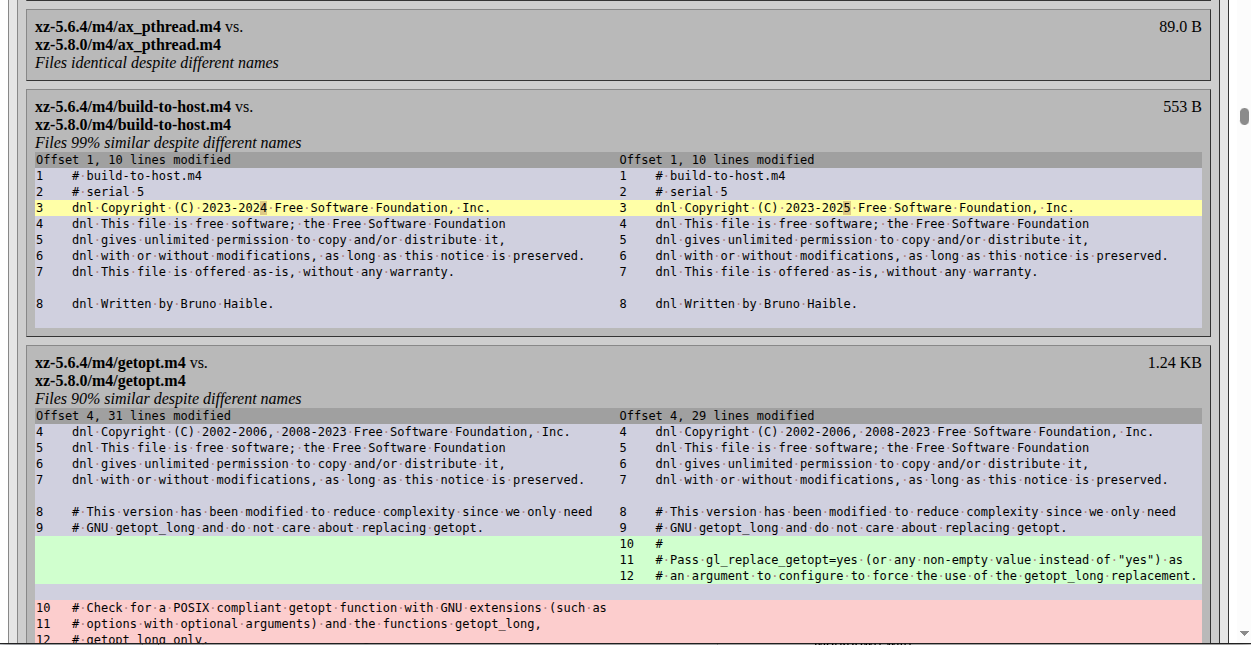
Reviewing changes between two source packages using diffoscope Diffoscope is an incredibly capable and handy tool to compare arbitrary files. For example, to view a report in HTML format of the differences between two XZ releases, run:
diffoscope --html-dir xz-utils-5.6.4_vs_5.8.0 xz-utils_5.6.4.orig.tar.xz xz-utils_5.8.0.orig.tar.xz
browse xz-utils-5.6.4_vs_5.8.0/index.html
Inspecting diffoscope output of differences between two XZ Utils releases If the changes are extensive, and you want to use a LLM to help spot potential security issues, generate the report of both the upstream and Debian packaging differences in Markdown with:
diffoscope --markdown diffoscope-debian.md xz-utils_5.6.4-1.debian.tar.xz xz-utils_5.8.1-2.debian.tar.xz
diffoscope --markdown diffoscope.md xz-utils_5.6.4.orig.tar.xz xz-utils_5.8.0.orig.tar.xz
The Markdown files created above can then be passed to your favorite LLM, along with a prompt such as:
Based on the attached diffoscope output for a new Debian package version compared with the previous one, list all suspicious changes that might have introduced a backdoor, followed by other potential security issues. If there are none, list a short summary of changes as the conclusion.

Reviewing Debian source packages in version control As of today only 93% of all Debian source packages are tracked in git on Debian s GitLab instance at salsa.debian.org. Some key packages such as Coreutils and Bash are not using version control at all, as their maintainers apparently don t see value in using git for Debian packaging, and the Debian Policy does not require it. Thus, the only reliable and consistent way to audit changes in Debian packages is to compare the full versions from the archive as shown above. However, for packages that are hosted on Salsa, one can view the git history to gain additional insight into what exactly changed, when and why. For packages that are using version control, their location can be found in the Git-Vcs header in the debian/control file. For xz-utils the location is salsa.debian.org/debian/xz-utils. Note that the Debian policy does not state anything about how Salsa should be used, or what git repository layout or development practices to follow. In practice most packages follow the DEP-14 proposal, and use git-buildpackage as the tool for managing changes and pushing and pulling them between upstream and salsa.debian.org. To get the XZ Utils source, run:
$ gbp clone https://salsa.debian.org/debian/xz-utils.git
gbp:info: Cloning from 'https://salsa.debian.org/debian/xz-utils.git'
At the time of writing this post the git history shows:
$ git log --graph --oneline
* bb787585 (HEAD -> debian/unstable, origin/debian/unstable, origin/HEAD) Prepare 5.8.1-2
* 4b769547 d: Remove the symlinks from -dev package.
* a39f3428 Correct the nocheck build profile
* 1b806b8d Import Debian changes 5.8.1-1.1
* b1cad34b Prepare 5.8.1-1
* a8646015 Import 5.8.1
* 2808ec2d Update upstream source from tag 'upstream/5.8.1'
 \
  * fa1e8796 (origin/upstream/v5.8, upstream/v5.8) New upstream version 5.8.1
  * a522a226 Bump version and soname for 5.8.1
  * 1c462c2a Add NEWS for 5.8.1
  * 513cabcf Tests: Call lzma_code() in smaller chunks in fuzz_common.h
  * 48440e24 Tests: Add a fuzzing target for the multithreaded .xz decoder
  * 0c80045a liblzma: mt dec: Fix lack of parallelization in single-shot decoding
  * 81880488 liblzma: mt dec: Don't modify thr->in_size in the worker thread
  * d5a2ffe4 liblzma: mt dec: Don't free the input buffer too early (CVE-2025-31115)
  * c0c83596 liblzma: mt dec: Simplify by removing the THR_STOP state
  * 831b55b9 liblzma: mt dec: Fix a comment
  * b9d168ee liblzma: Add assertions to lzma_bufcpy()
  * c8e0a489 DOS: Update Makefile to fix the build
  * 307c02ed sysdefs.h: Avoid <stdalign.h> even with C11 compilers
  * 7ce38b31 Update THANKS
  * 688e51bd Translations: Update the Croatian translation
*   a6b54dde Prepare 5.8.0-1.
*   77d9470f Add 5.8 symbols.
*   9268eb66 Import 5.8.0
*   6f85ef4f Update upstream source from tag 'upstream/5.8.0'
 \ \
  *   afba662b New upstream version 5.8.0
   /
  * 173fb5c6 doc/SHA256SUMS: Add 5.8.0
  * db9258e8 Bump version and soname for 5.8.0
  * bfb752a3 Add NEWS for 5.8.0
  * 6ccbb904 Translations: Run "make -C po update-po"
  * 891a5f05 Translations: Run po4a/update-po
  * 4f52e738 Translations: Partially fix overtranslation in Serbian man pages
  * ff5d9447 liblzma: Count the extra bytes in LZMA/LZMA2 decoder memory usage
  * 943b012d liblzma: Use SSE2 intrinsics instead of memcpy() in dict_repeat()
This shows both the changes on the debian/unstable branch as well as the intermediate upstream import branch, and the actual real upstream development branch. See my Debian source packages in git explainer for details of what these branches are used for. To only view changes on the Debian branch, run git log --graph --oneline --first-parent or git log --graph --oneline -- debian. The Debian branch should only have changes inside the debian/ subdirectory, which is easy to check with:
$ git diff --stat upstream/v5.8
debian/README.source   16 +++
debian/autogen.sh   32 +++++
debian/changelog   949 ++++++++++++++++++++++++++
...
debian/upstream/signing-key.asc   52 +++++++++
debian/watch   4 +
debian/xz-utils.README.Debian   47 ++++++++
debian/xz-utils.docs   6 +
debian/xz-utils.install   28 +++++
debian/xz-utils.postinst   19 +++
debian/xz-utils.prerm   10 ++
debian/xzdec.docs   6 +
debian/xzdec.install   4 +
33 files changed, 2014 insertions(+)
All the files outside the debian/ directory originate from upstream, and for example running git blame on them should show only upstream commits:
$ git blame CMakeLists.txt
22af94128 (Lasse Collin 2024-02-12 17:09:10 +0200 1) # SPDX-License-Identifier: 0BSD
22af94128 (Lasse Collin 2024-02-12 17:09:10 +0200 2)
7e3493d40 (Lasse Collin 2020-02-24 23:38:16 +0200 3) ###############
7e3493d40 (Lasse Collin 2020-02-24 23:38:16 +0200 4) #
426bdc709 (Lasse Collin 2024-02-17 21:45:07 +0200 5) # CMake support for building XZ Utils
If the upstream in question signs commits or tags, they can be verified with e.g.:
$ git verify-tag v5.6.2
gpg: Signature made Wed 29 May 2024 09:39:42 AM PDT
gpg: using RSA key 3690C240CE51B4670D30AD1C38EE757D69184620
gpg: issuer "lasse.collin@tukaani.org"
gpg: Good signature from "Lasse Collin <lasse.collin@tukaani.org>" [expired]
gpg: Note: This key has expired!
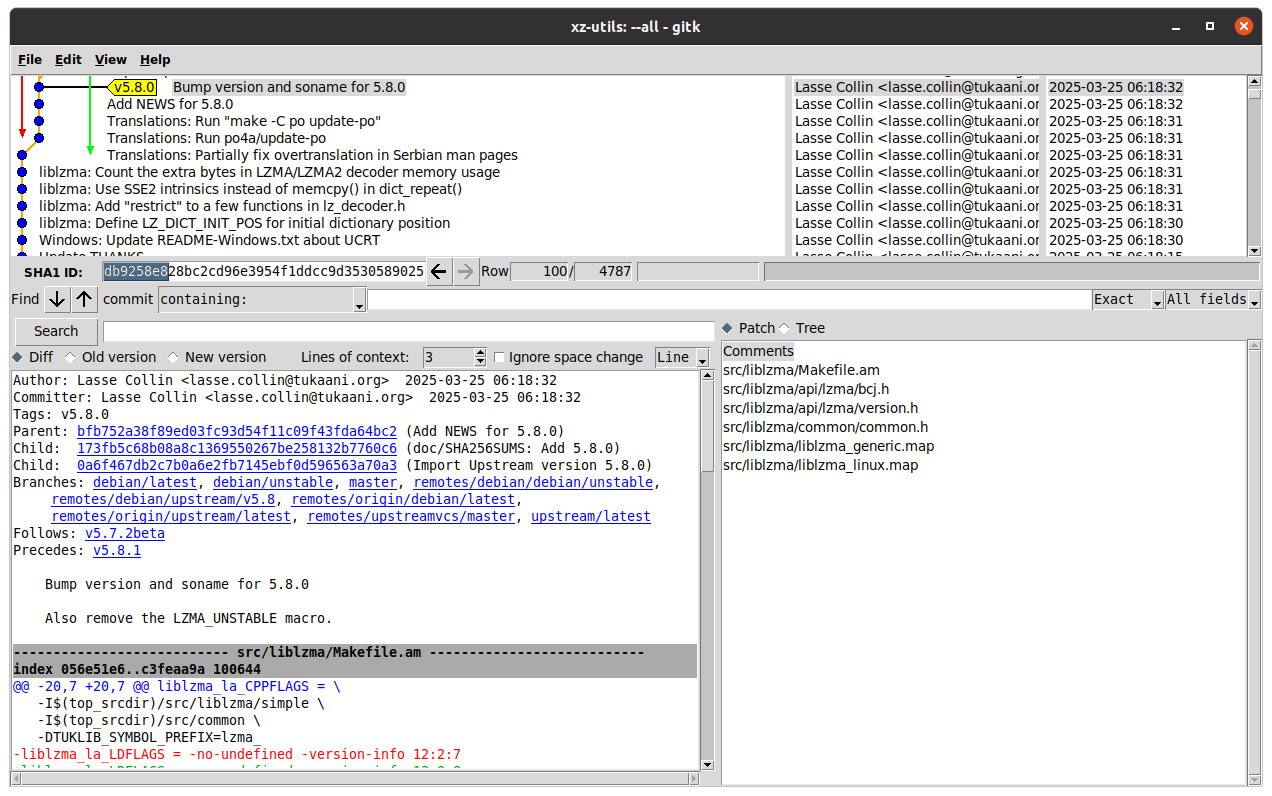
The main benefit of reviewing changes in git is the ability to see detailed information about each individual change, instead of just staring at a massive list of changes without any explanations. In this example, to view all the upstream commits since the previous import to Debian, one would view the commit range from afba662b New upstream version 5.8.0 to fa1e8796 New upstream version 5.8.1 with git log --reverse -p afba662b...fa1e8796. However, a far superior way to review changes would be to browse this range using a visual git history viewer, such as gitk. Either way, looking at one code change at a time and reading the git commit message makes the review much easier. Browsing git history in gitk --all

Comparing Debian source packages to git contents As stated in the beginning of the previous section, and worth repeating, there is no guarantee that the contents in the Debian packaging git repository matches what was actually uploaded to Debian. While the tag2upload project in Debian is getting more and more popular, Debian is still far from having any system to enforce that the git repository would be in sync with the Debian archive contents. To detect such differences we can run diff across the Debian source packages downloaded with debsnap earlier (path source-xz-utils/xz-utils_5.8.1-2.debian) and the git repository cloned in the previous section (path xz-utils):
diff
$ diff -u source-xz-utils/xz-utils_5.8.1-2.debian/ xz-utils/debian/
diff -u source-xz-utils/xz-utils_5.8.1-2.debian/changelog xz-utils/debian/changelog
--- debsnap/source-xz-utils/xz-utils_5.8.1-2.debian/changelog 2025-10-03 09:32:16.000000000 -0700
+++ xz-utils/debian/changelog 2025-10-12 12:18:04.623054758 -0700
@@ -5,7 +5,7 @@
 * Remove the symlinks from -dev, pointing to the lib package.
 (Closes: #1109354)

- -- Sebastian Andrzej Siewior <sebastian@breakpoint.cc> Fri, 03 Oct 2025 18:32:16 +0200
+ -- Sebastian Andrzej Siewior <sebastian@breakpoint.cc> Fri, 03 Oct 2025 18:36:59 +0200
In the case above diff revealed that the timestamp in the changelog in the version uploaded to Debian is different from what was committed to git. This is not malicious, just a mistake by the maintainer who probably didn t run gbp tag immediately after upload, but instead some dch command and ended up with having a different timestamps in the git compared to what was actually uploaded to Debian.

Creating syntetic Debian packaging git repositories If no Debian packaging git repository exists, or if it is lagging behind what was uploaded to Debian s archive, one can use git-buildpackage s import-dscs feature to create synthetic git commits based on the files downloaded by debsnap, ensuring the git contents fully matches what was uploaded to the archive. To import a single version there is gbp import-dsc (no s at the end), of which an example invocation would be:
$ gbp import-dsc --verbose ../source-xz-utils/xz-utils_5.8.1-2.dsc
Version '5.8.1-2' imported under '/home/otto/debian/xz-utils-2025-09-29'
Example commit history from a repository with commits added with gbp import-dsc:
$ git log --graph --oneline
* 86aed07b (HEAD -> debian/unstable, tag: debian/5.8.1-2, origin/debian/unstable) Import Debian changes 5.8.1-2
* f111d93b (tag: debian/5.8.1-1.1) Import Debian changes 5.8.1-1.1
* 1106e19b (tag: debian/5.8.1-1) Import Debian changes 5.8.1-1
 \
  * 08edbe38 (tag: upstream/5.8.1, origin/upstream/v5.8, upstream/v5.8) Import Upstream version 5.8.1
   \
    * a522a226 (tag: v5.8.1) Bump version and soname for 5.8.1
    * 1c462c2a Add NEWS for 5.8.1
    * 513cabcf Tests: Call lzma_code() in smaller chunks in fuzz_common.h
An online example repository with only a few missing uploads added using gbp import-dsc can be viewed at salsa.debian.org/otto/xz-utils-2025-09-29/-/network/debian%2Funstable An example repository that was fully crafted using gbp import-dscs can be viewed at salsa.debian.org/otto/xz-utils-gbp-import-dscs-debsnap-generated/-/network/debian%2Flatest. There exists also dgit, which in a similar way creates a synthetic git history to allow viewing the Debian archive contents via git tools. However, its focus is on producing new package versions, so fetching a package with dgit that has not had the history recorded in dgit earlier will only show the latest versions:
$ dgit clone xz-utils
canonical suite name for unstable is sid
starting new git history
last upload to archive: NO git hash
downloading http://ftp.debian.org/debian//pool/main/x/xz-utils/xz-utils_5.8.1.orig.tar.xz...
downloading http://ftp.debian.org/debian//pool/main/x/xz-utils/xz-utils_5.8.1.orig.tar.xz.asc...
downloading http://ftp.debian.org/debian//pool/main/x/xz-utils/xz-utils_5.8.1-2.debian.tar.xz...
dpkg-source: info: extracting xz-utils in unpacked
dpkg-source: info: unpacking xz-utils_5.8.1.orig.tar.xz
dpkg-source: info: unpacking xz-utils_5.8.1-2.debian.tar.xz
synthesised git commit from .dsc 5.8.1-2
HEAD is now at f9bcaf7 xz-utils (5.8.1-2) unstable; urgency=medium
dgit ok: ready for work in xz-utils
$ dgit/sid   git log --graph --oneline
* f9bcaf7 xz-utils (5.8.1-2) unstable; urgency=medium 9 days ago (HEAD -> dgit/sid, dgit/dgit/sid)
 \
  * 11d3a62 Import xz-utils_5.8.1-2.debian.tar.xz 9 days ago
* 15dcd95 Import xz-utils_5.8.1.orig.tar.xz 6 months ago
Unlike git-buildpackage managed git repositories, the dgit managed repositories cannot incorporate the upstream git history and are thus less useful for auditing the full software supply-chain in git.

Comparing upstream source packages to git contents Equally important to the note in the beginning of the previous section, one must also keep in mind that the upstream release source packages, often called release tarballs, are not guaranteed to have the exact same contents as the upstream git repository. Projects might strip out test data or extra development files from their release tarballs to avoid shipping unnecessary files to users, or projects might add documentation files or versioning information into the tarball that isn t stored in git. While a small minority, there are also upstreams that don t use git at all, so the plain files in a release tarball is still the lowest common denominator for all open source software projects, and exporting and importing source code needs to interface with it. In the case of XZ, the release tarball has additional version info and also a sizeable amount of pregenerated compiler configuration files. Detecting and comparing differences between git contents and tarballs can of course be done manually by running diff across an unpacked tarball and a checked out git repository. If using git-buildpackage, the difference between the git contents and tarball contents can be made visible directly in the import commit. In this XZ example, consider this git history:
* b1cad34b Prepare 5.8.1-1
* a8646015 Import 5.8.1
* 2808ec2d Update upstream source from tag 'upstream/5.8.1'
 \
  * fa1e8796 (debian/upstream/v5.8, upstream/v5.8) New upstream version 5.8.1
  * a522a226 (tag: v5.8.1) Bump version and soname for 5.8.1
  * 1c462c2a Add NEWS for 5.8.1
The commit a522a226 was the upstream release commit, which upstream also tagged v5.8.1. The merge commit 2808ec2d applied the new upstream import branch contents on the Debian branch. Between these is the special commit fa1e8796 New upstream version 5.8.1 tagged upstream/v5.8. This commit and tag exists only in the Debian packaging repository, and they show what is the contents imported into Debian. This is generated automatically by git-buildpackage when running git import-orig --uscan for Debian packages with the correct settings in debian/gbp.conf. By viewing this commit one can see exactly how the upstream release tarball differs from the upstream git contents (if at all). In the case of XZ, the difference is substantial, and shown below in full as it is very interesting:
$ git show --stat fa1e8796
commit fa1e8796dabd91a0f667b9e90f9841825225413a
(debian/upstream/v5.8, upstream/v5.8)
Author: Sebastian Andrzej Siewior <sebastian@breakpoint.cc>
Date: Thu Apr 3 22:58:39 2025 +0200
New upstream version 5.8.1
.codespellrc   30 -
.gitattributes   8 -
.github/workflows/ci.yml   163 -
.github/workflows/freebsd.yml   32 -
.github/workflows/netbsd.yml   32 -
.github/workflows/openbsd.yml   35 -
.github/workflows/solaris.yml   32 -
.github/workflows/windows-ci.yml   124 -
.gitignore   113 -
ABOUT-NLS   1 +
ChangeLog   17392 +++++++++++++++++++++
Makefile.in   1097 +++++++
aclocal.m4   1353 ++++++++
build-aux/ci_build.bash   286 --
build-aux/compile   351 ++
build-aux/config.guess   1815 ++++++++++
build-aux/config.rpath   751 +++++
build-aux/config.sub   2354 +++++++++++++
build-aux/depcomp   792 +++++
build-aux/install-sh   541 +++
build-aux/ltmain.sh   11524 ++++++++++++++++++++++
build-aux/missing   236 ++
build-aux/test-driver   160 +
config.h.in   634 ++++
configure   26434 ++++++++++++++++++++++
debug/Makefile.in   756 +++++
doc/SHA256SUMS   236 --
doc/man/txt/lzmainfo.txt   36 +
doc/man/txt/xz.txt   1708 ++++++++++
doc/man/txt/xzdec.txt   76 +
doc/man/txt/xzdiff.txt   39 +
doc/man/txt/xzgrep.txt   70 +
doc/man/txt/xzless.txt   36 +
doc/man/txt/xzmore.txt   31 +
lib/Makefile.in   623 ++++
m4/.gitignore   40 -
m4/build-to-host.m4   274 ++
m4/gettext.m4   392 +++
m4/host-cpu-c-abi.m4   529 +++
m4/iconv.m4   324 ++
m4/intlmacosx.m4   71 +
m4/lib-ld.m4   170 +
m4/lib-link.m4   815 +++++
m4/lib-prefix.m4   334 ++
m4/libtool.m4   8488 +++++++++++++++++++++
m4/ltoptions.m4   467 +++
m4/ltsugar.m4   124 +
m4/ltversion.m4   24 +
m4/lt~obsolete.m4   99 +
m4/nls.m4   33 +
m4/po.m4   456 +++
m4/progtest.m4   92 +
po/.gitignore   31 -
po/Makefile.in.in   517 +++
po/Rules-quot   66 +
po/boldquot.sed   21 +
po/ca.gmo   Bin 0 -> 15587 bytes
po/cs.gmo   Bin 0 -> 7983 bytes
po/da.gmo   Bin 0 -> 9040 bytes
po/de.gmo   Bin 0 -> 29882 bytes
po/en@boldquot.header   35 +
po/en@quot.header   32 +
po/eo.gmo   Bin 0 -> 15060 bytes
po/es.gmo   Bin 0 -> 29228 bytes
po/fi.gmo   Bin 0 -> 28225 bytes
po/fr.gmo   Bin 0 -> 10232 bytes
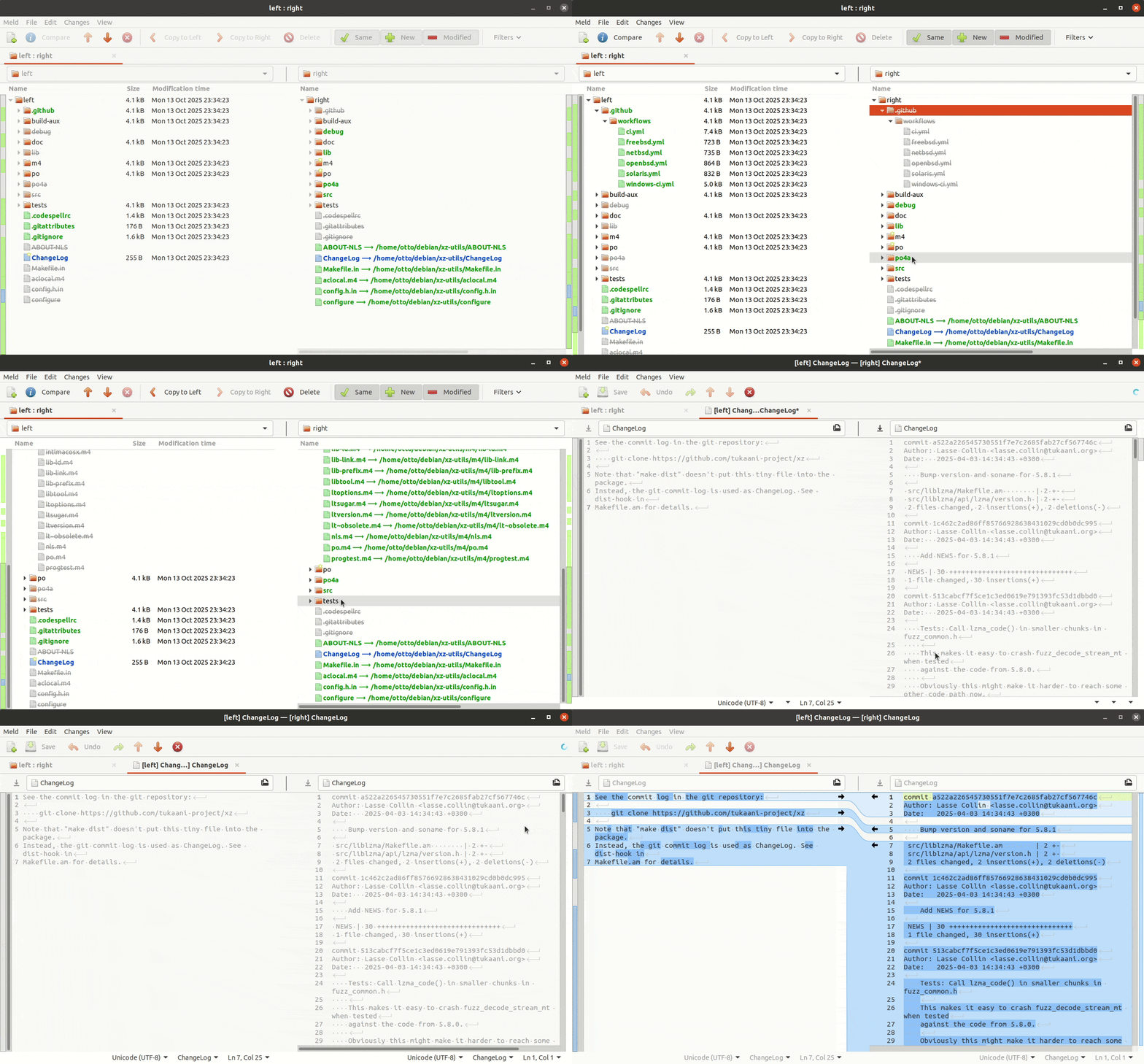
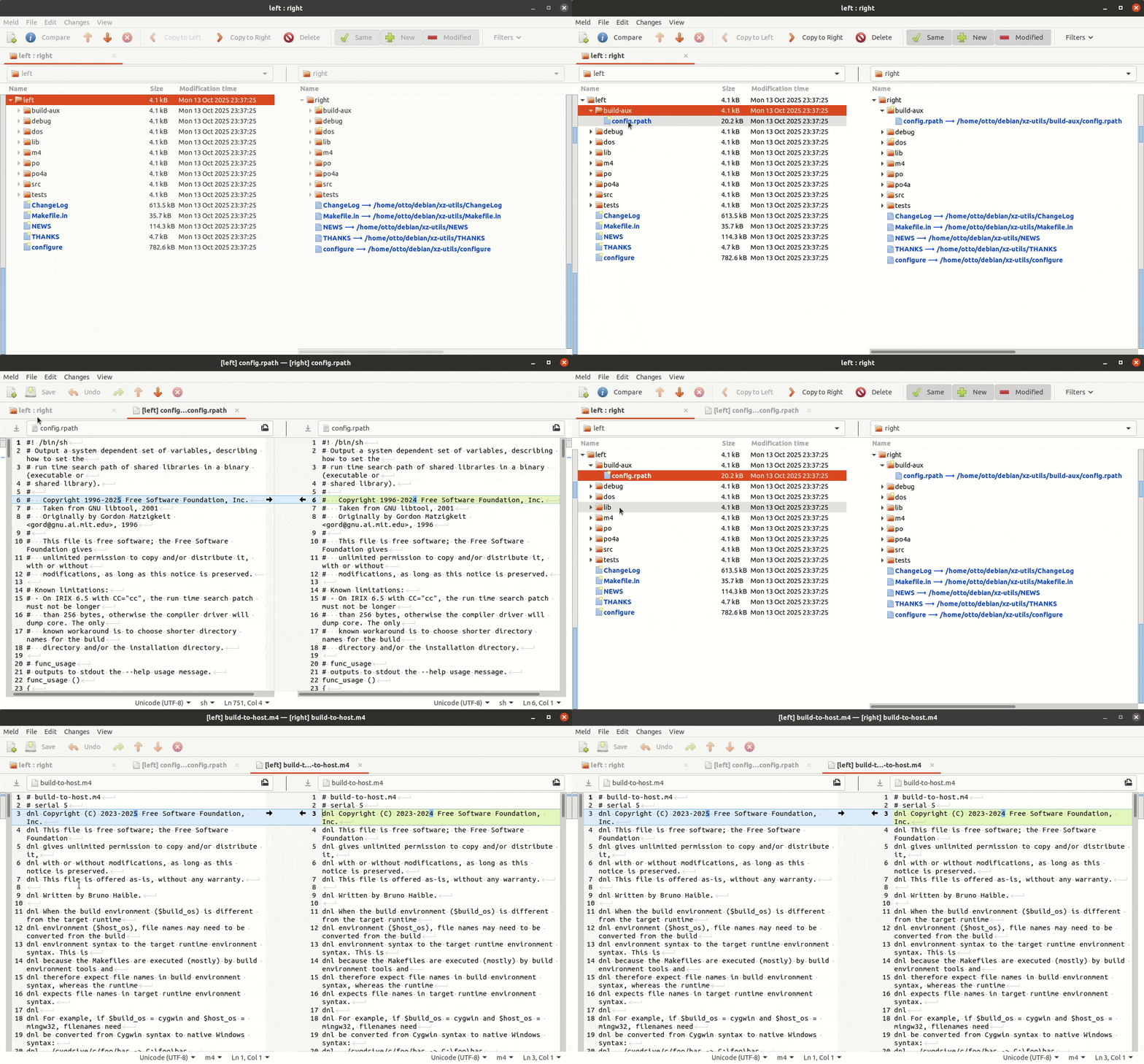
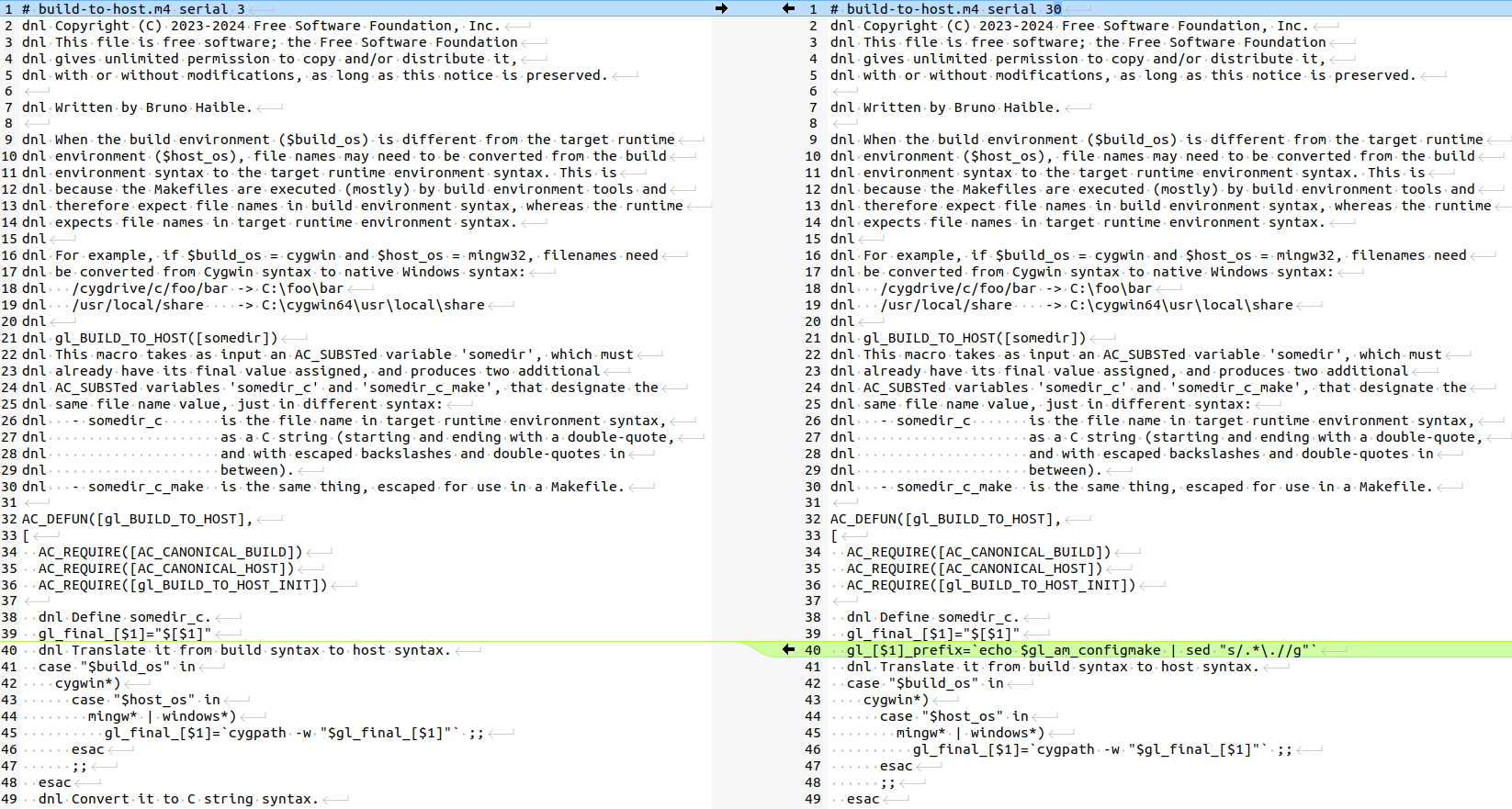
To be able to easily inspect exactly what changed in the release tarball compared to git release tag contents, the best tool for the job is Meld, invoked via git difftool --dir-diff fa1e8796^..fa1e8796. Meld invoked by git difftool --dir-diff afba662b..fa1e8796 to show differences between git release tag and release tarball contents To compare changes across the new and old upstream tarball, one would need to compare commits afba662b New upstream version 5.8.0 and fa1e8796 New upstream version 5.8.1 by running git difftool --dir-diff afba662b..fa1e8796. Meld invoked by git difftool --dir-diff afba662b..fa1e8796 to show differences between to upstream release tarball contents With all the above tips you can now go and try to audit your own favorite package in Debian and see if it is identical with upstream, and if not, how it differs.

Should the XZ backdoor have been detected using these tools? The famous XZ Utils backdoor (CVE-2024-3094) consisted of two parts: the actual backdoor inside two binary blobs masqueraded as a test files (tests/files/bad-3-corrupt_lzma2.xz, tests/files/good-large_compressed.lzma), and a small modification in the build scripts (m4/build-to-host.m4) to extract the backdoor and plant it into the built binary. The build script was not tracked in version control, but generated with GNU Autotools at release time and only shipped as additional files in the release tarball. The entire reason for me to write this post was to ponder if a diligent engineer using git-buildpackage best practices could have reasonably spotted this while importing the new upstream release into Debian. The short answer is no . The malicious actor here clearly anticipated all the typical ways anyone might inspect both git commits, and release tarball contents, and masqueraded the changes very well and over a long timespan. First of all, XZ has for legitimate reasons for several carefully crafted .xz files as test data to help catch regressions in the decompression code path. The test files are shipped in the release so users can run the test suite and validate that the binary is built correctly and xz works properly. Debian famously runs massive amounts of testing in its CI and autopkgtest system across tens of thousands of packages to uphold high quality despite frequent upgrades of the build toolchain and while supporting more CPU architectures than any other distro. Test data is useful and should stay. When git-buildpackage is used correctly, the upstream commits are visible in the Debian packaging for easy review, but the commit cf44e4b that introduced the test files does not deviate enough from regular sloppy coding practices to really stand out. It is unfortunately very common for git commit to lack a message body explaining why the change was done, and to not be properly atomic with test code and test data together in the same commit, and for commits to be pushed directly to mainline without using code reviews (the commit was not part of any PR in this case). Only another upstream developer could have spotted that this change is not on par to what the project expects, and that the test code was never added, only test data, and thus that this commit was not just a sloppy one but potentially malicious. Secondly, the fact that a new Autotools file appeared (m4/build-to-host.m4) in the XZ Utils 5.6.0 is not suspicious. This is perfectly normal for Autotools. In fact, starting from XZ Utils version 5.8.1 it is now shipping a m4/build-to-host.m4 file that it actually uses now. Spotting that there is anything fishy is practically impossible by simply reading the code, as Autotools files are full custom m4 syntax interwoven with shell script, and there are plenty of backticks ( ) that spawn subshells and evals that execute variable contents further, which is just normal for Autotools. Russ Cox s XZ post explains how exactly the Autotools code fetched the actual backdoor from the test files and injected it into the build. Inspecting the m4/build-to-host.m4 changes in Meld launched via git difftool There is only one tiny thing that maybe a very experienced Autotools user could potentially have noticed: the serial 30 in the version header is way too high. In theory one could also have noticed this Autotools file deviates from what other packages in Debian ship with the same filename, such as e.g. the serial 3, serial 5a or 5b versions. That would however require and an insane amount extra checking work, and is not something we should plan to start doing. A much simpler solution would be to simply strongly recommend all open source projects to stop using Autotools to eventually get rid of it entirely.

Not detectable with reasonable effort While planting backdoors is evil, it is hard not to feel some respect to the level of skill and dedication of the people behind this. I ve been involved in a bunch of security breach investigations during my IT career, and never have I seen anything this well executed. If it hadn t slowed down SSH by ~500 milliseconds and been discovered due to that, it would most likely have stayed undetected for months or years. Hiding backdoors in closed source software is relatively trivial, but hiding backdoors in plain sight in a popular open source project requires some unusual amount of expertise and creativity as shown above.

Is the software supply-chain in Debian easy to audit? While maintaining a Debian package source using git-buildpackage can make the package history a lot easier to inspect, most packages have incomplete configurations in their debian/gbp.conf, and thus their package development histories are not always correctly constructed or uniform and easy to compare. The Debian Policy does not mandate git usage at all, and there are many important packages that are not using git at all. Additionally the Debian Policy also allows for non-maintainers to upload new versions to Debian without committing anything in git even for packages where the original maintainer wanted to use git. Uploads that bypass git unfortunately happen surpisingly often. Because of the situation, I am afraid that we could have multiple similar backdoors lurking that simply haven t been detected yet. More audits, that hopefully also get published openly, would be welcome! More people auditing the contents of the Debian archives would probably also help surface what tools and policies Debian might be missing to make the work easier, and thus help improve the security of Debian s users, and improve trust in Debian.

Is Debian currently missing some software that could help detect similar things? To my knowledge there is currently no system in place as part of Debian s QA or security infrastructure to verify that the upstream source packages in Debian are actually from upstream. I ve come across a lot of packages where the debian/watch or other configs are incorrect and even cases where maintainers have manually created upstream tarballs as it was easier than configuring automation to work. It is obvious that for those packages the source tarball now in Debian is not at all the same as upstream. I am not aware of any malicious cases though (if I was, I would report them of course). I am also aware of packages in the Debian repository that are misconfigured to be of type 1.0 (native) packages, mixing the upstream files and debian/ contents and having patches applied, while they actually should be configured as 3.0 (quilt), and not hide what is the true upstream sources. Debian should extend the QA tools to scan for such things. If I find a sponsor, I might build it myself as my next major contribution to Debian. In addition to better tooling for finding mismatches in the source code, Debian could also have better tooling for tracking in built binaries what their source files were, but solutions like Fraunhofer-AISEC s supply-graph or Sony s ESSTRA are not practical yet. Julien Malka s post about NixOS discusses the role of reproducible builds, which may help in some cases across all distros.

Or, is Debian missing some policies or practices to mitigate this? Perhaps more importantly than more security scanning, the Debian Developer community should switch the general mindset from anyone is free to do anything to valuing having more shared workflows. The ability to audit anything is severely hampered by the fact that there are so many ways to do the same thing, and distinguishing what is a normal deviation from a malicious deviation is too hard, as the normal can basically be almost anything. Also, as there is no documented and recommended default workflow, both those who are old and new to Debian packaging might never learn any one optimal workflow, and end up doing many steps in the packaging process in a way that kind of works, but is actually wrong or unnecessary, causing process deviations that look malicious, but turn out to just be a result of not fully understanding what would have been the right way to do something. In the long run, once individual developers workflows are more aligned, doing code reviews will become a lot easier and smoother as the excess noise of workflow differences diminishes and reviews will feel much more productive to all participants. Debian fostering a culture of code reviews would allow us to slowly move from the current practice of mainly solo packaging work towards true collaboration forming around those code reviews. I have been promoting increased use of Merge Requests in Debian already for some time, for example by proposing DEP-18: Encourage Continuous Integration and Merge Request based Collaboration for Debian packages. If you are involved in Debian development, please give a thumbs up in dep-team/deps!21 if you want me to continue promoting it.

Can we trust open source software? Yes and I would argue that we can only trust open source software. There is no way to audit closed source software, and anyone using e.g. Windows or MacOS just have to trust the vendor s word when they say they have no intentional or accidental backdoors in their software. Or, when the news gets out that the systems of a closed source vendor was compromised, like Crowdstrike some weeks ago, we can t audit anything, and time after time we simply need to take their word when they say they have properly cleaned up their code base. In theory, a vendor could give some kind of contractual or financial guarantee to its customer that there are no preventable security issues, but in practice that never happens. I am not aware of a single case of e.g. Microsoft or Oracle would have paid damages to their customers after a security flaw was found in their software. In theory you could also pay a vendor more to have them focus more effort in security, but since there is no way to verify what they did, or to get compensation when they didn t, any increased fees are likely just pocketed as increased profit. Open source is clearly better overall. You can, if you are an individual with the time and skills, audit every step in the supply-chain, or you could as an organization make investments in open source security improvements and actually verify what changes were made and how security improved. If your organisation is using Debian (or derivatives, such as Ubuntu) and you are interested in sponsoring my work to improve Debian, please reach out.

17 October 2025

David Bremner: Hibernate on the pocket reform 13/n

Context

Some progress upstream Recently Sebastian Reichel at Collabora [1] has made a few related commits, apparently inspired in part by my kvetching on this blog.

Disconnecting and reconnecting PCI busses At some point I noticed error message about the nvme device on resume. I then learned how to disconnect and reconnect PCI buses in Linux. I ended up with something like the following. At least the PCI management seems to work. I can manually disconnect all the PCI busses and rescan to connect them again on a running system. It presumably helps that I am not using the nvme device in this system.
set -x
echo platform >  /sys/power/pm_test
echo reboot > /sys/power/disk
rmmod mt76x2u
sleep 2
echo 1   tee /sys/bus/pci/devices/0003:30:00.0/remove
sleep 2
echo 1   tee /sys/bus/pci/devices/0004:41:00.0/remove
sleep 2
echo 1   tee /sys/bus/pci/devices/0004:40:00.0/remove
sleep 2
echo LSPCI:
lspci -t
sleep 2
echo disk >  /sys/power/state
sleep 2
echo 1   tee /sys/bus/pci/rescan
sleep 2
modprobe mt76x2u

Minimal changes to upstream With the ongoing work at collabora I decided to try a minimal patch stack to get the pocket reform to boot. I added the following 3 commits (available from [3]).
09868a4f2eb (HEAD -> reform-patches) copy pocket-reform dts from reform-debian-packages
152e2ae8a193 pocket/panel: sleep fix v3
18f65da9681c add-multi-display-panel-driver
It does indeed boot and seems stable.
$ uname -a
Linux anthia 6.18.0-rc1+ #19 SMP Thu Oct 16 11:32:04 ADT 2025 aarch64 GNU/Linux
Running the hibernation script above I get no output from the lspci, but seemingly issues with PCI coming back from hibernate:
[  424.645109] PM: hibernation: Allocated 361823 pages for snapshot
[  424.647216] PM: hibernation: Allocated 1447292 kbytes in 3.23 seconds (448.07 MB/s)
[  424.649321] Freezing remaining freezable tasks
[  424.654767] Freezing remaining freezable tasks completed (elapsed 0.003 seconds)
[  424.661070] rk_gmac-dwmac fe1b0000.ethernet end0: Link is Down
[  424.740716] rockchip-dw-pcie a40c00000.pcie: Failed to receive PME_TO_Ack
[  424.742041] PM: hibernation: hibernation debug: Waiting for 5 second(s).
[  430.074757] pci 0004:40:00.0: [1d87:3588] type 01 class 0x060400 PCIe Root Port
F F & Zn [  watchdog: CPU4: Watchdog detected hard LOCKUP on cpu 5
[  456.039004] Modules linked in: xt_CHECKSUM xt_tcpudp nft_chain_nat xt_MASQUERADE nf_nat nf_conntrack nf_defrag_ipv6 nf_defrag_ipv4 nft_compat x_tables bridge stp llc nf_tables aes_neon_bs aes_neon_blk ccm dwmac_rk binfmt_misc mt76x2_common mt76x02_usb mt76_usb mt76x02_lib mt76 mac80211 rk805_pwrkey snd_soc_tlv320aic31xx snd_soc_simple_card reform2_lpc(OE) libarc4 rockchip_saradc industrialio_triggered_buffer kfifo_buf industrialio cfg80211 rockchip_thermal rockchip_rng hantro_vpu cdc_acm v4l2_vp9 v4l2_jpeg rockchip_rga rfkill snd_soc_rockchip_i2s_tdm videobuf2_dma_sg v4l2_h264 panthor snd_soc_audio_graph_card drm_gpuvm snd_soc_simple_card_utils drm_exec evdev joydev dm_mod nvme_fabrics efi_pstore configfs nfnetlink autofs4 ext4 crc16 mbcache jbd2 btrfs blake2b_generic xor xor_neon raid6_pq mali_dp snd_soc_meson_axg_toddr snd_soc_meson_axg_fifo snd_soc_meson_codec_glue panfrost drm_shmem_helper gpu_sched ao_cec_g12a meson_vdec(C) videobuf2_dma_contig videobuf2_memops v4l2_mem2mem videobuf2_v4l2 videodev
[  456.039060]  videobuf2_common mc dw_hdmi_i2s_audio meson_drm meson_canvas meson_dw_mipi_dsi meson_dw_hdmi mxsfb mux_mmio panel_edp imx_dcss ti_sn65dsi86 nwl_dsi mux_core pwm_imx27 hid_generic usbhid hid xhci_plat_hcd onboard_usb_dev xhci_hcd nvme nvme_core snd_soc_hdmi_codec snd_soc_core nvme_keyring nvme_auth hkdf snd_pcm_dmaengine snd_pcm snd_timer snd soundcore fan53555 rtc_pcf8523 micrel phy_package stmmac_platform stmmac pcs_xpcs rk808_regulator phylink sdhci_of_dwcmshc mdio_devres dw_mmc_rockchip of_mdio sdhci_pltfm phy_rockchip_usbdp fixed_phy dw_mmc_pltfm fwnode_mdio typec phy_rockchip_naneng_combphy phy_rockchip_samsung_hdptx pwm_rockchip sdhci dwc3 libphy dw_wdt dw_mmc ehci_platform rockchip_dfi mdio_bus cqhci ulpi ohci_platform ehci_hcd udc_core ohci_hcd rockchipdrm phy_rockchip_inno_usb2 usbcore dw_hdmi_qp analogix_dp dw_mipi_dsi cpufreq_dt dw_mipi_dsi2 i2c_rk3x usb_common drm_dp_aux_bus [last unloaded: mt76x2u]
[  456.039111] Sending NMI from CPU 4 to CPUs 5:
[  471.942262] page_pool_release_retry() stalled pool shutdown: id 9, 2 inflight 60 sec
[  532.989611] page_pool_release_retry() stalled pool shutdown: id 9, 2 inflight 121 sec
This does look like some progress, probably thanks to Sebastien. Comparing with the logs in hibernate-pocket-12, the resume process is not bailing out complaining about PHY.

Attempt to reapply PCI reset patches Following the procedure in hibernate-pocket-12, I attempted to re-apply the pci reset patches [2]. In particular I followed the hints output by b4. Unfortunately there are too many conflicts now for me to sensibly resolve.
  1. https://gitlab.collabora.com/hardware-enablement/rockchip-3588/linux.git#rockchip-devel
  2. https://lore.kernel.org/all/20250715-pci-port-reset-v6-0-6f9cce94e7bb@oss.qualcomm.com/#r
  3. https://salsa.debian.org/bremner/collabora-rockchip-3588#reform-patches

13 October 2025

Wouter Verhelst: RPM and ECDSA GPG keys

Dear lazyweb, At work, we are trying to rotate the GPG signing keys for the Linux packages of the eID middleware We created new keys, and they will be installed on all Linux machines that have the eid-archive package installed soon (they were already supposed to be, but we made a mistake). Running some tests, however, I have a bit of a problem:
[wouter@rhel rpm-gpg]$ sudo rpm --import RPM-GPG-KEY-BEID-RELEASE
[wouter@rhel rpm-gpg]$ sudo rpm --import RPM-GPG-KEY-BEID-RELEASE-2025
fout: RPM-GPG-KEY-BEID-RELEASE-2025: key 1 import failed.
[wouter@rhel rpm-gpg]$ sudo rpm --import RPM-GPG-KEY-BEID-CONTINUOUS
This is on RHEL9. The only difference between the old keys and the new one, apart of course from the fact that the old one is, well, old, is that the old one uses the RSA algorithm whereas the new one uses ECDSA on the NIST P-384 curve (the same algorithm as the one used by the eID card). Does RPM not support ECDSA keys? Does anyone know where this is documented? (Yes, I probably should have tested this before publishing the new key, but this is where we are)

10 October 2025

Reproducible Builds: Reproducible Builds in September 2025

Welcome to the September 2025 report from the Reproducible Builds project! Welcome to the very latest report from the Reproducible Builds project. Our monthly reports outline what we ve been up to over the past month, and highlight items of news from elsewhere in the increasingly-important area of software supply-chain security. As ever, if you are interested in contributing to the Reproducible Builds project, please see the Contribute page on our website. In this report:

  1. Reproducible Builds Summit 2025
  2. Can t we have nice things?
  3. Distribution work
  4. Tool development
  5. Reproducibility testing framework
  6. Upstream patches

Reproducible Builds Summit 2025 Please join us at the upcoming Reproducible Builds Summit, set to take place from October 28th 30th 2025 in Vienna, Austria! We are thrilled to host the eighth edition of this exciting event, following the success of previous summits in various iconic locations around the world, including Venice, Marrakesh, Paris, Berlin, Hamburg and Athens. Our summits are a unique gathering that brings together attendees from diverse projects, united by a shared vision of advancing the Reproducible Builds effort. During this enriching event, participants will have the opportunity to engage in discussions, establish connections and exchange ideas to drive progress in this vital field. Our aim is to create an inclusive space that fosters collaboration, innovation and problem-solving. If you re interesting in joining us this year, please make sure to read the event page which has more details about the event and location. Registration is open until 20th September 2025, and we are very much looking forward to seeing many readers of these reports there!

Can t we have nice things? Debian Developer Gunnar Wolf blogged that George V. Neville-Neil s Kode Vicious column in Communications of the ACM in which reproducible builds is mentioned without needing to introduce it (assuming familiarity across the computing industry and academia) . Titled, Can t we have nice things?, the article mentions:
Once the proper measurement points are known, we want to constrain the system such that what it does is simple enough to understand and easy to repeat. It is quite telling that the push for software that enables reproducible builds only really took off after an embarrassing widespread security issue ended up affecting the entire Internet. That there had already been 50 years of software development before anyone thought that introducing a few constraints might be a good idea is, well, let s just say it generates many emotions, none of them happy, fuzzy ones. [ ]

Distribution work In Debian this month, Johannes Starosta filed a bug against the debian-repro-status package, reporting that it does not work on Debian trixie. (An upstream bug report was also filed.) Furthermore, 17 reviews of Debian packages were added, 10 were updated and 14 were removed this month adding to our knowledge about identified issues. In March s report, we included the news that Fedora would aim for 99% package reproducibility. This change has now been deferred to Fedora 44 according to Phoronix. Lastly, Bernhard M. Wiedemann posted another openSUSE monthly update for their work there.

Tool development diffoscope version 306 was uploaded to Debian unstable by Chris Lamb. It included contributions already covered in previous months as well as some changes by Zbigniew J drzejewski-Szmek to address issues with the fdtump support [ ] and to move away from the deprecated codes.open method. [ ][ ] strip-nondeterminism version 1.15.0-1 was uploaded to Debian unstable by Chris Lamb. It included a contribution by Matwey Kornilov to add support for inline archive files for Erlang s escript [ ]. kpcyrd has released a new version of rebuilderd. As a quick recap, rebuilderd is an automatic build scheduler that tracks binary packages available in a Linux distribution and attempts to compile the official binary packages from their (purported) source code and dependencies. The code for in-toto attestations has been reworked, and the instances now feature a new endpoint that can be queried to fetch the list of public-keys an instance currently identifies itself by. [ ] Lastly, Holger Levsen bumped the Standards-Version field of disorderfs, with no changes needed. [ ][ ]

Reproducibility testing framework The Reproducible Builds project operates a comprehensive testing framework running primarily at tests.reproducible-builds.org in order to check packages and other artifacts for reproducibility. In August, however, a number of changes were made by Holger Levsen, including:
  • Setting up six new rebuilderd workers with 16 cores and 16 GB RAM each.
  • reproduce.debian.net-related:
    • Do not expose pending jobs; they are confusing without explaination. [ ]
    • Add a link to v1 API specification. [ ]
    • Drop rebuilderd-worker.conf on a node. [ ]
    • Allow manual scheduling for any architectures. [ ]
    • Update path to trixie graphs. [ ]
    • Use the same rebuilder-debian.sh script for all hosts. [ ]
    • Add all other suites to all other archs. [ ][ ][ ][ ]
    • Update SSH host keys for new hosts. [ ]
    • Move to the pull184 branch. [ ][ ][ ][ ][ ]
    • Only allow 20 GB cache for workers. [ ]
  • OpenWrt-related:
    • Grant developer aparcar full sudo control on the ionos30 node. [ ][ ]
  • Jenkins nodes:
    • Add a number of new nodes. [ ][ ][ ][ ][ ]
    • Dont expect /srv/workspace to exist on OSUOSL nodes. [ ]
    • Stop hardcoding IP addresses in munin.conf. [ ]
    • Add maintenance and health check jobs for new nodes. [ ]
    • Document slight changes in IONOS resources usage. [ ]
  • Misc:
    • Drop disabled Alpine Linux tests for good. [ ]
    • Move Debian live builds and some other Debian builds to the ionos10 node. [ ]
    • Cleanup some legacy support from releases before Debian trixie. [ ]
In addition, Jochen Sprickerhof made the following changes relating to reproduce.debian.net:
  • Do not expose pending jobs on the main site. [ ]
  • Switch the frontpage to reference Debian forky [ ], but do not attempt to build Debian forky on the armel architecture [ ].
  • Use consistent and up to date rebuilder-debian.sh script. [ ]
  • Fix supported worker architectures. [ ]
  • Add a basic excuses page. [ ]
  • Move to the pull184 branch. [ ][ ][ ][ ]
  • Fix a typo in the JavaScript. [ ]
  • Update front page for the new v1 API. [ ][ ]
Lastly, Roland Clobus did some maintenance relating to the reproducibility testing of the Debian Live images. [ ][ ][ ][ ]

Upstream patches The Reproducible Builds project detects, dissects and attempts to fix as many currently-unreproducible packages as possible. We endeavour to send all of our patches upstream where appropriate. This month, we wrote a large number of such patches, including:

Finally, if you are interested in contributing to the Reproducible Builds project, please visit our Contribute page on our website. However, you can get in touch with us via:

Sergio Cipriano: Avoiding 5XX errors by adjusting Load Balancer Idle Timeout

Avoiding 5XX errors by adjusting Load Balancer Idle Timeout Recently I faced a problem in production where a client was running a RabbitMQ server behind the Load Balancers we provisioned and the TCP connections were closed every minute. My team is responsible for the LBaaS (Load Balancer as a Service) product and this Load Balancer was an Envoy proxy provisioned by our control plane. The error was similar to this:
[2025-10-03 12:37:17,525 - pika.adapters.utils.connection_workflow - ERROR] AMQPConnector - reporting failure: AMQPConnectorSocketConnectError: timeout("TCP connection attempt timed out: ''/(<AddressFamily.AF_INET: 2>, <SocketKind.SOCK_STREAM: 1>, 6, '', ('<IP>', 5672))")
[2025-10-03 12:37:17,526 - pika.adapters.utils.connection_workflow - ERROR] AMQP connection workflow failed: AMQPConnectionWorkflowFailed: 1 exceptions in all; last exception - AMQPConnectorSocketConnectError: timeout("TCP connection attempt timed out: ''/(<AddressFamily.AF_INET: 2>, <SocketKind.SOCK_STREAM: 1>, 6, '', ('<IP>', 5672))"); first exception - None.
[2025-10-03 12:37:17,526 - pika.adapters.utils.connection_workflow - ERROR] AMQPConnectionWorkflow - reporting failure: AMQPConnectionWorkflowFailed: 1 exceptions in all; last exception - AMQPConnectorSocketConnectError: timeout("TCP connection attempt timed out: ''/(<AddressFamily.AF_INET: 2>, <SocketKind.SOCK_STREAM: 1>, 6, '', ('<IP>', 5672))"); first exception - None
At first glance, the issue is simple: the Load Balancer's idle timeout is shorter than the RabbitMQ heartbeat interval. The idle timeout is the time at which a downstream or upstream connection will be terminated if there are no active streams. Heartbeats generate periodic network traffic to prevent idle TCP connections from closing prematurely. Adjusting these timeout settings to align properly solved the issue. However, what I want to explore in this post are other similar scenarios where it's not so obvious that the idle timeout is the problem. Introducing an extra network layer, such as an Envoy proxy, can introduce unpredictable behavior across your services, like intermittent 5XX errors. To make this issue more concrete, let's look at a minimal, reproducible setup that demonstrates how adding an Envoy proxy can lead to sporadic errors.

Reproducible setup I'll be using the following tools: This setup is based on what Kai Burjack presented in his article. Setting up Envoy with Docker is straightforward:
$ docker run \
    --name envoy --rm \
    --network host \
    -v $(pwd)/envoy.yaml:/etc/envoy/envoy.yaml \
    envoyproxy/envoy:v1.33-latest
I'll be running experiments with two different envoy.yaml configurations: one that uses Envoy's TCP proxy, and another that uses Envoy's HTTP connection manager. Here's the simplest Envoy TCP proxy setup: a listener on port 8000 forwarding traffic to a backend running on port 8080.
static_resources:
  listeners:
  - name: go_server_listener
    address:
      socket_address:
        address: 0.0.0.0
        port_value: 8000
    filter_chains:
    - filters:
      - name: envoy.filters.network.tcp_proxy
        typed_config:
          "@type": type.googleapis.com/envoy.extensions.filters.network.tcp_proxy.v3.TcpProxy
          stat_prefix: go_server_tcp
          cluster: go_server_cluster
  clusters:
  - name: go_server_cluster
    connect_timeout: 1s
    type: static
    load_assignment:
      cluster_name: go_server_cluster
      endpoints:
      - lb_endpoints:
        - endpoint:
            address:
              socket_address:
                address: 127.0.0.1
                port_value: 8080
The default idle timeout if not otherwise specified is 1 hour, which is the case here. The backend setup is simple as well:
package main

import (
    "fmt"
    "net/http"
    "time"
)

func helloHandler(w http.ResponseWriter, r *http.Request)  
  w.Write([]byte("Hello from Go!"))
 

func main()  
    http.HandleFunc("/", helloHandler)

    server := http.Server 
        Addr:        ":8080",
        IdleTimeout: 3 * time.Second,
     

    fmt.Println("Starting server on :8080")
    panic(server.ListenAndServe())
 
The IdleTimeout is set to 3 seconds to make it easier to test. Now, oha is the perfect tool to generate the HTTP requests for this test. The Load test is not meant to stress this setup, the idea is to wait long enough so that some requests are closed. The burst-delay feature will help with that:
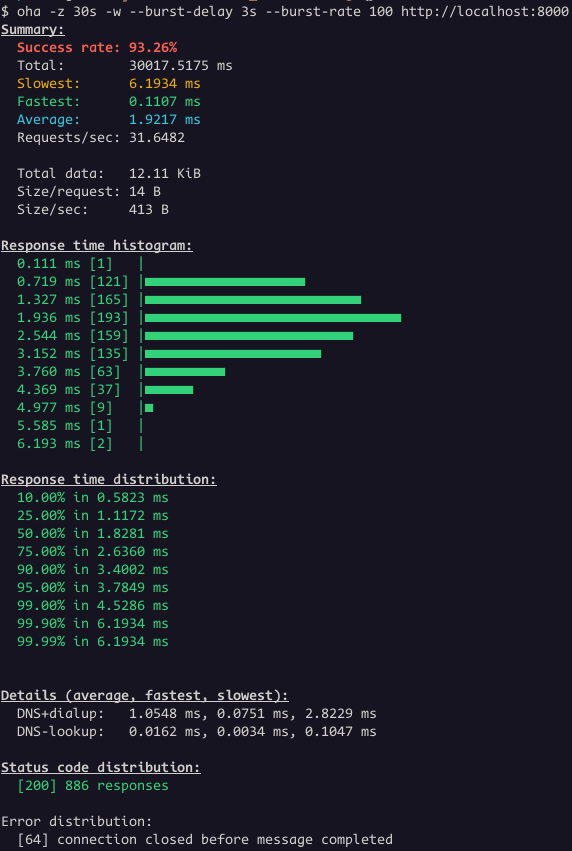
$ oha -z 30s -w --burst-delay 3s --burst-rate 100 http://localhost:8000
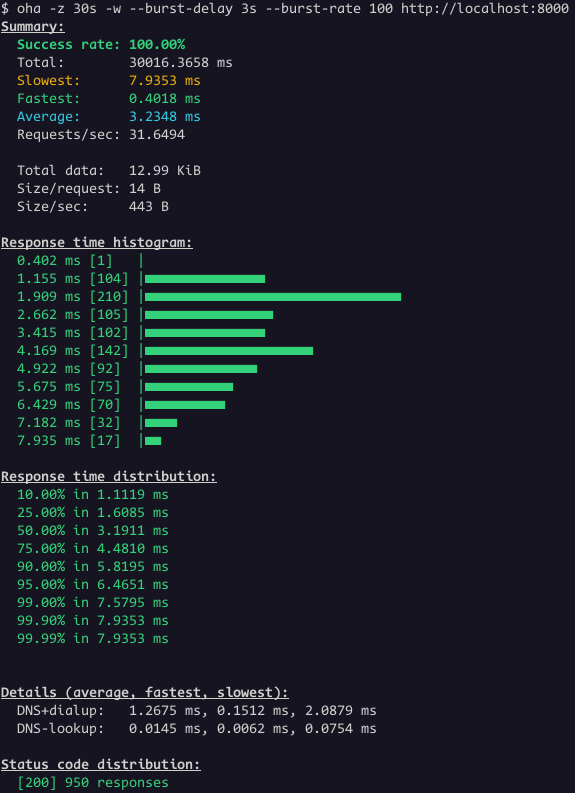
I'm running the Load test for 30 seconds, sending 100 requests at three-second intervals. I also use the -w option to wait for ongoing requests when the duration is reached. The result looks like this: oha test report tcp fail We had 886 responses with status code 200 and 64 connections closed. The backend terminated 64 connections while the load balancer still had active requests directed to it. Let's change the Load Balancer idle_timeout to two seconds.
filter_chains:
- filters:
  - name: envoy.filters.network.tcp_proxy
    typed_config:
      "@type": type.googleapis.com/envoy.extensions.filters.network.tcp_proxy.v3.TcpProxy
      stat_prefix: go_server_tcp
      cluster: go_server_cluster
      idle_timeout: 2s # <--- NEW LINE
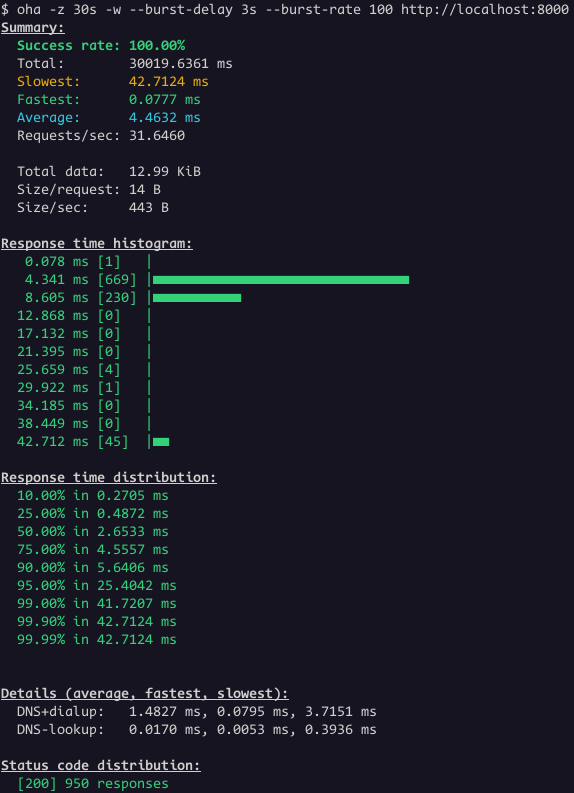
Run the same test again. oha test report tcp success Great! Now all the requests worked. This is a common issue, not specific to Envoy Proxy or the setup shown earlier. Major cloud providers have all documented it. AWS troubleshoot guide for Application Load Balancers says this: The target closed the connection with a TCP RST or a TCP FIN while the load balancer had an outstanding request to the target. Check whether the keep-alive duration of the target is shorter than the idle timeout value of the load balancer. Google troubleshoot guide for Application Load Balancers mention this as well: Verify that the keepalive configuration parameter for the HTTP server software running on the backend instance is not less than the keepalive timeout of the load balancer, whose value is fixed at 10 minutes (600 seconds) and is not configurable. The load balancer generates an HTTP 5XX response code when the connection to the backend has unexpectedly closed while sending the HTTP request or before the complete HTTP response has been received. This can happen because the keepalive configuration parameter for the web server software running on the backend instance is less than the fixed keepalive timeout of the load balancer. Ensure that the keepalive timeout configuration for HTTP server software on each backend is set to slightly greater than 10 minutes (the recommended value is 620 seconds). RabbitMQ docs also warn about this: Certain networking tools (HAproxy, AWS ELB) and equipment (hardware load balancers) may terminate "idle" TCP connections when there is no activity on them for a certain period of time. Most of the time it is not desirable. Most of them are talking about Application Load Balancers and the test I did was using a Network Load Balancer. For the sake of completeness, I will do the same test but using Envoy's HTTP connection manager. The updated envoy.yaml:
static_resources:
  listeners:
  - name: listener
    address:
      socket_address:
        address: 0.0.0.0
        port_value: 8000
    filter_chains:
    - filters:
      - name: envoy.filters.network.http_connection_manager
        typed_config:
          "@type": type.googleapis.com/envoy.extensions.filters.network.http_connection_manager.v3.HttpConnectionManager
          stat_prefix: go_server_http
          access_log:
          - name: envoy.access_loggers.stdout
            typed_config:
              "@type": type.googleapis.com/envoy.extensions.access_loggers.stream.v3.StdoutAccessLog
          http_filters:
          - name: envoy.filters.http.router
            typed_config:
              "@type": type.googleapis.com/envoy.extensions.filters.http.router.v3.Router
          route_config:
            name: http_route
            virtual_hosts:
            - name: local_service
              domains: ["*"]
              routes:
              - match:
                  prefix: "/"
                route:
                  cluster: go_server_cluster
  clusters:
  - name: go_server_cluster
    type: STATIC
    load_assignment:
      cluster_name: go_server_cluster
      endpoints:
      - lb_endpoints:
        - endpoint:
            address:
              socket_address:
                address: 0.0.0.0
                port_value: 8080
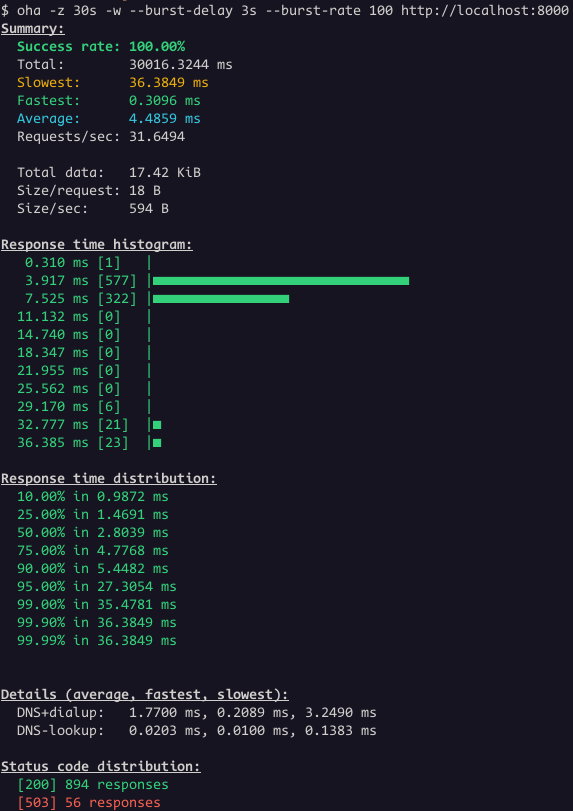
The yaml above is an example of a service proxying HTTP from 0.0.0.0:8000 to 0.0.0.0:8080. The only difference from a minimal configuration is that I enabled access logs. Let's run the same tests with oha. oha test report http fail Even thought the success rate is 100%, the status code distribution show some responses with status code 503. This is the case where is not that obvious that the problem is related to idle timeout. However, it's clear when we look the Envoy access logs:
[2025-10-10T13:32:26.617Z] "GET / HTTP/1.1" 503 UC 0 95 0 - "-" "oha/1.10.0" "9b1cb963-449b-41d7-b614-f851ced92c3b" "localhost:8000" "0.0.0.0:8080"
UC is the short name for UpstreamConnectionTermination. This means the upstream, which is the golang server, terminated the connection. To fix this once again, the Load Balancer idle timeout needs to change:
  clusters:
  - name: go_server_cluster
    type: STATIC
    typed_extension_protocol_options: # <--- NEW BLOCK
      envoy.extensions.upstreams.http.v3.HttpProtocolOptions:
        "@type": type.googleapis.com/envoy.extensions.upstreams.http.v3.HttpProtocolOptions
        common_http_protocol_options:
          idle_timeout: 2s # <--- NEW VALUE
        explicit_http_config:
          http_protocol_options:  
Finally, the sporadic 503 errors are over: oha test report http success

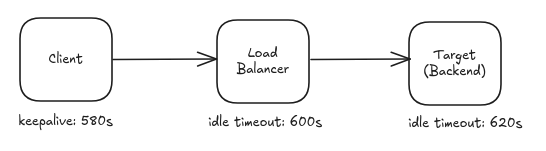
To Sum Up Here's an example of the values my team recommends to our clients: recap drawing Key Takeaways:
  1. The Load Balancer idle timeout should be less than the backend (upstream) idle/keepalive timeout.
  2. When we are working with long lived connections, the client (downstream) should use a keepalive smaller than the LB idle timeout.

Dirk Eddelbuettel: RcppArmadillo 15 CRAN Transition: Offering Office Hours

armadillo image Armadillo is a powerful and expressive C++ template library for linear algebra and scientific computing. It aims towards a good balance between speed and ease of use, has a syntax deliberately close to Matlab, and is useful for algorithm development directly in C++, or quick conversion of research code into production environments. RcppArmadillo integrates this library with the R environment and language and is widely used by (currently) 1273 other packages on CRAN, downloaded 41.8 million times (per the partial logs from the cloud mirrors of CRAN), and the CSDA paper (preprint / vignette) by Conrad and myself has been cited 651 times according to Google Scholar. Armadillo 15 brought changes. We mentioned these in the 15.0.2-1 and 15.0.2-1 release blog posts: (The second point is a consequence of the first. Prior to C++14, deprecation notes were issue via a macro, and the macro was set up by Conrad in the common way of allowing an override, which we took advantage of in RcppArmadillo effectively shielding downstream package. In C++14 this is now an attribute, and those cannot be suppressed.) We tested this then-upcoming change extensively: Thirteen reverse dependency runs expoloring different settings and leading to the current package setup where an automatic fallback to the last Armadillo 14 release offers fallback for hardwired C++11 use and Armadillo 15 others. Given the 1200+ reverse deoendencies, this took considerable time. All this was also quite extensively discussed with CRAN (especially Kurt Hornik) and documented / controlled via a series of issue tickets starting with overall issue #475 covering the subissues: The sixty pull requests (or emailed patches) followed a suggestion by CRAN to rank-order packages affected by their reverse dependencies sorted in descending package count. Now, while this change from Armadillo 14 to 15 was happening, CRAN also tightened the C++11 requirement for packages and imposed a deadline for changes. In discussion, CRAN also convinced me that a deadline for the deprecation warning, now unmasked, was viable (and is in fairness commensurate with similar, earlier changes triggered by changes in the behaviour of either gcc/g++ or clang/clang++). So we now have two larger deadline campaigns affecting the package (and as always there are some others). These deadlines are coming close: October 17 for the C++11 transition, and October 23 for the deprecation warning. Now, as became clear preparing the sixty pull requests and patches, these changes are often relatively straightforward. For the former, remove the C++11 enforcement and the package will likely build without changes. For the latter, make the often simple (e.g. swith from arma::is_finite to std::isfinite) change. I did not encounter anything much more complicated yet. The number of affected packages approximated by looking at all packages with a reverse dependency on RcppArmadillo and having a deadline can be computed as
suppressMessages(library(data.table))
D <- setDT(tools::CRAN_package_db())
P <- data.table(Package=tools::package_dependencies("RcppArmadillo", reverse=TRUE, db=D)[[1]])
W <- merge(P, D, all.x=TRUE)[is.na(Deadline)==FALSE,c(1:2,38,68)]
W

W[, nrevdep := length(tools::package_dependencies(Package, reverse=TRUE, recursive=TRUE, db=D)[[1]]), by=Package]
W[order(-nrevdep)]
and has been declining steadily from over 350 to now under 200. For that a big and heartfelt Thank You! to all the maintainers who already addressed their package and uploaded updated packages to CRAN. That rocks, and is truly appreciated. Yet the number is still large. And while issues #489 and #491 show a number of pending packages that have merged but not uploaded (yet?) there are also all the other packages I have not been able to look at in detail. While preparing sixty PRs / patches was viable over a period of a good week, I cannot create these for all packages. So with that said, here is a different suggestion for help: All of next week, I will be holding open door open source office hours online two times each day (11:00h to 13:00h Central, 16:00h to 18:00h Central) which can be booked via this booking link for Monday to Friday next week in either fifteen or thirty minutes slots you can book. This should offer Google Meet video conferencing (with jitsi as an alternate, you should be able to control that) which should allow for screen sharing. (I cannot hookup Zoom as my default account has organization settings with a different calendar integration.) If you are reading this and have a package that still needs helps, I hope to see you in the Open Source Office Hours to aid in the RcppArmadillo package updates for your package. Please book a slot!

This post by Dirk Eddelbuettel originated on his Thinking inside the box blog. If you like this or other open-source work I do, you can sponsor me at GitHub.

John Goerzen: I m Not Very Popular, Thankfully. That Makes The Internet Fun Again

Like and subscribe! Help us get our next thousand (or million) followers! I was using Linux before it was popular. Back in the day where you had to write Modelines for your XF86Config file and do it properly, or else you might ruin your monitor. Back when there wasn t a word processor (thankfully; that forced me to learn LaTeX, which I used to write my papers in college). I then ran Linux on an Alpha, a difficult proposition in an era when web browsers were either closed-source or too old to be useful; all sorts of workarounds, including emulating Digital UNIX. Recently I wrote a deep dive into the DOS VGA text mode and how to achieve it on a modern UEFI Linux system. Nobody can monetize things like this. I am one of maybe a dozen or two people globally that care about that sort of thing. That s fine. Today, I m interested in things like asynchronous communication, NNCP, and Gopher. Heck, I m posting these words on a blog. Social media displaced those, right? Some of the things I write about here have maybe a few dozen people on the planet interested in them. That s fine. I have no idea how many people read my blog. I have no idea where people hear about my posts from. I guess I can check my Mastodon profile to see how many followers I have, but it s not something I tend to do. I don t know if the number is going up or down, or if it is all that much in Mastodon terms (probably not). Thank goodness. Since I don t have to care about what s popular, or spend hours editing video, or thousands of dollars on video equipment, I can just sit down and write about what interests me. If that also interests you, then great. If not, you can find what interests you also fine. I once had a colleague that was one of these plugged into Silicon Valley types. He would periodically tell me, with a mixture of excitement and awe, that one of my posts had made Hacker News. This was always news to me, because I never paid a lot of attention over there. Occasionally that would bring in some excellent discussion, but more often than not, it was comments from people that hadn t read or understood the article trying to appear smart by arguing with what it or rather, what they imagined it said, I guess. The thing I value isn t subscriber count. It s discussion. A little discussion in the comments or on Mastodon that s perfect, even if only 10 people read the article. I have the most fun in a community. And I ll go on writing about NNCP and Gopher and non-square DOS pixels, with audiences of dozens globally. I have no advertisers to keep happy, and I enjoy it, so why not?

8 October 2025

Colin Watson: Free software activity in September 2025

About 90% of my Debian contributions this month were sponsored by Freexian. You can also support my work directly via Liberapay or GitHub Sponsors. Some months I feel like I m pedalling furiously just to keep everything in a roughly working state. This was one of those months. Python team I upgraded these packages to new upstream versions: I had to spend a fair bit of time this month chasing down build/test regressions in various packages due to some other upgrades, particularly to pydantic, python-pytest-asyncio, and rust-pyo3: After some upstream discussion I requested removal of pydantic-compat, since it was more trouble than it was worth to keep it working with the latest pydantic version. I filed dh-python: pybuild-plugin-pyproject doesn t know about headers and added it to Python/PybuildPluginPyproject, and converted some packages to pybuild-plugin-pyproject: I updated dh-python to suppress generated dependencies that would be satisfied by python3 >= 3.11. pkg_resources is deprecated. In most cases replacing it is a relatively simple matter of porting to importlib.resources, but packages that used its old namespace package support need more complicated work to port them to implicit namespace packages. We had quite a few bugs about this on zope.* packages, but fortunately upstream did the hard part of this recently. I went round and cleaned up most of the remaining loose ends, with some help from Alexandre Detiste. Some of these aren t completely done yet as they re awaiting new upstream releases: This work also caused a couple of build regressions, which I fixed: I fixed jupyter-client so that its autopkgtests would work in Debusine. I fixed waitress to build with the nocheck profile. I fixed several other build/test failures: I fixed some other bugs: Code reviews Other bits and pieces I fixed several CMake 4 build failures: I got CI for debbugs passing (!22, !23). I fixed a build failure with GCC 15 in trn4. I filed a release-notes bug about the tzdata reorganization in the trixie cycle. I filed and fixed a git-dpm regression with bash 5.3. I upgraded libfilter-perl to a new upstream version. I optimized some code in ubuntu-dev-tools that made O(1) HTTP requests when it could instead make O(n).

3 October 2025

Dirk Eddelbuettel: #053: Adding llvm Snapshots for R Package Testing

Welcome to post 53 in the R4 series. Continuing with posts #51 from Tuesday and #52 from Wednesday and their stated intent of posting some more here is another quick one. Earlier today I helped another package developer who came to the r-package-devel list asking for help with a build error on the Fedora machine at CRAN running recent / development clang. In such situations, the best first step is often to replicate the issue. As I pointed out on the list, the LLVM team behind clang maintains an apt repo at apt.llvm.org/ making it a good resource to add to Debian-based container such as Rocker r-base or the offical r-base (the two are in fact interchangeable, and I take care of both). A small pothole, however, is that the documentation at the top of apt.llvm.org site is a bit stale and behind two aspects that changed on current Debian systems (i.e. unstable/testing as used for r-base). First, apt now prefers files ending in .sources (in a nicer format) and second, it now really requires a key (which is good practice). As it took me a few minutes to regather how to meet both requirements, I reckoned I might as well script this. Et voil the following script does that:
#!/bin/sh

## Update does not hurt but is not strictly needed
#apt update --quiet --quiet
#apt upgrade --yes

## wget -qO- https://apt.llvm.org/llvm-snapshot.gpg.key   sudo tee /etc/apt/trusted.gpg.d/apt.llvm.org.asc
## or as we are root in container
wget -qO- https://apt.llvm.org/llvm-snapshot.gpg.key > /etc/apt/trusted.gpg.d/apt.llvm.org.asc

cat <<EOF >/etc/apt/sources.list.d/llvm-dev.sources
Types: deb
URIs: http://apt.llvm.org/unstable/
# for clang-21 
#   Suites: llvm-toolchain-21
# for current clang
Suites: llvm-toolchain
Components: main
Signed-By: /etc/apt/trusted.gpg.d/apt.llvm.org.asc
EOF

test -d ~/.R   mkdir ~/.R
cat <<EOF >~/.R/Makevars
CLANGVER=-22
# CLANGLIB=-stdlib=libc++
CXX=clang++\$(CLANGVER) \$(CLANGLIB)
CXX11=clang++\$(CLANGVER) \$(CLANGLIB)
CXX14=clang++\$(CLANGVER) \$(CLANGLIB)
CXX17=clang++\$(CLANGVER) \$(CLANGLIB)
CXX20=clang++\$(CLANGVER) \$(CLANGLIB)
CC=clang\$(CLANGVER)
SHLIB_CXXLD=clang++\$(CLANGVER) \$(CLANGLIB)
EOF

apt update
apt install --yes clang-22
Once the script is run, one can test a package (or set of packages) against clang-22 and clang++-22. This may help R package developers. The script is also generic enough for other development communities who can ignore (or comment-out / delete) the bit about ~/.R/Makevars and deploy the compiler differently. Updating the softlink as apt-preferences does is one way and done in many GitHub Actions recipes. As we only need wget here a basic Debian container should work, possibly with the addition of wget. For R users r-base hits a decent sweet spot.

This post by Dirk Eddelbuettel originated on his Thinking inside the box blog. If you like this or other open-source work I do, you can now sponsor me at GitHub.

Guido G nther: Free Software Activities September 2025

Another short status update of what happened on my side last month. Nothing stands out too much, I enjoyed doing the OSK changes the most as that helped to improve the typing experience further. Also doing a small bit of kernel work again was fun (still need to figure out the 6mq's touch controller repsonsiveness though). See below for details on the above and more: phosh phoc phosh-mobile-settings stevia (formerly phosh-osk-stub) xdg-desktop-portal-phosh pfs libphosh-rs Phrog feedbackd feedbackd-device-themes Debian gnome-settings-daemon git-buildpackage govarnam Sessions twenty-twenty-hugo tuwunnel Linux mutter Phosh debs phosh-site Reviews This is not code by me but reviews I did on other peoples code. The list is (as usual) slightly incomplete. Thanks for the contributions! Help Development If you want to support my work see donations. Comments? Join the Fediverse thread

1 October 2025

Birger Schacht: Status update, September 2025

Regarding Debian packaging this was a rather quiet month. I uploaded version 1.24.0-1 of foot and version 2.8.0-1 of git-quick-stats. I took the opportunity and started migrating my packages to the new version 5 watch file format, which I think is much more readable than the previous format. I also uploaded version 0.1.1-1 of libscfg to NEW. libscfg is a C implementation of the scfg configuration file format and it is a dependency of recent version of kanshi. kanshi is a tool similar to autorandr which allows you define output profiles and kanshi switches to the correct output profile on hotplug events. Once libscfg is in unstable I can finally update kanshi to the latest version. A lot of time this month in finalizing a redesign of the output rendering of carl. carl is a small rust program I wrote that provides a calendar view similar to cal, but it comes with colors and ical file integration. That means that you can not only display a simple calendar, but also colorize/highlight dates based on various attributes or based on events on that day. In the initial versions of carl the output rendering was simply hardcoded into the app.
Screenshot of carl
This was a bit cumbersome to maintain and not configurable for users. I am using templating languages on a daily basis, so I decided I would reimplement the output generation of carl to use templates. I chose the minijinja Rust library which is based on the syntax and behavior of the Jinja2 template engine for Python . There are others out there, like tera, but minijinja seems to be more active in development currently. I worked on this implementation on and off for the last year and finally had the time to finish it up and write some additional tests for the outputs. It is easier to maintain templates than Rust code that uses write!() to format the output. I also implemented a configuration option for users to override the templates. Additional to the output refactoring I also fixed couple of bugs and finally released v0.4.0 of carl. In my dayjob I released version 0.53 of apis-core-rdf which contains the place lookup field which I implemented in August. A couple of weeks later we released version 0.54 which comes with a middleware to show pass on messages from the Django messages framework via response header to HTMX to trigger message popups. This implementation is based on the blog post Using the Django messages framework with HTMX. Version 0.55 was the last release in September. It contained preparations for refactoring the import logic as well as a couple of UX improvements.

22 September 2025

David Bremner: Hibernate on the pocket reform 12/n

Context

Update to latest rockchip-devel For some reason I decided to try re-applying the PCI series. Good news: the pci series finally applies cleanly.
$ git fetch collabora && git switch -c tmp collabora  # [1]
$ b4 am 20250715-pci-port-reset-v6-0-6f9cce94e7bb@oss.qualcomm.com
$ git switch reform-patches  # [2]
$ git rebase -i tmp
  1. https://gitlab.collabora.com/hardware-enablement/rockchip-3588/linux.git#rockchip-devel
  2. https://salsa.debian.org/bremner/collabora-rockchip-3588#reform-patches

Rebuild the kernel
$ cp /boot/config-6.17.0-rc7+ .config
$ make olddefconfig
$ yes ''   make localmodconfig
$ make KBUILD_IMAGE=arch/arm64/boot/Image bindeb-pkg -j$(nproc)

try the hibernation test, again Running the following test script
set -x
echo platform >  /sys/power/pm_test
echo reboot > /sys/power/disk
sleep 2
rmmod mt76x2u
sleep 2
echo disk >  /sys/power/state
sleep 2
modprobe mt76x2u
Initially there is some output like this
[  151.752683] rockchip-dw-pcie a40c00000.pcie: Failed to receive PME_TO_Ack
[  151.754035] PM: hibernation: hibernation debug: Waiting for 5 second(s).
[  157.821584] rockchip-dw-pcie a40c00000.pcie: Phy link never came up
[  157.822139] rockchip-dw-pcie a40c00000.pcie: fail to resume
[  157.822636] rockchip-dw-pcie a40c00000.pcie: PM: dpm_run_callback(): genpd_restore_noirq returns -110
[  157.823442] rockchip-dw-pcie a40c00000.pcie: PM: failed to restore noirq: error -110
A small amount of detective work suggests that a40c00000.pcie corresponds to the first PCI bridge on the rk3588 SOC.
$ ls -l /sys/bus/pci/devices
total 0
lrwxrwxrwx 1 root root 0 Sep 23 10:32 0003:30:00.0 -> ../../../devices/platform/a40c00000.pcie/pci0003:30/0003:30:00.0
lrwxrwxrwx 1 root root 0 Sep 23 10:32 0004:40:00.0 -> ../../../devices/platform/a41000000.pcie/pci0004:40/0004:40:00.0
lrwxrwxrwx 1 root root 0 Sep 23 10:32 0004:41:00.0 -> ../../../devices/platform/a41000000.pcie/pci0004:40/0004:40:00.0/0004:41:00.0
Then after a pause,
[ 1032.039237] watchdog: CPU5: Watchdog detected hard LOCKUP on cpu 6
[ 1032.039778] Modules linked in: xt_CHECKSUM xt_tcpudp nft_chain_nat xt_MASQUERADE nf_nat nf_conntrack nf_defrag_ipv6 nf_defrag_ipv4 nft_compat x_tables bridge stp llc nf_tables aes_neon_bs aes_neon_blk ccm dwmac_rk binfmt_misc mt76x2_common mt76x02_usb mt76_usb mt76x02_lib mt76 rk805_pwrkey snd_soc_tlv320aic31xx snd_soc_simple_card mac80211 rockchip_saradc reform2_lpc(OE) industrialio_triggered_buffer libarc4 kfifo_buf cfg80211 industrialio rockchip_thermal rockchip_rng cdc_acm rfkill snd_soc_rockchip_i2s_tdm hantro_vpu rockchip_rga panthor v4l2_vp9 v4l2_jpeg snd_soc_audio_graph_card videobuf2_dma_sg v4l2_h264 drm_gpuvm snd_soc_simple_card_utils drm_exec evdev joydev dm_mod nvme_fabrics efi_pstore configfs nfnetlink autofs4 ext4 crc16 mbcache jbd2 btrfs blake2b_generic xor xor_neon raid6_pq mali_dp snd_soc_meson_axg_toddr snd_soc_meson_axg_fifo snd_soc_meson_codec_glue panfrost drm_shmem_helper gpu_sched ao_cec_g12a meson_vdec(C) videobuf2_dma_contig videobuf2_memops v4l2_mem2mem videobuf2_v4l2 videodev
[ 1032.039834]  videobuf2_common mc dw_hdmi_i2s_audio meson_drm meson_canvas meson_dw_mipi_dsi meson_dw_hdmi mxsfb mux_mmio panel_edp imx_dcss ti_sn65dsi86 nwl_dsi mux_core pwm_imx27 hid_generic usbhid hid onboard_usb_dev nvme nvme_core nvme_keyring nvme_auth snd_soc_hdmi_codec snd_soc_core xhci_plat_hcd xhci_hcd snd_pcm_dmaengine snd_pcm snd_timer snd soundcore rtc_pcf8523 fan53555 micrel phy_package stmmac_platform stmmac pcs_xpcs phylink mdio_devres rk808_regulator of_mdio sdhci_of_dwcmshc fixed_phy sdhci_pltfm fwnode_mdio libphy sdhci phy_rockchip_usbdp dw_mmc_rockchip dw_mmc_pltfm typec phy_rockchip_naneng_combphy pwm_rockchip dw_wdt phy_rockchip_samsung_hdptx dwc3 cqhci dw_mmc mdio_bus rockchip_dfi ehci_platform rockchipdrm ulpi ehci_hcd dw_hdmi_qp ohci_platform udc_core ohci_hcd analogix_dp dw_mipi_dsi i2c_rk3x cpufreq_dt usbcore phy_rockchip_inno_usb2 dw_mipi_dsi2 drm_dp_aux_bus usb_common [last unloaded: mt76x2u]
[ 1032.039886] Sending NMI from CPU 5 to CPUs 6:
previous episode

Evgeni Golov: Booting Vagrant boxes with UEFI on Fedora: Permission denied

If you're still using Vagrant (I am) and try to boot a box that uses UEFI (like boxen/debian-13), a simple vagrant init boxen/debian-13 and vagrant up will entertain you with a nice traceback:
% vagrant up
Bringing machine 'default' up with 'libvirt' provider...
==> default: Checking if box 'boxen/debian-13' version '2025.08.20.12' is up to date...
==> default: Creating image (snapshot of base box volume).
==> default: Creating domain with the following settings...
==> default:  -- Name:              tmp.JV8X48n30U_default
==> default:  -- Description:       Source: /tmp/tmp.JV8X48n30U/Vagrantfile
==> default:  -- Domain type:       kvm
==> default:  -- Cpus:              1
==> default:  -- Feature:           acpi
==> default:  -- Feature:           apic
==> default:  -- Feature:           pae
==> default:  -- Clock offset:      utc
==> default:  -- Memory:            2048M
==> default:  -- Loader:            /home/evgeni/.vagrant.d/boxes/boxen-VAGRANTSLASH-debian-13/2025.08.20.12/libvirt/OVMF_CODE.fd
==> default:  -- Nvram:             /home/evgeni/.vagrant.d/boxes/boxen-VAGRANTSLASH-debian-13/2025.08.20.12/libvirt/efivars.fd
==> default:  -- Base box:          boxen/debian-13
==> default:  -- Storage pool:      default
==> default:  -- Image(vda):        /home/evgeni/.local/share/libvirt/images/tmp.JV8X48n30U_default.img, virtio, 20G
==> default:  -- Disk driver opts:  cache='default'
==> default:  -- Graphics Type:     vnc
==> default:  -- Video Type:        cirrus
==> default:  -- Video VRAM:        16384
==> default:  -- Video 3D accel:    false
==> default:  -- Keymap:            en-us
==> default:  -- TPM Backend:       passthrough
==> default:  -- INPUT:             type=mouse, bus=ps2
==> default:  -- CHANNEL:             type=unix, mode=
==> default:  -- CHANNEL:             target_type=virtio, target_name=org.qemu.guest_agent.0
==> default: Creating shared folders metadata...
==> default: Starting domain.
==> default: Removing domain...
==> default: Deleting the machine folder
/usr/share/gems/gems/fog-libvirt-0.13.1/lib/fog/libvirt/requests/compute/vm_action.rb:7:in 'Libvirt::Domain#create': Call to virDomainCreate failed: internal error: process exited while connecting to monitor: 2025-09-22T10:07:55.081081Z qemu-system-x86_64: -blockdev  "driver":"file","filename":"/home/evgeni/.vagrant.d/boxes/boxen-VAGRANTSLASH-debian-13/2025.08.20.12/libvirt/OVMF_CODE.fd","node-name":"libvirt-pflash0-storage","auto-read-only":true,"discard":"unmap" : Could not open '/home/evgeni/.vagrant.d/boxes/boxen-VAGRANTSLASH-debian-13/2025.08.20.12/libvirt/OVMF_CODE.fd': Permission denied (Libvirt::Error)
    from /usr/share/gems/gems/fog-libvirt-0.13.1/lib/fog/libvirt/requests/compute/vm_action.rb:7:in 'Fog::Libvirt::Compute::Shared#vm_action'
    from /usr/share/gems/gems/fog-libvirt-0.13.1/lib/fog/libvirt/models/compute/server.rb:81:in 'Fog::Libvirt::Compute::Server#start'
    from /usr/share/vagrant/gems/gems/vagrant-libvirt-0.11.2/lib/vagrant-libvirt/action/start_domain.rb:546:in 'VagrantPlugins::ProviderLibvirt::Action::StartDomain#call'
    from /usr/share/vagrant/gems/gems/vagrant-2.3.4/lib/vagrant/action/warden.rb:48:in 'Vagrant::Action::Warden#call'
    from /usr/share/vagrant/gems/gems/vagrant-libvirt-0.11.2/lib/vagrant-libvirt/action/set_boot_order.rb:22:in 'VagrantPlugins::ProviderLibvirt::Action::SetBootOrder#call'
    from /usr/share/vagrant/gems/gems/vagrant-2.3.4/lib/vagrant/action/warden.rb:48:in 'Vagrant::Action::Warden#call'
    from /usr/share/vagrant/gems/gems/vagrant-libvirt-0.11.2/lib/vagrant-libvirt/action/share_folders.rb:22:in 'VagrantPlugins::ProviderLibvirt::Action::ShareFolders#call'
    from /usr/share/vagrant/gems/gems/vagrant-2.3.4/lib/vagrant/action/warden.rb:48:in 'Vagrant::Action::Warden#call'
    from /usr/share/vagrant/gems/gems/vagrant-libvirt-0.11.2/lib/vagrant-libvirt/action/prepare_nfs_settings.rb:21:in 'VagrantPlugins::ProviderLibvirt::Action::PrepareNFSSettings#call'
    from /usr/share/vagrant/gems/gems/vagrant-2.3.4/lib/vagrant/action/warden.rb:48:in 'Vagrant::Action::Warden#call'
    from /usr/share/vagrant/gems/gems/vagrant-2.3.4/lib/vagrant/action/builtin/synced_folders.rb:87:in 'Vagrant::Action::Builtin::SyncedFolders#call'
    from /usr/share/vagrant/gems/gems/vagrant-2.3.4/lib/vagrant/action/warden.rb:48:in 'Vagrant::Action::Warden#call'
    from /usr/share/vagrant/gems/gems/vagrant-2.3.4/lib/vagrant/action/builtin/delayed.rb:19:in 'Vagrant::Action::Builtin::Delayed#call'
    from /usr/share/vagrant/gems/gems/vagrant-2.3.4/lib/vagrant/action/warden.rb:48:in 'Vagrant::Action::Warden#call'
    from /usr/share/vagrant/gems/gems/vagrant-2.3.4/lib/vagrant/action/builtin/synced_folder_cleanup.rb:28:in 'Vagrant::Action::Builtin::SyncedFolderCleanup#call'
    from /usr/share/vagrant/gems/gems/vagrant-2.3.4/lib/vagrant/action/warden.rb:48:in 'Vagrant::Action::Warden#call'
    from /usr/share/vagrant/gems/gems/vagrant-2.3.4/plugins/synced_folders/nfs/action_cleanup.rb:25:in 'VagrantPlugins::SyncedFolderNFS::ActionCleanup#call'
    from /usr/share/vagrant/gems/gems/vagrant-2.3.4/lib/vagrant/action/warden.rb:48:in 'Vagrant::Action::Warden#call'
    from /usr/share/vagrant/gems/gems/vagrant-libvirt-0.11.2/lib/vagrant-libvirt/action/prepare_nfs_valid_ids.rb:14:in 'VagrantPlugins::ProviderLibvirt::Action::PrepareNFSValidIds#call'
    from /usr/share/vagrant/gems/gems/vagrant-2.3.4/lib/vagrant/action/warden.rb:48:in 'Vagrant::Action::Warden#call'
    from /usr/share/vagrant/gems/gems/vagrant-2.3.4/lib/vagrant/action/warden.rb:127:in 'block in Vagrant::Action::Warden#finalize_action'
    from /usr/share/vagrant/gems/gems/vagrant-2.3.4/lib/vagrant/action/warden.rb:48:in 'Vagrant::Action::Warden#call'
    from /usr/share/vagrant/gems/gems/vagrant-2.3.4/lib/vagrant/action/builder.rb:180:in 'Vagrant::Action::Builder#call'
    from /usr/share/vagrant/gems/gems/vagrant-2.3.4/lib/vagrant/action/runner.rb:101:in 'block in Vagrant::Action::Runner#run'
    from /usr/share/vagrant/gems/gems/vagrant-2.3.4/lib/vagrant/util/busy.rb:19:in 'Vagrant::Util::Busy.busy'
    from /usr/share/vagrant/gems/gems/vagrant-2.3.4/lib/vagrant/action/runner.rb:101:in 'Vagrant::Action::Runner#run'
    from /usr/share/vagrant/gems/gems/vagrant-2.3.4/lib/vagrant/action/builtin/call.rb:53:in 'Vagrant::Action::Builtin::Call#call'
    from /usr/share/vagrant/gems/gems/vagrant-2.3.4/lib/vagrant/action/warden.rb:48:in 'Vagrant::Action::Warden#call'
    from /usr/share/vagrant/gems/gems/vagrant-libvirt-0.11.2/lib/vagrant-libvirt/action/create_network_interfaces.rb:197:in 'VagrantPlugins::ProviderLibvirt::Action::CreateNetworkInterfaces#call'
    from /usr/share/vagrant/gems/gems/vagrant-2.3.4/lib/vagrant/action/warden.rb:48:in 'Vagrant::Action::Warden#call'
    from /usr/share/vagrant/gems/gems/vagrant-libvirt-0.11.2/lib/vagrant-libvirt/action/create_networks.rb:40:in 'VagrantPlugins::ProviderLibvirt::Action::CreateNetworks#call'
    from /usr/share/vagrant/gems/gems/vagrant-2.3.4/lib/vagrant/action/warden.rb:48:in 'Vagrant::Action::Warden#call'
    from /usr/share/vagrant/gems/gems/vagrant-libvirt-0.11.2/lib/vagrant-libvirt/action/create_domain.rb:452:in 'VagrantPlugins::ProviderLibvirt::Action::CreateDomain#call'
    from /usr/share/vagrant/gems/gems/vagrant-2.3.4/lib/vagrant/action/warden.rb:48:in 'Vagrant::Action::Warden#call'
    from /usr/share/vagrant/gems/gems/vagrant-libvirt-0.11.2/lib/vagrant-libvirt/action/resolve_disk_settings.rb:143:in 'VagrantPlugins::ProviderLibvirt::Action::ResolveDiskSettings#call'
    from /usr/share/vagrant/gems/gems/vagrant-2.3.4/lib/vagrant/action/warden.rb:48:in 'Vagrant::Action::Warden#call'
    from /usr/share/vagrant/gems/gems/vagrant-libvirt-0.11.2/lib/vagrant-libvirt/action/create_domain_volume.rb:97:in 'VagrantPlugins::ProviderLibvirt::Action::CreateDomainVolume#call'
    from /usr/share/vagrant/gems/gems/vagrant-2.3.4/lib/vagrant/action/warden.rb:48:in 'Vagrant::Action::Warden#call'
    from /usr/share/vagrant/gems/gems/vagrant-libvirt-0.11.2/lib/vagrant-libvirt/action/handle_box_image.rb:127:in 'VagrantPlugins::ProviderLibvirt::Action::HandleBoxImage#call'
    from /usr/share/vagrant/gems/gems/vagrant-2.3.4/lib/vagrant/action/warden.rb:48:in 'Vagrant::Action::Warden#call'
    from /usr/share/vagrant/gems/gems/vagrant-2.3.4/lib/vagrant/action/builtin/handle_box.rb:56:in 'Vagrant::Action::Builtin::HandleBox#call'
    from /usr/share/vagrant/gems/gems/vagrant-2.3.4/lib/vagrant/action/warden.rb:48:in 'Vagrant::Action::Warden#call'
    from /usr/share/vagrant/gems/gems/vagrant-libvirt-0.11.2/lib/vagrant-libvirt/action/handle_storage_pool.rb:63:in 'VagrantPlugins::ProviderLibvirt::Action::HandleStoragePool#call'
    from /usr/share/vagrant/gems/gems/vagrant-2.3.4/lib/vagrant/action/warden.rb:48:in 'Vagrant::Action::Warden#call'
    from /usr/share/vagrant/gems/gems/vagrant-libvirt-0.11.2/lib/vagrant-libvirt/action/set_name_of_domain.rb:34:in 'VagrantPlugins::ProviderLibvirt::Action::SetNameOfDomain#call'
    from /usr/share/vagrant/gems/gems/vagrant-2.3.4/lib/vagrant/action/warden.rb:48:in 'Vagrant::Action::Warden#call'
    from /usr/share/vagrant/gems/gems/vagrant-2.3.4/lib/vagrant/action/builtin/provision.rb:80:in 'Vagrant::Action::Builtin::Provision#call'
    from /usr/share/vagrant/gems/gems/vagrant-2.3.4/lib/vagrant/action/warden.rb:48:in 'Vagrant::Action::Warden#call'
    from /usr/share/vagrant/gems/gems/vagrant-libvirt-0.11.2/lib/vagrant-libvirt/action/cleanup_on_failure.rb:21:in 'VagrantPlugins::ProviderLibvirt::Action::CleanupOnFailure#call'
    from /usr/share/vagrant/gems/gems/vagrant-2.3.4/lib/vagrant/action/warden.rb:48:in 'Vagrant::Action::Warden#call'
    from /usr/share/vagrant/gems/gems/vagrant-2.3.4/lib/vagrant/action/warden.rb:127:in 'block in Vagrant::Action::Warden#finalize_action'
    from /usr/share/vagrant/gems/gems/vagrant-2.3.4/lib/vagrant/action/warden.rb:48:in 'Vagrant::Action::Warden#call'
    from /usr/share/vagrant/gems/gems/vagrant-2.3.4/lib/vagrant/action/builder.rb:180:in 'Vagrant::Action::Builder#call'
    from /usr/share/vagrant/gems/gems/vagrant-2.3.4/lib/vagrant/action/runner.rb:101:in 'block in Vagrant::Action::Runner#run'
    from /usr/share/vagrant/gems/gems/vagrant-2.3.4/lib/vagrant/util/busy.rb:19:in 'Vagrant::Util::Busy.busy'
    from /usr/share/vagrant/gems/gems/vagrant-2.3.4/lib/vagrant/action/runner.rb:101:in 'Vagrant::Action::Runner#run'
    from /usr/share/vagrant/gems/gems/vagrant-2.3.4/lib/vagrant/action/builtin/call.rb:53:in 'Vagrant::Action::Builtin::Call#call'
    from /usr/share/vagrant/gems/gems/vagrant-2.3.4/lib/vagrant/action/warden.rb:48:in 'Vagrant::Action::Warden#call'
    from /usr/share/vagrant/gems/gems/vagrant-2.3.4/lib/vagrant/action/builtin/box_check_outdated.rb:93:in 'Vagrant::Action::Builtin::BoxCheckOutdated#call'
    from /usr/share/vagrant/gems/gems/vagrant-2.3.4/lib/vagrant/action/warden.rb:48:in 'Vagrant::Action::Warden#call'
    from /usr/share/vagrant/gems/gems/vagrant-2.3.4/lib/vagrant/action/builtin/config_validate.rb:25:in 'Vagrant::Action::Builtin::ConfigValidate#call'
    from /usr/share/vagrant/gems/gems/vagrant-2.3.4/lib/vagrant/action/warden.rb:48:in 'Vagrant::Action::Warden#call'
    from /usr/share/vagrant/gems/gems/vagrant-2.3.4/lib/vagrant/action/builder.rb:180:in 'Vagrant::Action::Builder#call'
    from /usr/share/vagrant/gems/gems/vagrant-2.3.4/lib/vagrant/action/runner.rb:101:in 'block in Vagrant::Action::Runner#run'
    from /usr/share/vagrant/gems/gems/vagrant-2.3.4/lib/vagrant/util/busy.rb:19:in 'Vagrant::Util::Busy.busy'
    from /usr/share/vagrant/gems/gems/vagrant-2.3.4/lib/vagrant/action/runner.rb:101:in 'Vagrant::Action::Runner#run'
    from /usr/share/vagrant/gems/gems/vagrant-2.3.4/lib/vagrant/machine.rb:248:in 'Vagrant::Machine#action_raw'
    from /usr/share/vagrant/gems/gems/vagrant-2.3.4/lib/vagrant/machine.rb:217:in 'block in Vagrant::Machine#action'
    from /usr/share/vagrant/gems/gems/vagrant-2.3.4/lib/vagrant/environment.rb:631:in 'Vagrant::Environment#lock'
    from /usr/share/vagrant/gems/gems/vagrant-2.3.4/lib/vagrant/machine.rb:203:in 'Method#call'
    from /usr/share/vagrant/gems/gems/vagrant-2.3.4/lib/vagrant/machine.rb:203:in 'Vagrant::Machine#action'
    from /usr/share/vagrant/gems/gems/vagrant-2.3.4/lib/vagrant/batch_action.rb:86:in 'block (2 levels) in Vagrant::BatchAction#run'
The important part here is
Call to virDomainCreate failed: internal error: process exited while connecting to monitor:
2025-09-22T10:07:55.081081Z qemu-system-x86_64: -blockdev  "driver":"file","filename":"/home/evgeni/.vagrant.d/boxes/boxen-VAGRANTSLASH-debian-13/2025.08.20.12/libvirt/OVMF_CODE.fd","node-name":"libvirt-pflash0-storage","auto-read-only":true,"discard":"unmap" :
Could not open '/home/evgeni/.vagrant.d/boxes/boxen-VAGRANTSLASH-debian-13/2025.08.20.12/libvirt/OVMF_CODE.fd': Permission denied (Libvirt::Error)
Of course we checked that the file permissions on this file are correct (I'll save you the ls output), so what's next? Yes, of course, SELinux!
# ausearch -m AVC
time->Mon Sep 22 12:07:55 2025
type=AVC msg=audit(1758535675.080:1613): avc:  denied    read   for  pid=257204 comm="qemu-system-x86" name="OVMF_CODE.fd" dev="dm-2" ino=1883946 scontext=unconfined_u:unconfined_r:svirt_t:s0:c352,c717 tcontext=unconfined_u:object_r:user_home_t:s0 tclass=file permissive=0
A process in the svirt_t domain tries to access something in the user_home_t domain and is denied by the kernel. So far, SELinux is both working as designed and preventing us from doing our work, nice. For "normal" (non-UEFI) boxes, Vagrant uploads the image to libvirt, which stores it in ~/.local/share/libvirt/images/ and boots fine from there. For UEFI boxen, one also needs loader and nvram files, which Vagrant keeps in ~/.vagrant.d/boxes/<box_name> and that's what explodes in our face here. As ~/.local/share/libvirt/images/ works well, and is labeled svirt_home_t let's see what other folders use that label:
# semanage fcontext -l  grep svirt_home_t
/home/[^/]+/\.cache/libvirt/qemu(/.*)?             all files          unconfined_u:object_r:svirt_home_t:s0
/home/[^/]+/\.config/libvirt/qemu(/.*)?            all files          unconfined_u:object_r:svirt_home_t:s0
/home/[^/]+/\.libvirt/qemu(/.*)?                   all files          unconfined_u:object_r:svirt_home_t:s0
/home/[^/]+/\.local/share/gnome-boxes/images(/.*)? all files          unconfined_u:object_r:svirt_home_t:s0
/home/[^/]+/\.local/share/libvirt/boot(/.*)?       all files          unconfined_u:object_r:svirt_home_t:s0
/home/[^/]+/\.local/share/libvirt/images(/.*)?     all files          unconfined_u:object_r:svirt_home_t:s0
Okay, that all makes sense, and it's just missing the Vagrant-specific folders!
# semanage fcontext -a -t svirt_home_t '/home/[^/]+/\.vagrant.d/boxes(/.*)?'
Now relabel the Vagrant boxes:
% restorecon -rv ~/.vagrant.d/boxes/boxen-VAGRANTSLASH-debian-13
Relabeled /home/evgeni/.vagrant.d/boxes/boxen-VAGRANTSLASH-debian-13 from unconfined_u:object_r:user_home_t:s0 to unconfined_u:object_r:svirt_home_t:s0
Relabeled /home/evgeni/.vagrant.d/boxes/boxen-VAGRANTSLASH-debian-13/metadata_url from unconfined_u:object_r:user_home_t:s0 to unconfined_u:object_r:svirt_home_t:s0
Relabeled /home/evgeni/.vagrant.d/boxes/boxen-VAGRANTSLASH-debian-13/2025.08.20.12 from unconfined_u:object_r:user_home_t:s0 to unconfined_u:object_r:svirt_home_t:s0
Relabeled /home/evgeni/.vagrant.d/boxes/boxen-VAGRANTSLASH-debian-13/2025.08.20.12/libvirt from unconfined_u:object_r:user_home_t:s0 to unconfined_u:object_r:svirt_home_t:s0
Relabeled /home/evgeni/.vagrant.d/boxes/boxen-VAGRANTSLASH-debian-13/2025.08.20.12/libvirt/box_0.img from unconfined_u:object_r:user_home_t:s0 to unconfined_u:object_r:svirt_home_t:s0
Relabeled /home/evgeni/.vagrant.d/boxes/boxen-VAGRANTSLASH-debian-13/2025.08.20.12/libvirt/metadata.json from unconfined_u:object_r:user_home_t:s0 to unconfined_u:object_r:svirt_home_t:s0
Relabeled /home/evgeni/.vagrant.d/boxes/boxen-VAGRANTSLASH-debian-13/2025.08.20.12/libvirt/Vagrantfile from unconfined_u:object_r:user_home_t:s0 to unconfined_u:object_r:svirt_home_t:s0
Relabeled /home/evgeni/.vagrant.d/boxes/boxen-VAGRANTSLASH-debian-13/2025.08.20.12/libvirt/OVMF_CODE.fd from unconfined_u:object_r:user_home_t:s0 to unconfined_u:object_r:svirt_home_t:s0
Relabeled /home/evgeni/.vagrant.d/boxes/boxen-VAGRANTSLASH-debian-13/2025.08.20.12/libvirt/OVMF_VARS.fd from unconfined_u:object_r:user_home_t:s0 to unconfined_u:object_r:svirt_home_t:s0
Relabeled /home/evgeni/.vagrant.d/boxes/boxen-VAGRANTSLASH-debian-13/2025.08.20.12/libvirt/box_update_check from unconfined_u:object_r:user_home_t:s0 to unconfined_u:object_r:svirt_home_t:s0
Relabeled /home/evgeni/.vagrant.d/boxes/boxen-VAGRANTSLASH-debian-13/2025.08.20.12/libvirt/efivars.fd from unconfined_u:object_r:user_home_t:s0 to unconfined_u:object_r:svirt_home_t:s0
And it works!
% vagrant up
Bringing machine 'default' up with 'libvirt' provider...
==> default: Checking if box 'boxen/debian-13' version '2025.08.20.12' is up to date...
==> default: Creating image (snapshot of base box volume).
==> default: Creating domain with the following settings...
==> default:  -- Name:              tmp.JV8X48n30U_default
==> default:  -- Description:       Source: /tmp/tmp.JV8X48n30U/Vagrantfile
==> default:  -- Domain type:       kvm
==> default:  -- Cpus:              1
==> default:  -- Feature:           acpi
==> default:  -- Feature:           apic
==> default:  -- Feature:           pae
==> default:  -- Clock offset:      utc
==> default:  -- Memory:            2048M
==> default:  -- Loader:            /home/evgeni/.vagrant.d/boxes/boxen-VAGRANTSLASH-debian-13/2025.08.20.12/libvirt/OVMF_CODE.fd
==> default:  -- Nvram:             /home/evgeni/.vagrant.d/boxes/boxen-VAGRANTSLASH-debian-13/2025.08.20.12/libvirt/efivars.fd
==> default:  -- Base box:          boxen/debian-13
==> default:  -- Storage pool:      default
==> default:  -- Image(vda):        /home/evgeni/.local/share/libvirt/images/tmp.JV8X48n30U_default.img, virtio, 20G
==> default:  -- Disk driver opts:  cache='default'
==> default:  -- Graphics Type:     vnc
==> default:  -- Video Type:        cirrus
==> default:  -- Video VRAM:        16384
==> default:  -- Video 3D accel:    false
==> default:  -- Keymap:            en-us
==> default:  -- TPM Backend:       passthrough
==> default:  -- INPUT:             type=mouse, bus=ps2
==> default:  -- CHANNEL:             type=unix, mode=
==> default:  -- CHANNEL:             target_type=virtio, target_name=org.qemu.guest_agent.0
==> default: Creating shared folders metadata...
==> default: Starting domain.
==> default: Domain launching with graphics connection settings...
==> default:  -- Graphics Port:      5900
==> default:  -- Graphics IP:        127.0.0.1
==> default:  -- Graphics Password:  Not defined
==> default:  -- Graphics Websocket: 5700
==> default: Waiting for domain to get an IP address...
==> default: Waiting for machine to boot. This may take a few minutes...
    default: SSH address: 192.168.124.157:22
    default: SSH username: vagrant
    default: SSH auth method: private key
    default:
    default: Vagrant insecure key detected. Vagrant will automatically replace
    default: this with a newly generated keypair for better security.
    default:
    default: Inserting generated public key within guest...
    default: Removing insecure key from the guest if it's present...
    default: Key inserted! Disconnecting and reconnecting using new SSH key...
==> default: Machine booted and ready!

Vincent Bernat: Akvorado release 2.0

Akvorado 2.0 was released today! Akvorado collects network flows with IPFIX and sFlow. It enriches flows and stores them in a ClickHouse database. Users can browse the data through a web console. This release introduces an important architectural change and other smaller improvements. Let s dive in!
$ git diff --shortstat v1.11.5
 493 files changed, 25015 insertions(+), 21135 deletions(-)

New outlet service The major change in Akvorado 2.0 is splitting the inlet service into two parts: the inlet and the outlet. Previously, the inlet handled all flow processing: receiving, decoding, and enrichment. Flows were then sent to Kafka for storage in ClickHouse:
Akvorado flow processing before the change: flows are received and processed by the inlet, sent to Kafka and stored in ClickHouse
Akvorado flow processing before the introduction of the outlet service
Network flows reach the inlet service using UDP, an unreliable protocol. The inlet must process them fast enough to avoid losing packets. To handle a high number of flows, the inlet spawns several sets of workers to receive flows, fetch metadata, and assemble enriched flows for Kafka. Many configuration options existed for scaling, which increased complexity for users. The code needed to avoid blocking at any cost, making the processing pipeline complex and sometimes unreliable, particularly the BMP receiver.1 Adding new features became difficult without making the problem worse.2 In Akvorado 2.0, the inlet receives flows and pushes them to Kafka without decoding them. The new outlet service handles the remaining tasks:
Akvorado flow processing after the change: flows are received by the inlet, sent to Kafka, processed by the outlet and inserted in ClickHouse
Akvorado flow processing after the introduction of the outlet service
This change goes beyond a simple split:3 the outlet now reads flows from Kafka and pushes them to ClickHouse, two tasks that Akvorado did not handle before. Flows are heavily batched to increase efficiency and reduce the load on ClickHouse using ch-go, a low-level Go client for ClickHouse. When batches are too small, asynchronous inserts are used (e20645). The number of outlet workers scales dynamically (e5a625) based on the target batch size and latency (50,000 flows and 5 seconds by default). This new architecture also allows us to simplify and optimize the code. The outlet fetches metadata synchronously (e20645). The BMP component becomes simpler by removing cooperative multitasking (3b9486). Reusing the same RawFlow object to decode protobuf-encoded flows from Kafka reduces pressure on the garbage collector (8b580f). The effect on Akvorado s overall performance was somewhat uncertain, but a user reported 35% lower CPU usage after migrating from the previous version, plus resolution of the long-standing BMP component issue.

Other changes This new version includes many miscellaneous changes, such as completion for source and destination ports (f92d2e), and automatic restart of the orchestrator service (0f72ff) when configuration changes to avoid a common pitfall for newcomers. Let s focus on some key areas for this release: observability, documentation, CI, Docker, Go, and JavaScript.

Observability Akvorado exposes metrics to provide visibility into the processing pipeline and help troubleshoot issues. These are available through Prometheus HTTP metrics endpoints, such as /api/v0/inlet/metrics. With the introduction of the outlet, many metrics moved. Some were also renamed (4c0b15) to match Prometheus best practices. Kafka consumer lag was added as a new metric (e3a778). If you do not have your own observability stack, the Docker Compose setup shipped with Akvorado provides one. You can enable it by activating the profiles introduced for this purpose (529a8f). The prometheus profile ships Prometheus to store metrics and Alloy to collect them (2b3c46, f81299, and 8eb7cd). Redis and Kafka metrics are collected through the exporter bundled with Alloy (560113). Other metrics are exposed using Prometheus metrics endpoints and are automatically fetched by Alloy with the help of some Docker labels, similar to what is done to configure Traefik. cAdvisor was also added (83d855) to provide some container-related metrics. The loki profile ships Loki to store logs (45c684). While Alloy can collect and ship logs to Loki, its parsing abilities are limited: I could not find a way to preserve all metadata associated with structured logs produced by many applications, including Akvorado. Vector replaces Alloy (95e201) and features a domain-specific language, VRL, to transform logs. Annoyingly, Vector currently cannot retrieve Docker logs from before it was started. Finally, the grafana profile ships Grafana, but the shipped dashboards are broken. This is planned for a future version.

Documentation The Docker Compose setup provided by Akvorado makes it easy to get the web interface up and running quickly. However, Akvorado requires a few mandatory steps to be functional. It ships with comprehensive documentation, including a chapter about troubleshooting problems. I hoped this documentation would reduce the support burden. It is difficult to know if it works. Happy users rarely report their success, while some users open discussions asking for help without reading much of the documentation. In this release, the documentation was significantly improved.
$ git diff --shortstat v1.11.5 -- console/data/docs
 10 files changed, 1873 insertions(+), 1203 deletions(-)
The documentation was updated (fc1028) to match Akvorado s new architecture. The troubleshooting section was rewritten (17a272). Instructions on how to improve ClickHouse performance when upgrading from versions earlier than 1.10.0 was added (5f1e9a). An LLM proofread the entire content (06e3f3). Developer-focused documentation was also improved (548bbb, e41bae, and 871fc5). From a usability perspective, table of content sections are now collapsable (c142e5). Admonitions help draw user attention to important points (8ac894).
Admonition in Akvorado documentation to ask a user not to open an issue or start a discussion before reading the documentation
Example of use of admonitions in Akvorado's documentation

Continuous integration This release includes efforts to speed up continuous integration on GitHub. Coverage and race tests run in parallel (6af216 and fa9e48). The Docker image builds during the tests but gets tagged only after they succeed (8b0dce).
GitHub workflow for CI with many jobs, some of them running in parallel, some not
GitHub workflow to test and build Akvorado
End-to-end tests (883e19) ensure the shipped Docker Compose setup works as expected. Hurl runs tests on various HTTP endpoints, particularly to verify metrics (42679b and 169fa9). For example:
## Test inlet has received NetFlow flows
GET http://127.0.0.1:8080/prometheus/api/v1/query
[Query]
query: sum(akvorado_inlet_flow_input_udp_packets_total job="akvorado-inlet",listener=":2055" )
HTTP 200
[Captures]
inlet_receivedflows: jsonpath "$.data.result[0].value[1]" toInt
[Asserts]
variable "inlet_receivedflows" > 10
## Test inlet has sent them to Kafka
GET http://127.0.0.1:8080/prometheus/api/v1/query
[Query]
query: sum(akvorado_inlet_kafka_sent_messages_total job="akvorado-inlet" )
HTTP 200
[Captures]
inlet_sentflows: jsonpath "$.data.result[0].value[1]" toInt
[Asserts]
variable "inlet_sentflows" >=   inlet_receivedflows  

Docker Akvorado ships with a comprehensive Docker Compose setup to help users get started quickly. It ensures a consistent deployment, eliminating many configuration-related issues. It also serves as a living documentation of the complete architecture. This release brings some small enhancements around Docker: Previously, many Docker images were pulled from the Bitnami Containers library. However, VMWare acquired Bitnami in 2019 and Broadcom acquired VMWare in 2023. As a result, Bitnami images were deprecated in less than a month. This was not really a surprise4. Previous versions of Akvorado had already started moving away from them. In this release, the Apache project s Kafka image replaces the Bitnami one (1eb382). Thanks to the switch to KRaft mode, Zookeeper is no longer needed (0a2ea1, 8a49ca, and f65d20). Akvorado s Docker images were previously compiled with Nix. However, building AArch64 images on x86-64 is slow because it relies on QEMU userland emulation. The updated Dockerfile uses multi-stage and multi-platform builds: one stage builds the JavaScript part on the host platform, one stage builds the Go part cross-compiled on the host platform, and the final stage assembles the image on top of a slim distroless image (268e95 and d526ca).
# This is a simplified version
FROM --platform=$BUILDPLATFORM node:20-alpine AS build-js
RUN apk add --no-cache make
WORKDIR /build
COPY console/frontend console/frontend
COPY Makefile .
RUN make console/data/frontend
FROM --platform=$BUILDPLATFORM golang:alpine AS build-go
RUN apk add --no-cache make curl zip
WORKDIR /build
COPY . .
COPY --from=build-js /build/console/data/frontend console/data/frontend
RUN go mod download
RUN make all-indep
ARG TARGETOS TARGETARCH TARGETVARIANT VERSION
RUN make
FROM gcr.io/distroless/static:latest
COPY --from=build-go /build/bin/akvorado /usr/local/bin/akvorado
ENTRYPOINT [ "/usr/local/bin/akvorado" ]
When building for multiple platforms with --platform linux/amd64,linux/arm64,linux/arm/v7, the build steps until the highlighted line execute only once for all platforms. This significantly speeds up the build. Akvorado now ships Docker images for these platforms: linux/amd64, linux/amd64/v3, linux/arm64, and linux/arm/v7. When requesting ghcr.io/akvorado/akvorado, Docker selects the best image for the current CPU. On x86-64, there are two choices. If your CPU is recent enough, Docker downloads linux/amd64/v3. This version contains additional optimizations and should run faster than the linux/amd64 version. It would be interesting to ship an image for linux/arm64/v8.2, but Docker does not support the same mechanism for AArch64 yet (792808).

Go This release includes many changes related to Go but not visible to the users.

Toolchain In the past, Akvorado supported the two latest Go versions, preventing immediate use of the latest enhancements. The goal was to allow users of stable distributions to use Go versions shipped with their distribution to compile Akvorado. However, this became frustrating when interesting features, like go tool, were released. Akvorado 2.0 requires Go 1.25 (77306d) but can be compiled with older toolchains by automatically downloading a newer one (94fb1c).5 Users can still override GOTOOLCHAIN to revert this decision. The recommended toolchain updates weekly through CI to ensure we get the latest minor release (5b11ec). This change also simplifies updates to newer versions: only go.mod needs updating. Thanks to this change, Akvorado now uses wg.Go() (77306d) and I have started converting some unit tests to the new test/synctest package (bd787e, 7016d8, and 159085).

Testing When testing equality, I use a helper function Diff() to display the differences when it fails:
got := input.Keys()
expected := []int 1, 2, 3 
if diff := helpers.Diff(got, expected); diff != ""  
    t.Fatalf("Keys() (-got, +want):\n%s", diff)
 
This function uses kylelemons/godebug. This package is no longer maintained and has some shortcomings: for example, by default, it does not compare struct private fields, which may cause unexpectedly successful tests. I replaced it with google/go-cmp, which is stricter and has better output (e2f1df).

Another package for Kafka Another change is the switch from Sarama to franz-go to interact with Kafka (756e4a and 2d26c5). The main motivation for this change is to get a better concurrency model. Sarama heavily relies on channels and it is difficult to understand the lifecycle of an object handed to this package. franz-go uses a more modern approach with callbacks6 that is both more performant and easier to understand. It also ships with a package to spawn fake Kafka broker clusters, which is more convenient than the mocking functions provided by Sarama.

Improved routing table for BMP To store its routing table, the BMP component used kentik/patricia, an implementation of a patricia tree focused on reducing garbage collection pressure. gaissmai/bart is a more recent alternative using an adaptation of [Donald Knuth s ART algorithm][] that promises better performance and delivers it: 90% faster lookups and 27% faster insertions (92ee2e and fdb65c). Unlike kentik/patricia, gaissmai/bart does not help efficiently store values attached to each prefix. I adapted the same approach as kentik/patricia to store route lists for each prefix: store a 32-bit index for each prefix, and use it to build a 64-bit index for looking up routes in a map. This leverages Go s efficient map structure. gaissmai/bart also supports a lockless routing table version, but this is not simple because we would need to extend this to the map storing the routes and to the interning mechanism. I also attempted to use Go s new unique package to replace the intern package included in Akvorado, but performance was worse.7

Miscellaneous Previous versions of Akvorado were using a custom Protobuf encoder for performance and flexibility. With the introduction of the outlet service, Akvorado only needs a simple static schema, so this code was removed. However, it is possible to enhance performance with planetscale/vtprotobuf (e49a74, and 8b580f). Moreover, the dependency on protoc, a C++ program, was somewhat annoying. Therefore, Akvorado now uses buf, written in Go, to convert a Protobuf schema into Go code (f4c879). Another small optimization to reduce the size of the Akvorado binary by 10 MB was to compress the static assets embedded in Akvorado in a ZIP file. It includes the ASN database, as well as the SVG images for the documentation. A small layer of code makes this change transparent (b1d638 and e69b91).

JavaScript Recently, two large supply-chain attacks hit the JavaScript ecosystem: one affecting the popular packages chalk and debug and another impacting the popular package @ctrl/tinycolor. These attacks also exist in other ecosystems, but JavaScript is a prime target due to heavy use of small third-party dependencies. The previous version of Akvorado relied on 653 dependencies. npm-run-all was removed (3424e8, 132 dependencies). patch-package was removed (625805 and e85ff0, 69 dependencies) by moving missing TypeScript definitions to env.d.ts. eslint was replaced with oxlint, a linter written in Rust (97fd8c, 125 dependencies, including the plugins). I switched from npm to Pnpm, an alternative package manager (fce383). Pnpm does not run install scripts by default8 and prevents installing packages that are too recent. It is also significantly faster.9 Node.js does not ship Pnpm but it ships Corepack, which allows us to use Pnpm without installing it. Pnpm can also list licenses used by each dependency, removing the need for license-compliance (a35ca8, 42 dependencies). For additional speed improvements, beyond switching to Pnpm and Oxlint, Vite was replaced with its faster Rolldown version (463827). After these changes, Akvorado only pulls 225 dependencies.

Next steps I would like to land three features in the next version of Akvorado:
  • Add Grafana dashboards to complete the observability stack. See issue #1906 for details.
  • Integrate OVH s Grafana plugin by providing a stable API for such integrations. Akvorado s web console would still be useful for browsing results, but if you want to build and share dashboards, you should switch to Grafana. See issue #1895.
  • Move some work currently done in ClickHouse (custom dictionaries, GeoIP and IP enrichment) back into the outlet service. This should give more flexibility for adding features like the one requested in issue #1030. See issue #2006.

I started working on splitting the inlet into two parts more than one year ago. I found more motivation in recent months, partly thanks to Claude Code, which I used as a rubber duck. Almost none of the produced code was kept:10 it is like an intern who does not learn.

  1. Many attempts were made to make the BMP component both performant and not blocking. See for example PR #254, PR #255, and PR #278. Despite these efforts, this component remained problematic for most users. See issue #1461 as an example.
  2. Some features have been pushed to ClickHouse to avoid the processing cost in the inlet. See for example PR #1059.
  3. This is the biggest commit:
    $ git show --shortstat ac68c5970e2c   tail -1
    231 files changed, 6474 insertions(+), 3877 deletions(-)
    
  4. Broadcom is known for its user-hostile moves. Look at what happened with VMWare.
  5. As a Debian developer, I dislike these mechanisms that circumvent the distribution package manager. The final straw came when Go 1.25 spent one month in the Debian NEW queue, an arbitrary mechanism I don t like at all.
  6. In the early years of Go, channels were heavily promoted. Sarama was designed during this period. A few years later, a more nuanced approach emerged. See notably Go channels are bad and you should feel bad.
  7. This should be investigated further, but my theory is that the intern package uses 32-bit integers, while unique uses 64-bit pointers. See commit 74e5ac.
  8. This is also possible with npm. See commit dab2f7.
  9. An even faster alternative is Bun, but it is less available.
  10. The exceptions are part of the code for the admonition blocks, the code for collapsing the table of content, and part of the documentation.

21 September 2025

Gunnar Wolf: We, Programmers A Chronicle of Coders from Ada to AI

This post is a review for Computing Reviews for We, Programmers A Chronicle of Coders from Ada to AI , a book published in Addison-Wesley
When this book was presented as available for review, I jumped on it. After all, who doesn t love reading a nice bit of computing history, as told by a well-known author (affectionaly known as Uncle Bob ), one who has been immersed in computing since forever? What s not to like there? Reading on, the book does not disappoint. Much to the contrary, it digs into details absent in most computer history books that, being an operating systems and computer architecture geek, I absolutely enjoyed. But let me first address the book s organization. The book is split into four parts. Part 1, Setting the Stage, is a short introduction, answering the question Who are we? ( we being the programmers, of course). It describes the fascination many of us felt when we realized that the computer was there to obey us, to do our bidding, and we could absolutely control it. Part 2 talks about the giants of the computing world, on whose shoulders we stand. It digs in with a level of detail I have never seen before, discussing their personal lives and technical contributions (as well as the hoops they had to jump through to get their work done). Nine chapters cover these giants, ranging chronologically from Charles Babbage and Ada Lovelace to Ken Thompson, Dennis Richie, and Brian Kernighan (understandably, giants who worked together are grouped in the same chapter). This is the part with the most historically overlooked technical details. For example, what was the word size in the first computers, before even the concept of a byte had been brought into regular use? What was the register structure of early central processing units (CPUs), and why did it lead to requiring self-modifying code to be able to execute loops? Then, just as Unix and C get invented, Part 3 skips to computer history as seen through the eyes of Uncle Bob. I must admit, while the change of rhythm initially startled me, it ends up working quite well. The focus is no longer on the giants of the field, but on one particular person (who casts a very long shadow). The narrative follows the author s life: a boy with access to electronics due to his father s line of work; a computing industry leader, in the early 2000s, with extreme programming; one of the first producers of training materials in video format a role that today might be recognized as an influencer. This first-person narrative reaches year 2023. But the book is not just a historical overview of the computing world, of course. Uncle Bob includes a final section with his thoughts on the future of computing. As this is a book for programmers, it is fitting to start with the changes in programming languages that we should expect to see and where such changes are likely to take place. The unavoidable topic of artificial intelligence is presented next: What is it and what does it spell for computing, and in particular for programming? Interesting (and sometimes surprising) questions follow: What does the future of hardware development look like? What is prone to be the evolution of the World Wide Web? What is the future of programming and programmers? At just under 500 pages, the book is a volume to be taken seriously. But space is very well used with this text. The material is easy to read, often funny and always informative. If you enjoy computer history and understanding the little details in the implementations, it might very well be the book you want.

Dirk Eddelbuettel: rcppmlpackexamples 0.0.1 on CRAN: New Package

mlpack is a fabulous project providing countless machine learning algorithms in clean and performant C++ code as a header-only library. This gives both high performance and the ability to run the code in resource-constrained environment such as embedded systems. Bindings to a number of other languages are available, and an examples repo provides examples. The project also has a mature R package on CRAN which offers the various algorithms directly in R. Sometimes, however, one might want to use the header-only C++ code in another R package. How to do that was not well documented. A user alerted me by email to this fact a few weeks ago, and this lead to both an updated mlpack release at CRAN and this package. In short, we show via three complete examples how to access the mlpack code in C++ code in this package, offering a re-usable stanza to start a different package from. The only other (header-only) dependencies are provided by CRAN packages RcppArmadillo and RcppEnsmallen wrapping, respectively, the linear algebra and optimization libraries used by mlpack. Courtesy of my CRANberries, there is also a a new package note (no diffstat report yet). More detailed information is on the rcppmlpackexamples page, or the github repo.

This post by Dirk Eddelbuettel originated on his Thinking inside the box blog. If you like this or other open-source work I do, you can sponsor me at GitHub.

Joey Hess: cheap DIY solar fence design

A year ago I installed a 4 kilowatt solar fence. I'm revisiting it this Sun Day, to share the design, now that I have prooved it out.
The solar fence and some other ground and pole mount solar panels, seen through leaves.
Solar fencing manufacturers have some good simple designs, but it's hard to buy for a small installation. They are selling to utility scale solar mostly. And those are installed by driving metal beams into the ground, which requires heavy machinery. Since I have experience with Ironridge rails for roof mount solar, I decided to adapt that system for a vertical mount. Which is something it was not designed for. I combined the Ironridge hardware with regular parts from the hardware store. The cost of mounting solar panels nowadays is often higher than the cost of the panels. I hoped to match the cost, and I nearly did. The solar panels cost $100 each, and the fence cost $110 per solar panel. This fence was significantly cheaper than conventional ground mount arrays that I considered as alternatives, and made a better use of a difficult hillside location. I used 7 foot long Ironridge XR-10 rails, which fit 2 solar panels per rail. (Longer rails would need a center post anyway, and the 7 foot long rails have cheaper shipping, since they do not need to be shipped freight.) For the fence posts, I used regular 4x4" treated posts. 12 foot long, set in 3 foot deep post holes, with 3x 50 lb bags of concrete per hole and 6 inches of gravel on the bottom.
detail of how the rails are mounted to the posts, and the panels to the rails
To connect the Ironridge rails to the fence posts, I used the Ironridge LFT-03-M1 slotted L-foot bracket. Screwed into the post with a 5/8 x 3 inch hot-dipped galvanized lag screw. Since a treated post can react badly with an aluminum bracket, there needs to be some flashing between the post and bracket. I used Shurtape PW-100 tape for that. I see no sign of corrosion after 1 year. The rest of the Ironridge system is a T-bolt that connects the rail to the L-foot (part BHW-SQ-02-A1), and Ironridge solar panel fasteners (UFO-CL-01-A1 and UFO-STP-40MM-M1). Also XR-10 end caps and wire clips. Since the Ironridge hardware is not designed to hold a solar panel at a 90 degree angle, I was concerned that the panels might slide downward over time. To help prevent that, I added some additional support brackets under the bottom of the panels. So far, that does not seem to have been a problem though. I installed Aptos 370 watt solar panels on the fence. They are bifacial, and while the posts block the back partially, there is still bifacial gain on cloudy days. I left enough space under the solar panels to be able to run a push mower under them.
Me standing in front of the solar fence at end of construction
I put pairs of posts next to one-another, so each 7 foot segment of fence had its own 2 posts. This is the least elegant part of this design, but fitting 2 brackets next to one-another on a single post isn't feasible. I bolted the pairs of posts together with some spacers. A side benefit of doing it this way is that treated lumber can warp as it dries, and this prevented much twisting of the posts. Using separate posts for each segment also means that the fence can traverse a hill easily. And it does not need to be perfectly straight. In fact, my fence has a 30 degree bend in the middle. This means it has both south facing and south-west facing panels, so can catch the light for longer during the day. After building the fence, I noticed there was a slight bit of sway at the top, since 9 feet of wooden post is not entirely rigid. My worry was that a gusty wind could rattle the solar panels. While I did not actually observe that happening, I added some diagonal back bracing for peace of mind.
view of rear upper corner of solar fence, showing back bracing connection
Inspecting the fence today, I find no problems after the first year. I hope it will last 30 years, with the lifespan of the treated lumber being the likely determining factor. As part of my larger (and still ongoing) ground mount solar install, the solar fence has consistently provided great power. The vertical orientation works well at latitude 36. It also turned out that the back of the fence was useful to hang conduit and wiring and solar equipment, and so it turned into the electrical backbone of my whole solar field. But that's another story.. solar fence parts list
quantity cost per unit description
10 $27.89 7 foot Ironridge XR-10 rail
12 $20.18 12 foot treated 4x4
30 $4.86 Ironridge UFO-CL-01-A1
20 $0.87 Ironridge UFO-STP-40MM-M1
1 $12.62 Ironridge XR-10 end caps (20 pack)
20 $2.63 Ironridge LFT-03-M1
20 $1.69 Ironridge BHW-SQ-02-A1
22 $2.65 5/8 x 3 inch hot-dipped galvanized lag screw
10 $0.50 6 gravel per post
30 $6.91 50 lb bags of quickcrete
1 $15.00 Shurtape PW-100 Corrosion Protection Pipe Wrap Tape
N/A $30 other bolts and hardware (approximate)
$1100 total (Does not include cost of panels, wiring, or electrical hardware.)

19 September 2025

Dirk Eddelbuettel: RcppArmadillo 15.0.2-2 on CRAN: Transition to Armadillo 15

armadillo image Armadillo is a powerful and expressive C++ template library for linear algebra and scientific computing. It aims towards a good balance between speed and ease of use, has a syntax deliberately close to Matlab, and is useful for algorithm development directly in C++, or quick conversion of research code into production environments. RcppArmadillo integrates this library with the R environment and language and is widely used by (currently) 1261 other packages on CRAN, downloaded 41.4 million times (per the partial logs from the cloud mirrors of CRAN), and the CSDA paper (preprint / vignette) by Conrad and myself has been cited 647 times according to Google Scholar. This versions updates the 15.0.2-1 release from last week. Following fairly extensive email discussions with CRAN, we are now accelerating the transition to Armadillo. When C++14 or newer is used (which after all is the default since R 4.1.0 released May 2021, see WRE Section 1.2.4), or when opted into, the newer Armadillo is selected. If on the other hand either C++11 is still forced, or the legacy version is explicitly selected (which currently one package at CRAN does), then Armadillo 14.6.3 is selected. Most packages will not see a difference and automatically switch to the newer Armadillo. However, some packages will see one or two types of warning. First, if C++11 is still actively selected via for examples CXX_STD then CRAN will nudge a change to a newer compilation standard (as they have been doing for some time already). Preferably the change should be to simply remove the constraint and let R pick the standard based on its version and compiler availability. These days that gives us C++17 in most cases; see WRE Section 1.2.4 for details. (Some packages may need C++14 or C++17 or C++20 explicitly and can also do so.) Second, some packages may see a deprecation warning. Up until Armadillo 14.6.3, the package suppressed these and you can still get that effect by opting into that version by setting -DARMA_USE_LEGACY. (However this route will be sunset eventually too.) But one really should update the code to the non-deprecated version. In a large number of cases this simply means switching from using arma::is_finite() (typically called on a scalar double) to calling std::isfinite(). But there are some other cases, and we will help as needed. If you maintain a package showing deprecation warnings, and are lost here and cannot workout the conversion to current coding styles, please open an issue at the RcppArmadillo repository (i.e. here) or in your own repository and tag me. I will also reach out to the maintainers of a smaller set of packages with more than one reverse dependency. A few small changes have been made internal packaging and documentation, a small synchronization with upstream for two commits since the 15.0.2 release, as well as a link to the ldlasb2 repository and its demonstration regarding some ill-stated benchmarks done elsewhere. The detailed changes since the last CRAN release follow.

Changes in RcppArmadillo version 15.0.2-2 (2025-09-18)
  • Minor update to skeleton Makevars,Makevars.win
  • Update README.md to mention ldlasb2 repository
  • Minor documentation update (#487)
  • Synchronized with Armadillo upstream (#488)
  • Refine Armadillo version selection in coordination with CRAN maintainers to support transition towards Armadillo 15.0.*

Courtesy of my CRANberries, there is a diffstat report relative to previous release. More detailed information is on the RcppArmadillo page. Questions, comments etc should go to the rcpp-devel mailing list off the Rcpp R-Forge page.

This post by Dirk Eddelbuettel originated on his Thinking inside the box blog. If you like this or other open-source work I do, you can sponsor me at GitHub.

14 September 2025

Ian Jackson: tag2upload in the first month of forky

tl;dr: tag2upload (beta) is going well so far, and is already handling around one in 13 uploads to Debian. Introduction and some stats We announced tag2upload s open beta in mid-July. That was in the middle of the the freeze for trixie, so usage was fairly light until the forky floodgates opened. Since then the service has successfully performed 637 uploads, of which 420 were in the last 32 days. That s an average of about 13 per day. For comparison, during the first half of September up to today there have been 2475 uploads to unstable. That s about 176/day. So, tag2upload is already handling around 7.5% of uploads. This is very gratifying for a service which is advertised as still being in beta! Sean and I are very pleased both with the uptake, and with the way the system has been performing. Recent UI/UX improvements During this open beta period we have been hard at work. We have made many improvements to the user experience. Current git-debpush in forky, or trixie-backports, is much better at detecting various problems ahead of time. When uploads do fail on the service the emailed error reports are now more informative. For example, anomalies involving orig tarballs, which by definition can t be detected locally (since one point of tag2upload is not to have tarballs locally) now generally result in failure reports containing a diffstat, and instructions for a local repro. Why we are still in beta There are a few outstanding work items that we currently want to complete before we declare the end of the beta. Retrying on Salsa-side failures The biggest of these is that the service should be able to retry when Salsa fails. Sadly, Salsa isn t wholly reliable, and right now if it breaks when the service is trying to handle your tag, your upload can fail. We think most of these failures could be avoided. Implementing retries is a fairly substantial task, but doesn t pose any fundamental difficulties. We re working on this right now. Other notable ongoing work We want to support pristine-tar, so that pristine-tar users can do a new upstream release. Andrea Pappacoda is working on that with us. See #1106071. (Note that we would generally recommend against use of pristine-tar within Debian. But we want to support it.) We have been having conversations with Debusine folks about what integration between tag2upload and Debusine would look like. We re making some progress there, but a lot is still up in the air. We are considering how best to provide tag2upload pre-checks as part of Salsa CI. There are several problems detected by the tag2upload service that could be detected by Salsa CI too, but which can t be detected by git-debpush. Common problems We ve been monitoring the service and until very recently we have investigated every service-side failure, to understand the root causes. This has given us insight into the kinds of things our users want, and the kinds of packaging and git practices that are common. We ve been able to improve the system s handling of various anomalies and also improved the documentation. Right now our failure rate is still rather high, at around 7%. Partly this is because people are trying out the system on packages that haven t ever seen git tooling with such a level of rigour. There are two classes of problem that are responsible for the vast majority of the failures that we re still seeing: Reuse of version numbers, and attempts to re-tag tag2upload, like git (and like dgit), hates it when you reuse a version number, or try to pretend that a (perhaps busted) release never happened. git tags aren t namespaced, and tend to spread about promiscuously. So replacing a signed git tag, with a different tag of the same name, is a bad idea. More generally, reusing the same version number for a different (signed!) package is poor practice. Likewise, it s usually a bad idea to remove changelog entries for versions which were actually released, just because they were later deemed improper. We understand that many Debian contributors have gotten used to this kind of thing. Indeed, tools like dcut encourage it. It does allow you to make things neat-looking, even if you ve made mistakes - but really it does so by covering up those mistakes! The bottom line is that tag2upload can t support such history-rewriting. If you discover a mistake after you ve signed the tag, please just burn the version number and add a new changelog stanza. One bonus of tag2upload s approach is that it will discover if you are accidentally overwriting an NMU, and report that as an error. Discrepancies between git and orig tarballs tag2upload promises that the source package that it generates corresponds precisely to the git tree you tag and sign. Orig tarballs make this complicated. They aren t present on your laptop when you git-debpush. When you re not uploading a new upstream version, the tag2upload service reuses existing orig tarballs from the archive. If your git and the archive s orig don t agree, the tag2upload service will report an error, rather than upload a package with contents that differ from your git tag. With the most common Debian workflows, everything is fine: If you base everything on upstream git, and make your orig tarballs with git archive (or git deborig), your orig tarballs are the same as the git, by construction. We recommend usually ignoring upstream tarballs: most upstreams work in git, and their tarballs can contain weirdness that we don t want. (At worst, the tarball can contain an attack that isn t visible in git, as with xz!) Alternatively, if you use gbp import-orig, the differences (including an attack like Jia Tan s) are imported into git for you. Then, once again, your git and the orig tarball will correspond. But there are other workflows where this correspondence may not hold. Those workflows are hazardous, because the thing you re probably working with locally for your routine development is the git view. Then, when you upload, your work is transplanted onto the orig tarball, which might be quite different - so what you upload isn t what you ve been working on! This situation is detected by tag2upload, precisely because tag2upload checks that it s keeping its promise: the source package is identical to the git view. (dgit push makes the same promise.) Get involved Of course the easiest way to get involved is to start using tag2upload. We would love to have more contributors. There are some easy tasks to get started with, in bugs we ve tagged newcomer mostly UX improvements such as detecting certain problems earlier, in git-debpush. More substantially, we are looking for help with sbuild: we d like it to be able to work directly from git, rather than needing to build source packages: #868527.

comment count unavailable comments

Next.

Previous.