Search Results: "pere"

1 March 2017

Petter Reinholdtsen: Unlimited randomness with the ChaosKey?

A few days ago I ordered a small batch of the ChaosKey, a small USB dongle for generating entropy created by Bdale Garbee and Keith Packard. Yesterday it arrived, and I am very happy to report that it work great! According to its designers, to get it to work out of the box, you need the Linux kernel version 4.1 or later. I tested on a Debian Stretch machine (kernel version 4.9), and there it worked just fine, increasing the available entropy very quickly. I wrote a small test oneliner to test. It first print the current entropy level, drain /dev/random, and then print the entropy level for five seconds. Here is the situation without the ChaosKey inserted:
% cat /proc/sys/kernel/random/entropy_avail; \
  dd bs=1M if=/dev/random of=/dev/null count=1; \
  for n in $(seq 1 5); do \
     cat /proc/sys/kernel/random/entropy_avail; \
     sleep 1; \
  done
300
0+1 oppf ringer inn
0+1 oppf ringer ut
28 byte kopiert, 0,000264565 s, 106 kB/s
4
8
12
17
21
%
The entropy level increases by 3-4 every second. In such case any application requiring random bits (like a HTTPS enabled web server) will halt and wait for more entrpy. And here is the situation with the ChaosKey inserted:
% cat /proc/sys/kernel/random/entropy_avail; \
  dd bs=1M if=/dev/random of=/dev/null count=1; \
  for n in $(seq 1 5); do \
     cat /proc/sys/kernel/random/entropy_avail; \
     sleep 1; \
  done
1079
0+1 oppf ringer inn
0+1 oppf ringer ut
104 byte kopiert, 0,000487647 s, 213 kB/s
433
1028
1031
1035
1038
%

Quite the difference. :) I bought a few more than I need, in case someone want to buy one here in Norway. :) Update: The dongle was presented at Debconf last year. You might find the talk recording illuminating. It explains exactly what the source of randomness is, if you are unable to spot it from the schema drawing available from the ChaosKey web site linked at the start of this blog post.

22 February 2017

Lisandro Dami n Nicanor P rez Meyer: Developing an nrf51822 based embedded device with Qt Creator and Debian

I'm currently developing an nRF51822-based embedded device. Being one the Qt/Qt Creator maintainers in Debian I would of course try to use it for the development. Turns out it works pretty good... with some caveats.
There are already two quite interesting blog posts about using Qt Creator on MAC and on Windows, so I will not repeat the basics, as they are there. Both use qbs, but I managed to use CMake.

Instead I'll add some tips on the stuff that I needed to solve in order to make this happen on current Debian Sid.


Cheers!

20 February 2017

Petter Reinholdtsen: Detect OOXML files with undefined behaviour?

I just noticed the new Norwegian proposal for archiving rules in the goverment list ECMA-376 / ISO/IEC 29500 (aka OOXML) as valid formats to put in long term storage. Luckily such files will only be accepted based on pre-approval from the National Archive. Allowing OOXML files to be used for long term storage might seem like a good idea as long as we forget that there are plenty of ways for a "valid" OOXML document to have content with no defined interpretation in the standard, which lead to a question and an idea. Is there any tool to detect if a OOXML document depend on such undefined behaviour? It would be useful for the National Archive (and anyone else interested in verifying that a document is well defined) to have such tool available when considering to approve the use of OOXML. I'm aware of the officeotron OOXML validator, but do not know how complete it is nor if it will report use of undefined behaviour. Are there other similar tools available? Please send me an email if you know of any such tool.

13 February 2017

Petter Reinholdtsen: Ruling ignored our objections to the seizure of popcorn-time.no (#domstolkontroll)

A few days ago, we received the ruling from my day in court. The case in question is a challenge of the seizure of the DNS domain popcorn-time.no. The ruling simply did not mention most of our arguments, and seemed to take everything KOKRIM said at face value, ignoring our demonstration and explanations. But it is hard to tell for sure, as we still have not seen most of the documents in the case and thus were unprepared and unable to contradict several of the claims made in court by the opposition. We are considering an appeal, but it is partly a question of funding, as it is costing us quite a bit to pay for our lawyer. If you want to help, please donate to the NUUG defense fund. The details of the case, as far as we know it, is available in Norwegian from the NUUG blog. This also include the ruling itself.

3 February 2017

Petter Reinholdtsen: A day in court challenging seizure of popcorn-time.no for #domstolkontroll

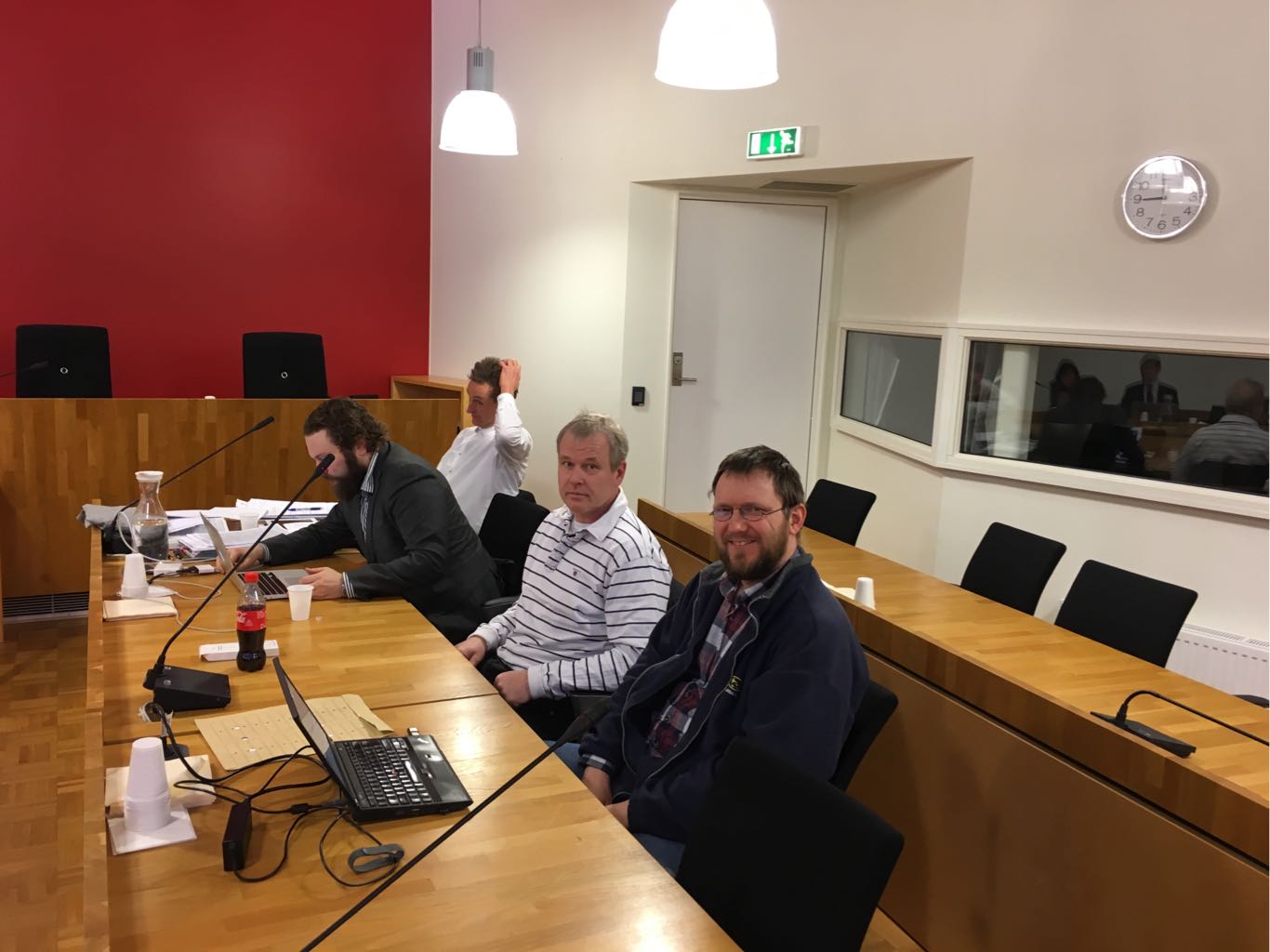
On Wednesday, I spent the entire day in court in Follo Tingrett representing the member association NUUG, alongside the member association EFN and the DNS registrar IMC, challenging the seizure of the DNS name popcorn-time.no. It was interesting to sit in a court of law for the first time in my life. Our team can be seen in the picture above: attorney Ola Tellesb , EFN board member Tom Fredrik Blenning, IMC CEO Morten Emil Eriksen and NUUG board member Petter Reinholdtsen. The case at hand is that the Norwegian National Authority for Investigation and Prosecution of Economic and Environmental Crime (aka kokrim) decided on their own, to seize a DNS domain early last year, without following the official policy of the Norwegian DNS authority which require a court decision. The web site in question was a site covering Popcorn Time. And Popcorn Time is the name of a technology with both legal and illegal applications. Popcorn Time is a client combining searching a Bittorrent directory available on the Internet with downloading/distribute content via Bittorrent and playing the downloaded content on screen. It can be used illegally if it is used to distribute content against the will of the right holder, but it can also be used legally to play a lot of content, for example the millions of movies available from the Internet Archive or the collection available from Vodo. We created a video demonstrating legally use of Popcorn Time and played it in Court. It can of course be downloaded using Bittorrent. I did not quite know what to expect from a day in court. The government held on to their version of the story and we held on to ours, and I hope the judge is able to make sense of it all. We will know in two weeks time. Unfortunately I do not have high hopes, as the Government have the upper hand here with more knowledge about the case, better training in handling criminal law and in general higher standing in the courts than fairly unknown DNS registrar and member associations. It is expensive to be right also in Norway. So far the case have cost more than NOK 70 000,-. To help fund the case, NUUG and EFN have asked for donations, and managed to collect around NOK 25 000,- so far. Given the presentation from the Government, I expect the government to appeal if the case go our way. And if the case do not go our way, I hope we have enough funding to appeal. From the other side came two people from kokrim. On the benches, appearing to be part of the group from the government were two people from the Simonsen Vogt Wiik lawyer office, and three others I am not quite sure who was. kokrim had proposed to present two witnesses from The Motion Picture Association, but this was rejected because they did not speak Norwegian and it was a bit late to bring in a translator, but perhaps the two from MPA were present anyway. All seven appeared to know each other. Good to see the case is take seriously. If you, like me, believe the courts should be involved before a DNS domain is hijacked by the government, or you believe the Popcorn Time technology have a lot of useful and legal applications, I suggest you too donate to the NUUG defense fund. Both Bitcoin and bank transfer are available. If NUUG get more than we need for the legal action (very unlikely), the rest will be spend promoting free software, open standards and unix-like operating systems in Norway, so no matter what happens the money will be put to good use. If you want to lean more about the case, I recommend you check out the blog posts from NUUG covering the case. They cover the legal arguments on both sides.
9 January 2017

Petter Reinholdtsen: Where did that package go? geolocated IP traceroute

Did you ever wonder where the web trafic really flow to reach the web servers, and who own the network equipment it is flowing through? It is possible to get a glimpse of this from using traceroute, but it is hard to find all the details. Many years ago, I wrote a system to map the Norwegian Internet (trying to figure out if our plans for a network game service would get low enough latency, and who we needed to talk to about setting up game servers close to the users. Back then I used traceroute output from many locations (I asked my friends to run a script and send me their traceroute output) to create the graph and the map. The output from traceroute typically look like this:
traceroute to www.stortinget.no (85.88.67.10), 30 hops max, 60 byte packets
 1  uio-gw10.uio.no (129.240.202.1)  0.447 ms  0.486 ms  0.621 ms
 2  uio-gw8.uio.no (129.240.24.229)  0.467 ms  0.578 ms  0.675 ms
 3  oslo-gw1.uninett.no (128.39.65.17)  0.385 ms  0.373 ms  0.358 ms
 4  te3-1-2.br1.fn3.as2116.net (193.156.90.3)  1.174 ms  1.172 ms  1.153 ms
 5  he16-1-1.cr1.san110.as2116.net (195.0.244.234)  2.627 ms he16-1-1.cr2.oslosda310.as2116.net (195.0.244.48)  3.172 ms he16-1-1.cr1.san110.as2116.net (195.0.244.234)  2.857 ms
 6  ae1.ar8.oslosda310.as2116.net (195.0.242.39)  0.662 ms  0.637 ms ae0.ar8.oslosda310.as2116.net (195.0.242.23)  0.622 ms
 7  89.191.10.146 (89.191.10.146)  0.931 ms  0.917 ms  0.955 ms
 8  * * *
 9  * * *
[...]
This show the DNS names and IP addresses of (at least some of the) network equipment involved in getting the data traffic from me to the www.stortinget.no server, and how long it took in milliseconds for a package to reach the equipment and return to me. Three packages are sent, and some times the packages do not follow the same path. This is shown for hop 5, where three different IP addresses replied to the traceroute request. There are many ways to measure trace routes. Other good traceroute implementations I use are traceroute (using ICMP packages) mtr (can do both ICMP, UDP and TCP) and scapy (python library with ICMP, UDP, TCP traceroute and a lot of other capabilities). All of them are easily available in Debian. This time around, I wanted to know the geographic location of different route points, to visualize how visiting a web page spread information about the visit to a lot of servers around the globe. The background is that a web site today often will ask the browser to get from many servers the parts (for example HTML, JSON, fonts, JavaScript, CSS, video) required to display the content. This will leak information about the visit to those controlling these servers and anyone able to peek at the data traffic passing by (like your ISP, the ISPs backbone provider, FRA, GCHQ, NSA and others). Lets pick an example, the Norwegian parliament web site www.stortinget.no. It is read daily by all members of parliament and their staff, as well as political journalists, activits and many other citizens of Norway. A visit to the www.stortinget.no web site will ask your browser to contact 8 other servers: ajax.googleapis.com, insights.hotjar.com, script.hotjar.com, static.hotjar.com, stats.g.doubleclick.net, www.google-analytics.com, www.googletagmanager.com and www.netigate.se. I extracted this by asking PhantomJS to visit the Stortinget web page and tell me all the URLs PhantomJS downloaded to render the page (in HAR format using their netsniff example. I am very grateful to Gorm for showing me how to do this). My goal is to visualize network traces to all IP addresses behind these DNS names, do show where visitors personal information is spread when visiting the page.

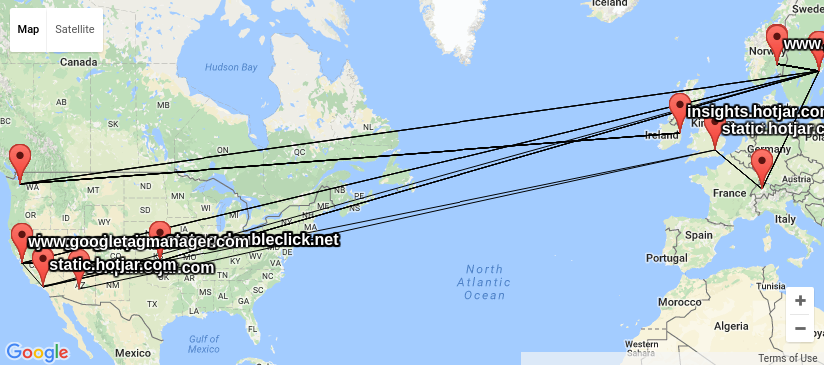
map of combined traces for URLs used by www.stortinget.no using GeoIP When I had a look around for options, I could not find any good free software tools to do this, and decided I needed my own traceroute wrapper outputting KML based on locations looked up using GeoIP. KML is easy to work with and easy to generate, and understood by several of the GIS tools I have available. I got good help from by NUUG colleague Anders Einar with this, and the result can be seen in my kmltraceroute git repository. Unfortunately, the quality of the free GeoIP databases I could find (and the for-pay databases my friends had access to) is not up to the task. The IP addresses of central Internet infrastructure would typically be placed near the controlling companies main office, and not where the router is really located, as you can see from the KML file I created using the GeoLite City dataset from MaxMind.

scapy traceroute graph for URLs used by www.stortinget.no I also had a look at the visual traceroute graph created by the scrapy project, showing IP network ownership (aka AS owner) for the IP address in question. The graph display a lot of useful information about the traceroute in SVG format, and give a good indication on who control the network equipment involved, but it do not include geolocation. This graph make it possible to see the information is made available at least for UNINETT, Catchcom, Stortinget, Nordunet, Google, Amazon, Telia, Level 3 Communications and NetDNA.

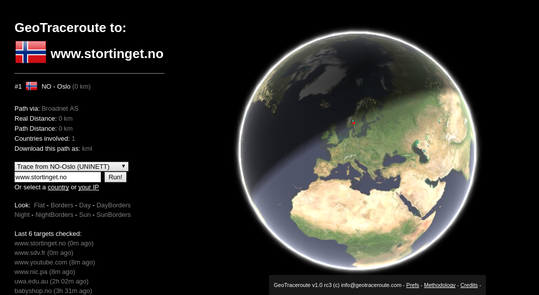
example geotraceroute view for www.stortinget.no In the process, I came across the web service GeoTraceroute by Salim Gasmi. Its methology of combining guesses based on DNS names, various location databases and finally use latecy times to rule out candidate locations seemed to do a very good job of guessing correct geolocation. But it could only do one trace at the time, did not have a sensor in Norway and did not make the geolocations easily available for postprocessing. So I contacted the developer and asked if he would be willing to share the code (he refused until he had time to clean it up), but he was interested in providing the geolocations in a machine readable format, and willing to set up a sensor in Norway. So since yesterday, it is possible to run traces from Norway in this service thanks to a sensor node set up by the NUUG assosiation, and get the trace in KML format for further processing.

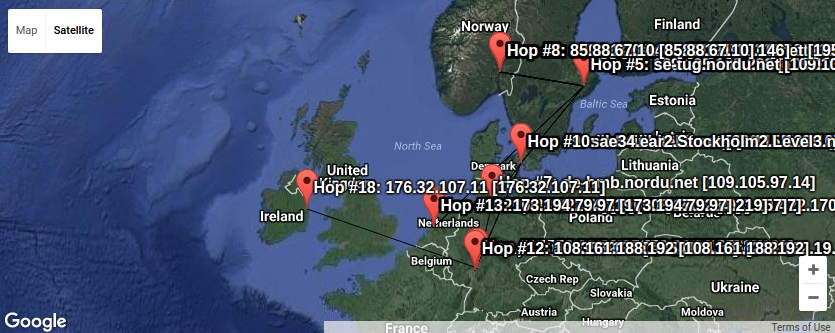
map of combined traces for URLs used by www.stortinget.no using geotraceroute Here we can see a lot of trafic passes Sweden on its way to Denmark, Germany, Holland and Ireland. Plenty of places where the Snowden confirmations verified the traffic is read by various actors without your best interest as their top priority. Combining KML files is trivial using a text editor, so I could loop over all the hosts behind the urls imported by www.stortinget.no and ask for the KML file from GeoTraceroute, and create a combined KML file with all the traces (unfortunately only one of the IP addresses behind the DNS name is traced this time. To get them all, one would have to request traces using IP number instead of DNS names from GeoTraceroute). That might be the next step in this project. Armed with these tools, I find it a lot easier to figure out where the IP traffic moves and who control the boxes involved in moving it. And every time the link crosses for example the Swedish border, we can be sure Swedish Signal Intelligence (FRA) is listening, as GCHQ do in Britain and NSA in USA and cables around the globe. (Hm, what should we tell them? :) Keep that in mind if you ever send anything unencrypted over the Internet. PS: KML files are drawn using the KML viewer from Ivan Rublev, as it was less cluttered than the local Linux application Marble. There are heaps of other options too. As usual, if you use Bitcoin and want to show your support of my activities, please send Bitcoin donations to my address 15oWEoG9dUPovwmUL9KWAnYRtNJEkP1u1b.

4 January 2017

Petter Reinholdtsen: Introducing ical-archiver to split out old iCalendar entries

Do you have a large iCalendar file with lots of old entries, and would like to archive them to save space and resources? At least those of us using KOrganizer know that turning on and off an event set become slower and slower the more entries are in the set. While working on migrating our calendars to a Radicale CalDAV server on our Freedombox server, my loved one wondered if I could find a way to split up the calendar file she had in KOrganizer, and I set out to write a tool. I spent a few days writing and polishing the system, and it is now ready for general consumption. The code for ical-archiver is publicly available from a git repository on github. The system is written in Python and depend on the vobject Python module. To use it, locate the iCalendar file you want to operate on and give it as an argument to the ical-archiver script. This will generate a set of new files, one file per component type per year for all components expiring more than two years in the past. The vevent, vtodo and vjournal entries are handled by the script. The remaining entries are stored in a 'remaining' file. This is what a test run can look like:
% ical-archiver t/2004-2016.ics 
Found 3612 vevents
Found 6 vtodos
Found 2 vjournals
Writing t/2004-2016.ics-subset-vevent-2004.ics
Writing t/2004-2016.ics-subset-vevent-2005.ics
Writing t/2004-2016.ics-subset-vevent-2006.ics
Writing t/2004-2016.ics-subset-vevent-2007.ics
Writing t/2004-2016.ics-subset-vevent-2008.ics
Writing t/2004-2016.ics-subset-vevent-2009.ics
Writing t/2004-2016.ics-subset-vevent-2010.ics
Writing t/2004-2016.ics-subset-vevent-2011.ics
Writing t/2004-2016.ics-subset-vevent-2012.ics
Writing t/2004-2016.ics-subset-vevent-2013.ics
Writing t/2004-2016.ics-subset-vevent-2014.ics
Writing t/2004-2016.ics-subset-vjournal-2007.ics
Writing t/2004-2016.ics-subset-vjournal-2011.ics
Writing t/2004-2016.ics-subset-vtodo-2012.ics
Writing t/2004-2016.ics-remaining.ics
%
As you can see, the original file is untouched and new files are written with names derived from the original file. If you are happy with their content, the *-remaining.ics file can replace the original the the others can be archived or imported as historical calendar collections. The script should probably be improved a bit. The error handling when discovering broken entries is not good, and I am not sure yet if it make sense to split different entry types into separate files or not. The program is thus likely to change. If you find it interesting, please get in touch. :) As usual, if you use Bitcoin and want to show your support of my activities, please send Bitcoin donations to my address 15oWEoG9dUPovwmUL9KWAnYRtNJEkP1u1b.

23 December 2016

Petter Reinholdtsen: Appstream just learned how to map hardware to packages too!

I received a very nice Christmas present today. As my regular readers probably know, I have been working on the the Isenkram system for many years. The goal of the Isenkram system is to make it easier for users to figure out what to install to get a given piece of hardware to work in Debian, and a key part of this system is a way to map hardware to packages. Isenkram have its own mapping database, and also uses data provided by each package using the AppStream metadata format. And today, AppStream in Debian learned to look up hardware the same way Isenkram is doing it, ie using fnmatch():
% appstreamcli what-provides modalias \
  usb:v1130p0202d0100dc00dsc00dp00ic03isc00ip00in00
Identifier: pymissile [generic]
Name: pymissile
Summary: Control original Striker USB Missile Launcher
Package: pymissile
% appstreamcli what-provides modalias usb:v0694p0002d0000
Identifier: libnxt [generic]
Name: libnxt
Summary: utility library for talking to the LEGO Mindstorms NXT brick
Package: libnxt
---
Identifier: t2n [generic]
Name: t2n
Summary: Simple command-line tool for Lego NXT
Package: t2n
---
Identifier: python-nxt [generic]
Name: python-nxt
Summary: Python driver/interface/wrapper for the Lego Mindstorms NXT robot
Package: python-nxt
---
Identifier: nbc [generic]
Name: nbc
Summary: C compiler for LEGO Mindstorms NXT bricks
Package: nbc
%
A similar query can be done using the combined AppStream and Isenkram databases using the isenkram-lookup tool:
% isenkram-lookup usb:v1130p0202d0100dc00dsc00dp00ic03isc00ip00in00
pymissile
% isenkram-lookup usb:v0694p0002d0000
libnxt
nbc
python-nxt
t2n
%
You can find modalias values relevant for your machine using cat $(find /sys/devices/ -name modalias). If you want to make this system a success and help Debian users make the most of the hardware they have, please helpadd AppStream metadata for your package following the guidelines documented in the wiki. So far only 11 packages provide such information, among the several hundred hardware specific packages in Debian. The Isenkram database on the other hand contain 101 packages, mostly related to USB dongles. Most of the packages with hardware mapping in AppStream are LEGO Mindstorms related, because I have, as part of my involvement in the Debian LEGO team given priority to making sure LEGO users get proposed the complete set of packages in Debian for that particular hardware. The team also got a nice Christmas present today. The nxt-firmware package made it into Debian. With this package in place, it is now possible to use the LEGO Mindstorms NXT unit with only free software, as the nxt-firmware package contain the source and firmware binaries for the NXT brick. As usual, if you use Bitcoin and want to show your support of my activities, please send Bitcoin donations to my address 15oWEoG9dUPovwmUL9KWAnYRtNJEkP1u1b.

20 December 2016

Petter Reinholdtsen: Isenkram updated with a lot more hardware-package mappings

The Isenkram system I wrote two years ago to make it easier in Debian to find and install packages to get your hardware dongles to work, is still going strong. It is a system to look up the hardware present on or connected to the current system, and map the hardware to Debian packages. It can either be done using the tools in isenkram-cli or using the user space daemon in the isenkram package. The latter will notify you, when inserting new hardware, about what packages to install to get the dongle working. It will even provide a button to click on to ask packagekit to install the packages. Here is an command line example from my Thinkpad laptop:
% isenkram-lookup  
bluez
cheese
ethtool
fprintd
fprintd-demo
gkrellm-thinkbat
hdapsd
libpam-fprintd
pidgin-blinklight
thinkfan
tlp
tp-smapi-dkms
tp-smapi-source
tpb
%
It can also list the firware package providing firmware requested by the load kernel modules, which in my case is an empty list because I have all the firmware my machine need:
% /usr/sbin/isenkram-autoinstall-firmware -l
info: did not find any firmware files requested by loaded kernel modules.  exiting
%
The last few days I had a look at several of the around 250 packages in Debian with udev rules. These seem like good candidates to install when a given hardware dongle is inserted, and I found several that should be proposed by isenkram. I have not had time to check all of them, but am happy to report that now there are 97 packages packages mapped to hardware by Isenkram. 11 of these packages provide hardware mapping using AppStream, while the rest are listed in the modaliases file provided in isenkram. These are the packages with hardware mappings at the moment. The marked packages are also announcing their hardware support using AppStream, for everyone to use: air-quality-sensor, alsa-firmware-loaders, argyll, array-info, avarice, avrdude, b43-fwcutter, bit-babbler, bluez, bluez-firmware, brltty, broadcom-sta-dkms, calibre, cgminer, cheese, colord, colorhug-client, dahdi-firmware-nonfree, dahdi-linux, dfu-util, dolphin-emu, ekeyd, ethtool, firmware-ipw2x00, fprintd, fprintd-demo, galileo, gkrellm-thinkbat, gphoto2, gpsbabel, gpsbabel-gui, gpsman, gpstrans, gqrx-sdr, gr-fcdproplus, gr-osmosdr, gtkpod, hackrf, hdapsd, hdmi2usb-udev, hpijs-ppds, hplip, ipw3945-source, ipw3945d, kde-config-tablet, kinect-audio-setup, libnxt, libpam-fprintd, lomoco, madwimax, minidisc-utils, mkgmap, msi-keyboard, mtkbabel, nbc, nqc, nut-hal-drivers, ola, open-vm-toolbox, open-vm-tools, openambit, pcgminer, pcmciautils, pcscd, pidgin-blinklight, printer-driver-splix, pymissile, python-nxt, qlandkartegt, qlandkartegt-garmin, rosegarden, rt2x00-source, sispmctl, soapysdr-module-hackrf, solaar, squeak-plugins-scratch, sunxi-tools, t2n, thinkfan, thinkfinger-tools, tlp, tp-smapi-dkms, tp-smapi-source, tpb, tucnak, uhd-host, usbmuxd, viking, virtualbox-ose-guest-x11, w1retap, xawtv, xserver-xorg-input-vmmouse, xserver-xorg-input-wacom, xserver-xorg-video-qxl, xserver-xorg-video-vmware, yubikey-personalization and zd1211-firmware If you know of other packages, please let me know with a wishlist bug report against the isenkram-cli package, and ask the package maintainer to add AppStream metadata according to the guidelines to provide the information for everyone. In time, I hope to get rid of the isenkram specific hardware mapping and depend exclusively on AppStream. Note, the AppStream metadata for broadcom-sta-dkms is matching too much hardware, and suggest that the package with with any ethernet card. See bug #838735 for the details. I hope the maintainer find time to address it soon. In the mean time I provide an override in isenkram.

11 December 2016

Petter Reinholdtsen: Oolite, a life in space as vagabond and mercenary - nice free software

In my early years, I played the epic game Elite on my PC. I spent many months trading and fighting in space, and reached the 'elite' fighting status before I moved on. The original Elite game was available on Commodore 64 and the IBM PC edition I played had a 64 KB executable. I am still impressed today that the authors managed to squeeze both a 3D engine and details about more than 2000 planet systems across 7 galaxies into a binary so small. I have known about the free software game Oolite inspired by Elite for a while, but did not really have time to test it properly until a few days ago. It was great to discover that my old knowledge about trading routes were still valid. But my fighting and flying abilities were gone, so I had to retrain to be able to dock on a space station. And I am still not able to make much resistance when I am attacked by pirates, so I bougth and mounted the most powerful laser in the rear to be able to put up at least some resistance while fleeing for my life. :) When playing Elite in the late eighties, I had to discover everything on my own, and I had long lists of prices seen on different planets to be able to decide where to trade what. This time I had the advantages of the Elite wiki, where information about each planet is easily available with common price ranges and suggested trading routes. This improved my ability to earn money and I have been able to earn enough to buy a lot of useful equipent in a few days. I believe I originally played for months before I could get a docking computer, while now I could get it after less then a week. If you like science fiction and dreamed of a life as a vagabond in space, you should try out Oolite. It is available for Linux, MacOSX and Windows, and is included in Debian and derivatives since 2011. As usual, if you use Bitcoin and want to show your support of my activities, please send Bitcoin donations to my address 15oWEoG9dUPovwmUL9KWAnYRtNJEkP1u1b.

25 November 2016

Petter Reinholdtsen: Quicker Debian installations using eatmydata

Two years ago, I did some experiments with eatmydata and the Debian installation system, observing how using eatmydata could speed up the installation quite a bit. My testing measured speedup around 20-40 percent for Debian Edu, where we install around 1000 packages from within the installer. The eatmydata package provide a way to disable/delay file system flushing. This is a bit risky in the general case, as files that should be stored on disk will stay only in memory a bit longer than expected, causing problems if a machine crashes at an inconvenient time. But for an installation, if the machine crashes during installation the process is normally restarted, and avoiding disk operations as much as possible to speed up the process make perfect sense. I added code in the Debian Edu specific installation code to enable eatmydata, but did not have time to push it any further. But a few months ago I picked it up again and worked with the libeatmydata package maintainer Mattia Rizzolo to make it easier for everyone to get this installation speedup in Debian. Thanks to our cooperation There is now an eatmydata-udeb package in Debian testing and unstable, and simply enabling/installing it in debian-installer (d-i) is enough to get the quicker installations. It can be enabled using preseeding. The following untested kernel argument should do the trick:
preseed/early_command="anna-install eatmydata-udeb"
This should ask d-i to install the package inside the d-i environment early in the installation sequence. Having it installed in d-i in turn will make sure the relevant scripts are called just after debootstrap filled /target/ with the freshly installed Debian system to configure apt to run dpkg with eatmydata. This is enough to speed up the installation process. There is a proposal to extend the idea a bit further by using /etc/ld.so.preload instead of apt.conf, but I have not tested its impact.

13 November 2016

Petter Reinholdtsen: Coz profiler for multi-threaded software is now in Debian

The Coz profiler, a nice profiler able to run benchmarking experiments on the instrumented multi-threaded program, finally made it into Debian unstable yesterday. Llu s Vilanova and I have spent many months since I blogged about the coz tool in August working with upstream to make it suitable for Debian. There are still issues with clang compatibility, inline assembly only working x86 and minimized JavaScript libraries. To test it, install 'coz-profiler' using apt and run it like this:
coz run --- /path/to/binary-with-debug-info
This will produce a profile.coz file in the current working directory with the profiling information. This is then given to a JavaScript application provided in the package and available from a project web page. To start the local copy, invoke it in a browser like this:
sensible-browser /usr/share/coz-profiler/viewer/index.htm
See the project home page and the USENIX ;login: article on Coz for more information on how it is working.

7 November 2016

Petter Reinholdtsen: How to talk with your loved ones in private

A few days ago I ran a very biased and informal survey to get an idea about what options are being used to communicate with end to end encryption with friends and family. I explicitly asked people not to list options only used in a work setting. The background is the uneasy feeling I get when using Signal, a feeling shared by others as a blog post from Sander Venima about why he do not recommend Signal anymore (with feedback from the Signal author available from ycombinator). I wanted an overview of the options being used, and hope to include those options in a less biased survey later on. So far I have not taken the time to look into the individual proposed systems. They range from text sharing web pages, via file sharing and email to instant messaging, VOIP and video conferencing. For those considering which system to use, it is also useful to have a look at the EFF Secure messaging scorecard which is slightly out of date but still provide valuable information. So, on to the list. There were some used by many, some used by a few, some rarely used ones and a few mentioned but without anyone claiming to use them. Notice the grouping is in reality quite random given the biased self selected set of participants. First the ones used by many: Then the ones used by a few. Then the ones used by even fewer people And finally the ones mentioned by not marked as used by anyone. This might be a mistake, perhaps the person adding the entry forgot to flag it as used? Given the network effect it seem obvious to me that we as a society have been divided and conquered by those interested in keeping encrypted and secure communication away from the masses. The finishing remarks from Aral Balkan in his talk "Free is a lie" about the usability of free software really come into effect when you want to communicate in private with your friends and family. We can not expect them to allow the usability of communication tool to block their ability to talk to their loved ones. Note for example the option IRC w/OTR. Most IRC clients do not have OTR support, so in most cases OTR would not be an option, even if you wanted to. In my personal experience, about 1 in 20 I talk to have a IRC client with OTR. For private communication to really be available, most people to talk to must have the option in their currently used client. I can not simply ask my family to install an IRC client. I need to guide them through a technical multi-step process of adding extensions to the client to get them going. This is a non-starter for most. I would like to be able to do video phone calls, audio phone calls, exchange instant messages and share files with my loved ones, without being forced to share with people I do not know. I do not want to share the content of the conversations, and I do not want to share who I communicate with or the fact that I communicate with someone. Without all these factors in place, my private life is being more or less invaded.

4 November 2016

Petter Reinholdtsen: My own self balancing Lego Segway

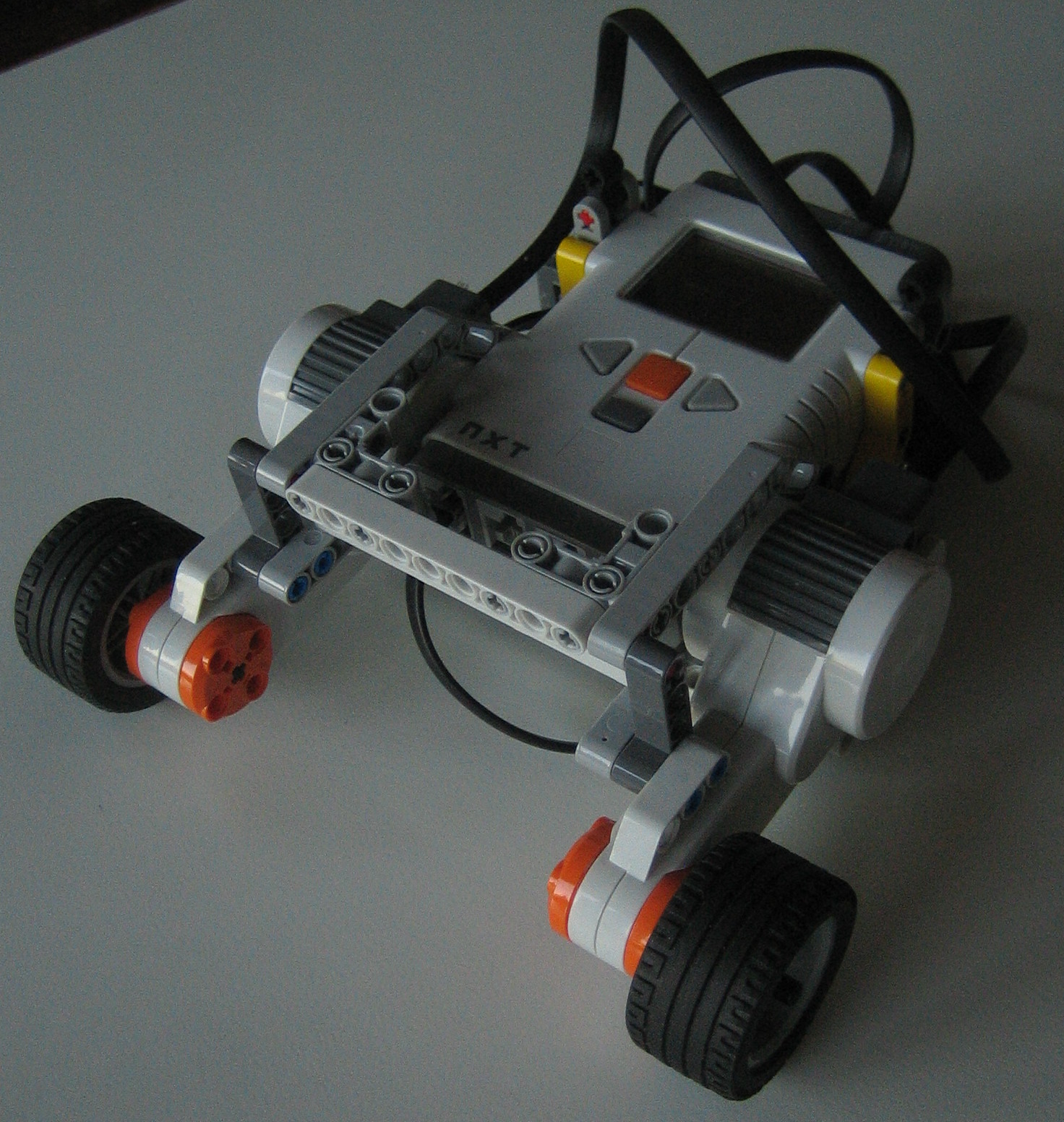
A while back I received a Gyro sensor for the NXT Mindstorms controller as a birthday present. It had been on my wishlist for a while, because I wanted to build a Segway like balancing lego robot. I had already built a simple balancing robot with the kids, using the light/color sensor included in the NXT kit as the balance sensor, but it was not working very well. It could balance for a while, but was very sensitive to the light condition in the room and the reflective properties of the surface and would fall over after a short while. I wanted something more robust, and had the gyro sensor from HiTechnic I believed would solve it on my wishlist for some years before it suddenly showed up as a gift from my loved ones. :) Unfortunately I have not had time to sit down and play with it since then. But that changed some days ago, when I was searching for lego segway information and came across a recipe from HiTechnic for building the HTWay, a segway like balancing robot. Build instructions and source code was included, so it was just a question of putting it all together. And thanks to the great work of many Debian developers, the compiler needed to build the source for the NXT is already included in Debian, so I was read to go in less than an hour. The resulting robot do not look very impressive in its simplicity:

Because I lack the infrared sensor used to control the robot in the design from HiTechnic, I had to comment out the last task (taskControl). I simply placed /* and */ around it get the program working without that sensor present. Now it balances just fine until the battery status run low:

Now we would like to teach it how to follow a line and take remote control instructions using the included Bluetooth receiver in the NXT. If you, like me, love LEGO and want to make sure we find the tools they need to work with LEGO in Debian and all our derivative distributions like Ubuntu, check out the LEGO designers project page and join the Debian LEGO team. Personally I own a RCX and NXT controller (no EV3), and would like to make sure the Debian tools needed to program the systems I own work as they should.

3 November 2016

Norbert Preining: Debian/TeX Live 2016.20161103-1

This month s update falls onto a national holiday in Japan. My recent start as a normal company employee in Japan doesn t leave me enough time during normal days to work on Debian, so things have to wait for holidays. There have been a few notable changes in the current packages, and above all I wanted to fix an RC bug and on the way fixed also several other (sometimes rather old) bugs.

texlive2016-debian From the list of new packages I want to pick apxproof: I have written something myself for one of my rather long papers (with proofs about 60pp), where at times I had to factor out the proofs into an appendix. I did this my own way, but I would have preferred to have a nice package! Another interesting change is the upstream merge of collection-mathextra (which translated to the Debian package texlive-math-extra) and collection-science (Debian: texlive-science) into a new collection collection-mathscience. Since introducing new packages and phasing out old ones is generally a pain in Debian, I decided to digress from the upstream naming convention and use texlive-science for the new collection-mathscience. In the end Mathematics is the most important science of all  Finally also a word about removals: Several ConTeXt packages have been removed due to the fact that they are outdated. These removals will find their way in an update of the Debian ConTeXt package in near future. The TeX Live packages lost voss-mathmode, which was retracted by the author due to various reasons. He is working on an updated version that will hopeful reappear in both TeX Live and Debian in near future. Well, that s it for now. Here now the full list with links. Enjoy. New packages apxproof, bangorexam, biblatex-gb7714-2015, biblatex-lni, biblatex-sbl, context-cmscbf, context-cmttbf, context-inifile, context-layout, delimset, latex2nemeth, latexbangla, latex-papersize, ling-macros, notex-bst, platex-tools, testidx, uppunctlm, wtref, xcolor-material. Removed packages voss-mathmode. Updated packages apa6, autoaligne, babel-german, biblatex-abnt, biblatex-anonymous, biblatex-apa, biblatex-manuscripts-philology, biblatex-nature, biblatex-realauthor, bibtex, bidi, boondox, bxcjkjatype, chickenize, churchslavonic, cjk-gs-integrate, context-filter, cooking-units, ctex, denisbdoc, dvips, europasscv, fixme, glossaries, gzt, handout, imakeidx, ipaex-type1, jsclasses, jslectureplanner, kpathsea, l3build, l3experimental, l3kernel, l3packages, latexindent, latexmk, listofitems, luatexja, marginnote, mcf2graph, minted, multirow, nameauth, newpx, newtx, noto, nucleardata, optidef, overlays, pdflatexpicscale, pst-eucl, reledmac, repere, scanpages, semantic-markup, tableaux, tcolorbox, tetex, texlive-scripts, ticket, todonotes, tracklang, tudscr, turabian-formatting, updmap-map, uspace, visualtikz, xassoccnt, xecjk, yathesis.

10 October 2016

Petter Reinholdtsen: Experience and updated recipe for using the Signal app without a mobile phone

In July I wrote how to get the Signal Chrome/Chromium app working without the ability to receive SMS messages (aka without a cell phone). It is time to share some experiences and provide an updated setup. The Signal app have worked fine for several months now, and I use it regularly to chat with my loved ones. I had a major snag at the end of my summer vacation, when the the app completely forgot my setup, identity and keys. The reason behind this major mess was running out of disk space. To avoid that ever happening again I have started storing everything in userdata/ in git, to be able to roll back to an earlier version if the files are wiped by mistake. I had to use it once after introducing the git backup. When rolling back to an earlier version, one need to use the 'reset session' option in Signal to get going, and notify the people you talk with about the problem. I assume there is some sequence number tracking in the protocol to detect rollback attacks. The git repository is rather big (674 MiB so far), but I have not tried to figure out if some of the content can be added to a .gitignore file due to lack of spare time. I've also hit the 90 days timeout blocking, and noticed that this make it impossible to send messages using Signal. I could still receive them, but had to patch the code with a new timestamp to send. I believe the timeout is added by the developers to force people to upgrade to the latest version of the app, even when there is no protocol changes, to reduce the version skew among the user base and thus try to keep the number of support requests down. Since my original recipe, the Signal source code changed slightly, making the old patch fail to apply cleanly. Below is an updated patch, including the shell wrapper I use to start Signal. The original version required a new user to locate the JavaScript console and call a function from there. I got help from a friend with more JavaScript knowledge than me to modify the code to provide a GUI button instead. This mean that to get started you just need to run the wrapper and click the 'Register without mobile phone' to get going now. I've also modified the timeout code to always set it to 90 days in the future, to avoid having to patch the code regularly. So, the updated recipe for Debian Jessie:
  1. First, install required packages to get the source code and the browser you need. Signal only work with Chrome/Chromium, as far as I know, so you need to install it.
    apt install git tor chromium
    git clone https://github.com/WhisperSystems/Signal-Desktop.git
    
  2. Modify the source code using command listed in the the patch block below.
  3. Start Signal using the run-signal-app wrapper (for example using pwd /run-signal-app).
  4. Click on the 'Register without mobile phone', will in a phone number you can receive calls to the next minute, receive the verification code and enter it into the form field and press 'Register'. Note, the phone number you use will be user Signal username, ie the way others can find you on Signal.
  5. You can now use Signal to contact others. Note, new contacts do not show up in the contact list until you restart Signal, and there is no way to assign names to Contacts. There is also no way to create or update chat groups. I suspect this is because the web app do not have a associated contact database.
I am still a bit uneasy about using Signal, because of the way its main author moxie0 reject federation and accept dependencies to major corporations like Google (part of the code is fetched from Google) and Amazon (the central coordination point is owned by Amazon). See for example the LibreSignal issue tracker for a thread documenting the authors view on these issues. But the network effect is strong in this case, and several of the people I want to communicate with already use Signal. Perhaps we can all move to Ring once it work on my laptop? It already work on Windows and Android, and is included in Debian and Ubuntu, but not working on Debian Stable. Anyway, this is the patch I apply to the Signal code to get it working. It switch to the production servers, disable to timeout, make registration easier and add the shell wrapper:
cd Signal-Desktop; cat <<EOF   patch -p1
diff --git a/js/background.js b/js/background.js
index 24b4c1d..579345f 100644
--- a/js/background.js
+++ b/js/background.js
@@ -33,9 +33,9 @@
          );
      );
 
-    var SERVER_URL = 'https://textsecure-service-staging.whispersystems.org';
+    var SERVER_URL = 'https://textsecure-service-ca.whispersystems.org';
     var SERVER_PORTS = [80, 4433, 8443];
-    var ATTACHMENT_SERVER_URL = 'https://whispersystems-textsecure-attachments-staging.s3.amazonaws.com';
+    var ATTACHMENT_SERVER_URL = 'https://whispersystems-textsecure-attachments.s3.amazonaws.com';
     var messageReceiver;
     window.getSocketStatus = function()  
         if (messageReceiver)  
diff --git a/js/expire.js b/js/expire.js
index 639aeae..beb91c3 100644
--- a/js/expire.js
+++ b/js/expire.js
@@ -1,6 +1,6 @@
 ;(function()  
     'use strict';
-    var BUILD_EXPIRATION = 0;
+    var BUILD_EXPIRATION = Date.now() + (90 * 24 * 60 * 60 * 1000);
 
     window.extension = window.extension    ;
 
diff --git a/js/views/install_view.js b/js/views/install_view.js
index 7816f4f..1d6233b 100644
--- a/js/views/install_view.js
+++ b/js/views/install_view.js
@@ -38,7 +38,8 @@
             return  
                 'click .step1': this.selectStep.bind(this, 1),
                 'click .step2': this.selectStep.bind(this, 2),
-                'click .step3': this.selectStep.bind(this, 3)
+                'click .step3': this.selectStep.bind(this, 3),
+                'click .callreg': function()   extension.install('standalone')  ,
              ;
          ,
         clearQR: function()  
diff --git a/options.html b/options.html
index dc0f28e..8d709f6 100644
--- a/options.html
+++ b/options.html
@@ -14,7 +14,10 @@
         <div class='nav'>
           <h1>  installWelcome  </h1>
           <p>  installTagline  </p>
-          <div> <a class='button step2'>  installGetStartedButton  </a> </div>
+          <div> <a class='button step2'>  installGetStartedButton  </a>
+	    <br> <a class="button callreg">Register without mobile phone</a>
+
+	  </div>
           <span class='dot step1 selected'></span>
           <span class='dot step2'></span>
           <span class='dot step3'></span>
--- /dev/null   2016-10-07 09:55:13.730181472 +0200
+++ b/run-signal-app   2016-10-10 08:54:09.434172391 +0200
@@ -0,0 +1,12 @@
+#!/bin/sh
+set -e
+cd $(dirname $0)
+mkdir -p userdata
+userdata=" pwd /userdata"
+if [ -d "$userdata" ] && [ ! -d "$userdata/.git" ] ; then
+    (cd $userdata && git init)
+fi
+(cd $userdata && git add . && git commit -m "Current status."   true)
+exec chromium \
+  --proxy-server="socks://localhost:9050" \
+  --user-data-dir=$userdata --load-and-launch-app= pwd 
EOF
chmod a+rx run-signal-app
As usual, if you use Bitcoin and want to show your support of my activities, please send Bitcoin donations to my address 15oWEoG9dUPovwmUL9KWAnYRtNJEkP1u1b.

7 October 2016

Petter Reinholdtsen: Isenkram, Appstream and udev make life as a LEGO builder easier

The Isenkram system provide a practical and easy way to figure out which packages support the hardware in a given machine. The command line tool isenkram-lookup and the tasksel options provide a convenient way to list and install packages relevant for the current hardware during system installation, both user space packages and firmware packages. The GUI background daemon on the other hand provide a pop-up proposing to install packages when a new dongle is inserted while using the computer. For example, if you plug in a smart card reader, the system will ask if you want to install pcscd if that package isn't already installed, and if you plug in a USB video camera the system will ask if you want to install cheese if cheese is currently missing. This already work just fine. But Isenkram depend on a database mapping from hardware IDs to package names. When I started no such database existed in Debian, so I made my own data set and included it with the isenkram package and made isenkram fetch the latest version of this database from git using http. This way the isenkram users would get updated package proposals as soon as I learned more about hardware related packages. The hardware is identified using modalias strings. The modalias design is from the Linux kernel where most hardware descriptors are made available as a strings that can be matched using filename style globbing. It handle USB, PCI, DMI and a lot of other hardware related identifiers. The downside to the Isenkram specific database is that there is no information about relevant distribution / Debian version, making isenkram propose obsolete packages too. But along came AppStream, a cross distribution mechanism to store and collect metadata about software packages. When I heard about the proposal, I contacted the people involved and suggested to add a hardware matching rule using modalias strings in the specification, to be able to use AppStream for mapping hardware to packages. This idea was accepted and AppStream is now a great way for a package to announce the hardware it support in a distribution neutral way. I wrote a recipe on how to add such meta-information in a blog post last December. If you have a hardware related package in Debian, please announce the relevant hardware IDs using AppStream. In Debian, almost all packages that can talk to a LEGO Mindestorms RCX or NXT unit, announce this support using AppStream. The effect is that when you insert such LEGO robot controller into your Debian machine, Isenkram will propose to install the packages needed to get it working. The intention is that this should allow the local user to start programming his robot controller right away without having to guess what packages to use or which permissions to fix. But when I sat down with my son the other day to program our NXT unit using his Debian Stretch computer, I discovered something annoying. The local console user (ie my son) did not get access to the USB device for programming the unit. This used to work, but no longer in Jessie and Stretch. After some investigation and asking around on #debian-devel, I discovered that this was because udev had changed the mechanism used to grant access to local devices. The ConsoleKit mechanism from /lib/udev/rules.d/70-udev-acl.rules no longer applied, because LDAP users no longer was added to the plugdev group during login. Michael Biebl told me that this method was obsolete and the new method used ACLs instead. This was good news, as the plugdev mechanism is a mess when using a remote user directory like LDAP. Using ACLs would make sure a user lost device access when she logged out, even if the user left behind a background process which would retain the plugdev membership with the ConsoleKit setup. Armed with this knowledge I moved on to fix the access problem for the LEGO Mindstorms related packages. The new system uses a udev tag, 'uaccess'. It can either be applied directly for a device, or is applied in /lib/udev/rules.d/70-uaccess.rules for classes of devices. As the LEGO Mindstorms udev rules did not have a class, I decided to add the tag directly in the udev rules files included in the packages. Here is one example. For the nqc C compiler for the RCX, the /lib/udev/rules.d/60-nqc.rules file now look like this:
SUBSYSTEM=="usb", ACTION=="add", ATTR idVendor =="0694", ATTR idProduct =="0001", \
    SYMLINK+="rcx-%k", TAG+="uaccess"
The key part is the 'TAG+="uaccess"' at the end. I suspect all packages using plugdev in their /lib/udev/rules.d/ files should be changed to use this tag (either directly or indirectly via 70-uaccess.rules). Perhaps a lintian check should be created to detect this? I've been unable to find good documentation on the uaccess feature. It is unclear to me if the uaccess tag is an internal implementation detail like the udev-acl tag used by /lib/udev/rules.d/70-udev-acl.rules. If it is, I guess the indirect method is the preferred way. Michael asked for more documentation from the systemd project and I hope it will make this clearer. For now I use the generic classes when they exist and is already handled by 70-uaccess.rules, and add the tag directly if no such class exist. To learn more about the isenkram system, please check out my blog posts tagged isenkram. To help out making life for LEGO constructors in Debian easier, please join us on our IRC channel #debian-lego and join the Debian LEGO team in the Alioth project we created yesterday. A mailing list is not yet created, but we are working on it. :) As usual, if you use Bitcoin and want to show your support of my activities, please send Bitcoin donations to my address 15oWEoG9dUPovwmUL9KWAnYRtNJEkP1u1b.

4 October 2016

Iain R. Learmonth: Decentralise (in a kind of centralised way)

Once a month I am involved in running an informal session, loosely affiliated with Open Rights Group and FSFE, called Cryptonoise. Cryptonoise explores methods for protecting your digital rights, with a leaning towards focusing on privacy, and provides a venue for like minded people to meet up and discuss the state of the digital landscape and those that may try to infringe on the rights of digital citizens. We ve all made it easy for large enterprises and governments to collect masses of data about our online activities because we perform most of those activities in the same place. Facebook, Google and Twitter spring to mind as examples of companies that have grown to dangerous sizes with little competition. This is not paranoia. This is real. We make it a lot more difficult when we spread out. Our meetups are held at 57North Hacklab and at the last meetup on the 29th September I set up a GNU Social instance for the members of 57North. GNU Social provides the same functionality as Twitter but as a decentralised federated network. Federation is a feature that is found in protocols like E-Mail, XMPP and SIP. It doesn t matter which server you re using, you can still talk to all the other users on all the other servers. While I m using social.57north.org.uk I can still follow FSF on status.fsf.org, for example, with no prior coordination with system administrators or anything complicated. It all just works. People have pointed out that I ve just introduced another point of centralisation but I don t see it necessarily as a bad thing. I think too many users in a single service starts to look dangerous but as long as user counts don t go too high I believe that the benefits of sharing the administrative workload (performing updates, monitoring, keeping the TLS cert current, etc.) far outweigh the effects of having a few extra users. I think 100 is probably about the maximum number I would be comfortable with, although I ll admit I ve not based this on anything and it s chosen arbitrarily. The jabber.ccc.de server is an example of a service that grew too large. It was set up by members of CCC and made available to all, but ended up becoming the de facto service for hackers. The jabber.ccc.de team have made appeals for others to set up their own servers, and you should. For a great overview and guide for setting up your own real-time commmunication servers, check out the RTC Quick Start Guide. This work was enabled by Shell who had previously set up a Central Authentication Service, which GNU Social already had a plugin to use as the authentication backend. No one likes to have a whole load of different passwords for different services and integration with this allows for identities to be consistent across the 57North services. She has also setup a Matrix homeserver, another step towards decentralisation and an end of reliance on centralised giants. If you have an account on a GNU Social instance, you can follow me here.

28 September 2016

Alessio Treglia: Emptiness and Form

Being_ParmenidesIn the perennial search of the meaning of life and the fundamental laws that govern nature, man was always faced for millennia with the mysterious concept of emptiness. What is emptiness? Does it really exist in nature? Is emptiness the non-being, as theorized by Parmenides?

Until the early years of the last century, technology had not yet been able to equip scientists with the necessary tools to investigate the innermost structure of matter, so the concept of emptiness was always faced with insights and metaphors that led, over the centuries, to a broad philosophical debate.

For the ancient atomist Greek philosophers, the existence of emptiness was not only possible but had become a necessity, becoming the ontological principle for the existence of being: for them, actually, the emptiness that permeates the atoms is what allows movement.

<Read More [by Fabio Marzocca]>

30 August 2016

Petter Reinholdtsen: First draft Norwegian Bokm l edition of The Debian Administrator's Handbook now public

In April we started to work on a Norwegian Bokm l edition of the "open access" book on how to set up and administrate a Debian system. Today I am happy to report that the first draft is now publicly available. You can find it on get the Debian Administrator's Handbook page (under Other languages). The first eight chapters have a first draft translation, and we are working on proofreading the content. If you want to help out, please start contributing using the hosted weblate project page, and get in touch using the translators mailing list. Please also check out the instructions for contributors. A good way to contribute is to proofread the text and update weblate if you find errors. Our goal is still to make the Norwegian book available on paper as well as electronic form.

Next.

Previous.