Search Results: "orv"

15 November 2008

Matthew Garrett: Adventures in PCI hotplug

I played with an Eee for a bit last time I was in Boston, culminating in a patch to make the eeepc-laptop driver use standard interfaces rather than just having random files in /sys that people need to write custom scripts to use. The world became a better place.

However. Asus implemented the rfkill control on the Eee in a slightly odd way. Disabling the wifi actually causes the entire card to drop off the bus, similar to how Bluetooth is normally handled. The difference is that the Bluetooth dongles are almost exclusively USB, while the Eee's wifi is PCI. Linux supports hotplugging of PCI devices, but nothing seemed to work out of the box on the Eee. Another case of this was the SD reader in the Acer Aspire One. Unless a card was present in the slot during boot, it simply wouldn't appear on the PCI bus. It turned out that Acer have implemented things in such a way that removing the card results in the entire chip being unplugged. This was when I started looking more closely into how this functionality is implemented.

The two common cases of PCI hotplug are native PCIe hotplug and ACPI mediated hotplug. In the former case, the chipset generates an interrupt when a hotplug event occurs and the OS then rescans the bus. This is a mildly complicated operation, requiring enabling the slot, checking whether there's a card there, powering the card and all its functions up, waiting for the PCIe link to settle and then announcing the new PCI device to the rest of the OS. ACPI-mediated hotplugging puts more of the load on the firmware rather than the OS - the hotplug event generates a notify message that is caught by the ACPI interpreter in the OS, allowing the OS to check for device presence by calling another ACPI method. If the device is present it's then a simple matter of telling the PCI layer about it.

Native PCIe hotplug has the advantage that there's much less vendor code involved. ACPI is still involved to an extent - an _OSC method on the PCIe bridge is called to allow the OS to tell the firmware that it supports handling hotplug events. This allows the firmware to stop sending any ACPI notifications. ACPI hotplugging requires more support in the firmware, but can work for PCI as well as PCIe.

The general approach taken to getting the Eee's wifi hotplugging to work has been to load the pciehp driver with the pciehp_force=1 argument. This tells the driver to listen for hotplugging events even when there's no _OSC method to tell the firmware that the OS is handling things now. Since the hardware will generate the event anyway, things work. However, this is non-ideal. Some hardware exists where ACPI hotplugging will work, but due to quirks in the hardware design native PCIe hotplugging control will fail. This has been handled in their firmware by having the _OSC method fail, signalling to the pciehp driver that it shouldn't bind to the port. Using pciehp_force overrides that, leading to a situation where hardware could potentially be removed from a port that's powered up. Unfortunate.

My first approach was to add a new argument to pciehp called pciehp_passive. This would indicate to the pciehp driver that it should only listen for notifications from the hardware. User-triggered events would not be supported, avoiding the situation where anyone could remove the card by accident. This worked on my test machine (an Eee 901 somewhere in Ottawa, since I don't actually have one myself...) but was reported to work less well on a 700. Since the 700 didn't claim to have any support for power control, the code was forced to wait a second on every operation to see whether the link powered up or not. This resulted in long pauses during boot and suspend/resume operations.

The final issue that convinced me that this was the wrong approach was reading a document on Microsoft's site on how PCIe hotplugging is implemented in Windows. It turns out that XP doesn't support native PCIe hotplugging at all - that feature was added in Vista. Both the Eee and the Aspire One are available with XP, but things work there. So PCIe native hotplugging was clearly not the right answer. Time to look further.

Armed with a disassembly of the Aspire One's DSDT, I figured out why the ACPI hotplug driver didn't work on it. The first thing the driver does is walk the list of ACPI devices, looking for any that are removable. That was being implemented by looking for an _EJ0 method. _EJ0 indicates that the device can be ejected under the control of the OS. The Aspire One doesn't have an _EJ0 method on its SD readers. However, it did have an _RMV method. This can be used to indicate that a device is removable but not ejectable - that is, the device can be removed (by physically pulling it out or by the hardware taking it away itself), but there's no standard way to ask the OS to logically disconnect it. A quick patch to acpiphp later and the Aspire One now worked without any forcing or spec contravention. This also has the nice side effect of making expresscard hotplug work on a bunch of machines where it otherwise wouldn't.

But back to the Eee. acpiphp still wasn't binding, and a closer examination revealed why. There's nothing to indicate that the Eee's ports are hotpluggable, and there's no topological data in the ACPI tables that ties the wifi function to the PCIe root bridges. However, the Eee firmware was sending an ACPI notification on wifi hotplug. But it was only sending this to the PCIe root bridges, and there's no way to then tell which device had potentially appeared or vanished.

In the end, I gave up on trying to solve this generically. Instead I've got a patch that implements the hotplugging entirely in eeepc-laptop. In an ideal world nobody else will have implemented this in the same way as Asus and we can all be happy.

24 October 2008

Biella Coleman: Hacker practice: Moral genres and the cultural articulation of liberalism

So I usually don’t announce my publications on my blog and for various reasons. The main one is that I am more than a little embarrassed that some of them are behind walled gardens (but being I am a junior prof, I am not in a position to negotiate otherwise). Otherwise, some of my pieces are semi-jargony (in the academic sense) and may not be of interest to readers who I think are more geek than academic. Finally, the process of publishing is so slow, so long, and so painful, I try not to think about it, much less write about it, if I can help it. But I decided to announce this
piece , which is on hackers (surprise surprise) as it might be of interest to some readers and because people can download it for free here for the rest of the month (but registration is required ) Co-written with Alex Rex Golub, I am pretty happy to see in print although it is far more academic in its tone, argument, and language than most of everything else I have written. This is in part because the article is more theoretical than ethnographic (hence the journal, Anthropological Theory) and tackles the question of liberalism alongside hacking. It seeks to demonstrate that these can be talked about 1) together and in cultural terms 2) that we we can identify some cohesive elements to hacking and liberalism, in part by placing them in conversation with each other 3) and yet we can also locate plurality and diversity within liberalism and hacking as well. This is a lot to tackle and cover in one piece under 35 pages and I am sure it could have been pulled off better but I think it is is a decent start to thinking about these questions. If you are interested but are allergic to academicalese, sticking to the Introduction, the Hacker Ethical Practice: Three Examples section, and Conclusion, will give you a taste of the arguments while avoiding most of the jargon. The irony of this article is that even if it hits at some pretty theoretical issues, it was provoked by a mundane conversation and disagreement I had with one hacker, Karl Fogel, over another hacker, Kevin Mitnick. After returning from the hacker conference, HOPE, I had dinner with Karl and told him about Kevin Mitnick’s keynote speech, which I found particularity enjoyable and entertaining. After calling Mitnick a hacker, Karl responded with the following: Kevin is not hacker. He is a cracker. Though I think I convinced him that cracker may not be the best word for him (and he convinced me there are differences between hacking, noting perceptively that his primary motivation seemed to be getting access to something he wasn’t allowed to have access to that is, it was more about breaking the rules and the thrill of crossing a social line, than about learning a technical system. ), I decided that I wanted to write a piece that squarely addressed tensions and differences among hackers instead of whitewashing them away as most authors, journalist, and even some hackers do.
Although most of the time, it seems like it is the Karl-type hackers who accuse the Mitnick-type hackers of not being true and authentic, recently I have been in a few situations where the tables were turned. For example, last year I was having coffee with a 2600-type who insisted that hacking on Linux was not hacking at all (not innovative enough, according to his world view). Another example I came across was in a recent Phrack issue where the prophiled hacker, the Unix Terrorist, takes a swipe at (well honestly at everyone and everythin) but when he is talking trash about who is and who is not a hacker, he singles out F/OSS developers:
Linus Torvalds isn’t a hacker! Richard Stallman isn’t a hacker! Niels Provos
isn’t a hacker! Fat/ugly, maybe! Hackers, no! And what is up with
the use of the term “cracker”? As far as I’m concerned, that term
applies to people that bypass copyright protection mechanisms.
Vladimir Levin? HACKER. phiber optik? HACKER. Kevin Mitnick? OK,
maybe a gay/bad one, but still WAS a “hacker.” Hope that’s clear.
Of course, one can play the game of defining the authentic hacking (and it makes sense for many to do this!) but my interest as an anthropologist has never been to draw a bright and clear boundary between good hackers and bad hackers. or “real and fake hackers,” but instead to describe and grapple with the tension points and internal ambiguities among hackers (my whole course is designed around this theme, in fact). This is not to say that anything goes in the world of hacking (that is, I don’t consider any computer break in a hack; I often just call it a crime) but if there is a group of people calling themselves hackers and thinking to some degree of the ethical implications of their actions, as an anthropologist, this is enough “social evidence” to start asking some questions about the political and cultural significance of their actions.

16 October 2008

Biella Coleman: Geeks and the Other Sex, again

I know this is on Planet already BUT I need to keep it for my own records on hacker humor (I have a chapter on this in my book) and well, it is good enough to have it show up 2x:
I occasionally send quotes that make me smile to Joey, but this time I can’t resist circulating it more widely… >
> Marek Vasut (1):
> i2c/tps65010: Vibrator hookup to gpiolib Guys, I know we geeks aren’t known for our sex-life, but do we have to
make it so obvious? (Linus Torvalds)

Mark Brown: If we build it they will come

It looks like the jack reporting API for ALSA which just got merged into the mainline kernel for inclusion in 2.6.28 already has its first user - code from Matthew Ranostay supporting the jack detection in Sigmatel HDA codecs was just queued for merge in the next merge window. Admittedly, the jack reporting API has been available in ALSA git since July but it does look like it is just impressively fast adoption after the mainline merge. Still, a long way to go before user space can start to rely on knowing if things are plugged in or not.

Adrian von Bidder: Geeks and the other sex?

I occasionally send quotes that make me smile to Joey, but this time I can't resist circulating it more widely...
> 
> Marek Vasut (1):
>       i2c/tps65010: Vibrator hookup to gpiolib
Guys, I know we geeks aren't known for our sex-life, but do we have to 
make it so obvious?
(Linus Torvalds)

3 October 2008

Christian Perrier: Why I think Foss.in/2008 is missing its target..

(long post, you've been warned) With his his 'Omelette Post' about FOSS.IN/2008 Call for Participation, Atul Chitnis, the FOSS.IN team 'leader' indeed sent an strong sign. For those who aren't aware of it, FOSS.IN is the longstanding major FLOSS event in India and, still (just like our beloved Debconf) only run by volunteers. Last year, along with Sam Hocevar, I had the chance to attend the event and share the groove of that big, huge, conference, with over 2,000 participants. Some other Debian fellows also made it in the past (Jaldhar, Bdale...). During the Debian Project Day as well as regular conference days, we had the great opportunity to meet with the people who currently participate in Debian (and Ubuntu) in South Asia, as well as first meeting some major contributors from other projects. For me, and, I think, of all people I met up there, this was a great *and productive* event. Maybe not productive at the moment it happened, but productive in terms of mutual awareness, knowledge and friendship. All people who attended such conferences (should I say "Debconf" or "FOSDEM"?) know what I'm talking about. The conference was still quite focused on "real" FLOSS contribution more than evangelizing or politics. And I think it succeeded in it quite well. This year, I already planned to not attend...mostly because such event, with the associated long travel time, is something I can't really fit in my real life right now. Also, because it conflicts with a planned Extremadura work session, indeed. Still, I would indeed not have attended it. Atul's post makes it clear: the even will only be about coding. The point is to put focus on people who code and we do 'real' code. Bug fixing is not coding. Translation effort is not coding. Work on support for complex languages is not coding. Actually, what FOSS.IN/2008 organizers are trying to do is a kind of big Debcamp. I'm afraid it won't work this way. From what I have seen in years of participation to Debian, things just don't come up this way. People don't sit down and code because they're invited to. And, still, are only "people who code" the only people that matter in a project? Debian is sometimes seen as one of the biggest FLOSS projects all around (probably shared with the Linux kernel). How many people in Debian just "sit down and code"? What about those people who maintain our web site, our archive, setup our infrastructure, our new maintainer queue, our communication channels? What about those dozens of people who nicely maintain packages and keep the link with upstream developers, or fix bugs.... Those people do not seem welcomed at FOSS.IN/2008. "Not only bug fixing" is said in this announcement. This, I don't get it. At all. Why would "bug fixing" be second class work? Why would it be more noble to "code" new stuff? Maybe Atul did not mean to say this. He wants to have Indian contributors in FLOSS to be more visible....but I don't share this. Indian contributors in Debian *are* visible. Giridhar Appaji Nag is visible, "my" translator crew is visible, Kartik Mistry is visible (he once was too visible, even, by maintaining a little bit too many packages...). Bug fixing is the most noble task I see in FLOSS development. This is what we need the most. I recently blogged about how I feel APT to be 'poorly' maintained (once again, that was not targeted to current APT maintainers). What I would respect deeply is to see a bunch of Indian contributors stand up and take this task over. Atul, that would certainly not be "outsourcing code/package maintenance" and, no, these are not things one can get involved with instantly. Really, I don't buy this vision and that saddens me. That saddens me mostly because I know the folks there. I know the FOSS.IN organizers and I have deep respect for them. I just think they're missing the target and are too ambitious: one cannot change an event so drastically by just saying it has to change..:-) And, really, I'm even more sad to see localization work be called a low-hanging fruit from a country where there are 22 official languages. Or take words such as "talk is cheap, show me the code" as $ DEITY 's Holy Word just because it was once said by Linus Torvalds (who said many stupid things). Code is just one part of FLOSS development. Certainly one of the important parts but still one part. What would have happened to FLOSS if only "coders" had been working on it all over those years? It would be something used by about 10,000 people all around the world, that's all. We should not make an opposition between those who code and those who don't. By the way, do *I* code? When I'm sitting at 07:00AM on a Saturday morning, hacking on Samba packages and try to have Samba 3.2.4 built with the set of patches we have on Debian....do I code? I'm not *producing* code....the code was produced by those wonderful Samba Team folks. Does Karolin Seeger code when she's releasing samba with such a precise and constant schedule as she's doing since early 2008? Or Ana Guerrero when she (not alone!) compiles dozens of KDE packages and organizes and bumps the maintenance of KDE in Debian for the best of our users. Or Miriam Ruiz when she picks up each and every possible free game and tries to get it in Debian, talks with upstream developers, help them to fiw their code to suit the severe requirements of the Debian policy? Or Clytie Siddall when she translates about every major FLOSS in Vietnamese (nor URL here, sorry)? All these folks are part of the FLOSS game. You want Indians to be part of FLOSS game? Then allow the potential Karolin, Ana, Miriam or Clytie to be part of Indian FLOSS game and don't try to make FOSS.in the place where you seek the future Indian Linus Torvalds and only him her. Talk is cheap, show me the contribution.

23 August 2008

Daniel Burrows: Package Management Sudoku 2

I got several emails in reply to my previous post on representing Sudoku problems as package dependencies. Several people asked about the algorithm that aptitude uses to solve these problems. A slightly out-of-date discussion package management and the aptitude algorithm can be found at http://people.debian.org/~dburrows/model.pdf. One question was interesting enough to deserve a follow-up blog post: Wolf T. referred to the page http://norvig.com/sudoku.html and asked how long it would take aptitude aptitude to solve the hard Sudoku problems on that page. He suspected that aptitude would do basic constraint propagation and then be forced to exhaustively search all the possible solutions to the problem. In brief: the answer is that it doesn't work by default, but not for the reason he suggested, and you can make it work with a few command-line arguments. In order to try this out you'll need a new version of the Sudoku reducer that can parse the problems on that Web page: debsudoku2.py. If I do a straight conversion of one of those problems and then run it through aptitude, it goes spinning off and never comes back. But aptitude is coded to avoid exhaustive searches; otherwise it couldn't solve dependency problems in reasonable amounts of time. In this particular situation, though, aptitude is clearly performing an exhaustive search; here's one series of status outputs:
open: 5124; closed: 4993; defer: 0; conflict: 374
Resolving dependencies...
open: 10090; closed: 9942; defer: 0; conflict: 398
Resolving dependencies...
open: 14726; closed: 14888; defer: 0; conflict: 440
Resolving dependencies...
Here open is the number of partial solutions that aptitude wants to examine, and closed is the number that it's already examined. aptitude isn't making progress here and it isn't finding solutions; in fact, it's creating, on average, about two new partial solutions for every one it examines. Why is aptitude doing this? Its resolver isn't a brute-force algorithm; in fact, it looks remarkably like the Sudoku solver discussed at http://norvig.com/sudoku.html. On each step, aptitude takes a partial solution, picks one dependency, and resolves it by installing or removing a package. This is pretty much equivalent to filling in one not-filled-in cell; in fact, in the conflicts Sudoku reduction, it's exactly equivalent. There is one difference, though, and it stems from a difference in the problem domains of Sudoku and package management:
Not all dependency resolutions are created equal.
In Sudoku, any solution to the puzzle will do. Not so in package management; solving a dependency problem by removing every package on the system will produce a formally correct answer and a very unhappy user. Even results that are not utterly disastrous could be annoying to the user, so the resolver needs to somehow aim for good answers. The page on Sudoku solvers suggests sticking to whatever value you placed in a cell, unless that doesn't lead to any solutions at all. This is technically known as a depth-first search. The problem with taking this approach when resolving package dependencies is that an apparently safe choice can end up requiring undesirable actions later on (like removing large swathes of the system). For this reason, aptitude tries to strike a balance between sticking to its current line of reasoning, and abandoning it when it seems to be turning out badly (this makes it a form of best-first search). On typical Debian archives, the package relationships are simple enough that it's OK if aptitude does this from time to time; it makes the search a little more thorough (thus costly), but the ability to back out of questionable branches is very valuable. But it looks like when aptitude is applied to Sudoku puzzles, it has trouble settling on a single series of choices. It keeps thinking that the solutions are getting worse, so it backs up and tries another branch, but they don't look any better over there, so it backs up and tries another branch, and so on. The option Aptitude::ProblemResolver::StepScore sets how hard aptitude will try to stick to the same line of reasoning. Its default value is 70, which is reasonable for package archives, but turning it up to a large value such as 10000 will cause aptitude to use a straight depth-first search, just like the Sudoku page recommends:
$ aptitude -s -o 'aptitude::problemresolver::stepscore=10000' -o 'aptitude::auto-install=false' install puzzle
Setting auto-install to false is a workaround for another odd corner case/bug that happens to bite this Sudoku problem: for technical reasons, doing this lets aptitude know that it should avoid solutions that cancel the installation of puzzle. Otherwise you have to sit there telling it no for a bunch of solutions you aren't interested in. Future versions of aptitude will probably provide a way to explicitly give hints to the resolver. With these options, aptitude was able to solve the hard Sudoku puzzles that I gave it in anywhere from fifteen seconds to a minute and 47 seconds. In contrast, the straight Sudoku solver does 30 problems in a second. Why is aptitude so slow? Based on skimming debug traces and looking at the run-time behavior, I conjecture that there are several reasons:
  1. The aptitude search algorithm is very heavyweight. In the case where it takes over a minute, it only actually examines about 5,000 possible solutions. I don't know exactly where all this time is going, but I do know that the resolver does a lot of work on each step, for instance to try and detect dead ends that it hasn't reached yet. This is the conflicts counter that appears while the resolver is running. This pays off tremendously in terms of allowing aptitude to skip huge amounts of work (it may be why aptitude can solve Sudoku puzzles at all!), but it means that the resolver takes a long time for each potential solution it looks at.
  2. The Sudoku page suggests taking the cell with the fewest number of possible entries as the choice. I distinctly remember writing code to do this in aptitude, but it looks like I threw it out at some point or never committed it. I don't see why it should be any worse than the current approach, though (which is to pick an arbitrary dependency); maybe it just got misplaced at some point. Implementing this behavior decreased the time required to solve one puzzle from a minute and 45 seconds to just under a minute; I've committed this change to the post-lenny branch.
  3. The Sudoku resolver has the advantage of being able to very quickly identify illegal moves. aptitude's resolver can learn this information, but it takes time and it can't apply Sudoku-specific optimizations. For instance, the Sudoku solver knows exactly which values can be placed in a given cell at any time. aptitude has to actually consider each of the cells that's available as a possibility and prove to itself that, e.g., 4 and 6 can't be written in the same cell at the same time. And although it can learn this information, it takes time to do so and it takes time to see whether any of the past conflicts that it remembers are present in a given solution.
As I noted above, I've already checked in one change to the resolver's behavior. It might also be worth seeing what happens with a massive increase in StepScore, so I've pegged it at 10000 on my computer to see whether the results I get are noticeably worse. The third item above -- the fact that aptitude needs to do more work to understand which packages can't be installed -- is interesting. The Sudoku solver is very proactive about this: it keeps track at all times of which cell values are legal, and updates these sets every time it transitions. In contrast, aptitude constantly re-checks all the possible moves it could make to see which ones are currently legal. I think that the resolver's speed could be boosted a little by doing the following:
  1. Cache the currently legal solutions of each dependency at the time it's inserted into the queue.
  2. When a new search node is generated by resolving a dependency, drop the formerly legal moves that are knocked out (for instance, by installing a different version of the same package).
  3. Come up with a quick way of re-testing new conflicts (the global list of dead-ends) so that search nodes that are already in the queue can be checked against the conflicts that were added since they were queued.
These changes won't make aptitude able to solve problems that it couldn't solve before, or at least not very many of them, but they should make the resolver faster on every problem it encounters. However, I don't think I want to actually implement them. It would be tricky to confirm that the resolver got faster on real dependency problems (since it's normally almost instantaneous), the changes would make the resolver code more complex and fragile (less readable, less maintainable), and there's a real chance of breaking something. Unless there are cases where the resolver is currently too slow on real package archives that don't involve an exponential blowup, I'm going to shelve the idea for now.

14 August 2008

Eddy Petrișor: vga=what in lilo.conf for 1280x800 1440x1024

With the more frequent wide screen laptops using 1280x800 or something else like 1440x1280, most people would want the console in vesa mode to use the entire screen, not only 1024x768.

I was in that situation and wanted to know the "secret code" that was needed for that console mode since these modes for 1280x800 seem to be vendor specific and not a VESA standard. They are not present in the official documentation but can be found with a simple command:

hwinfo --framebuffer grep 1280x800

and pick one of those that makes sense for you. Add that to lilo.conf, run lilo (run etckeeper commit, if you use etckeeper) and reboot. Enjoy.

10 July 2008

Cyril Brulebois: SysRq trick

While building and testing LiveCDs, QEMU and VirtualBox can speed up development cycles until a bug is encountered: apt-get update hanging on a rename operation. Maybe aufs is at fault? Its author then asks for some data, including what happens when some SysRq keys are pressed. What they are is already quite extensively explained in Documentation/sysrq.txt (Linux sources), but I d like to point to a nice trick for people using emulation and virtualization tools (ever tried to send Ctrl+Alt+Delete to a virtual machine?):
# echo $letter > /proc/sysrq-trigger
where $letter is any of the supported SysRq keys. As an example:
# echo d > /proc/sysrq-trigger
# dmesg   tail -1
[558193.423427] SysRq : HELP : loglevel0-8 reBoot Crashdump tErm Full kIll
saK showMem Nice powerOff showPc show-all-timers(Q) unRaw Sync showTasks
Unmount shoW-blocked-tasks

16 June 2008

Edd Dumbill: We're all ops people now

Ten years ago, most of us wouldn't have dreamt we'd be managing terabits of storage, tens of megabits of bandwidth, arrays of network-distributed services. The height of a programmer's worry would likely be choice of UI toolkit or finding the right way to indent code, and the height of consumer concern deciding which room to put the new computer in. Now the problems associated with managing large networks are becoming real for everyone, right down to the consumer level. Stupendously large amounts of computing resource are available at an instant. Your household probably has more than a terabyte of storage already. Issues such as single sign-on are going to hit home over the next year, as networked computing and entertainment devices profilerate. Features such as Apple's Time Machine will be increasingly vital — software that makes traditionally gnarly sysadmin tasks consumer-friendly. The rebranding of .Mac into "Mobile Me" is also a step in this direction. The impact on developers As software developers, we also have to cope with the effects of this resource-richness. For small sums of money we can get access to large computing clusters, geographically redundant hosting services. Our programs have left the desktop and found their new home on the web. System administration issues loom large upon us, security concerns lurk auspiciously in the corners of our minds. Although the cost of infrastructure has dropped radically, other costs remain high and are going to stay that way. System administrators are not only grumpy, they demand high wages. Commercial software license fees spiral out of control: traditional per-CPU licensing models make little sense when you can quickly bring up tens of machines. The cost in power is already troubling large companies, and there's no reason to suspect the problems won't ripple down. Help is at hand from a variety of technologies. If they don't yet make massive resource management trivial, they at least make it possible. Some of these also inhabit the weird territory of being both the source of a problem and a solution at the same time: virtualization, for example. Distributed revision control systems Distributed revision control is a technology whose time has finally come in popular circles, thanks in part to Linus Torvald's Git system. DRCS has several important impacts on today's developer: All these trends lower the barrier to entry, increase collaboration and agility of development. You can the value of this as more software tools become free. Selling such tools is rapidly becoming a thing of the past, the advantages of sharing enable the developers at the sharp end to get their jobs done quicker. However, such increased agility and, well, messiness leave other problems to solve, which the next two technologies address. Virtualization Hardware-as-a-service, infrastructure-as-a-service, call it what you will. The ability to create what we used to call entire machines, pick them up and move them around the network is revolutionary, and it's something that will have a real impact on regular developers. The benefits are at several levels. Configuration management Computing is a zero-sum game, and despite our increased ability to create and distribute software, problems still exist. We just pushed them to the next level. In good part, this next level is the problem of configuration management. We now have networks and clusters of (virtual) machines, software so agile we need six decimal places to describe its revision levels, and network and authentication paths that are starting to tangle. How do we manage that? One thing developers crave is repeatability. That's why we love our makefiles, autoconf, Ant, rake and so on. It's the one time even the most imperative-minded programmer writes declarative code. We like to say "let the world be like this." Our new sprawling world lacks this feature, and the best of our old toolkits — .debs, RPMs — address things only at the level of packages in a single environment. So developers must look to the world of operations, a territory we probably thought we needn't enter. In this world the new "make" is called Puppet. You write recipes to describe how things ought to be, and Puppet will make it so. I've been spending some time digging into Puppet, and feel excited by the confidence it's giving me. Now my applications exceed single source trees, and single machines, it gives me the means to tie the whole together. This article was going to be solely about Puppet, but that will have to wait now for another time. It's likely you'll have played with virtual machines and distributed revision control, but have you tried Puppet yet? Give it a spin, and let your mind wander over the benefits for your organization and development approaches. Conclusions
For developers and users alike, our world is changing. Hardware, connectivity and increasingly software is becoming cheap or free. The solidity of the old things we put value on — real things you can touch like disks — is eroding. What really matters is our data, our creations, and their communication. If they don't quite yet exist in a universal "cloud" yet, they're certainly getting frisky. As vendors provide solutions for consumers to manage their new domestic infrastructure, developers must look to network-aware toolkits and operations techniques to manage and get the best from their emergent infrastructures. Also on this topic: Join the conversation about this post

3 May 2008

Ben Hutchings: Becoming a kernel developer

After a fair amount of clean-up, a lot of waiting for review, and some ruthless pruning, I and my colleagues at Solarflare finally got our net driver accepted for Linux 2.6.26. Meanwhile a larger version of the driver made it into Xen's Linux tree, along with dependent drivers to provide a secure fast path to the hardware from domU. Somewhere down the road we're going to have to resolve these two versions, but now I'm just pleased to have a working driver in-tree. There are some other changes I've worked on over the past few months: However, this is still only part of my work. My main task at the moment is to write more unit tests for our next NIC.

3 April 2008

Joachim Breitner: Distance Map Morpher

In my last blog entry, I was asking for algorithms to morph a picture so that contour lines would become circles. I then started to write some python/gtk/cairo code to actually visualize my thought. It came out relatively pretty, so I made the GUI around it usable (although far from nice, I guess) and put the current, early version in a darcs repostory (DarcsWeb browser available).
This is a screenshot (click for full version) of a map of my part of town, shamlessly stolen off the internet. The red shading shows the distance from the thick point of the graph the redder, the closer. On the right the image is morphed so that all points on a circle around the center have the same distance to it. The blue shape on the left and the blue circle on the right are points with distance 205.Below the user canCurrently, there is one algorithm to determine the distance of a point to the center: Travel along the graph to the most suitable edge, leave at the point closest to the target and then go crossroads , which comes at a greater cost.There are some things to do, most notable:Comments and patches are, as always, welcome. If you want to try it out make sure you have python2.5, pygtk and numeric-python installed.

22 February 2008

John Goerzen: Revisiting Git and Mercurial

Exactly one year ago today, I wrote about Git, Mercurial, and Bzr. I have long been interested in VCS, and looked at the three main DVCS systems back then.

A Quick Review

Mercurial was, and for the moment, remains, my main VCS. Bzr remains really uninteresting; I don't see it offering anything compelling that Mercurial or Git can't do. My Git gripes mainly revolved around its interface and documentation. Also, I do have Windows people using my software, and need a plausible solution for them, even though I personally do no development on that platform.

Ted Tso wrote his own article in reply to mine, noting that the Git community had identified many of the same things I had ans was working on them.

I followed up to Ted with:

... So if Ted's right, and a year from now git is easier to use, better documented, more featureful, and runs well on Windows, it won't be that hard to switch over and preserve history. Ted's the sort of person that usually is right, so maybe I should starting looking at hg2git right now.


So I guess that means it's time to start looking at Git again.

This is rather rambly, I know. It's late and I want to get these thoughts down before going to sleep...

Looking at Git

I started at the Git wikipedia page for an overview of the software. It linked to two Google Tech Talks about Git: one by Linus Torvalds and another by Randal Schwartz. Of the two, I found Linus' more entertaining and Randal's more informative. Linus' point that CVS is fundamentally broken, and that SVN trying to be "a better CVS" (an early goal of svn, at least) means it too is fundamentally broken, strikes me as quite sound.

One other interesting tidbit I picked up is that git can show you where functions have moved from one file to another, thanks to its rename-detection heuristic. That sounds really sweet, and is the best reason I've yet heard for Git's stubborn refusal to track renames.

The Landscape

I've been following Mercurial and Darcs somewhat, and not paying much attention to Git. Mercurial has been adding small features, and is nearing version 1.0. Darcs has completed a major overhaul both of its repository format and internal algorithms and is nearing version 2.0, and appears to have finally killed the doppleganger (aka conflict spinlock) bug for good.

Git, meanwhile, seems to have made strides in usability and documentation in its 1.5.x versions.

One thing particularly interesting to me is: what projects are using the different VCSs. High-profile projects now using Mercurial include OpenSolaris, OpenJDK (Java 7), and Mozilla's projects. Git has, of course, the Linux kernel. It also has just about everything associated with freedesktop.org, including X. Also a ton of Unixy stuff.

Both Mercurial and Git communities are working on TortoiseHg/TortoiseGit types of GUIs for Windows users. Git appears to have a sane Windows port now as well, putting it on pretty much even footing with Mercurial and Darcs there. However, I didn't spot anything with obvious Windows ties in the Git "what projects use git" pages.

The greater speed of Mercurial and Git -- even for pushing and pulling small patches -- likely will keep me away from Darcs for the moment.

Onwards...

As time allows (I do have other things keeping me busy), I plan to install git and work through some tutorials and try to use it in practice as much as possible, to get a good feel for it.

Future

It is beneficial to be using a VCS that is popular, though that is certainly not a major criterion for me. I refuse to use SVN because its lack of distributed functionality makes it too unproductive to be useful. But it looks like Git is gaining a lot of traction these days, especially in Debian circles, which also makes it more interesting.

I notice that Ted did convert e2fsprogs over to git as he said he might, incidentally.

14 February 2008

Romain Francoise: So what's wrong with 1975 programming?

I enjoyed reading the ArchitectNotes on the Varnish wiki:
Take Squid for instance, a 1975 program if I ever saw one: You tell it how much RAM it can use and how much disk it can use. It will then spend inordinate amounts of time keeping track of what HTTP objects are in RAM and which are on disk and it will move them forth and back depending on traffic patterns.

Well, today computers really only have one kind of storage, and it is usually some sort of disk, the operating system and the virtual memory management hardware has converted the RAM to a cache for the disk storage.

So what happens with squid's elaborate memory management is that it gets into fights with the kernel's elaborate memory management, and like any civil war, that never gets anything done.
Varnish was designed by FreeBSD developer Poul-Henning Kamp. There is something to be said about user-space apps designed by kernel developers: they're always super fast because kernel developers know how to make the most of the system, having spent hours optimizing the kernel itself for some usage patterns.

This is why git (designed by Linus Torvalds, for those of you who've lived under a rock for the past three years) is so much faster than other comparable systems, for example. It uses tricks such as giving the O_NOATIME flag to open() to avoid updating access times on files where it knows that they don't matter, and it's a "huge time-saver". (Of course, you can also just mount your partitions with noatime and enjoy a similar performance boost in all applications!)

13 January 2008

Matthew Garrett

Neil:

The vast majority of your criticisms are unfounded. Nvidia contribute code to the open driver for their network hardware (see the commits) - you don't mention what version of Debian you're actually running, but if it's etch then it's hardly surprising that new hardware isn't supported terribly well. Try a more recent kernel. It's not clear what you expect HP to have done here - used older hardware to make sure Debian worked?

"the graphics don't work with standard Debian kernels and the standard Debian 'nv' driver" - this seems fairer. No 7000-series IDs have been added to the nv driver for some time, and 7150 is clearly missing. Naughty nvidia. No biscuit. But, again, hard to see what you wanted HP to do here - you bought a machine with an nvidia graphics chipset, and you're surprised that the open support is poor?

"I'll still need some firmware for the bcm43xx wireless card - and it is that firmware that made my previously ultra-reliable iBook into a flaky, power hungry psycho-beast." - no. Given that the firmware runs fine on non-Linux platforms, it's pretty clear that it's the (entirely open) driver that's at fault. Which is hardly surprising, given that it's had to be reverse engineered due to Broadcom providing no specifications whatsoever, but blaming vendors for using proprietary firmware is a bit much. Do you have the source for your CPU microcode? Your BIOS? The firmware that's in flash on your other wireless cards? Your hard drive? As a community, we haven't been sending a strong message to vendors that we want open firmware. Acting shocked that they then don't provide it is alarmingly unreasonable.

"GNOME doesn't yet work because of the proprietary crap" - the only proprietary crap you need is the graphics driver, and it's unlikely (though possible) that it's breaking GNOME. Perhaps you have another bug?

"I didn't think companies were still producing crap of this pitiful standard - HP: you stink" - this might at some level be linked to the fact that you paid 500 pounds, and as a result you got something made from cheap parts. That's not HP's fault. Their consumer hardware isn't designed to work with Linux. It's hardware that's designed to be as cheap and shiny as possible in order to appeal to home users who are then going to use it to download films and porn and animated mouse cursors in order to ensure that all their private data get sent to Russia. If it's supported by Linux then that's a happy coincidence. If not, then who cares?

Never mind. It's likely that your laptop is one of the machines that has some debugging hardware on io port 0x80, and as a result Linux's use of that as a delay port (despite the hardware's acpi tables claiming it as a motherboard resource) is likely to cause the machine to deadlock randomly if you do things like try to read the hardware clock or nvram. That's likely to cause you more problems than HP's use of Nvidia graphics.

29 December 2007

Enrico Zini: eeepc

Meet the EeePC Being in Taiwan, we swiftly got hold of an Eeepc. Instead of installing Debian into it, we decided to keep the original system and see how it works. It's a Debian derivative, and the feeling inside a terminal window is quite familiar. The boot is very fast. Two seconds after the video bios quickly shows on the screen, the X cursor appears. It's definitely worth having a look at how this devil boots. The "Asus Launcher" is worth a look. IMHO it's nicer and more useful than the usual launcher menu that we get in Gnome or KDE 3, although it probably only makes sense on a small display. It replaces the desktop background, has tabs, no clutter and allows to launch applications. Turns out it's customisable as well. What's on the system KDE 3.4.2, with some applications renamed so that their names are more human. For example, konsole became console. vim! \o/ But not emacs :) mc! Someone out there wanted to make my life easier. fbreader. I had never heard of it, but it's a very good discovery that I've now started to use it on my laptop as well. Little howtos To get to a terminal, hit Ctrl+T in the file manager, or Ctrl+Alt+T elsewhere. The root password is the same as the user password. To change the system language, I managed with a simple dpkg-reconfigure locales. Ways they simplified the unix system It's single user: I didn't find a way to create multiple users besides the terminal, and the login program does not ask for a username, only for the password. The "win" key has a house painted on it, and it's used as "hide/show all applications" key. When all applications are minimised, the Asus launcher is visible instead of the X background: this behaviour basically turns the key into a sort of "run application" key. The key still works as a kind of shift, although it probably was not intended to. The repository management is interesting. /etc/apt/sources.list contains:
deb http://update.eeepc.asus.com/p701 p701 main
deb http://update.eeepc.asus.com/p701/tw p701 main
which means they have a repository per eepc model and a subrepository per localised version. The "Internet" group of applications has a Wikipedia toplevel application: it's nice to see the ecosystem of free software / free culture coming together to provide a nice user experience. An extra link to the SD card mount point (besides the one in /mount) appears in the home directory automatically when the SD card is inserted. This means that when you do "save as" from all sorts of applications, the SD card is there, easy to reach. This helps if one decides not to use the internal flash for data, and just save everything in the SD card: I like doing this, as it allows me to quickly move the SD card with all the data between the EeePC and other computers. Changes I made so far Activate en_GB.UTF-8 via dpkg-reconfigure locales. Add en_GB.UTF-8 to /etc/scim/global, to get SCIM input methods to work. Little flaws Virtual screens are enabled, so W+arrow switches virtual screen. The feeling you get if you hit W+arrow is that all your applications disappeared. This could be improved by having the vm keep the asus launcher at the bottom of the current virtual screen, instead of just at the bottom of the first screen. Or, to disable virtual screens by default. It is possible to drag the lower panel around, maybe accidentally: that's another of our fancy default "features" that should be disabled by default. It is also possible to remove applets from the applet bar by mistake: for example I wanted to disconenct the wireless, and I instead ended up quitting the wireless applet. Luckily, the next time I started the computer it magically came back. ~/.xsession-errors is continuously getting the useless stdout/stderr debugging flood of GUI apps. Noone bothers usually, except that in this case the file is on flash, where unneeded writes are also very much unwanted. I'm considering symlinking it to /dev/null, but ideally we should get GUI apps to only write out what is really important. Battery charging doesn't show how long it is going to take until the battery is fully charged. No capslock or numlock leds. This probably calls for disabling or remapping of capslock. Numlock is very hard to hit by accident, but capslock is. Random thoughts If you buy an eeepc, I really suggest you think of it a mass consumption appliance and stay on the original OS for a while. Most of what's in here is what we use everyday, just on a different context. Try to use it as an appliance and see if it is perfect, and if it isn't, try to find out what is missing. It is a fantastic way to find out important bits that are missing in Debian as well. Also, if you're used to tailoring everything to yourself before starting to use a Linux system, this is a great way to try the usage experience that we can offer by default. The Firefox welcome page the first time you connect, for example, is surprisingly nice. Everything we know as doable comes a bit as as a surprise because this time someone has done it for us. I wish that that someone can be invited to talk at the next Debconf: the possibility of having a look at the work that has been done in bending Debian to this nice little device is to me one of the most valuable things so far about the eeepc. Help/About KDE/Credits It's reachable by most applications, and says:
The development team would like to thank the following people and organizations for their contributions:
  • the Debian Project,
  • the GNU Project,
  • the KDE Project,
  • the Mozilla Project,
  • the OpenOffice.org Project,
  • the SAMBA Project,
  • the X.Org Foundation,
Linus Torvalds and the other Linux kernel developers, and Free software developers around the world.
I'm using an appliance that is thanking me, and others like me: priceless!

3 December 2007

Michael Prokop: git[-svn] in 30 minutes

… or something like that… I planned to write a short note about how to start with using git-svn so I can provide a pointer to some of my colleagues. It turned out that git has too many nice features that you should be aware of. :) Hopefully my notes (now being a reference for myself as well, thx to gebi for all the help and feedback) are useful anyway. If you think something (more or less essential, or at least something most of us should be aware of) is missing: please feel free to mention that in the comment section of my blog entry, thanks. Disclaimer: I’m still happy with mercurial for what I - and we at grml in general - use it: linear, but anyway distributed development. git on the other hand provides some really nice features. Rebasing and branching with git is really great - so non-linear development just works. As usual: use the right tool for the right job. git is a bit complicate to use. Not only but especially in the beginning. On the other hand I’m not such a big friend of subversion. If you wanthave to use subversion (Graz University of Technology for example provides a svn service to their students and employees) but prefer to work with git instead you should be aware of git-svn. git-svn gives you bidirectional operation between subversion and git. First of all make sure you have all you might need when working with git. Make sure to use a current version of git (I’m refering to version >=1.5.3). Just execute the following command line on your Debian system to install all relevant packages:
aptitude install \
git-buildpackage git-core git-cvs git-daemon-run \
git-doc git-email git-gui git-load-dirs git-svn \
gitk gitweb qgit
Now let’s start with some general and basic configuration:
# Remove directories from the SVN tree if there
# are no files left behind, configure it globaly:
git config --global svn.rmdir=true
# Want some more global, personal git configuration?
for line in  
  user.name=Michael Prokop 
  user.email=foo@example.invalid 
  color.diff=auto 
  color.diff.new=cyan 
  color.diff.old=magenta 
  color.diff.frag=yellow 
  color.diff.meta=green 
  color.diff.commit=normal 
do
  git config --global $line
done
Check out man git-config for much more details about configuration options. First tip: set ‘g’ as an alias for git so you don’t have to type that much. I’ll write the long version in the following examples so copy/paste works for everyone. Make sure to use the short options of git itself as well: use ‘git co’ for example instead of ‘git checkout’. You can define your own aliases inside git as well - either manually in ~/.gitconfig or running something like:
git config --global alias.st status
Enough pre-configuration for now. It’s time to checkout the SVN repository:
# Check out the SVN repository and set 'svn/' as
# prefix for the branches:
git svn clone -s --prefix=svn/ \
https://svn.tugraz.at/svn/$project foobar && 
cd foobar
# Adjust svn:ignore settings within git:
git svn show-ignore >> .git/info/exclude
# List all branches:
git branch -a
# List all remote branches:
git branch -r
# Rebase your local changes against the
# latest changes in SVN (kind of 'svn up'):
git svn rebase
# Checkout a specific branch:
git checkout $branch
Ok so far? But what do we have to do if we want to work on the upstream source and are allowed to commit/push directly to the repository? Let’s see how to work on that without using branches:
# Hack:
$EDITOR foobar
# Check status
git st[atus]
# List diff:
git diff [foobar]
# Commit it with a commit message using $EDITOR:
git commit -a
# Now commit your changes (that were committed
# previously using git) to SVN, as well as
# automatically updating your working HEAD:
git svn dcommit
But what should we do if we do not have commit rights? Let’s create our own branch and send a patch via mail to upstream:
# Make a new branch:
git checkout -b mikas_demo_patch
# and hack...
$EDITOR
# Commit all changes:
git ci -a -m 'Best patch but worst commit msg ever'
# ... and prepare patch[es]:
git format-patch -s -p -n master
# Now send mail(s) either use git-send-email:
git send-email --to foo@example.invalid *.patch
# ... or if you prefer mutt instead (short zsh syntax):
for f in *.patch ; mutt -H $f
You got a mail from someone else and would like to incorporate changes from the attached patch in your repository? Just store the mail in a seperate mailbox (use save-message in mutt for example, keybinding ’s’ by default), then execute:
# Apply a [series of] patch[es] from a mailbox
git am /path/to/mailbox
Want to work on a seperate branch and rebase your work with upstream?
# First of all make sure to use recent sources...
# So pull when using plain git:
git pull -u
# .. or when using git-svn use:
git svn rebase
# Then create a new branch:
git checkout -b mika
# Hack:
$EDITOR
# Commit:
git ci -a -m 'Best patch but worst commit msg ever'
# Switch to master branch:
git checkout master
# Pull again when using plain git:
git pull -u
# .. or when using git-svn use:
git svn rebase
# Finally switch back
git checkout mika
# Now rebase it with plain git using:
git rebase origin/master
# ... or when using git-svn:
git svn rebase
# Now check out the last 5 commits:
git log -n5
Another branch-session might look like:
git co -b foo
$EDITOR
git ci -a -m 'foo changes'
git co master
git co -b bar
$EDITOR
git ci -a -m 'bar changes''
git co foo
git rebase bar
git log -n5
git st
git branch
Pfuhhh? Right. :) Now it’s time to check out another cool feature: git stash, which is just great when pulling into a dirty tree or when suffering from interrupted workflow. Demo:
git stash
git pull / fetch+rebase
$EDITOR # fix conflicts
git commit -a -m "Fix in a hurry"
git stash apply
git stash clear # unless you want to keep the stash
git reset rocks as well:
# List all recent actions:
git reflog
# Now undo the last action:
git reset --hard HEAD@ 0 
How to get rid of branches?
# Delete a branch. The branch must be fully merged:
git branch -d remove_me_branch
# Delete a branch irrespective of its index status:
git branch -D remove_me_branch
# Delete a remote branch:
git push reponame :branch
Repack a git repository to minimize its disk usage:
git pack-refs --prune
git reflog expire --all
git repack -a -d -f -l
git prune
git rerere gc
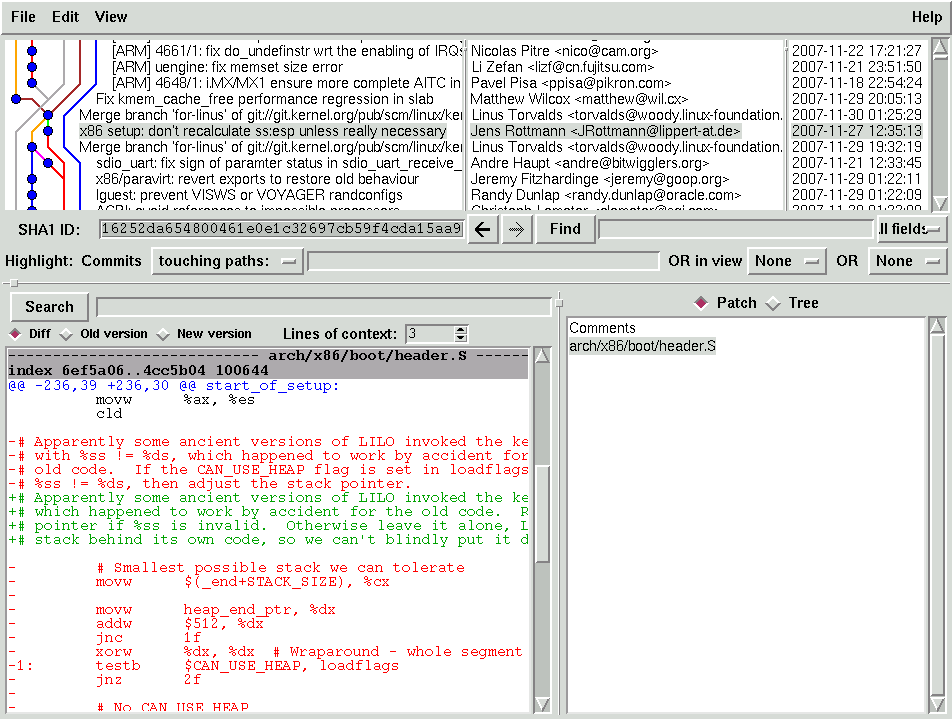
Use git cherry to find commits not merged upstream. Another really cool feature is the interactive rebasing: git rebase –interactive Make sure you are aware of gitk: Screenshot of gitk … and don’t forget to set readable fonts for gitk, like:
[ -r ~/.gitk ]   cat > ~/.gitk << EOF
set mainfont  Arial 10 
set textfont   Courier 10 
set uifont  Arial 10 bold 
EOF
If you prefer a Qt based interface check out qgit. Useful ressources:

8 November 2007

Miriam Ruiz: C and multithreading

Reading mig21’s weblog, in which I often find really interesting stuff, I found Ian Lance Taylor’s article “Single Threaded Memory Model“, which kind of bothers me a bit. It reports a recent discussion on the gcc and LKML mailing lists about how C compilers, gcc in this case, optimize for single threaded code, sometimes leading to counter-intuitive results which won’t work properly in multi-threaded software (leading, for example, to race conditions). The interesting part is that the C language standard, which in general describes a single threaded model, apparently says nothing about when values have to be written to memory. Thus, this kind of optimization seem to be perfectly valid. Linus Torvalds complains about gcc developers taking more care about “what the spec says” than about real problems, but the fact is that if those kind of optimizations are valid according to the specs, there’s no guarantee at all that it won’t happen with whatever C compiler you might be using. To prevent this kind of behaviour in standard C, according to Ian, the variable needs to be marked as volatile, or it needs to use an explicit memory barrier. The moral in this case is that multithreading might not be as easy as it seems and should be handled with caution.

14 October 2007

Martin F. Krafft: Converting a package to Git

Previously, I demonstrated a Debian packaging workflow using Git and I mentioned the possibility of a follow-up post; well, here it is: you want to use my workflow (or one that's related) for a package that is currently maintained with Subversion on svn.debian.org and you'd like to keep the history during the conversion. Make sure to read the previous post before this one. I am again using the example of mdadm since its Git packaging repository is in a state of shambles and I want to restart to get it right and import the history from the previous Subversion repository. What better way than to write a blog post as I do so? Well, plenty actually. This kind of post isn't really made for a blog, and I have started work on setting up ikiwiki on madduck.net, but it's not yet ready, so I'll stick with the blog for now. I will make sure that links don't break as I move content over, so feel free to bookmark this
Importing the package into Git Thanks to git-svn, the initial step of getting your package imported into Git is a breeze:
$ git-svn clone --stdlayout --no-metadata \
    svn+ssh://svn.debian.org/svn/pkg-mdadm/mdadm mdadm
Sit back and enjoy. If that command exits prematurely with an error such as the following:
Malformed network data: Malformed network data at /usr/local/bin/git-svn line 1029
then you should upgrade to a newer Git version, or have a look here. If your Git does not know --stdlayout then upgrade as well (or use -T trunk -t tags -b branches instead). Sam Vilain notes that it is important to "get the attribution right with the final SVN import - getting the authors map right. I didn't do that. If you look at the repository resulting from the above command, you'll notice strange commit authors, such as madduck@some-unique-uuid-from-svn . git-svn allows you to map these to real names with real email addresses, which ensures that the attributions are good for the whole world to see. When done, switch to the repository and run git-branch -r. As you'll see, git-svn imported all SVN branches and tags as remote branches. You need those if you want to bidirectionally track the Subversion repository, but we are converting, as you may have guessed by the --no-metadata switch above. Therefore, we resort to the Dinosaur method of converting branches to tags, which I'll simplify for mdadm. We also just delete all remote branches after tagging, since mdadm never used branches in the SVN repository. Your mileage may vary.
git branch -r   sed -rne 's, *tags/([^@]+)$,\1,p'   while read tag; do
  echo "git tag debian/$tag tags/$ tag ^; git branch -r -d tags/$tag"
done
git branch -r   while read tag; do
  echo "git branch -r -d $tag"
done
If that seems to work alright, then you can execute the commands. Sam Vilain (again) hints me at git-pack-refs and then to edit .git/packed-refs with an editor. This certainly leaves more room for errors but might be significantly faster.
Cleaning up the SVN references Even though we passed --no-metadata to git-svn, it did leave some traces in .git/, which we can now safely remove:
$ git config --remove-section svn-remote.svn
$ rm -r .git/svn
Setting things straight You can skip this section unless you want to know a bit about how to fix up stuff with Git. There was actually some nasty tagging errors leading up to the 2.5.6-9 release for etch and I could never be bothered to fix those in SVN, but now I can (I love Git!):
$ git tag -d debian/2.5.6-10            # never existed
$ git tag -f debian/2.5.6-8 2.5.6-8~2   # mistagged
$ git checkout -b maint/etch 2.5.6-8    # this is when we diverged
$ git apply < /tmp/mdadm-2.5.6-8..2.5.6-9.diff
$ git add debian/po/gl.po debian/po/pt.po debian/changelog
$ git commit -s
$ git tag debian/2.5.6-9
Now that that's fixed, there is one other thing to worry about, namely the very last commit to SVN, which obsoletes the repository and points to the Git repository. But that's not all of it. I was also silly enough to include a fix in the same commit. Let's see what Git can do. Since the process of obsoletion involves all but adding a file, we can simply --amend the last commit and provide a new log message:
$ git checkout master
$ git rm OBSOLETE debian/OBSOLETE
$ git commit --amend
Now the repository is in an acceptable state.
Making ends meet The pkg-mdadm effort on svn.debian.org only maintained the ./debian/ directory, separate from the upstream code, and boy was that a bad idea. Just to give one example: think about what's involved in preparing a Debian-specific patch against the upstream code this has to end, and we can make it end right here; let's import upstream's code (again not using his ADSL line, but the upstream branch of the pkg-mdadm Git repository; see the previous post for details):
$ git remote add upstream-repo git://git.debian.org/git/pkg-mdadm/mdadm
$ git config remote.upstream-repo.fetch \
    +refs/heads/upstream:refs/remotes/upstream-repo/upstream
$ git fetch upstream-repo
$ git checkout -b upstream upstream-repo/master
Now we have two unconnected ancestries in our repository, and it's time to join them together. The most logical way seems to be to use the last upstream tag for which we have a Debian tag: 2.6.2. For this, we branch off the corresponding Debian tag (2.6.2-1) and merge upstream's 2.6.2 tag into the new branch. This will be a temporary branch Then, we rebase (remember, nothing has been published yet) the master branch on top of this temporary branch, before we end that branch's short life. The Debian tag stays where it is since it describes the state of the repository at time of the release of 2.6.2-1.
$ git checkout -b tmp/join debian/2.6.2-1
$ git merge mdadm-2.6.2
$ git rebase tmp/join master
$ git branch -d tmp/join
It just so happens that the head of the SVN repository, which is identical to the tip of our master branch, corresponds to Debian release 2.6.2-2, so we tag it:
$ git tag debian/2.6.2-2
We are now also "born" in the sense that maintenance in Git has started. Let's mark that point in history. There is no real reason I can foresee for this yet, but nonetheless:
$ git tag -s git-birth
Turning dpatch files into feature branches We want to turn dpatch files into feature branches and we somehow make it "proper". We could branch, apply the patch, delete the patch file, checkout master and delete the patch file there as well, but that appears "improper" to me at least; so instead, we'll cherry-pick:
$ git checkout -b deb/conffile-location
$ debian/patches/01-mdadm.conf-location.dpatch -apply
$ git rm debian/patches/01-mdadm.conf-location.dpatch
$ git commit -s
$ git commit -s $(git ls-files --others --modified)
I should quickly intervene to make sure you are following. I am making use of Git's index here. Applying the patch makes the changes in the working tree, but we did not tell Git that we want those to be part of the commit just yet. Instead, we delete the dpatch with git-rm, which automatically registers the deletion with the index. Thus, the first git-commit creates a commit which deletes the dpatch, while the second git-commit creates a commit with all the changes from the dpatch, using git-ls-files to identify new and modified files. But for now, let's move on. We have two commits in the deb/conffile-location branch, and one of those is relevant to the master branch, we cherry-pick it:
$ git cherry-pick deb/conffile-location^
If you're confused, let me explain: our goal is to have a number of feature branches, of which master is the one in which most of ./debian/ is maintained. All the branches later come together in the long-living build branch, so deb/conffile-location will never be merged back into master. However, once we applied the dpatch to the feature branch, we can delete it from there and the master branch. By cherry-picking, we "import" the deletion to the master branch. I repeat the same procedure for deb/docs, merging all the documentation-related dpatches, but I'll spare you the details.
and then Git let me down In the next step, I found I had misunderstood Git merging: I thought Git was smart, but Linus had his reasons for calling Git the "stupid content tracker" (more on that later). Read on as I am obsoleting dpatch files that upstream had merged: 99-*-FIX.dpatch. For consistency, I wanted to cherry-pick each of the appropriate upstream commits into the master branch along with deleting the corresponding dpatch file. Here is one example: 99-monitor-6+10-FIX.dpatch was obsoleted by upstream's commit 66f8bbb; the -x records the original commit ID in the log:
$ git cherry-pick -x 66f8bbb
$ git rm debian/patches/99-monitor-6+10-FIX.dpatch
$ git commit -s -m"remove dpatch obsoleted by $(git rev-parse --short HEAD)"
I repeated the procedure for the other dpatch files, removed the dpatch infrastructure, and then went on to merge it all into build to build the package. The build branch is a long-living branch off upstream, but which upstream? I'll fast-forward you past a segfault problem with mdadm, which upstream (thought to have) resolved with commit 23dc1ae after 2.6.3, but he had not yet released 2.6.4. Looking at the commits between 23dc1ae and upstream's HEAD at the time, I decided to include them all and snapshot 4450e59:
$ git fetch upstream-repo
$ git checkout upstream
$ git merge upstream-repo
$ git tag mdadm-2.6.3+200709292116+4450e59 4450e59
$ git checkout master
$ git merge --no-commit mdadm-2.6.3+200709292116+4450e59
$ dch -v mdadm-2.6.3+200709292116+4450e59-1
$ git add debian/changelog
$ git commit -s
And then I called poor-mans-gitbuild, which merges master and then deb/* into build. Here is when stuff blew up. I'll make a long story short (read my description of the problem and Linus' answer if you want to know more): I thought Git was smart to identify merges common to both branches and do the right thing, but it turn out that Git does not care at all about commits, it only worries about content and the end result. In our case, unfortunately (or fortunately), the outcome meant a conflict because the upstream branch introduced a simple change (last hunk) in the lines surrounding the patch we cherry-picked, and Git can't handle it. The solution is not to cherry-pick, to cherry-pick all commits touching the context of the dpatch, or to simply merge upstream into all out feature branches. In our case, the first is the easiest solution and since importing dpatch files is a one-time thing (thank $DEITY), I'll leave it at that. Almost. I have spent two days thinking about this more than I should have. And it was this point Linus made which made me appreciate Git even more:
Conflicts aren't bad - they're good. Trying to aggressively resolve them automatically when two branches have done slightly different things in the same area is stupid and just results in more problems. Instead, git tries to do what I don't think anybody else has done: make the conflicts easy to resolve, by allowing you to work with them in your normal working tree, and still giving you a lot of tools to help you see what's going on.
The end This concludes today's report. Importing the changes from the old Git repo, tagging and merging the branches is all covered in my previous post, or at least you'll find enough information there to complete the exercise. I would like to specifically thank Sam Vilain and Linus Torvalds for their help in preparing this post, as well as the #git/freenode inhabitants, as always. If you are interested in the topic of using version control for distro packaging, I invite you to join the vcs-pkg mailing list and/or the #vcs-pkg/irc.oftc.net IRC channel. Also, if you are interested in Git in general, you can find a list of blog posts on the Git wiki. NP: The Police: Zenyatta Mondatta

Next.

Previous.