Search Results: "olly"

22 July 2011

Olly Betts: Xapian 1.3 Branched

(Actually, we branched six weeks ago, but I've not got around to writing about it until now.) The development branch approach we used for 1.1.x development releases leading to a stable 1.2.0 release seemed to work pretty well, so we're adopting that again. The main problem last time was that it took a long time to actually stabilise 1.1.x because we kept slipping more changes in. For 1.3.x, we need to be more disciplined and changes should be developed on a branch and not merged prematurely. We now have solid git mirroring, so developing on a branch is a more pleasant experience than before. We also need to be brutal sooner. It's better for everyone to (say) achieve two releases series in two years than have one release series take two years. When I was in the UK back in May, Richard and I sat down and hashed out a list of goals for a 1.4 release series. This is what we came up with (the order is just how they came to mind, so isn't really significant):
read more

9 July 2011

Wouter Verhelst: Freedom, continued

Okay, so the story continues: Joe Brockmeier has posted a rebuttal to Nina Paley's post that I commented on earlier today. Basically, Joe says that Culture is not the same things as Software, and gives a lot of arguments as to why this would be true. But I can't agree with him. Let's see why. His first argument is "One of these things is not like the other". As in,
But it's far more reasonable and sensible to discuss Perl scripts and software written in assembler embedded on a chip together, and the rights that they come with, than to try to talk about rights to modify sculpture and essays.
I don't see how one could combine a perl script with an embedded assembler program, except perhaps over a network, or by using exec() two cases in which the FSF would consider that they are not even derivatives anymore, they are "at arm's length", and it would be legal to do something like this if one bit was released under the GPL while the other was not. At the same time, it's possible to engrave (part of) an essay into a statue, for example. Or make a technical apparatus which looks like a statue but which will play music if you come near it. Both would be valid cases of some artist combining two separate and (at first sight) distinct things into one work.
Sure, you could crowdsource sculpture, but I doubt it will have much practical application. (And certainly difficult over the Internet, but I digress...)
It's called RepRap, and it's very much possible over the Internet. Joe moves on, with 'Unintended consequences of forkable prose'.
Take the GNU Manifesto, for example. If you could "fork" the manifesto, I could easily see variant versions modified to justify open source instead of free software.
This argument had been brought forward during the discussions which Debian had on the GFDL vote, and has been seriously debunked there. In short: the ability and right to fork someone's prose does not, in any way, give you the right to misrepresent them. While I believe it should be okay for someone to base a theoretical Open Source Manifesto on the GNU Manifesto, I do not believe it should be okay for them to still keep calling it the GNU Manifesto. It's not the same thing anymore, so that should be clear. This is true within Free Software as well: if you fork, you give it a new name, so it becomes clear that you're not the original anymore. Moreover, I doubt the kind of prose found in the GNU Manifesto is the same kind of prose that Nina would like to see in a free culture movement. Not because the GNU Manifesto is a bad piece of writing it isn't but because Free Culture likely focuses on other things than manifestos. Next, we get "Solving a problem that doesn't exist"
The spark that fired off the GNU revolution was a legitimate problem because of non-free code, a user was unable to make use of hardware they (or their university) legitimately owned.
(...)
While Paley and others may want the same freedoms to go with cultural works, it is not a real problem in the same sense.
Pardon ye me? I am a musician. Not a very brilliant one, mind you, but I play the flute with much enthusiasm, and have done so in a number of places. If you've been to any debconf since 2007, surely you must've heard me play. Also, I've been singing in choirs since I was sixteen which, I just realized, means I've now been singing for more than half my lifetime. Time flies, it must be said. One of the orchestra that I've been playing in was an extended flute choir with a rather unusual instrumentarium: apart from 30-something flautists, the orchestra also had a piano and drummer, a number of guitar players, and a bass guitar. Such an unusual set of music means you have three options: you play original music, written specifically for your group; you play something written for a different set of instruments, without changing anything, and hope nobody notices that it doesn't actually sound very well; or you make modifications. You make a derivative work of the music, so you can actually play it. There, I've said the word. This isn't just true for music; I've yet to see the first theatre performance that is true, word-for-word, to the original script. Also, movies use music all the time. When they do, there are usually two options: either they have original pieces of music written specifically for their movie (as is the case for most Hollywood blockbusters), or they take a piece of existing music, and adapt it so it fits the events in the movie better. By, say, shortening it, so it doesn't run into the next scene. Or by repeating the refrain an extra time, so the words line up nicely with the action. Or by having a group of musicians record a version of that piece specifically for your movie, which is the same thing in everything except the speed so that the feet of the actor walking on the big screen hit the ground in sync with the music. Or... well. You get the idea. By claiming that artists have no need to modify and derive from others, the only thing Joe accomplishes is to show that he really, really, really doesn't know what the fuck he's talking about. Artists have a need to modify other artists' works all the time. The only difference with free software is that they either need to invoke the fair use clause, or need to pay big bucks to the original rightsholder. Sound familiar? Joe finishes up with stating that despite all of that, Free Culture is still possible. And:
That doesn't mean that free culture is impossible. It simply means that different standards apply.
Exactly: different standards apply. And why? There is no good reason for that. Because people make money from cultural works? Well, money is made from software, too, that has never been a good enough reason. Because Culture is not functional? How many in the Free Software movement would even be willing to only be doing software all the time, and not ever do anything remotely related to Culture? None, I would say. Culture is just as functional as Software, it just serves different functions. In the comments, Joe clarifies that he isn't against people preferring not to use the ND clause in the CC licenses they select, he's just against demanding that others do the same. That argument would make sense if not for the fact that the FSF demands, mostly, that Software Should Be Free!!1!. By not complaining about the GNU Manifesto, but complaining about Paley's "Rantifesto", which basically complains about the lack of such an environment in the free culture movement, Joe just makes a fool of himself. Anyway, 'nuff said.

31 May 2011

Jamie McClelland: We need better metaphors

Most of us developers use metaphors to help convey an understanding of how our software works. Sadly, many developers choose the "master" and "slave" metaphor. Why would we voluntarily choose such an ugly human human interaction with a real and present history in many of our lives to describe software that we've written? I wouldn't rule out the possibility that someone will (or already has) invented software for which the master/slave metaphor aptly conveys its function, however, I'd prefer not to use it. Also, many people intentionally play with master/slave relationships because of the history and connotations it provokes. However, use of this metaphor in software like MySQL databases or Bind Name servers seems pointless, offensive and mis-leading. I've never seen the use of the master/slave metaphor in software that conveyed more than the idea that one piece of the software essentially controls, wholly or in part, another piece of software. So, why master/slave? There are many metaphors to choose from - parent/infant, boss/worker, guard/prisoner, king/subject, landowner/serf, top/bottom, etc. What does master/slave convey that the others don't convey? Or, maybe they all convey the same thing, so it doesn't make a difference which one you choose (after all, it's just a metaphor). In that case, how about replacing master/slave with the metaphor husband/wife? Whoops. Now that's offensive (if you don't think that's offensive you can stop reading here and please don't post any comments - I won't change your mind). But, that's different right? At one point in history, the role of the wife was to do as her husband says, but it's 2011, and we've evolved beyond that, so by using husband/wife we'd be re-enforcing that ugly, sexist stereotype. However, how is that different from master/slave? It is 2011 after all. Isn't the role of the master to abdicate and the role of the slave to revolt? Maybe that's why Bind has so many security problems...

15 May 2011

Steve Kemp: Images transitioned, and mysql solications.

Images Moved
So I've retired my old picture hosting sub-domain, and moved all the files which were hosted by the dynamic system into a large web-root. This means no more uploads are possible, but each link continues to work. For example: Happily the system generated "random" links, and it was just a matter of moving each uploaded file into that static location, then removing the CGI application. The code for the new site has now been made public, although I suspect there will need to be some email-pong if anybody wishes to use it. Comments welcome.
MySQL replacements?
Lets pretend I work for a company which has dealings with many MySQL users. Lets pretend that, even though it is true, such that I don't have to get into specifics. Let us pretend that we have many many hundreds of users who are very happy with MySQL, but that we have a few users who have "issues". That might be:
  • mysqld segfaulting every few months, with no real idea why.
    • Transactions are involved. So are stored proceedures.
    • MySQL paid support might have been perfect, or it might have lead to "yup, its a bug. good luck rebuilding with this patch. let us know how it turns out kthxbai."
    • Alternatively it might not have been re-producable.
  • Master-Master and Master-Slave setups being "unreliable" such that data inconsistencies arise despite MySQL regarding them as being in sync.
    • Good luck resolving that when you have two almost-identical "mysqldump" outputs which are 6Gb each and which cause "diff" to exit with "out of memory" even on a 64Gb host.
    • Is it possible to view differences in table-data, via the binary records? That'd be a fun project .. for a masochist.
  • Poor usage of resources.
  • Heavy concurrancy caused by poorly developed applications in a load-balanced environment, leading to stalling queries. (Wordpress + Poor wordpress plugins I'm looking at you; you're next on my killfile).
To compound this problem some of these installations may or may not be running Etch. let us pretend they are not, just to simplify things. (They mostly arent' these days, but I'm sure I could think of one or two if I tried) So, in this hypothetical situation what would you recommend? I know there are new forks aplenty of MySQL. Drizzle et al. I suspect most of the forks will be short-lived - lots of this stuff is hard and non-sexy. I suspect the long-lived forks are probably concentrating on edge-cases we've not hit (yet), or on sexy exciting things like new storage engines and going nosql like all the cool kids. Realistically going down the postgresql road is liable to lead to wholly different sets of problems, and a significant re-engineering of several sites, applications and tools with no proof of stability. Without wanting to jump ship entirely, what, if any, are our options?
PS. MySQL I still mostly love you, but my two most recent applications were written to use redis instead. Just a coincidence... I swear. No, put down that axe. Please can't we just talk about it?/p> ObQoote: "I've calculated your chance of survival, but I don't think you'll like it. " - Hitchhikers Film.

11 April 2011

Olly Betts: GSoC Proposal Status

There seems to be a lot of confusion amongst students as to what "Status: pending" on their proposal means. Well, a state diagram explains this clearly (brief summary: pending is good): GSoC Proposal Status State Diagram Note: Now that student applications have closed, moving a "withdrawn" application back to "pending" counts as a modification to the proposal so you'll need to get the org to click "Allow proposal modifications" on your proposal before you can do this.
9 April 2011

Olly Betts: Xapian GSoC Applications for 2011

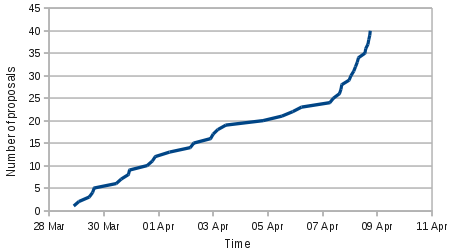
Student applications for GSoC closed a few hours ago. This is Xapian's first year as a mentoring organisation (though I've been involved in previous years with SWIG and Debian) and we've been blown away by the response from students. If you'd have asked me when we'd got accepted, I'd have guessed we might get 20 applications and feel we'd done well, but counting up now we have 42. Ignoring two which were withdrawn (one duplicate, one a spam which surprisingly got withdrawn when I politely suggested such applications weren't useful), here is a graph of applications against time: Graph of student applications to Xapian in GSoC 2011 If you're an admin or a mentor, you can produce a similar graph for your own org(s) - just download this OpenDocument spreadsheet and follow the instructions inside. Now the task of selection starts in earnest. I've gone through and marked the seven spam proposals as ineligible (that's one line proposals, proposals with no connection at all to Xapian, and proposals which are just a title and/or paste from our ideas list with a generic biography). That leaves 33, but not all are really in the running, before our student applicants start to despair! I don't have a good picture yet, but it looks like there are something like 10-15 we'll be seriously considering.

7 April 2011

Amaya Rodrigo: Baking for the weekend


Madeleines / Magdalenas
Originally uploaded by Amayita.
Madeleines / Magdalenas (http://en.wikipedia.org/wiki/Madeleine_%28cake%29), home made, and Jolly Roger themed!
And Flan: 4 minutes, pressure cooker made, Cr me caramel (http://en.wikipedia.org/wiki/Cr%C3%A8me_caramel)
I adapted the recipes to make them healthier (fructose instead of sugar, whole brown flour instead of white, refined one).

31 March 2011

Lars Wirzenius: World Backup Day

It's the first World Backup Day today. As the Obnam author, I can wholly agree. backup-poster.png See source at backup-poster.svg. (Sorry, I didn't have the right font, so it doesn't look quite right.)

29 January 2011

Adrian von Bidder: Sci-Fi classics (and other stuff)

I again find myself spending time watching movies ... catching up on all those friends who chastise me for not having seen whatever movie we're talking about. For example, the first three Terminator movies. I'm always fond of old style science fiction, so the first of these is quite cute. And then there's the liquid metal effect introduced in Judgment Day, which also is cool, and at the time certainly was at the bleeding edge of what was possible in CG. But by the third movie the concept itself is sure showing its age although it's still well made action, I didn't enjoy it as much. Haven't got hold of the Salvation nor Bruno Mattai's unofficial Terminator 2. Speaking about old fashioned Sci Fi: Blade Runner has a very nice retro look in the buildings and furnishings. And, although this is more because it also was made in the early 80s, very retro computer consoles :-) Fun to watch, but I'm not quite happy with how the plot turns out in the end. But then, it's a Hollywood production, so should I be surprised? But there's not only Sci Fi ... The Shawshank Redemption is a gripping story about an innocent serving a 20 years sentence for murder. A banker entering the rough world of prison, bets are taken how long he'll last. But obviously it turns out that he's really quite tough ... I'm getting good at this ... I thought Jim Jarmusch after about 20s of the opening credits of Down By Law. While it is (again) about innocent people in prison, the focus here is solely on the interaction of three people sharing a cell, excluding almost everything else. Done beautifully in black and white, and while it's not fast paced in any way, the plot has a steady flow to it.

16 November 2010

Michal Čihař: Czech foreign words dictionary in Debian

Yesterday, stardict-czech got accepted to Debian. So there is yet another useful dictionary for Czech users available in Debian without need to use my repository (however daily builds are still available there). The dictionary is built from ABZ.cz: slovn k ciz ch slov using my set of scripts, which are also capable of converting other dictionaries. Thanks to FTP masters team for accepting new package even in freeze, when they are busy with other things. Great work guys.

Filed under: Debian Stardict 0 comments Flattr this!

6 November 2010

Joey Hess: howto: create your own time zone

Tomorrow I won't have to deal with it getting dark at a soul-crushing 5:30 pm. Nor will I have to wake up blearily an hour early in the spring. Instead I will be enjoying my new, custom time zone. It's "JEST", for "Joey's Eastern (non)Standard Time", and in JEST, there is no spring forward or fall back stress. The folly of daylight savings time (Ben Franlin's best prank ever) really becomes apparent when you have solar power. It's bad enough that the sun is setting at 6:30 without compounding that by an hour. By keeping my clock set so the sun sets in midwinter at 6 pm, I will maximise what little light there is, and minimise time spent using batteries in the dark. Of course, it helps that I'm my own boss, and that most of the people I work with are probably not in a nearby timezone anyway, and that most things are done asynchronously. Since JEST is an hour ahead of local time here in the winter, I will, at worst, tend to be running early. So I only have to change my clocks one time -- and by "change", I mean create a custom timezone in Linux. Here's how to do that.
  1. Make a custom timezone file. The standard one for North America is a bewildering 3000 lines of special cases, conflicting legistlation, and historical weirdness, but I only need one: echo "Zone JEST -4:00 - JEST" > JEST.zone
  2. Compile and install it to somewhere; I put it in ~/.zoneinfo zic JEST.zone -d ~/.zoneinfo
  3. Set TZ to use it. Also TZDIR if it's not in the system directory. export TZDIR=~/.zoneinfo TZ=JEST
Update: Turns out it was easier than I thought, just setting TZ=FOO+4 will make date display a timezone "FOO" that is 4 hours behind GMT. So all I need is to set TZ=JEST+4 Result:
date: Sat Oct 30 21:43:39 JEST 2010
date -R: Sat, 30 Oct 2010 21:43:39 -0400
Previously:

16 October 2010

Vincent Sanders: Coming to terms

Yesterday was not a great day. One of the family's cats died.

Molly just after she arrived 26th September 2000
Molly, for that was her name, came to us the week Melodie and I moved into our first house together. September 15th 2000, in the middle of the fuel protests which were raging at the time, we hired a van and moved in.

Most people would have considered that enough for one week! We happened to be in Halifax on the Sunday afternoon at the supermarket and decided to visit the RSPCA because somehow we decided what our new home needed was a cat.

On that day a decade ago we saw Molly and Lucy, a pair of cats who needed a new home as their previous owners had a baby who was allergic to them. I still recall them skulking at the back of their cage in the cattery, Lucy who was reluctant to come down of a perch to be petted and Molly looking generally unhappy. No-one else wanted this misfit pair because they were already both over 5 years old, the warden despairing of ever finding them a home.

Of course they were obviously the right animals for us! ;-) So by the end of the week we had taken them home. Molly immediately showed how things were going to be by shredding her way out of the RSPCA provided double walled cardboard carrier. To the day she died she detested being placed inside a carrier, funny that.

Melodie and Molly in the snow 28th December 2000
By the end of the year, when the snow came, the cats ruled the house and we were all happy together.

Little did we realise that soon in the summer of 2001 there would be another arrival to the family.

Molly with Melodie and Alex 2001
The arrival of our first child in June 2001 was a complete change in all our lives but we all managed to settle back into a routine. Although the banishment of the cats from upstairs remained a point of disagreement for a long time.

As Alex grew up the cats learned that feeding times for Alex could result in all manner of things falling from above. Soon Alex was mobile which resulted in different lessons on cats being sharp objects if not treated with respect. In February 2003 our family grew once more with the arrival of Joshua. The cats, now used to infants, took this in their stride.

Molly in Febuary 2004 hiding on a windowsill
While still about day to day the cats are not captured on camera so often form this point on.

Over the forthcoming months they ensured they were out of reach of the newborn and the precocious toddler.

By the time of Joshuas first birthday in 2004 Molly had taken to hiding "out of the way" as much as possible but remained as affectionate as ever.

Molly in a box March 2007
As the children grew up and life progressed Molly became ever more at home and developed the odd aggravating trait like taking clean washing off airers and dragging it out the window, through the cat flap and upstairs so she could sleep on it!

She still enjoyed participating in claiming boxes and defending them vigorously though!

The kids took on the job of feeding the cats which made their bond closer ensuring they were greeted by happy cats sitting lookout as they came home from school each day.

Molly continued to be a good companion and an infuriating self centred animal like all good cats.
Molly asleep in the kitchen sink
Then on Tuesday evening our Neighbour knocked on our front door. They gave us the news that one of our cats had been run over and taken to the Vet. I immediately went to the back door and called and shook the treat box.

Lucy came running, but molly did not. We rang the vets who confirmed they had molly (we had them electronically tagged back in Halifax) and that they advised we did not come and see her until they had chance to asses her and deal with the shock.

As the days progressed her prognosis improved and then sank. She had a broken jaw, broken teeth, a dislocated hip, extensive bruising and something was definitely wrong with her kidney function.

Thursday evening the whole family went to see her and she purred and seemed happy to see us, she looked as bad as I feared though and somehow I knew there and then that this was probably goodbye. The children stroked her and petted her for a while and we left with an odd sadness, oh and to the sound of molly trying to gouge the veterinary nurse.

Yesterday she was due to have surgery to fix her jaw and hip...Alas when she was anaesthetised and x-rayed once more it became evident the hip was not just dislocated but her femur was fractured and there was additional damage. So just after midday came the call to ask what we wanted to do. The vet could attempt the repairs but due to her age and the other complications it was probably futile. So with heavy heart we agreed the best thing was not to revive her and she died a short time later.

I shall miss her morning greetings, her demands for attention, her sleeping in odd places and her companionship. I keep calling for her at meal times forgetting she will never come. I think Lucy is upset too, after spending their lives together her friend is gone and I cannot explain that to her.

So that is the end of Molly, a good cat.


6 October 2010

Daniel Kahn Gillmor: monkeysphere and distributed naming

Roland Mas writes an interesting article about decentralized naming, in which he says:
Monkeysphere aims at adding a web of trust to the SSL certificates system, but the CA chain problem seems to persist (although I must admit I'm not up to speed with the actual details).
Since i'm one of the Monkeysphere developers, i figure i should respond! Let me clarify that Monkeysphere doesn't just work in places where X.509 (the SSL certificate system) works. It works in other places too (like SSH connections). And I don't think that the CA chain problem that remains in Monkeysphere is anything like the dangerous mess that common X.509 usage has given us. I do think that at some level, people need to think about who is introducing them to other people -- visual or human-comprehensible representations of public key material are notoriously difficult to make unspoofable. On the subject of distributed naming: OpenPGP already allows distributed naming: every participant in the WoT is allowed to assert that any given key maps to any given identity. Duplicates and disagreements can exist just fine. How an entity decides to certify another entity's ID without a consensus global namespace is a tough one, though. If i've always been known as "John Smith" to my friends, and someone else has also been known as "John Smith" to his friends, our friends aren't actually disagreeing or in conflict -- it's just that neither of us has a unique name. The trouble comes when someone new wants to find "John Smith" -- which of us should they treat as the "correct" one? I think the right answer probably has to do with who they're actually looking for, which has to do with why they're looking for someone named "John Smith". If they're looking for John Smith because the word on the street is that John Smith is a good knitter and they need a pair of socks, they can just examine what information we each publish about ourselves, and decide on a sock-by-sock basis which of us best suits their needs. But if they're looking for "John Smith" because their cousin said "hey, i know this guy John Smith. I think you would like to argue politics over a beer with him", then what matters is the introduction. And OpenPGP handles that just fine -- if their cousin has only ever met a single John Smith, that's the right one. If their cousin has met several John Smiths, then the searcher would do well to ask their cousin some variant of "hey, do you mean John Smith or John Smith ", or even "do you mean the John Smith who Molly has met, or the one who Charles has met?" (assuming that Molly and Charles have each only certified one John Smith in common with the cousin, and not the same one as each other), or to get a real-time introduction to a particular John Smith, where his specific key is somehow recordable by the searcher for future conversations (or beer drinking). This is what we do in the real world anyway. We currently lack good UIs for doing this over the network, but the certification infrastructure is in place already. What we're lacking in infrastructure, though, is a way to have a distributed addressing. Roland's proposal was to publish addresses corresponding to cryptographic identities within some DNS zone, or in freenet or gnutella. Another approach (piggybacking on existing infrastructure) would be to include IP address information in the OpenPGP self-certification, so the holder of the name could claim exactly their own IP address. This could be distributed through the keyserver network, just like other updates are today, and it could be done simply and immediately with a well-defined OpenPGP notation. I'd be happy to talk to interested people about how to specify such a notation, and what possible corner cases we might run into. Drop a note here, or mail the Monkeysphere mailing list or hop onto #monkeysphere on irc.oftc.netTags: authentication, distributed naming, identity, monkeysphere

2 August 2010

Christine Spang: lolbikeride to debconf

DebConf being in New York City this year, clearly the right way to get there was to bike, together with Molly and Daf. Being touring newbs, there were a few mishaps.

Day 1 We aimed to catch the 10:00 commuter rail train from Boston to Providence, Rhode Island, but we ran late (predictable) and had problems with the bicycle rack for my racing bike, which attaches without frame mounts (also predictable, since Mako and Mika test-rode it earlier in the week), so we didn't make it in to the station until around 10:20. We used the extra time to eat and fix up the bikes, though, so it's not clear how much of a setback that was. Here are our bikes ready to go at the Providence commuter rail station. bikes at Providence We then had some problems with Molly's brakes, and it took a long time to navigate out of the city, but eventually we found ourself on the "Washington Secondary Trail" a wonderful bike path along an old rail line. Every couple miles there'd be an old covered rail bridge over the river, and it was a well-paved straight shot for about ten miles, with no cars and no need to navigate. Molly on a train bridge Just as we were getting into things after the bike trail ended, something completely unexpected happened. This is Daf's derailleur after it sheared off in the middle as we attempted to start after a red light outside Tractor Supply Co. broken derailleur Luckily, John and his son Chris lent us a hand and hauled Daf and his bike to the nearest bicycle shop in the back of their pickup truck. They'd just come from there, where John had bought Chris a new helmet. Greenway Cycles, the only bike shop in a twenty mile radius, was three miles away. We got there an hour before it closed and Rick replaced the derailleur and straightened the hanger in a jiffy. Due to all these things, we didn't get as far as we'd planned in the first day and ended up camping in Seaport Campground in Mystic, Connecticut, rolling in at around 22:00. We did about 65 miles, including six due to the detour to the cycle shop. Carrying camping gear is heavy! Several delicious peanut butter and jelly bagels and some wheatberry and couscous salad later, we were passed out.



Day 2 Molly at the campground The second day included less bike trouble, but was no less eventful, and we were tired from the previous day's riding. The highlights included taking a tiny sidewalk path that I'm baffled how Google knows about up onto a sidewalk alongside the I-95 bridge across the Thames to New London, Connecticut. the Thames bridge The 13:00 ferry from New London to Orient Point, New York, where we got some remarkably good veggie burgers (whole edamame visible!) for lunch. Cross Sound Ferry And a vineyard on the north fork of Long Island, where we stopped for a quick tasting and ended up picking up a bottle of barrel-fermented chardonnay. The vineyard was small 23 acres, with 11 acres of grapes and the proprietors were friendly and extremely interested in our trip. They gave us a dollar off on the bottle due to our method of transport. The Old Field Vineyard It turns out there are only two trains a day on the Long Island rail, and we just barely caught the 18:52 return from Riverhead. We had mere seconds in the station and ended up without enough cash to pay for tickets onboard, but the conductor just took what we had and gave us tickets to Penn Station anyway. Outside Penn, a girl with a mohawk and a messenger bag overheard us talking about biking up Broadway and told us to bike up 8th Avenue instead. "Always bike up 8th and down Broadway because they have bike lanes in those directions." Thus, we didn't die dodging taxis in the dark. So basically, due to various people being extremely nice to us for no good reason, we made it to Columbia University around 22:30, on the correct day. Warm fuzzies for humanity all around. :)



25 May 2010

Russell Coker: Links May 2010

AdRevenge is an interesting concept to pay for Google Adsense adverts about how companies suck [1]. If a suitably large group of people pay to warn you about a company then it s a good signal that the company is actually doing the wrong thing. A guest post by Mili on Charles Stross blog has an interesting analysis of the economcs of Intellectual Property and concludes that content is a public good [2]. New Age Terrorists Develop Homeopathic Bomb [3], an amusing satire of medical fraud and security theatre. The sit has a lot of other good satire too. Mark Shuttleworth wrote an interesting post about new window management changes that will soon go into Ubuntu [4]. He points out that the bottom status bar in applications is a throw-back to Windows 3.1 and notes that a large part of the incentive for removing it (and using the title-bar for the status) is the work on the Netbook version of Ubuntu. This is really ironic given that the resolution of current Netbooks is quite similar to that of desktop systems that were current when Windows 3.1 came out. Omar Ahmad gave an insightful TED talk about the benefit of using a pen and paper to send a letter to a politician [5]. Sebastian Wernicke gave an amusing and informative TED talk about how to give a good TED talk [6]. His talk gives some useful ideas for public speaking that are worth considering. Catherine Mohr gave a brief and interesting TED talk about how to build an energy efficient house with low embodied energy [7]. Her blog at www.301monroe.com has the details. Stephen Wolfram (of Mathematica fame) gave an interesting TED talk [8]. He covers a lot of interesting things that can be done with computers, primarily based on the Wolfram Alpha [9] platform which allows natural language queries of a large data set. He also talks about the search for a Theory of Everything. Esther Duflo gave an interesting TED talk about using social experiments to fight poverty [10]. She describes how scientific tests have been used to determine the effectiveness of various ways of preventing disease and encouraging education in developing countries. One example of the effectiveness of such research is the DeWormTheWorld.org project which was founded after it was discovered that treating intestinal worms was the most cost effective way of getting African children to spend longer at school. David L. Rosenhan wrote an interesting research paper On Being Sane In Insane Places about pseudo-patients admitted to psychiatric hospitals [11]. It seems that psychiatric staff were totally unable to recognise a sane person who was admitted even though other patients could do so. It also documents how psychiatric patients were treated as sub-human. One would hope that things had improved since 1973, but it seems likely that many modern psychiatric hospitals are as bad as was typical in 1973. It s also worth considering the issue of the treatment in society of people who have been diagnosed with a mental illness, it seems likely that the way people are treated in the community would have similar bad results to that which was documented for treatment in psychiatric hospitals even the sanest people will act strangely if treated in an insane manner! Also it seems to me that there could be potential for using a panel of patients assembled via the Delphi Method as part of the psychiatric assessment process as it has been demonstrated that patients can sometimes assess other patients more accurately than psychiatrists! Simon Sinek gave an inspiring TED talk about how great leaders inspire action [12]. Of course the ideas he describes don t just apply to great leaders, they should apply to ordinary people who just want to convince others to adopt their ideas. Stephen Collins write a good article summarising the main reasons why the proposed great firewall of Australia is a bad idea [13]. Lenore Skenazy who is famous for letting her 9yo son catch the metro alone during broad daylight on a pre-planned route home has created a web site about Free Range Kids [14]. She seems to be starting a movement to oppose Helicopter Parenting and has already written a book about her ideas for parenting. The incidence of crime has been steadily increasing, as has the ability of the police to apprehend criminals and recover abducted children. There s no reason for children to be prevented from doing most of the things that children did when I was young!

11 March 2010

Gunnar Wolf: Boogie el Aceitoso Oily Boogie

Today I took a break before my usual lunchtime to go to the movies Boogie el Aceitoso was on at 13:00 (and not at the more usual, late screenings). Oily Boogie is a great antihero drawn by the much beloved Roberto El Negro Fontanarrosa, a very widely known Argentinian humorist/cartoonist. I got acquinted with Boogie as during the 80s-90s my parents were asiduous readers of Proceso, a weekly political analysis magazine which included one of his cartoons at the last page. Boogie is a pathological ex-Vietnam, ex-Laos ex-El Salvador, ex-Gulf War, ex-(whatever comes next) USA soldier, who deals with the local mafias whenever he is not active. Brutal, often seen as inhuman. I remember reading it without really understanding its nonsensical violence at first. And, as I said, Fontanarrosa is a very loved cartoonist - In Mexico I think we were much more acquinted with Boogie than with Inodoro Pereyra, and still, Fontanarrosa's death in 2007 was very heartfelt here. About the movie: I found it to be very good, of course, knowing what to expect. Most lines are short, screen adequations of various cartoons along Boogie's long life as a thug. I specially liked the animation technique I know very little about the subject, but it mixed quite naturally and constantly obvious still, cartoony characters with vivid, photo-based items. It creates a completely believable atmosphere inside the absolute amoral, selfish and (fortunately!) grossly exagerated and impossible world of Boogie. I sometimes feel somewhat stupid when writing in English for a mostly Spanish-speaking audience Still, if you see Boogie in a movie theater, don't hesitate and go. As always, with non-top-selling, non-Hollywood movies, it is quite probable it will not be showing for long.

8 March 2010

Vincent Sanders: Music hath charms to soothe a savage breast, to soften rocks, or bend a knotted oak.

Since I last mentioned music back in January I have accumulated another ten albums and unlike last time where there were only a couple of stand outs, this time I have he opposite problem.

The unordered list:

Justin Sandercoe - "Small town eyes"

I am learning to play the guitar, I have been using Justins' course, it is very very good, this album? Also very good. If you like melodic guitar lead music with varied influences this is for you. A couple of tracks made me immediately think of some Crowded House riffs (which is not a bad thing). Only minor niggle is the uneven levels on some of the louder pieces, but it really is a minor observation on an otherwise fine first album.

Molly Lewis - "I made you a CD, but I eated it."

Although this is only a short selection of original material from Molly, it is a very promising first album. I really like her voice and although a ukulele is not generally the most well respected of instruments, in her hands, it has an odd charm. This album is available from DFTBA records.

Rhett and Link - "Up to this point"

A pair of talented comedians who use music very effectively to highlight their humour. I originally stumbled across them on youtube and decided to take a punt. The album is 27 short pieces which fit together surprisingly well. Difficult to categorise but think a cross between Flight of the Choncords and Jonathan Coulton with a dash of youtube immediacy.

They Might Be Giants - "Flood", "Apollo 18" and "John Henry"

Strictly a replacement of the old tapes which have completely disintegrated in the intervening couple of decades since first purchased. Flood is still one of my favourite albums ever, certainly in my top 10. If you do not know them TMBG are just ace, please try their music!

Seasick Steve - "Started out with nothin and i still got most of it left"

Well its a kinda fun album primarily based on blues electric "guitar" (some of the instruments are little more than a stick with a nail in and a guitar pickup.) Nothing bad, easy to get along with, definitely worth a listen.

La Roux - "La Roux"

This synth pop album was on remainder in ASDA and I took a gamble. Its OK I guess and for 3quid I cannot really complain.

Red Hot Chili Peppers - "By the way"

Not their best, but competent enough.

Aqua - "Aquarium" , "Aquarius"

Um...yes, I have a soft spot for 90's cheese OK? Nothing more than a gross self indulgence of my silly side. But they are fun ;-)


So that is my new music since January all 166 tracks of it . Most of it pretty good, certainly no lemons (well aside from the Aqua but that is supposed to be silly!)

Oh and The XX has really grown on me from last time and I am looking forward to their next release.


28 February 2010

Russ Allbery: Review: Coders at Work

Review: Coders at Work, by Peter Seibel
Publisher: Apress
Copyright: 2009
ISBN: 1-4302-1948-3
Format: Trade paperback
Pages: 601
Coders at Work is a collection of edited interviews by Peter Seibel (probably best known previously for his book Practical Common Lisp) of an eclectic and excellent collection of fifteen programmers. It opens with an interview with Jamie Zawinski (one of the original Netscape developers) and closes with Donald Knuth. In between, the interview subjects range in programmer generations from Fran Allen (who started at IBM in 1957) and Bernie Cosell (one of the original ARPANET developers) to Brad Fitzpatrick (LiveJournal founder and original developer). Techniques and preferences also range widely, including two people involved in JavaScript development and standardization (Brendan Eich and Douglas Crockford), a functional programming language designer and developer (Simon Peyton Jones), language designers and standardizers such as Guy Steele, and people like Dan Ingalls who have a different experimental approach to programming than the normal application development focus. All of the interviewees are asked roughly the same basic questions, but each discussion goes in different directions. Seibel does an excellent job letting the interview subjects shape the discussion. Two things immediately stood out for me about this book. First, it's huge, and that's not padding. There are just over 600 pages of content here, much of it fascinating. The discussions Seibel has are broad-ranging, covering topics from the best way to learn programming to history and anecdotes of the field. There's some discussion of technique, but primarily at the level of basic approaches and mindset. One typical question is how each programmer organizes their approach to reading code that isn't familiar with them. Each interviewee is also asked for book recommendations, for their debugging techniques, for their opinions on proving code correct, and how they design code. The participants are so different in their backgrounds and approaches that these conversations go in fifteen different directions. This is one of the most compelling and engrossing non-fiction books I've read. Second, the selection of interview subjects, while full of well-known names in the field, is not the usual suspects. While I'm interested in the opinions of people like Larry Wall and Guido van Rossum, I've already heard quite a lot about how they think about programming. That's material that Coders at Work doesn't need to cover, and it doesn't. Many of the interview subjects here are people I'd heard of only vaguely or not at all prior to this book, often because they work in an area of programming that I'm not yet personally familiar with. Those who I had heard of, such as L. Peter Deutsch, I often knew in only one context (Ghostscript in that case) and was unfamiliar with the rest of their work. This gives the book a great exploratory feel and a lot of originality. There is so much good material here that it's hard to give a capsule review. This is a book I'm highly likely to re-read, taking more detailed notes. There's entertaining snarking from Jamie Zawinski and Brendan Eich, fascinating history of the field (including in gender balance) from Fran Allen, and an intriguing interview with Joe Armstrong (creator of Erlang), who seems to have a far different attitude towards languages and libraries than the other interviewees. Every interview is full of gems, bits of insight that I now want to research or play with. A couple of examples come to mind, just to provide a feel of the sort of insights I took out of the book. In the interview with Joshua Bloch, who does a lot of work on library APIs, he mentions that empathy is one of the most important skills for designing an API. You have to be able to put yourself in the shoes of the programmer who's going to use the API and understand how it will feel to them. This came up in the context of a discussion about different types of programmers, and how programmers can be good at different things; the one who can do low-level deep optimization may not have that sense of empathy. Another example: Bernie Cosell talked about how he did debugging, and how he got a reputation for being a fantastic debugger who was able to fix just about anything. He confessed that he often reached a portion of the code that he didn't understand, that seemed too complex and tricky for what it was attempting to accomplish, and rather than trace through it and try to understand it, he just rewrote it. And after rewriting, the bug was often gone. It wasn't really debugging, but at the same time it's close to the more recent concept of refactoring. Several of the interview subjects commented on a subjective feeling of complexity and how when it gets too high that's a warning sign that code may need to be rethought and rewritten. A third example: I was fascinated by the number of interviewees who said that they used printf, assert, and eyeballs to debug rather than using any more advanced debugging tools. The former Lisp developers would often bemoan the primitiveness of tools like gdb, but many of them found that print statements and thinking hard about the code were usually all that's needed. (There was also a lot of discussion about test suites and test-driven development.) The general consensus was that concurrency problems were the hardest to debug; they made up a disproportional number of the responses to Seibel's question about the hardest bug the programmer ever had to track down. I could go on giving similar examples at great length, but apart from the specific bits of wisdom, the strongest impact this book made on me was emotional. Coders at Work is full of people who love programming and love software, and that enthusiasm, both in general and for specific tools and ideas, comes through very clearly. I found it inspiring. I realized while reading this book, and I suspect I'm not alone among programmers in this, that I largely stopped learning how to program a few years back and have been reusing skills that I already have. Reading Coders at Work gave me a strong push towards finding ways to start learning, experimenting, and trying new techniques again. It also filled me with enthusiasm for the process of programming, which immediately helped my productivity on my own coding projects. This is obviously a book whose primary target audience is practicing programmers, and while it doesn't go too far into language theory, I was relying on remembered terms and structure from my master's degree for a few of the interviews. I think it's approachable for anyone who has a working background in programming and a few languages or a CS degree, but it might be a stretch for someone new to the field. But even someone without any programming knowledge at all would get a lot out of the anecdotes and snapshots of the history of software development. Coders at Work is also full of jumping-off points for some additional research on Google or additional reading in other recommended books. I only have one complaint, which I have to mention in passing: for such a large book full of interesting ideas and book recommendations, the index is wholly inadequate. I tried looking up five or six things in it, including the source of some of the book recommendations that are collected in an appendix, and I struck out every time. It's very hard to find something again in 600 pages, and more attention paid to the index would have been greatly appreciated. But, despite that, for people within the target audience, I cannot recommend this book too highly. Not only was it full of useful information, at the level of programming above the code details that's often the hardest to talk about, but it's consistently entertaining and emotionally invigorating and inspiring. It made the rounds of tech blogs when it was first released, to nearly universal approval, and I can only echo that. If you're a practicing programmer, I don't think you'll regret spending a few weeks reading and thinking about this book. Rating: 10 out of 10

16 February 2010

Russell Coker: Would you Short-Change a Pedophile?

For some time the film industry has been running an anti-piracy campaign with slogans such as you wouldn t steal a car [1] in an attempt to draw a false analogy between downloading a movie and stealing a significant and valuable object the modern equivalent to being a horse thief . One of the many ways that such poor analogies break down is the fact that downloading a movie is not a crime, it s copyright infringement. The best analogy that I can think of for non-commercial copyright infringement is the practice of short-changing. I expect that almost everyone has at some time received less change than they deserved when buying something at a shop, the cashier aims to collect $1 or $2 from each customer and can easily double the amount of money that they take home at the end of the day. When a customer complains they just pretend to have made a mistake and although short-changing is a crime (unlike copyright infringement) it almost never results in police action. The practice is tolerated to such a degree that some people know the shops where they are likely to be short-changed, they count their change more carefully and demand the full amount but don t bother complaining to the manager! The film industry also tries to portray itself as representing struggling artists who deserve the money, it s described as a moral issue good people pay for movies while bad people download movies and steal cars. But then there s the case of Roman Polanski who is a well known movie director and child rapist [2]. I expect that most store employees would gladly palm some of the change if Roman Polanski was a customer that is of course if they weren t too busy arranging a lynch mob. So instead of you wouldn t steal a car a more reasonable statement would be you would short-change a pedophile if you weren t organising a lynch mob . Please note that murdering a criminal as part of a lynch mob is a crime (unlike making an unauthorised copy of a DVD), so I encourage people not to perform lynchings. Many important people in the movie industry have different ideas, the Wall Street Journal has an article about the petition to free Roman Polanski which demonstrates the difference between Hollywood attitudes and those of the rest of the world [3]. For them, violent crime is no big deal if the criminal is famous and the victim isn t but anything which affects their own wealth is regarded as a serious issue. Indiewire has a copy of the petition to free Roman and a list of the names of 100 people who signed it [4] (I heard that the latest count was nearer 150 but couldn t find a reference). I believe that the matter of morals is not whether someone who rapes children deserves jail time (that issue is really clear) but whether it is morally acceptable to give money to such a criminal or their supporters. I suggest that the list of signatories to the pro-rape petition be black-listed, any movie that involves any of them should not be paid for either don t see the movie or download it without paying at your own whim. If anyone knows of a web site that is being regularly updated with a list of all past and current projects involving people who signed the petition for Roman then please let me know it would be good to have a list of movies that I will never pay for. Anyone who feels morally obliged to pay something for a movie and who has a great desire to watch a movie made by Roman Polanski or his supporters could download it and then make a donation to a charity equivalent to the purchase price rumor has it that women s refuges are always short of funds. As an aside I find Wikipedia a good reference for movies that I don t plan to see, I read the plot summary on the wiki page and then have no curiosity about what happens in the movie if that isn t adequate I ask friends for spoilers or do a Google search on the movie name and spoilers .

15 February 2010

Adrian von Bidder: Papillon

Another attempt to shorten my list of movies where not having seen them makes me an absolute philistine, according to various friends: Papillon, with Steve McQueen and Dustin Hoffmann. Ignoring the tragic history behind it (the French penal system in French Guiana during the colonial era I didn't know about this from school), it's great entertainment. There is a kind of happy end, but nowhere close to what Hollywood does to its stories these days... A long time on the to watch list: The Fifth Element by Luc Besson. I don't know why but I had always been sceptical if I'd enjoy this one, but my feeling was completely wrong. Real fun. While I think the basic idea of superheroes getting older and having a midlife crisis, or a daughter, (and of course during the film, getting back into action) could make a wonderful film, the ending of Watchmen left me with a bad feeling about the whole film. But then I never read or watched superhero cartoons anyway, so maybe it's just that I'm not the intended audience for this one. Finally, V for Vendetta is another interpretation of the 1984 theme (actually, it's the interpretation of a graphic novel, but I've not read that), with a very well chosen John Hurt as Big Brother (or, I should say, High Chancellor Adam Sutler.) With quite a few slapstick moments, this isn't really as dark as the theme might suggest.

Next.

Previous.