Here is my monthly update covering what I have been doing in the free software world (previous month):
diffoscope is our in-depth and content-aware diff utility that can locate and diagnose reproducibility issues.
buildinfo.debian.net is my experiment into how to process, store and distribute .buildinfo files after the Debian archive software has processed them.
Statutory warning It s a long read.
I start by sharing I regret, I did not hold onto the Budget and Economics 101 blog post for one more day. I had been holding/thinking on to it for almost couple of weeks before posting, if I had just waited a day more, I would have been able to share an Indian Express story . While I thought that the work for the budget starts around 3 months before the budget, I came to learn from that article that it takes 6 months. As can be seen in the article, it is somewhat of a wasted opportunity, part of it probably due to the Government (irrespective of any political party, dynasty etc.) mismanagement.
What has not been stated in the article is what I had shared earlier, reading between the lines, it seems that the Government isn t able to trust what it hears from its advisers and man on the street. Unlike Chanakya and many wise people before him who are credited with advising about good governance, that a good king is one who goes out in disguise, learns how his/er subjects are surviving, seeing what ills them and taking or even not taking corrective steps after seeing the problem from various angles. Of course it s easier said then done, though lot of Indian kings did try and ran successful provinces. There were also some who were more interested in gambling, women and threw/frittered away their kingdoms.
The 6-month things while not being said in the Express article is probably more about checking and re-checking figures and sources to make sure they are able to read whatever pattern the various Big Businesses, Industry, Social Welfare schemes and people are saying I guess. And unless mass digitalization as well as overhaul of procedures, Right to Information (RTI) happens, don t see any improvement in the way the information is collected, interpreted and shared with the public at large.
It would also require people who are able to figure out how things work sharing the inferences (right or wrong) through various media so there is discussion about figures and policy-making. Such researchers and their findings are sadly missing in Indian public discourses and only found in glossy coffee table books :(.
One of the most basic question for instance is, How much of any policy should be based on facts and figures and how much giving fillip to products and services needed in short to medium term ?
Also how much morality should play a part in Public Policy ?
Surprisingly, or probably not, most Indian budgets are populist by nature with some scientific basis but most of the times there is no dialog about how the FM came to some conclusion or Policy-making. I am guessing a huge part of that has also to do with basic illiteracy as well as Economic and Financial Illiteracy.
Just to share a well-known world-over example, one of the policies where the Government of India has been somewhat lethargic is wired broadband penetration. As have shared umpteen times, while superficially broadband penetration is happening, most of the penetration is the unreliable and more expensive mobile broadband penetration.
While this may come as a shock to many of the users of technology, BSNL, a Government company who provides broadband for almost 70-80% of the ADSL wired broadband subscribers gives 50:1 contention ratio to its customers.
One can now understand the pathetic speeds along with very old copper wiring (20 odd years) on which the network is running. The idea/idiom of running network using duct-tape seems pretty apt in here
Now, the Government couple of years ago introduced FFTH Fiber-to-the-home but because the charges are so high, it s not going anywhere. The Government could say 10% discount in your Income Tax rates if you get FFTH. This would force people to get FFTH and would also force BSNL to clean up its act. It has been documented that a percentage increase in broadband equals a similar percentage rise in GDP.
Having higher speeds of broadband would mean better quality of streaming video as well as all sorts of remote teaching and sharing of ideas which will give a lot of fillip to all sorts of IT peripherals in short, medium and long-term as well. Not to mention, all the software that will be invented/coded to take benefit of all that speed.
Although, realistically speaking I am cynical that the Government would bring something like this
Moving on
Another interesting story which I had shared was a bit about World History
Now the Economist sort of confirmed how things are in Pakistan. What is and was interesting that the article is made by a politically left-leaning magazine which is for globalization, business among other things .
So, there seem to be only three options, either I and the magazine are correct or we both are reading it wrong.
The third and last option is that the United States realize that Pakistan can no longer be trusted as Pakistan is siding more and more with Chinese and Russians, hence the article. Atlhough it seems a somewhat far-fetched idea as I don t see the magazine getting any brownie points with President Trump. Unless, The Economist becomes more hawkish, more right-wingish due to the new establishment.
I can t claim to have any major political understanding or expertise but it does seem that Pakistan is losing friends. Even UAE have been cautiously building bridges with us. Now how this will play out in the medium to long-term depends much on the personal equations of the two heads of state, happenings in geopolitics around the world and the two countries, decisions they take, it is a welcome opportunity as far they (the Saudis) have funds they want to invest and India can use those investments to make new infrastructure.
Now, I need a bit of help of Java and VCS (Version control system) experts . There is a small game project called Mars-Sim. I asked probably a few more questions than I should have and the result was that I was made a member of the game team even though I had shared with them that I m a non-coder.
I think such a game is important as it s foss. Both the game itself is foss as well as its build-tools with a basic wiki. Such a game would be useful not only to Debian but all free software distributions.
Journeying into the game
Unfortunately, the game as it is currently, doesn t work with openjdk8 but private conversations with the devs. have shared they will work on getting it to work on OpenJDK 9 which though is sometime away.
Now as it is a game, I knew it would have multiple multimedia assets. It took me quite sometime to figure out where most of the multimedia assets are.
I was shocked to find that there aren t any tool/s in Debian as well a GNU/Linux to know about types of content is there inside a directory and its sub-directories.
I framed it in a query and found a script as an answer . I renamed the script to file-extension-information.sh (for lack of imagination of better name).
After that, I downloaded a snapshot of the head of the project from https://sourceforge.net/p/mars-sim/code/HEAD/tree/ where it shows a link to download the snapshot.
https://sourceforge.net/code-snapshots/svn/m/ma/mars-sim/code/mars-sim-code-3847-trunk.zip
unzipped it and then ran the script on it
[$] bash file-extension-information.sh mars-sim-code-3846-trunk
theme: 1770
dtd: 31915
py: 10815
project: 5627
JPG: 762476
fxml: 59490
vm: 876
dat: 15841044
java: 13052271
store: 1343
gitignore: 8
jpg: 3473416
md: 5156
lua: 57
gz: 1447
desktop: 281
wav: 83278
1: 2340
css: 323739
frag: 471
svg: 8948591
launch: 9404
index: 11520
iml: 27186
png: 3268773
json: 1217
ttf: 2861016
vert: 712
ogg: 12394801
prefs: 11541
properties: 186731
gradle: 611
classpath: 8538
pro: 687
groovy: 2711
form: 5780
txt: 50274
xml: 794365
js: 1465072
dll: 2268672
html: 1676452
gif: 38399
sum: 23040
(none): 1124
jsx: 32070
It gave me some idea of what sort of file were under the repository. I do wish the script defaulted to showing file-sizes in KB if not MB to better assess how the directory is made up but not a big loss .
The above listing told me that at the very least theme, JPG, dat, wav, png, ogg and lastly gif files.
For lack of better tools and to get an overview of where those multimedia assets used ncdu
[shirish@debian] - [~/games/mars-sim-code-3846-trunk] - [10210]
[$] ncdu mars-sim/
--- /home/shirish/games/mars-sim-code-3846-trunk/mars-sim --------------------------------------------------------------------------------------
46.2 MiB [##########] /mars-sim-ui
15.2 MiB [### ] /mars-sim-mapdata
8.3 MiB [# ] /mars-sim-core
2.1 MiB [ ] /mars-sim-service
500.0 KiB [ ] /mars-sim-main
188.0 KiB [ ] /mars-sim-android
72.0 KiB [ ] /mars-sim-network
16.0 KiB [ ] pom.xml
12.0 KiB [ ] /.settings
4.0 KiB [ ] mars-sim.store
4.0 KiB [ ] mars-sim.iml
4.0 KiB [ ] .project
I found that all the media is distributed randomly and posted a ticket about it. As I m not even a java newbie, could somebody look at mokun s comment and help out please ?
On the same project, there has been talk of migrating to github.com
Now whatever little I know of git, it makes a copy of the whole repository under .git/ folder/directory so having multimedia assets under git is a bad, bad idea, as each multimedia binary format file would be unique and no possibility of diff. between two binary files even though they may be the same file with some addition or subtraction from earlier version.
I did file a question but am unhappy with the answers given. Can anybody give some definitive answers if they have been able to do how I am proposing , if yes, how did they go about it ?
And lastly
America was founded by immigrants. Everybody knows the story about American Indians, the originals of the land were over-powered by the European settlers. So any claim, then and now that immigration did not help United States is just a lie.
This came due to a conversation on #debconf by andrewsh
[18:37:06] I d be more than happy myself to apply for an US tourist not transit visa when I really need it, as a transit visa isn t really useful, is just as costly as a tourist visa, and nearly as difficult to get as a tourist visaFWIW I am in complete agreement with Andrew s assessment of how it might be with foreigners. It has been on my mind and thoughts for quite some time although andrewsh put it eloquently. But as always I m getting ahead of myself. The conversation is because debconf this year would be in Canada. For many a cheap flight, one of the likely layovers/stopover can be the United States. I actually would have gone one step further, even if it was cheap transit visa, it would equally be unfun as it would discriminate. About couple of years back, a friend of mine while explaining what visa is, put it rather succinctly the visa officer looks at only 3 things a. Your financial position something which tells that you can take care of your financial needs if things go south b. You are not looking to settle there unlawfully c. You are not a criminal. While costs do matter, what is disturbing more is the form of extremism being displayed therein. While Indians from the South Asian continent in US have been largely successful, love to be in peace (one-off incidents do and will happen anywhere) if I had to take a transit or tourist visa in this atmosphere, it would leave a bad taste in the mouth. When one of my best friends is a Muslim, 20% of the population in India is made of Muslims and 99% of the time both of us co-exist in peace I simply can t take any alternative ideology. Even in Freakonomics 2.0 the authors when they shared that it s less than 0.1 percent of Muslims who are engaged in terrorist activities, if they were even 1 percent than all the world s armed forces couldn t fight them and couldn t keep anyone safe. Which simply means that 99.99% of even all Muslims are good. This resonates strongly with me for number of reasons. One of my uncles in early to late 80 s had an opportunity for work to visit Russia for official work. He went there and there were Secret Police after him all the time. While he didn t know it, I later read it, that it was SOP (Standard Operating Procedure) when all and any foreigners came visiting the country, and not just foreigners, they had spies for their own citizens. Russka a book I read several years ago explained the paranoia beautifully. While U.S. in those days was a more welcoming place for him. I am thankful as well as find it strange that Canada and States have such different visa procedures. While Canada would simply look at the above things, probably discreetly inquire about you if you have been a bad boy/girl in any way and then make a decision which is fine. For United States, even for a transit visa I probably would have to go to Interview where my world view would probably be in conflict with the current American world view. Interestingly, while I was looking at conversations on the web and one thing that is missing there is that nobody has talked about intelligence community. What Mr. Trump is saying in not so many words is that our intelligence even with all the e-mails we monitor and everything we do, we still can t catch you. It almost seems like giving a back-handed compliment to the extremists saying you do a better job than our intelligence community. This doesn t mean that States doesn t have interesting things to give to the world, Star Trek conventions, Grand Canyon (which probably would require me more than a month or more to explore even a little part), NASA, Intel, AMD, SpaceX, CES (when it s held) and LPC (Linux Plumber s conference where whose who come to think of roadmap for GNU/Linux). What I wouldn t give to be a fly in the wall when LPC, CES happens in the States. What I actually found very interesting is that in the current Canadian Government, if what I read and heard is true, then Justin Trudeau, the Prime Minister of Canada made 50 of his cabinet female. Just like in the article, studies even in Indian parliament have shown that when women are in power, questions about social justice, equality, common good get asked and policies made. If I do get the opportunity to be part of debconf, I would like to see, hear, watch, learn how the women cabinet is doing things. I am assuming that reporting and analysis standards of whatever decisions are more transparent and more people are engaged in the political process to know what their elected representatives are doing.
[18:37:40] I m not entirely sure I wish to transit through the US in its Trumplandia incarnation either
[18:38:07] likely to be more difficult and unfun
as it has been becoming more and more dangerous to bicycle here in Pune as there is no demarcation for cyclists, I am sure lot of Canadians must be using this opportunity fully.
Lastly, on the debconf preparation stage, things have started becoming a bit more urgent and hectic. From a monthly IRC meet, it has now become a weekly meet. Both the wiki and the website are slowly taking up shape. http://deb.li/dc17kbp is a nice way to know/see progress of the activities happening .
One important decision that would be taken today is where people would stay during debconf. There are options between on-site and two places around the venue, one 1.9 km around, the other 5 km. mark. Each has its own good and bad points. It would be interesting to see which place gets selected and why. [ Chris Lamb ]
* Optimisations:
- Avoid multiple iterations over archive by unpacking once for an ~8X
runtime optimisation.
- Avoid unnecessary splitting and interpolating for a ~20X optimisation
when writing --text output.
- Avoid expensive diff regex parsing until we need it, speeding up diff
parsing by 2X.
- Alias expensive Config() in diff parsing lookup for a 10% optimisation.
* Progress bar:
- Show filenames, ELF sections, etc. in progress bar.
- Emit JSON on the the status file descriptor output instead of a custom
format.
* Logging:
- Use more-Pythonic logging functions and output based on __name__, etc.
- Use Debian-style "I:", "D:" log level format modifier.
- Only print milliseconds in output, not microseconds.
- Print version in debug output so that saved debug outputs can standalone
as bug reports.
* Profiling:
- Also report the total number of method calls, not just the total time.
- Report on the total wall clock taken to execute diffoscope, including
cleanup.
* Tidying:
- Rename "NonExisting" -> "Missing".
- Entirely rework diffoscope.comparators module, splitting as many separate
concerns into a different utility package, tidying imports, etc.
- Split diffoscope.difference into diffoscope.diff, etc.
- Update file references in debian/copyright post module reorganisation.
- Many other cleanups, etc.
* Misc:
- Clarify comment regarding why we call python3(1) directly. Thanks to J r my
Bobbio <lunar@debian.org>.
- Raise a clearer error if trying to use --html-dir on a file.
- Fix --output-empty when files are identical and no outputs specified.
[ Reiner Herrmann ]
* Extend .apk recognition regex to also match zip archives (Closes: #849638)
[ Mattia Rizzolo ]
* Follow the rename of the Debian package "python-jsbeautifier" to
"jsbeautifier".
[ siamezzze ]
* Fixed no newline being classified as order-like difference.
reprotest development
reprotest 0.5 was uploaded to unstable by Chris Lamb. It included contributions from:
[ Ximin Luo ]
* Stop advertising variations that we're not actually varying.
That is: domain_host, shell, user_group.
* Fix auto-presets in the case of a file in the current directory.
* Allow disabling build-path variations. (Closes: #833284)
* Add a faketime variation, with NO_FAKE_STAT=1 to avoid messing with
various buildsystems. This is on by default; if it causes your builds
to mess up please do file a bug report.
* Add a --store-dir option to save artifacts.
Other contributions (not yet uploaded):
website.git notifications now go to#reproducible-builds. Thanks todanielsh and the KGB bot maintainers.arm64 architecture was fully tested in all three suites in just 15 days. Thanks again to Codethink.co.uk for their support!pg_dump with -O --column-inserts to make easier to import our main database dump into a non-PostgreSQL database. (mapreri)armhf network: CPU frequency scaling was enabled for three
Firefly boards, enabling the CPUs to run at full speed. (vagrant)
Debian LTS
November marked the 20th month I contributed to Debian LTS
under the Freexian umbrella. I had 8 hours allocated which I used
by:
% appstreamcli what-provides modalias \ usb:v1130p0202d0100dc00dsc00dp00ic03isc00ip00in00 Identifier: pymissile [generic] Name: pymissile Summary: Control original Striker USB Missile Launcher Package: pymissile % appstreamcli what-provides modalias usb:v0694p0002d0000 Identifier: libnxt [generic] Name: libnxt Summary: utility library for talking to the LEGO Mindstorms NXT brick Package: libnxt --- Identifier: t2n [generic] Name: t2n Summary: Simple command-line tool for Lego NXT Package: t2n --- Identifier: python-nxt [generic] Name: python-nxt Summary: Python driver/interface/wrapper for the Lego Mindstorms NXT robot Package: python-nxt --- Identifier: nbc [generic] Name: nbc Summary: C compiler for LEGO Mindstorms NXT bricks Package: nbc %A similar query can be done using the combined AppStream and Isenkram databases using the isenkram-lookup tool:
% isenkram-lookup usb:v1130p0202d0100dc00dsc00dp00ic03isc00ip00in00 pymissile % isenkram-lookup usb:v0694p0002d0000 libnxt nbc python-nxt t2n %You can find modalias values relevant for your machine using cat $(find /sys/devices/ -name modalias). If you want to make this system a success and help Debian users make the most of the hardware they have, please helpadd AppStream metadata for your package following the guidelines documented in the wiki. So far only 11 packages provide such information, among the several hundred hardware specific packages in Debian. The Isenkram database on the other hand contain 101 packages, mostly related to USB dongles. Most of the packages with hardware mapping in AppStream are LEGO Mindstorms related, because I have, as part of my involvement in the Debian LEGO team given priority to making sure LEGO users get proposed the complete set of packages in Debian for that particular hardware. The team also got a nice Christmas present today. The nxt-firmware package made it into Debian. With this package in place, it is now possible to use the LEGO Mindstorms NXT unit with only free software, as the nxt-firmware package contain the source and firmware binaries for the NXT brick. As usual, if you use Bitcoin and want to show your support of my activities, please send Bitcoin donations to my address 15oWEoG9dUPovwmUL9KWAnYRtNJEkP1u1b.
% isenkram-lookup bluez cheese ethtool fprintd fprintd-demo gkrellm-thinkbat hdapsd libpam-fprintd pidgin-blinklight thinkfan tlp tp-smapi-dkms tp-smapi-source tpb %It can also list the firware package providing firmware requested by the load kernel modules, which in my case is an empty list because I have all the firmware my machine need:
% /usr/sbin/isenkram-autoinstall-firmware -l info: did not find any firmware files requested by loaded kernel modules. exiting %The last few days I had a look at several of the around 250 packages in Debian with udev rules. These seem like good candidates to install when a given hardware dongle is inserted, and I found several that should be proposed by isenkram. I have not had time to check all of them, but am happy to report that now there are 97 packages packages mapped to hardware by Isenkram. 11 of these packages provide hardware mapping using AppStream, while the rest are listed in the modaliases file provided in isenkram. These are the packages with hardware mappings at the moment. The marked packages are also announcing their hardware support using AppStream, for everyone to use: air-quality-sensor, alsa-firmware-loaders, argyll, array-info, avarice, avrdude, b43-fwcutter, bit-babbler, bluez, bluez-firmware, brltty, broadcom-sta-dkms, calibre, cgminer, cheese, colord, colorhug-client, dahdi-firmware-nonfree, dahdi-linux, dfu-util, dolphin-emu, ekeyd, ethtool, firmware-ipw2x00, fprintd, fprintd-demo, galileo, gkrellm-thinkbat, gphoto2, gpsbabel, gpsbabel-gui, gpsman, gpstrans, gqrx-sdr, gr-fcdproplus, gr-osmosdr, gtkpod, hackrf, hdapsd, hdmi2usb-udev, hpijs-ppds, hplip, ipw3945-source, ipw3945d, kde-config-tablet, kinect-audio-setup, libnxt, libpam-fprintd, lomoco, madwimax, minidisc-utils, mkgmap, msi-keyboard, mtkbabel, nbc, nqc, nut-hal-drivers, ola, open-vm-toolbox, open-vm-tools, openambit, pcgminer, pcmciautils, pcscd, pidgin-blinklight, printer-driver-splix, pymissile, python-nxt, qlandkartegt, qlandkartegt-garmin, rosegarden, rt2x00-source, sispmctl, soapysdr-module-hackrf, solaar, squeak-plugins-scratch, sunxi-tools, t2n, thinkfan, thinkfinger-tools, tlp, tp-smapi-dkms, tp-smapi-source, tpb, tucnak, uhd-host, usbmuxd, viking, virtualbox-ose-guest-x11, w1retap, xawtv, xserver-xorg-input-vmmouse, xserver-xorg-input-wacom, xserver-xorg-video-qxl, xserver-xorg-video-vmware, yubikey-personalization and zd1211-firmware If you know of other packages, please let me know with a wishlist bug report against the isenkram-cli package, and ask the package maintainer to add AppStream metadata according to the guidelines to provide the information for everyone. In time, I hope to get rid of the isenkram specific hardware mapping and depend exclusively on AppStream. Note, the AppStream metadata for broadcom-sta-dkms is matching too much hardware, and suggest that the package with with any ethernet card. See bug #838735 for the details. I hope the maintainer find time to address it soon. In the mean time I provide an override in isenkram.
O(n^2) complexity for archive member lookup..par files as Zip archives, including a patch which was merged into master..debian.org machines.jenkins.debian.net and tests.reproducible-builds.org run. Many thanks to Profitbricks for supporting jenkins.debian.net since August 2012!jenkins.debian.net.
My monthly report covers a large part of what I have been doing in the free software world. I write it for my donors (thanks to them!) but also for the wider Debian community because it can give ideas to newcomers and it s one of the best ways to find volunteers to work with me on projects that matter to me.
Debian LTS
In the 11 hours of (paid) work I had to do, I managed to release DLA-716-1 aka tiff 4.0.2-6+deb7u8 fixing CVE-2016-9273, CVE-2016-9297 and CVE-2016-9532. It looks like this package is currently getting new CVE every month.
Then I spent quite some time to review all the entries in dla-needed.txt. I wanted to get rid of some misleading/no longer applicable comments and at the same time help Olaf who was doing LTS frontdesk work for the first time. I ended up tagging quite a few issues as no-dsa (meaning that we will do nothing for them as they are not serious enough) such as those affecting dwarfutils, dokuwiki, irssi. I dropped libass since the open CVE is disputed and was triaged as unimportant. While doing this, I fixed a bug in the bin/review-update-needed script that we use to identify entries that have not made any progress lately.
Then I claimed libgc and and released DLA-721-1 aka libgc 1:7.1-9.1+deb7u1 fixing CVE-2016-9427. The patch was large and had to be manually backported as it was not applying cleanly.
The last thing I did was to test a new imagemagick and review the update prepared by Roberto.
pkg-security work
The pkg-security team is continuing its good work: I sponsored patator to get rid of a useless dependency on pycryptopp which was going to be removed from testing due to #841581. After looking at that bug, it turns out the bug was fixed in libcrypto++ 5.6.4-3 and I thus closed it.
I sponsored many uploads: polenum, acccheck, sucrack (minor updates), bbqsql (new package imported from Kali). A bit later I fixed some issues in the bbsql package that had been rejected from NEW.
I managed a few RC bugs related to the openssl 1.1 transition: I adopted sslsniff in the team and fixed #828557 by build-depending on libssl1.0-dev after having opened the proper upstream ticket. I did the same for ncrack and #844303 (upstream ticket here). Someone else took care of samdump2 but I still adopted the package in the pkg-security team as it is a security relevant package. I also made an NMU for axel and #829452 (it s not pkg-security related but we still use it in Kali).
Misc Debian work
Django. I participated in the discussion about a change letting Django count the number of developers that use it. Such a change has privacy implications and the discussion sparked quite some interest both in Debian mailing lists and up to LWN.
On a more technical level, I uploaded version 1.8.16-1~bpo8+1 to jessie-backports (security release) and I fixed RC bug #844139 by backporting two upstream commits. This led to the 1.10.3-2 upload. I ensured that this was fixed in the 1.10.x upstream branch too.
dpkg and merged /usr. While reading debian-devel, I discovered dpkg bug #843073 that was threatening the merged-/usr feature. Since the bug was in code that I wrote a few years ago, and since Guillem was not interested in fixing it, I spent an hour to craft a relatively clean patch that Guillem could apply. Unfortunately, Guillem did not yet manage to pull out a new dpkg release with the patches applied. Hopefully it won t be too long until this happens.
Debian Live. I closed #844332 which was a request to remove live-build from Debian. While it was marked as orphaned, I was always keeping an eye on it and have been pushing small fixes to git. This time I decided to officially adopt the package within the debian-live team and work a bit more on it. I reviewed all pending patches in the BTS and pushed many changes to git. I still have some pending changes to finish to prettify the Grub menu but I plan to upload a new version really soon now.
Misc bugs filed. I filed two upstream tickets on uwsgi to help fix currently open RC bugs on the package. I filed #844583 on sbuild to support arbitrary version suffix for binary rebuild (binNMU). And I filed #845741 on xserver-xorg-video-qxl to get it fixed for the xorg 1.19 transition.
Zim. While trying to fix #834405 and update the required dependencies, I discovered that I had to update pygtkspellcheck first. Unfortunately, its package maintainer was MIA (missing in action) so I adopted it first as part of the python-modules team.
Distro Tracker. I fixed a small bug that resulted in an ugly traceback when we got queries with a non-ASCII HTTP_REFERER.
Thanks
See you next month for a new summary of my activities.
No comment Liked this article? Click here. My blog is Flattr-enabled.
siamezzze: I've been accepted to #outreachy winter internship - going to work with Debian reproducible builds team. So excited about that! <3 DebianToolchain development and fixes dpkg:
62~bpo8+1 was
uploaded
to jessie-backports by Mattia Rizzolo.
Meanwhile in git, Ximin Luo greatly improved speed by fixing a O(n2)
lookup
which was causing diffs of large packages such as GCC and glibc to take many
more hours than was necessary. When this commit is released, we should
hopefully see full diffs for such
packages
again. Currently we have 197 source packages which - when built - diffoscope
fails to analyse.
buildinfo.debian.net development
dpkg-genbuildinfo includes Build-Path only
if it is under /build. HW42 updated our jobs so this is the case for our
builds too, so you can see the build path in the .buildinfo files.$pkg-$version
directory naming scheme (which is what dpkg-source -x gives but is not
mandated by Debian nor always-true) or that they're being built from a SCM.dpkg-genbuildinfo also records a sanitised Environment. This is
different in our builds, so HW42, Reiner and Holger updated our jobs to hide
these differences from diffoscope output..buildinfo file server:
Before proceeding, here is some context: When building new things, it is usually better to use the Elliptic Curve technology algorithm Ed25519 instead of RSA. There is also ECDSA which has had a comparatively slow uptake, for a number of reasons that is widely available and is a reasonable choice when Ed25519 is not available. There are also post-quantum algorithms, but they are newer and adopting them today requires a careful cost-benefit analysis.
First some background. RSA is an asymmetric public-key scheme, and relies on generating private keys which are the product of distinct prime numbers (typically two). The size of the resulting product, called the modulus n, is usually expressed in bit length and forms the key size. Historically RSA key sizes used to be a couple of hundred bits, then 512 bits settled as a commonly used size. With better understanding of RSA security levels, the common key size evolved into 768, 1024, and later 2048. Today s recommendations (see keylength.com) suggest that 2048 is on the weak side for long-term keys (5+ years), so there has been a trend to jump to 4096. The performance of RSA private-key operations starts to suffer at 4096, and the bandwidth requirements is causing issues in some protocols. Today 2048 and 4096 are the most common choices.
My preference for non-2048/4096 RSA key sizes is based on the simple and na ve observation that if I would build a RSA key cracker, there is some likelihood that I would need to optimize the implementation for a particular key size in order to get good performance. Since 2048 and 4096 are dominant today, and 1024 were dominent some years ago, it may be feasible to build optimized versions for these three key sizes.
My observation is a conservative decision based on speculation, and speculation on several levels. First I assume that there is an attack on RSA that we don t know about. Then I assume that this attack is not as efficient for some key sizes than others, either on a theoretical level, at implementation level (optimized libraries for certain characteristics), or at an economic/human level (decision to focus on common key sizes). Then I assume that by avoiding the efficient key sizes I can increase the difficulty to a sufficient level.
Before analyzing whether those assumptions even remotely may make sense, it is useful to understand what is lost by selecting uncommon key sizes. This is to understand the cost of the trade-off.
A significant burden would be if implementations didn t allow selecting unusual key sizes. In my experience, enough common applications support uncommon key sizes, for example GnuPG, OpenSSL, OpenSSH, FireFox, and Chrome. Some applications limit the permitted choices; this appears to be rare, but I have encountered it once. Some environments also restrict permitted choices, for example I have experienced that LetsEncrypt has introduced a requirement for RSA key sizes to be a multiples of 8. I noticed this since I chose a RSA key size of 3925 for my blog and received a certificate from LetsEncrypt in December 2015 however during renewal in 2016 it lead to an error message about the RSA key size. Some commercial CAs that I have used before restrict the RSA key size to one of 1024, 2048 or 4096 only. Some smart-cards also restrict the key sizes, sadly the YubiKey has this limitation. So it is not always possible, but possible often enough for me to be worthwhile.
Another cost is that RSA signature operations are slowed down. This is because the exponentiation function is faster than multiplication, and if the bit pattern of the RSA key is a 1 followed by several 0 s, it is quicker to compute. I have not done benchmarks, but I have not experienced that this is a practical problem for me. I don t notice RSA operations in the flurry of all of other operations (network, IO) that is usually involved in my daily life. Deploying this on a large scale may have effects, of course, so benchmarks would be interesting.
Back to the speculation that leads me to this choice. The first assumption is that there is an attack on RSA that we don t know about. In my mind, until there are proofs that the currently known attacks (GNFS-based attacks) are the best that can be found, or at least some heuristic argument that we can t do better than the current attacks, the probability for an unknown RSA attack is therefor, as strange as it may sound, 100%.
The second assumption is that the unknown attack(s) are not as efficient for some key sizes than others. That statement can also be expressed like this: the cost to mount the attack is higher for some key sizes compared to others.
At the implementation level, it seems reasonable to assume that implementing a RSA cracker for arbitrary key sizes could be more difficult and costlier than focusing on particular key sizes. Focusing on some key sizes allows optimization and less complex code.
At the mathematical level, the assumption that the attack would be costlier for certain types of RSA key sizes appears dubious. It depends on the kind of algorithm the unknown attack is. For something similar to GNFS attacks, I believe the same algorithm applies equally for a RSA key size of 2048, 2730 and 4096 and that the running time depends mostly on the key size. Other algorithms that could crack RSA, such as some approximation algorithms, does not seem likely to be thwarted by using non-standard RSA key sizes either. I am not a mathematician though.
At the economical or human level, it seems reasonable to say that if you can crack 95% of all keys out there (sizes 1024, 2048, 4096) then that is good enough and cracking the last 5% is just diminishing returns of the investment. Here I am making up the 95% number. Currently, I would guess that more than 95% of all RSA key sizes on the Internet are 1024, 2048 or 4096 though. So this aspect holds as long as people behave as they have done.
The final assumption is that by using non-standard key sizes I raise the bar sufficiently high to make an attack impossible. To be honest, this scenario appears unlikely. However it might increase the cost somewhat, by a factor or two or five. Which might make someone target a lower hanging fruit instead.
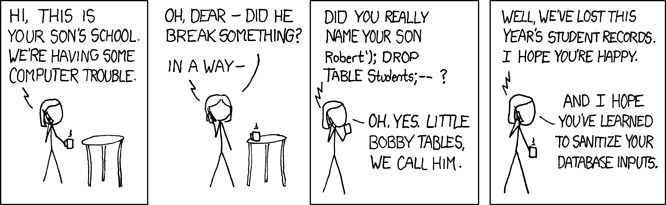
Putting my argument together, I have 1) identified some downsides of using non-standard RSA Key sizes and discussed their costs and implications, and 2) mentioned some speculative upsides of using non-standard key sizes. I am not aware of any argument that the odds of my speculation is 0% likely to be true. It appears there is some remote chance, higher than 0%, that my speculation is true. Therefor, my personal conservative approach is to hedge against this unlikely, but still possible, attack scenario by paying the moderate cost to use non-standard RSA key sizes. Of course, the QA engineer in me also likes to break things by not doing what everyone else does, so I end this with an ObXKCD.
So, it's now been twenty years since I became a Debian Developer. I
couldn't remember the exact date I signed up, but I
decided to do some forensics to find out. First, I can check on the
dates on my first Debian system, as I've kept it running as a Debian
system ever since!

jack:~$ ls -alt /etc ... -rw-r--r-- 1 root root 6932 Feb 10 1997 pine.conf.old -rw-r--r-- 1 root root 6907 Dec 29 1996 pine.conf.old2 -rw-r--r-- 1 root root 76739 Dec 7 1996 mailcap.old -rw-r--r-- 1 root root 1225 Oct 20 1996 fstab.old jack:~$I know that I did my first Debian installation in late October 1996, migrating over from my existing Slackware installation with the help of my friend Jon who was already a DD. That took an entire weekend and it was painful, so much so that several times that weekend I very nearly bailed and went back. But, I stuck with it and after a few more days I decided I was happier with Debian than with the broken old Slackware system I'd been using. That last file (fstab.old) is the old fstab file from the Slackware system, backed up just before I made the switch. I was already a software developer at the time, so of course the first thing I wanted to do once I was happy with Debian was to become a DD and take over the Debian maintenance of mikmod, the module player I was working on at the time. So, I mailed Bruce to ask for an account (there was none of this NM concept back then!) and I think he replied the next day. Unfortunately, I don't have the email in my archives any more due to a disk crash back in the dim and distant past. But I can see that the first PGP key I generated for the sake of joining Debian dates from October 30th 1996 which gives me a date of 31st October 1996 for joining Debian. Twenty years, wow... Since then, I've done lots in the project. I'm lucky enough to been to 11 DebConfs, hosted all around the world. I'm massively proud to have been voted DPL for two of those twenty years. I've worked on a huge number of different things in Debian, from the audio applications I started with to the installer (yay, how things come back to bite you!), from low-level CD and DVD tools (and making our CD images!) to a wiki engine written in python. I've worked hard to help make the best Operating System on the planet, both for my own sake and the sake of our users. Debian has been both excellent fun and occasionally a huge cause of stress in my life for the last 20 years, but despite the latter I wouldn't go back and change anything. Why? Through Debian, I've made some great friends: in Cambridge, in the UK, in Europe, on every continent. Thanks to you all, and here's to (hopefully) many years to come!
Back in August, I was looking for a
Homeserver replacement. During FrOSCon I was then reminded
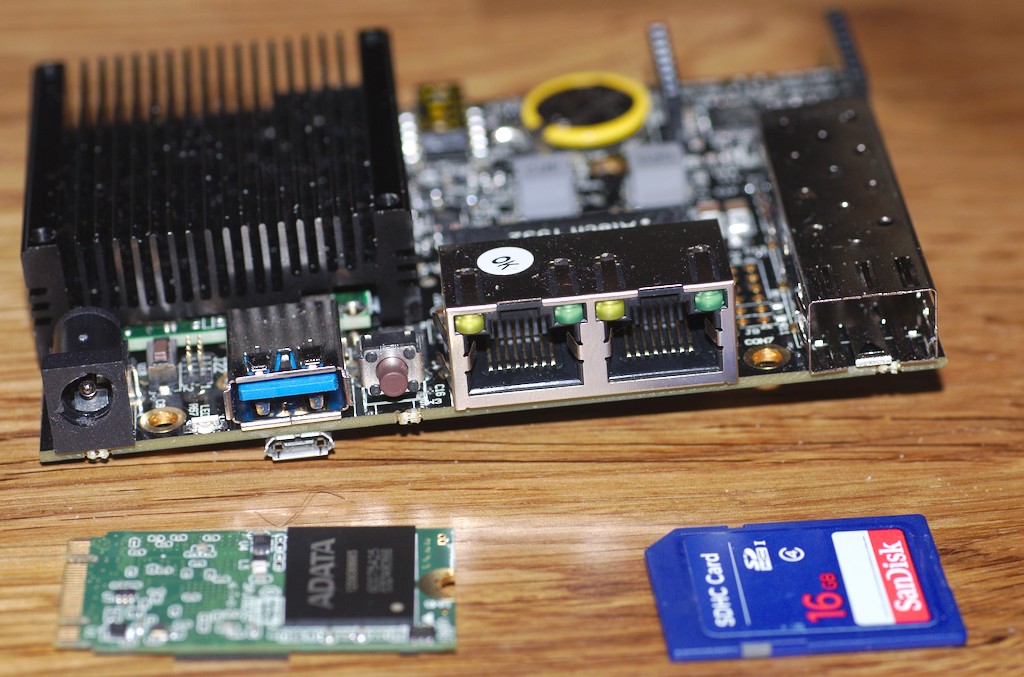
of the Turris Omnia project by NIC.cz. The basic SoC (Marvel
Armada 38x) seemed to be nice hand have decent mainline support (and,
with the turris, users interested in keeping it working). Only I don't
want any WIFI and I wasn't sure the standard case would be all that
usefully. Fortunately, there's also a simple board available with the
same SoC called ClearFog and so I got one of these (the Base
version). With shipping and the SSD (the only 2242 M.2 SSD with 250
GiB I could find, a ADATA SP600) it slightly exceeds the budget but
well.
When installing the machine, the obvious goal was to use mainline FOSS
components only if possible. Fortunately there's mainline kernel
support for the device as well as mainline U-Boot. First attempts
to boot from a micro SD card did not work out at all, both with
mainline U-Boot and the vendor version though. Turns out the eMMC
version of the board does not support any micro SD cards at all, a
fact that is documented but others failed to notice as well.
U-Boot
As the board does not come with any loader on eMMC and booting
directly from M.2 requires removing some resistors from the board, the
easiest way is using UART for booting. The vendor wiki has some shell
script wrapping an included C fragment to feed U-Boot to the device
but all that is really needed is U-Boot's kwboot utility. For some
reason the SPL didn't properly detect UART booting on my device (wrong
magic number) but patching the if (in arch-mvebu's spl.c) and always
assume UART boot is an easy way around.
The plan then was to boot a Debian armhf rootfs with a
defconfig kernel from USB stick. and install U-Boot and the rootfs
to eMMC from within that system. Unfortunately U-Boot seems to be
unable to talk to the USB3 port so no kernel loading from there. One
could probably make UART loading work but switching between screen for
serial console and xmodem seemed somewhat fragile and I never got it
working. However ethernet can be made to work, though you need to set
eth1addr to eth3addr (or just the right one of these) in U-Boot,
saveenv and reboot. After that TFTP works (but is somewhat slow).
eMMC
There's one last step required to allow U-Boot and Linux to access the
eMMC. eMMC is wired to the same PINs as the SD card would be. However
the SD card has an additional indicator pin showing whether a card is
present. You might be lucky inserting a dummy card into the slot or go
the clean route and remove the pin specification from the device tree.
--- a/arch/arm/dts/armada-388-clearfog.dts
+++ b/arch/arm/dts/armada-388-clearfog.dts
@@ -306,7 +307,6 @@
sdhci@d8000
bus-width = <4>;
- cd-gpios = <&gpio0 20 GPIO_ACTIVE_LOW>;
no-1-8-v;
pinctrl-0 = <&clearfog_sdhci_pins
&clearfog_sdhci_cd_pins>;
Next Up is flashing the U-Boot to eMMC. This seems to
work with the vendor U-Boot but proves to be tricky with
mainline. The fun part boils down to the fact that the boot firmware
reads the first block from eMMC, but the second from SD card. If
you write the mainline U-Boot, which was written and tested for SD
card, to eMMC the SPL will try to load the main U-Boot starting from
it's second sector from flash -- obviously resulting in garbage. This
one took me several tries to figure out and made me read most of the
SPL code for the device. The fix however is trivial (apart from the
question on how to support all different variants from one codebase,
which I'll leave to the U-Boot developers):
--- a/include/configs/clearfog.h
+++ b/include/configs/clearfog.h
@@ -143,8 +143,7 @@
#define CONFIG_SPL_LIBDISK_SUPPORT
#define CONFIG_SYS_MMC_U_BOOT_OFFS (160 << 10)
#define CONFIG_SYS_U_BOOT_OFFS CONFIG_SYS_MMC_U_BOOT_OFFS
-#define CONFIG_SYS_MMCSD_RAW_MODE_U_BOOT_SECTOR ((CONFIG_SYS_U_BOOT_OFFS / 512)\
- + 1)
+#define CONFIG_SYS_MMCSD_RAW_MODE_U_BOOT_SECTOR (CONFIG_SYS_U_BOOT_OFFS / 512)
#define CONFIG_SYS_U_BOOT_MAX_SIZE_SECTORS ((512 << 10) / 512) /* 512KiB */
#ifdef CONFIG_SPL_BUILD
#define CONFIG_FIXED_SDHCI_ALIGNED_BUFFER 0x00180000 /* in SDRAM */
Linux
Now we have a System booting from eMMC with mainline U-Boot (which is
a most welcome speedup compared to the UART and TFTP combination from
the beginning). Getting to fine-tune linux on the device -- we want to
install the armmp Debian kernel and have it work. As all the drivers
are build as modules for that kernel this also means initrd
support. Funnily U-Boots bootz allows booting a plain vmlinux
kernel but I couldn't get it to boot a plain initrd. Passing a uImage
initrd and a normal kernel however works pretty well. Back when I
first tried there were some modules missing and ethernet didn't work
with the PHY driver built as a module. In the meantime the PHY problem
was fixed in the Debian kernel and almost all modules already
added. Ben then only added the USB3 module on my suggestion and as a
result, unstable's armhf armmp kernel should work perfectly well on
the device (you still need to patch the device tree similar to the
patch above). Still missing is an updated flash-kernel to
automatically generate the initrd uImage which is
work in progress but got stalled until I fixed the U-Boot on eMMC
problem and everything should be fine -- maybe get debian u-boot
builds for that board.
Pro versus Base
The main difference so far between the Pro and the Base version of the
ClearFog is the switch chip which is included on the Pro. The Base
instead "just" has two gigabit ethernet ports and a SFP. Both, linux'
and U-Boot's device tree are intended for the Pro version which makes
on of the ethernet ports unusable (it tries to find the switch behind
the ethernet port which isn't there). To get both ports working (or
the one you settled on earlier) there's a second patch to the device
tree (my version might be sub-optimal but works), U-Boot -- the
linux-kernel version is a trivial adaption:
--- a/arch/arm/dts/armada-388-clearfog.dts
+++ b/arch/arm/dts/armada-388-clearfog.dts
@@ -89,13 +89,10 @@
internal-regs
ethernet@30000
mac-address = [00 50 43 02 02 02];
+ managed = "in-band-status";
+ phy = <&phy1>;
phy-mode = "sgmii";
status = "okay";
-
- fixed-link
- speed = <1000>;
- full-duplex;
- ;
;
ethernet@34000
@@ -227,6 +224,10 @@
pinctrl-0 = <&mdio_pins>;
pinctrl-names = "default";
+ phy1: ethernet-phy@1 /* Marvell 88E1512 */
+ reg = <1>;
+ ;
+
phy_dedicated: ethernet-phy@0
/*
* Annoyingly, the marvell phy driver
@@ -386,62 +386,6 @@
tx-fault-gpio = <&expander0 13 GPIO_ACTIVE_HIGH>;
;
- dsa@0
- compatible = "marvell,dsa";
- dsa,ethernet = <ð1>;
- dsa,mii-bus = <&mdio>;
- pinctrl-0 = <&clearfog_dsa0_clk_pins &clearfog_dsa0_pins>;
- pinctrl-names = "default";
- #address-cells = <2>;
- #size-cells = <0>;
-
- switch@0
- #address-cells = <1>;
- #size-cells = <0>;
- reg = <4 0>;
-
- port@0
- reg = <0>;
- label = "lan1";
- ;
-
- port@1
- reg = <1>;
- label = "lan2";
- ;
-
- port@2
- reg = <2>;
- label = "lan3";
- ;
-
- port@3
- reg = <3>;
- label = "lan4";
- ;
-
- port@4
- reg = <4>;
- label = "lan5";
- ;
-
- port@5
- reg = <5>;
- label = "cpu";
- ;
-
- port@6
- /* 88E1512 external phy */
- reg = <6>;
- label = "lan6";
- fixed-link
- speed = <1000>;
- full-duplex;
- ;
- ;
- ;
- ;
-
gpio-keys
compatible = "gpio-keys";
pinctrl-0 = <&rear_button_pins>;
Conclusion
Apart from the mess with eMMC this seems to be a pretty nice
device. It's now happily running with a M.2 SSD providing enough
storage for now and still has a mSATA/mPCIe plug left for future
journeys. It seems to be drawing around 5.5 Watts with SSD and one
Ethernet connected while mostly idle and can feed around 500 Mb/s from
disk over an encrypted ethernet connection which is, I guess, not too
bad. My plans now include helping to finish flash-kernel support,
creating a nice case and probably get it deployed. I might bring
it to FOSDEM first though.
Working on it was really quite some fun (apart from the frustrating
parts finding the one-block-offset ..) and people were really
helpful. Big thanks here to Debian's arm folks, Ben Hutchings the
kernel maintainer and U-Boot upstream (especially Tom Rini and Stefan
Roese)
SUBSYSTEM=="usb", ACTION=="add", ATTR idVendor =="0694", ATTR idProduct =="0001", \
SYMLINK+="rcx-%k", TAG+="uaccess"
The key part is the 'TAG+="uaccess"' at the end. I suspect all
packages using plugdev in their /lib/udev/rules.d/ files should be
changed to use this tag (either directly or indirectly via
70-uaccess.rules). Perhaps a lintian check should be created
to detect this?
I've been unable to find good documentation on the uaccess feature.
It is unclear to me if the uaccess tag is an internal implementation
detail like the udev-acl tag used by
/lib/udev/rules.d/70-udev-acl.rules. If it is, I guess the
indirect method is the preferred way. Michael
asked for more
documentation from the systemd project and I hope it will make
this clearer. For now I use the generic classes when they exist and
is already handled by 70-uaccess.rules, and add the tag
directly if no such class exist.
To learn more about the isenkram system, please check out
my
blog posts tagged isenkram.
To help out making life for LEGO constructors in Debian easier,
please join us on our IRC channel
#debian-lego and join
the Debian
LEGO team in the Alioth project we created yesterday. A mailing
list is not yet created, but we are working on it. :)
As usual, if you use Bitcoin and want to show your support of my
activities, please send Bitcoin donations to my address
15oWEoG9dUPovwmUL9KWAnYRtNJEkP1u1b.
Here is my monthly update covering what I have been doing in the free software world (previous month):
diffoscope is our "diff on steroids" that will not only recursively unpack archives but will transform binary formats into human-readable forms in order to compare them.
disorderfs is our FUSE filesystem that deliberately introduces nondeterminism into the results of system calls such as readdir(3).
strip-nondeterminism is our tool to remove specific information from a completed build.
I attended the Debian Bug Squashing Party (BSP) in Salzburg, Austria where 70+ "release-critical" bugs were fixed. Sincere thanks to Bernd Zeimetz (bzed) for organising and Conova for sponsoring/hosting. The event was covered by the Salzburg Cityguide.
I attended NixOS user group in London, England.
Niels Thykier granted me commit access to the Lintian Git repository and I added myself to the debian/copyright there.
Filed an ITP for the roughtime secure time synchronisation client and server. This is blocked on packaging the Bazel build system. (#838416)
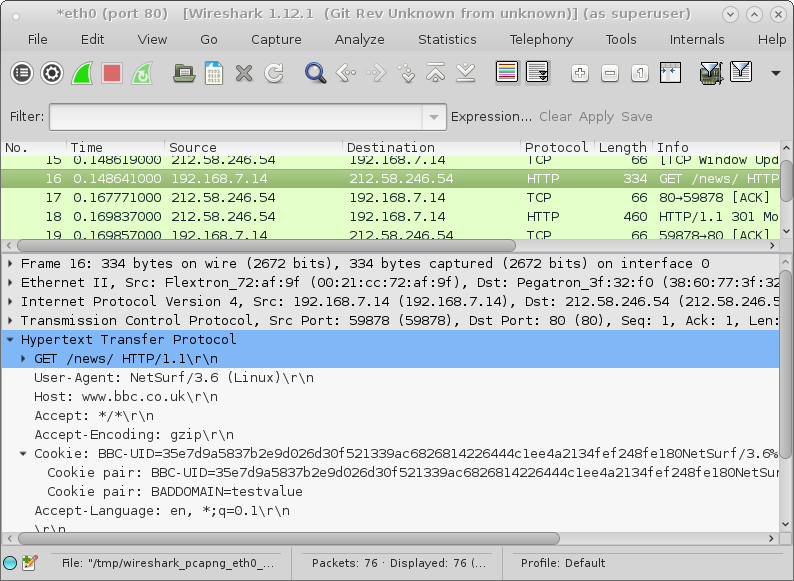
The HTTP cookie is simply a way for a website to identify a connecting browser session so that state can be kept between retrieving pages. Due to shortcomings in the design of cookies and implementation details in browsers this has lead to a selection of unwanted side effects. The specific issue that I am talking about here is the supercookie where the super prefix in this context has similar connotations as to when applied to the word villain.
There is no way to generate the correct set of top level domains with an algorithm so a database is required and is called the Public Suffix List (PSL). This database is a simple text formatted list with wildcard and inversion syntax and is at time of writing around 180Kb of text including comments which compresses down to 60Kb or so with deflate.struct pnode
uint16_t label_index; /* index into string table of label */
uint16_t label_length; /* length of label */
uint16_t child_node_index; /* index of first child node */
uint16_t child_node_count; /* number of child nodes */
;
union pnode
struct
uint16_t index; /* index into string table of label */
uint8_t length; /* length of label */
uint8_t has_children; /* the next table entry is a child node */
label;
struct
uint16_t node_index; /* index of first child node */
uint16_t node_count; /* number of child nodes */
child;
;
static const union pnode pnodes[8580] =
/* root entry */
.label = 0, 0, 1 , .child = 2, 1553 ,
/* entries 2 to 1794 */
.label = 37, 2, 1 , .child = 1795, 6 ,
...
/* entries 8577 to 8578 */
.label = 31820, 6, 1 , .child = 8579, 1 ,
/* entry 8579 */
.label = 0, 1, 0 ,
;
Copyright (c) 2002 Robert Jan Versluis, Rocrail.net
All rights reserved.
Commercial usage needs permission.
The replacement happened with these Git commits:
commit cfee35f3ae5973e97a3d4b178f20eb69a916203e
Author: Rob Versluis <r.j.versluis@rocrail.net>
Date: Fri Jul 17 16:09:45 2015 +0200
update copyrights
commit df399d9d4be05799d4ae27984746c8b600adb20b
Author: Rob Versluis <r.j.versluis@rocrail.net>
Date: Wed Jul 8 14:49:12 2015 +0200
update licence
commit 0daffa4b8d3dc13df95ef47e0bdd52e1c2c58443
Author: Rob Versluis <r.j.versluis@rocrail.net>
Date: Wed Jul 8 10:17:13 2015 +0200
update
Getting in touch again, still being really interested and wanting to help...
As I consider such a non-license as really dangerous when distributing any sort of software, be it Free or non-free Software, I posted the below text on the Rocrail forum:
Hi Rob,
I just stumbled over this post [3] [link reference adapted for this
blog post), which probably is the one you have referred to above.
It seems that Rocrail contains features that require a key or such
for permanent activation. Basically, this is allowed and possible
even with the GPL-3+ (although Free Software activists will not
appreciate that). As the GPL states that people can share the source
code, programmers can easily deactivate license key checks (and
such) in the code and re-distribute that patchset as they like.
Furthermore, the current COPYING file is really non-protective at
all. It does not really protect you as copyright holder of the
code. Meaning, if people crash their trains with your software, you
could actually be legally prosecuted for that. In theory. Or in the
U.S. ( ;-) ). Main reason for having a long long license text is to
protect you as the author in case your software causes t trouble to
other people. You do not have any warranty disclaimer in your COPYING
file or elsewhere. Really not a good idea.
In that referenced post above, someone also writes about the nuisance
of license discussions in this forum. I have seen various cases
where people produced software and did not really care for
licensing. Some ended with a letter from a lawyer, some with some BIG
company using their code under their copyright holdership and their
own commercial licensing scheme. This is not paranoia, this is what
happens in the Free Software world from time to time.
A model that might be much more appropriate (and more protective to
you as the author), maybe, is a dual release scheme for the code. A
possible approach could be to split Rocrail into two editions:
Community Edition and Professional/Commercial Edition. The Community
Edition must be licensed in a way that it allows re-using the code
in a closed-source, non-free version of Rocrail (e.g. MIT/Expat
License or Apache2.0 License). Thus, the code base belonging to the
community edition would be licensed, say..., as Apache-2.0 and for
the extra features in the Commercial Edition, you may use any
non-free license you want (but please not that COPYING file you have
now, it really does not protect your copyright holdership).
The reason for releasing (a reduced set of features of a) software as
Free Software is to extend the user base. The honey jar effect, as
practise by many huge FLOSS projects (e.g. Owncloud, GitLab, etc.).
If people could install Rocrail from the Debian / Ubuntu archives
directly, I am sure that the user base of Rocrail will increase.
There may also be developers popping up showing an interest in
Rocrail (e.g. like me). However, I know many FLOSS developers (e.g.
like me) that won't waste their free time on working for a non-free
piece of software (without being paid).
If you follow (or want to follow) a business model with Rocrail, then
keep some interesting features in the Commercial Edition and don't
ship that source code. People with deep interest may opt for that.
Furthermore, another option could be dual licensing the code. As the
copyright holder of Rocrail you are free to juggle with licenses and
apply any license to a release you want. For example, this can be
interesing for a free-again Rocrail being shipped via Apple's iStore.
Last but not least, as you ship the complete source code with all
previous changes as a Git project to those who request GitBlit
access, it is possible to obtain all earlier versions of Rocrail. In
the mail I received with my GitBlit credentials, there was some text
that prohibits publishing the code. Fine. But: (in theory) it is
not forbidden to share the code with a friend, for local usage. This
friend finds the COPYING file, frowns and rewinds back to 2015 where
the license was still GPL-3+. GPL-3+ code can be shared with anyone
and also published, so this friend could upload the 2015-version of
Rocrail to Github or such and start to work on a free fork. You also
may not want this.
Thanks for working on this piece of software! It is highly
interesing, and I am still sad, that it does not come with a free
license anymore. I won't continue this discussion and move on, unless
you are interested in any of the above information and ask for more
expertise. Ping me here or directly via mail, if needed. If the
expertise leads to parts of Rocrail becoming Free Software again, the
expertise is offered free of charge ;-).
light+love
Mike
Wow, the first time I got moderated somewhere... What an experience!
This experience now was really new. My post got immediately removed from the forum by the main author of Rocrail (with the forum's moderator's hat on). The new experience was: I got really angry when I discovererd having been moderated. Wow! Really a powerful emotion. No harassment in my words, no secrets disclosed, and still... my free speech got suppressed by someone. That feels intense! And it only occurred in the virtual realm, not face to face. Wow!!! I did not expect such intensity...
The reason for wiping my post without any other communication was given as below and quite a statement to frown upon (this post has also been "moderately" removed from the forum thread [2] a bit later today):
Mike,
I think its not a good idea to point out a way to get the sources back to the GPL periode.
Therefore I deleted your posting.
(The phpBB forum software also allows moderators to edit posts, so the critical passage could have been removed instead, but immediately wiping the full message, well...). Also, just wiping my post and not replying otherwise with some apology to suppress my words, really is a no-go. And the reason for wiping the rest of the text... Any Git user can easily figure out how to get a FLOSS version of Rocrail and continue to work on that from then on. Really.
Now the political part of this blog post...
Fortunately, I still live in an area of the world where the right of free speech is still present. I found out: I really don't like being moderated!!! Esp. if what I share / propose is really noooo secret at all. Anyone who knows how to use Git can come to the same conclusion as I have come to this morning.
[Off-topic, not at all related to Rocrail: The last votes here in Germany indicate that some really stupid folks here yearn for another this time highly idiotic wind of change, where free speech may end up as a precious good.]
To other (Debian) Package Maintainers and Railroad Enthusiasts...
With this blog post I probably close the last option for Rocrail going FLOSS again. Personally, I think that gate was already closed before I got in touch.
Now really moving on...
Probably the best approach for my new train conductor hobby (as already recommended by the woman at my side some weeks back) is to leave the laptop lid closed when switching on the train control units. I should have listened to her much earlier.
I have finally removed the Rocrail source code from my computer again without building and testing the application. I neither have shared the source code with anyone. Neither have I shared the Git URL with anyone. I really think that FLOSS enthusiasts should stay away from this software for now. For my part, I have lost my interest in this completely...
References
if % QUERY_STRING starts with one of <parameters>:
rewrite % REQUEST_URI from /new/ to /old/
Honestly, it took me several hours to find a solution that was satisfying and
scales well. Hopefully, this post will save time for others with the need for
a similar solution.
Research and first attempt: RewriteCond % QUERY_STRING ...
After reading through some documentation, particularly
Manipulating the Query String,
the following ideas came to my mind at first:
RewriteCond % REQUEST_URI ^/new/
RewriteCond % QUERY_STRING ^(param1)(.*)$ [OR]
RewriteCond % QUERY_STRING ^(param2)(.*)$ [OR]
...
RewriteCond % QUERY_STRING ^(paramN)(.*)$
RewriteRule /new/ /old/?%1%2 [R,L]
or instead of an own RewriteCond for each parameter:
RewriteCond % QUERY_STRING ^(param1 param2 ... paramN)(.*)$
RewriteEngine On
RewriteMap RewriteParams "dbm:/tmp/rewrite-params.map"
RewriteCond % REQUEST_URI ^/new/
RewriteCond $ RewriteParams:% QUERY_STRING NOT_FOUND !=NOT_FOUND
RewriteRule ^/new/ /old/ [R,L]
param1 param1
param2 param2
...
paramN paramN
Then I created a DBM hash map file
from that plain text map file,
as DBM maps are indexed, while TXT maps are not. In other words: with big
maps, DBM is a huge performance boost:
httxt2dbm -i /tmp/rewrite-params.txt -o /tmp/rewrite-params.map
RewriteEngine On
Second line defines the RewriteMap that I created above. It contains the
list of parameters to be rewritten:
RewriteMap RewriteParams "dbm:/tmp/rewrite-params.map"
The third line limits the rewrites to REQUEST_URIs that start with /new/.
This is particularly required to prevent rewrite loops. Without that
condition, queries that have been rewritten to /old/ would go through the
rewrite again, resulting in an endless rewrite loop:
RewriteCond % REQUEST_URI ^/new/
The fourth line is the core condition: it checks whether QUERY_STRING (the
GET parameters) is listed in the RewriteMap. A fallback value 'NOT_FOUND'
is defined if the lookup didn't match. The condition is only true, if the
lookup was successful and the QUERY_STRING was found within the map:
RewriteCond $ RewriteParams:% QUERY_STRING NOT_FOUND !=NOT_FOUND
The last line is a simple RewriteRule from /new/ to /old/. It is
executed only if all previous conditions are met. The
flags are R
for redirect (issuing a HTTP redirect to browser) and L for last
(causing mod_rewrite to stop processing immediately after that rule):
RewriteRule ^/new/ /old/ [R,L]
Next.