Search Results: "nion"

1 August 2023

Jonathan Dowland: Interzone's new home

IZ #294, the latest issue IZ #294, the latest issue
The long running British1 SF Magazine Interzone has a new home and new editor, Gareth Jelley, starting with issue 294. It's also got a swanky new format ("JB6"): a perfect-bound, paperback novel size, perfect for fitting into an oversize coat or jeans pocket for reading on the train. I started reading Interzone in around 2003, having picked up an issue (#176) from Feb 2002 that was languishing on the shelves in Forbidden Planet. Once I discovered it I wondered why it had taken me so long. That issue introduced me to Greg Egan. I bought a number of back issues on eBay, to grab issues with stories by people including Terry Pratchett, Iain Banks, Alastair Reynolds, and others.
IZ #194: The first by TTA press IZ #194: The first by TTA press
A short while later in early 2004, after 22 years, Interzone's owner and editorship changed from David Pringle to Andy Cox and TTA Press. I can remember the initial transition was very jarring: the cover emphasised expanding into coverage of Manga, Graphic Novels and Video Games (which ultimately didn't happen) but after a short period of experimentation it quickly settled down into a similarly fantastic read. I particularly liked the move to a smaller, perfect-bound form-factor in 2012. I had to double-check this but I'd been reading IZ throughout the TTA era and it lasted 18 years! Throughout that time I have discovered countless fantastic authors that I would otherwise never have experienced. Some (but by no means all) are Dominic Green, Daniel Kaysen, Chris Beckett, C cile Cristofari, Aliya Whiteley, Tim Major, Fran oise Harvey, Will McIntosh. Cox has now retired (after 100 issues and a tenure almost as long as Pringle) and handed the reins to Gareth Jelley/MYY Press, who have published their first issue, #294. Jelley is clearly putting a huge amount of effort into revitalizing the magazine. There's a new homepage at interzone.press but also companion internet presences: a plethora of digital content at interzone.digital, Interzone Socials (a novel idea), a Discord server, a podcast, and no doubt more. Having said that, the economics of small magazines have been perilous for a long time, and that hasn't changed, so I think the future of IZ (in physical format at least) is in peril. If you enjoy short fiction, fresh ideas, SF/F/Fantastika; why not try a subscription to Interzone, whilst you still can!

  1. Interzone has always been "British", in some sense, but never exclusively so. I recall fondly a long-term project under Pringle to publish a lot of Serbian writer Zoran ivkovi , for example, and the very first story I read was by Australian Greg Egan. Under Jelley, the magazine is being printed in Poland and priced in Euros. I expect it to continue to attract and publish writers from all over the place.

29 July 2023

Shirish Agarwal: Manipur, Data Leakage, Aadhar, and IRCv3

Manipur Lot of news from Manipur. Seems the killings haven t stopped. In fact, there was a huge public rally in support of the rapists and murderers as reported by Imphal Free Press. The Ruling Govt. both at the Center and the State being BJP continuing to remain mum. Both the Internet shutdowns have been criticized and seems no effect on the Government. Their own MLA was attacked but they have chosen to also be silent about that. The opposition demanded that the PM come in both the houses and speak but he has chosen to remain silent. In that quite a few bills were passed without any discussions. If it was not for the viral videos nobody would have come to know of anything  . Internet shutdowns impact women disproportionately as more videos of assaults show  Of course, as shared before that gentleman has been arrested under Section 66A as I shared in the earlier blog post. In any case, in the last few years, this Government has chosen to pass most of its bills without any discussions. Some of the bills I will share below. The attitude of this Govt. can be seen through this cartoon
The above picture shows the disqualified M.P. Rahul Gandhi because he had asked what is the relationship between Adani and Modi. The other is the Mr. Modi, the Prime Minister who refuses to enter and address the Parliament. Prem Panicker shares how we chillingly have come to this stage when even after rapes we are silent

Data Leakage According to most BJP followers this is not a bug but a feature of this Government. Sucheta Dalal of Moneylife shared how the data leakage has been happening at the highest levels in the Government. The leakage is happening at the ministerial level because unless the minister or his subordinate passes a certain startup others cannot come to know. As shared in the article, while the official approval may take 3-4 days, within hours other entities start congratulating. That means they know that the person/s have been approved.While reading this story, the first thought that immediately crossed my mind was data theft and how easily that would have been done. There was a time when people would be shocked by articles such as above and demand action but sadly even if people know and want to do something they feel powerless to do anything

PAN Linking and Aadhar Last month GOI made PAN Linking to Aadhar a thing. This goes against the judgement given by the honored Supreme Court in September 2018. Around the same time, Moneylife had reported on the issue on how the info. on Aadhar cards is available and that has its consequences. But to date nothing has happened except GOI shrugging. In the last month, 13 crore+ users of PAN including me affected by it  I had tried to actually delink the two but none of the banks co-operated in the same  Aadhar has actually number of downsides, most people know about the AEPS fraud that has been committed time and time again. I have shared in previous blog posts the issue with biometric data as well as master biometric data that can and is being used for fraud. GOI either ignorant or doesn t give a fig as to what happens to you, citizen of India. I could go on and on but it would result in nothing constructive so will stop now

IRCv3 I had been enthused when I heard about IRCV3. While it was founded in 2016, it sorta came on in its own in around 2020. I did try matrix or rather riot-web and went through number of names while finally setting on element. While I do have the latest build 1.11.36 element just hasn t been workable for me. It is too outsized, and occupies much more real estate than other IM s (Instant Messengers and I cannot correct size it like I do say for qbittorrent or any other app. I had filed couple of bugs on it but because it apparently only affects me, nothing happened afterwards  But that is not the whole story at all. Because of Debconf happening in India, and that too Kochi, I decided to try out other tools to see how IRC is doing. While the Debian wiki page shares a lot about IRC clients and is also helpful in sharing stats by popcounter ( popularity-contest, thanks to whoever did that), it did help me in trying two of the most popular clients. Pidgin and Hexchat, both of which have shared higher numbers. This might be simply due to the fact that both get downloaded when you install the desktop version or they might be popular in themselves, have no idea one way or the other. But still I wanted to see what sort of experience I could expect from both of them in 2023. One of the other things I noticed is that Pidgin is not a participating organization in ircv3 while hexchat is. Before venturing in, I also decided to take a look at oftc.net. Came to know that for sometime now, oftc has started using web verify. I didn t see much of a difference between hcaptcha and gcaptcha other than that the fact that they looked more like oil paintings rather than anything else. While I could easily figure the odd man out or odd men out to be more accurate, I wonder how a person with low or no vision would pass that ??? Also much of our world is pretty much contextual based, figuring who the odd one is or are could be tricky. I do not have answers to the above other than to say more work needs to be done by oftc in that area. I did get a link that I verified. But am getting ahead of the story. Another thing I understood that for some reason oftc is also not particpating in ircv3, have no clue why not :(I

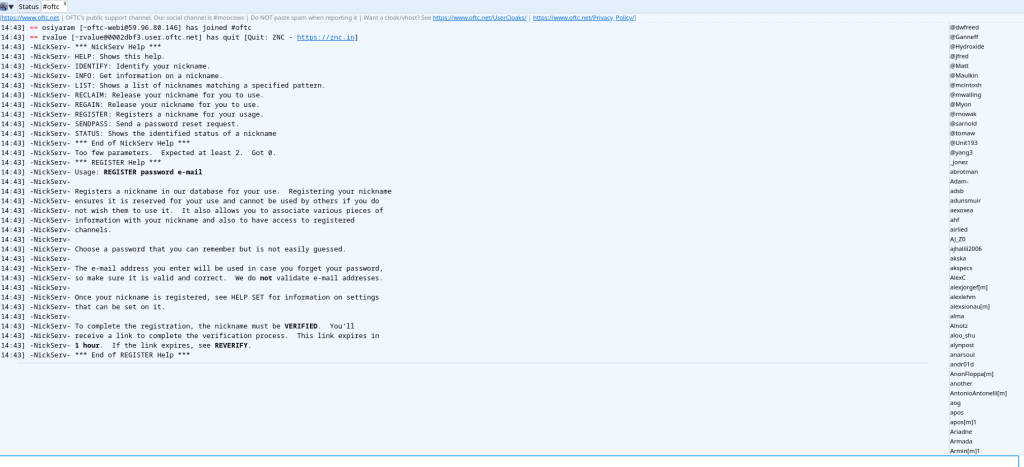
Account Registration in Pidgin and Hexchat This is the biggest pain point in both. I failed to register via either Pidgin or Hexchat. I couldn t find a way in either client to register my handle. I have had on/off relationships with IRC over the years, the biggest issue being IIRC is that if you stop using your handle for a month or two others can use it. IIRC, every couple of months or so, irc/oftc releases the dormant ones. Matrix/Vector has done quite a lot in that regard but that s a different thing altogether so for the moment will keep that aside. So, how to register for the network. This is where webchat.oftc.net comes in. You get a quaint 1970 s IRC window (probably emulated) where you call Nickserv to help you. As can be seen it one of the half a dozen bots that helps IRC. So the first thing you need to do is /msg nickserv help what you are doing is asking nickserv what services they have and Nickserv shares the numbers of services it offers. After looking into, you are looking for register /msg nickerv register Both the commands tell you what you need to do as can be seen by this
Let s say you are XYZ and your e-mail address is xyz@xyz.com This is just a throwaway id I am taking for the purpose of showing how the process is done. For this, also assume your passowrd is 1234xyz;0x something like this. I have shared about APG (Advanced Password Generator) before so you could use that to generate all sorts of passwords for yourself. So next would be /msg nickserv register 1234xyz;0x xyz@xyz.com Now the thing to remember is you need to be sure that the email is valid and in your control as it would generate a link with hcaptcha. Interestingly, their accessibility signup fails or errors out. I just entered my email and it errors out. Anyway back to it. Even after completing the puzzle, even with the valid username and password neither pidgin or hexchat would let me in. Neither of the clients were helpful in figuring out what was going wrong. At this stage, I decided to see the specs of ircv3 if they would help out in anyway and came across this. One would have thought that this is one of the more urgent things that need to be fixed, but for reasons unknown it s still in draft mode. Maybe they (the participants) are not in consensus, no idea. Unfortunately, it seems that the participants of IRCv3 have chosen a sort of closed working model as the channel is restricted. The only notes of any consequence are being shared by Ilmari Lauhakangas from Finland. Apparently, Mr/Ms/they Ilmari is also a libreoffice hacker. It is possible that their is or has been lot of drama before or something and that s why things are the way they are. In either way, doesn t tell me when this will be fixed, if ever. For people who are on mobiles and whatnot, without element, it would be 10x times harder. Update :- Saw this discussion on github. Don t see a way out  It seems I would be unable to unable to be part of Debconf Kochi 2023. Best of luck to all the participants and please share as much as possible of what happens during the event.

19 July 2023

Shirish Agarwal: RISC-V, Chips Act, Burning of Books, Manipur

RISC -V Motherboard, SBC While I didn t want to, a part of me is hyped about this motherboard. This would probably be launched somewhere in November. There are obvious issues in this, the first being unlike regular motherboards you wouldn t be upgrade as you would do.You can t upgrade your memory, can t upgrade the CPU (although new versions of instructions could be uploaded, similar to BIOS updates) but as the hardware is integrated (the quad-core SiFive Performance P550 core complex) it would really depend. If the final pricing is around INR 4-5k then it may be able to sell handsomely provided there are people to push and provide support around it. A 500 GB or 1 TB SSD coupled with it and a cheap display unit and you could use it anywhere although as the name says it s more for tinkering as the name suggests. Another board that could perhaps be of more immediate use would be the beagleboard. They launched the same couple of days back and called it Beagle V-Ahead. Again, costs are going to be a concern. Just a year before the pandemic the Beagleboard Black (BB) used to cost in the sub 4k range, today it costs 8k+ for the end user, more than twice the price. How much Brexit is to be blamed for this and how much the Indian customs we would never know. The RS Group that is behind that shop is head-quartered in the UK. As said before, we do not know the price of either board as it probably will take few months for v-ahead to worm its way in the Indian market, maybe another 6 months or so. Even so, with the limited info. on both the boards, I am tilting more towards the other HiFive one. We should come to know about the boards say in 3-5 months of time.

CHIPS Act I had shared about the Chips Act a few times here as well as on SM. Two articles do tell how the CHIPS Act 2023 is more of a political tool, an industrial defence policy rather than just business as most people tend to think.

Cancelation of Books, Books Burning etc. Almost 2400 years ago, Plato released his work called Plato s Republic and one of the seminal works within it is perhaps one of the most famous works was the Allegory of the Cave. That is used again and again in a myriad ways, mostly in science-fiction though and mostly to do with utopian, dystopian movies, webseries etc. I did share how books are being canceled in the States, also a bit here. But the most damning thing has happened throughout history, huge quantities of books burned almost all for politics  But part of it has been neglect as well as this time article shares. What we have lost and continue to lose is just priceless. Every book has a grain of truth in it, some more, some less but equally enjoyable. Most harmful is the neglect towards books and is more true today than any other time in history. Kids today have a wide variety of tools to keep themselves happy or occupied, from anime, VR, gaming the list goes on and on. In that scenario, how the humble books can compete. People think of Kindle but most e-readers like Kindle are nothing but obsolescence by design. I have tried out Kindle a few times but find it a bit on the flimsy side. Books are much better IMHO or call me old-school. While there are many advantages, one of the things that I like about books is that you can easily put yourself in either the protagonist or the antagonist or somewhere in the middle and think of the possible scenarios wherever you are in a particular book. I could go on but it will be a blog post or two in itself. Till later. Happy Reading.

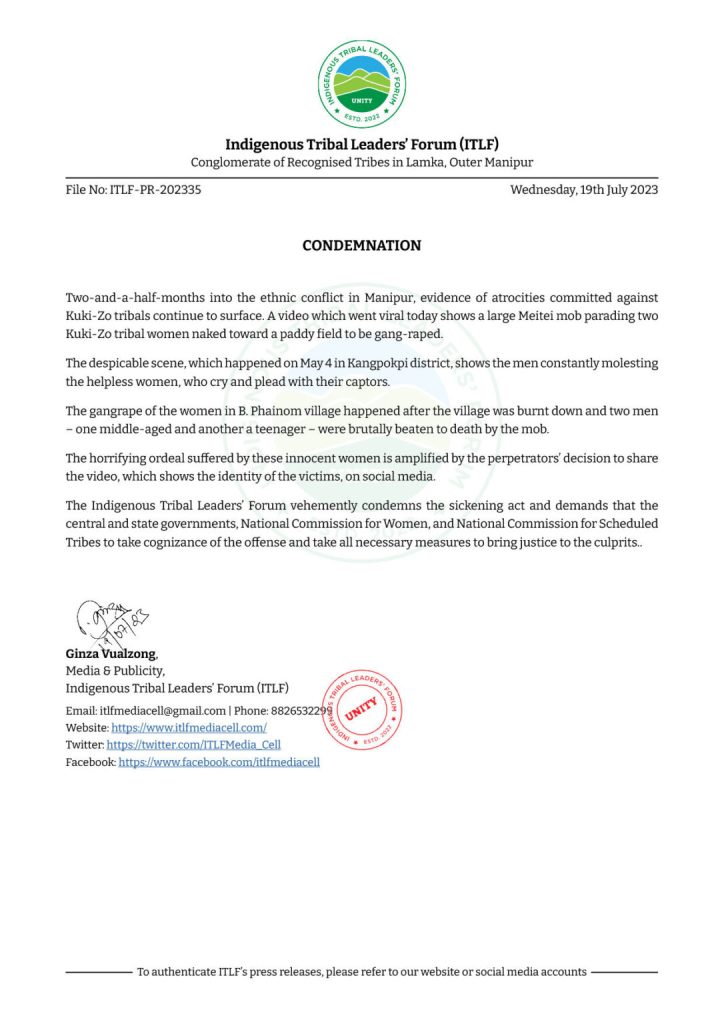
Update:Manipur Extremely horrifying visuals, articles and statements continue to emanate from Manipur. Today, 19th July 2023, just couple of hours back, a video surfaced showing two Kuki women were shown as stripped, naked and Meitei men touching their private parts. Later on, we came to know that this was in response of a disinformation news spread by the Meitis of few women being raped although no documentary evidence of the same surfaced, no names nothing. While I don t want to share the video I will however share the statement shared by the Kuki-Zo tribal community on that. The print gives a bit more context to what has been going on.
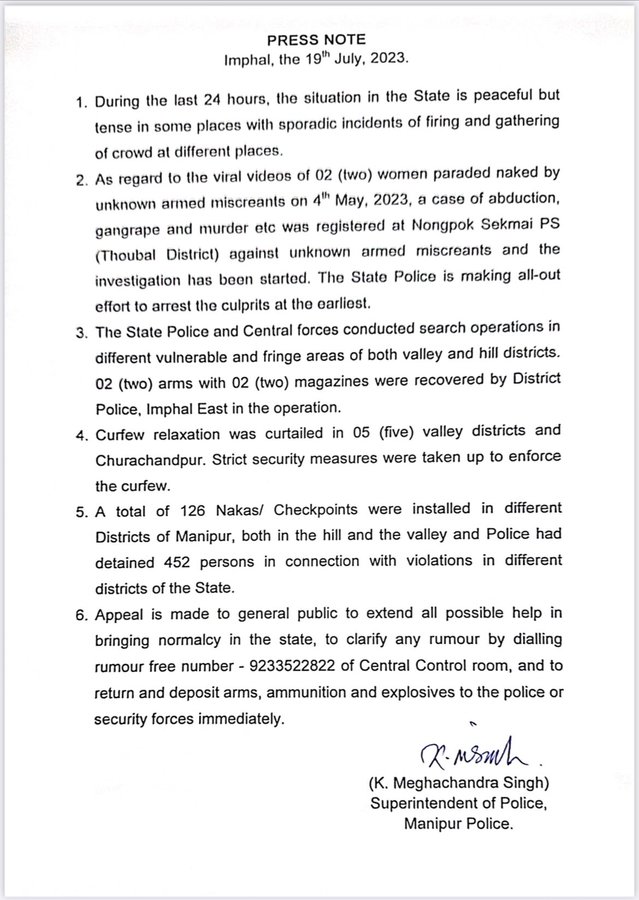
Update, Few hours later : The Print also shared more of a context about six days ago. The reason we saw the video now was that for the last 2.5 months Manipur was in Internet shutdown so those videos got uploaded now. There was huge backlash from the Twitter community and GOI ordered the Manipur Police to issue this Press Release yesterday night or just few hours before with yesterday s time-stamp.
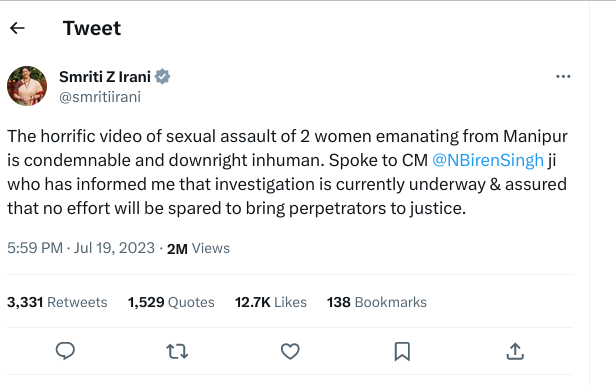
IndianExpress shared an article that does state that while an FIR had been registered immediately no arrests so far and this is when you can see the faces of all the accused. Not one of them tried to hide their face behind a mask or something. So, if the police wanted, they could have easily identified who they are. They know which community the accused belong to, they even know from where they came. If they wanted to, they could have easily used mobile data and triangulation to find the accused and their helpers. So, it does seem to be attempt to whitewash and protect a certain community while letting it prey on the other. Another news that did come in, is because of the furious reaction on Twitter, Youtube has constantly been taking down the video as some people are getting a sort of high more so from the majoritarian community and making lewd remarks. Twitter has been somewhat quick when people are making lewd remarks against the two girl/women. Quite a bit of the above seems like a cover-up. Lastly, apparently GOI has agreed to having a conversation about it in Lok Sabha but without any voting or passing any resolutions as of right now. Would update as an when things change. Update: Smriti Irani, the Child and Development Minister gave the weakest statement possible
As can be noticed, she said sexual assault rather than rape. The women were under police custody for safety when they were whisked away by the mob. No mention of that. She spoke to the Chief Minister who has been publicly known as one of the provocateurs or instigators for the whole thing. The CM had publicly called the Kukus and Nagas as foreigners although both of them claim to be residing for thousands of years and they apparently have documentary evidence of the same  . Also not clear who is doing the condemning here. No word of support for the women, no offer of intervention, why is she the Minister of Child and Women Development (CDW) if she can t use harsh words or give support to the women who have gone and going through horrific things  Update : CM Biren Singh s Statement after the video surfaced
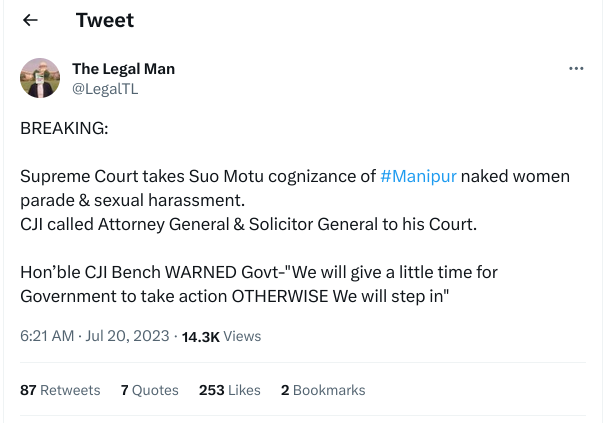
This tweet is contradictory to the statements made by Mr. Singh couple of months ago. At that point in time, Mr. Singh had said that NIA, State Intelligence Departments etc. were giving him minute to minute report on the ground station. The Police itself has suo-moto (on its own) powers to investigate and apprehend criminals for any crime. In fact, the Police can call for questioning of anybody in any relation to any crime and question them for upto 48 hours before charging them. In fact, many cases have been lodged where innocent persons have been framed or they have served much more in the jail than the crime they are alleged to have been committed. For e.g. just a few days before there was a media report of a boy who has been in jail for 3 years. His alleged crime, stealing mere INR 200/- to feed himself. Court doesn t have time to listen to him yet. And there are millions like him. The quint eloquently shares the tale where it tells how both the State and the Centre have been explicitly complicit in the incidents ravaging Manipur. In fact, what has been shared in the article has been very true as far as greed for land is concerned. Just couple of weeks back there have been a ton of floods emanating from Uttarakhand and others. Just before the flooding began, what was the CM doing can be seen here. Apart from the newspapers I have shared and the online resources, most of the mainstream media has been silent on the above. In fact, they have been silent on the Manipur issue until the said video didn t come into limelight. Just now, in Lok Sabha everybody is present except the Prime Minister and the Home Minister. The PM did say that the law will take its own course, but that s about it. Again no support for the women concerned.  Update: CJI (Chief Justice of India) has taken suo-moto cognizance and has warned both the State and Centre to move quickly otherwise they will take the matter in their own hand.
Update: Within 2 hours of the CJI taking suo-moto cognizance, they have arrested one of the main accused Heera Das
The above tells you why the ban on Internet was put in the first place. They wanted to cover it all up. Of all the celebs, only one could find a bit of spine, a bit of backbone to speak about it, all the rest mum
Just imagine, one of the women is around my age while the young one could have been a daughter if I had married on time or a younger sister for sure. If ever I came face to face with them, I just wouldn t be able to look them in the eye. Even their whole whataboutery is built on sham. From their view Kukis are from Burma or Burmese descent. All of which could be easily proved by DNA of all. But let s leave that for a sec. Let s take their own argument that they are Burmese. Their idea of Akhand Bharat stretches all the way to Burma (now called Myanmar). They want all the land but no idea with what to do with the citizens living on it. Even after the video, the whataboutery isn t stopping, that shows how much hatred is there. And not knowing that they too will be victim of the same venom one or the other day  Update: Opposition was told there would be a debate on Manipur. The whole day went by, no debate. That s the shamelessness of this Govt.  Update 20th July 19:25 Center may act or not act against the perpetrators but they will act against Twitter who showed the crime. Talk about shooting the messenger
We are now in the last stage. In 2014, we were at 6

12 July 2023

Freexian Collaborators: Debian Contributions: /usr-merge updates, DebConf Bursary prep, and more! (by Utkarsh Gupta)

Contributing to Debian is part of Freexian s mission. This article covers the latest achievements of Freexian and their collaborators. All of this is made possible by organizations subscribing to our Long Term Support contracts and consulting services.

/usr-merge, by Helmut Grohne, et al The work on /usr-merge continues from May. The lengthy discussion was condensed into a still lengthy rewrite of DEP17 listing all known problems and proposed mitigations. An initial consensus call did not resolve all questions, but we now have rough consensus on finalizing the transition without relying on major changes to dpkg. Other questions still have diverging opinions and some matters such as how to not break backports are still missing satisfying answers.

DebConf Bursary prep, by Utkarsh Gupta DebCamp and DebConf is happening from 03rd September to 17th September in Kochi, India, and the DebConf Bursary team is gearing up for that. After extending the bursary deadline (catering to the requests coming in from various people), we ve finally managed to clock over 260 bursary requests. The team is set up and we re starting to review the applications. The team intends to roll out the result as soon as possible.

debci, by Helmut Grohne As Freexian is working on deploying autopkgtests for the LTS and ELTS services, debci and autopkgtests were improved in Debian to better deal with derivatives (e.g. by better supporting external package signing keyrings). Other aspects that are not deployed on ci.debian.net such as the qemu backend were also improved. We express thanks to the relevant maintainers Antonio Terceiro, Paul Gevers and Simon McVittie for their timely reviews and merges of our changes.

Miscellaneous contributions
  • Following the release of Debian 12, Rapha l Hertzog updated tracker.debian.org to be aware of trixie. He also pushed some fixes to distro-tracker (the software powering tracker.debian.org) and released version 1.2.0 (since the former release was lacking fixes to run on Debian 12 bookworm).
  • Following the release of Debian 12, Helmut Grohne updated crossqa.debian.net systems. He also sent 7 patches for cross build failures and continued adapting rebootstrap to changes in unstable.
  • Santiago Ruano Rinc n started to work on how to improve the robustness of Salsa CI s pipeline for some jobs failing frequently.
  • Thorsten Alteholz did security updates of cpdb-libs in Unstable and Bookworm.
  • Stefano Rivera upgraded pixelfed.debian.social to bookworm.
  • Stefano started an re2 library transition, and started preparation for the next transition.
  • Helmut Grohne updated debvm in unstable releasing changes that accumulated during the freeze.
  • Stefano did some work on the website and infrastructure for DebConf 23.
  • Utkarsh Gupta helped review and fix open redmine bugs and fix them all in unstable.

11 July 2023

Simon Josefsson: Coping with non-free software in Debian

A personal reflection on how I moved from my Debian home to find two new homes with Trisquel and Guix for my own ethical computing, and while doing so settled my dilemma about further Debian contributions. Debian s contributions to the free software community has been tremendous. Debian was one of the early distributions in the 1990 s that combined the GNU tools (compiler, linker, shell, editor, and a set of Unix tools) with the Linux kernel and published a free software operating system. Back then there were little guidance on how to publish free software binaries, let alone entire operating systems. There was a lack of established community processes and conflict resolution mechanisms, and lack of guiding principles to motivate the work. The community building efforts that came about in parallel with the technical work has resulted in a steady flow of releases over the years. From the work of Richard Stallman and the Free Software Foundation (FSF) during the 1980 s and early 1990 s, there was at the time already an established definition of free software. Inspired by free software definition, and a belief that a social contract helps to build a community and resolve conflicts, Debian s social contract (DSC) with the free software community was published in 1997. The DSC included the Debian Free Software Guidelines (DFSG), which directly led to the Open Source Definition.

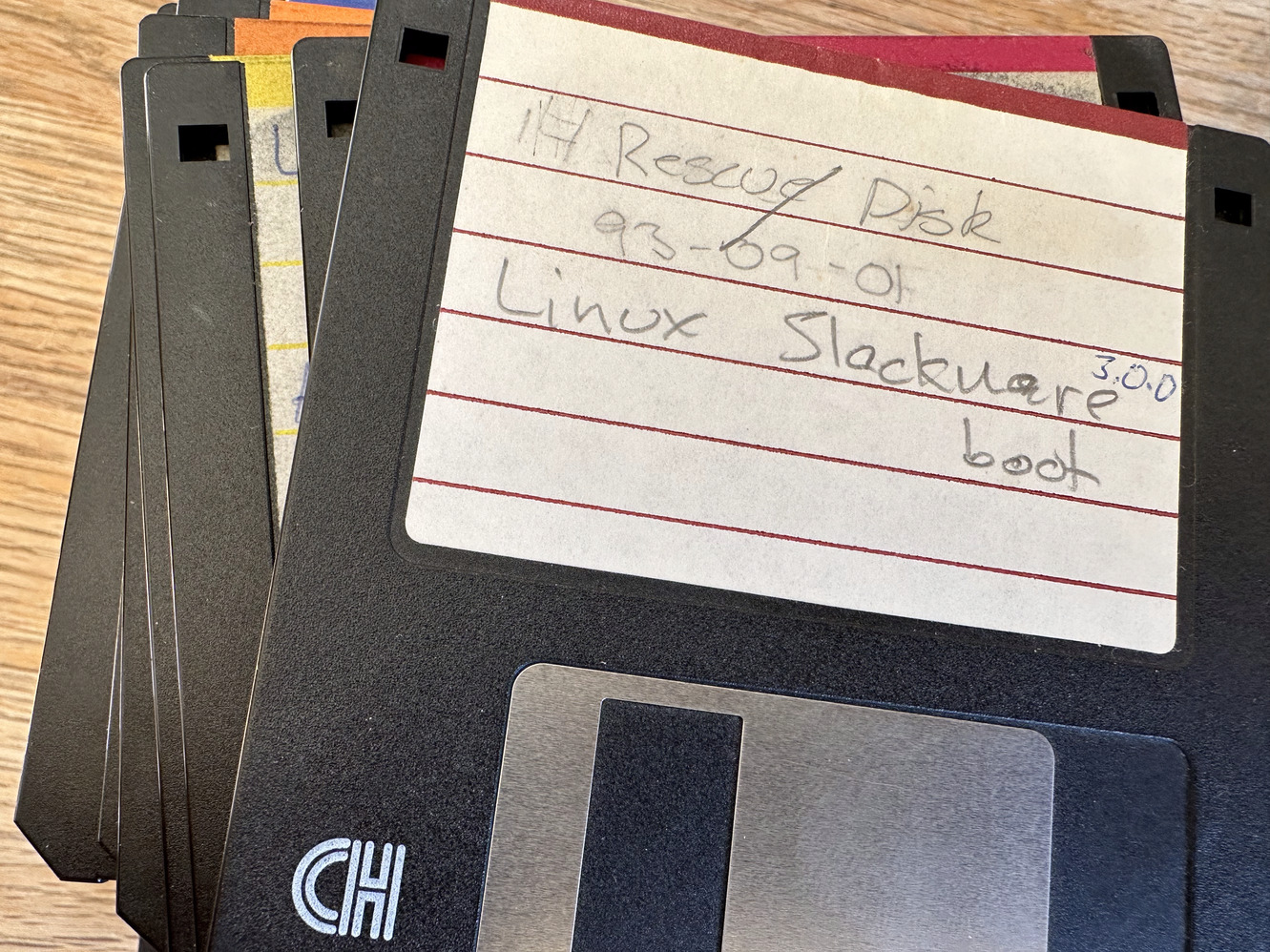
Slackware 3.5" disksOne of my earlier Slackware install disk sets, kept for nostalgic reasons.
I was introduced to GNU/Linux through Slackware in the early 1990 s (oh boy those nights calculating XFree86 modeline s and debugging sendmail.cf) and primarily used RedHat Linux during ca 1995-2003. I switched to Debian during the Woody release cycles, when the original RedHat Linux was abandoned and Fedora launched. It was Debian s explicit community processes and infrastructure that attracted me. The slow nature of community processes also kept me using RedHat for so long: centralized and dogmatic decision processes often produce quick and effective outcomes, and in my opinion RedHat Linux was technically better than Debian ca 1995-2003. However the RedHat model was not sustainable, and resulted in the RedHat vs Fedora split. Debian catched up, and reached technical stability once its community processes had been grounded. I started participating in the Debian community around late 2006. My interpretation of Debian s social contract is that Debian should be a distribution of works licensed 100% under a free license. The Debian community has always been inclusive towards non-free software, creating the contrib/non-free section and permitting use of the bug tracker to help resolve issues with non-free works. This is all explained in the social contract. There has always been a clear boundary between free and non-free work, and there has been a commitment that the Debian system itself would be 100% free. The concern that RedHat Linux was not 100% free software was not critical to me at the time: I primarily (and happily) ran GNU tools on Solaris, IRIX, AIX, OS/2, Windows etc. Running GNU tools on RedHat Linux was an improvement, and I hadn t realized it was possible to get rid of all non-free software on my own primary machine. Debian realized that goal for me. I ve been a believer in that model ever since. I can use Solaris, macOS, Android etc knowing that I have the option of using a 100% free Debian. While the inclusive approach towards non-free software invite and deserve criticism (some argue that being inclusive to non-inclusive behavior is a bad idea), I believe that Debian s approach was a successful survival technique: by being inclusive to and a compromise between free and non-free communities, Debian has been able to stay relevant and contribute to both environments. If Debian had not served and contributed to the free community, I believe free software people would have stopped contributing. If Debian had rejected non-free works completely, I don t think the successful Ubuntu distribution would have been based on Debian. I wrote the majority of the text above back in September 2022, intending to post it as a way to argue for my proposal to maintain the status quo within Debian. I didn t post it because I felt I was saying the obvious, and that the obvious do not need to be repeated, and the rest of the post was just me going down memory lane. The Debian project has been a sustainable producer of a 100% free OS up until Debian 11 bullseye. In the resolution on non-free firmware the community decided to leave the model that had resulted in a 100% free Debian for so long. The goal of Debian is no longer to publish a 100% free operating system, instead this was added: The Debian official media may include firmware . Indeed the Debian 12 bookworm release has confirmed that this would not only be an optional possibility. The Debian community could have published a 100% free Debian, in parallel with the non-free Debian, and still be consistent with their newly adopted policy, but chose not to. The result is that Debian s policies are not consistent with their actions. It doesn t make sense to claim that Debian is 100% free when the Debian installer contains non-free software. Actions speaks louder than words, so I m left reading the policies as well-intended prose that is no longer used for guidance, but for the peace of mind for people living in ivory towers. And to attract funding, I suppose. So how to deal with this, on a personal level? I did not have an answer to that back in October 2022 after the vote. It wasn t clear to me that I would ever want to contribute to Debian under the new social contract that promoted non-free software. I went on vacation from any Debian work. Meanwhile Debian 12 bookworm was released, confirming my fears. I kept coming back to this text, and my only take-away was that it would be unethical for me to use Debian on my machines. Letting actions speak for themselves, I switched to PureOS on my main laptop during October, barely noticing any difference since it is based on Debian 11 bullseye. Back in December, I bought a new laptop and tried Trisquel and Guix on it, as they promise a migration path towards ppc64el that PureOS do not. While I pondered how to approach my modest Debian contributions, I set out to learn Trisquel and gained trust in it. I migrated one Debian machine after another to Trisquel, and started to use Guix on others. Migration was easy because Trisquel is based on Ubuntu which is based on Debian. Using Guix has its challenges, but I enjoy its coherant documented environment. All of my essential self-hosted servers (VM hosts, DNS, e-mail, WWW, Nextcloud, CI/CD builders, backup etc) uses Trisquel or Guix now. I ve migrated many GitLab CI/CD rules to use Trisquel instead of Debian, to have a more ethical computing base for software development and deployment. I wish there were official Guix docker images around. Time has passed, and when I now think about any Debian contributions, I m a little less muddled by my disappointment of the exclusion of a 100% free Debian. I realize that today I can use Debian in the same way that I use macOS, Android, RHEL or Ubuntu. And what prevents me from contributing to free software on those platforms? So I will make the occasional Debian contribution again, knowing that it will also indirectly improve Trisquel. To avoid having to install Debian, I need a development environment in Trisquel that allows me to build Debian packages. I have found a recipe for doing this: # System commands:
sudo apt-get install debhelper git-buildpackage debian-archive-keyring
sudo wget -O /usr/share/debootstrap/scripts/debian-common https://sources.debian.org/data/main/d/debootstrap/1.0.128%2Bnmu2/scripts/debian-common
sudo wget -O /usr/share/debootstrap/scripts/sid https://sources.debian.org/data/main/d/debootstrap/1.0.128%2Bnmu2/scripts/sid
# Run once to create build image:
DIST=sid git-pbuilder create --mirror http://deb.debian.org/debian/ --debootstrapopts "--exclude=usr-is-merged" --basepath /var/cache/pbuilder/base-sid.cow
# Run in a directory with debian/ to build a package:
gbp buildpackage --git-pbuilder --git-dist=sid
How to sustainably deliver a 100% free software binary distributions seems like an open question, and the challenges are not all that different compared to the 1990 s or early 2000 s. I m hoping Debian will come back to provide a 100% free platform, but my fear is that Debian will compromise even further on the free software ideals rather than the opposite. With similar arguments that were used to add the non-free firmware, Debian could compromise the free software spirit of the Linux boot process (e.g., non-free boot images signed by Debian) and media handling (e.g., web browsers and DRM), as Debian have already done with appstore-like functionality for non-free software (Python pip). To learn about other freedom issues in Debian packaging, browsing Trisquel s helper scripts may enlight you. Debian s setback and the recent setback for RHEL-derived distributions are sad, and it will be a challenge for these communities to find internally consistent coherency going forward. I wish them the best of luck, as Debian and RHEL are important for the wider free software eco-system. Let s see how the community around Trisquel, Guix and the other FSDG-distributions evolve in the future. The situation for free software today appears better than it was years ago regardless of Debian and RHEL s setbacks though, which is important to remember! I don t recall being able install a 100% free OS on a modern laptop and modern server as easily as I am able to do today. Happy Hacking! Addendum 22 July 2023: The original title of this post was Coping with non-free Debian, and there was a thread about it that included feedback on the title. I do agree that my initial title was confrontational, and I ve changed it to the more specific Coping with non-free software in Debian. I do appreciate all the fine free software that goes into Debian, and hope that this will continue and improve, although I have doubts given the opinions expressed by the majority of developers. For the philosophically inclined, it is interesting to think about what it means to say that a compilation of software is freely licensed. At what point does a compilation of software deserve the labels free vs non-free? Windows probably contains some software that is published as free software, let s say Windows is 1% free. Apple authors a lot of free software (as a tangent, Apple probably produce more free software than what Debian as an organization produces), and let s say macOS contains 20% free software. Solaris (or some still maintained derivative like OpenIndiana) is mostly freely licensed these days, isn t it? Let s say it is 80% free. Ubuntu and RHEL pushes that closer to let s say 95% free software. Debian used to be 100% but is now slightly less at maybe 99%. Trisquel and Guix are at 100%. At what point is it reasonable to call a compilation free? Does Debian deserve to be called freely licensed? Does macOS? Is it even possible to use these labels for compilations in any meaningful way? All numbers just taken from thin air. It isn t even clear how this can be measured (binary bytes? lines of code? CPU cycles? etc). The caveat about license review mistakes applies. I ignore Debian s own claims that Debian is 100% free software, which I believe is inconsistent and no longer true under any reasonable objective analysis. It was not true before the firmware vote since Debian ships with non-free blobs in the Linux kernel for example.

10 July 2023

Shirish Agarwal: PLIO, Mum, Debconf, Pressure Cooker, RISC-V,

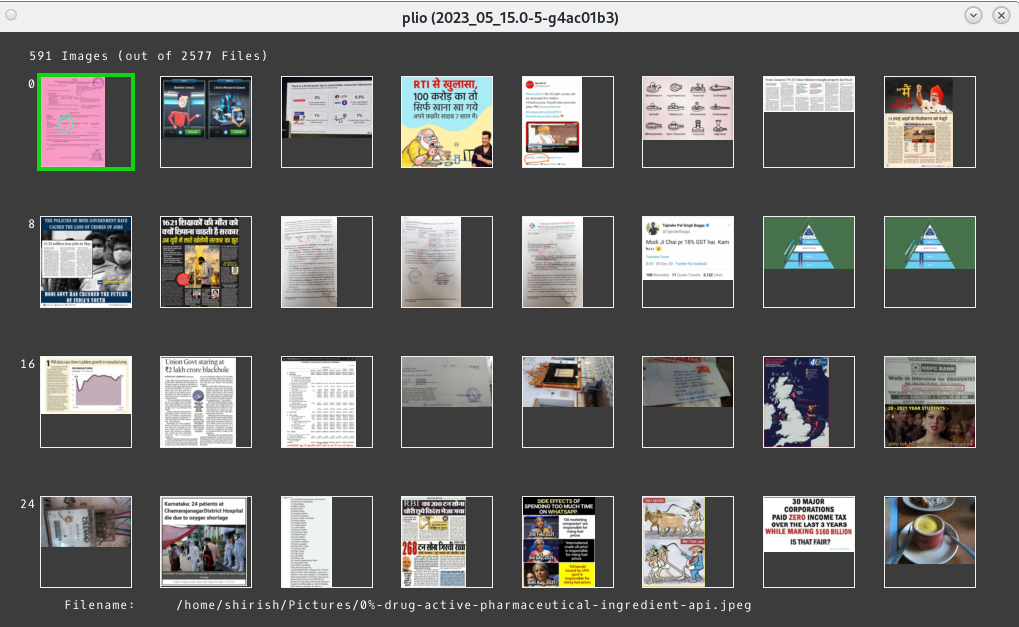
PLIO I have been looking for an image viewer that can view images via modification date by default. The newer, the better. Alas, most of the image viewers do not do that. Even feh somehow fails. What I need is default listing of images as thumbnails by modification date. I put it up on Unix Stackexchange couple of years ago. Somebody shared ristretto but that just gives listing and doesn t give the way I want it. To be more illustrative, maybe this may serve as a guide to what I mean.
There is an RFP for it. While playing with it, I also discovered another benefit of the viewer, a sort of side-benefit, it tells you if any images have gone corrupt or whatever and you get that info. on the CLI so you can try viewing that image with the path using another viewer or viewers before deleting them. One of the issues is there doesn t seem to be a magnify option by default. While the documentation says use the ^ key to maximize it, it doesn t maximize. Took me a while to find it as that isn t a key that I use most of the time. Ironically, that is the key used on the mobile quite a bit. Anyways, so that needs to be fixed. Sadly, it doesn t have creation date or modification date sort, although the documentation does say it does (at least the modification date) but it doesn t show at my end. I also got Warning: UNKNOWN command detected! but that doesn t tell me enough as to what the issue is. Hopefully the developer will fix the issues and it will become part of Debian as many such projects are. Compiling was dead easy even with gcc-12 once I got freeimage-dev.

Mum s first death anniversary I do not know where the year went by or how. The day went in a sort of suspended animation. The only thing I did was eat and sleep that day, didn t feel like doing anything. Old memories, even dreams of fighting with her only to realize in the dream itself it s fake, she isn t there anymore  Something that can never be fixed

Debconf Kochi I should have shared it few days ago but somehow slipped my mind. While it s too late for most people to ask for bursary for Debconf Kochi, if you are anywhere near Kochi in the month of September between the dates. September 3 to September 17 nearby Infopark, Kochi you could walk in and talk to people. This would be for people who either have an interest in free software, FOSS or Debian specific. For those who may not know, while Debian is a Linux Distribution having ports to other kernels as well as well as hardware. While I may not be able to provide the list of all the various flavors as well as hardware, can say it is quite a bit. For e.g. there is a port to RISC-V that was done few years back (2018). Why that is needed will be shared below. There is always something new to look forward in a Debconf.

Pressure Cooker and Potatoes This was asked to me in the last Debconf (2016) by few people. So as people are coming to India, it probably is a good time to sort of reignite the topic :). So a Pressure Cooker boils your veggies and whatnot while still preserving the nutrients. While there are quite a number of brands I would suggest either Prestige or Hawkins, I have had good experience with both. There are also some new pressure cookers that have come that are somewhat in the design of the Thai Wok. So if that is something that you are either comfortable with or looking for, you could look at that. One of the things that you have to be sort of aware of and be most particular is the pressure safety valve. Just putting up pressure cooker safety valve in your favorite search-engine should show you different makes and whatnot. While they are relatively cheap, you need to see it is not cracked, used or whatever. The other thing is the Pressure Cooker whistle as well. The easiest thing to cook are mashed potatoes in a pressure cooker. A pressure Cooker comes in Litres, from 1 Ltr. to 20 Ltr. The larger ones are obviously for hotels or whatnot. General rule of using Pressure cooker is have water 1/4th, whatever vegetable or non-veg you want to boil 1/2 and let the remaining part for the steam. Now the easiest thing to do is have wash the potatoes and put 1/4th water of the pressure cooker. Then put 1/2 or less or little bit more of the veggies, in this instance just Potatoes. You can put salt to or that can be done later. The taste will be different. Also, there are various salts so won t really go into it as spices is a rabbit hole. Anyways, after making sure that there is enough space for the steam to be built, Put the handle on the cooker and basically wait for 5-10 minutes for the pressure to be built. You will hear a whistling sound, wait for around 5 minutes or a bit more (depends on many factors, kind of potatoes, weather etc.) and then just let it cool off naturally. After 5-10 minutes or a bit more, the pressure will be off. Your mashed potatoes are ready for either consumption or for further processing. I am assuming gas, induction cooking will have its own temperature, have no idea about it, hence not sharing that. Pressure Cooker, first put on the heaviest settings, once it starts to whistle, put it on medium for 5-10 minutes and then let it cool off. The first time I had tried that, I burned the cooker. You understand things via trial and error.

Poha recipe This is a nice low-cost healthy and fulfilling breakfast called Poha that can be made anytime and requires at the most 10-15 minutes to prepare with minimal fuss. The main ingredient is Poha or flattened rice. So how is it prepared. I won t go into the details of quantity as that is upto how hungry people are. There are various kinds of flattened rice available in the market, what you are looking for is called thick Poha or zhad Poha (in Marathi). The first step is the trickiest. What do you want to do is put water on Poha but not to let it be soggy. There is an accessory similar to tea filter but forgot the name, it basically drains all the extra moisture and you want Poha to be a bit fluffy and not soggy. The Poha should breathe for about 5 minutes before being cooked. To cook, use a heavy bottomed skillet, put some oil in it, depends on what oil you like, again lot of variations, you can use ground nut or whatever oil you prefer. Then use single mustard seeds to check temperature of the oil. Once the mustard seeds starts to pop, it means it s ready for things. So put mustard seeds in, finely chopped onion, finely chopped coriander leaves, a little bit of lemon juice, if you want potatoes, then potatoes too. Be aware that Potatoes will soak oil like anything, so if you are going to have potatoes than the oil should be a bit more. Some people love curry leaves, others don t. I like them quite a bit, it gives a slightly different taste. So the order is
  1. Oil
  2. Mustard seeds (1-2 teaspoon)
  3. Curry leaves 5-10
  4. Onion (2-3 medium onions finely chopped, onion can also be used as garnish.)
  5. Potatoes (2-3 medium ones, mashed)
  6. Small green chillies or 1-2 Red chillies (if you want)
  7. Coriander Leaves (one bunch finely chopped)
  8. Peanuts (half a glass)
Make sure that you are stirring them quite a bit. On a good warm skillet, this should hardly take 5 minutes. Once the onions are slighly brown, you are ready to put Poha in. So put the poha, add turmeric, salt, and sugar. Again depends on number of people. If I made for myself and mum, usually did 1 teaspoon of salt, not even one fourth of turmeric, just a hint, it is for the color, 1 to 2 teapoons of sugar and mix them all well at medium flame. Poha used to be two or three glasses. If you don t want potato, you can fry them a bit separately and garnish with it, along with coriander, coconut and whatnot. In Kerala, there is possibility that people might have it one day or all days. It serves as a snack at anytime, breakfast, lunch, tea time or even dinner if people don t want to be heavy. The first few times I did, I did manage to do everything wrong. So, if things go wrong, let it be. After a while, you will find your own place. And again, this is just one way, I m sure this can be made as elaborate a meal as you want. This is just something you can do if you don t want noodles or are bored with it. The timing is similar. While I don t claim to be an expert in cooking in anyway or form, if people have questions feel free to ask. If you are single or two people, 2 Ltr. Pressure cooker is enough for most Indians, Westerners may take a slightly bit larger Pressure Cooker, maybe a 3 Ltr. one may be good for you. Happy Cooking and Experimenting  I have had the pleasure to have Poha in many ways. One of my favorite ones is when people have actually put tadka on top of Poha. You do everything else but in a slight reverse order. The tadka has all the spices mixed and is concentrated and is put on top of Poha and then mixed. Done right, it tastes out of this world. For those who might not have had the Indian culinary experience, most of which is actually borrowed from the Mughals, you are in for a treat. One of the other things I would suggest to people is to ask people where there can get five types of rice. This is a specialty of South India and a sort of street food. I know where you can get it Hyderabad, Bangalore, Chennai but not in Kerala, although am dead sure there is, just somehow have missed it. If asked, am sure the Kerala team should be able to guide. That s all for now, feeling hungry, having dinner as have been sharing about cooking.

RISC-V There has been lot of conversations about how India could be in the microprocesor spacee. The x86 and x86-64 is all tied up in Intel and AMD so that s a no go area. Let me elaborate a bit why I say that. While most of the people know that IBM was the first producers of transistors as well as microprocessors. Coincidentally, AMD and Intel story are similar in some aspects but not in others. For a long time Intel was a market leader and by hook or crook it remained a market leader. One of the more interesting companies in the 1980s was Cyrix which sold lot of low-end microprocessors. A lot of that technology also went into Via which became a sort of spiritual successor of Cyrix. It is because of Cyrix and Via that Intel was forced to launch the Celeron model of microprocessors.

Lawsuits, European Regulation For those who have been there in the 1990s may have heard the term Wintel that basically meant Microsoft Windows and Intel and they had a sort of monopoly power. While the Americans were sorta ok with it, the Europeans were not and time and time again they forced both Microsoft as well as Intel to provide alternatives. The pushback from the regulators was so great that Intel funded AMD to remain solvent for few years. The successes that we see today from AMD is Lisa Su s but there is a whole lot of history as well as bad blood between the two companies. Lot of lawsuits and whatnot. Lot of cross-licensing agreements between them as well. So for any new country it would need lot of cash just for licensing all the patents there are and it s just not feasible for any newcomer to come in this market as they would have to fork the cash for the design apart from manufacturing fab.

ARM Most of the mobiles today sport an ARM processor. At one time it meant Advanced RISC Machines but now goes by Arm Ltd. Arm itself licenses its designs and while there are lot of customers, you are depending on ARM and they can change any of the conditions anytime they want. You are also hoping that ARM does not steal your design or do anything else with it. And while people trust ARM, it is still a risk if you are a company.

RISC and Shakti There is not much to say about RISC other than this article at Register. While India does have large ambitions, executing it is far trickier than most people believe as well as complex and highly capital intensive. The RISC way could be a game-changer provided India moves deftly ahead. FWIW, Debian did a RISC port in 2018. From what I can tell, you can install it on a VM/QEMU and do stuff. And while RISC has its own niches, you never know what happens next.One can speculate a lot and there is certainly a lot of momentum behind RISC. From what little experience I have had, where India has failed time and time again, whether in software or hardware is support. Support is the key, unless that is not fixed, it will remain a dream  On a slightly sad note, Foxconn is withdrawing from the joint venture it had with Vedanta.

9 July 2023

Russell Coker: Matrix

Introduction In 2020 I first setup a Matrix [1] server. Matrix is a full featured instant messaging protocol which requires a less stringent definition of instant , messages being delayed for minutes aren t that uncommon in my experience. Matrix is a federated service where the servers all store copies of the room data, so when you connect your client to it s home server it gets all the messages that were published while you were offline, it is widely regarded as being IRC but without a need to be connected all the time. One of it s noteworthy features is support for end to end encryption (so the server can t access cleartext messages from users) as a core feature. Matrix was designed for bridging with other protocols, the most well known of which is IRC. The most common Matrix server software is Synapse which is written in Python and uses a PostgreSQL database as it s backend [2]. My tests have shown that a lightly loaded Synapse server with less than a dozen users and only one or two active users will have noticeable performance problems if the PostgreSQL database is stored on SATA hard drives. This seems like the type of software that wouldn t have been developed before SSDs became commonly affordable. The matrix-synapse is in Debian/Unstable and the backports repositories for Bullseye and Buster. As Matrix is still being very actively developed you want to have a recent version of all related software so Debian/Buster isn t a good platform for running it, Bullseye or Bookworm are the preferred platforms. Configuring Synapse isn t really hard, but there are some postential problems. The first thing to do is to choose the DNS name, you can never change it without dropping the database (fresh install of all software and no documented way of keeping user configuration) so you don t want to get it wrong. Generally you will want the Matrix addresses at the top level of the domain you choose. When setting up a Matrix server for my local LUG I chose the top level of their domain luv.asn.au as the DNS name for the server. If you don t want to run a server then there are many open servers offering free account. Server Configuration Part of doing this configuration required creating the URL https://luv.asn.au/.well-known/matrix/client with the following contents so clients know where to connect. Note that you should not setup Jitsi sections without first discussing it with the people who run the Jitsi server in question.
 
  "m.homeserver":  
    "base_url": "https://luv.asn.au"
   
  "jitsi":  
    "preferredDomain": "jitsi.perthchat.org"
   
  "im.vector.riot.jitsi":  
    "preferredDomain": "jitsi.perthchat.org"
   
 
Also the URL https://luv.asn.au/.well-known/matrix/server for other servers to know where to connect:
 
  "m.server": "luv.asn.au:8448"
 
If the base_url or the m.server points to a name that isn t configured then you need to add it to the web server configuration. See section 3.1 of the documentation about well known Matrix client fields [3]. The SE Linux specific parts of the configuration are to run the following commands as Bookworm and Bullseye SE Linux policy have support for Synapse:
setsebool -P httpd_setrlimit 1
setsebool -P httpd_can_network_relay 1
setsebool -P matrix_postgresql_connect 1
To configure apache you have to enable proxy mode and SSL with the command a2enmod proxy ssl proxy_http and add the line Listen 8443 to /etc/apache2/ports.conf and restart Apache. The command chmod 700 /etc/matrix-synapse should probably be run to improve security, there s no reason for less restrictive permissions on that directory. In the /etc/matrix-synapse/homeserver.yaml file the macaroon_secret_key is a random key for generating tokens. To use the matrix.org server as a trusted key server and not receive warnings put the following line in the config file:
suppress_key_server_warning: true
A line like the following is needed to configure the baseurl:
public_baseurl: https://luv.asn.au:8448/
To have Synapse directly accept port 8448 connections you have to change bind_addresses in the first section of listeners to the global listen IPv6 and IPv4 addresses. The registration_shared_secret is a password for adding users. When you have set that you can write a shell script to add new users such as:
#!/bin/bash
# usage: matrix_new_user USER PASS
synapse_register_new_matrix_user -u $1 -p $2 -a -k THEPASSWORD
You need to set tls_certificate_path and tls_private_key_path to appropriate values, usually something like the following:
tls_certificate_path: "/etc/letsencrypt/live/www.luv.asn.au-0001/fullchain.pem"
tls_private_key_path: "/etc/letsencrypt/live/www.luv.asn.au-0001/privkey.pem"
For the database section you need something like the following which matches your PostgreSQL setup:
  name: "psycopg2"
  args:
    user: WWWWWW
    password: XXXXXXX
    database: YYYYYYY
    host: ZZZZZZ
    cp_min: 5
    cp_max: 10
You need to run psql commands like the following to set it up:
create role WWWWWW login password 'XXXXXXX';
create database YYYYYYY with owner WWWWWW ENCODING 'UTF8' LOCALE 'C' TEMPLATE 'template0';
For the Apache configuration you need something like the following for the port 8448 web server:
<VirtualHost *:8448>
  SSLEngine on
...
  ServerName luv.asn.au;
  AllowEncodedSlashes NoDecode
  ProxyPass /_matrix http://127.0.0.1:8008/_matrix nocanon
  ProxyPassReverse /_matrix http://127.0.0.1:8008/_matrix
  AllowEncodedSlashes NoDecode
  ProxyPass /_matrix http://127.0.0.1:8008/_matrix nocanon
  ProxyPassReverse /_matrix http://127.0.0.1:8008/_matrix
</VirtualHost>
Also you must add the ProxyPass section to the port 443 configuration (the server that is probably doing other more directly user visible things) for most (all?) end-user clients:
  ProxyPass /_matrix http://127.0.0.1:8008/_matrix nocanon
This web page can be used to test listing rooms via federation without logging in [4]. If it gives the error Can t find this server or its room list then you must set allow_public_rooms_without_auth and allow_public_rooms_over_federation to true in /etc/matrix-synapse/homeserver.yaml. The Matrix Federation Tester site [5] is good for testing new servers and for tests after network changes. Clients The Element (formerly known as Riot) client is the most common [6]. The following APT repository will allow you to install Element via apt install element-desktop on Debian/Buster.
deb https://packages.riot.im/debian/ default main
The Debian backports repository for Buster has the latest version of Quaternion, apt install quaternion should install that for you. Quaternion doesn t support end to end encryption (E2EE) and also doesn t seem to have good support for some other features like being invited to a room. My current favourite client is Schildi Chat on Android [7], which has a notification message 24*7 to reduce the incidence of Android killing it. Eventually I want to go to PinePhone or Librem 5 for all my phone use so I need to find a full featured Linux client that works on a small screen. Comparing to Jabber I plan to keep using Jabber for alerts because it really does instant messaging, it can reliably get the message to me within a matter of seconds. Also there are a selection of command-line clients for Jabber to allow sending messages from servers. When I first investigated Matrix there was no program suitable for sending messages from a script and the libraries for the protocol made it unreasonably difficult to write one. Now there is a Matrix client written in shell script [8] which might do that. But the delay in receiving messages is still a problem. Also the Matrix clients I ve tried so far have UIs that are more suited to serious chat than to quickly reading a notification message. Bridges Here is a list of bridges between Matrix and other protocols [9]. You can run bridges yourself for many different messaging protocols including Slack, Discord, and Messenger. There are also bridges run for public use for most IRC channels. Here is a list of integrations with other services [10], this is for interacting with things other than IM systems such as RSS feeds, polls, and other things. This also has some frameworks for writing bots. More Information The Debian wiki page about Matrix is good [11]. The view.matrix.org site allows searching for public rooms [12].

27 June 2023

Matt Brown: Designing a PCBA friendly CO2 monitor

co2mon.nz currently uses monitors based on Oliver Seiler s open source design which I am personally building. This post describes my exploration of how to achieve production of a CO2 monitor that could enable the growth of co2mon.nz.

Goals Primarily I want to design a CO2 monitor which allows the majority of the production process to be outsourced. In particular, the PCB should be able to be assembled in an automated fashion (PCBA). As a secondary goal, I d like to improve the aesthetics of the monitor while retaining the unique feature of displaying clear visual indication of the current ventilation level through coloured lights. Overall, I ll consider the project successfull if I can achieve a visually attractive CO2 monitor which takes me less than 10 minutes per monitor to assemble/box/ship and whose production cost has the potential to be lower than the current model.

PCB

Schematic The existing CO2 monitor design provides a solid foundation but relies upon the ESP32 Devkit board, which is intended for evaluation purposes and is not well suited to automated assembly. Replacing this devkit board with the underlying ESP32 module is the major change needed to enable PCBA production, which then also requires moving the supporting electronics from the devkit board directly onto the primary PCB. The basic ESP32 chipset used in the devkit boards is no longer available as a discrete module suitable for placement directly onto a PCB which means the board will also have to be updated to use a more modern variant of the ESP32 chipset which is in active production such as the ESP32-S3. The ESP32-S3-WROOM1-N4 module is a very close match to the original devkit and will be suitable for this project. In addition to the change of ESP module, I made the following other changes to the components in use:
  • Added an additional temperature/humidity sensor (SHT30). The current monitors take temperature/humidity measurements from the SCD40 chipset. These are primarily intended to help in the calculation of CO2 levels and rely on an offset being subtracted to account for the heat generated by the electronic components themselves. I ve found their accuracy to OK, but not perfect. SHT30 is a cheap part, so its addition to hopefully provide improved temperature/humidity measurement is an easy choice.
  • Swapped to USB-C instead of USB-B for the power connector. USB-C is much more common than USB-B and is also smaller and not as tall off the board which provides more flexibility in the case design.
With major components selected the key task is to draw the schematic diagram describing how they electrically connect to each other, which includes all the supporting electronics (e.g. resistors, capacitors, etc) needed. Schematic I started out trying to use the EasyEDA/OSHWLab ecosystem thinking the tight integration with JLCPCB s assembly services would be a benefit, but the web interface was too clunky and limiting and I quickly got frustrated. KiCad proved to be a much more pleasant and capable tool for the job. The reference design in the ESP32 datasheet (p28) and USB-C power supply examples from blnlabs were particularly helpful alongside the KiCad documentation and the example of the existing monitor in completing this step (click the image to enlarge).

Layout The next step is to physically lay out where each component from the schematic will sit on the PCB itself. Obviously this requires first determining the overall size, shape and outline of the board and needs to occur in iteration with the intended design of the overall monitor, including the case, to ensure components like switches and USB sockets line up correctly. In addition to the requirements around the look and function of the case, the components themselves also have considerations that must be taken into account, including:
  • For best WiFi reception, the ESP32 antenna should be at the top of the monitor and should not have PCB underneath it, or for a specified distance either side of it.
  • The SHT30 temperature sensor should be as far from any heat generating components (e.g. the ESP32, BME680 and SCD40 modules) as possible and also considering that any generated heat will rise, as low on the monitor as possible.
  • The sensors measuring the air (SCD40, BME680 and SHT30) must have good exposure to the air outside the case.
PCB Taking all of these factors into account I ended up with a square PCB containing a cutout in the top right so that the ESP32 antenna can sit within the overall square outline while still meeting its design requirements. The SCD40 and BME680 sit in the top left corner, near the edges for good airflow and far away from the SHT30 temperature sensor in the bottom left corner. The LEDs I placed in a horizontal row across the center of the board, the LCD in the bottom right, a push button on the right-hand side and the USB-C socket in the center at the bottom. Once the components are placed, the next big task is to route the traces (aka wires) between the components on the board such that all the required electrical connections are made without any unintended connections (aka shorts) being created. This is a fun constraint solving/optimisation challenge and takes on an almost artistic aspect with other PCB designers often having strong opinions on which layout is best. The majority of the traces and routing for this board were able to be placed on the top layer of the PCB, but I also made use of the back layer for a few traces to help avoid conflicts and deal with places where different traces needed to cross each other. It s easy to see how this step would be much more challenging and time consuming on a larger and more complex PCB design. The final touches were to add some debugging breakouts for the serial and JTAG ports on the ESP32-S3 and a logo and various other helpful text on the silkscreen layer that will be printed on the PCB so it looks nice.

Production For assembly of the PCB, I went with JLCPCB based out of China. The trickiest part of the process was component selection and ensuring that the parts I had planned in the schematic were available. JLCPCB in conjunction with lcsc.com provides a basic and extended part library. If you use only basic parts you get quicker and cheaper assembly, while using extended parts bumps your order into a longer process with a small fee charged for each component on the board. Initially I spent a lot of time selecting components (particularly LEDs and switches) that were in the basic library before realising that the ESP32 modules are only available in the extended library! I think the lesson is that unless you re building the most trivial PCB with only passive components you will almost certainly end up in the advanced assembly process anyway, so trying to stay within the basic parts library is not worth the time. Unfortunately the SCD40 sensor, the most crucial part of the monitor, is not stocked at all by JLCPCB/LCSC! To work around this JLCPCB will maintain a personal component library for you when you ship components to them to for use in future orders. Given the extra logistical time and hassle of having to do this, combined with having a number of SCD40 components already on hand I decided to have the boards assembled without this component populated for the initial prototype run. This also had the benefit of lowering the risk if something went wrong as the cost of the SCD40 is greater than the cost of the PCB and all the other components combined! I found the kicad-jlcpcb-tools plugin for KiCad invaluable for keeping track of what part from lcsc.com I was planning to use for each component and generating the necessary output files for JLCPCB. The plugin allows you to store these mappings in your actual schematic which is very handy. The search interface it provides is fairly clunky and I found it was often easier to search for the part I needed on lcsc.com and then just copy the part number across into the plugin s search box rather than trying to search by name or component type. The LCD screen is the remaining component which is not easily assembled onto the PCB directly, but as you ll see next, this actually turned out to be OK as integrating the screen directly into the case makes the final assembly process smoother. fabricated PCBs The final surprise in the assembly process was the concept of edge rails, additional PCB material that is needed on either side of the board to help with feeding it through the assembly machine in the correct position. These can be added automatically by JLCPCB and have to be snapped off after the completed boards are received. I hadn t heard about these before and I was a little worried that they d interfere or get in the way of either the antenna cut-out at the top of the board, or the switch on the right hand side as it overhangs the edge so it can sit flush with the case. In the end there was no issue with the edge rails. The switch was placed hanging over them without issue and snapping them off once the boards arrived was a trivial 30s job using a vice to hold the edge rail and then gently tipping the board over until it snapped off - the interface between the board and the rails while solid looking has obviously been scored or perforated in some way during the production process so the edge breaks cleanly and smoothly. Magic! The process was amazingly quick with the completed PCBs (picture above) arriving within 7 days of the order being placed and looking amazing.

Case

Design I mocked up a very simple prototype of the case in FreeCAD during the PCB design process to help position and align the placement of the screen, switch and USB socket on the PCB as all three of these components interface directly with the edges of the case. Initially this design was similar to the current monitor design where the PCB (with lights and screen attached) sits in the bottom of the case, which has walls containing grilles for airflow and then a separate transparent perspex is screwed onto the top to complete the enclosure. As part of the aesthetic improvements for the new monitor I wanted to move away from a transparent front panel to something opaque but still translucent enough to allow the colour of the lights to show through. Without a transparent front panel the LCD also needs to be mounted directly into the case itself. The first few prototype iterations followed the design of the original CO2 monitor with a flat front panel that attaches to the rest of the case containing the PCB, but the new requirement to also attach the LCD to the front panel proved to make this unworkable. To stay in place the LCD has to be pushed onto mounting poles containing a catch mechanism which requires a moderate amount of force and applying that force to the LCD board when it is already connected to the PCB is essentially impossible. case with lcd attached As a result I ended up completely flipping the design such that the front panel is a single piece of plastic that also encompasses the walls of the case and contains appropriate mounting stakes for both the screen and the main PCB. Getting to this design hugely simplified the assembly process. Starting with an empty case lying face down on a bench, the LCD screen is pushed onto the mounting poles and sits flush with the cover of the case - easily achieved without the main PCB yet in place. case with pcb in place Next, the main PCB is gently lowered into the case facing downwards and sits on the mounting pole in each corner with the pins for the LCD just protruding through the appropriate holes in the PCB ready to be quickly soldered into place (this took significant iteration and tuning of dimensions/positioning to achieve!). Finally, a back panel can be attached which holds the PCB in place and uses cantilever snap joints to click on to the rest of the case. Overall the design is a huge improvement over the previous case which required screws and spacers to position the PCB and cover relative to the rest of the case, with the spacers and screws being particularly fiddly to work with. The major concern I had with the new design was that the mount to attach the monitor to the wall has moved from being attached to the main case and components directly to needing to be on the removable back panel - if the clips holding this panel to the case fail the core part of the monitor will fall off the wall which would not be good. To guard against this I ve doubled the size and number of clips at the top of the case (which bears the weight) and the result seems very robust in my testing. To completely assemble a monitor, including the soldering step takes me about 2-3 minutes individually, and would be even quicker if working in batches.

Production Given the number of design/testing iterations required to fine tune the case I chose not to outsource case production for now and used my 3D printer to produce them. I ve successfully used JLCPCB s 3D printing service for the previous case design, so I m confident that getting sufficient cases printed from JLCPCB or another supplier will not be an issue now that the design is finalised. completed monitor I tried a variety of filament colours, but settled on a transparent filament which once combined in the necessary layers to form the case is not actually transparent like perspex is, but provides a nice translucent medium which achieves the goal of having the light colour visible without exposing all of the circuit board detail. There s room for future improvement in the positioning of the LEDs on the circuit board to provide a more even distribution of light across the case but overall I really like the way the completed monitor ends up looking.

Evaluation Building this monitor has been a really fun project, both in seeing something progress from an idea, to plans on a screen to a nice physical thing on my wall, but also in learning and developing a bunch of new skills in PCB design, assembly and 3D design. completed monitor The goal of having a CO2 monitor which I can outsource the vast majority of production of is as close to being met as I think is possible without undertaking the final proof of placing a large order. I ve satisfied myself that each step is feasible and that the final assembly process is quick, easy and well below the level of effort and time it was taking me to produce the original monitors. Cost wise it s also a huge win, primarily in terms of the time taken, but also in the raw components - currently the five prototypes I ordered and built are on par with the component cost of the original CO2 monitor, but this will drop further with larger orders due to price breaks and amortisation of the setup and shipping expenses across more monitors. This project has also given me a much better appreciation for how much I m only just scratching the surface of the potential complexities and challenges in producing a hardware product of this type. I m reasonably confident I could successfully produce a few hundred and maybe even a few thousand monitors using this approach, but it s also clear that getting beyond that point is and would be a whole further level of effort and learning. Hardware is hard work. That s not news to anyone, including me, but there is something to be said for experiencing the process first hand to make the reality of what s required real. The PCB and case designs are both shared and can be found at https://github.com/co2monnz/co2monitor-pcb and https://github.com/co2monnz/cad, feedback and suggestions welcome!

22 June 2023

Russ Allbery: Review: Furious Heaven

Review: Furious Heaven, by Kate Elliott
Series: Sun Chronicles #2
Publisher: Tor
Copyright: 2023
ISBN: 1-250-86701-0
Format: Kindle
Pages: 725
Furious Heaven is the middle book of a trilogy and a direct sequel to Unconquerable Sun. Don't start here. I also had some trouble remembering what happened in the previous book (grumble recaps mutter), and there are a lot of threads, so I would try to minimize the time between books unless you have a good memory for plot details. This is installment two of gender-swapped Alexander the Great in space. When we last left Sun and her Companions, Elliott had established the major players in this interstellar balance of power and set off some opening skirmishes, but the real battles were yet to come. Sun was trying to build her reputation and power base while carefully staying on the good side of Queen-Marshal Eirene, her mother and the person credited with saving the Republic of Chaonia from foreign dominance. The best parts of the first book weren't Sun herself but wily Persephone, one of her Companions, whose viewpoint chapters told a more human-level story of finding her place inside a close-knit pre-existing friendship group. Furious Heaven turns that all on its head. The details are spoilers (insofar as a plot closely tracking the life of Alexander the Great can contain spoilers), but the best parts of the second book are the chapters about or around Sun. What I find most impressive about this series so far is Elliott's ability to write Sun as charismatic in a way that I can believe as a reader. That was hit and miss at the start of the series, got better towards the end of Unconquerable Sun, and was wholly effective here. From me, that's high but perhaps unreliable praise; I typically find people others describe as charismatic to be some combination of disturbing, uncomfortable, dangerous, or obviously fake. This is a rare case of intentionally-written fictional charisma that worked for me. Elliott does not do this by toning down Sun's ambition. Sun, even more than her mother, is explicitly trying to gather power and bend the universe (and the people in it) to her will. She treats people as resources, even those she's the closest to, and she's ruthless in pursuit of her goals. But she's also honorable, straightforward, and generous to the people around her. She doesn't lie about her intentions; she follows a strict moral code of her own, keeps her friends' secrets, listens sincerely to their advice, and has the sort of battlefield charisma where she refuses to ask anyone else to take risks she personally wouldn't take. And her use of symbolism and spectacle isn't just superficial; she finds the points of connection between the symbols and her values so that she can sincerely believe in what she's doing. I am fascinated by how Elliott shapes the story around her charisma. Writing an Alexander analogue is difficult; one has to write a tactical genius with the kind of magnetic attraction that enabled him to lead an army across the known world, and make this believable to the reader. Elliott gives Sun good propaganda outlets and makes her astonishingly decisive (and, of course, uses the power of the author to ensure those decisions are good ones), but she also shows how Sun is constantly absorbing information and updating her assumptions to lay the groundwork for those split-second decisions. Sun uses her Companions like a foundation and a recovery platform, leaning on them and relying on them to gather her breath and flesh out her understanding, and then leaping from them towards her next goal. Elliott writes her as thinking just a tiny bit faster than the reader, taking actions I was starting to expect but slightly before I had put together my expectation. It's a subtle but difficult tightrope to walk as the writer, and it was incredibly effective for me. The downside of Furious Heaven is that, despite kicking the action into a much higher gear, this book sprawls. There are five viewpoint characters (Persephone and the Phene Empire character Apama from the first book, plus two new ones), as well as a few interlude chapters from yet more viewpoints. Apama's thread, which felt like a minor subplot of the first book, starts paying off in this book by showing the internal political details of Sun's enemy. That already means the reader has to track two largely separate and important stories. Add on a Persephone side plot about her family and a new plot thread about other political factions and it's a bit too much. Elliott does a good job avoiding reader confusion, but she still loses narrative momentum and reader interest due to the sheer scope. Persephone's thread in particular was a bit disappointing after being the highlight of the previous book. She spends a lot of her emotional energy on tedious and annoying sniping at Jade, which accomplishes little other than making them both seem immature and out of step with the significance of what's going on elsewhere. This is also a middle book of a trilogy, and it shows. It provides a satisfying increase in intensity and gets the true plot of the trilogy well underway, but nothing is resolved and a lot of new questions and plot threads are raised. I had similar problems with Cold Fire, the middle book of the other Kate Elliott trilogy I've read, and this book is 200 pages longer. Elliott loves world-building and huge, complex plots; I have a soft spot for them too, but they mean the story is full of stuff, and it's hard to maintain the same level of reader interest across all the complications and viewpoints. That said, I truly love the world-building. Elliott gives her world historical layers, with multiple levels of lost technology, lost history, and fallen empires, and backs it up with enough set pieces and fragments of invented history that I was enthralled. There are at least five major factions with different histories, cultures, and approaches to technology, and although they all share a history, they interpret that history in fascinatingly different ways. This world feels both lived in and full of important mysteries. Elliott also has a knack for backing the ambitions of her characters with symbolism that defines the shape of that ambition. The title comes from a (translated) verse of an in-universe song called the Hymn of Leaving, which is sung at funerals and is about the flight on generation ships from the now-lost Celestial Empire, the founding myth of this region of space:
Crossing the ocean of stars we leave our home behind us.
We are the spears cast at the furious heaven
And we will burn one by one into ashes
As with the last sparks we vanish.
This memory we carry to our own death which awaits us
And from which none of us will return.
Do not forget. Goodbye forever.
This is not great poetry, but it explains so much about the psychology of the characters. Sun repeatedly describes herself and her allies as spears cast at the furious heaven. Her mother's life mission was to make Chaonia a respected independent power. Hers is much more than that, reaching back into myth for stories of impossible leaps into space, burning brightly against the hostile power of the universe itself. A question about a series like this is why one should want to read about a gender-swapped Alexander the Great in space, rather than just reading about Alexander himself. One good (and sufficient) answer is that both the gender swap and the space parts are inherently interesting. But the other place that Elliott uses the science fiction background is to give Sun motives beyond sheer personal ambition. At a critical moment in the story, just like Alexander, Sun takes a detour to consult an Oracle. Because this is a science fiction novel, it's a great SF set piece involving a mysterious AI. But also because this is a science fiction story, Sun doesn't only ask about her personal ambitions. I won't spoil the exact questions; I think the moment is better not knowing what she'll ask. But they're science fiction questions, reader questions, the kinds of things Elliott has been building curiosity about for a book and a half by the time we reach that scene. Half the fun of reading a good epic space opera is learning the mysteries hidden in the layers of world-building. Aligning the goals of the protagonist with the goals of the reader is a simple storytelling trick, but oh, so effective. Structurally, this is not that great of a book. There's a lot of build-up and only some payoff, and there were several bits I found grating. But I am thoroughly invested in this universe now. The third book can't come soon enough. Followed by Lady Chaos, which is still being written at the time of this review. Rating: 7 out of 10

18 June 2023

Louis-Philippe V ronneau: Solo V2: nice but flawed

EDIT: One of my 2 keys has died. There are what seems like golden bubbles under the epoxy, over one of the chips and those were not there before. I've emailed SoloKeys and I'm waiting for a reply, but for now, I've stopped using the Solo V2 altogether :( I recently received the two Solo V2 hardware tokens I ordered as part of their crowdfunding campaign, back in March 2022. It did take them longer than advertised to ship me the tokens, but that's hardly unexpected from such small-scale, crowdfunded undertaking. I'm mostly happy about my purchase and I'm glad to get rid of the aging Tomu boards I was using as U2F tokens1. Still, beware: I am not sure it's a product I would recommend if what you want is simply something that works. If you do not care about open-source hardware, the Solo V2 is not for you. The Good A side-by-side view of the Solo V2's top and back sides I first want to mention I find the Solo V2 gorgeous. I really like the black and gold color scheme of the USB-A model (which is reversible!) and it seems like a well built and solid device. I'm not afraid to have it on my keyring and I fully expect it to last a long time. An animation of the build process, showing how the PCB is assembled and then slotted into the shell I'm also very impressed by the modular design: the PCB sits inside a shell, which decouples the logic from the USB interface and lets them manufacture a single board for both the USB-C and USB-A models. The clear epoxy layer on top of the PCB module also looks very nice in my opinion. A picture of the Solo V2 with its silicone case on my keyring, showing the 3 capacitive buttons I'm also very happy the Solo V2 has capacitive touch buttons instead of physical "clicky" buttons, as it means the device has no moving parts. The token has three buttons (the gold metal strips): one on each side of the device and a third one near the keyhole. As far as I've seen, the FIDO2 functions seem to work well via the USB interface and do not require any configuration on a Debian 12 machine. I've already migrated to the Solo V2 for web-based 2FA and I am in the process of migrating to an SSH ed25519-sk key. Here is a guide I recommend if you plan on setting those up with a Solo V2. The Bad and the Ugly Sadly, the Solo V2 is far from being a perfect project. First of all, since the crowdfunding campaign is still being fulfilled, it is not currently commercially available. Chances are you won't be able to buy one directly before at least Q4 2023. I've also hit what seems to be a pretty big firmware bug, or at least, one that affects my use case quite a bit. Invoking gpg crashes the Solo V2 completely if you also have scdaemon installed. Since scdaemon is necessary to use gpg with an OpenPGP smartcard, this means you cannot issue any gpg commands (like signing a git commit...) while the Solo V2 is plugged in. Any gpg commands that queries scdaemon, such as gpg --edit-card or gpg --sign foo.txt times out after about 20 seconds and leaves the token unresponsive to both touch and CLI commands. The way to "fix" this issue is to make sure scdaemon does not interact with the Solo V2 anymore, using the reader-port argument:
  1. Plug both your Solo V2 and your OpenPGP smartcard
  2. To get a list of the tokens scdaemon sees, run the following command: $ echo scd getinfo reader_list gpg-connect-agent --decode awk '/^D/ print $2 '
  3. Identify your OpenPGP smartcard. For example, my Nitrokey Start is listed as 20A0:4211:FSIJ-1.2.15-43211613:0
  4. Create a file in ~/.gnupg/scdaemon.conf with the following line reader-port $YOUR_TOKEN_ID. For example, in my case I have: reader-port 20A0:4211:FSIJ-1.2.15-43211613:0
  5. Reload scdaemon: $ gpgconf --reload scdaemon
Although this is clearly a firmware bug2, I do believe GnuPG is also partly to blame here. Let's just say I was not very surprised to have to battle scdaemon again, as I've had previous issues with it. Which leads me to my biggest gripe so far: it seems SoloKeys (the company) isn't really fixing firmware issues anymore and doesn't seems to care. The last firmware release is about a year old. Although people are experiencing serious bugs, there is no official way to report them, which leads to issues being seemingly ignored. For example, the NFC feature is apparently killing keys (!!!), but no one from the company seems to have acknowledged the issue. The same goes for my GnuPG bug, which was flagged in September 2022. For a project that mainly differentiates itself from its (superior) competition by being "Open", it's not a very good look... Although SoloKeys is still an unprofitable open source side business of its creators 3, this kind of attitude certainly doesn't help foster trust. Conclusion If you want to have a nice, durable FIDO2 token, I would suggest you get one of the many models Yubico offers. They are similarly priced, are readily commercially available, are part of a nice and maintained software ecosystem and have more features than the Solo V2 (OpenPGP support being the one I miss the most). Yubikeys are the practical option. What they are not is open-source hardware, whereas the Solo V2 is. As bunnie very well explained on his blog in 2019, it does not mean the later is inherently more trustable than the former, but it does make the Solo V2 the ideological option. Knowledge is power and it should be free. As such, tread carefully with SoloKeys, but don't dismiss them altogether: the Solo V2 is certainly functioning well enough for me.

  1. Although U2F is still part of the FIDO2 specification, the Tomus predate this standard and were thus not fully compliant with FIDO2. So long and thanks for all the fish little boards, you've served me well!
  2. It appears the Solo V2 shares its firmware with the Nitrokey 3, which had a similar issue a while back.
  3. This is a direct quote from one of the Solo V2 firmware maintainers.

6 June 2023

Shirish Agarwal: Odisha Train Crash and Coverup, Demonetization 2.0 & NHFS-6 Survey

Just a few days back we came to know about the horrific Train Crash that happened in Odisha (Orissa). There are some things that are known and somethings that can be inferred by observance. Sadly, it seems the incident is going to be covered up  . Some of the facts that have not been contested in the public domain are that there were three lines. One loop line on which the Goods Train was standing and there was an up and a down line. So three lines were there. Apparently, the signalling system and the inter-locking system had issues as highlighted by an official about a month back. That letter, thankfully is in the public domain and I have downloaded it as well. It s a letter that goes to 4 pages. The RW is incensed that the letter got leaked and is in public domain. They are blaming everyone and espousing conspiracy theories rather than taking the minister to task. Incidentally, the Minister has three ministries that he currently holds. Ministry of Communication, Ministry of Electronics and Information Technology (MEIT), and Railways Ministry. Each Ministry in itself is important and has revenues of more than 6 lakh crore rupees. How he is able to do justice to all the three ministries is beyond me  The other thing is funds both for safety and relaying of tracks has been either not sanctioned or unutilized. In fact, CAG and the Railway Brass had shared how derailments have increased and unfulfilled vacancies but they were given no importance  In fact, not talking about safety in the recently held Chintan Shivir (brainstorming session) tells you how much the Govt. is serious about safety. In fact, most of the programme was on high speed rail which is a white elephant. I have shared a whitepaper done by RW in the U.S. that tells how high-speed rail doesn t make economic sense. And that is an economy that is 20 times + the Indian Economy. Even the Chinese are stopping with HSR as it doesn t make economic sense. Incidentally, Air Fares again went up 200% yesterday. Somebody shared in the region of 20k + for an Air ticket from their place to Bangalore  Coming back to the story itself. the Goods Train was on the loopline. Some say it was a little bit on the outer, some say otherwise, but it is established that it was on the loopline. This is standard behavior on and around Railway Stations around the world. Whether it was in the Inner or Outer doesn t make much of a difference with what happened next. The first train that collided with the goods train was the 12864 (SMVB-HWH) Yashwantpur Howrah Express and got derailed on to the next track where from the opposite direction 12841 (Shalimar- Bangalore) Coramandel Express was coming. Now they have said that around 300 people have died and that seems to be part of the cover-up. Both the trains are long trains, having between 23 odd coaches each. Even if you have reserved tickets you have 80 odd people in a coach and usually in most of these trains, it is at least double of that. Lot of money goes to TC and then above (Corruption). The Railway fares have gone up enormously but that s a question for perhaps another time  . So at the very least, we could be looking at more than 1000 people having died. The numbers are being under-reported so that nobody has to take responsibility. The Railways itself has told that it is unable to identify 80% of the people who have died. This means that 80% were unreserved ticket holders or a majority of them. There have been disturbing images as how bodies have been flung over on tractors and whatnot to be either buried or cremated without a thought. We are in peak summer season so bodies will start to rot within 24-48 hours  No arrangements made to cool the bodies and take some information and identifying marks or whatever. The whole thing being done in a very callous manner, not giving dignity to even those who have died for no fault of their own. The dissent note also tells that a cover-up is also in the picture. Apparently, India doesn t have nor does it feel to have a need for something like the NTSB that the U.S. used when it hauled both the plane manufacturer (Boeing) and the FAA when the 737 Max went down due to improper data collection and sharing of data with pilots. And with no accountability being fixed to Minister or any of the senior staff, a small junior staff person may be fired. Perhaps the same official that actually told them about the signal failures almost 3 months back  There were and are also some reports that some jugaadu /temporary fixes were applied to signalling and inter-locking just before this incident happened. I do not know nor confirm one way or the other if the above happened. I can however point out that if such a thing happened, then usually a traffic block is announced and all traffic on those lines are stopped. This has been the thing I know for decades. Traveling between Mumbai and Pune multiple times over the years am aware about traffic block. If some repair work was going on and it wasn t able to complete the work within the time-frame then that may well have contributed to the accident. There is also a bit muddying of the waters where it is being said that one of the trains was 4 hours late, which one is conflicting stories. On top of the whole thing, they have put the case to be investigated by CBI and hinting at sabotage. They also tried to paint a religious structure as mosque, later turned out to be a temple. The RW says done by Muslims as it was Friday not taking into account as shared before that most Railway maintenance works are usually done between Friday Monday. This is a practice followed not just in India but world over. There has been also move over a decade to remove wooden sleepers and have concrete sleepers. Unlike the wooden ones they do not expand and contract as much and their life is much more longer than the wooden ones. Funds had been marked (although lower than last few years) but not yet spent. As we know in case of any accident, it is when all the holes in cheese line up it happens. Fukushima is a great example of that, no sea wall even though Japan is no stranger to Tsunamis. External power at the same level as the plant. (10 meters above sea-level), no training for cascading failures scenarios which is what happened. The Days mini-series shares some but not all the faults that happened at Fukushima and the Govt. response to it. There is a difference though, the Japanese Prime Minister resigned on moral grounds. Here, nor the PM, nor the Minister would be resigning on moral grounds or otherwise :(. Zero accountability and that was partly a natural disaster, here it s man-made. In fact, both the Minister and the Prime Minister arrived with their entourages, did a PR blitzkrieg showing how concerned they are. Within 50 hours, the lines were cleared. The part-time Railway Minister shared that he knows the root cause and then few hours later has given the case to CBI. All are saying, wait for the inquiry report. To date, none of the accidents even in this Govt. has produced an investigation report. And even if it did, I am sure it will whitewash as it did in case of Adani as I had shared before in the previous blog post. Incidentally, it is reported that Adani paid off some of its debt, but when questioned as to where they got the money, complete silence on that part :(. As can be seen cover-up after cover-up  FWIW, the Coramandel Express is known as the Migrant train so has a huge number of passengers, the other one which was collided with is known as sick train as huge number of cancer patients use it to travel to Chennai and come back

Demonetization 2.0 Few days back, India announced demonetization 2.0. Surprised, don t be. Apparently, INR 2k/- is being used for corruption and Mr. Modi is unhappy about it. He actually didn t like the INR 2k/- note but was told that it was needed, who told him we are unaware to date. At that time the RBI Governor was Mr. Urjit Patel who didn t say about INR 2k/- he had said that INR 1k/- note redesigned would come in the market. That has yet to happen. What has happened is that just like INR 500/- and INR 1k/- note is concerned, RBI will no longer honor the INR 2k/- note. Obviously, this has made our neighbors angry, namely Nepal, Sri Lanka, Bhutan etc. who do some trading with us. 2 Deccan herald columns share the limelight on it. Apparently, India wants to be the world s currency reserve but doesn t want to play by the rules for everyone else. It was pointed out that both the U.S. and Singapore had retired their currencies but they will honor that promise even today. The Singapore example being a bit closer (as it s in Asia) is perhaps a bit more relevant than the U.S. one. Singapore retired the SGD $10,000 as of 2014 but even in 2022, it remains as legal tender. They also retired the SGD $1,000 in 2020 but still remains legal tender.

So let s have a fictitious example to illustrate what is meant by what Singapore has done. Let s say I go to Singapore, rent a flat, and find a $1000 note in that house somewhere. Both practically and theoretically, I could go down to any of the banks, get the amount transferred to my wallet, bank account etc. and nobody will question. Because they have promised the same. Interestingly, the Singapore Dollar has been pretty resilient against the USD for quite a number of years vis-a-vis other Asian currencies. Most of the INR 2k/- notes were also found and exchanged in Gujarat in just a few days (The PM and HM s state.). I am sure you are looking into the mental gymnastics that the RW indulge in :(. What is sadder that most of the people who try to defend can t make sense one way or the other and start to name-call and get personal as they have nothing else

Disability questions dropped in NHFS-6 Just came to know today that in the upcoming National Family Health Survey-6 disability questions are being dropped. Why is this important. To put it simply, if you don t have numbers, you won t and can t make policies for them. India is one of the worst countries to live if you are disabled. The easiest way to share to draw attention is most Railway platforms are not at level with people. Just as Mick Lynch shares in the UK, the same is pretty much true for India too. Meanwhile in Europe, they do make an effort to be level so even disabled people have some dignity. If your public transport is sorted, then people would want much more and you will be obligated to provide for them as they are citizens. Here, we have had many reports of women being sexually molested when being transferred from platform to coach irrespective of their age or whatnot  The main takeaway is if you do not have their voice, you won t make policies for them. They won t go away but you will make life hell for them. One thing to keep in mind that most people assume that most people are disabled from birth. This may or may not be true. For e.g. in the above triple Railways accidents, there are bound to be disabled people or newly disabled people who were healthy before the accident. The most common accident is road accidents, some involving pedestrians and vehicles or both, the easiest is Ministry of Road Transport data that says 4,00,000 people sustained injuries in 2021 alone in road mishaps. And this is in a country where even accidents are highly under-reported, for more than one reason. The biggest reason especially in 2 and 4 wheeler is the increased premium they would have to pay if in an accident, so they usually compromise with the other and pay off the Traffic Inspector. Sadly, I haven t read a new book, although there are a few books I m looking forward to have. People living in India and neighbors please be careful as more heat waves are expected. Till later.

5 June 2023

Reproducible Builds: Reproducible Builds in May 2023

Welcome to the May 2023 report from the Reproducible Builds project In our reports, we outline the most important things that we have been up to over the past month. As always, if you are interested in contributing to the project, please visit our Contribute page on our website.


Holger Levsen gave a talk at the 2023 edition of the Debian Reunion Hamburg, a semi-informal meetup of Debian-related people in northern Germany. The slides are available online.
In April, Holger Levsen gave a talk at foss-north 2023 titled Reproducible Builds, the first ten years. Last month, however, Holger s talk was covered in a round-up of the conference on the Free Software Foundation Europe (FSFE) blog.
Pronnoy Goswami, Saksham Gupta, Zhiyuan Li, Na Meng and Daphne Yao from Virginia Tech published a paper investigating the Reproducibility of NPM Packages. The abstract includes:
When using open-source NPM packages, most developers download prebuilt packages on npmjs.com instead of building those packages from available source, and implicitly trust the downloaded packages. However, it is unknown whether the blindly trusted prebuilt NPM packages are reproducible (i.e., whether there is always a verifiable path from source code to any published NPM package). [ ] We downloaded versions/releases of 226 most popularly used NPM packages and then built each version with the available source on GitHub. Next, we applied a differencing tool to compare the versions we built against versions downloaded from NPM, and further inspected any reported difference.
The paper reports that among the 3,390 versions of the 226 packages, only 2,087 versions are reproducible, and furthermore that multiple factors contribute to the non-reproducibility including flexible versioning information in package.json file and the divergent behaviors between distinct versions of tools used in the build process. The paper concludes with insights for future verifiable build procedures. Unfortunately, a PDF is not available publically yet, but a Digital Object Identifier (DOI) is available on the paper s IEEE page.
Elsewhere in academia, Betul Gokkaya, Leonardo Aniello and Basel Halak of the School of Electronics and Computer Science at the University of Southampton published a new paper containing a broad overview of attacks and comprehensive risk assessment for software supply chain security. Their paper, titled Software supply chain: review of attacks, risk assessment strategies and security controls, analyses the most common software supply-chain attacks by providing the latest trend of analyzed attack, and identifies the security risks for open-source and third-party software supply chains. Furthermore, their study introduces unique security controls to mitigate analyzed cyber-attacks and risks by linking them with real-life security incidence and attacks . (arXiv.org, PDF)
NixOS is now tracking two new reports at reproducible.nixos.org. Aside from the collection of build-time dependencies of the minimal and Gnome installation ISOs, this page now also contains reports that are restricted to the artifacts that make it into the image. The minimal ISO is currently reproducible except for Python 3.10, which hopefully will be resolved with the coming update to Python version 3.11.
On our rb-general mailing list this month: David A. Wheeler started a thread noting that the OSSGadget project s oss-reproducible tool was measuring something related to but not the same as reproducible builds. Initially they had adopted the term semantically reproducible build term for what it measured, which they defined as being if its build results can be either recreated exactly (a bit for bit reproducible build), or if the differences between the release package and a rebuilt package are not expected to produce functional differences in normal cases. This generated a significant number of replies, and several were concerned that people might confuse what they were measuring with reproducible builds . After discussion, the OSSGadget developers decided to switch to the term semantically equivalent for what they measured in order to reduce the risk of confusion. Vagrant Cascadian (vagrantc) posted an update about GCC, binutils, and Debian s build-essential set with some progress, some hope, and I daresay, some fears . Lastly, kpcyrd asked a question about building a reproducible Linux kernel package for Arch Linux (answered by Arnout Engelen). In the same, thread David A. Wheeler pointed out that the Linux Kernel documentation has a chapter about Reproducible kernel builds now as well.
In Debian this month, nine reviews of Debian packages were added, 20 were updated and 6 were removed this month, all adding to our knowledge about identified issues. In addition, Vagrant Cascadian added a link to the source code causing various ecbuild issues. [ ]
The F-Droid project updated its Inclusion How-To with a new section explaining why it considers reproducible builds to be best practice and hopes developers will support the team s efforts to make as many (new) apps reproducible as it reasonably can.
In diffoscope development this month, version 242 was uploaded to Debian unstable by Chris Lamb who also made the following changes: In addition, Mattia Rizzolo documented how to (re)-produce a binary blob in the code [ ] and Vagrant Cascadian updated the version of diffoscope in GNU Guix to 242 [ ].
reprotest is our tool for building the same source code twice in different environments and then checking the binaries produced by each build for any differences. This month, Holger Levsen uploaded versions 0.7.24 and 0.7.25 to Debian unstable which added support for Tox versions 3 and 4 with help from Vagrant Cascadian [ ][ ][ ]

Upstream patches The Reproducible Builds project detects, dissects and attempts to fix as many currently-unreproducible packages as possible. We endeavour to send all of our patches upstream where appropriate. This month, we wrote a large number of such patches, including: In addition, Jason A. Donenfeld filed a bug (now fixed in the latest alpha version) in the Android issue tracker to report that generateLocaleConfig in Android Gradle Plugin version 8.1.0 generates XML files using non-deterministic ordering, breaking reproducible builds. [ ]

Testing framework The Reproducible Builds project operates a comprehensive testing framework (available at tests.reproducible-builds.org) in order to check packages and other artifacts for reproducibility. In May, a number of changes were made by Holger Levsen:
  • Update the kernel configuration of arm64 nodes only put required modules in the initrd to save space in the /boot partition. [ ]
  • A huge number of changes to a new tool to document/track Jenkins node maintenance, including adding --fetch, --help, --no-future and --verbose options [ ][ ][ ][ ] as well as adding a suite of new actions, such as apt-upgrade, command, deploy-git, rmstamp, etc. [ ][ ][ ][ ] in addition a significant amount of refactoring [ ][ ][ ][ ].
  • Issue warnings if apt has updates to install. [ ]
  • Allow Jenkins to run apt get update in maintenance job. [ ]
  • Installed bind9-dnsutils on some Ubuntu 18.04 nodes. [ ][ ]
  • Fixed the Jenkins shell monitor to correctly deal with little-used directories. [ ]
  • Updated the node health check to warn when apt upgrades are available. [ ]
  • Performed some node maintenance. [ ]
In addition, Vagrant Cascadian added the nocheck, nopgo and nolto when building gcc-* and binutils packages [ ] as well as performed some node maintenance [ ][ ]. In addition, Roland Clobus updated the openQA configuration to specify longer timeouts and access to the developer mode [ ] and updated the URL used for reproducible Debian Live images [ ].

If you are interested in contributing to the Reproducible Builds project, please visit our Contribute page on our website. However, you can get in touch with us via:

1 June 2023

Jamie McClelland: Enough about the AI Apocalypse Already

After watching Democracy Now s segment on artificial intelligence I started to wonder - am I out of step on this topic? When people claim artificial intelligence will surpass human intelligence and thus threaten humanity with extinction, they seem to be referring specifically to advances made with large language models. As I understand them, large language models are probability machines that have ingested massive amounts of text scraped from the Internet. They answer questions based on the probability of one series of words (their answer) following another series of words (the question). It seems like a stretch to call this intelligence, but if we accept that definition then it follows that this kind of intelligence is nothing remotely like human intelligence, which makes the claim that it will surpass human intelligence confusing. Hasn t this kind of machine learning surpassed us decades ago? Or when we say surpass does that simply refer to fooling people into thinking an AI machine is a human via conversation? That is an important milestone, but I m not ready to accept the turing test as proof of equal intelligence. Furthermore, large language models hallucinate and also reflect the biases of their training data. The word hallucinate seems like a euphemism, as if it could be corrected with the right medication when in fact it seems hard to avoid when your strategy is to correlate words based on probability. But even if you could solve the here is a completely wrong answer presented with sociopathic confidence problem, reflecting the biases of your data sources seems fairly intractable. In what world would a system with built-in bias be considered on the brink of surpassing human intelligence? The danger from LLMs seems to be their ability to convince people that their answers are correct, including their patently wrong and/or biased answers. Why do people think they are giving correct answers? Oh right terrifying right wing billionaires (with terrifying agendas have been claiming AI will exceed human intelligence and threaten humanity and every time they sign a hyperbolic statement they get front page mainstream coverage. And even progressive news outlets are spreading this narrative with minimal space for contrary opinions (thank you Tawana Petty from the Algorithmic Justice League for providing the only glimpse of reason in the segment). The belief that artificial intelligence is or will soon become omnipotent has real world harms today: specifically it creates the misperception that current LLMs are accurate, which paves the way for greater adoption among police forces, social service agencies, medical facilities and other places where racial and economic biases have life and death consequences. When the CEO of OpenAI calls the technology dangerous and in need of regulation, he gets both free advertising promoting the power and supposed accuracy of his product and the possibility of freezing further developments in the field that might challenge OpenAI s current dominance. The real threat to humanity is not AI, it s massive inequality and the use of tactics ranging from mundane bureaucracy to deadly force and incarceration to segregate the affluent from the growing number of people unable to make ends meet. We have spent decades training bureaucrats, judges and cops to robotically follow biased laws to maintain this order without compassion or empathy. Replacing them with AI would be make things worse and should be stopped. But, let s be clear, the narrative that AI is poised to surpass human intelligence and make humanity extinct is a dangerous distraction that runs counter to a much more important story about the very real and very present exploitative practices of the [companies building AI], who are rapidly centralizing power and increasing social inequities. . Maybe we should talk about that instead?

30 May 2023

Russ Allbery: Review: The Mimicking of Known Successes

Review: The Mimicking of Known Successes, by Malka Older
Series: Mossa and Pleiti #1
Publisher: Tordotcom
Copyright: 2023
ISBN: 1-250-86051-2
Format: Kindle
Pages: 169
The Mimicking of Known Successes is a science fiction mystery novella, the first of an expected series. (The second novella is scheduled to be published in February of 2024.) Mossa is an Investigator, called in after a man disappears from the eastward platform on the 4 63' line. It's an isolated platform, five hours away from Mossa's base, and home to only four residential buildings and a pub. The most likely explanation is that the man jumped, but his behavior before he disappeared doesn't seem consistent with that theory. He was bragging about being from Valdegeld University, talking to anyone who would listen about the important work he was doing not typically the behavior of someone who is suicidal. Valdegeld is the obvious next stop in the investigation. Pleiti is a Classics scholar at Valdegeld. She is also Mossa's ex-girlfriend, making her both an obvious and a fraught person to ask for investigative help. Mossa is the last person she expected to be waiting for her on the railcar platform when she returns from a trip to visit her parents. The Mimicking of Known Successes is mostly a mystery, following Mossa's attempts to untangle the story of what happened to the disappeared man, but as you might have guessed there's a substantial sapphic romance subplot. It's also at least adjacent to Sherlock Holmes: Mossa is brilliant, observant, somewhat monomaniacal, and very bad at human relationships. All of this story except for the prologue is told from Pleiti's perspective as she plays a bit of a Watson role, finding Mossa unreadable, attractive, frustrating, and charming in turn. Following more recent Holmes adaptations, Mossa is portrayed as probably neurodivergent, although the story doesn't attach any specific labels. I have no strong opinions about this novella. It was fine? There's a mystery with a few twists, there's a sapphic romance of the second chance variety, there's a bit of action and a bit of hurt/comfort after the action, and it all felt comfortably entertaining but kind of predictable. Susan Stepney has a "passes the time" review rating, and while that may be a bit harsh, that's about where I ended up. The most interesting part of the story is the science fiction setting. We're some indefinite period into the future. Humans have completely messed up Earth to the point of making it uninhabitable. We then took a shot at terraforming Mars and messed that planet up to the point of uninhabitability as well. Now, what's left of humanity (maybe not all of it the story isn't clear) lives on platforms connected by rail lines high in the atmosphere of Jupiter. (Everyone in the story calls Jupiter "Giant" for reasons that I didn't follow, given that they didn't rename any of its moons.) Pleiti's position as a Classics scholar means that she studies Earth and its now-lost ecosystems, whereas the Modern faculty focus on their new platform life. This background does become relevant to the mystery, although exactly how is not clear at the start. I wouldn't call this a very realistic setting. One has to accept that people are living on platforms attached to artificial rings around the solar system's largest planet and walk around in shirt sleeves and only minor technological support due to "atmoshields" of some unspecified capability, and where the native atmosphere plays the role of London fog. Everything feels vaguely Edwardian, including to the occasional human porter and message runner, which matches the story concept but seems unlikely as a plausible future culture. I also disbelieve in humanity's ability to do anything to Earth that would make it less inhabitable than the clouds of Jupiter. That said, the setting is a lot of fun, which is probably more important. It's fun to try to visualize, and it has that slightly off-balance, occasionally surprising feel of science fiction settings where everyone is recognizably human but the things they consider routine and unremarkable are unexpected by the reader. This novella also has a great title. The Mimicking of Known Successes is simultaneously a reference a specific plot point from late in the story, a nod to the shape of the romance, and an acknowledgment of the Holmes pastiche, and all of those references work even better once you know what the plot point is. That was nicely done. This was not very memorable apart from the setting, but it was pleasant enough. I can't say that I'm inspired to pre-order the next novella in this series, but I also wouldn't object to reading it. If you're in the mood for gender-swapped Holmes in an exotic setting, you could do worse. Followed by The Imposition of Unnecessary Obstacles. Rating: 6 out of 10

29 May 2023

John Goerzen: Recommendations for Tools for Backing Up and Archiving to Removable Media

I have several TB worth of family photos, videos, and other data. This needs to be backed up and archived. Backups and archives are often thought of as similar. And indeed, they may be done with the same tools at the same time. But the goals differ somewhat: Backups are designed to recover from a disaster that you can fairly rapidly detect. Archives are designed to survive for many years, protecting against disaster not only impacting the original equipment but also the original person that created them. Reflecting on this, it implies that while a nice ZFS snapshot-based scheme that supports twice-hourly backups may be fantastic for that purpose, if you think about things like family members being able to access it if you are incapacitated, or accessibility in a few decades time, it becomes much less appealing for archives. ZFS doesn t have the wide software support that NTFS, FAT, UDF, ISO-9660, etc. do. This post isn t about the pros and cons of the different storage media, nor is it about the pros and cons of cloud storage for archiving; these conversations can readily be found elsewhere. Let s assume, for the point of conversation, that we are considering BD-R optical discs as well as external HDDs, both of which are too small to hold the entire backup set. What would you use for archiving in these circumstances? Establishing goals The goals I have are: I would welcome your ideas for what to use. Below, I ll highlight different approaches I ve looked into and how they stack up. Basic copies of directories The initial approach might be one of simply copying directories across. This would work well if the data set to be archived is smaller than the archival media. In that case, you could just burn or rsync a new copy with every update and be done. Unfortunately, this is much less convenient with data of the size I m dealing with. rsync is unavailable in that case. With some datasets, you could manually design some rsyncs to store individual directories on individual devices, but that gets unwieldy fast and isn t scalable. You could use something like my datapacker program to split the data across multiple discs/drives efficiently. However, updates will be a problem; you d have to re-burn the entire set to get a consistent copy, or rely on external tools like mtree to reflect deletions. Not very convenient in any case. So I won t be using this. tar or zip While you can split tar and zip files across multiple media, they have a lot of issues. GNU tar s incremental mode is clunky and buggy; zip is even worse. tar files can t be read randomly, making it extremely time-consuming to extract just certain files out of a tar file. The only thing going for these formats (and especially zip) is the wide compatibility for restoration. dar Here we start to get into the more interesting tools. Dar is, in my opinion, one of the best Linux tools that few people know about. Since I first wrote about dar in 2008, it s added some interesting new features; among them, binary deltas and cloud storage support. So, dar has quite a few interesting features that I make use of in other ways, and could also be quite helpful here: Additionally, dar comes with a dar_manager program. dar_manager makes a database out of dar catalogs (or archives). This can then be used to identify the precise archive containing a particular version of a particular file. All this combines to make a useful system for archiving. Isolated catalogs are tiny, and it would be easy enough to include the isolated catalogs for the entire set of archives that came before (or even the dar_manager database file) with each new incremental archive. This would make restoration of a particular subset easy. The main thing to address with dar is that you do need dar to extract the archive. Every dar release comes with source code and a win64 build. dar also supports building a statically-linked Linux binary. It would therefore be easy to include win64 binary, Linux binary, and source with every archive run. dar is also a part of multiple Linux and BSD distributions, which are archived around the Internet. I think this provides a reasonable future-proofing to make sure dar archives will still be readable in the future. The other challenge is user ability. While dar is highly portable, it is fundamentally a CLI tool and will require CLI abilities on the part of users. I suspect, though, that I could write up a few pages of instructions to include and make that a reasonably easy process. Not everyone can use a CLI, but I would expect a person that could follow those instructions could be readily-enough found. One other benefit of dar is that it could easily be used with tapes. The LTO series is liked by various hobbyists, though it could pose formidable obstacles to non-hobbyists trying to aceess data in future decades. Additionally, since the archive is a big file, it lends itself to working with par2 to provide redundancy for certain amounts of data corruption. git-annex git-annex is an interesting program that is designed to facilitate managing large sets of data and moving it between repositories. git-annex has particular support for offline archive drives and tracks which drives contain which files. The idea would be to store the data to be archived in a git-annex repository. Then git-annex commands could generate filesystem trees on the external drives (or trees to br burned to read-only media). In a post about using git-annex for blu-ray backups, an earlier thread about DVD-Rs was mentioned. This has a few interesting properties. For one, with due care, the files can be stored on archival media as regular files. There are some different options for how to generate the archives; some of them would place the entire git-annex metadata on each drive/disc. With that arrangement, one could access the individual files without git-annex. With git-annex, one could reconstruct the final (or any intermediate) state of the archive appropriately, handling deltions, renames, etc. You would also easily be able to know where copies of your files are. The practice is somewhat more challenging. Hundreds of thousands of files what I would consider a medium-sized archive can pose some challenges, running into hours-long execution if used in conjunction with the directory special remote (but only minutes-long with a standard git-annex repo). Ruling out the directory special remote, I had thought I could maybe just work with my files in git-annex directly. However, I ran into some challenges with that approach as well. I am uncomfortable with git-annex mucking about with hard links in my source data. While it does try to preserve timestamps in the source data, these are lost on the clones. I wrote up my best effort to work around all this. In a forum post, the author of git-annex comments that I don t think that CDs/DVDs are a particularly good fit for git-annex, but it seems a couple of users have gotten something working. The page he references is Managing a large number of files archived on many pieces of read-only medium. Some of that discussion is a bit dated (for instance, the directory special remote has the importtree feature that implements what was being asked for there), but has some interesting tips. git-annex supplies win64 binaries, and git-annex is included with many distributions as well. So it should be nearly as accessible as dar in the future. Since git-annex would be required to restore a consistent recovery image, similar caveats as with dar apply; CLI experience would be needed, along with some written instructions. Bacula and BareOS Although primarily tape-based archivers, these do also also nominally support drives and optical media. However, they are much more tailored as backup tools, especially with the ability to pull from multiple machines. They require a database and extensive configuration, making them a poor fit for both the creation and future extractability of this project. Conclusions I m going to spend some more time with dar and git-annex, testing them out, and hope to write some future posts about my experiences.

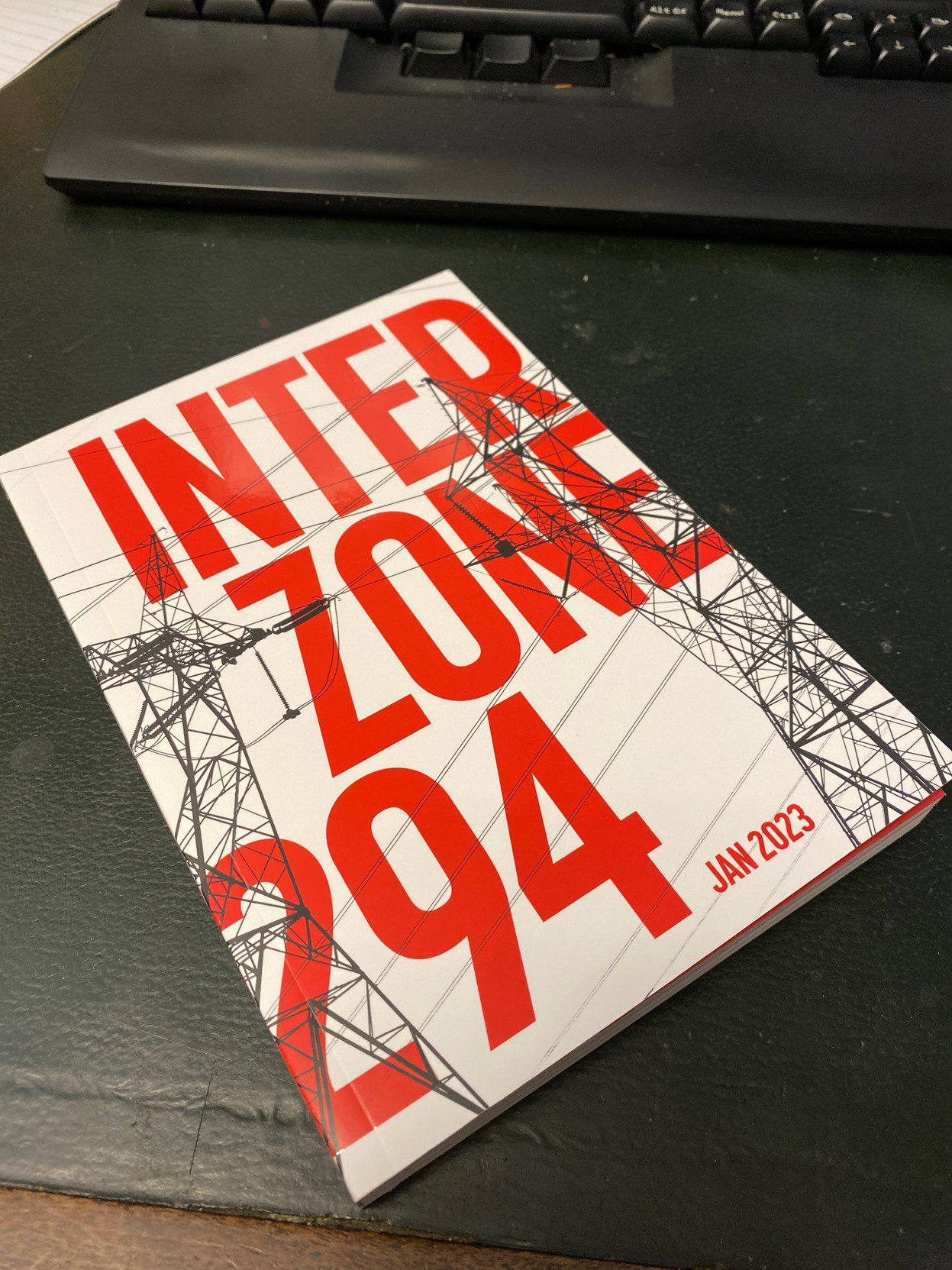
Jonathan Carter: MiniDebConf Germany 2023

This year I attended Debian Reunion Hamburg (aka MiniDebConf Germany) for the second time. My goal for this MiniDebConf was just to talk to people and make the most of the time I have there. No other specific plans or goals. Despite this simple goal, it was a very productive and successful event for me. Tuesday 23rd:
Wednesday 24th:
Thursday 25th:
Friday 26th:
Saturday 27th: Sunday 28th: Monday 29th:
Das is nicht gut.
Tuesday 30th:

Thank you to Holger for organising this event yet again!

24 May 2023

Jonathan Carter: Debian Reunion MiniDebConf 2022

It wouldn t be inaccurate to say that I ve had a lot on my plate in the last few years, and that I have a *huge* backlog of little tasks to finish. Just last week, I finally got to all my keysigning from DebConf22. This week, I m at MiniDebConf Germany in Hamburg. It s the second time I m here! And it s great already. Last year I drafted a blog entry, but never got around to publishing it. So, in order to mentally tick off yet another thing, here follows a somewhat imperfect (I had to delete a lot of short-hand because I didn t know what it means anymore), but at least published post about my activities from a year ago. This week (well, last year) I attended my first ever in-person MiniDebConf and MiniDebCamp in Hamburg, Germany. The last time I was in Germany was 7 years ago for DebConf15 (or at time of publishing, actually, last year for this same event). My focus for the week was to work on Debian live related stuff. In preparation for the week I tried to fix/close as many Calamares bugs as I could, so before the event I closed: Monday to Friday we worked together on various issues, and the weekend was for talks. On Monday morning, I had a nice discussion with Roland Clobus who has been working on making Debian live images reproducible. He s also been working on testing Debian Live on openqa.debian.net. We re planning on integrating his work so that Debian 12 live images will be reproducible. For automated testing on openqa, it will be ongoing work, one blocker has been that snapshots.debian.org limits connections after a while, so builds on there start failing fast.
On Monday afternoon, I went ahead and uploaded the latest Calamares hotfix (Calamares 3.2.58.1-1) release that fixes a UI issue on the partitioning screen where it could get stuck. On 15:00 we had a stand-up meeting where we introduced ourselves and talked a bit about our plans. It was great to see how many people could benefit from each other being there. For example, someone wanting to learn packaging, another wanting to improve packaging documentation, another wanting help with packaging something written in Rust, another wanting to improve Rust packaging in general and lots of overlap when it comes to reproducible builds! I also helped a few people with some of their packaging issues. On Monday evening, someone in videoteam managed to convince me to put together a loopy loop for this MiniDebConf. There s really wasn t enough time to put together something elaborate, but I put something together based on the previous loopy with some experiments that I ve been working on for the upcoming DC22 loopy, and we can use this loop to do a call for content for the DC22 loop. On Tuesday morning had some chats with urbec and Ilu,Tuesday afternoon talked to MIA team about upcoming removals. Did some admin on debian.ch payments for hosting. On Tuesday evening worked on live image stuff (d-i downloader, download module for dmm). On Wednesday morning I slept a bit late, then had to deal with some DPL admin/legal things. Wednesday afternoon, more chats with people. On Thursday: Talked to a bunch more people about a lot of issues, got loopy in a reasonably shape, edited and published the Group photo!
On Friday: prepared my talk slides, learned about Brave (https://github.com/bbc/brave) It initially looked like a great compositor for DebConf video stuff (and possible replacement for OBS, but it turned out it wasn t really maintained upstream). In the evening we had the Cheese and Wine party, where lots of deliciousness was experienced. On Saturday, I learned from Felix s talk that Tensorflow is now in experimental! (and now in 2023 I checked again and that s still the case, although it hasn t made it s way in unstable yet, hopefully that improves over the trixie cycle) I know most of the people who attended quite well, but it was really nice to also see a bunch of new Debianites that I ve only seen online before and to properly put some faces to names. We also had a bunch of enthusiastic new contributors and we did some key signing.

21 May 2023

Russ Allbery: Review: The Stone Canal

Review: The Stone Canal, by Ken MacLeod
Series: Fall Revolution #2
Publisher: Tor
Copyright: 1996
Printing: January 2001
ISBN: 0-8125-6864-8
Format: Mass market
Pages: 339
The Stone Canal is a sort of halfway sequel to The Star Fraction. They both take place in the same universe, but the characters are almost entirely disjoint. Half of The Stone Canal happens (mostly) well before the previous book and the other half happens well after it. This book does contain spoilers for the ending of The Star Fraction if one connects the events of the two books correctly (which was a bit harder than I thought it should be), so I would not read them out of order. At the start of The Stone Canal, Jon Wilde wakes up on New Mars beside the titular canal, in the middle of nowhere, accompanied only by a robot that says it made him. Wilde remembers dying on Earth; this new life is apparently some type of resurrection. It's a long walk to Ship City, the center of civilization of a place the robot tells him is New Mars. In Ship City, an android named Dee Model has escaped from her owner and is hiding in a bar. There, she meets an AI abolitionist named Tamara, who helps her flee out the back and down the canal on a boat when Wilde walks into the bar and immediately recognizes her. The abolitionists provide her protection and legal assistance to argue her case for freedom from her owner, a man named Reid. The third thread of the story, and about half the book, is Jon Wilde's life on Earth, starting in 1975 and leading up to the chaotic wars, political fracturing, and revolutions that formed the background and plot of The Star Fraction. Eventually that story turns into a full-fledged science fiction setting, but not until the last 60 pages of the book. I successfully read two books in a Ken MacLeod series! Sadly, I'm not sure I enjoyed the experience. I commented in my review of The Star Fraction that the appeal for me in MacLeod's writing was his reputation as a writer of political science fiction. Unfortunately that's been a bust. The characters are certainly political, in the sense that they profess to have strong political viewpoints and are usually members of some radical (often Trotskyite) organization. There are libertarian anarchist societies and lots of political conflict. But there is almost no meaningful political discussion in any of these books so far. The politics are all tactical or background, and often seem to be created by authorial fiat. For example, New Mars is a sort of libertarian anarchy that somehow doesn't have corporations or a strongman ruler, even though the history (when we finally learn it) would have naturally given rise to one or the other (and has, in numerous other SF novels with similar plots). There's a half-assed explanation for this towards the end of the book that I didn't find remotely believable. Another part of the book describes the formation of the libertarian microstate in The Star Fraction, but never answers a "why" or "how" question I had in the previous book in a satisfying way. Somehow people stop caring about control or predictability or stability or traditional hierarchy without any significant difficulties except external threats, in situations of chaos and disorder where historically humans turn to anyone promising firm structure. It's common to joke about MacLeod winning multiple libertarian Prometheus Awards for his fiction despite being a Scottish communist. I'm finding that much less surprising now that I've read more of his books. Whether or not he believes in it himself, he's got the cynical libertarian smugness and hand-waving down pat. What his characters do care deeply about is smoking, drinking, and having casual sex. (There's more political fire here around opposition to anti-smoking laws than there is about any of the society-changing political structures that somehow fall into place.) I have no objections to any of those activities from a moral standpoint, but reading about other people doing them is a snoozefest. The flashback scenes sketch out enough imagined history to satisfy some curiosity from the previous book, but they're mostly about the world's least interesting love triangle, involving two completely unlikable men and lots of tedious jealousy and posturing. The characters in The Stone Canal are, in general, a problem. One of those unlikable men is Wilde, the protagonist for most of the book. Not only did I never warm to him, I never figured out what motivates him or what he cares about. He's a supposedly highly political person who seems to engage in politics with all the enthusiasm of someone filling out tax forms, and is entirely uninterested in explaining to the reader any sort of coherent philosophical approach. The most interesting characters in this book are the women (Annette, Dee Model, Tamara, and, very late in the book, Meg), but other than Dee Model they rarely get much focus from the story. By far the best part of this book is the last 60 pages, where MacLeod finally explains the critical bridge events between Wilde's political history on earth and the New Mars society. I thought this was engrossing, fast-moving, and full of interesting ideas (at least for a 1990s book; many of them feel a bit stale now, 25 years later). It was also frustrating, because this was the book I wanted to have been reading for the previous 270 pages, instead of MacLeod playing coy with his invented history or showing us interminable scenes about Wilde's insecure jealousy over his wife. It's also the sort of book where at one point characters (apparently uniformly male as far as one could tell from the text of the book) get assigned sex slaves, and while MacLeod clearly doesn't approve of this, the plot is reminiscent of a Heinlein novel: the protagonist's sex slave becomes a very loyal permanent female companion who seems to have the same upside for the male character in question. This was unfortunately not the book I was hoping for. I did enjoy the last hundred pages, and it's somewhat satisfying to have the history come together after puzzling over what happened for 200 pages. But I found the characters tedious and annoying and the politics weirdly devoid of anything like sociology, philosophy, or political science. There is the core of a decent 1990s AI and singularity novel here, but the technology is now rather dated and a lot of other people have tackled the same idea with fewer irritating ticks. Not recommended, although I'll probably continue to The Cassini Division because the ending was a pretty great hook for another book. Followed by The Cassini Division. Rating: 5 out of 10

12 May 2023

Holger Levsen: 20230512-Debian-Reunion-Hamburg-2023

Small reminder for the Debian Reunion Hamburg 2023 from May 23 to 30 As in previous years there will be a rather small Debian Reunion Hamburg 2023 event taking place from May 23rd until the 30th (with the 29th being a public holiday in Germany and elsewhere). We'll have days of hacking (inside and outside), a day trip and a small cheese & wine party, as well as daily standup meetings to learn what others are doing, and there shall also be talks and workshops. At the moment there are even still some beds on site available and the CfP is still open! For more information on all of this: please check the above wiki page! May the force be with you.

4 May 2023

Holger Levsen: 20230504-Debian-Reunion-Hamburg-2023

Small reminder for the Debian Reunion Hamburg 2023 from May 23 to 30 As in previous years there will be a rather small Debian Reunion Hamburg 2023 event taking place from May 23rd until the 30th (with the 29th being a public holiday in Germany and elsewhere). We'll have days of hacking (inside and outside), a day trip and a small cheese & wine party, as well as daily standup meetings to learn what others are doing, and there shall also be talks and workshops. At the moment there are even still some beds on site available! For more information on all of this: please check the above wiki page! May the force be with you.

Next.

Previous.