Search Results: "nic"

21 April 2026

Dirk Eddelbuettel: RcppArmadillo 15.2.6-1 on CRAN: Several Updates

armadillo image Armadillo is a powerful and expressive C++ template library for linear algebra and scientific computing. It aims towards a good balance between speed and ease of use, has a syntax deliberately close to Matlab, and is useful for algorithm development directly in C++, or quick conversion of research code into production environments. RcppArmadillo integrates this library with the R environment and language and is widely used by (currently) 1263 other packages on CRAN, downloaded 45.7 million times (per the partial logs from the cloud mirrors of CRAN), and the CSDA paper (preprint / vignette) by Conrad and myself has been cited 683 times according to Google Scholar. This versions updates to the 15.2.5 and 15.2.6 upstream Armadillo releases from, respectively, two and five days ago. The package has already been updated for Debian, and built for r2u. When we ran the reverse-dependency check for 15.2.5 at the end of last week, one package failed. I got in touch with the authors, filed an issue, poked some more, isolated the one line that caused an example to fail and right then 15.2.6 came out fixing just that. It was after all an upstream issue. We used to ran these checks before Conrad made a release, he now skips this and hence needed a quick follow-up release. It can happen. The other big change is that this R package release phases out the dual support for both C++14 or newer (as in current Armadillo) along with a C++11 fallback for more slowly updating packages. I am happy to say that after over eight months of this managed transition (during which CRAN expulsed some laggard packages that were not moving in from C++11) we are now at all packages using C++14 or newer which is nice. And I will take this as an opportunity to stress that one can in fact manage a disruptive API change this way as we just demonstrated. Sadly, R Core does not seem to have gotten that message and rollout of this package was also still a little delayed because of the commotion created by the last minute API changes preceding the R 4.6.0 release later this week. Smaller changes in the package are a switch in pdf vignette production to the Rcpp::asis() driver, and a higher-precision computation in rmultinom() (matching a change made in R-devel during last week in its use of Kahan summation). All detailed changes since the last CRAN release follow.

Changes in RcppArmadillo version 15.2.6-1 (2026-04-20)
  • Upgraded to Armadillo release 15.2.6 (Medium Roast Deluxe)
    • Ensure internally computed tolerances are not NaN
  • The rmultinom deploys 'Kahan summation' as R-devel does now.

Changes in RcppArmadillo version 15.2.5-1 [github-only] (2026-04-18)
  • Upgraded to Armadillo release 15.2.5 (Medium Roast Deluxe)
    • Fix for handling NaN elements in .is_zero()
    • Fix for handling NaN in tolerance and conformance checks
    • Faster handling of diagonal views and submatrices with one row>

  • Sunset the C++11 fallback of including Armadillo 14.6.3 (#504 closing #503)
  • The vignettes have refreshed bibliographies, and are now built using the Rcpp::asis vignette builder (#506)
  • One rmultinom test is skipped under R-devel which has switched to a higher precisions calc
Courtesy of my CRANberries, there is a diffstat report relative to previous release. More detailed information is on the RcppArmadillo page. Questions, comments etc should go to the rcpp-devel mailing list off the Rcpp R-Forge page.

This post by Dirk Eddelbuettel originated on his Thinking inside the box blog. If you like this or other open-source work I do, you can sponsor me at GitHub. You can also sponsor my Tour de Shore 2026 ride in support of the Maywood Fine Arts Center.

Russell Coker: More About Ebook Readers in Debian

FBReader After my previous blog post about eBook readers in Debian [1] a reader recommended FBReader. I tried it and it s now my favourite reader. It works nicely on laptop and phone and takes significantly less RAM than Calibre or Arianna (especially important for phones). While the problems with my FLX1s not displaying text with Calibre or Arianna might be the fault of something on the FLX1s side those problems just don t happen with FBReader. FBReader has apparently now got a proprietary version as the upstream, but we still have FOSS code to use in Debian. It would be nice if someone updated it to store the reading location using WebDAV and/or a local file that can be copied with the NextCloud client or similar. Currently there is code to store reading location in the Google cloud which I don t want to use. It s not THAT difficult to see what chapter you are at with one device and just skip to that part on another, but it is an annoyance. One thing I really like about FBReader is that you can run it with a epub file on the command line and it just opens it and when it s been closed you can just open it again to the same spot in the same file. I don t want a library to view a book list, I just want to go back to what I was last reading in a hurry. Calibre might be better for some uses, for example I can imagine someone in the publishing industry with a collection of thousands of epub files finding that Calibre works better for them. But for the typical person who just wants to read one book and keep reading it until they finish it FBReader seems clearly better. The GUI is a little unusual, but it s not at all confusing and it works really well on mobile. Okular I tried Okular (the KDE viewer for PDF files etc) which displays epub files if you have the okular-extra-backends installed, but it appears to not display books with the background color set to black. I would appreciate it if someone who has read some public domain or CC licences epub files can recommend ones with a black background that I could use for testing as I can t file a Debian bug report without sample data to reproduce the bug. I decided not to use it for actual book reading as FBReader is far better for my use taking less RAM and being well optimised for mobile use. Folite Foliate supports specifying a book on the command-line which is nice. But it takes more memory than FBReader which is probably mostly due to using webkit to display things. The output was in 2 columns on my laptop in small text which is probably configurable but I didn t proceed with it. I determined that it doesn t compare with FBReader for my use. It s written in JavaScript which may be a positive feature for some people. Koodo I had a brief test of Koodo which isn t in Debian. Here is the Koodo Reader Github [2]. I installed the .deb that they created, it installs files to /opt/Koodo Reader/ (yes that s a space in the directory name) and appears to have Chromium as part of the runtime. I didn t go past that even though it appears to have a decent feature set. It is licensed under version 3 of the AGPL so is suitable for Debian packaging if someone wants to do it. Thorium I saw the Thorium reader on Github [3] which looks promising, it s under the BSD 3 clause license so is suitable for Debian packaging. The EDR Lab seems like a good project for advancing electronic document use [4] and it would be good to have their stuff in Debian. For the moment I m happy using FBReader.

20 April 2026

Russ Allbery: Review: Surface Detail

Review: Surface Detail, by Iain M. Banks
Publisher: Orbit
Copyright: October 2010
Printing: May 2011
ISBN: 0-316-12341-2
Format: Trade paperback
Pages: 627
Surface Detail is the ninth novel in Banks's Culture science fiction (literary space opera?) series. As with most of the Culture novels, it can be read in any order, although this isn't the best starting point. There is an Easter egg reference to Use of Weapons that would be easier to notice if you have read that book recently, but which is not that important to the story. Lededje Y'breq is an Indented Intagliate from the Sichultian Enablement. Her body is patterned from her skin down to her bones, covered with elaborate markings similar to tattoos that extend to her internal organs. As an intagliate, she is someone's property. In her case, she is the property of Joller Veppers, the richest man in the Enablement and her father's former business partner. Intagliates are a tradition of great cultural pride in the Enablement. They are a living representation of the seriousness with which debts and honor are taken, up to and including one's not-yet-born children becoming the property of one's debtor. Such children are decorated as living works of art of the highest skill and technical sophistication; after all, the Enablement are not barbarians. As the story opens, Lededje is attempting, not for the first time, to escape. This attempt is successful in an unexpected way. Prin and Chay are Pavulean researchers and academics who, as this story opens, are in Hell. They are not dead; they have infiltrated the Hell that Pavuleans are shown to scare them into proper behavior in order to prove that it is not an illusion and their society does indeed torture people in an afterlife, in more awful ways than people dare imagine. They have reached the portal through which temporary visitors exit, hoping to escape with firm evidence of the existence and horrors of the Pavulean afterlife. They will not be entirely successful. Yime Nsokyi is a Culture agent for Quietus, the part of Contact that concerns itself with the dead. Many advanced societies throughout the galaxy have invented and reinvented the ability to digitize a mind and then run it in a virtual environment. Once a society can capture the minds of every person in that society from that point forward, it faces the question of whether to do so and, if it does, what to do with those minds. More specifically, it faces the moral question of whether to punish the minds of people who were horrible in life. It faces the question of whether to create Hell. Vatueil is a soldier in a contestation, a limited and carefully monitored virtual war. The purpose of that war game is to, once and for all, resolve the question of whether civilizations should be allowed to create Hells. Some civilizations consider them integral to their religion or self-conception. Others consider them morally abhorrent, and that conflict was in danger of spilling over into war in the Real. Hence the War in Heaven: Both sides committed to fight in a virtual space under specific and structured rules, and the winner decides the fate of the galaxy's Hells. Vatueil is fighting for the anti-Hell side. The anti-Hell side is losing. There are very few authors who were better at big-idea science fiction than Iain M. Banks. I've been reading a few books about AI ships and remembered that I had two unread Culture novels that I was saving. It felt like a good time to lose myself in something sprawling. Surface Detail does sprawl. Even by Banks's standards, there was an impressive amount of infodumping in this book. Banks always has huge and lovingly described set pieces, and this book is no exception, but there are also paragraphs and pages of background and cultural musings and galactic politics. We are introduced to not one but three new Contact divisions; as well as the already-mentioned Quietus, there is Numina, which concerns itself with the races that have sublimed (transcended), and Restoria, which deals with hegemonizing swarms (grey goo nanotech, paperclip maximizers, and their equivalents). Infodumping is both a feature and a bane of big-idea science fiction, and it helps to be in the right mood. It also helps if the info being dumped is interesting, and this is where Banks shines. This is a huge, sprawling book, but it deals with some huge, sprawling questions and it has interesting and non-reductive thoughts about them. The problems posed by the plot come with history, failed solutions, multi-sided political disputes, strategies and tactics of varying morality and efficacy, and an effort to wrestle with the irreducible complexity of trying to resolve political and ethical disagreements in a universe full of profound disagreements and moral systems that one cannot simply steamroll. It also helps that the characters are interesting, even when they're not likable. Surface Detail has one fully hissable villain (Veppers) as a viewpoint character, but even Veppers is interesting in a "let me check the publication date to see if Banks was aware of Peter Thiel" sort of way. The Culture ships, of which there are several in this story, tend towards a gently sarcastic kindness that I find utterly charming. Lededje provides the compelling motive force of someone who has no involvement in the broader philosophical questions and instead intends to resolve one specific problem through lethal violence. Vatueil and Yime were a bit bland in personality, more exposition generators than characters I warmed to, but their roles and therefore the surrounding exposition were fascinating enough that I still enjoyed their sections. I'm sure this is not an original observation, but I was struck reading this book in the first half of 2026 that the Culture functions as an implementation of what the United States likes to think it is but has never been. It has a strong sense of shared ethics and moral principles, it tries to export them to the rest of the galaxy through example, persuasion, and careful meddling, but it tries to follow some combination of pragmatic and moral rules while doing so, partly to avoid a backlash and partly to avoid becoming its own sort of hegemonizing swarm. That is a powerfully attractive vision of how to be an advanced civilization, and the fact that every hegemon that has claimed that mantle has behaved appallingly just makes it more intriguing as a fictional concept. In this book, like in many Culture books, the Culture is painfully aware of the failure modes of meddling, and the story slowly reveals the effort the Culture put into staying just on a defensible side of their own moral lines. This is, in a sense, a Prime Directive story, but with a level of hard-nosed pragmatism and political sophistication that the endless Star Trek Prime Directive episodes never reach. Surface Detail does tend to sprawl, and I'm not sure Banks pulled together all the pieces of the plot. For example, if there was a point to the subplot involving the Unfallen Bulbitian, it was lost on me. (There is always a possibility with Banks that I wasn't paying close enough attention.) But the descriptions are so elaborate and the sense of politics and history are so deep that I was never bored, even when following a plot thread that meandered off into apparent irrelevance. The main plot line comes to a satisfying conclusion that may be even more biting social commentary today than it was in 2010. A large part of the plot does involve Hell, so a warning for those who haven't read much Banks: He adores elaborate descriptions of body horror and physical torture. The sections involving Prin and Chay are rather grim and horrific, probably a bit worse than Dante's Inferno. I have a low tolerance for horror and I was able to read past and around the worst bits, but be warned that Banks indulges his love for the painfully grotesque quite a bit. This was great, and exactly what I was hoping for when I picked it up. It's not the strongest Culture novel (for me, that's either The Player of Games or Excession), but it's one of the better ones. Highly recommended, although if you're new to the Culture, I would start with one of the earlier books that provide a more gradual introduction to the Culture and Special Circumstances. Followed, in the somewhat disconnected Culture series sense, by The Hydrogen Sonata. Content warnings: Rape (largely off-screen), graphic violence, lots of Bosch-style grotesque torture, and a lot of Veppers being a thoroughly awful human being as a viewpoint character. Rating: 8 out of 10

18 April 2026

Valhalla's Things: Pizza!

Posted on April 18, 2026
Tags: madeof:atoms, craft:cooking
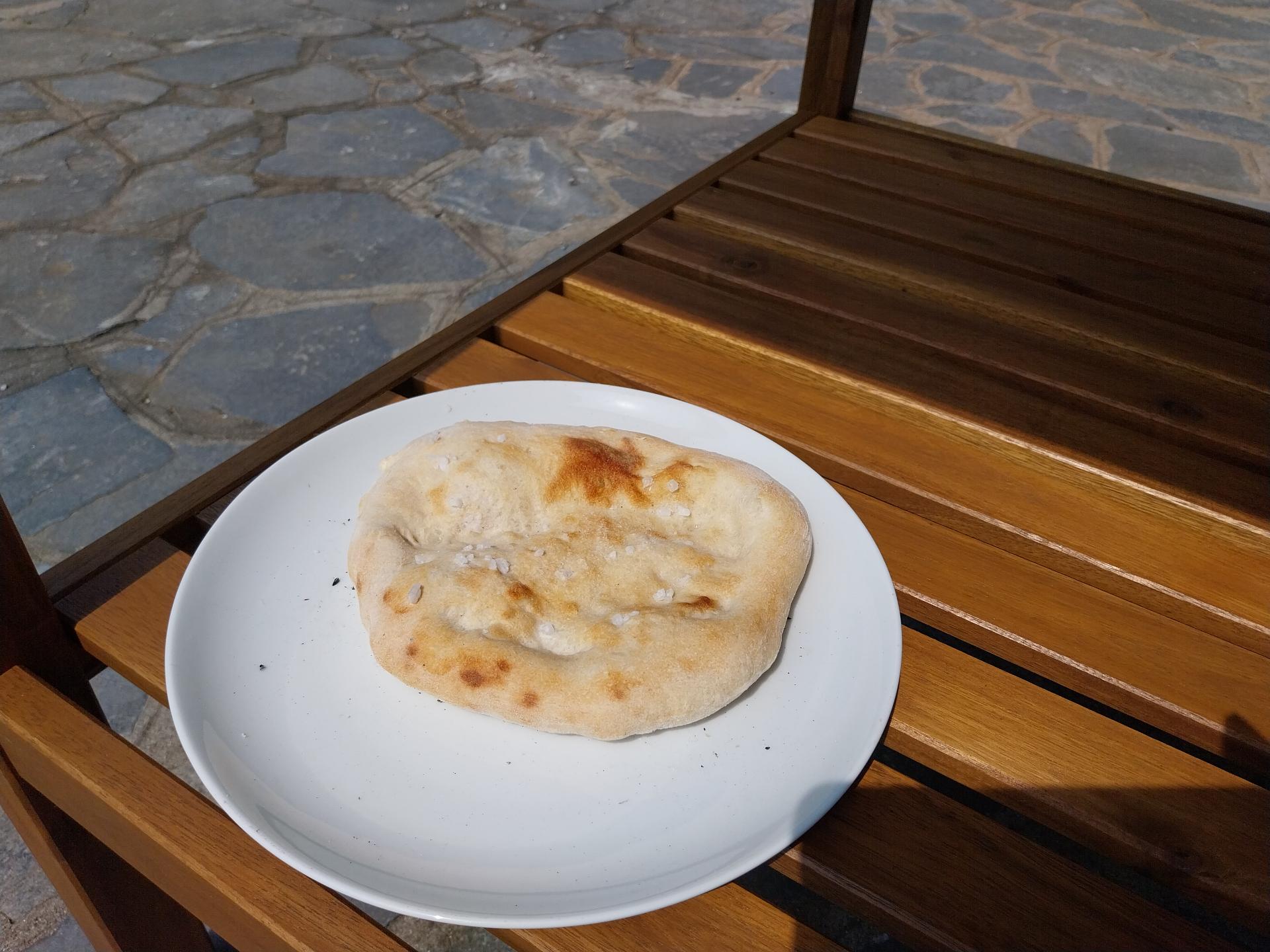
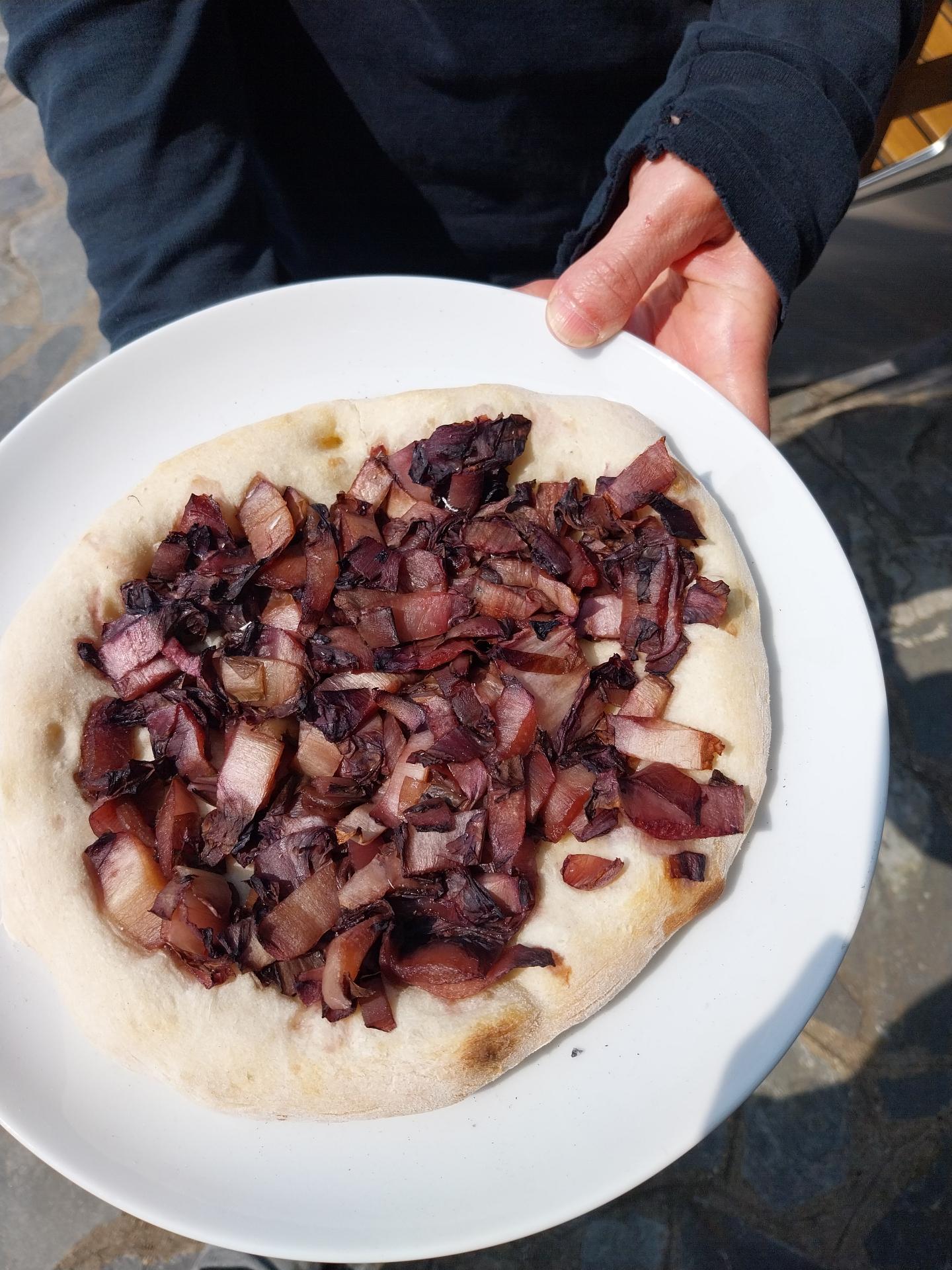
This post contains a bit of consumerism and is full of references to commercial products, none of which caused me to receive any money nor non-monetary compensation. This post has also been written after eating in one meal the amount of bread-like stuff that we usually have in more than 24 hours. I ve been baking bread since a long time ago. I don t know exactly when, but probably it was the early 2000s or so, and remained a regular-ish thing until 2020, when it became an extremely regular thing, as in I believe I bake bread on average every other day. In the before times, I ve had a chance to bake pizza in a wood fired oven a few times: a friend had one and would offer the house, my partner would mind the fire, and I would get there with the dough and prepare the pizza. Now that we have moved to a new house, we don t have a good and convenient place for a proper wood fired oven in masonry, but we can use one of the portable ones, and having dealt with more urgent expenses, I decided that just before the potential collapse of the global economy was a good time as any to buy the oven I had been looking at since we found this house. I decided to get an Ooni Karu 2, having heard good things about the brand, and since it looked like a good balance between size and portability. I also didn t consider their gas fired ovens (nor did I buy the gas burner) because I m trying to get rid of gas, not add stuff that uses it, and I didn t get an electric one because I m not at all unhappy with the bakery-style pizza we make in our regular oven, and I have to admit we also wanted to play with fire1. We also needed an outdoor table suitable to use the oven on and store it. Here I looked for inspiration at the Ooni tables (and for cheaper alternatives in the same style), but my mother who shares the outdoor area with us wasn t happy with the idea of steel2. And then I was browsing the modern viking shores, and found that there was a new piece in the N MMAR series my mother likes (and of which we already have some reclining chairs): a kitchen unit in wood with a steel top. At first I expected to just skip the back panel, since it would be in the way when using the oven, but then I realized that it could probably be assembled upside down, down from the top between the table legs, and we decided to try that option. This week everything had arrived, and we could try it. Yesterday evening, after dinner (around 21, I think) I prepared the dough with the flour I usually use for bakery-style pizza: Farina di Grano Tenero Tipo 0 PANE (320 - 340 W); since I wanted to make things easier for myself I only used 55% hydration, so the recipe was:
  • 1 kg flour
  • 550 g water
  • 2 g dry yeast
  • 12 g salt
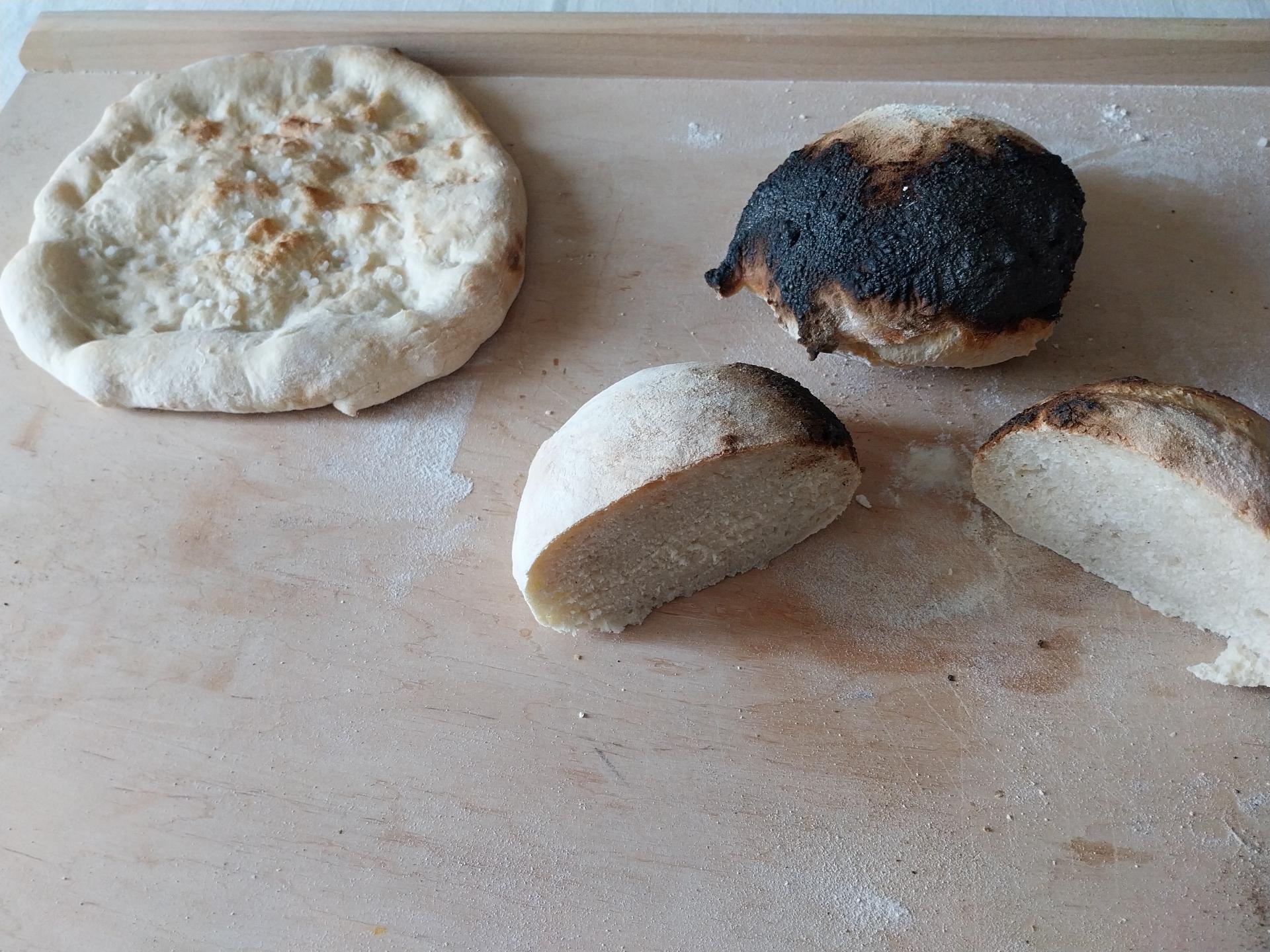
The next time I think I ll try with one of my other staples: Molino Bogetto etichetta blu (260/280 W) Then this morning we assembled the N MMAR , then I divided the dough in eight balls, put them in a covered but not sealed container 3, well floured with rice flour and then we fired the oven (as in: my partner did, I looked for a short while and then set the table and stuff), using charcoal, because we already had some, and could conveniently get more at the supermarket. When the oven had reached temperatures in the orange range4 I stretched the smallest ball out, working on my wooden peel, sprayed it with water5, sprinkled it with coarse salt and put it in the oven. After 30 seconds I turned it around with the new metal peel, then again after 30 seconds, and then I lost count of how many times I repeated this6, but it was probably 2 or 3 minutes until it looked good. A flatbread on a regular plate: it's only a bit more than half the plate in diameter, puffed up near the borders and thin in the middle, and only lightly browned in places, not burnt. It's sitting on the lower shelf of a wooden table. And it was good. The kind of pizza that is quite soft, especially near the borders. We ate it with fresh mozzarella and tomatoes, and then made another one the same way, to finish the mozzarella. Another flatbread on the same plate, this time it's about 4 cm smaller than the plate on all sides, and it's covered with brownish-red chopped up vegetables. This was supposed to be our lunch, but we decided to try one with some leftover cooked radicchio, and that also worked quite nicely. And finally, we decided we needed to try a more classical pizza, with tomato sauce and cured meat, of which we forgot to take pictures. Up to here we had eaten about half of the dough, and we were getting full: I had prepared significantly more than what I expected to eat, to be able to accidentally burn some, but also with the idea to bake something else to be eaten later. So I made two more focaccias with just water and salt, and then I tried to cook some bread with what I expected to be residual heat. Another flatbread with coarse salt and two bread rolls, one of which is completely carbonized on one side. The other one has been cut, and while it has a carbonized spot, it is also well cooked in the middle, and perfectly edible. Except that the oven was getting a bit too cold, so my partner added some charcoal, and when I put the last two unflattened balls right at the back of the oven where it was still warmer, that side carbonized. After 5 minutes I moved them to the middle of the oven, and turned them, and then after another turn and 5 more minutes they were ready. And other than the burnt crust, they were pretty edible. So, the thoughts after our first experience. Everybody around the table (my SO, my mother and me) was quite happy with the results, and they are different enough from the ones I could get with the regular oven. As I should have expected, it s much faster than a masonry oven, both in getting to temperature and in cooling down: my plan for residual heat bread cooking will have to be adjusted with experience. We were able to get it hot enough, but not as hot as it s supposed to be able to get: we suspect that using just charcoal may have influenced it, and next week we ll try to get some wood, and try with a mix. As for the recipe, dividing the dough in eight parts worked quite well: maybe the pizzas are a bit on the smaller side, but since they come one at a time it s more convenient to cut and share them, and maybe make a couple more at the end. Of course, I ll want to try different recipes, for different styles of pizzas (including some almost-trademark-violating ones) and for other types of flatbread. I expect it won t be hard to find volunteers to help us with the experiments. :D
  1. any insinuation that there may have been considerations of having a way to have freshly baked bread in case of a prolonged blackout may or may not be based on reality. But it wasn t the only or even the main reason.
  2. come on! it s made of STEEL. how can it be not good? :D
  3. IKEA 365+ 3.1 glass, the one that is 32 cm 21 cm 9 cm; it was just big enough for the amount of dough, and then I covered it with a lid that is missing the seal.
  4. why did they put a thermometer on it, and not add labels with the actual temperature? WHY???
  5. if you don t have dietary restrictions a bit of olive oil would taste even better.
  6. numbers above 2 are all basically the same, right?

17 April 2026

Russell Coker: Home Battery

Prices On the 19th of March I got a home battery system installed. The government has a rebate scheme so it had a list price of about $22k for a 40kWh setup and cost me about $12k. It seems that 40KWh is the minimum usable size for the amount of electricity I use, I have 84 cores running BOINC when they have nothing better to do which is 585W of TDP according to Intel. While the CPUs are certainly using less than the maximum TDP (both due to design safety limits and the fact that I have disabled hyper-threading on all systems due to it providing minimal benefits and potential security issues) given some power usage by cooling fans and some inefficiency in PSUs I think that assuming that 585W is accounted for 24*7 by CPUs is reasonable. So my home draws between 800W and 1KW when no-one is home and with an electric car and all electric cooking a reasonable amount of electricity can be used. My bills prior to the battery installation were around $200/month which was based on charging my car only during sunny times as my electricity provider (Amber Electric) has variable rates based on wholesale prices. Also the feed in rates if my solar panels produce too much electricity in sunny times often go negative so if I don t use enough electricity. I haven t had the electric car long enough to find out what the bills might be in winter without a home battery. Before getting the battery my daily bills according to the Amber app were usually between $5 and $10. After getting it the daily bills have almost always been below $5. The only day where it s been over $5 since the battery installation was when electricity was cheap and I fully charged the home battery and my car which used 50KWh in one day and cost $7.87 which is 16 cents per KWh. 16 cents isn t the cheapest price (sometimes it gets as low as 10 cents) but is fairly cheap, sometimes even in the cheap parts of the day it doesn t get that low (the cheapest price on the day I started writing this was 20 cents). So it looks like this may save me $100 per month, if so there will be a 10% annual return on investment on the $12K I spent. This makes it a good investment, better than repaying a mortgage (which is generally under 6%) and almost as good as the long term results of index tracker funds. However if it cost $22K (the full price without subsidy) then it would still be ok but wouldn t be a great investment. The government subsidised batteries because the huge amount of power generated by rooftop solar systems was greater than the grid could use during the day in summer and batteries are needed to use that power when it s dark. Android App The battery system is from Fox ESS and the FoxCloud 2.0 Android app is a bit lacking in functionality. It has a timer for mode setting with options Self-use (not clearly explained), Feed-in Priority (not explained but testing shows feeding everything in to the grid), Back Up , Forced Charge , and Forced Discharge . Currently I have Forced Charge setup for most sunny 5 hours of the day for a maximum charge power of 5KW. I did that because about 25KW/day is what I need to cover everything and while the system can do almost 10KW that would charge the battery fully in a few hours and then electricity would be exported to the grid which would at best pay me almost nothing and at worst bill me for supplying electricity when they don t want it. There doesn t seem to be a never put locally generated power into the grid unless the battery is full option. The force charge mode allows stopping at a certain percentage, but when that is reached there is no fallback to another option. It would be nice if the people who designed the configuration could take as a baseline assumption that the macro programming in office suites and functions in spreadsheets are things that regular people are capable of using when designing the configuration options. I don t think we need a Turing complete programming language in the app to control batteries (although I would use it if there was one), but I think we need clauses like if battery is X% full then end this section . There is no option to say force charge until 100% or force charge for the next X minutes as a one-off thing. If I came home in the afternoon with my car below 50% battery and a plan to do a lot of driving the next day then I d want to force charge it immediately to allow charging the car overnight. But I can t do that without entering a schedule . For Unix people imagine having to do everything via a cron job and no option to run something directly from the command-line. It s a little annoying that they appear to have spent more development time on animations for the app than some of what should be core functionality. Management Amber has an option to allow my battery to be managed by them based on wholesale pries but I haven t done that as the feed-in prices are very low. So I just charge my battery when electricity is cheap and use it for the rest of the day. There is usually a factor of 2 or more price difference between the middle of the day and night time so that saves money. It also means I don t have to go out of my way to try and charge my car in the middle of the day. There is some energy lost in charging and discharging the batteries but it s not a lot. I configured the system to force charge for the 5 sunniest hours every day for 5KW as that s enough to keep it charged overnight and 5KW is greater than the amount of solar electricity produced on my house since I ve been monitoring it so that forces it to all be used for the battery. In summer I might have to change that to 6KW for the sunniest 2 or 3 hours and then 4KW or 5KW surrounding that which will be a pain to manage. Instead of charging the car every day during sunny times I charge it once or twice a week, I have a 3.3KW charger and the car has a 40KWh battery so usually it takes me less than 10 hours to fully charge it and I get at least 5 hours of good sunlight in the process. There are people hacking on these devices which is interesting to get direct control from computers [1], and apparently not banned from the official community for doing so. I m not enthusiastic enough to do this, I ve got plenty of other free software things to work on. But it s good that others are doing so.

16 April 2026

Sahil Dhiman: What is Life (to you)?

It started with a thought: to understand people s perspectives on life and its meaning. So I texted folks, What is life (to you)? . Each of the following list items (-) is a response from a different individual, mostly verbatim.
- A lot
- Everyone has a few universal basic qualities, and some special qualities. To me life is pursuit of exploring world based on those qualities and maturing those qualities as one goes on about exploring world/life with those qualities.
Discovering and enhancing experiences as one goes through them.
- life is endless suffering
- my answer might change daily, but this is what I ve noticed and feel recently. Life is a spectrum with two distinct ends: what we control and what we don t. At birth, the spectrum is largely tilted toward control, but throughout our lives, it gradually shifts toward the other side. Ultimately, as we approach death, we lose all control over any aspect of our existence, reaching the other end of the spectrum.
tho this isn t universal, privilege plays a huge part in what you control tho i believe it holds true for the majority
but yeah man, meaning and purpose are dynamic, it s in their nature to change i can give you a different answer this evening itself xD
- Funeral Monologue from Synecdoche, New York. https://www.youtube.com/watch?v=Z9PzSNy3xj0
- Zindagi ek nadiya hai, Aur mujhe tairna nahi aata
(translation - Life is a river, and I don t know how to swim)
On a more serious note, Life is what you make it out for yourself. The only established truth is that it will end. We can never know if there is something after or if there was something before. So try to live a life that you feel aspired by? But this question was beautifully answered by that book which you had about that dying professor
(Me - He was talking about Tuesday s with Morrie)
- My answer is 42
- One, it s living on your own terms, you define everything for yourself, success, normal, whatever. You get to curate your version of it no matter the societal norms.
It s an accumulation of experiences - friends, parents, work, activities, doing shit loads. Sab try karo- travel, zumba, art, music, workout, sports, dil kara ye karna hai karlo. (translation - If your heart wants to do it, just do it.)
Then I think relationships - all that you ve nurtured, people forget maintaining people because of work. It takes efforts to keep people in your life, everyone that comes has a place in yours, how well thats stays is upto you. You also get to curate your people, who stays who don t. Family toh hai hi (translation - family is there) but everyone else that comes along can make it pretty good.
So I don t want to be 50 and be like chalo ab kuch apne liye karte hai (translation - Come on, now let s do something for ourselves) Do whatever shit you want today. Not everything costs money, and if it does get thrifty
But do keep healthy while doing all of that
- Being alive so that my daughter can grow up and i can help raising her kids as well. Raising kids without mother is tough :P
- Definitively, I feel like Life is a by product of proteins and energy working together. But in a more personal sense, Life is a dumb joke played onto us. It s a rat race. But rats exists because of life and then it becomes a chicken-egg problem
Honestly, I don t give good answers to life questions. I m generally the one asking
Life can be like a box of chocolates, you don t know what you re gonna get untill you experience the chocolate(assuming the chocolates are heterogenous and contains a mix of everything)
Camus once said, Life is a revolt , and one of his students added more spice to it like Life is a revolt against the meaninglessness of existence"
I kinda feel like Life is the pursuit of every person s search for meaning
- Imprisonment waiting for execution
I have one more thought while we are on the topic , game with pre defined starting position and predefined destination , path to reach is a maze
- A phase where you can have a really good time or really bad one, usually the mix of both. A phase where you are prisoner to responsibility and materialistic wants.
It s a hell for you, where you try to create heaven for others. Being born was never your choice, but ending is always in your hands but you are a prisoner. You fear that leaving this world behind will destroy the heavens you created for others and they will be back to hell. But eventually everyone moves on watching the hourglass of their life.
Once you are left with no desires or no one to create heavens for, you look arround yourself. You see everyone chasing something, everyone scared of their limitted life time sliping away yet you want it to end sooner.
Doesn t matter if it was all good till now, or all bad. The other half is waiting for redemption. If it was all good, it s best time to die don t wait for the bad to start. If was all bad, it s still the best time to die what if it was the good one and more worst is waiting for you. We desire to be remembered, yet we want to free from this loop of suffering.
Someone once said, life is a suffering, chose your sufferings.
- Life to me is to live without regrets and live with freedom.
Life is always unpredictable and this unpredictability makes it more interesting and worth it.
- As of now, for the state of mind that I am in , I think for me life is about subtle struggle, subtle inconveniences and yet moving forward cause that s all I know.
I am not sure if any of this has any meaning, but sometimes I feel I was born of a purpose and that the universe has my back.
For me it s about raising my consciousness, understanding people to their depths, gaining moderate material success and helping people to some extend.
I have tried to seek a grander meaning but I have failed.
Life for me is what I make out it.
In my times of great success i rarely think about life for I am busy enjoying it, whatever you may call that state of mind.
- For me its the little things that you enjoy with YOUR people
- Life to me is about living and loving, and doing it in a way that sustains. It s the people who shape you, the work you get absorbed in, the quiet moments in between. There s also the wanting, the drive to figure out what s worth going after and how to get there, but that s just one part of it, not the point of it. And none of it happens in a vacuum. I m aware of the privileges that let me live this way, and I try to hold on to that gratitude. In the end, life has both a material and a non-material side, and a lot of what we do is chasing material things in an attempt to satisfy something non-material within us
- Mere liye (translation - for me) life is staying at my home and studying random economics papers. That s when I enjoy myself the most.
- Very complicated
Some days I wish this life never ended and some time I feel it would be better if it stopped at that moment.
It all depends on the events that happen in the so called life .
So life to me is a string of events that happen anyway and you get to make some decisions which can turn it in any direction and then you wonder how did that happen.
- not forgetting to breathe, learn, eat, game, take a good shit, love, sleep.
- To be honest it changed with time! At 19 it was about freedom, wasn t sure what freedom meant but i wanted that! To be free from everything, maybe because parents still controlled a part of my life. Then came 22-24 where i was working, trying to figure out what i want, the meaning changed from freedom to living for myself. To earn more, to be greedy about myself and pursue whatever would help me gain more steps in my career.
Came my mba life, switched my life from doing for myself to trying everything out to have no regrets. Life meaning was just about living with no regrets, invested, gambled, did everything to earn that tag of yeah, have tried that . Now it has all switched to, it was all just a fake facade. Life turned to having a meaningful life rather than finding meaning in what i am doing. Living for people around me, chhoti chhoti cheezo m khushi (translation - happiness in small things(?)) isn t really a topic of conversation but more of happy thing for me. So it changed, and m quite happy to be honest. Life did show me a lot of failures, but was privileged enough to face those failures. Gained a lot of learnings if not money
Hopeful for more learnings and change meaning of life with time
- A task.
- You have different answers at different times You learn different meanings at different times When you are studying, basically it is about job, finding a partner then it becomes, house, car other things based on your income in between, there can be passion too
Free Software was a passion, electoral politics too, but both kind of faded and I want cooperative and user driven development now (prav - something that motivates me every day) and these days learning Chinese and watching Cdrama takes a huge part of my leisure time it is heavily subjective and also influences by previous experiences people around you, how much influence they have on you
it also depends on if they had to struggle in their life or not, for some life did not give much troubles and trouble itself can be relative people who never had to struggle may find even smallest challenges as troubles like if you own a car, your worry is finding a parking slot
- I am too young to think about lyfe
- A ticket to see the show on earth, I guess
I guess life is different depending on the mood. It is a very broad question.
(Me - What is it in this present mood?)
Learning stuff (like I am learning a new language) and being happy but also to regulate emotions in a world where being optimistic is getting harder each day.
Life is also having a unique set of glasses you wear. Both in terms of looking from your eyeballs and your psychological perspective. Both are unique and cannot be replicated.
It is interesting what people on their deathbed think of life. If I know I am dying, my perspective would change a whole lot.
Life is finishing reading books while we are alive
Life is sleeping after a good XMPP chat
- Dukh dard peeda (translation - surrow pain suffering)
- uhh to word it? life is just like a journey from A to somewhere and its all about what paths you take and what line you get on to me, just a series of short adventures that all connect to a larger sequence until you can t have any more adventures-
(Me - eee, THE END. drop dead, like a coin)
yeaaaah- I am not really for spirituality of an afterlife, to me life just ends at some point, after which point there fails to remain a discernable you, and some X time after which, you will be last remembered, try to make that last time a good one I guess?
(Me - no soul?)
uhhh not in the way most people think of it i guess?
theres just a lot of yous, theres the physical you, there is the idea of you, there is the expectation of you, and one of the undefinable you I would label as the soul maybe? like the part thats not physically you, but also certainly you
(Me - can t say I understood part, but I get you in this sense)
mhm- well its about just questioning who you are more so questioning what life is-, I have sadly spent way too much time trying to figure that out
- Making the best of the time you have
- living a full range of experiences and embracing the good ones, seeing all that the world has to offer. In the end we were always just stardust. Might as well enjoy it when we are stardust with a consciousness of our own.
- For some reason or the Universe s /dev/random I was born here as a biological being, and from my experience I understood living is hard and the best way to live is by embracing it. Loving everyone and everything around you. Be happy and joyful until you naturally say good bye to this world.
- Life is being fucked by everything and you just have to figure out and try to stick to the things worth being fucked for
Note: Following was transcribed from a audio message.
- There are five conditions to become a life to survive in the environment. I think there s five conditions by the biological definitions and reproduction is one of the factor virus is not considered a life form because it cannot reproduce on its own but technically it s kind of a life because it reproduces using the DNA ability this is the biological definition. Do you want a philosophical definition?
My definition is kind of the same except that you get life experiences along with it as a human. Extra benefits is that you are not an NPC. All other organisms are NPCs. But humans can interpret the world and change it to their liking. That is life in the case of a human. But then many humans are mostly NPCs. But they still can change the life. Okay, fuck this. Where is this even going?
A human is an exception in the case of life, because human is not an NPC. Human can interrupt the world, human can change it to its liking, which is why we are such a successful organism on this planet. That is life to me. That s a human. But all of this is kind of meaningless, because the biological impurity of a human being still exists, so you still have the urges to reproduce, which kind of makes it like just another organism. But then, humans are yet to evolve to overcome that biological imperative.
I m grateful for all the replies, outlooks, and subsequent conversations I got to have after this question with everyone. After all, it was a deeply personal question. It does fit in nicely with my definition of life:
Life is all about experiences and all the transient relationships one gets to have with folks we meet on the way.

15 April 2026

Paul Tagliamonte: designing arf, an sdr iq encoding format

Interested in future updates? Follow me on mastodon at @paul@soylent.green. Posts about hz.tools will be tagged #hztools.

Want to jump right to the draft? I'll be maintaining ARF going forward at /draft-tagliamonte-arf-00.txt.
It s true processing data from software defined radios can be a bit complex which tends to keep all but the most grizzled experts and bravest souls from playing with it. While I wouldn t describe myself as either, I will say that I ve stuck with it for longer than most would have expected of me. One of the biggest takeaways I have from my adventures with software defined radio is that there s a lot of cool crossover opportunity between RF and nearly every other field of engineering. Fairly early on, I decided on a very light metadata scheme to track SDR captures, called rfcap. rfcap has withstood my test of time, and I can go back to even my earliest captures and still make sense of what they are IQ format, capture frequencies, sample rates, etc. A huge part of this was the simplicity of the scheme (fixed-lengh header, byte-aligned to supported capture formats), which made it roughly as easy to work with as a raw file of IQ samples. However, rfcap has a number of downsides. It s only a single, fixed-length header. If the frequency of operation changed during the capture, that change is not represented in the capture information. It s not possible to easily represent mulit-channel coherent IQ streams, and additional metadata is condemned to adjacent text files.

ARF (Archive of RF) A few years ago, I needed to finally solve some of these shortcomings and tried to see if a new format would stick. I sat down and wrote out my design goals before I started figuring out what it looked like. First, whatever I come up with must be capable of being streamed and processed while being streamed. This includes streaming across the network or merely written to disk as it s being created. No post-processing required. This is mostly an artifact of how I ve built all my tools and how I intereact with my SDRs. I use them extensively over the network (both locally, as well as remotely by friends across my wider lan). This decision sometimes even prompts me to do some crazy things from time to time. I need actual, real support for multiple IQ channels from my multi-channel SDRs (Ettus, Kerberos/Kracken SDR, etc) for playing with things like beamforming. My new format must be capable of storing multiple streams in a single capture file, rather than a pile of files in a directory (and hope they re aligned). Finally, metadata must be capable of being stored in-band. The initial set of metadata I needed to formalize in-stream were Frequency Changes and Discontinuities. Since then, ARF has grown a few more. After getting all that down, I opted to start at what I thought the simplest container would look like, TLV (tag-length-value) encoded packets. This is a fairly well trodden path, and used by a bunch of existing protocols we all know and love. Each ARF file (or stream) was a set of encoded packets (sometimes called data units in other specs). This means that unknown packet types may be skipped (since the length is included) and additional data can be added after the existing fields without breaking existing decoders.
tag
length
value
Heads up! Once this is posted, I'm not super likely to update this page. Once this goes out, the latest stable copy of the ARF spec is maintained at draft-tagliamonte-arf-00.txt. This page may quickly become out of date, so if you're actually interested in implementing this, I've put a lot of effort into making the draft comprehensive, and I plan to maintain it as I edit the format.
Unlike a traditional TLV structure, I opted to add flags to the top-level packet. This gives me a bit of wiggle room down the line, and gives me a feature that I like from ASN.1 a critical bit. The critical bit indicates that the packet must be understood fully by implementers, which allows future backward incompatible changes by marking a new packet type as critical. This would only really be done if something meaningfully changed the interpretation of the backwards compatible data to follow.
Flag Description
0x01Critical (tag must be understood)
Within each Packet is a tag field. This tag indicates how the contents of the value field should be interpreted.
Tag ID Description
0x01Header
0x02Stream Header
0x03Samples
0x04Frequency Change
0x05Timing
0x06Discontinuity
0x07Location
0xFEVendor Extension
In order to help with checking the basic parsing and encoding of this format, the following is an example packet which should parse without error.
 00, // tag (0; no subpacket is 0 yet)
 00, // flags (0; no flags)
 00, 00 // length (0; no data)
 // data would go here, but there is none
Additionally, throughout the rest of the subpackets, there are a few unique and shared datatypes. I document them all more clearly in the draft, but to quickly run through them here too:

UUID This field represents a globally unique idenfifer, as defined by RFC 9562, as 16 raw bytes.

Frequency Data encoded in a Frequency field is stored as microhz (1 Hz is stored as 1000000, 2 Hz is stored as 2000000) as an unsigned 64 bit integer. This has a minimum value of 0 Hz, and a maximum value of 18446744073709551615 uHz, or just above 18.4 THz. This is a bit of a tradeoff, but it s a set of issues that I would gladly contend with rather than deal with the related issues with storing frequency data as a floating point value downstream. Not a huge factor, but as an aside, this is also how my current generation SDR processing code (sparky) stores Frequency data internally, which makes conversion between the two natural.

IQ samples ARF supports IQ samples in a number of different formats. Part of the idea here is I want it to be easy for capturing programs to encode ARF for a specific radio without mandating a single iq format representation. For IQ types with a scalar value which takes more than a single byte, this is always paired with a Byte Order field, to indicate if the IQ scalar values are little or big endian.
ID Name Description
0x01f32interleaved 32 bit floating point scalar values
0x02i8 interleaved 8 bit signed integer scalar values
0x03i16interleaved 16 bit signed integer scalar values
0x04u8 interleaved 8 bit unsigned integer scalar values
0x05f64interleaved 64 bit floating point scalar values
0x06f16interleaved 16 bit floating point scalar values

Stream Header Immediately after the arf Header, some number of Stream Headers follow. There must be exactly the same number of Stream Header packets as are indicated by the num streams field of the Header. This has the nice effect of enabling clients to read all the stream headers without requiring buffering of unread packets from the stream.
id
flags
fmt
bo
rate
freq
guid
site
In order to help with checking the basic parsing and encoding of this format, the following is an example stream header subpacket (when encoded or decoded this will be found inside an ARF packet as described above) which should parse without error, with known values.
00, 01, // id (1)
00, 00, 00, 00, 00, 00, 00, 00, // flags
01, // format (float32)
01, // byte order (Little Endian)
00, 00, 01, d1, a9, 4a, 20, 00, // rate (2 MHz)
00, 00, 5a, f3, 10, 7a, 40, 00, // frequency (100 MHz)

// guid (7b98019d-694e-417a-8f18-167e2052be4d)
7b, 98, 01, 9d, 69, 4e, 41, 7a,
8f, 18, 16, 7e, 20, 52, be, 4d,

// site_id (98c98dc7-c3c6-47fe-bc05-05fb37b2e0db)
98, c9, 8d, c7, c3, c6, 47, fe,
bc, 05, 05, fb, 37, b2, e0, db,

Samples Block of IQ samples in the format indicated by this stream s format and byte_order field sent in the related Stream Header.
id
iq samples
In order to help with checking the basic parsing and encoding of this format, the following is an samples subpacket (when encoded or decoded this will be found inside an ARF packet as described above). The IQ values here are notional (and are either 2 8 bit samples, or 1 16 bit sample, depending on what the related Stream Header was).
01, // id
ab, cd, ab, cd, // iq samples

Frequency Change The center frequency of the IQ stream has changed since the Stream Header or last Frequency Change has been sent. This is useful to capture IQ streams that are jumping around in frequency during the duration of the capture, rather than starting and stopping them.
id
frequency
In order to help with checking the basic parsing and encoding of this format, the following is a frequency change subpacket (when encoded or decoded this will be found inside an ARF packet as described above).
01, // id
00, 00, b5, e6, 20, f4, 80, 00 // frequency (200 MHz)

Discontinuity Since the last Samples packet for this stream, samples have been dropped or not encoded to this stream. This can be used for a stream that has dropped samples for some reason, a large gap (radio was needed for something else), or communicating iq snippits .
id
In order to help with checking the basic parsing and encoding of this format, the following is a discontinuity subpacket (when encoded or decoded this will be found inside an ARF packet as described above).
01, // id

Location Up-to-date location as of this moment of the IQ stream, usually from a GPS. This allows for in-band geospatial information to be marked in the IQ stream. This can be used for all sorts of things (detected IQ packet snippits aligned with a time and location or a survey of rf noise in an area)
flags
sys
lat
long
el
accuracy
The sys field indicates the Geodetic system to be used for the provided latitude, longitude and elevation fields. The full list of supported geodetic systems is currently just WGS84, but in case something meaningfully changes in the future, it d be nice to migrate forward. Unfortunately, being a bit of a coward here, the accuracy field is a bit of a cop-out. I d really rather it be what we see out of kinematic state estimation tools like a kalman filter, or at minimum, some sort of ellipsoid. This is neither of those - it s a perfect sphere of error where we pick the largest error in any direction and use that. Truthfully, I can t be bothered to model this accurately, and I don t want to contort myself into half-assing something I know I will half-ass just because I know better.
System Description
0x01 WGS84 - World Geodetic System 1984
In order to help with checking the basic parsing and encoding of this format, the following is a location subpacket (when encoded or decoded this will be found inside an ARF packet as described above).
00, 00, 00, 00, 00, 00, 00, 00, // flags
01, // system (wgs84)
3f, f3, be, 76, c8, b4, 39, 58, // latitude (1.234)
40, 02, c2, 8f, 5c, 28, f5, c3, // longitude (2.345)
40, 59, 00, 00, 00, 00, 00, 00, // elevation (100)
40, 24, 00, 00, 00, 00, 00, 00 // accuracy (10)

Vendor Extension In addition to the fields I put in the spec, I expect that I may need custom packet types I can t think of now. There s all sorts of useful data that could be encoded into the stream, so I d rather there be an officially sanctioned mechanism that allows future work on the spec without constraining myself. Just an example, I ve used a custom subpacket to create test vectors, the data is encoded into a Vendor Extension, followed by the IQ for the modulated packet. If the demodulated data and in-band original data don t match, we ve regressed. You could imagine in-band speech-to-text, antenna rotator azimuth information, or demodulated digital sideband data (like FM HDR data) too. Or even things I can t even think of!
id
data
In order to help with checking the basic parsing and encoding of this format, the following is a vendor extension subpacket (when encoded or decoded this will be found inside an ARF packet as described above).
// extension id (b24305f6-ff73-4b7a-ae99-7a6b37a5d5cd)
b2, 43, 05, f6, ff, 73, 4b, 7a,
ae, 99, 7a, 6b, 37, a5, d5, cd,

// data (0x01, 0x02, 0x03, 0x04, 0x05)
01, 02, 03, 04, 05

Tradeoffs The biggest tradeoff that I m not entirely happy with is limiting the length of a packet to u16 65535 bytes. Given the u8 sample header, this limits us to 8191 32 bit sample pairs at a time. I wound up believing that the overhead in terms of additional packet framing is worth it because always encoding 4 byte lengths felt like overkill, and a dynamic length scheme ballooned codepaths in the decoder that I was trying to keep as easy to change as possible as I worked with the format.

Freexian Collaborators: Debian Contributions: Debusine projects in GSoC, Debian CI updates, Salsa CI maintenance and more! (by Anupa Ann Joseph)

Debian Contributions: 2026-03 Contributing to Debian is part of Freexian s mission. This article covers the latest achievements of Freexian and their collaborators. All of this is made possible by organizations subscribing to our Long Term Support contracts and consulting services.

Debusine projects in Google s Summer of Code While Freexian initiated Debusine, and is investing a lot of resources in the project, we manage it as a true free software project that can and should have a broader community. We always had documentation for new contributors and we aim to be reactive with them when they interact via the issue tracker or via merge requests. We decided to put those intentions under stress tests by proposing five projects for Google s Summer of Code as part of Debian s participation in that program. Given that at least 11 candidates managed to get their merge request accepted in the last 30 days (interacting with the development team is part of the pre-requisites to apply to Google Summer of Code projects these days), the contributing experience must not be too bad. If you want to try it out, we maintain a list of quick fixes that are accessible to newcomers. And as always, we welcome your feedback!

Debian CI: incus backend and upgrade to Bootstrap 5, by Antonio Terceiro debci 3.14 was released on March 4th, with a followup 3.14.1 release with regression fixes a few days afterwards. Those releases were followed by new development and maintenance work that will provide extra capabilities and stability to the platform. This month saw the initial version of an incus backend land in Debian CI. The transition into the new backend will be done carefully so as to not disrupt testing migration. Each package will be running jobs with both the current lxc backend and with incus. Packages that have the same result on both backends will be migrated over, and packages that exhibit different results will be investigated further, resulting in bug reports and/or other communication with the maintainers. On the frontend side, the code has been ported to Bootstrap 5 over from the now ancient Bootstrap 3. This need has been originally reported back in 2024 based on the lack of security support for Bootstrap 3. Beyond improving maintainability, this upgrade also enables support for dark mode in debci, which is still work in progress. Both updates mentioned in this section will be available in a following debci release.

Salsa CI maintenance by Santiago Ruano Rinc n et al. Santiago reviewed some Salsa CI issues and reviewed associated merge requests. For example, he investigated a regression (#545), introduced by the move to sbuild, on the use of extra repositories configured as .source files; and reviewed the MR (!712) that fixes it. Also, there were conflicts with changes made in debci 3.14 and debci 3.14.1 (those updates are mentioned above), and different people have contributed to fix the subsequent issues, in a long-term way. This includes Rapha l who proposed MR !707 and who also suggested Antonio to merge the Salsa CI patches to avoid similar errors in the future. This happened shortly after. Those fixes finally required the unrelated MR !709, which will prevent similar problems when building images. To identify bugs related to the autopkgtest support in the backport suites as early as possible, Santiago proposed MR !708. Finally, Santiago, in collaboration with Emmanuel Arias also had exchanges with GSoC candidates for the Salsa CI project, including the contributions they have made as merge requests. It is important to note that there are several very good candidates interested in participating. Thanks a lot to them for their work so far!

Miscellaneous contributions
  • Rapha l reported a zim bug affecting Debian Unstable users, which was already fixed in git apparently. He could thus cherry-pick the fix and update the package in Debian Unstable.
  • Carles created a new page on the InstallingDebianOn in Debian Wiki.
  • Carles submitted translation errors in the debian-installer Weblate.
  • Carles, using po-debconf-manager, improved Catalan translations: reviewed and submitted 3 packages. Also improved error handling when forking or submitting an MR if the fork already existed.
  • Carles kept improving check-relations: code base related general improvements (added strict typing, enabled pre-commit). Also added DebPorts support, virtual packages support and added commands for reporting missing relations and importing bugs from bugs.debian.org.
  • Antonio handled miscellaneous Salsa support requests.
  • Antonio improved the management of MiniDebConf websites by keeping all non-secret settings in git and fixed exporting these sites as static HTML.
  • Stefano uploaded routine updates to hatchling, python-mitogen, python-virtualenv, python-discovery, dh-python, pypy3, python-pipx, and git-filter-repo.
  • Faidon uploaded routine updates to crun, libmaxminddb, librdkafka, lowdown, platformdirs, python-discovery, sphinx-argparse-cli, tox, tox-uv.
  • Stefano and Santiago continued to help with DebConf 26 preparations.
  • Stefano reviewed some contributions to debian-reimbursements and handled admin for reimbursements.debian.net.
  • Stefano attended the Debian Technical Committee meeting.
  • Helmut sent 8 patches for cross build failures.
  • Building on the work of postmarketOS, Helmut managed to cross build systemd for musl in rebootstrap and sent several patches in the process.
  • Helmut reviewed several MRs of Johannes Schauer Marin Rodrigues expanding support for DPKG_ROOT to support installing hurd.
  • Helmut incorporated a final round of feedback for the Multi-Arch documentation in Debian policy, which finally made it into unstable together with documentation of Build-Profiles.
  • In order to fix python-memray, Helmut NMUed libunwind generally disabling C++ exception support as being an incompatible duplication of the gcc implementation. Unfortunately, that ended up breaking suricata on riscv64. After another NMU, python-memray finally migrated.
  • Thorsten uploaded new upstream versions of epson-inkjet-printer-escpr and sane-airscan. He also fixed a packaging bug in printer-driver-oki. As of systemd 260.1-1 the configuration of lpadmin has been added to the sysusers.d configuration. All printing packages can now simply depend on the systemd-sysusers package and don t have to take care of its creation in maintainer scripts anymore.
  • In collaboration with Emmanuel Arias, Santiago had exchanges with GSoC candidates and reviewed the proposals of the Linux livepatching GSoC 2026 project.
  • Colin helped to fix CVE-2026-3497 in openssh and CVE-2026-28356 in multipart.
  • Colin upgraded tango and pytango to new upstream releases and packaged pybind11-stubgen (needed for pytango), thanks to a Freexian customer. Tests of reproducible builds revealed that pybind11-stubgen didn t generate imports in a stable order; this is now fixed upstream.
  • Lucas fixed CVE-2025-67733 and CVE-2026-21863 affecting src:valkey in unstable and testing. Also reviewed the same fixes targeting stable proposed by Peter Wienemann.
  • Faidon worked with upstream and build-dep Debian maintainers on resolving blockers in order to bring pyHanko into Debian, starting with the adoption of python-pyhanko-certvalidator. pyHanko is a suite for signing and stamping PDF files, and one of the few libraries that can be leveraged to sign PDFs with eIDAS Qualified Electronic Signatures.
  • Anupa co-organized MiniDebConf Kanpur and attended the event with many others from all across India. She handled the accommodation arrangements along with the registration team members, worked on the budget and expenses. She was also a speaker at the event.
  • Lucas helped with content review/schedule for the MiniDebConf Campinas. Thanks Freexian for being a Gold sponsor!
  • Lucas organized and took part in a one-day in-person sprint to work on Ruby 3.4 transition. It was held in a coworking space in Brasilia - Brazil on April 6th. There were 5 DDs and they fixed multiple packages FTBFSing against Ruby 3.4 (coming to unstable soon hopefully). Lucas has been postponing a blog post about this sprint since then :-)

14 April 2026

Dirk Eddelbuettel: anytime 0.3.13 on CRAN: Mostly Minor Bugfix

A maintenance release 0.3.13 of the anytime package arrived on CRAN today, sticking with the roughly yearly schedule we have now. Binaries for r2u have been built already. The package is fairly feature-complete, and code and functionality remain mature and stable. anytime is a very focused package aiming to do just one thing really well: to convert anything in integer, numeric, character, factor, ordered, input format to either POSIXct (when called as anytime) or Date objects (when called as anydate) and to do so without requiring a format string as well as accomodating different formats in one input vector. See the anytime page, the GitHub repo for a few examples, the nice pdf vignette, and the beautiful documentation site for all documentation. This release was triggered by a bizarre bug seen on elementary os 8. For reason anytime was taking note on startup where it runs, and used a small and simply piece of code reading /etc/os-release when it exists. We assumed sane content, but this particular operating system and releases managed to have a duplicate entry throwing us spanner. So now this code is robust to duplicates, and no longer executed on each startup but as needed which is a net improvement. We also switched the vignette to being deployed by the new Rcpp::asis() driver. The short list of changes follows.

Changes in anytime version 0.3.13 (2026-04-14)
  • Continuous integration has received minor updates
  • The vignette now use the Rcpp::asis() driver, and references have been refreshed
  • Stateful 'where are we running' detection is now more robust, and has been moved from running on each startup to a cached 'as needed' case

Courtesy of my CRANberries, there is also a diffstat report of changes relative to the previous release. The issue tracker tracker off the GitHub repo can be use for questions and comments. More information about the package is at the package page, the GitHub repo, in the vignette, and at the documentation site.

This post by Dirk Eddelbuettel originated on his Thinking inside the box blog. If you like this or other open-source work I do, you can now sponsor me at GitHub. You can also sponsor my Tour de Shore 2026 ride in support of the Maywood Fine Arts Center.

Petter Reinholdtsen: Talking to the Computer, and Getting Some Nonsense Back...

At last, I can run my own large language model artificial idiocy generator at home on a Debian testing host using Debian packages directly from the Debian archive. After months of polishing the llama.cpp, whisper.cpp and ggml packages, and their dependencies, I was very happy to see today that they all entered Debian testing this morning. Several release-critical issues in dependencies have been blocking the migration for the last few weeks, and now finally the last one of these has been fixed. I would like to extend a big thanks to everyone involved in making this happen. I've been running home-build editions of whisper.cpp and llama.cpp packages for a while now, first building from the upstream Git repository and later, as the Debian packaging progressed, from the relevant Salsa Git repositories for the ROCM packages, GGML, whisper.cpp and llama.cpp. The only snag with the official Debian packages is that the JavaScript chat client web pages are slightly broken in my setup, where I use a reverse proxy to make my home server visible on the public Internet while the included web pages only want to communicate with localhost / 127.0.0.1. I suspect it might be simple to fix by making the JavaScript code dynamically look up the URL of the current page and use that to determine where to find the API service, but until someone fixes BTS report #1128381, I just have to edit /usr/share/llama.cpp-tools/llama-server/themes/simplechat/simplechat.js every time I upgrade the package. I start my server like this on my machine with a nice AMD GPU (donated to me as a Debian developer by AMD two years ago, thank you very much):
  LC_ALL=C llama-server \
    -ngl 256  \
    -c $(( 42 * 1024)) \
    --temp 0.7 \
    --repeat_penalty 1.1 \
    -n -1 \
    -m Qwen3-Coder-30B-A3B-Instruct-Q5_K_S.gguf
It only takes a few minutes to load the model for the first time and prepare a nice API server for me at https://my.reverse.proxy.example.com:8080/v1/, available (note, this sets up the server up without authentication; use a reverse proxy with authentication if you need it) for all the API clients I care to test. I switch models regularly to test different new ones, the Qwen3-Coder one just happen to be the one I use at the moment. Perhaps these packages is something for you to have fun with too? As usual, if you use Bitcoin and want to show your support of my activities, please send Bitcoin donations to my address 15oWEoG9dUPovwmUL9KWAnYRtNJEkP1u1b.

Russell Coker: Furilabs FLX1s Finally Working

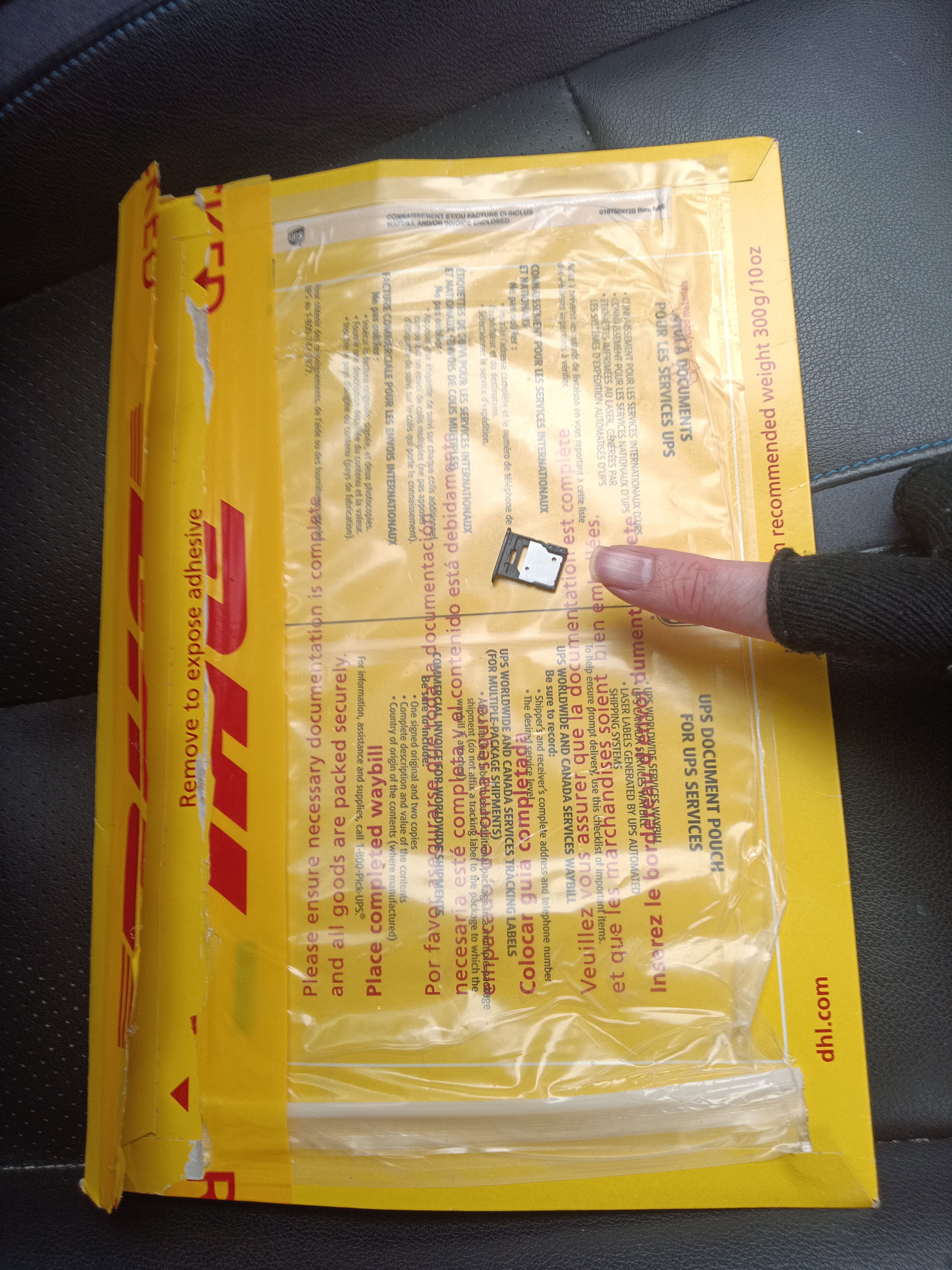
I ve been using the Furilabs FLX1s phone [1] as my daily driver for 6 weeks, it s a decent phone, not as good as I hoped but good enough to use every day and rely on for phone calls about job interviews etc. I intend to keep using it as my main phone and as a platform to improve phone software in Debian as you really can t effectively find bugs unless you use the platform for important tasks. Support Problems I previously wrote about the phone after I received it without a SIM caddy on the 13th of Jan. I had a saga with support about this, on the 16th of Jan one support person said that they would ship it immediately but didn t provide a tracking number or any indication of when it would arrive. On the 5th of Feb I contacted support again and asked how long it would be, the new support person seemed to have no record of my previous communication but said that they would send it. On the 17th of Feb I made another support request including asking for a way of direct communication as the support email came from an address that wouldn t accept replies, I was asked for a photo showing where the problem is. The support person also said that they might have to send a replacement phone! The last support request I sent included my disappointment at the time taken to resolve the issue and the proposed solution of replacing the entire phone (why have two international shipments of a fragile and expensive phone when a single letter with a cheap SIM caddy would do?). I didn t receive a reply but the SIM caddy arrived on the 2nd of Mar. Here is a pic of the SIM caddy and the package it came in: One thing that should be noted is that some of the support people seemed to be very good at their jobs and they were all friendly. It was the system that failed here, turning a minor issue of a missing part into a 6 week saga. Furilabs needs to do the following to address this issue:
  1. Make it possible to reply directly to a message from a support person. Accept email with a custom subject to sort it, give a URL for a web form, anything. Collating discussions with a customer allows giving better support while taking less time for the support people.
  2. Have someone monitor every social media address that is used by the company. When someone sends a support request in a public Mastodon post it indicates that something has gone wrong and you want to move quickly to resolve it.
  3. Take care of the little things, like sending a tracking number for every parcel. If it s something too small for a parcel (the SIM caddy could have fit in a regular letter) then just tell the customer what date it was posted and where it was posted from so they have some idea of when it will arrive.
This is not just a single failure of Furilabs support, it s a systemic failure of their processes. Problems I Will Fix Unless Someone Beats Me to it Here are some issues I plan to work on. Smart Watch Support I need to port one of the smart watch programs to Debian. Also I want to make one of them support the Colmi P80 [2]. A smart watch significantly increases the utility of a phone even though IMHO they aren t doing nearly all the things that they could and should do. When we get Debian programs talking to the PineTime it will make a good platform for development of new smart phone and OS features. Nextcloud I have ongoing issues of my text Nextcloud installation on a Debian VM not allowing connection from the Linux desktop app (as packaged in Debian) and from the Android client (from f-droid). The desktop client works with a friend s Nextcloud installation on Ubuntu so I may try running it on an Ubuntu VM I run while waiting for the Debian issue to get resolved. There was a bug recently fixed in Nextcloud that appears related so maybe the next release will fix it. For the moment I ve been running without these features and I call and SMS people from knowing their number or just returning calls. Phone calls generally aren t very useful for me nowadays except when applying for jobs. If I could deal with recruiters and hiring managers via video calls then I would consider just not having a phone number. Wifi IPv6 Periodically IPv6 support just stops working, I can t ping the gateway. I turn wifi off and on again and it works. This might be an issue with my wifi network configuration. This might be an issue with the way I have configured my IPv6 networking, although that problem doesn t happen with any of my laptops. Chatty Sorting Chatty is the program for SMS that is installed by default (part of the phosh/phoc setup), it also does Jabber. Version 0.8.7 is installed which apparently has some Furios modifications and it doesn t properly support sorting SMS/Jabber conversations. Version 0.8.9 from Debian sorts in the same way as most SMS and Jabber programs with the most recent at the top. But the Debian version doesn t support Jabber (only SMS and Matrix). When I went back to the Furilabs version of Chatty it still sorted for a while but then suddenly stopped. Killing Chatty (not just closing the window and reopening it) seems to make it sort the conversations sometimes. Problems for Others to Fix Here are the current issues I have starting with the most important. Important The following issues seriously reduce the usability of the device. Hotspot The Wifi hotspot functionality wasn t working for a few weeks, this Gitlab issue seems to match it [3]. It started working correctly for a day and I was not sure if an update I applied fixed the bug or if it s some sort of race condition that worked for this boot and will return next time I reboot it. Later on I rebooted it and found that it s somewhat random whether it works or now. Also while it is mostly working it seemed to stop working about every 25 minutes or so and I had to turn it off and on again to get it going. On another day it went to a stage where it got repeated packet loss when I pinged the phone as a hotspot from my laptop. A pattern of 3 ping responses and 3 Destination Host Unreachable messages was often repeated. I don t know if this is related to the way Android software is run in a container to access the hardware. 4G Reliability Sometimes 4G connectivity has just stopped, sometimes I can stop and restart the 4G data through software to fix it and sometimes I need to use the hardware switch. I haven t noticed this for a week or two so there is a possibility that one fix addressed both Hotspot and 4G. One thing that I will do is setup monitoring to give an alert on the phone if it can t connect to the Internet. I don t want it to just quietly stop doing networking stuff and not tell me! On-screen Keyboard The compatibility issues of the GNOME and KDE on-screen keyboards are getting me. I use phosh/phoc as the login environment as I want to stick to defaults at first to not make things any more difficult than they need to be. When I use programs that use QT such as Nheko the keyboard doesn t always appear when it should and it forgets the setting for word completion (which means spelling correction). The spelling correction system doesn t suggest replacing dont with don t which is really annoying as a major advantage for spelling checkers on touch screens is inserting an apostrophy. An apostrophy takes at least 3* longer than a regular character and saving that delay makes a difference to typing speed. The spelling correction doesn t correct two words run together. Medium Priority These issues are ongoing annoyances. Delay on Power Button In the best case scenario this phone has a much slower response to pressing the power button than the Android phones I tested (Huawei Mate 10 Pro and Samsung Galaxy Note 9) and a much slower response than my recollection of the vast majority of Android phones I ve ever used. For testing pressing buttons on the phones simultaneously resulted in the Android phone screens lighting up much sooner. Something like 200ms vs 600ms I don t have a good setup to time these things but it s very obvious when I test. In a less common case scenario (the phone having been unused for some time) the response can be something like 5 seconds. The worst case scenario is something in excess of 20 seconds. For UI designers, if you get multiple press events from a button that can turn the screen on/off please make your UI leave the screen on and ignore all the stacked events. Having the screen start turning on and off repeatedly when the phone recovers and processes all the button presses isn t good, especially when each screen flash takes half a second. Notifications Touching on a notification for a program often doesn t bring it to the foreground. I haven t yet found a connection between when it does and when it doesn t. Also the lack of icons in the top bar on the screen to indicate notifications is annoying, but that seems to be an issue of design not the implementation. Charge Delay When I connect the phone to a power source there is a delay of about 22 seconds before it starts to charge. Having it miss 22 seconds of charge time is no big deal, having to wait 22 seconds to be sure it s charging before leaving it is really annoying. Also the phone makes an audible alert when it gets to 0% charge which woke me up one night when I had failed to push the USB-C connector in hard enough. This phone requires a slightly deeper connector than most phones so with some plugs it s easy to not quite insert them far enough. Torch aka Flash The light for the torch or flash for camera is not bright at all. In a quick test staring into the light from 40cm away wasn t unpleasant compared to my Huawei Mate 10 Pro which has a light bright enough that it hurts to look at it from 4 meters away. Because of this photos at night are not viable, not even when photographing something that s less than a meter away. The torch has a brightness setting which doesn t seem to change the brightness, so it seems likely that this is a software issue and the brightness is set at a low level and the software isn t changing it. Audio When I connect to my car the Lollypop player starts playing before the phone directs audio to the car, so the music starts coming from the phone for about a second. This is an annoying cosmetic error. Sometimes audio playing pauses for no apparent reason. It doesn t support the phone profile with Bluetooth so phone calls can t go through the car audio system. Also it doesn t always connect to my car when I start driving, sometimes I need to disable and enable Bluetooth to make it connect. When I initially set the phone up Lollypop would send the track name when playing music through my car (Nissan LEAF) Bluetooth connection, after an update that often doesn t happen so the car doesn t display the track name or whether the music is playing but the pause icon works to pause and resume music (sometimes it does work). About 30 seconds into a phone call it switches to hands-free mode while the icon to indicate hands-free is not highlighted, so I have to press the hands-free button twice to get it back to normal phone mode. Low Priority I could live with these things remaining as-is but it s annoying. Ticket Mode There is apparently some code written to display tickets on screen without unlocking. I want to get this working and store screen-caps of the Android barcode screens of the different loyalty cards so I can scan them without unlocking. My threat model does not include someone trying to steal my phone to get a free loaf of bread on the bakery loyalty program. Camera The camera app works with both the back and front cameras, which is nice, and sadly based on my experience with other Debian phones it s noteworthy. The problem is that it takes a long time to take a photo, something like a second after the button is pressed long enough for you to think that it just silently took a photo and then move the phone. The UI of the furios-camera app is also a little annoying, when viewing photos there is an icon at the bottom left of the screen for a video camera and an icon at the bottom right with a cross. Which every time makes me think record videos and leave this screen not return to taking photos and delete current photo . I can get used to the surprising icons, but being so slow is a real problem. GUI App Installation The program for managing software doesn t work very well. It said that there were two updates for Mesa package needed, but didn t seem to want to install them. I ran flatpak update as root to fix that. The process of selecting software defaults to including non-free, and most of the available apps are for desktop/laptop with no way to search for phone/tablet apps. Generally I think it s best to just avoid this and use apt and flatpak directly from the command-line. Being able to ssh to my phone from a desktop or laptop is good! Android Emulation The file /home/furios/.local/share/andromeda/data/system/uiderrors.txt is created by the Andromeda system which runs Android apps in a LXC container and appears to grow without end. After using the phone for a month it was 3.5G in size. The disk space usage isn t directly a problem, out of the 110G storage space only 17G is used and I don t have a need to put much else on it, even if I wanted to put backups of /home from my laptop on it when travelling that would still leave plenty of free space. But that sort of thing is a problem for backing up the phone and wasting 3.5G out of 110G total is a fairly significant step towards breaking the entire system. Also having lots of logging messages from a subsystem that isn t even being used is a bad sign. I just tried using it and it doesn t start from either the settings menu or from the f-droid icon. Android isn t that important to me as I want to get away from the proprietary app space so I won t bother trying this any more. Unfixable Problems Unlocking After getting used to fingerprint unlocking going back to a password is a pain. I think that the hardware isn t sufficient for modern quality face recognition that can t be fooled by a photo and there isn t fingerprint hardware. When I first used an Android phone using a pin to unlock didn t seem like a big deal, but after getting used to fingerprint unlock it s a real drag to go without. This is a real annoyance when doing things like checking Wikipedia while watching TV. This phone would be significantly improved with a fingerprint sensor or a camera that worked well enough for face unlock. Plasma Mobile According to Reddit Plasma Mobile (KDE for phones) doesn t support Halium and can never work on this phone because of it [4]. This is one of a number of potential issues with the phone, running on hardware that was never designed for open OSs is always going to have issues. Wifi MAC Address The MAC keeps changing on reboot so I can t assign a permanent IPv4 address to the phone. It appears from the MAC prefix of 00:08:22 that the network hardware is made in InPro Comm which is well known for using random addresses in the products it OEMs. They apparently have one allocation of 2^24 addresses and each device randomly chooses a MAC from that range on boot. In the settings for a Wifi connection the Identity tab has a field named Cloned Address which can be set to Stable for SSID that prevents it from changing and allows a static IP address allocation from DHCP. It s not ideal but it works. Network Manager can be configured to have a permanent assigned MAC address for all connections or for just some connections. In the past for such things I have copied MAC addresses from ethernet devices that were being discarded and used them for such things. For the moment the Stable for SSID setting does what I need but I will consider setting a permanent address at some future time. Docks Having the ability to connect to a dock is really handy. The PinePhonePro and Librem5 support it and on the proprietary side a lot of Samsung devices do it with a special desktop GUI named Dex and some Huawei devices also have a desktop version of the GUI. It s unfortunate that this phone can t do it. The Good Things It s good to be able to ssh in to my phone, even if the on-screen keyboard worked as well as the Android ones it would still be a major pain to use when compared to a real keyboard. The phone doesn t support connecting to a dock (unlike Samsung phones I ve used for which I found Dex to be very useful with a 4K monitor and proper keyboard) so ssh is the best way to access it. This phone has very reliable connections to my home wifi. I ve had ssh sessions from my desktop to my phone that have remained open for multiple days. I don t really need this, I ve just forgotten to logout and noticed days later that the connection is still running. None of the other phones running Debian could do that. Running the same OS on desktop and phone makes things easier to test and debug. Having support for all the things that Linux distributions support is good. For example none of the Android music players support all the encodings of audio that comes from YouTube so to play all of my music collection on Android I would need to transcode most of them which means either losing quality, wasting storage space, or both. While Lollypop plays FLAC0, mp3, m4a, mka, webm, ogg, and more. Conclusion This is a step towards where I want to go but it s far from the end goal. The PinePhonePro and Librem5 are more open hardware platforms which have some significant benefits. But the battery life issues make them unusable for me. Running Mobian on a OnePlus 6 or Droidian on a Note 9 works well for the small tablet features but without VoLTE. While the telcos have blocked phones without VoLTE data devices still work so if recruiters etc would stop requiring phone calls then I could make one of them an option. The phone works well enough that it could potentially be used by one of my older relatives. If I could ssh in to my parents phones when they mess things up that would be convenient. I ve run this phone as my daily driver since the 3rd of March and it has worked reasonably well. 6 weeks compared to my previous use of the PinePhonePro for 3 days. This is the first time in 15 years that a non-Android phone has worked for me personally. I have briefly used an iPhone 7 for work which basically did what it needed to do, it was at the bottom of the pile of unused phones at work and I didn t want to take a newer iPhone that could be used by someone who s doing more than the occasional SMS or Slack message. So this is better than it might have been, not as good as I hoped, but a decent platform to use it while developing for it.

Ravi Dwivedi: Hungary Visa

The annual LibreOffice conference 2025 was held in Budapest, Hungary, from the 3rd to the 6th of September 2025. Thanks to the The Document Foundation (TDF) for sponsoring me to attend the conference. As Hungary is a part of the Schengen area, I needed a Schengen visa to attend the conference. In order to apply for a Schengen visa, one needs to get an appointment at VFS Global and submit all the required documents there, which are then forwarded to the embassy. I got an appointment for a Hungary visa at VFS Global in New Delhi for the 24th of July. There were many appointment slots available for the Hungary visa. One could easily get an appointment for the next day at the Delhi center. There were some technical problems on the VFS website, though, as I was unable to upload a scanned copy of my passport while booking the appointment. I got an error saying, Unfortunately, you have exceeded the maximum upload limit. The problem didn t get fixed even after contacting the VFS helpline. They asked me to try in the Firefox browser and deleting all the cache, which I already did. So I created another account with a different email address and phone number, after which I was able to upload my passport and book an appointment. Other conference attendees from India also reported facing some technical issues on the VFS Hungary website. Anyway, I went to the VFS Hungary application center as per my appointment on the 24th of July. Going inside, I located the Hungary visa application counter. There were two applicants ahead of me. When it was my turn, the VFS staff warned me that my passport was damaged. The damage was on the bio-data page. All the details could be seen, but the lamination of the details page wore off a bit. They asked me to write an application to the Embassy of Hungary in New Delhi stating that I insist VFS to submit my application along with describing the damage on my passport. I got a bit worried about my application getting rejected due to the damage. But I decided to gamble my money on this one, as I didn t have time (and energy) to apply for a new passport before this trip. Moreover, I had struck down a couple of fields in my visa application form which were not applicable to me, due to which the VFS staff asked me to fill out another visa application. After this, the application got submitted, and it was 11,000 INR (including the fee to book the appointment at VFS). Here is the list of documents I submitted: It took 2 hours for me to submit my visa application, even though there were only two applicants before me. This was by far the longest time to submit a Schengen visa application for me. Fast-forward to the 30th of July, and I received an email from the Embassy of Hungary asking me to submit an additional document - paid air ticket - for my application. I had only submitted dummy flight tickets, and they were enough for the Schengen visas I applied for until now. This was the first time a country was asking me to submit a confirmed flight ticket during the visa process. I consulted my travel agent on this, and they were fairly confident that I will get the visa if the embassy is asking me to submit confirmed flight tickets. So I asked the travel agent to book the flight tickets. These tickets were 78,000, and the airline was Emirates. Then, I sent the flight tickets to the embassy by email. The embassy sent the visa results on the 6th of August, which I received the next day. My visa had been approved! It took 14 days for me to get the Hungary visa after submitting the application. See you in the next one! Thanks to Badri for proofreading.

12 April 2026

Vasudev Kamath: Hardening the Unpacakgeable: A systemd-run Sandbox for Third-Party Binaries

The Shift in Software Consumption Historically, I have been a "distribution-first" user. Sticking to tools packaged within the Debian archives provides a layer of trust; maintainers validate licenses, audit code, and ensure the entire dependency chain is verified. However, the rapid pace of development in the Generative AI space specifically with new tools like Gemini-CLI has made this traditional approach difficult to sustain. Many modern CLI tools are built within the npm or Python ecosystems. For a distribution packager, these are a nightmare; packaging a single tool often requires packaging a massive, shifting dependency chain. Consequently, I found myself forced to use third-party binaries, bypassing the safety of the Debian archive.
The Supply Chain Risk Recent supply chain attacks affecting widely used packages like axios and LiteLLM have made it clear: running unvetted binaries on a personal system is a significant risk. These scripts often have full access to your $HOME directory, SSH keys, and the system D-Bus. After discussing these concerns with a colleague, I was inspired by his approach using a Flatpak-style sandbox for even basic applications like Google Chrome. I decided to build a generalized version of this using OpenCode and Qwen 3.6 Fast (which was available for free use at the time) to create a robust, transient sandbox utility.
The Solution: safe-run-binary My script, safe-run-binary, leverages systemd-run to execute binaries within an isolated scope. It implements strict filesystem masking and resource control to ensure that even if a dependency is compromised, the "blast radius" is contained.
Key Technical Features
1. Virtualized Home Directory (tmpfs)
Instead of exposing my real home directory, the script mounts a tmpfs over $HOME. It then selectively creates and bind-mounts only the necessary subdirectories (like .cache or .config) into a virtual structure. This prevents the application from ever "seeing" sensitive files like ~/.ssh or ~/.gnupg.
2. D-Bus Isolation via xdg-dbus-proxy
For GUI applications, providing raw access to the D-Bus is a security hole. The script uses xdg-dbus-proxy to sit between the application and the system bus. By using the --filter and --talk=org.freedesktop.portal.* flags, the app can only communicate with necessary portals (like the file picker) rather than sniffing the entire bus.
3. Linux Namespace Restrictions

The sandbox utilizes several systemd execution properties to harden the process:

  • RestrictNamespaces=yes: For CLI tools, this prevents the app from creating its own nested namespaces.
  • PrivateTmp=yes: Ensures a private /tmp space that isn't shared with the host.
  • NoNewPrivileges=yes: Prevents the binary from gaining elevated permissions through SUID/SGID bits.
4. GPU and Audio Passthrough
The script intelligently detects and binds Wayland, PipeWire, and NVIDIA/DRI device nodes. This allows browsers like Firefox to run with full hardware acceleration and audio support while remaining locked out of the rest of the filesystem.
Usage To run a CLI tool like Gemini-CLI with access only to a specific directory:
safe-run-binary -b ~/.gemini-config -- npx @google/gemini-cli
For a GUI application like Firefox:
safe-run-binary --gui -b ~/.mozilla -b ~/.cache/mozilla -b ~/Downloads -- firefox
Conclusion While it is not always possible to escape the need for third-party software, it is possible to control the environment in which it operates. By leveraging native Linux primitives like systemd and namespaces, high-grade isolation is achievable. PS: If you spot any issues or have suggestions for improving the script, feel free to raise a PR on the repo.

Russ Allbery: Review: The Teller of Small Fortunes

Review: The Teller of Small Fortunes, by Julie Leong
Publisher: Ace
Copyright: November 2024
ISBN: 0-593-81590-4
Format: Kindle
Pages: 324
The Teller of Small Fortunes is a cozy found-family fantasy with a roughly medieval setting. It was Julie Leong's first novel. Tao is a traveling teller of small fortunes. In her wagon, pulled by her friendly mule Laohu, she wanders the small villages of Eshtera and reads the trivial fortunes of villagers in the tea leaves. An upcoming injury, a lost ring, a future kiss, a small business deal... she looks around the large lines of fate and finds the small threads. After a few days, she moves on, making her solitary way to another village. Tao is not originally from Eshtera. She is Shinn, which means she encounters a bit of suspicion and hostility mixed with the fascination of the exotic. (Language and culture clues lead me to think Shinara is intended to be this world's not-China, but it's not a direct mapping.) Tao uses the fascination to help her business; fortune telling is more believable from someone who seems exotic. The hostility she's learned to deflect and ignore. In the worst case, there's always another village. If you've read any cozy found-family novels, you know roughly what happens next. Tao encounters people on the road and, for various reasons, they decide to travel together. The first two are a massive mercenary (Mash) and a semi-reformed thief (Silt), who join Tao somewhat awkwardly after Tao gives Mash a fortune that is far more significant than she intended. One town later, they pick up an apprentice baker best known for her misshapen pastries. They also collect a stray cat, because of course they do. It's that sort of book. For me, this sort of novel lives or dies by the characters, so it's good news that I liked Tao and enjoyed spending time with her. She's quiet, resilient, competent, and self-contained, with a difficult past and some mysteries and emotions the others can draw over time. She's also thoughtful and introspective, which means the tight third-person narration that almost always stays on Tao offers emotional growth to mull over. I also liked Kina (the baker) and Mash; they're a bit more obvious and straightforward, but Kina adds irrepressible energy and Mash is a good example of the sometimes-gruff soldier with a soft heart. Silt was a bit more annoying and I never entirely warmed to him, but he's tolerable and does get a bit of much-needed (if superficial) character development. It takes some time for the reader to learn about the primary conflict of the story (Tao does not give up her secrets quickly), so I won't spoil it, but I thought it worked well. I was momentarily afraid the story would develop a clear villain, but Leong has some satisfying alternate surprises in store. The ending was well-done, although it is very happily-ever-after in a way that may strike some readers as too neat. The Teller of Small Fortunes aims for a quiet and relaxed mood rather than forcing character development through difficult choices; it's a fine aim for a novel, but it won't match everyone's mood. I liked the world-building, although expect small and somewhat disconnected details rather than an overarching theory of magic. Tao's ability gets the most elaboration, for obvious reasons, and I liked how Leong describes it and explores its consequences. Most of the attention in the setting is on the friction, wistfulness, and small reminders of coming from a different culture than everyone around you, but so long ago that you are not fully a part of either world. This, I thought, was very well-done and is one of the places where the story is comfortable with complex feelings and doesn't try to reach a simplifying conclusion. There is one bit of the story that felt like it was taken directly out of a Dungeons & Dragons campaign to a degree that felt jarring, but that was the only odd world-building note. This book felt like a warm cup of tea intended to comfort and relax, without large or complex thoughts about the world. It's not intended to be challenging; there are a few plot twists I didn't anticipate, but nothing that dramatic, and I doubt anyone will be surprised by the conclusions it reaches. It's a pleasant time with some nice people and just enough tension and mystery to add some motivation to find out what happens next. If that's what you're in the mood for, recommended. If you want a book that has Things To Say or will put you on the edge of your seat, maybe save this one for another mood. All the on-line sources I found for this book call it a standalone, but The Keeper of Magical Things is set in the same world, so I would call it a loose series with different protagonists. The Teller of Small Fortunes is a complete story in one book, though. Rating: 7 out of 10

6 April 2026

Thorsten Alteholz: My Debian Activities in March 2026

Debian LTS/ELTS This was my hundred-forty-first month that I did some work for the Debian LTS initiative, started by Raphael Hertzog at Freexian. During my allocated time I uploaded or worked on: I also worked on the check-advisories script and proposed a fix for cases where issues would be assigned to the coordinator instead of the person who forgot doing something. I also did some work for a kernel update and packages snapd and ldx on security-master and attended the monthly LTS/ELTS meeting. Last but not least I started to work on gst-plugins-bad1.0 Debian Printing This month I uploaded a new upstream versions: Several packages take care of group lpadmin in their maintainer scripts. With the upload of version 260.1-1 of systemd there is now a central package (systemd systemd-standalone-sysusers systemd-sysusers) that takes care of this. Other dependencies like adduser can now be dropped. This work is generously funded by Freexian! Debian Lomiri This month I continued to work on unifying packaging on Debian and Ubuntu. This makes it easier to work on those packages independent of the used platform. I am also able to upload Debian packages to the corresponding Ubuntu PPA now. A small bug had to be fixed in the python script to allow the initial configuration in Launchpad. This work is generously funded by Fre(i)e Software GmbH! Debian Astro This month I uploaded a new upstream version or a bugfix version of: I also uploaded lots of indi-drivers (libplayerone, libsbig, libricohcamerasdk, indi-asi, indi-eqmod, indi-fishcamp, indi-inovaplx, indi-pentax, indi-playerone, indi-sbig, indi-mi, libahp-xc, indi-aagcloudwatcher, indi-aok, indi-apogee, libapogee3, indi-nightscape, libasi, libinovasdk, libmicam, indi-avalon, indi-beefocus, indi-bresserexos2, indi-dsi, indi-ffmv, indi-fli, indi-gige, info-gphoto, indi-gpsd, indi-gpsnmea, indi-limesdr, indi-maxdomeii, indi-mgen, indi-rtklib, indi-shelyak, indi-starbook, indi-starbookten, indi-talon6, indi-weewx-json, indi-webcam, indi-orion-ssg3, indi-armadillo-playtypus ) to experimental to make progress with the indi-transition. No problems with those drivers appeared and the next step would be the upload of indi version 2.x to unstable. I hope this will happen soon, as new drivers are already waiting in the pipeline. There have been also four packages, that migrated to the official indi package and are no longer needed as 3rdparty drivers (indi-astrolink4, indi-astromechfoc, indi-dreamfocuser, indi-spectracyber). While working on these packages, I thought about testing them. Unfortunately I don t have enough hardware to really check out every package, so I can upload most of them only as is. In case anybody is interested in a better testing coverage and me being able to provide upstream patches, I would be very glad about hardware donations. Debian IoT This month I uploaded a new upstream version or a bugfix version of: Debian Mobcom This month I uploaded a new upstream version or a bugfix version of: misc This month I uploaded a new upstream version or a bugfix version of: I also sponsored the upload of Matomo. Thanks a lot to William for preparing the package.

4 April 2026

Isoken Ibizugbe: Post Outreachy Activities

It s been about a month since I wrapped up my Outreachy internship, but my journey with Debian is far from over. I planned to keep contributing and exploring the community, and these past few weeks have been busy

Testing Locales and Solving Bug #1111214

For the openQA project, we decided to explore how accurate local language installations are and see if we can improve the translations. While exploring this, I started working on automating a test for a specific bug report: Debian Bug #1111214

This is a test I had started by writing a detailed description of the installation process to confirm that selecting the Spanish_panama locale works accurately. I spent time studying previous language installation tests, and I learned that I needed to add a specific tag (LANGUAGE-) to the needles (visual test markers).

Since the installation wasn t in English anymore, taking the correct screenshots and defining the areas took quite some time. I used the following command on the CLI to run the test:

openqa-cli api -X POST isos ISO=debian-live-testing-amd64-gnome.iso DISTRI=debian-live VERSION=forky FLAVOR=gnome LANGUAGE=spanish_panama ARCH=x86_64 BUILD=1311 CHECKSUM=unknown

While working on this, I got stuck at the complete_installation step. Because the keyboard layout had changed to Spanish, the commands required to confirm a successful install weren t working as expected. Specifically, we had an issue typing the greater than sign (>).

My mentor, Roland Clobus, worked on a clever maneuver for the keys (AltGr-Shift-X), which was actually submitted upstream to openSUSE.

In this step, I also had to confirm that the locale was correctly set to LANG= es_PA.UTF-8 . I had to dig into the scripts and Linux commands to make this work. It was a bit intimidating at first, but it turned out to be a great learning experience. You can follow my progress on this Merge Request here. I m currently debugging a small issue where the home key seems to click twice in the final step, and after that, the test would be complete  .

Community & Connections

Beyond the code, I ve been getting more involved in the social side of Debian:

  • Debian Women: I attended the monthly meeting and met Sruthi Chandran. I ve always seen her name as an Outreachy organizer, so it was great to meet her! She is currently running for Debian Project Leader (DPL). We also discussed starting technical sessions to introduce members to packaging, which I am very excited to learn.
  • DebConf Preparation: I am officially preparing for my first DebConf! My mentors, Tassia and Roland, along with my fellow intern Hellen, have been incredibly supportive in guiding me through the application and presentation process.

Dirk Eddelbuettel: Sponsor me for Tour de Shore 2026 to support MFA

tour de shore 2026 On June 19 and 20, I will cycle a little over 100 miles from downtown Chicago and its wonderful Millenium Park to New Buffalo, Michigan, as part of the Tour de Shore 2026. The ride passes through northwest Indiana and the extended Indiana Dunes National Park ending the next morning in the southwestern Michigan town of New Buffalo. I rode Tour de Shore once before in 2024 and had a generally wonderful time (even considering some soreness after a century of miles over 1 1/2 days). Tour de Shore is riding in support of Maywood Fine Arts Center, a local arts and sports center in Maywood, Illinois, a suburb one over from where I live and hence just a few good miles west of downtown. Maywood, Illinois is home to legends such as the late John Prine as well as several NBA players such as player and coach Doc Rivers. tour de shore 2026 donation page But Maywood, Illinois is also little less well off than other western suburbs. The Maywood Fine Arts Center is simply legendary is what they do for this community (and surrounding communities), and especially the youth support. They can use a dollar a two. Their story about Tour de Shore is worth a read too for background and motivation. I have bootstrapped my donation page page with a dollar for each mile to be cycled. It would be simply terrific if you could join me. A nickel, a dime, or a quarter per mile cycled would help. Multiples of that help too: More is of course still always better. Anything you can afford will go a long way towards a worthy goal in a community that could use the help. Of and if you are local to the area, I believe you can still register for Tour de Shore 2026. So see you out there in June? And if not, maybe help with a dollar or two?

This post by Dirk Eddelbuettel originated on his Thinking inside the box blog.

2 April 2026

Joerg Jaspert: Building a house - 1 year in

Haven t written here about it, but last March we finally started on our journey to get our own house build, so we can move out of the rented flat here. That will be a big step, both the actual building, but also the moving - I am living at this one single place for 36 years now. If you can read german there is a dedicated webpage where I sometimes write about the process. Will have much more details (and way more ramblings) than the following part. If you can t read german, a somewhat short summary follows. Yes, still a lot of text, but shortened, still.

What? Why now? Current flat has 83m - which simply isn t enough space. And the number of rooms also doesn t fit anymore. But it is hard to find a place that fits our requirements (which do include location). Moving to a different rented place would also mean changed amount of rent. And nowadays that would be huge increase (my current rent is still the price from about 30 years ago!). So if we go and pay more - we could adjust and pay for something we own instead. And both, my wife and I had changes in our jobs that made it possible for us now, so we started looking.

Market Brrrr, looking is good, actually finding something that fits - not so. We never found an offer that fit. Space wise, sure. But then location was off, or price was idiotically high. Location fit, but then size was a joke, and guess about the price Who needs 200 square meters with 3 rooms? Entirely stupid design choices there. Or how about 40 square meters of hallway - with 50m of tiny rooms around. What are they smoking? Oh, there, useful size, good rooms - but now you want more money than a kidney is worth, or something. Thanks, no.

New place In February 2025 we finally got lucky and found a (newly opened) area with a large number of places to build a house on. Had multiple talks with someone from on of the companies developing that area (there are two you can select from), then talked with banks and signed a contract in March 2025. We got promised that actual house construction would be first quarter of 2026, finished in second quarter.

House type There are basically 2 ways of building a new house (that matter here). First is called Massivhaus , second is called Fertighaus in german, roughly translating to solid and prefabricated. The latter commonly a wood based construction, though it doesn t need to be. The important part of it is the prefabrication, walls and stuff get assembled in a factory somewhere and then transported to your place, where they play big kid lego for a day and suddenly a house is there. A common thought is prefabricated is faster, but that is only a half true. Sure, the actual work on side is way shorter - usually one or two days and the house is done - while a massive construction usually takes weeks to build up. But that is only a tiny part of the time needed, the major part goes of into planning and waiting and in there it doesn t matter what material you end up with.

Money fun Last year already wasn t the best time to start a huge loan - but isn t it always a few years ago would have been better ? So we had multiple talks with different banks and specialised consultants until we found something that we thought is good for us. Thinking about it now - we should have put even more money on top as reserve , but who could have thought that 2026 turns into such a shitshow? Does not help at all, quite the contrary. And that damn lotto game always ends up with the wrong numbers, meh.

Plans and plans and more plans - and rules For whichever reason you can not just go and put something on your ground and be happy. At least not if you are part of the normal people and not enormously rich. There is a large set of rules to follow. Usually that is a good thing, even though some rules are sometimes hard to understand. In Germany, besides the usual laws, we have something that is called Bebauungsplan , which translates to development plan (don t know if that carries the right meaning, it s a plan on what and how may be build, which can have really detailed specifications in). It basically tells you every aspect on top of the normal law that you have to keep in mind. In our case we have the requirement of 2 full floors and CAN have a third smaller on top, it limits how high the house can be and also how high our ground floor may be compared to the street. It regulates where on the property we may build and how much ground we may cover with the house, it gives a set of colors we are allowed to use, it demands a flat roof that we must have as a green roof and has a number of things more that aren t important enough to list here. If you do want to see the full list, my german post on it has all the details that matter to us. With all that stuff in mind - off to plans. Wouldn t have believed how many details there are to take in. Room sizes are simple, but how to arrange them for ideal usage of the sun, useful ways inside the house, but also keeping in mind that water needs to flow through and out. Putting a bath room right atop a living room means a water pipe needs to go down there. Switch the bath room side in the house, and it suddenly is above the kitchen - means you can connect the pipes from it to the ones from kitchen, which is much preferred than going through the living room. And lots more such things. It took us until nearly end of October to finalize the plans! And we learned a whole load from it. We started with a lot of wishes. The planner tried to make them work. Then we changed our minds. Plans changed. Minds changed again. Comparing the end result with the first draft we changed most of the ground floor around, with only the stairs and the entrance door at the same position. Less changes for the upper floor, but still enough.

Side quests The whole year was riddled with something my son named side quests. We visited a construction exhibition near us, we went to the house builders factory and took a look on how they work. We went to many different other companies that do SOME type of work which we need soon, say inside floors, painters, kitchen and more stuff. Of course the most important side quest was a visit to the notary to finalize the contracts, especially for the plot of land (in Germany you must have a notary for that to get entered into the governments books). Creates lots of fees, of course, for the notary and also the government (both fees and taxes here).

Building permit We had been lucky and only needed a small change to the plans to get the building permit - and the second part, the wastewater permit (yes, you need a separate one for this) also got through without trouble.

Choices, so many of them So in January we finally had an appointment for something that s called Bemusterung which badly translates to Sampling . Basically two days at the house builders factory to select all of what s needed for the house that you don t do in the plans. Doors, inside and out and their type and color and handles. Same things for the windows and the blinds and the protection level you want the windows to have. Decide about stairs, design for the sanitary installations - and also the height of the toilet! - and the tiles to put into the bathrooms. Decisions on all the tech needed (heating system, ventilation and whatnot. Two days, busy ones - and you can easily spend a lot of extra money here if you aren t careful. We managed to get out of it with only about 4000 extra, so pretty good.

Electro and automation Now, here I am special. Back when I was young the job I learned is electrician. So here I have very detailed wishes. I am also running lots of automatism in my current flat - obviously the new house should be better than that. So I have a lot of ideas and thoughts on it, so this is entirely extra and certainly out of the ordinary the house builder usually see. Which means I do all of that on my own. Well, the planning and some of the work, I must have a company at hand for certain tasks, it is required by some rules. But they will do what I planned, as long as I don t violate regulations. Which means the whole electrical installation is different. Entirely planned for automatisms and using KNX for it. I am so happy to ditch Homeassistant and the load of Homematic, Zigbee and ZWave based wireless things. Ok, Homeassistant is a nice thing - it can do a lot. And it can bridge between about any system you can find. But it is a central single point of failure. And it is a system that needs constant maintenance. Not touched for a while? Plan for a few hours playing update whack-a-mole. And often enough a component here or there breaks with an update. Can be fixed, but takes another hour or two. So I change. Away from wireless based stuff. To wires. To a system thats a standard for decades already. And works entirely without a SPOF. (Yes, you can add one here too). And, most important, should I ever die - can easily be maintained by anyone out there dealing with KNX, which is a large number of people and companies. Without digging through dozens of specialised integrations and whatnot. I may even end up with Homeassistant again - but that will entirely be as a client. It won t drive automations. It won t be the central point to do anything for the house. It will be a logging and data collecting thing that enables me to put up easy visualizations. It may be an easy interface for smartphones or tablets to control parts of the house, for those parts where one wants this to happen. Not the usual day-to-day stuff, extras on top.

Actual work happening Since march there finally is action visible. The base of the house is getting build. Wednesday the 1st April we finally got the base slab poured on the construction site and in another 10 days the house is getting delivered and build up. A 40ton mobile crane will be there.

1 April 2026

Ben Hutchings: FOSS activity in March 2026

31 March 2026

Junichi Uekawa: April already.

April already. Wondering how bazel update is going in Debian. Seems like a large undertaking.

Next.

Previous.